Introduction
Nephrogenesis in the rat starts at embryonic day 12 and is complete at about 10 days after birth.Reference Guron and Friberg1 Maternal low protein (LP) intake impairs nephrogenesisReference Langley-Evans, Welham and Jackson2, Reference Nuyt and Alexander3 and leads to renal injury in rats.Reference Nwagwu, Cook and Langley-Evans4–Reference Vehaskari6 Undernutrition in humans is associated with a reduction in kidney size and microalbuminuria.Reference Painter, Roseboom and van Montfrans7 However, the stage at which nephrogenesis is most sensitive to the long-term deleterious effects of maternal LP intake is unknown.
Nephrogenesis is not the only developmental process affected by maternal undernutrition.Reference McMillen and Robinson8 Animals subject to fetal undernutrition typically display a phenotype, which includes raised blood pressure and insulin resistance. A number of studies have indicated that lifespan is shortened by prenatal undernutrition.Reference Jennings, Ozanne, Dorling and Hales9–Reference Aihie Sayer, Dunn, Langley-Evans and Cooper11 Loss of functional units, and often function, has been observed for muscle, endocrine pancreas, cardiomyocytes and many other tissues. This is in-keeping with the suggestion that early life programming of development and hence risks of disease in later life, may be due to adaptive remodeling of organs and tissues.Reference Langley-Evans12 Recently, we observed that in both male and female rat offspring muscle fiber number and density were especially sensitive to protein restriction in mid-pregnancy.Reference Mallinson, Sculley and Craigon13 By 18 months of age, male offspring subjected to low-protein intake in mid-pregnancy showed more food intake in association with loss of body weight and subcutaneous fat,Reference Bellinger, Sculley and Langley-Evans14 suggesting a mild catabolic state.
Renal injury is often present in aging laboratory rats, especially in males.Reference Baylis15, Reference Baylis16 Oxidative stress and apoptosis are sequels of target organ injury.Reference Langley-Evans and Sculley10 Disturbance of the balance between antioxidant and oxidative processes is well-documented in the offspring of rats fed a LP diet in pregnancy. In early adulthood, such animals exhibit more oxidative injury when subject to stressors,Reference Langley-Evans, Phillips and Jackson17 generally suppressed antioxidant capacityReference Langley-Evans and Sculley18 and disturbances of the γ-glutamyl cycle.Reference Langley-Evans, Wood and Jackson19, Reference Langley, Seakins, Grimble and Jackson20 The main aim of this study was to assess whether prenatal undernutrition altered the normal age-related decline in renal function. We hypothesized that, with respect to renal injury and markers of oxidative stress and apoptosis in aging rats, maternal low-protein intake in the rat would have its greatest impact during early nephrogenesis, that is, in mid- and late-pregnancy. Therefore, we examined the impact of staged exposure to maternal LP diet during pregnancy on proteinuria and related variables in 18-month-old male and female offspring of dams subjected to LP diets only during early-, mid- or late pregnancy in comparison to control or LP diets throughout pregnancy.
Materials and methods
Chemicals and reagents
Unless indicated otherwise in the text all chemicals were of reagent or molecular biology grade and were purchased from Sigma-Aldrich (Poole, UK).
Animals
The experimental design for this study has been described previously,Reference Langley-Evans and Sculley10, Reference Mallinson, Sculley and Craigon13, Reference Bellinger, Sculley and Langley-Evans14 and was performed in accordance with the Animals Act 1986 (scientific procedures) are were licensed by the Home Office. Briefly 57 Wistar rat dams were exposed to ad lib low-protein (9% casein) or control (18% casein) diets that were iso-energetic. The LP diets were administered throughout pregnancy (LPA, day 0–22), during early-pregnancy (LPE, days 0–7), mid-pregnancy (LPM, days 8–14), and late-pregnancy (LPL, days 15–22). Eight dams (1 control, 1 LPA, 3 LPE and 3 LPM) failed to deliver at the end of gestation and the final numbers of litters were control n = 10, LPA n = 11, LPE n = 10, LPM n = 8 and LPL n = 10. At delivery of litters, all mothers were transferred to standard ad lib laboratory chow diet (B&K Universal rat and mouse diet, 20% protein, 3% fat). To minimize variation in the nutrition of the pups during suckling litters were culled to four males and four females, with culled animals selected at random from each sex group. Cull was within 12 h of birth. None of the dams gave birth to fewer than 10 pups. The offspring of the control and LP fed dams thus differed only in terms of their prenatal nutritional exposures. At 4 weeks of age the offspring were weaned onto ad lib chow diet. Animals were housed under temperature controlled conditions on a 12 h light:dark cycle in groups of 2–4 until 18 months of age, at which point they were culled using carbon dioxide asphyxia and cervical dislocation. Where possible, one male and one female animal from each litter was included in the study. Blood sampling was terminal and within an hour of the completion of the 24-h urine collection. Blood was sampled by cardiac puncture into heparinized vacutainers. Kidneys were rapidly dissected and snap-frozen in liquid nitrogen prior to storage at −80°C and later analyses.
Clinical chemistry
Urine was collected for 24 h in metabolism cages on the day prior to cull, and urine volume was measured. Home Office regulations do not permit more than 24 h housing in these conditions. Urine protein was determined using the Bradford method (Bio-Rad Laboratories GmbH, Munchen Germany).Reference Blezer, Schurink and Nicolay21 Plasma urea (DiaSys Diagnostic Systems GmbH, Holzheim, Germany) and creatinine (DiaSys Diagnostic Systems GmbH) were determined enzymatically.Reference Thomas22, Reference Burtis and Ashwood23
Antioxidant enzyme activities
The activities of the antioxidant enzymes catalase, glutathione peroxidase (GPx) and superoxide dismutase (SOD) were determined in all kidney samples. SOD activity represents total SOD within the tissue with no separation of the CuZn and Mn forms. In addition the activity of glutathione reductase (GRed) was determined in the kidney samples. Activities of GPx and GRed were determined as described previously.Reference Langley-Evans, Phillips and Jackson17 Catalase was determined using the spectrophotometric method of Aebi,Reference Aebi24 in which the conversion of hydrogen peroxide to water and oxygen is monitored as a change in absorbance at 240 nm. SOD was determined using the method of Winterbourn et al.Reference Winterbourn, Hawkins, Brian and Carrell25, in which the light-triggered release of superoxide radicals from riboflavin leads to the formation of a blue complex through reaction with nitroblue tetrazolium. All enzyme activities are expressed as units per milligram protein. Protein concentrations were determined using the method of Bradford.Reference Blezer, Schurink and Nicolay21
GSH, GSSG, and Carbonyls
Glutathione (GSH), oxidized glutathione (GSSG) concentrations in perchloric acid extracts of kidney were determined as described previouslyReference Langley and Kelly26 using a modification of the enzymatic method of Tietze.Reference Tietze27 Data are expressed as micromoles glutathione per gram tissue. Protein carbonyl content was determined as an index of oxidative injury to kidney tissue, using a 2,4-dinitrophenylhydrazine labeling method as previously described.Reference Langley-Evans and Sculley10
Gene expression
Total RNA was isolated from snap frozen kidney samples using the TRIzol method (Invitrogen, UK). The RNA was treated with DNase (Promega, UK) and subjected to phenol-chloroform extraction and ethanol precipitation. About 0.5 μg of total RNA was reverse-transcribed using MMLV Reverse Transcriptase (Promega, UK). Real-time reverse transcription-polymerase chain reaction (PCR) was performed using a Roche LightCycler 480 System (Roche, UK). A template-specific primer pair and an oligonucleotide probe (Sigma-Genosys, UK) specific to each of Bax, BCl2 and 18S rRNA were designed using Primer Express version 1.5 (Applied Biosystems). All primer sets were tested under the LightCycler PCR conditions using rat genomic DNA as a template. In all cases a single product of the appropriate size was detected by gel electrophoresis (data not shown). A negative template control and relative standard curve were included on every PCR run. A standard curve was prepared from a pool of sample complementary DNA at relative dilutions of 0.05, 0.1, 0.2, 0.4, 1.0, 2.5 and 5.0. Relative target quantity was calculated from the standard curve and all samples were normalized to 18S rRNA expression.
Statistics
All data were analyzed using the Statistical Package for Social Sciences (version 16; SPSS Inc., Chicago, IL, USA). The effect of maternal diet and sex upon the measured endpoints was assessed using a General Linear Model ANOVA (fixed factors, maternal diet, offspring sex). Post hoc the least significance difference test was used to identify inter-group differences. Correlations between variables were assessed using a parametric, partial correlation analysis that controlled for the confounding influence of sex. Values are expressed as mean values with their standard errors. A P value < 0·05 was considered statistically significant.
Results
Renal function
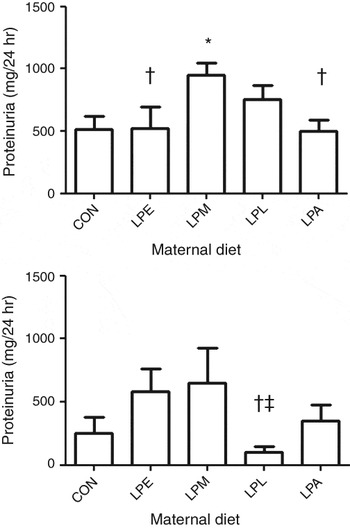
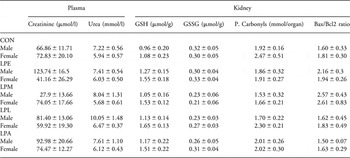
In males proteinuria was higher in the LPM group than in the control, LPA and LPE groups (P < 0.05, Fig. 1). In females proteinuria was higher in the LPM and LPE groups than in the LPL group (P < 0.05, Fig. 1). Overall, proteinuria was higher in males than in females (P < 0.001). There were no dietary effects on plasma creatinine, or plasma urea (Table 1). Overall, plasma urea was higher in males than in females (P < 0.01). Overall survival at 18 months was 76% in males and 86% in females. Importantly, there were no significant differences in survival between groups in either males or females at 18 months.Reference Langley-Evans and Sculley10
Proteinuria, log-transformed for statistical analysis, was influenced by sex (P < 0.001) and maternal diet (P = 0.048). Top panel males, bottom panel females. *denotes significantly different to CON of same sex. †denotes significantly different to LPM of same sex. ‡denotes significantly different to LPE of same sex. Con male n = 7, Con female n = 8, LPE male n = 5, LPE female n = 8, LPM male n = 6, LPM female n = 5, LPL male n = 7, LPL female n = 8, LPA male n = 8, LPA female n = 8. CON, control; LPE, early gestation; LPM, mid gestation; LPL, late gestation; LPA, throughout gestation.

Renal function, glutathione status, carbonyls and Bax/Bcl2 ratio

GSH, reduced glutathione; GSSG, oxidized glutathione (both expressed per gram tissue); P. Carbonyls, protein carbonyl content; CON, control; LPE, early gestation; LPM, mid gestation; LPL, late gestation; LPA, throughout gestation.
All data are shown as mean ± s.e.m.n value as shown in Figure 2.
There were no significant differences between groups within each gender for any of these variables.
Antioxidant enzymes: SOD, GPx, GRed and catalase
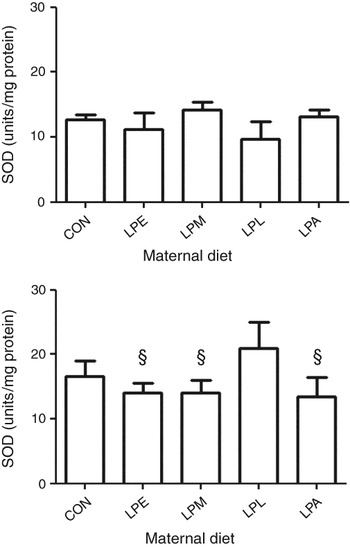
SOD: The first step in the neutralization of reactive oxygen species is SOD, which converts superoxide into hydrogen peroxide. In females total renal SOD activity was slightly lower in the LPE, LPM and LPA as compared to LPL (P < 0.05, Fig. 2). In males there were no differences between groups. Overall, total renal SOD activity was slightly higher in females than in males. Hydrogen peroxide is either converted to GSSG and water by glutathione peroxidise, or to oxygen and water by catalase. Reduced GSH is converted to GSSG by GPx and can be regenerated through activity of GRed.
Renal superoxide dismutase (SOD) activity was influenced by sex (P = 0.045), maternal diet (P = 0.013) and the interaction of sex and diet (P = 0.008). Top panel males, bottom panel females. §denotes significantly different to LPL of same sex. Con male n = 4, Con female n = 7, LPE male n = 4, LPE female n = 6, LPM male n = 4, LPM female n = 6, LPL male n = 6, LPL female n = 7, LPA male n = 7, LPA female n = 6. CON, control; LPE, early gestation; LPM, mid gestation; LPL, late gestation; LPA, throughout gestation.

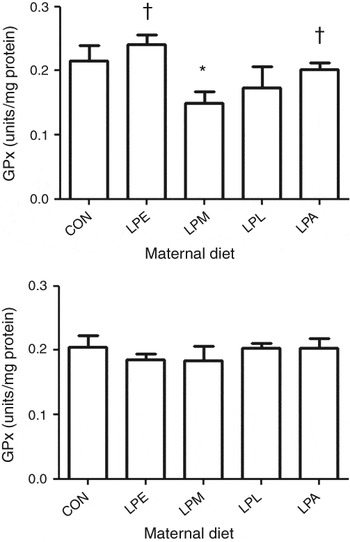
GPx: In males GPx activity was lower in the LPM group than in the control, LPA and LPE groups (P < 0.05, Fig. 3). This pattern was quite opposite to that of proteinuria in males (see Fig. 1). Indeed, in males these data correlated inversely (R = −0.445, P = 0.018, n = 32). In females there were no differences between groups.
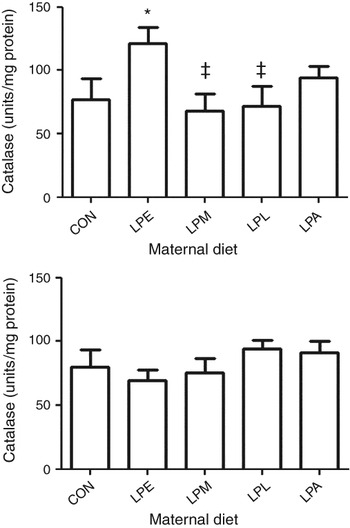
Renal catalase activity was influenced by maternal diet (P = 0.007) and the interaction of sex and diet (P = 0.004). *denotes significantly different to CON of same sex. ‡denotes significantly different to LPE of same sex. Con male n = 7, Con female n = 8, LPE male n = 5, LPE female n = 8, LPM male n = 6, LPM female n = 6, LPL male n = 6, LPL female n = 8, LPA male n = 8, LPA female n = 7. CON, control; LPE, early gestation; LPM, mid gestation; LPL, late gestation; LPA, throughout gestation.

Catalase: In males catalase activity was lower in the LPM, LPL and control groups than in the LPE group (P < 0.05, Fig. 4). In females there were no differences between groups.
Renal glutathione peroxidase (GPx) activity was influenced by the interaction of sex and diet (P = 0.040). Top panel males, bottom panel females. *denotes significantly different to CON of same sex. †denotes significantly different to LPM of same sex. n value as shown in Figure 3. CON, control; LPE, early gestation; LPM, mid gestation; LPL, late gestation; LPA, throughout gestation.

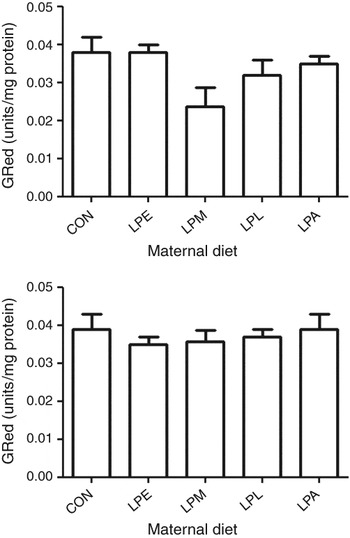
GRed: In males GRed activity showed a pattern similar to that of GPx, although the differences failed to reach significance (Fig. 5). GPx and GRx activity were directly correlated in males (R = 0.889, P < 0.001, n = 32). In females there were no differences between groups.
Renal glutathione reductase (GRed) activity was influenced by sex (P = 0.022) and maternal diet P = 0.054. Top panel males, bottom panel females. n value as shown in Figure 3. CON, control; LPE, early gestation; LPM, mid gestation; LPL, late gestation; LPA, throughout gestation.

The concentrations of GSSG and GSH in the kidney were not influenced by diet in males or females (Table 1). Protein carbonyl content, an indicator of oxidative damage to proteins, were also not significantly different between groups, despite significant overall effects of diet, sex and their interaction (Table 1).
Apoptosis
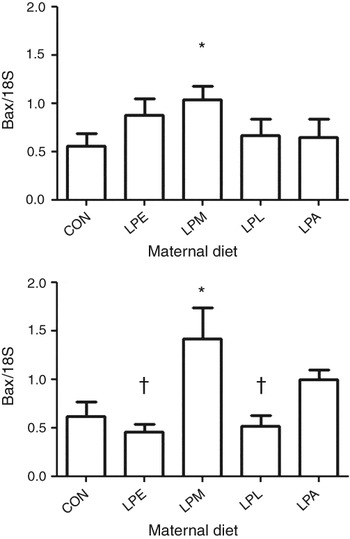
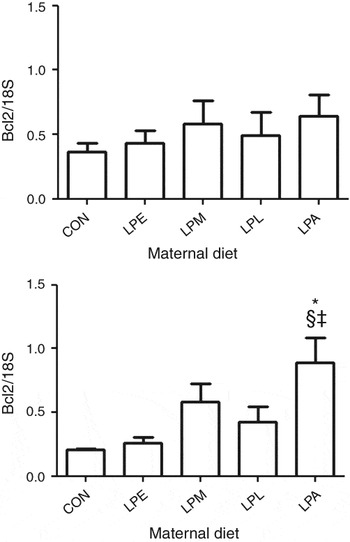
Bax expression was higher in LPM males v. controls, and in LPM females v. controls, LPE and LPL (P < 0.05, Fig. 6). In females LPE and LPL were also lower than LPA. Bcl2 expression was higher in LPA females v. controls, LPE and LPL (P < 0.05, Fig. 7). Bax/BcL2 ratios were not significantly influenced by diet or sex (Table 1), but they correlated positively with proteinuria (R = 0.324, P = 0.026, n = 52).
Bax expression was significantly influenced by sex (P = 0.016), maternal diet (P = 0.005) and the interaction of sex and diet (P = 0.021). Top panel males, bottom panel females. *denotes significantly different to CON of same sex. †denotes significantly different to LPM and LPA of same sex. Con male n = 5, Con female n = 6, LPE male n = 5, LPE female n = 6, LPM male n = 4, LPM female n = 5, LPL male n = 5, LPL female n = 5, LPA male n = 5, LPA female n = 6. CON, control; LPE, early gestation; LPM, mid gestation; LPL, late gestation; LPA, throughout gestation.

Bcl2 expression was influenced by diet (P = 0.019) and the interaction of diet and sex (P = 0.046). Top panel males, bottom panel females. *denotes significantly different to CON of same sex. ‡denotes significantly different to LPE of same sex. §denotes significantly different to LPL of same sex. Con male n = 5, Con female n = 4, LPE male n = 5, LPE female n = 6, LPM male n = 4, LPM female n = 4, LPL male n = 6, LPL female n = 6, LPA male n = 7, LPA female n = 7. CON, control; LPE, early gestation; LPM, mid gestation; LPL, late gestation; LPA, throughout gestation.

Discussion
In aging laboratory rats of common strains such as Wistar and Sprague-Dawley renal disease is very common, especially in males.Reference Baylis15, Reference Baylis16 It is characterized by proteinuria, tubulointerstitial disease and apoptosis.Reference Thomas, Anderson and Gordon28 Thus, proteinuria can be regarded as part of the phenotype of the aging rat. Developmental circumstances can have a substantial impact on the phenotype of aging organisms,Reference McMillen and Robinson8 however, much less information is available on the sensitive phases of development regarding different tissues. For the kidneys, in rats, one would suspect mid- or late gestation, or even the early lactation period, because this is the phase of nephrogenesis. The most striking observation in this study is that in rats, reducing maternal protein intake in late gestation, thus at the peak of nephrogenesis, did not result in enhanced proteinuria in 18-month-old male or female offspring. In fact, LP intake in mid-gestation, thus in early nephrogenesis, was the event, which was associated with most proteinuria in the aging rats, while in females LP intake in late-gestation actually reduced proteinuria. Moreover, even before nephrogenesis (days 0–7 gestation), LP can impact on renal integrity in adult life. Surprisingly, LP throughout gestation had little effect on proteinuria, confirming lack of enhanced albuminuria in aging rats after similar protein-deprivation throughout gestation.Reference Petry, Jennings, James, Hales and Ozanne29 Our findings suggest that for aging rat kidney LP poses the greatest threat when restricted to the initial stages of nephrogenesis. This corroborates reports by Welham et al. Reference Welham, Wade and Woolf30 who found that exposure to LP diets before E13 (i.e. in LPE and LPM) enhanced mesenchymal apoptosis in metanephroi and was associated with reduced gene expression of prox-1, which codes for a homeobox transcription factor, and cofilin-1, which codes for an actin depolymerizing protein.Reference Welham, Riley, Wade, Hubank and Woolf31
Antioxidant enzyme expression and activity are lower in kidneys of hypertensive rats, whether this is diet-inducedReference Roberts, Barnard and Sindhu32 or genetic.Reference Zhan, Sindhu, Pang, Ehdaie and Vaziri33 Less is known on antioxidant enzymes in kidneys of perinatally undernourished rats. Zinc-deprivation during gestation induces mild proteinuria at 2 months of age, which is associated with a decrease in GPx activity.Reference Tomat, Inserra and Veiras34 Manganese SOD protein expression was lower in the renal cortex of aging male than aging female rats,Reference Tarry-Adkins, Ozanne, Norden, Cherif and Hales35 which concurs with our observations on renal SOD activity. However, the depressive effects of protein-deprivation during nephrogenesis on antioxidant enzyme activity in aging kidneys do not appear to have been reported previously. Low GPX activity appeared to correlate with proteinuria, particularly in males. Heavy proteinuria can be induced by daily intraperitoneal injections of bovine albumin. This so-called overload proteinuria is a useful model to determine cause and effect relations with respect to proteinuria.Reference Eddy36 Overload proteinuria reduced activity of several antioxidants enzymes (catalase, GPx, and total SOD) in renal cortex and medulla.Reference Tapia, Sánchez-González and Medina-Campos37 Thus it is plausible that changes in antioxidant enzyme activity observed in our study were secondary to differences in proteinuria.
However, studies of other tissues suggest that the maternal LP diet may impact upon oxidant/antioxidant balance independently of proteinuria. Young adult rats exposed to protein restriction throughout gestation exhibit perturbations of the γ-glutamyl cycle, have lower tissue glutathione concentrationsReference Langley-Evans, Phillips and Jackson17, Reference Langley-Evans, Wood and Jackson19 and exhibit evidence of enhanced oxidative processes in liver.Reference Langley-Evans and Sculley18, Reference Langley, Seakins, Grimble and Jackson20 There is a greater sensitivity to pulmonary injury in LPA rats, which are subjected to an oxidizing atmosphere.Reference Langley-Evans, Phillips and Jackson17 We have previously reported that younger LPE males had elevated protein carbonyl concentrations in the heart.Reference Langley-Evans and Sculley10 Note that the pathogenesis of proteinuria, in particular whether so-called glomerular proteinuria is actually of tubular origin, remains controversial.Reference Christensen, Birn, Rippe and Maunsbach38, Reference Comper and Russo39 However, genetic proteinurias,Reference Tryggvason, Patrakka and Wartiovaara40 and differences in susceptibility to the development of proteinuria and renal injury between rat strains,Reference Pugliese, Ricci and Iacobini41 have only been related to variation in glomerular characteristics.
Tubular epithelial apoptosis was more extensive in aged obese Wistar rats than in age-matched (lean) hypertensive (SHR) or normotensive (WKY) rats.Reference Percy, Brown, Power, Johnson and Gobe42 Our data suggest that higher Bax expression in LPM males and, to a lesser extent, females may be the result of toxic effects of proteinuria. Once again, the overload proteinuria model demonstrated extensive tubular apoptosis after only a few days of heavy proteinuria.Reference Thomas, Brunskill and Harris43 However, in diabetic nephropathy there is some evidence that tubular injury precedes heavy proteinuria.Reference Singh, Winocour and Farrington44
The rate of progression of renal disease is generally higher in men than in women.Reference Silbiger and Neugarten45 Multiple studies have documented sex-related differences in the occurrence of hypertension and renal development later in life due to perinatal micronutrient deficiency.Reference Woods, Ingelfinger and Rasch46–Reference McMullen and Langley-Evans49 Generally, female offspring are resistant.
The relative insensitivity of the LPA group to age-related changes and the reduction of proteinuria in LPL females are striking. This suggests adaptation to early insults affecting nephrogenesis. The nature of this adaptation remains unclear and may be isolated to the kidney. Although we have previously demonstrated that early life programming of high blood pressure can be induced by single-week exposures to the maternal LP diet, the impact of an insult lasting throughout gestation in blood pressure was greater than for any specific 7-day window.Reference Langley-Evans, Welham, Sherman and Jackson50 This suggests that high proteinuria in aging LPM and LPE rats may be partially independent of systemic blood pressure. The evidence suggests that sensitivity of the different groups to age-related changes is organ specific. Indeed the same LPA animals as used in this study were shown to have identical metabolic profiles and disturbances of hepatic lipid metabolism to LPL and LPM groups.Reference Erhuma, Salter, Sculley, Langley-Evans and Bennett51 The sensitivity to senescent changes of the LPM group and, for some variables, even the LPE group suggests that the very early stages of nephrogenesis are particularly susceptible to LP availability. We have previously reported that the early phase of nephrogenesis may be vulnerable to the influence of undernutrition in sheep.Reference Gopalakrishnan, Gardner and Dandrea52 In humans, nephrogenesis starts slowly from the 10th to the 18th week of gestation (equivalent to the end of LPE and beginning of LPM) and accelerates from the 18th to the 32nd week (equivalent to the LPM and beginning of LPL) after which it stops.Reference Hinchliffe, Sargent, Howard, Chan and van Velzen53, Reference Gasser, Mauss and Ghnassia54 However, nephrogenesis in the rat starts in LPM and continues throughout LPL, far into the lactation period.Reference Guron and Friberg1 In 50-year-old subjects from the Dutch Famine Birth Cohort Study microalbuminuria was most prevalent in those exposed to the famine in mid-gestation (in terms of nephrogenesis equivalent to LPL).Reference Painter, Roseboom and van Montfrans7 The sensitivity of LPM rats to the development of proteinuria suggests that in the rat early nephrogenesis is more sensitive to protein deprivation than in the human. However, 18-month-old rats are considerably more senescent than 50-year-old humans. Thus, prevalence of (micro)albuminuria may still shift as the Dutch Famine Birth Cohort ages.
It should be noted that the animals included in this study were survivors of a larger trial of ageing animals. The impact of maternal diet upon lifespan is reported elsewhere,Reference Langley-Evans and Sculley10 but the main outcome was that after adjusting for birth weight and early growth, animals of the LPA group tended to have shorter lives than controls, while offspring from LPE (females) and LPL (males and females) groups had longer lifespan. By 18 months into the study approximately 7% of females and 20% of males in the full cohort had died a natural death. Where it was possible to determine the cause of death, 20% of males appeared to have died due to renal pathology, while none of the females showed gross evidence of renal-related death.
In conclusion, we have observed that senescence-related loss of renal function was greater in male rats following protein-restriction during mid-gestation. This functional decline was associated with disturbance of antioxidant status and more apoptosis. The findings of this study are important as they highlight the early phase of nephrogenesis as a vulnerable period during which the animal is sensitive to programming influences of the maternal diet.
Acknowledgements
This study was funded by the British Heart Foundation and the European Union FP6 programme (EARNEST Consortium). The expert technical assistance of Mr R. Plant and Ms Sarah Kirkland is gratefully acknowledged.
Statement of Interest
None.