

Introduction
Approximately 50% of African American smokers consume 10 or fewer cigarettes per day (Okuyemi, Ahluwalia, Richter, Mayo, & Resnicow, Reference Okuyemi, Ahluwalia, Richter, Mayo and Resnicow2001; Okuyemi, Ahluwalia, Banks, Harris, Mosier, & Nazir, Reference Okuyemi, Ahluwalia, Banks, Harris, Mosier and Nazir2004; Trinidad, Pérez-Stable, Emery, White, Grana, & Messer, Reference Trinidad, Pérez-Stable, Emery, White, Grana and Messer2009). Although African American smokers report lower levels of daily smoking, they have higher serum cotinine levels per cigarette smoked, are more susceptible to developing smoking-related illnesses (American Cancer Society [ACS], 2007; Haiman, Stram, Wilkens, Pike, Kolonel, & Henderson, Reference Haiman, Stram, Wilkens, Pike, Kolonel and Henderson2006), and have greater difficulty quitting smoking when compared to Caucasian smokers. Most smoking cessation trials exclude light smokers and there is little published data on the characteristics associated with smoking in this subset of smokers (Faseru, Choi, Krebill, Mayo, Nollen, & Okuyemi, Reference Faseru, Choi, Krebill, Mayo, Nollen and Okuyemi2011; Okuyemi et al., Reference Okuyemi, Cox, Nollen, Snow, Kaur and Choi2007). Identifying factors related to cigarette use among African Americans, even those who might be considered light smokers, may be helpful in reducing smoking-related illnesses in this group.
Little is known about the manifestation of tobacco dependence among African American light smokers. Okuyemi and colleagues examined different measures of tobacco dependence among African American light smokers using Cigarette Dependence Scale (CDS), the Fagerström Test for Nicotine Dependence Scale (FTND), and the Nicotine Dependence Syndrome Scale (NDSS), and found each of these instruments captured a different aspect of dependence in this population (Okuyemi, Pulvers, Cox, Thomas, Kaur, & Mayo, Reference Okuyemi, Pulvers, Cox, Thomas, Kaur and Mayo2007). The CDS demonstrated the strongest associations with biochemical markers of cotinine (r = 0.25) and carbon monoxide breath samples (r = 0.28), and the five factor structure of the NDSS was maintained in this sample. Mean scores on the FTND was 2.8 (SD = 1.74), which suggests lower levels of nicotine dependence among African American smokers. Light smokers reported greater dependence on all three scales (FTND = 2.99, CDS = 15.7, and NDSS = −0.87) compared to chippers (FTND = 2.2, CDS = 12.5, NDSS = -1.32), suggesting the general definition of light smoking (10 or fewer cigarettes per day) is not necessarily a homogeneous group.
The 68-item Wisconsin Inventory of Smoking Dependence Motives (WISDM) is a multidimensional measure of tobacco dependence that has been used to evaluate smoking-related motivation (Piper, Piasecki, Federman, Bolt, Smith, & Fiore, Reference Piper, McCarthy and Baker2004; Piper, McCarthy, Bolt, Smith, Lerman, & Benowitz, Reference Piper, Bolt, Kim, Japuntich, Smith, Niederdeppe, Cannon and Baker2008; Shenassa, Graham, Burdzovic, & Buka, Reference Shenassa, Graham, Burdzovic and Buka2009; Smith, Piper, Fiore, & Baker, Reference Smith, Piper, Fiore and Baker2007; Smith, Piper, Bolt, Fiore, Wetter, & Cinciripini, Reference Smith, Piper, Bolt, Fiore, Wetter, Cinciripini and Baker2010). The benefit of studying nicotine dependence as a multidimensional construct include: (a) the ability to study variables that may mediate or moderate dependence; (b) the opportunity to measure the developmental time course of nicotine dependence as it occurs during smoking initiation to chronic use; (c) the potential to identify the presence nicotine dependence among populations of smokers where traditional measures fail; and (d) the capability of being helpful in treatment settings by identifying barriers to cessation (Baker et al., Reference Baker, Brandon and Chassin2004; Piper et al., Reference Piper, McCarthy and Baker2006). Items on the WISDM-68 were chosen based on constructs from clinical or research settings that are indirectly related to dependence (e.g., smoking to maintain current weight) and may provide new insights into the development and maintenance of nicotine dependence (Piper et al., Reference Piper, Bolt, Kim, Japuntich, Smith, Niederdeppe, Cannon and Baker2008a, Reference Piper, McCarthy, Bolt, Smith, Lerman and Benowitz2008b).
An abbreviated 30-item version was developed to reduce assessment burden while capturing the multidimensional structure of the original WISDM and maintaining instrument integrity (Smith et al., Reference Smith, Piper, Fiore and Baker2007), and was later expanded to a 37-item version (Smith et al., Reference Smith, Piper, Bolt, Fiore, Wetter, Cinciripini and Baker2010). Recently the brief 37-item WISDM has been tested among 1,633 African American heavy smokers (average CPD = 26.4, SD = 9.6), and found to have different factor loadings compared to their Caucasian counterparts on subscales related, especially subscales pertaining to affiliative attachment and affective enhancement (Ma, Li, & Payne, Reference Ma, Li and Payne2012). At the time of conducting the parent trial of this study, the 37-item WISDM had not been published; therefore, we utilized the 30-item version of the WISDM for this study.
Previous measures of tobacco dependence have classified African Americans light smokers as less dependent, despite their difficulty with quitting smoking successfully. The growing phenomenon of light and intermittent smokers challenges the physiological model of dependence, which base the maintenance of smoking behaviour on constructs such as tolerance and withdrawal (Shiffman, Reference Shiffman2009). Given the struggles seen in this population, other psychological factors sustaining smoking behaviour must be present. The current study offers an exploratory assessment of smoking motives among African American light smokers enrolled in a clinical trial using the 30-item version of the WISDM. The goal of this project is to identify nicotine dependence factors pertinent to African American light smokers. A better description of nicotine dependence in African American light smokers will inform development of appropriate smoking cessation interventions and best clinical practices for the care of this population of smokers.
Methods
Design
The Kick It at Swope III study (KIS-III) was a randomised, double-blind, placebo controlled study of sustained release bupropion for smoking cessation among 540 African American light smokers. Recruitment methods and study methodology are published elsewhere and are briefly described below (Cox et al., Reference Cox, Faseru, Mayo, Krebill, Snow and Bronars2011; Reference Cox, Nollen, Mayo, Choi, Faseru and Benowitz2012). Participants were recruited from an urban city in the Midwest. Eligible participants were (a) self-identified as African American, age 18 or older, (b) were interested in quitting smoking, (c) reported smoking 10 or fewer cigarettes per day for the past 6 months, (d) smoked on at least 25 days during the past month, and (f) had a functioning telephone number and home address.
Measures
The WISDM-30 (Smith et al., Reference Smith, Piper, Fiore and Baker2007) measures motivational domains related to nicotine dependence. This measure consists of 30 items scored on a 7-point Likert scale (1 = Not true of me at all to 7 = Extremely true for me). The WISDM-30 includes 10 subscales: Automaticity, Craving, Weight Concerns, Negative Reinforcement, Affiliative Attachment, Cue-Exposure/Associate processes, Taste and Sensory Processes, Social-Environmental Goads, Cognitive Enhancement, and Loss of Control/Tolerance. Each subscale is scored by taking the average of all the ratings on the subscale items. A total score is calculated by summing all the subscale scores. Subscale scores can range from 1 to 7 and total scores range from 10 to 70.
Demographic information such as age, gender, marital status, income, employment status and education were collected using standardised questionnaires. Plasma cotinine samples were also collected during the baseline visit.
Data Analysis
Continuous demographic and smoking related variables were summarised by means and standard deviations. Categorical demographic variables were reported in frequencies and percentages. To evaluate the factor structure of the WISDM-30, the dataset was randomly split into two subsets. An exploratory factor analysis (EFA) was performed using a principle components analysis with an oblimin rotation on the first dataset. Both the overall and item level Kaiser-Meyer-Olkin (KMO) measures of sampling adequacy were evaluated. A visual inspection of the scree plot guided the determination of the number of factors with eigenvalues > 1 to retain. Scale items were associated with solution factors through achieving at 0.4 or greater rotated standardised regression coefficient. We specified the number of factors found in the first factor analysis in our exploratory factor analysis applied to our second replicate dataset, resulting in randomly split exploratory factor analyses. All analyses were performed with SAS 9.2 (Cary, NC.).
Results
Smoking Characteristics
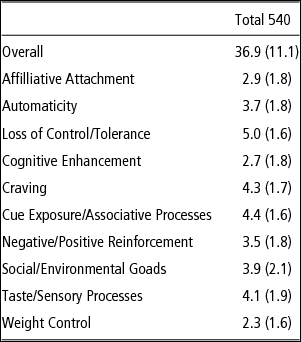
A total of 540 individuals completed the assessment battery. There was no missing data. Participants were predominantly female (66.1%), average age of 46.5 (SD = 11.3) years old, and smoked since the age of 21 (SD = 7.1) years. On average, participants reported using 8.0 cigarettes per day (SD = 2.5) with 72% smoking a cigarette within 30 minutes of wakening. Baseline serum cotinine was 275.8 ng/ml (SD = 155.8). In the past year, participants reported making 3.7 quit attempts (SD = 4.7). The WISDM-30 overall and subscale scores for the sample are illustrated in Table 1.
WISDM-30 total and subscale scores, means and standard deviations
Factor Analysis Results of the WISDM-30
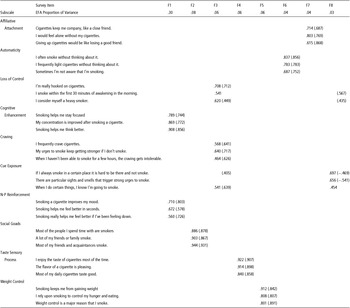
From our exploratory analysis (EFA), an 8-factor solution explained 69% of the variation in responses. The overall MSA was 0.88 with item level MSA ranging 0.68–0.94 across the 30 items of the WISDM. The rotated factor standardised regression coefficients for both exploratory (EFA) and randomly split EFA are illustrated in Table 2. As demonstrated in Table 2, the 8-factor solution of the EFA was relatively well formed. All factors were composed of at least three or more scale items with a consistent separable thematic interpretation based on the WISDM-30 subscales.
Rotated factor pattern for EFA and EFA standardised regression coefficients

Six of our eight factors replicated the original subscales of the WISDM. The first factor accounted for 30% of the variance explained with the remaining 7-factor ranging between 3–8% respectively. Factor 1 consisted of items from the Cognitive Enhancement and Negative/Positive Reinforcement subscales of the original WISDM-30, suggesting a relationship between attention and negative mood states. Additionally, the third factor contained items from the Craving and Tolerance/Loss of Control subscales, and suggests a relationship between experiences of craving or smoking urge and feeling dependent on cigarettes. One item from the original Cue Exposure subscale of the WISDM-30, (e.g., ‘When I do certain things, I know I am going to smoke’), crossloaded on both Factor 3 as well as Factor 8.
Results from the randomly split EFA replicated the findings of the original EFA, with the exception of the item ‘I smoke within the first 30 minutes of awakening in the morning’. Originally this item loaded on the Factor 3 in the original EFA analysis; however results from the randomly split EFA analysis show this item loading on Factor 8. Factor 3 on both the EFA and randomly split EFA consisted of items from the Craving and Tolerance/Loss of Control subscales while Factor 8 consisted of items from the Cue Reactivity subscale of the WISDM-30. Two items also cross-loaded on both Factors 3 and 8 (e.g., ‘I consider myself a heavy smokers’; ‘If I always smoke in a certain place it is hard for me to be there and not smoke’). These items describe smoking being triggered in the environment as well as the perception of feeling dependent on cigarettes.
Discussion
The current study offers an exploratory assessment of smoking motives among African American light smokers using the 30-item version of the WISDM. We conducted an EFA of the WISDM-30 (Smith et al., Reference Smith, Piper, Fiore and Baker2007) among African American light smokers. Unlike the 10-factor solution found by Smith and colleagues among Caucasian and African American smokers consuming approximately one pack/day, our study of African American light smokers found an 8-factor solution from both EFA and the randomly split EFA. Current findings replicated six of the original 10 subscales, and identified two combined factors.
The factor that accounted for the most variance consisted of items from Cognitive Enhancement and Negative/Reinforcement subscales. Items on the Negative Reinforcement subscale focus on using smoking to relieve negative affective states, while the Cognitive Enhancement subscale consists of items measuring the use of smoking to improve one's focus and attention (Piper et al., Reference Piper, McCarthy and Baker2004, Reference Piper, Bolt, Kim, Japuntich, Smith, Niederdeppe, Cannon and Baker2008a). Previous research has shown negative mood states and difficulty concentrating as symptoms of nicotine withdrawal (Hughes, Reference Hughes1992, Reference Hughes2007; Hughes & Hatsukami, 1986). Nicotine deprived smokers have shown increases in self-reported negative affect as well as greater cognitive impairments on tests of attention and memory, that are reversed when smokers are allowed to smoke or are administered nicotine (Heishman, Kleykamp, & Singleton, Reference Heishman, Kleykamp and Singleton2010; Myers, Taylor, Moolchan, & Heishman, Reference Myers, Taylor, Moolchan and Heishman2008). Additionally, African American light smokers report smoking to improve mood and concentration (Jeffries, Catley, Okuyemi, Nazir, McCarter, & Grobe, Reference Jeffries, Catley, Okuyemi, Nazir, McCarter and Grobe2004; Thomas, Bronars, Stewart, Okuyemi, Befort, & Nazir, Reference Thomas, Bronars, Stewart, Okuyemi, Befort and Nazir2009).
Items from the Tolerance/Locus of Control and Craving subscales combined to form a separate construct, which seems indicative of discomfort associated with not smoking as well as feeling dependent on cigarettes. Shenassa and colleagues (Reference Shenassa, Graham, Burdzovic and Buka2009) found similar results among a sample of predominately women (smoking approximately 18 CPD), in that both the Craving and Tolerance/Loss of Control subscales were highly correlated and may be tapping into identical constructs. Craving strength has been linked to increased intensity of withdrawal symptoms (Hughes, Reference Hughes2007; Perkins, Briski, Fonte, Scott, & Lerman, Reference Perkins, Briski, Fonte, Scott and Lerman2009; Teneggi, Tiffany, Squassante, Milleri, Ziviani, & Bye, Reference Teneggi, Tiffany, Squassante, Milleri, Ziviani and Bye2002) and greater risk relapse among individuals attempting to quit (Allen, Bade, Hatsukami, & Center, Reference Allen, Bade, Hatsukami and Center2008; Shiffman, Paty, Gnys, Kassel, & Hickcox, Reference Shiffman, Paty, Gnys, Kassel and Hickcox1996; Shiffman, Engberg, Paty, Perz, Gnys, & Kassel, Reference Shiffman, Engberg, Paty, Perz, Gnys, Kassel and Hickcox1997). Smokers who experience lower self-efficacy in their ability to manage withdrawal symptoms are at greater risk for maintaining smoking cessation as well as relapsing when attempting to quit (Baker, Mermelstein, Collins, Piper, Jorenby, & Smith, Reference Baker, Mermelstein, Collins, Piper, Jorenby and Smith2011; Schnoll, Martinez, Tatum, Glass, Bernath, & Ferris, Reference Schnoll, Martinez, Tatum, Glass, Bernath and Ferris2010). Further elucidation as to why these variables are related may provide insight into the development of novel treatments for light smoking populations.
It is noted that all of the WISDM-30 subscale scores for this sample are generally lower in comparison to WISDM-30 subscale scores reported in a sample of heavy smoking Caucasians (Smith et al., Reference Smith, Piper, Fiore and Baker2007). None of the subscale score averages were above five, suggesting that many of the motives were not strongly endorsed in this sample. These low WISDM-30 subscale scores also had large standard deviations, suggesting heterogeneity in responding individual and their motivation to smoke. Reasons for the variability are unclear. Perhaps a subset of light smoking African Americans appear more similar to that of heavy smoking Caucasians. For instance, the length of smoking history, even at lower rates, establishes a behavioural pattern that differs between chronic light smokers and emerging smokers. Data pertaining to the smoking trajectories of African American smokers shows that many African Americans will initiate tobacco use later in life and consistently smoke fewer cigarettes per day compared to Caucasian smokers (Trinidad, Gilpin, Lee, & Pierce, 2004; White, Nagin, Replogle, & Stouthamer-Loeber, Reference White, Nagin, Replogle and Stouthamer-Loeber2004). Therefore, these light smokers potentially may develop nicotine dependence despite smoking fewer cigarettes per day. A possible explanation is that slower nicotine metabolism has been associated with lower rates of smoking, especially among African Americans, leaving the body exposed to nicotine for a longer period of time (Pérez-Stable, Herrera, Jacob, & Benowitz, Reference Pérez-Stable, Herrera, Jacob and Benowitz1998; Tyndale & Sellers, Reference Tyndale and Sellers2001).
Results are exploratory and limited in their generalisability to other smoking populations (e.g., ethnicity, age, amount smoked). In addition, this study consisted of treatment seeking smokers which may be more dependent than the general population of light smokers. Whether results were affected by participants’ motivation to quit is unclear. Of note, the 30-item version of the WISDM used in this study was subsequently expanded to consist of 37-items and categorised into Primary and Secondary Motives (Smith et al., Reference Smith, Piper, Bolt, Fiore, Wetter, Cinciripini and Baker2010). For the present, the current paper serves to advance our insight into smoking dependence motives among African American light smokers. This work may help advance intervention research with identifying targets for treatment germane to this subset of smokers. Further, this data has potential to help researchers select more focused, relevant questionnaires, which aids in the reduction in assessment burden for participants in clinical trials. Finally, from a clinical perspective, results from this study may aid practitioners in initiating conversations regarding smoking motivations among patients who are African American and light smokers. Future research examining the WISDM among different populations of smokers would be beneficial to further understand the role of nicotine dependence and smoking motives in maintaining smoking behaviour.
Acknowledgements
The authors would like to thank the staff at Swope Health Central, as well as Olivia Chang, Emily Kravit, Jennifer Lipari, Ian Lynam, Heather Newhard, Teri Tapp and Cinnamon Smith for their efforts on this project. We are also grateful to the volunteers who participated in this research. (Clinical Trials NCT00666978)
Financial Support
Conducted at the University of Kansas School of Medicine and Swope Health Services with support from the National Cancer Institute, R01 CA091912.
Conflict of Interest
Dr Okuyemi is the PI of a smoking cessation projected funded by Pfizer Pharmaceuticals, Inc.
Ethical Standards
The authors assert that all procedures contributing to this work comply with the ethical standards of the relevant national and institutional committees on human experimentation and with the Helsinki Declaration of 1975, as revised in 2008.