




No CrossRef data available.
The reappropriation of tongzhi
Published online by Cambridge University Press: 12 October 2005
Abstract
A general address term in Communist China, the Chinese word tongzhi ‘comrade’ was appropriated by gay rights activists in Hong Kong to refer to members of sexual minorities. It has positive connotations of respect, equality, and resistance. This article focuses on the reappropriation of this word by a mainstream newspaper in Hong Kong. The parodic use of tongzhi allows journalists to ridicule gay rights activists so as to increase the entertainment value of news stories. At the same time, it mocks activists' demand for equality and may lead to the pejoration of the term. This study provides synchronic evidence for sociolinguistic accounts that explain how lexical items may undergo pejoration because of the context of their use. It shows that because the meaning potential of a word is not bounded by the intentions of its users, words that marginalized groups have appropriated can be resignified yet again in hateful contexts.An earlier version of this article was presented at the First IGALA (International Gender and Language Association) Conference at Stanford in May 2000 and was published in the proceedings of that conference. I would like to thank Penny Eckert, Jane Hill, Miyako Inoue, Don Kulick, Sally McConnell-Ginet, John Rickford, and two anonymous reviewers for their comments and suggestions.
Information
- Type
- Research Article
- Information
- Copyright
- © 2005 Cambridge University Press
[T]he word is not a material thing but rather the eternally mobile, eternally fickle medium of dialogic interaction. It never gravitates toward a single consciousness or a single voice. The life of the word is contained in its transfer from one mouth to another, from one context to another context, from one social collective to another, from one generation to another. In this process the word does not forget its own path and cannot completely free itself from the power of these concrete contexts into which it has entered. %M. M. Bakhtin (1984:202)
INTRODUCTION
In February 1998 the Second Chinese Tongzhi Conference was held in Hong Kong.1
The Chinese label tongzhi is a superordinate term that refers to members of sexual minority groups (lesbians, gay men, bisexuals, transgenders, and transsexuals). Sometimes it is also used as a gender-specific term to refer to gay men only (see Wong 2003, chap. 4). In this article I use “sexual minorities” as a shorthand term for lesbians, gay men, bisexuals, transgenders, and transsexuals. Tongzhi is the pinyin (romanization) of the Chinese expression in Mandarin. In Cantonese, it is pronounced as tung4-ji3 (4 = low falling tone; 3 = mid level tone). Since this article focuses on the language use of a newspaper in Hong Kong, where Cantonese is spoken, the romanization is based on the Cantonese rather than the Mandarin pronunciation of characters. The only exceptions are original Mandarin quotes, names of people and places in Taiwan and mainland China, Taiwanese and mainland Chinese book titles, and the terms tongzhi and gay. Tongzhi is used more often than its Cantonese counterpart in academic writing in English (e.g., Chou 2000), and gay is a loanword from English. The romanization used in this article is based on the Yale system (see Matthews & Yip 1994). For easier reading, tones are not indicated.
According to some of tongzhi activists with whom I talked, this fascination began with articles about gay men's cruising places published in weekly tabloid magazines in the mid-1990s.

‘Long yang’ (or lung yeung) is an expression used to refer to men with same-sex desire. Men who are attracted to the same sex are often said to have lung-yeung pik (the fetish of long-yang).
The Cantonese expression kai-go kai-dai, loosely translated as ‘sworn brothers’ here, is a euphemism for men who engage in anal sex. As a vocative, kai-dai is an insult.
This article prompted tongzhi activists to organize a news conference in which they demanded a public apology from the newspaper. As a result of the incident, the relationship between ODN and tongzhi activists reached its lowest point.
The significance of the article mentioned above cannot be overstated. Established in 1969, ODN covers local, international, financial, sports, and entertainment news. The daily also provides information on fashion trends, foreign travel, and horse racing. Though not known for its political commentary, ODN is the most widely circulated newspaper in Hong Kong. It sells more than 350,000 copies and boasts a seven-figure readership (Cohen 1997). Its wide readership is probably due to its approach to news reporting: ODN is known for its informal style, celebrity gossip, paparazzi photography, and colorful illustrations. All these attract the reader's attention and enhance the entertainment value of news stories, increasing the sales of the newspaper and boosting the company's bottom line. Given its focus on “soft news” (news that is typically more sensational and entertainment-oriented than traditional public affairs news), some believe that ODN is a tabloid rather than a quality newspaper, but it is important to point out that there is no clear-cut distinction between tabloids and quality newspapers in Hong Kong. Even in ODN, one finds articles that are not very different from those in quality newspapers (see, e.g., Appendix 1). However, other articles may have a more tabloid feel to them (see, e.g., Appendix 2). Whether ODN is a “pure tabloid” is debatable, but there is no question that because of its wide readership this newspaper plays an important role in Hong Kong society.5
Another relevant point is that in ODN, tongzhi is often used in “tabloid-like” news stories (e.g., Appendix 2), while tung-sing-lyun je ‘homosexual’ is found in articles that are similar to those in quality newspapers (e.g., Appendix 1).
Since the incident described above, ODN has, for the most part, shied away from the blatant derogation of sexual minorities. What is perhaps surprising is that tongzhi – the term of reference for sexual minorities favored by gay rights activists in Hong Kong – has to a certain extent replaced explicitly derogatory labels such as sing-bin-taai ‘perverts’ and lung-yeung pik ‘the fetish of long-yang’ that were commonly used in mainstream newspapers (including ODN) even in the late 1980s (see also Chou 2000). The use of appropriate terminology to refer to sexual minorities has always been an important issue for gay and lesbian movements in many parts of the world. As Goffman (1963:24) states, an important task for representatives of stigmatized groups is to convince the general public to use a “softer” label. A general address term in Communist China, tongzhi (often glossed ‘comrade’) has become disfavored owing to its original political connotations (Fang & Heng 1983). Nevertheless, it was appropriated by tongzhi activists in the late 1980s as a reference term for lesbians, gay men, bisexuals, transsexuals, and transgendered persons, and it has positive connotations of respect, equality, and resistance (Wong & Zhang 2000). Thus, for many activists, the adoption of tongzhi by mainstream newspapers is a cause for rejoicing. As Chung, a well-known tongzhi activist in Hong Kong, said, “Not only in Taiwan, but in Hong Kong, the term tongzhi is widely used in newspapers now, thanks to the hard work of many activists. I still remember when I first came back to Hong Kong from the U.S. in 1995, derogatory terms like gay-lou were much more frequently used.”6
Personal e-mail communication. Chung is a pseudonym. The term gay-lou is similar to faggot in English (see the more detailed discussion below).
Is the widespread use of tongzhi in mainstream newspapers testimony to the success of activists engaged in the sexuality-based social movement in Hong Kong? Taking this question as its point of departure, this study examines the struggle over the meaning of tongzhi. The analysis is based on all 126 articles about lesbians, gay men, and/or other sexual minorities published between November 1998 and December 2000 in ODN. These articles were found in three sections of the newspaper: local news, international news, and news from Taiwan and mainland China. I decided to focus on these three sections because it is there that the putative objectivity of news reporting is often underscored. In contrast, it is more acceptable for journalists to express their personal opinions in other sections (e.g., the entertainment section) and in other types of articles (e.g., social commentaries and editorials).
Incorporating some of Bakhtin's (1981, 1984) insights on voice and appropriation, this study aims to contribute to research on meaning contestation by demonstrating how parody – not just a “weapon of the weak” (Scott 1985) but also a “weapon of the strong” (Hill 1999:686) – serves as an important strategy in struggles to control the meaning of words. In addition, it provides concrete synchronic evidence for sociolinguistic accounts that show how certain lexical items may undergo pejoration as a result of the context in which they are used. In what follows, I argue that the widespread use of tongzhi does not indicate that the attitude of ODN toward sexual minorities has become more positive than before. While the term tung-sing-lyun je ‘homosexual’ is often found in medical and legal news, tongzhi is mostly used to refer to lesbians and gay men in highly sensationalized news stories about murder, fist fights, gay sex clubs, and domestic disputes of gay and lesbian couples. Through the parodic use of tongzhi in these articles, ODN editors and journalists reappropriate the term and deny its link to activists. Similar to the strategic use of quotation marks, direct quotation, colorful language, and details tangential to the reported event, the use of tongzhi is one of the strategies adopted by editors and journalists to make fun of activists and others with same-sex desire, so as to increase the entertainment value of the news story. At the same time, it mocks tongzhi activists' demand for respect and equality, and it sows the seeds for the pejoration of the term. One might argue that, at least in ODN, tongzhi does not denote ‘sexual minorities’ or ‘lesbians and gay men’ in general, but lesbians and gay men who engage in illegal, indecent, or immoral behavior.
STRUGGLES OVER MEANING
The (re)appropriation of tongzhi is reminiscent of the struggles to control the meaning of words like nigger and queer in the United States. The N-word is perhaps the most offensive and inflammatory racial slur in the English language. However, many have pointed out that its use is not necessarily racist, nor does its use by African Americans reflect self-hate. In fact, African Americans use the N-word for a myriad of functions – for instance, to mean ‘male’ without any evaluative implications (Spears 1998:239), to refer to a person who acts inappropriately (Smitherman 1977:62), and to identify themselves as real, authentic, and unassimilated (Kennedy 2002:49). Most pertinent to the present study is the use of the N-word “as a rhetorical boomerang against racists” (Kennedy 2002:36). In his study of interracial friendships among adolescents in south London, Hewitt 1986 found that some Black teens would tease their white friends as “nigger” and the white teens would in turn respond with “honky” or “snowflake.” “This practice,” Hewitt (1986:238) claims, “turns racism into a kind of effigy to be burned up in an interactive ritual which seeks to acknowledge and deal with its undeniable presence whilst acting out the negation of its effects.” Foreshadowing the concept of resignification, the white comedian Lenny Bruce recommended ridding the N-word of its racist meaning through overuse: “If President Kennedy got on television and said, ‘Tonight I'd like to introduce the niggers in my cabinet,’ and he yelled ‘Niggerniggerniggerniggerniggerniggernigger’ at every nigger he saw…till nigger didn't mean anything anymore, till nigger lost its meaning…you'd never hear any four-year-old nigger cry when he came home from school” (Bruce 1967, cited in Kennedy 2002:38–39).
The word queer is often cited as an example of how derogatory labels can indeed be resignified. The resignification of queer is made possible by the instability and reiterability of the linguistic sign. Butler asserts that it is important for marginalized groups to lay claims to terms such as queer because these terms “lay their claim on us prior to our full knowing. Laying claim to such terms in reverse will be necessary to refute homophobic deployments of the terms in law, public policy, on the street, in ‘private’ life” (1993:229). Butler 1997 pursues this further in her analysis of censorship of homophobic and racist discourses. Arguing against anti-hate speech legislation, she suggests that it is more effective to exploit the open temporality of the linguistic sign so as to wrestle derogatory terms from their prior contexts and resignify them in a subversive manner.
Although the resignifiability of derogatory terms is much celebrated, it is important to bear in mind that resignification can be refolded into hate. Indeed, marginalized groups can resignify hate speech so that it means something more than hate. However, even when marginalized groups gain a victory, the war is never over, because words that have been reclaimed or appropriated by marginalized groups can be resignified yet again in hateful contexts. This point has received little attention from researchers. The present study is an attempt to address this lacuna in research.
Sociolinguistic research on pejoration can perhaps shed light on how appropriated words may be resignified in malicious contexts. McConnell-Ginet 1989 proposes a discourse-based theory to explain how the micropolitics of daily discourse between ordinary individuals can lead to the semantic derogation of women. For example, hussy – once merely a synonym for housewife – acquired negative connotations because of the way in which it was used. Specifically, it is plausible that some members of the speech community considered sexual wantonness a characteristic of housewives. Such people would say hussy and rely on their addressees to invoke that characteristic when interpreting the utterance. Although the addressees might not accept this putative common belief, the insult would work as long as they were aware of it and as a result, understood it as an insult. When enough uses of hussy to insult succeeded, subsequent language users would be able to interpret the insult without relying on any extralinguistic attitudes. The stereotype might fade, but the meaning that hussy as an insult conveyed became part of the literal meaning of the word (McConnell-Ginet 1989:44).
Nevertheless, given the focus of previous studies (e.g., McConnell-Ginet 1989, Schulz 1975) on changes that took place in the past, it is difficult to recapture the actual discourse conditions and social contexts in which changes occurred.7
One possible exception is Ehrlich & King 1994. The authors examine several feminist linguistic innovations such as the neutral title Ms and the neutral generic he/she. They conclude that, given the socially constructed and constituted nature of linguistic meanings, these innovations lose their neutrality in the mouths of a sexist speech community. The present study is different from Ehrlich & King 1994 in that it focuses on the pejoration of a social category label in one particular domain, mainstream newspapers, and the various strategies through which pejoration is achieved.
Semantic change is frequently socially conditioned, and crucially involves language use; thus, the meaning of a word alters because one sense is favoured and another disfavoured in a particular context. Lack of evidence makes historical work extremely difficult in such cases: we may know that a certain Old English word had a particular meaning because of its use in a translation, or the definition given in a glossary, but we cannot establish its full range of senses or connotational meanings it had at the relevant period.
To address this issue, I believe it is important to draw on insights from the sociolinguistic study of language variation and change – in particular, its concern with change in progress and its emphasis on how synchronic variation can shed light on diachronic change (Labov 1972). By focusing on recent and ongoing changes (e.g., the ongoing semantic change of tongzhi), we can observe the discourse conditions and social contexts in which semantic change takes place.
In the following sections, I show how parody serves as an important strategy in the pejoration of tongzhi, a term appropriated by activists to refer to members of sexual minority groups. However, before delving into the main subject matter of the article, I will first provide a brief overview of the discursive history of tongzhi and activists' appropriation of the term. It will contextualize the discussion that follows, and it will allow the reader to understand the importance of this label in Chinese cultures and societies.
THE DISCURSIVE HISTORY OF TONGZHI
The label tongzhi (often glossed ‘comrade’) has a long history, and its meaning has changed over the years. Originating some 2200 years ago in the early Qin Dynasty, it was initially defined as “pertaining to people who have the same ethics and ideals.” Its association with political discourse began to strengthen when it was used in the will of Dr. Sun Yat-Sen, in which he called on his followers to carry on the revolution: Geming shangwei chenggong, tongzhi rengxu nuli! ‘As the revolution is not yet completed, all my followers must endeavor to carry it out!’8
Because many of the original quotes were in Mandarin Chinese, I use mostly pinyin (the romanization of Mandarin) in this section.
During the Communist Revolution (1921–1949) the term acquired stronger political and revolutionist connotations, and its use as an address term instead of a term of reference became more popular. The reciprocal use of the term at that time signaled solidarity, equality, respect, and intimacy among the revolutionaries. It was an honorific address term reserved for Chinese Communist Party members and other revolutionaries who shared the same goals: to overthrow the old social system (represented by the Nationalist government) and to build a new China ruled by the people. At that time, being addressed as tongzhi required the addressee's admission into the party or demonstration of one's commitment to the Communist Revolution.9
The term tongzhi is still currently used in Taiwan among the Nationalist Party members of the older generation and in official documents and announcements to address Nationalist Party members, but the popularity of its use has never reached the same level in Taiwan as in mainland China.
The connotations of tongzhi underwent tremendous changes after the founding of the People's Republic of China in 1949. The party made great efforts to promote the use of tongzhi as a new address term among the masses to replace terms that signal differences in social status and class – e.g., xiaojie ‘miss’ (an unmarried woman of the privileged class) and laoye ‘master’ (the head of the family in the privileged class). Extension of the use of tongzhi from members of the Revolutionary Army to the general public was a strategy of the Communist Party to establish an ideology of egalitarianism (Scotton & Zhu 1983). After the Cultural Revolution (1966–1976), tongzhi became even more widely used.
In the last two decades, with mainland China's rapid social and economic changes, tongzhi has become disfavored owing to its original political and revolutionist connotations. Address terms that were replaced by tongzhi (e.g. xiaojie ‘miss’) have been revived and are becoming more and more popular. Although tongzhi is out of date in mainland China, it has been appropriated by activists engaged in sexuality-based social movements in Hong Kong and Taiwan to refer to members of sexual minorities.
ACTIVISTS' APPROPRIATION OF TONGZHI
The use of tongzhi to refer to lesbians, gay men, and other sexual minorities is clearly stated in the explanation of the term provided by a booklet published by Chi Heng Foundation, an influential Hong Kong organization whose goal is to eliminate discrimination against sexual minorities:
Revolutionaries often use tongzhi for those with a common goal. In recent years, this label has been appropriated to refer to homosexuals, bisexuals, transgenders, transsexuals and other sexual minorities…. Tongzhi offers a simpler and more direct way to talk about those of non-normative sexual orientations…. In the beginning, some newspapers and magazines rejected this term due to the reader's possible confusion about its meaning. In recent years, it has been widely adopted. It is possible that this usage will be included in future dictionaries as well. (Data Collection Group 2001:98)
Various origin stories have been offered to explain how tongzhi was first used as a label for those of non-normative sexual orientations. Chou Wah-Shan (2000:2), a well-known scholar and activist in Hong Kong, claims that a gay activist appropriated tongzhi for the first Hong Kong Gay and Lesbian Film Festival (Heung-Gong tongzhi din-ying gwai) in 1989.10
Another origin story of tongzhi goes back even further. According to one of the activists I interviewed, a Hong Kong writer with the pen name Mai Ke (Michael) appropriated it from communist revolutionary discourse in the late 1970s. Mai Ke (personal communication) himself said that he used it to refer to a lesbian friend of his. Then he started using it as a euphemism for gay or lesbian in general. In the mid-1980s he was writing for two magazines in Hong Kong (City Magazine and Film Biweekly). He might have used the term tongzhi in either one of these magazines – mostly likely in a review of Early Frost, a movie about a gay man suffering from AIDS, or in one of the many articles about gay movies in Film Biweekly (under the pen-name Yuk-Yin-Yau-Ji). Then Edward Lam, the curator of the film festival, picked it up and used it in the title of the first gay and lesbian film festival in Hong Kong in the late 1980s.
Through the stylized use of tongzhi, activists invoke the voice of Chinese revolutionaries so as to achieve their social and expressive goals, the most prominent of which is to underscore the cultural distinctiveness of same-sex desire in Chinese cultures and societies. In stylization, the speaker adopts someone else's discourse to reinforce his or her own words. However, the speaker's voice and the other person's voice do not merge. As Bakhtin (1984:189) points out: “After all, what is important to the stylizer is the sum total of devices associated with the other's speech precisely as an expression of a particular point of view. He works with someone else's point of view.”
Examples of activists' stylized use of tongzhi can be found in G&L Magazine. Published in Taiwan, this magazine targets Chinese sexual minorities in Hong Kong, Taiwan, and overseas communities and was the only Chinese tongzhi magazine until recently. It covers a wide range of topics: fashion tips, fitness advice, local and foreign news, and issues specific to Chinese sexual minorities. However, G&L Magazine is not merely a lifestyle magazine. Instead, as the editor repeatedly emphasizes, its main goals are to give support and encouragement to gay and lesbian Chinese and to promote the movement for equality in Taiwan and Hong Kong (Wong & Zhang 2000:250).
The association of tongzhi with Chinese revolutionaries is clearly invoked when the term is used with other linguistic features typical of revolutionist discourse to create a discourse of resistance. These features include expressions of combat, struggle, and encouragement, such as zhandou ‘combat’ and zuozhan ‘fight’ in ex. (1), nuli ‘strive’ and fendou ‘struggle’ in ex. (2), and wuqi ‘weapon’ and dafangong ‘fierce counterattack’ in ex. (3). These expressions are often in slogan forms accompanied by exclamation marks. In addition, the quote from Sun's will has also been used several times to express encouragement by both the producers and the readers of the magazine. Ex. (4), an extract from a reader's letter to the editor, is a typical example. The use of tongzhi in the quote does not refer to the followers of the 1911 Revolution; rather, it has been appropriated to refer to those who belong to the tongzhi movement.

Through the use of tongzhi, activists, including the producers of G&L Magazine, invoke the voice of Chinese revolutionaries so as to give a sense of legitimacy to their movement. The use of tongzhi in the examples above invites the comparison of activists with Chinese revolutionaries. Both are united by shared beliefs and a striving for a shared cause – for tongzhi activists, the promotion of equal rights for Chinese sexual minorities, and for Chinese revolutionaries, the establishment of a new government. Activists exploit the revolutionary connotations of tongzhi and its suggestions of liberty, solidarity, and intimacy. They call on Chinese sexual minorities to respect themselves and to join the common endeavor of fighting for equality in a heterosexist society. The values espoused by Chinese revolutionaries – such as freedom, respect, and equality – are shared not only by tongzhi activists but also by Chinese people all over the world. Through the use of the term, tongzhi activists liken their struggle for respect and equality to Chinese revolutionaries' fight for similar ideals in the past. Thus, the tongzhi movement is presented as a quintessential Chinese social movement.
JOURNALISTS' REAPPROPRIATION OF TONGZHI
While activists' appropriation of tongzhi exemplifies stylization, ODN editors' and journalists' reappropriation is a prime example of parody. Dentith (2000:9) defines parody as “any cultural practice which provides a relatively polemical allusive imitation of another cultural production or practice.” Like stylization, parody involves the speaker's appropriation of someone else's words to serve his or her own purposes. However, while the two voices are in accord with each other in stylization, the speaker's voice in parody is directly opposed to the other person's voice (Bakhtin 1984). The differences between the two voices are emphasized so that the parodist can distance himself or herself from the parodied point of view (Rossen-Knill & Henry 1997:728). In the case of Anglo Southwest Spanish, for example, the contrast between the parodying (Anglo) voice and the parodied (Spanish) voice is underscored through the use of hyperanglicizations, exaggerated pronunciations, and blatantly incorrect grammatical constructions (Hill 1993). As Hill argues, the “boldness” of these alternations serves two main functions: “It both distances utterers from the voice which issues from their mouths and serves to denigrate the source of that voice, constructing this source as ridiculous and contemptible” (1993:149–50). The latter function highlights the critical aspect of parody. Yet a parodic message is not only critical but also comical. Some claim that they use Anglo Southwest Spanish (or Mock Spanish) because it is funny (Hill 1999:682). Nevertheless, to understand Mock Spanish humor, one needs to have access to “very negative racializing representations of Chicanos and Latinos as stupid, politically corrupt, sexually loose, lazy, dirty, and disorderly” (1999:682). Thus, the comical and the critical aspects of parody go hand in hand.
Central to ODN editors' and journalists' parody of activists is the juxtaposition of two opposing voices: the activist's voice and the editor's/journalist's voice. Unlike activists, editors and journalists do not use tongzhi for its positive indexical meanings, nor do they liken activists' struggle for respect and equality to Chinese revolutionaries' fight for similar ideals in the past. Instead, through the use of tongzhi, ODN editors and journalists ironically “quote” activists; they incorporate the activist's voice into highly sensationalized news stories that negatively portray sexual minorities. These stories are about murder, fist fights, gay sex clubs, and domestic disputes of gay and lesbian couples. Finding itself in hostile company, the activist's voice is overwhelmed by the editor's/journalist's voice. The incongruity between activists' use and editors'/journalists' use of tongzhi contributes to the critical and comical effects of the parody. In these news articles, it is difficult to retrieve the positive affective and ideological stances (e.g., solidarity, liberty) that activists have used the term to index. In addition, against the backdrop of stories about gay men's lewd conduct and lesbians' fist fights, activists' use of tongzhi to call for respect and equality seems ridiculous and laughable. Thus, in ODN, tongzhi has merely become a label that refers to lesbians and gay men who engage in illegal, indecent, or immoral behavior. In this section, I discuss the contexts in which the use of tongzhi is embedded, and how such embedding serves to “tame” the activist's voice that the label carries. After a brief discussion of the use of gay and tung-sing-lyun je ‘homosexual,’ I will focus on how tongzhi is used in ODN.
Gay and tung-sing-lyun je
In addition to tongzhi, ODN journalists sometimes use gay (a loanword from English) and tung-sing-lyun je ‘homosexual’ to refer to those with same-sex desire. Eighteen of the 126 articles use the term gay. The English word gay is homophonous with the Chinese (Cantonese) word that means ‘foundation.’ Thus, this Chinese word is now used to refer to ‘gay men (and/or lesbians)’ in written Chinese in Hong Kong. Although for some gay and lesbian Hongkongers the term may index an outward (i.e., nonlocal) orientation in matters concerning same-sex desire (see Wong 2003, chap. 2 for detailed discussion), it is sometimes considered pejorative when used by heterosexual Hongkongers.
In ODN, gay is often found in collocation with words that carry negative connotations. The expression gaau-gay is a prime example. This expression does not have an exact equivalent in English. The verb gaau can be glossed roughly as ‘to do (something that is socially disapproved or undesirable),’ and it is used in expressions such as gaau fan-oi-ching ‘to engage in extramarital affairs' and gaau jing-bin ‘to stage a coup d’état’. The expression gaau-gay can be translated ‘to engage in homosexual behavior’, and this expression carries negative meanings as well. Another expression in which gay is often used by straight Hongkongers is gay-lou. It is often regarded as a derogatory term of reference for gay men. In this expression, lou roughly means ‘disgusting guy’. In fact, lou is used in myriad terms with extremely negative meanings, such as sei-lou (lit. ‘dead, disgusting guy’) and aam-sap-lou (lit. ‘sleazy, disgusting guy’). The expression gay-lou is somewhat like faggot in English. The expressions gaau-gay and gay-lou are both found in ODN. The use of gay-lou and gaau-gay is shown in ex. (5).

Notice that gaau-gay and gay-lou are in quotation marks (which look like

in written Chinese text). The use of quotation marks allows the journalist to disassociate himself or herself from the derogatory expressions: The expressions in quotation marks do not belong to the journalist, but to someone else. Through this stylistic device, the journalist accomplishes an act of ventriloquism and succeeds in insulting lesbians and gay men through the words of an unnamed (homophobic) source, while distancing himself or herself from the derogatory expressions.
In addition to gay, tung-sing-lyun je ‘homosexual’ is another common term of reference for lesbians and/or gay men in ODN. A morphemic translation of the English word homosexual, tung-sing-lyun je is similar to gay in that it specifies sexual orientation explicitly and is a label imported from the West. Like its English counterpart, tung-sing-lyun je is a medical term. In Hong Kong, it was (and to a certain extent still is) the official label used in the public domain (e.g., government documents, medical reports) to refer to those with same-sex desire (see also Chou 2000:79).
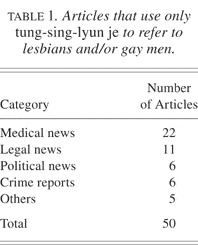
Of the 126 articles that I examined, 50 use only the term tung-sing-lyun je ‘homosexual’ to refer to those with same-sex desire. These articles can be classified into five categories: legal news, medical news, political news, crime reports (e.g. suicide, murder, burglary), and others. Legal news articles include those on topics like same-sex marriage in Canada, political asylum for gay immigrants in the United States, and civil rights for sexual minorities. Almost three-quarters of the articles in the medical news category are about AIDS. The six articles in the political news category include those on topics such as the putative influence of homosexuals in the Latvian government and Malaysian prime minister Mahathir's and his daughter's conflicting views on homosexuals. The distribution of these articles is shown in Table 1. One of the articles that uses only tung-sing-lyun je to refer to lesbians and/or gay men is reproduced as Appendix 1. Since the present study focuses on the use of tongzhi instead of tung-sing-lyun je, I will not provide a detailed textual analysis of this article here, but suffice it to say that the portrayal of lesbians and gay men in Appendix 1 is less sensationalized than in articles where tongzhi is used to refer to those with same-sex desire (e.g., Appendix 2; see discussion below).
Articles that use only tung-sing-lyun je to refer to lesbians and/or gay men.

Content
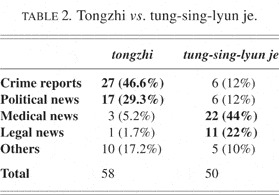
There are 58 articles that use the term tongzhi, slightly more than those that only use tung-sing-lyun je to refer to those with same-sex desire.11
Some of the articles that predominantly use tongzhi to refer to members of sexual minorities may also use other labels such as tung-sing-lyun je ‘homosexual’. Since the new meaning of tongzhi (‘sexual minorities') coexists with the old one (‘comrade’) and some readers may not be familiar with the new meaning, it is possible that tung-sing-lyun je is used in these articles to reduce semantic ambiguity, to make sure that the reader knows that tongzhi refers to ‘sexual minorities’ or ‘lesbians or gay men’. This is particularly evident in (7), from an article about the putative influence of the “Tongzhi Party” in the British government. Since tongzhi also refers to (communist) comrades, the sole use of the term in this article may lead to readers’ confusion (i.e., the reader may think that “Tongzhi Party” refers to the Communist Party).
Tongzhi vs. tung-sing-lyun je.

In seven of the 58 articles that use the term tongzhi, the mention of sexual minorities is gratuitous or secondary information. Very often, the sexual orientation of those in the story is not relevant. As Bell (1991:156) explains, deviance is a negative characteristic with proven news interest. Lesbians, gay men, and/or other sexual minorities are often linked to other social undesirables (e.g., prostitutes) to enhance the negativity of the news story. For instance, an article published on 2 March 1999 (“Liuling man caught for murder of sex worker:”) reports that a female sex worker was murdered by one of her clients in a hotel in mainland China. Although the news story itself has nothing to do with gay men, the journalist mentions that the murder took place in a hotel frequented by both female sex workers and male tongzhis. The underlying assumption is that the mention of male tongzhis highlights the deviant nature of the story, thereby increasing its news value.
In addition, many of the 58 articles provide inaccurate, biased, or misleading information about lesbians and gay men. Journalists often attribute suicide, murder, and other crimes to homosexuality. Ex. (6) is an excerpt from an article published on 2 July 1999 (“Female tongzhi strangles lover”). In this article, the journalist reports an incident in which a lesbian strangled her lover to death because the latter wanted to leave and marry a man. The journalist describes the murder:

It appears that jealousy rather than homosexuality was the motive for the crime. In fact, given that the victim wanted to marry a man, one might even argue that the murder was caused by heterosexuality. If a woman were murdered because she wanted to leave her longtime boyfriend to marry another man, would the journalist attribute the crime to heterosexuality?
The biased or inaccurate information that ODN provides pertains not only to lesbians and gay men themselves but also to the discrimination that they often have to endure. Ex. (7) is from an article about what the journalist calls “Tongzhi Party” (probably not a political party per se but rather a group of gay rights activists or gay politicians) in the United Kingdom. The journalist states that the Conservative Party does not allow lesbians or gay men to become parliamentary representatives because “it is afraid that it [i.e. homosexuality] will make politics more complicated.” The journalist further explains that gay politicians are more likely to be blackmailed than heterosexual politicians. The policy of the Conservative Party, according to the journalist, does not stem from discrimination. What is left unsaid is the fact that regardless of gay or lesbian politicians' performance on the job, their careers will be ruined if their same-sex desire is exposed. This precisely is due to the social stigma attached to homosexuality. If this is not discrimination based on sexual orientation, what counts as discrimination? The journalist has little to say on this issue. Redefinition such as this is a popular discursive strategy used by the print media to depoliticize issues such as rape, discrimination, and sexual harassment (Ehrlich & King 1994).

Headlines
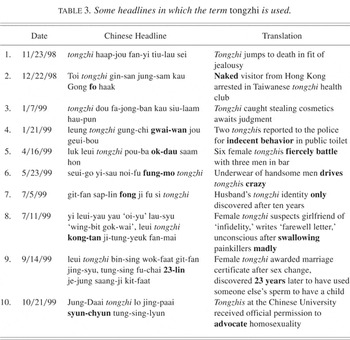
An examination of headlines in which the term tongzhi is used (see Table 3) illustrates the domination of the editor's voice over the activist's voice. According to Iarovici & Amel 1989, headlines serve two main functions. The first function is a semantic one; a headline is like a summary of a news story, informing the reader about the content or nature of the subsequent text (see also Bell 1991:181–91). Very often, a headline is based on the lead (first paragraph) of the article. It encapsulates the important points of the “hard news formula” – what, who, where, how, when, and why – and it usually plays up one of these elements (Harriss et al. 1992:515). The second function is what Iarovici & Amel call “the pragmatic function of the headline”: Headlines serve the purpose of attracting the reader's attention. The pragmatic function may be intensified through the use of common rhetorical devices such as alliteration, punning, and pseudo-direct quotes.
Some headlines in which the term tongzhi is used.

With regard to the first function, contra Iarovici & Amel, many of the headlines in which tongzhi is used are not summaries of news stories; rather, they highlight elements that are tangential to the reported events. A few headlines single out tongzhis, even though the tongzhi aspect of the news story is only a secondary detail. Article 6 is about a new trend of selling used underwear in Taiwan. The headline is seui-go yi-sau noi-fu fung-mo tongzhi ‘Underwear of handsome men drives tongzhis crazy’. Although the article is mostly about the sale of women's used underwear to heterosexual men, the headline highlights the sale of men's used underwear to gay men. It appears that the editor assumes that the sale of used underwear to tongzhis can emphasize the deviant nature and increase the news value of the story.
In addition, many headlines highlight the protagonist's sexual orientation even though it is an insignificant detail. Article 3 is about a person who was caught stealing cosmetics. The news story is trivial enough, but the main question is why this person's sexual orientation should be mentioned in the headline of the article. It is possible that the person may not even identify himself as tongzhi.12
Wong (2003, chap. 2) points out that many lesbians and gay men who are not engaged in the tongzhi movement do not identify themselves as tongzhi.
With regard to the second function, the headlines in Table 3 attract the reader's attention by exaggerating the negative aspect of the news story, and this is done through the use of value-laden lexical items, sensational language, and unnecessary details. Examples of evaluative expressions include gwai-wan ‘indecent behavior’ (article 4), fung-mo ‘to drive (someone) crazy’ (article 6), kong-tan ‘swallowing madly’ (article 8), and syun-chyun ‘advocate’ (article 10). Highly descriptive language and unnecessary details are also used to dramatize and sensationalize the news story. While the headline of article 2 highlights the fact that the Hong Kong visitor was naked (fo in Cantonese) when he was arrested in a Taiwanese health club, the headline of article 5 describes the intensity of the fist fight between the six lesbians and the three men through the use of the colorful expression ok-dau ‘to battle fiercely’. In addition, some of these headlines emphasize the “out-of-ordinariness” of the news story. The headline of article 9 underscores the length of time (23 years) it took to discover that a lesbian couple used someone else's sperm to have a child. Similarly, the headline of article 7 uses the adverb fong ‘only’ to stress the fact that the wife was not aware of her husband's same-sex attraction for 10 years; the underlying assumption is that this is an unusually long time for someone to be unaware of a spouse's sexual orientation. The use of these details emphasizes the deviance of the reported event and increases the news value of the story.
What attracts the reader's attention is not only the use of sensational language but also the incongruity between tongzhi and the contexts of its use, and the comical effects that this incongruity produces. The copyeditor's use of evaluative expressions and value-laden lexical items heightens this incongruity and the opposition between the editor's voice and the activist's voice. In these headlines, tongzhi and the activist's voice that it invokes seem out of place: Tongzhi – a term with serious, positive meanings such as equality and respect – is found in defamatory and facetious headlines about lesbians who engage in fist fights and gay men who rush to buy handsome men's used underwear. In other words, a positive term of reference for sexual minorities is used in headlines that denigrate them. In this context, the editor's voice dominates the activist's voice, and activists' use of tongzhi to call for respect seems absurd and laughable. Thus, through the parodic use of tongzhi in these headlines, ODN editors attract the reader's attention, poke fun at activists' demand for equality, and make it difficult to access the positive indexical meanings that activists have attached to the term. Devoid of positive connotations, tongzhi is merely a term that refers to lesbians and gay men who engage in socially disapproved behavior. In the following section, I present a textual analysis of one of the articles in which tongzhi is used. This analysis will illustrate further how editors' and journalists' reappropriation denies the link of tongzhi to activists and may lead to the pejoration of the term.
Textual analysis
In articles where tongzhi is used to refer to lesbians, gay men, and/or other sexual minorities, the journalist's voice sometimes manifests itself in the overtly negative evaluation of tongzhis. Ex. (8) is the lead paragraph of an article about two men who were arrested for indecent behavior in a public toilet. In the first line, the two men are described as having the ‘long yang fetish’ – men's “abnormal” attraction to the same sex. The journalist's negative evaluation of the two men is made explicit through a description of their behavior: chau-taai bat-lou ‘their despicable manner was utterly exposed’. The incident is also dramatized through the use of colorful language such as chi-mun daai-hoi ‘the door of the stall was left wide open’ and si-man … deun-gok au-sam ‘citizens … were immediately repulsed’.

The explicit value judgment against sexual minorities and their behavior described above is far less common than journalists' subjective evaluation conveyed through more covert means. The following textual analysis, which focuses on one article in which tongzhi is used, shows how the journalist's voice – critical of tongzhi activists – manifests itself in a more subtle manner. It provides further evidence of ODN journalists' attempts to sever the link between the word tongzhi and the positive indexical meanings that activists have attached to it. This article (reproduced in Appendix 2) was published in the 23 November 2000 issue. It is about a gay man who was assaulted by an acquaintance in his own apartment. He then attempted suicide by slashing his wrist in order to scare his assailant away. The headline is Wai chin jang-jap aai da, laam tongzhi got-mak ‘Beaten up because of quarrel over money, male tongzhi slashes wrist’. In four instances, the journalist uses (laam) tongzhi ‘(male) tongzhi’ – a term that “belongs” to activists – to refer to the victim and the assailant:

Despite the use of this supposedly positive term of reference for sexual minorities, the journalist's portrayal of the victim is far from flattering. The following discussion focuses on how the journalist's bias against homosexuality is conveyed through the strategic use of quotation marks, direct quotation, colorful language, and details that are tangential to the reported event. Like these elements, the parodic use of tongzhi serves to entertain ODN readers by making fun of those with same-sex desire. At the same time, it mocks activists' demand for respect and equality, and it initiates the pejoration of the term.
Quotation marks
As previously discussed, the use of quotation marks indicates that the expressions within quotation marks belong not to the journalist but to someone else. In the case of gaau-gay and gay-lou, this stylistic device enables the journalist to disassociate himself or herself from the derogatory expressions and to attribute them to an unnamed (homophobic) source. Similarly, in ex. (9) (an excerpt from Appendix 2), the use of quotation marks around the derogatory expression leung-leung hong ‘effeminate (or queeny)’ allows the journalist to “quote” an unidentified source which claims the protagonist's effeminacy. Thus, the journalist assumes the “animator” role (Goffman 1979): Presumably he or she is merely repeating what someone else says and should not be held responsible for the proposition expressed. Yet, speaking through this unidentified voice, the journalist succeeds in communicating his or her homophobic attitude, effectively denigrating the male tongzhi while denying any responsibility for the attitude expressed.

In this article, the use of quotation marks serves two additional other functions. First, it shows that the words within quotation marks are “marked” in some way. In ex. (10), Hello Kitty is a Japanese but English-language brand name, and paak-yun is a colloquial spoken Cantonese slang expression meaning ‘to take drugs’. Quotation marks are used around these two expressions to indicate their marked status in the predominantly standard written Chinese text; that is, the slang expression and the English brand name are marked against the language used in the rest of the article.

Second, the journalist uses quotation marks to attribute certain expressions to the protagonists in the news story, but this act of attributing often serves the purpose of ridiculing lesbians, gay men, and/or other sexual minorities. Ex. (11) shows the use of quotation marks for laam-yau ‘boyfriend’:

An examination of other articles reveals that quotation marks are often used for expressions about lesbians' and gay men's relationships, such as yit-lyun ‘deeply in love’, laam-pang-yau ‘boyfriend’, leui-yau ‘girlfriend’, oi-chaau ‘love nest’, tung-geui ‘cohabitation’, yi-yan sai-gaai ‘two-person world’, paak-to ‘to date’, and ching ‘passion’. As Garber (1999:659) points out, a writer can express doubt through the use of quotation marks. In other words, the implicit question invoked through the use of this stylistic device is: “Can you imagine saying or believing this?” In the context of the examples discussed above, this device indicates that what is within the quotation marks is falsely or improperly named (e.g., “the so-called dating,” “the so-called girlfriend”). A corollary of this is that same-sex relationships are only poor imitations of “real,” heterosexual relationships. Through the use of quotation marks around certain key expressions, journalists succeed in trivializing same-sex relationships and mocking the protagonists in the news stories.
Direct quotation
Like quotation marks, direct quotation is a means through which the journalist indexes other voices and positions himself or herself with respect to those voices. Unlike the use of quotation marks described above, however, it combines the quoted utterance with an explicit reference to the quoted speaker and the use of a metapragmatic verb. The use of direct quotation can be found in the lead paragraph of Appendix 2. The lead is arguably the most important part of a news article (Bell 1991:176). According to one newswriting manual (Harriss et al. 1992:87), newswriting is “narrative writing turned upside down.” While the climax usually comes near the end of a narrative, the most important fact is given at the beginning of a news story, usually, in the first paragraph. Like a “mini-story,” the lead is the summary of the article; it paints a verbal picture of an interesting person, event, or place. Concentrating the news value of the story, it sets the mood. In addition, it attracts the reader's attention so that he or she will continue reading the article (Harriss et al. 1992:120; see also Laai 1997:35). An effective lead sometimes emphasizes only one of the Ws (who, what, when, where, why, and how). For instance, in articles about murder or accidents, journalists sometimes emphasize the person who has been killed or injured in order to avoid a long summary lead (Harriss et al. 1992:103). The lead of Appendix 2 is:

Newswriting manuals state that direct quotation serves two main functions in news stories. First, journalists often use it to overcome the problem of monotony and to add liveliness to their reports (Harriss et al. 1992:142). In ex. (12), this function of direct quotation is heightened by the journalist's use of the expression giu-yau-sing ‘effeminate voice’ in line 6. In addition, notice that unlike the rest of the article (which is in Standard Written Chinese), the direct quotation is in Cantonese. The codeswitch in lines 7 and 8, together with the expression giu-yau-sing, provides a highly descriptive portrait of the protagonist.
Second, direct quotation adds authority to news stories: Material summarized by the journalist is sometimes treated with skepticism, but direct quotes serve as proof of authenticity (Harriss et al. 1992:142; Zelizer 1995:36). However, the authenticity of the direct quotation in ex. (12) is questionable. Probing a little deeper, one may wonder if the victim actually said what is represented here. Since the journalist was not present when the event took place, it is impossible that he or she could have heard what the victim said to the assailant. Thus, the direction quotation in ex. (12) is more likely to be what Tannen 1995 calls “constructed dialogue” than a verbatim representation of the victim's words at the time of the reported event. This constructed dialogue gives the quoted utterance an air of authenticity. In reality, it is a rhetorical strategy which allows the journalist to provide a negative evaluation of the victim. As Hill (1995:118) explains, evaluation is often embedded in reported speech. The fact that the direct quotation may be taken as a faithful representation of the victim's words makes the journalist's evaluation of the victim as effeminate (also manifest in the description of the victim's way of speaking in line 6) all the more powerful. Possibly disguising his or her role as the “author” (Goffman 1979) of the quoted utterance, the journalist assumes the “animator” role and offers the direct quotation as “proof” of the victim's effeminacy.
Colorful language
To increase news value, the journalist also adds superfluous details and uses many evaluative lexical items to dramatize the story in Appendix 2. It appears that the journalist is more concerned with creating a highly dramatized caricature of the effeminate protagonist than with reporting the attack. In (12), the journalist explains in line 1 that the protagonist works as a masseur; this information is not relevant to the incident itself; however, given its perceived association with prostitution, working as a masseur is rather stigmatized in Hong Kong. Thus, this detail contributes to the deviant nature and concomitant news value of the story. Similarly, the evaluative expression fan ‘in fury’ in line 10 increases the negativity and enhances the reportability of the story.
The use of colorful language and superfluous details is further illustrated by the journalist's excessive description of the protagonist's appearance. Paragraphs II and IV of Appendix 2 are shown in exx. (13) and (14), respectively. In ex. (13), notice the journalist's repeated emphasis on the protagonist's effeminate voice and mannerisms in line 2. Similarly, in ex. (14), the protagonist's “Hello Kitty” slippers are highlighted in line 6 – “Hello Kitty” products are extremely popular among teenage girls in Hong Kong. In fact, the journalist is at pains to illustrate the protagonist's effeminacy through a caricature made up of the following elements:
- the protagonist's effeminate voice (line 6 in ex. 12 and line 2 in ex. 13),
- his mannerisms (line 2 in ex. 13),
- his words (lines 7 and 8 in ex. 12),
- his profession (line 1 in ex. 12),
- the earrings on his right ear (line 1 in ex. 13),
- his “Hello Kitty” slippers (line 6 in ex. 14), and
- his actions (lines 9 and 10 in ex. 12 and lines 1 and 2 in ex. 14).
Finally, in ex. (14), the use of the expression sin-hyut jik-lau ‘fresh blood was rushing straight out’ in line 2 further dramatizes the story. Rather than an objective news report of an assault, the journalist uses direct quotation as well as superfluous details and colorful language to create a highly entertaining and ludicrous portrayal of an effeminate gay man who tried to scare away his assailant by committing suicide (a stereotypical feminine act), rather than standing up for himself (a stereotypical masculine act).

The term tongzhi
Like quotation marks and direct quotation, the use of tongzhi allows the journalist to incorporate someone else's voice into the news story, in this case the voice of tongzhi activists. The activist's voice is directly opposed to the journalist's voice: The journalist's defamatory description of the victim in Appendix 2 is antithetical to activists' call for respect for sexual minorities. However, the journalist's negative evaluation of the victim and others with same-sex desire – conveyed through the strategic use of quotation marks, direct quotation, colorful language, and details tangential to the reported event – is evident throughout the article. Against this backdrop, the activist's voice is overwhelmed by the journalist's voice.
The journalist's parodic use of tongzhi is similar to the strategic use of direct quotation and other linguistic resources discussed above: It serves to entertain the reader by poking fun at those with same-sex desire. Through the use of tongzhi, the journalist ironically “quotes” activists. The activist's voice is incongruent with the context in which it is situated. Tongzhi – a term with serious, positive indexical meanings (e.g., liberty, equality) – is used in a defamatory article about a gay masseur who was assaulted by his tongzhi friend. This “out-of-placeness” is what makes the use of tongzhi in Appendix 2 comical.13
The mismatch between tongzhi and the context of its use also enables the reader to recognize the journalist's parodic use of the term (Fairclough 1992:123).
See, e.g., Haeri's (2003:36) discussion of the use of Classical Arabic in everyday conversation for humorous effects.
At the same time, the journalist's parodic use of tongzhi mocks activists' demand for respect and equality, and it sows the seeds for the pejoration of the term. Activists' use of tongzhi to call for respect seems outrageous and laughable in this story about how a male tongzhi (whom the journalist seems to insinuate is disreputable) was robbed by another equally “disreputable” tongzhi. The journalist's implicit question to the reader is as follows: Do lesbians and gay men such as the ones described in this news story (whom activists would refer to as tongzhis) deserve respect and equality? Finally, the incongruity between tongzhi and the context of its use in this article renders it difficult if not impossible to perceive tongzhi as a positive term of reference for sexual minorities. Thus, the positive indexical meanings that activists have attached to the term have all but disappeared.
CONCLUSION
Both gay rights activists and ODN editors and journalists attempt to control the meaning of tongzhi through the use of different strategies. For activists, tongzhi is a positive term of reference for sexual minorities. The positive indexical meanings that activists have attached to this recent label for sexual minorities – including respect, equality, and intimacy – are drawn from the previous use of tongzhi as a term of reference for Chinese revolutionaries. Activists' stylized use of tongzhi involves narrowing the “intertextual gap” (Briggs & Bauman 1992:149) between their use of tongzhi and Chinese revolutionaries' use of the very same term.15
I use the term “intertextual gap” slightly differently from Briggs & Bauman 1992. They use it to refer to the gap between texts and genres.
In the hands of ODN editors and journalists, however, tongzhi has become a label for lesbians and gay men who engage in socially disapproved behavior. Editors' and journalists' parodic use of tongzhi involves widening the intertextual gap between their use of tongzhi and activists' use of the term. This is achieved through the mismatch between tongzhi and the context of its use. In ODN, the term tongzhi (which activists use to demand respect for sexual minorities) finds itself in stories about gay men's lewd conduct, lesbians' fist fights, and other news articles in which sexual minorities are negatively portrayed. The incongruity between this supposedly positive reference term and the negative contexts in which it is used allows the reader to recognize the editor's/journalist's intention to parody, contributes to the comical and critical aspects of the news story, and suppresses the positive indexical meanings that activists have attached to the term. Many readers who were not familiar with the use of tongzhi to refer to lesbians, gay men, and/or other sexual minorities are exposed to it only in mainstream newspapers such as ODN. As a result, they may regard tongzhi as yet another pejorative term for lesbians and gay men. As McConnell-Ginet (1989:46) points out, a word becomes an insult because of the context in which it is used. After it has been used in a negative context long enough, the addressee or the reader does not need the extralinguistic context to gain access to the derogatory connotations. It is possible that despite all the positive connotations that tongzhi has gained through its use in the tongzhi community, its meaning may be determined by those who have the advantage of defining the label for the wider community. Thus, the adoption of tongzhi by ODN and other mainstream newspapers may lead to the pejoration of the term.
Yet the preceding account is perhaps too pessimistic. The fate of tongzhi as a positive term of reference for sexual minorities is by no means doomed. This is due in part to the fact that the meaning potential of a word is not bounded by its users' intentions. Terms such as tongzhi, as Butler (1997:161) argues, “are not property; they assume a life and a purpose for which they were never intended.” This is evident in the appropriation and reappropriation of tongzhi: Chinese revolutionaries of the past certainly did not intend tongzhi to be used as a label for sexual minorities, and the negative meanings that ODN editors and journalists have attached to the term are directly opposed to activists' intentions. Despite attempts by different speakers, the meaning of a word can never be fixed, and this is precisely where its political promise lies. In her discussion of queer, Butler (1997:14) asserts that the resignification of this term suggests that “speech can be ‘returned’ to its speaker in a different form, that it can be cited against its originary purposes, and perform a reversal of effects.” Thus, although tongzhi may have become a derogatory label in mainstream newspapers such as ODN, future successful attempts to rescue the term from pejoration cannot be precluded.
Repetition is a crucial element in the process of resignification. Since the force of a derogatory label must be maintained through repetition, it can be challenged through repetition as well. Butler's (1997) analysis of hate speech can perhaps shed light on this issue. Butler claims that although the enunciation of hate speech promotes the maintenance of social domination, there may be “false” or “wrong” enunciations that can discontinue or subvert social domination. If, as McConnell-Ginet 1989 argues, a word becomes an insult after it has been used in negative contexts over a long time, it is also possible that a derogatory label will lose its negative meanings if more and more speakers repeatedly use it in positive contexts. “The interval between instances of utterances,” as Butler maintains, “shows how words might, through time, become disjoined from their power to injure and recontextualized in more affirmative modes” (1997:15).
Nevertheless, it is doubtful that the repeated use of “false” or “wrong” enunciations by itself is enough to rescue tongzhi from pejoration. After all, activists' appropriation of queer in the United States was accompanied by a strengthened sense of self-affirmation among members of sexual minority groups, as well as by other strategies that aimed to change the perception of the general public toward non-normative sexual orientations. Recognizing the fact that tongzhis have become the targets of the news media, Chi Heng Foundation – a Hong Kong organization whose goal is to eliminate discrimination against sexual minorities – established the Award for the Best Reporting of Tongzhi Issues (tongzhi yi-tai bou-dou jeung) in 2000. Presented annually to journalists who engage in positive and accurate news reporting about sexual minorities, it encourages the media to pay attention to tongzhi-related issues in order to raise the awareness of the general public and to rectify misunderstandings about the tongzhi community. In 2000, the panel of judges included a group of high school students, individuals who cast their votes on the Internet, and celebrities such as the eminent Chinese writer Bai Xianyong, the well-known Hong Kong director Anne Hui, and the famous Hong Kong actor/singer Leslie Cheung. The ten best articles were selected, and the one with the highest score received the award. This event received much positive exposure in the media, and its success attests to the fact that the image of sexual minorities and, most important, the meaning of tongzhi are not solely determined by ODN editors and journalists.
The right to make meaning is an important form of symbolic capital. Are tongzhis members of sexual minority groups who deserve respect and equality? Or are they lesbians and gay men who engage in despicable behavior? This is not just a matter of semantics. As McConnell-Ginet (2002:158–59) points out, “words are key resources for thought and action, central players in theory and in politics.” The cycle of activists' and journalists' (re)appropriation of tongzhi illustrates the struggle over the meaning of the term. Both parody and stylization are important strategies in this struggle. This struggle is about how sexual minorities should be labeled and who has the right to label them. And most important, it is about the demand of sexual minorities for their rightful place in Hong Kong society.
APPENDIX 1
Article from Oriental Daily News, 4 November 1999

Toronto established the first homosexual scout unit
TORONTO (Reuters) – Many teenagers have experience participating in scouting groups, but the scout association in Toronto has recently established a homosexual scout unit, so that homosexuals can enjoy the scouting experience. The scout association is also considering establishing another homosexual scout unit for those between the ages of fourteen and seventeen.
Suicide rate higher for homosexuals
This homosexual scout unit – the first of its kind in North America – welcomes men and women between the ages of eighteen and twenty-six. There are currently nine homosexuals who have already signed up.
The spokesperson of the scouting association [name] explained that although this homosexual scouting unit might attract public criticism, he hoped that it would allow homosexuals to participate in scouting activities as well.
One of the founders of the homosexual scouting unit [name] pointed out that participating in scouting groups could help teenagers develop their self-respect. He also explained that the suicide rate is higher among homosexual teenagers than among heterosexual teenagers. They are also more likely to run away from home. Not only do scouting groups give teenagers an opportunity to participate in outdoor activities, but they also help them develop their full potential.
However, male homosexuals are forbidden to become boy scouts in many of the American states. A female homosexual, [name] grew up in the U.S. but now teaches in a Canadian school; she left the U.S. because of discrimination. She believes that the homosexual scout unit will offer positive social activities to homosexuals.
APPENDIX 2
Article from Oriental Daily News, 23 November 2000

Beaten up because of quarrel over money, male tongzhi slashes wrist
A homosexual man, who works as a masseur, invited a tongzhi yesterday morning to go back to his place in Yaumatei to chat. It is suspected that because of money, a quarrel broke out. He was beaten up and wounded. He said in a soft, effeminate voice, ‘Don't do that. If you don't stop, I'll kill myself in front of you.’ Since the other person ignored him, he slashed his wrist in fury and was then taken to the hospital for treatment. Afterwards, however, he claimed that the other person committed the crime under the influence of drugs and that he was not planning to take legal action.
The last name of the male tongzhi who was taken to the hospital is Yeung (27 years old). He lives by himself in a shared apartment at 12 Temple Street. He has two earrings on his right ear. His voice and his mannerisms are ‘effeminate.’ He said that his parents separated many years ago. When he was in Form Two, he discovered that he is attracted to the same sex, and he became interested in his male classmates. After graduation, he worked as an office clerk. He had a serious ‘boyfriend,’ but they broke up before long.
Criminal record because of theft
Afterwards, he hung out with the wrong crowd and became addicted to the bad habit of taking soft drugs. One time, after having ‘taken drug,’ he became confused, committed theft, and received a criminal record. Consequently, he lost his job as well. To make a living, he started working as a masseur three years ago. All the customers are men with the Long-Yang fetish. He charges from a little more than one thousand dollars to several thousand dollars.
About 4 o'clock yesterday morning, Yeung was in a video arcade close to where he lives. He ran into a tongzhi with the last name Ng (40 years old) whom he has known for ten years. Yeung invited him to go back to his place to chat. After having taken a shower and changed his clothes, Yeung returned to his room. He discovered that someone was acting strange after ‘taking drug.’ In addition to making a mess in the apartment, he threatened Yeung and asked him for money. After refusing Ng's request, Yeung was beaten up. Yeung tried to ask Ng to stop but to no avail, so he picked up a piece of plastic to slash his wrist. Immediately, fresh blood was rushing straight out. Ng saw what happened; he did not dare to stay any longer and left immediately. Neighbors heard the commotion and called the police. Wearing a white bathrobe and ‘Hello Kitty’ slippers, Yeung was taken to the hospital.
References
REFERENCES
Bakhtin, Mikhail
(1981).
The dialogic imagination. Ed.
Michael Holquist,
trans. Carly Emerson & Michael Holquist.
Austin:
University of Texas Press.
Bakhtin, Mikhail
(1984).
Problems of Dostoevsky's poetics. Ed. and trans.
Caryl Emerson.
Minneapolis:
University of Minnesota Press.
Bell, Allan
(1991).
The language of news mdia.
Oxford:
Blackwell.
Briggs, Charles, &
Bauman, Richard
(1992).
Genre, intertextuality, and social power.
Journal of Linguistic Anthropology
2:131–72.Google Scholar
Bruce, Lenny
(1967).
The essential Lenny Bruce. Ed.
John Cohen.
New York:
Ballantine.
Butler, Judith
(1993).
Bodies that matter: On the discursive limits of
‘sex.’
New York:
Routledge.
Butler, Judith
(1997).
Excitable speech: A politics of the performative.
New York:
Routledge.
Chou, Wah-Shan
(2000).
Tongzhi: Politics of same-sex eroticism in Chinese societies.
New York:
Harrington Park.
Cohen, Elliot
(1997).
Hong Kong: The future of press freedom.
Columbia Journalism Review,
May/June 1997,
48–50.Google Scholar
Data Collection Group
(2001).
Speaking the same language without fear [tung-yin
mou-gei]. In
Ng Sing-Bong (ed.),
Tongzhi and the news media [tongzhi yu
chyun-mui],
98–103.
Hong Kong:
Chi Heng Foundation.
Dentith, Simon
(2000).
Parody.
London & New York:
Routledge.
Ehrlich, Susan, &
King, Ruth
(1994).
Feminist meanings and the (de)politicization of the lexicon.
Language in Society
23:59–76.Google Scholar
Fairclough, Norman
(1992).
Discourse and social change.
Cambridge:
Polity.
Fang, Hanquan, &
Heng, J. H.
(1983).
Social changes and changing address norms in China.
Language in Society
12:497–507.Google Scholar
Goffman, Erving
(1963).
Stigma: Notes on the management of spoiled identity.
New York:
Simon & Schuster.
Haeri, Niloofar
(2003).
Sacred language, ordinary people: Dilemmas of culture and politics
in Egypt.
New York:
Palgrave Macmillan.
Harriss, Julian;
Leiter, Kelly; &
Johnson, Stanley
(1992).
The complete reporter: Fundamentals of news gathering, writing, and
editing.
New York:
Macmillan.
Hewitt, Roger
(1986).
White talk Black talk: Inter-racial friendship and communication
amongst adolescents.
Cambridge:
Cambridge University Press.
Hill, Jane
(1993).
Hasta la vista, baby: Anglo Spanish in the American
Southwest.
Critique of Anthropology
13:145–76.Google Scholar
Hill, Jane
(1995).
The voices of Don Gabriel: Responsibility and self in a modern
Mexicano narrative. In
Tedlock & Mannheim,
97–147.
Hill, Jane
(1999).
Language, race, and white public space.
American Anthropologist
100:680–89.Google Scholar
Iarovici, Edith, &
Amel, Rodica
(1989).
The strategy of the headline.
Semiotica
77:441–59.Google Scholar
Kennedy, Randall
(2002).
Nigger: The strange career of a troublesome word.
New York:
Pantheon.
Laai, Laan-Heung
(1997).
News writing in Chinese [chyun-mui jung-man
se-jok].
Hong Kong:
Jung-Wa.
Labov, William
(1972).
Sociolinguistic patterns.
Philadelphia:
University of Pennsylvania Press.
Loo, John (ed.)
(1999).
New reader on Chinese tongzhi (essays and conference proceedings)
[wa-yan tongzhi san duk-bun].
Hong Kong:
Worldson.
Matthews, Stephen, &
Yip, Virginia
(1994).
Cantonese: A comprehensive grammar.
New York:
Routledge.
McConnell-Ginet, Sally
(1989).
The sexual (re)production of meaning: A discourse-based
theory. In
Francine Wattman Frank &
Paula A. Treichler (eds.)
Language, gender, and professional writing: Theoretical approaches
and guidelines for nonsexist usage,
35–50.
New York:
Commission on Status of Women in the Profession, Modern Language
Association of America.
McConnell-Ginet, Sally
(2002).
‘Queering’ semantics. In
Kathryn Campbell-Kibler
et al. (eds.),
Language and sexuality: Contesting meaning in theory and
practice,
137–60.
Stanford:
CSLI Publications.
McMahon, April
(1994).
Understanding language change.
Cambridge & New York:
Cambridge University Press.
Rossen-Knill, Deborah, &
Henry, Richard
(1997).
The pragmatics of verbal parody.
Journal of Pragmatics
27:719–52.Google Scholar
Schulz, Muriel
(1975).
The semantic derogation of women. In
Barrie Thorne &
Nancy Henley (eds.),
Language and sex: Difference and dominance,
64–75.
Rowley, MA:
Newbury House.
Scott, James
(1985).
Weapons of the weak: Everyday forms of peasant resistance.
New Haven:
Yale University Press.
Scotton, Carol M., &
Zhu, Wanjin
(1983).
Tongzhi in China: Language change and its conversational
consequences.
Language in Society
12:477–94.Google Scholar
Smitherman, Geneva
(1977).
Talkin and testifyin: The language of Black America.
Boston:
Houghton Mifflin.
Spears, Arthur
(1998).
African-American language use: Ideology and so-called
obscenity. In
Salikoko Mufwene
et al. (eds.),
African-American English,
226–50.
New York:
Routledge.
Tannen, Deborah
(1995).
Waiting for the mouse: Constructed dialogue in conversation.
In
Tedlock & Mannheim,
198–217.
Tedlock, Dennis, &
Mannheim, Bruce (eds.)
(1995).
The dialogic emergence of culture.
Urbana & Chicago:
University of Illinois Press.
Wong, Andrew
(2003).
Tongzhi, ideologies, and semantic change.
Dissertation,
Department of Linguistics, Stanford University.
Wong, Andrew, &
Zhang, Qing
(2000).
The linguistic construction of the tongzhi
community.
Journal of Linguistic Anthropology
10:248–78.Google Scholar
Zelizer, Barbie
(1995).
Text, talk, and journalistic quoting practices.
Communication Review
1:33–51.Google Scholar
Articles that use only tung-sing-lyun je to refer to lesbians and/or gay men.
Tongzhi vs. tung-sing-lyun je.
Some headlines in which the term tongzhi is used.
 You have
Access
- 56
- Cited by