Chronic heart disease (CHD) comprises a heterogeneous group of diseases characterised by a structural heart defect.Reference Karsdorp, Everaerd, Kindt and Mulder 1 They are the most common single-organ malformations,Reference Lindinger, Schwedler and Hense 2 with an incidence of six to eight in every 1000 live births.Reference Hoffmann and Kaplan 3 , Reference Marino, Shera and Wernovsky 4 Over the past few decades, new surgical techniques and advances in cardiopulmonary bypass, intensive care, cardiac catheterisation, non-invasive imaging, and medical therapies have reduced mortality dramatically, resulting in a growing proportion of patients reaching adolescence and adulthood.Reference Marino, Lipkin and Newburger 5 – Reference Politi, Pinccinelli and Poli 9 Survival and objective assessment of heart functioning do not reflect the entire impact of CHD and its treatment.Reference Mussatto and Tweddell 10 Survivors are at risk of a variety of physical and psychosocial problems, such as stigmatisation due to large incisions in the chest,Reference Nousi and Christou 11 developmental and motor dysfunctions, neurocognitive deficits, residual injuries, persisting functional restrictions,Reference Lindinger, Schwedler and Hense 2 , Reference Apitz 12 – Reference Mahle, Clancy, Moss, Gerdes, Jobes and Wernovsky 18 behavioural and emotional problems,Reference Marino, Lipkin and Newburger 5 , Reference Nousi and Christou 11 – Reference Alden, Gilljam and Gillberg 13 , Reference Connolly, McClowry, Hayman, Mahony and Artman 19 – Reference Hövels-Gürich, Konrad and Skorzenski 23 long-term sequelae for psychosocial development,Reference Marino, Shera and Wernovsky 4 , Reference Goldbeck and Seitz 20 , Reference Birkeland, Rydberg and Hägglöf 24 – Reference Granberg, Rydberg and Fisher 30 and, by extension, of reduced health-related quality of life.Reference Uzark, Jones, Slusher, Limbers, Burwinkle and Varni 31 – Reference Krol, Grootenhuis, Destree-Vonk, Lubbers, Koopman and Last 34 This development leads to a steadily increasing need to assess health-related quality of life.Reference Hövels-Gürich, Konrad and Wiesner 22 , Reference Berkes, Pataki and Kiss 35
Health-related quality of life is a multidimensional construct including physical, psychological, and social well-being and functioning.Reference Goldbeck and Melches 28 , Reference Uzark, Jones, Slusher, Limbers, Burwinkle and Varni 31 There is no linear relationship between physical health and health-related quality of life. Chronic somatic diseases manifest a disease-specific organic dysfunction, leading to specific subjective complaints. They, in turn, impact the patient’s general well-being and functioning. More precisely, physical symptoms may impair the patient’s psychological and social well-being and functioning; therefore, viewed together, these aspects can help increase an overall understanding of the disease.Reference Wilson and Cleary 36 – Reference Marino, Beebe and Cassedy 38
Thus, multiple factors have to be considered when investigating health-related quality of life in children with CHD.Reference Nousi and Christou 11 Previous health-related quality of life studies in patients with CHD described psychological,Reference Karsdorp, Everaerd, Kindt and Mulder 1 , Reference Cohen, Mansoor, Langut and Lorber 32 , Reference Toren and Horesh 39 psychosocial,Reference Marino, Lipkin and Newburger 5 , Reference Birkeland, Rydberg and Hägglöf 24 , Reference Granberg, Rydberg and Fisher 30 and medical variablesReference Goldbeck and Melches 29 , Reference Seitz, Borth-Bruns and Goldbeck 40 separately and their impact on health-related quality of life as well as specific dimensions of health-related quality of life.Reference Marino, Lipkin and Newburger 5 , Reference Mussatto and Tweddell 10 , Reference Ekman-Joelson, Berntsson and Sunnegarth 27 , Reference Goldbeck and Melches 28 , Reference Uzark, Jones, Slusher, Limbers, Burwinkle and Varni 31 , Reference Cohen, Mansoor, Langut and Lorber 32 , Reference Krol, Grootenhuis, Destree-Vonk, Lubbers, Koopman and Last 34 , Reference Menahem, Poulakis and Prior 41 , Reference Culbert, Ashburn and Cullen-Dean 42 Health-related quality of life,Reference Spijkerboer, Utens, De Koning, Bogers, Helbing and Verhulst 33 , Reference Hülser, Dubowy, Knobl, Meyer and Schölmerich 43 , Reference Utens, Verhulst, Duivenvoorden, Meijboom, Erdman and Hess 44 emotional and psychological functioning,Reference Culbert, Ashburn and Cullen-Dean 42 and psychosocial adjustment were investigated as outcomes after different invasive treatments,Reference Politi, Pinccinelli and Poli 9 , Reference Spijkerboer, Utens, De Koning, Bogers, Helbing and Verhulst 33 , Reference Hülser, Dubowy, Knobl, Meyer and Schölmerich 43 , Reference Utens, Verhulst, Duivenvoorden, Meijboom, Erdman and Hess 44 , Reference Landolt, Valsangiacomo Buechel and Latal 45 or patients with different diagnoses were compared.Reference Maso, Beardslee, Silbert, Fyler and Psychological 46 Predictors and associated factors of psychosocial well-being were examined.Reference Cohen, Mansoor, Langut and Lorber 32 , Reference Utens, Verhulst, Duivenvoorden, Meijboom, Erdman and Hess 44 Drakouli et al Reference Drakouli, Petsios, Giannakopoulos, Patiraki, Voutoufianaki and Matziou 37 found in a systematic review that patients’ quality of life was associated with more severe cardiac lesions. Children reported diminished quality of life after cardiac surgery concerning physical, psychosocial, emotional, and school functioning. The most important determinants of children’s quality of life were parental support, lower socio-economic status, limitations due to physical impairment, sense of coherence, and finally the level of the child’s everyday anxiety and depression. A very small proportion of studies investigated medical variables predicting health-related quality of life at school age and beyond.Reference Seitz, Borth-Bruns and Goldbeck 40 Utens et alReference Utens, Verhulst, Duivenvoorden, Meijboom, Erdman and Hess 44 identified several medical variables such as number of heart operations, hypothermia, duration of pregnancy, % oxygen saturation, and age at surgical repair as significant predictors for behavioural/emotional maladjustment of school-aged children and beyond with CHD; however, the impact of these factors on health-related quality of life within a multidimensional approach is under-researched. The scope of medical and socio-demographic variables associated with health-related quality of life within a multidimensional approach largely remains unclear. Only a few studies have integrated medical and psychosocial variables.Reference Marino, Beebe and Cassedy 38 Goldbeck et alReference Goldbeck and Melches 29 demonstrated significant effects of disease severity on health-related quality of life of children with CHD and of social disadvantages on health-related quality of life of both children and their parental caregivers.
Previous studies on health-related quality of life are limited due to small sample sizeReference Goldbeck and Melches 28 , Reference Krol, Grootenhuis, Destree-Vonk, Lubbers, Koopman and Last 34 , Reference Landolt, Valsangiacomo Buechel and Latal 45 , Reference Goldbeck, Melches, Franz, Voßbeck, Lang and Mihatsch 47 and the use of non-specific psychometric instruments such as generic quality-of-life instruments or screening instruments for behavioural problems.Reference Goldbeck and Melches 28 , Reference Uzark, Jones, Slusher, Limbers, Burwinkle and Varni 31 , Reference Spijkerboer, Utens, De Koning, Bogers, Helbing and Verhulst 33 , Reference Krol, Grootenhuis, Destree-Vonk, Lubbers, Koopman and Last 34 , Reference Hülser, Dubowy, Knobl, Meyer and Schölmerich 43 , Reference Utens, Verhulst, Duivenvoorden, Meijboom, Erdman and Hess 44 , Reference Goldbeck, Melches, Franz, Voßbeck, Lang and Mihatsch 47 These instruments, however, have limitations when aiming at specific psychosocial and physical sequelae of somatic diseases. Reference Marino, Lipkin and Newburger 5 , Reference Nousi and Christou 11 On the basis of the available information, only one study so far has used a disease-specific health-related quality of life instrument – Pediatric Cardiac Quality of Life Inventory – to assess health-related quality of life of children with CHD. Another disease-specific quality of life questionnaire is the PedsQL TM 3.0 Cardiac Module. Reference Uzark, Jones, Burwinkle and Varni 48 Compared with this measure, the Pediatric Cardiac Quality of Life Inventory focusses even more on the physical and psychosocial impact of heart diseases. As expected, the external validity of the original and German versions of the Pediatric Cardiac Quality of Life Inventory correlate with disease severity, and accordingly the measures are sensitive for disease-specific burdens and functional restrictions.Reference Goldbeck and Borth-Bruns 49 , Reference Marino, Tomlinson and Wernovsky 50 Marino et alReference Marino, Beebe and Cassedy 38 found that the factors worse executive functioning, gross motor ability, and symptoms of anxiety and depression significantly predicted lower Pediatric Cardiac Quality of Life Inventory scores, and they appear to be key health-related quality of life drivers in survivors with complex CHD. Further investigations including other potential factors that impact health-related quality of life and multiple informants are needed.Reference Uzark, Jones, Slusher, Limbers, Burwinkle and Varni 31 , Reference Spijkerboer, Utens, De Koning, Bogers, Helbing and Verhulst 33
This study aimed to extend our knowledge on the long-term development of children and adolescents with CHD. The objectives were to identify medical and socio-demographic determinants of health-related quality of life in children and adolescents with CHD, and to investigate the concordance of patients’ self-reports and parents’ proxy reports.
Materials and methods
Study design
This study was conducted between 2010 and 2012, and was part of a cross-sectional, multicentre study in eight German centres and one Swiss centre for paediatric cardiology. Patients aged between 8 and 17 years with either acquired heart disease or congenital heart disease and fluent in German were eligible. The questionnaires were completed by patients and their parental caregivers at the clinic or at home. The research protocol was approved by the Institutional Review Board at the University of Ulm, Germany. Informed consent was obtained from all individual participants included in the study.
Study sample
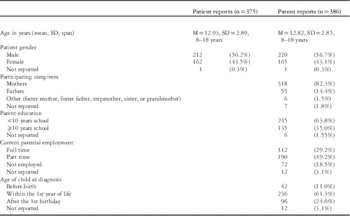
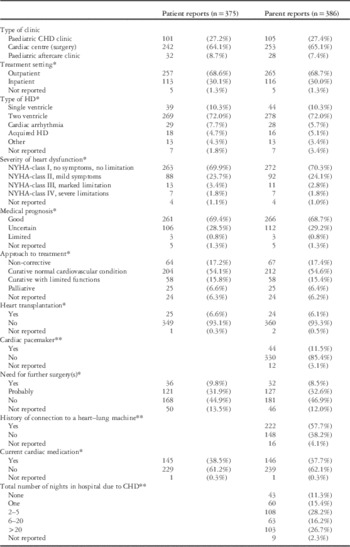
Altogether, 676 children and adolescents with heart disease as well as their parental caregivers who attended the medical centres and fulfilled inclusion criteria were approached to participate in this study. In the end, 375 children and adolescents (response rate 56.1%) and 386 parents (response rate 57.7%) participated in the present study. There were no significant differences in medical and socio-demographic characteristics between responders and non-responders. Table 1 gives the participants’ socio-demographic and socio-economic characteristics. Table 2 gives the participants’ medical characteristics.
Socio-demographic information of the study participants.

Socio-demographic information of subjects based on parent reports
Medical information of the subsamples.

* Medical information of subjects based on physician reports
** Medical information of subjects based on parent reports
Measures
Health-related quality of life
The Pediatric Cardiac Quality of Life Inventory is a disease-specific questionnaire for children and adolescents.Reference Marino, Shera and Wernovsky 4 , Reference Marino, Tomlinson and Wernovsky 50 For this study, the original American-English versions were translated into German using international guidelines for the cross-cultural translation and validation of patient-reported outcomes.Reference Wild, Grove and Martin 51 The German versions showed high internal consistencies (Cronbachs’ α between 0.92 and 0.95).Reference Goldbeck and Borth-Bruns 49 For test–re-test reliability determination, a subgroup of children and adolescents with heart disease, who were outpatients in the first assessment, as well as parents whose children with heart disease were outpatients in the first assessment, were re-assessed after 4–6 weeks. If any significant life event or change in clinical status had occurred between the two time points, these questionnaires were excluded from this analysis. The test–re-test reliability was sufficient with correlations between rtt=0.73 and 0.93.Reference Goldbeck and Borth-Bruns 49 The children’s version (ages 8–12) comprises 27 items on three dimensions: impact of disease, psychosocial impact, and emotional environment. The adolescent version (age 13 and above) comprises 38 items on corresponding dimensions. The two subscales impact of disease and psychosocial impact can be added to a total score, indicating overall health-related quality of life.
Medical and socio-demographic information
Medical variables were collected through a medical case report form filled out by the responsible physician, based on the patient’s medical charts; furthermore, the physicians evaluated the current health status (NYHA-class) and the medical prognosis. The NYHA classification system gives the classification of cardiac insufficiency and is widely used to characterise the severity of cardiac disease.Reference Hoppe, Böhm and Dietz 17 , Reference Goldbeck and Seitz 20 Prognosis was acquired as subjective assessments by the physicians and estimated to be good, uncertain, or limited. Socio-demographic and socio-economic data were provided by the caregivers and the children or adolescents themselves by means of a self-constructed questionnaire.
Statistical analysis
Descriptive analyses were performed for each medical and socio-demographic variable. To meet the current standards in quality of life assessment, the Pediatric Cardiac Quality of Life Inventory total raw scores were transformed linearly into a scale ranging from 0 to 100, with higher values indicating good health-related quality of life.
χ2 tests were computed to investigate differences in terms of disease severity depending on different settings of medical care delivery, such as paediatric CHD clinic, cardiac centre for surgery, and paediatric aftercare clinic.
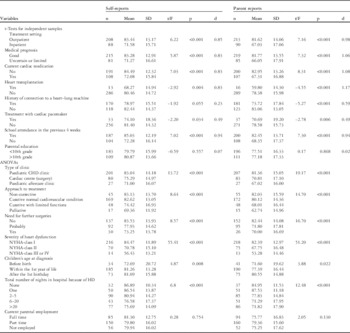
To explore the impact of each separate predictor variable, the hypothesised medical and socio-economic predictor variables were tested on the Pediatric Cardiac Quality of Life Inventory total score separately by bivariate analyses; t-tests for independent samples were used for variables with two characteristics. Between-group effect sizes were computed using Cohen’s d. Univariate analysis of variances were performed for variables with more than two characteristics. The medical or socio-economic variables were used as independent variables, and the health-related quality of life total score was used as a dependent variable. A significance level of α=0.05 was applied (two-sided).
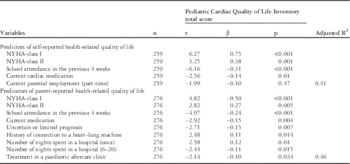
We calculated two separate regression models for parent-reported and self-reported quality of life scores to estimate associations between potential predictors and outcomes. The relationship between CHD and health-related quality of life was explored by multilinear regression analysis with a stepwise inclusion procedure of independent variables (Table 3), which had been pre-selected on the basis of findings from previous studies.Reference Marino, Lipkin and Newburger 5 , Reference Goldbeck and Melches 29 , Reference Drakouli, Petsios, Giannakopoulos, Patiraki, Voutoufianaki and Matziou 37 , Reference Laane, Meberg and Otterstad 52 The Pediatric Cardiac Quality of Life Inventory total score was used as a dependent variable. To estimate associations between each characteristic of the potential predictors, ordinal scaled variables were dichotomised for linear regression analysis. Characteristics of type of clinic, approach to treatment, need for further surgery, severity of heart dysfunction, children’s age at diagnosis, number of nights spent in hospitals, parental education, and current parental employment were coded into 0, 1. Independent variables that met the significance criterion of p<0.10 were entered in multivariate analyses. Those with p<0.05 remained in the final multivariate model. Estimations of model-explained variation were determined by R2 statistics.
Group comparisons of variables impacting health-related quality of life (as indicated by the Pediatric Cardiac Quality of Life Inventory total scores).

ANOVA=analysis of variance
A paired sample t-test was computed to examine differences in mean scores of self-reported and parent-proxy health-related quality of life ratings, patients and parents. A significance level of p<0.05 was applied (two-sided).
Statistical analyses were performed using the software programme IBM Statistical Package for the Social Sciences (SPSS) for Windows Version 21.0.
Results
Disease severity differences depending on different settings of medical care delivery
The following variables were tested: type of heart disease, approach to treatment, heart transplantation, assessment of severity of heart dysfunction via NYHA classification system, physicians’ subjective assessment of medical prognosis, current cardiac medication, number of nights spent in hospitals due to heart disease, cardiac pacemaker, need for further surgery, as well as school attendance over the previous 4 weeks. χ2 Tests showed significant differences with regard to disease severity of heart disease in children treated in a paediatric CHD clinic, cardiac centre for surgery, and a paediatric aftercare clinic (p<0.01).
Factors predicting health-related quality of life
The impact of each hypothesised predictor variable was indicated by bivariate associations with the Pediatric Cardiac Quality of Life Inventory total score (Table 3). Most hypothesised predictor variables indicated that patients with mild disease severity obtained significantly higher Pediatric Cardiac Quality of Life Inventory total scores than patients with at least moderate disease severity. Owing to the known impactReference Hülser, Dubowy, Knobl, Meyer and Schölmerich 43 of health-related quality of life, predictor variables that failed significant associations were not excluded from regression analysis.
According to the first regression model, 42% of the variance in self-reported health-related quality of life (total score) was explained by investigated variables (adjusted R2=0.41; F(5,253)=36.59, p<0.001). According to the second regression model, 47% of the variance in parent-reported health-related quality of life was explained (adjusted R2=0.46; F(9,266)=26.57; p<0.001). Higher Pediatric Cardiac Quality of Life Inventory total scores were predicted by NYHA-class I and NYHA-class II as well as no history of a connection to a heart–lung machine and total number of nights spent in a hospital (once). Lower Pediatric Cardiac Quality of Life Inventory total scores were associated with no school attendance during the previous 4 weeks, current cardiac medication, current parental employment, unsure or limited prognosis, total number of nights spent in a hospital (6–20), and treatment in a paediatric aftercare clinic. All predictor variables indicated that patients with mild disease severity obtained significantly higher Pediatric Cardiac Quality of Life Inventory total scores than patients with at least moderate disease severity. The results of the final prediction models are presented in Table 4.
Prediction of health-related quality of life outcomes by multiple variables.

Comparison between self-reports and parent-proxy ratings
Paired t-tests showed significant mean differences between self-reports and parent-proxy ratings of health-related quality of life (n=249, t=2.73, p<0.01). Children and adolescents reported significantly better health-related quality of life (M=80.3, SD=15.1) than their parents (M=78.7, SD=15.8). There was a strong correlation between self-reported and parent-reported health-related quality of life (rsp=0.82, p<.001).
Discussion
This study investigated the health-related quality of life of children and adolescents with CHD in a clinical population with on average mild-to-moderate disease severity. Participants of the study were diverse regarding their specific diagnosis and their demographic and socio-economic characteristics. The validity of the study findings is strengthened by a large sample size, multicentre recruitment, and the use of a disease-specific measure with good psychometric properties.
As expected and consistent with the literature,Reference Laane, Meberg and Otterstad 52 , Reference Mair, Puga and Danielsson 53 CHD severity as indicated by NYHA classification, treatment history, current treatment, and medical prognoses were significantly associated with health-related quality of life. Among the psychosocial factors, patients’ school attendance was, independently of other factors, associated with health-related quality of life, both from the patients’ and their parents’ perspectives; moreover, parent reports indicated an additional effect of hospitalisation on their children’s health-related quality of life.
The need for frequent medical treatment and the limited psychosocial functioning due to CHD are known to interrupt school attendance. Days off school not only impair academic education and performance but are also associated with social isolation from healthy peers.Reference Gentles, Gauvreau and Mayer 54 Frequency and duration of inpatient treatments as well as type and intensity of medical interventions – for example, medication and connection with a heart–lung machine – predict poorer health-related quality of life.Reference Connolly, McClowry, Hayman, Mahony and Artman 19 , 55 , Reference Casey, Sykes, Craig, Power and Mulholland 56 From the available literature, it is known that children and adolescents especially with complex CHD display poorer school performance because of many hospital stays and neuropsychological dysfunction.Reference Casey, Sykes, Craig, Power and Mulholland 56 School problems and learning difficulties increase with disease severity.Reference Uzark, Jones, Slusher, Limbers, Burwinkle and Varni 31 Owing to physical impairments, some children with CHD are less involved in school activities. They do not participate fully in or are excluded from classroom activities. They do not become members of the class.Reference Granberg, Rydberg and Fisher 30 This is associated with the risk of a negative impact on health-related quality of life.
Significant associations between different settings for the provision of medical care and patients’ health-related quality of life could be demonstrated. Children participating in inpatient paediatric aftercare programmes show significantly greater disease severity as well as significantly lower health-related quality of life, compared with children treated in paediatric CHD clinics and cardiac centres for surgery. It seems that the history of medical treatment and disease severity has a major influence on health-related quality-of-life estimations. Especially children and adolescents participating in inpatient paediatric aftercare programmes undergo more different invasive treatments, and show poorer manifestations of medical variables such as NYHA-class III or IV; therefore, this finding might constitute a selection effect and might reflect different levels of exposure to medical stressors such as hospital stay and associated traumatic experiences according to medical interventionsReference Connolly, McClowry, Hayman, Mahony and Artman 19 , Reference Goldbeck, Melches, Franz, Voßbeck, Lang and Mihatsch 47 in children and adolescents with CHD.
Our study shows that patients and parents have very similar perceptions of patients’ health-related quality of life. A high correlation between self-reports and parent reports could be demonstrated. Previous studies of children with CHD found significant differencesReference Spijkerboer, Utens, De Koning, Bogers, Helbing and Verhulst 33 , Reference Krol, Grootenhuis, Destree-Vonk, Lubbers, Koopman and Last 34 as well as rather low-to-moderate correlations between self-reports and parent reports.Reference Goldbeck and Melches 28 , Reference Goldbeck, Melches, Franz, Voßbeck, Lang and Mihatsch 47 It cannot be ruled out that caregivers and children were aware of each other’s evaluation of health-related quality of life when responding to their own questionnaire, although the instructions advised patients and parents to fill in the questionnaires independently. It may be that parents and children in our study population have similar perceptions owing both to a strong empathy of parents with their child’s situation and to the close connection between them during medical consultations and daily care.
The limitations of our study have to be considered when interpreting and generalising the findings. Our study sample only comprised a small proportion of severely ill children and adolescents. In addition, there is broad empirical evidence for the impact of parental psychological well-being on their children’s psychological adaptation. Reference Beardslee, Versage and Gladstone 57 , Reference Wiegand-Grefe and Petermann 58 Parents of children with CHD show high levels of anxious and depressive symptoms, for example, among parents of children with cystic fibrosis, Reference Besier, Born and Henrich 59 and traumatic symptoms, for example, after cardiac surgery. Reference Franich-Ray, Bright and Anderson 60 Owing to limited resources, we were not able to assess these parental variables. Thus, further research should include more children with a severe disease and should also consider parental symptoms such as anxiety, depression, or post-traumatic stress.
Conclusions
Children and adolescents with CHD can benefit from integration into school. Multiprofessional care teams are highly recommended to address the comprehensive needs of children and adolescents with CHD and consider and monitor their health-related quality of life when planning and evaluating medical treatment and psychosocial interventions. In future, the use of health-related quality of life as an additional outcome variable in clinical studies, as recommended, for example, by the Food and Drug Administration 61 for clinical trials, will probably extend our knowledge on the effects of interventions for children and adolescents with CHD.
Acknowledgements
None.
Financial Support
The present study was supported by the Deutsche Kinderkrebsnachsorge, Stiftung für das chronisch kranke Kind, Villingen-Schwenningen, Germany.
Conflicts of Interest
The authors declare that there are no conflicts of interest.
Ethical Standard
The authors assert that all procedures contributing to this work comply with ethical standards of the relevant national guidelines on human experimentation and with the Helsinki Declaration of 1975, as revised in 2008, and has been approved by the institutional committees (Institutional Review Board at the University of Ulm, Germany).