INTRODUCTION
Plant organic reserves are nitrogen (N) and carbon (C) compounds elaborated and stored in permanent organs of the plant, mainly those remaining after herbage removal, and used as substrates for maintenance during periods of stress and early re-growth of tissues after defoliation (White Reference White1973; Perry & Moser Reference Perry and Moser1974). Those compounds are generally stored in underground and ground-level organs, which include roots, rhizomes, stolons, stem bases and crown (Volenec et al. Reference Volenec, Ourry and Joern1996; Avice et al. Reference Avice, Louahlia, Kim, Jacquet, Morvan-Bertrand, Prud'homme, Ourry and Simon2001), although they may also be stored temporarily in all parts of the plant (White Reference White1973; Perry & Moser Reference Perry and Moser1974). In legumes such as alfalfa, C and N compounds are stored and remobilized from crown and taproot to support shoot growth (Avice et al. Reference Avice, Louahlia, Kim, Jacquet, Morvan-Bertrand, Prud'homme, Ourry and Simon2001). In perennial grass tillers, non-structural carbohydrates (NSC) located in the lower region of the shoots are utilized as an energy source to initiate growth after defoliation until the minimum leaf area required to produce enough photosynthates to sustain plant respiration and growth is achieved (White Reference White1973). In this sense, the contribution of each storage organ to shoot re-growth is reported to differ among species, strategies of grazing management and seasonal climatic conditions (White Reference White1973; Perry & Moser Reference Perry and Moser1974).
The ability of plants to use internal stores of C and N to quickly re-establish photosynthetically active leaf area and restore assimilate supply to meet the demand of the remaining organs is one of the key factors affecting plant survival during early re-growth (Volenec et al. Reference Volenec, Ourry and Joern1996). Although the importance of NSC as an energy reserve during re-growth of perennial temperate grasses has been established previously (Hume Reference Hume1991; Donaghy & Fulkerson Reference Donaghy and Fulkerson1998), there is some debate regarding the relative contribution of NSC and N reserves to plant growth (Mousel et al. Reference Mousel, Schacht, Zanner and Moser2005). The mobilization of reserve compounds may be limited more by N than C stores, since N uptake can be severely reduced or even interrupted for several days after defoliation (Clement et al. Reference Clement, Hopper, Jones and Leafe1978; Jarvis & MacDuff Reference Jarvis and MacDuff1989). According to Gloser et al. (Reference Gloser, Kosvancová and Gloser2007), N reserves can support re-growth of plants after defoliation even under fluctuating external N availabilities. In contrast, Turner et al. (Reference Turner, Donaghy, Lane and Rawnsley2006b ) pointed out that N reserves were found to play a minor role during re-growth of cocksfoot (Dactylis glomerata L.), indicating that the reliance on N as a plant reserve has not been conclusively established. Although they are used as substrates in respiration, N reserves are still not as important as carbohydrate reserves in supporting re-growth (White Reference White1973). However, Ourry et al. (Reference Ourry, Boucaud and Salette1988, Reference Ourry, Bigot and Boucaud1989) and Gloser et al. (Reference Gloser, Kosvancová and Gloser2007) concluded that N compounds are important components interfering with restoration of sward leaf area index (LAI) and growth.
Strategies of grazing management have been developed aiming at controlling timing, severity, frequency and selectivity of defoliation to obtain optimal or desired responses of the vegetation and the grazing animal (e.g. rotational stocking), and considered feasible only if they cause minimal impact on plant vigour (Turner et al. Reference Turner, Donaghy, Lane and Rawnsley2007). Under those circumstances, plant vigour has often been related to the level of available carbohydrates and N reserves stored above and below ground (Reece et al. Reference Reece, Nichols, Brummer and Engel1997). Bell & Ritchie (Reference Bell and Ritchie1989) and Fulkerson & Donaghy (Reference Fulkerson and Donaghy2001) indicated that defoliation interval is generally more important than defoliation severity in determining re-growth. In cocksfoot, Turner et al. (Reference Turner, Donaghy, Lane and Rawnsley2006b ) found that more frequent defoliation resulted in reduced NSC assimilation and, therefore, reduced leaf, root and tiller dry weight during re-growth. On the other hand, defoliation severity may interfere with plant re-growth and persistence (Fulkerson & Slack Reference Fulkerson and Slack1995) by interfering with NSC levels in plant stores. A decrease in NSC levels with low cutting heights was observed on vegetative tillers of prairie and orchard grass by Turner et al. (Reference Turner, Donaghy, Lane and Rawnsley2007), highlighting the importance of determining minimum defoliation heights below which restoration of photosynthetic tissues and growth is impaired and persistence decreased. However, under rigid continuous stocking management, relatively stable LAI is maintained and the physiological role of organic reserves may be questioned, since plants would be capable of sustaining a continuous flux of current assimilates. In that context, organic reserves could be important only when swards are maintained below a minimum LAI and/or when plants are subjected to limiting growth conditions. These are questions fundamentally related to plant physiology and would need adequately controlled experiments to be answered. In the current literature there is virtually no information on carbohydrate and N reserves of forage plants subjected to continuous stocking management, particularly for tropical forage grasses.
Brazil has c. 196 million ha of permanent pasture (FAO 2011), of which c. 0·56 are comprised of cultivated species (IBGE 1996), with marandu palisade grass (Brachiaria brizantha (Hochst. ex A. Rich.) cvar Marandu) representing more than 0·50 of the total (Santos-Filho Reference Santos-Filho, Miles, Maass and Valle1996) and normally used under continuous stocking management. In spite of the importance of marandu palisade grass to pastoral systems of animal production, basic information regarding its morphological and physiological responses to grazing is scarce, particularly those related to the relationship between plant organic reserves (NSC and N compounds) and sward LAI and its influence on plant growth and herbage accumulation. Against that background, and bearing in mind the limitations of a field experiment to deal with this issue, the objective of the present study was to determine a grazing management target for continuously stocked marandu palisade grass that ensures herbage production without depleting plant organic reserves through evaluations of the patterns of variation in LAI, herbage accumulation and carbohydrate and N reserves in shoot and root throughout the year.
MATERIALS AND METHODS
Experimental site
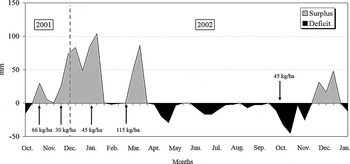
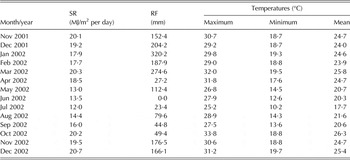
The experiment was conducted at E.S.A. ‘Luiz de Queiroz’ (ESALQ), University of São Paulo, Piracicaba, SP, Brazil (22°42'S, 47°37'W and 550 m a.s.l.), on a marandu palisade grass pasture (Brachiaria brizantha (Hochst. ex A. Rich.) Stapf. cvar Marandu) established in 2001 on a Eutroferric Red Nitosol. The average soil chemical characteristics for the 0–20 cm layer were: pH CaCl2: 5·6; organic matter (OM) = 41 dg/dm3; phosphorus (P) (ion-exchange resin extraction method) = 67 mg/dm3; calcium (Ca) = 74 mmolc/dm3; magnesium (Mg) = 19 mmolc/dm3; potassium (K) = 6·5 mmolc/dm3; hydrogen (H)+aluminium (Al) = 36 mmolc/dm3; sum of bases = 99 mmolc/dm3; cation exchange capacity = 134·8 mmolc/dm3; base saturation = 74%. Climate is sub-tropical with dry winters, with an average annual rainfall of 1328 mm (CEPAGRI 2012). Rainfall, solar radiation and average mean, minimum and maximum temperatures are shown in Table 1 and soil water balance in Fig. 1. A total of 301 kg N/ha and 42 kg K/ha were applied throughout the experimental period according to the following dates and rates: 66 kg N/ha on 7 November 2001, using ammonium nitrate; 30 kg N/ha and 17 kg K/ha on 1 December 2001; 45 kg N/ha and 25 kg K/ha on 10 January 2002, using a commercial N:P:K formula (30:00:20); 115 kg N/ha on 7 March 2002, and 45 kg N/ha on 30 October 2002, using urea.
Monthly soil water balance (calculated at 10-day intervals considering a soil water storage capacity of 50 mm) from November 2001 to December 2002 (arrows correspond to fertilizer application dates and rates).

Monthly solar radiation (SR), rainfall (RF) and averages of maximum, minimum and mean air temperatures on the experimental site from November 2001 to December 2002

Treatments corresponded to four levels of grazing intensity – severe (S), severe/moderate (S/M), moderate (M) and lenient (L) – implemented in the field using bands of sward surface height (SSH – 10, 20, 30 and 40 cm ± 10%, respectively) maintained through continuous stocking and variable stocking rate. These were allocated to experimental units (1200 m2 paddocks) according to a randomized complete block design with four replications. Grazing was carried out by 2-year-old Nelore (Bos taurus indicus) and Canchim (5/8 Charolais (Bos taurus taurus) × 3/8 Zebu (Bos taurus indicus)) heifers with an initial body weight of 280–320 kg. The experimental period started on 8 January and finished on 17 December 2002, totalling 343 days.
Prior to the beginning of measurements, on 28 and 29 August 2001, paddocks were grazed and subsequently mowed to c. 8 cm in preparation for the experiment. All paddocks had animals grazing at the end of October 2001, ensuring a minimum period of 60 days under the grazing regimes imposed before the commencement of measurements on 8 January 2002. Sward height was monitored twice a week (3 and 4 day-intervals) on 20 points per paddock using a thin acetate sheet and ruler (Fagundes et al. Reference Fagundes, Da Silva, Pedreira, Sbrissia, Carnevalli, Carvalho and Pinto1999). Average sward height on paddocks was allowed to vary within a range of 0·1 around the target, with animals being added or removed when the sward height was close to the upper or lower end of the range, respectively.
Measurements
Herbage accumulation, herbage mass and sward leaf area index
Herbage accumulation was determined within four exclosure cages (1·40 × 0·70 m) per experimental unit at 28-day intervals. After each sampling, cages were rotated and anchored on new areas that were considered to be representative of sward condition at the time of sampling (visual assessment of height and herbage mass). Herbage accumulation was calculated as the difference in herbage mass in the cage between the first and last day of exclusion (Davies et al. Reference Davies, Forthergill and Morgan1993). These were determined using calibration curves between sward height and herbage mass, produced in a concomitant set of measurements being made in the same experimental area (Da Silva et al. Reference Da Silva, Gimenes, Sarmento, Sbrissia, Oliveira, Hernadez-Garay and Pires2013) following the procedure described by Da Silva & Cunha (Reference Da Silva and da Cunha2003). Estimates of sward herbage mass were made on a monthly basis using data from the measurements of sward height and the calibration equations.
Leaf area index was determined every 4 weeks for herbage samples collected within four metallic frames (0·30 × 0·37 m) located in areas representative of sward condition at the time of sampling (visual assessment of height and herbage mass). Cuts were made at ground level and a sub-sample was hand-dissected into leaf (leaf laminae), stem (leaf sheath + stem), dead material and weeds. The leaves had their area estimated using the LAI-3100 leaf area integrator (LICOR, Lincoln, Nebraska, USA). After separation, the components were dried in a forced draught oven at 65 °C until constant weight and the results used to calculate LAI.
Additional herbage samples were harvested from the upper layer of the swards (mainly comprised of leaves – Da Silva et al. Reference Da Silva, Gimenes, Sarmento, Sbrissia, Oliveira, Hernadez-Garay and Pires2013) every month, dried in a forced draught oven at 65 °C until constant weight, ground using 1 mm sieve and stored for N content determination and inferences on the N nutrition status of plants (Lemaire et al. Reference Lemaire, Jeuffroy and Gastal2008). Total N (TN) was determined using the volumetric method of micro Kjeldhal (AOAC 1995).
Root and shoot mass and organic reserves
Root and shoot samples were harvested every 4 weeks using a cylinder with 15-cm internal diameter placed onto the plant's crown and introduced into the soil to a depth of c. 20 cm. Six cylinders were harvested per experimental unit from points representative of sward condition at the time of sampling (visual assessment of height and herbage mass). The resulting cylinders (soil containing roots and herbage mass above ground) were taken immediately to the laboratory, where their depth was standardized to 10 cm from ground level by removal and disposal of excess soil and roots. The above-ground herbage was cut at 5 cm from ground level, leaving only the base of the stems (from this point onwards denominated shoot) and discarding the excess material. From the standardized cylinders, the base of stems was cut at ground level to form the shoot samples. Because of variations in the contents of reserve carbohydrate and nitrogenous compounds in storage organs throughout the day, samples were consistently harvested between 06:00 and 10:00 h.
Shoot samples were washed using running water, divided into two sub-samples and placed on aluminium trays, which were put aside to dry; one under shade and the other in a forced draught oven at 100 °C during the first hour (in order to stop respiration and enzymatic processes) and at 65 °C afterwards until constant weight. The remaining part of the cylinder, containing soil and roots, was washed on 300 mm sieves using pressurized water in order to separate roots from dirt. After washing, roots were also divided up into two sub-samples and placed on aluminium trays, which followed the same drying procedure described above for shoot samples. Root and shoot mass were calculated using the diameter of the sampling cylinder as reference.
After drying, shoot and root samples were weighed, ground using a 1 mm sieve and stored for chemical analysis. Non-structural carbohydrates were determined using acid digestion of samples by sulphuric acid and precipitation of carbohydrates by copper sulphate (Smith Reference Smith1969 modified by Silva Reference Silva and Silva1981). Total N was determined using the volumetric method of micro Kjeldhal (AOAC 1995). Soluble N was determined indirectly as the difference between total N and insoluble N. Insoluble N content was determined after washing of samples to eliminate soluble N, using the same procedure described above for total N.
Data processing and statistical analysis
Data were collected monthly but results were pooled into seasons of the year as follows: summer (January to March), autumn (April to June), winter (July and August), early spring (September and October) and late spring (November and December). Grouping using 2-month data from July onwards was done as a means of separating September and October into a single group, since the pattern of variation in herbage accumulation rates in those months was very distinct. Analysis of variance was carried out on the grouped data using the Mixed Procedure of SAS® (SAS Inst., Cary, NC, USA) and the restricted maximum likelihood (REML) method. For the data set comprised of sward structural characteristics – LAI, herbage mass and herbage accumulation rates – season of the year was analysed as repeated measure and the correlation/covariance matrices tested were: compound symmetric (CS), first-order autoregressive (AR(1)), heterogeneous first-order autoregressive (ARH(1)), first-order autoregressive moving-average (ARMA(1,1)) unstructured (UN), Huynh-Feldt (HF), toeplitz (TOEP), heterogeneous toeplitz (TOEPH) and standard variance components (VC). The model used considered grazing intensity, blocks and season of the year as variation causes. For the dataset comprised of organic reserves – NSC and total and soluble N (concentration and content) – season of the year and plant compartment (root and shoot) were analysed as doubly repeated measures (Piepho et al. Reference Piepho, Büchse and Richter2004) and the correlation/covariance matrices tested were: UN@AR(1), UN@CS and UN@UN. In this case the model used considered grazing intensity, blocks, plant compartment and season of the year as variation causes. The subject was defined by nesting the treatment factor into blocks. The choice of the correlation/covariance matrix was made using the Schwarz's Bayesian Criterion (SBC or BIC in SAS) (Littell et al. Reference Littell, Pendergast and Natarajan2000). The correction for degrees of freedom was made by the Kenward & Roger (Reference Kenward and Roger1997) method (SAS command: DDFM = KR) and the analysis performed considering grazing intensity, plant compartment (root and shoot), season of the year and their interactions and blocks as fixed effects (Piepho et al. Reference Piepho, Büchse and Richter2004). The SLICE command was used in cases of significant interactions and, when appropriate, means were calculated using the ‘LSMEANS’ statement and comparisons made using the Student test at P < 0·05.
RESULTS
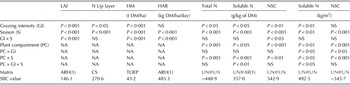
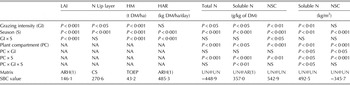
A summary of the statistics and the results from the analysis performed in the data set is presented in Table 2. Additionally, information is given regarding the choice and type of correlation/covariance matrices used for each response variable studied.
Summary of the statistical analysis, matrices used for modelling correlation/covariance structures and values of the Schwarz's Bayesian Criterion (SBC) used to choose them
NS, not significant; NA, not applicable.
Sward herbage mass and nitrogen content of the upper layer
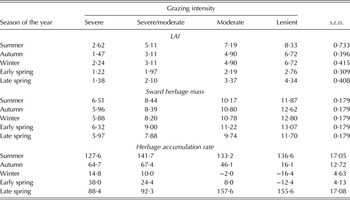
Throughout the experiment, sward herbage mass progressively decreased as grazing intensity (GI) increased. For the severe grazing treatment, herbage mass was higher during summer and early spring, with lower similar values during autumn, winter and late spring. For swards subjected to the severe/moderate grazing treatment, the highest and lowest values were recorded during early and late spring, respectively, while intermediate similar values were recorded during the remaining seasons of the year. For swards subjected to the moderate and lenient grazing treatments, herbage mass increased from summer to early spring, decreasing during late spring when the lowest values were recorded (Table 3).
Leaf area index, sward herbage mass (t DM/ha) and herbage accumulation rate (kg DM/ha per day) of marandu palisade grass subjected to intensities of continuous stocking management throughout the year. s.e.d., standard error of difference; degrees of freedom for the grazing intensity x season of the year interaction = 12 for all variables; n = 4

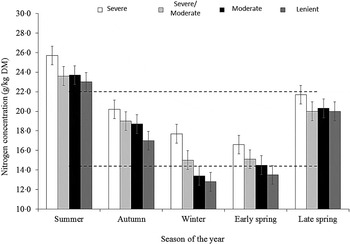
The N concentration of the upper layer was higher during late spring and summer, lower during winter and early spring and intermediate during autumn (24·0, 18·7, 14·7, 14·9 and 20·4 ± 0·49 g/kg for summer, autumn, winter, early and late spring, respectively) (Fig. 2). The N concentration of the severe grazing treatment was similar to that of the severe/moderate grazing treatment, but higher than that of the moderate and lenient grazing treatments (20·4, 18·6, 18·1 and 17·3 ± 0·64 g/kg for S, S/M, M and L treatments, respectively).
Nitrogen concentration (g/kg of DM) of the upper layer of marandu palisade grass swards subjected to intensities of continuous stocking management throughout the seasons of year. Dotted lines represent N critical level from 14·4 to 22·0 g/kg (Batista & Monteiro Reference Batista and Monteiro2007). Bars represent s.e.m., n = 4.

Sward leaf area index and rates of herbage accumulation
Sward LAI was larger for swards subjected to the lenient grazing treatment throughout the year, with similar values recorded for those subjected to the moderate grazing treatment during summer and early spring. The largest values were recorded in summer for swards subjected to the severe/moderate, moderate and lenient grazing treatments, and decreased progressively until early spring, when the lowest values were recorded. For swards subjected to the severe grazing treatment, the largest values were recorded in summer and winter, followed by those recorded in autumn, early spring and late spring. The LAI started to increase in late spring, although recorded values were still lower than those recorded in summer. It increased by 57 and 54% from early to late spring for swards subjected to lenient and moderate grazing treatments, contrasting with only 6·6 and 13·1% for those subjected to the severe/moderate and severe grazing treatments (Table 3).
A seasonal effect was observed on rates of herbage accumulation (HAR) for all intensities of grazing, with larger values recorded during summer and late spring and lower values recorded during winter and early spring. There was no difference among GI treatments during summer. For autumn, winter and early spring, lower values were recorded for swards subjected to the lenient grazing treatment. However, swards subjected to the moderate and lenient grazing treatments showed larger values than those subjected to the severe and severe/moderate grazing treatments during late spring (Table 3).
Concentration of nitrogen compounds
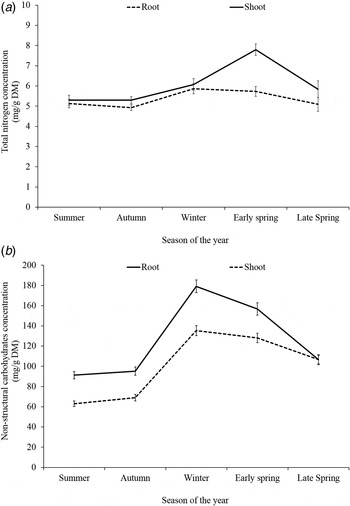
Total N concentration for the whole plant was higher for swards subjected to the severe grazing treatment (6·4 ± 0·29 mg/g DM), with no differences observed among severe/moderate, moderate and lenient grazing treatments (5·2 ± 0·29, 5·5 ± 0·29 and 5·6 ± 0·29 mg/g DM to severe/moderate, moderate and lenient, respectively). The highest values of TN concentration in roots (TNR) were recorded in winter and early spring, decreasing 11·2% in late spring. Total N concentration in shoot (TNS) increased from summer to early spring, when the highest value was recorded (7·8 ± 0·25 mg/g), and decreased by around 25% in late spring. Higher values of TN were observed in shoot during autumn, early and late spring, with similar values between plant compartments during the remaining seasons of the year (Fig. 3(a)).
Concentration of total N (a) and NSC (b) of marandu palisade grass subjected to intensities of continuous stocking management throughout the seasons of year. Bars represent s.e.m., n = 16.

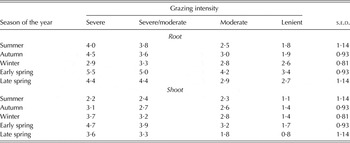
The concentration of soluble nitrogen (SN) was slightly higher in the root than in the shoot compartment for all seasons of the year, except for swards subjected to the severe grazing treatment during winter. Similar concentrations of SN in root (SNR) among GI treatments were observed during summer, winter and late spring. During autumn and early spring differences were observed only between swards subjected to the severe and lenient grazing treatments, with higher values recorded for the former. The values of SNR in swards subjected to the severe grazing treatment decreased from summer to winter, but increased 91·7% in early spring. In this season, the highest values of SNR were observed for all GI treatments. From early to late spring, values decreased by c. 20 and 30% in swards subjected to the severe and moderate grazing treatments, respectively, but remained stable for the severe/moderate and lenient grazing treatments.
There was no difference in the concentration of SN in shoot (SNS) among GI treatments during summer (average of 2·0 ± 0·40 mg/g) and autumn (average of 2·5 ± 0·33 mg/g), but a clear contrast between the severe and severe/moderate grazing with the lenient grazing treatment was recorded in winter, early and late spring, with lower values recorded for swards subjected to the lenient grazing treatment (Table 4). Values of SNS increased from summer to early spring for swards subjected to the severe and severe/moderate grazing treatments, and decreased by c. 24% in late spring on those subjected to the severe grazing treatment. For the moderate grazing treatment, higher values were observed during early spring compared to autumn and late spring. No differences were registered during summer, autumn, winter and early spring for the lenient grazing treatment, but values decreased by 55·9% in late spring.
Concentration of SN (mg/g DM) of root and shoot in marandu palisade grass subjected to intensities of continuous stocking management throughout the year. s.e.d., standard error of difference; degrees of freedom for the grazing intensity x season of the year x plant compartment interaction = 12; n = 4

Concentration of non-structural carbohydrates
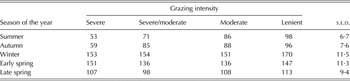
The concentration of NSC was higher in the root than in the shoot compartment from summer to early spring, with similar values between compartments during late spring (Fig. 3(b)). Higher values were observed during winter for the root, and winter and early spring for the shoot compartment. For both compartments, lower values were recorded during summer and autumn. During summer and autumn, lower values were recorded for swards subjected to the severe grazing treatment. There were no differences among GI treatments (Table 5) during winter (157 ± 4·1 mg/g), early (142 ± 4·0 mg/g) and late spring (107 ± 3·3 mg/g).
Concentration of NSC (mg/g DM) of marandu palisade grass subjected to intensities of continuous stocking management throughout the seasons of year. s.e.d., standard error of difference; degrees of freedom for the grazing intensity × season of the year interaction = 12; n = 8

Pools of non-structural carbohydrates and soluble nitrogen
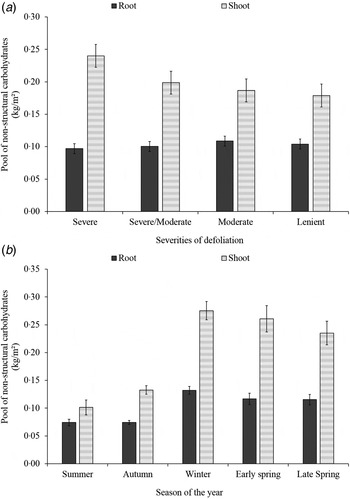
The pool of NSC (kg/m2) in the root compartment was similar among the GI treatments. On the other hand, in the shoot compartment larger values were recorded for swards subjected to the severe compared to those subjected to the moderate and lenient grazing treatments. The pool of NSC was larger in the shoot than in the root compartment regardless of GI treatments and season of the year (Fig. 4(a) and ( b )). In relation to the seasons of the year, the pools of NSC were 36·6, 78·6, 108·4, 123·7 and 103·9% larger for the shoot relative to the root compartment in summer, autumn, winter, early and late spring, respectively. In relation to the grazing intensities, the pools of NSC were 147·3, 99·0, 71·6 and 72·1% larger for the shoot relative to the root compartment for the severe, severe/moderate, moderate and lenient grazing treatments, respectively. For both compartments, the values increased from summer to winter, remaining stable until late spring.
Pool of NSC in shoot and roots of marandu palisade grass subjected to intensities of continuous stocking management throughout (a) according grazing intensities (n = 8). Bars represent s.e.m. and (b) the seasons of year (n = 16)

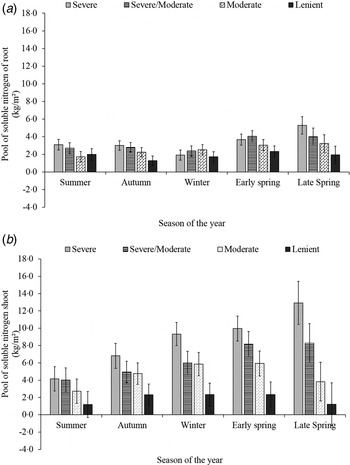
The pool of soluble N (kg/m2) in the root compartment was similar among the GI treatments during summer, winter and early spring. In autumn and late spring, larger values were recorded for swards subjected to the severe compared to those subjected to the lenient grazing treatment. Larger values were recorded during early spring for the severe and severe/moderate grazing treatments. There was no difference among seasons of the year for the moderate grazing treatment. For the lenient grazing treatment, differences were observed only in autumn and early spring, with lower values for the former (Fig. 5(a)). The pool of soluble N in the shoot compartment was similar among the GI treatments during summer only. For autumn, winter and late spring larger values were recorded for the severe relative to the lenient grazing treatment, and in early spring larger values were recorded for the severe/moderate relative to the lenient grazing treatment. For swards subjected to the severe and severe/moderate grazing treatments, values increased from summer to winter, remaining stable from then onwards. For swards subjected to the moderate grazing treatment, the lowest value was recorded during summer, with no differences among the remaining seasons of the year. There was no difference among seasons of the year for swards subjected to the lenient grazing treatment (Fig. 5(b)). The pool of soluble N was larger in the shoot than in the root compartment for the severe, severe/moderate and moderate grazing treatments, with differences between plant compartments increasing as intensity of grazing increased. For the lenient grazing treatment, larger values were recorded for the shoot compartment during autumn and winter and for the root compartment during summer and late spring. In early spring there was no difference between plant compartments.
Pool of SN of marandu palisade grass subjected to intensities of continuous stocking management throughout the seasons of year. (a) SN of root, and (b) SN of shoot. Bars represent s.e.m., n = 4.

DISCUSSION
Under intermittent stocking, forage plants have a well-known temporal pattern of mobilization and utilization of organic reserves, and the critical role of carbohydrates and N reserves from root and shoot as substrates for re-growth was advocated long ago (Morvan-Bertrand et al. Reference Morvan-Bertrand, Boucaud and Prud'homme1999). For such a grazing method, the severity of defoliation affects root growth although the effect may be compensated by increased N uptake per unit of root weight in certain species (Thornton & Millard Reference Thornton and Millard1997). For Lolium perenne L., increasing defoliation severity increased the relative contribution of roots in supplying mobilized N to growing leaves and decreased the relative contribution of adult leaves (Lestienne et al. Reference Lestienne, Thornton and Gastal2006). Turner et al. (Reference Turner, Donaghy, Lane and Rawnsley2006a ) demonstrated that frequent defoliation of cocksfoot (Dactylis glomerata L.) resulted in reduced water-soluble carbohydrate assimilation and, therefore, leaf, root and tiller dry matter accumulation during subsequent periods of re-growth. However, under continuous stocking the relative importance of storage organs (roots and shoot) and compounds (C or N) to the supply of assimilates and maintenance of growth for contrasting intensities of defoliation (targets of grazing management) are not clearly described in the literature, particularly for tropical forage species.
According to White (Reference White1973), the major storage areas of carbohydrate reserves in perennial grasses are usually the lower regions of the stems (stem bases), stolons, crowns and rhizomes. However, Perry & Moser (Reference Perry and Moser1974) demonstrated that the relative importance of plant parts as storage organs vary with plant species in relation to both NSC concentration and organ size. The results from the present study show that although the NSC (Fig. 3) and soluble N (Table 4) concentration were higher in the root compartment, the shoot compartment represented the major pool of NSC and soluble N regardless of the grazing intensities used (Figs 4 and 5).
Under intermittent stocking, the shoot includes fully expanded leaf material (mainly leaf sheaths) as well as the (enclosed) basal, immature parts of expanding leaves and leaf primordia at the apex of the tiller base. The former may serve as a source for mobilized C and N, whereas the latter generate the new foliage, and may act as sinks (Schnyder & De Visser Reference Schnyder and De Visser1999). In that context, the role of shoot as storage organ decreases as defoliation severity increases (Lestienne et al. Reference Lestienne, Thornton and Gastal2006), with initial growth becoming more dependent on reserves mobilized from roots. Based on the available information in the literature for forage plants under intermittent stocking, it was expected that increases in grazing intensity should result in increasing importance of the root compartment as reserve supplier. However, since under continuous stocking a relatively constant proportion of the sward leaf area is removed (Mazzanti & Lemaire Reference Mazzanti and Lemaire1994), the remaining leaf area may be sufficient for supplying assimilates. This is in line with the results of Carvalho et al. (Reference Carvalho, Da Silva, Sbrissia, Fagundes, Carnevalli, Pinto and Pedreira2001) for cultivars of Cynodon sp. managed under continuous stocking at 5, 10, 15 and 20 cm using a similar protocol to the one used in the current experiment: their results showed larger depletion of NSC pool in shoot during periods of active plant growth (November to March), while the NSC pool in roots was not affected by the grazing intensities used, only by season of the year.
The LAI was lower on swards subjected to the more intense grazing regimes (severe and severe/moderate), but there was no difference among GI treatments in relation to the pool of NSC in the root compartment. In addition, similar values to the pool of soluble N in the root were verified during summer, winter and early spring (Fig. 5(a)). On the other hand, the pool of NSC in shoot was larger on swards subjected to the severe and severe/moderate grazing treatments relative to those subjected to the moderate and lenient grazing treatments (Fig. 4(b)). Sbrissia et al. (Reference Sbrissia, Da Silva, Sarmento, Molan, Andrade, Gonçalves and Lupinacci2010), in a concomitant experiment in the same experimental area, reported higher rates of tiller appearance and larger tiller population density for swards subjected to the severe and severe/moderate grazing treatments. This indicates that under severe grazing, swards were capable of compensating the reduced leaf area through a larger population of younger tillers and, probably, higher photosynthetic efficiency. The integration of results from the current experiment and those from Sbrissia et al. (Reference Sbrissia, Da Silva, Sarmento, Molan, Andrade, Gonçalves and Lupinacci2010) suggests that under continuous stocking and no soil fertility limiting conditions, herbage accumulation is sustained mainly by current assimilates produced by the shoot rather than organic reserves mobilized from the root, a condition in which the quality of the sward leaf area is crucial for maintaining plant growth. This hypothesis is corroborated by the larger pool of SN in the root compartment of swards subjected to the severe grazing treatment relative to those subjected to the lenient grazing treatment in autumn and late spring, and in the shoot compartment of swards subjected to the severe and severe/moderate grazing treatments from autumn until late spring.
The accumulation of organic reserves in plants is seasonal, increasing during autumn and early winter and rapidly declining with the beginning of the new growing season in spring (Corre et al. Reference Corre, Bouchart, Ourry and Boucaud1996). During summer, the concentration of NSC was lower on swards subjected to the severe and severe/moderate grazing relative to those subjected to the moderate and lenient grazing treatments. However, they were capable of restoring NSC levels during autumn and winter, with no differences among GI treatments during winter, early and late spring. A similar seasonal pattern of response was reported by Carvalho et al. (Reference Carvalho, Da Silva, Sbrissia, Fagundes, Carnevalli, Pinto and Pedreira2001) in an analogous experiment with Cynodon sp. subjected to intensities of continuous stocking management.
The N concentration of the upper layer of swards decreased from summer to early spring. Although the decrease was observed for all GI treatments, values were smaller than 14·4 g/kg, the critical level for N nutrition of marandu palisade grass (Batista & Monteiro Reference Batista and Monteiro2007), on swards subjected to the moderate and lenient grazing treatments during winter and early spring (Fig. 2). As the plant grows and herbage mass increases, the N concentration in plant tissues decreases, even when there is an unlimited supply of N (Lemaire et al. Reference Lemaire, Jeuffroy and Gastal2008). Such a decrease is the result of larger deposition of structural tissues than necessary to support plant weight and architecture, which have low N concentration. This is in agreement with the observed variations in concentration of SN in shoot among the GI treatments, according to which swards subjected to the severe and severe/moderate grazing treatments showed higher values during winter, early and late spring relative to those subjected to the lenient grazing treatment. Limiting climatic conditions, particularly soil water deficit, interfere negatively with N uptake and mineralization of soil organic matter by reducing microbial activity. In that context, since the supply of N is limited, internal recycling may become the main source of nutrients to plants. Under those conditions, proteins and free amino acids may be used as reserve compounds. Considering that the largest proportion of N is immobilized as structural components due to the higher herbage mass, and given the limited N supply at that time of the year, the negative impact on plant N nutrition was larger on swards subjected to the lenient grazing treatment. This is in line with the results of herbage accumulation, since recorded values were lowest during winter and early spring and even negative for swards subjected to the moderate and lenient grazing treatments. In late spring, LAI and HAR increased relatively more on swards subjected to the moderate and lenient grazing relative to those subjected to the severe and severe/moderate grazing treatments, demonstrating recovery of their growth potential when growth conditions were restored and the N was supplied via fertilization (45 kg N/ha in 30 October 2002).
On the other hand, since plants were not stimulated to grow in winter and early spring, carbohydrates were concentrated in plant tissues, resulting in the highest recorded values of NSC concentration throughout the experiment (Fig. 3(b)). Under those conditions, plant growth was favoured on swards subjected to the severe and severe/moderate grazing treatments, since they showed the highest values of HAR. Swards subjected to the moderate and lenient grazing treatments had larger LAI than those subjected to the severe grazing treatment, a condition that, in theory, would favour photosynthesis and growth (Booysen & Nelson Reference Booysen and Nelson1975; Grant et al. Reference Grant, Barthram and Torvell1981). However, during winter and early spring the low values of HAR of swards subjected to the moderate and lenient grazing treatments indicate that leaves were generally old and less photosynthetically active, therefore unlikely to contribute substantially to growth (Gifford & Marshall Reference Gifford and Marshall1973; Woledge Reference Woledge1977; Gay & Thomas Reference Gay and Thomas1995). Generally, when management of continuously stocked swards is not adequate, canopy photosynthesis is reduced because of reduced photosynthetic efficiency of old leaves (Parsons Reference Parsons, Jones and Lazenby1988; Hernandez-Garay et al. Reference Hernandez-Garay, Matthew and Hodgson2000) and accumulation of stem and senescent material in sward herbage mass.
Marandu palisade grass is known for presenting very slow growth during the transition from winter to early spring. Although SN concentration increased from winter to early spring in both compartments, the concentration of NSC in the root compartment decreased by c. 12·5%. A larger reduction in the concentration of NSC was recorded for the lenient grazing treatment (Table 5). The decrease in NSC concentration was the result of the reduction in the NSC pool mainly in root (which decreased by 11·7%) relative to shoot compartment (decrease of 5·3%). That could be associated with mobilization of organic reserves from the roots, including root death, a condition in which the dependence of plants on the external supply of nutrients (fertilization) would be greater due to the reduction in root mass and exploited soil volume.
The proportion of SN relative to TN in the shoot compartment remained relatively stable throughout the seasons of the year (values varying from 38 to 46%), but increased in the root compartment from winter to early spring (59, 65, 50, 79 and 71% during summer, autumn, winter, early and late spring). Free amino acids have been identified as the major storage form of N in roots. In the Euphorbiaceae family, proteins also accumulate during the autumn and winter months, although the pool of free amino acids is larger (Bewley Reference Bewley2002). These may be the more predominant source of N during the resumption of spring growth, a time of intense turnover in the tiller population (Sbrissia et al. Reference Sbrissia, Da Silva, Sarmento, Molan, Andrade, Gonçalves and Lupinacci2010) as well as in roots, as the result of the improving environmental conditions and higher N mineralization. Under those conditions, increases in soluble N in roots relative to TN may represent higher N uptake from the soil, highlighting the importance of adequate fertilization programmes.
In late spring, clear contrasts for LAI and HAR were recorded, particularly for the severe and lenient grazing treatments. The results indicate that even when maintaining higher soluble N concentration in shoot, herbage accumulation was limited by the reduced leaf area of the severe grazing treatments. Therefore, under continuous stocking, targets of grazing management that maximize herbage accumulation throughout the year must ensure an adequate balance between quantity and quality of sward leaf area. This condition was obtained by the severe/moderate and moderate grazing intensities, and corresponded to management heights between 20 and 30 cm.
Thanks are due to Dr Gerson Barreto Mourão, from University of São Paulo, for the valuable comments and advices regarding the statistical analysis of the data, to Fundação de Amparo à Pesquisa do Estado de São Paulo (FAPESP) and Conselho Nacional de Desenvolvimento Científico e Tecnológico (CNPq) for the financial support and to the research team at USP/ESALQ, Brazil.