Introduction
Irritability, a behavioral pattern characterized by anger in response to frustration, is a symptom of several pediatric mental disorders including disruptive mood dysregulation disorder (DMDD; Kircanski et al., Reference Kircanski, Clayton, Leibenluft and Brotman2018), oppositional defiant disorder (ODD; Burke et al., Reference Burke, Boylan, Rowe, Duku, Stepp, Hipwell and Waldman2014), generalized anxiety disorder (Stoddard et al., Reference Stoddard, Stringaris, Brotman, Montville, Pine and Leibenluft2014), and depression (Savage et al., Reference Savage, Verhulst, Copeland, Althoff, Lichtenstein and Roberson-Nay2015; Stringaris et al., Reference Stringaris, Cohen, Pine and Leibenluft2009; Vidal-Ribas et al., Reference Vidal-Ribas, Brotman, Valdivieso, Leibenluft and Stringaris2016). In childhood, severe, chronic irritability is impairing and predicts risk for later psychopathology (Leibenluft & Stoddard, Reference Leibenluft and Stoddard2013; Pagliaccio et al., Reference Pagliaccio, Pine, Barch, Luby and Leibenluft2018; Wakschlag et al., Reference Wakschlag, Choi, Carter, Hullsiek, Burns, McCarthy, Leibenluft and Briggs-Gowan2012, Reference Wakschlag, Estabrook, Petitclerc, Henry, Burns, Perlman, Voss, Pine, Leibenluft and Briggs-Gowan2015). While parenting relates to children’s irritability (Dougherty et al., Reference Dougherty, Smith, Bufferd, Stringaris, Leibenluft, Carlson and Klein2013; Krieger et al., Reference Krieger, Leibenluft, Stringaris and Polanczyk2013), most work investigating associations between parenting and irritability focuses on parental control behaviors, such as discipline and reinforcement contingency (McLeod et al., Reference McLeod, Wood and Weisz2007; Silk, Reference Silk2003). Less research examines the impact that parental responses to children’s emotions (i.e., emotion socialization; Katz & Gottman, Reference Katz and Gottman1997) have on irritability. The present study examined longitudinal trajectories of irritability in early childhood across ages 2–7 and the moderating effects of both parental emotion socialization and control behaviors on risk for irritability in adolescence at age 12.
Considerable research has demonstrated that parental control behaviors, such as consistent reinforcement (Barkley, Reference Barkley2013; Comer et al., Reference Comer, Chow, Chan, Cooper-Vince and Wilson2013; Kazdin, Reference Kazdin2010), decrease disruptive behaviors. Nevertheless, in examining relations between parenting and irritability, it is important to consider parenting behaviors related to emotion. Indeed, irritability has longitudinal and genetic associations to emotional disorders, such as anxiety and depression (Stoddard et al., Reference Stoddard, Stringaris, Brotman, Montville, Pine and Leibenluft2014; Stringaris et al., Reference Stringaris, Cohen, Pine and Leibenluft2009; Stringaris et al., Reference Stringaris, Zavos, Leibenluft, Maughan and Eley2012). Therefore, examining parental emotion socialization behaviors (e.g., minimizing child’s sadness) may provide unique insight into parenting behaviors that impact irritability in children. This is particularly central to identifying targets for adapting current parenting interventions to make them better suited for helping children with high stable irritability.
Parenting behaviors in response to children’s emotions include modeling, acknowledging, supporting, guiding children’s emotional responses, and emotion coaching (Katz & Gottman, Reference Katz and Gottman1997). Considerably less work has examined the relation between this dimension of parenting and child irritability. The work that has been conducted in this area focuses on child externalizing behaviors generally, not irritability per se (Eisenberg et al., Reference Eisenberg, Losoya, Fabes, Guthrie, Reiser, Murphy, Shepard, Poulin and Padgett2001; Havighurst et al., Reference Havighurst, Wilson, Harley, Prior and Kehoe2010). This work demonstrates that children whose parents respond negatively to their distress experience more anger and more difficulty regulating their emotions (Dunsmore et al., Reference Dunsmore, Booker and Ollendick2013; Katz & Windecker-Nelson, Reference Katz and Windecker-Nelson2004; Shipman et al., Reference Shipman, Schneider, Fitzgerald, Sims, Swisher and Edwards2007). In contrast, in young children (ages 30–33 months) with poor effortful control and high anger proneness, appropriate maternal responsiveness reduces externalizing problems and promotes compliance at age 40 months (Kochanska & Kim, Reference Kochanska and Kim2013; Wiggins et al., Reference Wiggins, Mitchell, Stringaris and Leibenluft2014). While this suggests that parental emotion socialization influences anger up to several months later, it remains unknown whether parental emotion socialization influences longer-term trajectories of irritability.
Unlike other socialization behavior, parental control behaviors include the extent to which parents exhibit behaviors such as disciplining, monitoring, and autonomy granting (Kiff et al., Reference Kiff, Lengua and Zalewski2011). For instance, engaging in inconsistent discipline, excessive monitoring, or low autonomy granting may be considered as high negative control behaviors. Negative parental control behaviors such as inconsistent discipline predict irritability in youth between the ages of 8 and 11 after controlling for prior levels of irritability and parenting (Lengua & Kovacs, Reference Lengua and Kovacs2005). Parental overprotection also relates to internalizing and externalizing problems in 9- to 12-year-olds (Roelofs et al., Reference Roelofs, Meesters, ter Huurne, Bamelis and Muris2006). Further, leniency in parental control and inconsistent monitoring negatively impact children’s development of emotional and behavioral regulation (Hart et al., Reference Hart, Newell, Olsen, Greene and Burleson2003).
To examine how parenting relates to developmental trajectories of irritability, the current study made use of the Temperament Over Time dataset, a large longitudinal dataset of temperament and clinical outcome measures. Specifically, we tested whether parents’ responses to children’s negative emotions (e.g., sadness, anger, etc.) at age 7 (assessed using the Coping with Children’s Negative Emotions Scale [CCNES]) moderated the relations between early childhood irritability from ages 2–7 (assessed using the Child Behavior Checklist [CBCL]) and adolescent irritability at age 12 (assessed using the Affective Reactivity Index [ARI]). We also tested whether parental control behaviors at age 5 (assessed using the Child Rearing Practices Report [CRPR]) moderated the relation between early childhood irritability and adolescent irritability. We hypothesized that highly irritable children may be particularly sensitive to both positive and negative environmental influences (Pluess & Belsky, Reference Pluess and Belsky2010). If this were the case, then highly irritable children who experience negative parental emotion socialization and negative parental control behaviors would exhibit greater irritability in adolescence. Conversely, positive parental emotion socialization and positive control behaviors would buffer the effects of early childhood irritability on adolescent irritability. Alternatively, it could be that highly irritable children are more likely to experience irritability in adolescence only in the context of negative parenting behaviors (Belsky et al., Reference Belsky, Hsieh and Crnic1998; Brooker & Buss, Reference Brooker and Buss2014; Zuckerman, Reference Zuckerman and Zuckerman1999) and that positive behaviors do not act as a buffer.
Method
Participants
The large longitudinal study from which this sample was drawn recruited families with 4-month-old infants. Seven hundred and seventy-nine full-term, typically developing infants were screened at 4-months of age for temperamental reactivity to novel visual and auditory stimuli (Fox et al., Reference Fox, Henderson, Rubin, Calkins and Schmidt2001; Hane et al., Reference Hane, Fox, Henderson and Marshall2008). Infant behavior was coded on three dimensions during the presentation of the novel stimuli: motor activity, positive affect, and negative affect to determine reactivity. Of the 779 infants recruited, 291 were selected based on their reactivity for longitudinal follow-up. The selected sample was comprised of 105 infants exhibiting negative reactivity (i.e., infants who scored high on motor arousal and negative affect), 103 exhibiting positive reactivity (i.e., infants who scored high on motor arousal and positive affect), and 83 were a part of a non-reactive control group (i.e., scoring at the mean on all three dimensions). No indices of irritability (i.e., early childhood irritability data from ages 2–7 and adolescent irritability at age 12) differed as a function of reactivity at 4 months (ps > .135). Infants in this selected sample (N = 291) were followed annually from age 2 to 5 and every 2 years from age 7 to 12. Participants were primarily white (64%) and initially (i.e., at 4-months) from two-parent, middle- to upper-class families.
Data loss
Supplemental Table 1 illustrates the sample sizes (out of 291) that completed each questionnaire measure of interest. However, notably, individuals who provided data at one time point were not necessarily the same individuals who provided data at another time point. While overall attrition rates were low, there was data loss for the questionnaire measures of interest. All participants were provided the opportunity to fill out the CBCL and parenting questionnaires. Data loss for these measures was due to failure to fill out the questionnaire. In contrast, the 12-year ARI was only administered to those individuals who elected to participate in an magnetic resonance imaging visit.
Data analyses were conducted on individuals who provided complete data for all timepoints of interest (although see the Supplement for a detailed description of missing data, discussion of the choice to use listwise deletion, the impact that listwise deletion may have on these analyses, and replicated analyses using multiple imputation). Of the 234 individuals who provided CBCL data for irritability trajectories from age 2–7 years, 185 provided data on parental emotion socialization behavior and parental control behavior. Of the 185 individuals who provided both CBCL and parenting behavior data, 82 also completed the ARI, a clinical measure of irritability, at the 12-year visit. Since the sample size of the low increasing irritability trajectory was n = 4 (see Table 1 for number of participants in each of the four irritability trajectories identified), we removed this group from all analyses. The sample for the moderation analyses thus comprised of 78 children with data on early childhood irritability, adolescent irritability, and parental emotion socialization and control behavior (see Table 2 for descriptive statistics for key study variables). Children who did and did not provide data at all timepoints were largely comparable. However, those who did and did not provide usable ARI data at age 12 did differ in terms of sex – significantly more females (compared to males) provided ARI data (p = .032). There were no other differences on any other measure of interest or in terms of maternal education (ps > .117).
Irritability class membership for participants with parenting behavior data

Descriptive statistics for key study variables

Note. CCNES = coping with children’s negative emotions scale. CRPR = child rearing practices report. ARI = affective reactivity index (mean parent- and child-report).
Measures
Early childhood irritability
To capture individual differences in irritable temperament, we examined developmental trajectories of irritability using the CBCL (Achenbach & Edelbrock, Reference Achenbach and Edelbrock1983) administered at ages 2, 3, 4, 5, and 7 years. The preschool version of the CBCL for Ages 1.5–5 was administered at ages 2, 3, 4, and 5, and the childhood version of the CBCL for ages 6–18 was administered at age 7. Items on the CBCL ask parents to reflect on their child’s behavior over the past 6 months and to rate each of the items on the questionnaire (preschool version consisted of 99 items and childhood version consisted of 113 items) on a 3-point Likert scale (0 = not true; 1 = somewhat or sometimes true; 2 = very true/often). Consistent with previous research (Roberson-Nay et al., Reference Roberson-Nay, Leibenluft, Brotman, Myers, Larsson, Lichtenstein and Kendler2015; Stringaris, Goodman, et al., Reference Stringaris, Goodman, Ferdinando, Razdan, Muhrer, Leibenluft and Brotman2012), we summed parents’ responses on three items common across both versions (“stubborn, sullen, or irritable,” “sudden changes in mood or feelings,” and “temper tantrums or hot temper”) to create an irritability composite. The CBCL is known to demonstrate strong psychometric properties (Achenbach & Edelbrock, Reference Achenbach and Edelbrock1983; Warnick et al., Reference Warnick, Bracken and Kasl2008). In our sample, the irritability composite had an acceptable Cronbach’s alpha value of .65.
For analytic purposes, we made use of irritability trajectories from 2 to 7. In this analysis, we used childhood irritability trajectories that were originally computed and reported in Filippi et al., Reference Filippi, Subar, Sachs, Kircanski, Buzzell, Pagliaccio, Abend, Fox, Leibenluft and Pine2020, using latent class growth analysis of the CBCL irritability composite data described above. Trajectory identification was conducted using data from a total of 234 participants (i.e., all individuals with at least 2 time points of CBCL irritability data). This approach is effective in modeling sustained irritability over early childhood (Wiggins et al., Reference Wiggins, Mitchell, Stringaris and Leibenluft2014) and in predicting later outcomes (e.g., Filippi et al., Reference Filippi, Subar, Sachs, Kircanski, Buzzell, Pagliaccio, Abend, Fox, Leibenluft and Pine2020; Pagliaccio et al., Reference Pagliaccio, Pine, Barch, Luby and Leibenluft2018). Models with two to six classes were estimated and the best fitting model was chosen using multiple fit indicators and interpretability (See Filippi et al., Reference Filippi, Subar, Sachs, Kircanski, Buzzell, Pagliaccio, Abend, Fox, Leibenluft and Pine2020 for details and fit statistics for this sample). Based on these criteria, the 4-class solution was determined to be the most parsimonious model. The trajectories identified in Filippi et al. (Reference Filippi, Subar, Sachs, Kircanski, Buzzell, Pagliaccio, Abend, Fox, Leibenluft and Pine2020) showed the following four patterns: low stable, low increasing, high decreasing, and high stable groups. Table 1 illustrates the trajectory groups for those participants with parenting behavior data. Each participant was assigned to the irritability trajectory group for which they had the highest probability score. For example, if a participant had the highest probability of belonging to the high stable group compared to the other three groups, then that participant’s early childhood irritability trajectory was coded as high stable. Since the sample size of the low increasing irritability group was n=4, we removed this group from all analyses.
Parental emotion socialization
Parental emotion socialization behaviors were measured using the CCNES, (Fabes et al., Reference Fabes, Eisenberg and Bernzweig1990) administered at age 7. The CCNES is a parent-report questionnaire evaluating parents’ reactions to the negative affect that their children display in response to distressing events. The CCNES consists of twelve scenarios that would upset or frustrate children (e.g., “If my child becomes angry because he/she is sick or hurt and can’t go to his/her friend’s birthday party, I would:…”). Each scenario was followed by six different ways that the parent might respond to the child’s negative emotions (e.g., “get angry at my child”). On a 7-point Likert scale, parents rated how likely they would be to respond each way. Each of the six ways of responding to the child’s negative emotions corresponds to a unique subscale. Subscales include Distress Reactions (e.g., “get angry at my child”), Punitive Reactions (e.g., “send my child to his/her room to cool off”), Minimization Reactions (e.g., “tell my child not to make a big deal out of missing the party”), Expressive Encouragement (e.g., “encourage my child to express his/her feelings of anger and frustration”), Emotion-Focused Reactions (e.g., “soothe my child and do something fun with him/her to make him/her feel better about missing the party”), and Problem-Focused Reactions (e.g., “help my child think about ways that he/she can still be with friends”). The total score for each subscale was calculated by adding the ratings on the items in that subscale. Prior work has demonstrated that the CCNES has good reliability (Eisenberg & Fabes, Reference Eisenberg and Fabes1994; Fabes et al., Reference Fabes, Poulin, Eisenberg and Madden-Derdrich2002). In our sample, the Cronbach’s alpha values for each of the subscales were as follows: Distress Reactions = .63, Punitive Reactions = .68, Minimization Reactions = .79, Expressive Encouragement = .89, Emotion-Focused Reactions = .81, and Problem-Focused Reactions = .75.
The three subscales that included positive responses to children’s negative emotions (Expressive Encouragement, Problem-Focused Reactions, and Emotion-Focused Reactions) were correlated, as were the three subscales that included negative responses to children’s negative emotions (Distress Reactions, Punitive Reactions, and Minimization Reactions; See Supplemental Table 3 for correlations among the six CCNES subscales). Thus, we computed the average of the scores on the three positive subscales to create a composite of positive parental emotion socialization and the average of the scores on the three negative subscales to create a composite of negative parental emotion socialization.
Parental control
To measure parental control, we adapted the modified version of the CRPR, (Rickel & Biasatti, Reference Rickel and Biasatti1982). Because the scale was administered at age 5, 4 questions were taken out from the 40-item modified version that was irrelevant to children of this age group (e.g., “I believe in toilet training a child as soon as possible,” “I dread answering my child’s questions about sex,” etc.) The version adapted for this age consists of 36 items, each describing a child-rearing attitude, behavior, or value (Block, Reference Block1965). Parents were asked to rate each item on a 6-point Likert scale from “most descriptive” to “least descriptive” of their child rearing practices. The CRPR is comprised of two subscales: Nurturance (e.g., “I encourage my child to be curious, to explore, and question things”) and Restrictiveness (e.g., “I believe that a child should be seen and not heard”). The Nurturance subscale was used as a proxy of positive control behavior and the Restrictiveness subscale was used as a proxy of negative control behavior. Total scores for the Restrictiveness and Nurturance subscales were computed by summing the parent’s ratings for all items associated with that subscale (18 items per subscale). In line with previous work (Kochanska et al., Reference Kochanska, Kuczynski and Radke-Yarrow1989; McNally et al., Reference McNally, Eisenberg and Harris1991), we found strong internal consistency for both subscales: Nurturance (Cronbach’s alpha = 0.88) and Restrictiveness (Cronbach’s alpha = 0.78).
Irritability symptoms in adolescence
To assess irritability symptoms at age 12, we used parent- and child-reports on the ARI, (Stringaris et al., Reference Stringaris, Zavos, Leibenluft, Maughan and Eley2012). This clinical tool consists of 7 items, such as “gets angry frequently” and “often loses his/her temper.” Each item was rated on a 3-point Likert scale (“0 = not true”; “1 = somewhat true”; “2 = certainly true”) based on the child’s behavior and feelings over the past 6 months. The total score was computed by summing up the first six items (as per guidelines outlined in Stringaris et al., Reference Stringaris, Zavos, Leibenluft, Maughan and Eley2012; higher scores indicated greater irritability). Parent- and child-report scores were found to be correlated (r (88) = 0.24, p = .022). Thus, parent (M = 1.25, SD = 1.63, Range = 0–6) and child (M = 1.89, SD = 2.26, Range = 0–10) ARI scores were averaged to obtain an index of adolescent irritability symptoms. As with past research (DeSousa et al., Reference DeSousa, Stringaris, Leibenluft, Koller, Manfro and Salum2013; Mulraney et al., Reference Mulraney, Melvin and Tonge2014), both the parent- (Cronbach’s alpha = 0.80) and child-report (Cronbach’s alpha = 0.86) scores demonstrated strong internal consistency.
Data analytic plan
To begin, we tested the assumptions of linear regression to determine whether regression was appropriate for this dataset. To do so we examined the data distributions (see Supplement for histograms), examined potential non-linearity in the predictor-outcome relationships, non-constant variance of error terms, and any extreme values in the predictors or outcome variables. Results of this work demonstrated that the only variable that had a skewed distribution was the Mean ARI variable which showed zero inflation. Overall, it was determined that linear regression was appropriate (see Figures S5–8 in the Supplement for QQ plots).
For this study, we used group membership (a categorical variable) as our measure of early childhood irritability. For our primary analyses, we first examined whether 12-year irritability symptoms differed as a function of childhood irritability. To do so, we conducted a one-way analysis of variance on ARI at age 12 with irritability group membership as the between-groups factor. Second, we examined if parenting moderated the relation between early childhood irritability and irritability symptoms in adolescence. To do so, we ran a regression using R’s lme4 package (Bates et al., Reference Bates, Maechler, Bolker and Walker2015). The dependent variable for this model was mean of parent- and child-report ARI scores and predictors included a main effect of early childhood irritability (i.e., categorical variable), main effects for each of the four parenting behavior composite scores (i.e., negative parental emotion socialization, positive parental emotion socialization, negative control, and positive control) and the 2-way interactions between each early childhood irritability group and each parenting behavior. The low stable irritability group was the reference group.
Averaging parent- and child-reports of irritability symptoms in adolescence uses two informants to quantify symptoms and may be more reliable over time. Nevertheless, this approach has limitations, particularly in the context of low correlations between parent- and child-reports of irritability symptoms, as in our sample. Additionally, these primary analyses are subject to shared method variance. To address this issue, we provide secondary analyses examining parent- and child-reports separately. Secondary analyses replicated these primary regression models by examining ARI parent- and child-report of adolescent irritability symptoms separately. Regressions using child-report ARI as the dependent measure may be viewed as stronger than primary analyses because they utilize two independent reports of irritability.
Irritable children have difficulty tolerating frustrative non-reward and may be especially sensitive to inconsistent parental contingencies for their behavior in response to frustration. As such, consistent delivery of consequences is a critical aspect of exposure-based cognitive-behavioral therapy (Brotman et al., Reference Brotman, Kircanski and Leibenluft2017). In an exploratory analysis, we examined whether consistency in parenting behavior influenced the development of irritability. Consistency in parenting behavior was measured by computing the standard deviation for each parenting measure (negative parental emotion socialization, positive parental emotion socialization, negative parental control, and positive parental control) for each participant. We then replicated the primary regression model by replacing the parenting composite scores with the standard deviation of each parenting measure (i.e., our index of consistency of each type of parenting).
Results
Primary analyses
To begin, we examined the relation between early childhood irritability and adolescent irritability symptoms at age 12. Results revealed a significant main effect of early childhood irritability group membership on adolescent irritability symptoms at age 12 (F (2, 81) = 5.53, p = .006). Post hoc Bonferroni test revealed that children in the high stable irritability group had significantly higher ARI scores than children in the low stable irritability group (p = .001). Thus, as expected, individuals who experienced high stable irritability over childhood exhibited more irritability symptoms in adolescence.
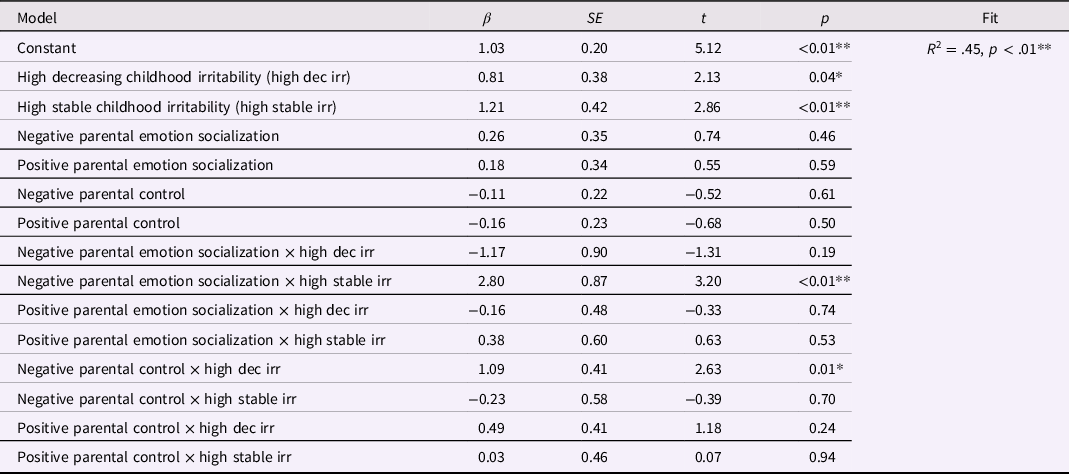
Next, we evaluated whether parenting moderated the link between childhood and adolescent irritability symptoms. Moderation analyses revealed that negative parental emotion socialization moderated the relation between high stable irritability in childhood and irritability symptoms in adolescence (β = 2.80, p < .01; see Table 3). Specifically, relative to children with low stable irritability, those children who exhibited both high stable irritability and had parents who exhibited more negative emotion socialization showed more irritability symptoms in adolescence. Further, negative parental control moderated the relation between early childhood high decreasing irritability and irritability symptoms in adolescence (β = 1.09, p = .010; see Table 3). Relative to children with low stable irritability, children in the high decreasing irritability group who had parents who exhibited more negative parental control behavior showed more irritability symptoms in adolescence. There were no other significant interactions relative to the reference group (i.e., low-stable irritability group). Notably, using continuous measures of early childhood irritability yielded comparable results as did analyses utilizing multiple imputation (See Supplement).
Regression results for primary analyses predicting mean ARI

Note. Low-stable childhood irritability group was the reference group in the model. Mean ARI refers to average of parent- and child-report.
* p < .05.
** p < .01.
Secondary analyses
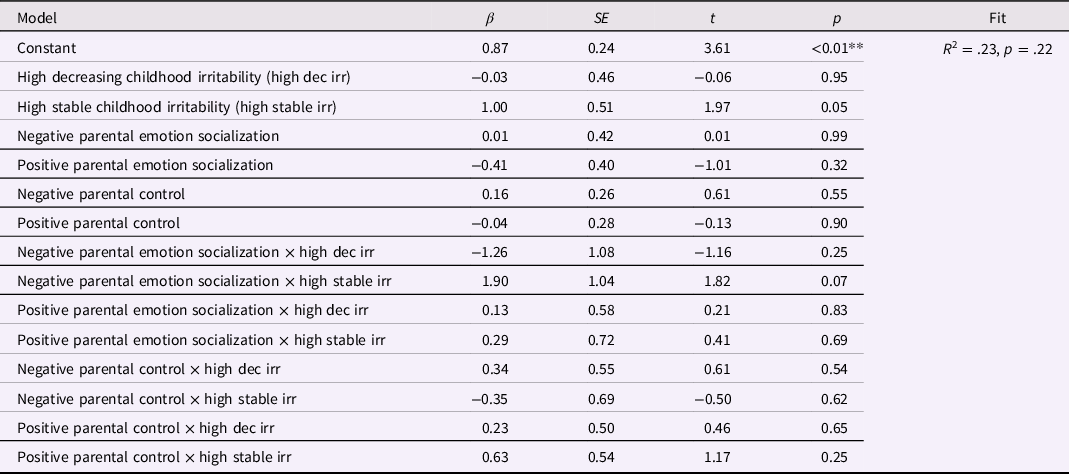
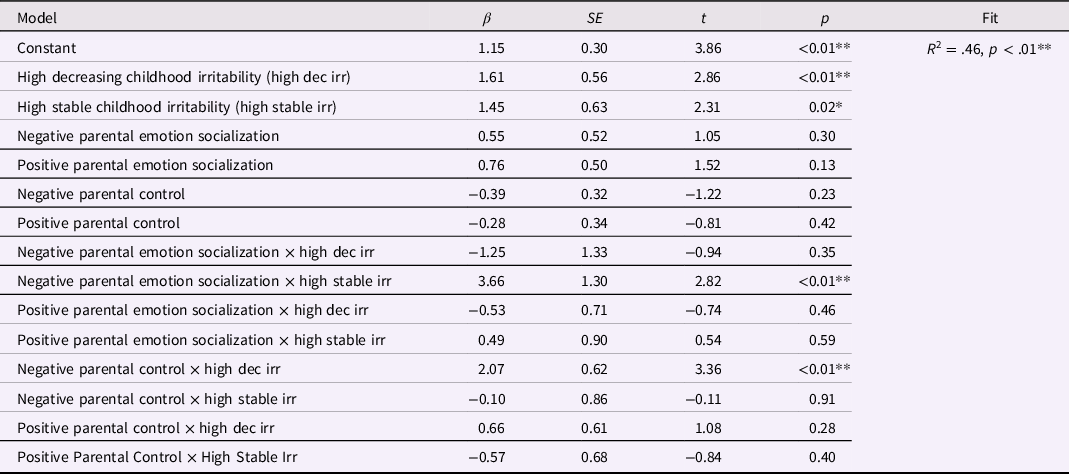
Whereas primary analyses used mean ARI as the dependent variable (see Table 3), secondary analyses used parent and child ARI separately (Tables 4 and 5, respectively). Results indicated that there were no significant interactions between the early childhood irritability and parenting behaviors predicting parent-report ARI (ps > .07; see Table 4). In contrast, negative parental emotion socialization moderated the relation between early childhood high stable irritability and child-report of irritability symptoms in adolescence (β = 3.66, p < .01; see Table 5). Further, positive parental control behavior moderated the relation between early childhood high decreasing irritability group membership and child-report on the ARI (β = 2.07, p < .01; see Table 5). Thus, the results of the model using child-report of irritability symptoms at age 12 are consistent with the primary analyses (using mean ARI) and highlight that the mean ARI results were likely driven by child-report on the ARI.
Regression results for secondary analyses predicting parent-report ARI

Note. Low-stable childhood irritability group was the reference group in the model.
** p < .01.
Regression results for secondary analyses predicting child-report ARI

Note. Low-stable childhood irritability group was the reference group in the model.
* p < .05.
** p < .01.
Exploratory analyses
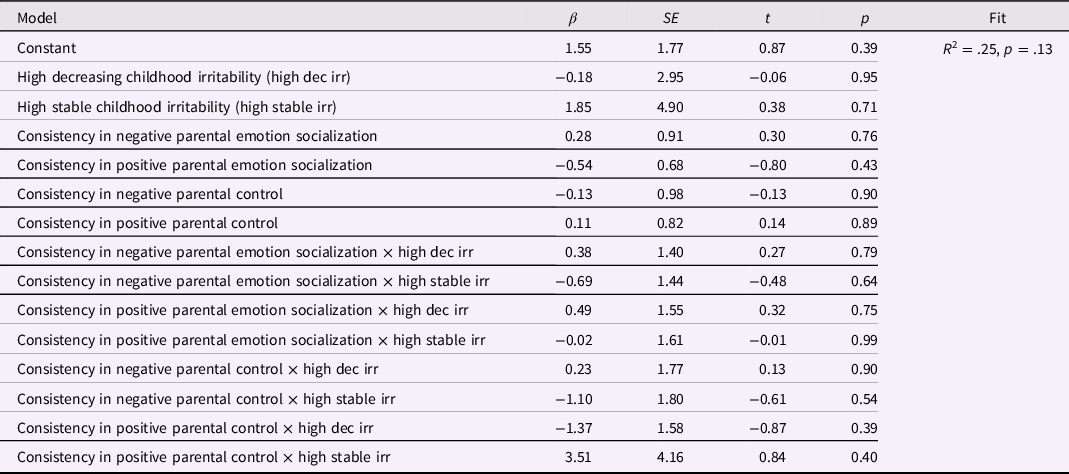
Consistency in the parenting measures did not moderate the relation between early childhood irritability group membership and irritability symptoms in adolescence (ps > .39; see Table 6).
Regression results for exploratory analyses predicting mean ARI using early childhood irritability and consistency in parenting behaviors as predictors

Note. Low-stable childhood irritability group was the reference group in the model. Mean ARI refers to average of parent- and child-report.
Discussion
The current study examined the moderating effects of two dimensions of parenting, emotion socialization and control behaviors, on the development of irritability. Results demonstrated that parents’ responses to children’s negative emotions influenced the trajectory of child irritability. Specifically, highly irritable children whose parents responded to their child’s negative emotions with distress, punishment, and minimization were more likely to exhibit higher irritability in adolescence. Additionally, results revealed that children with high decreasing irritability trajectory in early childhood whose parents exhibited negative control behavior (specifically restrictiveness) were more likely to exhibit higher irritability in adolescence. Notably, positive strategies for dealing with children’s negative emotions (e.g., Expressive Encouragement, Problem-Focused Reactions, and Emotion-Focused Reactions) did not moderate irritability in adolescence, nor did positive parental control behaviors. Secondary analyses demonstrated that these effects were primarily driven by child-report of adolescent irritability symptoms. Together, these results provide novel evidence that parenting behavior and early childhood irritability may jointly influence irritability in adolescence.
Common parenting interventions (e.g., parent management training, which emphasizes consistent reinforcement; Barkley, Reference Barkley2013; Comer et al., Reference Comer, Chow, Chan, Cooper-Vince and Wilson2013; Kazdin, Reference Kazdin2010 and cognitive-behavioral therapy which emphasizes learning strategies to change behavior; Kendall, Reference Kendall2011; Sukhodolsky et al., Reference Sukhodolsky, Kassinove and Gorman2004; Sukhodolsky & Scahill, Reference Sukhodolsky and Scahill2012) have been shown to reduce disruptive behaviors. However, it is unclear how these parenting interventions map onto specific parenting behaviors (e.g., parental emotional socialization and parental control; Kircanski et al., Reference Kircanski, Craske, Averbeck, Pine, Leibenluft and Brotman2019; Lengua, Reference Lengua2006; Lengua & Kovacs, Reference Lengua and Kovacs2005). This study provides initial data examining how parenting and irritability in childhood jointly influence adolescent irritability. Notably, this study is the first to show that negative parent emotion socialization influences the development of irritability. Irritable children commonly experience frustration in response to their parents. When parents are highly dismissive of their child’s anger and sadness, the child experiences greater stress (Katz & Gottman, Reference Katz and Gottman1997) and this could perpetuate the child’s irritability long-term. In line with past work, this study illustrates that how parents respond to children’s negative emotions influences trajectories of irritability into adolescence.
Negative parental control behaviors significantly moderated the development of irritability for children who exhibited high decreasing patterns of irritability over time (but not those exhibiting high stable patterns of irritability). This finding is consistent with prior studies that illustrate that negative parental control behaviors such as inconsistent discipline predict future irritability (Lengua, Reference Lengua2006; Lengua & Kovacs, Reference Lengua and Kovacs2005). Speculatively, this pattern of results might suggest that children exhibiting a relatively normative trajectory of irritability (i.e., irritability that peaks during the preschool years and decreases over time; Leibenluft & Stoddard, Reference Leibenluft and Stoddard2013) may be more sensitive to negative control behaviors, thereby resulting in higher levels of irritability in adolescence (Lengua & Kovacs, Reference Lengua and Kovacs2005). In contrast, children with high stable irritability may be more sensitive to how parents respond to their emotions.
Unexpectedly, positive parental emotion socialization and positive parental control behaviors did not moderate irritability symptoms exhibited in adolescence. While replication in a larger sample is critical, this work may suggest some specificity in the parenting behaviors associated with later outcomes – in particular negative parenting moderated risk (Belsky et al., Reference Belsky, Hsieh and Crnic1998; Brooker & Buss, Reference Brooker and Buss2014; Zuckerman, Reference Zuckerman and Zuckerman1999). In line with these results, it has been shown that highly irritable children process happy faces differently than children with low levels of irritability (Tseng et al., Reference Tseng, Thomas, Harkins, Pine, Leibenluft and Brotman2016) and have the tendency to label neutral faces as negative (Stoddard et al., Reference Stoddard, Sharif-Askary, Harkins, Frank, Brotman, Penton-Voak, Maoz, Bar-Haim, Munafò, Pine and Leibenluft2016). Perhaps highly irritable children are less responsive to positive feedback and more so to negative parental responses when distressed. Examining the pathophysiology of irritability and its specific associations with parenting behaviors may inform the development of irritability.
Parent management training emphasizes consistent positive reinforcement (e.g., praise) and non-reinforcement (e.g., active ignore), and encourages the selective use of consequences. Surprisingly, our exploratory analyses examining consistency in parenting measures as moderators did not reveal any significant interactions. However, given the exploratory nature of this work, investigating this in a larger sample using a more specific targeted measure of parenting consistency is necessary. While several studies illustrate that parenting interventions influence child anger and disruptive behavior (Comer et al., Reference Comer, Chow, Chan, Cooper-Vince and Wilson2013; Lochman et al., Reference Lochman, Barry and Pardini2003; Sukhodolsky et al., Reference Sukhodolsky, Kassinove and Gorman2004; Sukhodolsky & Scahill, Reference Sukhodolsky and Scahill2012), the present study is an important first step in understanding which types of parenting behaviors impact the development of irritability. Examining the effectiveness of different types of parenting behaviors in a clinical sample may also be an important future direction for intervention research.
This study is the first to investigate the impact of both dimensions of parenting (control and emotion socialization) on the trajectories of irritability by making use of a large longitudinal dataset and modeling irritability trajectories over time. Nevertheless, this work has limitations. First, this study only utilized questionnaire assessments, all but one of which was completed by mothers. While questionnaires provide valuable information, there may be reporter bias (i.e., measures based on maternal perceptions could differ from observer assessments of parenting) and shared variance between constructs. (Although, our regressions using child-report ARI as the dependent measure suggest that shared methods variance is not driving these effects.) Furthermore, utilization of the modified version of the CRPR with a Likert format also meant that the study lost advantages of the Q-sort methodology, including minimization of the response set and engagement of participants. Moreover, while early childhood irritability was assessed using the CBCL irritability composite (parent-report), adolescent irritability was assessed using parent- and child-reports of the ARI. The a priori decision to utilize the ARI as a clinical outcome measure came from this study’s longstanding collaboration with researchers from the NIMH, many of whom use this measure with their clinical samples. We elected to utilize the ARI so that this work could align with and inform work being conducted in clinical samples. While there was a moderate positive association between the 12-year CBCL irritability composite and ARI scores (see Supplement), inconsistency in the irritability questionnaires over time may have impacted the results. Indeed, this work raises questions about the stability of temperamental measures of irritability (i.e., the CBCL) and clinical assessments of irritability (see also Filippi et al., Reference Filippi, Subar, Sachs, Kircanski, Buzzell, Pagliaccio, Abend, Fox, Leibenluft and Pine2020). Secondly, the rates of irritability at age 12 are low, with only 34 out of the 291 children (12%) in the original sample exceeding the clinical cutoffs (Kircanski et al., Reference Kircanski, Zhang, Stringaris, Wiggins, Towbin, Pine, Leibenluft and Brotman2017). Further, at age 12, none had a diagnosis of DMDD and only a few children had disruptive behavior problems and attention-deficit/hyperactivity disorder, (see Supplement for details). Due to the relatively low irritability in this sample, the current findings are better interpreted as representing how parenting influences the development of normative levels of irritability. Replication in clinical samples and community samples is necessary to determine generalizability. Third, the two dimensions of parenting – parental control and parental emotion socialization – were assessed at two different ages (ages 5 and 7 respectively), thereby confounding age of assessment and parent behavior. Future studies should follow children prospectively to examine the influence of both parenting dimensions (emotion socialization and control behaviors) on irritability development from early childhood to adolescence. Fourth, this study relies only on parents’ reports of their parenting behaviors and does not quantify the transactional nature of parent and child interactions. Assessing frustration and parents’ behavioral responses to the child during a temper outburst could provide important insight into the role of parenting behavior on irritability. Thus, future behavioral studies are needed to better characterize parent-child interactions during frustration. These studies could elucidate ways to refine interventions specifically for irritability. Lastly, individuals in this longitudinal study were not a typical community sample but instead were selected for exhibiting high rates of negative and positive reactivity to novelty in infancy (age 4 months). This resulted in a sample that had children with higher rates of risk for anxiety symptoms. Thus, generalizability of these results needs further evaluation.
To conclude, the current study revealed that negative parental control behaviors and negative parental emotion socialization influenced the development of irritability in children. This study is among the first to examine links between parental emotion socialization and the development of irritability. The rich longitudinal data provided by this large cohort study allowed us to assess longitudinal trajectories of irritability to identify those children with persistent irritability and examine whether changes in irritability were moderated by parenting behaviors. These results suggest that both irritability in early childhood and negative parenting behaviors may jointly influence irritability in adolescence.
Supplementary material
The supplementary material for this article can be found at https://doi.org/10.1017/S0954579421001346
Acknowledgements
The authors wish to thank all the families who participated in this longitudinal study.
Funding statement
This research was supported by Grant U01 MH 093349 to N.A.F. and the Intramural Research Program of the NIMH (supporting D.S.P., E.L., C.F.), project ZIA-MH002782.
Conflicts of interest
None.