The second meeting of West Germany's Ministry of Family Affairs, held in December 1954, was tense. The Family Ministry was new and had an unclear mandate aside from helping to shore up Konrad Adenauer's support amongst religious conservatives. Its first chairman, a devout Catholic named Franz-Josef Würmeling, saw the advisory meetings as a chance to reach clarity about the nature of the office and scheme ways to ensure its influence. He invited a wide array of social experts, including the most influential family sociologist of the era, Helmut Schelsky, whose magisterial study, Changes in the German Family in the Present Day, had recently appeared to great acclaim. The problem was that Schelsky was opposed – loudly, publicly opposed – to the very concept of a Family Ministry. A few months earlier he had already aired his grievances in a full-page article in the Frankfurter Allgemeine Zeitung, one of Germany's most important newspapers. It is not clear whether Würmeling invited Schelsky in order to hash out their differences in person, or, instead, to give his committee the scientific imprimatur that only he could provide. Either way, the visit was a disaster. Schelsky dominated the proceedings, railroading a discussion about the way to make the Ministry efficacious into an unwelcome one about the Ministry's right to exist. He was not invited back.Footnote 1
The fact that Schelsky and Würmeling worked together on the board is well known, but their disagreement is not.Footnote 2 The two are often discussed in the same breath as manifestations of a conservative pro-family consensus in post-war West Germany. Indeed, they had much in common. Both argued that the family should be at the moral and economic core of German reconstruction, providing a safe harbour from the violent ideological excesses of the German past. Both believed, too, that communism and homosexuality threatened the fragile gender order at the heart of the new West Germany. They held these positions, however, for fundamentally different reasons because they were fundamentally different public figures emerging from different interwar experiences. Würmeling was a staunch Catholic and a Christian Democrat who had spent the 1930s keeping his distance from Nazism. For him the family was a pre-political institution based in natural law, deserving state protection for precisely that reason. Schelsky voted for the Social Democrats, and he had been a crusading Nazi philosopher in the 1930s. For him nothing was natural because everything was political: he criticised natural law and believed that the state's role was not to protect a pre-existing institution but to create one, either through interventionist family policy (as in the Nazi period), or through the cultivation of a pro-family culture using media, education and the social sciences (as was appropriate in the post-Nazi era). Their ideas were kindred – which is why Schelsky was invited to the meeting in the first place – but different enough that they clashed when brought into proximity. Their relationship points to the hidden truth of the familial consensus of the conservative 1950s. Like many post-war German families, it was structured by a marriage of convenience and less stable than it appeared.
Historians have long recognised the new centrality of the family in West Germany. Dagmar Herzog and Robert Moeller have placed sexuality and the family at the centre of their influential readings of post-war German history, showing how ‘traditional’ sexuality was figured as a central component of post-fascist reconstruction. Merith Niehuss has provided a magisterial social history of West German family life, showing how the family was shaped by material realities (demography, immigration, housing) as much as by culture. Her work is complemented by the policy-oriented histories of Christiane Kuller and Ursula Münch, who emphasise relationships between the federal state, the regional Länder and the subsidiary organisations that were so crucial to the complex, neo-corporatist German welfare state. Hannah Schissler and Sarah Elise Wiliarty have focused on the gender ideals of the Social Democratic Party (Sozialdemokratische Partei Deutschlands, SPD) and the Christian Democratic Union (Christlich Demokratische Union Deutschlands, CDU), emphasising like Moeller and Herzog the conservative, heternormative view of the family that was common currency across the political spectrum. Lukas Rölli-Alkemper has explored the family concepts and activism of Catholic Church leaders, theologians and social scientists. Erica Carter and Mark E. Spicka have detailed the ways in which heroic labouring women, necessarily entrusted with authority in the immediate reconstruction era, were recoded as ‘consuming housewives’ in the 1950s. On the cultural front, Elizabeth Heineman and Till van Rahden have in recent years been tracing the shifting contours of the German family's public presentation and private order, focusing on internal issues of sexuality and authority, while Niehuss and Heineman have done exemplary comparative work on West Germany and its neighbours.Footnote 3
Together these historians show how the racialised, bio-political imagination of the Nazi era transformed into a new social imaginary in which the social body was reconstituted as a network of happy, heteronormative and consuming families, interlocked through a project of economic expansion instead of military conquest. They also remind us that familialism was predicated on a fantasy. After all, the war had unleashed waves of gender trouble, symbolised most famously by the ‘women of the rubble’ who, in the absence of their sons and husbands, performed much of the physical labour required to rebuild German cities. The divorce rate spiked, and a generation of women whose spouses had died at the front presented an ideological and social challenge. Many at the time were aware that the family image presented by the state and the media was fanciful. ‘The family fragment dominates the hour’, a Berlin journalist wrote in 1946, surveying the wreckage of his city. ‘But the idea of the family as a basic formation – that is, as an imaginary space which one can restore and fill – seems to have remained alive’. In his oral history of the post-war era, Lutz Niethammer likewise found that the family had become ‘an obligation, a phantom, and a project’ – above all, ‘the project of fantasy’.Footnote 4
Post-war familialism, like all fantasies, was rooted in past experience and past trauma. In one sense, this has long been recognised. Family theorists and politicians claimed at the time that the turn to the family was a depoliticising move in the wake of Nazi totalitarianism and the horrifying experiences of the war. This argument is compelling, and some later historians have seconded it. It presumes, however, that the nuclear family unit is inherently stable and pre-political. This presumption is internal to familialist ideology and should not, therefore, be used to evaluate its rise.
More recent scholarship has shown that the post-war family emerged not as a product of nature or nostalgia, but of a long evolution in gender relations, household organisation and the history of emotions. A social and cultural history of the post-war family requires, that is, a trans-war approach that is attentive both to the changes occasioned by the war and to the longer continuities that traversed it.Footnote 5 This essay will use the tools of intellectual history to show how familialism – the ideology of family – should be understood in the same way.Footnote 6 The analysis will show that the family values consensus represented the re-articulation of pre-existing bio-political concerns in a framework that was palatable in the Cold War Atlantic world, where the family was widely and wrongly understood to be the pre-political unit par excellence. Beneath the placid surface of familialism, the intellectual ferment of interwar Germany survived; the apparent depoliticisation of the family unit masked the survival of past political ideologies in a new key. To see how, this essay will analyse the archives, writings and careers of Würmeling and Schelsky, two of the most important architects of post-war familialism, across the chasm of the war. Their twin stories help us to understand the ways that post-war familialism rehearsed the ideological divisions of the interwar period. This, in turn, helps us to understand the diverse currents of anti-familialism that emerged in the 1960s.
Franz-Josef Würmeling and the Moral Politics of the Family
Franz-Josef Würmeling grew up at the very heart of Catholic Germany. His father, Bernhard Würmeling, was an important figure in the German Centre Party, the parliamentary party that had represented Germany's Catholics since the days of Bismarck. Würmeling himself received a Catholic education and was, in his student days, inducted into the Catholic Student Union, a socialising experience that brought him friends and contacts that would serve him well for decades. In addition to his important experience as a Catholic, the young Würmeling was also, like many Catholics by 1914, a German nationalist.Footnote 7 He served in the navy and found an opportunity after the armistice to continue the struggle. When he was only twenty-three years old, he was called to serve as a proxy mayor in a small town whose mayor had been imprisoned by French occupying forces. For unclear reasons he soon joined his predecessor in prison. Upon his release he was proud to have served his fatherland once more against the hated French.Footnote 8 Throughout the 1920s and 1930s he held a variety of minor administrative posts, aiding the Prussian Ministry of the Interior and managing the financial affairs of the provincial government in Kassel, a small town in Hesse.
Little in Würmeling's career in the 1930s presaged a career in the service of the family. However, as he explained decades later, he was firmly ensconced in the family ideology of the Centre Party and German Catholicism more broadly.Footnote 9 His library, some of which survives in his archive, includes an important 1919 work on marriage by Joseph Mausbach, one of the leading theologians of Weimar Germany and a champion of the Centre Party. Mausbach, just as Würmeling would do decades later, wrote of the ‘enormous importance of marital fertility’, arguing that contraception and abortion were diminishing Germany's moral fibre and demographic might, especially in light of booming birth rates to the east. Likewise, Mausbach reiterated the traditional Catholic view that sexual desire had no intrinsic meaning or virtue but was a dangerous force that must be harnessed in the name of ‘higher and more objective life-needs and values’ – notably procreation.Footnote 10
Centre politicians and Catholic theorists worried, rightly, that the patriarchal family unit was under assault from socialists and sex reformers like Max Hodann and Magnus Hirschfeld. They warned against new styles of dress and dancing, inveighing against contraception and the ‘loose women’ who supposedly stalked the night of Weimar's cities. This moral panic legitimated a crusading family politics by the Centre Party. Bernhard Würmeling contributed an important memorandum on behalf of Caritas, the Catholic welfare organisation, along these lines. He insisted that family welfare be provided by confessional organisations instead of state ones whenever possible – presuming a partnership between Caritas and the state, but also presuming an unequal one.Footnote 11 Meanwhile, Catholics joined hands with other conservatives in the name of state censorship, which sometimes embroiled them in disputes with more tolerant social democrats.Footnote 12
This focus on the family led some Catholics into an uneasy relationship with the Third Reich and its style of eugenics. As Ingrid Richter has shown, Catholic ideologues and Centre Party politicians embraced a certain form of eugenics, even if they normally remained wary of enforced sterilisations and the biological racism of the National Socialists.Footnote 13 Moreover, at least some Catholic ideologues were drawn to Hitler because of his stated intention to combat sexual immorality. ‘We Catholics’, wrote one prominent theologian, ‘have protested tirelessly’ against the ‘trash and smut’ of modern civilisation to no avail. Now that the National Socialists have come to power ‘we already see the result’.Footnote 14 While this anti-socialist and anti-‘smut’ mentality led some Catholics to support Hitler's family politics throughout the Third Reich, there were also many acts of protest – especially as it became increasingly clear that Hitler's notions of gender, sexuality and eugenics clashed violently with traditional Catholic teachings.Footnote 15
Würmeling's ambivalent position towards the Nazis mirrored that of his Church. He showed signs of collaboration, and signs of wariness too, but no evidence exists that he was a genuine resister. He did claim after the war, in a biographical sketch he prepared for the CDU press, that he ran into political troubles in the late 1930s that forced him out of public service. This may well be true but does not say much, insofar as many convinced Catholic Nazis, like Carl Schmitt, ran into similar troubles at that time.Footnote 16
Two pieces of evidence for Würmeling's complex 1930s itinerary survive. The first is an article on ‘Welfare for Wanderers’ (Wandererfürsorge) that he wrote for Der Gemeindetag, a journal devoted to National Socialist welfare policy (the title was a term of art in German charitable work, referring to institutions, primarily religious in nature, that were designed to help homeless, itinerant migrants or beggars). The Nazi solution then in gestation was simply to clap these ‘asocial’ elements into concentration camps. Würmeling disagreed. ‘The goal must be’, he declared, ‘to abolish the penniless wanderer's right to exist’ by restricting internal migration and using the law to ensure that the wanderers begin a path to ‘reintegration’. ‘National education and religious supervision’, Würmeling mused, would turn the indigent beggar into a proper ‘national comrade’. On the one hand, Würmeling was kinder to the homeless than some Nazi leaders, insofar as he essentially wanted to strengthen the religious welfare institutions that had been in place since the Wilhelmine period (perhaps for this reason, the editors of the journal appended a note claiming that they did not fully agree with Würmeling's views). And yet, on the other hand, his article clearly buttressed the legitimacy of the Nazi regime. Its mere existence showed that the scion of a famous Catholic family was willing to publish in a Nazi journal. Moreover, he wrote in the standard Nazi lexicon, imagining a transition from asocial to comrade (Volksgenosse). And most importantly, like other Catholic moralists briefly enchanted with the awesome power of the Nazi state, he argued that the Nazi takeover presented a great opportunity: ‘if there is ever a time ripe for the reaching of this ideal’, he proclaimed, ‘it is the present, in which the state has attained unparalleled strength’.Footnote 17
The second piece of evidence can be found in his archive. In 1938 Würmeling met an official at the League of Large Families (Reichsbund der Kinderreichen), a Nazi organisation, and expressed some interest in joining. In response an official sent him a selection of literature, including a pamphlet called ‘Why Race and Population Politics?’, as well as a membership form. A month later an officer in the SS wrote to Würmeling, complaining that they had not received the form and wondering why he had not joined. The form remains in the archive, along with the pamphlet (which Würmeling had been asked to return): clearly he was interested enough to learn more and not to be marked as a resister, but he was sceptical enough to keep his distance.Footnote 18
After the war Würmeling naturally gravitated towards the Christian Democratic Union, where he began a successful career in politics. The CDU was an unstable combination of conservative Protestants, social Catholics and liberals, and Adenauer relied on his underlings and ministers to keep his political juggling act in motion. Würmeling's role was to shore up Adenauer's support among conservative Catholics. In addition to lending his famous family name, he was a leader of Fides Romana, a lay Catholic men's organisation under whose auspices he went on a much-publicised visit to Pope Pius XII. He began writing increasingly frequently about the family around 1952, just as Adenauer began pondering the addition of a family ministry to the federal government's welfare apparatus.Footnote 19 In 1953 Würmeling was the natural choice to head Adenauer's new Family Ministry. Adenauer was, as usual, acting in the interests both of his party and the nation (as he understood it): the Family Ministry was designed to counter the aging of the German population by encouraging births and also to placate the Catholic church leaders and clergy who constituted an important power bloc in the unruly CDU.Footnote 20
The Family Ministry was a typical feature of the first decade of West German reconstruction, which was dominated, in Christian Democratic circles at least, by a discourse of moral regeneration. Nazis, according to this influential narrative, had been materialist and sexually liberatory, and therefore the post-Nazi era required a return to sturdy, older values.Footnote 21 The husband's responsibility for work and the wife's role as a housewife were viewed even by jurists as ‘correspond[ing] to the eternal natural essence of marriage’ and ‘to the biological inequality of husband and wife’.Footnote 22 Würmeling spoke this language with a native fluency, drawing on God and natural law in his many public speeches, linking them as Mausbach had to the geopolitical necessities of the state. An unpublished autobiographical reflection he wrote decades later likewise claims that Catholic social teaching had guided his actions after the war.Footnote 23 The public record confirms this judgment. In one article defending the necessity of his new ministry published in an industrial journal he explained that ‘the German nation’ was in danger of dying out – a danger that could only be met through ‘our families, which must be ethically and economically prepared for children’. ‘We must’, he concluded, ‘act ethically from the Christian family ideal, as it has arisen in the West’.Footnote 24
The legacy of the interwar era is apparent in Würmeling's discourse, which drew on a Catholic idea of ethical bio-politics that could be found in Mausbach. He saw no need to hide his ideology's interwar roots. In a remarkable 1954 speech to the Bundestag Würmeling approvingly quoted from Vichy France's revamped Civil Code and its contention that ‘the man is the head of the family’, speciously remarking that such sentiments were common even in France, ‘the nation that created the idea of freedom’.Footnote 25 Even some elements of Nazism survived in his rhetoric. In a remarkable feat of transliteration, used by other Christian Democratic leaders too, Würmeling revived the Nazi notion of ‘living space’ (Lebensraum), applying it not to physical territory in the East but to political and cultural ‘space’ for the family at the heart of the nation.Footnote 26
The kinds of indirect family politics championed by his father were the only ones available to Würmeling after the war. Neither political will nor funds were available for an activist family politics, and West Germany remained far behind France in this regard (the occupying Allied armies in fact outlawed the maternal and parenthood benefits of the Nazi state, viewing them as suspiciously totalitarian).Footnote 27 Meanwhile, his Family Ministry, summoned into being primarily for political reasons, had no clear policy power and was doomed to play a nebulously defined ‘coordinating’ role.Footnote 28 Würmeling organised inside the government to launch programs that would be politically and fiscally possible. His name is to this day is synonymous in Germany with a programme he launched to provide discount train tickets to large families. He pressured the Finance Ministry to provide income tax exemptions, beginning with the first child and increasing with each additional one. Likewise, he pushed the Labour Ministry towards benefits for mothers and small direct cash transfers per child (Kindergeld), beginning with the second child. The SPD and the unions were in favour of this plan, looking towards France, where enormous, union-backed child allowances were the norm. However, Würmeling and the CDU dramatically watered it down, providing small allowances beginning with the second child; moreover, despite union outcry, the allowances were dispensed by employers, not the state, in keeping with the traditional Catholic (and Christian Democratic) concern for subsidiarity.Footnote 29
Würmeling's social Catholic heritage influenced his approach to the Family Ministry in multiple ways. First and foremost, as the nature of the Kindergeld demonstrates, Würmeling helped to consolidate a particular vision of welfare in the 1950s: one based not around social justice or the logic of ‘class’ but social security and the logic of ‘family’ or ‘generation’. This was in keeping with longstanding Catholic teaching that class was an illegitimate social grouping while family was a natural one. The goal of family policy, Würmeling argued, was to ensure that families that decided to have multiple children would not be pauperised and would instead be allowed to particulate fully in the economic dynamism of the social market economy. ‘State and society’, Würmeling announced, ‘do not have the right to cast healthy and naturally developing families into such a de-classing’. The solution was not to equalise society using the bankrupt notion of the class but instead to use various social policies to ensure ‘that families with children can move reasonably near to the social level [Schicht] to which the father, through industry and effort, brought them’.Footnote 30 Würmeling's memorandum quoted from the so-called ‘Four-Professor Manifesto’ that Adenauer had ordered a few years earlier to counter criticism that the CDU was not a party of ideas: ‘in the place of a class’, argued the four sociologists, ‘the family must today become the object of social politics’.Footnote 31
Secondly, Würmeling's notion of the family underwrote a furious anti-communism. He was obsessed, as Mausbach had been decades earlier, with booming populations to the east and the fear of Bolshevik hordes marauding through the nation. ‘Millions of internally healthy families with honestly raised children’, Würmeling declared, ‘are as important as all military assurances against the child-rich nations of the East’.Footnote 32 In a 1953 speech called ‘What does the Family Ministry Want?’, he explained that the family is the ‘natural antithesis to the collective, whose ever increasing power is increasingly endangering the family's final sphere of freedom and privacy’.Footnote 33 And as for so many West German anti-communists, the very hallmark of that regime was gender trouble. In front of a group of students in Bonn, he painted a nightmare portrait of ‘regiments of Amazonians’ working in the Eastern coalmines, a form of gender equality that was ‘in truth an inequality’, given that men and women are naturally different.Footnote 34
Thirdly, like the Centre Party leadership before him, Würmeling was willing to use quite aggressive state measures to save the family from the immoral tendencies of consumer culture (especially when those measures exercised sovereignty over the public square instead of the private spaces of the family).Footnote 35 He was obsessed with the power of the media, perhaps out of an awareness of how effectively the Nazis had utilised it as a propaganda tool. But while they had used it to elevate the nation and race, Würmeling wanted it to protect what he called ‘the eternally valid orienting image [Richtbild] of marriage and family’. ‘It is film above all’, he explained in a 1954 speech, ‘that we must, sadly, hold responsible for much of the destruction of marriage and family’. Like many conservatives he loathed the film censorship system put in place by the American occupiers. Wary of the significant film censorship in Weimar, they had instituted an American-style system in which, while Church officials had seats on the board of the decision making body, industry representatives formed a majority. Religious authorities balked at the laxity of this system, which resulted in the release of such licentious hits as The Sinner (1950). Although claiming to have never seen the film, Würmeling sharply criticised it: insofar as the health of the family was of paramount concern to national security, films like this were profoundly dangerous. In 1954 he went so far as to call for a ‘people's censor’ (Volkszensur) to take the place of the ill-functioning board in existence. Although he was careful to distinguish this from a ‘state censor’, the phrase had unmistakable Nazi overtones. It caused an uproar amongst the SPD and even had Adenauer back-pedalling.Footnote 36
Würmeling mistook the temperature of the German public in his call for renewed censorship. His parochial, authoritarian conservatism, so clearly a relic of interwar Catholicism, became increasingly out of place in a modernising Germany. Soon, even sympathetic Catholics were forced to admit that Würmeling's stodgy traditionalism made him seem ‘absurd’, and the Working Group of German Family Organisations would have to send a letter to Adenauer imploring him not to fire the beleaguered minister.Footnote 37 He was becoming a figure of disdain and even of fun. Soon after his call for a national censor, an unflattering cover story on Würmeling appeared in Der Spiegel, one of West Germany's most prominent magazines. The profile was entitled ‘The Pope's Guard’, and it accused Würmeling of using his post to pursue an ‘intolerant’ and ideologically specific vision of marriage and family. The Spiegel profile featured a joke, told alarmingly by a Jesuit. Question: ‘What do Würmeling and Mau-Mau have in common?’ Answer: ‘They are both blacks that have gone wild’.Footnote 38 The black skin of the anti-colonial revolutionary and the black cassock of the family policymaker are here united, as though Würmeling's own intense moralism were just as much a threat to Western order as decolonisation. As the joke makes clear, Würmeling's ironic opponents had ideological preconceptions of their own – one could mock Catholic familialism while simultaneously giving voice to other uncomfortable relics of the German ideological past (in this case, racism and imperialism). This was especially true of another critic of Würmeling's: Helmut Schelsky.
Helmut Schelsky and the Dogmatism of the ‘Sceptical Generation’
If Würmeling helped reintroduce religion into the public square, Helmut Schelsky played a signal role in the West German version of what Lutz Raphael has called ‘the scientization of the social’: the long process in which experts in the human and social sciences made themselves indispensable to administrative bodies, industrial firms and the state.Footnote 39 This process achieved exceptional velocity in the 1950s, as so-called ‘contemporary sociology’ (zeitnahe Soziologie) provided expertise on a wide array of social problems. Schelsky was a technocrat and an institution builder, interested in placing the interdisciplinary social sciences in the service of economic and social development. If Würmeling was most comfortable in the early, moralising years of the reconstruction, Schelsky came into his own in the later 1950s, as the moral panic and material deprivation of the post-war years gave way to economic expansion, increased housing construction, consumer culture and sexual liberalisation.Footnote 40
The basic fact of the transition from reconstruction to modernisation in the 1950s is well established by now, but Axel Schildt and Arnold Syttowek's call for an interrogation of its contours has seldom been answered.Footnote 41 In the case of familialism at least, it is certainly more complex than the transition from ‘religion’ to ‘science’ that sociologists themselves claimed to represent. For one thing, the new social sciences were themselves heavily moralising, partially because the German Catholic Church was taking a social-scientific turn at the same time.Footnote 42 For another, remarkable continuities have been uncovered between Nazi-era and post-war social science. Schelsky himself, as Paul Nolte has written, ‘represents like nobody else the continuity and the novelty of empirical social research in Germany’.Footnote 43 Schelsky's rise and the new prominence of empirical family sociology should be viewed alongside Camille Robcis's and Amelia Lyons's accounts of France, Robert Self's and Wendy Kline's accounts of the United States and even Matthew Connelly's account of the United Nations.Footnote 44 As this literature indicates, the social-scientific, technocratic ethos of post-war welfare states was linked across the globe with the more transparently racist population politics of the interwar years.
As with Würmeling, Schelsky's post-war ideology should be viewed as a reframing of his interwar commitments. And while Würmeling was embedded in political and social Catholicism, Schelsky emerged from a network of fascist social scientists. Schelsky was born a few years after Würmeling in Saxony, a complex region that played host to a powerful socialist movement alongside a reactionary nationalist one.Footnote 45 Schelsky, like many Saxons from middle-class families, entered political life through the far-right youth groups that cropped up across Germany in the 1920s. A promising student from a young age, in 1932 his studies brought him to Leipzig, where he entered a variety of National Socialist organisations (a year before Hitler's seizure of power, and therefore a year before there was any professional justification for doing so). While he did not officially join the party until 1937, he immediately began wearing his storm trooper uniform to class and loudly, disruptively declaiming his anti-Semitic, Nazi beliefs.Footnote 46 At the same time, he encountered Hans Freyer and Arnold Gehlen, two brilliant sociologists who were, like Schelsky, committed to the National Socialist Revolution.Footnote 47
While Würmeling and other social Catholics worried about the encroaching power of the state, Schelsky, like his mentors, rejected the liberal distinction between public and private, arguing that all action, and all thought, is inescapably political. This is first apparent in Schelsky's first book, The Socialist Way of Life (1934), a rousing defence of National Socialism from the perspective of sociology and idealist philosophy. Like Heidegger, who is not cited but who nonetheless haunts the work, Schelsky argued that human beings create themselves through goal-oriented action, and not through disembodied cogitation. These goals can only be arrived at together with others. Some goals are higher than others: to take Schelsky's example, two men who come together to buy a car are not necessarily expressing their ethical being to its utmost. The highest goals are those incarnated in the nation – the largest and most glorious community that the individual human can access. Like Carl Schmitt, who influenced him throughout his life, Schelsky believed that the notion of ‘humanity’ as a source of ethics was inherently absurd.Footnote 48 Instead, the state alone was the emanation and representative of the Volk, bearing the right, and the duty, to organise all lower cultural entities like churches and ‘research institutes’. Nonetheless, following Max Frauendorfer and other Nazi corporatists, Schelsky imagined a social order divided into a hierarchically organised constellation of communities, each one governed by the leadership principle within its own ranks. While these would be subordinate to the state and orient themselves towards national goals, they also pursued their own logic, and should have a leader (Führer) from within. The individual human being had little role in Schelsky's thought: indeed, Schelsky seemed to believe that individual humans were not worth consideration except insofar as they contributed to the national project. ‘True socialism’, Schelsky chillingly concluded, ‘means the discarding, or even the killing, of those people who cannot work for the Volk, or who damage it’.Footnote 49
While Schelsky later discounted his Nazism as a youthful flirtation, his embrace of it was not, like Würmeling's, short-lived and ambiguous. Indeed, the same Naziphile ideas appeared in print a full seven years later in his second book. In Thomas Hobbes: A Political Doctrine, written literally from the front lines of the Second World War, he argued, contra Schmitt, that Hobbes provided precisely the model for a total politicisation of man that National Socialism required.Footnote 50 While religious pluralism was a reality in Hobbes's day, his entire project was designed to eradicate it through conjoining political and theological languages into one mythical whole, eradicating the subjective space of inner freedom that, Schelsky and Schmitt agreed, corroded the national community. Schelsky's innovation was to focus above all on Hobbes's anthropology instead of his political theory proper. Through constant reference to John Dewey's pragmatism, Schelsky sketched out an image of man as fundamentally a creature of practice.Footnote 51 By controlling the education and practice of the community, the Leviathan politicised man in his entirety, which was, for the Schelsky of 1941 as for the Schelsky of 1934, the height of political ethics.
Schelsky had little to say about the family, as such, during these years. It is clear, though, that unlike Würmeling he was not predisposed to think of the family as a divinely ordained, natural community. First, he was wholly in favour of the bio-political, eugenic measures being taken by the National Socialist state: ‘the sterilisation of hereditarily polluted men’ was, from his perspective, ‘a socialist deed’ (for Schelsky, Nazism was the truest form of socialism). Second, while Catholics and the Centre Party argued that education should be in the hands of parents and confessional schools, Schelsky left no doubt that the State should be responsible for educating children to serve the Volk. Indeed, education is ‘its highest goal’, as only through education can the national community penetrate the innermost being of each individual citizen: ‘A strong state, conscious of its task and effectively fulfilling it, knows no other form of education than the one that prepares the youth to participate in the state [Erziehung zum Staat]’.Footnote 52
After the war Schelsky abandoned the heightened register of his first books and turned to the sober empirical sociology then enjoying a boom in West Germany. Together with Arnold Gehlen, his comrade and mentor, he voraciously read American sociologists at the American Library in Karlsruhe.Footnote 53 Like them, he hoped to transition sociology away from an idealistic, philosophising discipline into an empirically oriented social science, grounded in data and survey research. He made no public apology for his own Nazism, and his continued association with former Nazis indicates that he did not think one was necessary. Notably, he remained in lively correspondence with the disgraced legal theorist Carl Schmitt throughout the decade (in 1983 Schelsky wrote a remarkable private meditation on his relationship with Schmitt, admitting that Schmitt and three other people, all Nazi Party members, had been the greatest inspirations to his life and thought).Footnote 54
His turn to the family in these years was almost overdetermined. In the first years after the war, when West Germany suffered dramatic economic and political chaos, Schelsky devoted himself to the German Red Cross and worked for the International Tracing Service, which was designed to reunite the hundreds of thousands of families that had been separated by the war. His humanitarian work brought him into contact with the international social scientific-humanitarianism nexus for the first time. These organisations, along with the United Nations, viewed the reuniting of families as the first step in the reconstruction of healthy societies. The familial consensus was overwhelming: psychoanalysis, for instance, was dominated by figures like Anna Freud and Dorothy T. Burlingham, who were theorising the absolute centrality of a healthy, normal home life to a non-neurotic child.Footnote 55 Schelsky served on the board of UNESCO's Institute for Social Sciences, founded in 1951, based in Cologne and devoted to nourishing, as a 1954 UNESCO pamphlet had it, the ‘growing interest in “family sociology” and in certain countries considerable research into family problems’.Footnote 56
Schelsky was only the most famous of a large number of sociologists and intellectuals who viewed the revamped family as the centre of a revived Germany. Drawing on American family sociology of the 1930s, a new breed of empirically oriented family sociologists like René König and Gerhard Wurzbacher explored the possibility that the family was both losing many of its functions in an industrial age and providing an entirely necessary service to social wellbeing.Footnote 57 Wurzbacher served, like Schelsky, on the board of the UNESCO Institute, and his Portraits of Contemporary German Life (1954) drew on Ernst Burgess and other Americans to argue that the smaller, more emotionally-intimate family still ‘accomplishes for our industrialised and bureaucratised society an extraordinarily meaningful service in the moulding and spiritual health of modern men’.Footnote 58 Schelsky was personally closer to Gerhard Mackenroth, another recovering Nazi, who served as the chair of sociology, social science and statistics in Kiel. Mackenroth, who worked alongside Schelsky on his family research, was equally convinced that the family was the proper locus of social policy and national regeneration.Footnote 59
In a blockbuster trilogy – Changes in the German Family (1953), The Sociology of Sexuality (1955) and The Sceptical Generation (1957) – Schelsky crafted a social-scientific rationale for the depoliticised, family-focused and consumerist 1950s. Politics, he argued, was a dangerous and intoxicating game, and one that had caused enormous havoc in Germany. Thankfully the age of politicisation was drawing to a close. West Germans, he decided, were not so different from Americans, and he essentially provided a German version of Daniel Bell's ‘End of Ideology’ thesis (he had personally worked to introduce David Riesman's Lonely Crowd to a German audience). West Germany, Schelsky proclaimed, belonged fully to the Western political community, sharing its anti-communist virtues and also its consumerist malaise. ‘With his recent publications’, one radio personality declared in 1958, Schelsky ‘has demonstrated a sensitive attention to the neuralgic points of our society’.Footnote 60
The narrowing sphere of politics necessarily expanded the sphere that Schelsky labelled private: in sharp contrast to his Nazi writings, he now held that arenas like youth culture, sexuality and the family were private institutions that had nothing to do with the tumultuous sphere of the political. In all of his books, the family played an outsized role, and he was the most articulate defender of the widely-accepted view that happy, healthy families are the best bedrock of a happy, healthy state. This was argued most forcefully in his landmark Changes in the German Family, one of the first works of empirical, survey-based sociology to be published in West Germany. His essential point, drawing on a thesis made famous by the Chicago school of family sociology in the 1930s, was that the family, due to industrialisation, had lost many of its former public functions to become an emotionally intimate, inward-facing unity.Footnote 61 Schelsky viewed this as a universal facet of modernisation, albeit one that was happening with special rapidity in Germany. He studied refugee families in particular, only to discover that the refugee family, unmoored from larger communities, was fast becoming the model of German family life throughout the nation. Nonetheless, even in this chastened form, Schelsky marvelled at the ‘amazing permanence of this institution amidst changes in, or even collapse of, its social environment’.Footnote 62
Schelsky still believed that the family had an important function, but as he had in the 1930s he refused to think in terms of natural law: the vague notion of ‘society’ now played the role that ‘politics’ had in his earlier work. For him, the function of the family could only be understood in context, and in industrial societies the family served an essential purpose of moral education. In his own way, he was just as concerned with morality as Würmeling. But while Würmeling regularly drew on God, natural law and the bio-political needs of the Volk, Schelsky opted for the logic of the social scientist. He was appalled to find that the recognition of the plasticity of sexual norms was leading some to conclude that the whole notion of sexual morality was antiquated. In his view, the disentanglement of sexual norms from biology or natural law should lead to a reconsideration of their source, not a rejection of the concept. Like Lévi-Strauss and other social scientists of the era, Schelsky was convinced that social order rested upon the construction and defence of sexual norms, and he defended ‘the vital role of morality in conduct for the individual and for society’. In many societies those norms are underwritten by religion, but Schelsky recognised that pluralist societies in the present could not rely on that buttress of absolutism. In its place he had recourse to vague notions of tradition and properly utilised sociology.Footnote 63
Schelsky was also, in his way, just as committed to playing a public role as Würmeling, but he did not think it could come through holding office. Post-war Germans, Schelsky thought, were wary of taking guidance from a discredited state, so he instead sought to conquer the public sphere. His work on sexuality, available in a cheap paperback, sold over one hundred thousand copies, and Rolf Wiggershaus has argued that Schelsky's breed of ‘popular positivism’ successfully captured the public sphere from the more radical Frankfurt School.Footnote 64 He quickly ascended the heights of the academy as well. He began at the Academy for Social Economics in Hamburg, which he directed from 1949 to 1953 before becoming a professor there (his surviving lecture notes leave no doubt that he did his best to instil in his students the political meaning of the family, as the antidote to a rapidly bureaucratising and mechanistic state).Footnote 65 In 1960 he moved to the chair of sociology at the prestigious University of Münster, where he led the Dortmund Social Science Research Centre, perhaps the largest and most influential centre of knowledge production in West Germany. In 1970, lastly, he became a professor of sociology at the newly-founded Bielefeld University.
Despite his new public reticence towards the political, Schelsky's social-scientific moralism endorsed aggressive political interventions, primarily against communists and homosexuals. In his work on the family he seized every opportunity to lambast communist ideals of gender equality, which uprooted the institution's internal power dynamic.Footnote 66 Specifically, he argued that East German attempts to force women into the workforce destabilised the crucial family unit. Moreover, he believed that economic progress was rendering old-style forms of class conflict irrelevant and untenable (he thus arrived at Würmeling's kindred belief from a different direction). The economically moribund and politically authoritarian society under construction in East Germany, he argued, relied on patently false ideas about the continued existence of class and class consciousness in a modernising society. His 1953 theory of the ‘levelled society’ presumed that old class markers mattered less and less, consumed in the torrent of market-driven economic growth. Likewise, his account of the ‘sceptical generation’ a few years later was designed to show that consumerism and industrialisation rendered political ideologies like communism irrelevant. Today's youth, he decided, were not interested in class conflict, but rather ‘social security’ and ‘social advancement’.Footnote 67
Schelsky's account of homosexuality mobilised social science and Nazi memory to legitimate continued social stigmatisation and legal repression of homosexuals. He did not argue that homosexuality was wrong in the abstract, as he had no recourse to natural law. His claim was merely that it was inappropriate for industrial, Western societies that relied on monogamy and the nuclear family. The ‘social purposelessness’ of homosexuality, he argued, has no place in a society conditioned by the ‘Christian tradition of the West’. Rejecting those who believed it had biological or even psychoanalytic causes, he instead argued for social causation: all-male fraternising, military service, social disruption and the collapse of traditionally masculine ideals of labour and fatherhood were his preferred explanations (although he did not make it explicit, the first three of these could easily be linked with Nazism, which in the 1950s was viewed as an enabler of homosexuality). To understand, however, is not to forgive, and Schelsky concluded that a social or legal acceptance of homosexuality, however much it might improve the lives of homosexuals themselves, would be a mistake, insofar as it would upset the delicate sexual balance that lay at the heart of the German reconstruction.Footnote 68
In 1957 Schelsky was able to explicitly defend Nazi legislation in the guise of the empirical social scientist. He gave expert testimony at the Federal Constitutional Court, which was hearing cases about the continued legality of the Nazis’ repressive anti-homosexual legislation. The court notoriously decided, with Schelsky's help, to keep paragraph 175 on the books, holding that it did not conflict with the constitutional principles of equality or free development of the personality and moreover that it was not ‘Nazi’ legislation at all. In his testimony, Schelsky repeated many of his claims from the Sociology of Sexuality, namely that homosexuals represented a danger to society in that they were ‘asocial’ elements. His claims, as before, were grounded purely in social science, and not in ethics or natural law, a point he emphasised by claiming that male homosexuality should be legally judged more harshly than lesbianism on account of men's greater public influence and significance.Footnote 69
Schelsky's campaign against homosexuality revived his theoretical stance of the 1930s, according to which the rights of the individual paled before that of the community: the only possible basis of moral or legal norms. His old commitment to the leadership principle (Führerprinzip) likewise resurfaced in his attacks on the feminist and Marxist theories of the family that were beginning to gain traction in the 1950s, notably through the Frankfurt School's suggestion that the ‘authoritarian’ tendencies in the German family were partially responsible for the onset of Nazism. As he had in his 1930s work, Schelsky drew on theorists like Schmitt and Maurice Hauriou to claim that every institution entailed its own leadership principle, and that this could only be jettisoned at the risk of dissolving the institution itself. The family, while providing moral education, should be understood like all institutions through the primary framework of authority and law: it was built upon an internal power hierarchy, and one that privileged the rule of the father.Footnote 70 The Frankfurt School and its ‘dogmatic anti-authoritarian family ideology’ threatened this rule, and thereby the stability of the family itself.Footnote 71 Schelsky performed the same trick on feminists, who he claimed did no more than pursue the political and economic utilisation of women by the Nazis.Footnote 72
In public he could continue to claim that he was doing no more than defending the expanded, apolitical private sphere that he saw as necessary to political and social stability. As he argued in a 1959 book, the new German sociology, unlike its predecessors, was entirely value free and empirical: instead of getting lost in ideology, Schelsky averred, sociologists were, like the modern society they studied, now facing the cold hard light of reality.Footnote 73 And yet, if this were true, one would imagine that Schelsky's work would stand the test of time. It has not. Methodologically, for instance, Schelsky's family study was on shaky ground. He studied about 160 families, all of them refugee families and most of them located in a small region in the north; from here he attempted to make claims about the German family as such. This focus led him predictably to his desired result: the stability of the family and the increasing irrelevance of old markers of class or religious identity.Footnote 74
The Schelsky of the 1950s should be viewed not as the paragon of abstract social-scientific rationality but as a reformed version of the Schelsky of the 1930s. He continued to believe in institutional authority, the centrality of socially-defined morality and the absurdity of deriving value from ‘nature’ or ‘humanity’. One might simply conclude that these are hallmarks of the German sociological tradition and not especially surprising. But the similarities don't end there: Schelsky continued to believe, contra figures like Max Weber or Karl Mannheim, in the fundamentally political purposes of knowledge production. The social sciences, from his perspective, should not reach findings that would destabilise society because the very role of those sciences, in which post-religious societies came to knowledge about themselves, was to ensure the stability and moral power of established institutions. In public, he was normally careful not to say this, and in his editorial against the Family Ministry he argued that the family was an ‘independent community’ and that it would constitute ‘totalitarianism’ to intervene in it.Footnote 75 He did point out the potentially deleterious example of poorly interpreted social sciences, such as when he bemoaned the fact that the Kinsey Report was being used to legitimate sexual immorality, but this was only in order to buttress his point that properly objective social science would in fact legitimate the need for moral policing.Footnote 76
In private, however, Schelsky was more like his old self, and he made it clear that social-scientific knowledge should submit itself to the needs of the collective. Unlike Würmeling he continued to view the family primarily in terms of the Volk as a whole. This was the essential point of his fiery intervention at the 1954 meeting of the Family Ministry's advisory board, a transcript of which survives in the archives. Here Schelsky dropped the mask: the problem with state intervention in the family was tactical, not scientific or moral. Family politics were crucial, he argued, but not now. ‘A family policy without psychological preparation’, he exclaimed, ‘creates opposition. In Germany we have taken the last step first’. After the Nazi experiment, he continued, Germans were wary of state intervention into the family, especially when it looked, as Würmeling's Ministry did, like a particular political project of a political party. His fundamental goals were the same as before, and he viewed the citizens’ wariness of politicised family life as an obstacle to be overcome, partially through such ‘indirect’ measures as family-friendly propaganda and home economics courses aimed at mothers. It was clear that he continued to think ontologically along the same lines as before, too: ‘as champion of the fate of the collective social body’, he announced, ‘the State makes certain demands of the family as the institution of the generation and education of coming generations’. The state, he argued, had a legitimate interest in such matters as the choice of spouse and the inner norms of private life, and it should use propaganda to push people in the right directions. ‘Psychologically’, however, ‘we must always ensure that the promoted measures do not appear to the public as an extended organ of the state, but as autonomous’. He was hopeful that this procedure would work over time, largely thanks to the Nazi example, and that a more aggressive family politics would eventually arise. Policymakers could ‘take into account’ the fact that ‘for many reasons, including the unconscious aftermath of the work of the NSV [Nazi People's Welfare]’, the German retained some predispositions towards public regulation of private life.Footnote 77
Empirical social science, Schelsky showed, could easily be turned against communism, homosexuality and feminism – it is no wonder that Würmeling thought he might be a worthy addition to the family ministry's advisory board. They did not get along, in the end, because they continued to live in distinct moral universes. Würmeling was a nationalist, but for him the family was more important than the state, and it was obvious that the state should dedicate itself to helping families wherever possible in the name of natural law. For Schelsky, by contrast, the putative privacy of the family had nothing to do with natural law but was instead a temporary expedient in the adventure of post-fascist Germany. The best way to defend family and morality was indirect and took, among other forms, the emerging social-scientific consensus that the family was the bedrock of modern, Western, anti-communist society. The differences between Würmeling and Schelsky could not be papered over, and they could not work together. When familialism entered its great crisis in the 1960s, this divided house would not stand.
Familialism Under Assault: Würmeling and Schelsky in the 1960s
Both Schelsky and Würmeling endured a fall from grace in the 1960s, as critics from across the ideological spectrum lambasted the familialist trope that only heteronormative, reproductive, nuclear families could secure a healthy democracy. Their fates were quite different, however – the nature of their fall was conditioned by the nature of their grace. Just as it is too simple to view them both as representatives of a monolithic family consensus in the 1950s, it is equally too simple to view them as kindred victims of the so-called ‘sexual revolution’. That revolution, too, was internally riven. Shifts in medicine, culture and workplace participation coincided to produce the epochal shift in practice and knowledge that we call the sexual revolution and many of them contradicted one another. An understanding of the complexities and contradictions of post-war familialism allows us to better understand the complexities and contradictions of its 1960s opponents.
Würmeling faded somewhat gently into irrelevance as his Church and his party transformed around him. Although left out of much of the current literature on the global sixties, one of the central ideological struggles in that tempestuous decade took place within the Catholic Church.Footnote 78 Drawing on the immense resources offered by the Catholic tradition, Catholic students, in West Germany as elsewhere, turned against war, ecological devastation and sexual conservatism, mobilising the old language of morality and natural law in radically new ways. In West Germany, where familialism was at the centre of the political imaginary, tensions exploded over Humanae Vitae, Paul VI's epochal anti-contraception encyclical. By 1968, the year of the encyclical, the interpretation of Nazism had changed: it was now viewed as a sexually repressive and conservative movement. From this perspective Humanae Vitae looked like the height of fascism, and opposition to it became commonplace within the German Catholic Church. Mainstream publications like Mann in der Zeit, alongside such new dissident voices as Kritischer Katholizismus, lambasted the encyclical, while even the German bishops declared that birth control should remain an affair of the individual conscience. At the tumultuous 1968 Catholic Congress (Katholikentag), a vote was held on the pope's new policy: about 3,000 attendees voted against it, while less than 100 supported it.Footnote 79
Würmeling was horrified by this outburst of sexually progressive lay activity in his beloved Church, and he worked privately and unsuccessfully to tone down the German response to Humanae Vitae.Footnote 80 He performed a similar, and similarly unsuccessful, role in his beloved CDU, itself in the process of a dramatic transformation. He left the Bundestag in 1968 after a dispute with Helmut Kohl, a rising star in the party, over confessional schooling: an issue dear to Würmeling's heart, as it was to his father's, but one that was increasingly irrelevant to Germans, even Catholic ones, who were more interested in job training and efficiency than they were in religious education.Footnote 81 The next year, he was one of few aging reactionaries to protest the long-overdue revision of paragraph 175.
Ten years later, in his unpublished autobiographical reflections, Würmeling waxed philosophical about Germany's changes, and was even able to poke gentle fun at himself for being old-fashioned.Footnote 82 Schelsky did not go so gently, and by the 1970s he was writing jeremiads against the new political and intellectual culture of post-1968 Germany. The tensions within the Church and the CDU were irrelevant to him, as he did not approve of their approach in the first place. But, like Würmeling, he found himself attacked on his own turf and in his own language. Even in the specific field of family sociology, Schelsky's research methods and findings were overthrown. Using new tools and methods, notably census records analysed with early computers, family sociologists and historians upended the comforting story that had underwritten the familialist consensus of the 1940s and 1950s. The new research, spearheaded by Peter Laslett and his Cambridge Group for the History of Population and Social Structure, showed that the ‘nuclear family’ was not a weak novelty in need of state support but an entrenched social formation that had been the norm for centuries.Footnote 83
Schelsky's troubles were deeper than that, as he didn't define himself as a family sociologist, narrowly construed. The family was central to him because it seemed like the most important site from which a healthy German reconstruction might be imagined (it played a central role in all of his books of the 1950s and not only the Changes volume). For this very reason, the family was also viewed as a central site of contestation by the new generation of student radicals. More than elsewhere in Europe, the rise of feminism in West Germany struck at the very core of the social imaginary.Footnote 84 In the universities, and amongst SPD-supporting students, Schelsky's brand of putatively ideology-free, social-scientific moralism came under attack as Wilhelm Reich's brand of sexual liberation and psychoanalysis displaced Schelsky's moralising sociology. Schelsky, the poet of objective sociology, was dismayed by the transformation of his beloved discipline, and he took to calling himself an ‘anti-sociologist’.Footnote 85
He personally suffered at the hands of the new generation, too. In 1965, in the midst of an inquiry over the wisdom of opening a new university, his Nazi past came to light and became a scandal. He was not hounded out of the profession, thanks largely to the intervention of hundreds of scholars on his behalf, including conservatives (Hermann Lübbe), liberals (Ralf Dahrendorf) and radicals (Theodor Adorno). Shocked at the political activism of a generation he deemed ‘sceptical’, he turned on the students, decrying the ‘witch hunt’ against a respected scholar by young students intent on misrepresenting the ‘political immaturity of a young man’.Footnote 86 Social-scientific knowledge was no longer playing the role he wanted it to. It was calling the family into question, undoing the gender consensus of the early post-war era and pointing towards a new and more democratic Germany. One in which Würmeling and Schelsky, those two poets of the hearth, were no longer at home.
Conclusion: The Anatomy Lesson of Dr. Helmut Schelsky
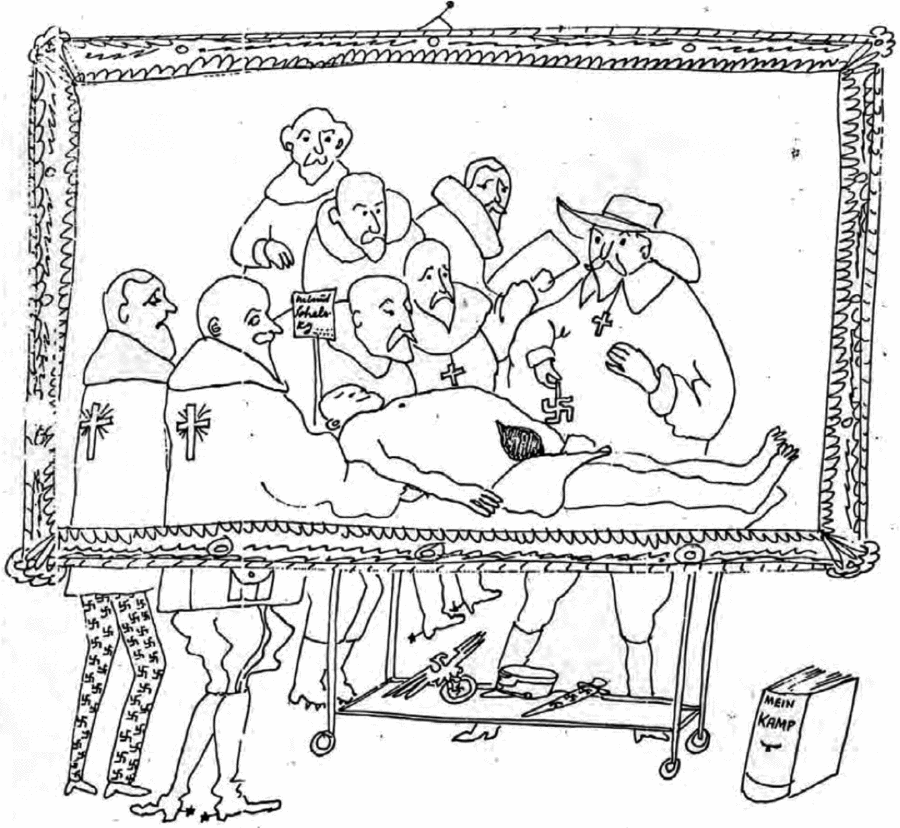
Würmeling and Schelsky were brought down by enemies in their own midst: Catholics in the former case, scientifically-minded students in the other. Their joint biographies illuminate the complexities of German history between Weimar and the 1960s and the difficulty of periodisation, especially when it comes to issues like eugenics, gender and the family. Schelsky, who despite everything was a brilliant intellectual, saw this clearly. In a postcard to Rudolf Oetker, a supporter of Schelsky's who himself had been a convinced National Socialist, he provided a remarkable image that encapsulates many of the themes broached in this essay. The drawing is a reworking of Rembrandt's famous painting, ‘The Anatomy Lesson of Dr. Nicolaes Tulp’. The cadaver is clearly identified with a nametag as Schelsky himself. The anatomist and his students are turned into Christians: crucifixes appear around their necks and on their cloaks. Schelsky, that is, interpreted himself as the inert victim of moralists, not scientists. And, what's more, moralists who were hiding their true nature: Schelsky's portrait shows the legs and feet of the ‘doctors’, and it is clear that they are the true Nazis. Underneath their Christian cloaks, the doctors are wearing military regalia. One of them has Nazi-emblazoned pants and the bottom tray of the surgical table features Nazi memorabilia. They are not the only Nazis in the image, however. They have in fact succeeded in pulling a swastika from the stomach of the corpse.
What did Schelsky mean by the postcard? Surely it was primarily intended as a self-exoneration of a sort, but it also implicates Schelsky. The swastika was, indeed, hiding in his stomach. This was the largest deviation between the postcard and Schelsky's surprisingly accurate portrayal of the painting: in the original, the doctors are dissecting the arm, but here they operate in the stomach. Could Schelsky be implying that he had, unlike the doctors, fully digested his Nazism? Is that the meaning of the enigmatic smile on the corpse's face?
Perhaps his point was a broader one about the nature and complexity of West German intellectual life in the 1950s and 1960s, and one that seems to critique present historical treatments avant la lettre. The standard version of West German history presumes that Nazism was followed by an era of Christian moralising, which was in turn followed by a period of science, progress and democracy. Schelsky's portrait shows us a much more complex reality in which Nazism and Christianity, those two great ideologies of the German past, survived into the 1960s, scrambled by the introduction of a scientific apparatus that could obscure that fact, as in the case of the doctors, or illuminate it, as in the case of Schelsky himself. Christianity, Nazism and scientific exploration do not here follow the model of a progressive sequence but of a complex coexistence. Mein Kampf, in Schelsky's portrayal, becomes Mein Kamp, signalling an era of self-referential theatricality and performance. However much the drawing represents reprehensible forms of moral equivalency, the methodological point is well taken. The most hegemonic forms of scientific investigation or moral righteousness have histories, too – sometimes fully digested, sometimes hiding outside the frame.
Schlesky's reworking of Rembrandt's ‘The Anatomy Lesson of Dr. Nicolaes Tulp’