




No CrossRef data available.
Article contents
Anxiety and depression, attention, and executive functions in hypothyroidism
Published online by Cambridge University Press: 26 August 2005
Abstract
Background: Divergences in cognitive disturbances in hypothyroidism reported in the literature are a result of a methodological bias. Methods: By using a precise methodology, we examined attention and executive functions in hypothyroidism, verified the presence of anxiety and depressive symptoms in hypothyroidism, and examined the possible link between these symptoms and the cognitive disturbances (searching for attentional bias for words with a negative emotional valence). We administered a battery of cognitive tests to 23 participants who had undergone thyroidectomy for thyroid carcinoma: for the first time in an euthyroid state, then 3 weeks later (still in the euthyroid state) to assess the test/retest effect, and finally 4 weeks later in an hypothyroid state. We compared their performance with that of a group of 26 control participants who were also administered the same cognitive tests, also 3 times. Results: In hypothyroidism, the thyroid participants were more anxious and depressed than the controls and presented attentional and executive disturbances that reflected general slowing and difficulties in using their capacities of inhibition. However, they did not exhibit an attentional bias for words with a negative emotional valence. Conclusions: Contrary to what was expected, symptoms of anxiety and not symptoms of depression interfered with the cognitive performance of participants in hypothyroidism. (JINS, 2005, 11, 535–544.)
Keywords
Information
- Type
- Research Article
- Information
- Journal of the International Neuropsychological Society , Volume 11 , Issue 5 , September 2005 , pp. 535 - 544
- Copyright
- © 2005 The International Neuropsychological Society
INTRODUCTION
Several studies on cognitive functioning have reported that hypothyroidism acquired in adulthood affects attention (Whybrow, 1996), memory (Baldini et al. 1997; Burmeister et al., 2001; Dugbartey, 1998; Haggerty et al., 1986; Jaeschke et al., 1996; McDermott & Ridgway, 2001; Monzani et al., 1993; Osterweil et al., 1992), and executive functions (Denicoff et al. 1990; Osterweil et al., 1992). Although they all focus on cognition, they have different outcomes and conclusions. Burmeister et al. (2001) found mnemonic functions to be disturbed with no effect on executive functioning, whereas Denicoff et al. (1990) observed the opposite. Osterweil et al. (1992) found both areas to be affected. A possible explanation for these differences is that these cognition studies of hypothyroid participants suffer from a methodological bias: (1) the lack of a sufficiently large control group of similar age and sociocultural level (Burmeister et al., 2001; Denicoff et al., 1990; Monzani et al., 1993); (2) a test/retest effect linked to the repeated administration of the same cognitive test (some tests are indeed very sensitive to this test/retest effect: e.g., the California Verbal Learning Test); and (3) insufficient sensitivity of the cognitive tests used, for example, the paper and pencil version of the Stroop test (Burmeister et al., 2001) or the Wechsler memory test (Baldini et al., 1997; Monzani et al., 1993).
Moreover, several studies have demonstrated an association or link between hypothyroidism and depression or anxiety (Burmeister et al., 2001; Whybrow, 1996). This cooccurrence can be confusing, because diminished neuropsychological functioning also occurs in depression and affects attention (Cornblatt et al., 1989; Nelson et al., 1998), memory (Austin et al., 1992; Bradley et al., 1995), and executive functions (Merriam et al., 1999; Silberman et al., 1983). In addition, anxious individuals exhibit deficient inductive reasoning (Reed, 1977), slowed decision latencies (Volans, 1976), shallow depth of processing (Fransson, 1977), and reduced memory span (Idzihowski & Baddeley, 1987). They also demonstrate impaired attentional control (Broadbent et al., 1986) and have particular problems in the execution of attentional inhibition (Fox, 1994). In fact, few studies have investigated the possibility of a link between the cognitive problems associated with hypothyroidism and those seen with depression and anxiety. This raises the question of whether the cognitive problems seen in hypothyroid participants reflect an accompanying depression and anxiety or whether the hypothyroid state itself induces these cognitive problems.
With this background information, we formulated our two main objectives. First, we screened for and assessed the presence of attention and executive dysfunction in hypothyroid participants. To avoid methodological biases, we needed to be cautious in our choice of cognitive tests and so used attention and executive functioning tests, as they are particularly sensitive to the hypothyroid metabolic state (Denicoff et al., 1990; Osterweil et al., 1992; Whybrow, 1996). The cognitive test battery (cf. Methods) was processed by computer and so is particularly precise. To determine the test/retest effect, we included a control group matched for age and sociocultural level.
Second, if cognitive dysfunctions were found in the hypothyroid population, a second question needed answering. Were these cognitive and executive problems associated with the hypothyroid condition itself or were they associated with a depressed or anxiety state that often accompanies hypothyroidism? One accepted and valuable method for answering this question is to include emotionally charged tests (Bradley et al., 1995; Mathews et al., 1996). Indeed, several authors have demonstrated an attentional bias for words with negative depressive and anxious connotations or valence in depressed patients (Bradley et al., 1995; Mathews et al., 1996). Other important findings are the inhibition difficulty observed during executive tasks, particularly when the words to be ignored have an emotional valence corresponding to the participant's mood (Gotlib et al., 1988; Murphy et al., 1999) and the quality of mnemonic encoding of words as a function of the emotional state of the participant (Bower, 1981). Several authors have identified a preconscious attentional bias using subliminal tasks (the participant is not aware of exposure due to extremely short stimulation) for words with a negative emotional valence in anxious participants and a conscious bias using supraliminal tasks (participant is aware of exposure) in depressed participants (Bradley et al., 1995; Mathews et al., 1996). Individuals with generalized anxiety disorder showed greater interference in color-naming performance on trials with threatening, rather than neutral, words in comparison with normal controls, irrespective of whether the words were masked (subliminal task) or unmasked (supraliminal task) (MacLeod et al., 1986; Mogg et al., 1993). In depression, functional imaging work has shown that certain tests, such as the “go/no go task” (Elliott et al., 2002) and the Emotional Stroop (Whalen et al., 1998) are indeed associated with abnormalities in the prefrontal neural response of depressed participants.
To our knowledge, the influence of words with a negative emotional valence congruent with the depressed mood of hypothyroid participants on their cognitive performance has not yet been investigated. If cognitive disorders are linked to anxiety and depression in hypothyroidism, words with a negative emotional valence should have an impact on cognitive performance, which would not be the case if the cognitive disorders are specifically linked to hypothyroidism.
We hypothesized that (1) the thyroid participants in a hypothyroid state would be more anxious and depressed than when they were in a euthyroid state, (2) their performance in attention and executive tasks would be lower, and (3) the impact of words with a negative emotional valence on their executive functions would be greater.
METHODS
Research Participants
We studied 23 participants in remission after they had undergone total thyroidectomy for a low risk, well-differentiated thyroid carcinoma (8 males and 15 females; mean age, 50.13 yr; range, 32–72 yr; sociocultural level from 1 to 3, mean: 2.48; mean duration of time elapsed since thyroidectomy: 27 ± 21 months). The participants were evaluated after achieving an euthyroid status by means of substitution treatment (mean thyroxine intake, 172.3 μg/day; range, 125–275 μg) and again after withdrawal of thyroid hormones. A severe hypothyroid status of short duration needed to be induced in these patients to perform scintigraphy (131I total body) to confirm that they were free of disease. Twenty-six control participants were matched for age and sociocultural level (13 males and 13 females; mean age, 48.85 years old; range, 21–69 years old; sociocultural level from 1 to 3, mean: 2.5). Both groups were comparable for age (t(47) = 0.317, p = .215) and schooling level [χ2(2, 49) = 1.82, p > 0.05], but not for gender, which was assumed not to have a significant influence on the outcome. The sociocultural levels are: 1 = secondary school to age 15; 2 = finished secondary school (∼18/19); 3 = higher studies or university.
The participants were recruited from the outpatient endocrinology unit and the normal controls from the care staff and volunteers of the Cliniques Universitaires Saint-Luc and from volunteer associations.
All of the participants and the normal controls gave their informed consent before entering the study, the protocol of which was approved by the Medical Ethics Committee of the School of Medicine of the Université Catholique de Louvain. The participants and the normal controls were administered routine laboratory thyroid function tests and a psychiatric interview using the Structural Clinical Interview for DSM-IV Axis I Disorders (SCID) (First et al., 1996) to exclude any axis I psychiatric disorder.
Exclusion criteria
For the thyroid participants: (1) unstable medical condition; (2) organic brain disorder; (3) <20 and >75 years of age; and (4) introduction or modification of psychotropic drugs during the 3 months preceding the study. Two patients were on 20 mg/day paroxetine, 2 on 20 mg/day citalopram; and 2 others on 150 mg/day venlafaxine. Although these participants were taking antidepressant drugs, they had been euthymic for some time before entering the study.
For the control participants: (1) unstable medical condition; (2) thyroid pathology; (3) organic brain disorder; (4) score >10 on the Beck Depression Inventory (BDI); (5) <20 and >75 years of age; (6) current or past mental disorder on the basis of a SCID I interview; and (7) introduction or modification of psychotropic drugs during the 3 months preceding the study.
Schedule and Clinical Tests
The thyroid participants were administered the battery of cognitive tests three times: the first and second time in an euthyroid state (to assess the test/retest effect) and a third time while hypothyroid. The control participants were administered the same cognitive tests three times, as well.
At Session 1, both of the groups received the serum thyroid tests (TSH and free T4), as well as the psychiatric interview. The participants then proceeded with the first cognitive test battery. The second testing session took place 3 weeks later, after which the thyroid participants stopped their thyroid hormones. The third test session followed 4 weeks later (the thyroid participants were now hypothyroid).
Procedure
The battery of cognitive tests included the phasic alertness task from the Test Battery for Attentional Performance (TAP) (Zimmermann & Fimm, 1994) for the assessment of attention, the Stroop test (Stroop, 1935) for the assessment of executive functions, and finally, a supraliminal and subliminal emotional Stroop test to analyze the impact of emotional words on cognition. By using both a supra- and a subliminal version of the emotional Stroop test, we hoped to elicit an attentional bias for negative emotional words and, if so, to determine whether this bias was caused by a preconscious automatic (supra- and subliminal conditions) or a consciously controlled process (supraliminal condition only) (Bradley et al., 1995; Mathews et al., 1996).
Phasic alertness task
This is a computerized test that evaluates the ability to increase the attention level when a stimulus is expected to occur (Zimmermann & Fimm, 1994). Phasic alertness is measured by the reaction time (RT) to a target stimulus (a white cross on a black background) accompanied by a warning signal (a beep). The participant must press a button as quickly as possible as soon as a cross appears on the screen but not when the warning signal is sounded. The median RT for correctly detected crosses is calculated with and without the signal. A participant's sensitivity to interference in the presence of an audible warning will be manifested either by a greater number of errors (pressing the button as soon as the audible signal is heard and not after the cross appears) or by an increase in the RT.
The Stroop test
We used a computerized Stroop task (Stroop, 1935). The experiment was run on a PC using the E-Prime software system version 1.0 (Schneider et al., 2002). The items were either neutral (colored string of symbols), congruent (color name matching color in which it was written), or incongruent (color name different from color in which it was written). The participants were asked to name the color in which the item is written. A short pretest was given to all of the participants to make sure they understood the expectations. The response latencies for trials with incorrect responses were excluded from the response latency analyses. The response latencies were determined for each group and for each item (congruent vs. neutral vs. incongruent) from the individual median RTs.
Supraliminal and subliminal emotional Stroop test
This test is a variant of the previous one. The participant must identify the color of words displayed on the screen. In this test, different types of words are used: color-congruent words (“red” written in red, “blue” written in blue), neutral emotional words (neutral words replacing the symbol of the Stroop version), and incongruent emotional words (reflecting depression and anxiety). To select these words, we conducted a survey presenting 244 words to 200 students. The supraliminal and subliminal Stroop tests each consisted of a mixture of the 4 types of words. The words were chosen and matched according to their relative lexical frequency and their length using the BRULEX (Content, 1990). In the supraliminal emotional Stroop task, the time of exposure was 10,000 ms, as in the Stroop test. In the subliminal version, the time of exposure was 14 ms, and the words were followed by a mask. The RT was measured between the onset of the mask and the response.
Clinical Outcome Measures
The affective symptoms were assessed by means of a self-rated Beck Depression Inventory (BDI) (Beck et al., 1961) and the anxiety symptoms by means of the State–Trait Anxiety Inventory (STAI) Scale (Spielberger et al., 1983).
In addition, when the thyroid participants were hypothyroid, we asked them to fill in a questionnaire devised by one of the authors (E. Constant) to assess their subjective symptoms. By using a scale from 1 (hardly at all) via 4 (moderate) to 7 (a lot), the patients were asked to rate the following symptoms: “act more slowly physically,” “lack energy,” “am more tired,” “sleep more than usual,” “walk more slowly,” “am more irritable,” “am sadder,” “am more sensitive emotionally,” “am more anxious,” “have difficulty concentrating,” “have difficulty memorizing.” These particular symptoms were selected on the basis of clinical experience and the usual complaints made by patients with hypothyroidism (Constant et al., 2001). We classified these symptoms into 3 categories as follows, each category being assigned a mean score:
Symptoms of psychomotor slowing (acting more slowly physically, lacking energy, being more tired, sleeping more than usual)
“Anxiety/depression” symptoms (being more irritable, sadder, emotionally more sensitive, more anxious)
Cognitive symptoms (having difficulty concentrating, having difficulty memorizing).
Statistical Analysis
For age, TSH, and free T4 values, the groups were compared using Student's t test. For educational level, the groups were compared by means of a chi-square test. Finally, since the RTs were not normally distributed, the log(10) transformation was applied to the median RTs. These transformed values were then analyzed using multifactorial ANOVAs with repeated measures, where sessions were differently weighted: Sessions 1 and 2 were each given the coefficient −1, and Session 3 was given the coefficient +2 (this was done to avoid a bias favoring the two euthyroid conditions over the single hypothyroid one). The statistical significance for all the analyses was set at α ≤ .05. Only significant effects are reported.
RESULTS
Thyroid Function Tests
Although the control participants and thyroid participants in euthyroidism differed significantly for TSH (t(47) = −2.94, p < .01—thyroid participants had lower TSH scores) and for free T4 (t(47) = 7.28, p < .001—thyroid participants had higher free T4 scores) (Table 1), these differences were without importance in the interpretation of the results, as all of the participants were biologically as well as clinically in euthyroidism. The significant although small difference between the two groups could be explained by the need to obtain a low TSH value within the normal range in the thyroid group. In hypothyroidism, the TSH levels of the thyroid participants were significantly higher than those of the controls (t(47) = 10.73, p < .001) and free T4 levels were significantly lower (t(47) = −14.84, p < .001), as was expected.
Mean thyroid indexes at the different sessions (standard deviations in parentheses)

Cognitive Functions
Phasic alertness task
The rate of the number of errors was low (less than 7%) and no significant effect emerged from the Group × Session × Signal ANOVA (all Fs < 1). A Group (2: Thyroid, Control) × Warning Signal (2: without, with) × Session (3: Session 1, Session 2, Session 3) ANOVA with repeated measures on the last 2 factors conducted on median response latencies (see Figure 1) revealed significant main effects for Session [F(1,47) = 10.33, p < .01] and for Warning Signal [F(1,47) = 14.52, p < .001] (with slower RTs without the warning signal) and a significant interaction between Group and Session [F(2,94) = 13.79, p < .00001].

Median reaction times (ms) and standard deviations for phasic alert scores with and without alarm.
Examination of this last interaction with planned comparisons revealed (1) that the thyroid participants had slower RTs when in the hypothyroid state (Session 3) than in the euthyroid state (Sessions 1 and 2) [F(1,47) = 28.93, p < .00001]; (2) that no significant difference emerged between the 3 sessions for the normal controls [F(1,47) = 1.06, p = .309]; and (3) that the thyroid participants had slower RTs than did the normal controls only in hypothyroidism (Session 3) [F(1,47) = 4.88, p < .05].
Stroop task
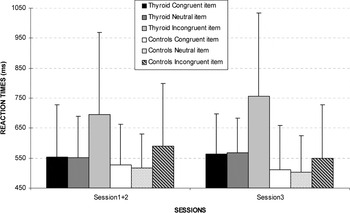
The error rate in the Stroop task was low (less than 4%), and there were no differences between the 2 groups. Given this ceiling effect, we focused our analysis solely on RTs. A Group (2: Thyroid, Control) × Session (3: Session 1, Session 2, Session 3) × Item (3: congruent, neutral, incongruent) ANOVA with repeated measures on the last two factors conducted on median response latencies (see Figure 2) revealed significant main effects for Item [F(2,94) = 46.23, p < .0001] and significant interactions between Group and Item [F(2,94) = 8.75, p < .001], between Group and Session [F(2,94) = 4.12, p < .05] (with slower RTs for the thyroid participants than for the controls only when in the hypothyroid state) (Session 3 (p < .05), and between Group, Item, and Session [F(4,188) = 2.42, p < .05].

Median reaction times (ms) and standard deviations for the Stroop test.
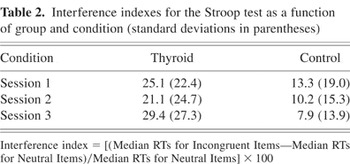
Examination of this last interaction with planned comparisons revealed (1) for the thyroid participants, slower RTs for incongruent items in hypothyroidism (Session 3) than in euthyroidism (Sessions 1 and 2) [F(1,47) = 4.56, p < .05], which was not the case for other items; (2) for the controls, no significant difference in RTs for any item between the 3 sessions; (3) slower RTs for neutral [F(1,47) = 4.26, p < .05] and incongruent [F(1,47) = 9.14, p < .01] items in the thyroid participants than in the controls in hypothyroidism (Session 3). These results indicate psychomotor slowing in hypothyroidism with an increased interference effect. This finding is confirmed by the classical interference index (Table 2).
Interference indexes for the Stroop test as a function of group and condition (standard deviations in parentheses)

A Group (2: Thyroid, Control) × Session (3: Session 1, Session 2, Session 3) ANOVA on the interference index (see Table 2), with repeated measures on the last factor, revealed a significant main effect for Group [F(1,47) = 7.53, p < 0.01] and a significant interaction between Group and Session [F(2,94) = 3.62, p < .05].
Planned comparisons revealed (1) a higher interference index in the thyroid participants in hypothyroidism (Session 3) than in euthyroidism (Sessions 1 and 2) [F(1,47) = 5.47, p < .05]; (2) an equivalent interference index across tests in the controls; and (3) a higher interference index for the thyroid participants than for the controls only when in hypothyroidism (Session 3) [F(1,47) = 12.55, p < .001].
Autoquestionnaires
For the Beck Depression Inventory (see Table 3), a Group (2: Thyroid, Control) × Session (3: Session 1, Session 2, Session 3) ANOVA with repeated measures on the last factor revealed significant main effects for Group [F(1,47) = 12.80, p < .001] and for Session [F(1,47) = 11.06, p < .01] and a significant interaction between Group and Session [F(2,94) = 14.60, p < .00001].
Mean scores on the different scales as a function of group and session (standard deviations in parentheses)

Planned comparisons revealed (1) that the thyroid participants had higher BDI scores than the controls for the three sessions (all ps ≤ .05), but particularly for Session 3 [F(1,47) = 26.32, p < .00001]; (2) that there were no significant differences between the sessions in the controls; and (3) that the thyroid participants showed higher scores in the hypothyroid state (Session 3) than when euthyroid (Sessions 1 and 2) [F(1,47) = 25.6, p < .00001].
For the STAI state scores (see Table 3), a Group (2: Thyroid, Control) × Session (3: Session 1, Session 2, Session 3) ANOVA with repeated measures on the last factor revealed significant main effects for Group [F(1,47) = 7.32, p < .01] and for Session [F(1,47) = 8.27, p < .01] and a significant interaction between Group and Session [F(2,94) = 6.89, p < .01].
Planned comparisons revealed (1) that the thyroid participants had higher STAI state scores than the controls only in hypothyroidism (Session 3) [F(1,47) = 12.95, p < .001]; (2) that no significant difference emerged between any session for the controls; and (3) that the thyroid participants scored higher in the hypothyroid state (Session 3) than when in euthyroidism (Sessions 1 and 2) [F(1,47) = 15.43, p < .001].
For the STAI trait scores (see Table 3), a Group (2: Thyroid, Control) × Session (3: Session 1, Session 2, Session 3) ANOVA with repeated measures on the last factor revealed a significant main effect for Group [F(1,47) = 10.41, p < 0.01], the thyroid participants obtaining higher scores than the controls.
Relation Between Anxiety, Depression, and Cognitive Symptoms in Hypothyroidism
We observed attention and executive disorders in the participants with hypothyroidism and noted that symptoms of anxiety and depression were more pronounced in them than while in a euthyroid state. What is the relationship between these 2 types of symptoms? We found no significant correlation between the anxious or the depressive symptomatology (the Beck Depression Inventory and STAI scales scores, respectively) and the performances on the different attention and executive tasks. However, when we divided the thyroid participants into two subgroups according to the criterion of anxiety using the state STAI (more anxious: 11, less anxious: 12), only the more anxious ones showed higher interference in hypothyroidism (Session 3) on the Stroop test than in euthyroidism (Sessions 1 and 2) [F(1,46) = 10.14, p < .01] and slower RTs in hypothyroidism than in euthyroidism on the phasic alertness test without the warning signal [F(1,21) = 13.49, p < .01]. When we looked at the same thyroid group but divided them according to depression severity (more depressed/less depressed), we found no differences for the various cognitive tests. Finally, the influence of words with a negative emotional valence on performance in the Stroop test was analyzed.
Supraliminal and subliminal emotional Stroop tasks
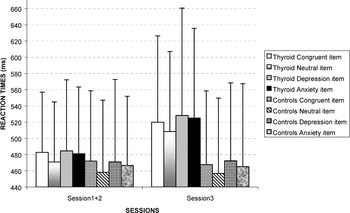
As for the Stroop task presented earlier, the error rate was low (less than 4%) and there were no differences between the groups. For this reason, the error rates were not analyzed. A Group (2: Thyroid, Control) × Stroop (2: supraliminal, subliminal) × Session (3: Session 1, Session 2, Session 3) × Word (4: congruent, neutral, incongruent depression, incongruent anxiety) ANOVA with repeated measures on the last three factors (see Figure 3) conducted on median response latencies revealed significant main effects for Word [F(3,141) = 8.31, p < .0001], for Stroop [F(1,47) = 75.58, p < .00001] (with slower RTs for the supraliminal task than for the subliminal task) and significant interactions between Group and Session [F(2,94) = 4.12, p < .05] and between Stroop and Session [F(2,94) = 3.72, p < .05].

Median reaction times (ms) and standard deviations for Supraliminal and Subliminal Emotional Stroop tests.
Examination of these interactions with planned comparisons revealed (1) for the thyroid participants, slower RTs in hypothyroidism (Session 3) than in euthyroidism (Sessions 1 and 2) [F(1,47) = 13.89, p < .001]; (2) no significant difference between the sessions in the controls; (3) a tendency for slower RTs in the thyroid participants than in the controls while in hypothyroidism (Session 3) [F(1,47) = 3.69, p = .06]; (4) for the subliminal task, slower RTs at Session 3 than at Sessions 1 and 2 [F(1,47) = 8.80, p < .01].
Concerning the interference index (see Table 4), a Group (2: Thyroid, Control) × Stroop (2: supraliminal, subliminal) × Session (3: Session 1, Session 2, Session 3) × Word (2: anxiety, depression) ANOVA with repeated measures on the last three factors did not reveal any significant main or interaction effect, which confirmed the absence of attentional bias for words with a negative emotional valence in the hypothyroid state.
Interference indexes for the supraliminal and subliminal emotional Stroop tests as a function of group and condition (standard deviations in parentheses)

DISCUSSION
This study examined the presence of anxiety and depressive symptoms in hypothyroid participants and the possible link between these symptoms and attentional and executive impairments. Our hypothesis that the participants in a hypothyroid state would be more anxious and depressed than when they are in a euthyroid state was confirmed, as was our expectation that their performances in attention and executive tasks would be lower. However, our third hypothesis, regarding the impact of words with a negative emotional valence on their executive functions, was not confirmed.
First of all, at the cognitive level, our study confirmed both attentional and executive disturbances in hypothyroidism.
At the attentional level during the phasic alertness tests, the performance of the thyroid participants was similar to that of the control participants in the first 2 sessions. In the third session, when the thyroid participants were hypothyroid, they showed slower RTs than did the controls, with and without the warning signal. Thus, during the hypothyroid state, no greater sensitivity to interference was observed when the warning signal was given. These results suggest that the central component of the alertness reaction is preserved, but that there is a general slowing in the hypothyroid condition, which has also been reported by other authors (Dugbartey, 1998; Osterweil et al., 1992). These authors suggested that hypothyroid participants will improve their reaction times when treated with thyroid hormones. It has also been suggested that thyroid hormones increase the number and activity of β-adrenergic receptors and that the catecholaminergic system stimulates attention and vigilance (Baldini et al., 1997).
Concerning the executive tasks, we advanced the hypothesis that thyroid participants in a hypothyroid state would perform more poorly in attention and executive tasks than otherwise. This has been studied in the past with the Digit Symbol Substitution Test and Trail Making Test (Denicoff et al., 1990; Osterweil et al., 1992). However, we elected to use the Stroop test, as it is not only a valid instrument for assessing executive functioning (capacities of inhibition), but it also is a useful tool for studying the influence on performance of words with a negative emotional valence. First of all, the psychomotor slowing in the hypothyroid participants was confirmed. Second, a higher interference index was seen in this group. Clinically, this means that hypothyroid participants have greater difficulties using their capacities of inhibition. It should be noted that other authors (Burmeister et al., 2001) did not demonstrate this increased interference effect in the same task in a similar population. One possible explanation for this is that these authors investigated fewer participants (13) and also used a noncomputerized version of the test.
Regarding anxiety and depression, several authors have shown an association between hypothyroidism and the depressive or anxious state (Burmeister et al., 2001; Whybrow, 1996). Our study confirms this. Indeed, the thyroid participants were significantly more depressed and more anxious while hypothyroid. Whether euthyroid or hypothyroid, they showed a higher STAI trait score than did the controls. This could be correlated with their history of cancer. However, the STAI state score was elevated only while they were hypothyroid, which may reflect the influence of thyroid hormones on anxiety, as has been discussed by several other authors (Boillet & Szoke, 1998; Denicoff et al., 1990; Monzani et al., 1993). Nevertheless, it should be stated that the depressive symptoms were not as intense as those encountered in major depression. In fact, the mean score on the Beck Depression Inventory during hypothyroidism was 11.8 ± 8.6, which is lower than the threshold score of 18.7 for considering mild depression.
As for the specific interaction between emotional life and cognition in the hypothyroid state, we examined the influence of words with a negative emotional valence on the executive performances, as has been done elsewhere in depression and anxiety studies (Bradley et al., 1995; Mathews et al., 1996). Contrary to expectations, we were unable to demonstrate any attentional bias for words with a negative emotional valence in hypothyroidism using the supraliminal and subliminal emotional Stroop test. We noted only a slowing in performance in the hypothyroid state, reflecting the psychomotor slowing that accompanies hypothyroidism. A possible reason for this is the lack of sensitivity in this test. Nevertheless, we observed an attentional bias for the same negative emotional valence words in major depression (Constant et al., 2005) on the same test. Another explanation could be that the thyroid participants in the present study were not depressed or anxious enough for such a bias to be observed. Indeed, in Mogg et al.'s study (1995), a preconscious attentional bias (under subliminal conditions) was shown in anxious patients, and a conscious bias (under supraliminal conditions) was shown in depressed patients, the latter having higher depression and anxiety scores than those of our hypothyroid participants. Although the hypothyroid state is accompanied by anxiety/depressive symptoms, they may not be severe enough to induce an attentional bias that would be manifest with negative emotional valence words.
Finally, although it was not possible to observe any significant difference between the more depressed and less depressed hypothyroid participants in various cognitive tests, significant differences in phasic alertness without the warning signal were observed between the more anxious and less anxious hypothyroid participants (more anxious patients showed greater slowing of reaction time), as well as in the Stroop test (more anxious ones showed higher interference in hypothyroidism). This suggests that symptoms of anxiety, rather than depressive symptoms, interfere with performance in attentional and executive tasks while the participants are hypothyroid.
There are several limitations to this study. First, we focused on aspects of attention and inhibitory executive functions, as these cognitive functions are particularly sensitive to the hypothyroid metabolic state. Nevertheless, it would have been interesting to look into memory functions. Second, this particular model of hypothyroidism (acute short-term hypothyroidism) differs from spontaneous hypothyroidism, which is often milder and slowly progressive (chronic long-term hypothyroidism). Indeed, one could argue that the unexpected finding of the prevalent interference effect of anxiety was the consequence of a sudden decline of circulating thyroid hormone in short-term hypothyroidism, which induces marked discomfort that is quite different from the insidious symptoms typical of long-term thyroid failure. Even if increased anxiety could be explained in part by awaiting the result of scintigraphy, this would not be the only explanation. The participants knew that the probability of having a recurrence of the disease was very low, as they all had had a low-risk well-differentiated thyroid carcinoma. A similar procedure that involved withdrawing thyroid hormones had already been done twice in the past. Moreover, the literature has reported increased anxiety also in long-term hypothyroid status (Boillet & Szoke, 1998; Monzani et al., 1993). A study by Denicoff et al. (1990) investigating thyroidectomized patients without substitution treatment showed that patients were more anxious without thyroid-hormone substitution treatment. Further studies are needed to determine if the results of the present study can be generalized to other types of hypothyroidism.
References
REFERENCES
Austin, M.,
Ross, M.,
Murray, C.,
O'Carroll, R.E.,
Ebmeier, K.P., &
Goodwin, G.M.
(1992).
Cognitive function in major depression.
Journal of Affective Disorders,
25,
21–30.Google Scholar
Baldini, I.M.,
Vita, A.,
Mauri, M.C.,
Amodei, V.,
Carrisi, M.,
Bravin, S., &
Cantalamessa, L.
(1997).
Psychopathological and cognitive features in subclinical
hypothyroidism.
Progress in Neuropsychopharmacology and Biological
Psychiatry,
21,
925–935.Google Scholar
Beck, A.T.,
Ward, C.H.,
Mendelson, M.,
Mock, J., &
Erbaugh, J.
(1961).
An inventory for measuring depression.
Archives of General Psychiatry,
4,
561–571.Google Scholar
Boillet, D. &
Szoke, A.
(1998).
Psychiatric symptoms as single manifestation of
hypothyroidism.
Encéphale,
24,
65–68.Google Scholar
Bradley, B.P.,
Mogg, K.,
Millar, N., &
White, J.
(1995).
Selective processing of negative information: Effects of clinical
anxiety, concurrent depression, and awareness.
Journal of Abnormal Psychology,
104,
532–536.Google Scholar
Broadbent, D.E.,
Broadbent, M.H.P., &
Jones, J.L.
(1986).
Performance correlates of self-reported cognitive failure and
obsessionality.
British Journal of Clinical Psychology,
25,
285–299.Google Scholar
Burmeister, L.A.,
Ganguli, M.,
Dodge, H.H.,
Toczek, T.,
DeKosty, S.T., &
Nebes, R.D.
(2001).
Hypothyroidism and cognition: Preliminary evidence for a specific
defect in memory.
Thyroid,
11,
1177–1185.Google Scholar
Constant, E.L.,
De Volder, A.G.,
Ivanoiu, A.,
Bol, A.,
Labar, D.,
Seghers, A.,
Cosnard, G.,
Melin, J., &
Daumerie, C.
(2001).
Cerebral blood flow and glucose metabolism in hypothyroidism: A
positron emission tomography study.
Journal of Clinical Endocrinology and Metabolism,
86,
3864–3870.Google Scholar
Constant, E.L.,
Adam, S.,
Gillain, B.,
Seron, X.,
Bruyer, R., &
Seghers, A.
(2005).
Effects of sertraline on depressive symptoms and attentional and
executive functions in major depression.
Depression and Anxiety,
21,
78–89.Google Scholar
Content, A.
(1990).
BRULEX: Une base de données lexicales informatisées
pour le français écrit et parlé.
Année psychologique,
90,
551–566.Google Scholar
Cornblatt, B.,
Nezenweger, M., &
Erlenmeyer-Kimling, L.
(1989).
The continuous performance test, identical pairs version: II.
Contrasting attentional profiles in schizophrenic and depressed
patients.
Psychiatry Research,
29,
65–85.Google Scholar
Denicoff, K.D.,
Joffe, R.T.,
Lakshmanan, M.C.,
Robbins, J., &
Rubinow, D.R.
(1990).
Neuropsychiatric manifestations of altered thyroid state.
American Journal of Psychiatry,
147,
94–99.Google Scholar
Dugbartey, A.T.
(1998).
Neurocognitive aspects of hypothyroidism.
Archives of Internal Medicine,
158,
1413–1418.Google Scholar
Elliott, R.,
Rubinsztein, J.S.,
Sahakian, B.J., &
Dolan, R.J.
(2002).
The neural basis of mood-congruent processing biases in
depression.
Archives of General Psychiatry,
59,
597–604.Google Scholar
First, M.B.,
Spitzer, R.L.,
Gibbon, M., &
Williams, J.B.W.
(1996).
Structured clinical interview for DSM-IV axis I disorders (SCID),
clinical version.
Washington, DC:
American Psychiatric Press.
Fox, E.
(1994).
Attentional bias in anxiety: A defective inhibition
hypothesis.
Cognition and Emotion,
8,
165–195.Google Scholar
Fransson, A.
(1977).
On qualitative differences in learning IV: Effects of intrinsic
motivation and extrinsic anxiety on process and outcome.
British Journal of Educational Psychology,
47,
244–257.Google Scholar
Gotlib, I.H.,
McLachlan, A.C., &
Katz, A.N.
(1988).
Biases in visual attention in depressed and nondepressed
individuals.
Cognition and Emotion,
2,
185–200.CrossRefGoogle Scholar
Haggerty, J.J.,
Evans, D.L., &
Prange, A.J., Jr.
(1986).
Organic brain syndrome associated with marginal
hypothyroidism.
American Journal of Psychiatry,
143,
785–786.Google Scholar
Idzihowski, C. &
Baddeley, A.
(1987).
Fear and performance in novice parachutists.
Ergonomics,
30,
1463–1474.Google Scholar
Jaeschke, R.,
Guyatt, G.,
Gerstein, H.,
Patterson, C.,
Molloy, W.,
Cook, D.,
Harper, S.,
Griffith, L., &
Carbotte, R.
(1996).
Does treatment with L-thyroxine influence health status in
middle-aged and older adults with subclinical hypothyroidism?
Journal of General Internal Medicine,
11,
744–749.Google Scholar
MacLeod, C.,
Mathews, A., &
Tata, P.
(1986).
Attentional bias in emotional disorders.
Journal of Abnormal Psychology,
95,
15–20.Google Scholar
Mathews, A.,
Ridgeway, V., &
Williamson, D.A.
(1996).
Evidence for attention to threatening stimuli in depression.
Behaviour Research and Therapy,
34,
695–705.Google Scholar
McDermott, M.T. &
Ridgway, E.C.
(2001).
Subclinical hypothyroidism is mild thyroid failure and should be
treated.
Journal of Clinical Endocrinology and Metabolism,
86,
4585–4590.Google Scholar
Merriam, E.P.,
Thase, M.E.,
Haas, G.L.,
Keshavan, M.S., &
Sweeney, J.A.
(1999).
Prefrontal cortical dysfunction in depression determined by
Wisconsin card sorting test performance.
American Journal of Psychiatry,
156,
780–782.Google Scholar
Mogg, K.,
Bradley, B.P., &
Williams, R.
(1995).
Attentional bias in anxiety and depression: The role of
awareness.
British Journal of Clinical Psychology,
34,
17–36.Google Scholar
Mogg, K.,
Bradley, B.P.,
Williams, R., &
Mathews, A.
(1993).
Subliminal processing of emotional information in anxiety and
depression.
Journal of Abnormal Psychology,
102,
304–311.Google Scholar
Monzani, F.,
Del Guerra, P.,
Caraccio, N.,
Pruneti, C.A.,
Pucci, E.,
Luisi, M., &
Baschieri, L.
(1993).
Subclinical hypothyroidism: Neurobehavioral features and beneficial
effect of L-thyroxine treatment.
Journal of Clinical Investigation,
71,
367–371.Google Scholar
Murphy, F.C.,
Sahakian, B.J.,
Rubinsztein, J.S.,
Michael, A.,
Rogers, R.D.,
Robbins, T.W., &
Paykel, E.S.
(1999).
Emotional bias and inhibitory control processes in mania and
depression.
Psychological Medicine,
29,
1307–1321.Google Scholar
Nelson, E.B.,
Sax, K.W., &
Strakowski, S.M.
(1998).
Attentional performance in patients with psychotic and nonpsychotic
major depression and schizophrenia.
American Journal of Psychiatry,
155,
137–139.Google Scholar
Osterweil, D.,
Syndulko, K.,
Cohen, S.N.,
Pettler-Jennings, P.D.,
Hershman, J.M.,
Cummings, J.L.,
Tourtelotte, W.W., &
Solomon, D.H.
(1992).
Cognitive function in non-demented older adults with
hypothyroidism.
Journal of American Geriatric Society,
40,
325–335.Google Scholar
Reed, G.F.
(1977).
Obsessional cognition: Performance on two numerical tasks.
British Journal of Psychiatry,
130,
184–185.Google Scholar
Schneider, W.,
Eschman, A., &
Zuccolotto, A.
(2002).
E-Prime user's guide.
Pittsburgh, PA:
Psychology Software Tools Inc.
Silberman, E.,
Weingartner, H., &
Post, R.M.
(1983).
Thinking disorder in depression.
Archives of General Psychiatry,
40,
775–780.Google Scholar
Spielberger, C.D.,
Gorsuch, R.L.,
Lushene, R.,
Vagg, P.R., &
Jacobs, G.A.
(1983).
Manual for the State-Trait Anxiety Inventory.
Palo Alto, CA:
Consulting Psychologists Press.
Stroop, J.R.
(1935).
Studies of interference in serial verbal reactions.
Journal of Experimental Psychology,
18,
643–662.Google Scholar
Volans, P.J.
(1976).
Styles of decision-making and probability appraisal in selected
obsessional and phobic patients.
British Journal of Social and Clinical Psychology,
15,
305–317.Google Scholar
Whalen, P.J.,
Bush, G.,
McNally, R.J.,
Wilhelm, S.,
McInerney, S.C.,
Jenike, M.A., &
Rauch, S.L.
(1998).
The emotional counting Stroop paradigm: A functional magnetic
resonance imaging probe of the anterior cingulate affective
division.
Biological Psychiatry,
44,
1219–1228.Google Scholar
Whybrow, P.C.
(1996).
Behavioral and psychiatric aspects of hypothyroidism. In
L.E. Braverman &
R.D. Utiger (Eds.),
The thyroid
(Werner & Ingbar's 7th ed., pp.
866–869).
Philadelphia:
Lippincott-Raven.
Zimmermann, P. &
Fimm, B.
(1994).
Tests d'évalution de l'attention
(TEA)–Version 1.02C.
French adaptation by P. North, M. Leclercq, N. Cremel, P. Tassi, D.
Jeromin (Eds). Herzogenrath, Germany:
Psytest.

Mean thyroid indexes at the different sessions (standard deviations in parentheses)

Median reaction times (ms) and standard deviations for phasic alert scores with and without alarm.
Median reaction times (ms) and standard deviations for the Stroop test.
Interference indexes for the Stroop test as a function of group and condition (standard deviations in parentheses)

Mean scores on the different scales as a function of group and session (standard deviations in parentheses)
Median reaction times (ms) and standard deviations for Supraliminal and Subliminal Emotional Stroop tests.

Interference indexes for the supraliminal and subliminal emotional Stroop tests as a function of group and condition (standard deviations in parentheses)
 You have
Access
- 60
- Cited by