

In the contemporary era of financial globalization, many countries have an unprecedented ability to issue sovereign bonds on international capital markets. In 1990, twenty-one non-OECD countries issued bonds in international markets; this number grew to forty-four by 1995. And in 2010, ninety-six non-OECD governments issued international bonds. In our issue-level data on sovereign debt, we document over 240,000 bond issues by 131 countries between 1990 and 2016. What is more, developing-country sovereign issuers are not simply passive takers of supply-side capital offerings. Developing-country governments make strategic choices over the timing and amount of their sovereign bond issues.Footnote 1 Here, we argue that their strategic choices also concern the terms of the bond issued. These bond terms are important: they influence countries’ future exposure to local and global crises, as well as to financial market pressures.
Bond terms provide governments an opportunity to trade off between borrowing costs and refinancing risks. We focus on whether governments denominate debt in their own (domestic) currency or in foreign currency. Domestic debt denomination, in particular, requires trade-offs that encapsulate classic ideological differences over economic policy. In brief, right governments prefer foreign denomination as a means of mitigating currency risk and thus minimizing borrowing costs, while left governments prefer domestic denomination to maximize flexibility while transferring currency risk to investors. Therefore, all else equal, we argue that left governments are more likely to issue domestic-denominated debt, even as doing so may necessitate trade-offs across other terms.
Our theoretical logic and empirical evidence highlight the agency of developing-country governments to bargain over the terms of their sovereign borrowing. While it is clear that financial globalization gives these countries access to private capital markets,Footnote 2 the long-standing expectation has been that creditors largely set the terms of their borrowing. Specifically, developing countries suffer, by virtue simply of their status, from “original sin.”Footnote 3 Thus developing-country sovereigns must issue debt in foreign currencies to placate investors’ concerns. At the extreme, “original sin” implies that demand for domestic-denominated debt from developing countries is effectively zero. In a milder form, it suggests that creditors and debtors will not agree on bond terms with domestic denomination because the creditors’ demands for other bond terms to compensate for domestic-currency risk would be so onerous.
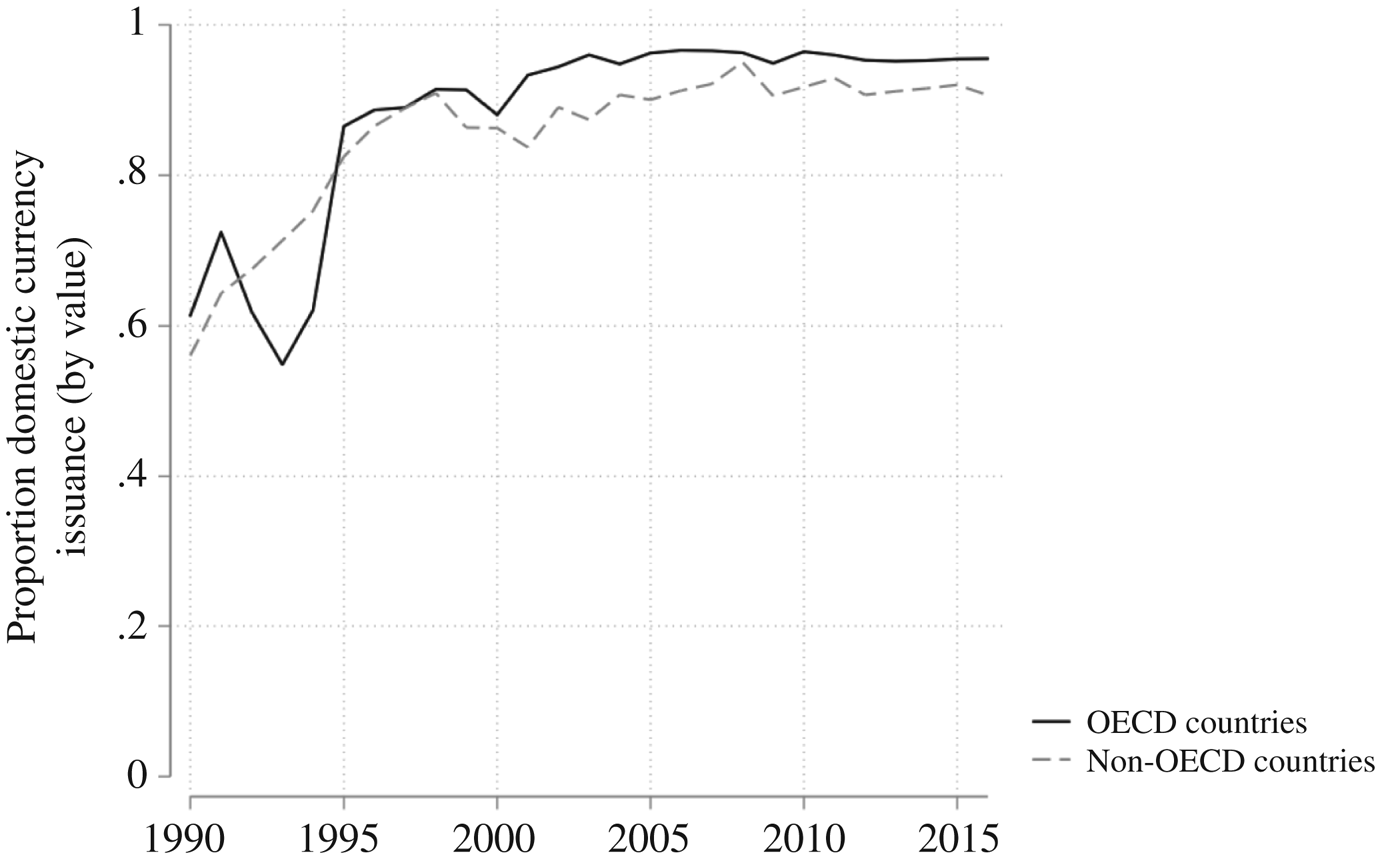
Strikingly, the empirical record upends these “original sin” expectations. Our issue-level data make the trend clear: 56 percent of non-OECD sovereign debt issued in 1990 was domestic-currency-denominated, 82 percent in 1995, and 92 percent in 2010. In recent years, countries including Brazil, Colombia, Venezuela, and Bolivia have refinanced outstanding foreign-currency debt to denominate in their own currencies. In the contemporary marketplace, domestic-denominated developing-country sovereign bond issues have become the norm. As we note later, structural aspects of contemporary international capital markets shed some light on why “original sin” expectations have been sidelined. The global investor base has grown dramatically; many governments have worked to create or deepen markets for local currency debt; and international financial institutions have worked with developing-country governments to professionalize the debt management offices (DMOs) responsible for issuing sovereign bonds. Liquid global capital markets offer opportunities, therefore, for many sovereign borrowers. Regardless, fully explaining this empirical pattern requires theoretical work to understand how creditors and debtors are frequently able to reach terms that reflect creditors’ appetite for, or at least acceptance of, domestic-currency-denominated debt.
Yet it would be a mistake to interpret the surge of domestic denomination as evidence that government desires to denominate in domestic currency are now costless, uncontested, or foregone. For example, a fierce debate raged in India in mid-2019, after the Indian government proposed issuing the country's first-ever non-rupee-denominated sovereign bonds; current and past policymakers clashed over the proposal in a plethora of prominent opinion pieces in India's major newspapers.Footnote 4 This contestation over debt denomination reveals the real and perceived trade-offs in play when governments bargain with creditors over the terms of their borrowing. While domestic-currency denomination is far more available to developing-country governments than it was decades ago, it nonetheless entails trade-offs on other terms of debt, as well as on other elements of economic policy. Distributional conflict related to these trade-offs is at the heart of governments’ currency-denomination choices.
Therefore, we approach the dramatic shift in debt denomination by focusing on the role of debtor governments in bargaining over the terms of their bond issues. Many analyses of sovereign debt focus on the supply (creditor) side of the market: investors’ assessments of default risk—and their resulting offers of bond terms—vary as a function of various political institutions, macroeconomic outcomes, and other past outcomes.Footnote 5 Implicit in these analyses is the assumption that developing-country sovereigns have little bargaining power vis-à-vis investors; while these governments may have domestically driven preferences over how they borrow, these preferences have scant influence over the bargains made with investors.
However, despite their apparent lack of bargaining power vis-à-vis official creditors,Footnote 6 developing-country governments often interact with multilateral financial institutions and individual donor governments in ways that reflect domestic considerations.Footnote 7 Developing-country governments may use conditional lending to tie their political rivals’ hands, avoid external financing conditions that threaten their own political survival, and use foreign aid revenues as a means of domestic credit-claiming.Footnote 8
We claim that the same pattern holds in the realm of private market sovereign bonds. Governments’ preferences over economic policy, rooted in domestic politics, shape not only their demands around sovereign borrowing but also the outcomes of their bargaining interactions with creditors. Governments’ preferences regarding sovereign debt denomination fall along traditional partisan lines. Left governments especially prefer domestic denomination, which transfers currency risk to investors. This frees the government from worry about the implications of currency depreciation or exchange rate volatility for the government's capacity to repay its obligations. Investors, however, require compensation for taking on currency risk, even in the context of liquid financial markets. Indeed, using our issue-level data on currency, maturity, and yield, we find descriptive evidence consistent with costs to domestic denomination. Moreover, we find that left governments are more likely to denominate in domestic currency in the presence of domestic institutions that blunt investors’ concerns over currency risk, specifically politically independent central banks or credibly fixed exchange rates. At the same time, left governments are less likely to issue in domestic currency in the context of a crisis, when investors are more sensitive to risks of holding foreign-currency-denominated assets.
On the other side of the partisan divide, we find that right governments are, all else equal, less likely to denominate their bonds in domestic currency. While right governments may sometimes employ domestic-currency denomination, especially when the market-based costs of doing so are low, their ideological preferences for monetary restraint and fiscal discipline result in a favorable view of foreign-currency denomination. That is, the constraints generated by foreign-currency borrowing are attractive: they limit the appeal of expansionary monetary and fiscal policies, both to right governments and to their successors. These systematic, partisan-based differences in how sovereigns issue bonds highlight the importance of demand-side preferences to determining outcomes in debt markets. Our logic also reinforces the notion that, despite the competitive pressures generated by economic globalization, political ideology remains an important factor in shaping governments’ policy decisions,Footnote 9 even in developing countries.
We use our issue-level data to illustrate the striking trend in domestic-currency denomination and situate it within broader global trends. We then develop our argument that domestic partisanship is a key, and enduring, determinant of debt denomination, even as creditors are generally more accepting of domestic-currency-denominated bonds. We present descriptive statistics, regression results, and robustness tests consistent with the importance of government ideology to debt denomination, across developing countries and throughout the time period. Moreover, we find that the relationship between left governments and domestic-currency debt is strongest in the presence of currency-risk-mitigating politically independent central banks or credibly fixed exchange rates. In contrast, left governments are less likely to denominate in domestic currency in the context of inflation or currency crises. We conclude by considering priorities for future research on the domestic politics of sovereign borrowing, as well as the persistence of developing-country currencies in global credit markets.
Trends in Developing-Country Sovereign Debt
While bond-based financing is not the only source of credit on which governments rely,Footnote 10 bond issuance on international markets is a very common form of financing for many developing countries, including many that previously were able to borrow only from official sources such as bilateral creditors or regional development banks.Footnote 11 This increased access has occurred in the context of significant increases in global capital market liquidity as well as the financialization of much economic activity.Footnote 12 Today the investor base for developing-country sovereign debt spans institutional investors, hedge funds, commercial banks, foreign central banks, sovereign wealth funds, and retail investors.Footnote 13 This growth in the number and type of creditors dovetails with contemporary demand for a wide and diversified range of investment instruments.Footnote 14 Moreover, many developing-country governments have increased domestic demand for their debt instruments through the privatization of their social security systems. Private or semi-private pension funds often prefer (and may be required) to hold their sovereign's debt.Footnote 15
Governments also have taken actions to increase the perceived quality of their sovereign debt offerings. In particular, the IMF, the World Bank, and various regional development banks have encouraged the professionalization of the national DMOs responsible for issuing and managing government portfolios. Though DMO policies have not fully converged, many developing countries now grant DMOs autonomy from elected officials and prioritize hiring staff with private-sector experience.Footnote 16 More professionalized DMOs are better able to liaise with private market actors, to analyze and time the supply-side dynamics of global markets, and to learn from the issuance choices of peer countries.Footnote 17 The correlation between these risk-mitigating actions and the growth of sovereign-bond-based financing suggests that developing-country governments have had success in addressing concerns over default risk; while these sovereigns often borrow at higher interest rates than their OECD counterparts, they nonetheless have access to bond issuance in private capital markets.
Still, the expansion of sovereign bond markets does not in itself suggest that investors have ceased to worry about currency risk. Governments face the temptation to erode the real value of debts denominated in their currency, over which they have sovereign control.Footnote 18 Domestic currencies often suffer volatility as well as depreciation, especially in developing-country contexts. Developing-country governments that want to borrow must therefore address investors’ concerns with currency risk, labeled “original sin.”Footnote 19
A direct way for a government to overcome this constraint is to tie its own hands at the point of issue, by denominating its offerings in a foreign currency, over which it has no control. The borrowing government assumes currency risk; it must generate foreign exchange to pay back or refinance debt obligations. At its starkest, “original sin” predicts no possibility for developing-country sovereigns to issue domestic-denominated debt. By virtue of their status, these sovereigns cannot assuage investors’ concerns regarding currency risk. A more modest version of the “original sin” logic implies that it would be extraordinarily costly (in interest rate and/or maturity terms) for a developing-country government to place a domestic-denominated bond.
In fact, our data show that these long-standing assumptions are flawed. “Original sin” anticipates that developing countries rarely borrow in their own currencies. But as the global market for developing-country sovereign debt has grown, the proportion of domestic-denominated offerings has expanded dramatically. Figure 1 shows the explosion in the percentage of sovereign debt issued in domestic currencies, in both OECD and non-OECD countries.Footnote 20 Many governments have refinanced outstanding foreign-denominated debt into domestic-currency debt, including Brazil, Colombia, and Venezuela.Footnote 21 For instance, in 2010, Bolivian officials proudly reported that Bolivia had cut dollar-denominated debt to 78 percent, from 95 percent, in just four years.Footnote 22
Trends in denomination of non-OECD sovereign bond issues (1990–2016)

The boom in domestic-denominated debt and the easing of the “original sin” constraint partly reflect the overall growth of sovereign bond markets. Recent scholarship speaks more precisely to the determinants of this boom. For instance, in economics, scholarship ties demand to global liquidity;Footnote 23 considers denomination and domestic economic conditions in a model of optimal monetary policy;Footnote 24 and argues that economic expansion and inflation stabilization in emerging markets help account for this shift.Footnote 25 In international political economy, scholarship identifies how governments can use their regulatory power to increase domestic investors’ holdings of their sovereign debt,Footnote 26 and how African countries like Ghana have attracted foreign investors to domestic bond markets.Footnote 27
Within this general trend, however, variation remains. Although domestic-currency issuance is not only possible but quite popular, some sovereigns persist in tying their hands via foreign denomination. For example, in 2012, the relatively creditworthy government of Costa Rica chose to issue eurobonds.Footnote 28 The government touted the historically low interest rate, achieved in part by denominating in foreign currency.Footnote 29 In 2019, Costa Rica explored refinancing some debt on more favorable terms; it again did so with foreign-denominated issues.Footnote 30 Also in 2019, Indian policymakers traded barbs in the press over the government's proposal to issue foreign-denominated bonds.Footnote 31
We focus on the enduring role of politics in denomination choices: governments assign different weightings in the trade-off between flexibility (facilitated by domestic-currency issuance) and costs on other terms (specifically, maturity structures and interest rates). Because government preferences over these elements vary as a function of ideology, currency denomination choices remain contested and politically relevant, despite broad trends in the sovereign debt market.
Theory and Hypotheses: Denomination and Partisanship
We contend that developing-country governments can have significant agency in structuring credit market transactions. Empirically, we document that investors (the supply side of credit markets) are willing to accept domestic denomination (Figure 1); our theoretical expectation is that creditors use other bond terms to compensate for that choice, consistent with a weaker version of the “original sin” logic. We therefore focus our theoretical logic on the demand-side preferences of governments. Specifically, we argue that government ideology has an important influence on how developing-country governments structure their interactions with sovereign credit markets. We theorize that consistent ideological preferences over denomination play a role above and beyond broader trends in international debt markets. This aligns with the empirical pattern in which investors have been willing to accept partisan differences in debt denomination.
We expect left governments to take advantage disproportionately of the market-based opportunity to borrow in their own currencies. Left governments have a well-earned reputation for distinct preferences over economic and social policy compared to their centrist/other and right counterparts. A long literature in comparative politics roots left governments’ distinct ideological preferences in the fact that their constituents hold more of their assets in human capital (labor) than in financial capital (business).Footnote 32 Risks to left parties’ core constituents stem largely from the commodification of labor and the resulting exposure to labor market disruptions.Footnote 33 Broadly, this results in left parties focusing on unemployment at the expense of inflation,Footnote 34 and on limiting market-generated inequality.Footnote 35 Left parties typically prioritize providing social protection, redistributing income, and regulating industries.Footnote 36 And because left parties’ core constituents are less likely to be connected to globally oriented financial institutions or to themselves invest in sovereign bonds, left governments will worry less about the potential erosion, via inflation and currency depreciation, of the real value of domestic-denominated assets.
Moreover, left governments tend to worry about the exposure to risk—for instance, to exchange rate volatility—generated by international markets. Thus left parties have been less likely to embrace financial liberalization.Footnote 37 Domestic-currency denomination therefore reduces left governments’ worries about the potential tension between enacting their preferred macroeconomic and microeconomic policies, on the one hand, and servicing and repaying foreign-currency-denominated debts, on the other. Instead, domestic denomination keeps inflation in the government's toolkit, as a potential response to high debt burdens as well as to a sluggish economy. Thus domestic denomination offers a pathway for left governments to privilege domestic rather than foreign objectives.Footnote 38
Central to our theory is that left governments’ focus is on autonomy vis-à-vis market forces, as they prefer to have more options for meeting the demands of their core constituents. Much of the time, left governments do not break currency pegs or run the printing presses, eroding their money's value. Yet they do value the possibility to do so, should domestic political or economic conditions demand it. A key observable implication of our argument, therefore, is that left governments consistently accept the costly trade-offs (on other features of sovereign bonds) necessary to issue in domestic currency.
Put differently, supply-side creditors insist on compensation for currency-related risk.Footnote 39 We expect governments issuing in domestic currency to consistently settle on other, less favorable financial terms, the most important of which are shorter maturities or higher yields.Footnote 40 Evidence of less favorable maturity and/or yield in the presence of domestic denomination matches our expectation that left governments are consistently willing to compensate investors for autonomy, whether or not they ultimately use that autonomy.
Right governments, by contrast, prefer to issue debt in foreign currency. Right parties traditionally privilege market-friendly policies, including monetary restraint, fiscal discipline, trade and financial liberalization, and respect for private property rights.Footnote 41 Right parties’ constituents typically are capital owners, including financial elites.Footnote 42 Business interests tend to welcome the opportunities for diversification and investment that come with capital account liberalization;Footnote 43 in contrast to left parties, they worry less about pressures on policies emanating from international markets. Furthermore, right governments are likely to have constituents who invest in government debt, and who appreciate assurances that the real value of their assets is secure.Footnote 44 Right governments also may view foreign-currency debt denomination as a means of tying the hands of their potential successors.Footnote 45 When debt stock is more foreign-denominated, subsequent governments will need to remain focused on generating foreign exchange and on preserving the value of the domestic currency. Thus right governments are relatively more willing to issue foreign-denominated debt that curtails their own access to policy instruments like inflation.
To be clear, when investors are willing to purchase domestic-denominated debt, and the costs of doing so in terms of maturity and/or yield are sufficiently low, we expect right governments to take advantage of issuing in domestic debt. In permissive market environments, right governments will not always avoid domestic denomination. This is consistent with our argument that right governments’ preferences are motivated in part by the costs of domestic versus foreign denomination. Nevertheless, we contend that right governments’ ideological preference for foreign denomination, all else equal, is enduring. Therefore, an observable implication of our argument is that there should exist significant differences between right and left governments’ propensity for domestic denomination, controlling for global market conditions. Given the empirical trend in domestic issuance, this implies that we should recover significant left–right partisan differences in issuance throughout the time period we analyze.Footnote 46
The subset of right governments which are motivated by economic nationalism may also prefer domestic-denominated debt for different reasons. Economic nationalists broadly object to the notion of limiting domestic policy options vis-à-vis foreign actors, including investors and intergovernmental institutions. Economic-nationalist audiences may view domestic denomination as a sign of prestige or progress, consistent with the country having greater autonomy from global pressures.Footnote 47 Traditionally, such nationalist claims emanate from the left, consistent with our theoretical prediction regarding left preferences. However, in recent years especially, such claims have emerged from the far-right end of the political spectrum. For example, in the 2019 debates in India over the (right) Modi government's proposal to issue foreign-denominated sovereign bonds, actors from the far right joined leftists in decrying the proposal in economic-nationalist terms.Footnote 48 Empirically, because our data end in 2016, we are able to exclude the most recent far-right phenomenon. Theoretically, we contend that economic nationalism does not systematically characterize right governments worldwide—our actors of interest—or right parties in general.Footnote 49
Our arguments that ideological preferences over debt denomination are meaningful and enduring for parties on the left and the right also assume that, at the level of mass politics, voters broadly recognize partisan ownership or “clarity of responsibility” over different economic issues,Footnote 50 and that party leaders craft their economic policy choices with an eye to winning the support of certain constituencies, such as labor or capital.Footnote 51 We acknowledge that not all developing countries that issue bonds in global markets have strong political competition. In less competitive systems, elite-level competition is most important;Footnote 52 different swaths of the selectorate are likely to align with left versus right political parties. Persistent elite-level ideological differences mean that, even without mass-level partisan contestation, our partisan-based theory of preference over denomination should generate distinct market outcomes.
Our theory carries implicit expectations about centrist parties and parties that do not fall neatly on the traditional left–right spectrum with reference to economic policy. In emphasizing the enduring preferences of left and right governments, we imply simultaneously that denomination preferences are not ex ante clear, meaningful, or enduring for governments of centrist or other orientations. Thus our expectations of left and right governments should hold with regard to centrist and/or other parties as the excluded category.
H1 All else equal, a right government is least likely to denominate sovereign debt in domestic currency, while a left government is most likely to do so.
Our expectations regarding left and right governments assume that governments vary, and continue to vary, in their ideological predispositions and their resulting policy choices. This assumption is consistent with scholarship that argues for the continued relevance of partisanship, despite economic globalization. It is in tension, however, with other scholarship which posits that market pressures forestall left governments’ ability to enact their preferred economic policy outcomes. In fact, both strands of scholarship inspire our next set of hypotheses concerning the conditional effects of supply-side creditors’ preferences on the likelihood that left governments issue in domestic currency.
On the one hand, a large body of scholarship finds significant evidence that partisan positions on economic policy are important.Footnote 53 In general, left governments are less inclined to engage in financial liberalization.Footnote 54 Left governments are also associated with higher sustained increases in public investment,Footnote 55 as well as with higher levels of spending in response to crises.Footnote 56 And even when countries have signed preferential trade agreements, newly elected left governments often impose new barriers to trade.Footnote 57 These distinctive policies appear in both developed and developing countries. In Latin America, for instance, left governments are more likely to pursue policies that seek to blunt rising inequality.Footnote 58
On the other hand, another body of scholarship argues that financial liberalization and the attendant possibility of capital flight greatly constrain the capacity of left parties to “act left” once in office.Footnote 59 This research contends that private markets are averse to the arrival in office of left-leaning political parties.Footnote 60 They may worry that left candidates would change investment policies, tax rates, public spending, or existing contractual commitments.Footnote 61 Left governments could face additional pressure from international financial institutions to maintain or implement neoliberal, Washington Consensus–style policies.Footnote 62 Left governments therefore could run on leftist economic policy platforms, but once in office find compelling incentives to adopt more centrist or right-leaning policies.Footnote 63 Left governments without access to alternative financing sources, such as rents from natural resources,Footnote 64 may be especially exposed to market pressures. This debate over whether left governments are able to “act left” plays out in analyses of the politics of sovereign debt. Some work identifies a significant role for partisanship in credit ratings and secondary markets, for example, that credit ratings agencies award lower sovereign ratings to left-governed countries, all else equal.Footnote 65 Others argue that investors use partisan cues as a shortcut when assessing political risk; increased bond spreads and capital flight occur when the government swings significantly away from conservative incumbents.Footnote 66 And in analyses including a range of developing countries, others find that bond markets react to left governments via greater volatility in sovereign spreads.Footnote 67
In contrast, in other work we find no effect of partisanship on a crucial set of outcomes in primary capital markets: the amount of sovereign debt issued by developing countries, and the timing of those issues.Footnote 68 That research identifies changes in supply-side market appetites for sovereign risk as key to the allocation of available credit. Specifically, the long-discussed “democratic advantage” in sovereign debt markets is contingent on the salience of sovereign risk to creditors. Secondary-market scholarship suggests, among other things, that sovereign risk is shaped by global market conditions,Footnote 69 peer-group heuristics,Footnote 70 central bank independence (CBI),Footnote 71 regime type,Footnote 72 and elections.Footnote 73 When investors are motivated to seek out safer assets, developing-country democracies gain an advantage over nondemocracies in issuing more sovereign debt, more often. However, holding the level of democracy constant, there is no significant difference in the amount or timing of debt issued by governments of different partisan orientations. This nonresult regarding partisanship is consistent with the strand of literature finding that macro-policy pressures from investors can constrain left parties from “acting left” once in office. Although left governments have an underlying, demand-side preference for fiscal flexibility and expansion, they nevertheless have difficulty achieving it by issuing more debt more often. In contrast, our theory posits that left governments will find it much easier to achieve their preferences for fiscal flexibility by choosing domestic denomination, so much so that we expect to recover systematic, partisan empirical patterns regardless of market conditions. Indeed, sovereign borrowers with similar overall debt burdens and similar macroeconomic fundamentals often exhibit marked variation in the currency denomination, maturity structure, and yield profile of their debt.Footnote 74
At the point of issue in primary capital markets, creditors and sovereign debtors agree on the terms (denomination as well as yield and maturity) of a specific sovereign debt instrument. This outcome represents the intersection of government demand for and investor supply of debt. On the demand side, it reflects the government's willingness to agree to a set of terms, in exchange for the extension of credit. On the supply side, it reflects investors’ assessment of country-specific and global risk factors, again in the context of a specific set of bond terms. Our overall contention is that creditors are often willing to accept a set of terms that reflects distinctively partisan preferences, specifically over debt denomination.
However, investors’ willingness to accept domestic denomination is not unlimited. Supply-side concerns about sovereign risk—including the worry that governments will erode the value of domestic-currency instruments via inflation—remain. Hence, investors require compensation for the added risk associated with partisan-based demands for domestic-currency issuance. The need to offer compensation suggests that a weak form of the “original sin” logic persists, even in a marketplace in which investors have an appetite for domestic-denominated sovereign debt instruments. Indeed, our arguments regarding partisan differences assume that issuing domestic debt is not costless, and that investors require compensation for its added risk. While we have emphasized that compensation to investors can occur via other financial terms of a bond issue, specifically its maturity and/or yield, bonds also vary in their nonfinancial terms. For instance, some bonds have collective-action clauses, intended to simplify restructuring in the case of a default.Footnote 75 Bonds also vary with regard to their governing law (which could be domestic or that of a major market, such as London or New York) and their exchange listing. Although our issue-level empirical data do not cover nonfinancial terms, our argument implies that sovereign risk can further be addressed via trade-offs across such nonfinancial terms at the point of issue.Footnote 76
Moreover, governments may compensate investors for currency risk via mechanisms beyond bond terms (financial or otherwise). For example, governments might aim their offerings at different segments of their potential investor base, varying the denomination of their offerings as investors’ time horizons or currency exposure vary. Governments also might use regulatory requirements or tax incentives to convince investors to hold their bonds.Footnote 77 Alternatively, governments might seek some credit outside private bond markets, from private commercial banks, bilateral official creditors, or international financial institutions;Footnote 78 these creditors may demand compensation that is political or diplomatic, rather than explicitly economic.Footnote 79
We focus on the risk-mitigating effects of politically independent monetary institutions as well as fixed exchange rates. Such institutions enhance governments’ monetary policy credibility, reducing demand-side risk concerns. Their presence can therefore facilitate domestic-currency issuance. Thus sovereign borrowers that prefer domestic denomination—that is, left governments—should be better able to find willing creditors in the presence of such institutions.
First, politically independent central banks are one mechanism that constrains politicians’ ability to act in ways contrary to market preferences. We follow a long literature suggesting that CBI may limit political leaders’ ability to intervene in the macroeconomy in politically expeditious but economically damaging ways.Footnote 80 With an independent central bank, typically mandated to attend to inflation (sometimes in balance with other goals like employment or economic growth), investors should have more certainty that a left government will not inflate away the value of domestic-denominated bonds. Thus, CBI should make it easier for left governments to issue such bonds.
H2 Left governments are more likely to denominate sovereign debt in domestic currency when the central bank is more independent, as opposed to less independent.
A fixed exchange rate is another mechanism that can address investors’ concerns that the real value of a domestic-currency bond at maturity will be significantly less than its nominal value at issue. A country with a commitment to a fixed exchange rate, generally tied to a major trading partner or source of capital, can generate greater confidence among bondholders regarding the future value of the asset.Footnote 81 Such an institution also should make it easier for left governments to place domestic-denominated debt. That is, fixed exchange rates facilitate the supply-side dynamics which allow left governments to achieve their partisan-based preferences.
H3 Left governments are more likely to denominate sovereign debt in domestic currency when the exchange rate is fixed rather than flexible.
Finally, investors become more averse to risk—and therefore less willing to purchase riskier assets like domestic-denominated bonds—in the face of inflation or currency crises. Left governments in particular will find it difficult to convince investors of their commitment to preserving the value of domestically denominated assets, given their well-known policy preferences that do not prioritize investors’ interests. We therefore anticipate that, in periods marked by the current or recent occurrence of currency and inflation crises, left governments will be less likely to engage in domestic-currency debt denomination.Footnote 82 This is not because crises change left governments’ underlying preferences, but because supply-side concerns are severe enough to swamp demand-side effects.
H4 Left governments are less likely to denominate sovereign debt in domestic currency when the country experiences a monetary crisis, as opposed to noncrisis conditions.
Our first hypothesis focuses on the agency of governments to influence how they access sovereign credit. We expect, unconditionally, that left and right governments will act in significantly different ways. The remaining hypotheses highlight the role of investors’ risk perceptions. These expectations are conditional, and they apply only to left governments. Since we expect that right governments are already inclined to market-friendly policies and the use of foreign-currency issuance, we do not have strict expectations regarding a further conditional effect of supply-side considerations on right governments’ denomination outcomes.
Empirical Strategy
To test these hypotheses, we analyze a new data set of the terms of approximately 240,000 initial sovereign issues in primary capital markets by 131 countries from 1990 to 2016.Footnote 83 Our data set covers the effective population of (non-US) sovereign bonds issued on international markets. Given that currency risk in wealthy countries is of limited concern to bond investors,Footnote 84 and that the claim regarding “original sin” refers to the developing world,Footnote 85 we analyze the set of non-OECD countries that have issued bonds in the period.
The primary market—the point at which sovereign borrowers and creditors come to agreement on the terms of bond issues—is the setting in which we can observe governments’ current preferences over debt denomination. Each bond issue represents a transaction in which sellers (borrowing governments, often with assistance from financial-sector underwriters) and buyers (investors) agree on issuance, regarding both amount and terms. Our issue-level data include information on bond denomination, maturity, and yield (interest rate). Note that our observational data do not allow us to observe a government's ideal point or requests with respect to terms; instead, we observe where government preferences intersect sufficiently with market demands to enable an issuance to occur.Footnote 86 Following our hypotheses, our statistical analyses assess not only what relationship, if any, partisanship has with outcomes in primary bond markets, but also the extent to which outcomes are conditioned by market expectations over future behavior as a function of political institutions and financial crises. Our statistical models further account for supply-side dynamics by including as control variables a set of features typically associated with bond market outcomes.
A common distinction in categorizing sovereign instruments separates “bills,” generally issued with a maturity of less than one year, and “bonds,” with maturities of one year or more. Governments typically issue bills to facilitate short-term debt rollovers, and it is less obvious whether these types of liquidity operations should be subject to political considerations over currency denomination since investors are likely less worried about wild fluctuations in exchange rates over short periods. In the longer term, flexibility-versus-cost trade-offs are more consequential as governments face higher likelihoods of inflationary pressure and investors are more concerned with currency fluctuation and depreciation. Therefore, we estimate our main models using the subsample of all bonds issued with a maturity of at least one year but all main results are robust to using the full sample of all issues, regardless of maturity.Footnote 87
We conduct our analyses at the country-month level.Footnote 88 Our main dependent variable is the percentage of the value (amount) of a sovereign's bonds issued in the country's domestic currency, collapsed by country-month. This measure captures all bonds issued in the currency within the control of the sovereign issuer. For instance, issuance by the Ugandan government in Ugandan shillings is categorized as domestic denomination, whereas issuance in any other currency is classified as foreign-denominated.Footnote 89 Our main political covariate of interest is government partisanship, both unconditionally and as affected by economic institutions and crisis environments (Hypotheses 1–4). We rely on standard, widely available measures of government partisanship, which allow us to test our hypotheses for a broad set of non-OECD countries. Our main measure of executive partisanship comes from the Database of Political Institutions (DPI). According to the DPI codebook, party orientation is coded relative to economic policy, which is the appropriate focus for our setting. Following standard practice, we characterize governments as “right,” “left,” or “centrist/other.”Footnote 90 This trichotomous division allows us to evaluate empirically whether partisanship on the left or the right correlates with systematically different outcomes, relative to the excluded category of centrist/other governments. To complement our monthly data on bond denomination, we update these annual data on government partisanship to the monthly level, using data on precise dates of electoral turnover.Footnote 91 To maximize data coverage, we first estimate models with the full sample of countries for which the DPI codes government partisanship. We subsequently re-estimate our primary models on democratic and nondemocratic subsamples, under the expectation that government partisanship may be more informative in more democratic countries, and given the extensive literature on the advantages democracies enjoy in accessing international credit markets.Footnote 92
Our other covariates of interest include CBI, which we dichotomize into those above or below the sample median level (H2).Footnote 93 We also code whether the exchange rate is pegged (H3). To identify countries facing crisis environments, we include a dummy that equals 1 if the country is facing an ongoing inflation crisis, and a dummy that equals 1 if the country is facing an exchange rate crisis (H4).
Given the observational nature of our data, it is important to account for additional factors that might plausibly be correlated both with the currency composition of debt issued in a country-month and with the partisan orientation of government.Footnote 94 We begin by including a set of baseline macroeconomic controls commonly associated with borrowing capacity, including GDP per capita and GDP growth, to capture the possibility that economic trajectories might vary with government partisanship. In addition, if left governments prefer to engage in more expansionary spending, there could be consequences for the market's tolerance for government bond terms. This leads us to control for the amount of existing external debt (% of GDP) and the current account balance (% of GDP). To account for the possibility that access to alternative sources of international capital could vary with government partisanship, we control for trade (% of GDP), oil rents (% of GDP), and foreign direct investment inflows (% of GDP).
Beyond this baseline set of covariates, we subsequently introduce a fuller set of controls that also might plausibly be jointly related to government partisanship and bond terms. The inclusion of these additional variables, however, leads to nontrivial reduction in our sample size. First, beyond the monetary crisis variables we prioritize in hypothesis testing, it may also be that countries experiencing a sovereign debt crisis find it harder to choose domestic denomination if the prospect of default makes investors shy away from any other risky term; if government partisanship also affects the likelihood that a country is in a crisis, lack of controls for these factors might result in omitted-variable bias. We therefore include dummies for current sovereign debt crises, as well as a dummy for the presence of an IMF program, the terms of which could be biased in favor of right governments.Footnote 95 We also include a measure of capital account openness, addressing the possibility that left governments are more likely to engage in restrictions on the capital account.Footnote 96 We furthermore control for democracy with a continuous measure (V-Dem's “polyarchy” score), and we probe potential heterogeneity by regime type in the robustness tests. All specifications include country fixed effects to capture country-specific, non-time-varying determinants of our outcomes of interest.
Perhaps the most important tasks in our empirical strategy are to account for the dramatic secular increase in the number of developing-country bond issuers and in the proportion of domestic-currency issuance over our period. We must address changes in the sovereign debt marketplace generally, before isolating the persistent role of partisan factors. Indeed, recent work on the tolerance of bond investors for country-level politics emphasizes that the international yield environment plays an important role.Footnote 97 To account for the possible effect of global capital cycles on our results, we also include in our baseline controls a monthly varying measure of the interest rate on ten-year US Treasury bonds, which are generally taken as the world's least risky asset.
To capture possible secular movements in our data, we introduce to all specifications a cubic polynominal in time.Footnote 98 To address simultaneity bias, we lag all right-hand-side measures by one year (as these data vary at the annual level), save our monthly measures of partisanship and the US ten-year Treasury interest rate, which are lagged by one month. Finally, note that our outcome of interest (percent domestic issuance) is observed in only country-months in which issuance actually occurs; when no issuance takes place, we cannot measure the proportion of debt in a given currency, and so treat these as missing. Therefore, while we use OLS with standard errors clustered by country as our baseline estimation method, as discussed in the appendix our results are robust when we employ a Heckman selection model to account for the possibility of selection bias in months in which issuance occurs (Table A23).Footnote 99
Results
Here, we present descriptive evidence consistent with our argument and its implications; report results supportive of Hypotheses 1–4; and report robustness analyses and extensions.
Descriptive Preliminaries
We begin by verifying that patterns in our data are consistent with the logic of our arguments. First, our claims regarding partisanship rest on the notion that, while “original sin” no longer precludes the issuance of domestic-denominated bonds, these instruments nonetheless carry significant currency risk for investors. Thus developing-country governments should compensate investors, in some way or another, for taking on these risks. The clearest and most direct means of doing so is via the other terms of the bond. Our issue-level data allow us to examine maturity and interest rate (often called the “coupon” for bonds), two key financial terms of any bond, sovereign or otherwise. We expect that domestic denomination requires issuers to trade off by offering shorter maturities and higher yields.Footnote 100
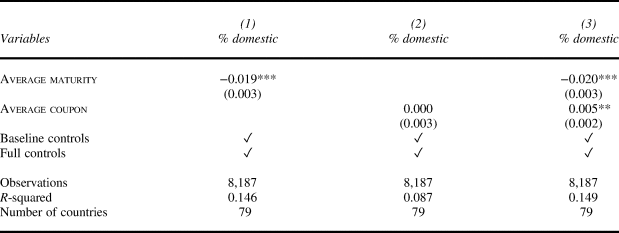
Table 1 explores this expectation via OLS regressions of the percent of domestic-currency issuance (by month) on the average maturity and interest rate of sovereign bonds issued (by month), including our full set of controls.Footnote 101 Note that choices of denomination, maturity, and interest rates are made at the same time; these regressions explore only associations and cannot be interpreted with reference to causality. We do indeed find domestic denomination to be significantly correlated with shorter average maturities (columns 1 and 3), as should be expected if investors tend to prefer to hold debt with shorter maturities in exchange for allowing governments to issue bonds in their own currency. And while when entered by itself the interest rate does not appear to be systematically associated with currency denomination (column 2), when entered jointly with maturity we recover a positive and statistically significant association between the average coupon (interest rate) charged on bonds a country issues and the proportion of this debt issued in domestic currency. This positive association between interest rates and domestic-currency issuance is consistent with a view that investors are likely (once maturity is taken into account) to charge governments an interest rate premium for the implied risk of holding domestic-currency debt. These associations between denomination, maturity, and interest rates provide prima facie evidence that domestic denomination carries costs with regard to other financial terms, which increases the plausibility of our argument that choosing it is a strategic decision.Footnote 102 We leave the development of a theory of how DMOs optimize across denomination, maturity, and yield for future research.Footnote 103
Domestic currency issuance and other bond terms

Notes: This table reports results of OLS regressions of domestic currency issuance (by month) on alternative terms of bonds (by month), as well as a set of control variables defined earlier. Country fixed effects are suppressed, as is a cubic polynomial in time. *p < 10; **p < .05; ***p < .01.
Robust standard errors clustered by country in parentheses.
Before moving on to test our primary hypotheses, we also re-emphasize that while interest rates, denomination, and maturity are key bond terms, bonds also vary in their nonfinancial terms. Unfortunately, because the Bloomberg information on which our data set is based often does not report these nonfinancial terms—reporting governing law for only 20 percent of our observations, for instance—we are unable to systematically assess their relationship with denomination. Nonetheless, our argument implies that, in addition to the relationships between financial terms shown in Table 1, sovereign risk could be addressed via trade-offs across nonfinancial terms.Footnote 104 Moreover, governments may compensate investors for currency risk via mechanisms beyond bond terms (financial or otherwise). Our conditional Hypotheses 2 and 3 postulate that domestic economic institutions—specifically, CBI and a fixed exchange rate—can have such compensatory effects.
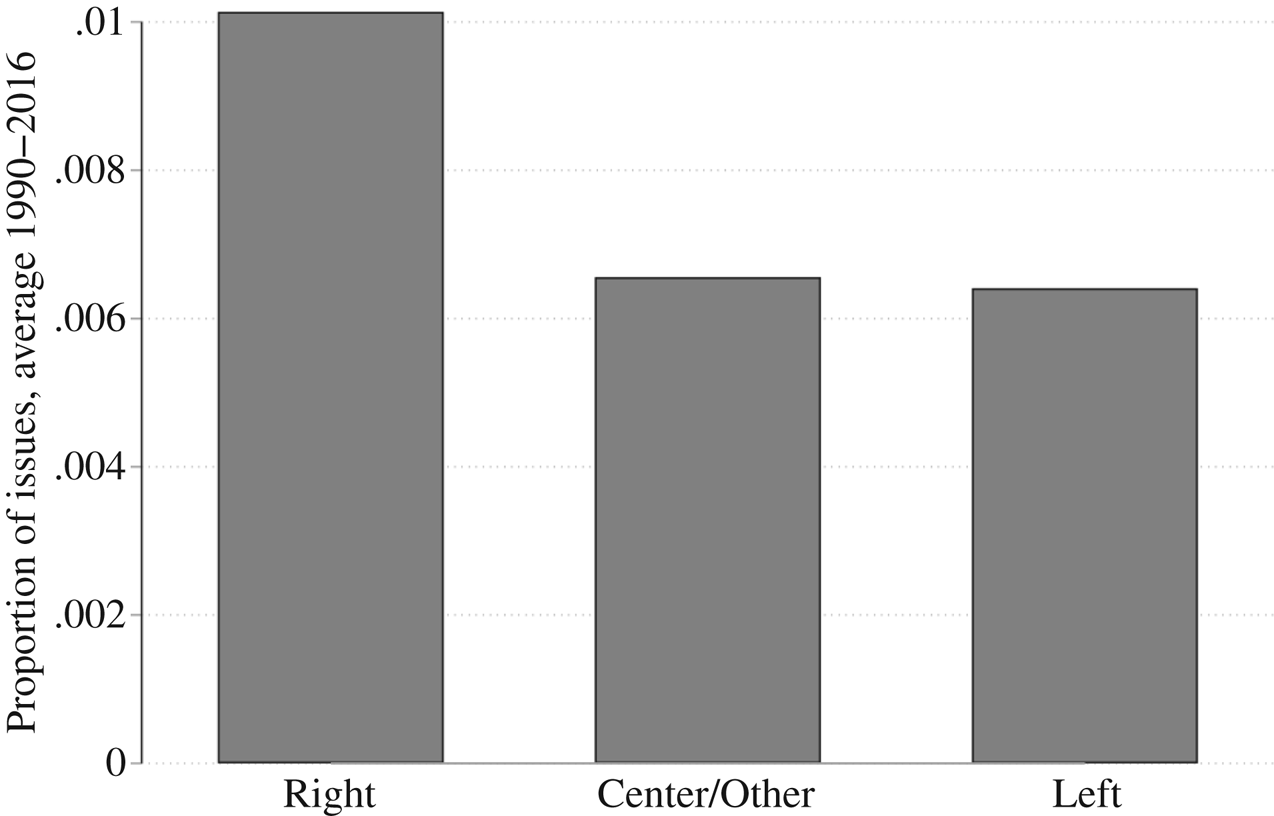
Next, for partisanship to be consequential for the choice of domestic denomination as we predict, it would be problematic if left governments in developing countries simply issued more sovereign bonds altogether. Figure 2 shows that, if anything, right governments issue more debt through sovereign bonds, while center governments issue roughly the same amount as left governments. However, partisanship does not remain a significant determinant of the amount of debt issued (as a percent of GDP, by country-month) in a multivariate regression framework.Footnote 105 Thus, while left governments might generally be associated with expectations of higher debt levels, they are not systematically acquiring more debt via sovereign bond issues on international markets.
Average amount of sovereign bond issuance (per GDP, monthly) by non-OECD countries

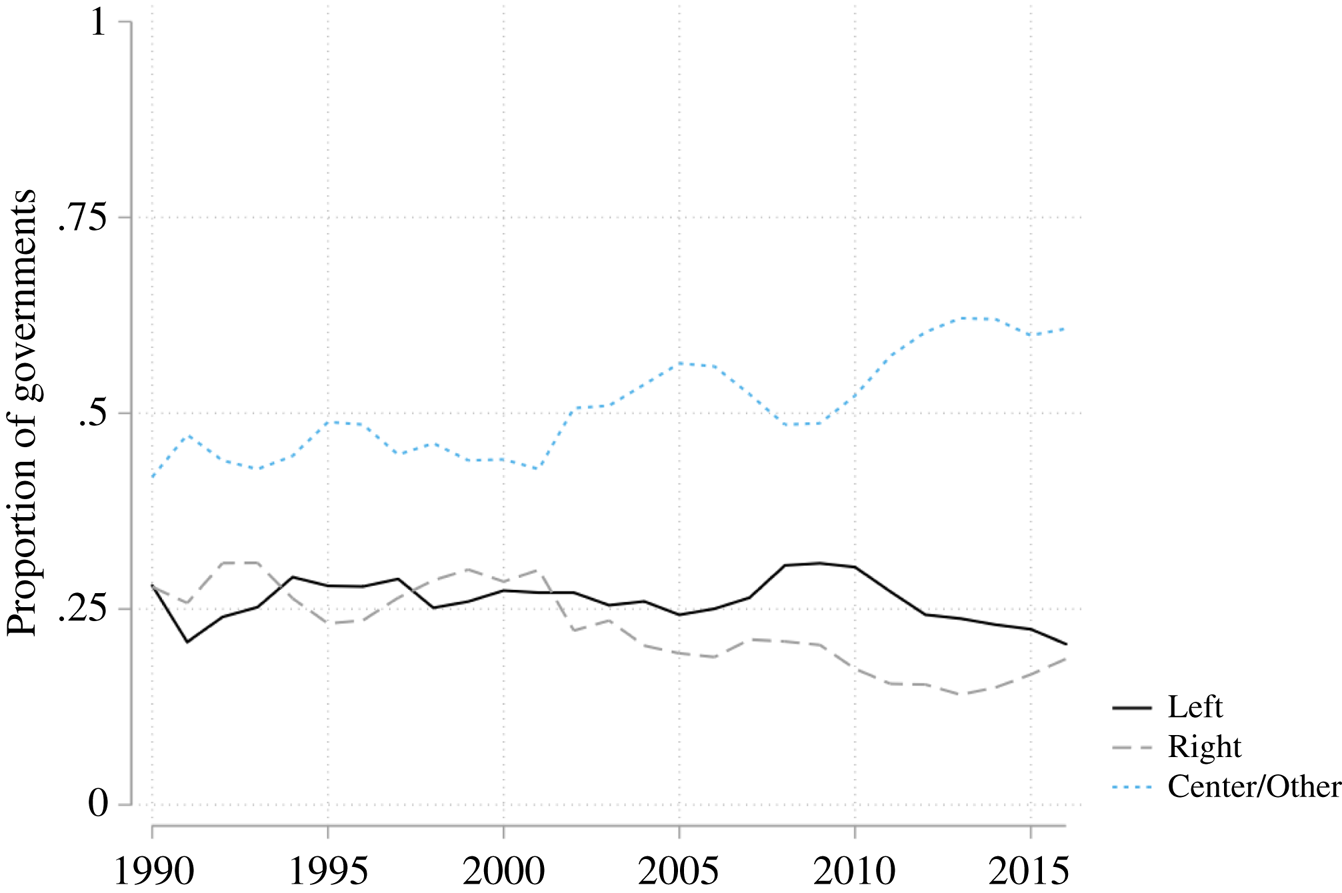
Our argument about partisanship would also be less credible if the proportion of left, right, or center parties in non-OECD countries changed radically over the period. But Figure 3 shows that this is not the case. Even with phenomena like the mid-2000s Pink Tide in Latin America, the proportion of left and right governments has remained relatively stable, and relatively balanced, over this period, with both slightly declining in recent years. If anything, these data suggest the growth of centrist/other governments in recent years. These trends also increase our confidence that our measure of partisanship is not obviously biased toward attaching our specific, economic partisan preferences of interest to too many rather than too few governments.Footnote 106
Trends in partisanship, non-OECD governments, 1990 to 2016

Hypothesis Testing
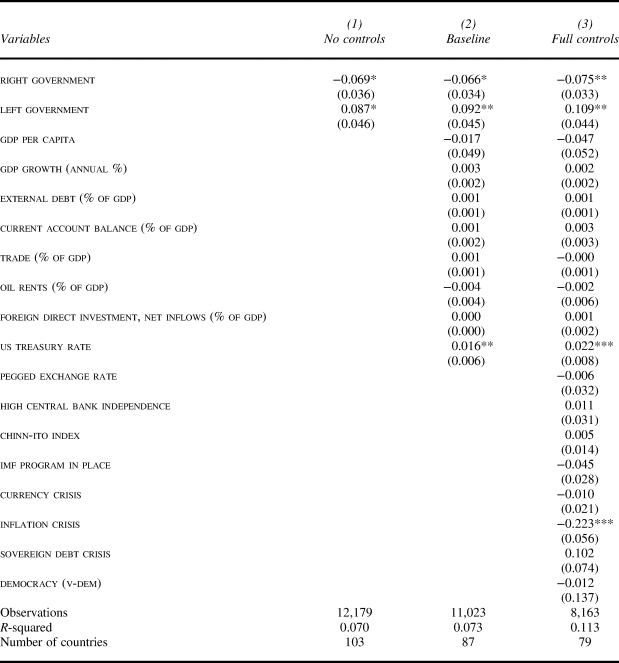
Table 2 reports results evaluating Hypothesis 1, that left (right) governments unconditionally issue a greater percentage of domestic- (foreign-) denominated sovereign bonds. First, column 1 reports results from a simple bivariate regression, in which we find that left governments are associated with a significantly greater share, and right governments a significantly smaller share, of bonds issued in domestic currency relative to the excluded category of center/other governments. Column 2 confirms that this relationship holds when we include our baseline controls, and column 3 reports support when including other covariates of interest.Footnote 107 The partisan differences we detect in domestic debt denomination appear to be a function of both left and right ideologies (Hypothesis 1). That is, right governments also appear to be acting on their distinct preferences over denomination (relative to centrist/other governments) even in a permissive marketplace.
OLS regressions, domestic currency issuance

Notes: This table reports results of OLS regressions of the proportion of domestic currency issuance (by month) on government partisanship (by month, lagged) and varying sets of controls. Country fixed effects are suppressed, as is a cubic polynomial in time. *p < 10; **p < .05; ***p < .01.
Robust standard errors clustered by country in parentheses.
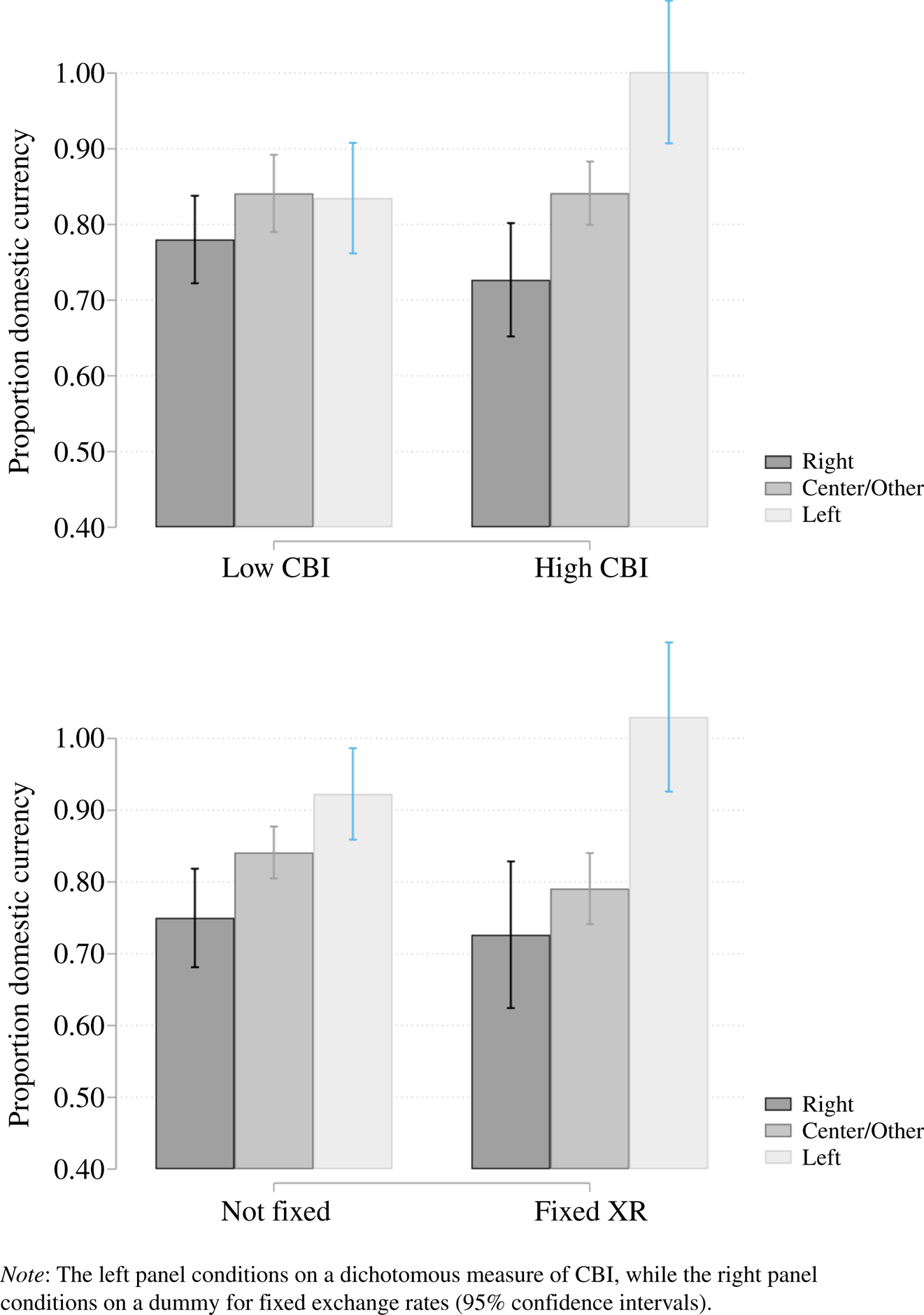
Next, we evaluate the effects of partisanship conditional on other covariates that can affect investors’ evaluations of governments’ propensity to maintain the value of domestic-denominated debt and, therefore, investors’ exposure to currency risk. Figure 4 reports differences in currency of issuance across government partisanship when interacted with a dummy for high CBI (Hypothesis 2).Footnote 108 We do indeed find that left governments in developing countries with high CBI are significantly more likely to issue debt in domestic currency. Results conditional on a pegged exchange rate are similar: left governments issue a greater proportion of domestic-denominated bonds under a pegged exchange rate (Hypothesis 3). These findings are consistent with our argument that left governments take advantage of credibility-enhancing institutions that improve their ability to make choices in line with their ideological preferences.
Effect of government partisanship on proportion of domestic-currency debt issued

We have argued that, as right governments’ preferences for foreign-currency denomination largely square with the preferences of investors, it is not clear theoretically whether we should expect similar partisan differences from right governments with strong institutional protections for the value of the domestic currency. As reported in Figure 4, in the presence of strong CBI, right governments appear even more likely to choose foreign over domestic denomination; this suggests that the right's ideological commitment to forego domestic denomination complements the ideological commitment to CBI. When the exchange rate is fixed, the point estimate suggests that right governments are even less likely to denominate in domestic currency, although this difference is not statistically significant at conventional levels. This would be consistent with the right's ideological preference to “bind the hands” of successor governments, expressed via both denomination choice and a fixed exchange rate.
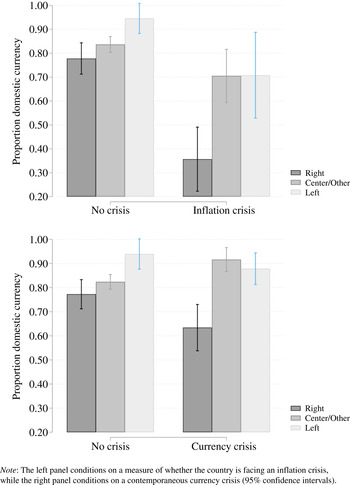
Yet, left governments’ credibility may be undermined by ongoing macroeconomic instability; crises affecting the value of the currency can therefore undermine a left government's ability to come to terms that include domestic denomination (Hypothesis 4). First, we expect that cases of rampant inflation, as a particularly relevant kind of economic mismanagement likely to drive subsequent devaluation, will suggest to investors increased currency risk. Figure 5 reports the results of an interaction of government partisanship with ongoing inflation crisis. We find that left governments not currently facing crisis remain capable of issuing a significantly greater percentage (compared to centrist/other or right governments) of domestic-denominated bonds; interestingly, in countries facing runaway inflation, left governments’ denomination outcomes appear indistinguishable from their centrist/other counterparts.
Effect of government partisanship on proportion of domestic-currency debt issued, depending on crisis environment

Second, we expect that a crashing exchange rate during a currency crisis makes investors especially reluctant to buy or hold domestic-denominated bonds, and that this reluctance particularly affects left governments given their denomination preferences. Figure 5 reports results from an interaction of currency crisis and government partisanship. Consistent with the view that left governments will be unable to issue in domestic currency when the market perceives the risks from such issuance as too high, we find that the positive and significant association between left government and domestic issuance present during “normal” economic times (relative to centrist/other governments) disappears during periods of wild oscillation in exchange rates. Interestingly, as reported in Figure 5, periods of macroeconomic disequilibrium appear to affect right governments’ decisions on currency issuance as well. In particular, it appears that right governments’ preference for foreign-currency issuance is pronounced when facing monetary crises; in “normal” times, however, right governments are indistinguishable from centrists in their currency issuance.Footnote 109 While we leave further refinement of this finding to future research, we note that this behavior is consistent with efforts by right governments to enforce monetary discipline through the taking on of additional foreign-currency debts.
Robustness and Extensions
Here, we focus on four key robustness and extension analyses: confirming effects over time; investigating effects across regime type; employing an alternative coding for partisanship; and incorporating institutional correlates of left government.Footnote 110
Effects over Time
First, we directly confront the question of whether denomination decisions were once politically relevant but are not anymore, given the boom in domestic issuance (see again Figure 1). Recall that our specifications include cubic polynomials in time to account for common secular evolution of dynamics across the entire sample. Still, is the effect of government ideology that we recover simply an artifact of a particular time period?
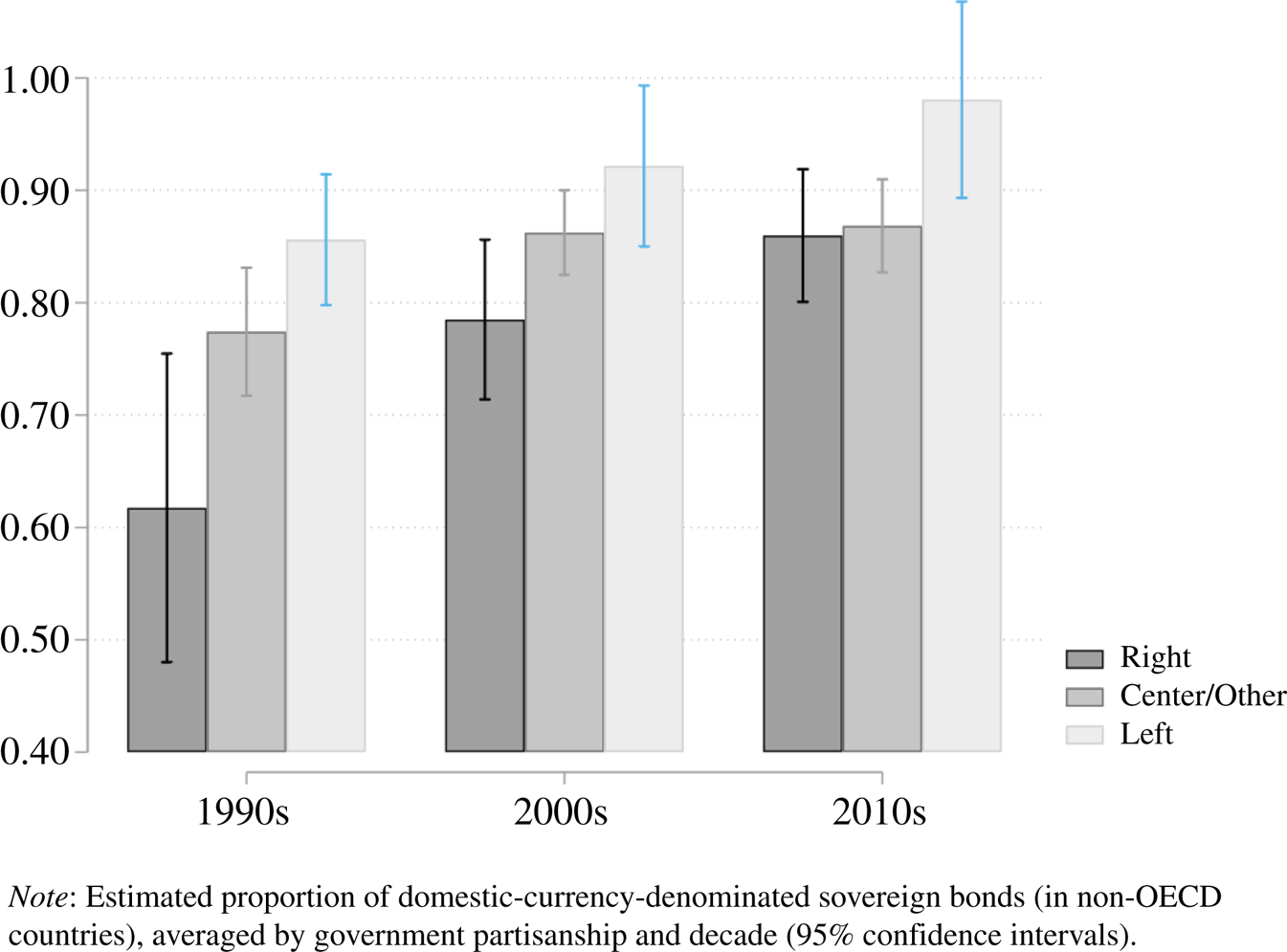
We re-estimate our core specification with dummies for the 1990s and 2000s (with the 2010s as the excluded category), and interact each decade dummy with our government partisanship measures. The results support our contention that the systematic relationship between left governments and domestic denomination is consistent and not an artifact of time,Footnote 111 with Figure 6 summarizing the key findings. First, both right and left governments issue greater proportions of domestic-denominated debt as time goes on. This is consistent with the reality that, given that the boom in domestic denomination is indicative of lower costs of bond terms that include that choice, right ideology does not force right governments to “look a gift horse in the mouth.”Footnote 112 Nonetheless, variation in partisan outcomes remains apparent: right governments issue lower proportions of domestic-denominated debt than left governments in the 1990s, 2000s, and 2010s (data through 2016). This is consistent with our theoretical argument and implies that partisan preferences are enduring and thus should be relevant whatever the overall market conditions. Also, center/other governments do not exhibit as clear a trend in issuance, consistent with our theory that these governments as a category do not have enduring, clear preferences over denomination. Empirically, their issuance in domestic currency increases from the 1990s to the 2000s; by the 2010s their outcomes are indistinguishable from those of right governments, and point estimates are consistently lower than left governments.
Estimated proportion of domestic-currency-denominated sovereign bonds (in non-OECD countries)

Subset on Regime Type
Thus far, we have controlled for the possibility of a direct effect of democracy on currency composition in a sample of all non-OECD countries for which the DPI provides data on partisanship.Footnote 113 However, our arguments are premised on the existence of political contestation: we expect governments’ domestic incentives to reflect their ideological leanings, which are ultimately linked to electoral concerns. While all sovereigns that maintain their own currencies confront the issue of how to denominate their bond issues, face-value partisanship may thus be a less meaningful predictor of a nondemocratic regime's choice over terms. To explore this potential heterogeneity, we split our data based on a binary measure of democracy.Footnote 114 Among the subsample of democracies, the effects of left and right governments are robust (column 1 of Appendix Table A9). In contrast, in the subset of nondemocracies, left and right partisanship are signed as expected but both lose statistical significance. These results underscore the importance of research questioning how the politics of sovereign debt in nondemocracies does or does not reflect that in democracies.Footnote 115
Alternative Coding for Government Partisanship
While we have so far used a standard source of information on government partisanship by relying on data from the DPI, it is possible that in seeking to fit government economic ideology into discrete categories the DPI coding may suffer from some mischaracterizations. Of course, so long as these miscodings of government partisanship are not systematically associated with the currency composition of government bonds, this measurement error will primarily serve to attenuate any true effect. Indeed, it is difficult to come up with a reason that such partisan codings would be likely to lead to directional bias in our primary estimates regarding proportions of domestic-currency denomination.
However, to further probe the robustness of our main results, we employed new data from the V-Dem project provided in the V-Party Dataset. These data rely on aggregated measures of expert codings to identify party characteristics for most political parties in the world from 1970 to 2019.Footnote 116 In particular, to match our theoretical interest in partisan preferences over monetary policy, we draw on V-Party's coding of parties along an “economic left-right scale.” As described in the codebook, left parties “want government to play an active role in the economy. This includes higher taxes, more regulation and government spending and a more generous welfare state.” Right parties “emphasize a reduced economic role for government: privatization, lower taxes, less regulation, less government spending, and a leaner welfare state.” A group of country experts are asked to place parties on a seven-point scale from “far left” to “far right,” and these estimates are then averaged according to a Bayesian updating process and centered on zero.
As we demonstrate in the appendix, when we replace our primary categorical measure of government partisanship from the DPI with this continuous measure of government right–left ideology from V-Party, we continue to find that left-leaning governments are significantly more likely to issue debt in domestic currency.Footnote 117 We also continue to find evidence for the role of institutional constraints in shaping the market's tolerance for issuance of domestic-currency bonds by left governments: the effect of a marginal increase toward the left side of the political spectrum is significantly associated with expanded domestic issuance only in the presence of CBI and fixed exchange rates. Similarly, we find that while left governments outside of crisis environments are significantly more likely to issue in their own currency, this effect disappears in the presence of ongoing inflation or currency crises likely to scare investors away from these domestic currencies. Thus, even using a conceptually distinct measure of government ideology from a completely different data source, we continue to find strong evidence that partisan preferences shape bond terms, particularly when markets are willing to tolerate them.
Institutional Correlates of Left Government
An alternative source of concern with our results might arise if there are additional institutional correlates of partisan governments that might also affect preferences over the currency denomination of sovereign debt. One potential institutional factor is the type of electoral institution in place in a given country; that is, the impact of government partisanship could differ in majoritarian versus proportional-representation systems.Footnote 118 As reported in Appendix Table A11, while governments in proportional-representation systems do appear somewhat less likely to issue domestic-denominated debt, the inclusion of a control for electoral institution type does not change the substantive size or statistical significance of our core findings of interest on government partisanship.
Alternatively, considering the conditioning effects of institutions to constrain monetary policy, while we have accounted for current institutional conditions, one might worry that left and right governments might have underlying preferences for differing monetary regimes, and that the length of time since such institutions have been in place might matter for investor expectations about their durability. We address this concern in Appendix Table A11 by including measures of the time (in years) a given country had high levels of CBI (in column 2) or a fixed exchange rate (in column 4). Note that these direct controls for the length of time under a given institution do not attenuate our main partisan effects of interest. We also probe this effect by interacting our measure of government partisanship with the time with high CBI (in column 3) or with a fixed exchange rate (in column 5). As reported in column 3, we do recover (weakly) statistically significant results suggesting that the capacity of left governments to issue more debt in domestic currency is strengthened the longer that CBI has been in place; this finding is consistent with the left's ability to issue in domestic currency being constrained by market expectations over potential monetary “malfeasance.” However, in column 5 we fail to find any evidence that the length of time since a fixed exchange rate has been in place has any conditioning influence on our main findings that left governments issue significantly more, and right governments significantly less, domestic-denominated debt.Footnote 119
Conclusion
For developing countries, the expansion of international capital markets in general, and sovereign bond markets specifically, offers opportunities as well as threats. Governments have been increasingly able to borrow to fund their activities, but in doing so they may expose themselves to pressures to enact or avoid certain policies. Thus financial openness could reduce the ability of governments to achieve their traditional ideological goals and, in turn, to serve their core constituents. The “original sin” logic offers one version of market-based constraints, in that developing countries were assumed to be unable to find an international market for domestic-denominated bonds.Footnote 120 This logic implies that, in seeking credit, developing-country governments have little or no power over the terms at which they borrow. Instead, supply-side considerations—investors’ preferences—loom very large.
The boom in the proportion of sovereign bonds issued in domestic currency, revealed by our data, undermines this expectation. Nonetheless, the new market appetite for domestic-denominated sovereign debt does not erase the importance of domestic politics to borrowing outcomes. Left governments prefer domestic denomination, preserving future monetary policy flexibility and insulation from depreciation-induced increases in debt repayment costs. Right governments, by contrast, have an ideological predisposition toward foreign-currency denomination, welcoming the lower costs and macroeconomic constraints it brings. Our analyses offer evidence that left governments in developing countries often are able to achieve their demand-side preferences: they are significantly more likely to issue debt denominated in their own currencies. Right governments, on the other hand, have followed the more general market shift toward domestic-currency borrowing, despite their underlying ideological predispositions.
Still, vestiges of the “original sin” dynamic remain: issuing domestic-denominated sovereign bonds on international markets requires compensation. In our data, we uncover a systematic correlation between domestic denomination and compensation in the form of shorter maturities. Future scholarship would do well to pay more attention to how DMOs conceive of the trade-offs across bond terms, as well as how they attempt to market their debt to varying groups of investors. Indeed, variation in the investor base is likely to generate variation in the constraints faced by debtor governments.Footnote 121 And, more broadly, political economists have paid much less attention to the origins and role of DMOs, especially relative to central banks.Footnote 122
Also, while left governments find it more difficult to choose domestic denomination when crisis heightens currency risks, they are better able to come to terms that include domestic denomination when constrained by an independent central bank or pegged exchange rate. Hence, supply-side concerns with currency risk are ameliorated as a result of governments’ other institutional features and choices. This conditioning effect of national economic institutions points to a need for greater attention to governments’ choices, not only across financing terms and debt instruments,Footnote 123 but also across national economic institutions. Governments reforming their institutions often are making trade-offs across types of constraints. In the area of sovereign debt, this is especially relevant as international financial institutions encourage developing-country governments to make their DMOs not only more professionalized but also more insulated from political authority.Footnote 124
Finally, our data reveal massive changes in the marketplace for assets involving domestic currencies, which speak to the debate over whether economic globalization leads toward convergence on a small number of global reserve currencies. Such convergence would privilege countries whose currencies sit atop the global pyramid while reducing the power of others,Footnote 125 and it would weaken other countries’ access to the state-building benefits that come with national currencies.Footnote 126 Consistent with the “currency as power” narrative, the dollar and the euro are key currencies for many international transactions; issuers of global reserve currencies experience a variety of benefits; and governments such as China seek to increase the international use of their currencies.Footnote 127 Nonetheless, it is clear from our data that many currencies now feature in global sovereign debt markets. Private investors in these markets seem to have appetites for portfolios including developing-country currencies—and to have been able to come to terms that include sufficient compensation to whet those appetites. For the 131 sovereign issuers covered in our data (1990 to 2016), national currencies remain very much alive.
Data Availability Statement
Replication files for this article may be found at <https://doi.org/10.7910/DVN/RREGA1>.
Supplementary Material
Supplementary material for this article is available at <https://doi.org/10.1017/S0020818321000357>.
Acknowledgments
Previous versions of this paper were presented at the 2018 International Political Economy Society meeting, the 2019 DebtCon meeting, the 2019 American Political Science Association meeting, New York University, Princeton University, and UC San Diego. We thank participants in those events, as well as B. Peter Rosendorff, Thomas Sattler, and two anonymous reviewers, for comments. Robert Galantucci and Mitch Watkins helped compile bond issue data; Devin Case-Ruchala and Bailee Donahue researched debt management practices; Kelly Kennedy and Benjamin Roberts helped compile credit rating and election data; and students at Innovations for Peace and Development at UT Austin researched case illustrations.