Maternal depression is associated with negative outcomes in children, and stress reactivity is likely to be a possible pathway by which this influence occurs. Living in poverty adds another layer of potentially negative experiences to children of depressed mothers, and may also influence stress reactivity. There is a large gap in the literature examining stress hormones in preschool children of mothers with depressive symptoms living in poverty, and this paper addresses that gap.
Effect of Maternal Depression on Children
From infancy through adolescence, children of depressed mothers are at a higher risk for psychopathology than children of nondepressed mothers (Goodman, Reference Goodman, Cicchetti and Walker2003; Radke-Yarrow, Reference Radke-Yarrow1998). Maternal depression has been linked with disturbances in infant affect, reduced mental and motor performance, and disturbances in early attachment relationships. Toddlers of depressed compared to nondepressed mothers show reduced social competence, react more negatively to stressful events, and are delayed in the acquisition of effective self-regulation strategies. In later childhood and adolescence, maternal depression is associated with increased rates of behavioral problems and lower levels of self-esteem and social competence.
Several possible mechanisms could potentially explain the relations between maternal depression and adverse child outcomes (Goodman & Gotlib, Reference Goodman and Gotlib1999). First, mother and child share common genetic information, which could be an important underlying factor (Goodman, Reference Goodman, Cicchetti and Walker2003; Tsuang & Faraone, Reference Tsuang and Faraone1990). Second, fetuses of depressed mothers may have increased exposure to stress hormones or toxins, and may receive less adequate care in the prenatal period. Third, children of depressed mothers often receive less responsive or nurturing care than children of mothers who are not depressed, and the depressed mothers are often less able to meet their children's age-appropriate and stage-salient needs (Arcenio, Sesin, & Siegel, Reference Arcenio, Sesin and Siegel2004). In the context of the developing world, maternal depression in the pre- and postnatal periods is also associated with poorer child growth and higher risk of diarrhea (Rahman, Iqbal, Bunn, Lovel, & Harington, Reference Rahman, Iqbal, Bunn, Lovel and Harrington2004). Fourth, children of depressed mothers may experience greater exposure to stressful life events, such as marital discord, heightened job stress, and interparental conflict.
Stress as a Potential Mediator
Underlying many of these potential mechanisms is the responsivity and vulnerability of stress-sensitive neurobiological systems, including activity of the hypothalamic–pituitary–adrenocortical (HPA) system (Gunnar & Davis, Reference Gunnar, Davis, Lerner, Easterbrooks and Mistry2003). Early adverse experiences can have long lasting effects on reactivity and regulation of the HPA system in children, and alterations in HPA activity have been observed in children of depressed mothers (Ashman, Dawson, Panagiotides, Yamada, & Wilkinson, Reference Ashman, Dawson, Panagiotides, Yamada and Wilkinson2002; Essex, Klein, Cho, & Kalin, Reference Essex, Klein, Cho and Kalin2002; Lupien, King, Meaney, & McEwen, Reference Lupien, King, Meaney and McEwen2000). It is becoming increasingly apparent that in humans and higher primates, activation and negative feedback regulation of the HPA system involves regions of the prefrontal cortex that are involved in attention and emotion regulation (Sullivan & Gratton, Reference Sullivan and Gratton2002). These regions are rich in receptors for cortisol, the primary hormone of the HPA system in humans, and have a protracted period of development in humans, not being fully mature until near the end of adolescence. Although not well understood, disturbances in the HPA system during development likely alters the maturation of prefrontal circuits involved in emotion regulation and executive functions such as working memory, effortful attentional control, and effortful inhibition of behavior (Blair, Granger, & Razza, Reference Blair, Granger and Razza2005). In children, both shy, anxious, internalizing behavior and underregulated, reckless, externalizing behavior patterns have been associated with increased stress reactivity and poorer stress system regulation (for a review, see Gunnar, Reference Gunnar, Vassey and Dadds2001).
Women living in conditions of poverty are at greater risk of having major depressive disorder and high levels of depressive symptoms (Kahn, Wise, Kennedy, & Kawachi, Reference Kahn, Wise, Kennedy and Kawachi2000). Although elevated basal and baseline levels of cortisol have often been observed in clinically depressed individuals, blunted cortisol responses to stress have also been observed in population studies (for review see Burke, Davis, Otte, & Mohr, Reference Burke, Davis, Otte and Mohr2005). In addition, blunted cortisol responses to stress have been observed in very low-income women with high levels of depressive symptoms (Burke, Fernald, Gertler, & Adler, Reference Burke, Fernald, Gertler and Adler2005). These findings are consistent with evidence of blunted HPA responsivity in the context of chronic stressful life circumstances. Several researchers have found a pattern of cortisol hyporesponsivity in children who are exposed to chronic stressors (Fries, Hesse, Hellhammer, & Hellhammer, Reference Fries, Hesse, Hellhammer and Hellhammer2005; Heim, Ehlert, & Hellhammer, Reference Heim, Ehlert and Hellhammer2000; McEwen, Reference McEwen1998b; Raison & Miller, Reference Raison and Miller2003). One explanation for this responsivity profile is that the stress system becomes less sensitive to stimuli after repeated stimulation. Although the factors that determine hyper- versus hypocortisolism in the context of chronic stress are not well understood, it is widely recognized that both patterns are associated with poor physical and mental health (McEwen, Reference McEwen1998a).
Poverty, Health, and Stress Reactivity
People who live with low socioeconomic status (SES) experience a variety of health disadvantages, ranging from higher rates of high blood pressure and disease incidence to higher death rates in adults (Kawachi, Kennedy, & Wilkinson, Reference Kawachi, Kennedy and Wilkinson1999; Marmot & Wilkinson, Reference Marmot and Wilkinson1999) and altered physiology and behavioral problems in children (Evans & English, Reference Evans and English2002). Poverty contributes independently to altered socioemotional development in children (Duncan & Brooks-Gunn, Reference Duncan, Brooks-Gunn, Duncan and Brooks-Gunn1997; Owens & Shaw, Reference Owens, Shaw and Luthar2003). Infants and toddlers growing up in poverty are disproportionately exposed to a wide range of risk factors (Bolig, Borkowski, & Brandenberger, Reference Bolig, Borkowski, Brandenberger, Whitman and Merluzzi1999; Bradley & Corwyn, Reference Bradley and Corwyn2002; Brooks-Gunn, Klebanov, Liew, & Duncan, Reference Brooks-Gunn, Klebanov, Liaw, Duncan, Fitzgerald and Lester1995). In the United States, for example, these risk factors include poor nutrition or malnutrition (Brooks-Gunn et al., Reference Brooks-Gunn, Klebanov, Liaw, Duncan, Fitzgerald and Lester1995; Guthrie & Morton, Reference Guthrie and Morton1999), less stimulating learning environments (Bradley, Corwyn, McAdoo, & Garcia Coll, Reference Bradley, Corwyn, McAdoo and Garcia Coll2001; Brooks-Gunn, Leventhal, & Duncan, Reference Brooks-Gunn, Leventhal, Duncan, Osofsky and Fitzgerald2000), crowded or substandard housing (Evans & English, Reference Evans and English2002; Koch, Lewis, & Quinones, Reference Koch, Lewis, Quinones, Coll and Surrey1998), exposure to domestic or community violence (Brooks-Gunn et al., Reference Brooks-Gunn, Leventhal, Duncan, Osofsky and Fitzgerald2000; Hsieh & Pugh, Reference Hsieh, Pugh, Kawachi, Kennedy and Wilkinson1999), greater environmental hazards (Cohen et al., Reference Cohen, Mason, Bedimo, Scribner, Basolo and Farley2003; Jacobs et al., Reference Jacobs, Clickner, Zhou, Viet, Marker and Rogers2002; Karns, Reference Karns, Bremner and Fogel2001; Wamboldt et al., Reference Wamboldt, Ho, Milgrom, Wamboldt, Sanders, Szefler and Bender2002), and reduced social support (Ceballo & McLoyd, Reference Ceballo and McLoyd2002). Children growing up in the context of poverty are at additional risk for problems if their mothers are depressed (Petterson & Albers, Reference Petterson and Albers2001). In the developing world, conditions of poverty are exacerbated by worse sanitation, crowding, and even more limited access to resources (Wagstaff, Bustreo, Bryce, Claeson, & WHO, Reference Wagstaff, Bustreo, Bryce and Claeson2004).
Although the correlations between low SES and poor health outcomes are familiar, neither the causal connection nor the mechanisms that produce these connections are fully understood. Some researchers suspect that activity of stress-sensitive physiological systems might mediate associations between SES and both health and behavioral outcomes (e.g., Hertzman, Reference Hertzman, Keating and Hertzman1999; Shonkoff & Phillips, Reference Shonkoff and Phillips2000). Furthermore, early experiences are believed to have particularly long-lasting effects on the reactivity and regulation of stress-sensitive physiological systems. Thus, growing up in a household with low income, poor health care, inadequate nutrition, and a depressed mother may have organizing effects on both basal activity of stress-sensitive physiological systems such as the HPA axis and/or reduce an individual's capacity to regulate physiological reactions to stressors. These changes in how the body deals with stress, in turn, may increase vulnerability to a wide range of health and behavioral problems.
SES and Cortisol
Despite a growing interest in the mechanisms linking SES to health, only a small number of researchers have looked at the relationship between SES and stress reactivity in children as a possible pathway (Gunnar, Morrison, Chisholm, & Schuder, Reference Gunnar, Morison, Chisholm and Schuder2001). In the context of the developed world, children from families with higher SES have been shown to have lower cortisol levels when compared with school-aged children who had lower SES (Essex et al., Reference Essex, Klein, Cho and Kalin2002; Lupien et al., Reference Lupien, King, Meaney and McEwen2000; Lupien, King, Meaney, & McEwen, Reference Lupien, King, Meaney and McEwen2001). Among low-income, preschool children, those whose families had higher income to needs ratio, a standard measure of poverty, also had children with lower levels of cortisol (Blair et al., Reference Blair, Granger and Razza2005). The only study comparing children of varying backgrounds in a developing country found that children from unstable backgrounds had higher salivary cortisol levels than children from stable backgrounds (Flinn & England, Reference Flinn and England1997). In sum, a handful of studies have shown that higher SES is linked with lower cortisol, but much remains unknown about the ways that poverty and cortisol are related, particularly in younger children.
The studies cited above that have found that lower SES is associated with higher cortisol levels in children (Essex et al., Reference Essex, Klein, Cho and Kalin2002; Lupien et al., Reference Lupien, King, Meaney and McEwen2000, Reference Lupien, King, Meaney and McEwen2001) have all also reported that the effects of lower SES are moderated by maternal depressive symptoms. These findings are consistent with studies of cortisol levels among children of clinically depressed mothers (Ashman et al., Reference Ashman, Dawson, Panagiotides, Yamada and Wilkinson2002; Dawson & Ashman, Reference Dawson, Ashman and Nelson2000; Halligan, Herbert, Goodyer, & Murray, Reference Halligan, Herbert, Goodyer and Murray2004). All of these studies, even those examining SES, have not examined samples of extremely low-income women and their children. The sample studied by Lupien and colleagues (Reference Lupien, King, Meaney and McEwen2000, Reference Lupien, King, Meaney and McEwen2001) resided in Montreal, Canada, where government policies provide health care and other economic safety-net resources for low-income families. In the sample studied by Essex and colleagues (Reference Essex, Klein, Cho and Kalin2002), the median income of their low-income group was $48,000 at the time the children's cortisol levels were obtained. Thus, the results of these previous studies examining low SES impacts on children's HPA activity may not extend to women and children living under extremely low-income conditions, conditions that are prevalent in developing countries. Specifically, extreme poverty might be expected to exert more sustained and chronic stress on both women and their children. Boyce and Ellis (Reference Boyce and Ellis2005) have argued that although moderate stress may result in elevations in cortisol, extreme and chronic stress might result in a blunting of HPA activity. This argument is based on the likelihood of downregulation of the HPA axis following periods of intense or repeated activation (Fries et al., Reference Fries, Hesse, Hellhammer and Hellhammer2005; Heim et al., Reference Heim, Ehlert and Hellhammer2000).
The goals of the study reported here were to investigate the associations between depressive symptomatology in mothers and salivary cortisol levels in their children in a sample experiencing extreme poverty. This study is using a sample of children very vulnerable to altered HPA activity because of the combination of poverty and depression. Children of depressed mothers living in poverty are a critically important group to study and represent a large portion of children who not only have current behavioral problems but then go on to develop more severe mental and physical health disorders.
The children in the study were preschool age and were the focus for several reasons. There is evidence that during the first years of life, the child's relationship with his or her primary caregiver serves as a significant regulator of reactivity of the HPA axis (Gunnar & Donzella, Reference Gunnar and Donzella2002). It was expected that disturbances in this relationship due to high maternal depressive symptoms might have particularly potent impacts on activity of the preschool-aged child's HPA axis. In addition, alterations in activity of the HPA axis during this period might affect rapidly developing neural systems involved in emotion and behavior regulation (Sullivan & Gratton, Reference Sullivan and Gratton2002). Indeed, recent evidence from a sample of preschool children in Head Start has revealed that children who failed to respond to a mild stressor (cognitive testing) also scored more poorly on tests of executive functioning (Blair et al., Reference Blair, Granger and Razza2005). We thus hypothesized that among families with very low incomes, rather than an association of maternal depressive symptoms with high levels of cortisol in the children, we might observe low patterns of cortisol production and lack of response to mild stressors. This would be the pattern consistent with downregulation of the axis following periods of significant chronic stress.
Methods
Subjects
A sample of 639 children (324 boys, 315 girls), ages 2.5–5, was recruited from a baseline survey of families across Mexico. Households were identified in a house to house survey in low-income areas (income <20th percentile nationally, equivalent to per capita income of <$2 per day) of urban Mexico. The survey was a baseline evaluation of mothers and children for a study of a social welfare program. Details of sample selection have been described previously (Del Pozo-González & Aparicio-Jiménez, Reference Del Pozo-González and Aparicio-Jiménez2002). This survey was carried out from March to July of 2003, and was approved by the Committee of Ethics in Human Research of the Instituto Nacional de Salud Pública (Mexico's National Institute of Public Health), and by the Center for the Protection of Human Subjects at the University of California at Berkeley. Upon arrival in the home, the research team provided a careful verbal explanation of the goals and risks of the research to all participants, and then obtained signatures of informed consent from all women. The portion of the visit during which consent was obtained lasted approximately 5 min.
Materials
Procedures
All participating households were visited unexpectedly (without prior appointment) by a team of health professionals who conducted an interview with each mother lasting approximately 1 hr and assessed the children with cognitive tests. The interviews were conducted at any time throughout the day from 0800 to 1600 hr, and included the assessment of several measures of physical and mental health, including the Center for Epidemiologic Studies—Depression Scale (CES-D), an assessment of depressive symptomatology (Radloff, Reference Radloff1977). Three samples of saliva were obtained from each child at 0 min (Time 0), 25 min (Time 1), and 50 min (Time 2) after arrival to measure salivary cortisol levels. Detailed descriptions of all components of the interview are described below. Children were not assessed if they were obviously sick (e.g., had a fever, were coughing severely), and only one child per household was selected, which was usually the oldest child available within the appropriate age range.
Depressive symptoms
Maternal depressive symptoms were assessed using the Spanish version of the CES-D, a 20-item questionnaire designed to assess intensity of depressive symptoms in the general population (Radloff, Reference Radloff1977). In the current study, the Cronbach alpha value for the total CES-D score was .86. It is important to note that the CES-D is not a clinical instrument to diagnose major depressive disorder, but is a screening tool for the probability that a disorder exists given certain scores. Items are scored to reflect the frequency of symptom occurrence during the past week on a scale of 0 to 3, with 0 reflecting not at all or less than 1 day and 3 reflecting 5–7 days. Symptoms assessed by this scale include depressed mood (dysphoria), loss of interest and/or pleasure in activities (anhedonia), fatigue, concentration difficulties, excessive guilt and/or worthlessness, vegetative symptoms such as sleep and appetite disturbances, and social difficulties. Scores range from 0 to 60, with a cutoff score in the United States of 16 indicating high risk of clinical depression (Radloff, Reference Radloff1977). The CES-D has been validated for use in Spanish-speaking populations (Masten, Caldwell-Colbert, Alcala, & Mijares, Reference Masten, Caldwell-Colbert, Alcala and Mijares1986; Salgado de Snyder & Maldonado, Reference Salgado de Snyder and Maldonado1994). A higher cutoff score has been proposed for adult Mexican women in rural areas of 35 given the higher prevalence of depressive symptomatology in those regions (Salgado de Snyder & Maldonado, Reference Salgado de Snyder and Maldonado1994). We used three different cutoffs for maternal depressive symptoms: 10 (1 SD below the mean), 16 (recommended cutoff in the United States), and 35 (recommended cutoff in rural Mexico), to reflect low, median, and high scores.
Stressors
The children in the study were exposed to two stressors: the unexpected arrival of a group of strangers (the health assessment team) and cognitive testing. Researchers arrived unannounced and spent the first 5 min primarily in conversation with the mother. One researcher then attempted to engage the child and establish rapport. Stranger approach is a stimulus frequently used in young children to produce mild fear and stress (Kagan, Reznick, & Snidman, Reference Kagan, Reznick and Snidman1987; Nachmias, Gunnar, Mangelsdorf, Parritz, & Buss, Reference Nachmias, Gunnar, Mangelsdorf, Parritz and Buss1996). Following a brief period for developing rapport, the researcher then administered a set of standardized cognitive tasks to assess language and cognitive competence. The battery took between 25 and 40 min to administer. On average, studies using cognitive testing to produce elevations in cortisol generally fail to evoke an average increase in cortisol when administered to adults (Dickerson & Kemeny, Reference Dickerson and Kemeny2004). In a study of a Head Start population, though, Blair and colleagues (Reference Blair, Granger and Razza2005) found that although on average cognitive tasks did not elicit cortisol increases, children who did show a small increase in cortisol followed by a return to baseline were children who scored higher on executive functioning. Thus, although we do not have data to directly assess whether the visit induced stress in the participants, an unexpected home visit with strangers is a face-valid stressor, encompassing recognized stressful components such as uncontrollability, unpredictability, and social evaluation (Dickerson & Kemeny, Reference Dickerson and Kemeny2004), and the stressor has been shown previously to be valid for the mothers (Burke, Fernald, et al., Reference Burke, Davis, Otte and Mohr2005).
Salivary cortisol
Saliva samples (100–200 µL) were collected at three time points during testing of the children to reflect the activity of the HPA system. The first sample was a baseline measure taken approximately 5 min after the interview team arrived to the home. This first sample was designed to reflect the activation of the HPA axis before the team's arrival, given the approximate 20–25 min time delay between cortisol secretion and subsequent salivary cortisol levels (Kirschbaum & Hellhammer, Reference Kirschbaum and Hellhammer1989). Two subsequent cortisol samples were collected 25 and 50 min after the first sample was collected. All samples were collected in sterile collection tubes (Salivettes, Sarstedt, Newton, NC) and kept at room temperature for a period no greater than 1 week. To determine the cortisol concentration in the saliva, the samples were assayed in the Biochemical laboratory in the Psychobiology Department, at the University of Trier. After collection in the field, all samples were shipped by express mail to the laboratory where they were stored at −20°C until analysis. After thawing, the samples were assayed in duplicate analyses using a standard time-resolved fluorescence immunoassay. Cortisol levels were determined employing a competitive solid phase time-resolved fluorescence immunoassay with fluoromeric end point detection. With a computer-controlled program, a standard curve was generated and the cortisol concentrations of the samples were calculated. Synthetic saliva mixed with cortisol in a range from 0 to 100 nmol/L served as standards. The intraassay coefficient of variation was between 3.28 and 4.72% and the interassay coefficient of variation was <5%. To meet statistical normality assumptions, all salivary cortisol data were transformed using a natural log transformation.
Statistical analysis
All data were analyzed using hierarchical linear modeling (HLM) procedures with SPSS 11.5 Advanced Models MIXED software (SPSS Corporation, Chicago, IL). HLM analytic techniques account for the hierarchical, nested structure of the data (in this case, three observations are nested within each individual), allow for modeling the nonindependence of residuals, and distinguish between fixed and random effects (Raudenbush & Bryk, Reference Raudenbush and Bryk2002; Singer, Reference Singer1998). To address the hierarchical structure of the data, two levels of equations were estimated. On the first level, we estimated each individual's baseline cortisol level (e.g., intercepts) and cortisol reactivity (e.g., slopes). On the second level, we estimated equations to predict differences in Level 1 intercepts and slopes from Level 2 predictors such as hours since awakening, age, and maternal depressive symptoms.
To ease the interpretation of the results, several adjustments were made to the data. First, we created dummy variables reflecting changes in cortisol levels between time points, so that the cortisol intercepts would reflect the average individual's cortisol level at baseline (Singer, Reference Singer1998). Second, all Level 2, between-person variables such as age and maternal depressive symptom scores were centered at their grand means (Raudenbush & Bryk, Reference Raudenbush and Bryk2002; Singer, Reference Singer1998). Third, given that cortisol follows a diurnal rhythm, with higher levels after awakening and lower levels later in the day, we created an individual-level covariate (“time since awakening”) that incorporates both sources of variability and centered it at its grand mean (6.5 hr from waking; Federenko et al., Reference Federenko, Wust, Hellhammer, Dechoux, Kumsta and Kirschbaum2004; Kudielka & Kirschbaum, Reference Kudielka and Kirschbaum2003).
Model fit indices, cortisol intercept, and slope variability, and alternate residual variance– covariance matrix structures were then examined. An autoregressive (AR-1) error matrix structure was determined to best fit the data. The above procedures produced the following multilevel model:

where t is the time of observation, i is the individual, β0 is the estimated intercept representing the average individual's Time 0 (baseline) level of cortisol, β1 reflects the effect of time since awakening on cortisol at Time 0, β2 reflects the effect of child's age on cortisol at Time 0, β3 reflects the difference in cortisol levels between Time 0 and Time 1, β4 reflects the difference in cortisol levels between Time 0 and Time 2, β5 reflects the effect of child's gender on Time 0 cortisol, β6 is the effect of maternal CES-D scores on Time 0 cortisol levels, β7 reflects the effect of the interaction of child's gender and maternal CES-D scores on Time 0 cortisol levels, β8 reflects the effect of child's gender on child's cortisol reactivity from Time 0 to Time 1, β9 reflects the effect of maternal CES-D scores on child's cortisol change from Time 0 to Time 1, β10 reflects the effect of child's gender on child's cortisol change from Time 0 to Time 2, β11 reflects the effect of maternal CES-D scores on child's cortisol change from Time 0 to Time 2, β12 reflects the effect of maternal CES-D and child's gender scores on child's cortisol change from Time 0 to Time 1, β13 reflects the effect of maternal CES-D and child's gender scores on child's cortisol change from Time 0 to Time 2, μi is the estimated variability between individuals in Time 0 cortisol levels, ρti is the autoregressive term, and r ti is the residual variance of cortisol between observations.
Our first hypothesis addressed whether elevations in maternal depressive symptoms would be associated with children's overall lower cortisol. The second examined whether any such effect could be observed at baseline (Time 0), indicating that it was not induced by the presence of the health team or cognitive testing. The third hypothesis examined whether maternal depressive symptoms were associated with either decreases in children's cortisol over the brief period the testing team was in the home or a lack of a cortisol response to the presence of these strangers and cognitive testing.
We also explored the contribution of child's gender to the various outcomes, by examining the interaction of child's gender and maternal depressive symptoms, and the three-way interaction of time, child's gender and maternal depressive symptoms. Although we had no specific hypotheses regarding gender, gender often moderates findings in the stress literature, although the associations are not fully understood (Gunnar & Vazquez, Reference Gunnar, Vazquez, Cicchetti and Cohen2006).
Results
Sample characteristics
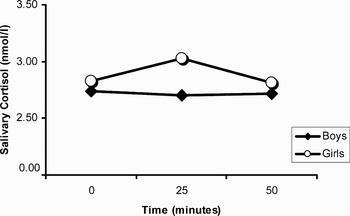
The mean age of the sample was 3.63 (SD = 0.67) years. Girls were slightly, but significantly, older than boys at 3.70 versus 3.56 years, respectively (p < .05). Mothers' ages ranged from 18 to 44, with a mean of 29. The mean maternal CES-D score was 20.28; approximately 60% of the sample had CES-D scores above 16 and 10% of the sample had scores above 35. The mean values (SD) for salivary cortisol in children were 2.78 (2.11), 2.86 (2.16), and 2.76 (2.14) nmol/L at Time 0, Time 1, and Time 2, respectively (Figure 1).
Unadjusted salivary cortisol concentrations (nmol/L) in boys and girls at Time 0, Time 1 (25 min after arrival), and Time 2 (50 min after arrival).

Total cortisol output
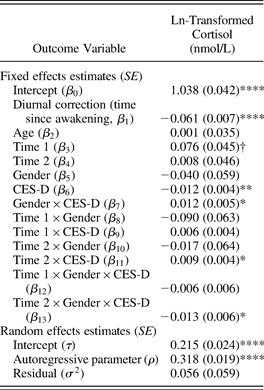
To investigate the association between maternal depressive symptoms and children's overall cortisol levels across the visit, we ran our model without the Time 2 and Time 3 and interaction terms. Results of these analyses demonstrated that maternal depressive symptoms were associated with lower overall cortisol output in both boys and girls (β = −0.007, SE = 0.003, p = .035).
Baseline (Time 0)
Because Time 0 cortisol should reflect HPA activity prior to the arrival of the health team, we examined it separately. Higher levels of maternal depressive symptoms were associated with lower cortisol levels in their children at Time 0 (β6 = −0.012, SE = 0.004, p < .01; Table 1). This effect was moderated by gender, as the Gender × CES-D interaction term was significant (β7 = 0.012 SE = 0.005, p < .01), revealing that the association between higher maternal depressive symptomatology and lower baseline child cortisol levels was being driven by the girls. There was an expected negative effect of time since awakening on Time 0 cortisol levels because children sampled later in the day were further into their diurnal cycle, and thus had lower baseline cortisol levels (β1 = −0.061, SE = 0.007, p < .0001). There was no effect of child age on Time 0 cortisol levels (β2 = 0.001, SE = 0.035, p = ns).
Salivary cortisol by CES-D scores, time, and gender

Note: Ln, natural logarithm; CES-D, Center for Epidemiologic Studies—Depression Scale.
†p < .10. *p < .05. **p < .01. ****p < .0001.
Response to strangers and cognitive testing
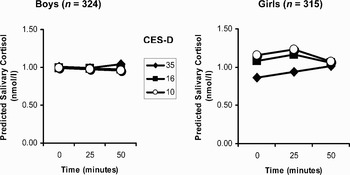
Overall, the results revealed a statistically nonsignificant trend for children to show an increase in salivery cortisol levels from Time 0 to Time 1 (β3 = .076, SE = 0.045, p = .089), with a nonsignificant decrease by Time 2. There was also a significant Time 2 × Gender × Maternal CES-D interaction (β13 = −0.013, SE = 0.006, p < .05), revealing that the effect of maternal depressive symptoms on change from Time 0 to Time 2 in children's cortisol differed for boys and girls. The Time 2 × Gender × Maternal CES-D interaction was probed further using simple effects tests (Figure 2) of boys and girls separately, each with three separate regression lines plotted at CES-D scores of 35 and 16 (Aiken & West, Reference Aiken and West1991). Regardless of maternal depressive symptom levels, boys showed no change in their cortisol levels over the 50-min period. However, girls whose mothers exhibited lower depressive symptom scores showed the pattern of small increases in cortisol from Time 0 to Time 1, followed by a nonsignificant decrease to Time 2. In contrast, girls of mothers with high CES-D scores had the lowest cortisol levels at Time 0 and their cortisol levels increased across the visit until they did not differ from girls whose mothers had lower CES-D scores.
Predicted salivary cortisol (nmol/L) responses over time in boys and girls by maternal depressive symptom scores (Center for Epidemiologic Studies—Depression Scale [CES-D]) scores, adjusted for age, and diurnal rhythm. Simple effects tests were conducted for boys and girls separately, each with three separate regression lines plotted at CES-D scores of 35 and 16, the recommended cutoffs for adult Mexican women and US samples, respectively, as well as a comparison group of CES-D scores of 10 (1 SD below the mean; Aiken & West, Reference Aiken and West1991).

Discussion
This study explores the associations between maternal depressive symptoms and children's salivary cortisol concentrations and responsiveness in a very low-income sample. Overall, our results suggest that among this very low-income sample, high levels of maternal depressive symptoms were associated with less overall cortisol output and lower baseline cortisol levels for both boys and girls, suggestive of hypocortisolism. For boys, the evidence for hypocortisolism is stronger, as they did not respond to the challenge of their home being visited by a group of strangers followed by their being administered a series of cognitive tasks. For girls, there was evidence that the strange adults and cognitive testing did evoke a small cortisol response, especially for the daughters with the lowest cortisol levels at Time 0 whose mothers scored highest in depressive symptoms. Thus, in an extremely low income sample, children of women who were high on depressive systems appear to have lower overall cortisol levels, in marked contrast to the higher cortisol levels associated with maternal depressive symptoms found in other studies.
Our results reveal very low absolute concentrations of salivary cortisol in preschool children from these very low-income households of urban Mexico compared with studies examining middle-class preschoolers in the United States (Gunnar & Donzella, Reference Gunnar and Donzella2002). Although to some extent this finding might be due to the need to store the samples for a period of time at room temperature in the field (Garde & Hansen, Reference Garde and Hansen2005), the cortisol levels we noted were quite comparable to those observed among Head Start children in a recent study (Blair et al., Reference Blair, Granger and Razza2005). In school-aged children, low basal cortisol levels have been shown to be associated with externalizing behaviors (Flinn & England, Reference Flinn and England1995; Spangler, Reference Spangler1995; Tennes & Kreye, Reference Tennes and Kreye1985); low cortisol has been observed in children with disruptive behavior disorder (McBurnett, Lahey, Rathouz, & Loeber, Reference McBurnett, Lahey, Rathouz and Loeber2000). In younger preschool children, this relationship has not been shown to be as strong (de Haan, Gunnar, Tout, Hart, & Stansbury, Reference de Haan, Gunnar, Tout, Hart and Stansbury1998), probably because oppositional and aggressive behaviors are more normative at this age (Gunnar & Vazquez, Reference Gunnar, Vazquez, Cicchetti and Cohen2006). However, in the Blair et al. study, children who failed to show a cortisol response to their mild cognitive testing stressor were also noted to be more disruptive in the classroom and more aggressive with peers. As noted, low cortisol levels associated with chronic economic and social stressors could reflect downregulation of the HPA axis (Fries et al., Reference Fries, Hesse, Hellhammer and Hellhammer2005) following chronic elevations in cortisol earlier in life (Gunnar & Vazquez, Reference Gunnar and Vazquez2001). Indeed, a recent study of infants in the United Kingdom showed overnight urinary cortisol and morning levels that were markedly (51 and 80%, respectively) elevated in infants from economically deprived areas (Wailoo et al., Reference Wailoo, Westaway, Joseph, Petersen, Davies and Thompson2003). Low levels of cortisol might, through impairment of permissive actions of glucocorticoids, reduce responsiveness of other stress-sensitive systems such as brain monoamines (Sapolsky, Romero, & Munck, Reference Sapolsky, Romero and Munck2000).
In the United States and the United Kingdom, maternal depression and/or high depressive symptoms early in the child's life have been shown to predict higher cortisol levels among preschool and school-aged children (Ashman et al., Reference Ashman, Dawson, Panagiotides, Yamada and Wilkinson2002; Essex et al., Reference Essex, Klein, Cho and Kalin2002) and adolescents (Halligan et al., Reference Halligan, Herbert, Goodyer and Murray2004). However, even when these studies have focused on families of lower income, the families included have not been ones living in extreme poverty by the standards of developing countries. Thus, we hypothesized that among the families we studied, the greater stress of extreme poverty combined with high maternal depressive symptoms might produce patterns of hypocortisolism among children. Taking absolute levels of SES into context, the profiles that we are reporting of children with depressed mothers look much more similar to profiles of children who have experienced substantial adversity early in life, such as children reared in institutions or those removed from their homes and placed in foster care (Gunnar & Donzella, Reference Gunnar and Donzella2002; Gunnar & Vazquez, Reference Gunnar and Vazquez2001). Thus, it is possible that extreme poverty in combination with maternal psychopathology may have similar implications for stress system development as does the extreme deprivation experienced by children in institutionalized care.
We hypothesized that higher levels of maternal depressive symptoms among these very low-income children would be associated with blunted responses to the challenge of having a team of strangers arrive at the home unannounced followed by the period of cognitive testing of the child. The findings regarding this hypothesis were mixed. For boys, cortisol levels did not vary significantly across the visit regardless of the level of their mothers' depressive symptoms. Although this finding might reflect a blunted cortisol response, it might also reflect protective effects of the mother's presence on the HPA axis (Gunnar & Donzella, Reference Gunnar and Donzella2002). For girls whose mothers were in the two lower depressive symptoms groups, we observed a small increase in child's salivary cortisol from Time 0 to Time 1, followed by a return toward Time 0 levels at Time 2. This pattern was comparable to that reported for the more competent (higher executive functioning, less aggressive) Head Start children (Blair et al., Reference Blair, Granger and Razza2005). Girls whose mothers were in the highest depressive symptom group also increased their cortisol levels over the visit; however, they continued to increase between Time 1 and Time 2, rather than returning to baseline or following a standard declining diurnal pattern.
Much of the stress response literature has focused on overresponsiveness or amplification of hormone production in response to adverse conditions (Gunnar & Donzella, Reference Gunnar and Donzella2002). However, there is a growing literature suggesting that hypoproduction of HPA hormones and hyporesponsive patterns to simuli such as what we have shown here, may be a measure more sensitive to repeated exposure to stressors (Fries et al., Reference Fries, Hesse, Hellhammer and Hellhammer2005; Heim et al., Reference Heim, Ehlert and Hellhammer2000; McEwen, Reference McEwen1998b; Raison & Miller, Reference Raison and Miller2003). Long-term social isolation after early weaning, for example, has also been shown to result in hypofunction of the HPA axis in the adult rat (Sanchez, Aguado, Sanchez-Toscano, & Saphier, Reference Sanchez, Aguado, Sanchez-Toscano and Saphier1998). Children who have psychosocial dwarfism have also been shown to have blunted response to adrenocorticotropin hormone, suggesting that they may also have hyporesponsive adrenal glands (Gunnar & Vazquez, Reference Gunnar and Vazquez2001). Many studies have also shown that passive coping, repression, and denial of stressful events may be related to the development of hypocortisolism (Heim et al., Reference Heim, Ehlert and Hellhammer2000). It is not surprising that children who are growing up in the context of extreme poverty and deprivation, who face the additional challenge of having a mother with depressive symptoms, have a hyporesponsive profile (Fries et al., Reference Fries, Hesse, Hellhammer and Hellhammer2005). If so, the evidence for hyporesponsiveness to a mild stressor was stronger for boys than girls.
Gender differences in the impact of early adverse experiences are sometimes, but not always reported (see review by Gunnar & Vazquez, Reference Gunnar, Vazquez, Cicchetti and Cohen2006). When found in animal studies, the effects on the HPA axis sometimes appear to be greater for females than males (e.g., McCormick, Smythe, Sharma, & Meaney, Reference McCormick, Smythe, Sharma and Meaney1995; Sanchez et al., Reference Sanchez, Noble, Lyon, Plotsky, Davis and Nemeroff2005). Among children reared under generally lower stress conditions, no consistent sex differences have been found in studies of basal cortisol; when gender differences are found in cortisol reactivity, they appear to be specific to the type of stressor used (e.g., competitive challenge affecting boys more than girls; Donzella, Gunnar, Krueger, & Alwin, Reference Donzella, Gunnar, Krueger and Alwin2000). The present results suggest that boys and girls both had lower cortisol output as a function of maternal depressive symptoms, but that girls may have been more capable than boys of being able to continue to respond to psychosocial challenge. Whether the girls will be shown to have better behavior and emotion regulation as in the Blair et al. study (Reference Blair, Granger and Razza2005) has not yet been examined in this data set.
Our results extend prior research that has revealed hypoactive cortisol production and blunted cortisol responses to laboratory and naturalistic psychosocial stressors. This is the first known study to find this pattern of responsivity in children of subclinically depressed women. However, given the high levels of depressive symptomatology reported in this population, it is likely that a subset of the maternal sample was clinically depressed. Women who are currently depressed may also have been depressed postpartum. Thus, we cannot exclude the possibility that this early experience, rather than current maternal depressive symptoms, is responsible for explaining the differences in children. There is evidence that postpartum depression is associated with altered cortisol profiles in children (Essex et al., Reference Essex, Klein, Cho and Kalin2002) and adolescents (Halligan et al., Reference Halligan, Herbert, Goodyer and Murray2004). In addition, we cannot exclude the possibility that prenatal anxiety could have contributed to the differences reported here (O'Connor et al., Reference O'Connor, Ben-Shlomo, Heron, Golding, Adams and Glover2005).
The children studied in the research reported here are clearly vulnerable to several types of risks. Thus, their developmental outcomes are influenced by a large number of social and family factors impacting their development rather than the specific type or weighting of each factor (Breitmayer & Ramey, Reference Breitmayer and Ramey1986; Rutter, Reference Rutter, Kent and Rolf1979; Sameroff et al., Reference Sameroff, Seifer, Baldwin and Baldwin1993). Prior work has found that higher cumulative levels of risk are related to poorer cognitive development (Brooks-Gunn et al., Reference Brooks-Gunn, Klebanov, Liaw, Duncan, Fitzgerald and Lester1995; Sameroff et al., Reference Sameroff, Seifer, Baldwin and Baldwin1993; Sameroff, Seifer, Barocas, Zax, & Greenspan, Reference Sameroff, Seifer, Barocas, Zax and Greenspan1987), psychological distress, and behavior problems (Brooks-Gunn et al., Reference Brooks-Gunn, Klebanov, Liaw, Duncan, Fitzgerald and Lester1995; Evans, Reference Evans2003), and communicative development (Hooper, Burchinal, Roberts, Zeisel, & Neebe, Reference Hooper, Burchinal, Roberts, Zeisel and Neebe1998). For families in persistent poverty, some risks are clearly present throughout the child's life, although other risk factors may emerge over time. Children living in families with high levels of persistent family stress have been shown to have reduced cortisol responses to a pharmacological challenge (Ronsaville et al., Reference Ronsaville, Municchi, Laney, Cizza, Meyer and Haim2006).
Living in a low-mortality, developing country such as Mexico offers the additional challenge of having very limited resources in a country where income distribution is wide, and a large proportion of the population has access to many more resources and wealth (Barraza-Llorens, Bertozzi, Gonzalez-Pier, & Gutierrez, Reference Barraza-Llorens, Bertozzi, Gonzalez-Pier and Gutierrez2002). Growing up in a low-income household is likely to have organizing effects on both basal activity of stress-sensitive physiological systems and/or reduces the individual's capacity to regulate physiological reactions to stressors. Changes in how the body deals with stress, in turn, may then increase vulnerability to a wide range of health and behavioral problems. In children, altered activity of the HPA system, as measured using salivary cortisol, may predict the emergence of emotional problems much later in life (Gunnar & Vazquez, Reference Gunnar, Vazquez, Cicchetti and Cohen2006).
One major limitation of our analysis is that we do not have a nonpoor sample of children from Mexico as a comparison group. Thus, we can only comment on depressive symptoms within a homogenously low-income population. Another limitation of our study was that we did not control for, nor did we have data available for, several variables that could confound salivary cortisol results, such as food eaten, caffeine intake, health problems, early life stress, exposure to marital discord, or current posttraumatic stress disorder. It is possible that one or a combination of these confounding variables may have influenced the results. An additional limitation to the interpretation of our results is that we measured salivary cortisol, which is the end product of a complex change of events involving the HPA axis. Thus, we are only able to comment on the concentrations of cortisol, and can only speculate about the mechanisms that could explain the higher or lower concentrations of cortisol. Despite these limitations, we are encouraged by many strengths of the study, including the large sample size, the collection of multiple samples per person, control for time of day and time of wakeup, use of a well-standardized and culturally acceptable measure of depressive symptoms, and collection of these measures and outcomes in a previously underresearched sample of low-income families in urban Mexico.