During the past century, 3 influenza pandemics have contributed to a significant increase in global morbidity and mortality ratesReference Whitley and Monto1 and have disrupted both social and economic systems.Reference Whitley and Monto1, Reference Osterholm2 As concerns about a pandemic threat grew in the last several years,Reference Whitley and Monto1, Reference Ungchusak, Auewarakul and Dowell3, Reference Taubenberger, Morens and Fauci4 worldwide, efforts were made to develop plans for responding to such an event.Reference Gross5-Reference Fauci8 Several local, state, federal, and global bodies drafted influenza pandemic preparedness plansReference Hampton9, Reference Mitka10 that describe key strategies such as resource management (ie, critical care triage), surveillance, and treatment to be implemented during an influenza pandemic. With the recognition that a novel strain of H1N1 influenza was circulating in North America in early 2009Reference Chowell, Bertozzi and Colchero11-Reference Perez-Padilla, de la Rosa-Zamboni and Ponce de Leon13 and the subsequent pandemic,Reference Cohen and Enserink14 governments and organizations implemented their pandemic plans.Reference Hampton9, Reference Mitka10
Information technology (IT) systems can play a key role in guiding disaster medical response during a public health emergency.Reference Harrison and Harrison15, Reference Chan, Killeen, Griswold and Lenert16 In 1 incident, IT systems provided critical data on burn bed availability in tertiary care centers to health care staff delivering medical treatment to burn patients in remote areas.Reference Barillo, Jordan, Jocz, Nye, Cancio and Holcomb17 During Hurricane Katrina, IT systems performed a similar role by providing health care workers with the immunization history of nearly 21 000 displaced children, thus preventing costly duplicate immunizations.Reference Urquhart, Williams, Tobias and Welch18 During an influenza pandemic, IT systems may help guide critical care triage and disaster medical response by providing realtime data such as resource availability and triage scoresReference Christian, Hawryluck and Wax19 to front line health care staff who are responding to the pandemic.
The objective of this study was 2-fold: to evaluate local, state, federal, and global pandemic influenza preparedness by identifying pandemic plans at the local, state, federal, and global levels, and to identify any proposed IT systems within these plans that could support critical care triage and disaster medical response during an influenza pandemic in the Canadian province of Ontario.
Methods
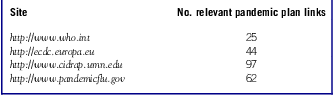
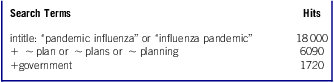
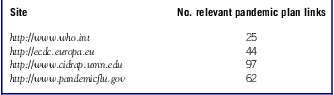
Multiple search strategies were used to identify papers or plans that examined the use of IT systems in critical care triage or disaster medical response during an influenza pandemic. The scope of the search focused on pandemic influenza plans given the heightened state of concern of the World Health Organization and other international and national bodies regarding an imminent influenza pandemic event. The specific search strategies including advanced key word search terms and number of results are discussed in greater detail below and outlined in Tables 1 and 2.
Key Pandemic Planning Internet Sites Reviewed
Advanced Search Strategy Using the Google Search Engine
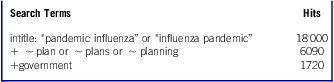
To be considered for review, documents had to be fully published in the English language and pertain specifically to an influenza pandemic. A preliminary search was conducted in the medical literature (MEDLINE via Ovid, 1996–week 1, June 2009) using the search string influenza* and pandemic* and ∼plan*, which resulted in 621 hits. None of these hits, however, fit our criteria for review because they were mainly commentaries and did not provide specific details regarding pandemic influenza preparedness plans. A broader search for pandemic plans was performed in key pandemic influenza preparedness sites (Table 1) and the Google search engine using advanced search terms (Table 2).Reference Milstein, Biersdorfer and MacDonald20 Additional plans were identified by hand-searching documents included from this search strategy. IT and pandemic planning experts were contacted to determine whether they were aware of any papers or plans that included details about IT systems for critical care triage or medical response during a pandemic (Dr Lewis Rubinson and Mr Paul Bartosh, personal communications, 2008).
Pandemic preparedness plans meeting our inclusion criteria were grouped into the following categories: local, state, federal, or global, and descriptive data such as plan author, publication date, and Internet URL were extracted and recorded in an electronic database. Plans were then systematically reviewed for descriptions of IT systems using key word search terms such as information technology, electronic data, or data. When provided in the plans, the tables of contents were assessed for chapters discussing informatics, information technology, surveillance, or communication and reviewed in greater detail.
Identified IT systems were then placed into one of the following categories based on their primary role during a pandemic: patient data collection, surveillance, triage, or other for systems not falling into any of the defined categories. For the purpose of this study, patient data collection, surveillance, and triage were defined, respectively, as “the detailed collection of data regarding individual patients in an effort to track patient outcomes and resource utilization,” “population-based or aggregate data collection primarily aimed at monitoring the course of the pandemic,” and “data collection specifically used for prioritizing patient care and resource allocation.”
Results
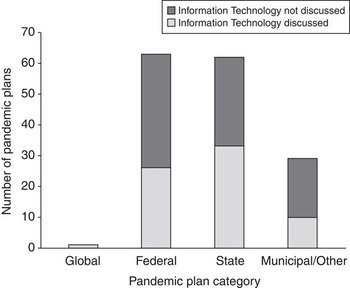
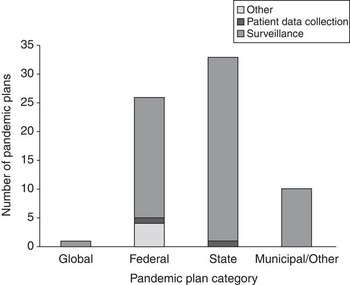
A total of 155 influenza pandemic preparedness plans met our inclusion criteria and were included in this review: 29 local, 62 state, 63 federal, and 1 global; 70 of these documents examined IT systems (10 local, 33 state, 26 federal, 1 global) and 85 did not (19 local, 29 state, 37 federal; Figure 1). Of the 70 plans discussing IT systems, 64 described surveillance systems (10 local, 32 state, 21 federal, 1 global), 2 described patient data collection systems (1 state, 1 federal); 4 described other types of IT infrastructures (4 federal), and none were specifically intended for triage (Figure 2).
Plans discussing information technology infrastructures by category.

Type of information technology infrastructure by category.

Patient data collection systems were discussed in the Kansas21 and Czech Republic22 pandemic plans. The Web Emergency Operations Center system discussed in the Kansas pandemic plan was developed to collect and communicate critical statewide data such as number of suspected, probable, and confirmed pandemic influenza cases; free beds in hospital emergency departments, intensive care units and medical wards; and available or needed medical resources such as isolation equipment and medical supplies.21 Similarly, the PANDEMIE system discussed in the Czech Republic plan is a secure electronic system designed to collect daily data reports describing morbidity and mortality; free beds in hospitals, and the distribution of drugs and vaccines by pharmacies.22
Other examples of IT infrastructure discussed in pandemic preparedness plans included the Reddinet Syndromic Surveillance System,23 the Homeland Security Information Network,24 the European Network and its Early Warning and Response System,25 and a real-time database to record the prescription of influenza-specific antivirals.26 The Reddinet Syndromic Surveillance System is a Web-based system that was designed to act as a central communication point between different health care institutions, departments, and pharmacies in Santa Barbara County (California), as well as many other areas within the United States. Similarly, the Homeland Security Information Network24 is a national system developed to serve as a Web-based communication and information-sharing platform between critical infrastructure and key resource businesses, sector leaders, and the National Infrastructure Coordinating Center and Department of Homeland Security. The European Network and its Early Warning and Response System was similarly developed as an electronic information-exchange system to report the numbers of influenza cases, outbreaks, and adopted measures between the European member states.25 The real-time database described in the Maltese pandemic plan was designed to serve as a proxy influenza surveillance system to monitor the spread of infection by recording the issuing of antiviral prescriptions and further providing detailed demographic reports to guide critical public health decisions.26
Discussion
Our search strategy identified 155 publicly available pandemic influenza preparedness plans, demonstrating the significant amount of work that has been conducted in this area during the past several years. Despite these efforts, many of these plans were high-level general documents, the majority of which were found not to discuss IT systems. One possible reason for this is that existing systems and established lines of communication would be assumed to adjust for an influx of influenza patients; however, this was not clearly communicated in the majority of pandemic influenza plans reviewed in this study. Further evaluation of how pandemic plans potentially relying on existing infrastructures would adapt to medical patients with respiratory failure is needed, along with additional published reports about how this could be accomplished.
Among the plans that did discuss IT systems, there was a strong focus on surveillance. Although watching the pandemic grow and evolve is important from a public health perspective, surveillance efforts fail to recognize the needs of a health care system supporting the medical response to a pandemic. A successful influenza pandemic response will require a greater level of detailed planning than was reported in many of the high-level documents.
Accurate and timely data collection at the individual patient level combined with information concerning resource availability are necessary to guide decision making during an influenza pandemic. Accurate information regarding the supply of and demand for critical resources is essential to be able to identify triggers for initiating mass critical care or triage, should resource shortfalls occur, and helps further establish a common information picture and attain situational awareness.Reference Christian, Hawryluck and Wax19, Reference Devereaux, Dichter and Christian27 In addition to providing information to guide the response, data collection at the individual patient level permits outcomes from triage decisions to be evaluated, which is vital to monitoring for over- or undertriage,Reference Frykberg28 and the performance of due diligence to ensure that abuses of the system are not occurring.
Although not perfect, the best examples of the type of data required for critical care triage and disaster medical response during an influenza pandemic were provided in the Kansas21 and Czech Republic22 pandemic plans. The IT systems described in these plans were designed to collect a mixture of both patient and surveillance data, including information concerning morbidity and mortality, free beds in tertiary care centers, issue of drugs and vaccines by pharmacies, resource demands, and the number of people off work from health care and other key institutions. Some of these data may already be collected by hospitals; however, it is typically not available in real time, and no interconnectivity with public health decision makers exists, further highlighting the divide between the classic public health and health care perspectives. Whereas triage highlights the need for having clinicians involved in directing the overall pandemic response, public health officials alone often fail to appreciate the need for collecting patient-level data.
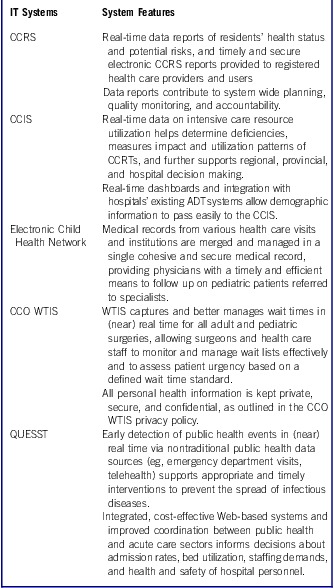
In addition to these characteristics, an ideal IT system designed for critical care triage and disaster medical response also should demonstrate ease of implementation within and across health care organizations; high acceptability by end users; minimal technical issues; effective and efficient documentation, data reporting, and data sharing; and advanced security features.Reference Lising and Kennedy29 Although such a specific IT system has yet to be developed in Ontario, a number of provincial health care IT systems are operating, which could be leveraged for critical care triage and disaster medical response during an influenza pandemic (Table 3). It should be noted that information sharing remains a challenge in areas with several different health care systems as well as those with a single public health system, where hospitals are distinct. Therefore, having a system in place is only part of the solution, because barriers to sharing information during a crisis also need to be overcome, particularly legislation around protecting health information.Reference Singer, Benatar and Bernstein30-Reference Wilson, McDougall and Upshur32
Health Care IT Systems in Ontario to Potentially Support Critical Care Triage During an Influenza Pandemic

Although our search strategy identified a number of pandemic influenza preparedness plans, our study was limited to plans that were accessible publicly. It is possible that other higher-level documents contain detailed descriptions of advanced IT systems, but they are not publicly available for security reasons. Similarly, hospitals may already have systems in place that operate across many geographic locations, and therefore, the details of these systems are not discussed in individual pandemic plans. Furthermore, some of the plans that were reviewed may have contained information pertaining to IT systems or infrastructures, but they were inadvertently missed by the key word and tables of contents searches.
Conclusions
Several pandemic influenza plans have been drafted at different levels worldwide, demonstrating the significant amount of work that has been conducted in this area. Despite these efforts, many plans were high-level, general documents, the majority of which did not describe IT systems. Of the plans that did examine IT systems, there was a strong focus on surveillance. Although surveillance is important, it does not address the needs of a health care system responding to an influenza pandemic. A successful response to a pandemic requires more detailed planning, such as accurate and timely patient data collection, combined with information concerning resource availability. The best examples of these types of systems were described in the Kansas and Czech Republic pandemic plans. Although such an IT system has not been developed in Ontario, several IT systems exist that could be leveraged to support critical care triage and medical response during an influenza pandemic.
Acknowledgment
The study was supported by the Canadian Institute of Health Research.
Author Disclosures
The authors report no conflicts of interest.
Published online: June 27, 2011. doi:10.1001/dmp.2011.45