Introduction
Stroke has become one of the major public health burdens, with the annual incidence reported between 300 to 500 per 100,000 population worldwide.Reference Sudlow and Warlow1, Reference McKay and Mensah2 With the advancement in the early management of stroke, three out of four patients now survive beyond the acute phase.Reference Sarti, Rasteny, Cepaitis and Tuomilehto3 Many of these, however, will continue to live with significant disability and impairment. Functional impairment remains the main burden, with about 40% of stroke survivors left with significant functional disabilities, especially problems of mobility, balance, motor function and gait.Reference Wilkinson, Wolfe, Warburton, Howard, Ross-Russel, Rudd and Beech4, Reference Patel, Tilling, Lawrence, Rudd, Wolfe and McKevitt5 Managing these patients is a challenge both to practitioners and carers, as they will need full support and assistance in attaining their best physical and psychological capabilities long after the acute episode.
Stroke patients who survive beyond the initial phase require a different approach from that in the acute hospital setting. It is acknowledged that their management must include three major components, namely further rehabilitation, secondary prevention and reintegration into the community.6–Reference Duncan, Zorowitz, Bates, Choi, Glasberg, Graham, Katz, Lamberty and Reker8 These three components function as a unit, aimed at preventing stroke recurrence and maximizing functional abilities. This review, however, will focus on long-term rehabilitation as this aspect of care forms the major part of management of stroke patients who have been discharged home into the community.
In preparation for this review the trial registers of relevant Cochrane Review Groups, including the Stroke Group, Effective Practice and Organization of Care Group and Dementia and Cognitive Improvement Group were searched. Other databases used were the Cochrane Central Register of Controlled Trials (CENTRAL), MEDLINE, EMBASE, CINAHL and AMED, together with sources from dissertation databases and research registers, scanned reference lists and experts in the field.
Long-term stroke recovery – the neuromolecular evidence
Long-term stroke care remains the ‘grey area’ in overall stroke management, as there is no clear consensus on the exact point when this stage of recovery starts, or how it is best delivered. Much of the past stroke literature focused on early intervention and service provision, as it was believed that no further functional gains were possible beyond six months.Reference Skilbeck, Wade, Hewer and Wood9–Reference Jongersen, Nakayama, Padersen, Raaschan, Vive-Larsen, Stoler and Olsen11 However, the last two decades have seen the emergence of evidence of benefit from longer-tem intervention and, whilst previously it was thought that best functional gains were achieved on average at 8–17 weeks after stroke onset, molecular mechanistic theories suggest otherwise.Reference Dobkin12 New evidence shows that stroke recovery varies greatly between individuals, with the possibility of better outcome if rehabilitative input starts early and is persistent.
Stroke recovery typically occurs in two stages. The first involves resolution of oedema, influx of ions and the start of inflammatory and oxidative processes at the area of the insult, together known as the ‘remodelling phase’.Reference Dobkin12 This phase can be influenced by input from the damaged area, with feedback contributing to the restoration of newly formed neuronal circuits and the implication that early rehabilitation may enhance the process of recovery by providing repetitive, persistent stimulus to the non-injured neurons.Reference Dobkin12 This is important as it may reduce the severity of chronic disability. The second stage involves later recovery and is associated with the ability of the neurons to adapt to earlier repetitive stimulus, propagating the restoration process and raising the possibility of retrieving some pre-stroke functional ability. This may take as little as 4 weeks, or as long as 43 weeks. Consequently many stroke physicians now believe that recovery is not constrained by the time-frame, but rather by individual ability to show functional improvement.Reference Dobkin12, Reference Ebrahim and Harwood13 Therefore rehabilitation now concentrates on providing appropriate stimuli, encouraging adaptive strategies in daily functional activities and providing coping strategies in areas that are affected by the stroke.
Community randomized controlled trials that looked into the functional outcome and survival status up to five years after stroke have shown that patients given early intervention retained functional benefits and had reduced relative risk of death and disability long after the acute event.Reference Gravenson, Gray, French and James14–Reference Lincoln, Husbands, Trescoll, Drummond, Gladman and Berman17 Although the studies were few and only involved periodic rehabilitation, results appear robust and contradict earlier evidence that patients’ recovery plateaus after six months. It is now understood that functional gains among individuals are varied, with some patients showing late recovery. Hence current understanding suggests a need for an active approach in the management of longer-term stroke patients, especially in the area of further rehabilitation.
Long-term rehabilitation – principles and practice
The World Health Organization describes rehabilitation as ‘the combined and co-ordinated use of medical, social, educational and vocational measures for training and retraining the individual to the highest level of functional ability’.18 With regard to longer-term rehabilitation, intervention aims directly and indirectly to increase independence of the individual, to the best of his or her capabilities. Rehabilitation encompasses not only physical intervention, but should address all aspects of everyday life, including psychological health and reintegration into the community.
Expert opinion is divided on longer-term stroke rehabilitation. The recently published Royal College of Physicians Stroke Guidelines reached a consensus that whilst ‘many patients wish to have rehabilitation therapy in the long term, either continuously or intermittently, it is neither practical nor best practice to continue therapy unless there is benefit to be gained; it wastes resources and maintains unrealistic expectations’.6 Other practice guidelines, however, suggest that long-term rehabilitation should continue until it is clear that maximum recovery has been achieved.7, Reference Duncan, Zorowitz, Bates, Choi, Glasberg, Graham, Katz, Lamberty and Reker8, 19 All guidelines agree that should any patient report residual impairment after the end of initial rehabilitation, they should be reassessed at least every six months and offered further targeted rehabilitation provided that the intervention will help them to recover further function.
In practice, long-term rehabilitation focuses on assessing the existence of residual problems of survivors, rather than on restoring functional ability, as in the early phase after stroke.Reference Gladman20 Those providing longer term rehabilitation must aim to develop a strategy or programme that is flexible in time and setting, tailored to meet the individual's needs and functional status, and that resists further decline over time. This should lead to a rehabilitation intervention programme that is often loosely standardized, but invariably structured to meet the needs of the individual survivors.
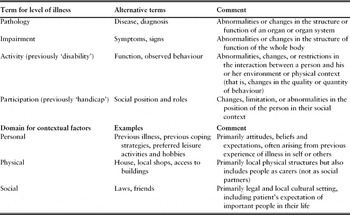
Another aspect of longer-term rehabilitation is the approach towards leisure and social interventions. The major guidelines have recommended that longer term management of stroke should emulate the chronic disease management approach, in which rehabilitation programmes teach patients what they can do for themselves to maintain health and functional status.6, 7 The aim is to encourage stroke survivors to be more independent and self-reliant. This model was well described by Wade and JongReference Wade and Jong21 in their framework based on the revised International Classification of Function (ICF) model (Table 1). It suggested that longer term rehabilitation should move away from the ‘activity phase’ and address the issue of ‘participation’. The aim should be to educate survivors to maximize their functional abilities in performing daily activities, hence promoting self-sufficiency without the need to rely heavily on their families and carers. Most of the intervention at this stage involves adaptation to daily activities, planning integration towards life in the community and restoring pre-stroke roles, such as driving and going back to work.
Rehabilitation framework model of revised International Classification of Impairment, Disability and Handicap (ICIDH)/International Classification of Function (ICF) (Wade & Jong 2000)Reference Wade and Jong21

In conclusion, although long-term rehabilitation is still not yet standard practice, the structure and configuration are beginning to take shape. It is certainly not irrelevant, as it provides continuity after the formal intervention provided in the hospital setting, or perhaps the closure that stroke survivors and their families desperately need at this stage of stroke recovery.
Long-term evidence of long-term rehabilitation – what is available?
Trials of longer term rehabilitation are few compared with the many conducted in earlier stages of stroke. However, lack of evidence of benefit does not equate to evidence of lack of benefit. The very fact that there are currently so few rehabilitation services that offer routine follow-up after six months after stroke may be the reason for so few trials in longer term rehabilitation.
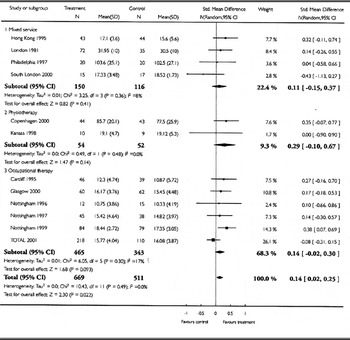
To date, there have been only two Cochrane reviews evaluating the effectiveness of providing further rehabilitation six months and longer after stroke.22, Reference Aziz, Bee, Phillips, Gladman, Legg and Walker23 The Outpatient Service Trialists (OST) looked into 14 trials with 1617 patients that compared intervention given up to one year post-stroke and those who received standardized or no treatment at all.22 The interventions given at this stage were mixed in nature, including services provided by physical therapy, occupational therapy and multi-disciplinary services, aimed at improving walking and/or activities of daily living (ADL) performance. Despite the heterogeneous nature of the intervention, meta-analysis demonstrated that to continue providing rehabilitation up to one year post-stroke reduced the odds of a poor outcome (odds ratio (OR) 0.72, 95% confidence interval (CI) 0.57–0.92, P = 0.009) and increased personal ADL scores (OR 0.14, 95% CI 0.02–0.25, P = 0.02). The pooled analysis also demonstrated that treatment when given at home up to one year post-stroke had a potentially favourable impact on mortality, though this did reach statistical significance (Table 2). Most importantly, the analysis showed that for every 100 stroke patients in the community receiving rehabilitation intervention, 7–11 patients would be spared a poor outcome in the future. The OST trial is important as it proved that despite the heterogeneity of intervention provided to patients, if given regularly even up to one year post-stroke, survivors were more likely to be independent and able to carry out functional tasks by themselves.
Meta-analysis of outcome of death of the OST trial*

*Table from Cochrane Review, 2002, issue 2.22 Copyright Cochrane Collaboration, reproduced with permission.
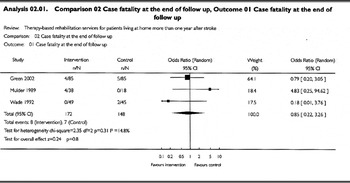
Another review, called Long-Term Rehabilitation in Stroke (LTRS), was conducted to assess whether the effectiveness in providing rehabilitation to stroke patients at home can be sustained beyond one year.Reference Aziz, Bee, Phillips, Gladman, Legg and Walker23 The review analysed only trials that involved therapy-based rehabilitation intervention for patients residing in the community who had a stroke one year or more before and who had completed formal rehabilitation. The review was only able to pool five eligible trials of 487 patients. Due to the small number, meta-analysis showed no significant reduction in deaths (Table 3). The review concluded that, due to the concept of longer term stroke rehabilitation being new, not many trials have been conducted to look into this aspect of care. This may explain the inconclusive evidence as to whether therapy-based rehabilitation intervention one year and beyond was able to influence any relevant patient or carer outcome. However, subjective analysis of the LTRS trial found that all the trials shared similar criteria; longer term rehabilitation intervention was based on an individual problem-solving method, with a common aim of reducing the level of disability by task-orientated behaviour and goal-orientated activities. It is suggested that intervention at this stage is feasible, but robust evidence of overall benefit is lacking.
Analysis of outcome of death in Long-Term Rehabilitation Trial (Cochrane Review, 2008; issue 2)Reference Aziz, Bee, Phillips, Gladman, Legg and Walker23

There have been a few studies that focused on leisure and social interventions long after stroke. Two mobility intervention studies had demonstrated a short-term improvement in treatment effects as measured in Barthel ADL scores, but these effects were small and intervention was conducted in small scale studies with short intervention periods.Reference Green, Forster and Boyle24, Reference Wade, Collen, Robb and Warlow25 Studies that looked into interventions to improve leisure activities were contradictory in their findings.Reference Drummond and Walker26–Reference Parker, Gladman, Drummond, Dewey, Lincoln and Barer28 An early study by Drummond found that structured leisure intervention programmes improved patients’ involvement in overall daily activities.Reference Drummond and Walker26 Logan et al. also found that survivors given occupational therapy intervention to increase outdoor mobility were more likely to leave the house at both four and ten months post-stroke.Reference Logan, Gladman, Avery, Walker, Dyas and Groom27 However, both studies were small in scale and had different rehabilitation interventions. In contrast to these findings, a larger multi-centre trial found no significant effects of leisure therapy or conventional occupational therapy on leisure participation of stroke patients 6 and 12 months after hospital discharge.Reference Parker, Gladman, Drummond, Dewey, Lincoln and Barer28
Challenges and pit-falls
Until recently, relatively little was known about long-term care and rehabilitation after stroke, as for many years service development and research have focused on prevention and early intervention. Studies looking at longer term stroke, especially those that looked into functional outcomes and service provision to those living in the community, were scarce, with small patient numbers and heterogeneous in nature.Reference Rodgers and Thomson29 Hence whilst numbers of stroke survivors continue to escalate, there are real challenges in delivering optimum longer term rehabilitation. Although the weight of evidence is still not in favour of providing rehabilitation beyond the hospital doors, stroke providers agree that there are significant gaps in service provision, especially in the community, and that these need resolute solutions.
The first challenge involves the apparent gap between rehabilitation intervention in acute settings and for those who survive six months and longer. There is no consensus on how best to identify the patients that might be in need of further rehabilitation and when is the best time to start rehabilitation in the community. No one has discussed how best to implement a seamless integration of the transfer of care from hospital to home. With evidence limited and elusive, stroke practitioners have little or no reference to guide them.
The second challenge is that only a few centres in the world promote collaborative management between clinicians and therapists in managing longer term stroke.Reference Young and Forster30–Reference Young, Murray and Forster32 Evidence demonstrates that survivors at this stage of recovery often experience problems associated with accessing information, transfer of care and psychological adjustments.Reference Young, Murray and Forster32 A case-control study looking into the problems of longer term stroke patients demonstrated that survivors experienced a lack of appropriate services and supports to accommodate the various needs and problems that they faced daily.Reference Aziz, Walker, Phillips, Von Fragstein and Gladman33 Although guidelines have advocated a more holistic approach in managing longer term stroke survivors, current practices remain fragmented and disjointed. Most survivors are seen either by their general practitioners alone, or attend rehabilitation intervention programmes that operate as a single discipline, or less commonly multi-disciplinary rehabilitation programmes.Reference Aziz, Walker, Phillips, Von Fragstein and Gladman33 Service provision is dependent primarily on geographical location and often there is lack of co-ordination between service providers, which may include primary care, social services, rehabilitation services and voluntary organizations. It still remains a challenge to stroke providers to formulate a management plan that combines rehabilitation, secondary prevention and best use of available community resources. Suggestions such as one-stop clinic centres, regular review clinics and the use of a case-management system have been advocated, but evidence to support their effectiveness is still lacking.
Unlike the management of acute stroke, where the ‘multi-disciplinary concept’ is well established and practised, the concept is far from ready to be implemented for the longer term management of stroke. A major challenge is the need to form a systematic community-based rehabilitation service, but the formation of an effective multi-disciplinary team is dependent on the characteristics of the community environment and the social support available. This is impossible to standardize without evidence from multi-centre studies.
Conclusion
Longer term rehabilitation after stroke remains a challenge both to clinicians and survivors. Current guidelines have set a clear and explicit standard of care for the components of acute management, secondary prevention and early rehabilitation. There is inadequate evidence to guide the development of a standard of care in longer-term rehabilitation. Taking into account the need for an individualized approach to rehabilitation, it is a challenge to standardize a community programme, let alone to set guidelines for this matter. What is needed is more evidence to support the value of longer-term stroke rehabilitation through high-quality multi-centre studies. Perhaps what is required now is a new approach. Longer-term rehabilitation must become central, rather than supplementary, to provision of care for stroke survivors attempting to make the best of their abilities after discharge back into their community.
Conflicts of interest
There are no conflicts of interest involved in the preparation of this review.
Acknowledgements
Dr Aznida Firzah of UKM proof-read this paper.