At the tail end of the “Nanjing Decade,” as Nationalist power reached its humble zenith, Chinese cultural elites envisioned the reversal of a host of humiliating phenomena long symbolic of the asymmetrical power relations among China, Japan, and the West. Among the new professional intelligentsia in Beijing and Nanjing, few issues rankled more than the half-century-long relocation of Chinese cultural artifacts and manuscripts at the hands of foreign archaeologists. “When will our countrymen measure up to the Stein and Pelliot spirit,” asked a Chinese pundit in 1936, “venture out into the world, unearth and gather up exquisite cultural treasures, and bring them back to our country, all for the greater glory of our nation?” (Yi 1936, 50). That was the ideal: to send out into the world their own debonair explorer whose collection of pilfered artifacts from exotic lands would stand as testament to the revival of Chinese imperial power. Such a day was still far in the future. Though foreign explorers in China could no longer rummage through sand-buried antiquities with impunity, still they came, brandishing deep pockets, indomitable wills, and diplomatic bombast, intent on one final foray into sparsely populated wastelands.
Yet gone were the days when unequal treaties signed in Beijing translated into automatic red-carpet treatment on the distant fringes of the Qing empire (Jacobs Reference Jacobs2012). By the 1920s, a decade of warlordism had taught foreigner explorers not to place much confidence in the writ of the central government outside its immediate sphere of control. The British diplomat Eric Teichman, writing in the 1930s, longed for a world that no longer was. “When I first went out to China thirty years ago,” he observed, “one could travel the length and breadth of the Chinese Empire in complete safety, unarmed and escorted by a magistrate's runner, equipped probably with nothing more formidable than a fan and umbrella” (Teichman Reference Teichman1937, 37). Not surprisingly, the Nationalist government, following its swift rise to power in the Yangzi delta from 1926 to 1928, looked to reverse this alarming hemorrhage of central government authority. The means by which it attempted to do so, the resources at its disposal, and the countermeasures of autonomous warlords in the provinces—these are the subjects of countless scholarly works produced over the past several decades (see, e.g., Eastman Reference Eastman1974, Reference Eastman1991; Kirby Reference Kirby1984; Strauss Reference Strauss1998; Zanasi Reference Zanasi2006). Yet scant attention has been paid to Nationalist unification efforts during the Nanjing era beyond the ken of inner Chinese warlords and their domains. All historians of China are familiar with the names of influential warlords, such as Feng Yuxiang, Yan Xishan, Li Zongren, Bai Chongxi, and Zhang Xueliang. Few, however, have ever heard of Jin Shuren, who, from 1928 to 1933, ruled distant Xinjiang.
Thus, for historians much as for the Nationalist government at the time, Xinjiang was so distant (2,300 miles to the provincial capital of Urumchi), so inaccessible (a telegram could take weeks and an overland trip months), and so culturally alien (over 90 percent of the population spoke either Turkic or Mongolian) that it may as well have been on the moon. Nevertheless, from 1928 to 1935, the Nationalists would attempt, against all odds, to land a man on this moon. Their efforts to infiltrate Xinjiang bear a striking resemblance to similar overtures made around this time toward Tibet, where, as Hsiao-ting Lin (Reference Lin2006) has shown, frontier and minority affairs were rarely approached with the intent of actually resolving them. Rather, they were more often utilized by the Nationalists as a pretext upon which to impinge upon the jurisdictions and prerogatives of other Han or Sino-Muslim warlord competitors in China proper. Yet it was not only “frontier” or “minority” issues that could serve as a springboard to strategic action. Sensitive issues of cultural and moral importance involving foreign “imperialists” could also be leveraged in a similarly pragmatic fashion. First and foremost, then, this is a study of how the Nationalists attempted to assert their authority in a distant borderland by leveraging morally discredited foreigners as convenient proxy vessels. In some key respects, their efforts also serve as a harbinger to what Anne-Marie Brady suggests, in her study of “foreign friends of China” after 1949, were “the ways and means by which the CCP manipulated foreigners and foreign things for its own ends” (Brady Reference Brady1997, 632; see also Brady Reference Brady2000).
The histories of Euro-American archaeological expeditions, both in China and across Eurasia, have been written several times, most famously by Anglophone writers adopting the perspective of Western protagonists (see, e.g., Hopkirk Reference Hopkirk1980; Meyer and Brysac Reference Meyer and Brysac1999, 310–93; Mirsky Reference Mirsky1977; Walker Reference Walker1995). More recently, an attempt has been made to balance these narratives with the voices of those Chinese officials and intellectuals whose business it was to track foreign archaeologists and comment upon their activities (Jacobs Reference Jacobs2009, Reference Jacobs, Cochran and Pickowicz2010, Reference Jacobs2012). Though both perspectives enrich our understanding of these expeditions, the end result still resembles a “he said, she said” type of narrative, in which the chauvinist words and deeds of foreign “imperialists” ultimately instigate an equally chauvinist backlash from native “nationalists,” who, at least against the silhouette of foreign aggression, often appear united. The legacy of such historical framing, however, leaves us with two relatively homogenous sides of a debate, with the result that a disproportionate amount of ink has been spilled over abstract moral concerns regarding issues of cultural sovereignty and foreign imperialism writ large (see, e.g., Balachandran Reference Balachandran2007; Colla Reference Colla2007; Cuno Reference Cuno2008; Danielsson Reference Danielsson2012; Hevia Reference Hevia, Bickers and Tiedemann2007; Middleton Reference Middleton, Bickers and Tiedemann2007; Reid Reference Reid2002). For much of the Republican era in China, however, the notion of coherent “Chinese” and “Western” actors is grossly misleading. Nowhere does this become clearer than in the fortunes of foreign expeditions to Xinjiang during the Nanjing Decade. In the present retelling of their fortunes, made possible only with the recent publication of extensive archival material from Xinjiang, the “agents” of Western imperialism recede into the background, while their “indignant” nationalist Chinese persecutors are revealed for the insecure, pragmatic geopolitical competitors they actually were. The second goal of this study, then, is to debunk the primacy of cultural and moral interpretations for transnational interactions that were, at heart, matters of geopolitical pragmatism.
One of the most useful ways to accomplish such a task is through the lens of diplomatic history (see, e.g., Goode Reference Goode2007). As a result, what follows are two detailed case studies of prominent archaeological expeditions undertaken in Xinjiang between 1927 and 1931, followed by a brief examination of several related initiatives in the remaining prewar years. The Sino-Swedish expedition, led by Sven Hedin and Xu Xusheng, brought unprecedented Chinese praise to the former and professional fame to the latter. By contrast, Aurel Stein's fourth and final trip to Xinjiang became such an embarrassment to the Hungarian-born British explorer that he never spoke of it again. The drastically divergent fates of each expedition can only be understood by turning to the domestic geopolitical context through which they navigated. It is a context not quite “Chinese,” but neither is it entirely “metropole” versus “periphery” either. It is a context in which the discourse of cultural sovereignty is cynically deployed by both “unprincipled” warlords and “legitimate” Nationalist officials alike. Foreign explorers and Chinese nationalists can be seen not as the knights and queens of the chessboard, but rather as the pawns of insecure geopolitical actors wading through uncharted territory. By using local geopolitics to reframe historical narratives mired in a cultural and moral gloss of imperialism and nationalism, scholars across Eurasia can further illuminate the lives of those influential statesmen who acted not in accordance with the dictates of abstract “-isms,” but rather within the context of the many miniature “great games” unfolding right before their eyes.
Warlordism Interrupted: The Sino-Swedish Expedition
In 1927, the famed Swedish explorer Sven Hedin returned to China. His goal was to map a pan-Eurasian air route through Chinese Central Asia, in accordance with the wishes of his Lufthansa financiers. It soon became apparent, however, that he would be lucky just to visit the northwestern frontier at all, much less scout out potential airstrips. The problem did not lie with Manchurian warlord Zhang Zuolin's government in Beijing, then in its death throes and all too eager to sell the requested visas. The problem lay instead with what Hedin's rival Aurel Stein referred to as “Young China”—that new generation of Western-educated technocrats and intellectuals who saw it as their duty to defend Chinese interests, in defiance of seemingly unprincipled warlords such as Zhang. In March 1927, Hedin got his first whiff of the new political environment. Having already been persuaded to renounce the exploration of air routes, Hedin instead resolved to lead a team of Swedish and German scholars on a scientific expedition to Xinjiang. Opposition soon coalesced among a handful of scholarly organizations in Beijing, chief among them the Committee for the Preservation of Antiquities (guwu baoguan weiyuanhui). The opposition of the Committee notwithstanding, Zhang's warlord government was not about to cede its political authority to a group of scholars. So the three sides hammered out a compromise: Hedin's expedition could proceed, but it would have to be reorganized as a joint Sino-Swedish venture, with the inclusion of eminent Chinese scholars among its ranks. Hedin agreed to these terms, and the expedition departed from Beijing in April (Hedin Reference Hedin1943, 1:6–8; Zhongguo Xinjiang Wei-wu-er zizhiqu dang'an guan et al. [hereafter ZXWZD] 2006, 6).Footnote 1 At Hedin's side was Xu Xusheng, dean and professor of philosophy and history at Peking University, now co-director of the expedition.
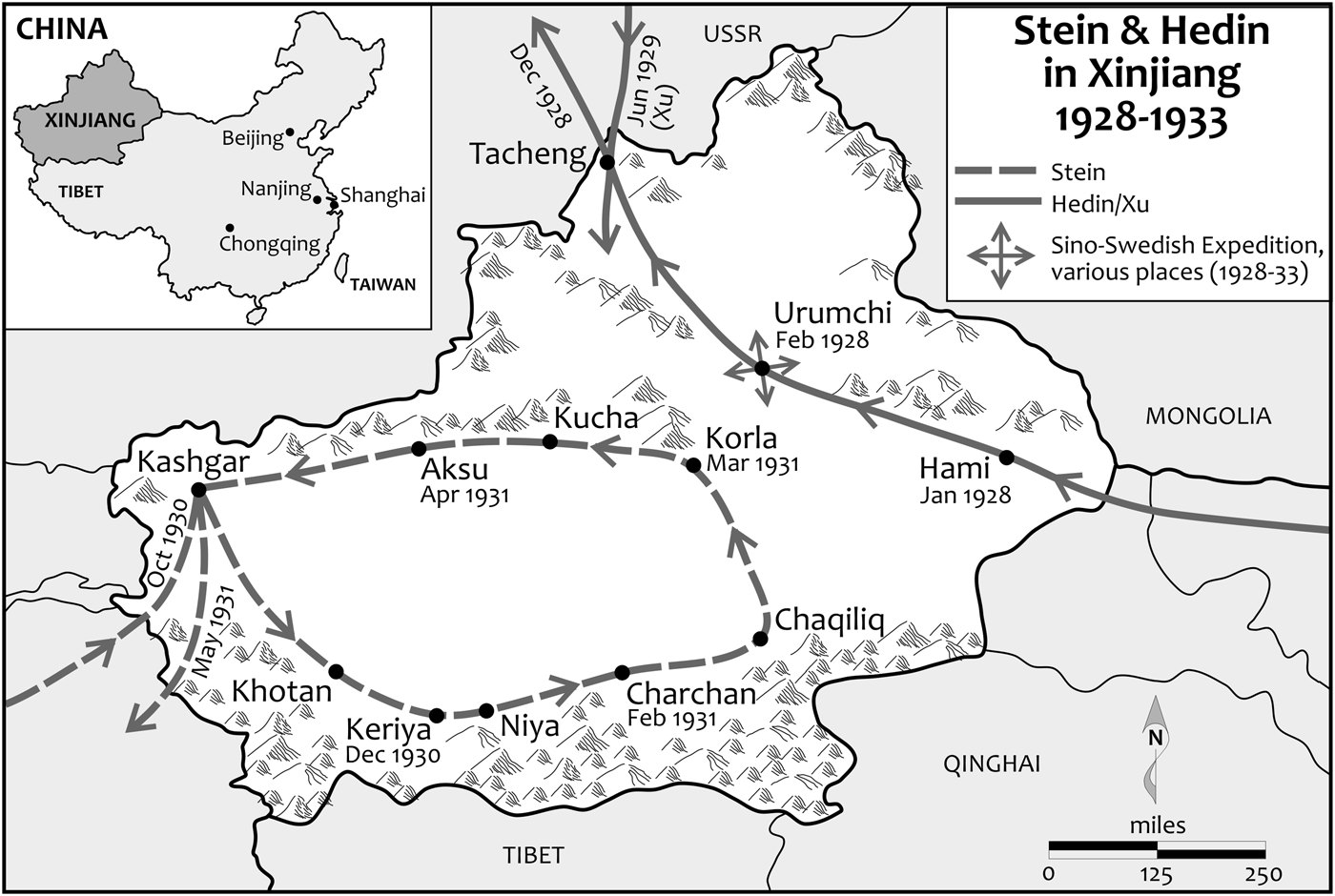
After a few initial misunderstandings, the governor of Xinjiang, Yang Zengxin, welcomed Hedin and Xu into his province (see figure 1). They were given comfortable quarters in Urumchi, the provincial capital, and free rein to carry out scientific experiments. Yet at no time did Xu or Hedin entertain any illusions about the balance of power in the northwest. Unlike during Hedin's first trip to Xinjiang more than thirty years prior, diplomatic papers issued in Beijing now meant nothing in Urumchi. Governor Yang called all the shots, and the expedition existed entirely at his pleasure. A decade of warlord politics in China meant that the soft persuasions and overt threats of foreign consuls on the eastern seaboard no longer carried any weight with a governor of the distant borderlands. “One felt very clearly that it was he who had the power here in this country and that we were quite at the mercy of his lightest whim,” Hedin later wrote. The governor was, “in a word, imposing and fascinating, and one always feels a certain interest in observing at close quarters a man who by dint of his own will and shrewdness has been able to achieve such terrific power over other men.”Footnote 2 As it turned out, Yang also had a sense of humor. “Why do you take the trouble of riding about in the deserts looking for old ruins?” he asked Hedin in March 1928. “Here in my yamen you have ample opportunity of studying archaeology, for as you see, everything here is in tumble-down, and the plaster in this room is falling off in big flakes” (Hedin Reference Hedin1943, 1:243, 246).
Stein and Hedin in Xinjiang, 1928–1933. Cartography by Debbie Newell.

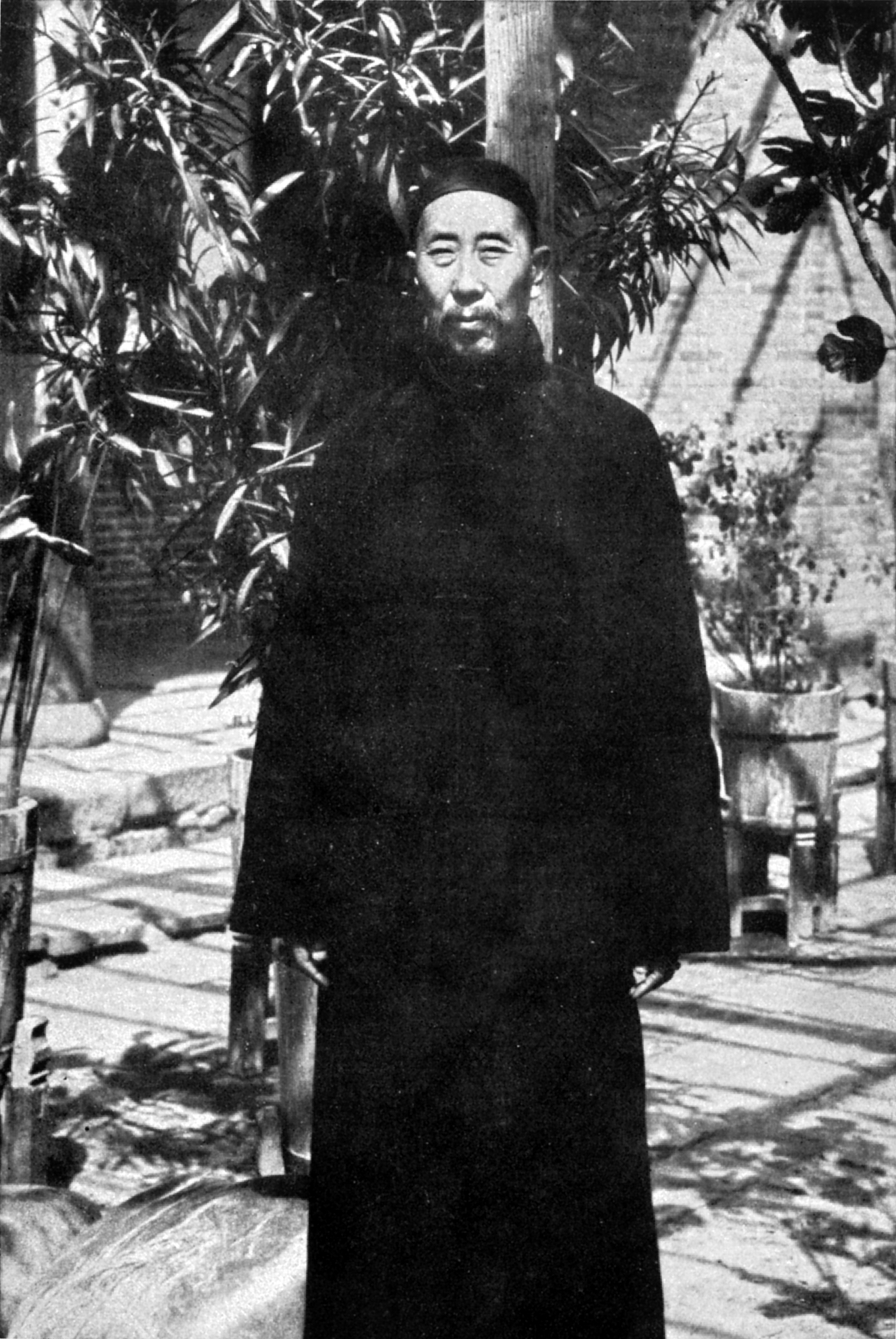
Yang's unexpected hospitality, however, soon came to an abrupt end. On July 7, 1928, some four months after the expedition's arrival in Urumchi, the governor's fears of inner warlord penetration of his province finally bore fruit: assassins dressed as waiters gunned him down during a graduation toast in the provincial capital. Xu was devastated. “Just yesterday we shared a pleasant conversation,” he wrote in his diary the next day. “Today he is with the ancients!” (Xu [1930] 2000, 230). Yet the passing of Governor Yang portended far more than the loss of a personal friend. His successor, a man by the name of Jin Shuren (see figure 2), knew full well that the inner Chinese warlord Feng Yuxiang was most likely behind the assassination.Footnote 3 That fact alone cast a dark shadow over anyone whose walking papers evinced stamps from within the pass. Thus, despite initially favorable impressions of Jin—Hedin referred to him as “gifted with presence of mind and energy,” and Xu commented on his “pleasant speech”—the new governor soon proved to be an implacable foe of the expedition (Hedin Reference Hedin1943, 2:5; Xu [1930] 2000, 237). With war clouds on the horizon, scientific endeavors took a back seat. After all, as far as Jin knew, Hedin and Xu may even have played a role in the assassination of his predecessor.
Jin Shuren, governor of Xinjiang, c. 1928. From the collection of the Museum of Ethnography, Sven Hedin Foundation. Used with permission.
The governor quickly made up his mind. The expedition had to go. All that was needed was a pretext.
A sizeable cache of ammunition tucked into some of the expedition's luggage seemed to fit the bill. Xu claimed it was fit only for shooting game (Xu [1930] 2000, 237, 240, 260; ZXWZD 2006, 16–22). When the make of the bullets proved indeterminate, Jin changed tack. The unearthing of a skull just north of Urumchi gave the governor an opportunity to take the moral high ground. “It is the custom of our country to leave the bones and skulls of the deceased in the ground,” Jin informed Xu. “Digging them up and exposing them to daylight is a practice scarcely to be condoned” (ZXWZD 2006, 21). Xu saw right through the governor's façade. “These officials cannot understand the purpose of our expedition for the life of them,” he complained in his diary. “How can we let people wholly ignorant about cultural affairs bear chief responsibility for passing judgment? Allowing them to determine ‘whether or not [our activities] are detrimental to culture’ is truly absurd” (Xu [1930] 2000, 243). Yet no one knew better than Xu that Jin's real purpose in levying such charges was not to champion the integrity of local customs. Rather, they were a convenient pretext to tighten a logistical noose around the expedition. Nowhere was this clearer than in the vicinity of Turpan, a perennial high-yield excavation site. On the pretense of “alleviating misunderstandings with the locals” and preventing the “transgression of academic boundaries,” the local magistrate took it upon himself to personally shadow a team of Swedish researchers for nearly forty miles. “I politely informed them that their activities must be restricted to the realm of weather and astronomy, that there was no need to take pictures of the local topography, and even less need to fire their weapons in pursuit of game” (ZXWZD 2006, 43).
One by one, Governor Jin came up with a reason to order every single member of the expedition back to Urumchi. Invoking the specter of war on the eastern front, Jin told Xu to recall his men from the southeastern border region with Gansu. Then he notified Hedin that Karashahr—located in the geographic center of the province—was also off-limits. With that, Hedin finally snapped. “Perhaps there is some legitimate concern about provincial security near Charchan,” Hedin conceded, referring to Xinjiang's most southeasterly oasis. “But Karashahr and Kucha are far away from the area in question, and surely the same concerns do not pertain there.” Hedin, struggling to keep his temper under control, now went out of his way to antagonize Jin. “Furthermore,” he concluded in his telegram to Jin, “the proper name of our organization is either the Northwest Scientific Expedition or the Chinese Northwestern Scientific Expedition. There is no other name. In a recent letter [from you] I noted an error on this account, and would appreciate it in the future if you could pay more attention to this matter” (ZXWZD 2006, 24–25, 31). Other than this parting shot, however, there was little Hedin could do, and by late December 1928, the writ of the governor was all too clear. Both Xu and Hedin conceded their defeat and exited the province, their once promising expedition in shambles (Xu [1930] 2000, 253, 260).
Back on the eastern seaboard, Hedin and Xu met with a very different reception. To begin with, Beijing—now renamed “Beiping” to reflect its demotion from the national capital—was no longer the locus of Chinese political authority. That distinction now belonged to Nanjing, where the emergent Leninist party-state of Chiang Kai-shek's Nationalist government set down roots in 1927. Within a year, warlords throughout the country had acknowledged nominal Nationalist authority, a rhetorical move meaning much on paper but little on the ground. One by one, piece by piece, Chiang and his rivals within the Party began the arduous task of recruiting intellectuals and attempting to divest former warlords of their power. Among their targets was Governor Jin of Xinjiang, whose considerable distance from Nanjing deterred the new government not in the least. Jin, a career northwestern official first appointed under the Qing dynasty, was, like Governor Yang before him, entirely beyond the orbit of Nationalist patronage networks. As such, Nanjing initially refused to confirm him as governor, instead announcing the imminent dispatch of a “pacification commissioner” to Urumchi. “It is said that the authorities are extremely uneasy at Nanjing's silence,” Xu Xusheng wrote in his diary on July 27, “and have decided to use a petition from the Mongol and Muslim nobles to try and force Nanjing's hand” (Xu [1930] 2000, 235). Jin's ploy achieved its purpose, and later that year Nanjing relented on the confirmation of the governor's civilian titles. With regard to Jin's much-sought-after military designations, however, the new central government held firm, leaving the governor no choice but to invoke an emasculated authority for years to come.
In February 1929, two months after his ignominious departure from the northwest, Sven Hedin arrived in Nanjing, where he met up with Xu Xusheng. Both men were received by Cai Yuanpei, one of the new breed of influential Nationalist officials occupying dual posts in government and academia. Cai, sensing a golden opportunity to test the waters in Xinjiang, promised to renew Xu and Hedin's visas, assuring them that “the government has the means to enforce its will” on Governor Jin. Two weeks later they were granted an audience with Chiang Kai-shek himself, then preoccupied with a warlord rebellion in north-central China. Chiang promptly signed off on a telegram to Jin, instructing the distant governor to “facilitate their endeavours and in nowise to throw obstacles in their way.” He reminded Jin that “it is your duty to act in accordance” with these orders. Hedin, cognizant of Jin's likely response, preferred to delay costly preparations for a second expedition until some form of agreement had been hammered out. Nationalist officials, however, urged him to depart without delay, for “an order from the Central Government required no answer since in practice it must be obeyed” (Hedin Reference Hedin1943, 2:50–52; see also ZXWZD 2006, 47).
For those members of Xu and Hedin's team still in Xinjiang—effectively under house arrest—this was most welcome news. Swedish geologist Erik Norin rushed to flaunt the new decree. “I have received a telegram from Dr. Hedin,” he wrote to Jin on March 19. “It says that the Chinese Association of Science has decided to extend our joint venture for an additional two years, and that the central government has also lent its approval. I trust Your Excellency has already been informed of this decision?” Jin played dumb. “My office has received no such notice,” he told Norin. “Seeing as it will be difficult to extend the deadline, you are hereby to adhere to the original schedule. I trust you will obey.” Hoping to get rid of Norin and the others before Hedin and Xu returned, Jin ordered the provincial Bureau of Education to discredit the expedition beyond repair. “They have been here for more than a year now, under the guise of academic inquiry, yet they have no accomplishments to speak of,” the Bureau wrote to Nanjing. “Instead they send their men to dig things up, disturb corpses, and fondle human skulls. These are grievous moral transgressions, and they have elicited the indignation of the Muslims.” As for the celebrated inclusion of Chinese understudies, they “are nothing more than the tools of the Swedish scientists, assisting in the secret mapping of our land and surveying of important strategic sites.” The Bureau ended with an appeal to the emerging rhetoric of cultural sovereignty, accusing the expedition of “destroying several thousand years' worth of antiquities” (ZXWZD 2006, 48–50).
Nanjing was unmoved. “The members of this expedition are engaged in scientific survey,” the Ministry of Foreign Affairs replied two weeks later. “This is quite different from that of an ordinary traveler, and you are to admit them into the province.” In order to defuse Jin's accusations of cultural theft, the Ministry submitted for the governor's perusal a set of regulations Hedin had agreed to in Nanjing regarding the eventual deposit of all relics within a Chinese museum. To counter the governor's security concerns, the Ministry described the expedition's weapons as nothing more than a “handgun, hunting rifles, and ammunition,” all perfectly legal and necessary. The only thing Nanjing had not addressed was the supposed “indignation” of the Muslims. Jin took note. “Only through my unflagging efforts and timely intervention were we able to prevent their work on the outskirts and escort Hedin safely out of the province,” Jin wrote on May 14, making it sound as if Hedin had barely escaped the clutches of a Muslim lynch mob. “If Hedin returns to Xinjiang again,” the governor warned solemnly, “a misunderstanding is bound to occur, and the people will rise up.” Sensing the need to grant himself a somewhat more impressive cultural resume, Jin then went ahead and invented the nonexistent “Society for the Preservation of Antiquities.” It, too, denounced the expedition. Toward Hedin and Xu's colleagues, eagerly awaiting the return of their co-directors in Urumchi, the governor insisted he had yet to see a “clear statement” of Nanjing's extension, and ordered them to leave the province at once (ZXWZD 2006, 51–53; see also Hedin Reference Hedin1943, 2:58–59).
Events came to a head in June. Five Swedish and two Chinese members of the expedition, having set off from Europe along the Trans-Siberian Railway, showed up at the border crossing in Tacheng with Nanjing-issued passports in hand. On orders from the governor, they were turned away. This snubbing at the border, Jin's first tangible repudiation of Nanjing's authority, necessitated the most spectacular justification to date. Unbeknownst to the Nationalist government, Jin now wrote, Hedin had once tried to transport “numerous firearms and a case of ammunition to the Torghut Mongols” in Karashahr. And it was certainly not a coincidence, Jin continued, that the Karashahr Mongols now evinced a hostile posture toward provincial authorities. “I had originally hoped to avoid publicizing this incident, but since matters have now come to this, I must marshal my courage and expose the details in a direct and honest manner.” If the Sino-Swedish expedition did not leave the province immediately, Jin suggested, open rebellion against Han rule would ensue. The governor concluded with a final plea to consider the “the masses,” who harbored “great antipathy” toward the expedition (ZXWZD 2006, 58–59). With that, Jin had thrown everything he had at the central government. The ball was now in Nanjing's court. In the face of such wily intransigence, were these archaeological proxies still worth fighting for?
The answer came one week later, as a reprimand from the Ministry of Education to its administrative counterpart in Xinjiang. “This expedition is purely a scholarly venture, and completely bereft of ulterior motives,” the Ministry wrote. “If there are misunderstandings, then we will look to you to dispel the suspicions of the masses by means of logical explanation. You cannot simply echo popular sentiment and join in the attack.” Breathing down Nanjing's back were powerful nationalist academics in Beijing and Nanjing, support from whom was essential for any claim to cultural and political legitimacy. Liu Fu, professor of literature at Peking University and a close colleague of Xu, reminded Nanjing of what was at stake. “It seems that orders from the central government must be approved by Governor Jin first,” Liu wrote from Beijing. “For a Chinese citizen equipped with a passport issued from his own central government to be unable to travel within the borders of our country—this is a frightening prospect.” According to Liu, the governor's repeated invocation of Muslim indignation and popular antipathy was nothing more than a pretext to “openly despise the telegrams and passports of the central government.” While damage to the expedition was inconsequential, “damage to the prestige of the central government is immense” (ZXWZD 2006, 60–62).
Having thrice witnessed the determination of the new government to back its proxies in Xinjiang, Governor Jin finally gave way. Quite miraculously, he claimed, owing to “strenuous efforts at clarification,” the anger of the masses had managed to dissipate (ZXWZD 2006, 77). Likewise, the border guards at Tacheng came to the sudden realization that the expedition's marching orders “actually do benefit academic research” (63). Though Jin, most begrudgingly, had once again admitted Xu and Hedin into his province, he kept his eyes peeled for anything capable of discrediting them. He ordered the confiscation of the expedition's wireless telegraph box, authorized intimate inspections of every piece of luggage, and intercepted all postal communications. “If you see any boxes with an inspection seal that has been tampered with,” the governor instructed his border guards in Hami, “open it up immediately, check its owner and his attendants for prohibited items on their persons, and submit a detailed description regarding any letter or report that is harmful to the security of Xinjiang” (89–91). When the governor's agents discovered a letter from a Russian official in Novosibirsk addressed to a Russian consul in Tacheng, Jin postponed its delivery for two months while he mulled its significance. A translator was finally procured, and the mystery solved: “Move the equipment to Dihua [i.e., Urumchi] when the road is dry” (93–94, 100).
The governor never found his smoking gun, and the Sino-Swedish expedition continued its work in the field for several more years. Ultimately, it helped produce the first generation of professional Chinese archaeologists, many of whom went on to long and distinguished careers. In the Chinese historical memory, the partnership between Sven Hedin and Xu Xusheng has been lauded as one of the first instances in which scientific cooperation between Chinese and foreign scholars was carried out on equal footing. In its own day, however, the significance of the expedition derived more from the implications it carried for domestic geopolitics rather than international scholarship. From 1929 to 1930, just two years after the creation of a new government, the Nationalists managed to enforce their writ on Governor Jin on a matter of national cultural importance. To be sure, Nanjing's triumph was largely symbolic. Yet it was something where once there had been nothing, and it laid the groundwork for future missions of a far more ambitious nature.
Key to the Nationalist victory over Xinjiang's governor had been recognition of the infallible rhetorical bulwark afforded the new government by the participation of Chinese scholars in “legitimate” academic ventures. Expeditions made up exclusively of foreigners were no longer welcome in China. Yet a marriage of convenience between foreign resources and Chinese personnel had something to offer both nationalist Chinese scholars and the Chinese Nationalist government. So long as Nanjing marshaled sufficient stamina to wear down the defenses of a distant governor, the combined weight of newly legitimized cultural and political capital could not be deflected indefinitely.
Nanjing Frustrated: Aurel Stein in Xinjiang
The tables were turned, however, when the Hungarian-born British archaeologist Aurel Stein returned to China in 1930, just one year after the Sino-Swedish expedition had won its hard-fought campaign to excavate in Xinjiang. American financiers at Harvard had managed to entice the sixty-eight-year-old explorer into an unprecedented fourth expedition to Xinjiang. Anticipating stiff resistance from what he dismissively characterized as “Young China,” Stein took care to enlist the diplomatic expertise of the British prior to his arrival. They advised a quick trip to Nanjing in April (bypassing the troublesome Beijing academic community altogether), where Minister of Foreign Affairs C. T. Wang (Wang Zhengting), informed that Stein intended only to excavate ancient “rubbish heap contents” (Stein Reference Stein1930, 224:105), promptly issued a visa for the “investigation of historical traces including relics of art and writing.” Negotiations were conducted with utmost efficiency and secrecy, just as the British had hoped—and as Nanjing would soon come to regret. Stein then set off for India, where he prepared for an overland trek into Xinjiang in August (Brysac Reference Brysac and Wang2002). The Nationalist government, banking on a ripple effect from the Sino-Swedish affair, ordered the governor to prepare for his arrival. “He will enter Xinjiang via India and continue on to Inner Mongolia,” came the directive in early May. “The Ministry has already granted him a two-year passport with which to carry out surveying activities. Please order your subordinates and all border officials to afford him the appropriate protections.” Jin, now resigned to conceding Nanjing's symbolic authority in such matters, made no attempt to dispute these orders (ZXWZD 2007, 1–2).
Yet the expeditions undertaken by Sven Hedin in 1929 and Aurel Stein in 1930 evinced a fundamental difference, one that both Jin and the Nationalist government seemed slow to pick up on. The Committee for the Preservation of Antiquities in Beijing, however, the same organization that had obliged Hedin to include Chinese counterparts, was quick to remind them: Stein, unlike Hedin, did not have a Chinese collaborator by his side. Decades of anti-imperialist historiography notwithstanding, we cannot lay the blame for this slight entirely at Stein's feet. Indeed, according to his diary, during his brief stay in Nanjing, Stein took the initiative on seven different occasions to inquire after the “assistance of a literatus and Chinese topographer,” even going so far as to interview one prospective candidate from the local university and drafting a tentative table of remuneration (Stein Reference Stein1930, 224:104–16). It was Stein's British handlers who forcibly dissuaded him from such a path. “I'm to be strongly advised not to take Chinese Ass-ts with me,” Stein wrote in his diary on May 9, “as Chairman [i.e., Governor Jin] may refuse their admission.” This was terrible advice, and one that the precedent of Hedin's Sino-Swedish expedition had clearly debunked. Stein, however, placed the utmost faith in his British sponsors, and brushed aside the first signs of trouble during an otherwise cordial dinner with Zhang Xinhai, an official in the Chinese Ministry of Foreign Affairs. “Refer to difficulties about taking Chinese assts for journey,” Stein wrote later that same day. “Ch. [Zhang] wants to know from whom this advice. . . . Had better omitted this piece of news” (224:117–18).Footnote 4
The absence of a Chinese colleague changed the parameters of debate considerably, and not in Nanjing's favor. Cai Yuanpei, now the newly promoted president of the prestigious Central Research Academy (Academia Sinica) in Nanjing, quickly sounded the alarm bells. “Our country's borderlands are immense, and it will be difficult to prevent him from absconding with relics under the guise of casual travel,” Cai wrote. Xinjiang's officials “must restrict Stein's movements and forbid the removal of any antiquity or relic from our territory” (ZXWZD 2007, 2–6). Cai then forwarded this message to Governor Jin and formally requested the revocation of Stein's visa in Nanjing.
Easier said than done. As it turned out, a significant amount of foreign patronage, political capital, and international prestige was invested in Stein's expedition. And unlike the Swedes, Stein's benefactors were able and willing to lock horns on his behalf. Before long, the British embassy lodged a forceful protest with the central government in Nanjing, followed by a veiled threat from its consular agents in Xinjiang to cancel a shipment of weapons then on its way to Governor Jin from India (Stein Reference Stein1930, 224:205–6). In light of the fact that Stein had already reached the border town of Tashkurgan by this point, however, both Jin and Nanjing saw no choice but to permit his entry to Kashgar. Yet with nationalist academics in an uproar, Stein now posed a liability to both the governor and the central government. The issue was no longer one of an autonomous frontier warlord pining for the swift departure of suspicious outsiders, while the distant central government attempted to preserve symbolic proxies within the jurisdiction of an adversary. With Chinese newspapers now ablaze with condemnations of spineless officials on either side of the country, the realization of what was at stake suddenly underwent a momentous shift. Inquiring minds throughout the country wanted to know: should Stein succeed in smuggling even the tiniest fragment of a bodhisattva's head out of Xinjiang, who would bear the stigma of having betrayed the Chinese nation for all posterity?
The race to pose as the most committed defender of China's cultural sovereignty had begun. Jin kick-started his campaign by instructing all officials in his province to implement the “strictest surveillance, disallow any and all excavations, and forbid any artifacts from leaving the country” (ZXWZD 2001, 137; 2007, 10). By 1930, the governor's legitimacy as steward of a Chinese province was just as vulnerable to charges of nationalist betrayal as was that of the central government. But this time, the governor's position proved more favorable. In October, the moment Stein set foot in Kashgar, Jin arranged for postal censor Zhang Hongsheng to shadow his every move. The governor intended for Zhang to play the exact same role for Jin in relation to Stein as Xu Xusheng had played for Nanjing vis-à-vis Hedin. Stein, hopeful that his companion might prove susceptible to “supplements in kind & coin,” volunteered to pay his salary.Footnote 5 Jin refused, then doubled Zhang's wages himself (Brysac Reference Brysac and Wang2002, 21; Stein Reference Stein1930, 224:219–38; ZXWZD 2001, 138–41).
It was the best investment Jin ever made. Zhang's reports from the field gave the governor a precious monopoly on information regarding Stein's whereabouts and activities. In his diary, Stein complained endlessly about Zhang. This former postal censor was making the most of his unexpected promotion, refusing to let his charge out of sight. One day, Stein managed to unearth a crumbling bodhisattva statue from the sand. A heated argument ensued, with Zhang insisting the artifact be kept out of Stein's bags (ZXWZD 2001, 148–49; 2007, 41). Then, on the road from Keriya to Charchan, Zhang discovered that the ground “was littered with derelict structures,” making it extremely difficult to “ensure that Stein obeys the laws of our country.” Before long, Stein produced a host of cartographic tools and proceeded to survey the land. “On several occasions, when I tried to obstruct him,” Zhang reported to Jin, “Stein resisted and refused to obey. He claimed that his survey of the ruins was purely in the interests of scholarship, with no other purpose, and that, if need be, he would simply take it up with my Excellency upon his arrival” in Urumchi (ZXWZD 2001, 150; 2007, 61).
Not surprisingly, Jin feared that word of Stein's willful transgressions of Zhang's surveillance might leak to the national press. He privately admonished the hapless Zhang, calling his efforts to restrain Stein “insufficient and unacceptable.” In the future, Zhang was to “exert every effort to watch over him,” and not let his “guard lapse for even one moment” (ZXWZD 2001, 152; 2007, 66). As it turned out, however, the problem went far beyond Zhang. Wherever Stein's party went, it seemed, some magistrate convened a formal military reception, arraying local notables and saluting generals in a display of diplomatic welcome. Lavish banquets invariably followed, lasting well into the night (see, e.g., Stein Reference Stein1930, 224:252–54, 270–71, 282). Representatives of “Young China” these men were not. They were veteran frontier officials of a bygone era—a time when Stein had been welcomed into Xinjiang and Chinese officials and scholars alike had cared not a whit about the removal of artifacts and manuscripts unearthed within their jurisdictions (Jacobs Reference Jacobs, Cochran and Pickowicz2010, Reference Jacobs2012). Surrounded on all sides by Chinese and Turkic friends indifferent to the larger political battles circling around them, Stein found his path repeatedly lubricated by local officials, landlords, chefs, guides, and porters he had befriended or otherwise employed on his first three expeditions. From each oasis he left laden with gifts (“a big & tasteless carpet with animal figures which shows what Khotan designing has come to” [Stein Reference Stein1930, 224:280]) and armed with letters of introduction for the next magistrate. In return, Stein was anything but stingy: one line in his pre-departure budget included $6,500 to purchase “presents” for such friends (Brysac Reference Brysac and Wang2002, 19).
Postal employee Zhang Hongsheng was torn. He had to balance strict marching orders from the governor against the disapproval of sympathetic local officials who, if properly supplicated, might one day facilitate his upward mobility. In front of the district magistrate of Aksu, Zhang expressed disapproval for obstruction of Stein's fieldwork, and talked excitedly about his finds at Niya. When the magistrate condemned the shrill rhetoric emanating from Nanjing and Beijing, Zhang echoed his sentiments. The irony of Zhang's behavior was not lost on Stein. “Chang chimes in sympathetically to suit our guest,” Stein wrote in his journal, “forgetting apparently his conduct at Malakalagan, Niya Site, Koyumal & ill-disguised threat at Temenpo.” And again a week later: “Chang as usual adopts attitude corresponding to that of visitor & displays hearty sympathy with my aims. How different from his conduct in Keriya area!” To Stein, Zhang was little more than “a clever opportunist who knows how [to] turn his coat” (Reference Stein1931, 224:409–10, 429). Jin, perhaps anticipating Zhang's conflict of interest, covered his bases by simultaneously courting influential academics in Beijing—men who could single-handedly destroy his reputation in the national press. “The scholarly community is the light of our nation,” Jin wrote to an association of Chinese scholarly outfits in November, “and the preservation of ancient artifacts is the bedrock of national sovereignty. . . . Though Stein's achievements over the past thirty years are acknowledged by both Chinese and foreigners alike, he has attained them by pillaging the ancestral traces of our national heritage and trampling over our nation's sovereignty” (ZXWZD 2007, 24).
Jin then turned to the Nationalist government in Nanjing, spinning an elaborate web of lies regarding Stein's activities and whereabouts. He falsely asserted that Stein had failed to visit a single site, assured Nanjing that numerous spies were watching him like a hawk, and insisted that Stein's departure was imminent. In fact, according to Jin, the only reason Stein remained in Xinjiang at all was due to an illness he contracted following an “eruption of anger” at Zhang's stifling surveillance. Behind the scenes, however, Jin was livid at Stein's continued presence, and scrambled to take control of the situation. “Find a way to force Stein out of the province as soon as possible,” he wrote to his officials in Kashgar (ZXWZD 2001, 144, 148, 151).
Neither the scholars in Beijing nor the bureaucrats in Nanjing bought any of the governor's excuses. At the Academia Sinica in Nanjing, Cai Yuanpei claimed that Stein was mapping the passes in preparation for a British military invasion from India, and that he had brought enormous funds to Xinjiang—whether for the collection of artifacts, a strategic survey of the land, or both, no one seemed to know (ZXWZD 2007, 35). If evidence surfaced to support the specter of a British invasion, Nanjing could use this as a pretext to dispatch an armed expedition into Jin's province. In December, the Nationalist Ministry of Foreign Affairs cancelled Stein's visa and insisted on his immediate removal from the province (ZXWZD 2001, 144). Stein, however, remained put. Four months later, Chinese scholars in Beijing came across a letter in the London Times postmarked by Stein from Xinjiang in February. Reports surfaced from foreigners in Tianjin that they had heard from Stein in Xinjiang as recently as April (ZXWZD 2007, 69, 71). These developments brought the matter to the attention of Chiang Kai-shek himself. “According to the evidence presented in these reports, there is no doubt that Stein is still in Xinjiang and engaged in his work,” Chiang wrote to the Executive Yuan in May. “The duplicity and craftiness on display here is truly despicable. . . . Send a stern telegram to the provincial government in Xinjiang that they are to observe and implement the many orders [we have issued], and expel him from the province” (74; see also 76, 78). If Jin could not get rid of Stein, the Nationalists would gain an ironclad pretext to enter Xinjiang, all in the name of cultural sovereignty.
Again, Jin responded with a chorus of lies. “We detained Stein at Keriya and sent him back to Kashgar,” he wrote. “Then, right as we were about to expel him he got sick.” Jin denied that Stein had visited any remote sites, assuring Nanjing that he would soon be gone. As for the rumored military vanguard from British India, “there is no such thing. Please do not overly concern yourself. If this were true, would I not have done something about it long ago? The newspapers have been full of falsehoods and half-truths as of late. You should keep this in mind” (ZXWZD 2001, 153; 2007, 80–81). With that, there was little else anyone on the eastern seaboard could do. Neither Nanjing nor Beijing had a man by Stein's side, and rumors of Stein's whereabouts from the Anglophone press could not compete with eyewitness Chinese testimony—however imperfect—on the ground. Much as the presence of Xu Xusheng had given the Nationalist government a legitimate pretext to berate Governor Jin in 1929, the failure to act similarly with Stein in 1930 gave Jin the opening he needed to turn Nanjing's tactics back against the Nationalists. In the end, the quality of postal censor Zhang's surveillance efforts over Stein was less important than this simple fact: he was there, and Nanjing's man was not. As such, Jin enjoyed the luxury of adhering to whatever version of the truth he chose.
For Stein, the failure to procure his own Chinese companion from a Nanjing- or Beijing-approved scholarly outfit stood as the single greatest contrast with Sven Hedin's Sino-Swedish expedition, a fact made all the more poignant when he crossed paths with one of the latter's members on his way out of the province. “Received impression of extensive and thorough work having been carried out with plentiful allowance of time,” Stein noted glumly (Reference Stein1931, 224:404). The old Hungarian simply did not know how to navigate the new cultural and political landscape of the Nanjing Decade, so very different from the beloved “old China” of his first three expeditions. On the eve of his departure, Stein continued to display a remarkable ignorance of contemporary Chinese geopolitics. “Afternoon has to be sacrificed to dealing with allegations in Waichiaopu's [Ministry of Foreign Affairs] Memo.,” he wrote on May 4, from Kashgar. “A sad waste of time caused by Young China & by Harvard-Yenching representative whom it holds under its thumb. How much of the same waste would have occurred if I had been induced to canvass that gentry last year in Peking?” (Reference Stein1931, 225:17). To the contrary, had Stein made a pilgrimage to the Beijing scholarly community—or, at a minimum, taken on a Chinese companion in Nanjing—he would have already met all of the conditions necessary for the Nationalist government to view him as a covert political agent worth fighting for.
The Afterlife of Proxy Politics
Stein eventually left Xinjiang, never to return again. Not so Sven Hedin. Always on the lookout for resourceful (or foolhardy) foreigners to deploy in domestic geopolitical battles, the Nationalist government returned to Hedin again and again for various quasi-official ventures into Xinjiang. In 1933, following a coup in Urumchi, Hedin walked willingly into a war zone, as various northwestern warlords fought to fill the shoes vacated by Jin. The by-now familiar strategy of sending thinly disguised cultural or scientific proxies into Xinjiang fooled no one this time around, and it was all Hedin could do to keep his head and shoulders intact. “Nanjing counts for nothing in a war in Xinjiang,” one of his many captors told him. “For that matter, we are under Nanjing, too, and it ought to be in both your interest and Nanjing's to help us” (Hedin [Reference Hedin1936] 2009, 101). But it was not just Hedin who found his foreign agenda manipulated for domestic geopolitics. In 1931, Chu Minyi, a highly placed Nationalist official with dual posts in government and education, conferred his blessing on a group of French cinematographers hoping to gather documentary material in Xinjiang. After reorganizing the proposed venture as the politically acceptable “Sino-French Academic Expedition”—with a few token Chinese companions in tow—the French proceeded to patch together a montage of severed heads, opium-besotted officials, and war-strewn battlefields. In Search of the Yellow Man, an over-the-top orientalist caricature of China set in Xinjiang, premiered in Paris the following year (Luo 1996, 43–45).
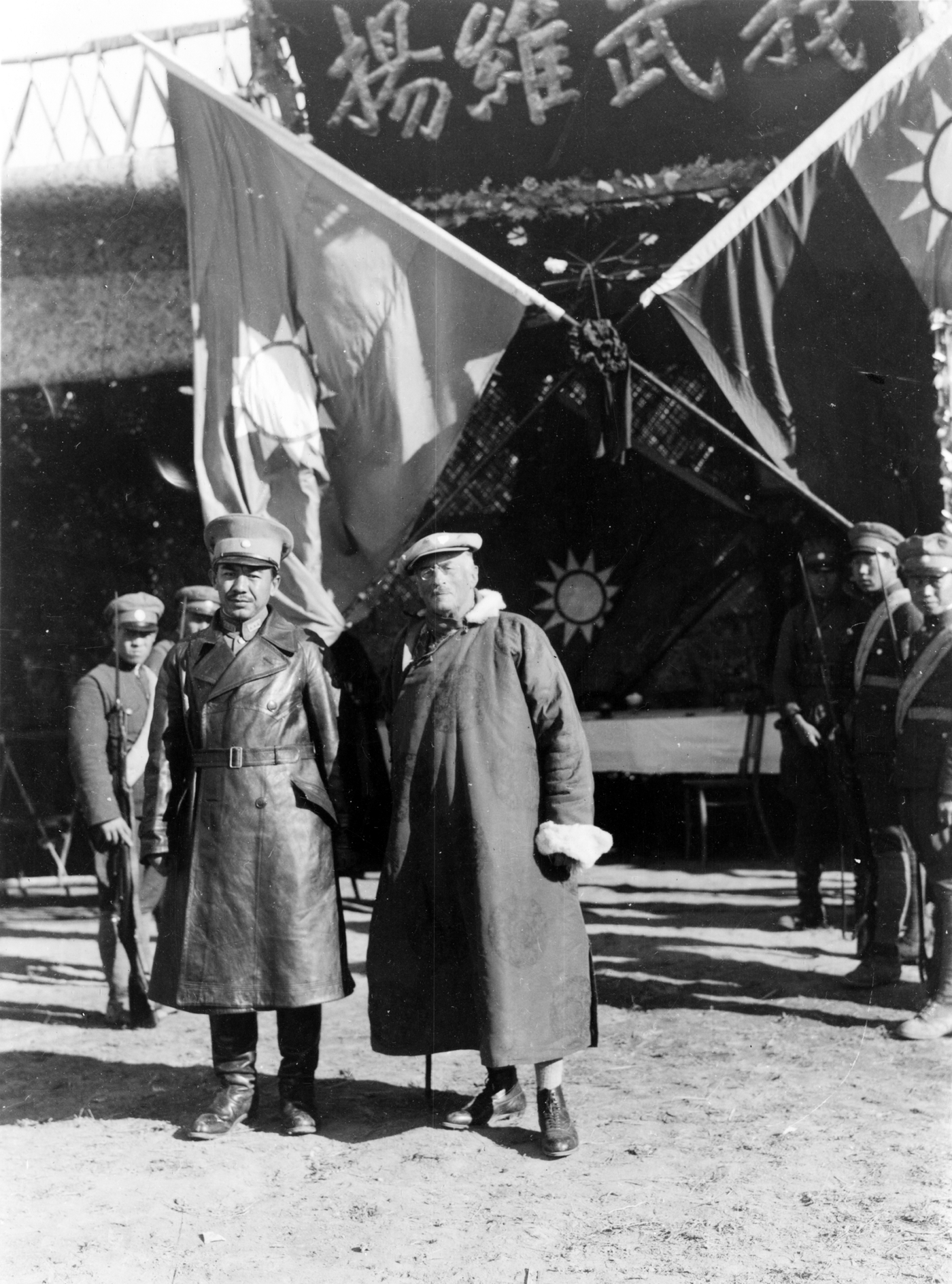
Nationalist China's half-decade-long “Great Game” in Xinjiang witnessed its last hurrah in 1935, when the British ambassador broached the possibility of a solo expedition. Eric Teichman, a career consular officer who had assisted in the arrangements for Stein's expedition, expressed his desire to return to Xinjiang in order to “study commercial relations, establish contact with the Provincial Government, and seek to concert with the latter measures for the encouragement of British trade with Xinjiang.” Seeing as Xinjiang's new warlord government was now oriented toward the Soviet Union rather than China, Nanjing leaped at the chance. “The reports we have received about Xinjiang as of late are quite disconcerting,” admitted Xu Mo, vice-minister of foreign affairs. “We heartily welcome your attempt to set up a consulate in [Urumchi], a proposal fully in line with our own government's policies” (Waijiaobu dang'an guan 1935, 5, 12–13). By 1935, relations between Nanjing and Xinjiang's new military governor Sheng Shicai (see figure 3) had gotten so bad—and concerns about Japan's rapid encroachment elsewhere so pressing—that this time no one even cared whether or not Teichman had a Chinese shadow.
Swedish explorer Sven Hedin with Sheng Shicai, military governor (duban) of Xinjiang, c. 1934. From the collection of the Museum of Ethnography, Sven Hedin Foundation. Used with permission.
Logistics were daunting, to say the least. “Though Sheng still sends an occasional telegram to Generalissimo Chiang [Kai-shek] and Wang [Jingwei],” Xu told his British counterpart, “to be perfectly honest, there is nothing else, and Sheng still harbors deep suspicions of the central government.” The frigid relationship between Sheng and Nanjing meant that Teichman would have to assume full responsibility for his own safety. “We would love for you to send him to Xinjiang, and we welcome this venture,” wrote Xu. “But you must also understand that this mission does carry a certain element of risk.” He then fired off a telegram to Governor Sheng, phrased “not as a request for his permission, but rather as a notification.” Yet the days when the central government could take the moral high road had long gone. “In the event that Sheng refuses,” Teichman was informed, “you will have to cease preparations for this trip” (Waijiaobu dang'an guan 1935, 13–14).
The initial response was not encouraging. “Normally we would welcome [such a journey],” wrote Li Rong, Sheng's civil counterpart and a widely acknowledged figurehead. “Yet despite the fact that the chaos has been quelled, there are still bandits roaming about, and the roads are in disrepair as far as the eye can see. If we were to be remiss in our duties to afford him the necessary protections, foreign relations may suffer.” In the event Teichman persisted in his plans, Li offered a terrifying portrait of the bubonic plague that awaited him in Kashgar. With that, Nanjing was urged to “please convey our deepest apologies.” The intrepid Brit, however, remained unfazed. “We look to you to see that there are no difficulties with the Provincial Authorities now,” Teichman wrote to Vice-Minister Xu on July 30, “for we are already committed to considerable expenditure.” Faced with pressure from the British, Nanjing hardened its stance toward Sheng. “We have already approved this trip. Order your officials to afford him the necessary protections and lend all possible assistance once he crosses into your jurisdiction.” Li again responded with a litany of excuses as to why he could not allow Teichman into Xinjiang. By this point, however, further negotiations were futile. In September 1935, much to Nanjing's unexpected delight, Teichman departed for the distant borderlands, bubonic plague be damned (Waijiaobu dang'an guan 1935, 50, 53, 62, 67–68).
Teichman's passport was the last that Nanjing would issue for travel to Xinjiang for nearly a decade. Though on paper Sheng “professed his loyalty and full obedience” to Nanjing, Teichman witnessed quite a different orientation of affection on display on November 7, Soviet National Day. “I have assisted at innumerable ‘joy days’ of the nations of the world,” he wrote, “but never have I seen one so thoroughly celebrated as this Seventh of November in Urumchi” (Teichman Reference Teichman1937, 110–11). At the end of nearly a decade of the Nationalists' “Great Game” in Xinjiang, it was clear to Teichman that Nanjing had not emerged the victor. From 1934 to 1943, the new outside power in Chinese Turkestan was Soviet, not Chinese. As it turned out, however, Governor Sheng would, much like the Nationalists before him, also end up treating these resourceful outsiders in Xinjiang as vessels for a domestic agenda.
But that is a different story.Footnote 6
Reframing Foreigners in Asia
In 1937, Eric Teichman penned an account of his journey to Xinjiang two years earlier. In his book, Journey to Turkistan, Teichman could not resist commenting upon contemporary moral debates surrounding the removal of artifacts and manuscripts from Chinese soil. “The Chinese complain, and the foreigner cannot well deny,” Teichman wrote in 1937, “that caravan-loads of priceless treasures from the temples, tombs and ruins of Chinese Turkistan have been carried off to foreign museums and are for ever lost to China. It makes ‘Young China’ boil with indignation,” he continued, “to read in the books of foreign travellers descriptions of how they carried off whole libraries of ancient manuscripts, frescoes and relics of early Buddhist culture in Turkistan” (Teichman Reference Teichman1937, 122–23). Such tinges of imperialist guilt have dominated scholarly discourse concerning foreign archaeological expeditions in the non-Western world. As a result, scholars have focused on what the explorers themselves wrote, what nationalist armchair intellectuals wrote, and what later generations of chastened Western elites wrote. This study suggests that the complexities of such expeditions might be more fully appreciated were scholars to take into account the concrete actions of domestic protagonists on the ground, rather than carefully groomed pronouncements in the public sphere.
Amid a backdrop of scarce national resources, political disunity, and foreign aggression, geopolitics was foremost on the minds of nearly every Chinese elite concerned with China's plight during the Nanjing Decade. The general consensus was that political unity was a prerequisite for reversing the tide of foreign humiliations. As Chiang Kai-shek put it, China was “a pile of sand,” whose centrifugal components “triggered the aggression of enemies” (Taylor Reference Taylor2009, 329). Domestic politics reigned paramount: so long as warlords and communist “bandits” continued to thumb their nose at Nanjing, the ultimate goal of wresting political and economic sovereignty back from the foreigners would forever remain a pipe dream. Now enter the foreign explorers. Ever since the May Thirtieth Incident in 1925, men such as art historian Langdon Warner found they could no longer remove Chinese antiquities without facing the wrath of nationalist Beijing elites (Balachandran Reference Balachandran2007; Jacobs Reference Jacobs, Cochran and Pickowicz2010, 73–77). Yet without a strong central government to add teeth to their rhetoric, this newfound cultural capital could only accomplish so much. Men like Sven Hedin and Aurel Stein continued to test their luck along China's distant borderlands, confident that chronic political disunity would ultimately dilute any concessions to cultural sovereignty they were forced to make on paper.
What I have sought to demonstrate in this study is not that Stein and Hedin were wrong—by and large, they were right, or they never would have been able to reach Xinjiang in the first place—but rather that, from the perspective of Asian history, a fixation on foreign explorers and their principled nationalist detractors skews scholars' perceptions of what was really at stake at the time. The discourse of cultural sovereignty, deployed by powerful academics in Beijing long before the rise of the Nationalist Party to power, certainly changed the rules of the game. But it did not change the nature of the game itself. In 1929 as in 1919, the central concern of Chinese intellectuals and political elites alike was how to achieve national unity. Only then could the foreigners be kicked out. The fortunes of foreign explorers in Xinjiang during the Nanjing Decade stand as vindication of this calculus. No attempt was made by either the warlord government in Beijing or the Nationalist government in Nanjing to turn Hedin or Stein away. Instead, they were welcomed as a thinly disguised means of projecting the authority of the Chinese central government over autonomous warlords in the borderlands.
Although domestic Chinese geopolitics facilitated Stein's and Hedin's entry into Xinjiang, once there, the ultimate fate of both expeditions depended upon the degree to which political elites on either side of the country could manipulate the rhetoric of cultural sovereignty for their own agenda. And there is no doubt that the name of the game was manipulation—not a principled defense of cultural sovereignty. Case in point: in order to ward off the Nationalist-sponsored Sino-Swedish expedition in 1929, Governor Jin Shuren vilified the first law-abiding foreign archaeologist in the history of modern China (Sven Hedin) and denigrated a patriotic Chinese academic destined to become one of the nation's most respected archaeologists (Xu Xusheng). He even went so far as to accuse the latter of treason, suggesting he was mapping the land in preparation for a German invasion. Then, in 1930, in order to derail any pretext Nanjing might seize upon to send its own agents into Xinjiang, Jin repeatedly covered the tracks of the most notorious (and unrepentant) cultural “thief” ever to set foot in the northwest (Aurel Stein). And lest such nationalist transgressions be ascribed solely to unprincipled warlords, it is important to recall how just how eager Nanjing was to issue visas to Xinjiang for a group of French cinematographers, who then proceeded to humiliate China on the world stage with footage gleaned from their travels. And, last but not least, it should be remembered how quickly and readily the Nationalist Foreign Ministry issued visas to both Stein and Teichman, all the while doing nothing to ensure the company of a Chinese colleague, a prerequisite clearly established—by warlords, no less—during the 1927 negotiations with Hedin. In fact, had Stein actually procured a Chinese colleague during his time in Nanjing, there is every reason to believe that both the Nationalist government in Nanjing and the scholarly community in Beijing would have attempted to portray the infamous plunderer of Dunhuang as a “penitent” ally of the Chinese people, in hopes of furthering their own agendas.Footnote 7
For what it is worth, there is no denying that the actions of men like Stein and Hedin were largely symbolic of China's greater political and economic subjugation to the foreign powers during the first half of the twentieth century. But they were so much more than that. The chief historical significance of Stein and Hedin's oft-debated expeditions in China during the Nanjing Decade lies not in their “symbolic imperialism”—political, cultural, or otherwise—but rather in the opportunity it afforded Chinese political elites to pursue their own domestic agenda. And the agendas, too, were similarly complex. In this article, I have focused on how foreign expeditions played into the hands of Chinese political actors, defined largely in terms of “metropole” and “periphery.” Yet even this characterization belies a deeper complexity. Strictly speaking, it was not “Nanjing” or “the Nationalists” who attempted to manipulate foreign explorers in Xinjiang. To dig even further, it can be said that it was certain factions within the Nationalist government—by no means a monolithic entity—who selectively sponsored such expeditions, often to buttress their own rise within the Party. For instance, “pacification” expeditions to Xinjiang sponsored by Chiang's rival Wang Jingwei in 1933 were likely attempts to bolster Wang's political clout within the Party, by demonstrating his resolve to “recover” Xinjiang for the central government.Footnote 8 Similarly, Governor Jin did not speak for “Xinjiang” or the “periphery.” He, too, faced a host of challenges to his position within the northwest, all of which informed his decision-making process when dealing with the unexpected proxy resources of foreign travelers in his jurisdiction.
All this is to say that the picture to emerge from foreign expeditions throughout Asia is far more complex—and interesting—than that usually conjured up by Manichean debates over cultural sovereignty, foreign imperialism, and native nationalisms. It is important to recall that such expeditions did not occur in a geopolitical vacuum. At every step throughout their travels, Stein, Hedin, Xu, and Teichman bumped up against Chinese officials, academics, servants, porters, chefs, and spies. All of these actors were implicated in larger geopolitical battles of which the foreign (and Chinese) protagonist was often only dimly aware, and in which he was far less important a variable than we might suppose.
Acknowledgments
For useful comments and insights on earlier drafts of this article, I would like to thank Daniel Waugh, Max Paul Friedman, Eric Lohr, Sarah Schneewind, and three anonymous reviewers for the journal. Colin Harris kindly granted access to the original manuscripts of Stein's field diaries at the Bodleian Library in Oxford.