



%20--%3e%3c!DOCTYPE%20svg%20PUBLIC%20'-//W3C//DTD%20SVG%201.0//EN'%20'http://www.w3.org/TR/2001/REC-SVG-20010904/DTD/svg10.dtd'%3e%3csvg%20version='1.0'%20id='Layer_1'%20xmlns='http://www.w3.org/2000/svg'%20xmlns:xlink='http://www.w3.org/1999/xlink'%20x='0px'%20y='0px'%20width='64px'%20height='64px'%20viewBox='5.5%20-3.5%2064%2064'%20enable-background='new%205.5%20-3.5%2064%2064'%20xml:space='preserve'%3e%3cg%3e%3ccircle%20fill='%23FFFFFF'%20fill-opacity='0'%20cx='37.785'%20cy='28.501'%20r='28.836'/%3e%3cpath%20fill='%23595959'%20d='M37.441-3.5c8.951,0,16.572,3.125,22.857,9.372c3.008,3.009,5.295,6.448,6.857,10.314%20c1.561,3.867,2.344,7.971,2.344,12.314c0,4.381-0.773,8.486-2.314,12.313c-1.543,3.828-3.82,7.21-6.828,10.143%20c-3.123,3.085-6.666,5.448-10.629,7.086c-3.961,1.638-8.057,2.457-12.285,2.457s-8.276-0.808-12.143-2.429%20c-3.866-1.618-7.333-3.961-10.4-7.027c-3.067-3.066-5.4-6.524-7-10.372S5.5,32.767,5.5,28.5c0-4.229,0.809-8.295,2.428-12.2%20c1.619-3.905,3.972-7.4,7.057-10.486C21.08-0.394,28.565-3.5,37.441-3.5z%20M37.557,2.272c-7.314,0-13.467,2.553-18.458,7.657%20c-2.515,2.553-4.448,5.419-5.8,8.6c-1.354,3.181-2.029,6.505-2.029,9.972c0,3.429,0.675,6.734,2.029,9.913%20c1.353,3.183,3.285,6.021,5.8,8.516c2.514,2.496,5.351,4.399,8.515,5.715c3.161,1.314,6.476,1.971,9.943,1.971%20c3.428,0,6.75-0.665,9.973-1.999c3.219-1.335,6.121-3.257,8.713-5.771c4.99-4.876,7.484-10.99,7.484-18.344%20c0-3.543-0.648-6.895-1.943-10.057c-1.293-3.162-3.18-5.98-5.654-8.458C50.984,4.844,44.795,2.272,37.557,2.272z%20M37.156,23.187%20l-4.287,2.229c-0.458-0.951-1.019-1.619-1.685-2c-0.667-0.38-1.286-0.571-1.858-0.571c-2.856,0-4.286,1.885-4.286,5.657%20c0,1.714,0.362,3.084,1.085,4.113c0.724,1.029,1.791,1.544,3.201,1.544c1.867,0,3.181-0.915,3.944-2.743l3.942,2%20c-0.838,1.563-2,2.791-3.486,3.686c-1.484,0.896-3.123,1.343-4.914,1.343c-2.857,0-5.163-0.875-6.915-2.629%20c-1.752-1.752-2.628-4.19-2.628-7.313c0-3.048,0.886-5.466,2.657-7.257c1.771-1.79,4.009-2.686,6.715-2.686%20C32.604,18.558,35.441,20.101,37.156,23.187z%20M55.613,23.187l-4.229,2.229c-0.457-0.951-1.02-1.619-1.686-2%20c-0.668-0.38-1.307-0.571-1.914-0.571c-2.857,0-4.287,1.885-4.287,5.657c0,1.714,0.363,3.084,1.086,4.113%20c0.723,1.029,1.789,1.544,3.201,1.544c1.865,0,3.18-0.915,3.941-2.743l4,2c-0.875,1.563-2.057,2.791-3.541,3.686%20c-1.486,0.896-3.105,1.343-4.857,1.343c-2.896,0-5.209-0.875-6.941-2.629c-1.736-1.752-2.602-4.19-2.602-7.313%20c0-3.048,0.885-5.466,2.658-7.257c1.77-1.79,4.008-2.686,6.713-2.686C51.117,18.558,53.938,20.101,55.613,23.187z'/%3e%3c/g%3e%3c/svg%3e)
%20--%3e%3c!DOCTYPE%20svg%20PUBLIC%20'-//W3C//DTD%20SVG%201.0//EN'%20'http://www.w3.org/TR/2001/REC-SVG-20010904/DTD/svg10.dtd'%3e%3csvg%20version='1.0'%20id='Layer_1'%20xmlns='http://www.w3.org/2000/svg'%20xmlns:xlink='http://www.w3.org/1999/xlink'%20x='0px'%20y='0px'%20width='64px'%20height='64px'%20viewBox='5.5%20-3.5%2064%2064'%20enable-background='new%205.5%20-3.5%2064%2064'%20xml:space='preserve'%3e%3cg%3e%3ccircle%20fill='%23FFFFFF'%20fill-opacity='0'%20cx='37.637'%20cy='28.806'%20r='28.276'/%3e%3cg%3e%3cpath%20fill='%23595959'%20d='M37.443-3.5c8.988,0,16.57,3.085,22.742,9.257C66.393,11.967,69.5,19.548,69.5,28.5c0,8.991-3.049,16.476-9.145,22.456%20C53.879,57.319,46.242,60.5,37.443,60.5c-8.649,0-16.153-3.144-22.514-9.43C8.644,44.784,5.5,37.262,5.5,28.5%20c0-8.761,3.144-16.342,9.429-22.742C21.101-0.415,28.604-3.5,37.443-3.5z%20M37.557,2.272c-7.276,0-13.428,2.553-18.457,7.657%20c-5.22,5.334-7.829,11.525-7.829,18.572c0,7.086,2.59,13.22,7.77,18.398c5.181,5.182,11.352,7.771,18.514,7.771%20c7.123,0,13.334-2.607,18.629-7.828c5.029-4.838,7.543-10.952,7.543-18.343c0-7.276-2.553-13.465-7.656-18.571%20C50.967,4.824,44.795,2.272,37.557,2.272z%20M46.129,20.557v13.085h-3.656v15.542h-9.944V33.643h-3.656V20.557%20c0-0.572,0.2-1.057,0.599-1.457c0.401-0.399,0.887-0.6,1.457-0.6h13.144c0.533,0,1.01,0.2,1.428,0.6%20C45.918,19.5,46.129,19.986,46.129,20.557z%20M33.042,12.329c0-3.008,1.485-4.514,4.458-4.514s4.457,1.504,4.457,4.514%20c0,2.971-1.486,4.457-4.457,4.457S33.042,15.3,33.042,12.329z'/%3e%3c/g%3e%3c/g%3e%3c/svg%3e)
1. The HD 5980 system
The multiple system HD 5980, located in the periphery of the Small Magellanic Cloud cluster NGC 346, has been studied since the 1950s. Its importance and remarkable properties and history are reviewed in Barbá et al. (Reference Barbá1996); Moffat et al. (Reference Moffat1998); Koenigsberger (Reference Koenigsberger2004); Hillier et al. (Reference Hillier2019) and Koenigsberger et al. (Reference Koenigsberger2022). Some of the outstanding features are summarized below.
HD 5980 contains two eclipsing stars (
 $\sim$
60
 $M_\odot$
+66 M
 $_\odot$
) in a 19.3 d eccentric orbit. They are identified as Star A and Star B. Both emit strong lines typical of the Wolf-Rayet WN sequence, and both appear to be following chemically homogeneous evolutionary tracks (Koenigsberger et al. Reference Koenigsberger2014; Shenar et al. Reference Shenar2016; Sharpe et al. Reference Sharpe2024). This means that they will be still very massive when they end their lives as supernovae and will thus leave behind massive compact objects.
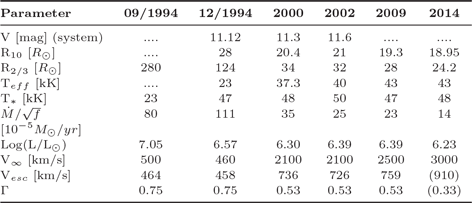
Between 1979 and 1993, Star A’s spectrum changed from subtype WN3 to the H-rich WN7. In 1993–1994 Star A suffered an eruptive event similar to those seen in luminous blue variables (see Table 1), shedding
 $\sim$
0.001 M
 $_\odot$
in the process (Koenigsberger Reference Koenigsberger2004 and references therein). It’s mass-loss rate during the
 $\sim$
12 month maximum was
 $\sim$
10
 $^{-3}$
M
 $_\odot$
/yr and its spectrum was similar to B1.5Ia
 $^+$
(or WN8, Reference BarbáBarbá et al. (1996)), with an effective temperature 21,000 K, suggesting it was at the bi-stability limit (Vink, de Koter, & Lamers Reference Vink, de Koter and Lamers1999). Other such eruptions are likely to have occurred in the past and will occur in the future. Meanwhile, Star B’s spectrum is believed to have remained as a H-poor WN4 (Niemela Reference Niemela1988), giving rise to a time-variable wind-wind collision zone. Thus, the intertwined ejecta, stellar winds and wind-wind collision zone are shaping the circumstellar environment into which the eventual SN ejecta will expand. Given these properties and the low-metallicity environment of the SMC, HD 5980 provides an excellent prototype for studying the end-stage processes that set the stage for distant, unresolved supernovae events and formation of binary collapsed objects.
Properties of Star A during the eruption and several epochs after (from Hillier et al. Reference Hillier2019).

Table 1 Long description
A table showing properties of Star A over different years. The table has 8 columns and 6 rows. Column headers are Parameter, 09/1994, 12/1994, 2000, 2002, 2009, 2014. Row 1: V [mag] (system), ..., 11.12, 11.3, 11.6, ..., .... Row 2: R10 [R0], ..., 28, 20.4, 21, 19.3, 18.95. Row 3: R2/3 [R0], 280, 124, 34, 32, 28, 24.2. Row 4: Teff [K], ..., 23, 37.3, 40, 43, 43. Row 5: T*, 23, 47, 48, 50, 47, 48. Row 6: M [10^-6 M0/yr], 80, 111, 35, 25, 23, 14. Row 7: Log(L/L0), 7.05, 6.57, 6.30, 6.39, 6.39, 6.23. Row 8: V-infinity [km/s], 500, 460, 2100, 2100, 2500, 3000. Row 9: V-escape [km/s], 464, 458, 736, 726, 759, (910). Row 10: Gamma, 0.75, 0.75, 0.53, 0.53, 0.53, (0.33).
Notes: See Hillier et al. (Reference Hillier2019) for a description of the parameters.
The observed spectrum of HD 5980 includes photospheric absorption lines belonging to a third object (Niemela Reference Niemela1988; Kaufer 2002, Star C, which has been classified as an O7If star (Georgiev et al. Reference Georgiev2011). It is responsible for
 $\sim$
30% of the total continuum light (Perrier, Breysacher and Rauw Reference Perrier, Breysacher and Rauw2009). The O-supergiant is orbiting an unknown companion with
 $P_C$
=97 d period,
 $e_C$
=0.8. If the the Star C and Star A + Star B systems are gravitationally bound to each other, long-term changes in the orbital periods of each system are to be expected. There is no clear signature indicating that eclipses are present in the the Star C system, and its radial velocity curves obtained at different epochs are too uncertain for a precise epoch-dependent period determination. Hence, a search for orbital period changes can currently only be performed for the Star A + Star B system.
2. Updated period for the Star A + Star B system
HD 5980 has been observed by TESS (Ricker et al. Reference Ricker2015) since 2018. The light curves show at least two eclipses in each sector as well as
 $P_{osc}$
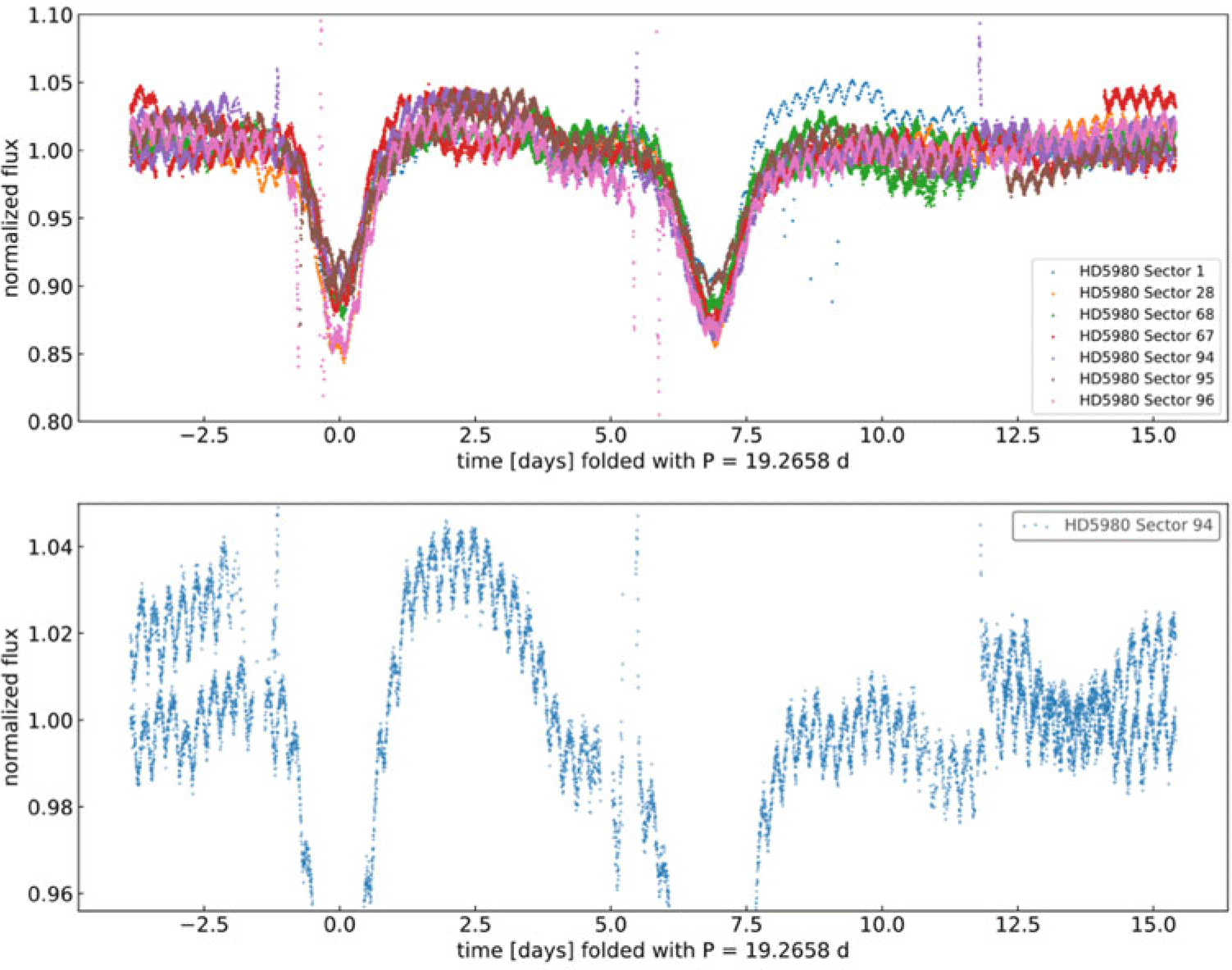
=0.252527 d oscillations (Kołaczek-Szymański et al. 2021). The latter were already found by Sterken & Breysacher (Reference Sterken and Breysacher1997) and suggested to be tidally excited oscillations by Hillier et al. (Reference Hillier2019). Koenigsberger et al. (Reference Koenigsberger2022) showed them to be present during both primary and secondary eclipses, which suggest that they arise in the Star C system. Kołaczek-Szymański et al. (2021) also reported a “Heartbeat” effect, which consists of a brightening shortly after periastron passage in very eccentric systems. This periastron-effect is likely present in both of the binary systems.
We determined the times of eclipse for the entire set of TESS data, up September 15, 2025. These light curves, obtained during sectors 1, 28, 67, 68, 94, 95, and 96, are illustrated in Fig. 1 where the significant variability from orbital cycle to cycle can be observed. The variability introduces uncertainties in the eclipse timing measurements.
TESS light curves observed during seven sectors of 25 days each, folded with the orbital period and centered on primery minimum (orbital phase
 $\phi$
=0.00). The top panel shows data from the sectors used for the period refinement, and the bottom panel is an amplified view of Sector 94 showing the
 $\beta$
Cep type oscillations.

We find
 $P_1$
=19.266079 d (0.000166 d) and
 $P_2$
=19.265718 d (0.000078 d), where
 $P_1$
,
 $P_2$
correspond to primary (orbital phase
 $\phi$
=0) and secondary (
 $\phi$
=0.36) minima, respectively. The average period is
 $\bar P$
=19.2658 (0.0001). The numbers in parentheses are the uncertainties.
Sterken & Breysacher (Reference Sterken and Breysacher1997) analyzed times of minima from data obtained between 1965 and 1995, from which they found the time of primary minimum (defined as the orbital phase at which Star A eclipses Star B): HJD=2,443,158.705d (0.07) + 19.2654 (0.0002)E, Here E is an integer corresponding to the orbital cycle following the given initial epoch. Thus, our value of
 $\bar P$
is larger than the Sterken & Breyscasher period (
 $P_{SB}$
). However, it is important to note that the larger scatter in our
 $P_1$
is caused primarily by the data of Sector 1 which, as pointed out by Kołaczek-Szymański et al. (2021), shows a prominent “Heartbeat” signature shortly after primary eclipse. Thus, because the secondary eclipse measurements result in a factor
 $\sim$
2 smaller scatter in the orbital period than the primary eclipse and because of the above issue with Sector 1, we are inclined to favor the
 $P_2$
value as representative of the 2018–2025 orbital period.
 $P_2$
coincides, within the uncertainties, with
 $P_{SB}$
.
Further observations are important in order to estabish whether variations in the orbital periods of the two binaries in HD 5980 can be detected because this would inform on whether the Star C system is gravitationally bound to the A+B system, a consideration that is relevant in the context of merger scenarios through which increasingly more massive objects can be assembled.
3. Acknowledgements
GK acnowledges support from UNAM PAPIIT grant IN 105723 and funding for the trip to Ensenada by UNAM, Instituto de Ciencias Físicas.
 ϕ
 β

 Open access

