Periodic financial crises have been a recurrent feature of capitalism for centuries.Footnote 1 Despite the efforts of governments to regulate speculation and mitigate the consequences of boom and bust cycles, and much talk about a ‘great moderation’ since the 1980s, recent events are a reminder that we are far from consigning manias and panics to the annals of history. Although the substantive importance of financial crises is self-evident, the politics of financial crisis response in contemporary, developed economies remains a relatively underdeveloped area of research.Footnote 2 Economists, using cross-national data, have traced the incidence of financial crises to factors such as capital flow bonanzas,Footnote 3 financial liberalization,Footnote 4 inequality,Footnote 5 and macroeconomic mismanagement or shocks,Footnote 6 but the politics underlying these policies remain underexplored. Japan's ‘lost decade’ of the 1990s has spawned a largely self-contained literature attributing stagnation to a variety of Japan-specific factors. In this paper, we will examine the divergent patterns of policy response in what are perhaps the two most important episodes of developed-country crises in recent years: Japan's post-bubble ‘lost decade’ of the 1990s and the United States subprime crisis of 2008.
Japan's financial crisis and economic stagnation since the 1990s presents one of the most striking puzzles of contemporary Japanese political economy. In the decades prior, Japan had achieved remarkably sustained, rapid economic growth. The country's economic success through the 1980s triggered anxiety and anti-Japanese sentiment in the United States, where Senator Paul Tsongas lamented that, ‘The Cold War is over, and Japan won.’ Many academic accounts touted the purported merits of Japanese political and economic practices, such as bureaucratic leadership and close collaboration between the public and private sectors.Footnote 7 Why then, did Japanese policymakers fail to respond effectively to the financial crisis of the 1990s? As we will discuss, conventional accounts have attributed Japan's lackadaisical response to a variety of political, institutional, and cultural factors unique to that country.Footnote 8 We will argue that these accounts are incomplete. The novel nature of Japan's crisis necessitated a process of learning, trial and error, and experimentation to determine the most effective solutions and methods of implementation. Policy innovation, like innovation in the private sector, is a search for unknown solutions under conditions of extreme uncertainty. As such, it takes more time and more effort for first-movers to ascertain effective policy measures. Once effective solutions have been demonstrated by earlier actors, subsequent implementation is much more rapid, targeted, and effective. Hence, when the United States encountered a financial crisis and liquidity trap in 2008, the response was a rapid, scaled-up application of policy measures developed gradually over the course of Japan's long stagnation. In short, we are proposing a theory of first-mover disadvantage in policy response.
To establish the plausibility of this theory, we conduct an in-depth examination of the policy measures undertaken by Japanese and US financial authorities. Our analysis is based on interviews with financial policymakers in the US and Japan as well as publicly available information and data. The empirical evidence broadly confirms our theoretical predictions. Japan's initial response was characterized by a cautious application of conventional policy measures, followed by a lengthy period of policy experimentation, and finally the ‘discovery’ of a policy mix that proved effective. In comparison, the United States entered the subprime crisis of 2008 with a wealth of information from the Japanese case. Key US policymakers had firsthand experience with Japan's crisis in their previous posts or through academic research. US financial officials pursued an early, large-scale implementation of policy measures deemed to have been successful in the Japanese case – a zero interest rate policy, quantitative easing, recapitalization of the financial sector with public support from top government leadership, and a large, frontloaded fiscal stimulus package. Public support for these measures was cultivated through explicit reference to the perils of following the Japanese example, a strategy unavailable to Japanese officials in the early 1990s.
Unlike analyses focusing on country-specific factors to explain financial crisis response, our theory has generalizable implications for a wide range of contingencies. These may include other types of unprecedented economic challenges, outbreaks of unknown disease, and novel terrorist tactics. We will discuss these issues and implications for additional research in the conclusion.
Theory: first-mover disadvantage
Our argument rests on a simple premise. When a policy challenge is novel or unprecedented, government responses will be characterized by a process that fundamentally differs from those who respond in a later time period. This is attributable to an inherent feature of being the first actor to respond to a new problem – since effective solutions and methods of implementation are unknown, policymakers must engage in a process of trial and error and experimentation. This process often appears messy, haphazard, ineffective, and confused. It is possible that such first-movers will hit upon effective solutions quickly by happenstance. However, it is more likely that they will encounter numerous dead ends as they apply conventional approaches only to find they are ineffective, experiment with novel policy ideas that turn out to be duds, and only gradually discover effective policy solutions.
In contrast, policymakers encountering similar problems in the future can learn from the experience of the first-movers. Since the first-movers have engaged in a long, painful process of discovery, there is less need for policy experimentation. Policymakers can avoid policies that have been demonstrated not to work. They can pick and choose the policies that appear most effective based on received wisdom and observation. Second-movers also have important political advantages. They can muster political support for their policies by pointing to the example of the first-mover. Political efforts and resources can be concentrated to build support behind a small number of effective policies rather than being spread out across a wide range of approaches that may or may not work. Even if the proposed policies prove to be politically unpopular, rapid and massive application can sidestep the erosion and fatigue that first-movers tend to face as they experiment with successive policy solutions.
Our theory draws from a rich literature in economics, political science, and other fields that examine innovation processes and learning.Footnote 9 It has been long known that innovative ideas and technologies are subject to spillover effects.Footnote 10 While initial research and development is a costly process, subject to unintended consequences and frequent dead ends, once new ideas and technologies are discovered, adoption by other actors tends to be more rapid and effective.Footnote 11
A similar insight also lies behind economic convergence predicted by neoclassical growth models such as the one pioneered by Robert Solow.Footnote 12 Since capital is subject to diminishing returns and technological diffusion will tend to equalize total factor productivity growth across national boundaries, countries are predicted to converge towards similar rates of economic development and growth. Information and technological diffusion also played a critical role in shaping the developmental patterns and strategies of late-developing states – such states often pursued interventionist strategies to facilitate technology transfer and guide the trajectory of development.Footnote 13
Although there is a well-developed literature on international diffusion in political science,Footnote 14 these studies have been frequently criticized for failing to sufficiently account for the possibility of myopic, independent adoption of common policies.Footnote 15 This is not a concern for the purposes of this paper – we provide direct, firsthand evidence that policymakers in the United States actively incorporated lessons from Japan into their policy response in 2008–09.
More importantly, existing studies have generally focused on identifying factors that facilitate or impede diffusion rather than the distinction between first and second-movers, the subject of this paper. It is not our goal in this paper to explain patterns of international diffusion. Rather, we posit that first and second-movers are fundamentally distinct, and scholars are likely to reach biased inferences about sources of policy variation without accounting for this fact – in this article, we argue that this is likely the case with existing work on Japan's seemingly ineffectual response to its financial crisis.
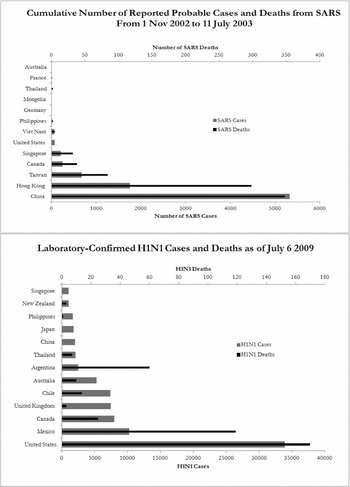
One simple illustration of our general theoretical perspective is the impact of novel, contagious diseases according to the timing of incidence. Figure 1 illustrates the number of cases and deaths of SARS and H1N1 by country. In both cases, the number of reported cases and deaths were highest for the earliest countries to encounter the disease – China and Hong Kong for SARS and Mexico and the United States for H1N1. The number of cases and fatalities is more closely associated with timing of first incidence than other plausible explanatory factors such as quality of the health system and economic development.Footnote 16 Because of the novel nature of these diseases, countries that encountered them for the first time were not immediately aware of the nature or severity of the problem they were confronting. In comparison, once the diseases and their characteristics were identified, other countries implemented countermeasures such as screening, quarantines, hygiene programs, public information campaigns, and vaccination. Nonetheless, governments of the first-mover states were criticized heavily for a host of structural inadequacies and policy failures.Footnote 17
The number of cases and deaths of SARS and H1N1 by country

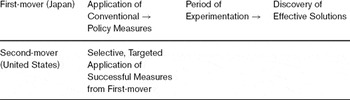
We are, of course, not claiming that economic crises are identical to contagious diseases. Financial crises occur with no clear pathogen, take longer to unfold, and impact a smaller total population – countries or financial institutions as opposed to individuals. Hence, the discovery of effective solutions is a more messy process subject to greater uncertainty and error, more akin to the management of disease before the advent of modern medicine.Footnote 18 Nonetheless, we posit that the pattern of response should exhibit important similarities. In both cases, the response of first-movers is likely to be slower and less effective as the nature of the problem is identified and solutions developed gradually. Second-movers should benefit from two primary advantages: problem recognition and adoption of solutions developed by the first-mover. Our theoretical propositions are summarized in Table 1.
Predicted pattern of policy response

Japanese and US response to financial crises
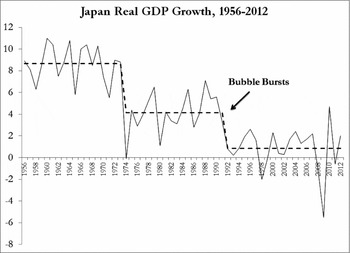
Japan struggled through a debilitating period of economic stagnation since the burst of its ‘bubble economy’ in 1990, a period often dubbed ‘the lost decade’. Average real GDP growth fell below 1% for roughly ten years. Although a period of modest expansion followed in the mid-2000s, economic contraction associated with the global financial crisis of 2008 and the Tohoku Earthquake and Tsunami of 2011 has produced nearly two decades of anemic cumulative growth in Japan. In nominal terms, because of deflation and the recent economic crisis, Japan's economy has effectively gone nowhere since 1991.Footnote 19 Asset prices declined dramatically and have never recovered bubble peaks – as of 2012, the Nikkei 225 traded at about a third of the peak level reached in 1989 and real estate in major metropolitan areas were less than half of what they were worth in 1991.
Scholars have proposed a wide range of Japan-specific explanations for the lost decade – e.g. underlying structural problems,Footnote 20 macroeconomic policy mismanagement,Footnote 21 misdirected ‘zombie bank lending,Footnote 22 policy paralysis,Footnote 23 and institutional rigidities.Footnote 24 The goal of our paper is not to dismiss these explanations – it is difficult to evaluate the validity of many competing theories that purport to explain macroeconomic outcomes in one country over a relatively short time period. However, it is worth noting that many of these factors were present well before the 1990s, and identical or similar factors were frequently cited as sources of Japan's remarkable growth since World War II. The bubble burst at the peak of Western interest in Japan's postwar economic miracle and a plethora of studies that touted the merits of Japanese practices.Footnote 25 Japan had also adeptly dealt with previous economic setbacks, such as the Great Depression, financial instability in the 1960s, and the Oil Shocks of the 1970s. It is clearly not the case that Japanese policymakers have a unique track record for being sluggish or ineffective in response to economic challenges.
It is also worth noting that the 2008 crisis affected a large number of diverse countries, including Japan, and solicited responses that look strikingly similar. Major developed countries quickly undertook actions such as large fiscal stimulus packages, capital injections into the financial sector, near-zero interest rates, and quantitative easing. Policy reactions were not uniform, which is an interesting topic in its own right, but the key point is that Japan's response in 2008 does not particularly stand out from that of other countries. Conventional accounts that attribute Japan's slow response to unique aspects of Japanese political economy provide an unsatisfactory explanation for Japanese behavior during the recent crisis – Japan's policy response has been broadly similar or more aggressive compared to that of its peers.Footnote 26
Compared to the methodological challenges associated with explaining macroeconomic performance, it is less problematic to draw inferences about policy response, the focus of this paper. By focusing on the pattern of implemented policies rather than their effectiveness, we can ignore confounding variables such as exogenous shocks to consumption or productivity growth. The sequencing, timing, and implementation of policies are readily observable. By focusing on policymaker perceptions of success and adoption rather than absolute effectiveness, we can evaluate which policies were deemed to have been successful both domestically and by foreign observers. Of course, our theory has important implications for economic performance as well – ceteris paribus, second-movers such as the United States should perform better than Japan did during its lost decade. However, in this article we will focus our efforts on analyzing policy response through comparison of Japan and the United States.Footnote 27
The novel nature of Japan's financial crisis
The utility of our case studies rests on the premise that Japan's financial crisis was sufficiently novel as to warrant the characterization of Japan as ‘first-mover’. Japan was certainly not the first country to experience an asset price bubble or financial crisis, which can be traced back at least to the seventeenth century.Footnote 28 However, Japan's crisis was the first instance of a ‘return to depression economics’ by an advanced developed economy in the post-World War II period. As Paul Krugman aptly notes, ‘Japan showed us a truth that our grandfathers knew, but that we had forgotten: that even cutting the interest rate all the way to zero may still not be enough.’Footnote 29 Japan was the first postwar economy to encounter a liquidity trap, in which deflation pushes nominal rates against the zero bound and renders conventional monetary policy ineffective.Footnote 30 In addition, the widespread damage to private sector balance sheets brought about by declining asset prices led to the first instance of a ‘balance sheet recession’ since the 1930s, in which growth is restrained as private financial institutions, firms, and individuals are driven to focus on debt repayment over consumption and investment.Footnote 31
Japanese policymakers had several precedents that they could draw on, but these either offered limited lessons for Japan's predicament or were judged to be irrelevant. Specifically, the Savings and Loan Crisis of the 1980s in the United States was the most proximate episode of financial distress in another major economy. However, the United States had allowed the S&L problem to fester for the good part of the decade,Footnote 32 and although resolution ultimately cost about $100 billion, the macroeconomic consequences were limited – the US economy grew robustly through the 1980s and only experienced a brief, shallow recession in 1990–1991. If any lessons were to be learned from the S&L Crisis, it was that regulatory forbearance and postponement of resolution until better economic times was a reasonable policy response.
Japanese officials viewed other recent crisis episodes as being largely irrelevant to their circumstances. The Latin American Debt Crisis occurred in developing economies with balance of payments difficulties, a far cry from Japan in the early 1990s. Spain experienced a major crisis in 1977, but the circumstances fundamentally differed from those in Japan – the Spanish crisis was triggered by a combination of oil shocks, economic mismanagement, and political uncertainty following the death of Franco, and the crisis was not preceded by an asset price bubble. The Scandinavian trio of Finland, Norway, and Sweden, experienced financial instability in the 1990s with considerable similarities to Japan.Footnote 33 However, the Scandinavian crises were occurring concurrently and the magnitude of the problem was smaller than that in Japan.Footnote 34 Reinhart and Rogoff, who have compiled data on historical crises, have classified these cases as the ‘Big Five’ – advanced economies that experienced protracted declines in economic performance subsequent to a financial crisis in the post-World War II period.Footnote 35 The Great Depression of the 1930s had great relevance for Japan's predicament, but this was difficult to realize ex ante. It was commonly believed at the time, not only in Japan, that the factors responsible for the depression – inflexibility of the gold standard, inappropriate monetary policy, and trade protectionismFootnote 36 – had been consigned to the dustbin of history.
The global crisis of 2008 has many features akin to Japan's crisis of the 1990s. Both crises were preceded by a dramatic run up in asset price valuations. Housing prices in the United States, which have traditionally exhibited zero growth after inflation, increased by about 150% within the course of a decade. Other countries experienced similar bubbles in asset prices – notably Australia, France, Ireland, Spain, and the United Kingdom. Leading up to the crisis, housing price appreciation in some of these countries was comparable to that experienced by Japan during its bubble.Footnote 37 The subsequent crisis has been associated with collapses in asset prices, deflationary pressure, and financial sector instability. Disinflation has prompted concerns over the potential for a Japanese-style liquidity trap.Footnote 38 Although the trial is still out, many economists are predicting anemic economic growth for an extended period for the affected economies. Despite these similarities, US officials have argued that a Japanese-style financial crisis was avoided through quick, decisive action – according to Secretary of State, Timothy Geithner, ‘overwhelming financial force to break the back of the financial panic’.Footnote 39
In this section, we will provide a comparison of how Japan and the United States responded to their respective financial crises based on interviews with officials in both countries as well as primary and secondary evidence. In particular, we will focus on monetary policy and financial sector bailouts. The case study evidence largely supports our theoretical predictions. Japanese policymakers initially responded to their crisis through use of conventional policy measures. Once these proved ineffectual, Japan entered a long period of trial and error and experimentation. As we will show, an effective policy mix was implemented by the early 2000s.
In contrast, by the time the US experienced a financial crisis in 2008, the Japanese experience provided ample information about the appropriate policy response. US policymakers quickly recognized the relevance of Japan's crisis and responded in large part through a rapid, stepped-up application of policy measures demonstrated to be effective from the Japanese experience. The relevance of the Japanese example is confirmed by numerous public statements by top government officials including the President, Treasury Secretary, and Federal Reserve Chairman, as well as lower-level officials responsible for policy implementation. As we will discuss, in several instances, US officials mimicked Japanese policies despite having advised the Japanese government to pursue a different course during the 1990s.
Monetary policy
In contemporary macroeconomics, monetary policy is generally viewed as the principal policy tool by which governments influence aggregate economic outcomes.Footnote 40 In Japan and the United States, monetary policy is conducted by central banks, respectively the Bank of Japan (BOJ) and the Federal Reserve.Footnote 41 The BOJ's initial response to the bursting of the bubble was fairly conventional. After realizing the economy was rapidly deteriorating, the BOJ reduced interest rates in succession, bringing the overnight lending rate from 6% in 1990 to 1% by 1995. There is considerable debate about whether the loosening of rates during the period was insufficient or too slow. Analyses based on application of monetary policy rules such as the Taylor Rule have produced mixed results. Monetary policy rules require inputs such as potential output that cannot be known with great accuracy. Hence, the BOJ's monetary policy decisions in the 1990s have been deemed too tight, too loose, or just right depending on the particular estimates employed.Footnote 42 In terms of aggregate economic performance, Japanese GDP growth was weak in the early 1990s but avoided outright contraction, and growth appeared to recover to normal levels by 1995/1996.
With perfect hindsight, one might argue that the BOJ should have acted more vigorously and swiftly in order to forestall a buildup of deflationary expectations and prevent running up against the zero bound – central banks cannot move nominal interest rates below zero, hence it is difficult to lower real interest rates once deflationary expectations take hold. However, deflation was not a primary concern for Japanese monetary authorities in the early 1990s. Since World War II, the principal challenge for monetary authorities had been avoiding inflation while maintaining robust economic growth. The oil shocks of the 1970s, combined with large-scale spending on social spending and the Vietnam War, had sent the US economy towards uncomfortably high levels of inflation in the 1970s and early 1980s. Other OECD countries dealt with similar challenges – Japanese inflation had briefly climbed to over 8% in the 1970s. Japan had also been scarred by the experience of rampant inflation in the 1940s. Deflationary threats were largely considered anachronistic – a throwback to the 1930s when countries tied their currencies to gold and had no independent control over monetary policy.Footnote 43 Hence, even during the late 1990s, when Japan's economy was slipping into deflation, BOJ officials remained deeply concerned about the dangers of inflation.Footnote 44
However, by 1998, the limitations of conventional monetary policy were becoming increasingly evident as Japan's economy slipped into outright contraction and deflation. At this point, the BOJ began to carefully experiment with a series of unconventional policy measures. In February 1999, the BOJ reduced the target call rate to 0.15% and introduced the ‘Zero Interest Rate Policy (ZIRP)’, in which ‘The Bank of Japan will provide more ample funds and encourage the uncollateralized overnight call rate to move as low as possible.’Footnote 45 While the Japanese economy recovered somewhat in the following years, the ZIRP failed to move the Japanese economy out of deflation.Footnote 46
In early 2001, as Japan entered another recession, the BOJ introduced quantitative easing, an important policy innovation. In March 2001, the main operating target was shifted from the call rate to outstanding balances of current accounts at the BOJ. Quantitative easing attempted to flood the financial sector with liquidity in order to facilitate lending and suppress interest rates on a wider range of securities by reducing their supply. The upper bound of the target range for the outstanding balance of the current accounts was repeatedly increased from ¥6 trillion in September 2001 to ¥35 trillion by 2004.Footnote 47 The BOJ gradually expanded the range of securities qualifying for purchase: i.e. expanded-maturity government securities (May 2001), asset-backed commercial paper (January 2002), mortgage-backed securities and loans to the government and deposit insurance corporation (March 2002), equities held in the banking system (September 2002), relaxed standards on purchases of commercial paper (December 2002).Footnote 48
The BOJ also experimented with signaling with the intent to raise long-term inflation expectations. The initial quantitative easing announcement came with the explicit commitment to keep the policy in place until the consumer price index reached 0% or above. This was refined in October 2003 with the additional condition that the BOJ must expect CPI inflation to not fall below 0% in the near future.Footnote 49
By 2008, Japan's long experience with deflationary recession had ignited considerable debate among academic economists about how countries might avoid and escape the liquidity trap associated with the zero nominal bound. Some economists argued for inflation targetingFootnote 50 or currency depreciation to facilitate import price inflation.Footnote 51 Ben Bernanke, the Chairman of the US Federal Reserve in 2007, was an active contributor to this debate and carefully studied the Japanese case for potential lessons. In 2000, Bernanke analyzed the Japanese predicament and argued that the liquidity trap can be overcome both in theory and in practice. For example, it is always possible for the government to ignite inflation, since the financial authorities effectively have the ability to print infinite sums of money:
[Consider] money-financed transfers to domestic households – the real-life equivalent of that hoary thought experiment, the ‘helicopter drop’ of newly printed money. I think most economists would agree that a large enough helicopter drop must raise the price level. Suppose that it did not, so that the price level remained unchanged. Then the real wealth of the population would grow without bound, as they are flooded with gifts of money from the government. . . Surely at some point the public would attempt to convert its increased real wealth into goods and services, spending that would increase aggregate demand and prices.Footnote 52
Hence, by the time the United States experienced its crisis in 2008, the US economic policy establishment was well aware of the dangers of deflation and had a good understanding of the range of available policy tools.Footnote 53 The Fed responded quickly in 2008 by rapidly cutting the Fed Funds rate to effectively zero by December of that year. This was followed by a quantitative easing program focusing on long-term government bonds and mortgage backed securities that expanded the Federal Reserve's balance sheet by over a trillion dollars. The Bank of England and the European Central Bank also responded to the crisis by quickly reducing rates and initiating quantitative easing programs.
Notably, the Federal Reserve's actions in 2007–2009 largely conformed to those of the BOJ. Rather than pursing other unconventional measures such as inflation-targeting, price-level targeting, currency depreciation, or ‘helicopter’ money-financed transfers, the Fed largely followed the blueprint laid out by the BOJ but implemented the policies more quickly and with greater scale. This reflected practical, political difficulties associated with the other unconventional measures. Inflation-targeting was seen as risky because the credibility of the central bank could be undermined if the target proves unachievable. Currency depreciation, if openly pursued, might be interpreted as predatory by foreign governments. Money-financed transfers require close collaboration with budgetary authorities, which could potentially compromise central bank independence.Footnote 54 It was not until 2010, as the US economy continued to suffer from high unemployment and disinflationary pressure, that the Fed began to mull additional, more original steps such as inflation- and price-level targeting.Footnote 55 The Fed also focused its quantitative easing program on fairly ‘safe’ securities such as US treasury bonds and mortgage-backed securities, eschewing the more unorthodox and potentially controversial instruments that the BOJ had experimented with, such as commercial paper and equities.
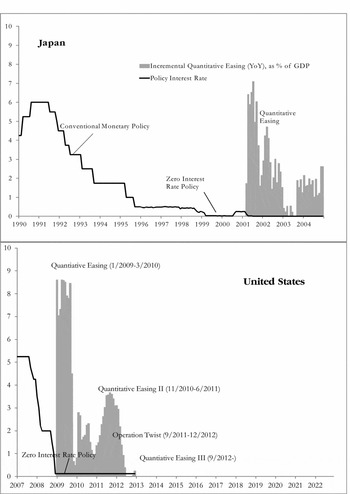
Monetary policy actions undertaken by the BOJ and the US Federal Reserve largely conform to our theoretical predictions. Figure 3 provides a graphical depiction of policy rates and quantitative easing during the crisis episodes. As a first-mover facing a new type of economic crisis, the BOJ initially applied conventional policy tools and failed to realize the novel nature of the threats it faced. As the crisis was prolonged and deflation took hold, the BOJ began experimenting with novel, unprecedented policies, including zero interest rates and quantitative easing. The US Federal Reserve acted with the full benefit of hindsight – Chairman Bernanke himself had carefully studied the Japanese example and came to office prepared to deal with a contingency resembling Japan or the 1930s Depression. The US response was noticeably more rapid. However, the US response was no more innovative or creative – in the immediate aftermath of the crisis, instead of experimenting with novel policy tools, the Fed largely adopted and scaled up BOJ initiatives that were deemed to have achieved a measure of success.
Japan Real GDP Growth, 1956–2012 Source: Japanese Cabinet Office SNA Statistics.

Monetary policy in Japan and the United States Note: In comparison to Japan, the United States moved more quickly towards unconventional policy measures such as ZIRP and QE, and implemented QE on a larger scale from the outset. Policy interest rate for the US is the Fed Funds Rate and for Japan the official discount rate until 1995, after which the BOJ switched its target to the overnight call rate. Quantitative easing is measured as the year-over-year expansion in central bank balance sheet as a share of GDP. US data are as of 2012.

Bailout of financial institutions
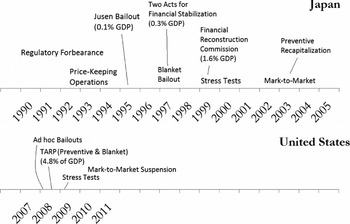
Asset price deflation wreaked havoc on the balance sheets of financial institutions in both Japan and the United States during their respective financial crises. In Japan, the initial reaction was to maintain the existing approach towards financial sector regulation on the assumption that economic growth and asset price reflation would eventually lead to normalization. Several creative policy measures were introduced, including accounting rule changes designed to ameliorate balance sheet difficulties and government purchase of equities to mitigate asset price deflation. Policy response was largely left to bureaucrats, who found it difficult to secure political support for unpopular financial sector bailouts. Resolution was achieved in the early 2000s based on a series of initiatives designed to encourage the financial sector transparency under the political leadership of Prime Minister Junichiro Koizumi. Key US policy officials responding to the crisis in 2008 had direct experience dealing with the Japanese crisis and implemented a set of policy measures designed to avoid the Japanese predicament. These included: (1) securing access to sufficient resources and wide latitude at an early stage for the purposes of financial sector recapitalization; (2) transparency of financial sector balance sheets through stress tests; and (3) frequent references to the Japanese case and involvement of high level political leaders to secure public support.
In the early 1990s, Japanese financial authorities attempted to manage the crisis according to conventional measures that had been developed over the course of Japan's economic development. The Ministry of Finance had effectively managed the Japanese financial system for many years through an informal regulatory regime based on policy networks incorporating political and private sector actors. A convoy approach was adopted, in which no banks were allowed to fail. Previous episodes of banking sector disruption, including serious difficulties in the 1960s, were handled by arranging ‘rescue mergers’, by which stronger banks would absorb struggling banks along with their impaired assets.Footnote 56
Hence, as Japan's stock market and real estate markets began to collapse, the Ministry of Finance initially responded through a continuation of what were deemed to be well-established policy measures. The primary focus was on regulatory forbearance – allowing financial institutions to mask their balance sheet problems on the assumption that a resumption of economic growth and asset price reflation would right the ship over time. In particular, accounting rules were relaxed and financial institutions were encouraged to implement various measures to sweep their problems ‘under the rug’.Footnote 57
Because of extensive cross-shareholding, Japanese corporations were heavily exposed to the stock market, which had declined by over 50% by 1992. The Ministry of Finance therefore intervened in stock markets to mitigate pressure on private balance sheets from falling equity prices. Pension fund assets were used to purchase stocks to hold the Nikkei 225 above the psychologically important 16,000 level. These public purchases accounted for one third of all activity in the Tokyo stock exchange in the spring of 1993.Footnote 58 The Ministry of Finance also discouraged short-selling by requesting the names of large sellers from major brokerages and encouraged private institutions to make investments based on longer time horizons.Footnote 59 These ‘price-keeping operations’ were successful in relieving downward pressure in the short-run, but they did not ultimately contribute to a resolution of financial sector difficulties.
Throughout the 1990s, Japanese financial authorities struggled to secure public support for any sort of financial sector bailout. In 1992, a speech by Prime Minister Kiichi Miyazawa hinting at the possibility of public capital injections invited a maelstrom of public opposition from financial institutions, business leaders, and the general public.Footnote 60 More significantly, the 1995 JusenFootnote 61 bailout became a political fiasco despite the small amount of funds at stake – 685 billion yen or about 0.1% of Japanese GDP (the crisis ultimately cost the Japanese government about 20% of GDP).Footnote 62 An Asahi poll found 87% of the public expressing opposition to the Jusen bailout.Footnote 63 The Minister of Finance was compelled to promise during the Jusen Diet that no further public money injection would occur except for resolving the Jusen problem.Footnote 64 In 1997, a series of large financial institutions came under duress, and Hokkaido-Takushoku Bank, one of Japan's major commercial banks, and Yamaichi Securities, one of the big 4 securities firms, abruptly collapsed. This led to a new round of legislation that gave some government agencies the authority to engage in limited public recapitalizations – initially the Deposit Insurance Corporation and then the newly established Financial Reconstruction Commission. However, these measures proved insufficient.
Importantly, in 1999, Japanese financial authorities for the first time made risk-based capital infusions, analogous to ‘stress tests’ undertaken by US financial authorities in 2009, albeit less strict.Footnote 65 The newly established Financial Reconstruction Commission assessed the health of various banks and injected public money totaling about 8.4 trillion yen as capital to 25 banks between March 1999 and October 2000.Footnote 66 Although risk-based capital infusions did not immediately succeed in resolving the bad debt problem, empirical analyses suggest that this was an important innovation: compared to previous measures, the 1999 capital injection had a much more significant effect on risk perceptions (the ‘Japan premium’)Footnote 67 and overall bank lending.Footnote 68
Economic stagnation and the accumulation of nonperforming loans continued into the early 2000s. Japan ultimately turned the corner under the leadership of Prime Minister Junichiro Koizumi. Several key policy measures contributed to the resolution of the nonperforming loan problem. First, Heizo Takenaka, an economic advisor to Koizumi and Minister of State for Economic and Fiscal Policy, implemented a series of accounting reforms designed to make it more difficult for banks to conceal their bad loans, including implementation of mark-to-market accounting and restrictions on the use of deferred tax assets.Footnote 69 This represented a decisive break from the previous policy of regulatory forbearance.
Second, Koizumi put himself front and center in the recapitalization effort. He organized a Minister-level ‘Meeting of the Financial System Management Council’,Footnote 70 which was held at the Prime Minister's House and organized by Cabinet Secretariat. For the first time, the Prime Minister was the chairperson of the policy organ responsible for financial sector bailouts. This broke from the traditional bureaucratic approach, which had been perceived as opaque and contributed to public opposition against bailout measures. Other members of the council included the Chief Cabinet Secretary, the Minister of Finance, the Minister of State for Financial Services, the Commissioner of Financial Services Agency, and the Governor of the Bank of Japan. Koizumi also secured a degree of public support for recapitalizations by associating the policy with his broader platform of structural reform.Footnote 71
The 2003 rescue of Resona Bank marked an important turning point in Japan's crisis. Resona's management attempted to satisfy the bank's Tier 1 capital requirements by including deferred tax assets, a claim that was rejected on the grounds that the bank was unlikely to return to profitability in the foreseeable future. Even though Resona was still technically solvent, Koizumi released a statementFootnote 72 that he would implement a recapitalization as a preventive measure to forestall potential disruption to the financial system. The government took over control of the bank, shareholders were heavily diluted, and the management was sacked. This was an unprecedented measure and based on shaky legal grounds, but the policy had the desired effect of serving as a wakeup call to the entire financial sector. Banks subsequently began to write off bad assets and cut off funding to delinquent ‘zombie’ borrowers.
The set of policy measures implemented under Koizumi finally reversed the accumulation of bad loans on the books of Japanese financial institutions. According to the Financial Services Agency, nonperforming loans, which had risen steadily and peaked at ¥43.2 trillion in 2002, declined to ¥11.9 trillion by 2007.Footnote 73 Until the global financial crisis of 2008, Japan's economy recorded modest but prolonged growth, averaging around 2% in real terms. This was to become the longest continuous period of expansion on record since World War II. Although growth never rose dramatically, adjusting for Japan's stagnant population growth and deflation by using real GDP growth per capita, Japan's economy grew during this period at a rate that exceeded that of other major developed economies such as the United States, Germany and France.Footnote 74
In the view of US policymakers, the Japanese experience highlighted the necessity of quick, massive, and preemptive public money injection as a means to address financial crises. As US Secretary of the Treasury Timothy Geithner noted in 2010 in response to a question about Japan's experience:
. . . we were going to try to follow as best we could the basic lessons of mistakes made by many governments in past financial crises, which had typically been to wait too long to escalate, to move only gradually, largely because – it's not just because people always hope it is going to get better, hope it will burn itself out – but because the political costs of acting with force to fix a financial crisis are always extremely high. No one wants to be in a position of having to take the steps which will necessarily be perceived as helping institutions that helped precipitate the crisis. So most countries wait. They wait too long to escalate. They under-do it rather than overdoing it. And they move too quickly to put on the brakes at the first signs of life and hope. That's a little oversimplified but that is a simple lesson of the arc of crisis response.Footnote 75
To a significant degree, these conclusions by US financial policymakers were developed through direct experience.Footnote 76 Timothy Geithner, who served as New York Fed President and then Treasury Secretary during the US subprime crisis, speaks Japanese and had been an attaché in the US Embassy to Japan in the early 1990s. Other key officials, including Lawrence Summers and Robert Dohner, had worked on Japan during the 1990s and early 2000s as the Treasury advised the Ministry of Finance on how to manage its financial difficulties.
Hence, US financial authorities approached the subprime crisis in 2008 with considerable knowledge and understanding of Japan's response. This led them towards a political strategy that emphasized direct involvement and commitment by the president to an early, large-scale, and preemptive recapitalization of the financial sector using public funds. President Obama leveraged the example of Japan during his first presidential news conference, asserting that, ‘We saw this happen in Japan in the 1990s, where they did not act boldly and swiftly enough, and as a consequence they suffered what was called the “lost decade” where essentially for the entire ‘90s they did not see any significant economic growth.’ He announced that his economic officials were hard at work to prevent such long-lasting stagnation.Footnote 77
This Japan-related experience directly contributed to the policy prescriptions eventually adopted by the Treasury. Unlike Japan, US officials sought to quickly rectify problems in financial sector balance sheets. Stress tests were conducted to identify capital shortfalls and remove opacity from the financial system. The Bush administration exerted pressure on Congress to pass the Troubled Asset Relief Program (TARP), which gave US financial authorities $700 billion (about 5% of GDP) and wide latitude to use the funds to address the crisis. In particular, TARP legislationFootnote 78 defined ‘Troubled Asset’ very broadly, i.e.: ‘Sec.3.(9) (B) any other financial instrument that the Secretary, after consultation with the Chairman of the Board of Governors of the Federal Reserve System, determines the purchase of which is necessary to promote financial market stability.’ US officials interpreted equities of private firms as falling under ‘any other financial instrument’. This justified reallocating TARP funds from their original intended purpose – purchase of toxic assets – to private sector recapitalization. Hence, US policymakers were able to manage a key political problem that had plagued Japanese financial authorities – deep public opposition to financial sector bailouts – by proceeding rapidly, asking for a large amount of funds at the outset, pointing to the examples of Japan's mistakes, directly involving the highest levels of executive office to build public support, and obtaining maximum flexibility during the height of financial panic.
US authorities also learned lessons from the Japanese experience that ran contrary to their initial inclinations in the 1990s.Footnote 79 During the acute stage of Japan's crisis in 1998, the US Treasury had advised the Ministry of Finance to only bailout financial institutions selectively based on an assessment of solvency. Instead, the recapitalization by the Financial Reconstruction Commission ‘spread money like peanut butter’, bailing out major financial institutions in equal measure. This reflected two features of financial crises that also applied in the US case. First, when asset valuations are uncertain or contested, it is unclear even to government officials which institutions are insolvent. Second, during a crisis of confidence, government actions such as selective bailouts can affect market psychology and asset valuations, pushing previously healthy institutions into distress. Hence, when the US utilized TARP assets for recapitalization of the financial sector, policymakers had revised their earlier views and adopted a blanket approach. In addition, much as the Japanese government had intervened preventively with respect to Resona, US financial authorities strong-armed financial institutions into accepting government funds, even in cases where this was deemed unnecessary by the financial institutions themselves, as was the case for JP Morgan and Wells Fargo. After this blanket bailout brought a measure of stability to financial markets, officials implemented risk-based infusions based on stress tests.
Nonetheless, US policies regarding the bailout of financial institutions did not perfectly reflect the lessons from the Japanese experience. In April 2009, after extensive lobbying by financial institutions, the US Financial Accounting Standards Board suspended mark-to-market accounting rules, which gave financial institutions substantial discretion in valuing assets on their balance sheets. Japanese financial authorities had used lax accounting rules to conceal private sector balance sheet problems in the 1990s – for example, allowing the use of deferred tax assets in the calculation of regulatory capital,Footnote 80 introducing cost-method accounting for equities during the height of financial panic in 1998,Footnote 81 and general permissiveness towards income smoothing and regulatory-capital arbitrage.Footnote 82 The adoption of mark-to-market rules in Japan beginning in 2001 was an important measure that forced private institutions to take losses and expunge bad assets rather than keeping them on their books at much higher previous valuations. To be clear, the suspension of mark-to-market rules can be an effective measure to stem the self-fulfilling dynamics of an immediate crisis – declining asset values damage balance sheets, which force asset sales, which lead to further declines in asset values. However, in the medium to long-term, suspension of mark-to-market rules incentivizes financial institutions to sit on bad assets in the hopes of eventual recovery rather than take their losses and move on.Footnote 83 This policy closely resembles the problematic measures undertaken by Japanese authorities in the 1990s.
Figure 4 presents a general timeline of financial rescue measures undertaken by both countries. Japan's efforts on recapitalizations largely conform to our predictions. The initial response primarily focused on application of conventional policy measures, such as maintenance of the convoy system and an assumption that reversion in asset prices would eventually right the ship. This was accompanied and followed by a range of unconventional policies, many of which turned out to be failures, ranging from price-keeping operations to creative accounting rules to prevent further damage to private sector balance sheets. Financial sector recapitalization was implemented very slowly and on a small scale. In the early 2000s, a policy mix based on transparent accounting rules, increasingly stringent stress tests, and government recapitalization of financial institutions under the direct leadership and accountability of the top political leaders, finally began to stem the tide of nonperforming assets and financial sector instability.
Timeline of major financial sector rescue measures

Key US officials were directly involved with Japan's difficulties and applied their lessons to the 2008 crisis. US policy emphasized quick, decisive action under the direct leadership of the executive branch, much like the 2003 Resona rescue under the leadership of Koizumi. The example of Japan's lost decade was invoked repeatedly to muster public support for otherwise unpopular policy measures. TARP legislation was designed to give financial authorities wide latitude and abundant resources by taking advantage of widespread panic in 2008. However, compared to monetary policy, US financial authorities were somewhat constrained by political realities on recapitalizations. This is exemplified by the FASB decision to suspend market-to-market accounting rules under pressure from the financial sector.
Alternative explanations and counterarguments
We should emphasize that our theory is not meant to explain all observed variation between the responses of Japan and the United States. Other factors undoubtedly played a role in determining the behavior of policymakers in these two countries – among other things, institutional differences, cultural factors, the role of particular individuals, and the proliferation of derivatives and the shadow banking system. Nonetheless, we believe that the empirical evidence establishes the plausibility of our claims. In addition, compared to country-specific explanations, our theory has the attraction of generalizability. Unlike theories that rely on Japan-specific or US-specific factors, our theory can be tested through application to a wider range of countries and issues.
Nonetheless, it is necessary to address several alternative explanations and counterarguments that may call into question our central claims. First, some may argue that the differences between the US and Japan are wholly attributable to differences in the nature of the crises confronted. In particular, although it is true that the US authorities moved relatively more quickly towards recapitalization, some of this may be attributed to different initial conditions. Since the US entered the subprime crisis in 2008 with mark-to-market accounting rules, it was relatively more difficult in the initial stages to kick the can down the road and hope for an eventual recovery in asset prices. The proliferation of derivatives and securitization had created what Gorton calls the ‘shadow banking system’, and events in 2008 resembled a classic bank run on the repo market.Footnote 84 These features of the US market in 2008 arguably forced the hands of US financial authorities to a far greater extent than was the case in Japan. However, there are several problems with this alternative explanation. US authorities could have and eventually did suspend market-to-market rules. Conditions in Japan in 1997 were not unlike those experienced in the US in 2008, with several large financial institutions collapsing within the course of a month. A variety of US officials have also stated publicly that a major motivation for the rapid response was a desire to avoid repeating Japan's errors.
Another plausible alternative explanation is that the strong presence and political influence of financial institutions in the US made the bailout quicker and more generous than in Japan.Footnote 85 Indeed, there is a revolving door between US Treasury officials and New York financial institutions, and the personal networks of former government officials and their ability to effectively convey industry perspectives to the Treasury is valued highly.Footnote 86 However, Japanese financial institutions were also politically powerful in the 1990s and similarly interconnected with government policymakers through the practice of amakudari, in which retired bureaucrats would find employment in finance. It is also worth noting that US financial institutions had strong reservations about receiving government bailouts – the executives of major financial institutions feared government intervention, particularly over compensation policies. Most strikingly, stronger banks such as JP Morgan and Wells Fargo were effectively forced to receive TARP funds despite their objections.Footnote 87
One might similarly argue that Japanese policymaking was rendered inflexible by continuing LDP rule, while the US quickly experienced a major change of power from Republicans to Democrats immediately after financial crisis onset. However, there is little reason to believe the power transition in the US had a decisive impact on the issues discussed in this article. Monetary policy was determined by the Fed under Ben Bernanke before and after the Obama administration came to power. The Obama administration also placed clear emphasis on policy continuity, for example appointing Tim Geithner from the New York Fed as Treasury Secretary. In Japan, the largest policy changes came under Koizumi, not during the brief period of non-LDP rule in 1993–1994.
Another potential counterargument concerns the existence of alternative models for financial crises resolution that US policymakers might have used as a templates for their response. US officials clearly viewed the Great Depression of the 1930s as an important historical precedent. However, Japan's lost decade was important in establishing the relevance of the depression for contemporary macroeconomic policymaking, and practical lessons from the depression on issues such as unconventional monetary policy were limited. The US Savings and Loans Crisis and the Swedish bank nationaliziation of the early 1990s might have served as alternative models from which to draw lessons.Footnote 88 US Treasury officials note that the S&L Crisis in particular was indeed mulled as a potential template for financial sector bailout, but the conditions were considered too different for a solution akin to the Resolution Trust Corporation (RTC) – the financial institutions at stake in 2008 were much larger and interconnected, and securitization had introduced valuation issues that made a RTC-type resolution impractical.Footnote 89 Although nationalization along the lines of Sweden was part of the public discourse in 2008 and 2009, it does not appear to have been considered a serious solution, primarily because that degree of government intervention was considered politically unpalatable. Furthermore, although the S&L crisis and Sweden might have offered some lessons for financial sector rescues, these crises were soluble using conventional monetary policy tools.
Finally, although we have focused on monetary policy and financial sector bailouts, one might argue that learning and first-mover disadvantage were less relevant in other policy areas, particularly fiscal policy. We believe this is correct, but for reasons that are consistent with the theoretical premises. In fiscal policy, there were no clear lessons offered by the Japanese example, and even had there been, the nature of policy implementation in fiscal policy makes it unlikely that the lessons would have been unproblematically reflected in outcomes.
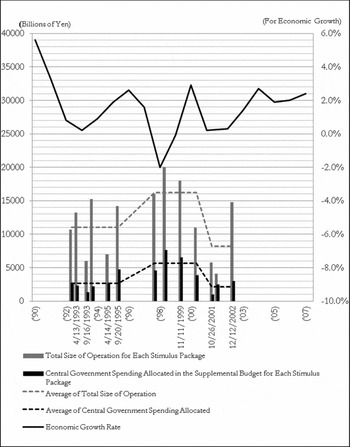
Comparatively speaking, the Japanese experience offers ambiguous lessons on the choice between fiscal stimulus and austerity. Fiscal stimulus may have played some role in preventing Japan from sliding into a far deeper recession or depression,Footnote 90 and in the early to mid 1990s, there is some evidence that economic performance correlated with the magnitude of actual stimulus measures.Footnote 91 However, the overall pattern of Japanese macroeconomic performance does not provide great support for the effectiveness of fiscal policy. Figure 5 plots Japanese GDP growth along with fiscal stimulus measures implemented by the Japanese government. The information on stimulus packages was obtained directly from the Ministry of Finance. We plot both the total size of the announced stimulus packages, along with the central government outlays associated with the supplemental budgets, which is a narrower measure that should more closely approximate the economic impact of the stimulus.Footnote 92 The largest fiscal stimulus outlays, which came in 1998–99, did not produce a sustained recovery, while stable economic growth in 2002–07 came during fiscal consolidation and the absence of meaningful stimulus measures under Prime Minister Koizumi.
Japanese stimulus packages (1992–2002) and economic growth Source: Ministry of Finance, Japan

It is therefore difficult to draw explicit lessons from the Japanese case about the efficacy of fiscal policy. As Martin Fackler notes, ‘Economists tend to divide into two camps on the question of Japan's infrastructure spending: those, many of them Americans like Mr. Geithner, who think it did not go far enough; and those, many of them Japanese, who think it was a colossal waste.’Footnote 93 Indeed, during the aftermath of the 2008 crisis, economists and policymakers split sharply between those advocating for fiscal stimulus measuresFootnote 94 and those calling for austerity to deal with ballooning public deficits.Footnote 95
Larry Summers, then Director of the National Economic Council, summarized the administration's thinking on fiscal policy measures as follows:
Our policy approach started with a major commitment to fiscal stimulus. Economists in recent years have become skeptical about discretionary fiscal policy and have regarded monetary policy as a better tool for short-term stabilization. Our judgment, however, was that in a liquidity trap-type scenario of zero interest rates, a dysfunctional financial system, and expectations of protracted contraction, the results of monetary policy were highly uncertain whereas fiscal policy was likely to be potent. We also concluded that we should confront the major contractionary forces in the economy by using all available tools.Footnote 96
The administration adopted a public line folding fiscal policy into Japan's general failure to act quickly and decisively.Footnote 97 This is consistent with some academic analyses of Japanese fiscal policy, which emphasize the insufficiency of these measures at early stages of the crisis.Footnote 98 However, we believe it is fair to say that US policymakers pursued fiscal stimulus for reasons largely unrelated to Japan's experience.
Another potential reason why fiscal policy might have reflected less learning is that, compared to central banking, where policymakers and related academics meet frequently and arguably constitute an epistemic community,Footnote 99 fiscal policy tends to be conducted by legislators or less-internationalized finance ministry bureaucrats. Analogously, international institutions such as the International Monetary Fund and Bank for International Settlements facilitate information exchange and a measure of coordination among financial authorities,Footnote 100 but there is no comparable global institutional framework for fiscal policy coordination.Footnote 101 Hence, even had the lessons from the Japanese experience been clear, the more politicized and less technocratic nature of decision-making over fiscal policy is likely to have inhibited cross-national learning.
Conclusion
We have argued that Japanese and US policymakers operated under fundamentally different conditions during their respective financial crises. Japanese policymakers underwent a process of learning, adjustment, experimentation, and discovery. This made their response appear, in retrospect, haphazard, myopic, and ineffective. Comparatively, the US entered its crisis with ample empirical evidence, received wisdom, and practical policy lessons from the Japanese case. The US response therefore came with greater speed, force, and precision.
In both monetary policy and financial sector bailouts, Japanese financial authorities initially had difficulty recognizing the full extent of the problems they confronted. Even when gradual recognition occurred, effective solutions were not immediately apparent and only arose through a slow process of trial and error. On financial recapitalizations, the lack of a convincing precedent made it particularly difficult for Japanese political leaders to convince a skeptical public. US policymakers attempted to avoid Japan's dilemma by acting quickly and decisively. The Bernanke Fed quickly reduced rates to zero and initiated quantitative easing on a larger scale than when the BOJ had first attempted the policy. TARP legislation, pushed aggressively during the height of panic, gave US financial authorities access to a large amount of funds with maximum flexibility. Stress tests were conducted to increase transparency and reduce the ability of banks to conceal their bad assets.
Nonetheless, political realities made it difficult for the US to avoid all of the mistakes committed by Japanese financial authorities. Although we have not focused on the precise mechanisms of cross-national diffusion in this paper, our findings suggest that monetary policy, financial sector bailouts, and fiscal policy lie on a continuum reflecting the likelihood of lessons being reflected in policy outcomes by second-movers. Monetary policy is politically insulated, technocratic, and characterized by frequent international contact among relevant policymakers. Financial sector bailouts are more inherently politicized, making it comparatively difficult for policymakers to implement lessons learned. Fiscal policy lies at the other extreme – legislators and financial officials involved in crafting fiscal stimulus measures tend to be domestically oriented, and the allocation of government resources inevitably triggers a wide range of unrelated political considerations.
To be clear, we are not arguing that Japanese financial authorities should be absolved from responsibility. Even considering the novel nature of Japan's crisis, several policy measures were ill-conceived and could have been recognized as such ex ante. In our judgment, primary among these were the BOJ's premature abandonment of the ZIRP in 2000 and the failure to target fiscal stimulus funds towards projects with higher long-term social returns. The BOJ also probably erred in the mid-2000s in failing to continue unconventional policy measures until deflation had come to a clear end.
More generally, we have proposed a new theory of policy response and learning. Like firms in the private sector and early developing states, countries dealing with novel challenges are distinct from later respondents. The initial process of policy innovation is a chaotic, messy process with many dead ends. In politics, first-movers are at an additional disadvantage as their constituents quickly lose patience with the perceived incompetence of their leaders. Second-mover countries can avoid the failures of the first-mover and selectively adopt the policy innovations that appear most effective. Without accounting for this possibility, scholars may reach biased inferences about cross-national variation in policy implementation. We have established the plausibility of this theory by examining financial crisis response in the United States and Japan.
Our theory could be tested through application to a broader range of policy issues in which countries face novel threats with a temporal lag – e.g., unprecedented environmental change, terrorism and non-traditional threats, and contagious disease. We predict that first-movers will tend to spend more time before implementing effective solutions and experience higher cumulative costs. Subsequent adopters will tend to implement successful policies from the first-mover with greater speed, scale, and effect. In terms of future research, we suspect testing the theory will be most productive in cases where the novel contingency is non-sentient or at least non-strategic. For example, the terrorist attacks of September 11 were novel and catastrophic for the United States, and if similar tactics were employed again, other countries will likely be able to respond with greater efficacy. However, because potential terrorists are aware of this, future attacks are unlikely to follow the same template – at least to some degree, future 9/11-style attacks are off of the equilibrium path. In contrast, phenomena such as contagious disease, economic crises, and environmental damage do not have a mind of their own and therefore offer greater scope for empirical evaluation.
About the authors
Phillip Y. Lipscy is Assistant Professor of Political Science at Stanford University and the Thomas Rohlen Center Fellow at the Shorenstein Asia Pacific Research Center. His research focuses on international and comparative political economy with an emphasis on East Asia, particularly Japan.
Hirofumi Takinami is a former Visiting Fellow, the Shorenstein Asia Pacific Research Center, Stanford University and former Visiting Scholar, Policy Research Institute, Ministry of Finance, Japan. His current research focuses on political economy of financial crises in Japan and the US.