Research has revealed that the development of tense inflection in individual children who learn English as their second language (L2) is affected by age of acquisition (Jia & Fuse, Reference Jia and Fuse2007; McDonald, Reference McDonald2000), length of L2 exposure (Blom, Paradis, & Sorenson Duncan, Reference Blom, Paradis and Sorenson Duncan2012; Chondrogianni & Marinis, Reference Chondrogianni and Marinis2011; Jia & Fuse, Reference Jia and Fuse2007; Paradis, Reference Paradis2011), and by properties of children's first language (L1; Blom et al., Reference Blom, Paradis and Sorenson Duncan2012; Dulay & Burt, Reference Dulay and Burt1974; Paradis, Reference Paradis2011). All three factors (age, exposure, and L1) index resources that can facilitate L2 tense inflection development. It is well-known that another group of English-acquiring children, children with specific language impairment (SLI), have persistent difficulties learning tense inflection, whether English is their L1 (Bedore & Leonard, Reference Leonard1998; Bishop, Adams, & Norbury, Reference Bishop, Adams and Norbury2006; Conti-Ramsden, Reference Conti-Ramsden2003; Redmond & Rice, Reference Redmond and Rice2001; Rice, Wexler, & Hershberger, Reference Rice, Wexler and Hershberger1998; Rice, Wexler, Marquis, & Hershberger, Reference Rice, Wexler, Marquis and Hershberger2000) or their L2 (Blom & Paradis, Reference Blom and Paradis2013; Jacobson & Schwartz, Reference Jacobson and Schwartz2005; Paradis, Reference Paradis, Haznedar and Gavruseva2008). This suggests that children with SLI might not be able to make use of resources to acquire tense inflection in the same way as do their peers with typical development (TD; Paradis, Reference Paradis2010a).
In this study we investigated whether English L2 children with TD and with SLI show differential effects of age of L2 acquisition, length of L2 exposure, and inflectional properties of the L1 in their learning of English tense inflection. The children in this study were on average 3.5 years old when they began acquiring English and had on average 2 years of substantial exposure to English at time of testing. Whereas previous research has looked at the effect of external and internal factors on the language development of L2 children with TD (cf. Hulk & Marinis, Reference Hulk and Marinis2011), very little is known about the role of individual difference factors in impaired acquisition in L1 or L2 contexts. By investigating the effects of age, exposure, and L1 in both L2 children with TD and with SLI, this study is aimed at enhancing our insight into sources of individual differences, or use of language learning resources, in children with SLI. The study is also aimed at investigating how the influence of these individual difference factors could be different for children with TD and children with SLI.
TENSE MARKING MORPHOLOGY IN ENGLISH L2 TD AND SLI
English L1 children with SLI omit the third person singular suffix –s, which expresses the present tense habitual, and past tense suffix –ed in obligatory contexts, in particular during the early elementary school years (Bedore & Leonard, Reference Bedore and Leonard1998; Bishop et al., Reference Bishop, Adams and Norbury2006; Conti-Ramsden, Reference Conti-Ramsden2003; Redmond & Rice, Reference Redmond and Rice2001; Rice et al., Reference Rice, Wexler and Hershberger1998; Rice et al., Reference Rice, Wexler, Marquis and Hershberger2000). Monolingual children with SLI omit tense inflections more frequently than do their age-matched peers with TD, and they also omit these inflections more often than do younger TD children matched on general language abilities (Leonard, McGregor, & Allen, Reference Leonard, McGregor and Allen1992; Oetting & Horohov, Reference Oetting and Horohov1997; Rice, Wexler, & Cleave, Reference Rice, Wexler and Cleave1995). Recent research has indicated that the patterns found for monolingual children extend to bilingual and L2 populations with language delays/impairments (Blom & Paradis, Reference Blom and Paradis2013; Jacobson & Livert, Reference Jacobson and Livert2010; Jacobson & Schwartz, Reference Jacobson and Schwartz2005; Paradis, Reference Paradis, Haznedar and Gavruseva2008). For instance, English L2 children with SLI have been found to omit regular past tense inflection (walk instead of walked) more often than their L2 TD peers, whereas accuracy at using irregular past tense verbs appeared to be unaffected by the presence of SLI in L2 learners of English (Blom & Paradis, Reference Blom and Paradis2013; Jacobson & Schwartz, Reference Jacobson and Schwartz2005). However, errors with irregular verbs did differ across L2 TD groups and L2 groups with language delays/impairments. Overregularization (catched instead of caught) was relatively frequent in children with TD, and the children with language delays/impairments often failed to use any tense marking expression with irregular verbs (e.g., catch; Blom & Paradis, Reference Blom and Paradis2013; Jacobson & Schwartz, Reference Jacobson and Schwartz2005). All of these patterns closely resemble findings that emerged from studies comparing monolingual English TD and SLI groups. Furthermore, after analyzing longitudinal data from two children learning L2 English with language delay/SLI, Paradis (Reference Paradis, Haznedar and Gavruseva2008) concluded that the acquisition of past tense and third person singular inflection seemed to be more impacted by the presence of language delay/SLI than by the acquisition of BE morphemes (i.e., forms from the suppletive paradigm of the verb be), based on the magnitude of differences between the affected children and their L2 peers with TD. Taken together, these findings contrasting regular inflections with irregular forms and BE morphemes suggest that the acquisition of affixal, bound morphology (inflection) could be particularly affected by SLI in L2 acquisition, in the same way that SLI affects monolingual language acquisition. The observed difficulties with tense inflection acquisition imply that L2 children with SLI make less use of resources to acquire regular tense inflection than do L2 children with TD. To investigate this idea, we examined the impact of three such resources that vary between individual learners, age of acquisition, length of L2 exposure, and L1 transfer in L2 children with TD and L2 children with SLI.
AGE, EXPOSURE, AND TRANSFER IN ENGLISH L2 CHILDREN WITH TD
Age of acquisition refers to the age at which an individual begins to acquire the L2. While a great deal of research has been conducted on the issue of ultimate attainment and age of acquisition, primarily contrasting adult L2 learners with child L2 learners (see Hyltenstam & Abrahamsson, Reference Hyltenstam, Abrahamsson, Doughty and Long2003, for review), for this study we are focusing on differences in age of acquisition within childhood and with rate of development, not ultimate attainment. Research has pointed to various reasons why, within early childhood, older children may have an advantage in learning an L2. They have more advanced cognitive abilities and mechanisms, greater social resources, and greater experience and knowledge of linguistic systems than do younger children (Golberg, Paradis & Crago, Reference Golberg, Paradis and Crago2008; Peets & Bialystok, Reference Peets and Bialystok2010; Rice, Reference Rice2010; Paradis, Reference Paradis2010b). An older chronological age has been found to be predictive of a faster rate of vocabulary development in English L2 children between ages 4 and 9 (Golberg et al., Reference Golberg, Paradis and Crago2008), and verb inflection development in English L2 children between ages 5 and 7 (Paradis, Reference Paradis2011), as well as in Dutch L2 children between ages 4 and 9 (Blom & Baayen, Reference Bittner, Dressler and Kilani-Schoch2013). Instead of simply age at testing, Chondrogianni and Marinis (Reference Chondrogianni and Marinis2011) looked at the effect of differential age of acquisition on English L2 children's development of tense inflection; however, no effect emerged in this study. Ceiling effects or lack of variability in children's accuracy with verb morphology is likely responsible for the null results. Therefore, in the present study, we investigated tense inflection use in a group of English L2 children who varied considerably in both length of exposure and in age of acquisition. The children in this study had an age of acquisition well within the assumed critical or sensitive period, following the common assumption that this period continues at least until the age of 6 or 7 (Hyltenstam & Abrahamsson, Reference Hyltenstam, Abrahamsson, Doughty and Long2003). Our expectation was that for these L2 children a later age of acquisition would predict higher accuracies at using tense inflection, in line with the findings on the impact of older chronological age.
The second variable investigated by this study is length of L2 exposure. Because an earlier age of acquisition and longer L2 exposure often go hand in hand (as does a later age of acquisition and shorter L2 exposure), including L2 exposure as a variable in this study allowed us to isolate effects of age of acquisition from length of exposure. Previous research has indicated that TD English L2 children with longer exposure to the L2 have higher accuracy with English tense inflection than do peers with lower exposure (third person singular: Blom et al., Reference Blom, Paradis and Sorenson Duncan2012; Chondrogianni & Marinis, Reference Chondrogianni and Marinis2011; tense marking in general: Jia & Fuse, Reference Jia and Fuse2007; Paradis, Reference Paradis2011). The few studies that did not find any influence of length of exposure either had an exposure span that was too narrow (Gutiérrez-Clellen & Kreiter, Reference Gutiérrez-Clellen and Kreiter2003) or performance on the task that was not sufficiently varied (past tense inflection in Chondrogianni & Marinis, Reference Chondrogianni and Marinis2011). We expected our findings to converge with previous research and that longer L2 exposure would be positively associated with tense inflection accuracy.
The third and final source of individual differences investigated for this study concerns children's abilities to make use of previous knowledge from their L1. Various studies have revealed that L2 children transfer grammatical properties of their L1 into their L2 (Blom & Baayen, Reference Bittner, Dressler and Kilani-Schoch2013; Blom et al., Reference Blom, Paradis and Sorenson Duncan2012; Blom & Paradis, Reference Blom and Paradis2013; Chondrogianni, Reference Chondrogianni, Haznedar and Slabakova2008; Haznedar, Reference Haznedar2001; Paradis, Reference Paradis2011; Unsworth, Reference Unsworth2005; Zdorenko & Paradis, Reference Zdorenko and Paradis2008, Reference Zdorenko and Paradis2011). Regarding tense inflection, children whose L1 has a rich tense inflection system are more accurate at using tense inflection than their peers with isolating L1s, as shown for English L2 (Blom & Paradis, Reference Blom and Paradis2013; Paradis, Reference Paradis2011) and Dutch L2 (Blom & Baayen, Reference Bittner, Dressler and Kilani-Schoch2013). Longitudinal data has revealed that children with richly inflecting L1s have steeper developmental curves for English third person singular inflection than children whose L1s are isolating and have no tense inflection (Blom et al., Reference Blom and Baayen2012). These findings support the hypothesis that knowledge of tense inflection seems to undergo positive transfer to the L2, and therefore, we expected an association between inflectional properties of the L1 and children's performance on tense marking in English L2 in the present study. As with the variables of age and L2 exposure, the children in the present study differed in terms of whether their L1 had a rich inflectional system.
AGE, EXPOSURE, AND TRANSFER IN ENGLISH L2 CHILDREN WITH SLI
In this study, the effects of age, exposure, and L1 transfer are compared in L2 children with TD and L2 children with SLI. Currently, no research exists that has compared the impact of individual difference factors between these two groups of children, and in this respect our study is explorative. In order to speculate on possible outcomes, we started from the recurring observation that children with SLI have cognitive deficits, in particular deficits in verbal short-term and working memory and speed of processing, so-called limited processing capacity (Archibald & Gathercole, Reference Archibald and Gathercole2006; Ellis Weismer, Evans, & Hesketh, 1999; Henry, Messer, & Nash, Reference Henry, Messer and Nash2012; Leonard et al., Reference Leonard, Weismer, Miller, Francis, Tomblin and Kail2007; Miller, Kail, Leonard, & Tomblin, Reference Lin2001; Montgomery & Windsor, Reference Montgomery and Windsor2007). During childhood, verbal memory shows steep growth (Gaulin & Campbell, Reference Gaulin and Campbell1994; Gathercole, Pickering, Ambridge, & Wearing, Reference Gathercole, Pickering, Ambridge and Wearing2004), and age may index verbal memory growth. In addition, verbal memory has been found to predict the dependent variable under investigation (tense marking morphological abilities) in monolingual children and adults (McDonald, Reference McDonald2008a, Reference McDonald2008b), L2 children with TD (Paradis, Reference Paradis2011) and children with SLI (Botting & Conti-Ramsden, Reference Botting and Conti-Ramsden2001; Conti-Ramsden, Reference Conti-Ramsden2003; Rispens, Reference Rispens2004). Consequently, differential effects of age on the tense marking abilities of children with TD and SLI may be indicative of differences in cognitive growth in the two groups, apart from overall more limited cognitive resources (less verbal memory and a slower speed of processing) in SLI compared to TD.
Less verbal memory capacity to hold linguistic information in store and slower speed (limited processing capacity) would predict that children with SLI would make less efficient use of language exposure than their peers with TD (Leonard, Reference Leonard1998, Reference Leonard and Kail2007; Leonard et al., Reference Leonard, Weismer, Miller, Francis, Tomblin and Kail2007). Some support for relationships between the processing of language input and children's language performance, including the production of tense inflection, comes from studies where the input was adjusted to children with SLI's limited processing abilities. For instance, children with SLI show improved real-time processing if linguistic material is presented at a slower rate (Montgomery, Reference Montgomery2005, Reference Montgomery2006), and they are more accurate at using third person singular inflection after repeated exposure to this verb form during intervention (Leonard, Camarata, Brown, & Camarata, Reference Leonard, Camarata, Brown and Camarata2004; Leonard, Camarata, Pawlowska, Brown, Camarata, Reference Leonard, Camarata, Pawlowska, Brown and Camarata2006). Because of their more limited processing abilities, children with SLI may lose the phonetic details of verb forms, and they may fail to memorize contextual information regarding the temporal interpretation of the utterance or the sentence subject. Both the loss of phonological and functional information could delay successful mapping of –ed onto the function of past tense and –s onto the functions of third person, singular, and present tense. Put differently, it may take longer for children with SLI than for TD children to take in the same amount of linguistic material from the input, and thus it would be expected that they would take longer to establish linguistic representations for verb inflections (Leonard et al., Reference Leonard, Weismer, Miller, Francis, Tomblin and Kail2007, p. 408). By extension, it would then be expected that L2 children with SLI need a longer period of exposure to English than do L2 children with TD in order to acquire tense inflections (cf. Paradis, Reference Paradis2010a; Jacobson & Livert, Reference Jacobson and Livert2010). Consequently, the same length of L2 exposure would be expected to have a greater positive impact on TD L2 children's inflection acquisition outcomes than on those of L2 children with SLI.
Turning to our third individual difference factor, we expected that L1 transfer to the developing L2 inflection system could also be influenced by the limited processing capacity of L2 children with SLI, and consequently, L1 transfer might affect children with TD and with SLI differently. Differences in the impact of L1 on TD and SLI could have at least two sources: impaired representations for tense in the L1, and thus a lack of available L1 information to transfer in children with SLI, or the inability of children with SLI to enable transfer processes to occur. We favored the latter over the former source for this study based on the following reasoning: For the present study, children's knowledge of L1 tense inflection was not separately assessed, but it is likely that both children in the TD and SLI group had developed sufficient knowledge of tense inflection from their L1 to allow some transfer. This is because the children with inflecting L1s in our study had L1s with rich systems of verb inflection, and in such languages, verb inflection tends to be learned relatively early in development (Bittner, Dressler, & Kilani-Schoch, Reference Bittner, Dressler and Kilani-Schoch2003), and tense marking morphology is relatively spared in children with SLI learning these languages (Leonard, Reference Leonard1998, Reference Leonard and Schwartz2009). Other studies of same-aged L2 children, with and without SLI, found evidence for L1 transfer in English L2 grammatical morphology (Blom et al., Reference Blom, Paradis and Sorenson Duncan2012; Blom & Paradis, Reference Blom and Paradis2013; Paradis, Reference Paradis2011; Zdorenko & Paradis, Reference Paradis, Haznedar and Gavruseva2008, Reference Paradis2011). Thus, assuming that the children had established sufficient knowledge of their L1, our differential expectation between the TD and SLI groups for the present study was largely based on the process of transfer itself, rather than on the assumption of incomplete L1 representations.
Regarding the processes by which positive transfer could occur in L2 acquisition, it has been pointed out that cross-linguistic overlap is important because it is the channel through which positive transfer can occur (Ringbom & Jarvis, Reference Ringbom, Jarvis, Long and Doughty2009). Transfer possibilities in the domain of verb inflection are thus limited because languages typically tend to differ morphosyntactically, both in the phonological forms and in the grammatical functions expressed (Gathercole, Reference Gathercole2007; MacWhinney, Reference MacWhinney, Robinson and Ellis2008). Nevertheless, some avenues for positive transfer in the domain of verb inflection can be identified. One avenue could be the transfer of cue strength from the L1 to the L2. Following the premises of the Competition Model as put forward in MacWhinney (Reference MacWhinney, Robinson and Ellis2008), it could be assumed that speakers of richly inflecting L1s will have established strong connections between lexical representations of verbs and the functions related to tense and properties of the subject, because in their L1 verbs express those functions. Upon hearing a verb in their L1, speakers will activate inflectional functions and verbs will serve as cues to inflectional functions. On the assumption that L2 children can transfer the cue strength of verbs similarly to L2 adults (MacWhinney, Reference MacWhinney1987), it would be expected that when hearing a verb in the L2 inflectional functions also get activated from this cue, facilitating the mapping of L2 verb forms to these functions in the emerging L2 system. L1 properties may also crucially influence how L2 learners focus their attention (Ellis, Reference Ellis2006). For instance, L1 Italian adults learning English pay attention to agreement in the L2 to identify the subject. This is because in their L1, speakers of Italian are used to interpreting the subject through the inflectional form of the verb when the subject itself is dropped (i.e., pro-drop; Bates & MacWhinney, Reference Bates, MacWhinney and Winitz1981). Such focused attention could also facilitate L2 verb inflection development in both L2 English adults and children.
Transfer processes involving cue strength and attentional focus are expected to speed up learning L2 inflection in children with inflecting L1s. However, L2 children with SLI may benefit less from these effects of positive transfer than L2 children with TD. In children with SLI, activation of inflectional functions may take longer than in children with TD due to slower processing. Furthermore, if accessed, inflectional functions may not be retained in verbal working memory long enough to permit successful mapping, because of verbal working memory limitations. Thus, although L2 children with SLI whose L1 is richly inflecting may have advantages compared to L2 children with SLI whose L1 has no inflection, they may profit less from these advantages than their TD peers with the same L1. We therefore expected that children with inflecting L1s might be better at using tense inflection in English than children with isolating L1s for both groups of L2 children, but we also expected the effect of L1 to be stronger for children with TD than with SLI.
Very little research has investigated linguistic transfer in bilingual/L2 children with SLI. In this respect it is relevant to mention the research reported in Armon-Lotem (Reference Armon-Lotem2010) and Armon-Lotem et al. (Reference Armon-Lotem, Adam, Blass, Fine, Harel, Saiegh-Haddad, Leikin, Tobin and Schwartz2012). Armon-Lotem points out that sequentially bilingual English–Hebrew children with SLI, with at least two years of exposure to Hebrew, reach a similar level of performance as their monolingual peers with SLI and sometimes even seem to do better. It is suggested that this last effect might indicate positive transfer. Unfortunately, in this study it is not specified how knowledge of English would facilitate acquiring the plural feminine form in Hebrew, which was the particular inflectional form with which the bilinguals did better. It is not immediately evident how English would help, because it has poor inflectional morphology and does not mark gender in the verbal inflectional paradigm. In addition, the sample sizes in this study were small, and for this reason caution is necessary in interpreting the results. Finally, this study does not address the question of whether L2 children with SLI can transfer to the same extent as their TD peers. Therefore, further research into L1 as a resource to acquire L2 tense inflection in children with SLI is warranted, in particular research with a larger sample of children and a sample that allows comparing children with TD and SLI.
RESEARCH QUESTIONS AND PREDICTIONS FOR THE STUDY
The aim of our study was to investigate if L2 children with and without SLI make use of certain language learning resources to the same extent for learning English regular tense inflection. We examined the predictive role of age of acquisition, L2 exposure, and L1 transfer in the accuracy with tense inflection by L2 children with and without SLI. Our research questions were as follows:
-
1. How does variation in age of acquisition affect tense inflection acquisition in L2 children, and is this effect the same for children with TD and with SLI? Greater cognitive resources that develop as a function of age could predict better performance with verb inflection in L2 children with TD who have an older age of acquisition. The same could hold for L2 children with SLI.
-
2. How does variation in length of L2 exposure affect tense inflection acquisition in L2 children, and is this effect the same for children with TD and with SLI? We predicted that performance with verb inflection would improve after longer L2 exposure for L2 children with TD, but that this effect could be diminished or absent in SLI due to their known processing capacity limitations, that might underlie less efficient intake of relevant input data.
-
3. How do differences in L1 tense-marking properties affect tense inflection acquisition in L2 children, and is this effect the same for children with TD and with SLI? We predicted that TD L2 children with richly inflecting L1s would benefit from positive transfer in their rate of L2 inflection acquisition. By contrast, it is conceivable that children with SLI would be limited with respect to the ability to transfer from their L1s due to processing capacity limitations, in which case we would expect stronger effects of L1 transfer in L2 children with TD than with SLI.
METHOD
Participants
Data from 24 children with typical language development (L2 TD) and 24 children with language impairment (L2 SLI) were analyzed for this study. The children were 5 or 6 years old at time of testing. They were all learning English as an L2 in an environment where (Canadian) English was the majority language (Edmonton, Toronto). Most children were born in Canada (73%). Only children with parents who were both foreign-born and native speakers of a language other than English were included. The majority of the children were exposed to no or very limited English before the age of 2 to 3 years or older and children's acquisition of English began in a preschool or school program (M age = 42 months 3 days [42;3]; range = 7–62, SD = 10.5). Children from families where English was used by the parents with the child from birth were excluded.
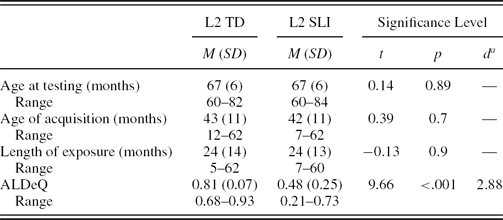
Children in the L2 TD group were recruited through schools and through agencies that offer assistance to newcomer families. Children with SLI were recruited through caseloads of school-based speech–language pathologists and through special kindergarten programs for children with language or cognitive delays. Speech–language pathologists were part of the educational team in these programs, and the children with SLI were referred to us by them. We requested referrals to English L2 children who exhibited language delay/impairment but who did not have hearing impairment, autism spectrum disorder, acquired neurological damage or clinically significant cognitive limitations. We also requested that children who presented primarily with speech–sound disorders not be referred. All L2 children with SLI had undergone speech–language assessments, but we did not have access to test scores. However, as part of our study we assessed children's development in their L1 through the Alberta Language Development Questionnaire (ALDeQ; Paradis, Emmerzael, & Sorenson Duncan, Reference Paradis, Emmerzael and Sorenson Duncan2010; http://www.chesl.ualberta.ca), a parent questionnaire. The ALDeQ contains questions about early milestones, current L1 abilities, behavior patterns and activity preferences, and family history. The ALDeQ yields proportion scores between 0 and 1.0, where higher scores signify responses more characteristic of TD. The SLI group scored significantly lower on the ALDeQ, as expected, because bilingual children with SLI display deficits in both their languages (Paradis, Genesee, & Crago, Reference Paradis2011). ALDeQ outcomes are shown in Table 1, together with other relevant participant information. Children with SLI display language difficulties but typically have a nonverbal IQ in the normal range (85 and above; Leonard, Reference Leonard1998). As a group the SLI group scored lower on nonverbal IQ than the TD group, t (45) = 2.73, d = 0.81; nearly all children in our study had nonverbal IQ scores of 85 and above, as measured by the Columbia Mental Maturity Scales (Burgemeister, Blum, & Lorge, Reference Burgemeister, Blum and Lorge1972). Two children in the SLI group scored just below 85. We decided to label the group SLI (and not LI) because almost all children in the group had scored above 85. Hence, the mean IQ for the group fit the criteria for SLI. The TD group also contained two children who scored below 85 for nonverbal IQ.
Characteristics of the English L2 group with TD and with SLI

Note: L2, second language learners; TD, typical development; SLI, specific language impairment; ALDeQ, Alberta Language Development Questionnaire.
a The Cohen d was used to measure the effect size and to indicate the magnitude of a difference.
Children in the TD and SLI groups were matched on a child-by-child basis using age at testing, length of exposure to English, and inflectional properties of the L1 as matching criteria. A second parental questionnaire, the Alberta Language Environment Questionnaire (Paradis, Reference Paradis2011; http://www.chesl.ualberta.ca) provided the information required for matching. Relevant Alberta Language Environment Questionnaire outcomes are shown in Table 1. A 4-month range was used for matching on age at testing and length of exposure. Eleven pairs were matched exactly in their L1. If no exact L1 match was available within the sample of children with the matching age and exposure, the L1 match was based on whether the L1 expressed tense through inflection on the verb (13 pairs). There were 9 pairs of children with typologically isolating L1s where tense is not expressed through inflection on the verb: Cantonese, Mandarin, Cantonese/Mandarin and Vietnamese (Lin, Reference Lin2001; Matthews & Yip, Reference Matthews and Yip1991; Thompson, Reference Thompson1987). Fifteen pairs of children had a typologically inflecting L1 that expresses tense on the verb: Arabic, Assyrian, Gujarati, Portuguese, Punjabi, Somali, Spanish and Urdu (Bateson, Reference Bateson1967; Bhatia, Reference Bhatia1993; Butt & Benjamin, Reference Butt and Benjamin2004; Mercer, Reference Mercer1961; Saeed, Reference Saeed1993; Schmidt, Reference Schmidt1999).
Procedures
Children were tested in English either in their homes or at school. For the questionnaires, parents were visited at home. Research assistants were all native speakers of Western Canadian English and, in the majority of the cases, a cultural-broker/interpreter accompanied the research assistant for the home visits, because the parents’ English was not fluent.
The dependent variable of the study was based on children's use of third person singular –s inflection and past tense –ed inflection as elicited with the third person singular and past tense probes of the Test of Early Grammatical Impairment (TEGI) screener (Rice & Wexler, Reference Rice and Wexler2001). The TEGI third person singular probe consists of pictures showing a character involved in an activity. A child's response was elicited through a question asked by the research assistant, such as Here is a teacher. Can you tell me what a teacher does? The TEGI past tense probe consists of pairs of pictures showing a child engaged in an activity in one picture and the child having completed the activity in second picture. In this case, the research assistant showed a set of pictures and said, for example, Here the boy is painting (showing first picture). Now he's done (referring to the second picture). Tell me what he did.
The TEGI has 10 third person singular probes and 18 past tense probes. On the TEGI past tense probes the children are more explicitly prompted to use a particular verb than with third person singular probes, with 10 probes triggering regular past tense verbs and 8 probes eliciting irregular past tense verbs. Both for third person singular and past tense, we excluded responses with irregular inflection, because our aim was to focus on an area of persistent difficulty in English SLI, and past research has shown that irregular past tense marking is not affected by SLI (for English L1: Oetting & Horohov, Reference Oetting and Horohov1997; Rice et al., Reference Rice, Wexler and Cleave1995; for English L2: Blom & Paradis, Reference Blom and Paradis2013; Jacobson & Schwartz, Reference Jacobson and Schwartz2005). The included third person singular verbs were arrest, ballet, bat, brush, burn, carry, catch, check, clean, clear, come, control, cook, dance, drive, fight, fire, fix, flow, fly, get, give, go, help, hit, hurt, jump, kick, let, live, look, love, make, move, paint, play, power, pull, put, rescue, ride, roll, save, see, shoot, shovel, sit, spray, stop, take, talk, tell, throw, use, want, wash, water, wonder, work, write. The following verbs were included for past tense -ed: brush, carry, chew, clean, climb, comb, fence, finish, fix, grab, help, hug, jump, kick, lift, open, paint, pick, plant, shovel, smell, splash, start, stop, tie, try, walk, want.
Measures
The dependent variable of the study was based on correct and incorrect verb inflection use. Correct responses included use of third person singular –s (teaches) and use of past tense –ed (painted), both with relevant TEGI probes. Incorrect responses were omissions of the inflectional ending (e.g., teach, paint). In the TD sample, two double marking errors were used with past tense probes (jumpeded, pickeded); these responses were also counted as incorrect. The number of included responses per child varied with a mean of 16.6 (range = 4–20, SD = 3.6) for L2 TD and 14.8 (range = 2–20, SD = 4.5) for L2 SLI.
Independent variables in the study were group (L2 TD, L2 SLI), age, exposure, and L1 typology (L1typ). Age of acquisition (age) and length of L2 exposure (exposure) were measured in months. Length of exposure was calculated by subtracting age of acquisition from children's age at time of testing, where age of acquisition was based on a demarcated time point at which English exposure increased substantially and started to take place on a regular basis, such as when a child began to attend a preschool program or kindergarten. L1typ was included in the study as a two-level factor that distinguished whether the L1 was isolating and did not have inflection on the verb (Cantonese, Mandarin, Vietnamese) or whether the L1 was an inflecting language that expressed tense and agreement on the verb through inflection (Arabic, Assyrian, Gujarati, Portuguese, Punjabi, Somali, Spanish, Urdu).
RESULTS
Descriptive statistics
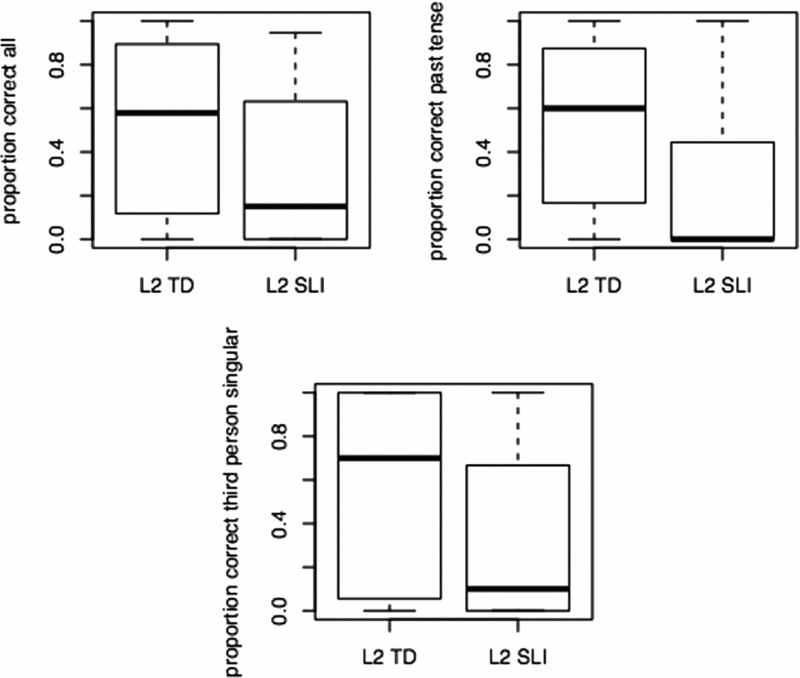
In total, 276 correct (156 correct third person singular, 120 correct past tense) and 370 incorrect (184 incorrect third person singular, 186 incorrect past tense) responses were produced, with children with SLI producing fewer correct responses than children in the TD group. Differences between the two groups in proportions of correct responses are illustrated in Figure 1. The line in the box plots in Figure 1 illustrates the general tendency in a group (median), whereas the boxes and whiskers indicate spread of the data; the top and bottom of a box indicate the upper and lower quartiles, whereas the ends of the whiskers show the highest and lowest datum within the 1.5 interquartile range.
The differences between the two groups in proportions of correct responses.

Figure 1 illustrates that the difference between L2 TD and L2 SLI in accurate use of verb inflection is visible when third person singular and past tense responses are collapsed but also in the separate data sets for third person singular and past tense. Further analyses were performed on the collapsed data for sufficient statistical power and to include all children in the analyses; two children did not produce any analyzable past tense responses, but these children did produce analyzable responses for third person singular.
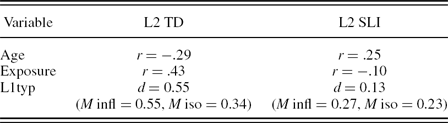
Table 2 indicates the strength and the directions of the relationships among age, exposure, and L1typ and the proportions of correctly used tense inflection in L2 TD and L2 SLI by means of effect sizes: the Pearson r for two numeric variables (age, proportion correct; exposure, proportion correct) and Cohen d for the relationship between a nominal and a numerical variable (L1typ, proportion correct)
Effect sizes for the relationships among age, exposure, and L1typ and proportion of correctly used tense inflection in L2 TD and L2 SLI

Note: L1typ, first language typology; L2, second language learners; TD, typical development; SLI, specific language impairment.
The L2 TD group showed a weak negative correlation between age of acquisition and proportion of correctly used inflection, whereas for the SLI group a weak positive correlation emerged. A moderate positive correlation was obtained between length of exposure and proportion of correctly used inflection for the L2 TD group and for the L2 SLI group, there was a weak, negative correlation. Note that the negative relation between age of acquisition and accuracy and the positive relation between length of exposure and accuracy in the L2 TD group could be the same effect, because in this data set a younger age of acquisition was strongly correlated with longer exposure to the L2 (r = –.91). Something similar may hold in the L2 SLI group with respect to the positive relationship between age and accuracy on the one hand and the negative relationship between exposure and accuracy on the other hand. For this reason, in the statistical analysis below, the two effects will be teased apart. In both groups, children with an inflecting L1 were on average more accurate at using tense inflection than were children with an isolating L1, as indicated by the mean accuracies for the two L1 groups. The magnitude of the difference between the two L1 groups in the TD group was larger than in the SLI group, as shown by the effect size measure d in Table 2.
Mixed logistic regression analyses
The data were statistically evaluated using mixed logistic regression analysis. Mixed logistic regression is an adjustment of the mixed linear regression analysis for categorical outcome variables. Thus, the outcome variable was not a derived continuous variable like proportion correct but instead a raw binary variable: correct response versus incorrect response. Mixed logistic regression allows assessing the simultaneous effect of multiple fixed effect predictor variables on one discrete outcome variable, while also including participant (child) and item (verb) as random effects in the same model. This analysis is different from analyses of variance, where effects of participant and item are assessed separately, or from ordinary least squares techniques of estimation, where predictors looking at effects of within and between participant phenomena cannot be assessed simultaneously.
Conducting the statistical analyses, we used the method of backward elimination. That is, the first model contained all predictor variables and, by removing nonsignificant predictors in a stepwise fashion, a simple model with only significant main effects was obtained (Chatterjee & Hadi, Reference Chatterjee and Hadi2006). After that, the model complexity was increased by including interaction effects. Nested models were compared by means of maximum likelihood ratio tests until the optimal regression model was obtained that was both simple and accurate. An index of goodness of fit was calculated, the index of concordance (C). As a rule of thumb, a value of condordance above 0.80 indexes accurate predictions.
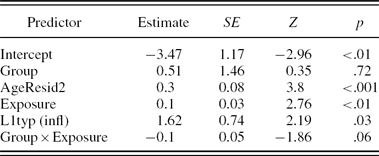
The analyses revealed that group, age, exposure, and L1typ all were significant predictors for children's accuracy at using tense inflection. However, as indicated above, correlational analyses indicated that effects of age and exposure could not be teased apart due to a strong negative correlation. This correlation showed that children who started to learn English at a relatively young age often had longer exposure to English at the time they were being tested than did children who started to learn English at a later age. To decorrelate age and exposure, a new predictor variable was created (AgeResid) by regressing age by exposure, and using the residuals of this model. AgeResid contained the variation in age that was not explained by exposure. When comparing the two L1 groups for differences in AgeResid, a difference was found between the groups, t (27) = 3.57, p = .001, and therefore a second decorrelated predictor was created (AgeResid2) by predicting the variation in age by both exposure and L1typ. Rerunning the model with AgeResid2, instead of age, we could ensure that the effect of age was independent of both exposure and L1typ. The correlation between age and AgeResid2 was moderate and significant, r = 0.38, t (45) = 2.75, p = .008, indicating that there is still a sufficient amount of overlap between the original predictor and the decorrelated predictor. Including AgeResid2 instead of age led to a simple model with main effects of group, AgeResid2, exposure, and L1typ with a good fit (C = 0.94). The model predictions are in Table 3.
Model predictions for Model 1 (only main effects, based on whole sample)

Note: AgeResid2, decorrelated predictor by predicting age by both exposure and first language typology (L1typ).
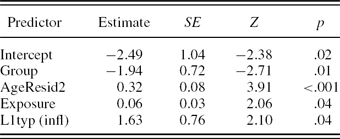
Adding interactions to the model, we obtained Model 2 with main effects of AgeResid2 and L1typ, and a trend towards an interaction of exposure and group (C = 0.94). This second model is displayed in Table 4. Comparing Model 1 and Model 2, we found a trend toward a significant preference for the second, nested, model, χ2 (1) = 3.2, p = .07.
Model predictions for Model 2

Note: AgeResid2, decorrelated predictor by predicting age by both exposure and first language typology (L1typ).
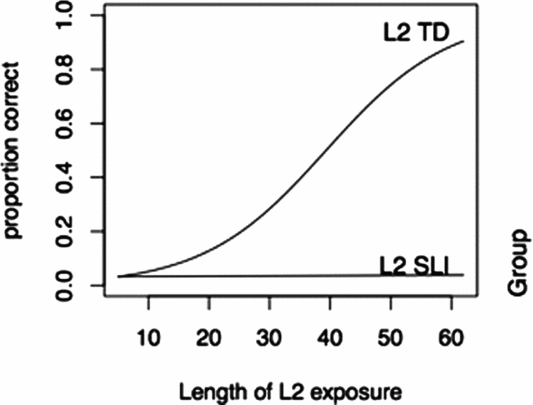
Both models reveal, first, that children with a later age of acquisition make fewer errors with tense inflection than children with an earlier age of acquisition. Second, children with longer exposure to English produced more correct tense inflections than children with shorter exposure. The significant interaction in Model 2 indicates that the length of L2 exposure does not exert its influence equally across the TD and SLI groups and that tense inflection use in the TD group was more influenced by length of exposure than in the SLI group. Third, children whose L1 has rich verb inflection were more accurate at tense inflection than were children whose L1 is isolating. The differential effect of L2 exposure on the two groups becomes apparent after visual inspection of Figure 2. Figure 2 shows the partial effects, that is, the interaction of group and exposure when all predictors in Model 2 are at the (default) reference level. The proportions correct in this figure do not represent the actual proportions correct in the two groups; the figure is insightful for estimating the differential effect of length of exposure in L2 TD and L2 SLI. The figure shows that whereas there are no differences in accuracy at using regular tense inflection between an L2 child with SLI who had 10 months of L2 exposure or 60 months of L2 exposure within the same exposure range, longer L2 exposure is a strong predictor of higher accuracies in L2 children with TD.
Longer second language (L2) exposure is a strong predictor of higher accuracies in L2 children with typical development.

Classification procedures
For further exploring the data, two classification procedures were employed: random forest analysis and binary recursive partitioning (Hothorn, Hornik, & Zeileis, Reference Hothorn, Hornik and Zeileis2006; Strobl, Malley, & Tutz, Reference Strobl, Mallay and Tutz2009; for application to linguistic data and further explanation, see Blom & Baayen, Reference Blom and Paradis2013; Tagliamonte & Baayen, Reference Tagliamonte and Baayen2012). Both are nonparametric, nonlinear techniques that split the sample into subsamples based on available predictors (group, age, exposure, L1typ). An advantage of classification is the flexibility in detecting interaction effects. In addition, there are no assumptions regarding how the data should be distributed, and even with highly correlated predictors classification produces accurate predictions. We applied both random forest analysis and binary recursive partitioning because the two procedures complement each other. In binary recursive partitioning, one classification tree is generated. This tree provides insight into how the data are structured and reveals interaction effects present in the data; however, as only one tree is grown, the predictions may be less reliable than those of a random forest analysis where many trees are grown.
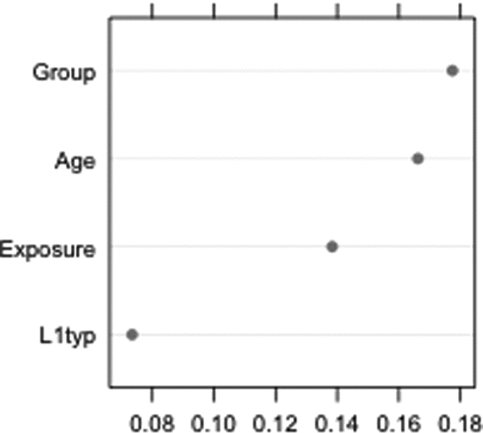
The variable importance plot in Figure 3 illustrates the impact of each predictor variable on the dependent variable according to the random forest analysis. In this set of data, group had the most impact, followed by age and exposure. L1typ followed at some distance; the impact of this variable was relatively minor. The model predictions from the random forest analysis were accurate (C = 0.91).
The impact of each predictor variable on the dependent variable according to the random forest analysis.

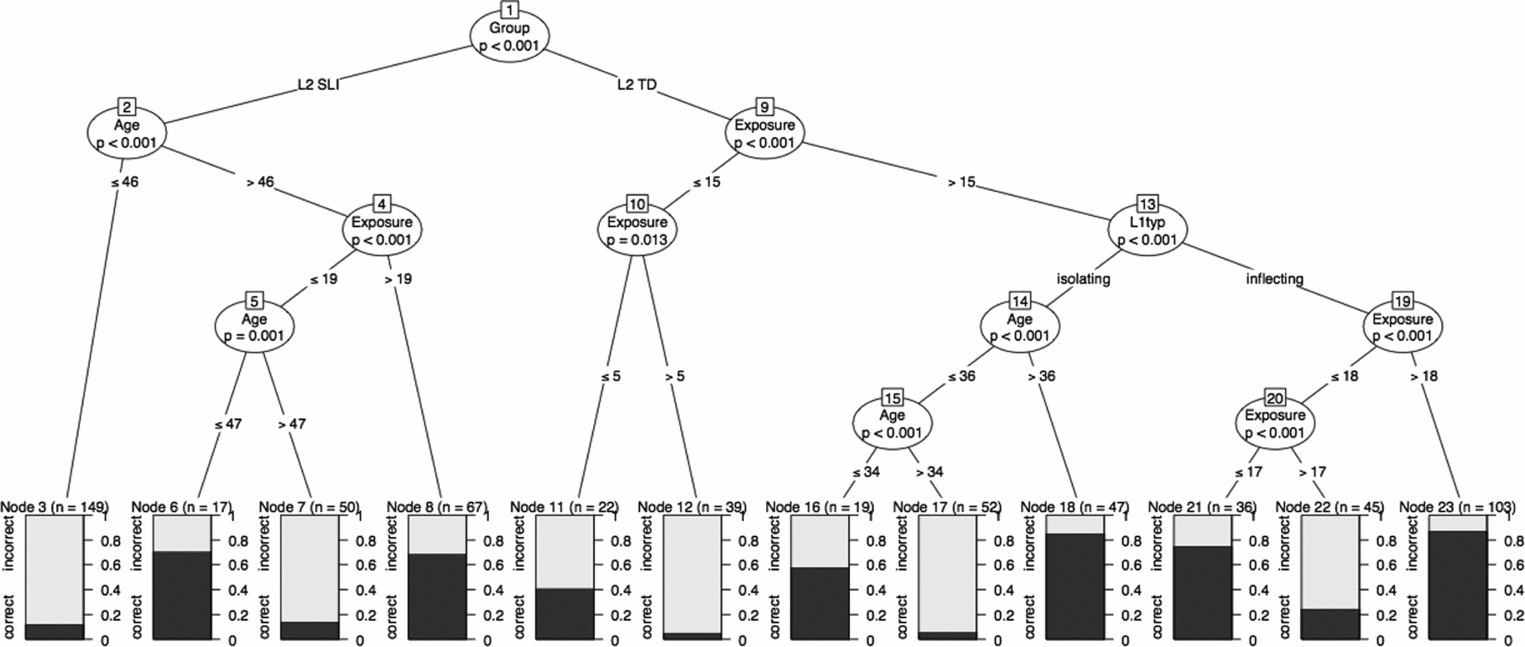
Figure 4 is the classification tree that represents the outcome of binary recursive partitioning. Binary recursive partitioning begins with the full sample of children (top of the tree in Figure 4); this sample is split into subsamples based on children that significantly differ from each other in performance. Splits are made based on the optimal classification given prespecified predictors. The lower down the classification tree, the smaller the subsamples will be. Because low numbers of observations and individual cases do not produce reliable generalizations, we decided to ignore splits lower in the classification tree. Our threshold was that a split must cover at least 60 observations (n ≥ 60). By implication, the smallest subsample will have three children, because a maximum of 20 responses was elicited per child (3 × 20 = 60). Application of this threshold leads to six relevant splits, at nodes 1, 2, 4, 9, 13, and 19 in Figure 4. The predictions of this model are accurate (C = 0.87).
The classification tree that represents the outcome of binary recursive partitioning.

The first split (Node 1) was made based on group, confirming that the TD children outperformed the children with SLI. The configuration of predictors within each group on the left and right shows how the predictor variables do not influence the TD children's acquisition in exactly the same way as they did for the L2 children with SLI. The left branch illustrates structure in the SLI group. Within this group, a split is made based on age (Node 2): children with SLI who started learning English at an older age were more accurate than children who started at a younger age. The age at which this effect of age of acquisition was most clear was 46 months: children who started L2 acquisition when younger than 46 months (roughly 4 years of age), were less accurate than children who started L2 acquisition when older than 4 years of age. Within the older age SLI group, children with exposure to the L2 longer than 19 months had higher accuracy than children with a shorter L2 exposure (Node 4). In the SLI group, L1 did not emerge as a significant predictor.
The right main branch of the classification tree illustrates the structure within the TD subsample. Within TD children, longer L2 exposure produced greater accuracy: TD children with exposure to the L2 longer than 15 months were more accurate than TD children with less than 15 months’ exposure (Node 9). The effects of the children's L1 were only relevant when TD children had passed through the first developmental stages, that is, after 15 months of exposure: At this point in development, children with an inflecting L1 were more accurate than children with an isolating L1 (Node 13). Within the subsample of TD children with an inflecting L1 and exposure of more than 15 months, we can observe a second effect of L2 exposure, indicating that after 3 more months of exposure (exposure > 18 months) performance had, again, significantly improved (Node 19).
DISCUSSION
Previous research has shown that English L2 children with language delay/SLI have difficulties acquiring tense inflection (i.e., third person –s and past tense –ed), similar to what has been reported for English L1 children with SLI (Blom & Paradis, Reference Blom and Paradis2013; Jacobson & Livert, Reference Jacobson and Livert2010; Jacobson & Schwartz, Reference Jacobson and Schwartz2005; Paradis, Reference Paradis, Haznedar and Gavruseva2008). Consistent with previous studies, the mixed effects regression analysis (Table 3), the variable importance analysis (Figure 3) and the classification tree (Figure 4) indicated that the L2 children with SLI in this study also had greater difficulties with tense inflection than their L2 TD peers. This effect was to some extent modulated by length of L2 exposure (e.g., interaction of predictors in Model 2, Table 4) such that group differences in accuracy with tense inflection were more prominent when exposure to the L2 was longer (Figure 2). The primary aim of our study was to investigate possible sources of the difficulties with tense inflection evidenced by L2 children with SLI. Individual difference factors point to resources that children use in order to acquire tense inflection: older age/cognitive maturity, longer exposure to the L2 input, and positive transfer due to having learned an L1 with rich inflection. The hypothesis that we wanted to test for this study was that L2 children with SLI use these resources to acquire tense inflection differently, possibly less, than their peers with TD. We first discuss the results for the TD group and then continue with the findings for the group with SLI.
Age, exposure, and transfer in English L2 children with TD
The outcomes of the mixed effects regression analysis in Tables 3 and 4 corroborated the idea that within childhood an older age of acquisition can support more rapid language development (Paradis, Reference Paradis2010b; Peets & Bialystok, Reference Peets and Bialystok2010). Enhancing effects of an older age of acquisition/older age at testing in L2 children have also been reported for vocabulary development (Chondrogianni & Marinis, Reference Chondrogianni and Marinis2011; Golberg et al., Reference Golberg, Paradis and Crago2008; Paradis, Reference Paradis2011) and the development of verbal morphology, both inflections and BE morphemes (Paradis, Reference Paradis, Genesee and Crago2011). In addition to the significant influence of age found in the regression model, age of acquisition contributed the most to explaining variation in this data set, as indicated by the ranking of variables in the variable importance plot (Figure 3). The classification tree analysis presented in Figure 4 suggests that the effect of age should be attributed to the SLI group more than to the TD group; we turn to this differential effect in the next section.
Speculating on what might underlie effects of age within childhood, we suggested in the introduction that age could be a variable indexing the maturation of cognitive mechanisms implicated in language learning, in particular verbal memory systems like working memory and phonological short-term memory. Therefore, older age predicting faster regular tense inflection development could mean that the development of mechanisms like verbal memory is what underlies this relationship. Verbal memory grows during childhood (Gaulin & Campbell, Reference Gaulin and Campbell1994; Gathercole et al., Reference Gathercole, Pickering, Ambridge and Wearing2004), and previous research has found support for the existence of relationships between verbal memory, on the one hand, and tense inflection performance, on the other hand (McDonald, Reference McDonald2008a, Reference McDonald2008b; Paradis, Reference Paradis2011). It is possible however that maturing cognitive mechanisms other than verbal memory, such as executive control and metalinguistic awareness, also contributed to the age effect in our study. An important next step to pursue would be to explore the multidimensional construct of age and identify the specific aspects of cognitive maturity that underlie the enhancing effect of an older age of acquisition in L2 children.
Regarding length of L2 exposure, according to the regression analysis (Tables 3 and 4), children with longer exposure to the L2 were, unsurprisingly, more accurate at using tense inflection than children with shorter L2 exposure, in line with findings reported elsewhere (Blom et al., Reference Blom, Paradis and Sorenson Duncan2012; Chondrogianni & Marinis, Reference Chondrogianni and Marinis2011; Jia & Fuse, Reference Jia and Fuse2007; Paradis, Reference Paradis2011). Within the L2 TD group, the effect of length of exposure was prominent, as indicated by length of exposure showing up as the highest classifying variable and also showing up twice as a predictor in the classification analysis (Figure 4). The first effect of length of exposure was found after 15 months, and a second effect emerged after 3 additional months of L2 exposure. Thus, children with exposure of more than 15 months were better at using correct tense inflection than children with less exposure. Within the group of children with over 15 months of exposure, a second effect of exposure emerged, showing that children with more than 18 months of exposure were more accurate than children with 18 or fewer months of exposure. This second effect emerged in the group of children with inflecting L1s only. We discuss this interaction between exposure and L1 below in greater detail.
Consistent with previous studies (Blom & Baayen, Reference Blom and Paradis2013; Blom et al., Reference Blom, Paradis and Sorenson Duncan2012; Dulay & Burt, Reference Dulay and Burt1974; McDonald, Reference McDonald2000; Paradis, Reference Paradis2011), the regression analysis found that rich inflection in the L1 supported English L2 children's development of English tense inflection (Tables 3 and 4). The classification analysis in Figure 4 indicated that this overall effect was largely due to the performance of the TD group. The ordering in the classification tree revealed that within this group, effects of the L1 became noticeable after 15 months of exposure to English, as noted above. This postponed transfer effect replicates previous findings that transfer effects in the domain of verb inflection development become visible when L2 learners show neither floor nor ceiling effects (Blom & Baayen, Reference Blom and Paradis2013) and show developmental readiness for transfer (Wode, Reference Wode and Wode1983; Zobl, Reference Zobl1980). Such developmental readiness is to be expected because in order to make use of overlap between the L1 and L2 some L2 knowledge is needed. For example, children should be able to identify verbs in the L2 to be able to transfer L1 verb inflection knowledge.
Age, exposure, and transfer in English L2 children with SLI
The classification analysis (Figure 4) revealed that the positive influence of an older age was stronger in children with SLI than in children with TD. The dividing point in the SLI group was the age of 46 months (3;10). Thus, in this sample, children with SLI who started learning English after this age performed significantly more accurately than children with SLI who started learning English before age 3;10. We hypothesized that such an age effect, in both the TD and SLI group, could be attributed to a larger verbal memory that facilitates learning tense inflection by retaining phonological and functional/semantic information. Because children with SLI have been found to have deficits in verbal memory (Archibald & Gathercole, Reference Archibald and Gathercole2006; Ellis Weismer et al., 1999; Henry et al., Reference Henry, Messer and Nash2012; Leonard et al., Reference Leonard, Weismer, Miller, Francis, Tomblin and Kail2007; Miller et al., Reference Miller, Kail, Leonard and Tomblin2001; Montgomery & Windsor, Reference Montgomery and Windsor2007) compared to their TD peers, this could explain why an older age of acquisition is even more advantageous for these children; their L2 learning capacity might grow even more with age than for TD children because of the deficits they have in language-learning mechanisms earlier on.
The second variable that showed a differential effect between the TD and SLI groups was length of L2 exposure. The interaction effects that emerged, both in the mixed logistic regression analysis (Table 4) and in the classification analysis (Figure 4), indicate that for the same length of exposure to the L2, TD children reached higher accuracies than children with SLI. This finding supports the idea that children with SLI make less efficient use of environmental stimuli than their TD peers, possibly because they have processing capacity limitations, notably in verbal memory and speed of processing (Leonard, Reference Leonard1998; Leonard et al., Reference Leonard, Weismer, Miller, Francis, Tomblin and Kail2007). However, length of exposure did positively influence the children with SLI who had a somewhat older age of acquisition, as indicated by the classification analysis (Figure 4): within the (left) SLI branch, L2 exposure is identified as a predictor only for children with an age of acquisition above 46 months (3;10). This subsample of older L2 children with SLI may have had more developed cognitive mechanisms for learning tense inflection. Cognitive growth may have put the older SLI subsample more on equal footing with the TD group as a whole with respect to learning mechanisms; therefore, the effects of longer exposure time also emerged for them. Even though there was a length of exposure effect for the older L2 children with SLI, these children needed more than 19 months of exposure for this effect to emerge, whereas the TD children needed more than 15 months of exposure. Therefore, despite some potential catching up with respect to developing cognitive mechanisms, it still took the older children with SLI a longer period of L2 exposure for this factor to begin to influence their L2 tense inflection.
The classification analysis (Figure 4) enables us to conclude that, in this sample, supportive properties of the L1 were clearly more important for the TD children than for the children with SLI. Thus, although previous findings might suggest that L2 children with SLI can make some use of their prior experience with L1 verb inflection when learning L2 verb inflection (Armon-Lotem, Reference Armon-Lotem2010; Armon-Lotem et al., Reference Armon-Lotem, Adam, Blass, Fine, Harel, Saiegh-Haddad, Leikin, Tobin and Schwartz2012), our data indicate that L2 children with SLI make less efficient use of L1 knowledge as a resource for learning inflectional morphology than do their peers with TD. This finding on effects of transfer allows us to reflect on ideas expressed in a series of responses to Paradis’ (Reference Paradis2010a) keynote article on the interface between bilingualism and language impairment. In various responses it is suggested that L2 children with SLI might make use of their L1 as a compensatory mechanism (Armon-Lotem, Reference Armon-Lotem2010; De Jong, Reference De Jong2010; Hulk & Unsworth, Reference Hulk and Unsworth2010). For instance, L1 knowledge could counteract the detrimental effects of processing capacity limitations on the language development of children with SLI in the L2 context (Paradis, Reference Paradis2010a). Processing capacity limitations, that is, less verbal memory capacity and slower speed of processing, are expected to influence how efficiently children with SLI are able to intake external input information, which may in part explain the linguistic profile of children with SLI, as pointed out in the introduction. The same limitations are equally likely to impact how efficiently children can make use of internal resources, such as cues and attentional focus, developed for processing the L1. Therefore, some compensatory effect of L1 knowledge could be expected in L2 children with SLI but only to a limited extent. The results of this study support this deduction.
CONCLUSION
The results of this study showed that L2 children with SLI make less efficient use of two resources for L2 learning than their TD peers: (a) L2 exposure and (b) L1 transfer. Both these findings are consistent with the idea that processing capacity limitations underlie the language difficulties in children with SLI. In contrast, results of this study showed that an older age of acquisition was associated with more accurate use of tense inflection for both children with TD and with SLI, although the impact of older age was more pronounced for the SLI group. This result suggests that the internal cognitive mechanisms that drive language learning continue to develop in children with SLI in the early elementary school years, as they do in children with TD.
ACKNOWLEDGMENTS
This research was supported by a Marie Curie International Fellowship IOF-219276 within the 7th European Community Framework Programme (to E.B.) and by Grant 200800618-2 from Alberta Innovates-Health Solutions, Grant 090415INV from the Alberta Centre for Child, Family and Community Research, and Grant 27061500 from the Canadian Language and Literacy Research Network (to J.P.).