Introduction
This article examines changing dynamics in the interactions between Sunni and Shia MuslimsFootnote 1 and Christians in contemporary northern Nigeria. Sunni Islam, based on Maliki law, has dominated Nigeria since its introduction to the region as far back as the fourteenth century. Until the 1970s, when the anti-Sufi Salafi reform movement known as Jamā’ atu Izalatul Bid’ ah wa’ iqā matul Sunnah (the Society for the Eradication of Innovations and Establishment of Sunna (Izala)Footnote 2 emerged as a branch of Sunni Islam, the vast majority of Muslims were followers of Qadiriyya and Tijaniyya, two prominent Sufi brotherhoods in Nigeria.Footnote 3 Christianity, which also predated colonialism, has nationally become one of the largest religions in postcolonial Nigeria. While we lack reliable statistical data on religious demography in Nigeria, scholars often treat the country’s population as closely divided between Muslims and Christians (Paden Reference Paden2006; Janson Reference Janson2021). In the north, Islam is the dominant religion, although substantial Christian pockets exist, particularly in the Middle Belt region. The vast majority of Muslims fall under the broader categorization of Sunni Islam, comprising Sufis (Qadiriyya, Tijaniyya and others), Salafis (Izala and Salafiyya followers) and those who prefer to be addressed as mere Sunnis. However, since the early 1990s, the number of Muslims identifying with Shia Islam as opposed to Sunni Islam has increased remarkably. Shia’s presence in northern Nigeria’s public space is becoming ubiquitous. This makes both Shia Muslims and Christians minority religious groups in the predominantly Sunni Muslim north. While Sunni Muslims have their internal tensions based on contradictory theological interpretations by different Sunni factions (to be discussed later), they are socially and politically united in matters related to religion in the broader context of Nigeria as a nation state. However, the division between Sunni and Shia is both political and theological, thus making the Shia presence in northern Nigeria complex, as Shia Muslims deal with religious politics in a different way from the majority of Sunnis. They sometimes turn to Christians for partnerships, a dynamic that is producing new patterns of socio-religious interactions in contemporary Nigeria.
Muslims and Christians have peacefully coexisted in northern Nigeria for a long time. Shobana Shankar’s monograph (Reference Shankar2014) has presented us with the nuances of these peaceful encounters, which are ongoing. However, following the 1979 controversy over the status of sharia in the nation’s legal system, studies on Muslim–Christian encounters in northern Nigeria started to emphasize conflict. Thanks to the regional- and ethno-religious-based politics that heightened tension and increased mutual distrust, rivalry and acrimony dominated encounters between adherents of the two religions in northern Nigeria (Laitin Reference Laitin1982). The incessant interreligious conflicts that were a result of the politicization of religion gradually reconfigured how Muslims and Christians lived in northern Nigeria. In Kaduna State in 1987, for example, the religious riot in Zangon Kataf drove many Muslims out of Kaduna South (Ibrahim Reference Ibrahim1989), while the 2000 sharia riot drove Christians out of Kaduna North, splitting the state and the township along religious lines (Angerbrandt Reference Angerbrandt2011; Harris Reference Harris2013). The southern parts of both the state and the township are now predominantly Christian and immigrant (from the Middle Belt), whereas the northern parts are predominantly Muslim. A similar process happened in Jos, Plateau State, where the township is now divided between Christians and Muslims (Harnischfeger Reference Harnischfeger2004; Reference Harnischfeger2006; Krause Reference Krause2011).
Even before the interreligious crises that started in the 1980s, religious segregation existed in some northern states. For example, a mud wall built between 1095 and 1134 surrounds Kano city for defence against external aggression. After the arrival of the British in 1903, this mud wall was used to segregate the old, Muslim, Kano city (birni) from the Nasarawa (European) township and Sabon Gari (New Town), which is the area where mainly Christian migrants arriving from southern Nigeria settled in large numbers. Sabon Gari was and still is considered an area of ill repute by some Muslims (Larkin Reference Larkin1999; Barkindo Reference Barkindo and Brenner1993). It stands as the moral antithesis of the birni, where church buildings, brothels and bars are banned, while female seclusion (purdah) and other Islamic practices are maintained. From the 1960s, newly established quarters outside the old city wall (waje) became destinations for some migrant workers and traders arriving in Kano. Thus, Christians and Muslims lived side by side in suburban areas such as Brigade, Mariri, Na’ibawa and Kurna. However, following a series of interreligious crises in the 1990s, some Christians living in those areas either relocated to Sabon Gari or left the state for other Christian-dominated areas. Moreover, since the reintroduction of sharia in 2000, hisbah (sharia enforcers) have remapped the boundaries where Islamic ‘authenticity’ and morality apply in these suburban neighbourhoods, making ethnic Muslims, non-Muslims and marginal Muslims such as Yanbori the targets of sharia enforcement (Casey Reference Casey2008). While this has increased the mass relocation of Christians and marginal Muslims to Sabon Gari, the continuous arrival of new migrants to Kano has led to the emergence of new Christian-dominated settlements, mostly close to the military and police barracks, such as Panisau, Janguza and Panshekara.
In general, religious tensions across the north from the 1980s to the 2000s have forced people of different faiths to relocate to areas they consider safe based on their religious identity. A Hausa Christian from Kano or a Fulani Christian from Sokoto would consider it safer to live in the Christian-dominated Middle Belt. Similarly, a Tarok Muslim from Plateau State or an Atyap Muslim from southern Kaduna may feel safer living in Katsina. Over time, these dynamics have led to the gradual physical remapping of northern Nigeria on religious grounds, with the predominantly Christian populated Middle Belt divided from the rest of northern Nigeria. Although the Middle Belt became the epicentre of the crisis between predominantly Muslim Fulani herders and predominantly Christian farmers from various ethnic groups, Christian Fulani are well tolerated in this region. For example, the religious group that calls itself ‘Fulani Christian’ is able to hold its seasonal public meetings in the Christian-dominated areas of the Middle Belt.
While the conflict-induced remapping of northern Nigeria is ongoing, the adherents of the two religions continue to interact across faiths and physical boundaries. Last (Reference Last2007), Larkin and Meyer (Reference Larkin, Meyer and Akyeampong2006) and Shankar (Reference Shankar2014) emphasize interesting alternative perspectives for understanding non-conflicting interactions between the followers of the two religions. However, if one compares literature on Christian–Muslim encounters produced in the north and the south, one would agree that they tend to produce stereotypes that portray both Muslims and Christians in the south as practising a ‘tolerant’ version of their religions while their counterparts in the north are more ‘conservative’ and ‘fanatical’. This pattern exemplifies what Benjamin Soares (Reference Soares2016: 673) refers to when cautioning that ‘the multiplicity of practices of pluralism, including the personal pluralism of individuals and groups who might engage with different religions or religious practices’, is disregarded if scholars’ efforts are limited within the boundaries that divide Islam and Christianity and within the geographical regions occupied by the adherent of the two traditions. For example, many scholars have addressed the rise in fundamentalist Christianity and Islam in northern Nigeria (Ibrahim Reference Ibrahim1989; Obadare Reference Obadare2004; Nmah and Amunnadi Reference Nmah and Amunnadi2011; Akubor and Ayogu Reference Akubor and Ayogu2020), not to mention Boko Haram and other jihadi groups that have dominated the study of Islam in the north (Thurston Reference Thurston2017a; Zenn Reference Zenn2020; Brigaglia and Locchi Reference Brigaglia and Locchi2020; Ibrahim Reference Ibrahim2019). Meanwhile, other scholars have shown how religious tolerance and pluralism exist among the Yoruba, which is the dominant ethnic group in south-western Nigeria (Janson Reference Janson and Uchendu2012; Reference Janson2016; Reference Janson2021; Janson and Meyer Reference Janson and Meyer2016; Williams Reference Williams2019; Peel Reference Peel2016).
Highlighting the views of some informants in her study area, Janson (Reference Janson2016: 652) mentioned that, ‘if Chrislam [a term for religious groups that combine elements of Christianity and Islam] were to have emerged in Hausaland in Northern Nigeria, “the founders and their followers would have been dead by now, because, unlike the southwesterners (Yorubas), northerners are not tolerant”’. While it is true that conflicts are more prevalent in the north than in the south-west, this academic perspective on a lack of religious pluralism in northern Nigeria has been compounded by the fact that there is a paucity of literature on Muslim minorities and new religious movements in that part of the country. When minority groups such as Shias are studied in this region, the focus is mostly on crises with either the Sunni majority (Sulaiman Reference Sulaiman, Tsiga and Adamu1997; Adam Reference Adam2016; Isa Reference Isa2018) or the Nigerian state (Hayatu Reference Hayatu2018; Hayatu et al. Reference Hayatu, Othman and Shariffuddin2017; Anjide and Okoli Reference Anjide and Okoli2017; Uche Reference Uche2019).
Based on ethnographic research in Kano, Kaduna, Plateau and Sokoto states, this article contributes to the understanding of Muslim–Christian relations in the north by analysing changing dynamics in the interactions between Sunni and Shia Muslims and Christians in the region. The emergence of the Shia group as a new actor in Nigerian religious and political spheres calls for the need to re-examine how intra- and interfaith encounters change religious cultures in Nigeria. This is more relevant considering how the Sunni-led sharia implementation either targeted already existing marginal Muslims or created new ones. Thus, I discuss how the intentional religious re-alliance initiated by Shia Muslims consciously creates shared experiences and thus a sense of commonality with Christians in the face of political marginalization by the Sunni. Beyond political solidarities in times of crisis, ideas and rituals circulate between Shia Muslims and Christians. One example is the Shia invention of Jesus’s Mawlid (Jesus’s birthday commemoration), which is unlike the conventional Christmas. In contrast to narratives that emphasize physical and spiritual differences between Muslims and Christians, these novel Shia rituals are attended by some Christians and performed at locations that were previously closed to Christians because of the aforementioned urban religious segregation. Despite the adherents of the two religions participating in mixed religious practices, they continue to see themselves separately as Muslims and Christians. These dynamics have elicited reactions from Sunni Muslims, who have also been contending with internal disputes, especially between Sufi and Salafi groups. In contrast to studies that illustrate borrowing and appropriation in the context of close neighbourly or familial relationships, this case study illustrates a much more intentional political process, whereby Shia Muslims consciously create shared experiences with Christians in order to establish a sense of commonality in the face of political marginalization.Footnote 4 By doing so, it adds to the understanding that the concept of ‘tolerance’ is not sophisticated enough to capture all forms of religious coexistence.
The following section presents a brief history of Shia Islam in Nigeria, followed by an analysis of sharia implementation as a turning point in the encounters between Sunni and Shia Muslims and Christians. The penultimate section presents debates within Shia Islam about the commemoration of Jesus’s birthday and how politically motivated borrowing from Christians by Shia Muslims creates shared experiences that reconfigure religious practices across boundaries. The last section discusses the impacts of those practices on Sunni Muslims.
Shia Islam in Nigeria
Shia Islam is a small but fast-growing minority Muslim group in Nigeria. Its history dates back to Lebanese, Syrian and Yemeni communities, which constituted an exclusivist minority religious group in the nineteenth century (Isa and Adam Reference Isa and Adam2017; Sule and Abdullahi Reference Sule and Abdullahi2019). However, inspired by the 1979 Islamic revolution in Iran, some Sunni Muslims in Nigeria started converting to Shia Islam. Conversion to Shia Islam stimulated by Iran began in 1980 when the Iranian government invited some young Muslim students under the Muslim Students’ Society of Nigeria (MSSN) to attend the first anniversary of the Islamic Revolution in Tehran (Sule and Abdullahi Reference Sule and Abdullahi2019). Among the delegates was Shaykh Ibrahim el-Zakzaky, the deputy vice president of the MSSN and leader of Yan’uwa Musulmi (Muslim Brotherhood), a religious movement modelled after the Sunni Muslim Brotherhood in Egypt and Sudan (Ben Amara Reference Ben Amara2020). Subsequently, the Iranian Islamic government sent a delegation to Nigeria in appreciation of the MSSN visit. Later, the Iranian government established a base in Nigeria and continued to interact with individual members of the Yan’uwa Musulmi, paving the way for the conversion of some of its members to Shia Islam (Bunza Reference Bunza and Gomez-Perez2005).
However, Shia Muslims gained public prominence in Nigeria in the 1990s when Shaykh Ibrahim el-Zakzaky declared himself a Shia Muslim and attempted to transform Yan’uwa Musulmi into a Shia movement. This move was met with resistance from some leading members of the group, leading to its disintegration into two factions. Malam Abubakar Mujahid Zaria led a group called Jama’atu Tajdidul Islam (Society for Renewal of Islam or JTI) to continue activism based on the Yan’uwa Musulmi’s Sunni founding tenets and rejected any influence from Iran. Shaykh el-Zakzaky named his faction Harkat al-Islamiyah fi Nigeria (Islamic Movement in Nigeria or IMN). IMN adopted the Twelver Shiism dominant in Iran as its guiding theology for establishing an Islamic government in Nigeria (Ben Amara Reference Ben Amara2020; Thurston Reference Thurston2017b; Reference Thurston2020).
Before his conversion to Shia Islam, Shaykh el-Zakzaky declared that he did not recognize any authority in Nigeria apart from that of Allah and sharia, a proclamation known as bara’a (revolt) or the ‘Funtua Declaration’. When he became a Shia Muslim, he upheld the same view, which means that he and his followers do not seek government permission for anything they do, making their relationship with Nigerian security personnel hostile. As a result, many IMN Shia members have died in various clashes with the Nigerian police and military during public religious processions and protests, which the Nigerian security personnel consider illegal (Hayatu et al. Reference Hayatu, Othman and Shariffuddin2017; Uche Reference Uche2019; Thurston Reference Thurston2020).
Given the confrontational attitude of IMN Shias towards the Nigerian state, and the fact that most government positions are held by Sunnis, tensions between Shia and Sunnis heightened. This also caused internal tension within the IMN as some members accused el-Zakzaky of prioritizing politics over Shia theology. Consequently, three smaller Shia factions emerged: Rasul A‘Azam Foundation, led by Shaykh Muhammad Nura Dass; Darul Thaqalain, led by Malam Isa Makama (Isa and Adam Reference Isa and Adam2013); and a third faction led by Shaykh Hamza Lawan, a former el-Zakzaky chauffeur who went to Iran to study, and, when he returned, broke away from el-Zakzaky and established his own small Shia group in Kaduna. The major difference between these factions and IMN is that the former choose to be apolitical by avoiding activities that may annoy the Nigerian government; rather, they concentrate on theological and educational activities. While Shia Islam expands in northern Nigeria, the resentment between three of its factions and the Sunni majority continues on different scales. This is also tied to the Middle East’s political tension, particularly between Saudi Arabia and Iran. While the Sunni Muslims accuse Iran of promoting Shia Islam in Nigeria, the minority Shia Muslims counter-accuse Sunni Muslims of denying them their religious freedom by using Saudi resources to ‘Salafize’ the region.
Another major incident in the history of Shia Islam in Nigeria was IMN members’ encounter with the Nigerian military. In December 2015, when the IMN Shia group was holding one of its religious gatherings in Zaria city, some of its youth occupied both lanes of the road that passes through the racecourse in Zaria, leading to the venue for their event.Footnote 5 This was not unusual. Normally, Shia marchers from Sokoto, Zamfara and Katsina, as well as those coming through Kano from north-eastern Nigeria, processed along the main flyover and highway in Zaria, blocking the traffic. Coming off the flyover, the Nigerian army chief’s motorcade had to pass by the racecourse to visit military barracks. However, the Shia youth occupying the road refused to allow them passage. A viral video recorded during the event showed the Nigerian army chief pleading with the Shias to let them pass; the latter insisted that they would allow them to pass only on the authority of their leader, Shaykh el-Zakzaky, who was not there to decide. The military convoy, as a federal unit, did not expect to be obstructed, let alone to seek permission from Shaykh el-Zakzaky, who had no civil standing either in Zaria city or in Kaduna State. Hence, the military saw the blockade as an insurrection and eventually forced their way through. This skirmish and the subsequent violent clashes led to the deaths of hundreds of Shia members. Many were arrested, including Shaykh el-Zakzaky and his wife.Footnote 6 Since then, the relationship between the Nigerian government and IMN Shias has continued to deteriorate, especially with the Shias persistently protesting on the streets of major northern Nigerian cities and Abuja, demanding the release of their leaders and members in detention.Footnote 7
Simultaneously, polemics increased between Shia and Sunni leaders (both Salafis and Sufis). An example of this is the public speeches of Muhammadu Sanusi II, the former emir of Kano and current Khalifa (supreme leader) of the Tijaniyya in Nigeria. He publicly rejected Shia Muslims by stating that ‘northern Nigeria’s Islam’ was founded on Sunni tenets and ‘will continue to be Sunni’.Footnote 8 In addition, he sometimes supported government clampdowns on Shia Muslims. The latter often respond through some of their prominent members, such as Haruna Elbinawi, a Shia Muslim blogger. His response to Sanusi reads:
Another malicious insinuation of Emir Sanusi is equating Shia Islam with murderous terrorist cults like Maitatsine and Boko Haram that are offshoots of Sunni Islam. These terrorist groups, from day one, were hell-bent on killing innocent civilians; they are murderous entities that only know how to kill people and they are not offshoots of Shia Islam. There is nowhere in the world where Shia Muslims are terrorists, terrorism has no place in Shia Islam because the Shia religious references will never approve it. Sheikh Zakzaky started his call more than 37 years ago, and no single innocent person had been killed. (Bamidele Reference Bamidele2015)
Elbinawi’s rejoinder was just one of the several responses by IMN members countering how Sunnis were labelling them terrorists and supporting government clampdowns against them. In June 2019, a federal high court in Abuja designated the IMN as ‘terrorists’ and ordered the federal government to ban the group (Adepegba Reference Adepegba2019); this happened the following month.Footnote 9 Despite banning the IMN and government recognition of Shia splinter groups, the IMN remains the largest, most visible and most active Shia organization in Nigeria.
‘Brothers united through Jesus’: sharia implementation as a turning point in Shia Muslim–Christian encounters
In 1999, when the Nigerian military organized elections and handed over power to democratically elected civilians, some Sunni Muslims (comprising both Salafi- and Sufi-oriented clerics, activists and politicians) used the opportunity to promise the electorate it would campaign to implement radical sharia reforms if elected. By the end of 2001, twelve northern states declared sharia as their state laws (Ostien Reference Ostien2007; Kendhammer Reference Kendhammer2016). Whereas many current observers focus on sharia implementation as the nearly complete ‘Islamization’ of Muslim-majority states in northern Nigeria, I am interested in how it changes the pattern of relationships within the Sunni, and between Sunnis, Shias and Christians. Both Christians and Shia Muslims opposed the sharia reintroduction for similar reasons. Shia Muslims opposed it because they knew that sharia interpretations based on Sunni canons would be detrimental to their preaching, particularly since some Salafis consider them non-Muslims. Christian groups who work to convert Muslims and traditionalists (Maguzawa) to Christianity in the region, especially in the rural areas, resisted sharia because they suspected that their missionary activities would be targeted.
As discussed above, the aftermath of sharia implementation saw tensions among Muslims and between Christians and Muslims across northern Nigeria. In the year 2000, pro- and anti-sharia demonstrators clashed in Kaduna, a Muslim-majority state with a large Christian minority. What started as peaceful anti-sharia demonstrations turned into a violent clash between Christians and Muslims that killed hundreds of people. Shia Muslims, who rejected the Sunni sharia implementation, supported Christian minorities during the conflict. These dynamics propelled major social, political and religious divisions between northern (Muslim) Kaduna and southern (Christian) Kaduna. Until recently, both northern and southern parts of Kaduna State were part of the Zaria emirate, with an emir at Zaria as its head.
The emir of Zaria appointed chiefs and district heads in Kaduna State. Under this structure, chiefs reported to district heads, who in turn reported to the emir. However, under the administration of Kaduna State governor Ahmed Makarfi (1999–2007), the south of Kaduna, which was formerly called southern Zaria, was able to leave the Zaria emirate by establishing its own non-Muslim-majority monarchies. In addition, some Shia-dominated neighbourhoods outside the walls of Zaria city, between Tudun Wada and Zango, and those created around el-Zakzaky’s house are strategically closed to non-Shias, a development that reflects a further remapping of neighbourhoods based on faith within the Zaria emirate.Footnote 10
The 2000s also corresponded with the global aftermath of 9/11, which provoked a dramatic reduction in Saudi Arabia’s outreach programmes, necessitating Nigerian Salafis to fundraise locally and establish income-generating businesses such as schools and sharia-compliant hotels. The pendulum of international support swung to Iran, and it was during this period that the Shia Muslim membership quickly expanded in Nigeria through IMN. Since its formation, IMN has attracted largely Sunni converts through incentives available to its economically disadvantaged members, including access to free health and education facilities of a decent standard, entrepreneur training and support, and individual welfare packages for those most in need. While it is challenging to find reliable statistics in Nigeria, in 2009 the Pew Research Center estimated Shia Muslims to comprise less than 5 per cent of Nigeria’s total Muslim population.Footnote 11 In 2020, Shia leaders in Nigeria estimated that they numbered over 10 million.Footnote 12 The rapid expansion of the Shia population escalated the tension between them and Sunnis, with both sides accusing the other of getting support from either Saudi Arabia or Iran to ‘Salafize’ or ‘Shia-ize’ Islam in northern Nigeria, making their relationship increasingly hostile.
Nevertheless, Shia Muslims’ efforts to build a relationship with Christians in northern Nigeria became prominent after sharia re-implementation starting in late 1999, when conflicts between Christians and Muslims became frequent. El-Zakzaky, who was previously imprisoned for inciting religious violence, found common ground with Christians in two ways. First, he labelled the uprising associated with the sharia declaration by Sunnis as a jabun jihadi (fake jihad); second, he condemned attacks on Christians. In many of his sermons and lectures, he expressed his concern that the motive behind sharia was not genuine. El-Zakzaky cautioned his followers against participating in any conflict resulting from the Sunni sharia project by pointing out to them that their problem was not with minority Christians but with the ruling elites who oppress people of all faiths. He often links this discourse to his IMN mission, which, according to him, is to establish a ‘true’ Islamic system in which ‘social justice’ will prevail for Muslims, Christians and traditionalists. Among the major discernible distinctions between el-Zakzaky and the local Sunni discourse of an Islamic state was el-Zakzaky’s emphasis on improving Muslim–Christian relations. However, he is often vague about how he plans to achieve this. Take, for example, his clarification of what he meant by coexistence between Muslims and non-Muslims in the following excerpt:
When we say we will live peacefully with people of other religions, we do not mean that there would be no difference between Muslims and non-Muslims. What we are saying is that we will coexist peacefully with non-Muslims under an Islamic state in the same way Prophet Muhammad did. He lived peacefully with Jews and Christians in Medina. The setting was an Islamic one in which Jews and Christians lived under trust [amana]. Subsequently, Muslims and followers of divergent religions have coexisted within many Muslim empires [Daulat] under the same context of amana. This is the teaching of Prophet Muhammad, which we are going to re-enact.Footnote 13
Although el-Zakzaky had previously led religious protests that turned into violent clashes between Muslims and Christians, the changing tone in his preaching towards accommodating Christians under his leadership indicated a major shift in his strategy. His words were also followed by practical examples when Shia Muslims protected Christians during violent interreligious conflicts. For example, during the 2011 post-election violence that took on a religious dimension, Shaykh el-Zakzaky and his followers sheltered many Christians in their houses and treated those wounded in Kaduna and Bauchi states. Many Christian groups in northern Nigeria recognized this gesture in their public speeches, and, following that moment, a new alliance between minority Shia Muslims and Christians arose. This was also happening amidst the gradual hardening of Sunni beliefs through the activities of hisbah in some states where Christian residents and marginal Muslims felt threatened and even harassed by them (Ibrahim Reference Ibrahim2022). Thus, both Shia Muslims and Christians began to recognize their commonalities as minority religious groups in northern Nigeria and started to coordinate their resistance against the political and social domination of the Sunni majority, including participating in each other’s religious rituals. For example, while the legality of celebrating Christmas by Muslims is contested, with some Salafi hardliners declaring it as haram (against sharia), the IMN Shia members started to attend Christmas and Easter events in churches. That was at the insistence of their leader, Shaykh el-Zakzaky, who enjoined his followers to explore dialogue with Christians in the region.
At Christmas, Shia Muslims attend church services and sit inside church halls while Christians worship. After the services, they feast together, and IMN Shia members address the Christian congregants as their ‘brothers united through Jesus’. These events become annual occurrences in some predominantly Muslim states such as Bauchi, Kaduna and Kano and in some predominantly Christian states such as Plateau and Taraba in northern Nigeria. Although this practice became prominent in the early 2010s, it became more coordinated after the deadly clash of December 2015 between Shia Muslims and the Nigerian army in Zaria. In December 2016, IMN coordinated a Christmas visit to churches across many northern states where the group has members. They presented a uniform sermon, part of which reads as follows:
In the covenant with Christians of Najran, the Prophet (SAWA) had stated: ‘I will protect their religion and their Church wherever they are found, be it on earth or at sea, in the West or in the East, with utmost vigilance on my part, the People of my House, and the Muslims as a whole’ … In the Charter of Medina, our Prophet (SAWA) guaranteed equal rights and freedoms to Christians and Jews. ‘Christians are my citizens, and by God, I hold out against anything that displeases them. No compulsion is to be on them. Neither are their judges to be removed from their jobs nor their monks from their monasteries. No one is to destroy a house of their religion, to damage it, or to carry anything from it to the Muslims’ houses. The Muslims are to fight for them. Their churches are to be respected. No one of the Muslims is to disobey this covenant till the Last Day.’ We therefore hold these covenants very dear. That is why this same hospitality is displayed by our leader, Sheikh Zakzaky, who follows the true teachings of the Prophet (SAWA) and his legacies. He showed us that Christians are not our enemies, but our brothers and sisters in humanity … Christians are at home during our programmes. For several Christians, his house is a preferred place of refuge in times of crisis. He sends us adherents to attend churches to protect them and also during Christian celebrations such as this …
Like I mentioned earlier, both Jesus and Imam Mahdi will work together. If we join forces from now against tyranny and oppression, we will be laying a good foundation for them. When they both return, they must see us prepared to assist them in their Divine mandate. It is on this basis that I call on Christians to team up with us. The Church should join the struggle against oppressors and tyrants. Together, we can champion unity among all religious people and take a unified stance against aggressive leaders. I, therefore, implore you to stand by us and our leader and all oppressed people in the country and against aggression and discrimination.Footnote 14
This message was read simultaneously by Shia Muslim leaders in different churches across the region and became a template for subsequent Christmas messages by Shia Muslims who visited churches. For instance, the following year, Dr Shu’aibu Musa, one of the IMN leaders in Kaduna, emphasized the same message that the Shias celebrate ‘the birth of he whose return has been foretold by our Prophet to herald the appearance of the awaited one Imam Mahdi’ (Mortimer Reference Mortimer2017). Fast forward to 2020, and the trend of Shias using Christmas to renew the Prophet Muhammad’s covenants with Christians and remind themselves about the return of both Jesus Christ and Imam Mahdi continues. An example of this was the Christmas speech of Mallam Muhammad Amin, an IMN leader in Nasarawa state (Dungs Reference Dungs2020).
On all occasions, Shias take pictures and record videos of their Christmas festivities, which they publicize through various media platforms, including their own newspapers (al-Mizan and The Pointer), Twitter, Facebook, WhatsApp and Telegram. The online comments generated by such publicity are mixed. While some self-identified Sunni Muslims and others mostly condemn the practice as sacrilegious, self-identified Shias and Christians largely commend the initiative. In sum, while the debates highlight tensions between Sunni and Shia Muslims and Christians, they also show how ordinary Shias and some Christians are expressing a willingness to work together. It is apparent, based on online discussions, that Shia Muslims and Christians mainly collaborate because of their status as religious minority groups in northern Nigeria.
At the institutional level, while many Christian leaders in the north describe this Shia innovation as ‘genuine’,Footnote 15 it also regenerates heated debates within Muslims over the legality of celebrating Christmas. Some Sunni clerics, particularly those belonging to the Salafi group, respond to the innovation with a series of sermons that condemn the casual celebration of Christmas by Muslims as ‘un-Islamic’, particularly when this occurs in churches alongside Christians. However, rather than relenting, Shias have intensified the practice. By 2020, some newspapers were reporting that Muslims outnumbered Christians in some churches during Christmas celebrations in northern Nigeria (HassanWuyo Reference HassanWuyo2020).
Shia Islam and the commemoration of Jesus’s Mawlid in Nigeria
While Shias innovate practices in order to bond with Christians, it is also obvious that they seek to publicly challenge Sunni norms. For example, IMN invented ‘Jesus’s Mawlid’ (Jesus’s birthday), which they celebrate annually, albeit in a different manner from the conventional Christmas (in both beliefs and practices). It is worth pointing out here that they are code switching when naming the event. In Hausa, they call it ‘Maulidin Annabi Isa’ (celebrating the Prophet Jesus’s birthday) – analogous to ‘Maulidin Annabi Muhammadu’ (celebrating the Prophet Muhammad’s birthday). However, since they also speak English, and to give the event an Islamic aura, they self-translated it as ‘Jesus’s Mawlid’ instead of Jesus’s birthday or Christmas. Some Shias who were among the founding members of IMN, told me that this new practice is based on their understanding of the Qur’an 2.285, which says that Muslims must believe in all prophets sent by God and are mandated not to discriminate against any. Therefore, since they celebrate Prophet Muhammad’s birthday, they also feel obliged to celebrate those of other prophets, especially those known as ‘ulul-‘azm (the resolute prophets) mentioned in the Qur’an 46.35 and in some hadiths (prophetic traditions). These prophets are Nuh (Noah), Ibrahim (Abraham), Musa (Moses), Isa (Jesus) and Muhammad. However, Shias publicly celebrate only the last two.
In Shia theology, there is a strong connection between ‘ulul-‘azm prophets and the Twelver Shia imams through wilaya (authority). They believe in a hadith in which the imams are introduced as inheritors of the knowledge, miracles and virtues of the ‘ulul-‘azm prophets. While some Shias told me that a few of them had been privately commemorating some selected prophets’ birthdays in their houses since the mid-1990s, public commemoration of Jesus’s Mawlid together with Christians started in the mid-2010s, with the approval of their leader, Shaykh el-Zakzaky. It has become an annual ritual organized by the Youth Forum of IMN in states such as Adamawa, Bauchi, Kaduna, Kano, Katsina, Niger, Plateau, Taraba and Abuja.Footnote 16 The size of the events depends on the local population of Shias and the level of mobilization they receive from the youth leaders in each city.
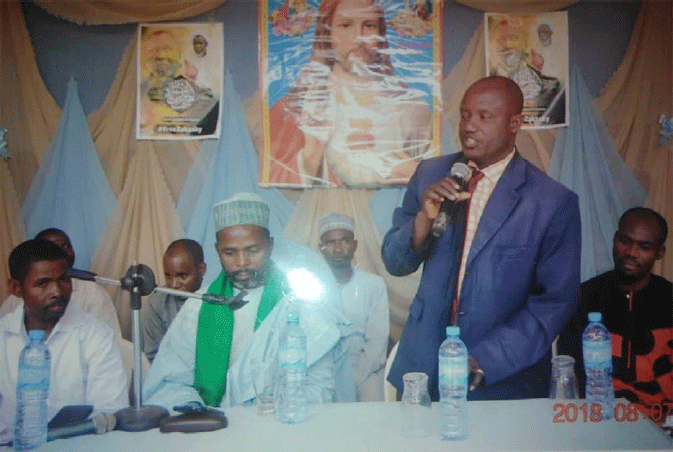
For instance, in Kano, the IMN youth wing organizes Jesus’s Mawlid at the Markazul Islamiyya (Islamic Centre) located at Kofar Waika within the old Kano city (birni). Shias invite Christians from different denominations to participate, and the programming of Jesus’s Mawlid addresses an interfaith audience. Everyone sits inside a hall (which is normally used as a mosque) decorated with assorted ribbons, balloons and lighting. On the walls, they hang pictures of Jesus and Shaykh el-Zakzaky (Figure 1). Shia clerics talk about Jesus from a Muslim viewpoint. While extolling Jesus as one of the ‘ulul-‘azm, the Shia clerics often emphasize the eschatological belief that Jesus’s return, as foretold by Prophet Muhammad, will herald the appearance of their awaited Imam Mahdi. According to Shia theology, both Jesus and their Mahdi will return ‘to fill the Earth with justice when it was filled with tyranny and oppression’,Footnote 17 and they believe that the time is fast approaching. While reciting portions of their scriptures that explain how both Jesus and the Imam Mahdi will work together, the Shia clerics urge Shias and Christians to unite and support them when they arrive.Footnote 18 Christian priests in attendance also present their own sermons about Jesus from biblical perspectives. IMN shu’ara (poets and praise singers) then stage a variety of live musical performances, adulating Jesus, Mary and Imam Hussein.
The 2018 Jesus’s Mawlid organized by IMN at Kofar Waika in Kano. Photograph by Sulaiman (on far left).

Although the Shias I interviewed mentioned that they organize public Jesus’s Mawlid because their scriptures instruct them to revere him, one should not ignore the political implications of this event. For instance, as some Sunni preachers are becoming more critical of Shias, the latter are also reasserting their influence by increasing their public performances. In this regard, while my Sunni interlocutors accused Shias of being ‘provocative’ through their public performances, the Shias defended themselves using ‘freedom of religion’ and ‘freedom of expression’, as enshrined in the Nigerian constitution, as well as the need for peaceful coexistence between Muslims and Christians in Nigeria, as sanctioned by their leader. Yet, they disregard the constitution by refusing to recognize the role of the Nigerian police in regulating public spaces, including during religious rituals. Another implication is that, as discussed earlier, Kano’s historical geography banned Christian public worship from the Islamic birni or cikin gari (inner city). However, the introduction of this hybrid Jesus’s Mawlid, hosted by Shias but also attended by Christians, including within the old city, has challenged both the historical religious segregation of Kano and the more recent enforcement of ‘authentic’ Islam by the hisbah throughout the city.
In Kaduna, not only do Christians attend and participate in Jesus’s Mawlid, but some have also started annual celebrations of Mawlid al-Nabiy (the Prophet Muhammad’s birthday) alongside Shias. So far, this Christian-organized Mawlid is being celebrated only in Kaduna. Pastor Yohanna Buru, the general overseer of Evangelical Intercessory Fellowship Ministries, is one of the clerics at the centre of these interfaith rituals. As discussed earlier, religious tensions have divided both Kaduna State and Kaduna township, including Zaria as a city and an emirate. However, Shia Muslims and Christians challenge this by organizing and attending rituals across these divides. For example, they converge on neutral ground such as stadiums situated in the Kaduna North township for the Mawlid al-Nabiy. During one of the meetings at Ranchers Stadium in Kaduna, Pastor Buru, who has been active in IMN-organized events, stated:
Every year during Christmas, thousands of Muslims have also celebrated with us … the birth of Jesus Christ with joy and happiness. We must remember that we are one family under God, worshiping one God, and we all believe in the Bible and the Qur’an.Footnote 19
Beyond reciprocity, Pastor Buru also considered celebrating Mawlid al-Nabiy as something enjoined in the Bible, mentioning that: ‘Our Bible teaches us to join and celebrate with our neighbour when they are happy and also he teaches us to mourn with them when they are sad’ (Lapai Reference Lapai2016). Christians attend similar Mawlid al-Nabiy organized by Shias in various parts of northern Nigeria, but the Kaduna event is the largest. This could be explained by the fact that Kaduna is the home state of Shaykh el-Zakzaky, the leader of the biggest Shia group in Nigeria. Being a colonial city, it also has a significant Christian population and has suffered more religious violence than other states, during which Shias have assisted Christians.
Some Salafis, who do not consider Shias as Muslims, use the example of Jesus’s Mawlid to justify their claim that Shias are closer to Christianity than Islam. In fact, since the emergence of the interfaith Jesus’s Mawlid celebration, some Salafis have even gone so far as to label Shia as a branch of Christianity. As a Salafi cleric mentioned:
Earlier on, we have said that they [Shias] are the same [as Christians]. Now people can confirm that based on their practices. They started by visiting churches to celebrate Christmas, and now they have invented their own Jesus’s Mawlid. What is it that is left for them to be declared as Christians? They are the same [laughter].Footnote 20
In contrast, the IMN Shias see themselves as an ‘Islamic movement with a Christian wing that strives to establish a just Islamic society in which people of different faiths peacefully coexist’.Footnote 21 However, Shaykh el-Zakzaky’s speeches have presented contrasting visions of this ideal society. In some instances, he seems to emphasize reviving sharia within the ‘defunct Sokoto caliphate’, founded by the nineteenth-century reformer Usman dan Fodiyo, while rejecting the Sarkin Musulmi (sultan of Sokoto caliphate) and emirs as dan Fodiyo’s representatives. In other instances, he envisions a modern Islamic nation state that would recognize Nigeria’s diversity. Based on this back and forth in his line of thinking, one could say that the Nigerian context in which IMN leadership operates and the everyday challenges its members encounter require it to adapt in many ways, including by changing its strategies and forming alliances with Christians. It is in this context that IMN considers its Christian allies as active IMN members, united by Jesus and the quest for social justice. When submitting a petition to the British parliament in London in 2019 over the continuous detention of el-Zakzaky by the Nigerian government, Pastor Buru, who was seen by IMN members as one of their active Christian members, commented on the Christian membership in IMN:
The governor of Kaduna even affirmed that there are Christians in the Islamic Movement. And I want to tell you that after the killing in 2014 when Shia Muslims were being killed in Zaria by the military, three sons of el-Zakzaky were killed there. And a Christian, Julius Anyanwu was killed. I was the one that represented Shaykh Ibrahim el-Zakzaky with other Muslims to speak to the family of Julius. El-Zakzaky wanted Christians and Muslims to know that the enemies are after disuniting us and causing chaos in Nigeria.Footnote 22
Anyanwu was said to be one of the Christians marching in solidarity with IMN during street protests. Commenting further on Christian membership in IMN, Pastor Buru emphasized that el-Zakzaky and IMN tolerance towards Christians in the north was his motivation for being part of the movement. He continued to be featured in IMN’s high-level delegation for many events. In September 2020, he was among the few Christians among the IMN delegates who visited the emir’s palace in Zaria and consoled people over the death of their former emir, Shehu Idris.Footnote 23
Inspired by IMN’s success with Jesus’s Mawlid despite Sunni criticism of it as ‘un-Islamic’, other Shia groups started building religious minority networks to create their own versions of interfaith or hybrid rituals. For instance, in 2020, the Rasul A‘Azam Foundation, a Shia faction in Nigeria with its head office in Kano, invented the Virgin Mary’s Mawlid, scheduled for 2020. The secretary of the movement, Shaykh Saleh Zaria, told me that they initially wanted a ritual that would be attended by all Christian denominations in the country. However, since IMN had already established Jesus’s Mawlid, they decided on the Virgin Mary’s Mawlid, although they knew that it would attract only Catholics because ‘Protestants and Pentecostal churches accord less status to Mary’.Footnote 24 To sidestep the Sunni criticism that Jesus’s Mawlid is ‘un-Islamic’ and ‘heretic’ because Islamic sources do not record such a practice, the Rasul A‘Azam Foundation shifted the focus of its ritual from the date of Mary’s birth to celebrating the life of Mary, as it does for other saints. The secretary of the foundation noted: ‘We are not commemorating the day. We are rejoicing that Allah has blessed humankind with her and the good things her birth brought to the world. Thus, we can celebrate her any day, any time we want.’Footnote 25
Like IMN, members of the Rasul A‘Azam Foundation conceived their idea of the Virgin Mary’s Mawlid based on a combined understanding of Mary’s virtues in both the Qur’an and the Bible. The maiden edition of the Virgin Mary’s Mawlid was slated for 2020 but postponed due to the coronavirus pandemic. While IMN regularly organizes Jesus’s Mawlid, including during the pandemic, the Rasul A‘Azam Foundation was yet to launch the Virgin Mary’s Mawlid at the time of writing. Shaykh Saleh attributed the delay to challenges in identifying Christian collaborators. He told me that most of his Christian friends were Pentecostals, and the Catholics he contacted were reluctant. The reason, according to Shaykh Saleh, is that both Rasul A’Azam Shias and Catholic priests need more time to establish a rapport. To make that happen more quickly, Shaykh Saleh mentioned that they have decided to relocate the venue of the yet-to-be-launched Virgin Mary’s Mawlid from the mainly Muslim Kano metropolis to the predominantly Christian southern Kaduna.
Reactions and impacts within Sunnis
The changing dynamics in Shia–Christian relations have elicited reactions and responses among Sunni Muslims. In general, Mawlid al-Nabiy is one of the most contested issues between Sufis and Salafis, who together constitute the Sunni majority in northern Nigeria. Salafis consider commemorating Prophet Muhammad’s birthday as bid‘a (reprehensible innovation), let alone celebrating Jesus’s Mawlid alongside Christians. Thus, some hardliner Salafis use the examples of Shias’ participation in Christmas and the subsequent invention of their own Jesus’s Mawlid to justify their claims that Shias are not Muslims.
This Salafi claim about Jesus’s Mawlid has broader implications beyond Shia–Sunni contestations; for that reason, Sufis become cautious when commenting about it. Because they value celebrating Mawlid al-Nabiy and their saints, critiquing Jesus’s Mawlid based on the context of the permissibility of any Mawlid would risk undermining their own religious practice. Thus, most Sufis choose to find ways to allow Jesus’s Mawlid to fit within Islam. Because Shias celebrate Jesus’s Mawlid in a different way from Christians, some Sufi adherents said that it does not equal celebrating Christmas. Others argued that, since Shias use the occasion to promote Jesus’s virtues based on Islamic teachings, they are engaging in da’wa (proselytization). This approach shows that Sufis’ tolerance of the Shia Jesus’s Mawlid is based on their shared view about Mawlid’s permissibility and their shared interest in opposing Salafism. However, even if they do not attack Shias for their Jesus’s Mawlid, this does not mean that they do not criticize them at all.
It is worth pointing out that debates over Jesus’s Mawlid took place alongside heightened tensions between Sufis and Salafis due to the adoption of sharia in northern Nigeria after 1999. Salafi activists who dominated the agitation for sharia also dominated its supervision and enforcement. They used this opportunity to promote a Salafi theology as the model for sharia. This prompted some pro-sharia Sufi clerics to accuse their Salafi counterparts of ‘Wahhabi-izing’ Sunni Islam in the region. For instance, some Sufi clerics I interviewed mentioned that they were actively part of the sharia renewal project until the Salafis among them ‘hijacked the process with their Wahhabi-ization agenda’, allegedly funded by the Saudi government.Footnote 26 This disagreement created competition between Salafi and Sufi groups over the supervision of sharia implementation, which provoked some pro-sharia governors to start sharing political appointments to head those institutions among different Sunni rival groups in the interests of maintaining peace and stability (Ibrahim Reference Ibrahim2020).
Following sharia implementation, some Sufi clerics began to recognize that they had more in common with the Shias than the Salafis. For example, Shaykh Abduljabbar Nasiru Kabara, a leader of a faction of Qadiriyya Sufi known as Ahabul kahfi Wal Raqim, became a vocal critic of Izala and Tijaniyya (Faydha branch), while openly supporting Shia groups. Between 2015 and the time of writing this article, he has become the Shias’ darling as he constantly criticizes hadiths considered ‘authentic’ by the four Sunni schools of thought and maligns Shaykh Ibrahim Niasse (the Faydha’s founder) while supporting Shia.Footnote 27 He repeatedly denied that he is a Shia even though he often sides with them. He also stated: ‘I used to be worried when someone categorizes me as a Shia. But I no longer care; what bothered me is to be called a Sunni.’Footnote 28 While Abduljabbar’s positioning of himself as a Sufi, but neither Sunni nor Shia, is confusing, especially bearing in mind the conventional categorizations of Muslims, his demeanour suggested that he was leaning towards Shia. In 2021, responding to a joint petition by some Salafi and Sufi clerics, the Ministry for Religious Affairs in the Kano State government organized a meeting at which a group of selected ulama from different Sunni groups challenged Shaykh Abduljabbar over his criticism of some authentic hadiths. The event was broadcast live on radio, television and the internet. On the recommendation of the Ministry for Religious Affairs, Shaykh Abduljabbar was later arrested and arraigned before a sharia court in Kano for blasphemy. He is currently in a Kano prison as the trial continues.
As the relationship between Shia Muslims and the Qadiriyya improves, the one between Tijaniyya (Faydha branch) and Qadiriyya deteriorates, especially since some Faydha members criticize Shias. An example of Faydha Tijaniyya’s criticism of Shia can be found in the public speeches of former emir Muhammadu Sanusi II, as previously discussed. Meanwhile, many non-Faydha Tijanis have become sympathizers of Shias and openly associate with them and attend their events.Footnote 29 These subtleties within Sufism are interesting because, although they have their own histories of contestations, the Tijaniyya and Qadiriyya united against the Izala (a Salafi group) when the latter first surfaced in the 1970s, and they continued to be united until the Shias became prominent in the 1990s. In other words, the emergence of Shia Islam and its ‘innovations’, coupled with sharia adoption, changed the dynamics among the different Sufi orders. A Shia informant captured the changing dynamics:
Our major problem is with Wahhabis and the so-called Salafis. We have less problem with ‘Yan darika [Sufis] because both Shaykh Ahmadu Tijani and Shaykh Abdulkadir Jelani are ahl al-bait [descendants of Prophet Muhammad]. Both Shaykhs have authored books praising the ahl al-bait. Their followers easily understand the commonality between us [Shias and Sufis] because all we are doing is exalting ahl al-bait. The branch of Sufism we have issues with is Faydha Tijaniyya. This Sufi group is against Shia in Nigeria because their leader Ibrahim Niasse met Wahhabis in Saudi Arabia, who changed his view of Tijaniyya as founded by Shaykh Ahmadu Tijani.Footnote 30
The quote above and the examples that preceded it show how boundaries between divergent Muslim groups are changing alongside developments in Muslim–Christian interactions in the sharia age. One implication of these complexities is that they call into question the categorizations and concepts we use in analysing Muslim groups and individuals. An example of this is the case of Shaykh Abduljabbar Nasiru Kabara, a Qadiriyya leader. His activities not only challenge what scholars understand as generic Sunni Islamic norms in Nigeria but he himself said that he is disturbed when called a Sunni while denying being a Shia. Another example is Shaykh el-Zakzaky, who is a Shia yet has positive relationships with some of his Sunni contemporaries. While el-Zakzaky constantly identifies with Usman dan Fodiyo, who was a Sunni and Qadiri, as his source of inspiration, he rejects the authority of the current sultan of Sokoto, who is acting as dan Fodiyo’s representative and supreme leader of Nigerian Muslims.
Conclusion
This article has analysed how postcolonial northern Nigeria, as a shared space between Muslims and Christians, has evolved through multifaceted and complex interactions between Sunni and Shia Muslims and Christians. It discussed the complex but changing relationships between various Muslim and Christian groups beyond the physical and spiritual divides mapped at various levels and that involve different Sunni groups and Shia Muslims on the one hand and Muslims–Christians on the other. While the article elaborated on how some adherents of Shia Islam and Christianity are brought together by their minority status, it also showed how focusing on Islamic minorities reveals their ability to have an impact on the Sunni majority.
Musa Ibrahim is a research fellow at the Centre for Cultural and African Studies, Kwame Nkrumah University of Science and Technology, Kumasi, Ghana, and a junior research fellow at the African Centre for Religion, Ethics and Society at the University of Cape Town, South Africa. He was a postdoctoral fellow for the Henry Luce Foundation’s Initiative on Religion in International Affairs at the University of Florida between 2019 and 2021. He received his PhD from the Bayreuth International Graduate School of African Studies, University of Bayreuth-Germany.