1 Introduction: the social and the personal in mobile language learning
With the advent of Mobile Assisted Language Learning (MALL), the way in which people engage in language learning may become, not only more portable, but also more informal and personal (Kukulska-Hulme & Shield, Reference Kukulska-Hulme and Shield2008). MALL has been hailed as a useful mode of delivering language learning content and co-constructing learning through collaborative activities (Pachler, Reference Pachler2007; Rosell-Aguilar, Reference Rosell-Aguilar2007; Kukulska-Hulme & Shield, Reference Kukulska-Hulme and Shield2008). More importantly, however, it has been pointed out that it can also form one of the components of the more informal and personal aspects of learning (Okabe & Ito, Reference Okabe and Ito2006; Kress & Pachler, Reference Kress and Pachler2007; Ros i Solé, Reference Ros i Solé2009). Introducing digital devices, such as MP3 players/recorders, into the language learning process may help us investigate learners’ socialisation into the target language outside formal educational spaces, the merging of public and private, and the knock-on effect the use of these devices might have on language learners’ changing identities.
Indeed, the advent of networked and mobile technologies has prompted sociologists and educationalists alike to question the role of technologies in shaping identity and social practices (Castells, Reference Castells1991, Castells et al., Reference Castells, Fernández-Ardévol and Linchuan Qiu2007; Sharples et al., Reference Sharples, Taylor and Vavoula2007). As Castells, Fernández-Ardévol and Linchuan Qiu (Reference Castells, Fernández-Ardévol and Linchuan Qiu2007) point out, mobile phones are not only fashionable gadgets, but also expressions of identity and life tools. Technology does not exist merely to help us lead our lives more efficiently, but also to shape the way in which we live our lives and learn. Although technological advances are still presented to us in terms of their storage capabilities, their portability, or even as fashion accessories, it is their potential for changing the ways in which we live our lives which is more significant (Ros i Solé, Reference Ros i Solé2009). The portability of mobile devices is not a mere matter of convenience: when we take advantage of mobility in the learning process, the nature of learning itself changes. As Sharples et al. (Reference Sharples, Taylor and Vavoula2007) point out, mobile learning involves a multiplicity of sites and forms of travel between them, and learning which is acquired in one context is transferred to another context and applied in a completely different environment. In such a dynamic learning scenario, knowledge is transferred, revisited and developed, and learners invest it with personal meaning by involving their own desires and goals.
It is not merely social spaces themselves which become an issue in mobile learning, but how the boundaries between the public and private spaces merge into one. The public becomes private as a part of a uniquely constructed history, e.g. conversations overheard in public spaces become soundbites for our personal consumption; similarly, photographs taken in the street are kept for personal reference, imbued with our own histories and meanings. Conversely, conversations on the phone, which used to be personal, have now become part of the public domain, on buses and in other public fora. In this way, the personal becomes more exposed, as ‘the gaze of the others is always present as a potentiality’ (Okabe & Ito, Reference Okabe and Ito2006: 15). Ultimately, MP3 players, camera phones, and mobile phones have become the tools for constructing a chronicling of the self.
In parallel with the recent interest in social approaches in language learning, models of language learning have also increasingly been adopting more social-oriented approaches to learning. In such approaches, language learners’ social lives acquire a central role in accounts of the language learning experience (Block, Reference Block2003; Kramsch, Reference Kramsch2006; Norton, Reference Norton2000). As a result, researchers have begun to change their perception of learners, from passive recipients of information to agents who play out different roles in new and changing teaching and social environments. Within such a view, learning a language inevitably means more than acquiring a set of linguistic rules and communicative skills: it involves learners experiencing language within the wider context of their social experiences and habitual practices.
A central tenet of this holistic and social perspective is that learners are perceived as having a stake in their learning which is deeply connected to their lives outside the educational environment; that is to say, language learning involves not only acquiring information, but also forming social relationships and engaging with new cultural backgrounds and emotional selves. Learners, then, are increasingly seen as part of a system that not only involves them in interaction with the social environment, but also engages their personal goals, desires, and day-to-day practices.
Within such a view, learning a language can be seen as part of the process by which learners use language to reflect on themselves and ponder their place in new linguistic worlds. Language is viewed as the site where identities are challenged and reconstructed, a site to experiment and construct new versions of the self (Pavlenko, Reference Pavlenko2002; Phipps, Reference Phipps2003; Ros i Solé, Reference Ros i Solé2007).
At the same time, a growing body of language learning research is beginning to move away from measuring effectiveness in language learning and starting to focus its attention on the day-to-day practices of the language learner (Norton, Reference Norton2000; Roberts et al., Reference Roberts, Byram, Barro, Jordan and Street2001; Phipps, Reference Phipps2007). So far, however, research into the changing lifestyles, identities and social practices of language learners has mainly been situated in the target language country, in the experience of residence abroad and in accounts of the immigrant language learner (Phipps, Reference Phipps2007; Norton, Reference Norton2000; Block, Reference Block2008; Roberts et al., Reference Roberts, Byram, Barro, Jordan and Street2001; Byram & Dervin, Reference Byram and Dervin2008). Research into the personal and social journeys which language learners of ‘foreign languages’ take in and out of educational contexts in their own place of residency is still in its infancy.
In our study, we followed a qualitative ethnographic-style methodology in order to find out not only about the possibilities of MP3 recording devices, but also about the learners’ social practices and the learning habits with which language learners engage. This was an open-ended study with no specific research question in mind, apart from the need to describe the learners’ experience of using these devices from their own perspective. In other words, we wanted to find out about the affordances of MP3 recording and playing digital devices for language learning and how they interact with students’ language learning practices. To this end, we carried out our research on two language groups: Icelandic and Serbian/Croatian. Below we describe in more detail what these ethnographic studies consisted of.
2 Methodology
2.1 The MP3 device as an aid to learning and a research tool
There is already a growing body of literature exploring the benefits of mobile technology in language learning (Pachler, Reference Pachler2007; Rosell-Aguilar, Reference Rosell-Aguilar2007; Kukulska-Hulme & Shield, Reference Kukulska-Hulme and Shield2008). Rather than setting out to measure the effectiveness of using MP3 recorders/players our study focused on the possibilities of such devices for language larning and the resulting experience of language learners.
The first thing that had to be done was to investigate what the functionalities of these devices were. We did this by consulting lay people’s expertise on such devices. We started our research on the ground by going ‘native’ and engaging with people closer to the digital generation than ourselves (e.g. students, mobile device enthusiasts, and high-street retailers). After familiarising ourselves with the technological device, we wanted to explore how mobile devices were appropriated and personalized by our students, and could empower learners by making them creators of content. In order to achieve this, the mobile devices had to be useful for speaking (producing/recording language), for listening and, ultimately, for sharing the content created. This led us to adopt an ethnographic approach for our study.
Although the most common use of MP3s, in non-educational and social contexts, is mainly for delivering content, e.g. podcasting (Kukulska-Hulme & Shield, Reference Kukulska-Hulme and Shield2008; Rosell-Aguilar, Reference Rosell-Aguilar2007), we wanted to give students a more central and creative role. With such a goal in mind, we embarked on adapting the MP3 device for our own educational purposes, which involved fostering speaking in the target language outside class and encouraging students to be the producers and creators of materials, rather than being passive consumers of content. As Pettit and Kukulska-Hulme (Reference Pettit and Kukulska-Hulme2006) point out, mobile devices, in contrast to the centralised university-wide infrastructure for online learning, have come to symbolize a greater focus on students and users.
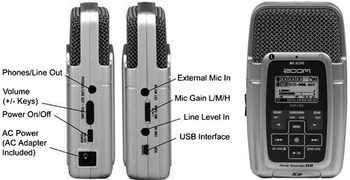
Having access to a digital mobile device that allowed them to record and play material also enabled learners to carry materials which were personally meaningful to them with them at all times, across a variety of spaces (e.g., from the bedroom to the language classroom, from the street to the museum, and from the community centre to the language lab). Unlike other types of recording devices, such as dictaphones, which have traditionally been available, MP3s allow language learners to store their audio files on the Internet and to easily share them with their peers and teachers. For these reasons, we chose a mobile device that was not only an MP3 and a multimedia player, but also a recording device which produced high quality recordings and made uploading of files onto the PC (and their future shareability) easy. Figure 1 illustrates one of the MP3 devices we used for our project.
MP3 recorder/player used by language learners

Moreover, we were not as interested in what uses the MP3 ‘inventors’ and producers had in mind, as in the uses to which the language learners might put them. Du Gay, Hall, Janes, Mackay and Negus (Reference Du Gay, Hall, Janes, Mackay and Negus1997), in their study of the Sony Walkman, have already placed the focus on the more active roles taken by ‘consumers’ of technical devices and on how they appropriate these devices.
Indeed, our study set out to show how prescribed uses can be contested and the device invested with alternative uses that make sense to the individual language learner: that is, we wanted to observe how learners appropriated these devices for their own personal use. Our concern for differentiation and personal appropriation, then, goes beyond the superficial targeting of ‘style’ according to age, gender, national identity and so on, but is focused on the use to which learners put the device, i.e. what do language learners do with MP3 players in their day-to-day activities and for what purpose?
2.2 An ethnographic approach
Engaging in language learning outside the ‘domesticated’ space of the classroom provides students with the opportunity to try out language learning practices in different scenarios. In this paper, we give an account of an ethnographic approach to research which ‘has as its focus the learner experience, rather than the evaluation of his/her learning’ (Ros i Solé, Reference Ros i Solé2009). We used the mobile device, not to prove a particular theory of language learning or to measure its effectiveness for learning a particular language, but rather to investigate how learners relate to these technologies on a more personal and social level in their everyday lives. By investigating what new social and personal practices and language learning habits emerge with this technology, we set out to uncover its personally meaningful affordances for language learning.
Thus, the original focus of this study was a broad one, with few a priori expectations of MALL and no preconceived hypothetical questions about the effectiveness of these devices for language learning. Instead, we wanted to observe what patterns of behaviour we could glean from language learners’ use of MP3 devices. For this purpose, we adopted an ethnographic methodology, where the researcher becomes a participant-observer, by ‘hanging around’ and documenting the mundane activities in which learners engage. Our methodology departed slightly from the traditional ‘field-work’ method by allowing students to be research collaborators, as described in the literature (e.g. Ros i Solé, Reference Ros i Solé2009; Okabe & Ito, Reference Okabe and Ito2006). Following such a technique in our study, we documented language learners’ practices by asking students to log their use of the devices in a diary, by having the teacher observe or elicit information in classroom discussions in a more informal way, and by conducting ethnographic-style interviews.
Such a methodological approach also allowed us to take an open, reflective and critical stance, which required us to become both close to, and familiar with, learners’ activities. We were able to do this through the different roles taken by the members of the research team, which was made up of two language teachers who were in regular contact with the language learners and taught them the language (i.e. Icelandic and Serbian), and a researcher who took more of a backstage role and who regularly met with the teachers to reflect and discuss the project. In this way, various data collection techniques and researchers’ roles were employed to gather information and to observe patterns of behaviour in language learners: informal conversations amongst teachers/researchers, observations of lessons, logs, questionnaires, discussions in the lesson, and interviews with students.
2.3 Tools and procedures
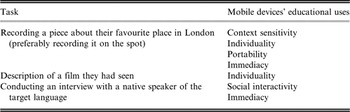
The procedure followed was one designed to integrate the use of MP3 players/recorders into students’ learning in an informal and fairly non-directive way. To this end, students were given the devices, were trained in how to use them, and an introductory lesson was organized, in which the teacher suggested activities which they might carry out with the devices. As Naismith et al. (Reference Naismith, Londsdale, Giasemi and Sharples2004) report, mobile devices enjoy the following advantages for educational use: portability, social interactivity, context sensitivity, individuality and immediacy. We therefore designed three tasks to get students started on using their devices, with a view to fulfilling the abovementioned potential of this technology. We illustrate this in Table 1.
MP3 language learning tasks

Although these were fixed tasks, they were designed to encourage students to exploit the characteristics of mobile devices in an open and undirected way, rather than trying to prescribe the content which they should produce and how they should go about it (place of recording, choice of topic, manner of conducting the interview, etc.).
In both studies, a session was organized where MP3 players were handed to students. They were first given instructions on how to use these MP3 players and it was agreed that students could keep the MP3 players for eight weeks. During this time they were encouraged to make a log of their experiences with their MP3, by writing down any activity which they did with the devices and any problems or successes which they experienced with it. At the end of term, students were asked to complete an open-ended questionnaire which contained more explicit questions about their use of the device. This was then followed by a classroom discussion about their experiences, moderated by the teacher. In addition, in the Serbian/Croatian study, students were also interviewed. Below we give an account of the procedures for each study.
2.4 Procedures for each language group
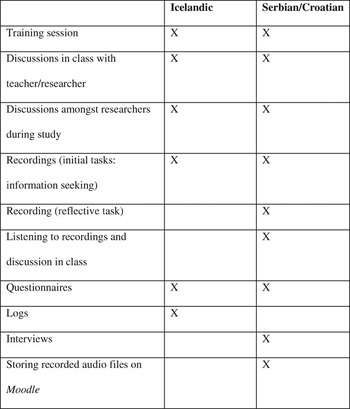
The Icelandic case study consisted of six students who were following an intermediate course, as part of their undergraduate degree in Scandinavian Studies at a UK university. They used the MP3 devices for a term, to carry out the tasks outlined in Figure 2, and to record any other uses they made of the device for language learning. As well as providing the foreign language recordings, they also provided logs of their impressions of using these devices and responses to an open-ended questionnaire. Twice a week, during the lesson, they also discussed their experiences of using the device with one of the researchers/language teachers participating in the project.
Tools and procedures for case studies

The Serbian/Croatian case study focused on six students of Serbian/Croatian at a UK university: two of them attending language level 2 classes (equivalent of an intermediate language course) and another four students of Serbian/Croatian attending language level 4 classes (equivalent of an advanced language course). Again, our aim was to integrate the MP3 work into their coursework, both inside and outside the classroom, and to create opportunities to discuss their experiences in the classroom at various intervals. This was done by gathering feedback on students’ experiences on several occasions. The tools employed here were recordings of their language tasks, questionnaires, as in the previous study, discussions in the classroom, and interviews in English with the language teacher/researcher. The follow-up interviews allowed us to probe further into their personal views on the use of these devices.
In the Serbian/Croatian case study, we introduced a new activity to focus further on the social habits and activities that learners engage in with mobile devices. Our goal was to get closer to what Okabe and Ito (Reference Okabe and Ito2006) call the chronicling of the self, by encouraging students to describe how they construct themselves for others.
In order to make this self-reflective task less intimidating, we asked students to record a three-day diary pretending that they were Serbian/Croatian speakers (rather than learners of Serbian/Croatian) who were visiting London. This exercise yielded interesting results and, above all, made students reflect on what it felt like to inhabit another culture and another self on a moment-by-moment basis, carrying out mundane activities.
In Figure 2 we compare the procedures and data-gathering tools used in the two case studies.
3 Results
As the Icelandic and Serbian case studies were carried out at different times and with different students, we will describe them separately below.
3.1 The Icelandic case study
Although, at first sight, it seemed as if the Icelandic group of students was not really engaging in the full range of functionalities of these devices, on a second reading something more revealing emerged. The students were accommodating their language learning to their already well-established learning habits and social activities (e.g. listening to music on their MP3 players). Instead of looking at MP3 players as another technical aid, completely separate from their own personal and private worlds, students embraced the new technology and integrated it into their ordinary practices. As a result, one of the most interesting outcomes of the Icelandic project was that the students transferred activities which they already did as part of their language learning, e.g. downloading CD material onto the MP3 device, creating vocabulary lists, or replicated their social habits, such as listening to music, and applied them to their language learning.
The following quotations from the logs and open-ended questionnaires completed by the students of Icelandic show what these new techno-educational and social activities were (e.g. listening to previously prepared materials, carrying out typical language learning activities, and listening to music, and more ordinary ones, such as walking to university or falling asleep).
I have been doing small word lists and listening to them, which is helpful when I manage to find time to listen to them (…) (Noemi, Log)
I exported a CD with conversations (I’m not sure which one, as there is no track information), but it made the walk into uni a little more interesting. (Ricky, Log)
I listened to Sálin Hans Jons Míns, which I got from www.tonlist.is. I think the ballad/up-tempo melodies give you subliminal cues as to what the words could be and the constant repetitions of the choruses do make the songs clearer. (Ricky, Log)
Unfortunately, I have been unable to actually fall asleep when listening to them yet, but I will try yet again to see if there is a way to let this happen. (Ray, Log)
As intended, the results of this initial pilot case study were more illuminating in terms of reflecting on the possible uses of MP3 players for language learning than in terms of drawing any conclusions about how effectively language learners learn using these devices.
Indeed, the most interesting outcome of this part of the research project was the insight into the way learners integrated these new devices into their ordinary lives and across different contexts. The fact that the learners of Icelandic introduced their language learning into their journey to university, into their bedrooms and favourite parks, not only showed them seemingly capitalising on the portability and informality of these devices, but also reflected their willingness to integrate them into the ordinary activities of their lives. The blurring of boundaries between language learning spaces, between the informal and the formal, and the possibility of a shift in the student’s role, from that of consumer to that of producer of content, were all positive outcomes of the Icelandic case study.
3.2 The Serbian/Croatian case study
The results of the second case study, the in-depth ethnographic-style study of the Serbian/Croatian group, proved even more fruitful, as it had the benefit of our reflections and insights from the first case study. It allowed us to delve, not only into students’ ordinary learning experiences, but also into their personal impressions about their self-image in the second language. Some general patterns emerged from students’ feedback, which we can summarize under two themes: the way students made sense of their language learning with these devices, and the use of MP3 players/recorders to challenge their sense of self in the second language. These topics formed the basis of the final interviews, investigating how learners were appropriating the MP3 devices, from a personal point of view.
So, upon completion of all the given tasks, and after the listening and discussion sessions, the teacher of Serbian/Croatian carried out the ethnographic interviews with each student, covering the following topics:
• Reflection and identity
• Students’ ownership of their learning
• Use of a variety of spaces and locations
• Integration in the classroom
• Perceived benefits for learning
The aim of the interview was to tap into learners’ subjective experiences of the use of the MP3 players, that is, to find out to what extent it helped them in building their uniquely constructed language learning experience, and to investigate to what extent MP3 players helped students reflect on their own practices in the target language. The following discussion draws on data from the interviews.
4 Discussion: mobile devices as an aid for reflecting on the L2 self
The analysis of the data in the interviews allowed us to delve further into the role of MP3 devices in constructing L2 learners’ social and personal lives, which we will deal with under the following headings: (a) mobility and flexibility, (b) the gaze of the other, and (c) coming to terms with the L2 self.
(a) Mobility and flexibility: contextualising and personalising learning
By asking students to use these devices, we gained an opportunity to acquire an understanding of how students learn in more flexible arrangements, across the spaces outside of the classroom. As with other mobile devices, MP3 players are designed to support communication and practice on the move, and we were therefore able to explore how learning happens when students are immersed in authentic contexts, without the authoritative ‘voice’ of the teacher who judges their performance by being present.
You have as much time as you want to practice how you speak. It is great. Also there were no barriers. You are alone, not with people who are there to assess you. (Interview, Nina, intermediate S/C)
At home, more comfortable, you do it in your own time, speak more freely, not worry about it. (Interview, Maria, advanced S/C)
Over the course of the eight weeks, we witnessed how using MP3 players facilitated contextual learning, allowing the information to be captured in the learner’s own location and in a way which was relevant to their needs. As well as facilitating social interaction, personal uses of MP3 devices resulted in greater levels of engagement with learning. For example, while recording the interviews, students adjusted the content of what they talked about to the sensitivities of the audience, as the following extract from the interviews with Serbian students illustrates:
We were in a Serbian church, so it helped; we were in the church when Kosovo gained independence, so we had to avoid that topic; we were nervous; some people were suspicious; it was more practical than inspirational. (Interview, John, intermediate S/C)
The recordings conducted by students in such contexts would then be transferred to a new location, the classroom, and re-evaluated from that perspective. As Sharples (2007) points out, mobile learning encourages learners to constantly reappraise their learning and personally transform knowledge, as they move across locations. The reappraisal of their learning led students to engage in a very interesting activity: they were able to reflect on how the other students saw them and how they felt about it. In other words, sharing their personally produced material with their peers had an impact on their development of a self-awareness in the target language. This is the topic we will deal with in the next section.
(b) ‘The gaze of the other’
The flexibility to carry activities across contexts and the variety of contexts in which they performed their language skills enabled learners to become aware of their sense of self in the target language. This awareness of the critical ear of the other is referred to in the interviews, when students talk about their feelings of anxiety about making mistakes in their recordings. Students seemed to be terrified of how they would be judged, not only by their classmates, but also by the teacher:
When listening to myself, I am really conscious of it and of making mistakes. (Interview, Maria, advanced S/C)
It is harder in the classroom. I feel under pressure and you (teacher) point out mistakes. (Interview, John, intermediate S/C)
Listening to other students’ recordings makes you notice your own and others’ mistakes. (Interview, Emma, advanced S/C)
When asked how they found bringing their own materials into the classroom, the students revealed that their initial self-consciousness and unease was quickly replaced by interest in what the others had created and the whole experience became very entertaining.
Completely fine, just for the first minute blushing; red, sounded silly; more fun listening to other people; even though you always hear them talking in class, whereas you never hear yourself, it was interesting to hear how they interpreted tasks: which film they picked … (Interview, Emma, advanced S/C)
It was funny. Different from what we were doing in the classrooms. And to hear what others were doing and to hear the interviews was entertaining. (Interview, Maria, advanced S/C)
Nervous; nerve-wracking, but at the end, fine and fun. (Interview, John, intermediate S/C)
Funny; cringe and then got used to it. The more we did, the better it was. (Interview, Nina, intermediate S/C)
Feelings of being ashamed and uncomfortable were compensated for by an awareness that all of them were in the same boat or, as one student put it:
I felt a bit ashamed of what I had done. But on the other hand we were listening to the others and it was all about equality. (Interview, Nina, intermediate S/C)
This is probably why the students chose to approach the whole exercise in the same way as they would approach a written task, planning their recordings, writing texts out and rehearsing them. Only in the later stages did they start reacting more spontaneously.
I just had the text. I was rehearsing first, even when I went to my favourite place in Primrose Hill. (Interview, Nina, intermediate S/C)
I planned interviews a little bit, with back up questions. Once I started talking, people asked questions and prompted us to say various things. Film and Place: wrote beforehand and read through. But thought I’d better write than spontaneously speak about it, because N will get hers perfect, so I didn’t want to have mistakes. (Interview, John, intermediate S/C)
Interviews written in advance and checked; also, later, bullet points and tried to speak, rather than read it. (Interview, Emma, advanced S/C)
Thus, for most of them, the envisaged audience when carrying out the recordings was their classmates or the teacher. The fact that they could hear themselves again, that the acts of speaking could be repeated, not only at home, but also in the classroom, meant that they could rehearse and would inevitably have to face their L2 personas in front of the teacher and the class.
(c) ‘Coming to terms with the new language self’
One of the questions we asked in the interview was how learners thought they were perceived when they spoke a foreign language in various contexts, e.g. by other speakers outside the classroom or in the classroom. Having the opportunity to hear their voice recorded and share their own recordings with other fellow students and the teacher confronted students with how they sounded when speaking in a foreign language. At the same time, they were able to perceive how they were positioned by others. Indeed, as illustrated by the students’ statements below, hearing their voice in Serbian/Croatian played a significant role in how learners valued their ‘additional’ language selves. One of the issues that was identified here was the fact that the students were actually aware of gaining a ‘voice’ (i.e., a different sense of who they were) in the target language, as the following quotation from one of the students shows, where s/he does not recognize him/herself:
When I begin to speak, I sometimes hear myself and I sound weird, I don’t sound like Serbian people…; In the classroom it is different, because we are foreigners, we have a different accent in the classroom, we pay more attention not to make mistakes. (Interview, Nina, intermediate S/C)
Or, an even more illustrative example:
Yeah, I sound really bad; I sound like Borat. (Interview, John, intermediate S/C)
The fact that mobile technology allows learners to carry information across contexts played a part in how learners viewed themselves. In our case, the learner revisited not only his/her learning but also his/her self-perception. Some students said that sitting in the classroom and listening to others, and especially to themselves, made them realize that “it is difficult to retain your personality in FL” and that the voices they heard sounded detached from them. Or, as one of the students said: “it is a voice I don’t normally hear”.
As the listening and discussion sessions progressed, it was markedly noticeable how the initial feelings of nervousness and embarrassment and the tendency to blush in front of their classmates and the teacher faded away. Students began to get used to their own voices and projected their personalities and began to feel more at ease when listening to themselves. They all confirmed that using mobile devices was beneficial in this process, helping them with “confidence building, because you can end up really hating your voice in the foreign language…” It was also valuable, in the sense that it allowed learners “to get used to yourself in Serbian and to dare to speak more. And it is easier if you speak to a machine”.
From the comments above, one could say that mobile language learning allows the learner to bridge the gap between the educational and the personal world of language learning, between their intimate recordings on their own or in the company of non-threatening familiar others, to the public and (more authoritative and judgemental) space of the classroom. In this way, learners are never completely in private, as Okabe and Ito (Reference Okabe and Ito2006:15) point out, ‘the gaze of the other is always present’.
5 Conclusion
As we have seen in our study, one of the ways in which the learning experiences outside the class can be brought into the classroom is with the aid of mobile technology. Moreover, the ability of mobile devices to let the learner approach language learning in the fluidity and ordinariness of everyday life and its practices has prompted language learners to start to reflect and engage with their own language learning selves in significant ways.
Whereas students of both Icelandic and of Serbian appropriated the MP3 devices, by adapting them to their own day-to-day practices and in a variety of contexts, it was the transference of the contents created outside the classroom into the classroom that revealed the most interesting findings. Indeed, the full integration of the device into the classroom allowed us to investigate more personal and social aspects of MALL.
The regular and intensive exchanges between the students of Serbian/Croatian and their teacher over the course of approximately two terms progressively focused on language learners’ reflections on their ‘voices’ in the target language. The students’ initial struggle with their L2 personas, which was linked to their concern about how they would be perceived by their classmates, soon gave way to their appreciation and positive images of themselves.
In this way, using MP3 mobile technology affords students the opportunity to use technology for their day-to-day practices in a variety of situations, but also to rehearse and confront this newly-found L2 self. In and out of the educational environment, crossing private and public boundaries, mobile devices have become extensions of the self, a crutch to rehearse a newly acquired language. Or, as Kress and Pachler (Reference Kress and Pachler2007) call it, a ‘prosthesis of the self’. Such technology of the self is then transformed, from being just a piece of technology that makes learning more efficient, to being a platform for reflecting on how we inhabit and embody the languages we learn. The use of mobile technology, such as the MP3 player/recorder that we have described, could provide learners with a means to integrate a sense of self in the educational environment.
Ironically, mobile technology could be seen as the prosthesis that allows learners to depart from models of language learning based on machine-like metaphors of input-output, and instead adopt a social practices approach, in which the learner uses a variety of locations to enact and rehearse a personal voice.