Clostridium difficile was estimated to cause approximately 0.5 million infections in 2011 in the United States and was among the top 5 infectious causes of death in Ontario, Canada (annual average, 2005–2007).Reference Lessa, Mu and Bamberg 1 , Reference Kwong, Ratnasingham and Campitelli 2 Age at least 65 years, comorbidities, recent or long hospital stay, and exposure to antimicrobials increase the risk for C. difficile infection (CDI).Reference Badger, Ledeboer, Graham and Edmiston 3 – Reference Hensgens, Goorhuis, Dekkers and Kuijper 6 Among those infected, approximately 22% experience a recurrence or treatment failure, suggesting that CDI may behave like a chronic condition.Reference Vardakas, Polyzos, Patouni, Rafailidis, Samonis and Falagas 7 , Reference Musher, Nuila and Logan 8 Up to 5% of infected individuals undergo a colectomy and more than 6% die within 3 months of diagnosis.Reference Halabi, Nguyen, Carmichael, Pigazzi, Stamos and Mills 9 – Reference Karas, Enoch and Aliyu 11
The economic burden of CDI was documented in a recent systematic review, with mean attributable CDI costs ranging from $8,911 to $30,049 per hospitalized patient (2014 US dollars).Reference Nanwa, Kendzerska and Krahn 12 The review noted that most CDI cost of illness studies did not evaluate costs beyond the initial hospitalization (ie, readmissions and ongoing medical care after discharge), leading to possible underestimation of the CDI burden. High quality short- and long-term attributable cost estimates for CDI provide fundamental evidence for hospital administrators, policy decision-makers, and researchers assessing the value of existing and novel strategies to prevent, detect, and treat CDI. Our objective was to estimate short- and long-term costs attributable to hospital-acquired CDI from the healthcare payer perspective.
METHODS
Study Design, Data Sources, and Participants
Our study received ethics approval from the institutional review boards at Sunnybrook Health Sciences Centre and the University of Toronto.
We conducted an incidence-based propensity-score matched cohort study to evaluate costs attributable to hospital-acquired CDI from the healthcare payer perspective (Ontario Ministry of Health and Long-Term Care). The study population from Ontario, Canada, was provided by the Institute for Clinical Evaluative Sciences, which houses a data repository of individually linked (via unique encoded identifiers) health service records for those eligible for publicly funded universal healthcare (~13 million, nearly the entire population of Ontario). 13
We identified incident cases of CDI (infected subjects who were symptomatic) from January 1, 2003, through December 31, 2010, using the International Statistical Classification of Diseases and Related Health Problems, 10th Revision, Canada (ICD-10-CA) code A04.7 (enterocolitis due to CDI) and followed up the cases through December 31, 2011 (see Supplementary Figure 1). We included elective and nonelective hospital admissions (differentiated by a specific field in the administrative data). The index date was the admission date of the index hospitalization.
For elective admission subjects, we assumed absence of community-associated CDI because their hospitalizations were planned. To exclude community-associated CDI among the nonelective admission group, we excluded infected subjects if (a) the length of stay (LOS) was no more than 2 days (consistent with studies that exclude those with symptom onset or a positive CDI test within 2 days of admissionReference Wilcox, Cunniffe, Trundle and Redpath 14 , Reference Campbell, Dean, Nathanson, Haidar, Strauss and Thomas 15 ); (b) CDI was the principal diagnosis and colectomy was performed within 2 days of admission; or (c) CDI was the principal diagnosis and suspected CDI, abdominal pain, cramps, or diarrhea was coded for a physician office or emergency department visit within 2 weeks prior to admission. For full exclusion criteria see Supplementary Table 1.
We matched each infected subject to 1 uninfected subject (those without the ICD-10-CA code A04.7) on both the propensity score and a limited set of baseline covariates. For the elective admission group, we identified a sample of uninfected elective admission subjects. The propensity score was estimated using a logistic regression model to regress exposure status (infected versus uninfected) on the following variables: rurality; neighborhood income quintile; comorbidities within 2 years prior to the index date; hospital facility; healthcare utilization (emergency department visit, hospital admission, same-day surgery, or long-term care stay) within 12 weeks prior to the index date; and a record of an infection that may have led to an antibiotic prescription within 12 weeks prior to the index date. We chose 12 weeks because the onset of CDI symptoms can occur up to 3 months after hospital discharge or antibiotic cessation.Reference Dubberke, McMullen and Mayfield 4 – Reference Hensgens, Goorhuis, Dekkers and Kuijper 6 See Supplementary Table 2 for details on each propensity score variable. In addition to matching on the propensity score, subjects were hard matched on sex, birth year plus or minus 3 years, index date plus or minus 30 days, and the first 3 digits of the intervention code (first elective procedure performed within 2 days of the hospital admission).
For the nonelective admission group, we identified uninfected subjects from a random sample of nonelectively admitted subjects with a LOS at least 3 days. The matching procedure was similar to the elective admission group, except the intervention code for an elective procedure was not applicable.
To determine the impact of CDI on costs near the time of death, we rematched infected subjects who died during the observation period to uninfected subjects who also died (randomly selected), ensuring similarity between infected and uninfected subjects. Variables included in the propensity score model were rurality, neighborhood income quintile, and comorbidities assessed 3 months prior to the death date, along with hard matching on birth year plus or minus 3 years, sex, and date (3 months prior to the death date) plus or minus 30 days.
For both sets of matches, we used nearest neighbor matching without replacement on the logit of the propensity score, using calipers of width equal to 0.2 of the standard deviation of the logit of the propensity score.Reference Austin 16 To assess balance, we calculated standardized differences between infected and uninfected subjects for each variable included in the propensity score, with standardized differences less than 0.1 indicating good balance.Reference Austin 17
Outcomes
We evaluated the following clinical outcomes: LOS, colectomy within 1 year after the index hospital admission date (identified using intervention codes outlined in Supplementary Table 3), and mortality. Cost outcomes included costs unadjusted for survival (during the index hospitalization and 30 days, 180 days, and 1 year after the index hospital admission date) and costs adjusted for survival (1, 2, and 3 years after the index hospital admission date). Costs captured the following publicly funded healthcare services: (1) inpatient hospitalizations, (2) same-day surgery procedures, (3) emergency department visits, (4) outpatient medications (for those aged ≥65 years or on social assistance), (5) physician services, (6) nonphysician services (eg, physiotherapy), (7) outpatient laboratory tests, (8) rehabilitation services, (9) complex continuing care admissions, (10) homecare services, (11) long-term care admissions, (12) dialysis clinic visits, (13) cancer clinic visits, and (14) assistive devices.Reference Wodchis, Bushmeneva, Nikitovic and McKillop 18 Index hospitalization costs included only hospital costs because physician services could not be disaggregated by inpatient versus outpatient services.
Analysis
Using the matched samples, we determined the relative risk and 95% CIs of colectomy and all-cause mortality.Reference Austin 19 , Reference Agresti and Min 20 We also estimated 3-year survival curves for infected subjects and matched uninfected subjects.
We evaluated attributable LOS and cumulative costs unadjusted for survival by calculating the mean difference between matched pairs. We used bootstrapping to calculate 95% CIs for the mean difference.Reference Austin and Small 21
To estimate cumulative attributable 1-, 2-, and 3-year costs adjusted for survival, we used the phase-of-care approach, assigning an infected subject’s observation time to distinct phases reflecting the course of the disease from diagnosis to death.Reference Brown, Riley, Potosky and Etzioni 22 – Reference Krajden, Kuo, Zagorski, Alvarez, Yu and Krahn 25 We defined 3 phases (acute infection, continuing care, and final care) and used clinical judgment and the shape of the cost functions (observed when costs were graphed) to determine phase length. We measured costs in 30-day periods and determined attributable phase-specific costs by calculating the mean difference between matched pairs.Reference Yabroff, Lamont and Mariotto 23 We combined phase-specific costs with crude monthly probabilities of death, derived from infected subjects, to obtain predicted cumulative attributable mean 1-, 2-, and 3-year costs.Reference Brown, Riley, Potosky and Etzioni 22 , Reference Yabroff, Lamont and Mariotto 23 We reported undiscounted and discounted costs (discount rate, 5% annually). 26 We used bootstrapping to calculate 95% CIs for mean attributable phase-specific costs.Reference Austin and Small 21 We derived the 95% CIs for the predicted 1-, 2-, and 3- year costs by combining the lower and upper limits of the CIs for the phase-specific costs with the crude monthly probabilities of death.Reference Yabroff, Lamont and Mariotto 23
We stratified mean attributable costs by healthcare service (eg, physician visits, emergency department visits), sex, age group, year of diagnosis, those who underwent colectomy attributable to CDI during the index hospitalization (see Supplementary Table 4), and survivorship, defined as short-term (died <1 year after the index date) versus long-term (died >1 year after the index date or survived the entire observation period) survivors.
All costs were evaluated in 2014 Canadian dollars ($1 Canadian=$0.9054146 US 27 ) and analyses were conducted at the Institute for Clinical Evaluative Sciences.
Sensitivity Analysis
CDI can be coded as a preadmission comorbidity, indicated by the hospitalization data field “diagnosis type.” Although the accuracy of this field is poor,Reference Juurlink, Croxford, Chong, Austin, Tu and Laupacis 28 it is possible that some of the infected subjects in our study had community-associated CDI or subjects may not have been incident cases. We therefore conducted a sensitivity analysis excluding these subjects to assess the impact on mean attributable costs. We also varied the phase length of the acute infection and final care phases by 1 to 12 months to assess the effect on predicted 1-year costs. We chose 1 month to capture a short episode of CDI and 12 months because it is commonly used in similar studies.Reference Brown, Riley, Potosky and Etzioni 22 , Reference Yabroff, Lamont and Mariotto 23
RESULTS
Study Cohort
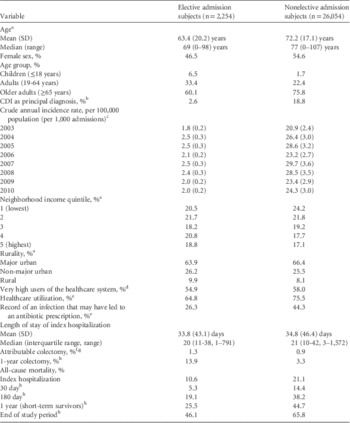
We identified 28,308 subjects infected with hospital-acquired CDI (Table 1). The crude mean annual incidence rate was 27.9 per 100,000 population (3.3 per 1,000 admissions). The mean (range) age of incident infected subjects was 71.5 (0–107) years; 54.0% were female, and 8.0% were elective admissions. Compared with elective admission subjects, nonelective admission subjects were more likely to be female, be older, and have more comorbidities (very high users of the healthcare system), along with greater healthcare utilization and possible antibiotic exposure within 12 weeks prior to the index hospitalization. They were also more likely to die.
Selected Characteristics of Infected Subjects Before Matching

NOTE. CDI, Clostridium difficile infection.
a At the index hospital admission date.
b Most responsible diagnosis (accounting for the greatest proportion of the length of hospital stay) for the index hospitalization.
c Not standardized to a specific year.
d Highest resource utilization band presented to summarize comorbidities that were measured within 2 years prior to the index hospital admission date (see Supplementary Tables 2 and 5).
e Within the 12 weeks prior to the index hospital admission date.
f During the index hospitalization.
g See Supplementary Table 4 for how a colectomy was attributed to CDI.
h After index hospital admission date.
Matching Results
After propensity-score matching, 1,471 (65.3%) of infected subjects in the elective admission group were matched to uninfected subjects, while 24,015 (92.2%) of infected subjects in the nonelective admission group were matched to uninfected subjects. Unmatched infected subjects in both groups had more comorbidities than matched infected subjects.
During the study period (January 2003 to December 2011), 43.8% (n=645) and 65.3% (n=15,692) of the matched infected subjects in the elective admission and nonelective admission groups, respectively, died.
Among those who died, 97.7% (n=630) in the elective admission group and 98.3% (n=15,433) in the nonelective admission group were successfully matched to comparable uninfected subjects that died.
After the matches were conducted, nearly all standardized differences for the baseline covariates were 0.1 or less (Supplementary Tables 5 and 6).
Outcomes
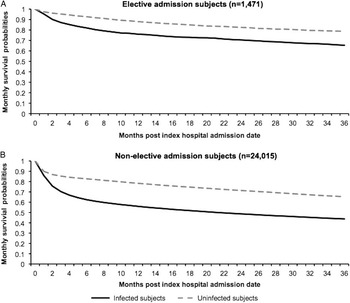
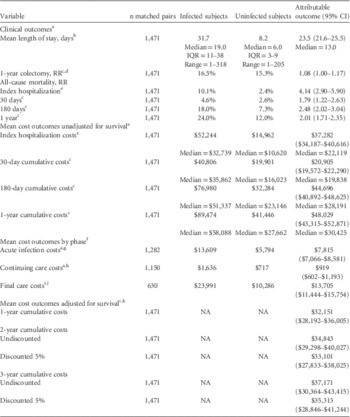
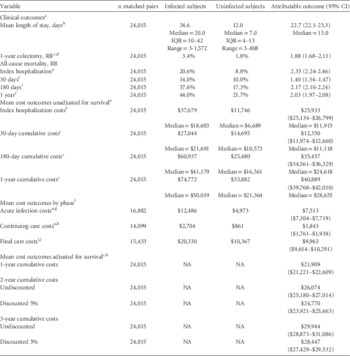
Hospital-acquired CDI was associated with worse clinical outcomes among infected subjects compared with matched uninfected subjects (Tables 2 and 3). The mean attributable LOS was 23.5 days (95% CI, 21.6–25.5 days; median, 13.0 days) for elective admission subjects and 22.7 days (22.1–23.3 days; 13.0 days) for nonelective admission subjects. The relative risk for colectomy was 1.08 (95% CI, 1.00–1.17) for elective admission subjects and 1.88 (1.68–2.11) for nonelective admission subjects. The relative risks for mortality during the index hospitalization and 1 year post–index hospital admission date were 4.14 (95% CI, 2.90–5.90) and 2.01 (1.71–2.35) for elective admission subjects and 2.35 (2.24–2.46) and 2.03 (1.97–2.08) for nonelective admission subjects. Infected subjects also experienced lower survival over 3 years than matched uninfected subjects (Figure 1).
Survival curves for infected subjects and their matched uninfected subjects, 3 years after the index hospital admission date.

Clinical and Cost Outcomes Attributable to Hospital-Acquired CDI Among Elective Admission Subjects

NOTE. CDI, Clostridium difficile infection; IQR, interquartile range; NA, not applicable; RR, relative risk.
a Index date was the index hospital admission date.
b Index hospital admission date to index hospital discharge date.
c After index hospital admission date.
d See Supplementary Table 3 for intervention codes used to identify a colectomy procedure.
e During the index hospitalization.
f Costs standardized to 30 days.
g Phase length up to 6 months.
h Phase length varied between 1 and 110 months.
i Costs derived from the re-match of infected subjects who died during the observation period to uninfected subjects who also died.
j Phase length up to 3 months.
k Phase-specific costs combined with crude monthly probabilities of death derived from the matched infected subjects.
Clinical and Cost Outcomes Attributable to Hospital-Acquired CDI Among Nonelective Admission Subjects

NOTE. CDI, Clostridium difficile infection; IQR, interquartile range; NA, not applicable; RR, relative risk.
a Index date was the index hospital admission date.
b Index hospital admission date to index hospital discharge date.
c After index hospital admission date.
d See Supplementary Table 3 for intervention codes used to identify a colectomy procedure.
e During the index hospitalization.
f Costs standardized to 30 days.
g Phase length up to 6 months.
h Phase length varied between 1 and 110 months.
i Costs derived from the re-match of infected subjects who died during the observation period to uninfected subjects who also died.
j Phase length up to 3 months.
k Phase-specific costs combined with crude monthly probabilities of death derived from the matched infected subjects.
Cumulative costs unadjusted for survival were higher among infected subjects compared with matched uninfected subjects (Tables 2 and 3). For elective admission subjects, cumulative mean attributable 30-day, 180-day, and 1-year costs unadjusted for survival were $20,905 (95% CI, $19,572–$22,290), $44,696 ($40,892–$48,625), and $48,029 ($43,315–$52,871), respectively, whereas for nonelective admission subjects, corresponding costs were $12,350 ($11,974–$12,660), $35,457 ($34,561–$36,329), and $40,889 ($39,768–$42,010), respectively.
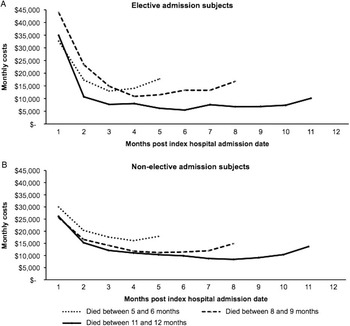
Costs exhibited a “U” shaped function from index hospital admission date to death (Figure 2). We defined acute infection to be up to 6 months and final care to be up to 3 months. The continuing care phase ranged from 0 to 110 months. Phase-specific costs were higher among infected subjects than uninfected subjects. For elective admission subjects, cumulative mean attributable 1-, 2-, and 3-year costs adjusted for survival were $32,151 (95% CI, $28,192–$36,005), $34,843 ($29,298–$40,027), and $37,171 ($30,364–$43,415), respectively, whereas for nonelective admission subjects, corresponding attributable costs were $21,909 ($21,221–$22,609), $26,074 ($25,180–$27,014), and $29,944 ($28,873–$31,086), respectively (Tables 2 and 3).
Costs (unadjusted for survival) of short-term survivors (infected subjects). Among elective admission infected subjects, 21 died between 5 and 6 months, 15 died between 8 and 9 months, and 12 died between 11 and 12 months and among nonelective admission infected subjects, 466 died between 5 and 6 months, 251 died between 8 and 9 months, and 214 died between 11 and 12 months.

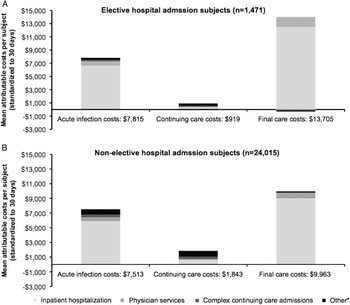
The largest cost components among the acute infection and final care phases were inpatient hospitalization and physician services (Figure 3). For the continuing care phase, the largest cost components were inpatient hospitalization and complex continuing care admissions.
Phase-specific costs stratified by healthcare services. *“Other” includes same-day surgery procedures, emergency department visits, outpatient medications, nonphysician services, outpatient laboratory tests, rehabilitation services, home care services, long-term care admissions, dialysis clinic visits, cancer clinic visits, and assisted devices.

In the stratified analyses, costs were generally higher for males, those infected after 2008, those who underwent a CDI-attributed colectomy, and short-term survivors (Supplementary Table 7).
Sensitivity Analysis
Cost results were sensitive to excluding those with a CDI diagnosis characterized as a preadmission comorbidity (5,641 [22.1%]; 3% to 14% higher costs, Supplementary Table 8). Costs were more sensitive to varying the length of acute infection (baseline 6 months) and final care (baseline 3 months) from 1 to 12 months, where mean attributable 1-year costs ranged from $27,516 to $43,730 (baseline $32,151) in the elective admission group and $18,775 to $28,411 (baseline $21,909) in the nonelective admission group (Supplementary Table 8).
DISCUSSION
Our findings suggest that hospital-acquired CDI prolongs hospital stay, substantially increases the risks for mortality and colectomy, and leads to greater short- and long-term healthcare costs compared with rigorously matched uninfected subjects. Attributable costs were greatest during the index hospitalization and decreased over time; however, higher costs persisted. To the best of our knowledge, this study is the first CDI costing study to present longitudinal costs, demonstrating that attributable costs accrue beyond 6 months after the index hospital admission date, and that costs, when graphed, follow a “U” shaped function, similar to cancer and heart failure.Reference Riley, Potosky, Lubitz and Kessler 24 , Reference Wijeysundera, Machado and Wang 29 For comparison, the mean 1-year costs ($21,909 to $32,151) attributable to hospital-acquired CDI were within the range for mean 1-year costs attributable to cancer ($5,115 to $59,582,Reference Yabroff, Lamont and Mariotto 23 , Reference Thein, Isaranuwatchai and Campitelli 30 converted to 2014 Canadian dollars 31 , 32 ).
Higher costs were found among (a) those who underwent a colectomy, because additional resources are needed to manage complications; (b) short-term survivors, indicating that CDI burden is proximal to the index hospitalization; and (c) those infected after 2008, which could be owing to a more virulent strain of CDI circulating in Ontario during that period.Reference Pillai, Longtin and Low 33
Our findings were generally consistent with previous studies. Death during the index hospitalization among infected elective admission subjects and 30-day mortality among infected nonelective admission subjects were within the range reported in comparable patient groups (eg, infected surgicalReference Yasunaga, Horiguchi, Hashimoto, Matsuda and Fushimi 34 , Reference Zerey, Paton, Lincourt, Gersin, Kercher and Heniford 35 and hospitalizedReference Hensgens, Goorhuis, Dekkers, van Benthem and Kuijper 36 , Reference Bhangu, Bhangu, Nightingale and Michael 37 patients). Moreover, attributable 180-day and 1-year mortality among the nonelective admissions group were similar to the results found in a Canadian study by Pepin et al,Reference Pepin, Valiquette and Cossette 38 who compared hospitalized patients with and without CDI. In terms of economic burden, among elective admission subjects, results were similar to Zerey et al,Reference Zerey, Paton, Lincourt, Gersin, Kercher and Heniford 35 who evaluated charges in surgical subjects from the United States (median attributable LOS, 14 days; 4-fold higher hospitalization charges for those with CDI versus those without CDI). Among nonelective admission subjects, results differed from Dubberke et al,Reference Dubberke, Reske, Olsen, McDonald and Fraser 39 who evaluated costs in nonsurgical subjects from the United States (median attributable LOS, 6 days; 50% to 80% higher hospitalization and 180-day costs for those with CDI versus those without CDI). The differences in results could be due to Dubberke et alReference Dubberke, Reske, Olsen, McDonald and Fraser 39 defining nonsurgical subjects as those without operating room costs and basing results on cases from 2003 only, whereas we included those with emergency interventions and subjects from 2003 to 2010.
Our study has some limitations. First, we did not validate the ICD-10-CA code used to identify CDI-infected subjects, because we did not have access to CDI-specific laboratory data. However, a Canadian validation study comparing the ICD-9/ICD-10-CA code against the reference standard of CDI stool toxin in an ulcerative colitis population reported 88% sensitivity and 100% specificity.Reference Negron, Barkema and Rioux 40 The lower sensitivity suggests that we may have underestimated the true number of infected subjects, but it is uncertain whether we under- or overestimated outcomes, because we do not know if those not identified had more or less severe disease than those included in this study. Second, our exclusion criteria might have excluded hospital-acquired CDI with community onset. Despite this, we feel our strict criteria provided a probable sample of hospital-acquired cases. In addition, although we were unable to match all patients who met our CDI definition, the matched infected subjects were generally a good representation of the groups before matching (Supplementary Table 5). However, the unmatched infected subjects had more comorbidities; therefore, we may have underestimated attributable outcomes. Third, we were unable to isolate the costs of CDI recurrences because we did not have access to CDI-specific laboratory data to define those; it is likely that the higher long-term attributable costs observed in our study are driven at least in part by recurrences. Other reasons for the long-term burden could be the need for continued medical care after CDI due to the frailty of these subjects. Last, we were unable to ascertain the timing of disease onset because we did not have access to CDI-specific laboratory data, which could have led to time-dependent bias, overestimating attributable LOS and therefore costs.Reference Mitchell, Gardner, Barnett, Hiller and Graves 41 However, because we matched on a broad range of covariates, we may have minimized this bias.Reference Austin 17
Strengths of our study include the availability of linked datasets enabling us to exclude possible community-associated CDI, the ability to match on a broad range of baseline covariates using propensity methods to reduce bias, and the comprehensiveness of our cost analysis that included all publicly funded healthcare services and an adjustment for survival.
Other jurisdictions can utilize our actual estimates (where costs can be converted to a preferred currency and/or year) or the relative results (eg, largest cost components, populations with higher costs, percent increase in costs due to CDI) to understand the burden of hospital-acquired CDI in their respective settings. Our results are based on a large population-based sample, thereby increasing the generalizability of our results, and costs were evaluated beyond a hospital stay, providing a more complete estimate of the economic burden. Therefore, our results can be used to support decisions on prevention and treatment strategies (eg, modification of antibiotic stewardship programs, addition of a CDI-safe antibiotic to the hospital formulary).
In conclusion, our study describes the attributable economic burden of hospital-acquired CDI, highlighting the need to explore and employ strategies that mitigate this costly infectious disease, along with the importance of examining the long-term impact of acute infectious diseases.
ACKNOWLEDGMENTS
Financial support. Canadian Institutes of Health Research (operating grant MOP 130553); and the Institute for Clinical Evaluative Sciences and Public Health Ontario, which are funded by annual grants from the Ontario Ministry of Health and Long-Term Care.
Potential conflicts of interest. N.N. reports that she received stipend support throughout her PhD graduate work from the University of Toronto, Pfizer Canada, the Ontario Graduate Scholarship program, and a Canadian Institutes of Health Research operating grant that funded this current study. J.C.K. reports that he is supported by a Canadian Institutes of Health Research New Investigator Award and a Clinician Scientist Award from the University of Toronto’s Department of Family and Community Medicine. P.C.A. reports that he is supported in part by a Career Investigator Award from the Heart and Stroke Foundation of Canada. N.D. reports that he is supported by a Canadian Institutes of Health Research Clinician Scientist Award. All other authors report no conflicts of interest relevant to this article.
Disclaimer. The Canadian Institutes of Health Research, University of Toronto, Pfizer Canada, the Ontario Graduate Scholarship program, and the Heart and Stroke Foundation did not participate in: the design or concept of the study; the acquisition, analysis, or interpretation of the data; and the drafting or reviewing of the manuscript. The opinions, results, and conclusions reported in this article do not necessarily represent the views of the Institute for Clinical Evaluative Sciences, Public Health Ontario, or the Ontario Ministry of Health and Long-Term Care. Parts of this material are based on data and information compiled and provided by the Canadian Institute of Health Information. However, the analyses, conclusions, opinions, and statements expressed herein are those of the authors, and not necessarily those of the Canadian Institute of Health Information.
SUPPLEMENTARY MATERIAL
To view supplementary material for this article, please visit http://dx.doi.org/10.1017/ice.2016.122