


1. Introduction
Blocking and extended morphological exponence have been widely discussed in the recent theoretical literature on inflectional morphology. In this article, we show that the two emerge as opposite sides of one coin within a Realization Optimality Theory approach to inflection. Blocking in inflectional morphology refers to a phenomenon in which a rule or affix prevents or ‘bleeds’ (Kiparsky Reference Kiparsky, Bach and Harms1968) the application of another rule or affix that expresses a similar or the same morphosyntactic feature value set as that expressed by the bleeding rule or affix (Anderson Reference Anderson1986; Noyer Reference Noyer1992, Reference Noyer1997; Stump Reference Stump2001, among many others). Blocking thus prevents the occurrence of multiple exponents of a single morphosyntactic feature value. Extended morphological exponence refers to cases in which a morphosyntactic or semantic feature value is realized by more than one exponent in the same word (Matthews Reference Matthews1991; Noyer Reference Noyer1992, Reference Noyer1997; Anderson Reference Anderson, Booij and Marle2001; Stump Reference Stump2001, among many others). Natural languages exhibit cases of both blocking and extended exponence, so any theory of morphology must accommodate both. It must also encode the observation that blocking is more common than extended exponence.Footnote 2 We will provide such a theory here, rooted in the realizational approach to inflection laid out in Matthews (Reference Matthews1972), Zwicky (Reference Zwicky, Niepokuj, Clay, Nikiforidou and Feder1985), Anderson (Reference Anderson1992), Stump (Reference Stump1993, Reference Stump2001), and Aronoff Reference Aronoff1994, where inflection is viewed as the realization of abstract morphosyntactic features through the application of morphological realization rules to lexemes. More broadly, we adopt the formalism of Optimality Theory (OT) and encode the morphological realization rules of, for example, Aronoff (Reference Aronoff1994) as ranked violable constraints (see also Russell Reference Russell1995, Kager Reference Kager and Kleinheiz1996, Yip Reference Yip, Lapointe, Brentari and Farrell1998, Hyman Reference Hyman, Booij and Marle2003, MacBride Reference MacBride2004). Both the novelty and the power of our approach lie in interspersing language-particular realization constraints with more general constraints, especially the constraint *Feature Split, which bars the realization of any morphosyntactic feature value by more than one exponent. We will discuss previous work first.
Within realizational approaches to inflectional morphology, two distinct treatments of blocking and extended exponence have been set out. Noyer (Reference Noyer1992, Reference Noyer1997) proposes a mechanism he calls feature discharge to account for some cases of blocking in inflectional morphology. This mechanism ensures that, once a morphosyntactic feature value is discharged or spelled out by an affix, it will no longer be available for further realization. Feature discharge therefore blocks the insertion of an affix that realizes the same morphosyntactic feature value by discharging the feature. But what about extended exponence, in which the feature seems to persist despite having been discharged? In order to allow for extended exponence, Noyer makes a distinction between primary and secondary exponents: an affix that realizes a morphosyntactic feature value as a secondary exponent presumes the cooccurrence of another affix that realizes the same morphosyntactic feature value as a primary exponent. Extended exponence in Noyer's framework therefore involves occurrences of both a primary and secondary exponent together.
Stump (Reference Stump2001) accounts for blocking and extended exponence within a realizational paradigm-based model, which consists of realization rules that associate morphosyntactic feature values with phonological forms based on templatic slots. Realization rules that fill in the same slot are placed in one rule block. Blocking takes place among the realization rules that compete for the same morphotactic slot. In other words, blocking takes place within a single rule block. Additionally, Stump proposes the Pāṇinian Determinism Hypothesis, i.e. competition among realization rules within a single rule block can only be determined by Pāṇini's Principle, which requires a realization rule to preempt others if it applies to a more specific morphosyntactic feature value set. In this framework, extended exponence involves more than one rule block or templatic slot. That is, actually realized exponents among whose morphosyntactic or semantic feature value sets there is a subset relation are placed in different rule blocks.
In these approaches, both of which accept the validity of Pāṇini's Principle, distinct machinery needs to be introduced in order to allow extended exponence. Noyer resorts to a distinction between primary and secondary exponents while Stump resorts to multiple rule blocks.
We argue for a Realization Optimality Theory approach to morphological exponence and show that it provides a unified account of both blocking and extended exponence without recourse to either a distinction between primary and secondary exponents or multiple rule blocks. The key device is the markedness constraint *Feature Split, which bans the realization of any morphosyntactic or semantic feature value by more than one exponent and is a spiritual sister to the feature discharge principle. The major difference is that *Feature Split is an OT constraint, and hence both violable and variable in ranking with morphological realization constraints that are specific to individual languages by their very nature. *Feature Split is a necessary condition of Pāṇini's Principle. That is, Pāṇini's Principle is violated only if *Feature Split is violated, too. *Feature Split is a more general mechanism than Pāṇini's Principle, whose application further requires a subset relation among competing exponents. The ranking of *Feature Split and the realization constraints that express the same morphosyntactic feature value(s) determines whether we find blocking or extended exponence. If *Feature Split ranks lower than two or more realization constraints expressing the same feature value(s), then we observe extended exponence. If *Feature Split ranks higher than the realization constraints, we will find blocking of lower-ranked affixes. In some cases, *Feature Split may rank between two competing exponents.
The organization of this paper is as follows. In Section 2, we compare a Realization Optimality Theory approach with the approaches to blocking and extended exponence in Noyer (Reference Noyer1992, Reference Noyer1997) and Stump (Reference Stump2001). We show that Realization OT readily captures both phenomena by means of a single device. We discuss other alternative approaches to blocking and extended exponence in Section 3. We show that Realization OT is superior to Peterson's (Reference Peterson, Duncan, Farkas and Spaelti1994) and Müller's (Reference Müller2007) mechanisms of deriving extended exponence, neither of which explains it. Realization OT has advantages over conventional OT models (McCarthy & Prince Reference McCarthy and Prince1993b, Russell Reference Russell, Archangeli and Terence Langendoen1997, Kurisu Reference Kurisu2000, Bonet Reference Bonet, Boersma and Cutillas2004, Mascaró Reference Mascaró2007, among many others) with respect to not just blocking and extended exponence, but morphology in general, because conventional OT models do not give any analytical space to morphological realization. We show that realization constraints are indispensable in morphological analysis and cannot be replaced by ‘universal’ expressiveness constraints (e.g. Kiparsky Reference Kiparsky, Booij and van Marle2005). We argue that *Feature Split, which unifies blocking and extended exponence, cannot be replaced by alignment constraints (McCarthy & Prince Reference McCarthy, Prince, Booij and Marle1993a, Russell Reference Russell, Archangeli and Terence Langendoen1997, Grimshaw Reference Grimshaw, Legendre, Grimshaw and Vikner2001). We show that Realization OT does not conflict with constructional approaches to morphology (Booij Reference Booij2002, Reference Booij, Dressler, Rainer, Kastovsky and Pfeiffer2005, Reference Booij, Montermini, Boyé and Hatbout2007, Reference Booij, Lieber and Štekauer2008, Reference Booij2009; Blevins Reference Blevins2006; Harris Reference Harris2009) under which lexical specifications are required to describe extended exponence. We compare Realization OT with diachronic approaches to extended exponence and argue that there is no necessary discrepancy between them in that diachronic models may conform to the same mechanism of deriving extended exponence as in Realization OT. We conclude in Section 4.
2. A Realization Optimality Theory approach to blocking and extended exponence
In this section we show that Realization OT provides a unified account of both blocking of inflectional affixes and extended morphological exponence, without recourse to either a distinction between primary and secondary exponents (Noyer Reference Noyer1992, Reference Noyer1997) or multiple rule blocks (Stump Reference Stump2001). We first discuss data from Tamazight Berber and Classical Arabic, which have been widely analyzed in the literature. This is an indispensable part of any paper that tries to account for blocking and extended exponence because these data have attracted great attention. Moreover, the Classical Arabic data exemplify a common pattern of blocking and extended exponence, and the Tamazight Berber data exemplify a common pattern of extended exponence, so we use them to illustrate our morphological model, which can easily apply to many other languages in which blocking and extended exponence are observed.
2.1 Tamazight Berber
Rolf Noyer takes an interesting rule-based realization approach to Tamazight Berber verbal morphology, whose paradigm is shown as follows:
(1) Completive paradigm of Tamazight Berber dawa‘cure’ (Abdel-Massih Reference Abdel-Massih1971: 171; Noyer Reference Noyer1992: 132; Stump Reference Stump2001: 157)

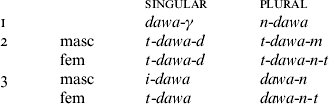
Noyer's analysis of the Tamazight Berber paradigm in (1), as summarized by Stump (Reference Stump2001: 157), is given in (2).Footnote 3
(2) Noyer's analysis of the Tamazight Berber paradigm
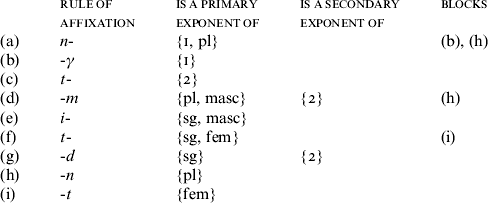
Noyer's realization theory is based on feature discharge. Once a morphosyntactic feature value is discharged or spelled out by an exponent, it will no longer be available for further realization. Thus, the prefix n- {1, pl} blocks the suffix -γ {1} because the first person feature value that is realized by n- is no longer available for realization by -γ. This is a case of what Noyer calls discontinous bleeding in which the blocking and blocked affixes belong to distinct position classes. Similar analyses apply to cases in which n- {1, pl} blocks -n {pl}, -m {pl, masc} blocks -n {pl}, and t- {sg, fem} blocks -t {fem}. Noyer's theory follows precisely Pāṇini's Principle, which requires an affix with more specific morphosyntactic content to preempt others with less specific content. Tamazight Berber, however, has cases of extended exponence, in which a morphosyntactic feature value is realized by more than one form, thus disobeying Pāṇini's Principle. For example, the second person plural masculine exponent -m cooccurs with the second person exponent t- (t-dawa-m), showing extended exponence of the second person feature. Additionally, the second person singular exponent -d cooccurs with the second person exponent t- {2} (t-dawa-d). These cases of extended exponence pose a challenge for a theory based on feature discharge, because if the second person feature value is first realized by -m {2, pl, masc} or -d {2, sg}, it should no longer be available for realization by t- {2} and therefore we should not expect the cooccurrence of t- with -m/-d.
In order to allow for extended exponence, Noyer introduces extra machinery in the distinction between primary and secondary exponents.Footnote 4 An affix that realizes a morphosyntactic feature value as a secondary exponent depends on the presence of another affix that realizes the same morphosyntactic feature value as a primary exponent. Only an affix that realizes a morphosyntactic feature value as a primary exponent can block or be blocked by another affix that also expresses the same feature value as a primary exponent. An affix that realizes a morphosyntactic feature value as a secondary exponent cannot block or be blocked by another affix that expresses the same feature value as either a primary or secondary exponent. Extended exponence in Noyer's framework therefore demands the occurrence together of both a primary and secondary exponent. According to Noyer, in Tamazight Berber t- is a primary exponent of the second person feature value, which can be further realized by -m or -d, which must be secondary exponents of {2}, because {2} has been discharged by t-.
Stump (Reference Stump2001) argues against Noyer's (Reference Noyer1992) analysis of extended exponence. Stump shows that it is not always possible to determine whether a given exponent is primary or secondary, even for a single form. Thus, it is possible to treat the Tamazight Berber suffixes -m and -d as primary exponents instead of secondary exponents. See (3) (from Stump Reference Stump2001:165). Stump remarks (p. 168) that ‘Noyer's notion of feature discharge is not a satisfactory alternative to the postulation of rule blocks, since it depends on an empirically unmotivated and ultimately paradoxical distinction between primary and secondary exponents’.Footnote 5
(3) Stump's reanalysis of the Tamazight Berber paradigm
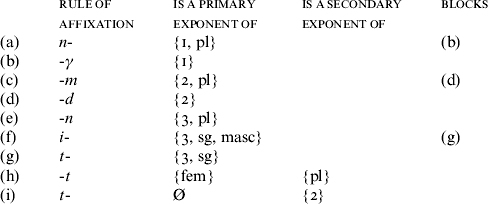
Stump (Reference Stump2001) presents an approach to Tamazight Berber verbal morphology within the framework of Paradigm Function Morphology, where realization rules that apply to the same affixal slot are placed in the same rule block. Within a rule block, Pāṇini's Principle is the only mechanism to determine which rule should apply (i.e. the Pāṇinian Determinism Hypothesis). Blocking is assumed to occur only within the same rule block, which corresponds to a single affixal slot. Extended exponence is allowed via multiple rule blocks: cooccurring exponents that would otherwise violate Pāṇini's Principle must fall in distinct rule blocks. Stump's analysis of blocking and extended exponence in Tamazight Berber follows (we simplify his notation). The output from one rule block becomes an input to the following one:
(4)
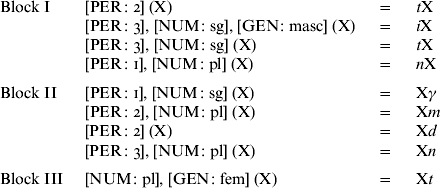
There are at least three problems for Stump's model. First, blocking and extended exponence are analyzed under two separate mechanisms, i.e. blocking of exponents is derived via Pāṇini's Principle that applies within a rule block while extended exponence is derived via multiple rule blocks. Second, as Noyer notes, Stump's model cannot account for cases of discontinuous bleeding in which the blocking and blocked affixes belong to different rule blocks or position classes given that Pāṇini's Principle does not apply across rule blocks in Stump's model.Footnote 6 Third, Paradigm Function Morphology needs to use counterintuitive underspecification. For example, although the Tamazight Berber suffix -d is patently an exponent of {2, sg} because it only occurs in the slot of {2, sg} it is analyzed as {2} under PFM.
To briefly summarize, neither model provides a unified account of blocking and extended exponence. To allow for extended exponence, they each have to introduce additional mechanisms.
2.2 A Realization Optimality Theory approach to Tamazight Berber morphology
In this section, we present a Realization Optimality Theory account of the Tamazight Berber data. This is an inferential–realizational model of inflectional morphology (Matthews Reference Matthews1972; Zwicky Reference Zwicky, Niepokuj, Clay, Nikiforidou and Feder1985; Anderson Reference Anderson1992; Aronoff Reference Aronoff1994; Stump Reference Stump1993, Reference Stump2001) within the framework of Optimality Theory (Prince & Smolensky Reference Prince and Smolensky1993/2004). Any inferential–realizational model of morphology needs to posit grammatical functions that realize morphosyntactic feature values. Following Russell (Reference Russell1995), Kager (Reference Kager and Kleinheiz1996), Yip (Reference Yip, Lapointe, Brentari and Farrell1998), Hyman (Reference Hyman, Booij and Marle2003) and MacBride (Reference MacBride2004), we assume that the phonological realization of inflectional affixes is done through realization constraints. The basic format of a realization constraint is shown in (5), which states that a morphosyntactic feature is realized by a morphophonological form. The symbol ‘:’ is read as ‘realized by’.
(5) {Morphosyntactic feature}: {Morphophonological form}
Functional morphemes such as affixes are encoded in realization constraints, which are a cornerstone of Realization Optimality Theory. For example, the realization constraint {2}: t- for Tamazight Berber is read: ‘{2} should be realized by t-’.Footnote 7 Additionally, we follow Prince & Smolensky (Reference Prince and Smolensky1993/2004), which encodes Pāṇini's Principle in OT constraint rankings (6). As a consequence, a constraint realizing a feature set outranks another constraint realizing a non-null subset of the features realized by the higher-ranked constraint.
(6) Pāṇini's Theorem on Constraint Ranking (Prince & Smolensky 2004: 99)
Let constraints S and G stand as specific to general in a Pāṇinian relation. Suppose these constraints are part of a constraint hierarchy CH, and that G is active in CH on some input i. Then if G>>S, S is not active on i.
Following previous works (e.g. Yip Reference Yip, Lapointe, Brentari and Farrell1998, Hyman Reference Hyman, Booij and Marle2003, MacBride Reference MacBride2004, Xu Reference Xu2007), we assume that morphosyntactic features are present in the input to realization and remain available throughout (i.e. are not deleted when ‘discharged’). The function Gen in Realization OT generates an infinite list of phonological forms to realize the features.Footnote 8 Since the outcomes of realizational morphology models are phonological forms, constraints of Realization OT specifically target morpho-phonological forms and no change of morphosyntactic features is assumed (see Grimshaw Reference Grimshaw1997).
In Realization OT, there is no methodological reason to underspecify the feature value set that an exponent realizes. The feature values associated with a given exponent are usually those shared on inspection by the forms in which the exponent occurs, no more and no less. Nor is there much reason to posit contentless default affixes. No morphosyntactic disjunctions are permitted either, leading to homophonous constraints in cases like the t- prefix for either {2} or {3, sg, fem} in Semitic languages. The key device within Realization OT that we introduce in this article is the markedness (more precisely economy) constraint *Feature Split, which bans the realization of a morphosyntactic feature value by more than one form.Footnote 9 This constraint favors simple exponence, which is assumed to be universally unmarked (Wurzel Reference Wurzel1989).Footnote 10 *Feature Split is a more general mechanism than Pāṇini's Principle, whose application further requires a subset relation among competing exponents. By varying the ranking of *Feature Split and constraints realizing the same morphosyntactic feature value(s), we can readily express both blocking and extended exponence. If *Feature Split is outranked by constraints realizing the same morphosyntactic feature value(s), we will expect extended exponence. Otherwise, we will observe blocking of inflectional affixes. From the learners' point of view, extended exponence is always a signal that *Feature Split, which by default outranks all realization constraints, must in this instance rank lower than the particular realizations that show extended exponence.
Let us reconsider the Tamazight Berber verbal paradigm in (1). Our proposed Realization OT grammar is presented in (7). Following Stump (Reference Stump2001), we assume that -m realizes {2, pl} and assimilates to [n] in the slot of {2, fem, pl}. Notice that the constraints {2, pl}: -m, {2, sg}: -d, and {2}: t- need to outrank *Feature Split because both -m {2, pl} and -d {2, sg} can co-occur with t- {2} (t-dawa-m, t-dawa-d) so that the second person feature value is realized by two exponents. The ranking of {2}: t- and {2, pl}: -m or {2, sg}: -d is indeterminate in that we cannot find any evidence to show that the former is outranked by the latter, but we assume that it still conforms to the specificity condition that requires a constraint with more specific morphosyntactic or semantic content to outrank a less specific realization constraint. For a clearer presentation, we rank *Feature Split higher than the remaining realization constraints simply to show that extended exponence is introduced by the constraints that outrank *Feature Split. But in fact, if, for example, {1, pl}: n- outranks *Feature Split, our results remain intact.Footnote 11
(7) {2, pl}: -m, {2, sg}: -d, {fem, pl}: -t, {3, pl}: -n >>{2}: t- >>
*Feature Split >>
{1, pl}: n-, {1, sg}: -γ, {3, sg, masc}: i-, {3, sg, fem}: t-
Our Realization OT grammar captures every paradigmatic cell in (1). The tableau for t-dawa-d {2, masc, sg}, for example, is shown in (8) below. The illicit output candidates *dawa-d and *t-dawa are ruled out because both -d {2, sg} and t- {2} need to be spelled out despite the violation of *Feature Split. We leave to our readers the exercise of confirming that the grammar in (7) captures the other slots in the paradigm of (1). The careful reader will have noticed that on our analysis no case of blocking is observed in the paradigm in (1). But we do not claim that every paradigm of every language must contain examples of both blocking and extended exponence. Many languages show no examples of extended exponence. We doubt that there are no languages without any instances of blocking, though that remains to be seen.
(8) t-dawa-d {2, masc, sg}

Notice that in our approach there is no need to avoid the feature value set {2, masc, sg} in Tamazight Berber verbal morphology. The constraint {2}: t- is insensitive to gender distinction in the environment of second person subject agreement. By contrast, Noyer (Reference Noyer1992) rules out the input feature value set {2, masc, sg} under the analysis in (2) because otherwise *t-i-dawa (t- {2}, i- {sg, masc}) would be the correct outcome as pointed out in Stump (Reference Stump2001).Footnote 12 Additionally, our Realization OT grammar does not resort to counterintuitive underspecification. For example, -d realizes {2, sg} in our framework while Stump (Reference Stump2001) analyzes it as an exponent of {2} even though it only occurs in the slots of {2, sg}.
The order of the suffixes -n (or -m assimilated into [n]) and -t can be determined by phonology.Footnote 13 The word-final cluster [nt] is more optimal than the final cluster [tn] because the former satisfies the Sonority Hierarchy Principle (Kenstowicz Reference Kenstowicz1994), which requires a coda to have a falling sonority contour, although various types of consonants can be underlyingly adjacent in Tamazight Berber (see Abdel-Massih Reference Abdel-Massih1971). The final cluster [nt] wins over [tən] with a ‘transitional vowel’ probably because of a constraint banning transitional vowels or empty morphs, though it is ranked low in Tamazight Berber because transitional vowels often break up complex consonant clusters.
The order of the suffixes -n (or -m assimilated into [n]) and -t could also be described by a template that requires -t to follow -n (cf. Hyman Reference Hyman, Booij and Marle2003; Paster Reference Paster, Booij and Marle2005, Reference Paster2006, Reference Paster2009, to appear).Footnote 14 Since affix ordering is not a theme of this paper, we will not discuss this issue in detail. But see Xu (Reference Xu2007) and Aronoff & Xu (Reference Aronoff and Xu2010) for detailed discussion of affix ordering under Realization OT; they remark that a templatic approach should be the last resort, given that a template, by definition, is stipulative in nature.Footnote 15
Two remarks deserve emphasis at this point. First, in conventional OT, constraints are assumed to have universal status; but realization constraints are necessarily language-specific in that they realize arbitrary Saussurean signs. It is important to emphasize that the target of conventional OT is phonology while our model deals mainly with morphology, which, since at least Ferdinand de Saussure, has emphasized arbitrary associations of meaning and form. In other words, morphological realization is necessarily language-particular and arbitrary, in any framework. We are concerned with morphological realization, not with phonology, and language-particular realization constraints are crucial in dealing with morphological phenomena, by definition. Whether language-particular constraints are necessary for purely phonological aspects of language is, thus, completely outside the scope of our work. In Section 3, we will compare Realization OT to conventional OT models that persist in maintaining the universality of constraints. We will show that realization constraints are indispensable in the morphological component of the whole grammatical architecture and that conventional OT models are incapable of handling morpheme realization and morphology in general.
Second, constraint rankings are sometimes indeterminate: for example, the ranking of {2, sg}: -d and {fem, pl}: -t. Flexibility of rule orderings also arises in Noyer (Reference Noyer1992, Reference Noyer1997) and Stump (Reference Stump2001). For example, on Noyer's analysis the order of the affixes i- {sg, masc} and t- {sg, fem} is flexible, as pointed out in Stump (Reference Stump2001). Stump (Reference Stump2001) proposes three rule blocks, those in (4) above, to analyze Tamazight Berber verbal morphology. The third block has only one realization rule. Each of the first two contains four realization rules whose order is indeterminate.
To briefly summarize, our Realization OT approach to the Tamazight Berber verbal morphology avoids both rule blocks and the distinction between primary and secondary exponents.
2.3 Classical Arabic
Realization OT also applies to Classical Arabic, which exhibits both blocking and extended exponence. We compare our approach to the Classical Arabic prefixal conjugation with Noyer (Reference Noyer1992, Reference Noyer1997), and Stump (Reference Stump2001), and continue to argue for its advantages. Consider the following paradigms:
(9) Classical Arabic prefixal conjugation (from Noyer Reference Noyer1997: 4–5)

There are at least two interesting issues in the above paradigms. First, the second person exponent t- co-occurs with the second person feminine singular marker -ii in the environment of {2, fem, sg} (e.g. t-aktub-ii), which is a case of extended exponence: {2} is realized by both t- and -ii. Second, in the environment of {3, fem, pl} we observe y-aktub-na instead of *t-aktub-na.
Noyer's (Reference Noyer1997: 54) analysis of the affixes in (9) is as follows:
(10) Noyer's analysis of the Classical Arabic prefixal conjugation
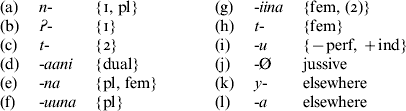
To explain cases like y-aktub-na {3, fem, pl} in which -na {fem, pl} blocks t- {fem} (*t-aktub-na), Noyer assumes that {fem} is first discharged or realized by -na and is no longer available for realization by t-. This is a case of discontinuous bleeding in which a suffix blocks a prefix. To allow for cases of extended exponence such as t-aktub-iina, Noyer distinguishes primary from secondary exponents, that is, t- is a primary exponent of {2} while -iina is a secondary exponent of {2}. The suffix -iina therefore does not block or get blocked by t-.
By modifying Noyer's analysis of the Classical Arabic affixes under Realization OT, we can account for the paradigm in (9) and readily capture both blocking and extended exponence without either the contentless elsewhere exponents in his analysis or a distinction between primary and secondary exponents. Also, Noyer analyzes n- as an exponent of {1, pl} although n- is also an exponent of {1, dual}.Footnote 16 He analyzes n- as an exponent of {1, pl} so that n- can block -uuna, which is analyzed as an exponent of {pl} (n-aktub-u vs. *n-aktub-uuna). By doing that, he gets another case of discontinuous bleeding, which he advocates in his framework. In order to account for the syncretism of {1, dual} and {1, pl} forms that share the same prefix n-, Noyer must then use a feature-changing mechanism to convert the feature value set {1, dual} into {1, pl}, while admitting that such feature-changing rules should be avoided.Footnote 17
Our analysis of the affixes in (9) is presented in (11). Where the analyses differ (compare (11) and (10) above), we use boldface type.
(11) Our analysis of the Classical Arabic prefixal conjugation
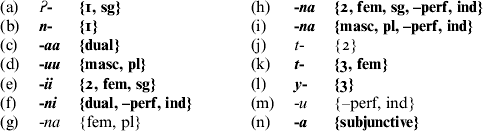
Several issues arise concerning our analysis. Noyer uses the feature value {+ind} while we use {ind} because generally we do not assume underspecification and {−ind} is therefore an illicit category in our framework. Additionally, according to Matthews (Reference Matthews1991) only marked features such as plural can form binary features, i.e. {+pl}, {–pl}. Indicative is an unmarked feature, so it should not be used for binary features. It is possible to analyze -na as a default exponent of {–perf, ind} since it occurs in the environment of both {2, fem, sg} and {masc, pl} which do not form a natural class. But what then of the suffix -u? The distribution of the suffix -u that realizes {–perf, ind} is also irregular. It basically occurs in the contexts of both {1} and {sg}, which do not form a natural class either. If we treat both -na and -u as default exponents of {–perf, ind}, it will be hard to explain why, for example, the exponent of {3, fem, sg, –perf, ind} is t-aktub-u instead of *t-aktub-na.Footnote 18
We analyze the three na-suffixes as homophones. It is common for languages to have homophonous affixes. In English, for example, the suffix -s can be a marker of either plural, or possessive, or third person singular agreement. The three na-suffixes are not reducible to one another except by illicit underspecification and we therefore list them separately.
It is possible to analyze, for example, -aani as a unitary suffix of {dual, –perf, ind} (see McCarthy Reference McCarthy, Downing, Hall and Raffelsiefen2005). As Noyer (Reference Noyer1997: 46) observes, ‘[w]herever the imperfect has a disyllabic suffix (-uuna, -iina, -aani), the subjunctive and jussive moods have only the first syllable of this suffix’. By positing a realization constraint like {dual, –perf, ind}: -aani, ‘we are forced to assert (in effect) that it is a mere accident that the [–indicative] affixes are in all cases the first syllables of the [+indicative] affixes’ (Noyer Reference Noyer1997: 47). To capture this generalization, Noyer proposes a morphologically conditioned rule of truncation under which the second syllable of a disyllabic suffix (-uuna, -iina, -aani) realizing {–perf, ind} is truncated in the context of {subjunctive} or {jussive}. By contrast, we analyze these disyllables as sequences of two separate suffixes, which captures Noyer's observation and avoids a rule of truncation, a relatively rare and marked type of process.
Noyer (Reference Noyer1997) analyzes the prefix y- as an elsewhere marker, which is expected to appear in any prefixal position that is not already occupied. We analyze it as an exponent of {3} since it only occurs in the context of {3}. We analyze t- as an exponent of {3, fem} so that based on *Feature Split it blocks y- in the environment of {3, fem} except where -na {fem, pl} occurs.Footnote 19
The jussive mood does not have an overt exponent. One way to express the jussive mood is to posit a zero suffix (see Noyer Reference Noyer1997) so that we can maintain the generalization that in the so-called Classical Arabic prefixal conjugation ‘every verb has at least and at most one suffix and at least and at most one prefix’ (Noyer Reference Noyer1997: 31). We can also assume that there is simply no exponent of the jussive mood. Under this assumption, a word has at most one suffix rather than exactly one suffix.
Finally, we use a templatic constraint to account for the distribution of -u, which realizes {–perf, ind}, and -a, which realizes {subjunctive}.Footnote 20 Our generalization is that -u and -a show up in the positions that no other suffix can fill in. Without a templatic constraint that requires a word to have at most one suffix, it will be hard to explain why t-aktub-na {2, fem, pl, –perf, ind} is grammatical while *t-aktub-u-na in which t- realizes {2}, -u realizes {–perf, ind}, and -na realizes {fem, pl} is ungrammatical. This templatic constraint is defined as follows:
(12) Verb Stem – Suffix (≦1): An inflected verb can have at most one suffix.
We encode our analyses of the Classical Arabic affixes into realization constraints. The grammar that consists of realization constraints, *Feature Split, and Verb Stem – Suffix (≦1) is presented as follows.Footnote 21 For a clearer presentation, we rank *Feature Split lower than the realization constraints that introduce extended exponence. The grammar in (13) captures every cell of the paradigms in (9).Footnote 22 It is by no means the only possible ranking, given that the ranking of constraints like {1, sg}:  - and {3}: y- is indeterminate.
(13) {2, fem, sg, –perf, ind}: -na, {masc, pl, –perf, ind}: -na, {dual, –perf, ind}: -ni >> {2, fem, sg}: -ii, {masc, pl}: -uu, {dual}: -aa>>{2}: t- >>
*Feature Split, Verb Stem – Suffix (≦1)>>{fem, pl}: -na >>
{3, fem}: t-, {1, sg}:
->>{1}: n-, {3}: y-, {–perf, ind}: -u, {subjunctive}: -a
Cases of extended exponence like t-aktub-ii {2, fem, sg, subjunctive} in which {2} is realized by both t- and -ii are accounted for by ranking the realization constraints {2, fem, sg}: -ii and {2}: t- higher than *Feature Split. The case of discontinuous bleeding in which -na {fem, pl} blocks t- {3, fem} in the context of {3, fem, pl} (y-aktub-na vs. *t-aktub-na) can only be ascribed to *Feature Split and the ranking *Feature Split>>{fem, pl}: -na>>{3, fem}: t->>{3}: y-. Thus *Feature Split crucially ranks between the two realizations for {2} that violate it and the realizations for {fem} and {pl} that obey it. See the tableau in (14).
(14) y-aktub-na {3, fem, pl}
Realization OT provides a unified account of blocking and extended exponence in Arabic without recourse to a distinction between primary and secondary exponents. Curiously, in Biblical Hebrew, we find t-aktub-na not only for {2, fem, pl, –perf} but also for {3, fem, pl, –perf}, rather than y-aktub-na, as in Arabic. The Hebrew form can be derived by ranking *Feature Split lower than both realization constraints, thus allowing both t- {3, fem} and -na {fem, pl} to realize {fem} simultaneously in the {3, fem, pl, –perf} form, rather than blocking the extended exponence (as in Arabic).Footnote 23
We can imagine that Stump (Reference Stump2001) would assume that, for example, blocking of n- {1} by - {1, sg} in Arabic takes place within a single rule block while the occurrence of both t- {2} and -ii {2, fem, sg} is accounted for by placing t- and -ii in two rule blocks. This analysis is subject to the same criticism as above: the lack of a unified explanation for blocking and extended exponence and the inability to handle discontinuous bleeding.
The languages we have discussed so far by no means exhaust the list of those in which blocking and/or extended exponence occurs, but they suffice to illustrate our model, which can easily apply to many others with blocking and/or extended exponence. A few more languages show extended exponence.Footnote 24 In Ancient Greek, ‘Perfective has extended exponents in e-le-lí-k-e-te (le-, y not y:, -k-); likewise Past (e-, -e-); likewise Active (-k-, -e-, -te)’ (Matthews Reference Matthews1991: 180). In Icelandic, the verb hafðir ‘have’ {2, sg, pret, ind} shows extended exponence, i.e. {sg} is doubly realized by the suffixes -i and -r and {pret} is realized by the suffixes -ð, -i as well as the stem vowel a (Anderson Reference Anderson1992: 55). In Welsh Romany, the preterite is realized by both the suffix -d and the suffixes that realize person and number as well (e.g. kam-d-án ‘love’+pret+2.sg.pret) (Stump Reference Stump1993: 450, citing Sampson Reference Sampson1926). In Archi, class markers representing the class of the head, which is not in the example (15), show up several times in a word. As seen in (15), ‘the root is as:á “of myself”, ej and u are suffixes, as is t:u, which forms adjectives’ (Corbett Reference Corbett1991: 108, citing Kibrik Reference Kibrik1977). In this example, d and r are markers of class II.
(15) d-as:á- r-ej- r-u-t:u- rII-of.myself-II-suffix-II-suffix-suffix-II‘my own’ [female]
These examples of extended exponence are fully compatible with Realization OT, which relies on violable markedness constraints such as *Feature Split.Footnote 25, Footnote 26 It is no surprise to the proposed Realization OT model that a morphosyntactic or semantic feature value can be multiply realized.
2.4 Problems in other languages
Noyer's and Stump's models encounter problems in other languages, such as Barasana, Batsbi, and Lezgian. This section continues to illustrate the problems of rule blocks and a distinction between primary and secondary exponents with data from these languages.
In Barasana (a Tukanoan language of Colombia and Brazil), a number of suffixes can affect stem tone. The Non3rdSubj suffix -b  causes H(igh tone) to align all the way to the right in words containing it, while the interrogative suffix -ri causes H to align all the way to the left (Gomez-Imbert & Kenstowicz Reference Gomez-Imbert and Kenstowicz2000, Pycha Reference Pycha2008, Inkelas to appear). See (16), in which the stem baa- ‘swim’ contains a lexical tone H+L(ow tone). Noyer's (Reference Noyer1992, Reference Noyer1997) model would ascribe the tonal changes in (16) to morphologically conditioned phonology or secondary exponence because he assumes that ‘[f]eature-changing rules (overwriting affixes) are always secondary exponents, which are expressed by dynamic rules’ (Noyer Reference Noyer1997: liv).
- (16)
(a) baa- ‘swim’
HL
(b) baa-b
‘I/you/we swam’HH H
(c) baa-ri ‘did he/she/they swim?’
H
Interestingly, the joint feature set {Non3rdSubj, int} is realized by both the tone of {Non3rdSubj} and the suffix -ri. Consider (17). The tone in (17b) is the only exponent of {Non3rdSubj}, so it must be a primary exponent. Therefore, the tone of {Non3rdSubj} is paradoxically either a primary or secondary exponent, depending on the context.
- (17)
(a) *baa-ri-b
, *baa-b -ri ‘did I/you/we swim?’(b) baa-ri ‘did I/you/we swim?’ HH H
Not surprisingly, additional mechanisms could be introduced to circumvent this paradox. For example, a zero morpheme could be added to (17b) (either baa-ri-Ø or baa-Ø-ri) so that the tone in (17b) still accompanies a primary zero exponent. Such a use of zeroes would make Noyer's model unfalsifiable.
Both the extended exponence in (16b) and the non-occurrence of -b in (17b) can be accounted for under the following Realization OT grammar.Footnote 27 We assume that {1} and {2} form a natural class {part(icipant) (in the speech act)} (see Siewierska Reference Siewierska2004). *Feature Split is outranked by the two constraints realizing {part, subj}, one of which spells out the suffix -b and the other of which requires H to occur throughout. This derives the extended exponence in (16b). Additionally, we refer to the phonological constraint Wd-Binary (Broselow & Xu Reference Broselow, Xu, Boersma and Cutillas2004), which requires a word to consist of two syllables. Both Wd-Binary and {int}: -ri block the occurrence of -b in (17b).
(18) Wd-Binary, {int}: -ri >>{part, subj}: -b
, {part, subj}: HHH >> *Feature Split
The tableaux illustrating the above grammar are presented in (19). In (19a) Candidate b is ruled out because H does not occur throughout. In (19b) Candidate b is ruled out because it is trisyllabic and therefore violates Wd-Binary. Candidate c is ruled out because {int} is not realized.
- (19)
(a) baa-b
(HHH) ‘I/you/we swam’(b) baa-ri (HHH) ‘did I/you/we swim?’
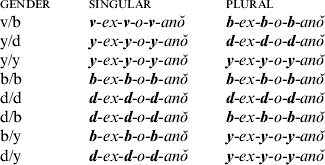
Noyer's distinction between primary and secondary exponents encounters difficulties in Batsbi (a language of the Nakh-Dagestanian family) as well. Harris (Reference Harris2009) argues convincingly that gender and number in verbal agreement are realized in Batsbi by the same morph that iteratively occurs in a word. In a Batsbi sentence, a verb agrees in gender and number with a noun that takes an absolutive case. Harris places Batsbi nouns into eight classes based on the corresponding agreement marker of a verb. Each of the classes assigns a distinct set of agreement markers to a verb. See the following paradigm, in which ex is a verbal stem, -o is a present tense marker, and anŏ is an evidential marker. When ex agrees with a first class singular noun, for example, it will take an agreement marker v-, which may iteratively precede each of the affixes that follow the verbal stem ex. Noyer would presumably consider the initial agreement marker a primary exponent of gender and number and the following repetitions secondary, so that they won't be blocked by the primary exponent. If so, we have to assume that the initial agreement marker and its following repetitions within the same word (e.g. v-ex- v-o- v-anŏ) are distinct morphemes, given their varied morphemic information, even if they are phonologically identical. This is an undesirable result, because it sacrifices the simpler generalization that the phonological form of the same agreement morpheme iterates across a Batsbi verb. Additionally, there is no reason other than mechanical necessity why a distinction between primary and second exponents is made among these phonologically identical markers. We should therefore resort to other formalisms to account for the Batsbi data and will return to this data in Section 3.
(20) Paradigm of d-ex-d-o-d-anŏ ‘evidently she/he/they destroyed it’ in the evidential (Harris Reference Harris2009: 299)
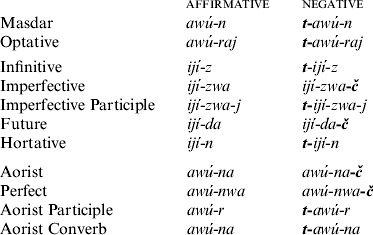
Lezgian negation markers pose a problem for Stump's (Reference Stump2001) model, which disallows discontinuous bleeding. Haspelmath (Reference Haspelmath1993: 127) remarks that in Lezgian ‘the participles, the converbs, the Infinitive, the Masdar, and the Periphrasis forms are non-finite, and that the remaining verb forms are finite. Within the group of finite verb forms, the Hortative, the Optative, the Imperative, and the Prohibitive will be said to be non-indicative, the others are indicative’. Haspelmath also said (p. 133) that ‘[f]inite indicative verb forms are negated by means of the suffix -č’. The remaining verb forms, which cover various categories that do not easily fall into a natural class, are negated by the ‘elsewhere’ prefix t-. Since the two negation markers t- and -č occupy distinct position classes with respect to the stem, they belong to different rule blocks in Stump's model. Stump's model cannot explain the complementary distribution of t- and -č in the environment of, for example, the verb awun (21) or rule out an illicit form like *t-ijí-zwa-č, in which -č is expected to block t-, given that blocking of exponents does not apply across rule blocks in Paradigm Function Morphology.Footnote 28
The blocking of t- by -č is easily accounted for under the Realization OT grammar: *Feature Split>>{neg, ind}: -č>>{neg}: t-. See the tableau in (22) below for an illustration of this grammar. We assume that an input consists of a stem ijí and {–perf, ind, neg}. We propose the constraint {–perf}: -zwa to realize the imperfective feature.
(21) awun ‘do’ (adapted from Haspelmath Reference Haspelmath1993: 135)
(22) Lezgian ijí-zwa-č
3. Alternative approaches to blocking and extended exponence
In this section, we discuss various alternative models of blocking and extended exponence and continue to advocate Realization OT.
Peterson (Reference Peterson, Duncan, Farkas and Spaelti1994) accounts for extended exponence within Anderson's (Reference Anderson1992) A-Morphous Morphology framework. He makes a distinction between a Realization Bank and an Exponence Bank, that is, if morphosyntactic feature values are multiply realized, they are entered into an Exponence Bank; otherwise, they are entered into a Realization Bank. This approach adds an extra mechanism to Anderson's rule-based theory. More seriously, it makes no attempt to explain or predict extended exponence.
Müller (Reference Müller2007) proposes an interesting mechanism of feature ‘enrichment’ to account for extended exponence so that Noyer's secondary exponence can be avoided. Under this mechanism, some morphosyntactic feature values are added to a post-syntactic feature set in Distributed Morphology. As a consequence, the enrichment approach gets around the notion of extended exponence, in which a morphosyntactic feature value is realized by more than one exponent. For example, to account for the Tamazight Berber form t-dawa-d ‘cure’ {2, sg} in which {2} is doubly realized by both the prefix t- and the suffix -d, Müller proposes an enrichment rule (23) to add another second person feature value to the set {2, sg} so that each second person feature value is realized by one vocabulary item t- or -d.
(23) Ø→[2] / [2] __
Again, Müller's enrichment approach arbitrarily adds an extra mechanism to Distributed Morphology solely for the purpose of handling extended exponence. That is, it gets around the notion of extended exponence via a stipulative mechanism that is not an inherent property of Distributed Morphology. Therefore, it does not make any prediction of extended exponence or provide a unified account of blocking and extended exponence. Harris (Reference Harris2009) criticizes Müller's enrichment mechanism and remarks (p. 294) that ‘[i]n the case of extended exponence, our understanding of morphology is not advanced by claims of a one-to-one correspondence of morpheme to meaning, accompanied by ways of dealing with examples that do not meet this ideal. We learn more about the morphology of natural language by admitting the existence of such examples and producing theories that predict their existence’.
In conventional OT models without realization constraints (McCarthy & Prince Reference McCarthy and Prince1993b, Russell Reference Russell, Archangeli and Terence Langendoen1997, Kurisu Reference Kurisu2000, Bonet Reference Bonet, Boersma and Cutillas2004, Mascaró Reference Mascaró2007, among many others), no reference is permitted to morphosyntactic information. Instead, the phonological content of affixes is introduced via an input and notions such as affix, root, and stem are deemed to constitute enough morphological information for the grammar to produce the correct output. There are potentially various ways to handle blocking and extended exponence under conventional OT, none of which, however, is capable of accounting for them as far as we can see. One possibility is to stipulate competing exponents in an input. For example, in Classical Arabic the co-occurrence of t- {2} and -ii {2, fem, sg} (e.g. t-aktub-ii) can be stipulated in an input, i.e. /{t-, -ii}, aktub/ in the style of Bonet (Reference Bonet, Boersma and Cutillas2004) and Mascaró (Reference Mascaró2007), who place the competing exponents in an input set. Blocking of n- {1} by - {1, sg} in Classical Arabic could also be stipulated in an input and might conceivably be expressed as, for example, /aktub+{->n-}/ (the formalism in the brackets is read: - should be spelled out rather than n-).Footnote 29 By putting aside the conventional OT requirement that no reference is permitted to morphosyntactic information in derivation, we might introduce morphosyntactic features into the input. Additionally, we can derive extended exponence via ‘universal’ faithfulness constraints such as Faith {2}, which outranks *Feature Split and requires exponents realizing {2} to occur in the output. Moreover, we could observe blocking of exponents by ranking *Feature Split higher than faithfulness constraints such as Faith {1}, which requires exponents realizing {1} to occur in the output. See the tableaux in (24) for an illustration of a conventional OT grammar to derive blocking and extended exponence.
- (24)
(a) t-aktub-ii (Classical Arabic)
(b)
-aktub-u (Classical Arabic)
Because blocking and extended exponence involve competition of exponents for realization of morphosyntactic features, a grammar that is capable of accounting for blocking and extended exponence must predict such competition. As we can see, this version of conventional OT stipulates competing exponents in an input and therefore cannot predict either blocking or extended exponence. In fact, conventional OT gives no analytical space to morphology in general, not to say blocking and extended exponence, given that all morphological generalizations including Pāṇini's Principle give way to stipulation under conventional OT.Footnote 30 For example, why can't other Classical Arabic exponents (e.g. y- {3}) occur in the inputs of the above tableaux? Why must t- {2} and -ii {2, fem, sg} co-occur in the input of Tableau (24a) given that Pāṇini's Principle requires -ii to preempt t- to realize {2, fem, sg}? In other words, by the time -ii and t- are introduced into an input, only -ii should occur instead of both. Moreover, why must - have priority over n- in terms of spell-out, but not the opposite?Footnote 31
All of the above-mentioned problems are addressed under a Realization OT grammar.Footnote 32 A Realization OT grammar with *Feature Split predicts either blocking or extended exponence as long as two realization constraints share one morphosyntactic feature value and therefore compete for spell-out of it. Given their supposed universal status, faithfulness constraints such as those in Tableaux (24) might appear to be more attractive than parametric realization constraints. Universal faithfulness constraints, however, are incapable of handling morphological realization, which is language-particular by definition, so they have to give way to more specific realization constraints, which exhibit their value in the morphological component of the grammatical architecture.Footnote 33
Kiparsky (Reference Kiparsky, Booij and van Marle2005) proposes an economy constraint similar to *Feature Split, which requires a meaning to be expressed by as few forms as possible. He also proposes an expressiveness constraint, which requires a meaning to be realized by a more complex form. Though Kiparsky aims to provide a unified account of synthetic forms (e.g. worse) and analytical forms (e.g. *more bad), a similar analysis could also be made of blocking and extended exponence. See (25) for an illustration of Kiparsky's constraints applying to blocking and extended exponence.
(25) Economy >> Expressiveness (blocking)Expressiveness >> Economy (extended exponence)
This approach requires distinct grammars (rankings) to account for the occurrence of blocking and extended exponence in the same language. By contrast, Realization OT provides a single grammar for each language and predicts that blocking and extended exponence can occur side by side in the same language.
More importantly, our approach predicts that blocking is a more common phenomenon than extended exponence; this is deduced from constraint rankings and seems intuitively correct. Blocking is a widely and completely accepted notion and has been around since Abbé Girard's 1718 treatise on synomyns. For example, everybody agrees that in English there exist specific and default markers of either plural or past tense. Extended exponence, by contrast, was not discovered until Matthews (1974), one indication that blocking is more common. An OT approach without realization constraints does not make such a prediction. In Realization OT, if *Feature Split is ranked with two realization constraints (RCs) expressing the same feature value (RC1 and RC2), there are more possible rankings that lead to blocking than extended exponence; see (26).
(26) RC1, RC2>>*Feature Split (extended exponence)RC1>>*Feature Split>>RC2 (blocking)*Feature Split>>RC1, RC2 (blocking)
The ranking in which *Feature Split must rank between RC1 and RC2 is exemplified by a grammar for English plural forms such as oxen (*oxens, *oxes). The suffix -en realizes both plural and an inflectional class feature <ox>(Aronoff Reference Aronoff1994) that is associated with ox as well. The realization constraint {<ox>, pl}: -en must outrank *Feature Split so that <ox>can be doubly realized by both ox and -en; see (27). We assume that an input consists of the lexeme ox and its inflectional class feature, here represented by <ox>, the plural feature, and the stem ox.
(27) oxen
One question is whether the factorial typology in (26) predicts a language in which only extended exponence is observed and blocking of any type is non-existent. The existence of such a language is highly dubious. In OT, markedness often reflects an implicational relation. That is, Structure A is more marked than Structure B if and only if the occurrence of A implies that of B, but not vice versa. For example, an onsetless syllable is considered more marked than one with an onset because the former always predicts the latter in a language, but not vice versa. The markedness constraint Onset encodes such an implication and predicts that any language should have syllables that bear an onset, given that there are only two types of syllables, either with or without an onset. Similarly, since simple exponence is widely accepted as unmarked compared to extended exponence, the markedness constraint *Feature Split predicts that if a language has extended exponence, we should also observe blocking of some type in this language. Any language which has extended exponence only will falsify our theory. In conventional OT, faithfulness constraints can outrank markedness constraints, e.g. Faith>>Onset. Such rankings would predict an onsetless language if historical innovations removed onsets from every syllable so that any input to the grammar would always be onsetless. But no such language has been found, probably because the chance of such a case is too low. In Realization OT, given that realization constraints are language-particular, the patterns of ranking of realization constraints in (26) predict that the more cases of exponent competition there are in a language, the more likely we will observe blocking.
*Feature Split cannot be replaced by alignment or morphotactic constraints (McCarthy & Prince Reference McCarthy, Prince, Booij and Marle1993a, Russell Reference Russell, Archangeli and Terence Langendoen1997, Grimshaw Reference Grimshaw, Legendre, Grimshaw and Vikner2001). *Feature Split handles cases in which phonological exponents compete to realize a morphosyntactic feature set, whereas alignment constraints deal with cases in which forms compete for a morphotactic position. The constraint *Feature Split applies in cases where alignment constraints are necessarily silent: where blocking and blocked exponents are in different morphotactic slots, i.e. discontinuousbleeding (Noyer Reference Noyer1992, Reference Noyer1997). In Lezgian, for example, the two negation markers t- and -č are in complementary distribution. An alignment constraint cannot rule out illicit forms like *t-ijí-zwa-č that contain both prefixal and suffixal negation markers, because t- and -č do not compete for one position. By contrast, *Feature Split readily rules out *t-ijí-zwa-č since negation is realized by both t- and -č. Furthermore, compared to various types of arbitrary language-particular alignment constraints such as N-Plural (a plural marker should follow a noun), Person Right (a person marker should be at the rightmost edge), etc., *Feature Split is a universal mechanism underlying every language and is formulated in a more consistent and straightforward way. Therefore, if *Feature Split can account for extended exponence, it is preferred to alignment constraints.
It is important to emphasize that we do not mean to abandon alignment constraints by claiming that they cannot replace *Feature Split. As already noted, the realization constraints that have been presented so far can easily be decomposed into realization and alignment constraints. For example, the constraint {2}: t- could be decomposed into the constraint {2}: t, which does not specify the position of t, and an alignment constraint that requires the second person marker t to precede the root. We use the format {2}: t- for simplicity of presentation. As a consequence, Realization OT can express the analyses of infixation, for example, that follow from ordering alignment constraints in relation to syllable structure constraints.Footnote 34
The Realization OT approach that we advocate in this article is compatible with constructional approaches to morphology (Booij Reference Booij2002, Reference Booij, Dressler, Rainer, Kastovsky and Pfeiffer2005, Reference Booij, Montermini, Boyé and Hatbout2007, Reference Booij, Lieber and Štekauer2008, Reference Booij2009; Blevins Reference Blevins2006; Harris Reference Harris2009). In a constructional approach to extended exponence, a morphological template is required and is able to describe, for example, multiple occurrences of an exponent. Harris (Reference Harris2009) takes a constructional approach to extended exponence in Batsbi under which the gender and number values are repeatedly realized (up to five times). See (20), repeated in (28), in which ex is a verbal stem, -o is a present tense marker, and anŏ is an evidential marker.
(28) Paradigm of d-ex-d-o-d-anŏ ‘evidently she/he/they destroyed it’ in the evidential (Harris Reference Harris2009: 299)
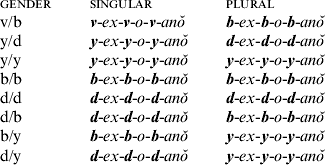
In Harris's (Reference Harris2009) framework, morphological analyses begin with a fully inflected word that is first entered into the lexicon, from which morphemes are abstracted through connectionist models. Harris remarks that Batsbi verbs that agree with nouns in absolutive case with respect to gender and number consist of two types of schemas, given in (29), which are residues after abstraction. CM stands for an overt agreement marker of gender and number.
- (29)
(a) CM-morph
(b) morph
We put aside issues of whether to take an abstractive or constructive approach to morphology, i.e. whether the complex word should be the starting point or endpoint of a derivational process. We can use a realization constraint to capture the above schemata. Let us take the first class singular as an example. Templatic constraints such as that in (30) require not only that gender and number be spelled out by a marker, but also that the marker occur in certain positions (see Hyman Reference Hyman, Booij and Marle2003). The schema in (29b) is captured by excluding the morph from the class of morphs that require a preradical CM marker.
(30) v.morph: In agreement with a v/b-class singular noun in absolutive case, gender {1} and singular are realized within a verb by v, which should precede a ‘CM’ class of morphs including ex, o, anŏ, etc.
Realization OT can easily incorporate such a templatic constraint, given that *Feature Split is a violable constraint and therefore can be trumped by a templatic constraint that leads to extended exponence. See the tableau in (31) below, in which the Batsbi form v-ex- v-o- v-anŏ {GEN: 1, NUM: sg} is derived via the ranking schema v.morph>>*Feature Split. We omit the input that contains the stem ex and the features {present, evidential, GEN: 1, NUM: sg} in the tableau. We also omit the realization constraints introducing the markers -o and -anŏ for simplicity of presentation. Neither omission affects our discussion. The order of the three morphs ex ‘destroy’, -o ‘a present tense marker’, and -anŏ ‘an evidential marker’ can be derived through the scope constraint that requires affix order to reflect semantic scope, which is not shown in the tableau given that semantic scope is not a theme of this paper.
(31) v-ex- v-o- v-anŏ {GEN: 1, NUM: sg} (Batsbi)
The Batsbi data in Harris (Reference Harris2009) present a type of extended exponence that differs from the language data we have discussed so far because in Batsbi extended exponence involves multiple occurrences of the same morph within a word, while in the languages we have discussed extended exponence involves the competition of distinct morphs for a morphosyntactic feature value set. By means of a single device *Feature Split, Realization OT not only unifies blocking and extended exponence, but also predicts extended exponence via constraint rankings given the violability of *Feature Split, while a non-OT constructional approach does not clearly make such a restricted prediction.
All the theoretical models we have discussed so far are synchronic in nature. There is a line of research on extended exponence from a diachronic perspective (Donohue Reference Donohue2003, Anderson Reference Anderson, Booij and van Marle2005, among others). For example, Donohue (Reference Donohue2003) presents a diachronic account of extended exponence in the Skou language of Papua New Guinea. He shows that extended exponence arose because the morphosyntactic content of an exponent had become opaque due to both the neutralization of phonemic contrasts and the simplification of consonant clusters of the exponent so that a new exponent was attached to the old one to more transparently express the morphosyntactic content. Based on a series of works by van Driem (Reference van Driem1987, Reference van Driem1990, Reference van Driem and Bradley1997), Anderson (Reference Anderson, Booij and van Marle2005) argues that extended exponence arose in some Kiranti languages of Nepal because repeated historical changes reduced distinct inflectional auxiliaries to agreement markers that could express the same agreement feature of the same type of argument.
The goal of these works is to find historical origins for extended exponence. By comparison, we attempt to establish a theoretical model capable of deriving both blocking and extended exponence synchronically. There is no necessary discrepancy between our model and diachronic approaches. It may well be the case that a diachronic model of extended exponence incorporates some mechanism of Realization OT, i.e. obedience and disobedience to *Feature Split that favors simple exponence, though historical changes could alter the frequencies of blocking and extended exponence deduced via constraint rankings. But it is not clear to us how a diachronic approach provides a unified account of extended exponence and blocking of exponents that is widely accepted as a consequence of cognitive limitations.
4. Conclusion
This paper argues for Realization Optimality Theory, an inferential– realizational model of morphology within Optimality Theory. We show that Realization OT provides a unified account of blocking and extended exponence without recourse to either the distinction between primary and secondary exponents (Noyer Reference Noyer1992, Reference Noyer1997) or multiple rule blocks (Stump Reference Stump2001). We propose the markedness constraint *Feature Split, which favors simple exponence and bans the realization of a morphosyntactic or semantic feature value by more than one form. If *Feature Split ranks lower than two or more constraints realizing the same morphosyntactic or semantic feature values, we observe extended exponence; otherwise, we find blocking of lower-ranked exponents. Additionally, the possible rankings of *Feature Split and competing realization constraints lead to the prediction that blocking should be more common than extended exponence. We discuss various alternative approaches to blocking and extended exponence and argue that none of them achieves a single advantage of Realization OT in terms of blocking and extended exponence.
We have shown that language-particular realization constraints, which equal lexical exponents or realization rules in rule-based models, are indispensable in morphological analysis, and OT models that fail to recognize the significance of realization constraints are incapable of handling morphological realization in general, not to say blocking and extended exponence that occur under morphological realization. In the past few decades, phonologists have tried to analyze everything related to morphology in the phonological component or ascribe it to phonology. We hope to have shown that an autonomous morphological component is indispensable and to have provided linguists a useful and promising tool for doing morphology.


