Introduction: a paradox that requires explanation
In an interview published in the Corriere della Sera on 3 February 2017, Matteo Renzi compared the constitutional referendum to a terrible missed penalty. It is hard to disagree with this assessment: a survey carried out for the Espresso group after the vote by Ilvo Diamanti’s LaPolis-Demos polling company revealed that the majority of Italians were in favour of the motions proposed by the government in the referendum of 4 December 2016: reducing the number of parliamentarians (92%) and replacing the perfectly bicameral system (61%).Footnote 1 Nevertheless, 59.1% (19,419,507) voted No, versus 40.9% (13,432,208) who voted Yes, with a turnout of 65.5%, much higher than expected. Why?
The simplest questions are often the most difficult to answer. After making his debut in the world of politics at just 29 years old, as president of the Province of Florence (2004-2009), Matteo Renzi entered the public consciousness as mayor of Florence (2009-2014) and even more so as the (losing) candidate in the primaries for the Partito Democratico (PD) in 2012 (Bosco and McDonnell Reference Bosco and McDonnell2012). Although he was defeated by Pierluigi Bersani, this campaign gave Renzi his first national platform, allowing him to display his skills as an orator. Indeed, his defeat in 2012 provided the launchpad for the December 2013 primaries that followed Bersani’s failure in the elections in February of the same year (ITANES 2013; Di Virgilio and Radaelli Reference Di Virgilio and Radaelli2013). By February 2014, Renzi was being summoned to the Quirinal Palace to be bestowed with the role of prime minister (Salvati, E. Reference Salvati2016).
His was a meteoric rise through the ranks, especially by Italian standards. The referendum should have represented the definitive assertion of his authoritativeness, or at least a confirmation of his democratic legitimacy, which he lacked before his arrival at Palazzo Chigi. Instead, however, it had the opposite result. Just an hour after polling stations closed, Renzi issued a statement confirming he was stepping down as prime minister, and the Movimento 5 Stelle (M5S) and Lega Nord called for immediate elections (Carbone and Piattoni Reference Carbone and Piattoni2016).
One senses that Renzi is a political leader who excels at individual competitions, but is not well-versed in team sports. Whenever he has had to affirm his leadership in direct elections, whether institutional (provincial and municipal elections) or party political (primaries), Renzi has had no problem emerging victorious. But when he has had to act as a mediator and employ the art of weaving and constructing complex relationships, he has been defeated. In terms of the Renaissance political thinkers of his native Florence, Renzi therefore seems to be a natural Machiavellian, but incapable of being Guicciardinian when required: as audacious as a character from Machiavelli’s The Prince – Cesare Borgia, for example – but unable to act like both ‘the fox and the lion’, as Machiavelli himself exhorted, and failing to employ the ‘prudence’ described in Francesco Guicciardini’s memorable texts. In short, he is not a sufficiently adaptive political animal.
As a result, the entire referendum campaign was fought in the wrong way, with the prime minister focusing the political meaning of the referendum on himself. However, just as simple questions are often the trickiest precisely because they rarely involve simple answers, likewise the referendum of 4 December certainly cannot be reduced to a hurried observation, but instead requires at least tentative explanation.
This paper therefore offers an empirical analysis of the results of the vote on 4 December and their potential implications. We will begin with a brief look back at previous attempts to overhaul the Italian constitution, to account for the difficulties and failures of the past. We will then move on to a brief review of the contents of Renzi’s reform and the various political factions that supported and opposed it. Before analysing the results, which makes up the majority of the paper, we will look fleetingly at the referendum campaign itself. Finally, the conclusion will seek to evaluate the impact of the referendum result on the Italian political system, as far as this is possible so soon after the event. At various points throughout we will highlight the mistakes (strategic and/or tactical) that Renzi made that stopped the Italians voting for a reform that they fundamentally agreed with. Methodologically, the analysis of the documents relating to the constitutional reform added to the ‘participatory observation’ by the author, who signed the researchers’ manifesto in support of the government billFootnote 2 and took an active part in the public debate that preceded the referendum.
Constitutional reforms in Italy: a difficult political process
Then, if you think that many of the recommendations presented in these texts are already well-known, it means it is time for those in the political sphere to start looking at the facts; if you notice that, especially on institutional matters, a range of options have been left open on various topics, it means it is time to make some definitive choices. And, if you want, with everyone’s support you can, of course, go furtherFootnote 3 .
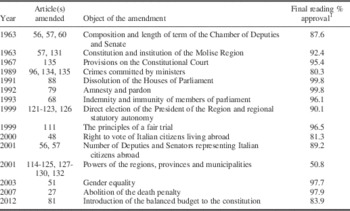
These words are taken from Giorgio Napolitano’s speech to Parliament on 22 April 2013, the day he began his second term as president of the Republic. He is referring to the suggestions made by the so-called saggi (wise men) appointed by the president for examining constitutional reform, continuing the work done previously under the government of Enrico Letta. As Pasquino and Valbruzzi (Reference Pasquino and Valbruzzi2017) make clear, there has been no shortage of constitutional reforms in the almost 70 years of the Republic’s history (Table 1).
Reforms made to the Italian constitution from 1948 to the present day

Source: Pasquino and Valbruzzi Reference Pasquino and Valbruzzi2017, p. 146.
1 If a constitutional reform bill is not voted in Parliament by two-thirds of the members of each chamber, the bill may be submitted to a referendum for its final approval (Article 138 of the Constitution). All the reforms indicated were approved by Parliament with the qualified majority under art. 138; only the 2001 reform was submitted to confirmative referendum.
However, it is important to distinguish between generic constitutional reforms and ‘systemic’ reforms (Cotta and Verzichelli Reference Cotta and Verzichelli2007). The latter are the reforms that affect, even if only incidentally, the form of state and/or the form of government, in other words the horizontal and/or vertical division of powers (Pasquino Reference Pasquino1982). Of the successful reforms, only that of 2001 promoted by the centre-left fits this category, while many attempts that were never fully implemented correspond to it perfectly: the various bicameral commissions chaired by Aldo Bozzi (1983-1985), Ciriaco De Mita and Nilde Iotti (1993-1994), and Massimo D’Alema (1997), as well as the centre-right’s constitutional reform bill of 2005, rejected by voters in a referendum the following year (Guarnieri and Newell Reference Guarnieri and Newell2005; Amyot and Verzichelli Reference Amyot and Verzichelli2006; Marangoni and Verzichelli Reference Marangoni and Verzichelli2017).
Well aware of this, Matteo Renzi initially sought to fashion a political agreement with Silvio Berlusconi and Forza Italia, through what became known as the ‘Nazareno Pact’, signed a few weeks before he became prime minister.Footnote 4 However, when the opportunity to consolidate his party arose with the election of Sergio Mattarella as president in January 2015, the prime minister opted for this option instead, and the agreement with Berlusconi fell through (Hanretty and Profeti Reference Hanretty and Profeti2015). Nevertheless, despite this choice, Renzi was unable to avoid a split within the PD, which led to the creation of the No committees headed by Massimo D’Alema.
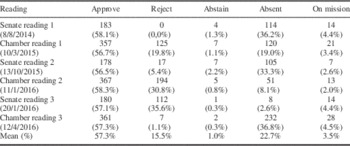
The decision to focus from the start on a confirmatory referendum under article 138 of the Italian constitution, instead of at least attempting to attain a two-thirds majority in parliament, proved to be flawed (mistake no. 1). With the sole exception of 2001, experience shows that the reforms that achieved success were those voted for by parliament with the required qualified majority. The others were abandoned for various reasons, often self-serving. As such, the decision to present the reform through a government bill, thereby exposing the topic to the partisan nature of politics, turned out to be unwise. Indeed, as we will see in the next paragraph (Table 2), each parliamentary vote on the reform received a significant number of votes opposing it, with the sole exception of the initial scrutiny that took place before Mattarella’s election.Footnote 5 A parliamentary bill would have been preferable; this would have avoided placing the topic within the government’s political agenda, allowing a wider parliamentary consensus to be sought. Even so, a two-thirds majority would probably have been difficult to achieve, but the parliamentary process would have been useful and would have prepared the ground for any subsequent referendum.
Legislative process leading to the 2016 constitutional reform (votes and percentages)

Source: data taken from the websites of the Chamber of Deputies and the Senate.
The contents of the constitutional reform and the new electoral law (the Italicum): the ‘combinato disposto’
With ruling no. 1/2014, Italy’s Constitutional Court declared the Porcellum, the electoral system proposed by the centre-right in 2005, and used for Italy’s votes in 2006, 2008 and 2013, partially unconstitutional (Chiaromonte Reference Chiaromonte2015). The topic of electoral law was therefore added to the political agenda of the Renzi government. Following some frenzied parliamentary manoeuvring, in June 2016 the government managed to get a new electoral law known as the Italicum, valid only for the Chamber of Deputies, approved through a vote of confidence. The Italicum is a proportional system with a majority premium: the country is divided into 100 constituencies with list voting, with between three and nine seats in each one and a threshold of 3% required to gain seats. The majority premium provides 340 seats (out of 630) to the winning list, which has to receive at least 40% of the votes in the first round, or win in the run-off between the two lists with the highest number of votes.Footnote 6 The capilista, those at the top of the list of candidates, are elected directly if the list achieves the required quotient, while voters can give one or two preferences (of different genders in the case of the latter) for the other candidates.
After a far from easy route through Parliament (Table 2), which lasted from April 2014 to April 2016, Matteo Renzi’s proposed constitutional reform received a vote in Parliament.
It was divided into five parts:
1) Replacing the perfectly (or equal) bicameral system and redefining the composition of the Senate
In place of the powers of no confidence towards the government held by both branches of Parliament and their equal participation in the legislative process, following the reform the Chamber of Deputies and the Senate of the Republic were to have different roles: the Chamber would represent the nation, express its confidence in the government and, by and large, approve regular laws; the Senate, meanwhile, would represent the regions and municipalities, would no longer have no-confidence powers towards the government and, along with the Chamber, would approve constitutional reforms and other more important laws. The new Senate was to comprise 100 members: 95 (74 councillors and 21 mayors) elected by the regional councils on their renewal, divided up proportionally to the population, and five nominated by the president of the Republic, with a seven-year term. The introduction of the ‘fixed-date law’ would have made it easier for the government to implement its programme.
2) Reform of the relationship between the state and the regions
Certain topics handed over to regional legislation in the constitutional reform of 2001 would have been returned to the state, eliminating the so-called ‘concurrent legislation’ between central and regional government that has caused many disagreements due to conflicting responsibilities. Furthermore, a ‘supremacy clause’ would, in exceptional circumstances, have allowed the state to intervene in regional affairs.
3) Institutions of direct democracy (referendums and laws formed by citizens’ initiative)
Petitions for citizens’ initiative laws would have required 150,000 signatures instead of 50,000 signatures, but with the guarantee of a debate in Parliament. The reform introduced the ‘propositive’ or ‘popular initiative’ referendum and forms of consultation with social stakeholders. For abrogative referendums, the threshold of 500,000 signatures and the quorum of an absolute majority of voters were confirmed; however, if at least 800,000 signatures were gathered, the quorum would have been lowered to a number equal to the majority of voters at the last election for the Chamber of Deputies.
4) Abolition of the CNEL and limiting institutional costs
The National Council for Economics and Labour (CNEL), a corporate body of very little political relevance, would have been abolished, and every constitutional reference to the provinces would have been removed to facilitate the restructuring of local government through regular legislation. In addition, the funds received by regional councillors were to be restricted.
5) Guarantee bodies (the president of the Republic and the Constitutional Court)
The quorum for the election for the head of state was to be raised to prevent a single party that had won a majority in the Chamber thanks to the Italicum being able to elect the President by itself. The Chamber rules were to include an ‘Opposition Statute’, and if requested by the opposition parties in one of the two branches of Parliament, the Constitutional Court would have to make a pronouncement on the constitutionality of a new electoral law within 30 days.Footnote 7
The combined weight of these constitutional reforms and the new electoral system, mentioned above, created what critics dubbed the ‘combinato disposto’, or ‘combined provisions’ (mistake no. 2): although the reform did not affect the government’s powers, they were effectively strengthened by the guarantee provided by the Italicum of a parliamentary majority in the Chamber, whereby the lower branch of parliament would be the only ‘political arena’ in which confidence in the government was required (D’Alimonte Reference D’Alimonte2015; Pasquino Reference Pasquino2015). In an almost Pavlovian way the ‘combinato disposto’ thus gave rise to a ‘dictator complex’ (Pombeni Reference Pombeni2016), which overshadowed all Italian public debates surrounding potential systemic reforms (Baldini Reference Baldini2017). The 1948 Constitution was basically written to prevent any politician from doing what Benito Mussolini managed to do with the Statuto Albertino. As a result, the ‘dictator complex’ leads to a clear paradox: if no political leader manages to reform the constitution by strengthening executive powers, the complex proves effective; were it not, it would have been contradicted by experience. The cost of this paradox, and its enduring nature, is the psychological impossibility, or at least enormous difficulty, of altering the systemic structure of the 1948 Constitution. Simply postponing the parliamentary scrutiny of electoral law until after the constitutional reform would have avoided the issue.Footnote 8 Instead, bringing forward the Italicum gave the negative impression that Renzi, as soon as the referendum was won, would have taken the country to the polls, to capitalise on his success. Moreover, it is important to remember that in January 2017 the Constitutional Court declared the Italicum’s run-off unconstitutional, thereby turning it into a predominantly proportional electoral system.Footnote 9
A no-holds-barred referendum campaign
Both the Yes and No sides were extremely well represented. Supporting the reforms were the PD and the Nuovo Centrodestra (NCD), the General Confederation of Italian Industry (Confindustria), the Confederation of Italian Workers’ Trade Unions (CISL), the agricultural union Coldiretti and some of the major daily newspapers (Il Sole 24 ore and Il Foglio and, less explicitly, Il Corriere della Sera and La Repubblica). Prominent figures who fought for a Yes vote included the former president Giorgio Napolitano, the former prime minister Romano Prodi and the CEO of Fiat Sergio Marchionne. All the opposition parties campaigned for No – from the M5S to Forza Italia and from the Lega Nord to Fratelli d’Italia – as did the Italian General Confederation of Labour (CGIL), Gustavo Zagrebelsky’sFootnote 10 anti-corruption association Libertà e Giustizia, the National Association of Italian Partisans (ANPI), and certain representatives of the dissident group within the PD and many First Republic politicians whose glory days are now behind them, led by former prime minister Massimo d’Alema. Il Fatto Quotidiano, the newspaper edited by Marco Travaglio, famous for his attacks on Silvio Berlusconi, was particularly combative in its output.
Communication, and the debates that accompanied the final weeks of the campaign, played a decisive role. This came to a head in relation to the vote of Italians living abroad, on whom the government expended a lot of energy; the national Committee for No declared pre-emptively that if these votes proved to be decisive, they would contest the referendum result and launch an appeal (Vampa and Vignati Reference Vampa and Vignati2017).
The Yes camp chose to take a populist and, at times, demagogic tone, seemingly suggested by Jim Messina,Footnote 11 the campaign expert hired especially by Renzi (Pritoni and Valbruzzi Reference Pritoni and Valbruzzi2017). Steering clear of the tricky task of making the contents of the reform accessible to the general public, Renzi decided instead to focus on the cost savings (the abolition of the CNEL and the provinces, the cut in the number of parliamentarians, the reduction in the pay received by regional councillors, etc.). This strategy at times gave the impression that the government wanted to distract public attention from the substance of the reforms, on which citizens ended up focusing: for example, one topic where Yes lost many votes was that of the indirect election of the new SenateFootnote 12 which was undoubtedly the major weakness in terms of the contents of the reform. The analysis produced in opposition to the reform discussed this point widely (Travaglio and Truzzi Reference Travaglio and Truzzi2016; Zagrebelsky and Pallante Reference Zagrebelsky and Pallante2016) and reached a significant number of people.
Playing the populist card from a position of power brings with it a dangerous trap, as highlighted by Luca Verzichelli:
(...) what we have defined as ‘populism in government’ from a leader like Renzi can, in place of good practices and virtuous cycles of reform, instead create the conditions for ‘populism in opposition’, already present in many European democracies, which strives to channel protest purely in terms of responsiveness, abandoning responsibility, the most common quality of classic party government in a parliamentary system (2017: forthcoming).
Imitations are never very effective: the public tends to opt for the original instead (Revelli Reference Revelli2015). When the M5S chose to reposition its stance in this area, proposing a radical cut in allowances for members of parliament, instead of the reform put forward by the government, Renzi’s difficulties became abundantly clear. The decision to adopt a tone that was far from highbrow in the communication in support of Yes did not produce the results hoped for (mistake no. 3). Reforming 47 articles of the constitution should have merited more institutional aplomb, which in all likelihood would have been seen by citizens as more appropriate to the circumstances. Here we must acknowledge the (perhaps unfairly) much-maligned minister Maria Elena Boschi, who went to great lengths to explain the contents of the reform, but without having the same sway or influence over public opinion as the prime minister.
Analysis of the results: a highly political vote
After his victory at the European elections in 2014, Matteo Renzi became convinced that a significant number of votes were shifting from the centre-right to the PD (if not to him personally). This hunch was wrong on two counts: the gains made by the PD at the European elections were more due to the collapse in the vote for Mario Monti’s Scelta Civica party than the result of people who had once voted for Berlusconi moving to Renzi (Colloca and Vignati Reference Colloca and Vignati2014). Here too Renzi was undone by his mistakes, generating an abnormally high turnout due to his overexposure in the media, which obviously benefited the populists (Pedrazzini and Pinto Reference Pedrazzini and Pinto2017).
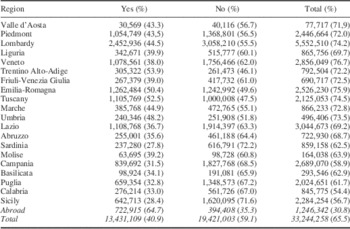
The No campaign prevailed for both social and political reasons. Looking first at the political reasons, one must, as Giovanni Sartori said, ‘explain politics with politics’. Simply put, the electorate represented by the parties supporting No was greater than those supporting Yes: PD voters opted almost unanimously for Yes, while those who voted for Forza Italia, the Lega Nord and M5S chose No. Based on the 2013 elections, this adds up to exactly 40% and 60% respectively of public support, which matches the Yes and No votes at the referendum. As shown in Table 3, No won in all regions of Italy, with the exception of Emilia Romagna, Tuscany and Trentino Alto Adige. As for social reasons, it is important to remember that the referendum took place in a gloomy climate defined by the financial crisis: it is clearly always the governing parties that pay the price when citizens’ quality of life falls dramatically.
Results of the 2016 constitutional referendum, by region (votes and percentages)

Source: official data provided by the Ministry of the Interior (http://elezionistorico.interno.it) (accessed 17 May 2016).
A statistical model that provides empirical evidence on both the political and social explanation across the entire country, analysed on a province-by-province basis, makes for interesting reading. The linear regression assembled by Regalia and Tronconi (Reference Regalia and Tronconi2017: 110-111) monitors the variance between the No vote and the 2013 list vote and, at the same time, studies its geographical distribution in relation to the unemployment rate. In the North of Italy, the interpretation based on party loyalty seems convincing – for every percentage point increase in vote in the 2013 elections, No increases by 0.75% – while the social explanation seems of little relevance. In the South, however, the political explanation does not produce a significant result, while the social explanation appears convincing: an increase of one percentage point in the unemployment rate leads to a gain of 0.34% for No.
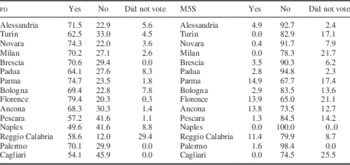
The analysis of the flow of votes,Footnote 13 meanwhile, aimed to study the solidarity of the PD compared to the internal faction headed by various former Democratici di Sinistra figures (D’Alema, Pier Luigi Bersani and Roberto Speranza), the level of engagement of the electorate on the centre-right (on either side of the referendum argument) and the behaviour of M5S voters (Tronconi Reference Tronconi2015). Applying the ‘Goodman model’ to 15 Italian cities to compare the referendum result with the political elections of 2013, Vignati (Reference Vignati2017: 119) came to the conclusion that the M5S electorate is stable, while voters for parties with a longer history tend to fragment. The tripolar framework in Italian politics that emerged from the most recent national elections was therefore confirmed, if not strengthened, by the referendum (Table 4): while the prime minister’s party has apparently suffered due to its internal opposition, M5S voters broadly opted for No;
Analysis of the flow of votes: how 100 voters who voted PD and M5S in 2013 voted in the constitutional referendum

Source: Vignati Reference Vignati2017, p. 120 and p. 124.
despite Renzi’s hopes, the number of Forza Italia voters who decided to go against the instructions of their party’s leaders was negligible.
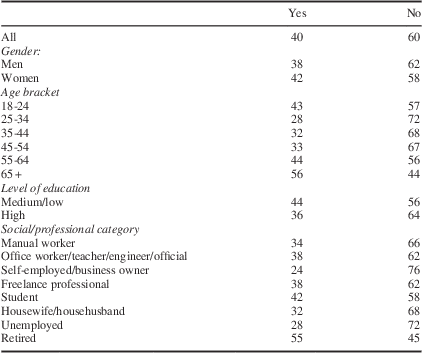
When it comes to analysing the vote in terms of socio-demographic categories, the polling by LaPolis-Demos reveals some interesting data.
A lot has been said about the youth vote, in part due to Renzi’s age: he entered Palazzo Chigi at the age of 39. However, in reality, consensus among his peers was minimal: the data in Table 5, for example, show a striking position taken by the 25-34 age group, with 72% opting for No. This probably reflects annoyance at the Jobs Act, which was seen as a way of creating a permanently precarious labour market (Helgason and Mérola Reference Helgason and Mérola2016). On the other hand, the baby boomers and veterans, with ‘insider’ positions in the workplace, voted in below-average numbers for NoFootnote 14 .
The constitutional referendum vote of 4 December 2016 by socio-demographic group

NB: This table includes data collected in two surveys (October and November), making a total of approx. 2400 respondents. The data was weighted based on the actual result of the constitutional referendum at a national level. Source: LaPolis polling company - University of Urbino, using Atlante Politico Demos & Pi data.
Source: Bordignon, Ceccarini and Diamanti Reference Bordignon, Ceccarini and Diamanti2017, p. 133.
In light of this empirical evidence, Renzi’s decision to personalise and politicise the referendum (mistake no. 4) appears to have been counterproductive. His determination to do so did nothing more than unite his opponents, including those who were only potential adversaries (such as Forza Italia). In other words, the Prime Minister did not take into consideration one of the oldest rules of international relations (and politics in general): the strongest player on the field must above all avoid the others forming an alliance against him. Renzi overestimated himself, and underestimated the possibility of the opposing parties being able to garner enough energy to defeat him. This hubris reached its peak when Renzi declared that he would leave politics if defeated: in doing so he gave his opponents an excellent reason to give their all to the referendum campaign. He was convinced that voters would unhesitatingly respond favourably to his appeal, thinking that support for the government was widespread. As this data shows, however, following the end of the honeymoon period of the 2014 European elections, the reality was complex and varied. The vote on 4 December 2016, instead of a referendum, was therefore transformed into a sort of recall election against the man in Palazzo Chigi.
A more pragmatic and prudent approach would have been to depoliticise the referendum, taking particular care to avoid it becoming a way for voters to express their verdict on the performance of the government: in times of crisis, appeals of this type never end well. Furthermore, certain political choices, not only the Jobs Act mentioned above, but also the Buona Scuola educational reform, were always going to generate discontent and frustration, and it would have been better not to have raised them, especially in traditionally progressive areas of the electorate (workers in trade unions, teachers, etc.).
Conclusions
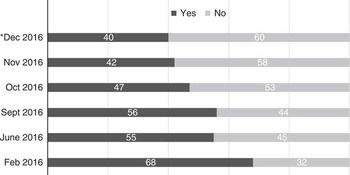
Data from Ilvo Diamanti’s polling organisation LaPolis-Demos (Fig. 1), taken from five polls between February and November 2016, show how over that period No shifted from a 30% to a 60% approval rate.
Constitutional referendum: evolution of voting intentions. ‘The constitutional referendum on reforming the Senate and other parts of the constitution will be held in the next few months. Do you think you will vote...’ (percentage values, excluding ‘don’t know’/‘refuse to say’) The data for those who replied ‘don’t know’/‘refuse to say’ for each survey is as follows: 26% (Feb 2016); 33% (Jun 2016); 30% (Sep 2016); 26% (Oct 2016); 25% (Nov 2016). *The data for December 2016 shows the referendum result at a national level. Source: LaPolis polling company - University of Urbino, using Atlante Politico Demos & Pi data. Source: Bordignon, Ceccarini and Diamanti Reference Bordignon, Ceccarini and Diamanti2017, p. 129.

It is hard to imagine clearer proof of the errors Renzi made in his handling of the referendum, both politically and in terms of the way it was communicated. As shown in this paper, and summarised in Table 6, the prime minister made fatal mistakes across the board.
Summary of Renzi’s mistakes

Source: author
Was a different result possible? We believe so: if Matteo Renzi had opted for a parliamentary bill instead of a government bill, if he had postponed the reforms to electoral law until after the constitutional reform, if he had avoided populist rhetoric and instead kept a low, institutional profile, and above all if he had not personalised and politicised the reform, in all likelihood he would have managed to retain at least some of the large lead he initially enjoyed in the polls. Indeed, this dominant position was his undoing: his certainty of winning encouraged him to put himself at the centre of the entire referendum process, so he could then portray it as a great personal success.
Focusing on this aspect is important, because the setback in the process of modernising the 1948 constitution has symbolic significance: it represents the defeat of the reformist agenda that had been given new impetus by Matteo Renzi’s actions. Although some aspects were yet to be properly analysed, the government’s policy had some innovative elements that had caught the attention of scholars (Ferrera 2016a; La Spina 2016; Piattoni Reference Piattoni2016).
What effects, then, does it have on the political system? Here one must agree with Pritoni, Vignati and Valbruzzi (Reference Pritoni, Vignati and Valbruzzi2017: 189): after years of mainstream political commentary on political leadership, pandering to the media and focusing on personalities, it should be recognised that the result on 4 December paints a different picture. It testifies to the rediscovery of the relevance of party structures across Italy: despite being in crisis (Ignazi Reference Ignazi2013; Mair Reference Mair2013), in this referendum the parties played a decisive role in the final result, managing to capture the attention of their electorate more than messages on TV and/or new media (Ignazi Reference Ignazi2002). On the PD front it means that Renzi’s operation, strongly criticised by D’Alema, to strengthen his leadership of the party using his premiership as leverage failed. As a result, the PD has not turned into yet another personalist party in Italian politics (Calise Reference Calise2007; Fabbrini Reference Fabbrini2009, Pasquino Reference Pasquino2014; Bordignon Reference Bordignon2014; Calise Reference Calise2016). At least in the short term, the PD will not become the PdR (i.e. the Partito di Renzi, or Renzi’s Party) spoken of by Ilvo Diamanti, and probably not even the ‘Partito della Nazione’ (‘all-nation party’), i.e. a party repositioned very much at the centre. Indeed, the return to a proportional system strengthens political identities rather than incentivising parties to cover wide areas in the electoral market, as happens with a majoritarian system.
The party system that emerged from the 2013 elections, which in the referendum, like the 2015 local elections, penalised the PD, has been reinforced. The two-party coalition system that established itself with the Second Republic is therefore shifting towards a tripolar system, still yet to be fully defined. The concept of the ‘Great Reform’, designed to give institutional coherence to the political system, which was proportional and consensual until it turned into a majoritarian system in the early 1990s, has therefore faded, and the political parties are once again fragmented, in what now seems an incurable ailment of Italian politics.
In this context, Matteo Renzi gambled everything on the referendum and lost badly, conceding political momentum to the anti-system forces – M5S, Lega Nord and Fratelli d’Italia – who would like Italy to leave the Euro (Ferrera Reference Ferrera2016b). The most alarming thing to emerge from the referendum is that, according to the latest polls, not even a liberal-democratic grosse koalition between the PD and Forza Italia, which should be capable of keeping Eurosceptic populism at bay (Salvati, M. Reference Salvati2017), would gain a majority in a future parliament. Indeed, following the prime minister’s reckless approach to the referendum campaign, which this article has sought to analyse, there is worrying growth in the approval rating for the those dubbed variously ‘populists’, ‘sovereignists’ and ‘nationalists’, those who reject international interdependence and integration, instead looking back nostalgically to the national prerogatives of a world before globalisation (Bartolini Reference Bartolini2016).
In spite of everything, Matteo Renzi is still the most competitive alternative to these parties. Will he continue to be the gambler we have seen to date, or will he display more Guicciardinian prudence? Despite the temptation, we will refrain from answering this question: the human spirit is impossible to predict.
Acknowledgements
The author would like to thank the anonymous referees for their stimulating observations and their encouragement to improve the paper and clarify certain passages.
Notes on contributor
Davide Gianluca Bianchi teaches courses on European politics at University of Bucharest and is currently also a researcher at Éupolis Lombardia. He has published more than 50 articles, chapters and books on topics related to regionalism and political representation in comparative perspective. He has also published amonograph, Élite in crisi. La revoca degli eletti in democrazia(Élites in crisis. Revocationof the elected indemocracy) (Preface by G.Urbani, Rubbettino, 2012), and edited a new Italian edition of Begriffdes Politischen(On the concept of Politics) by Carl Schmitt (Mimesis 2013).