

1 Introduction
According to the 2015 Paris Agreement, the Signatory States are committed to keeping the rise in temperature below 2°C. Intergovernmental Panel on Climate Change (IPCC) studies have shown that, in order to do so, it is necessary to achieve net-zero greenhouse gas (GHG) emissions – i.e., a balance between the amount of GHG emitted and the amount removed by carbon sinks. The European Union (EU) is keen to be at the forefront of this challenge. As the European Commission pointed out in its Communication on a “European Green Deal” (European Commission, 2019), the EU has already started to transform the economy with a view to achieving climate neutrality, but “current policies will only reduce GHG emissions by 60 % by 2050. Much remains to be done, starting with more ambitious climate action in the coming decade.” In this perspective, all relevant climate-related policies will be reviewed and all sectoral policies reconsidered. Carbon pricing must be aligned with climate objectives, and the different policy instruments must complement each other, together forming a coherent policy framework. Public investment and increased efforts to direct private capital toward climate action are needed in order to foster the deployment of innovative technologies and new infrastructures.
Achieving net-zero emissions by 2050 is extremely ambitious and tricky. Action is called for simultaneously on multiple fronts, while the costs and the potential for emissions’ reduction of many decarbonization technologies are still largely unknown, all in a general context of poor levels of acceptability of a tax on GHG emissions, as demonstrated in France. Moreover, time is running out. Efforts must be gradual enough to limit the negative impacts of stranded assets, and determined enough to trigger behavioral changes and prevent the construction of new polluting assets such as coal-fired power plants.
Benefit-cost analysis (BCA) makes it possible to select relevant actions and ensure that the various levers are mutually reinforcing, by assessing and ranking the socioeconomic value-added of projects or public policies. Sound BCA is especially useful in weighting the impacts at stake and identifying potential trade-offs or cobenefits between objectives. BCA as a practice has a long-standing tradition, dating back to the end of the nineteenth century. However, it only plays a minor role in the policy-making process of climate action. The aim of this paper is to emphasize the relevance of an updated and extended BCA framework (“climate-adjusted” BCA) in ensuring that all the mitigation actions we undertake are coherent and deployed in the right order.
This claim will be illustrated through the (admittedly imperfect) example of France. The French Government asked a panel chaired by Alain Quinet (the “Quinet II Committee”) to revise the carbon value used to evaluate French public policies, in order to align it with its new objective of carbon neutrality in 2050 (Quinet, Reference Quinet2019). Building on this work, we first emphasize why BCA is critical for the design of credible, ambitious, and cost-effective climate policies (Section 2). We then review the two different approaches adopted by different institutions and countries to compute the carbon value, which reflects the value placed by society on measures aimed at preventing CO2e emissions: the cost-benefit approach and the cost-effectiveness approach (Section 3). Finally, we show that, beyond the choice of a path of the carbon value, BCA applied to climate action raises specific challenges (Section 4). We need to simultaneously adapt the whole assessment framework – not only time horizon and discount rates but also reference scenarios – ensure that BCA will be effectively used for all decisions impacting climate change, and complement aggregated BCA results by analyzing the transfers required to compensate the adverse distributive impacts of climate policies.
2 BCA of climate policies is of prime importance
Carbon neutrality involves a large set of individual decisions, sectoral transformations, investments, and policy decisions. If climate change were the only externality in the economy, the alignment of these decisions could be achieved by applying a unique carbon price, leaving businesses and individuals with the responsibility of adapting their behavior and investing in low-carbon solutions. However, imperfections of all sorts, market failures, imperfect information, and behavioral biases make carbon pricing necessary but not sufficient. Moreover, the implementation of direct carbon pricing is difficult. As a result, the deep decarbonization of human activities is necessarily based on a range of complementary instruments. In this context, the construction of deep decarbonization pathways is more complex than most economists imagined, and some sort of “compass” is required: this should be “climate-adjusted” BCA.
2.1 An extensive toolkit of policy instruments, with a limited role for BCA
In practice, the vast majority of policy instruments introduced by countries to curb their GHG emissions are not primarily based on direct carbon pricing. For instance, at the European level, different regulations are aimed at achieving the three EU objectives: reducing GHG emissions, deploying renewable sources of energy, and increasing energy efficiency. Admittedly, the European Emissions Trading System (EU-ETS) covers 45 % of European emissions from more than 11,000 heavy energy-using installations (power stations and industrial plants) and airlines operating between European countries. In addition to the EU-ETS, many member States have also introduced carbon taxes (notably Sweden, Norway, Denmark, France, the UK, and Ireland). At the same time, generous subsidies or feed-in tariffs are being applied to renewable energy sources (most notably in Germany, Spain, and France). All countries have also adopted a large volume of regulations, such as standards for the emission rates of vehicles and power generators and for the energy efficiency of electricity-using products, and minimum requirements for the use of renewables in power generation.
This package, which also includes nudges and public labeling, has delivered some significant results: in 2017, GHG emissions in the EU-28 were reduced by 22 % compared with 1990 levels, representing an absolute reduction of 1240 million tons of CO2e, putting the EU on track to surpass its 2020 target. Despite this significant achievement, the policy package cannot be considered as optimal. At present, policy instruments in the EU are not balanced, and overlap in a number of ways. Until 2019, the depressed carbon price signal in the EU-ETS was partly due to counteractive interactions between policies on renewable energy and energy efficiency, which contributed to the creation of an imbalance between supply and demand. When they coexist with a cap-and-trade system, the effect of efficiency measures and support for low-carbon technologies is to lower the market price of emissions’ allowances, because the cost of reduction is supported by other schemes. By lowering the price of the allowances, such measures also lower the downstream effects. For example, wholesale electricity prices rise as a result of power companies passing on the carbon price. Moreover, many countries currently subsidize both renewables and fossil fuels.
Such extensive toolkits of environmental instruments can be justified if the set of feasible public policies is thus expanded. Most of the time, however, the use of multiple instruments reflects an incremental ad hoc approach to climate policy, and instruments are introduced in a piecemeal, overlapping fashion. Indeed, evidence suggests that BCA plays only a minor role in the design of mitigation actions. Some countries have integrated a carbon value in the economic frameworks they use to evaluate public policies, reflecting the value that the community attaches to measures aimed at preventing the emission of one ton of CO2e (cf. Box 1 for terminology). However, there is often no updated framework for applying BCA to climate change in the major economies and international organizations.
Carbon value: What are we talking about?
The public debate on climate policies is often confused by the fact that the terms used cover differing concepts. It is therefore useful to specify the terminology used here.
Cost-benefit approach. “Costs” are the costs of reducing emissions (abatement costs), whereas “benefits” are estimated by direct reference to the damage caused by climate change. In this approach, the carbon value is the social cost of carbon (SCC). It is obtained by equalizing the marginal cost of reducing emissions and the marginal benefits and cobenefits of the damage prevented, using an Integrated Assessment Model.
Cost-effectiveness approach. A global target (carbon budget) is set. The carbon value is then the carbon price that allows efficient achievement of the target. We call this the shadow price of a carbon target. In practice, in models, this shadow price is the dual variable of the carbon budget constraint introduced in the optimization program.
Policy instruments. Transposing the carbon value (SCC or shadow price of a carbon target, depending on the approach adopted) into policy instruments can take two forms:
-
(i) direct carbon pricing via a cap-and-trade system or a carbon tax;
-
(ii) standards, norms, and subsidies, which are not market pricing instruments but nevertheless impose a costly constraint on the use of carbon to which it is associated an implicit carbon price (effective cost of prevented emissions).
Leaving aside politicians’ habitual mistrust of BCA, a number of specific elements explain this situation: when available, “climate-updated” BCA is influential in only a limited number of processes or sectors, typically the transport sector; climate policies are implemented by different jurisdictions either using different values for the core parameters of BCA – carbon value and discount rate – or not applying BCA at all; and especially there is a lack of consensus with regard to the values to be used, due to the multiple uncertainties involved in their determination.
2.2 Experience in France
France has a long tradition of using BCA to inform public choices, notably with regard to infrastructures. Indeed, the nineteenth-century French engineer Jules Dupuit is considered the precursor of modern BCA. It is mandatory for major public investments, where evaluations have to be certified by counter-experts who check that environmental impact has been integrated properly (Baumstark et al., Reference Baumstark, Guesnerie, Ni and Ourliac2021). However, our aim is not to highlight any exemplarity but to use experience in France to show how much a more systematic use of BCA is needed in order to provide information on the performance of mitigation actions.
In France, the principle of integrating climate damage in evaluations of public investments was established in 1994 by Marcel Boiteux (Boiteux, Reference Boiteux1994), and a first set of carbon values was defined by a French official guideline for public BCA in the field of transportation projects at the beginning of the 2000s (Boiteux, Reference Boiteux2001). The carbon value was initially set at the level of €27/tCO2e. This value was then reconsidered by a specific committee commissioned by the Government, chaired by Alain Quinet (Quinet, Reference Quinet2008). Its dual objective was to broaden its sectoral scope and to be consistent with the overall ambition of France’s climate policy. Given the objectives in terms of CO2e reduction at this date, the committee recommended a carbon value of €1002008/tCO2e in 2030. A new committee, also chaired by Alain Quinet, reviewed this value after the 2015 Paris Agreement (Quinet, Reference Quinet2019), and considered that the carbon value should be increased significantly, to €250/tCO2e in 2030.
Both Quinet Reports make it clear that the carbon value should be used in the evaluation of all public policies. However, the 2008 report incorporated the prospect of implementing a carbon tax. This introduced confusion about the nature of the proposal, which was more for an effective carbon price, taking political economy constraints into consideration to ensure its acceptability, than for the estimate of a carbon value to be applied to all mitigation actions or policies.
The Quinet Report II restores a broader vision, recognizing that climate policy uses a variety of instruments. Action must be taken across a broad agenda driven by public policy, but it must be done in the right order, setting joint priorities, channeling resources toward meaningful initiatives, and deciding between the swift rollout of mature technologies or a wait for new solutions brought about by current innovations. It emphasizes that the whole economy is concerned: at the European level, although the energy used by the power sector, industry, transport, and the construction sector is the main source of emissions, agriculture, industrial processes, and waste management are also important emitters; and promoting carbon sinks is crucial to the absorption of residual gross emissions. In all cases, the key to a successful energy transition lies in both changes in behavior and the establishment of a capital stock enabling GDP to be decoupled from emissions. This requires investment and funding to be redirected to low-carbon projects.
In this context, BCA is needed for specifying comparisons between alternatives, identifying complementarities, and selecting the most relevant combinations of instruments. Thus, the “Quinet II” report emphasizes that the policy framework must address four key questions:
-
(i) Is the country on the right track toward decarbonization – i.e., is it on course to ultimately meet the “net-zero” goal? The answer to this question can be found in a quantitative monitoring of emission flows per sector and carbon sinks.
-
(ii) Does the observed trajectory enable the goal to be achieved at least cost? This is where the carbon value comes in as a useful guide, insofar as it enables a definition of the scope of relevant actions for the community. A higher carbon value extends the scope of socially profitable actions: all initiatives – whether public or private – with an abatement cost that is less than the carbon value should be undertaken whenever possible. When this cannot be done, the barriers and obstacles to such actions must be identified.
-
(iii) Are the actions ranked by merit order? All sorts of measures can be applied to achieve the target, but they must be undertaken in the right order. Low-cost drivers for reducing CO2e emissions must be leveraged as a priority, before costlier measures are implemented.
-
(iv) Do private stakeholders initiate measures of their own accord, or is public intervention required? In some cases, measures are cost-free or even generate gains. This is often the case when behavioral changes are made in favor of a more sober lifestyle, equipment-sharing strategies are adopted, or certain efforts are made to achieve greater energy efficiency. In most cases, externality is not factored in, and public intervention in the form of investment or incentives and regulatory measures is necessary.
2.3 The heterogeneity of abatement costs
Why insist so much on the need for BCA in this context? Because the efficacy of mitigation actions is extremely heterogeneous, as popularized by McKinsey in 2007 (Enkvist et al., Reference Enkvist, Nauclér and Rosander2007) and illustrated by many studies (see, e.g., Gillingham & Stock, Reference Gillingham and Stock2018, for a comprehensive survey). There is therefore a need to define a merit order of policy actions to minimize the economic and social costs of decarbonization. The carbon value is the anchor here, setting the baseline for calibrating climate policies.
The abatement cost of a decarbonization action can be simply defined as the discounted cost gap between the decarbonization action and the equivalent carbonized reference solution throughout the equipment’s life span. When the only motivation for carrying out the action is the climate, the action is useful from the community’s point of view if its abatement cost is less than the carbon value; if the cost is more than the carbon value, the action should not be implemented. In this way, BCA of mitigation actions weights the value of emissions’ reductions with their abatement costs. Of course, for policies that are not directly aimed at decarbonizing the economy but have a climate impact, comparing abatement costs and the carbon value is relevant only if full account is taken of all the cobenefits provided by the action. In the case of a high-speed line (HSL) investment project, e.g., assessment of the abatement cost should also include the time gains. Moreover, abatement costs should be assessed dynamically. The transition from coal to gas, e.g., generates significant short-term GHG savings for a relatively low switching price (€30/tCO2e at most) but involves installing appliances that emit CO2e in the long term. Conversely, some actions, such as the installation of photovoltaic solar panels and the development of electric vehicles, entail a high initial cost but also have the potential to reduce the cost over time through economies of scale and learning effects.
Fighting climate change is an urgent task, because the carbon budget available to keep the rise in temperature below 2°C is shrinking rapidly. But urgency does not mean that all possible mitigation actions need to be launched now, “whatever it takes,” i.e., whatever the abatement costs. Following a merit order strategy provides insurance against two risks: the risk of making premature choices in favor of specific technologies, locking in solutions which may ultimately prove to be non-efficient; and the risk of unsustainably increasing the transition costs borne by consumers (lower purchasing power), firms (stranded assets), and public finances (crowding out of other social priorities).
2.4 Multidimensional impacts
The relevance of BCA for climate policies is all the greater in as much as mitigation actions generally have multidimensional impacts. There is the danger of overlooking policies whose efficacy comes from the combination of “cobenefits.” The emblematic example is provided by the phasing-out of coal, which generates benefits for both the climate and health. Another example would be a new railway line that generated both time savings and reduced emissions.
There is also the (symmetrical) danger of paying insufficient attention to trade-offs that need to be considered. For example, promoting cycling provides climate and cardiovascular benefits, but the risk of accidents must also be borne in mind when designing appropriate roads. The general nature of the problem can be illustrated by numerous examples of past policy failures: neglect of the particle emissions inherent in wood energy; mistakes made in the management of vehicle fleets using a bonus system that considers CO2e emissions only, and not NOx and fine particles; and the need to compare nuclear risks with the social cost of the emissions from fossil-fired power plants which are necessary for supplementing the intermittency of renewables, etc.
It is therefore not enough to merely compare partial efficacy ratios of emissions when devising policies. BCAs are essential both in evaluating synergic impacts on solid grounds and in clarifying the trade-offs that need to be managed. They are also essential when integrating the effective impacts of policies, especially rebound effects. We use this term to refer to the observation that, in general, more effective equipment, such as low-emission cars, is used more intensively. The impact of higher emissions standards on CO2e emissions therefore needs to be estimated in the light of the induced mileage change, in the absence of incentives to reduce car use. Moreover, if the equipment continues to cause pollution, the corresponding subsidies are harmful to the climate, since they encourage the use of polluting products.
What is true for vehicles also applies to housing: stricter thermal regulations and the refurbishment of poorly insulated buildings often lead to higher temperatures in the dwellings. This comfort effect has a value for the inhabitants, especially for the poorest, which can be estimated in terms of consumer surplus. BCA must simultaneously consider effective CO2e emissions and the rebound effects: the merit of BCA is that it allows all these impacts to be summed up, using justified relative weights. Often, this process suggests studying complementary measures to limit side effects, and the relative performance of the different packages of instruments can thus be compared.
All in all, faced with these problems regarding the heterogeneity of abatement costs, multiple instruments, and multidimensional impacts, BCA appears to be necessary in order to underpin the policy-making process and minimize the transition costs. When a government opts to use non-pricing instruments – usually regulations or subsidies – detailed knowledge of abatement costs becomes essential to efficiency: too low a level of subsidy or light-touch regulation is inefficient; too high a level of subsidy creates rent-seeking; over-stringent regulation may impose compliance costs that are greater than the carbon value. Appropriate calibration of climate policy therefore depends on a government’s capacity to know the actual abatement costs and track them in detail.
3 The social benefits of climate actions: complementarity of estimates
When applied to decarbonization policies, BCA firstly requires the selection of a carbon value path, in order to monetize the climate benefits of investments and policies. Carbon valuation can involve two approaches: the cost-benefit approach, which defines the social cost of carbon (SCC) as the sum of the discounted marginal damages caused by climate change, and the cost-effectiveness approach (also referred to as the “target-consistent” approach by Wagner et al. (Reference Wagner, Anthoff, Cropper, Dietz, Gillingham, Groom, Kelleher, Moore and Stock2021)), which calculates the shadow price of a given carbon target.
The relevance of each approach also depends on the level of the decisions under scrutiny: the definition of a global ambition needs to consider damages; at the level of national policies, the question becomes less “why and how much” than how to achieve a committed goal for the least cost. This makes the two approaches complementary.
3.1 Estimating the social cost of carbon: mission impossible?
The cost-benefit approach involves achieving an overall discounted valuation of all short-, medium-, and long-term damages caused by the emission of one ton of CO2e. The comparison between the marginal damage and the marginal abatement cost will determine the socially optimal path of emissions’ reduction. The SCC assigns a monetary value to the social cost of damages and, correspondingly, the welfare gains from a reduction in emissions. Adopting this approach acts in principle as a hedge against two risks: making too much effort for too little social benefit, and not making enough effort to attain a high benefit despite a low associated cost.
It is instructive to set out the four main elements entering into the computation of the SCC:
-
(i) The sensitivity of climate to concentrations of GHG in the atmosphere, which is given by climate models.
-
(ii) The damage function, which captures the impact of rising temperatures on GDP or welfare. The cost of damage or cost of inaction consists of both market costs (e.g., loss of productivity and GDP, lower agricultural yields, destruction of productive capital due to natural disasters, etc.) and non-market costs (e.g., loss of biodiversity, destruction of ecosystems, etc.). Assigning a monetary value to damages is therefore subject to considerable uncertainty: How do we aggregate such a wide range of impacts and place a monetary value on what is partly non-market damage? Is the damage function multiplicative (i.e., the damage is correlated to the level of GDP) or additive (i.e., the damage is independent of the level of GDP)? What is the degree of convexity of the damage function?
-
(iii) The discount rate applied to damages. The marginal cost of damages caused in the future by the emission of one ton of CO2e today must be discounted in order to be tracked to its present value. Over the very long term – a horizon much longer than that used in financial markets – the discount rate involves ethical choices: pure time preference, aversion to intra- and intergenerational inequality, and assessing the long-term outlook and its attendant uncertainties (Stern, Reference Stern2006; Gollier, Reference Gollier2012). This is especially important in the context of global warming, given that large-scale changes are likely to occur before the end of the century.
-
(iv) The risk of serious and irreversible damage, over and above marginal damage (Weitzman, Reference Weitzman2014).
Cost-benefit approaches have ultimately been few. Only a handful of integrated assessment models have been used in major international studies, notably DICE (see, for the most recent version of the model, Nordhaus, Reference Nordhaus2018), FUND (Anthoff & Tol, Reference Anthoff, Tol, Tiezzi and Martini2014), and PAGE (Hope, Reference Hope2006). In fact, ranges for the SCC remain relatively broad – between $30 and $150 per ton of CO2e. Table 1 sets out a non-exhaustive list of figures for the SCC from two recent major studies: Nordhaus (Reference Nordhaus2018), using DICE, and an analysis by the U.S. Interagency Working Group, comparing DICE, FUND, and PAGE (U.S. Interagency Working Group on Social Cost of Carbon, 2016).
Social cost of carbon (per ton of CO2).

Sources: Nordhaus (Reference Nordhaus2018) and U.S. Interagency Working Group on Social Cost of Carbon (2016).
Recent economic research suggests that cost-benefit approaches tend to underestimate damages and therefore lead to much larger carbon budgets than those implicit in new climate change targets. There are three interrelated reasons for this underestimation:
-
(i) In general, models do not consider all potential damages, some of which are difficult to assign a monetary value to, because they have no direct impact on GDP and asset values, or do not factor in the most recent, more pessimistic, valuations (Aufhammer, Reference Aufhammer2018).
-
(ii) Climate change has traditionally been assumed to affect GDP through productivity, dwindling capital stock and destruction as a result of natural disasters. However, an emerging body of research suggests that the growth rate can also be affected by a reduction in the capital stock or productivity gains in poor countries and countries vulnerable to climate change (Dietz & Stern, Reference Dietz and Stern2015; Moore & Diaz, Reference Moore and Diaz2015).
-
(iii) Models underestimate the risk of disaster in the case of marked increases in temperature (Stern, Reference Stern2016). They compare the marginal cost of action and inaction, typically using normal probability distributions. However, climate change includes non-marginal risks of catastrophic damage, with probabilities of occurrence which, although they are unclear, are considerably higher than those obtained from a normal distribution (Van der Ploeg & de Zeeuw, Reference Van der Ploeg and de Zeeuw2014; Weitzman, Reference Weitzman2014).
In this respect, various criticisms fundamentally question the relevance of cost-benefit approaches and associated estimates of the SCC (Stern & Stiglitz, Reference Stern and Stiglitz2021). In his Dismal Theorem, Weitzman (Reference Weitzman2011, Reference Weitzman2014) describes a scenario in which the SCC tends to infinity while the probability of a catastrophe occurring decreases more slowly than the scale of catastrophic damage increases. Weitzman considered the implications of this outcome “absurd”: current generations cannot devote all their resources to disaster risk prevention, and the conditions under which the Dismal Theorem holds are undoubtedly highly restrictive. However, the message of caution when implementing and interpreting cost-benefit assessments remain valid: the value of emission reductions should not only be measured by the value of the damage prevented but also by the reduced probability of the occurrence of irreversible catastrophes.
Intervening in the context of Obama’s Clean Power Plan planning, Revesz et al. (Reference Revesz, Howard, Arrow, Goulder, Kopp, Livermore, Oppenheimer and Sterner2014) observed that “the social-cost benchmark is under fire,” with some industrial groups, politicians, and academics maintaining that these uncertainties render the estimate useless. In contrast, they vigorously asserted that the current estimate for the carbon value is useful for policy-making, notwithstanding the significant uncertainties. But, at the same time, they emphasized that “the models omit some major risks associated with climate change, such as social unrest and disruptions to economic growth, [and] they are probably understating future harms.” They therefore called on modelers, scientists, and environmental economists “to step outside their silos and work together to identify research gaps and modeling limitations,” suggesting that climate policies need enhanced BCA. The Biden Administration’s decision to re-establish the Interagency Working Group on the Social Cost of Greenhouse Gases is clearly a major step in this direction (The White House, 2021).
3.2 Cost-effectiveness approaches
Highlighting the limitations of existing cost-benefit approaches does not mean that the economic and social costs of mitigation to meet these thresholds can be ignored. A cost-effectiveness approach makes it possible to measure the economic effect of mitigation actions, the required decarbonization investment, and the risk of stranded costs to meet a given climate target.
With the cost-effectiveness approach, an abatement target is set exogenously, and the level and trajectory of the shadow price of carbon are calculated in order to reach that target in the most efficient way. In this case, the shadow price of carbon is the dual variable of the quantitative constraint. Compared to the cost-benefit approach, this approach avoids the difficult evaluation of damages and has a sound methodological basis: the optimal management of a non-renewable resource, in this case the carbon budget.
Indeed, because climate externality is related to the level of concentration of GHG in the atmosphere, targets are expressed in terms of the carbon budget, i.e., the maximum net accumulation of CO2e over a given period at or below which rises in temperatures are restrained. With this approach, the carbon value depends on the size of the carbon budget, available carbon sinks, decarbonization technologies, and achievable behavioral changes with regard to reaching the target, as well as the availability of flexible international mechanisms (e.g., purchasing emissions permits on international markets, availability of carbon sinks in other countries, etc.).
The slope of the carbon value path is consistent with the optimization of the extraction of a scarce natural resource. The price of the scarce resource will increase over time due to its increasing scarcity. In this case, the value of a ton of CO2e is intended to increase at the discount rate: Hotelling’s rule holds that the discount rate should equal unit changes in the carbon value, thereby protecting future values. Correspondingly, it protects against the risk of creating an incentive to postpone investment, as would be the case if the carbon value increased faster than the discount rate – which is known as the Green Paradox (Sinn, Reference Sinn2015).
3.3 A sharp upward revision of shadow prices
The well-defined cost-effectiveness analytical framework must confront a challenge, namely the rapid depletion of carbon budgets. The fifth report of the IPCC, published in 2013 and 2014, demonstrated that in the absence of specific efforts to reduce emissions, the global carbon budget to keep temperature increases below 2°C would run out by the middle of the century (IPCC, 2014). The IPCC also noted that a conservative estimate of the potential volume of negative emissions would make the second half of the twenty-first century a viable target for achieving carbon neutrality, i.e., a balance between gross GHG emissions and carbon sinks. These findings formed the foundation of the 2015 Paris Agreement.
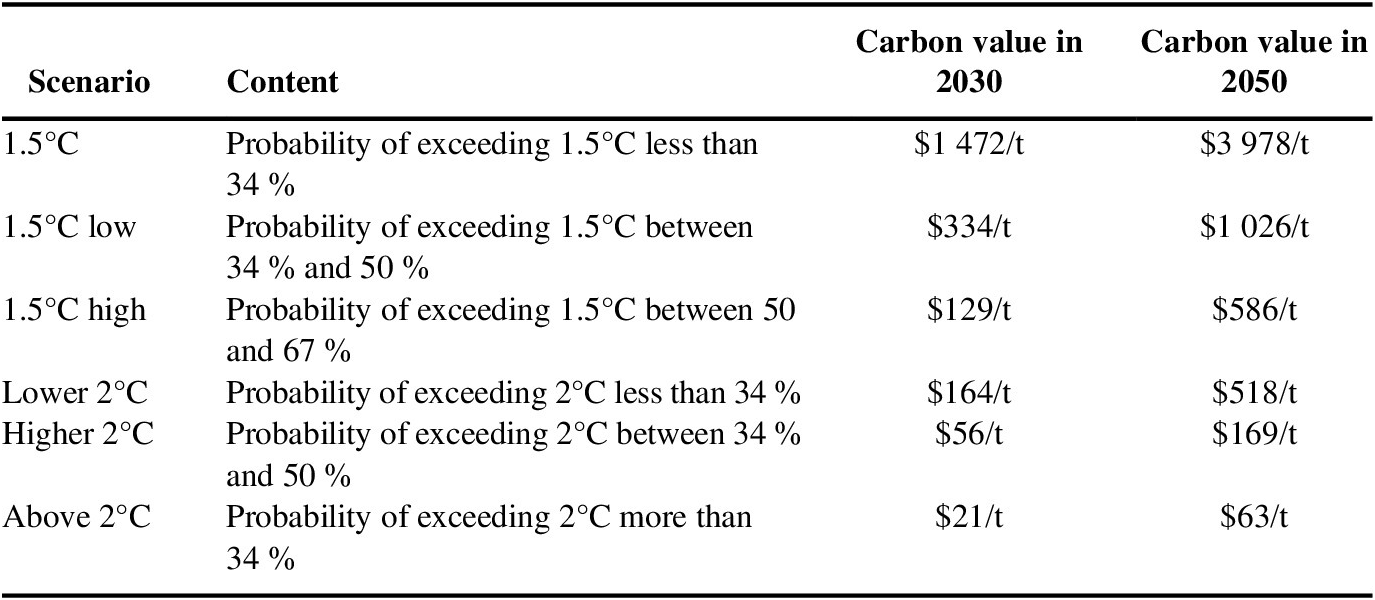
Carbon values linked to decarbonization targets are subject to significant upward revision in response to this dwindling carbon budget and more stringent targets. Table 2 gives mean world carbon values based on simulations carried out by the IPCC (2018), recognizing that there is considerable scattering around these mean values. Predictably, carbon values rise as the urgency of decarbonization increases. In addition, in the 1.5°C scenarios, the values reach the $100 mark before 2030, and “take off” thereafter.
Carbon values under IPCC calculations [in dollars (2010 value) per ton of CO2].

Note: In each scenario, average carbon value for a range of models and simulations.
Source: IPCC (2018), adapted from Figure 2.26.
The table highlights the difficulties associated with modeling the transition toward a carbon-neutral economy. Models give plausible values for required future carbon values through to 2030 and 2040, or until emissions have fallen broadly in line with “Factor 4” scenarios (i.e., reductions in GHG emission levels by a factor of four compared with 1990 levels). The robustness of the models’ output declines, because the horizon becomes more distant. As the level of emissions’ falls, reductions become harder to achieve and require structural, non-marginal changes, which models calibrated on the cost of existing or foreseeable technologies can no longer predict. Finally, it can be observed that the slope of carbon value paths between 2030 and 2050 is markedly higher than under any Hotelling’s Rule. Indeed, carbon values here reflect abatement costs at the margin of predefined decarbonization scenarios, which are not the result of an optimization under a single carbon budget. Additional constraints are placed on their time profile, the result suggesting that reinforcing the initial effort would be desirable.
In France, the carbon value recently proposed at the 2030 horizon by the second Quinet Commission is significantly higher than that taken from the previous report in 2008 (€100 at 2008 values and €110 at current values). This revision primarily reflects that action has been delayed until now and the resulting increased ambition required exceeds Factor 4. This goal entails high abatement costs or technological breakthroughs in several economic sectors, particularly agriculture (notably, the need to adapt crop and livestock farming), some industrial sectors (the need to find substitutes or disruptive technologies in essential production, such as cement, chemicals, and steel), and long-distance transport (land, sea, and air travel). The increase in the carbon value also reflects a lack of international cooperation and flexible mechanisms at the international level. The carbon value in France (see Figure 1) is within the range of values indicated in the IPCC’s latest October 2018 report for targets under 2°C and was revised sharply upward to factor in the risk of rapid depletion of the world’s carbon budget.

Determining a carbon value path at a country level must take account of the uncertainty of valuation which continues to increase into the future, because the scope for technological developments and diplomatic initiatives expands.
The sensitivity of results to the cost of technology is closely related to underlying assumptions of international cooperation. For industry, research and innovation efforts that place greater focus on decarbonization and are engaged simultaneously in multiple countries would have a powerful impact in terms of reducing the cost of technology, as can be seen at present in the case of renewable energy. Where multiple research bodies and companies in several countries become engaged in innovation projects, this should produce gains for the individual countries: each country benefits from the emergence and dissemination of innovation throughout the world, along with the reduction in the cost of technology facilitated by learning effects and economies of scale. These are referred to as “international spillover effects.”
Overall, the assumption of technological breakthroughs through closer international cooperation would undoubtedly have little effect on the price of carbon in 2030 but would accommodate an expected sharp reduction in the carbon value beyond 2030 (from €775 to €450). On the other hand, a lack of international cooperation would not justify an upward revision in the already-high baseline carbon value in France; any such revision would prevent the deployment of additional technologies within the same short timescale and could lead to restricted business activity and employment, with no sustainable benefit from the decline in the carbon intensity of human activity.
4 Implementation of BCA: an extended framework
Evaluating the costs and benefits of mitigation actions, or, more generally, the climate impact of policy actions, raises numerous challenges. The traditional BCA framework for implementing better climate policies needs to be expanded. In an introduction to a special issue of the Journal of Benefit Cost Analysis entitled “Perspectives on Implementing Benefit-Cost Analysis in Climate Assessment,” Sussman et al. (Reference Sussman, Grambsch, Li and Weaver2014) review some of these challenges. After an overview of the progress already achieved, we select here two areas in which we believe much work is still needed: the relevant reference scenario against which projects should be evaluated, and the articulation between efficiency and equity.
4.1 Relevance of an expanded assessment framework
BCA was traditionally performed in respect of a limited time period. An infrastructure investment was generally assessed for a period of 30–50 years; the subsequent social benefits were not taken into consideration. The time horizon has now been extended and the social discount rate revised downward. This has been an important argument for enhanced climate policies.
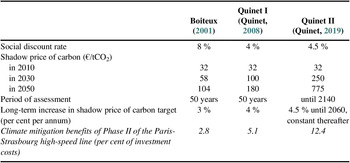
Table 3 highlights the shift over the last 20 years in the main parameters of the assessment framework in France and provides an example of the impact of these changes on the socioeconomic value of a high-speed railway line, specifically the second phase of the HSL between Paris and Strasbourg, representing 106 km of rail and costs of €2.1 billion. The climate benefits of the modal shift from air or car transport to rail have been revised upward significantly: from 2.8 % to 12.9 % of the initial investment cost, according to the new framework.
Evolution of socioeconomic methods.

Source: Authors’ calculations based on Boiteux (Reference Boiteux2001), Quinet I (Quinet, Reference Quinet2008), and Quinet II (Quinet, Reference Quinet2019).
To illustrate further the increased impact of climate concerns, we carry out a number of simulations to assess the socioeconomic value created by the emissions prevented in year t. This value can be measured by the total of emissions eliminated over year t multiplied by the same year’s shadow carbon price. For France, the social value of the emissions prevented in year t would be equivalent to about 1 % of GDP in 2030, 3.5 % of GDP in 2040, and 7 % of GDP in 2050 (Quinet, Reference Quinet2019). The value increases over time, because terminal emissions are more difficult to abate, making the actions undertaken more valuable.
4.2 Which baseline scenario?
The choice of the counterfactual or reference scenario is of crucial importance for BCA. Socioeconomic calculation does not evaluate a project’s absolute value but rather its contribution to collective well-being, compared to a situation in which the project would not have been undertaken. This assumes that coherent macroeconomic and sectoral reference scenarios are available, describing the evolution of the main parameters (economic, technological, and social trends) in the sector under consideration, along with a baseline option, i.e., a description of the alternatives in the project’s absence. The gains a project provides therefore very much depend on the hypotheses adopted to describe the situation in which it is not undertaken.
The importance of the reference scenario may be illustrated by the example of a railway project whose benefits in terms of the reduction in carbon emissions require evaluation. Such gains are essentially due to a modal shift. To appraise them, the evaluation sets a value on prevented emissions by users who switch from road or air travel to rail travel, using the shadow price of carbon path. However, the gains crucially depend on the assumptions made in the reference scenario about the car population from today to 2050 and beyond. If the car pool has not been decarbonized, the project achieves major carbon gains because of the modal shift. If, on the contrary, the car pool is assumed to be fully electrified over the period, there will be no carbon gains at the end of the period whatever the carbon value happens to be (assuming that electricity itself is totally decarbonized). The advantages of the railway project in terms of the reduction of carbon emissions due to the modal shift from car to train are therefore zero after 2050. The only gain left has to do with the shift from air to rail. Thus, an increasing carbon value over the long term does not automatically translate into an increasing value of a project’s carbon gains at distant time horizons. Everything depends on the reference scenario under consideration.
It is current socioeconomic practice in France that reference scenarios and options converge toward the official decarbonization goal (net-zero emissions in 2050), under the hypothesis of an alignment of public policies in order to achieve that goal. However, because the choice of reference scenario is of crucial importance for the appraisal of projects, it may seem prudent to evaluate the risk that the decarbonization goal will not be achieved at the specified horizon, and to take this risk into consideration in the evaluation process. The analysis of a project’s contribution to decarbonization must therefore take account of the speed of decarbonization. If decarbonization is slower than anticipated, the relevance of the project may be very different than if decarbonization is achieved in 2050. Assessing this risk necessarily requires expert judgements. For transparency, the good practice could be to use two reference scenarios, one where BCA aims at assessing whether the project contributes to achieving the objective in an efficient way, and one where BCA aims at assessing the contribution of the project to the decarbonization path.
4.3 Distributive issues
BCA provides an overall appraisal of the advisedness of a project or policy, based on the hypothesis of the simultaneous implementation of proper transfers in order to distribute the surplus (Drèze & Stern, Reference Drèze, Stern, Auerbach and Feldstein1987). When disaggregated, BCA is helpful at this level by making it possible to clarify the impact of policies and projects on the different categories of agents. In practice, however, the tendency is to separate efficiency and equity issues and to act as if the matter of surplus distribution could be left to general income redistribution. This is justifiable only when costs and benefits are naturally distributed among all agents. In the case of climate policy, this last assumption is questionable: as a rule, climate policies are regressive, and have a disproportionately adverse effect on the poor and vulnerable households. This is true for direct carbon pricing, as illustrated below by the case of the French carbon tax, but also for indirect carbon pricing: green subsidies are basically used by rich people (as tax credits; see, e.g., Borenstein & Davis, Reference Borenstein and Davis2016), who are also more able to bear the effect of the cost of emissions’ standards on the price of new vehicles. It is then essential to specify the accompanying measures necessary to ensure equity.
The 2018 “yellow vests” protests in France against an increase in carbon tax emphasized how much attention should be paid to its distributive effects. The French carbon tax, or more properly the “climate-energy contribution,” is an excise duty applied to the CO2 content of energy. It was introduced in 2014 at the initial rate of €7 per ton of CO2, on top of the domestic consumption taxes on energy products. Around 60 % of the total yield is paid by households; the rest is paid by businesses. In 2017, the Government announced an acceleration of the tax trajectory in order to reach €86.2/tCO2e in 2022, but then decided in November 2018 to freeze the tax rate at €44.6, as a response to the “yellow vests” protest.
Bureau et al. (Reference Bureau, Henriet and Schubert2019) have examined the distributive impacts of the reform consisting of an increase in the carbon tax from its current level (€44.6/tCO2e) to the level expected to be reached in 2022 (€86.2/tCO2e), accompanied by a reduction in the gap between the tax on diesel and the tax on petrol by 7.8 cents per liter.
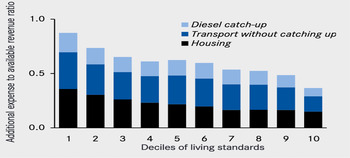
This reform is first considered without any revenue redistribution mechanism. The impacts of the reform are evaluated for each decile of standard of living. Figure 2 illustrates the burden of the reform, broken down into three parts: additional expenditure on housing due to the carbon tax, additional expenditure on transport due to the carbon tax, and additional expenditure on transport due to closing the diesel-petrol gap. The poorer the household, the greater the burden, accounting for nearly 1 % of disposable income for the bottom decile compared with 0.3 % for the top decile.
Effort rate of households associated with the reform before revenue use (in per cent).
Source: Bureau et al. (Reference Bureau, Henriet and Schubert2019).

Thus, the reform is regressive ex ante. The regressivity is more due to housing than to transport. The share in the cost ratio of closing the diesel-petrol gap is far from negligible, because this also has a regressive effect. This regressivity, reflecting the structure of emissions and the weight of energy expenditures in respective household budgets, requires accompanying mechanisms to ensure the equity of the reform and its political acceptability. This is what has been lacking in the establishment of the French carbon tax.
Simulations show that the unequal impacts of the taxation are not only due to the level of income (vertical heterogeneity). Within each income decile – “horizontal heterogeneity” – the impact of the tax on purchasing power is significant. Among the households in the bottom decile, 10 % lose more than €220 in purchasing power per year per consumption unit with the implementation of the reform, whereas about 10 % of households are not affected at all. Horizontal heterogeneity increases with income, so that in the 10th decile, 10 % of households lose more than €480 in purchasing power per year per consumption unit, whereas 10 % of households lose less than €25. This intradecile heterogeneity is due, in particular, to the location of households and the type of equipment they own: oil or gas heating vs. electric heating, and car with a diesel engine vs. car with a petrol engine. For example, for a given income, the relative loss of rural households compared to households in the Paris agglomeration is significant, at an average of about €130 per consumption unit.
However, a more in-depth analysis shows that horizontal heterogeneity is better explained by equipment than by geographical location alone. Once the differences in equipment are factored in, the differences in losses between rural and urban households vanish: with equal income and equipment, a rural household loses €20 more per consumption unit than a Parisian household. On the other hand, for the same income and type of location, a household equipped with a diesel car loses €230 more per consumption unit over 1 year than a household without a car, whereas a household heated by domestic fuel loses €157 more than a household heated by electricity.
The redistribution of carbon tax revenues is necessary in order to achieve a better sharing of household effort, but its implementation raises a series of difficulties. It is relatively easy to redistribute revenue according to income, but much more difficult to take into account the dimensions of horizontal heterogeneity in order to identify the losers properly without creating overly complex arrangements, significant windfall effects, or a weakening of the price signal. The previous exercise suggested calibrating the redistribution of revenues according to equipment. But this would be both complex regarding the information to be collected, and environmentally counterproductive. Another – still imperfect – option would be to subsidize changes in equipment. This makes it possible to target some of the losers in the reform (those who own polluting equipment) and does not decrease the incentive power of the tax. It has several disadvantages nevertheless: it can create significant windfall effects, it can be regressive, and, above all, it does not compensate all the losers. A last possibility would be to base the redistribution of revenue on geographical location, combined with a clear but not absolute correlation to equipment.
In the French case, Bureau et al. (Reference Bureau, Henriet and Schubert2019) show that it is possible to design a redistribution scheme that takes into account the two crucial dimensions of household income and location such that the combination of carbon tax and revenue redistribution reduces to a minimum the number of losing households in the bottom five deciles.
The logic underlying the previous exercise is that policy-makers calculate a carbon value using traditional BCA, evaluate the distributive effects its implementation using an explicit or implicit carbon price would have, and finally implement this carbon price together with measures to correct its regressivity. A more sophisticated approach would consist of directly incorporating distributional considerations in BCA exercises. One possible method is to use distributional weights in order to implement a social welfare function. Adler (Reference Adler2016) and Fleurbaey and Abi-Rafeh (Reference Fleurbaey and Abi-Rafeh2016) provide an overview of the underlying theory and the practical issues posed by weighted BCA. Hammit (Reference Hammit2021) provides more general guidelines for adapting BCA in order to address the two objectives of efficiency and equity. He notes that such methods are rarely used in practice. Weighted BCA is recommended in the Green Book, the UK Government’s guidance for policy evaluation (HM Treasury, 2018), but this is an exception. Much work still needs to be done, given the analytical complexities and the data needs involved.
Finally, Kornek et al. (Reference Kornek, Klenert, Edenhofer and Fleurbaey2021) is, to the best of our knowledge, the first paper (building on the authors’ earlier work) to show how the SCC and distributional issues depend on one another. Using a modified version of the NICE model (Dennig et al., Reference Dennig, Budolfson, Fleurbaey, Siebert and Socolow2015), which is itself a variant of the regionalized version of Nordhaus’ DICE model, they find that when low-income households experience large and uncompensated climate damage while abatement costs are proportional to income, the SCC tends to be higher than in the representative agent counterpart of the model. Their Integrated Assessment Model opens up the path for cost-benefit and cost-effectiveness estimates of the carbon value that do not accept inequalities as given but make them depend on climate policy, and vice versa.
5 Conclusion
Before the “Net-Zero Emissions” goal can be achieved, a relevant road map of the key policy actions and the requisite investments needs to be defined. To do this, a common carbon value and an appropriate BCA framework are the two elements that should be used to define the order of merit of the mitigation actions.
Recent progress in the methodology shows that BCA has become climate friendly, with longer time horizons and lower discount rates, higher and increasing carbon values, risk pricing, etc. Moreover, once the overall target is set, the question becomes less “why and how much?” and more “how can the goal we are committed to be reached at the lowest cost?” For this purpose, the cost-effectiveness approach that calculates the shadow price trajectory of a given carbon budget may be sufficient to set the reference values for climate BCA, as was done in France in the Quinet Report. The efforts to better estimate the SCC must be reinforced at the same time, of course. Above all, we must build efficient and equitable policies, and this needs enhanced BCA. Efficiency is the purpose of BCA. But BCA must also help in identifying accompanying measures to alleviate the dilemma between equity and efficiency.
There is a unique opportunity now to promote BCA. Thanks to the Paris Agreement, and to the recent decision of the Biden Administration to join the Agreement, there is now a larger consensus on the net-zero emissions target. The European Union and other major countries are designing new packages in order to honor their commitments. BCA must be the anchor of their construction process. In particular, it would be worth establishing a shadow price for the European carbon target in order to embody the climate ambition of the European Green Deal, make global goals credible, assess the climate impact of public investments, and more generally align policies and order mitigation actions according to their costs and merits. Such a shadow price should form part of a global assessment framework that also defines reference scenarios and discount rates, and integrates efficiency and equity issues.