Introduction
In the USA, obesity and its cardiometabolic sequelae are significant risk factors for and contributors to morbidity and mortality (CDC, 2018a, 2018b; Ogden, Yanovski, Carroll, & Flegal, Reference Ogden, Yanovski, Carroll and Flegal2007; Pi-Sunyer, Reference Pi-Sunyer2009). The mechanisms of obesity development are multifactorial, interdependent, and not completely understood. Contributors to the development of obesity include but are not limited to the food environment, socioeconomic status, dietary patterns, and genetics (CDC, 2018a; Chooi, Ding, & Magkos, Reference Chooi, Ding and Magkos2019; McLaren, Reference McLaren2007; Ogden, Lamb, Carroll, & Flegal, Reference Ogden, Lamb, Carroll and Flegal2010; Ogden et al., Reference Ogden, Yanovski, Carroll and Flegal2007). Once developed, obesity is a complicated and difficult disease to treat (Ogden et al., Reference Ogden, Yanovski, Carroll and Flegal2007), such that understanding potentially modifiable risk factors is critical in helping to reduce long-term disability, morbidity, and mortality at the population level.
Recent evidence suggests post-traumatic stress disorder (PTSD) is associated with obesity, accelerated weight gain, and a higher prevalence of obesity-related conditions (e.g. high blood pressure) among Veteran populations in the post-deployment period (Buta et al., Reference Buta, Masheb, Gueorguieva, Bathulapalli, Brandt and Goulet2018; Maguen et al., Reference Maguen, Madden, Cohen, Bertenthal, Neylan, Talbot and Seal2013; Mitchell, Porter, Boyko, & Field, Reference Mitchell, Porter, Boyko and Field2016; Pagoto, Reference Pagoto2011). Less is known about PTSD resulting from non-combat related sources of trauma and its association with weight among the general population. A few studies have observed that PTSD is associated with obesity and accelerated weight gain among the general population, especially among women (Farr et al., Reference Farr, Ko, Joung, Zaichenko, Usher, Tsoukas and Mantzoros2015; Kubzansky et al., Reference Kubzansky, Bordelois, Jun, Roberts, Cerda, Bluestone and Koenen2014; Pagoto et al., Reference Pagoto, Schneider, Bodenlos, Appelhans, Whited, Ma and Lemon2012; Perkonigg, Owashi, Stein, Kirschbaum, & Wittchen, Reference Perkonigg, Owashi, Stein, Kirschbaum and Wittchen2009). However, these studies are limited in their generalizability given small sample sizes (Farr et al., Reference Farr, Ko, Joung, Zaichenko, Usher, Tsoukas and Mantzoros2015), non-US samples (Perkonigg et al., Reference Perkonigg, Owashi, Stein, Kirschbaum and Wittchen2009), a female-only population (Kubzansky et al., Reference Kubzansky, Bordelois, Jun, Roberts, Cerda, Bluestone and Koenen2014), and cross-sectional study designs (Pagoto et al., Reference Pagoto, Schneider, Bodenlos, Appelhans, Whited, Ma and Lemon2012). Thus, further research investigating the relationship between PTSD and weight among a more sociodemographically diverse and non-Veteran population is warranted.
To investigate the association of PTSD and weight in a population exposed to the World Trade Center (WTC) disaster on 11 September 2001 (hereafter, 9/11), we used data from adults enrolled in the World Trade Center Health Registry (WTCHR), a large, sociodemographically diverse, longitudinal observational cohort study. Our goals for this investigation were twofold: (1) to test the hypothesis that having a post-9/11 history of PTSD is associated with higher categories of body mass index (BMI) (Aim 1) and (2) to test the hypothesis that having a post-9/11 history of PTSD is associated with a greater magnitude of weight gain over time (Aim 2). Weight and weight gain patterns vary among men and women across adulthood (CDC, 2020; Martin, Herrick, Sarafrazi, & Ogden, Reference Martin, Herrick, Sarafrazi and Ogden2018; Zheng et al., Reference Zheng, Manson, Yuan, Liang, Grodstein, Stampfer and Hu2017), such that we examine these associations stratified by age and sex. For both aims, our hypotheses are consistent across the age- and sex-stratified groups but we expected the associations to vary in magnitude.
Methods
Study population
Between 2003 and 2004, the WTCHR enrolled 71 426 individuals who lived, worked, or went to school in the area of the WTC disaster, were passing by or were involved in rescue and recovery work. Enrollees either responded to an outreach campaign (self-identified) or were identified and enrolled through lists provided by employers, government agencies, and other entities (list-identified). Participants completed a baseline (Wave 1) health survey via computer-assisted telephone interviews (CATI) or computer-assisted in-person personal interviews (CAPI) regarding their experiences on 9/11 and their health. Follow-up questionnaires were administered in subsequent years by web- and paper-interview in 2006–2007 (Wave 2), 2011–2012 (Wave 3), and 2015–2016 (Wave 4). Additional study details are described in detail elsewhere (Brackbill et al., Reference Brackbill, Hadler, DiGrande, Ekenga, Farfel, Friedman and Thorpe2009; Farfel et al., Reference Farfel, DiGrande, Brackbill, Prann, Cone, Friedman and Thorpe2008; Murphy et al., Reference Murphy, Brackbill, Thalji, Dolan, Pulliam and Walker2007). The institutional review boards at the Centers for Disease Control and Prevention and the New York City Department of Health and Mental Hygiene approved the WTCHR protocol; verbal informed consent was obtained from all participants.
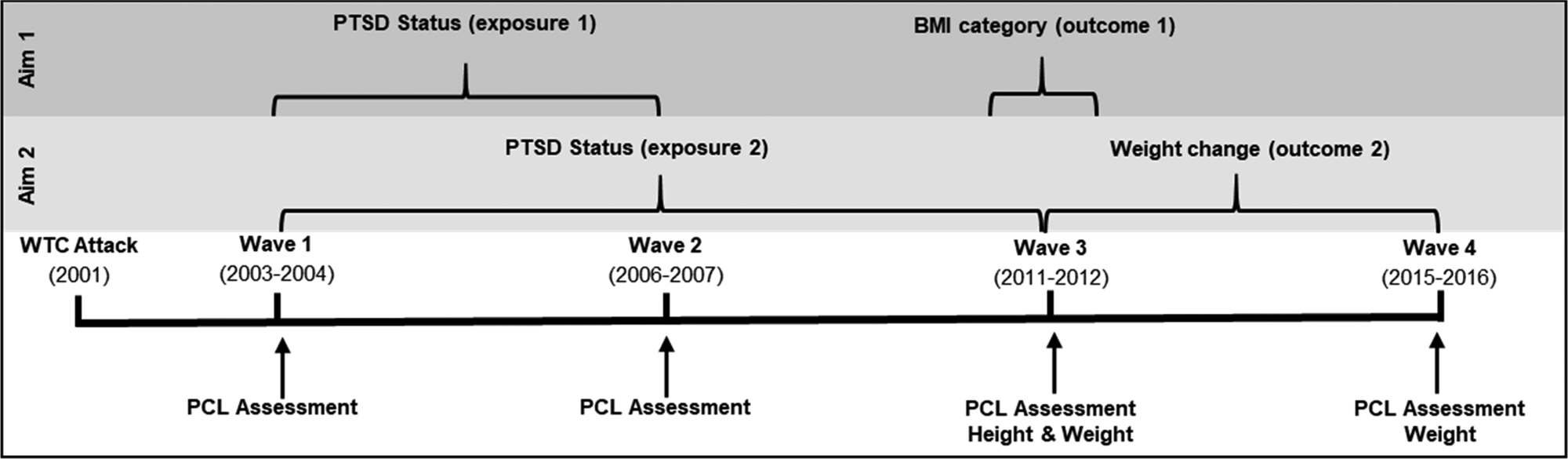
Data collection time points for the World Trade Center Health Registry (2003–2016) and study design for paper aims.

Study variables
Exposure: PTSD (No PTSD, intermittent, persistent)
At each wave (Waves 1–3), probable 9/11-related PTSD (hereafter, PTSD) was defined as a score of ⩾44 on the PTSD Checklist-Specific (PCL-S; internal consistency = 0.94–0.97; sensitivity = 0.78–0.82; specificity = 0.83–0.86) (Weathers, Litz, Herman, Huska, & Keane, Reference Weathers, Litz, Herman, Huska and Keane1993), a 17-item self-reported measure reflecting American Psychiatric Association's Diagnostic and Statistical Manual of Mental Disorders, 4th Edition (DSM-IV) criteria (Association, Reference Association1994; Blanchard, Jones-Alexander, Buckley, & Forneris, Reference Blanchard, Jones-Alexander, Buckley and Forneris1996; Ruggiero, Del Ben, Scotti, & Rabalais, Reference Ruggiero, Del Ben, Scotti and Rabalais2003). The PCL-S asked about symptoms in relation to an identified ‘stressful experience’, specifically the WTC disaster. A total symptom severity score was derived by summing the scores from the 17 items, with responses scored from 1, ‘Not at all’, to 5, ‘Extremely’. Based on the PTSD classification at Waves 1 and 2 (exposure 1) and Wave 1 through Wave 3 (exposure 2), we grouped individuals into three mutually exclusive categories to reflect one's post-9/11 history of PTSD: (1) no PTSD (no PTSD at any wave), (2) intermittent PTSD (PTSD at one or more waves, but not all waves), and (3) persistent PTSD (PTSD at all waves) (Fig. 1). It is important to note that these exposure definitions (no, intermittent, persistent) do not represent PTSD diagnoses made by healthcare professionals or align with formal diagnostic criteria, but rather, were labels selected to represent groups of individuals with a varying burden of PTSD symptoms over time. Finally, while our definition of PTSD is queried specific to the events of 9/11, the DSM construction of PTSD is based on a consistent and clearly defined pattern of symptoms, regardless of the initiating event (Association, Reference Association1994, Reference Association2013; North, Suris, Davis, & Smith, Reference North, Suris, Davis and Smith2009). Thus, the covariates and effect modifiers were identified for this analysis irrespective of underlying 9/11-related experiences and focused instead on PTSD as a disorder and as the primary exposure.
Outcomes: BMI categories and weight
Self-reported height in feet and inches and weight in pounds was collected for the first time on the Wave 3 survey (Fig. 1); BMI (Outcome 1) was calculated at Wave 3 and classified as: underweight (<18.5 kg/m2), normal (18.5–24.9 kg/m2), overweight (25–29.9 kg/m2), and obese (⩾30 kg/m2). Weight (outcome 2) was analyzed as continuous weight in pounds at each time point (Fig. 1); repeated measures of weight, as opposed to calculated weight change, increase statistical precision and account for differences at baseline between the groups (Cook & Ware, Reference Cook and Ware1983; Vickers, Reference Vickers2001).
Aim 2 sought to examine the relationship between PTSD and weight change over time, thus we excluded two groups of individuals with large weight loss or gain assumed or known to be attributable to factors other than PTSD: (1) women who reported being pregnant at Wave 4 (N = 82) and (2) individuals whose Wave 3 BMI was greater than or equal to 35 kg/m2 and had an observed percent weight loss between waves of more than 25% (N = 76). The assumption was that these individuals were likely to have had bariatric surgery. A recent study examining national data on weight gain in adult populations (1992–2010) observed a net decrease in BMI for those with class II or III obesity (BMI ⩾35 kg/m2) and suggested the increased use of bariatric surgery to promote weight loss may partly explain these findings (Stenholm et al., Reference Stenholm, Vahtera, Kawachi, Pentti, Halonen, Westerlund and Kivimaki2015). We did not have medication history and thus could not exclude individuals who may have started a medication regimen between Wave 3 and 4 that might contribute to significant weight gain.
Only biologically plausible heights and weights for men (⩾85.6 lb and ⩽480.9 lb; ⩾51.3in and ⩽80.5in) and women (⩾74.1 lb and ⩽570.9 lb; ⩾51.8in and ⩽73.5in) were included in either of the analyses which led to the exclusion of 97 values (Richards, Reference Richards2008).
Effect modifier: age and sex
The prevalence of obesity varies by age and is reported to be the highest among middle-aged adults aged 40–59 years old (CDC, 2018b). Further, as people age, shifts in metabolism make it easier to gain weight (CDC, 2020) and a lower proportion of older adults aged 60 and over actively try to lose weight as compared to younger and middle-aged adults (Martin et al., Reference Martin, Herrick, Sarafrazi and Ogden2018). In regards to sex, women are disproportionately affected by extreme obesity and BMI varies to a greater degree as compared to men (Hruby & Hu, Reference Hruby and Hu2015; Ogden, Carroll, Kit, & Flegal, Reference Ogden, Carroll, Kit and Flegal2014; Williamson, Reference Williamson1993). Similarly, weight change patterns over early to middle adulthood vary by sex, with women demonstrating a greater magnitude of weight gain over time (Zheng et al., Reference Zheng, Manson, Yuan, Liang, Grodstein, Stampfer and Hu2017). Given patterns of weight and weight change vary by both age and sex, all subsequent analyses examining the association of PTSD with weight and weight change were sex- (male, female) and age-stratified (Wave 3 age in years: 25–44, 45–59, 60+).
Covariates were selected a priori based on prior literature given their potential association with PTSD and weight (CDC, 2018a; Hruby & Hu, Reference Hruby and Hu2015) These included race/ethnicity (non-Hispanic white, non-Hispanic black, Hispanic, Asian, other), number of physical injuries on 9/11 (none, 1 injury, 2 + injuries), Wave 1 educational attainment (⩽high school/GED, some college, college graduate, graduate degree), a count (none, 1, 2+) of pre-9/11 chronic physical health conditions (asthma, hypertension, angina, history of heart attack, history of stroke, diabetes, coronary heart disease, cancer), and a pre-9/11 history (yes/no) of mental health conditions (depression, anxiety). All covariates were included in both multivariable models.
Analytic sample
Our study focuses on a sample of adults with available data on our exposure and outcomes of interest. Of the 71 426 WTCHR enrollees, we first excluded participants who did not participate in Waves 1 through 3 (N = 35 175) and those less than 18 years of age at Wave 1 (N = 148). Next, those reporting a pre-9/11 diagnosis of PTSD (N = 396) or those missing a Wave 1 or Wave 2 PCL-S score were excluded (N = 431). For Aim 1, individuals missing Wave 3 BMI (outcome 1) were excluded (N = 691), leaving an analytic cohort size of 34 585. For Aim 2, individuals who did not participate in Wave 4 (N = 7725), were missing Wave 3 PCL-S (N = 290), or were missing weight at wave 3 or wave 4 (outcome 2; N = 997) were further excluded, resulting in a final analytic sample size of 26 264 for Aim 2.
Statistical analysis
Pearson's χ2 tests for categorical variables and t tests or one-way ANOVA for continuous variables were used to assess differences in baseline characteristics across the PTSD exposure groups for both analytic samples. Analyses were conducted using SAS version 9.4 (Cary, NC).
For Aim 1, the cross-sectional association between PTSD categories and BMI categories was assessed using multinomial logistic regression. Adjusted odds ratios (OR) and 95% confidence intervals (CI) were computed comparing the intermittent and persistent PTSD groups with the no PTSD group and comparing those with obesity and overweight to those with normal weight as a referent. All models were adjusted for all described covariates and were stratified by sex and age. Due to small sample sizes, individuals with underweight (N = 370) were excluded from Aim 1 multivariable analyses.
For Aim 2, generalized estimating equations (GEE) with unstructured covariance matrices were used to compare the rate of weight change over time by the PTSD categories. Continuous weight in pounds, measured at Wave 3 and Wave 4, was modeled as the dependent variable; GEE models adjust for the correlations between repeated measures taken on the same individual over time (Cook & Ware, Reference Cook and Ware1983; Twisk, Reference Twisk2004; Zeger & Liang, Reference Zeger and Liang1986). The use of the repeated measures approach considers the differences in baseline weight across groups and facilitates the examination of how weight changed over time within individuals and how that change is related to the individual's PTSD history. The following equation represents the general form of the final fitted model for each age- and sex-specific group simplified to demonstrate just two PTSD categories (PTSD v. No PTSD (referent)).

In equation (1), Weightij indicates the estimated weight in pounds for individual i at time point j, β 0j represents baseline (wave 3) weight for the referent PTSD group, β 1j represents the estimated weight change between waves (slope) for the referent PTSD group, and β 2j represents the difference in baseline weight for the non-referent PTSD group. The β 3j interaction term enables the calculation of (1) PTSD group-specific average weight at Wave 4 and (2) estimated weight change (slope) between waves for the non-referent PTSD group. β 4j represents a vector of coefficients for covariates included in the model: race/ethnicity, education, number of physical injuries, pre-9/11 chronic physical health conditions, and pre-9/11 mental health conditions.
Sensitivity analyses
Inclusion in both analytic samples required meeting explicit inclusion criteria, including having complete data on exposure and outcomes at multiple time points. To examine the contribution of these restrictions on our sample, we conducted basic bivariate comparisons of all demographic characteristics between excluded participants and those included in the Aim 1 analytic sample.
We identified and excluded 76 participants who we assumed underwent bariatric surgery based on well-established clinical characteristics of bariatric surgery (BMI⩾35 kg/m2 and >25% weight loss), but it is unknown whether or not these patients actually received bariatric surgery. To examine the magnitude to which excluding these individuals impacted our results, we re-ran the foregoing Aim 2 analyses including these 76 individuals.
Results
Sample description
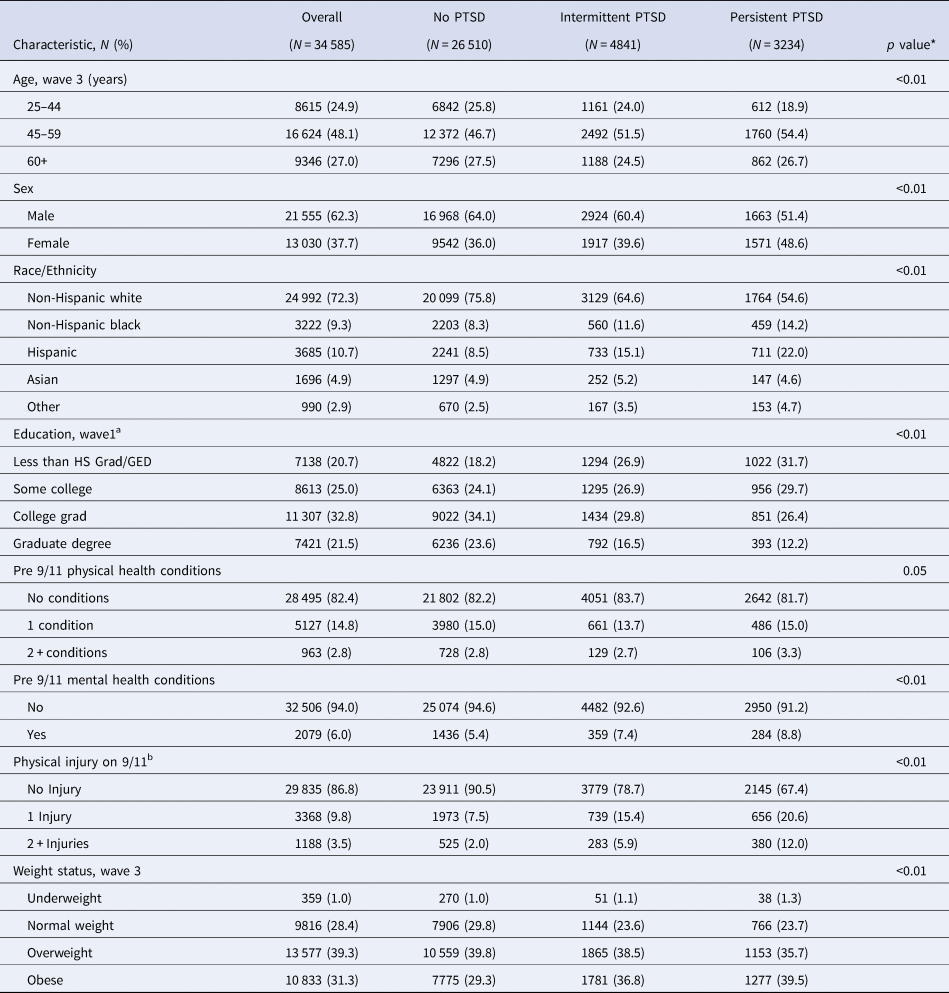
Selected characteristics of 21 555 men and 13 030 women included in the Aim 1 analyses are presented in Table 1. Individuals in the no PTSD group were more likely to be non-Hispanic white, report no physical injuries on 9/11, and have no pre-9/11 mental health conditions compared to those in the intermittent or persistent PTSD groups. Overall, we observed that at Wave 3 most of the sample had overweight or obesity (71%). The observed prevalence of obesity at Wave 3 was significantly greater (p < 0.01) among those with persistent (39.5%) and intermittent PTSD (36.8%) as compared to those with no PTSD (29.3%). Among those in the Aim 2 analyses, the trends in demographics were similar to Aim 1. Those in the no PTSD group had the lowest observed mean weight at Wave 3 (183.8 lbs) compared to the intermittent (189.5 lbs) and persistent PTSD (188.8lbs) groups (online Supplementary Table S1).
Demographic characteristics of 34 585 adults exposed to the World Trade Center disaster by probable PTSD classification

N, number; PTSD, post-traumatic stress disorder; GED, general education diploma.
a N = 106 missing education.
b N = 194 missing physical injury.
*p value using χ2 test.
Cross-Sectional association between wave 3 BMI and PTSD history
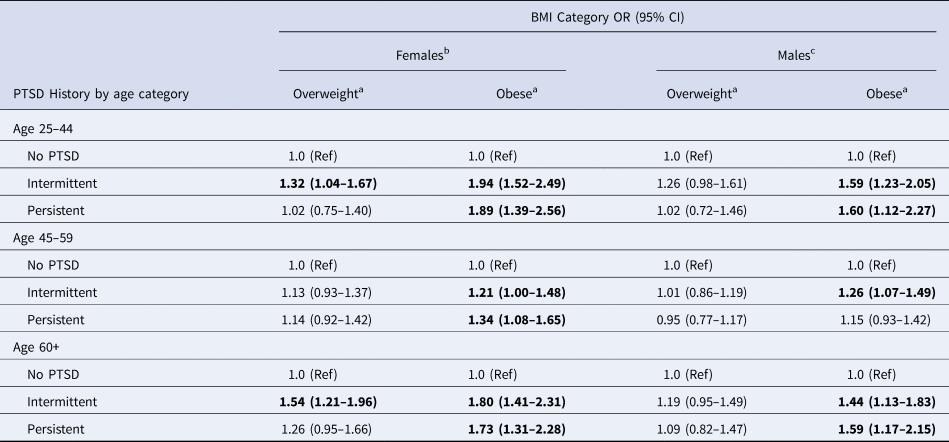
Among females with persistent PTSD compared to females in the no PTSD group, the odds of having obesity at Wave 3 were significantly elevated across all three age groups [OR, (95% CI): age 25–44: 1.89 (1.39–2.56); age 45–59: 1.34 (1.08, 1.65); age 60+: 1.73 (1.31–2.28)] (Table 2). The same trend was observed for women with intermittent PTSD, where the odds of having obesity were also increased across all three age groups [OR (95% CI): age 25–44: 1.94 (1.52–2.49); age 45–59: 1.21 (1.00–1.48); age 60+: 1.73 (1.31–2.28)]. The odds of having overweight at Wave 3 were also elevated among women with intermittent PTSD, ages 25–44 (OR 1.32, 95% CI 1.04–1.67) and ages 60+ (OR 1.54, 95% CI 1.21–1.96), but not among those 45–59 or among those in the persistent PTSD group.
Body mass index categories at Wave 3 regressed on PTSD history in males and females by age group, World Trade Center Health Registry, 2003–2012

PTSD, posttraumatic stress disorder; BMI, body mass index; N, number; OR, odds ratio; CI, confidence interval.
Model adjusted for the following covariates: race/ethnicity, number of physical injuries on 9/11, W1 education, mental health conditions pre-9/11, number of pre-9/11 chronic conditions.
Bold signifies statistically significant association.
aReference category: normal weight.
b Female analytic sample size, Age 25–44, N = 3591; Age 45–59, N = 5430; Age 60 + , N = 3614.
c Male analytic sample size, Age 25–44, N = 4845; Age 45–59, N = 10 925; Age 60 + , N = 5527.
Among males, similar associations were observed. Men with persistent PTSD who were ages 25–44 and 60+ had a higher odds of having obesity compared to those in the no PTSD group (OR 1.60, 95% CI 1.23–2.27 and OR 1.59, 95% CI 1.17–2.15, respectively), while those ages 45–59 did not (OR 1.15, 95% CI 0.93–1.42). Men with intermittent PTSD of all ages were also consistently more likely to have obesity compared to those in the no PTSD group [OR, (95% CI): age 25–44: 1.59 (1.23–2.05); age 45–59: 1.26 (1.07–1.49); age 60+: 1.44 (1.13–1.83)]. The odds of having overweight among men of all ages in the intermittent or persistent PTSD groups were not statistically significant.
Weight over time according to PTSD history
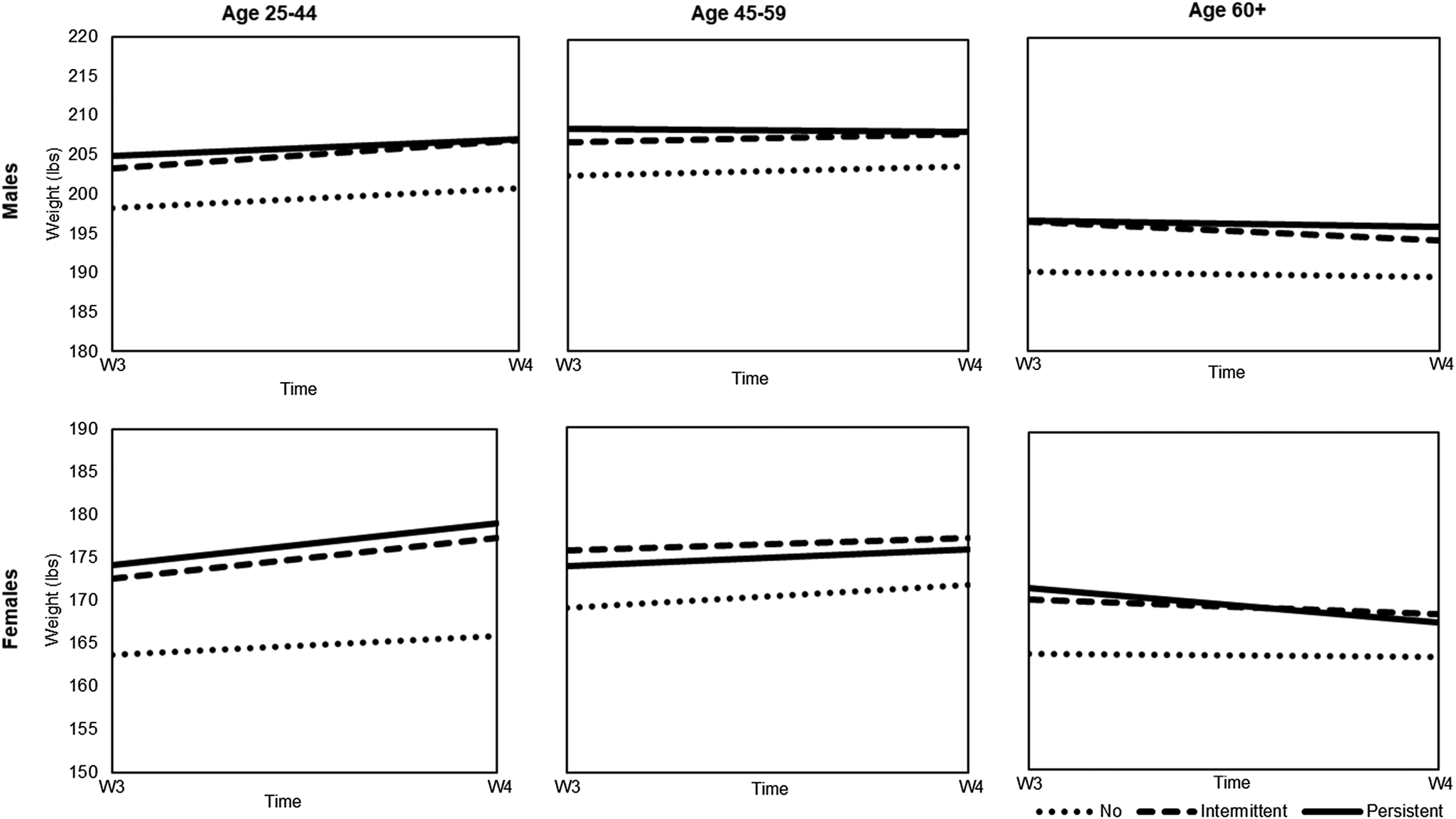
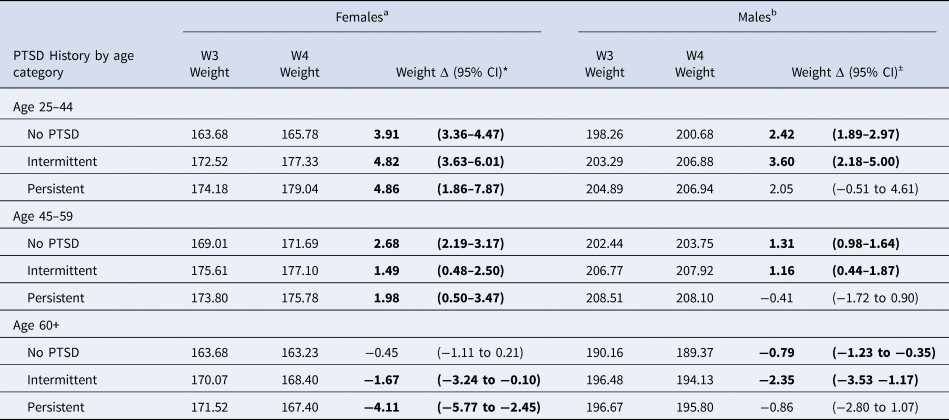
Women, regardless of PTSD history, ages 25–44 and 45–59 gained on average 1.49–4.86 pounds between Wave 3 and Wave 4, suggesting weight gain during this time was not greater among those with a history of PTSD compared to those without (Table 3). Conversely, women ages 60+ lost weight between Wave 3 and Wave 4, women with persistent PTSD experiencing the largest magnitude of weight loss (mean weight change: −4.11 lbs, 95% CI −5.77 to −2.45). Women ages 60+ with intermittent PTSD (mean weight change: −1.67 lbs, 95% CI −3.24 to −0.10) were also losing weight during this time period, while those in the no PTSD group were relatively stable in weight change between the two time periods (mean weight change: −0.45 lbs, 95% CI −1.11 to 0.21). Importantly, the estimated group-specific mean weight at Wave 3 and Wave 4 was consistently higher among women with intermittent and persistent PTSD as compared to those in the no PTSD across all age groups (Fig. 2).
Weight change over time by PTSD category, by gender and age group, World Trade Center Health Registry 2003–2016.

Weight change over time by PTSD history in males and females by age group, World Trade Center Health Registry, 2003–2016

PTSD, posttraumatic stress disorder; CI, confidence interval.
*Bold signifies statistically significant weight change between waves.
Models adjusted for the following covariates: race/ethnicity, number of physical injuries on 9/11, W1 education, mental health conditions pre-9/11, number of pre-9/11 chronic conditions.
a Female analytic sample size, Age 25–44, N = 2626; Age 45–59, N = 4250; Age 60 + , N = 2828.
b Male analytic sample size, Age 25–44: N = 3394; Age 45–59, N = 8563; Age 60 + , N = 4400.
Among men, similar to females, the rate of weight change between the waves was relatively similar across the age-specific PTSD groups (Table 3). Both younger age groups generally experienced weight gain during this time, while those ages 60+ experienced weight loss. Men ages 45–59 with persistent PTSD experienced little change between waves (mean weight change: −0.41 lbs, 95% CI −1.72 to 0.90), while those in the intermittent, and no PTSD groups gained weight (mean weight change: 1.16 lbs, 95% CI 0.44–1.87) and (mean weight change: 1.31 lbs, 95% CI 0.98–1.64, respectively). The opposite pattern was observed in men ages 60 + . Men in the no PTSD and intermittent PTSD groups lost weight (mean weight change: −0.79 lbs, 95% CI −1.23 to −0.35 and mean weight change: −2.35 lbs, 95% CI −3.53 to −1.17, respectively), while those with persistent PTSD (mean weight change: −0.86 lbs, 95% CI −2.80 to 1.07) were stable in their weight change between waves. Akin to the weight patterns among females, men across all age groups with persistent and intermittent PTSD had consistently higher estimated group-specific mean weights over time as compared to those in the no PTSD group (Fig. 2).
Sensitivity analysis
Compared to the analytic cohort, excluded participants were younger, non-White, and had a lower level of educational attainment (data not shown).
We reran the Aim 2 analyses including the 76 individuals (65% ages 45–59; approximately equal men and women, data not shown) who were excluded in the primary analyses as they were identified as possibly undergoing bariatric surgery. Among women, in the youngest (25–44) and oldest (60+) age groups, the results were largely unchanged from the primary analyses (online Supplementary Table S2). Among women ages 45–59 with intermittent and persistent PTSD, the patterns of weight gain over time observed in primary analyses were slightly less in magnitude and no longer significantly different than zero, but the estimates were still in the same direction. Compared to a pattern of weight gain in primary analyses, the magnitude of change in weight between waves among men ages 45–59 with intermittent PTSD was no longer significantly different than zero, suggesting no change in weight over time (online Supplementary Table S2). The magnitude and direction of all other male age-groups were similar to that of the primary analysis.
Discussion
In this sample of nearly 35 000 individuals exposed to the World Trade Center disaster and followed for 15 years, we observed that the majority of the sample had overweight or obesity (71%) when the first measurements of height and weight were collected in 2011–2012. We also observed important differences in the prevalence of overweight and obesity dependent on an individual's post-9/11 PTSD history. Persistent and intermittent 9/11-related PTSD was strongly associated with an increased odds of obesity among men and women 10 years following the WTC disaster. With regards to change in weight over time, our hypothesis that a history of PTSD would increase the magnitude of weight gain over time was not supported; all age groups ages 25–59, regardless of PTSD status, demonstrated weight gain over time. However, those with intermittent and persistent PTSD had consistently higher body weights than those who never had PTSD in the 10–15 years following the disaster. One important distinction from the rest of our findings is the pattern of distinct weight loss among women ages 60+ with persistent PTSD, which was not observed among younger women and men.
This is one of the first studies to capture recurrent measures of PTSD in a single exposure metric and how they are associated with weight later in life, making a comparison with existing literature difficult. However, our study findings corroborate the existing body of literature showing that a history of PTSD is associated with having overweight and obesity among community members (Farr et al., Reference Farr, Ko, Joung, Zaichenko, Usher, Tsoukas and Mantzoros2015; Kubzansky et al., Reference Kubzansky, Bordelois, Jun, Roberts, Cerda, Bluestone and Koenen2014; Pagoto et al., Reference Pagoto, Schneider, Bodenlos, Appelhans, Whited, Ma and Lemon2012; Perkonigg et al., Reference Perkonigg, Owashi, Stein, Kirschbaum and Wittchen2009) and in Veteran populations (Buta et al., Reference Buta, Masheb, Gueorguieva, Bathulapalli, Brandt and Goulet2018; Maguen et al., Reference Maguen, Madden, Cohen, Bertenthal, Neylan, Talbot and Seal2013; Mitchell et al., Reference Mitchell, Porter, Boyko and Field2016). Further, associations were greater in magnitude and more likely to be significant among women compared to men, which is consistent with findings from other studies (Buta et al., Reference Buta, Masheb, Gueorguieva, Bathulapalli, Brandt and Goulet2018; Maguen et al., Reference Maguen, Madden, Cohen, Bertenthal, Neylan, Talbot and Seal2013; Pagoto et al., Reference Pagoto, Schneider, Bodenlos, Appelhans, Whited, Ma and Lemon2012; Perkonigg et al., Reference Perkonigg, Owashi, Stein, Kirschbaum and Wittchen2009).
Several factors likely contributed to the differences in BMI observed among those with a history of and longer duration of PTSD. There is evidence to suggest PTSD is associated with behavioral changes, like physical inactivity, which can lead to increases in weight over time (Chwastiak, Rosenheck, & Kazis, Reference Chwastiak, Rosenheck and Kazis2011). Additionally, the potential for an increase in a less healthy dietary pattern in response to stress or to assist in emotional regulation could also contribute to weight increases (Adam & Epel, Reference Adam and Epel2007; Hirth, Rahman, & Berenson, Reference Hirth, Rahman and Berenson2011; Kubzansky et al., Reference Kubzansky, Bordelois, Jun, Roberts, Cerda, Bluestone and Koenen2014; Pagoto et al., Reference Pagoto, Schneider, Bodenlos, Appelhans, Whited, Ma and Lemon2012). Further, treatment with selective serotonin reuptake inhibitors (SSRIs) and other psychotropic medications can lead to weight gain (Fava, Reference Fava2000; Ferguson, Reference Ferguson2001; Vieweg et al., Reference Vieweg, Levy, Fredrickson, Chipkin, Beatty-Brooks, Fernandez and Pandurangi2008). There is also evidence that certain biological mechanisms associated with PTSD may also influence changes in body weight. Research suggests the neurobiological disruption of inhibitory control associated with PTSD may also be an important contributor to the risk of overeating and obesity (Appelhans, Reference Appelhans2009; Lagarde, Doyon, & Brunet, Reference Lagarde, Doyon and Brunet2010; Pagoto et al., Reference Pagoto, Schneider, Bodenlos, Appelhans, Whited, Ma and Lemon2012). Finally, PTSD is known to be associated with alterations in the functioning of the hypothalamic-pituitary-adrenocortical (HPA) axis, a hormone signaling pathway known for its importance in appetite regulation through the secretion of corticotropin-releasing hormone and cortisol, suggesting another possible link between PTSD and weight (Mastorakos & Zapanti, Reference Mastorakos and Zapanti2004; Pagoto et al., Reference Pagoto, Schneider, Bodenlos, Appelhans, Whited, Ma and Lemon2012). While we believe it is likely that PTSD leads to weight gain through the afore-mentioned pathways, our study cannot clearly define the temporal nature of the associations under investigation, given that baseline weight is not available. Evidence suggests the underlying alterations in sympathetic nervous system activity, metabolic pathways, and neuroendocrine pathways described in individuals with PTSD may also be present in individuals who have obesity (Masodkar, Johnson, & Peterson, Reference Masodkar, Johnson and Peterson2016; Michopoulos, Vester, & Neigh, Reference Michopoulos, Vester and Neigh2016). Therefore, the possibility that the reverse association, where overweight or obesity would increase one's risk of PTSD, cannot be ruled out in this study.
These mechanisms are also related to the findings of our second aim, which align with the findings of our first aim. While the observed patterns of weight change between Wave 3 and Wave 4 were largely similar across all groups regardless of PTSD history, those with a history of PTSD or longer duration of PTSD consistently weighed more across all time points. For the youngest group of women, this difference amounted to a 10–15 pound higher weight across time points. These findings have important clinical implications such that PTSD is likely an important marker for higher weight patterns across adulthood, a pattern which may increase an individual's risk for obesity-related diseases such as type 2 diabetes and heart disease (Goran, Ball, & Cruz, Reference Goran, Ball and Cruz2003; Pi-Sunyer, Reference Pi-Sunyer2009; Scherer & Hill, Reference Scherer and Hill2016).
Contrary to the consistent pattern of weight gain among the two younger age groups, we observed patterns of weight loss among the oldest age group among both men and women. These results were not surprising given the aging process results in muscle and bone mass loss (Launer, Harris, Rumpel, & Madans, Reference Launer, Harris, Rumpel and Madans1994; Padilla Colon et al., Reference Padilla Colon, Molina-Vicenty, Frontera-Rodriguez, Garcia-Ferre, Rivera, Cintron-Velez and Frontera-Rodriguez2018; Williams, Higgins, & Lewek, Reference Williams, Higgins and Lewek2002). However, women with persistent PTSD were observed to be losing weight at a faster rate than those women in the no PTSD group. This pattern was consistent with women who had experienced intermittent PTSD but at a lesser magnitude. The chronic effects of stress over the life course may magnify or accelerate the natural effects of aging on changes in body and muscle mass. Or, it could be that PTSD is related to the onset of mediating chronic conditions more common in older women, like osteoporosis (Huang et al., Reference Huang, Hsu, Huang, Bai, Su, Li and Chen2018), conditions which also are associated with weight loss (Shapses & Sukumar, Reference Shapses and Sukumar2012; Tirosh et al., Reference Tirosh, de Souza, Sacks, Bray, Smith and LeBoff2015). The effects of chronic PTSD and its effects on weight loss among older women warrant further investigation to confirm these findings are consistent in other study populations, as well as elucidating a better understanding of the mechanisms underlying this relationship.
Strengths and limitations
Several study limitations are worth noting. Our PTSD exposure relied on a survey-based measure at intermittent time points; over or underestimation of the true prevalence of PTSD may have occurred. However, PCL-S is a validated survey with high specificity, sensitivity, and internal consistency. Also, the use of self-reported height and weight may be subject to social desirability bias, or underreporting, which may be most exaggerated in those who have obesity and among women (Lin, DeRoo, Jacobs, & Sandler, Reference Lin, DeRoo, Jacobs and Sandler2012; Palta, Prineas, Berman, & Hannan, Reference Palta, Prineas, Berman and Hannan1982; Rowland, Reference Rowland1990). We also lacked information on psychotropic medication use for the treatment of PTSD, which is known to cause weight gain (Shrivastava & Johnston, Reference Shrivastava and Johnston2010). Additionally, the question regarding current pregnancy was only asked on Wave 4 and the history of gravidity and parity was unavailable, leaving the possibility of unmeasured confounding (Gunderson et al., Reference Gunderson, Murtaugh, Lewis, Quesenberry, West and Sidney2004). Next, although our primary exposure was defined using a longitudinal history of PTSD, questions ascertaining height and weight were asked for the first time at Wave 3, such that we cannot clearly define the temporal nature of this association. Future studies should capture the timing of onset, duration, and severity of PTSD and how it relates to weight change and weight over the life course, and how these patterns may differ between men and women. Furthermore, our study lacks a comparison group without exposure to trauma as the WTCHR only enrolled individuals exposed to the 9/11 disaster. Finally, there has been a substantial loss to follow-up from baseline; 71 426 participants enrolled at Wave 1 and 36 862 (51.6%) completed Wave 4. Our inclusion criteria required complete data on exposure and outcome measures, and excluded participants were sociodemographically different from participants included in the analytic samples. The primary strength of this study is the high level of generalizability and potential clinical utility as the WTCHR is a large, PTSD-prevalent, sociodemographically diverse cohort of participants with longitudinal data.
Clinical implications
Our findings highlight the need to work with primary care and mental health care providers to emphasize the importance of screening for overweight and obesity, tracking weight closely, and monitoring for any obesity-related sequelae among those reporting both current and past PTSD symptoms, especially among those reporting a longer duration of PTSD symptoms. Weight management interventions need to be customized according to the patient's history, needs, and preferences. Finally, given the difficulty in treating obesity, we encourage engaging people who screen positive for PTSD in discussions about weight management, including maintaining current weight, as an effort to prevent weight-related complications.
Conclusions
Our study demonstrated that the odds of having overweight or obesity were higher for individuals with intermittent and persistent 9/11-related PTSD resulting from non-combat related exposures and that those individuals stay at a higher weight across the life course. These findings have important implications for clinical treatment, where an interdisciplinary focus on both physical and mental health could help to improve long-term health outcomes.
Supplementary material
The supplementary material for this article can be found at https://doi.org/10.1017/S0033291720001208.
Acknowledgements
This publication was supported by Cooperative Agreement Numbers 2U50/OH009739 and 5U50/OH009739 from the National Institute for Occupational Safety and Health (NIOSH) of the Centers for Disease Control and Prevention (CDC); U50/ATU272750 from the Agency for Toxic Substances and Disease Registry (ATSDR), CDC, which included support from the National Center for Environmental Health, CDC; and by the New York City Department of Health and Mental Hygiene (NYC DOHMH). Its contents are solely the responsibility of the authors and do not necessarily represent the official views of NIOSH, CDC or the Department of Health and Human Services. The funders had no role in the design and conduct of the study; collection, management, analysis, and interpretation of the data; preparation, review or approval of the manuscript; and decision to submit the manuscript for publication.
Authors’ contributions
ET had full access to all the data in the study and takes responsibility for the integrity of the data and accuracy of the data analysis. ET conceptualized, analyzed, and interpreted the data and drafted the manuscript. RB supervised the project, contributed to the concept and design of the study, and contributed to critical revisions of the manuscript. KVO, SC, and JB contributed to the concept and design of the study and critical revisions of the manuscript. All authors discussed the results and contributed to the final manuscript.
Conflict of interests
The authors declare no competing financial interests.