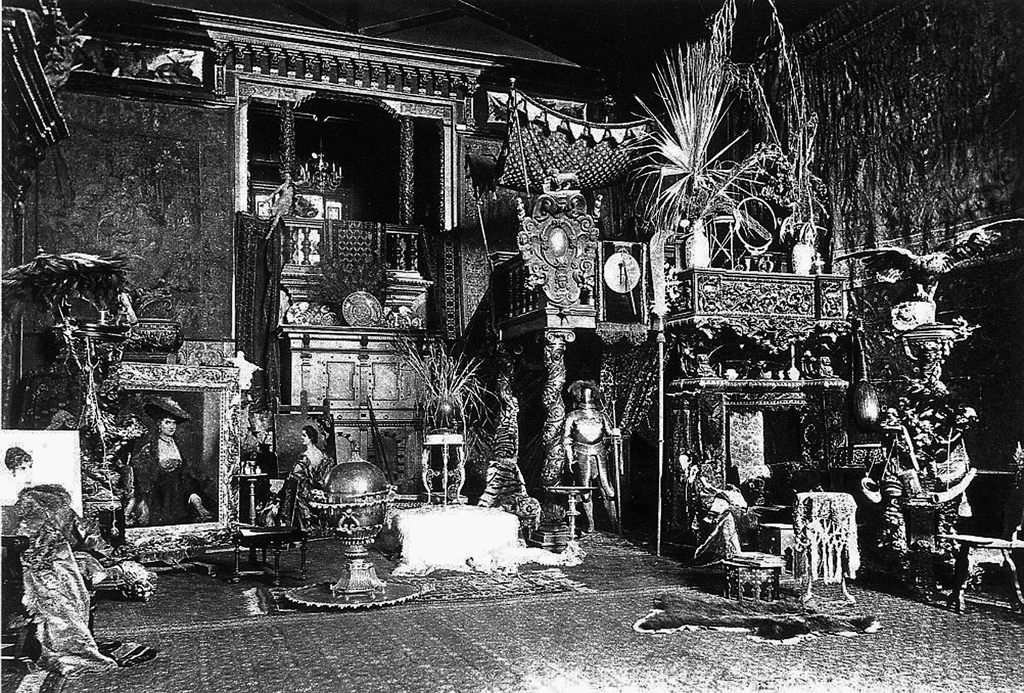
The Austrian painter Hans Makart died in early October 1884, having enjoyed a brief but spectacularly successful career, mainly in Vienna of the 1870s. Some months after his death, the contents of his Viennese atelier were put up for auction. The inventory, totalling 1,083 lots, included a few unsold or unfinished paintings, though not many. Mostly it consisted of a vast hoard of antiques, costumes, objets d'art, and other high-end bric-a-brac that had adorned Makart's famous studio, set up in a former iron-casting facility in the Gusshausstrasse, near the Karlskirche. For sale were assorted old and new paintings (some minor old masters, a Tiepolo), dozens of Gobelins and other tapestries, beds, chairs, inlaid tables, old Italian and German chests, frames, painted screens, ottomans, a Bösendorfer piano in walnut, mirrors, sixty-three oriental rugs, a huge wardrobe of historical and exotic costumes, sculptures, bronze medals, antique weapons and hunting gear, jewellery, glass and porcelain, lutes, mandolins, Chinese gongs, African stringed instruments, samovars, hour-glasses, one leopard skin, two stuffed peacocks, two eagles (Steinadler), a pelican, a falcon, a bull mastiff, a sailfish, pumpkins and gourds, shells, ivory trinkets, Egyptian baskets and ‘assorted fragments’. Also available were photographs and engravings, including a set of Josef Hoffmann's designs for the 1876 Bayreuth festival.Footnote 1 No wonder Cosima Wagner had described Makart's studio as a ‘sublime lumber-room’ after visiting in February 1875, while she and Richard were in Vienna working with singers for the Bayreuth Ring (see Fig. 1).Footnote 2
The studio of Hans Makart, photograph by Viktor Angerer, c.1875.

The Makart style: material high culture in the belle époque
The signature ‘style’ Makart had coined by the end of his life – one that continued to dominate the central European fin-de-siècle – was compounded of the opulent visual idiom of his history paintings, portraits, theatrical scenes, ceiling and wall designs, along with the decorative aesthetic of his sumptuously appointed studio, a gathering point for trend-setting members of the aristocracy and haute-bourgeoisie. His paintings were often designed for particular interior spaces, and his impact extended to all manner of visual and decorative mediums: hats and dresses, table ornaments, dining-room and salon décor. As the catalogue of a 1972 exhibit of Makart's work aptly suggests, he was a kind of Andy Warhol for late Hapsburg Vienna.Footnote 3
Makart's famous studio was indeed a veritable culture factory, not merely housing the latest products of his fertile brush, but also illustrating how these might be integrated into a total life style: the belle époque interior as a virtuosic performance of opulence and comfort where elements of private and public, antique and fashionable, native and exotic were synthesised in a single space. A contemporary critic, Robert Stiassny, expressed his somewhat ambivalent admiration of Makart's ‘exaltation of the object’ (Erhebung des Gegenständlichen) and his fantastically developed ‘material sensibility’ (Stoffgefühl) shortly after the artist's death. The atelier itself, he writes, was one of Makart's greatest works. ‘Hundreds, even thousands of objects’ confront the visitor; ‘every era and every people seem to have arranged a cosmopolitan, synchronistic rendezvous’. The style of the studio serves as an interpretive gloss on the material, figurative and colouristic abundance of the paintings as well: ‘All this chaos flowed together in such wonderfully coordinated groups, such harmonies of colour and line.’Footnote 4
Viennese journalist and art critic Carl von Vincenti offers an eyewitness account of the space dated April 1875, almost exactly contemporaneous with the visits of Richard and Cosima Wagner:
It is at once peculiarly splendid here and yet cozy, like a glimpse into a wildly picturesque and fantastical fairy tale … Widely spreading old Gobelins cover the brown paneling of the light-filled room; amidst the ceiling beams are nested Sonnenbrenner and a fabulously ornamented chandelier hangs from them; frescoes loom against gold backgrounds, paintings shine forth from dark frames, bizarre trinkets, potbellied urns with thin necks, decorative bronzes, many-hued fabrics and carpets from the Levant, ancient chests, ornate carvings, sculpted ensembles, tropical fronds, tiger skins, suits of armor and weaponry … Everything in this vivid, materially dense [stoffschweren] bazaar of painterly splendour is wonderfully suited to the broad, cheerfully fantastic decorative style that makes this one of the world's most beautiful studios.
Vincenti's description follows the trail of visual abundance up to the artist's workspace, a similarly decorated loft overlooking the main room – ‘a kind of artist's boudoir’ (Kunstboudoir) – and finally situates the painter himself within this representative habitat. The atelier, Vincenti concludes, ‘is a splendid expression of his decorative genius, a part of his fame, a part of Makart himself’.Footnote 5
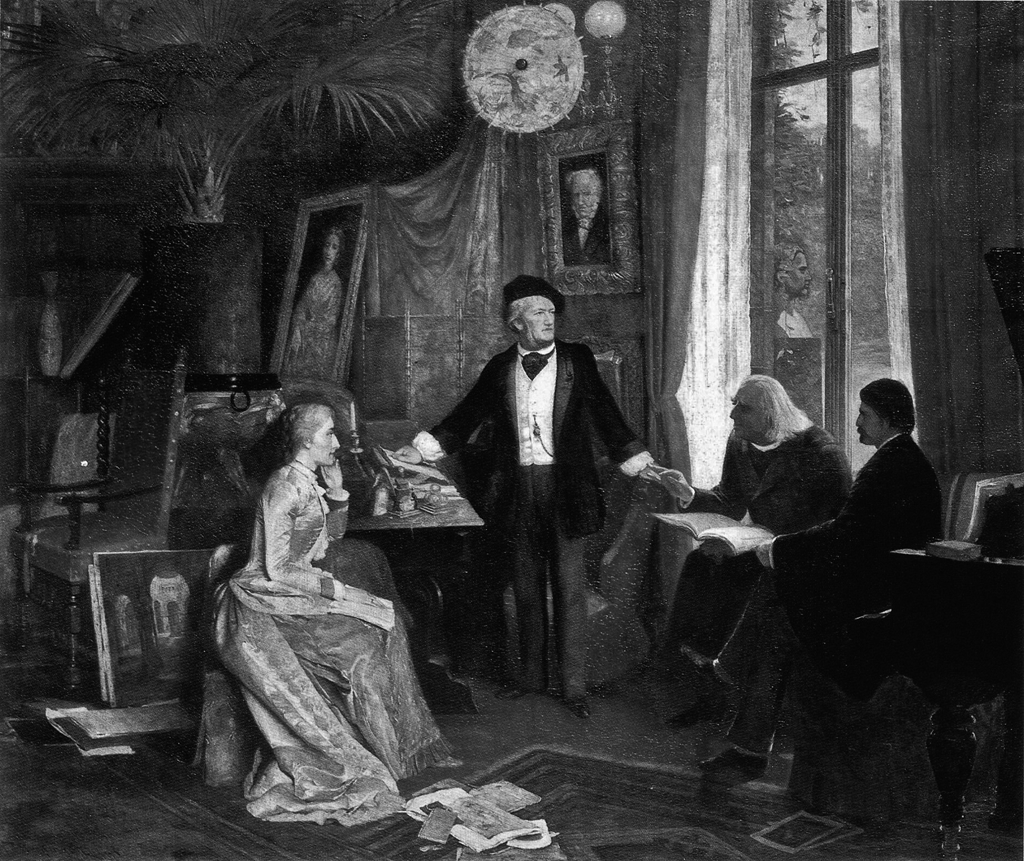
The echoes of Makart's studio in Richard Wagner's salon at Villa Wahnfried are palpable (see Fig. 2). Such traces of the ‘Makart style’ are hardly remarkable for the years around 1880, but a particular critical tradition linking the names (and ‘styles’) of Wagner and Hans Makart had begun to emerge over the preceding decade, when the reputation of both artists was reaching its zenith. Makart's star declined rapidly after the turn of the century, but the perception of a stylistic affinity with the composer has been preserved in a remark from Thomas Mann's famous essay ‘The Sorrows and Grandeur of Richard Wagner’. ‘Ultimately’, writes Mann, ‘Wagner's art is a product of the same historical and aesthetic milieu as those dried flower arrangements (complete with peacock feathers) by Makart which used to grace the padded and gilded salons of the bourgeoisie.’Footnote 6 For Mann, Wagner was a true avatar of late nineteenth-century bourgeois culture in his penchant for luxurious ostentation and self-indulgence no less than in his rigorous work ethic. The painstaking detailed craftsmanship of a score such as Die Meistersinger fully justified, and indeed was creatively enabled by, the ‘fastidious tidiness and bourgeois elegance’ with which Wagner surrounded himself. The same dialectic was even more vividly, and publicly, inscribed in Hans Makart's overstuffed and always busy Viennese studio. The comparison with Makart is meant primarily to highlight the first, more questionable side of this dialectic (the ostentation rather than the work ethic):
[I]t cannot be denied that Wagner's fondness for middle-class elegance shows a tendency to degeneracy, a strong tendency to assume characteristics that no longer have anything to do with the German sixteenth century, with master craftsman status and Dürer headgear, but which represent the nineteenth century at its international worst – in a word, the characteristics of bourgeois vulgarity.
The Salon at Villa Wahnfried, oil panting by Wilhelm Beckmann, 1880.
As an artist Makart was, like Wagner, a hard-working professional. As a ‘style’ he came to embody – unlike Wagner – all those things Carl Dahlhaus used to dismiss as ‘bad nineteenth century’ (a category probably derived from this very passage in Mann's essay).Footnote 7
For Mann, however, the ‘questionable’ is not a strictly negative category. It is also a dynamic, productive one. In the ‘Sorrows and Grandeur’ essay, for example, he characterises Wagner's oeuvre as ‘splendidly questionable, ambivalent and fascinating’.Footnote 8 Wagner's ‘taste for the opulent, for luxury and wealth, for velvets and silks and lavish Wilhelminian splendour’, Mann writes, is ‘a private, personal trait in the first instance, but one that reaches deep down into his intellectual and artistic being’.Footnote 9 The ‘questionable’ by definition provokes and engages; so, then, might Wagner's ‘vulgar bourgeois’ streak. How, for instance, does Wagner's addiction to sensuous stimuli relate to his campaign to reform, cleanse, and spiritualise opera? Or indeed, to his vehement opposition to the idea of art, and above all opera, as ‘luxury’? Warming to the endless melody of Wagner's own prose style, Mann poses the rhetorical question: ‘Was it not that element of the delicious, the sensual-pernicious, sensual-consuming, heavily intoxicating, hypnotically caressing, the thickly and richly padded – in a word, that supremely luxurious element in his music – which drew the bourgeois masses into its arms?’ Alluding to an 1818 poem by Eichendorff on the seductions of a dissipated life, ‘Frühlingsfahrt’, he asks further: is not Wagner's orchestra just like the ‘colourfully-sounding maw of the seductive surf’ (‘der buhlenden Wogen farbig klingenden Schlund’) that tempts one of the two journeymen figures in Eichendorff's poem?Footnote 10 Makart, indeed, was at once revered and reviled for his seductive deployment of ‘colour’ at the alleged expense of line and form, a configuration of critical terms commonly encountered in early Wagner reception (if also that of composers from Berlioz and Liszt to Mahler and the French ‘impressionists’).
Claims that certain music ‘sounds’ the way certain painting ‘looks’ are always questionable. But if Wagner did ‘sound’ to his later contemporaries something like Makart's pictures, is the near disappearance of Makart from the modern art historical canon an index of something that has disappeared or been suppressed from our perception of Wagner nowadays? Is that disappearance or suppression also registered in the seemingly immeasurable distance between modern production styles and the historicising, decorative, colouristic riot of the ‘Makart style’?
Mann's remarks in the ‘Sufferings and Grandeur’ essay turn out to be a close paraphrase of passages from the ‘Reflections of a Non-Political Man’ (1915–18) where, as in the later essay, he ponders the German bourgeois culture that nurtured the genius of both Schopenhauer and Wagner. In this earlier context, he surmises that his comparison might have a history: ‘I am not sure if I was the original author of the observation that Wagner's art and those elaborate dried flower-arrangements by Makart (complete with peacock feathers) share a common historical and aesthetic origin.’Footnote 11 In both contexts, notably, Makart exemplifies a style of interior decoration (‘dried flower-arrangements with peacock feathers’, the so-called ‘Makart bouquet’) rather than painting, a style for which his name had become a byword.Footnote 12 While the memory of the ‘style’ had already outlived the celebrity of the paintings by the early twentieth century, the genealogy of Mann's comments can in fact be traced back to the time of his own youth (and slightly before), when the comparison of Wagner and Makart was, at least briefly, an established critical trope.
‘The Richard Wagner of German painting’
Before Makart's name had become a byword for luxurious décor, an element of the vigorously sensual ‘contemporary’ quality of his painting struck viewers as Wagnerian. Already in 1869, just before he settled permanently in Vienna, Makart was hailed in the Parisian Gazette des beaux-arts as ‘the Richard Wagner of German painting’,Footnote 13 in a review by Eugène Müntz of an 1868 exhibition at the Munich Kunstverein including two early works in triptych form, Moderne Amoretten (Modern Cupids) and Die Pest in Florenz (The Plague in Florence, also referred to as The Seven Deadly Sins), works whose controversial reception brought the painter to international attention. Shortly thereafter, in 1871, the German art historian and critic Wilhelm Lübke devoted an entire essay to demonstrating the affinities shared by the controversial composer and the young Austrian painter. The Munich premiere of Die Meistersinger (1868), followed by productions in Vienna and Berlin over the next two years, had kept Wagner's name current in the press, and in the meantime a pair of large-format still lifes by Makart, collectively entitled Abundantia (subtitled, respectively, The Gifts of the Sea and The Gifts of the Land), had toured a number of German cities as a special exhibit. The vehemently mixed reception of these pictures, Lübke remarks, is just like that accorded to ‘a new opera by Richard Wagner’.Footnote 14 For Lübke, the appeal of these two figures to contemporary tastes is in every respect an index of the decadence of those tastes: the appetite for shock, for any means to novel sensory stimulation, and above all the loss of a healthy, proper relation to ‘nature’ as the ultimate arbiter of aesthetic value. His comparison of the painter and musician is not founded on shared subject matter (Makart would later execute a few Wagnerian subjects, as we will see, but they were not the foundation of a perceived parallel with Wagner's works), but a sense of ‘style’ or fundamental aesthetic character. ‘In looking at these newest works’ (the Abundantia pictures), he writes, ‘the peculiar affinity with Richard Wagner struck us more forcibly than ever – not just the external effect of the works, but in their essential artistic nature. Makart is indeed the music of the future in paint [gemalte Zukunftsmusik], just as Wagner strikes us as the musical Makart’.Footnote 15
A modern, decadent impulse to work ‘against nature’ in Makart's style is identified above all with an excessive cultivation of colouristic effect, and a concomitant disregard for rationality of line, draftsmanship, or logical composition. Terms such as Farbenreiz, Farbenaccorde and Farbenflecke (stimulus, chords and shots of colour) recur throughout the essay. Lübke also cites dismissively a phrase, ‘the sovereign idealism of colour’, by which an admiring Berlin critic had sought to elevate this trait to the level of an aesthetic virtue.Footnote 16 The hegemony of colour remains a consistent leitmotif in critical reception of Makart's work, both positive and negative, to the end of the century (see below, ‘Farbenrausch: colour as fetish’). For Lübke it is also the foundational point of the parallel with Wagner's music (and dramas): ‘All his operas are dominated by the same fantastic effects of timbre [Klangwirkung], the same lack of clear design, the same inability to construct real characters.’ Corporeal forms in Makart's pictures tend to lack any natural, logical relationship and favour, instead, a condition of orgiastic tumult:
Perhaps this also explains why all those “ideal” figures' in Wagner's operas, ‘even when committing acts of adultery and, as in the Nibelungen, a bit of incest into the bargain, fail to arouse the indignation of viewers and listeners: one is no more inclined to ascribe to them credible actions [wirkliches Handeln] than to the figures in Makart's paintings.Footnote 17
The regime of ‘absolute colour’ in Makart is paralleled by the ‘sovereign orchestra’ in Wagner. Orchestral colour privileges a visual, extra-musical dimension in operas that are ‘to be heard more with the eyes than the ears’, with all manner of painterly ‘sceneries and groupings’, ‘all those Venusbergs, riverbeds, rainbows, and magic fires’.Footnote 18 Painter and composer alike are only providing contemporary society with the qualities it desires, Lübke concludes: ‘What does our society want with an art that is serious, thoughtful, simple, and true? What it wants is rather a playful, luxuriously stimulating, sensuously tickling, visually intoxicating, aurally overwhelming form of art.’
The perfectly modern Gesamtkunstwerk should have been a Makart–Wagner collaboration, it would seem. By the end of the 1870s, when Makart's reputation was at its peak, Wagner seems in fact to have considered commissioning the artist to provide costume designs for the premiere of Parsifal in Bayreuth.Footnote 19 Nothing came of the idea, in the end, although Paul von Joukowsky's set designs for the production clearly evoke the ‘style’, which had become well codified by 1882. The personal encounters between composer and painter were few and brief, apart from a notable costumed fête given in Wagner's honour at Makart's studio in March 1875 (see below, ‘The Wagners chez Makart’). Their personalities were in some respects diametrically opposed: in contrast to Wagner's notorious volubility as interlocutor, correspondent, and writer on all possible subjects, Makart was soft-spoken to the point of taciturnity (the impact of a serious fall around age five may have resulted in some speech impairment), though not anti-social, and he left behind virtually no correspondence, memoirs, or other writings. When Lübke first proposed the elective affinity of composer and artist, Makart was more the young renegade, while Wagner was intent on consolidating his credentials as a modern ‘old master’ in the spirit of Hans Sachs and Die Meistersinger. Thus it was that Cosima Wagner registered not appreciation but merely pique when she and Richard noticed in an issue of the Augsburg Allgemeine Zeitung from May 1871 that the critic Karl Gutzkow had the cheek to compare ‘Die Meistersinger von Nürnberg with Flaubert's Madame Bovary and a picture by Makart!’Footnote 20 Gutzkow's intriguing but, alas, uncontextualised comparison reminds us of the provocatively modernist reputation Makart shared with the likes of Wagner and Flaubert, before he and his ‘style’ became demoted to signifiers of faded bourgeois pomposity. Looking beyond the flower arrangements and the archaicising exotic bric-a-brac, what might we still learn today by comparing Wagner's operas with ‘a picture by Makart’?
Wagnerian motifs
The linking of Makart's name with Wagner's was, as we have seen, based on an affinity of style rather than shared subjects, as in the case of artists such as Fantin-Latour in France or Makart's more conventionally academic contemporary Gabriel von Max. The relatively few Wagnerian subjects Makart did paint come from late in his brief career or are minor early works without explicit reference to Wagner's operas per se. It is nonetheless instructive to compare these with the more characteristic paintings that came to define the style towards 1870, prompting comparisons with Wagner independent of thematic correspondences.Footnote 21
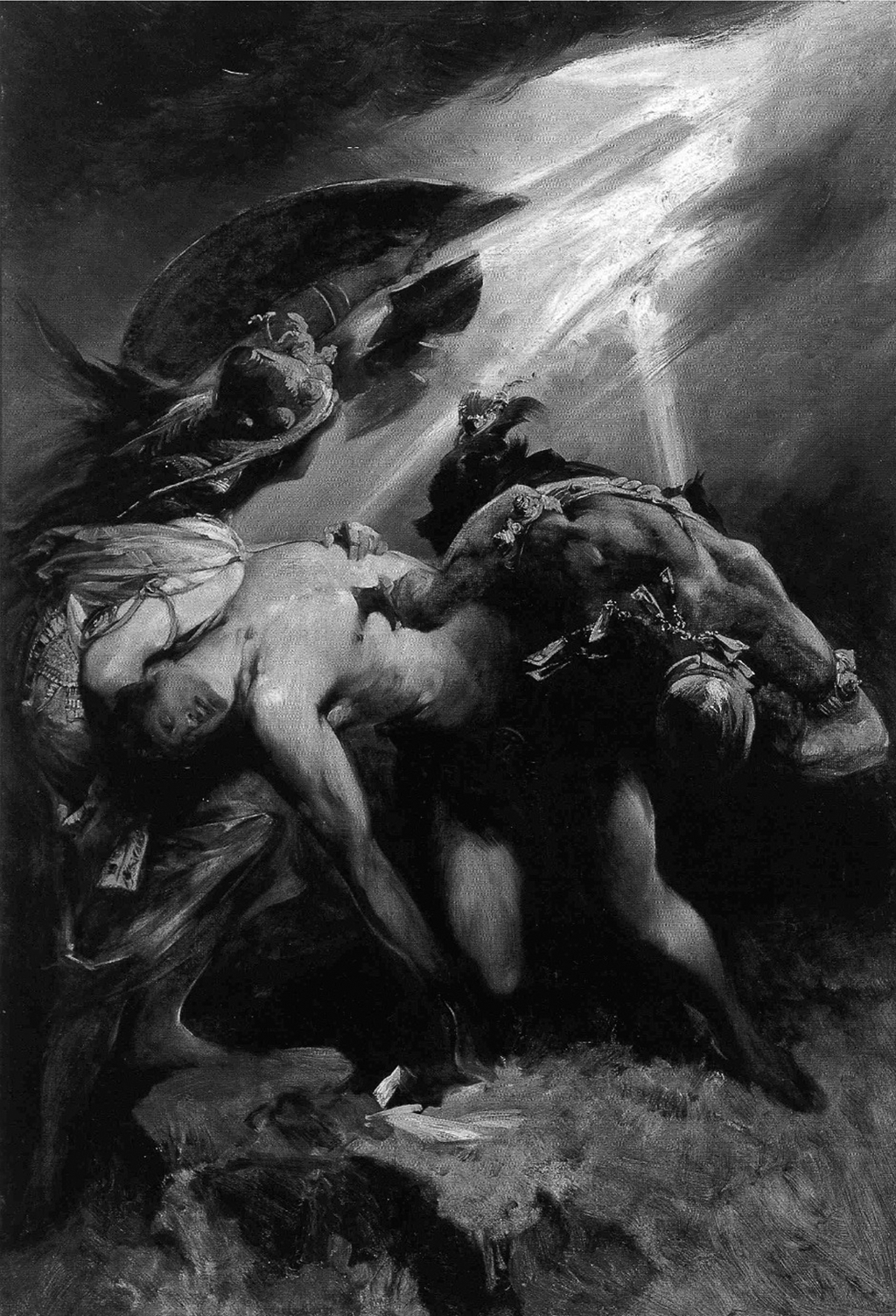
A series of scenes, mainly from Das Rheingold and Die Walküre, was executed sometime during the final year of Makart's life. (Seven of these are held by museums in Riga and Kiev; an eighth, depicting the Rhine-maidens receiving the Ring at the conclusion of Götterdämmerung, disappeared in 1945.) There is no known commission for these pictures. Possibly the composer's death in February 1883 prompted Makart to create them as a form of memorial, since they were first exhibited in September of that year. Makart was by now suffering from the later stages of a syphilitic infection that would result in his own death a year later, on 3 October 1884. Aside from this series, he produced relatively little work after about 1880. The notable austerity of this Ring ‘cycle’, executed largely in a morbid, sombre grisaille evoking dusk, night-time, or tempest-ridden settings, might conceivably be read as kind of ‘late style’ (though a monumental Spring and Summer from 1881 to 1883, part of projected cycle of seasons, display all the decorative floral abundance normally associated with him). The overall palette here contrasts remarkably with the rich abundance of tone and colour that had contributed so centrally to great popularity during the preceding decade. In each case the browns, greys, blacks, or streaked whites that dominate the picture also serve as a foil for a few highlighted details in gold or bronze: Brünnhilde's helmet, the hilt of Siegmund's sword, armbands on Fasolt and Hunding, an ‘oriental’ headdress for Hunding, a wide decorated girdle around Sieglinde's anachronistically tulle-like skirt, and a pile of stylised archaic trinkets representing the Nibelung hoard (as found in, respectively, The Battle of the Giants, The Death of Siegmund, and Brünnhilde Rescues Sieglinde; The Death of Siegmund is shown in Fig. 3).
Hans Makart, The Death of Siegmund, oil on canvas, 149.7×99.5 cm; before September 1883.
Despite the absence of his signature palette in these late scenes, the mannerist tendency of the bodies to contort and intertwine even to the point of illegibility (with hands and feet disappearing from view in many instances) continues a practice for which the artist was frequently taken to task in his earlier work. In the earlier work this fluid, seemingly evasive treatment of bodies was often read as a blatant sign of inferior draftsmanship, for which virtuosity of colour, movement and decoration was meant to compensate.
The few Wagnerian images that precede this late series have at most a tenuous connection with the composer's operas. The Belvedere Gallery in Vienna holds a partially detailed though perhaps unfinished design for a ceiling decoration of uncertain date. The motifs of the giants' combat and the embrace of Siegmund and Sieglinde are visible here, too, but only in sketchy, dark or veiled shapes, along with the ransom of Freia and the conversation of Brünnhilde and the Rhine-maidens (a scene not actually represented in Wagner's cycle). Female tutelary deities in somewhat more detailed outlines divide the four quadrants of the design, the whole executed in shades of brown, grey and russet, with decorative gold backgrounds and assorted objects (treasure, armour). (Ceiling design for The Ring of the Nibelung, Österreichische Galerie Belvedere, Vienna: www.artrenewal.org/pages/artwork.php?artworkid=15081&size=large.)
The design may come from the same time as the Ring series, though it has also been suggested as contemporary with designs for a celebrated mural décor for the library of the Viennese merchant Nikolaus Dumba (a notable patron and collector of music), from the early 1870s. Art historian Renata Kassal-Mikula proposed that Makart intended the design for a music room in his own Viennese home, next to the atelier in the Gusshausstrasse.Footnote 22 (Considering the absence of any evidence of a personal enthusiasm for Wagner or his works on Makart's part, especially at the time of settling in Vienna, the hypothesis seems unlikely.) In any case, the design was never carried out.
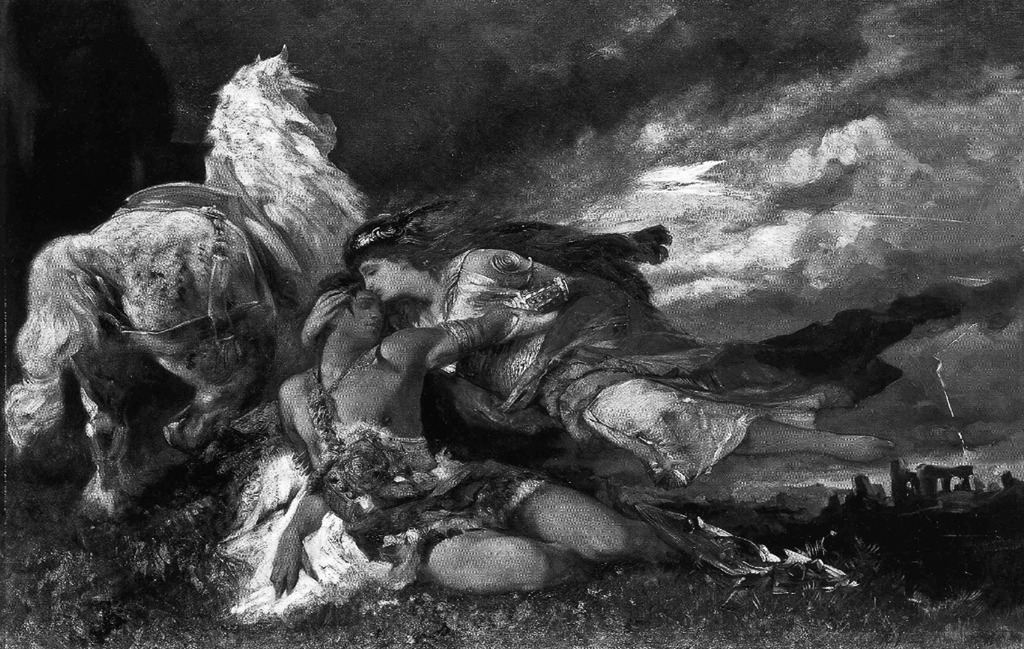
More reminiscent of the actual ‘Makart style’, as it came to be understood, is a single work dating from around 1880, The Valkyrie's Kiss (see Fig. 4). The colour scheme of the background storm and even the thin white strokes of lightning resemble the later Nibelung series, though the picture offers more by way of traditional landscape background and foreground, including Druidic temple ruins in the distance. The dreaming warrior cannot necessarily be identified as Wagner's Siegmund, in the absence of either Sieglinde or Hunding. His languid posture and apparently dreaming state look rather more appropriate for Sieglinde than her battle-ready hero. The valkyrie's tender ‘kiss of death’ suggests a Brünnhilde who has exchanged roles with Wotan. The epicene hero reclines gently on an animal pelt that would be equally at home on the floor of the artist's studio or an elegant Ringstrasse salon furnished in the ‘Makart style’.
Hans Makart, The Valkyrie's Kiss, oil on canvas, 130×200 cm, c.1880.
A much earlier picture of Siegfried's death, from the end of Makart's student years in Munich (now owned by the Creditansalt-Bankverein, Vienna), predates any knowledge of Wagner's Ring dramas and looks altogether different from the late Ring of the Nibelung series. The subject is taken from the Nibelungenlied, according to which Siegfried is slain by Hagen while drinking from a spring. An element that does recall the later Nibelung series is the mannerist contortions of Siegfried's body, with the extremities of head and feet essentially invisible. The body is entirely covered by a scarlet robe so that the twisted form takes on the aspect of a great pool of blood, even though no blood or wound is explicitly depicted. While the material textures of both robe and flesh are somewhat rough and sketch-like, the central role of the bright red drapery was to become a signature motif throughout the mature oeuvre.
These few Wagnerian motifs, in any case, played no significant role in Makart's wider public reputation. The late Nibelung series was only briefly exhibited before being auctioned off with the rest of the estate after the artist's death, and the earlier pictures (‘Wagnerian’ only by association) seem not to have had any public reception. So despite this small group of Wagnerian subjects, the perceived affinity between Wagner's music and Makart's pictures was not predicated on shared subject matter. Rather, it seems to have emerged from more general values such as a grandiosity of design at the expense of line or detail, decorative abundance, a predominance of ‘colour’ over ‘form’, an atmosphere of sensual indulgence and, in Makart's earlier works, an element of provocative (if mainly allusive) sexuality.
Farbenrausch: colour as fetish
‘Makart red’ became a catchword for the artist's style from early on, a key element in the material appeal of his painting itself apart from the style of décor later associated with him. Red fabrics or drapery formed a sort of Wagnerian ‘orchestral melody’ unifying many of Makart's visual compositions, whether diffuse historical scenes or simple portraits. One of the most admired large history paintings, Venice Pays Homage to Caterina Cornaro, and one that was widely exhibited during the peak of Makart's fame in the 1870s, frames the subject's head in a volcanic eruption of red fabrics, deriving in part from the supporting figures of cardinals, soldiers, ladies-in-waiting and so on, but centred in a plush damask backdrop and extended to a quasi-theatrical velvet curtain overhead (Venice Pays Homage to Caterina Cornaro, 1872–3; Österreichische Galerie Belvedere, Vienna: www.artrenewal.org/pages/artwork.php?artworkid=15075&size=large). A portrait of the Viennese singer Karoline Gomperz from 1870 is dominated by the contrasting shades of the subject's Renaissance-style blouse in deep maroon and the brilliant, fiery red of her skirt, which she calls attention to by gathering its folds in her left hand (Portrait of Karoline Gomperz, 1870; Carolino Augusteum, Salzburg: www.royal-painting.com/htmllarge/large-19965.html).
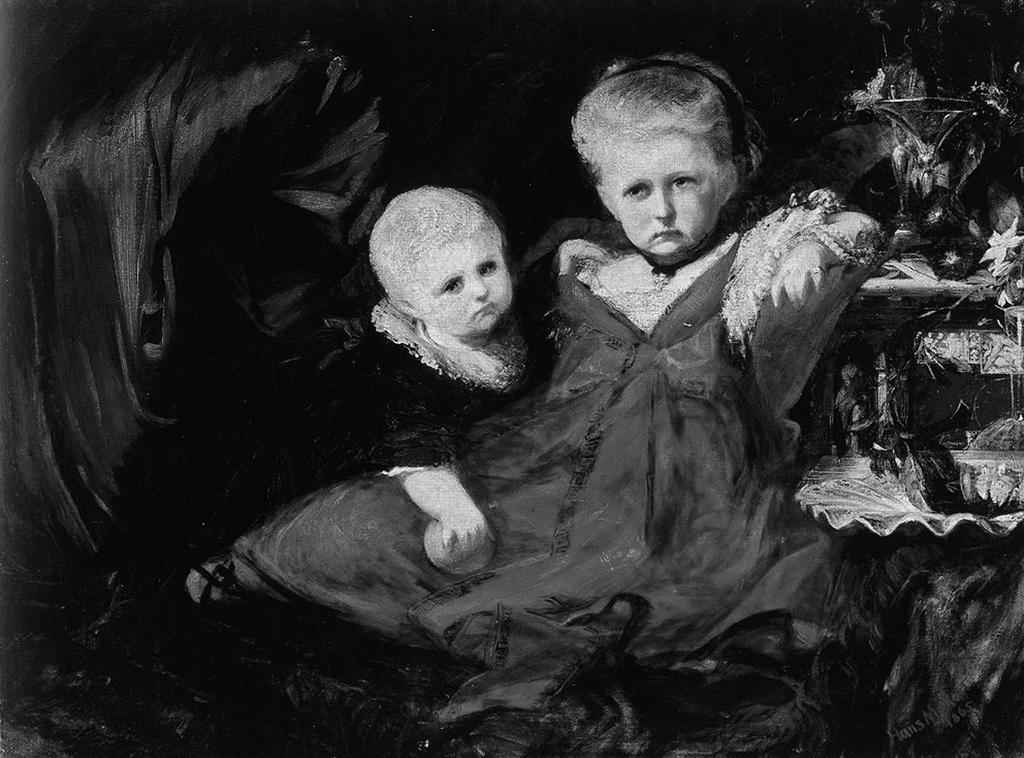
An earlier portrait of two nieces, Ida and Risse Rüssemeyer, from Makart's Munich period (1865) swathes the central figure even more emphatically in scarlet, echoed by a strangely free-floating piece of satin drapery hovering in the upper left-hand of the picture. Once again, hands and feet elude the eye (see Fig. 5).
Hans Makart, Portrait of Makart's Nieces, Ida and Risse Rüssemeyer, oil on canvas, 77.5×103 cm, 1865.
More striking still is the unsettlingly adult, world-weary look of the main figure, lounging amidst the sort of artfully arranged bric-a-brac that would contribute to define the later ‘style’. The incongruous merging of childlike figures and adult faces was to be a key element of several controversial works, above all the Moderne Amoretten triptych of 1868 (see below, Figs. 6 and 7). A frankly sexualised Allegory of Life's Pleasures (also from 1868) uses a swathe of red drapery to connect the vertical column formed by its two female semi-nudes with the slightly chaotic still life in the foreground (www.artrenewal.org/pages/artwork.php?artworkid=15044&size=large).
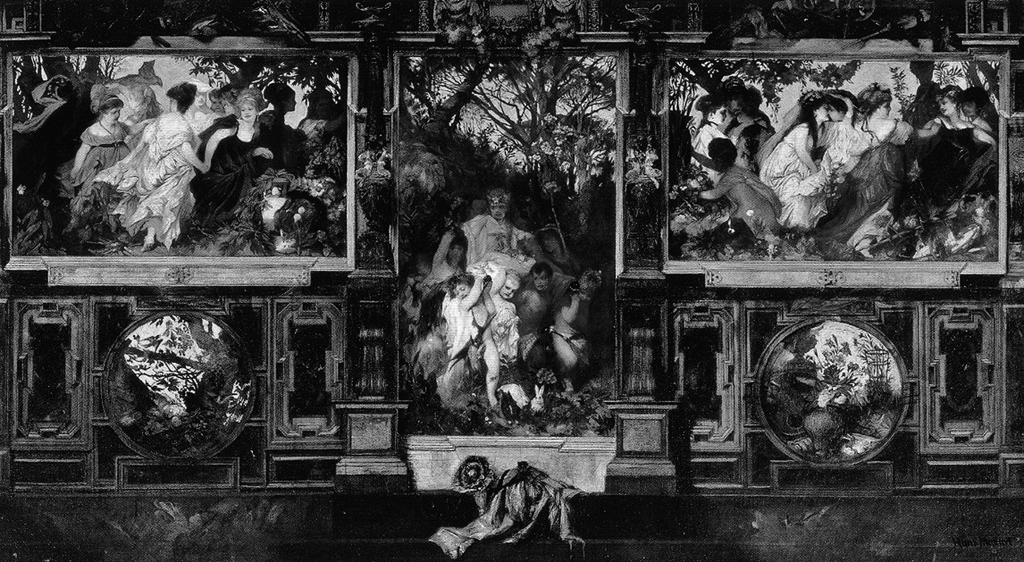
Hans Makart, Moderne Amoretten, sketch in oil on canvas over photographic collage, 80×149 cm, 1868.
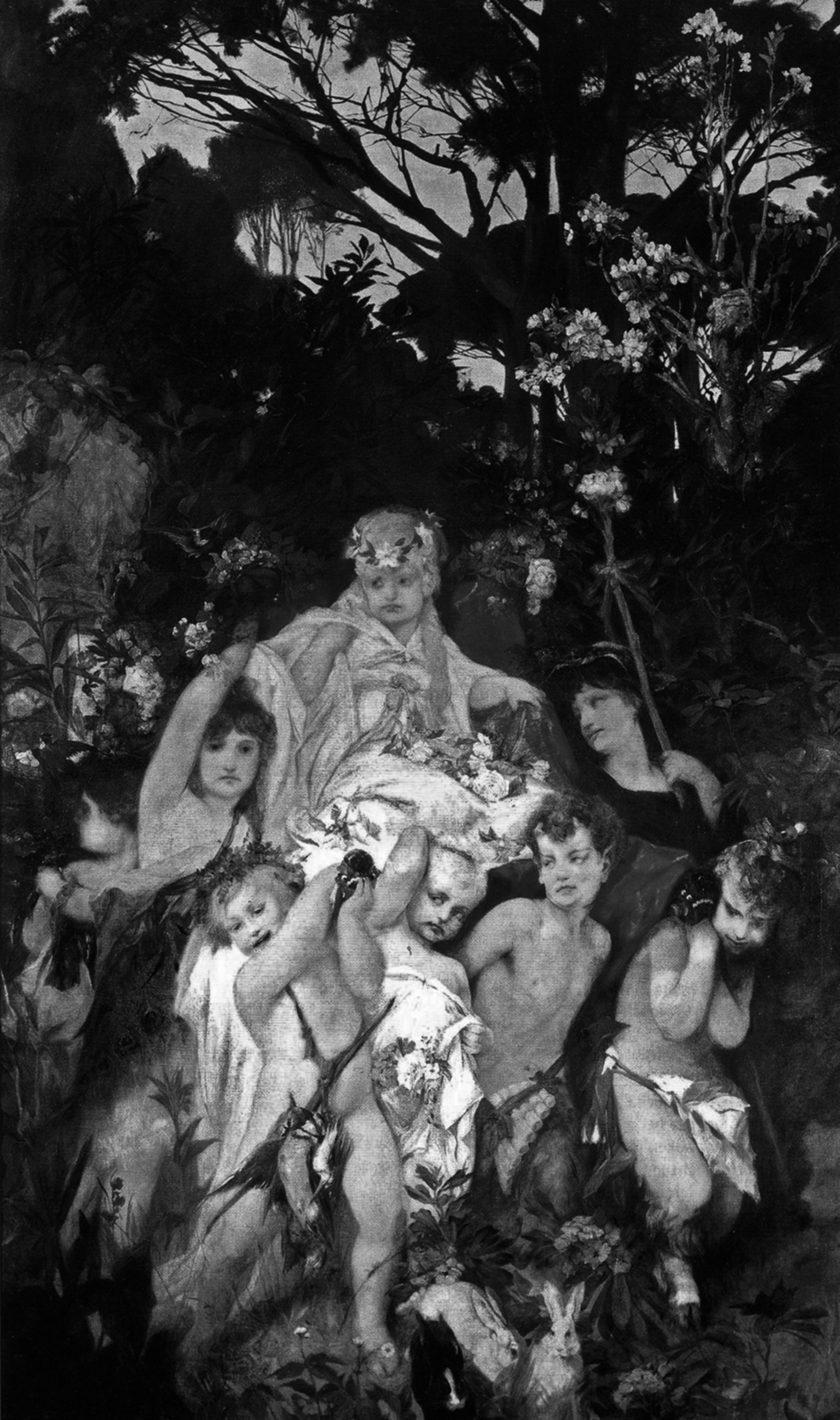
Hans Makart, Moderne Amoretten, central panel, oil on canvas, 295×169 cm, 1868.
The foregrounding of colour as a dominant, nearly autonomous parameter was, as noted earlier, a leading factor in controversial early reception of Makart. ‘The artist's eye’, wrote Robert Stiassny, ‘was so exclusively oriented to colours that every picture emerged from the palette at first as a frenzy of colour [Farbenrausch], for which he would only afterwards devise the subject’.Footnote 23 Wilhelm Lübke, as we saw, invoked this primacy of colour in his comparison of Makart and Wagner. ‘What is absolute colour in Makart’, Lübke asserted in his 1871 essay, ‘is the sovereign orchestra in Wagner.’Footnote 24 Just as Makart's fetishisation of colour and material textures seemed to relegate the proper subjects of his paintings to a secondary status, so Wagner was thought to subordinate his vocal lines to the overwhelming timbres and textures of the orchestra, ‘to which he gives all the roles’. (On this supposed subordination of vocal parts to the orchestra, Lübke was drawing on long-standing commonplace of anti-Wagner criticism.) Painter and composer alike were either censured or celebrated, according to one's aesthetic mores, for their experimentation with the sensual values of their mediums and the elevation of these above basic cognitive, structural features of graphic or melodic ‘design’ – legible bodies and narrative action in painting, comprehensible hierarchies of motive, phrase, and period in operatic melody. For Lübke, this inversion of values was essential to the dubious appeal of both artists to modern sensibilities precisely in the way they maximised sensual stimulus at the expense of ‘truth’ and ‘nature’ of design:
In Wagner's ‘endless melody’, an indistinct surge of tones, we can also recognise Makart's vague colouristic harmonies [Farbenakkorde], divorced from any truth to nature. The mood in both cases is a dreamlike, fantastical one; it is giddiness of the senses, as the Berlin critic correctly diagnoses it, an opium rush delivered through the ears in one case, and through the eyes in the other. A poetic element is expressed in all of this, no question. Situations of a fairy-tale-like atmosphere are depicted in a way capable of captivating the heart. But where one yearns for clear figures, human beings of flesh and blood, everything seems to dissolve into empty patterns.Footnote 25
An obituary of the artist in the leading Viennese paper, the Neue freie Presse, pointed to the autonomy of colour and a preoccupation with costume as the most salient features of Makart's style and its power of fascination, both related to the ‘forceful domination of the painterly element over the graphic’: ‘He reveled in the delights of colour as one inebriated, and the pleasure that animated him also moved the hearts of his viewers, who fell into raptures at the sight of these symphonies of colour [Farbensymphonien], yielding helplessly to their intoxicating magic.’Footnote 26
An influential critic of the next generation, Ludwig Hevesi, who drew attention to Makart's significance for the emergence of the now canonic Viennese modernist aesthetic of Gustav Klimt and his circle, likewise stressed the dynamics of colour and its tendency towards a kind of autonomy. ‘Through his whole being’, Hevesi writes in an essay from 1900 entitled ‘Hans Makart and the Secession’, ‘there flowed a single stream of colouration [Farbigkeit], as visible passion, as the optical sensation of pleasure.’ In describing the effects of the ‘Makart colour’ (Makartfarbe), Hevesi turns to an almost explicitly Wagnerian language, which needs to be sampled in the original: ‘In ihr [der ‘Makartfarbe’] war ein unablässiges Kommen und Gehen von Flimmer, ein Flackern von Flamme, ein Knistern und Sieden und Glühen ohne Ende.’Footnote 27 While noting the debt of the Secession artists to Makart's experiments with colour and multi-media design, Hevesi also summed up the ways in which Makart defined the stylistic aspirations of the contemporary bourgeoisie:
The German philistine's wife wore Makart's colours and fashions, every room in Mitteleuropa wanted to look just a bit like his studio, every public ceremony wanted to replicate his historical pageants. It is not too much to say that Makart was the most suggestive painter our German century has seen. He alone has defined an epoch, the ‘Makart era’. There is only one figure from the other arts who exerted the same demonic pied-piper genius [Rattenfängergenie]: Richard Wagner.Footnote 28
Reviewing the first Bayreuth festival in 1876 (where, incidentally, Makart was in attendance with his Munich-based colleague Franz Lenbach, a Wagner family friend), Eduard Hanslick expressed a similar view of the distinctively ‘modern’ genius shared by these two figures. Expressing scepticism towards the reliance of Wagner's Ring on modern technological ‘effects’ (musical or otherwise), Hanslick relates the perceived poverty of genuine design or form to contemporary criticisms of Makart:
Wagner has harnessed every kind of modern progress in the applied natural sciences. We looked with amazement upon the vast stage machinery, the gas-light apparatus, and steam devices above and below the Bayreuth stage. Wagner's Nibelungen could no more have been composed before the invention of electric light than it could without the harp or the bass tuba. And thus it is colouration [Colorit], in the broadest sense, that hides the weakness of design [Zeichnung] in Wagner's newest work and assumes an unprecedented level of independence. The analogy of Wagner the musician to the painter Makart or the poet Hamerling is manifest. The sensual enchantment of this music exerts a similarly direct and powerful stimulation on the nerves of its audience, above all the feminine component.Footnote 29
Hanslick's critique of Wagner's Gesamtkunstwerk here anticipates Adorno's Marxist metaphor of the Wagnerian ‘phantasmagoria’ while simultaneously recalling the cultural origins of that figure in the technology of modern entertainment (stage machinery, steam-works, gas and electric lighting).Footnote 30
As the chief music critic of the Viennese press, Hanslick was obviously well aware of Makart's popular reputation and the discourse around it. The comparison with the Austrian poet Robert Hamerling is most likely borrowed from one of Hanslick's university colleagues, Karl Landsteiner, who published a pamphlet entitled Hans Makart und Robert Hamerling: Zwei Repräsentanten moderner Kunst in 1873.Footnote 31 (Wilhelm Lübke's critique of the autonomy of ‘colour’ and the predominance of sensual effect over beauty and logic of ‘form’ or ‘design’ is also clearly echoed here.)
Despite their role in contemporary critical opinion, we might still wonder about the substance of such comparisons between Wagner and the young Austrian painter – neither of whom had evinced any really significant interest in each other's works, or even fields.Footnote 32 Are colouristic ‘stimulation’ and the decorative horror vacui of the belle époque enough to establish a meaningful kinship between Wagner's music and Makart's painting, or his ‘style’? (The critical fetishisation of colour altogether may provoke some scepticism today, but it has been suggested that Makart's famous reds may have suffered significant deterioration over time.) The sharply divided critical reception of both Wagner and Makart at the time of painter's widest fame – the 1870s and early 1880s – does present a parallel not suggested by any other German or Austrian artist of the period. But is it possible to account for their contemporary identification with any more concrete, material reference to their respective oeuvres?
Two key moments in Makart's career suggest such a possibility. In 1868, at the end of his apprenticeship in Munich, he came to international attention with the exhibition of two controversial triptychs, the Moderne Amoretten (Modern Cupids or putti) and the inconclusively titled Die Pest in Florenz or Die Sieben Todsünden (The Plague in Florence, The Seven Deadly Sins), contemporaneous with Wagner's second major Munich premiere, Die Meistersinger von Nürnberg. Both triptychs involve provocative, self-consciously ‘decadent’ variations on the classical motif of the bacchanal, inviting comparison with Wagner's revised Venusberg music for the 1861 Tannhäuser production, while the semiotics of eroticism and morbidity infusing the second series suggests an affinity with the poetic as well as musical language of Tristan und Isolde. Makart's own Meistersinger moment comes a decade later, in 1879 (shadowing Wagner's career at a delayed interval) with the design of a grand civic fête or pageant to celebrate the twenty-fifth wedding anniversary of the Hapsburg emperor Franz-Joseph I and the empress Elisabeth. Here a nationalist fantasy of an Austro-German golden age was staged as a truly populist Gesamtkunstwerk, glorifying the entrepreneurial spirit of the Vienna Ringstrasse in the imagery of Renaissance Germany and the Austrian Baroque – the Makart style taken to the streets.
Modern bacchanals: Moderne Amoretten, Die Pest in Florenz, and the Paris Venusberg
When Wagner was summoned to Munich by the royal patronage of Ludwig II in 1864, Hans Makart was in the midst of his apprenticeship to the highly regarded history painter Karl von Piloty at the Munich Academy of Fine Arts. He toured and exhibited with Piloty across the 1860s, until catapulted to fame (and notoriety) with the exhibition of the two above-mentioned triptychs, Moderne Amoretten and Die Pest in Florenz, at the Munich Kunstverein in second half of 1868. As Nikolaus Schaffer remarks, Makart's sudden prominence in European art occurred in the accepted ‘modernist’ manner; that is, by provoking scandal and controversy while also attracting the attention of serious critics in field.Footnote 33 (The initial reception altogether belies his posthumous reputation as a mere bourgeois tastemaker pandering to a decadent philistine materialism.)
The Moderne Amoretten group was exhibited in the early summer of 1868, at exactly the time Die Meistersinger was receiving its world premiere at the Munich Court and National Theater. Makart drew attention to the novelty of his conception not only with the adjective ‘modern’ in his title, but also through the simultaneous exhibition of the three individual panels as a composite ‘installation’ of sorts. Together these comprised a detailed oil sketch of how he envisioned the three panels to be deployed within an elaborate wall décor, provisionally intended for his own Munich studio, although the ornate decorative panelling would suggest rather some affluent domestic space (see Fig. 6, and colour image: www.jssgallery.org/Other_Artists/Hans_Makart/ModerneAmoretten_b.html).
The background landscape of the Amoretten is paradigmatic of the decorative artifice that came to define a ‘Makart style’ outside of his own painting – here, a delicate lattice-work of tree trunks, branches and leaves against a gold background reminiscent either of medieval devotional painting or modern japonaiserie. The flora, especially in the two tondo designs added to the model for the composite wall décor (beneath the flanking panels) with their delicate arrangements of reeds, fronds and dried flowers, offer more ingredients of the later decorative style. The burnished luxury of the whole ambience has little or nothing to do with the outdoors – one is reminded of Tannhäuser's yearning for the sun, the green grass and the ‘friendly firmament’ above (‘des Himmels freundliche Gestirne’) after his long dalliance in the artificial paradise of Venus's grotto. Makart's colour scheme is very deliberately ‘in defiance of nature’, as Wilhelm Lübke had complained. (‘His compositions as a whole, no less than the individual figures’ convey the feeling of something ‘thoroughly unreal, senseless, crazy’, Lübke continued.)Footnote 34
The real provocation of the Moderne Amoretten was located precisely in its element of calculated ‘unreality’, a morally suspect cognitive dissonance in the portrayal of the female ‘cupids’. The faces, hairstyles and costumes of these are contemporary and adult, in contrast to the diminutive shapes, creating an uneasy crossing of childhood and maturity, innocence and experience. Two figures in the right-hand panel share a Sapphic kiss or some intimate confidence, though there is nothing overtly sexual in the overall representation. The figures to the left of them are shrouded in a strange chiaroscuro redolent of the gas-lit interior of a theatre or a dance hall, recalling another of Lübke's censorious remarks: that Makart's image of feminine beauty seems to derive ‘from such as establishments as the Mabile, the Closerie des Lilas, the casinos of Baden-Baden and Bad Homburg, or their Viennese equivalents’.Footnote 35 The child-queen carried in state at the centre of the composition averts her eyes in a melancholy, sidelong glance, exuding a look of weariness or chagrin rather than pleasure (more evident in the finished version of the individual panel, see Fig. 7). Between the male putti carrying the litter at the front is a female figure with white or powdered hair, lipstick and clad in a white shift or negligee clutched at her side. The figures in the left panel are similarly made up in modern evening styles, the one at the far left sporting a black domino masquerade costume that flutters in a ghostly shape before her.
This strange mélange of eroticism and melancholy embedded in an exquisitely artificial landscape and (in the décor plan) prospectively staged on the wall of an elegant domestic interior captured the aesthetic imagination of the moment in a way critics found difficult to articulate. At some level it surely spoke to a nascent aesthetic of decadence. Karl Landsteiner sums up the tone of fascinated opprobrium elicited by the Amoretten in his essay on Makart and Hamerling:
The pictures are a kind of decorative improvisation, as Friedrich Pecht has rightly put it, in which not only all existing academic rules, but all canons of nature and verisimilitude are mocked to a nearly fabulous degree. The composition presents children and half-grown-up girls who are partly unclothed, partly dressed and coiffed in a wholly modern style; the resulting contrast has been described – whether rightly or wrongly, I dare not say – as a profanation of childhood. Comparing these figures with [Wilhlem] Kaulbach's very saucy representations of genies or cupids, one finds in Makart's Amoretten a sickly sensual trait, a breath of modern decadence and moral corruption. Not that Makart himself aimed to express this, but one can nonetheless read it into the picture. Perhaps he creates quite naively, as his admirers would have it; yet the ‘modern’ quality he produces, even in this [‘naïve’] way, is branded with the mark of corruption.Footnote 36
Presumably the critics were not seeing anything as pointed as a critique of child prostitution, but rather a reflection of some more generalised loss of sexual innocence that ‘branded’ (in Landsteiner's words) the modern psyche.Footnote 37
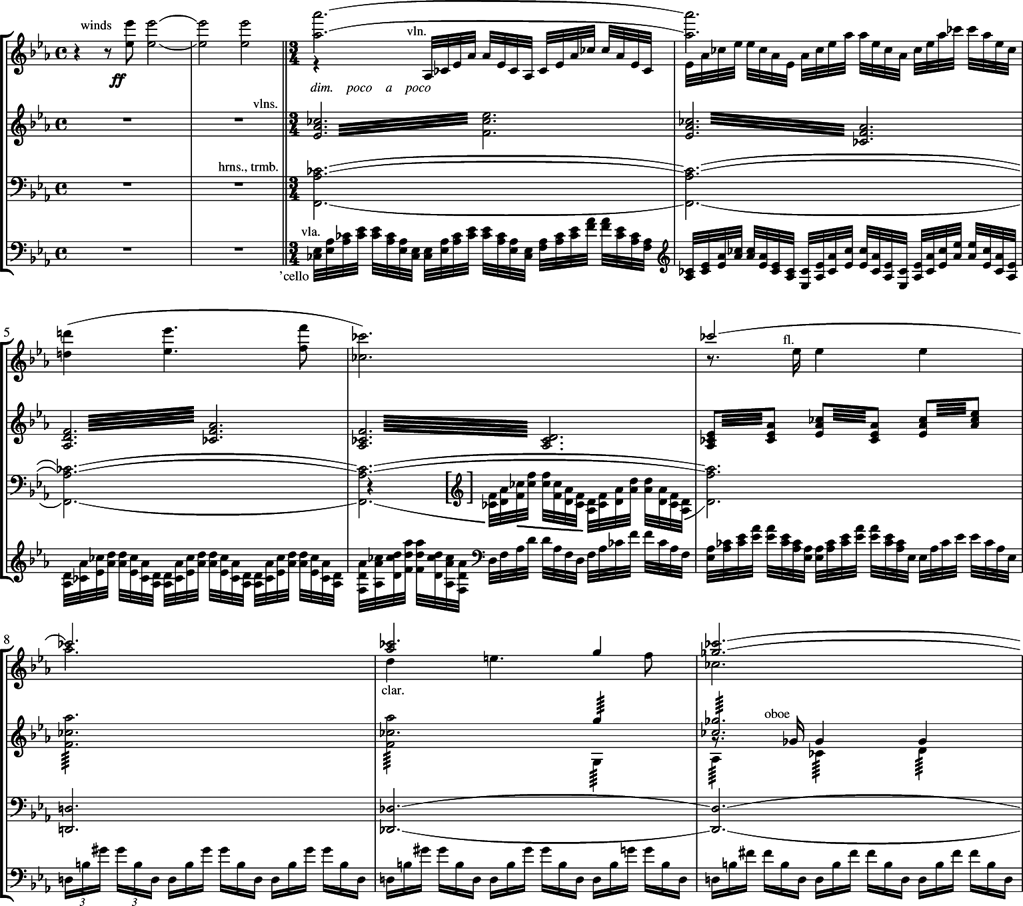
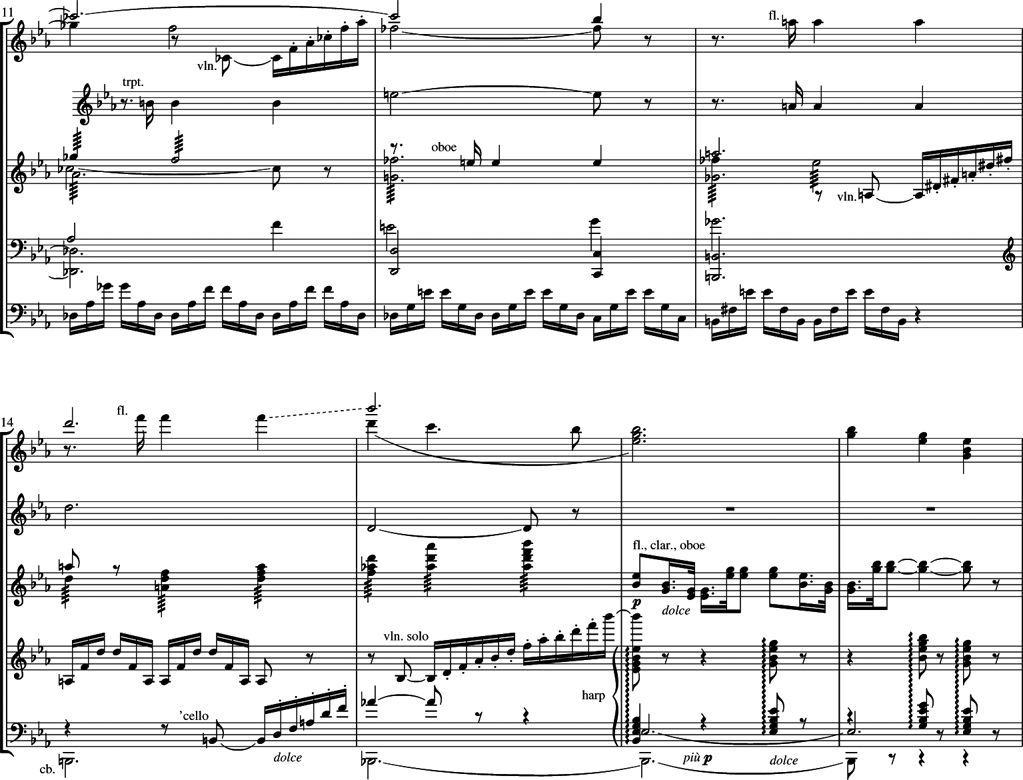
In a similar way, the seemingly innocuous, neo-classical rococo fauna that disport themselves in the Venusberg Bacchanal of Wagner's Tannhäuser are transformed into distinctly modern ‘desiring subjects’ by the music, most emphatically in the 1860–1 revision and expansion of Bacchanal for Paris. The personnel of the Paris scenario includes, in fact, a troupe of Amoretten who are at first discovered lying ‘chaotically intertwined in a confused heap like children exhausted after some raucous play’. (The fleshy ‘arabesque’ of childish limbs is a very Makart-like touch.) When the orgiastic tumult of fauns, satyrs, nymphs, bacchantes and youths has reached its climax, the frightened trio of ‘Graces’ awakens the Amoretten and orders them to rout the unruly crew. The cupids, serving as a kind of erotic police, tame the passions of various couples and re-arrange them tastefully in the background. All this is really a kind of allegorical-balletic curtain concealing the implied coupling of Tannhäuser and Venus, who are afterwards shown lingering in a calm post-coital embrace, entertained by projected tableaux of classical amorous metamorphoses (‘The Rape of Europa’, ‘Leda and the Swan’). During all of this Venus's languid motive from the original score is transformed by a new Tristanesque scoring and accompaniment, in fact the Tristan chord verbatim, gradually resolved towards E flat major (Ex. 1).
Lush scoring and Tristanesque harmonies in the Venusberg Bacchanal (1861 version), Tannhäuser, Act 1.
Continued
The original Venusberg music, Eduard Hanslick commented in reviewing the 1875 Viennese production of the revised score, had been ‘the boldest, most sensually intoxicating’ music for the stage anyone had ever encountered at the time. In comparison to the new score, however, it is as tame as ‘a Sunday afternoon bourgeois family gathering’. ‘Such an unfettered stream of passion as is produced here by the evolving masses of simpering and moaning couples might be too much even for the most liberal temperament. It is downright un-aesthetic.’Footnote 38 Hanslick easily recognised the role of the idiom of Tristan and Die Meistersinger, or what he also calls here ‘the later combinatorial style of orchestral writing’, in the new version of the Bacchanal. Among other things, he was taken aback by the undisguised musical expression of sexual desire applied to both human and mythic-allegorical figures, including a grossly material pantomime of Leda and the Swan: ‘It would have been quite enough with just the human couples, among which we only grudgingly include the four cancan-dancing, cloven-hoofed fauns in the foreground.’Footnote 39 The modern decadence of Wagner's Bacchanal is more overtly manifest than that of Makart's Amoretten, with its strangely ambivalent, hyper-aesthetic hothouse atmosphere. But in each case the startling, unconventional treatment of the specific medium (music, painting) contributes something essential to the provocative impact.Footnote 40 Hanslick's reaction to the overt sexuality of the new Bacchanal might equally well be elicited, in miniature, by a related Makart picture from a few years later, Pan and Flora (1872), in which another half-grown nymph encrusted in Makart-style ornament rests her hand tentatively on the knee of a similarly youthful faun who regards her with a knowing, impish leer (www.artrenewal.org/pages/artwork.php?artworkid=15076).
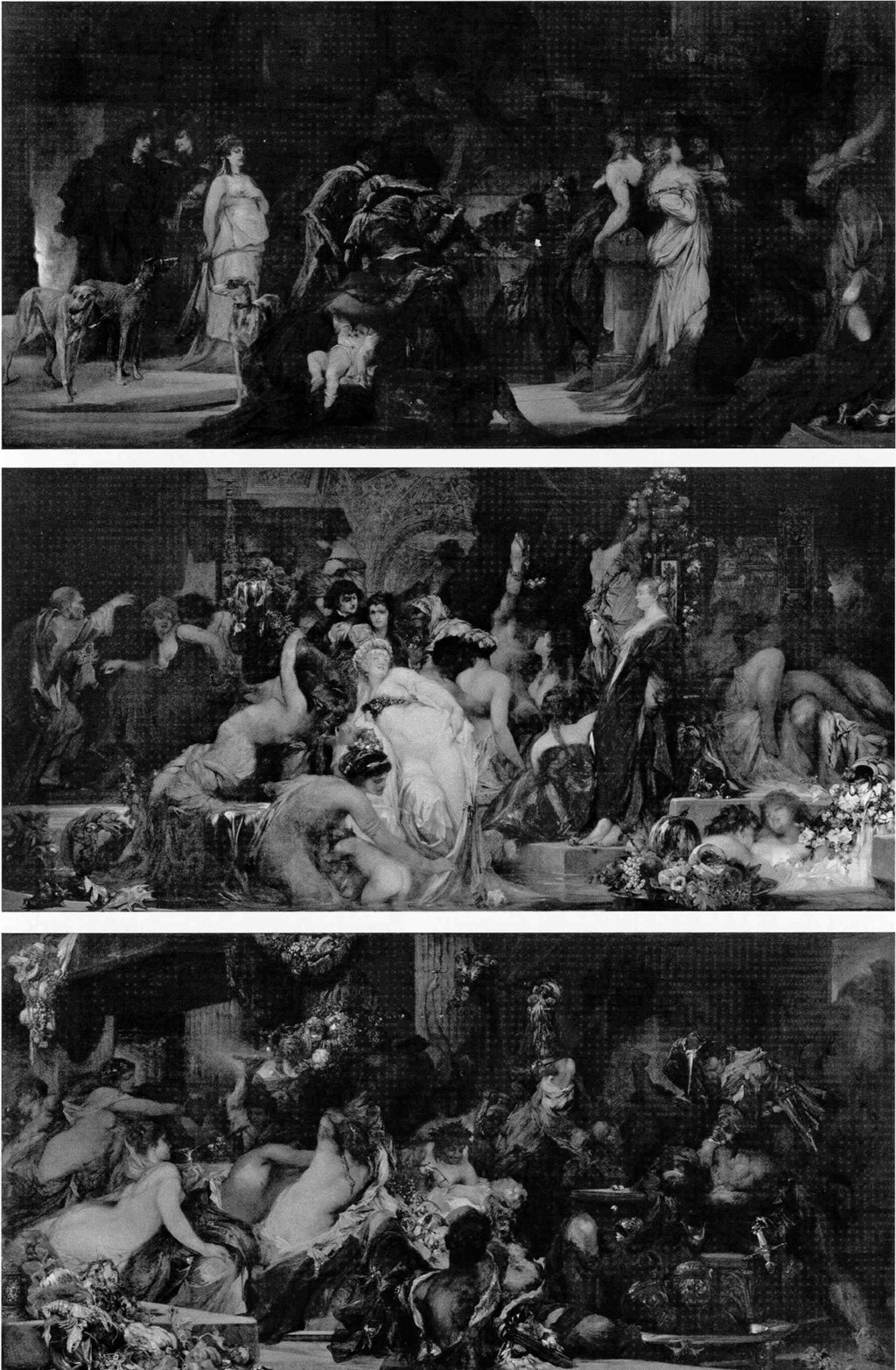
The Moderne Amoretten, like Pan and Flora, unsettle in part because of the element of coy reticence, the feigned naiveté that seems to mask the sexual undertones of the images. (Klingsor's phantasmagoric flower maidens in Parsifal exude just such mixture of faux-naiveté and decadent sexuality.) Makart's other controversial debut piece, the Plague in Florence series, more closely approaches the shameless abandon of the revised Venusberg Bacchanal. Indeed, the pictures were banned from exhibition in the Paris salon of 1869, apparently on account of their immodesty, exacerbated perhaps by the pointed lack of any coherent, legible and potentially redeeming narrative-historical ‘content’. (They were instead shown privately by the noted Parisian art dealer Adolphe Goupil.) This lack of a clearly delineated narrative subject in the paintings is partly excused by the allegorical plan indicated by one of the alternative titles for the series, The Seven Deadly Sins. The figures of Pride and Murder are detectable at the beginning of the first panel and the end of the third, respectively, with Lust garishly lit in the middle of the centre panel (analogous to the Queen of the Amoretten group) and red-clad Vanity to her right (see Figs. 8a, b and c, as well as the central panel shown here: www.fineart-china.com/upload1/file-admin/images/new16/Makart,%20Hans-668677.jpg).
Hans Makart, The Plague in Florence (or The Seven Deadly Sins), oil on canvas, 1868.
The other title attached to it, The Plague in Florence, is usually taken as an allusion to the setting of Boccaccio's Decameron, and some of the costumes confirm a Renaissance court setting, though the overarching motif is that of an enervating, self-destructive decadence of the late classical Roman variety (as in Thomas Couture's well-known Romans of the Decadence of 1847 in the Musée D'Orsay). That iconographic tradition is alluded to in yet another alternative title for the pictures, or maybe a kind of informal caption, attributed to the artist: Après nous le déluge. The background theme of Roman decadence is also suggested by the pairing of Makart's name with that of the contemporary Austrian poet Robert Hamerling in early critical responses, as by Viennese critics such as Hanslick and Karl Landsteiner. Hamerling's best-known work was an 1865 epic poem in six cantos, Ahasver in Rom, linking the legendary ‘Wandering Jew’ with the court of Emperor Nero. (The second canto is titled, in fact, ‘Bacchanal’.) Possibly Makart's idea was to merge the iconography of classical Roman decadence with that of corrupt Renaissance courtier society in the manner of Hugo's Lucrèce Borgia or Le roi s'amuse, a motif that would become increasingly popular through the late nineteenth century.
The deliberate evasion of any distinct setting or narrative content contributed to the provocative effect of The Plague, just as it had with the preceding Amoretten series. The rampant confusion of bodies characterising both the centre and right panels creates an analogy in terms of visual composition to Wagnerian ‘endless melody’, which Wilhelm Lübke had likened to the effect of what he called Makart's Farbenakkorde.Footnote 41 The profusion of mostly fragmentary bodies or body parts, like the gentler variation in the Amoretten pictures (or Wagner's Venusberg scenario) may be gesturally expressive but fails to cohere according to any normative visual syntax, just as the motives in Wagner's ‘endless melody’ resist falling into readily legible hierarchies of phrase, period, or group. Makart's bodies were also accused of consisting of ‘all flesh and no bones’.Footnote 42 The contorted forms and concealed extremities in the second and third panels of the Plague in Florence, the suppression of hands and feet that might articulate the precise ‘phrasing’ of the human shapes, are paradigmatic symptoms. Throwing himself into the spirit of this work in a 1942 monograph on Makart, the painter and modernist stage-designer Emil Pirchan spoke of ‘unheard-of satanic schemes for enervating pleasures of the lusting flesh, an ultimate frenzy of the senses, an abandoned orgy of blasphemy and horror’ and ‘an effusive, dangerously sultry riot of colour [Farbenrausch] which bathes in a hot golden shimmer both the naked and the costumed bodies, rolled together in a chiaroscuro borrowed from Veronese’.Footnote 43 At the time Pirchan was writing, the Pest in Florenz trilogy had recently been confiscated by Mussolini from the villa of an Austrian-Jewish banking family in Florence – Landau or von Landau – who had owned the pictures since 1871. Mussolini presented them to one of Makart's most assiduous collectors, Adolf Hitler, for his projected Führermuseum in Linz. (‘Après nous le déluge’, indeed.)
In these pictures, undirected expressive gesture is deployed in a composition that tends provocatively towards abstraction rather than unequivocal representation. Something similar could be said of both the musical idiom and the dramatic text of Wagner's Tristan und Isolde. Sceptical critics decried in the paintings, as in Wagner's music, the subordination of narrative action to unceasing, hypertrophied expressivity. Furthermore, the Plague pictures (however we read the subject) celebrate the same marriage of eroticism and morbidity that made Tristan such an appealing model of décadence towards the end of the century. Even before the term had become officially classified as an aesthetic category, critics perceived it as a value linking Makart's early style to the cultural moment. Writing around the time of the painter's rise to celebrity in 1869, critic and historian Friedrich Pecht remarked on a reciprocal relationship to the Zeitgeist, the ‘influence our times have visibly exercised on this artist and the peculiar powers of anticipation he has shown in this same regard’. ‘For the decadence [Verdorbenheit] depicted by Makart, this witches' Sabbath of materialism, of unbridled sensual pleasures, these are the terrible features of our times.’Footnote 44 Karl Landsteiner elaborates on the same theme: ‘His works are such an eminent expression of modern views [Anschauungen], they are so much informed by a striving for tickling, dazzling, sensually confounding effect for effect's sake, they conceal their fundamental idea behind a brilliant kaleidoscope of colour such that one has to conclude Makart is perhaps too much a painter.’Footnote 45 Similarly, Wagner had mockingly conceded that Tristan was perhaps ‘too much music’ for some of his critics.Footnote 46 Both artists, in other words, could be seen as pushing the expressive means of their specific medium towards ‘absolute’ ends, a tendency later codified as a central paradigm of aesthetic modernism.
Whether Makart might have actually attended the premiere of Wagner's Tristan in Munich three years before exhibiting these pictures, or how it might have spoken to him, it is impossible to say. It would be tempting to suppose he would have been susceptible to the atmosphere of Wagner's second act (though most likely the musical language would have alienated him). Certainly Emil Pirchan's overheated account of Makart's Plague series fits Wagner's music better than do the tastefully historicising stage designs by Angelo Quaglio and Heinrich Döll for the 1865 Munich Tristan. The Viennese-born artist Moritz von Schwind, by this time a fixture of the Munich art establishment, expressed his distaste for Makart's pictures in synaesthetic terms with specific reference to the contemporary ‘New German’ school: ‘everything confused, without subject [gedankenlos], affected, tarted up with unhealthy, lascivious little flecks of colour – it all has something venereal about it … I heartily detest these musical farces [diese Konzertpossen] with their syphilitic background’.Footnote 47 Schwind concludes that he has seen and heard quite enough of such modern ‘heroes’ ‘be it Wagner, Liszt, or Makart’.Footnote 48
The 1879 Vienna Festzug: civic Gesamtkunstwerk in the style of the old masters
After the scandal of his early exhibitions, Makart sought to accommodate himself to the artistic establishment with a series of large-format history paintings, notably Venice Paying Homage to Caterina Cornaro (1873) and Charles V Entering Antwerp (1878), as well as various classical and oriental subjects, in which academic emulation of masters such as Veronese or Tintoretto blended with his trademark elements of ‘modern’ sensuality and decorative sensibility. These efforts were rewarded by an appointment as the official professor of history painting at the Vienna Academy of Fine Arts in December 1878, succeeding Anselm Feuerbach (who expressed himself disparagingly on Makart's popular appeal on more than one occasion). The commission to design a grand historicising pageant celebrating the silver wedding anniversary of Hapsburg emperor Franz Joseph I and empress Elisabeth in 1879 signalled the peak of Makart's public and social success.
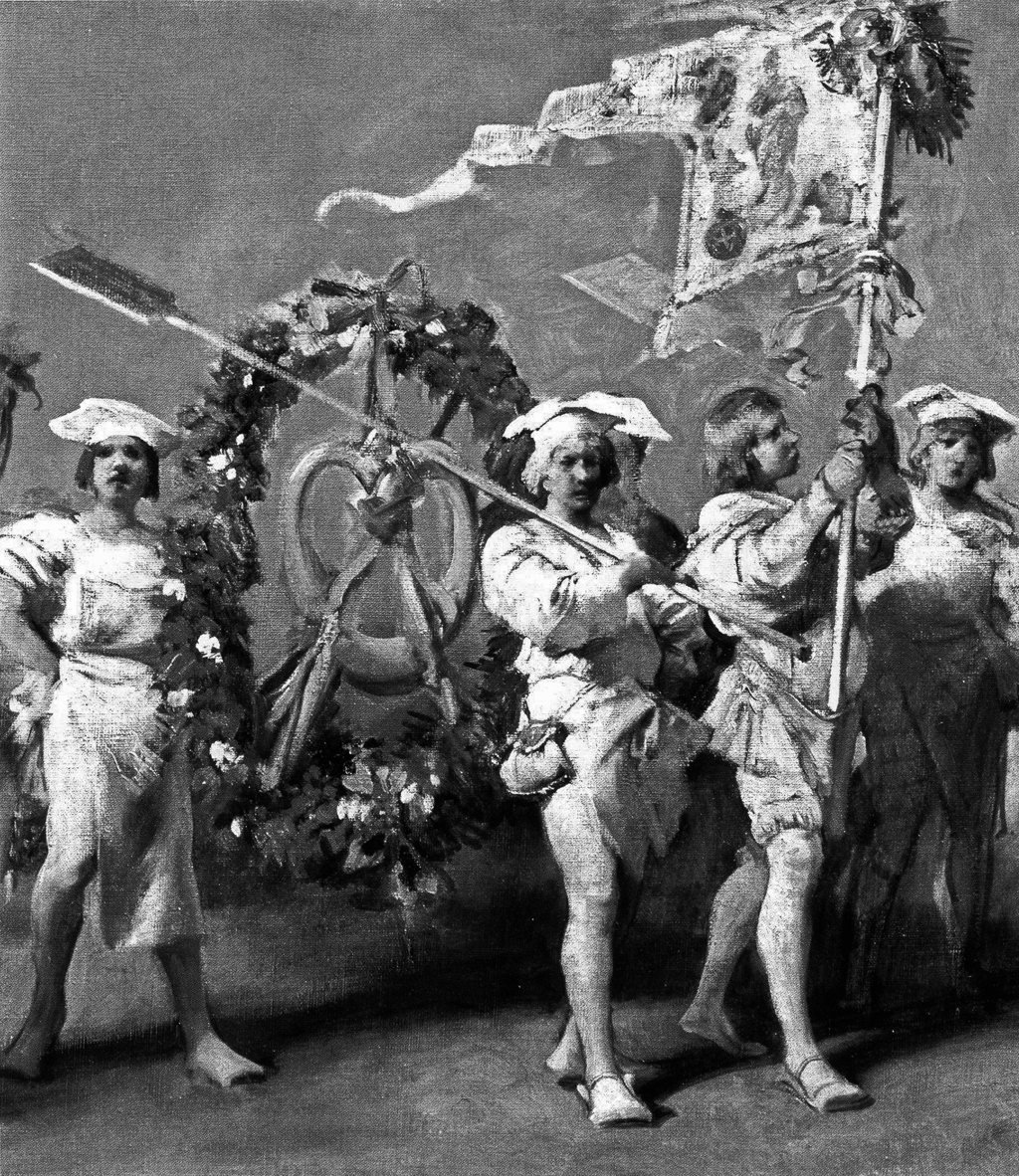
Such occasional pageants were a common enough phenomenon of the era. It was Makart's distinctive flair for translating the antique and the exotic into real backgrounds for modern life that made the 1879 pageant a touchstone of the genre. Despite the official dynastic occasion of the celebration, it was implicitly also a celebration of the new Vienna Ringstrasse and all it represented: economic recovery from the 1873 stock market crash and the rise of a powerful, affluent European bourgeoisie. The symbolic rapprochement of old aristocracy with an early modern middle class (and a concomitant shift of artistic patronage) enacted in Wagner's Die Meistersinger was publically celebrated in the Viennese Festzug, which similarly imparted historical and national dignity to the sources of bourgeois economic well being. An emphasis was placed on the more picturesque or traditional activities, such as horticulture, hunting, baking, blacksmithing, brewing, glass-blowing, printing and book-binding. The bakers' or tanners' floats could easily have been borrowed directly from the Festival Meadow scene of Wagner's Meistersinger (see Fig. 9). The general spirit of nostalgic völkisch-national exuberance suffusing the designs suggests a cross between Wagner's opera and the ‘Springtime for Hitler’ pageant from The Producers (see Fig. 9; for the Hunters' float see: www.artrenewal.org/pages/artwork.php?artworkid=15053&size=large; and for the Horticulture float see: www.artrenewal.org/pages/artwork.php?artworkid=15056&size=large).
Hans Makart, Design for the Bakers' float, 1879 Viennese Pageant (detail), oil on canvas, 64×285 cm (whole panel).
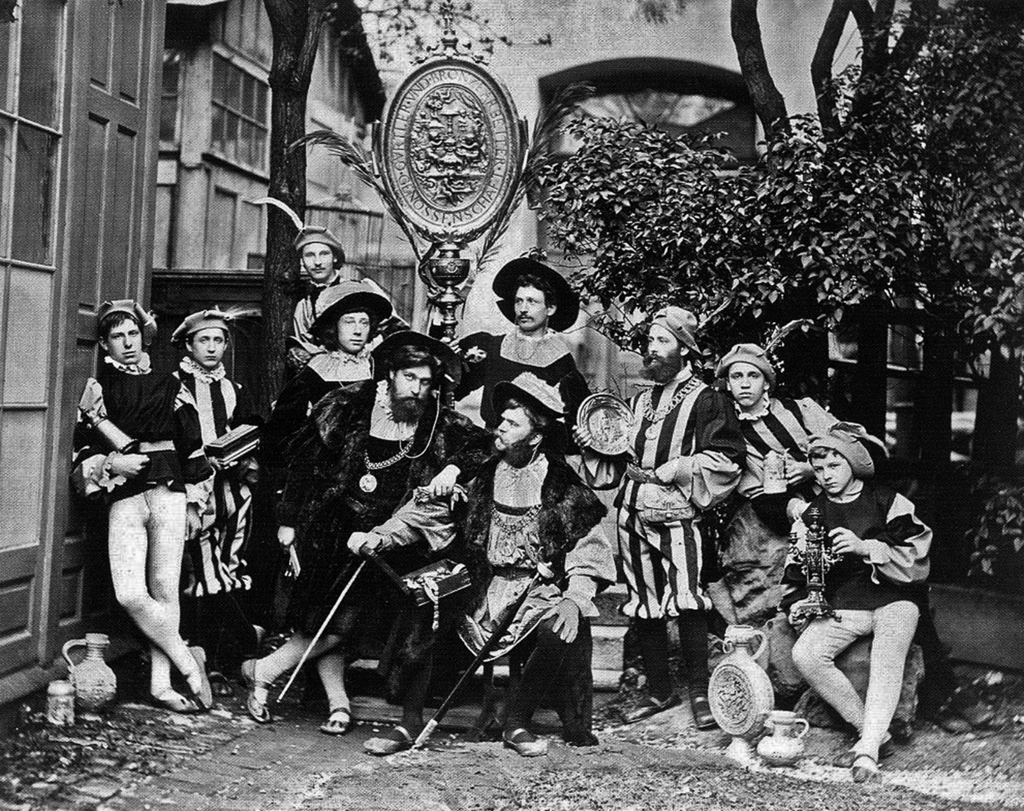
In addition to thirty-five detailed oil sketches in rectangular format (64×285 cm) that Makart prepared for the floats, numerous studio photographs of the participants record the elaborate historicising costumes created for the occasion in the spirit of Dürer or the Hapsburg-Spanish Renaissance. (Fig. 10 shows the costumed group representing the Bronze and Metalworkers Association.)
Bronze and Metalworkers Association, costumes for 1879 Viennese Pageant.
The profusion of costumed representatives of the arts and trades included a figure attired as Gutenberg, represented in a Sachs-like pose receiving a wreath from three muse-like maidens in Makart's design for the float of the printers, art- and book-dealers. Even modern industry was not altogether slighted: the railways were celebrated by a Baroque-style allegory of the steam engine in which a water-nixie is passionately embraced by a fire-god clutching a handful of lightning bolts.
If this ephemeral pageantry hardly shared the aspirations of a work like Die Meistersinger as a lasting memorial to ‘holy German art’, it did realise Wagner's theoretical programme for the ‘artwork of the future’ as a participatory event, a collective performance of civic and national identity. We might recall, too, the composer's early idea (however fanciful) to erect a wooden theatre for his Ring of the Nibelung that would be torn down after the premiere, so that the event would remain a pure, unique memory in the minds of the chosen few who had attended.Footnote 49 In its integration of history, style and aesthetic imagination with the fabric modern-day life, the Festzug represented something essential about Makart's achievement as an artist. ‘One could believe in his middle ages, however much the thoroughly modern underlying conception shone through’, wrote Robert Stiassny some years afterward. ‘The whole cornucopia of his imagination seemed to be dispersed here, and if we could consider Makart's studio among one of his best achievements, we might even call the Festzug his greatest work.’Footnote 50
The Wagners chez Makart, and a postscript on staging
Given Hans Makart's success in capturing the same blend of archaic national mythology and modern material sensuality evoked in the music dramas of Wagner, one can only wonder what might have emerged from their collaboration. The closest they came to one was the tentative approach to Makart about designing costumes for Parsifal, mentioned earlier. (That he would have been approached as a costume designer rather than a scene designer is telling; but theatrical set design was of course a specialised vocation and not one normally practised by the highest ranks of the profession.) When Richard and Cosima first saw Makart's name linked with Wagner's in 1871, we may recall that they were incensed at the idea that Die Meistersinger could belong in such scandalous company (together with Madame Bovary). But only two years later Cosima was all agog over the very pictures that had elicited the remark – the Abundantia diptych – when they were exhibited on tour in Bayreuth in 1873. In the meantime, during an 1872 trip to Vienna, she had visited the famous Makart atelier with Richard and her society friend Countess Dönhoff; the Makart style was in its ascendancy, and had begun to work its spell.Footnote 51 And two years later Wagner became the guest of honour at a glittering soirée hosted in Makart's Viennese studio, on 3 March 1875.
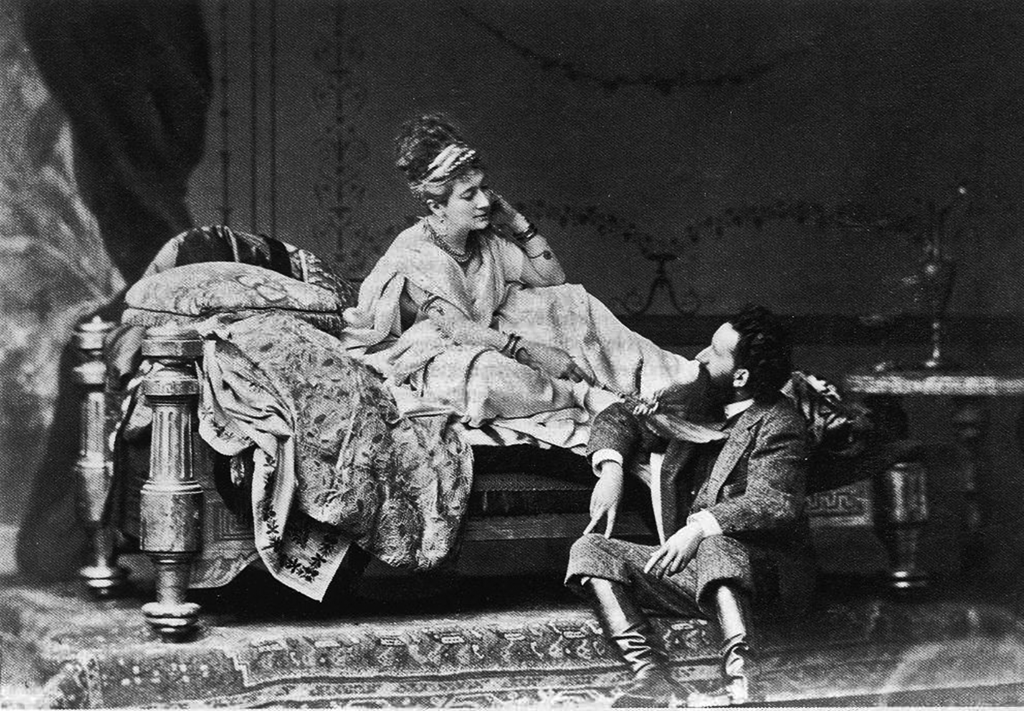
The entry in Cosima's diary recording the event is a star-struck roster of aristocratic and cultural notables: Hungarian counts and countesses, Princes Liechtenstein and Metternich, ‘the Liszt family’, the painter Heinrich von Angeli and his wife, the poet-librettist Salomon Mosenthal and architect Gottfried Semper. (The occasion had been engineered in part to bring together Semper and Wagner, who had not communicated since the plans for a Munich festival theatre had been tabled some ten years earlier.) The Hellmesberger quartet was invited to play Beethoven, but the commotion of costumed guests – if not the very contents of the studio – seems to have drowned out their efforts.Footnote 52 Among the guests was the actress Charlotte Wolter, something of a Viennese Sarah Bernhardt, an intimate of Makart's and occasional model. It was apparently his portraits of la Wolter in such femme fatale roles as Messalina and Cleopatra that inspired the Wagners to approach Makart about designing costumes for Parsifal – obviously with Kundry uppermost in mind.Footnote 53 (Fig. 11 is a photograph of Wolter costumed as Messalina in Adolph Wilbrandt's play Arria und Messalina, from a modelling session for a portrait done in 1875; see also the finished portrait Charlotte Wolter as Messalina: www.wikigallery.org/wiki/painting_84833/Hans-Makart/Charlotte-Wolter-als-%27Messalina%27-%28Charlotte-Wolter-as-%27Messalina%27%29.)
Charlotte Wolter costumed as Messalina in Adolph Wilbrandt's play Arria und Messalina.
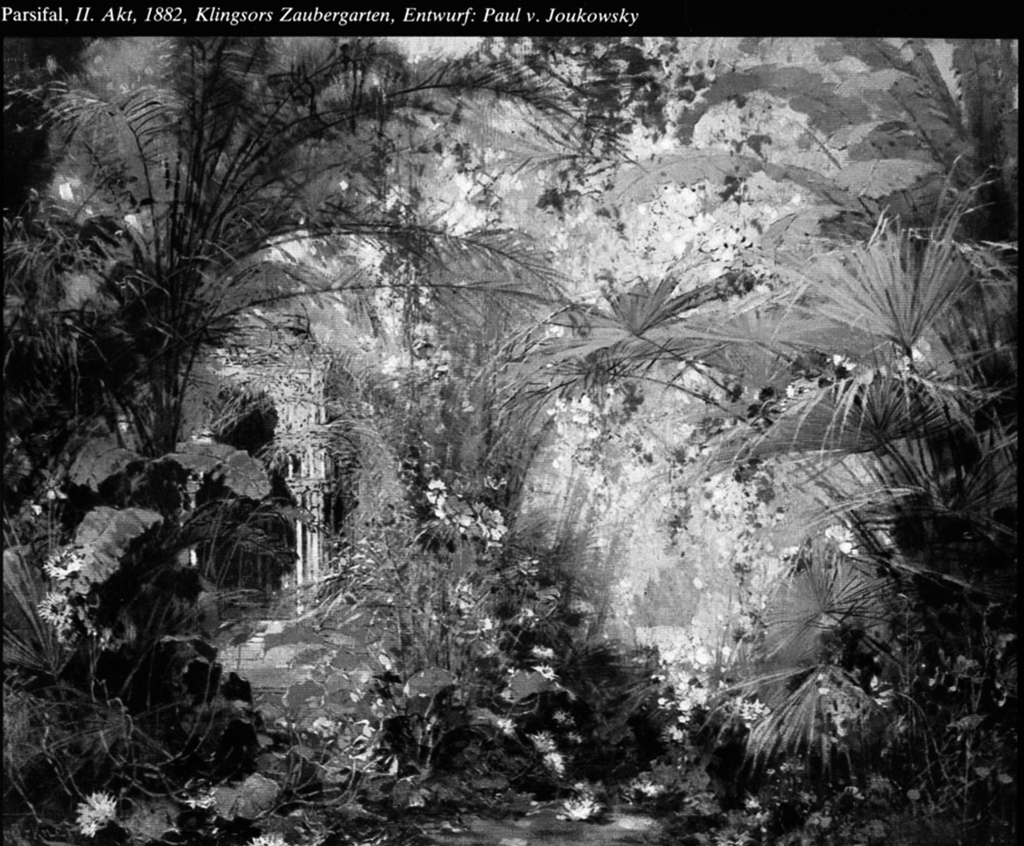
Of course, the Wagner–Makart collaboration on Parsifal never materialised.Footnote 54 Aside from two ultimately abortive designs for painted curtains to grace stages on the new Ringstrasse (an ornately framed scene from A Midsummer Night's Dream for the Wiener Stadttheater and a Bacchus and Ariadne motif for the Komische Oper), Makart did not work in the theatre during his brief and busy career. Not surprisingly, however, his style exerted its influence there. Paul von Joukowsky's design for Klingsor's ‘magic garden’ in Act 2 of Parsifal, for instance, is a riot of ferns, palm fronds and cascading blossoms in the Makart manner that influenced so many luxurious bourgeois interiors (see Fig. 12).
Paul von Joukowsky, oil sketch for Klingsor's Magic Garden, Parsifal Act 2, 1882.
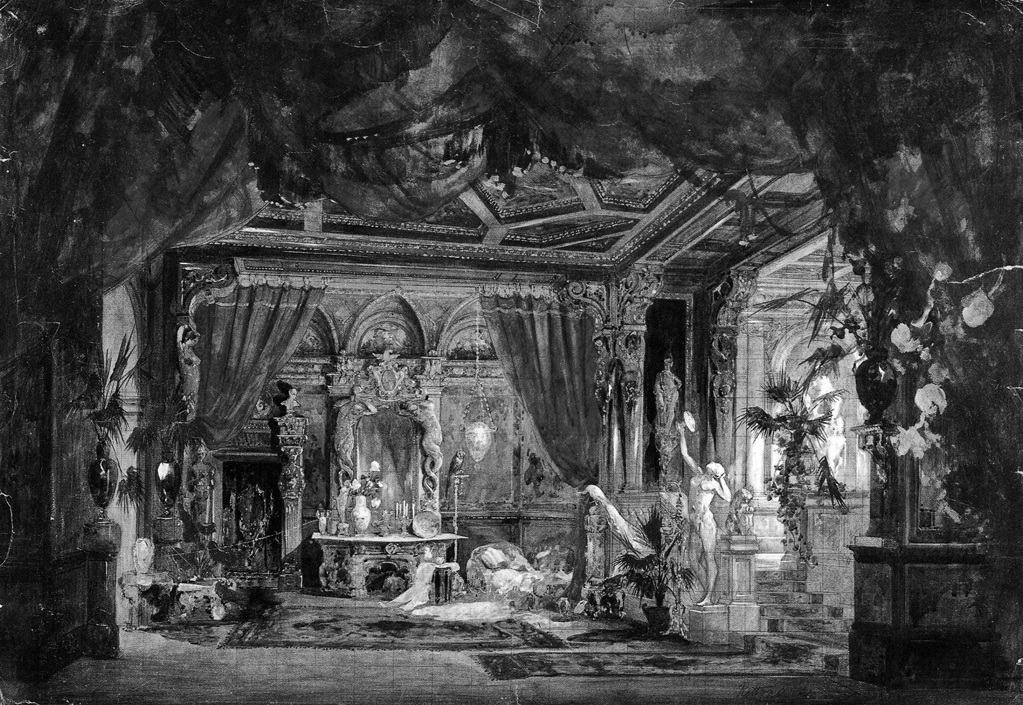
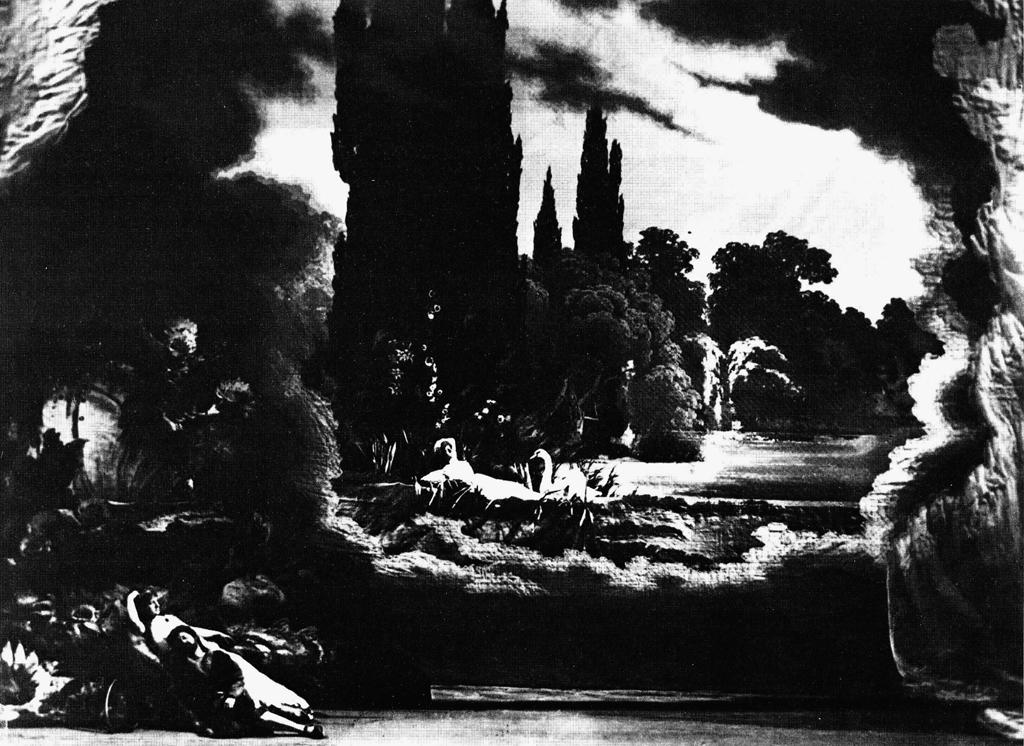
The vibrant red hangings and robes of Makart's history paintings can be found in the work of Italian set designers for Viennese stages, such as Francesco Rottanara's for the Raimundtheater or Carlo Brioschi's for the Hofoper. (Fig. 13 shows a large Renaissance interior for Schiller's Die Verschwörung des Fiesco zu Genua, done over entirely in the Makart style: the voluminous hangings are all in red.) Brioschi designed lavish, colourful sets for Vienna productions of Tristan and Tannhäuser at the Hofoper in 1883 and 1890, respectively, combining the style of Quaglio and Döll's 1860s Munich sets with touches of Makart and the popular fairy pantomime-extravaganzas of the period. A similar mixture is evident in Cosima Wagner's Bayreuth productions from the end of the century, as in the Venusberg sets of her 1891 Tannnhäuser (Fig. 14 shows the tableau of ‘Leda and the Swan’ from the final moments of the Bacchanal.)
Francesco Rottanara, set design for Schiller, Die Verschörung des Fiesco zu Genua, watercolor and mixed media, 1894.
‘Leda and the Swan’ tableau from the Venusberg Bacchanal in Tannhäuser, Act 1.
An appreciation of visual art had clearly been Cosima's special province throughout her marriage to Richard Wagner, and she seems to have served as his style consultant in many matters. From the moment of her first live encounter with Makart's painting she shared the enthusiasm it aroused in many contemporary connoisseurs. Despite her initial indignation at the idea, Cosima came to appreciate better than anyone what Wagner's operas really might have in common with ‘a picture by Makart’.
If the Makart style was so readily naturalised in the work of Wagner's theatrical collaborators and heirs, not to mention the décor of the Wahnfried salon, might it represent something essential about the ‘style’ of his works themselves? Could the influential idiom of Makart's painting provide an optical-critical tool of some kind that might help us recover a fresh perspective on the composer and his dramas? Could any of it be productively recuperated in ways of staging Wagner today? This is not the place to engage in polemics on the state of Wagner production. Suffice it to conclude with a qualified ‘yes’ to these questions.
After a century and a half it is easy to forget the original novelty and force of Wagner's sensual provocations, the delightful shock of his vibrant surfaces, the luxurious embrace of his plush, overstuffed textures. As Laurence Dreyfus has argued, modern audiences easily overlook the sensual, frankly erotic appeal Wagner's music exerted on listeners in his own day – a situation abetted by tendencies of modern criticism and production.Footnote 55 At the same time, Wagner's subject matter and his figures were, like Makart's, at least generically familiar to their audiences; it was rather the medium-specific elements of ‘style’ in which these subjects were executed that was strikingly modern. Wagner took material from Nordic myth, medieval Christian legend and early modern German history and redesigned it for contemporary – and even ‘future’ – sensibilities, as Makart did with Renaissance history painting, allegory, portraits, devotional painting, or Baroque and rococo décor. The signal success of both artists had much to do with their negotiation between a recognisable, conventional ‘grand style’, on one hand, and the distinctively modern stimulants they applied to it, on the other.
A production aesthetic that sought to reinvent that negotiation in contemporary terms could do more justice to the colours and textures of Wagner's imagination than the rumpled business suits and Office Depot or IKEA furniture intended to make Wagner ‘speak’ to us, nowadays, across gulf of time.Footnote 56 Modernist and post-modernist productions alike typically privilege the conceptual over the sensual content of the dramas. Since the era of Wieland Wagner, if not before, visual abstraction has been a means of exorcising the taint of late-bourgeois and nationalist ostentation that was already making Thomas Mann uneasy in 1933. Some productions, of course, such as Joachim Herz's or Patrice Chereau's Ring cycles of the 1970s, have chosen to foreground markers of such period ‘ostentation’ in a critical way, highlighting parallels between the fate of Wagner's gods and the chauvinist-imperialist hubris of the German Gründerzeit. There could surely be ways of citing the Makart style creatively, and critically, without lapsing into merely anachronistic picturesqueness of the sort Otto Schenk and Günther Schneider-Siemssen's Metropolitan opera productions were often accused of. In the Rheingold of Keith Warner's 2004–6 Ring cycle (revived in 2012), for instance, which follows the example of Herz and Chereau, Marie-Jeanne Lecca's grande-bourgeoise ruffled white gown and Titian-red hairstyle for Fricka have a distinctly Makartian look. Venus's grotto and Kundry's flower garden are obvious candidates for this treatment. Or perhaps Lohengrin's and Elsa's bridal chamber with pelts and vases? The Wartburg hall of song as a Makart-style conservatory? The Gibichung Hall as grand salon with suits of armour and layered oriental carpets? Klingsor's laboratory as Makart's atelier? The style could provide a hint of something ominous, decadent, or alluring appropriate to many Wagnerian settings. (Thomas Mann realised this when he had his Aarenhold twins, decadent bourgeois avatars of Wagner's Siegmund and Sieglinde, collapse on a bearskin rug at the conclusion of the story Wälsungenblut.)Footnote 57 It could resonate in visual terms with Sachs's response to the pleasurably unsettling ‘Wagnerian’ tone of Walther's music, which sounds at once ‘so old’ and yet ‘so new’. To whatever interpretive end we might put it, the Makart style could be recalled in counterpoint to Wagner's music as a means of recovering features once central to his irresistible fascination, features we are nowadays in danger of forgetting, suppressing, or simply taking for granted.