Introduction
Owner conflict may have been more important than historians have considered to date. Conflict goes by any number of synonyms: discord, disquiet, friction, infighting, stress, strife, struggle, etc. To grasp the significance of owner strife, I ask: How did conflict play out at a 1902 merger, International Harvester Company (IH), during its first ten years? How did owner discord affect the firm’s efficiency?Footnote 1
International Harvester projected power. In 1903 the Chicago fledgling claimed 96 percent of sales of the leading harvesting machine, the binder, and 91 percent of mowers. In 1910, IH still held 88 percent of sales of binders, 77 percent of mowers.Footnote 2 Yet its trust persona obscured a critical internal problem: Two sets of owners strained to topple one another. For the McCormicks, Cyrus H. McCormick Jr. played the key role, assisted by brothers Harold and Stanley. They had a resourceful in-law in John D. Rockefeller.Footnote 3 For the Deerings, there was William (the founder), two sons, and a son-in-law.Footnote 4 The owners could date being opponents at least to the so-called harvester war—the 1890s—years when, as the McCormick grandson described it, “competition grew … severe and unbusinesslike.”Footnote 5
For mergers at this time, one question was “control.” In 1932, Adolf Berle and Gardiner Means observed that one “type [of control]” was “majority control” (half the stock).Footnote 6 Stanley McCormick recalled in early 1903 that, during deliberations the previous July, “the D’s [Deerings] … refused to submit” to the McCormicks’ possible “51% of the stock.” Even so, Rockefeller pocketed $5.5 million in securities from J. P. Morgan in August or thereabouts (Table 1). Stanley recounted “that when the D’s [Deerings] heard that Mr. R. [Rockefeller] was to have a large block of the stock,” this news spurred them into “favoring, if not insisting upon, a voting trust.” George W. Perkins conveyed this news.Footnote 7
Voting Trust Certificates: Selected Owners, 1903-1912 ($ millions)
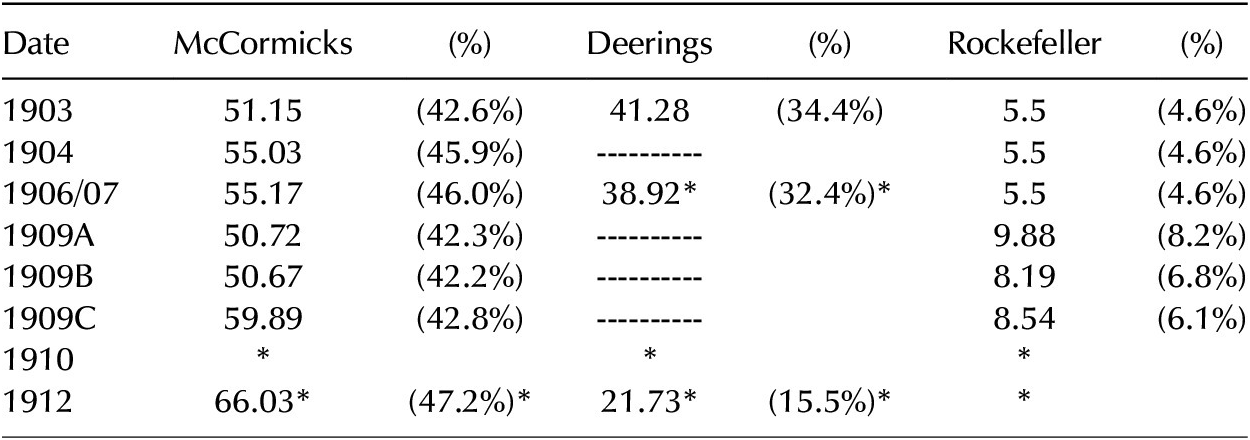
Notes: * Read notes. Total capitalization was $120 million in 1903 but increased in 1910 to $140 million where it stayed in 1912.
1903 required valuations made in August but omitted Cyrus McCormick’s addition of $3.5 million; 1904 data is reported for January 1. 1906/07 is reported as January 1, 1907 for the McCormicks and Rockefeller, but November 9, 1906 for the Deerings. The Deerings’ estimated 1906 holdings are reported as a fraction of 1,200,000 voting trust certificates; the percentage would be 32.9 percent based on 1,183,376 identified certificates.
Except for 1906 and 1912, I do not display figures for the Deerings where data is incomplete. The 1912 sum reported in the government’s antitrust brief leads to 15.5 percent, but in the text, I estimate 1912’s fraction ranged between 15.5 and 25 percent.
1909A refers to stock trust certificates for the McCormicks and Rockefeller on January 1. 1909B refers to their certificates for December 14. 1909C refers to their certificates after a common dividend for $20 million.
The Wall Street Journal’s estimate for 1910 placed the McCormicks’ certificates at $73.5 million (52.5 percent) and the Deerings at $31.2 million (22.3 percent). The article cautioned about possible data problems.
1912 data was found in the government’s antitrust brief, but the records accounted for $123.2 million out of $140 million in certificates. For more discussion, see text.
Correspondence indicates that as of July 31, 1912, John D. Rockefeller held at least 43,750 certificates. It is not clear whether his 43,750 shares were included in the McCormicks’ figure of $66.03 million. That said, he may have held more in 1912. Based on 1909C holdings, Rockefeller still had slightly more than $4 million certificates. Adding $4 million to the McCormicks’ 1912 $66.03 million would cross the halfway mark.
For the McCormicks’ figure of $66.03 million certificates in 1912, I report data from the government’s antitrust brief. I was not able to replicate this amount exactly, in part because it is difficult to identify all McCormicks.
In 1920, the McCormicks expanded their definition as to who held their shares. An expansive definition applied to 1912 might also have resulted in their holding over half the stock.
Sources: For IH’s capitalization and shareholdings (except for Rockefeller) in 1903, see Bureau of Corporations, International Harvester, table 6, p. 86, 87; for data in 1903 for Rockefeller alone as well as in 1904, 1907, and 1909A including Rockefeller and the McCormicks, see “Holdings of International Harvester Company Stock at Dates as Shown Below,” 2 Feb. 1910, Folder 7, Box 20, McCormick Estates Records, 1841-1969, McCormick Collection Mss. M, Series I: McCormick Harvesting Machine Company Records, 1841-1934, Series Mss. M, Series I (hereafter Mss. M, Series I), Wisconsin Historical Society, Division of Library, Archives, and Museum Collections, Madison, Wisconsin (hereafter WHS); for Cyrus McCormick’s 1903 addition, see “Credit Purchase I.H.Co. Stock from J.P.M.&Co. $3,500,000,” 30 July, 1904, Folder 7, Box 20, Mss. M, Series I, WHS; for data in 1909B and 1909C, including Rockefeller, see N.a., Untitled [Holdings as of date December 14, 1909], 2 Feb. 1910, Folder 7, Box 20, Mss. M, Series I, WHS; for the estimated 1910 data, see “M’Cormick Interests Retain Control of Harvester Stock,” Wall Street Journal (Nov. 17, 1910), 5; ProQuest Historical Newspapers: The Wall Street Journal; for data about McCormick and Deering holdings in 1912, see International Harvester Co. Brief for the Government filed in the District Court of the United States for the District of Minnesota during the October Term, 1913, in the case of the United States of America v. International Harvester Co. and Others, 63rd Cong., 2nd sess., Senate Document No. 558, July 27, 1914, 42-43, Volume 4, International Harvester Company Legal and Patent Records, 1901-1947, Part I: Original Collection, 1907-1922, McCormick Collection Mss. 3Z (hereafter Mss. 3Z), WHS; for Deering data in 1906, see Government Exhibit 266, Voting Trust Certificate Holders, 321-22, United States of America, Petitioner v. International Harvester Company, Defendants in the District Court of the United States for the District of Minnesota (US v. IHC): Government’s Exhibits and Rebuttal (Government’s Exhibits), [1913], volume 4, Mss. 3Z, WHS; for McCormick and Rockefeller data in 1912, see also Government Exhibit 266, Voting Trust Certificate Holders, 343-48, US v. IHC: Government’s Exhibits, volume 4, Mss. 3Z, WHS; for Rockefeller’s data in 1912, see as well J. Alva Jenkins to John A. Chapman, 31 July 1912, Folder “I. H. Company Finances,” Box 34, Cyrus Hall McCormick Jr., 1859-1936, Subject File, 1840-1942, McCormick Collection Mss. 2C, WHS; J. F. Stone to John D. Rockefeller, 3 Sept. 1912, Folder 1, Box 21, Mss. M, Series I, WHS; “I. H. Co. Stock location supplied by Mc.C.H.Co.,” 11 July [?], 1912, Folder 7, Box 20, Mss. M, Series I, WHS. For 1920 and the McCormicks’ expansive definition of their holdings, see “Tables Showing Effect of Three Alternative Plans for Increased Capitalization of International Harvester Company,” 2 Apr. 1920, Folder “I. H. Company Finances,” Box 34, Mss. 2C, WHS.
Perkins snapped up the merger deal for J. P. Morgan & Company. His influence came in two ways.Footnote 8 First, there was a voting trust (1902–1912). In brief, Cyrus H. McCormick Jr., William Deering’s son, Charles, and Perkins voted nearly all stock. The agreement stated, “The action of a majority of the Voting Trustees … shall … constitute the action of the Voting Trustees and have the same effect as though assented to by all.” When the first two “deadlock[ed],” Perkins became “arbiter” or tiebreaker.Footnote 9 Second, a McCormick document, likely from 1903, noted that Perkins had “unfettered control of the initial organization of the new Company, … including by-laws, directors, committees and officers.” And, in July 1902, Perkins told Morgan, “The new company is to be organized by us; … the Board of Directors, the Officers, and the whole outfit left to us,— nobody having any right to question in any way any choice we may make.” Perkins’s influence over “directors, committees and officers” potentially allowed him to quiet discord.Footnote 10
Critical to mitigating owner strife was the sale of a portion of stock by one set of owners. Legal scholar Brian Cheffins sketched the context whereby mergers were important in having new owners dispose of some stock, or “cash out.”Footnote 11 However, Gary Herrigel cautioned that owners varied in managing their “investment risk”—that is, as to “what caused those owners to prefer cashing out over continued private control.” That choice characterized IH owners: The Deerings ultimately would “cash out” in part; the McCormicks would remain fixed on “control.” At first things were not so easy, however. To “cash out,” International Harvester had to be publicly traded, which did not happen until 1908. This meant that when an issue split the owners, it fell to Morgan’s partner to find a way out of the predicament. His biographer, John A. Garraty, writes that in 1906 Perkins initiated changes to management and investments, including public trading, which enabled the owners to move apart.Footnote 12
Some scholars stress that Perkins reconfigured management, but management was not the entire answer.Footnote 13 Garraty also described changes to investments. However, his argument is partially unfinished. For example, he lacked data to determine whether the Deerings did indeed part with a fraction of stock. As another example, beyond Perkins’s verbal commitments, I located an important 1906 agreement (which Garraty and others may not have seen) that spelled out the compromise.Footnote 14 Then, placing Perkins in the entire ten years of the voting trust (1902–1912) shows he underwent a learning process. Initially, in 1902–1903, he bungled a major issue. In 1906, he changed course. The agreement detailed requirements that, in the six years thereafter, set in motion two changes. First, when the McCormicks took over in August 1912, they could be thankful that the Deerings’ ability to wage conflict had lost strength given their transfer of some stock (Table 1). Second, the McCormicks agreed to a stock dividend for 1910—something the Deerings could appreciate. These changes (and public trading) helped mitigate discord.Footnote 15
This paper aims to extend analysis Garraty began as to how owners mitigated conflict at International Harvester. Doing so, it speaks to overlapping literatures on mergers and corporate efficiency. Naomi R. Lamoreaux addressed mergers’ anticompetitive tactics. Alfred D. Chandler Jr. also singled out mergers, but emphasized that their managers—owners were largely absent in his analysis—brought to fruition “methods” for efficiency related to “vertical integration” and the “managerial hierarchy.”Footnote 16 Yet there may have been amalgamations in which owners were present (not absent); and in which owner friction derailed the elusive goal of improved efficiency.Footnote 17
My argument turns on owner conflict. Historians typically have depicted conflict between owners and other actors, such as rivals, workers, and managers.Footnote 18 What of conflict in which one owner wrestled another? It can be divided into cases focused on “control,” as seen in research by Lamoreaux and coauthors, and cases for issues aside from “control,” such as Robert Ozanne’s study of labor at Harvester.Footnote 19 How prevalent was owner strife? Looking at mergers, owner conflict may have been common. Mergers often aimed to halt competition. Max Weber drew this relationship: “A peaceful conflict is ‘competition’ in so far as it consists in a formally peaceful attempt to attain control over opportunities and advantages.”Footnote 20 It is hard to believe that a merger would quickly cause actors to put aside competitive tactics or to forget past years of tense battles. Then, many mergers entailed entrepreneurs—strong-willed people who were unlikely to play second fiddle to other owners. The McCormick grandson observed for International Harvester: “Perkins had sensed that no McCormick and no Deering could long remain at peace with each other.” He added: “The voting trust served to tide the new company over a difficult trial period.”Footnote 21
A Basis for Conflict
International Harvester drew together the McCormick Harvesting Machine Company, the Deering Harvester Company, the Warder, Bushnell & Glessner Company (known under its product line, Champion), the Milwaukee Harvester Company, and the Plano Manufacturing Company. Reasons for the merger included hoping to branch out beyond U.S. markets; removing a thorn in the side of U.S. Steel; allowing the aging entrepreneur, William Deering, to retire comfortably; and replacing blistering competition with peaceful coexistence. This last reason especially applied to the McCormicks and the Deerings.Footnote 22 In 1902, Deering profits were 76 percent of the McCormick Company’s. For harvester-binders, Deering’s total unit sales were 90 percent of McCormick’s.Footnote 23
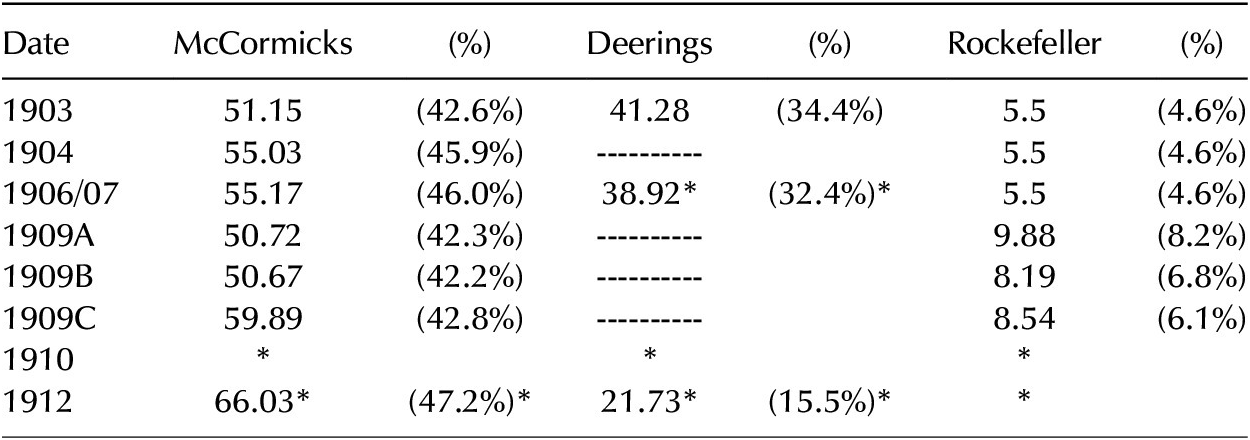
The 1890s “harvester war” spurred families to invest in their brands.Footnote 24 They clashed over almost any activity—the sales force, pricing tactics, credit terms, technical design of machines, marketing aimed to belittle competitors, and marketing aimed to tell farmers stories of “progress.” The last activity was critical.Footnote 25 For example, the McCormicks loved Cyrus McCormick (1809–1884) to such an extent that, as the grandson reported, “The family business was a memorial to its founder.”Footnote 26 As to strides in technology, the Deerings professed to be tops. The McCormick author gave William Deering praise: “In one year Deering had built and occupied a new factory, bought a hitherto untried patent and turned it into an immensely successful machine, invaded a field already crowded with experienced manufacturers, and was rapidly running away with the remaining shreds of the popular favor they had gained through so many years! (Figure 1)”Footnote 27
Deering Harvester Co., Forty Harvest Seasons, 1858-1898 (Chicago, Ill., 1898), inside back cover. Wisconsin Historical Society, WHS-147187.
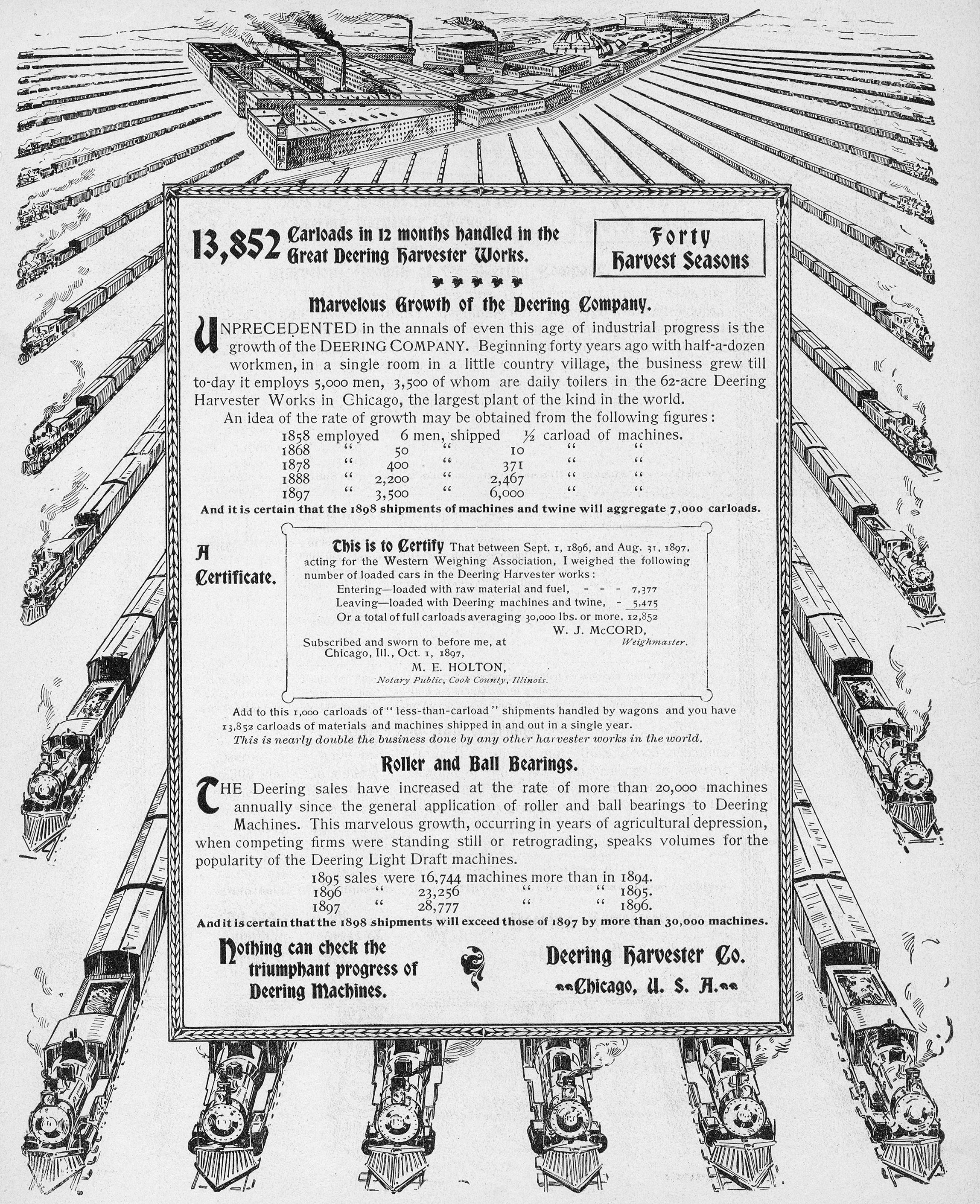
With this as a backdrop, neither contender readily made way for the other. Consider language they used at the outset. In August 1903, the Deerings were said to have “recognized that the McCormick name was more valuable than the Deering name.” That was not the key issue for them. They were said to have “brought to the I.H.Co. …— the steel mill, ore properties, plant in Canada, together with the very large and profitable business which they had built up.” Looking ahead, the Deerings framed their “farsightedness of plans and properties” relative to the McCormicks’: “They were in a more advantageous position and brought a greater value along that line than the McC. [McCormick] situation, confined to a single manufacturing plant with none of these adjuncts.”Footnote 28 That was not the McCormicks’ self-assessment. An undated internal document, likely from 1903, stated, “We believed that we were justified in accepting that the McCormick interests would be treated as an elder brother in the Combination or senior partner in a firm.” Although expressing concerns about Morgan & Company, the document saw the McCormicks as showing “calm, deliberate judgment and painstaking effort” (Figure 1).Footnote 29
Perkins could not dictate friendlier relations, but did allot certificates. Appraisals had been tense; as a result, the Bureau of Corporations (the Bureau) reported, “certain amounts were fixed by George W. Perkins more or less independently of the appraisals.”Footnote 30 Before Perkins allotted certificates in August 1903, Cyrus McCormick obtained $3.5 million certificates from Morgan. This meant that after August the McCormicks and Rockefeller had 50 percent–plus of certificates (Table 1). (A Rockefeller loan made possible this $3.5 million addition.) They would have had “majority control” into 1909 had there been no voting trust. Although I did not locate complete records for 1910 to 1912, Rockefeller likely made possible McCormicks’ “control.” That said, the Deerings were not cowed.Footnote 31
In terms of governance, at the top was the voting trust. Launched immediately upon the organization of the firm (August 13, 1902), it ran out after ten years (August 1, 1912). As noted, Cyrus McCormick Jr., Charles Deering, and George Perkins operated the device.Footnote 32 The voting trust agreement spelled out a few limitations, but also made this clear: “The Voting Trustees possess and shall be entitled in their discretion to exercise … all rights and powers of absolute owners of said stock, including the right to vote for every purpose and to consent to any corporate act of said Company.” Shareholders owned “stock trust certificates.” The first provision assured their dividends, but the eighth indicated their lack of authority: “it being expressly stipulated that no voting right passes to others by or under said stock trust certificates or by or under this agreement.”Footnote 33
Below the voting trust was the board of directors, consisting of 18 individuals whose ties Helen M. Kramer detailed. These people largely replicated in three blocks the three trustees, yet Perkins could tilt his faction to favor either the Deerings or the McCormicks. Five McCormick directors and four Deering directors joined. Morgan claimed Perkins and four others. Judge Elbert H. Gary, head of U.S. Steel, served and likely assisted Morgan. Among those remaining, two hailed from other firms to the merger. A New York attorney seemed not to have strong ties to anyone; and there was a person from New Jersey, which the Bureau of Corporations found “was put in to comply with the corporation laws of New Jersey requiring a resident director.” The critical point is that Perkins exercised power through the board.Footnote 34
Below the board of directors were the officers and key members (Table 2).Footnote 35 Again, Perkins’s choices replicated the three voting trustees. In this case, however, the division of positions created competing sources of power. IH President Cyrus McCormick vied with Charles Deering, chair of an executive committee. As Stanley McCormick observed in January 1903: “At the first meeting of the Board of Directors, the motion was passed giving to the Chairman of the Executive Committee the entire power of the Committee during the time which may intervene between the meetings of the Committee. This, of course, gives him [Charles] powers greater than the President.”Footnote 36 For a finance committee, Perkins (the chair), George F. Baker, and Charles Deering had the ability to outnumber Cyrus. Finally, the Deering son-in-law exercised authority as not only secretary but also treasurer (Table 2).Footnote 37 These roles set the stage for potential conflict.
Owners’ Official Capacities, 1902-1912
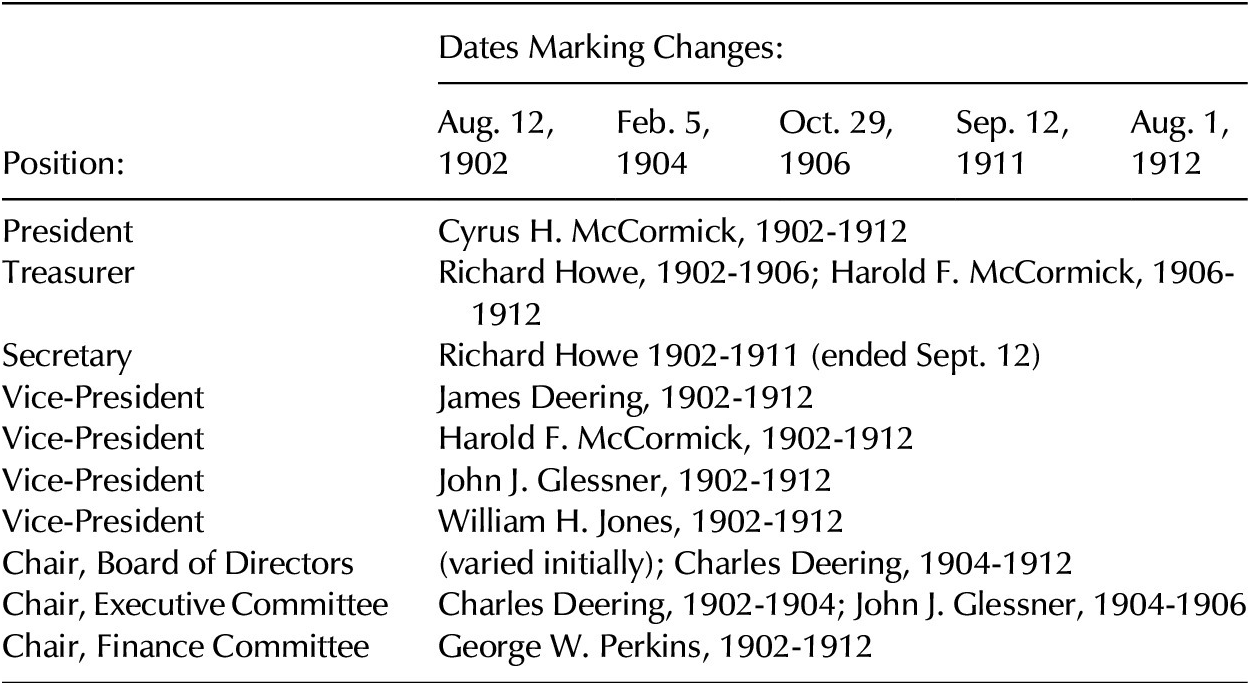
Notes: November 23, 1906 marked the dissolving of the Executive Committee. October 29, 1906 saw Elbert H. Gary’s addition to the Finance Committee; otherwise there were no changes to this committee till 1912.
Sources: Petitioner’s Exhibit 6A, “By-Laws of International Harvester Company. 1902,” 55; Petitioner’s Exhibit 7, “Officers of International Harvester Company, 1902 to date,” 65; Petitioner’s Exhibit 8, “Directors of International Harvester Company, 1902–1912,” 66–68; Petitioner’s Exhibit 9, “Members of Executive Committee of International Harvester Co., August 13, 1902, to November 23, 1906,” 69; Petitioner’s Exhibit 10, “Members of Finance Committee of International Harvester Co., August 13, 1902, to date,” 70; all in United States of America, Petitioner v. International Harvester Company et al., Defendants in the District Court of the United States for the District of Minnesota: Government’s Exhibits and Rebuttal, [1913], volume 4, https://hdl.handle.net/2027/coo1.ark:/13960/t6qz2tj6c; IH, 1912 Annual Report, the Wisconsin Historical Society website, http://content.wisconsinhistory.org/cdm/search/collection/ihc/searchterm/annual%20report/field/title/mode/exact/conn/and/order/title.
Inside International Harvester, 1902–1905
Among many disputes in 1902 and 1903, one concerned the separation of steel/ore assets from Harvester so that U.S. Steel could have them. Another turned on an idea to increase the amount of stock. One more addressed the dividend—just how large it should be. Perkins likely mishandled the steel matter. Afterward, the McCormicks altered their communications to be more frank. This helped with the stock issue, but dividends proved difficult.Footnote 38
Morgan had assembled the Steel Trust in 1901, and the Harvester Trust in 1902. Very quickly, Perkins bluntly asked for a change that Stanley McCormick summed up: “It has been suggested by Mr. P. [Perkins] that the I. H. Co. should sell to the Steel Co. its ore and coal lands and steel properties, and should make a contract for ten years or more with the Steel Co. for the purchase of steel and pig iron.” The matter became known simply as the “steel contract.” Either U.S. Steel got what it wanted, or International Harvester could undertake what the Bureau said “is now commonly called ‘integration.’”Footnote 39
How did the Deerings and the McCormicks react? Perhaps Perkins swayed the Deerings, perhaps not. Their views may have evolved during the months of debate from September 1902 to August 1903.Footnote 40 The McCormicks were clear: They moved to halt the “steel contract,” as Fred V. Carstensen analyzed. In February 1903, Board Director Cyrus Bentley wrote Harold McCormick. He had strong words for Perkins regarding steel, but tried to offer constructive suggestions to the McCormicks. “You should at this time neither seek a quarrel with Perkins nor become subservient to him. A position that is firm without being quarrelsome seems to me the position for you to take.” Bentley thus advocated “firm” communication.Footnote 41
At the time of the appraisals in August 1903, the McCormick attorney, John P. Wilson, was said to tell Perkins frankly, “If … I could place them [the McCormicks] in a position where they would feel assured that there would be no future disturbance in the way of parting with the steel properties and the steel plant, it would have some modifying influence on their views.” Perkins acknowledged this reasoning. He was said to be “perfectly aware that … the Ds. [Deerings] and the McCs. [McCormicks] would be one against him on that [steel] proposition, that their views coincided upon the question that it was for the interest of the Harvester Co. not to have contracts with the Steel Co. but to go ahead with their own properties.”Footnote 42 Although the actions of the Deerings were not fully clear, it appears that Perkins lost. In early 1904, he seemed to apologize in a general way, as Cyrus McCormick recorded: “Perkins said that he was well aware that in the work which he tried to do for the Company in the past he had not given satisfaction to everybody -- perhaps to no one.” He did not cite steel events, but maybe that was an obvious topic from “the past.” His comment came in the midst of a dispute in January 1904, as will be discussed, when Perkins was to a degree learning and beginning to appeal to the McCormicks.Footnote 43
While owners debated steel, another pressing topic was profits. The firm started October 1, 1902, and the three months left for 1902 were included in 1903 (Table 3). Looking just at 1903, the Bureau of Corporations reported woebegone profits of $2.58 million. Sales of binders peaked in 1901–1902. Questions about ore assets, inventories, and the last quarter of 1902 stoked a dispute between IH and the Bureau over earnings (Table 3). One might report doubtful profits for 1903; cite Harvester’s objection that 1903 was so unusual as to be left aside; or delve into the accounting complications.Footnote 44
International Harvester’s Profits and Dividends, 1903-1912

Notes: IH began operations on October 1, 1902. The company and the Bureau of Corporations (BOC) included the last three months of 1902 in 1903’s profits. For just 1903, the Bureau placed earnings at $2.58 million. I report two data series on profits—International Harvester’s and the Bureau of Corporation’s. The Bureau’s figures were available through 1911. “1903” was unusual for several reasons; see the Bureau’s report for more analysis. I use the terms profits and net earnings interchangeably in this essay. The Bureau compiled its own earnings figures to scrutinize IH’s data. Here I employ the data series mostly for descriptive purposes: the trends for IH and the Bureau show profits improved under the voting trust. See text for more discussion.
Data for 1910 include a stock dividend of $20 million. The dividend rate represents dividends as a percent of total capitalization, which was $120 million through 1909 and then $140 million. This table combines information mostly found in two of the Bureau of Corporations’ tables, and information follows the Bureau’s presentation.
Sources: Bureau of Corporations, International Harvester, Table 40, p. 211 for dividends and dividend rate (except for 1912), 233, Table 50, p. 234 for profits, from 1903 to 1911; 190-219, 233-35 for a discussion of 1903 earnings. Profits (IH) for 1912 come from IH, 1912 Annual Report, 5 (and page 5 for dividends in 1912), see the Wisconsin Historical Society website,
http://content.wisconsinhistory.org/cdm/search/collection/ihc/searchterm/annual%20report/field/title/mode/exact/conn/and/order/title; Ozanne, Wages in Practice, Table 27, pp. 116-18. A similar table is Defendants’ Exhibit 212, “International Harvester Company. Statement of Net Earnings and Dividends, 1903 to 1912,” 123, United States of America, Petitioner v. International Harvester Company et al., Defendants in the District Court of the United States for the District of Minnesota: Testimony of Witnesses for the Defendants, [1913], volume 14, https://hdl.handle.net/2027/coo1.ark:/13960/t6d234k3q.
The column for dividends as a share of earnings benefited from Carstensen’s analysis in “International,” 510. On the concept of the dividend rate, see Baskin and Miranti, History of Corporate Finance, 181.
The climate for 1903 earnings and Cyrus McCormick’s frank approach figured in subsequent issues. Morgan offered the idea of issuing $60 million in common in addition to the $120 million original stock, which would be designated preferred. In September 1903, McCormick visited Morgan and Perkins. He outlined reasons for dropping the stock idea. All in all, “whenever the financial condition of the Company was such that it was desirable or feasible to pay six per cent regularly and easily that would be time enough to take up the question [of common stock].”Footnote 45 McCormick then “had a further talk with Mr. Perkins.” When “one of the interests did not wish it, would it be for the interests of this Company to force the common stock upon any one?” he asked, and recorded Perkins’s reply as “no, of course not.” Conceivably, a stock issue would have raised funds, but it posed problems. Perkins registered McCormick’s stance. The issue appears not to have come to a vote.Footnote 46
Also in September 1903, dividends split the trio. When, according to Cyrus McCormick, “a three per cent dividend was recommended to the Directors,” Morgan was said to indicate, “It has been generally understood between the people down here that this was to be a six per cent stock.” Yet given profits in 1903 (Table 3), it was not surprising that McCormick resisted: “Whatever our hopes for the future may be, there is now no good ground for expecting that for several years to come the Company can afford to pay a dividend in excess of six per cent. upon $120,000,000 of stock.”Footnote 47
In 1904, dividends edged up from 3 to 4 percent (Table 3). In March 1905, Deering son-in-law Richard Howe offered a new plan to boost the dividend to 5 percent, a move Cyrus McCormick considered. However, in October McCormick wrote Rockefeller: “I agree with you entirely on the policy of keeping the dividends down until such time as we can increase our working capital.”Footnote 48 The rate held to 4 percent through 1906. Although less a burden than 5, it claimed 85 percent of net earnings in 1904, 64 percent in 1905, and 65 percent in 1906 (Table 3).Footnote 49
Behind such topics as dividends brewed a conflict over power. In 1904 everyone’s attention focused on IH President Cyrus McCormick.Footnote 50 As discussed, the chair of the executive committee also claimed power (Table 2). Cyrus recounted that in January 1904 “Mr. Howe suggested that a general manager be appointed who should report all the business of the Company to the President … and in case of disagreement … the subject … should be referred to the Executive Committee for decision.” This plan’s unspoken key gave Charles Deering, as chair of the executive committee, power to decide differences, as Cyrus saw it.Footnote 51
Perkins rejected the Deerings’ plan. After making an apology, as noted, he offered his own plan. It called for the position of “Chairman of the Board of Directors” as Charles Deering. Another director, J. J. Glessner, became the new “Chairman of the Executive Committee,” but this job was redefined and called “nominal.” Then Perkins wanted “all the Vice-Presidents to report to the President as the supreme power in the executive business of the Company.” Cyrus McCormick explained to another director that Perkins and Gary had reversed course. Gary also apologized. Further, Cyrus noted Gary’s diplomatic framing of events, having “said that Charles Deering was given the most conspicuous place as to honor and dignity but that the President of the Company was and would be the supreme power in the management of the business.”Footnote 52 The plan went into effect: Charles Deering no longer chaired the executive committee effective February 5, 1904 (Table 2). The board—as Perkins wanted—affirmed the president’s authority.Footnote 53 The Deerings’ plan might have improved affairs. Instead, what stands out is Perkins’s one-sided response.
Mitigating Conflict
Owners’ uneasy relations burst into serious troubles in 1906.Footnote 54 Perkins’s biographer pictured an investment problem: The Deerings asked for more dividends.Footnote 55 A related demand was to suggest to change top officials. Morgan’s partner together with Gary and the McCormicks compromised.Footnote 56 Perhaps Perkins’s action reflected this episode’s gravity; perhaps he grasped that a one-sided approach produced strong opposition from the diverging owners. In October, a settlement was reached. His biographer recounts him helping the Deerings with stock matters, and then, rearranging management.Footnote 57 Beyond Perkins’s verbal commitments, a critical document was the “Memorandum of Agreement” (October 29, 1906). It involved four McCormicks (all save Rockefeller), all four Deerings, Gary, Perkins (but not Morgan), Plano’s W. H. Jones, Champion’s J. J. Glessner, and a McCormick attorney. A close reading of the agreement follows.Footnote 58
The Deerings’ demand for dividends was met this way. Gary offered a plan, which appeared in the very first provision of the agreement.Footnote 59 It stated that $120 million of stock would become two classes—preferred and common. As to the dividend rate, for common it was zero, but for preferred it was 7 percent. The first provision further declared: “All agree that if the net earnings of the company are sufficient they will vote to pay the full dividends of seven percent per annum, either quarterly or semiannually, on the preferred stock, for a period of at least three years.” As for the sale of stock, it was declared: “The preferred stock shall be promptly listed on the stock exchanges of New York and Chicago and also the common when and as the Board of Directors may decide.”Footnote 60
The Deerings also accepted changes. True, the tenth provision stated, “The said Deerings shall retain their present official positions.” This included Charles serving on the finance committee with Cyrus McCormick. Still, a very brief statement read: “Deerings to convey such interest as they have and all claims against them waived.” The point applied to raw materials, including ore. This appears to indicate that the Deerings agreed not to use premerger steel/ore for future conflicts. The Deerings were not entirely cut out of management. The son-in-law “Howe shall retain and hold the office of Secretary.” Further, the ninth item held: “The said Deerings … shall be at liberty to go to the President at any time for information or to give advice.”Footnote 61
For the McCormicks, the third provision declared: “Continue Cyrus H. McCormick as President.” In addition, effective October 29, 1906, Harold McCormick became treasurer, replacing Howe (Table 2). Some items the Deerings lost, the McCormicks gained. For example, they likely were heartened when provisions closed the executive committee and called vice presidents’ roles “nominal.” Then the brief statement about ore was important in reducing the possibility of future conflict.Footnote 62
One of Perkins’s demands concerned management. His top choice was C. S. Funk as general manager, as scholars report. He also supported the assistant comptroller, W. M. Reay, who had worked in accounting since at least 1903. In addition, the third provision read: “Continue A. E. Mayer in charge of sales. Continue Burr Kennedy in charge of manufacturing. Continue H. F. Perkins in charge of steel business.” Then a 1908 organizational document showed that twelve out of fifteen or sixteen top managers had long worked for IH, and that year directed Collection, Experimental, and Patent aside from departments just named. What was important was their “experience”—a quality Chandler identified. These and other tested managers gained authority as the former entrepreneurs’ roles were redefined elsewhere in the agreement.Footnote 63
Perkins demanded public trading, which was detailed in the first provision. Given the McCormick/Rockefeller holdings exceeded 50 percent, the Deerings could not unseat them (Table 1). At that date, sixty-five investing entities with five hundred–plus certificates held 98.6 percent of certificates. (Some thirty-four of them with about 10 percent of certificates may not have been tied to former entrepreneurs, but it is difficult to know for certain.) Compared to 34.4 percent in 1903, the Deerings claimed an estimated 32.4 percent (or 32.9 percent) of certificates in 1906 (Table 1). Public trading meant they could “cash out.” For the McCormicks, public trading increased the number of investors, as will be discussed, creating a new constituency.Footnote 64
The McCormicks undertook private conferences in 1906, as Cyrus noted in a 1910 letter to McCormick stockholders. There were dialogues with Jones of Plano and Glessner of Champion. These efforts seem to have contributed to a more felicitous environment. They may have also bolstered the McCormicks’ confidence.Footnote 65
Where Perkins’s biographer cited the importance of public trading, data show that by 1912 the Deerings’ and the McCormicks’ holdings of trust certificates had diverged to a degree. From 1903 to 1912, the Deerings’ share of certificates slid from 34.4 percent to 15.5 percent. The McCormicks’ holdings in combination with Rockefeller’s remained high at or above 47 percent (Table 1). The data require caution, because 168,392 out of 1,400,000 certificates in 1912 are not reported. There may have been omissions, such as Perkins’s 30,000 shares. Other owners may have held part of unidentified shares, implying 1912 figures may be low estimates.Footnote 66
Given 168,392 unidentified certificates (or $16.8 million valued at $100 a share), I suggest a range for the Deerings’ fraction of total certificates in 1912. As noted, Table 1 yields a low figure of 15.5 percent. Supposing the Deerings held all 168,392 certificates except for Perkins’s 30,000 (or $13.8 added to $21.73 million in Table 1), then their fraction in 1912 would have been 25.4 percent (not 15.5 percent). The Deerings could not have held all 138,392 certificates, however. By 1913, there were 6,543 shareholders. Roughly 200 clusters of investors were “holding 500 or more voting trust certificates” in 1912, leaving many with small amounts. Their stock would have lowered the Deerings’ fraction, but I lack the data to specify amounts precisely. Many hypotheticals can be framed, such that the Deerings might have held some or none of the unidentified certificates. Their 1912 fraction likely ranged between 15.5 and 25 percent, which is less than that in 1903 (34.4 percent). This quantitative exercise yields a wide range, yet it leads to this qualitative finding: It implies the Deerings could still launch debates, but also prospects for conflict were diminishing.Footnote 67
As of April 1920, the Deerings had indeed begun to diversify. They held under 150,000 shares out of 1,400,000 or less than 11 percent of shares, compared to 34 percent in 1903 (Table 1). The McCormicks plus Rockefeller owned 46 percent in April. The 1920 document showed holdings for other groups connected to the McCormicks; their shares raised the McCormicks’ total beyond half the stock. (That year a plan for employees resulted in substantial increases to stock, such that after April figures are not easily comparable.)Footnote 68
To reach this outcome, just as the Deerings shifted after 1906, the McCormicks appeared to have evolved with respect to investors. A 1909 discussion centered on a stock dividend—$20 million—to be added to common for 1910, plus a jump from 0 to 4 percent in the rate on common.Footnote 69 Given the voting trust, the Deerings may have teamed with Perkins for such changes; (they engaged Perkins the next year).Footnote 70 Yet this does not rule out additional influences. The general counsel, as Cyrus McCormick recorded, preferred “the dividend of common stock … because it would support the argument already made in both these [state level antitrust] cases that the Company was short of money.” Then Perkins, Cyrus noted, preferred “a common stock dividend” and “to keep down the rate of dividend. He said that the rate of dividend was more important in the eyes of the general public than the question of the amount of the capital stock.” It is worth noting that a stock dividend likely could not shield IH from criticism over its wealth.Footnote 71
As plausible is this reading. Some new investors wanted more dividends. John A. Chapman, a McCormick associate, related to Cyrus that he had “endeavored … to explain to” an investor the merits of “putting the money back into building up the business.” By contrast, the investor held: “If the Company were earning 15 or 16%, the stockholders were entitled to half of the income.”Footnote 72 Some McCormick loyalists anticipated Chapman. Yet, in September 1909, Cyrus recorded “that the outlook for the Company is good.” In other words, given a spectrum between investing all profits and paying dividends, McCormick approved giving a stock dividend (not a high dividend rate) to owners of common (Table 3). Harold McCormick related, “our interests believe that this is the wise thing to do for the Company.”Footnote 73
In 1910 Morgan & Company initiated a second debate over stock calling for adding $20 million in common (not a stock dividend) and augmenting the dividend rate for 1911, but the outcome was only a 5 percent rate on common. When Harvester borrowed funds from Rockefeller, his employee, F. T. Gates, composed a critical letter, recounting McCormick concerns and depicting Morgan/Perkins as potentially speculating. Perhaps either one did so, but Perkins still held 40,000 (perhaps 50,000) shares at the end of 1911. Further, he left Morgan & Company by the start of 1911 and remained a Harvester director till he died in 1920 (and chaired the Finance Committee for some of that time). The Deerings were involved in 1910 as they wanted to keep the voting trust alive. Perkins tested a proposal that found some favor with the McCormicks. Yet at a crucial moment, Cyrus McCormick noted “Mr. Perkins’ retirement.” McCormick added: “His action may influence to some extent the present negotiation.”Footnote 74
Perkins’s mediating role was difficult. He erred with the 1902–1903 “steel contract,” a topic Carstensen analyzed. Among possible readings, I interpret him as having learned from the episode. Recall his apology in 1904, approach to the power debate that year, and effort at a compromise in 1906. Recall too Morgan’s sale of certificates to Cyrus McCormick in 1902-1903, which let his bloc reach the halfway mark. In 1909, McCormick acknowledged a large stock dividend. In 1911, Perkins was said to conclude on a positive note: “We have worked out plenty of difficult matters very well.” Was there more to Perkins? Yes. Among questions, one might ask, did miscommunications among the three hamper relations over many years?Footnote 75
The 1906 agreement had shaped the next six years, such that, as the clock on the voting trust ran out, Harvester was publicly traded. It was profitable (Table 3). The Deerings had “cashed out” in part (Table 1). McCormick agreed to the sizeable 1910 stock dividend. Although events in 1911 were unpleasant, grounds for owner conflict were receding.Footnote 76
Conflict and Efficiency
Although owner strife hampered efficiency through 1906, the October compromise seemed to clear the air: Management was key. As early as 1913, the Bureau stated, “This lack of effective internal organization had a marked influence on earnings until the end of the year 1906.” Since then, scholars find that the compromise largely gave management to the McCormicks. They proved effective with many issues, including business abroad as Carstensen investigated, but not labor. Here I extend and partially modify this account.Footnote 77
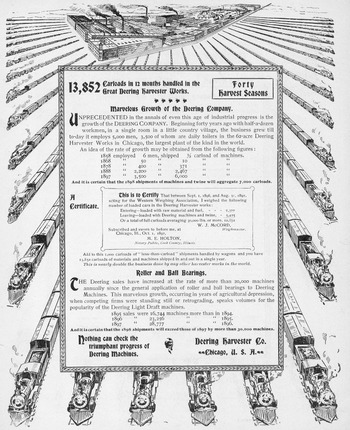
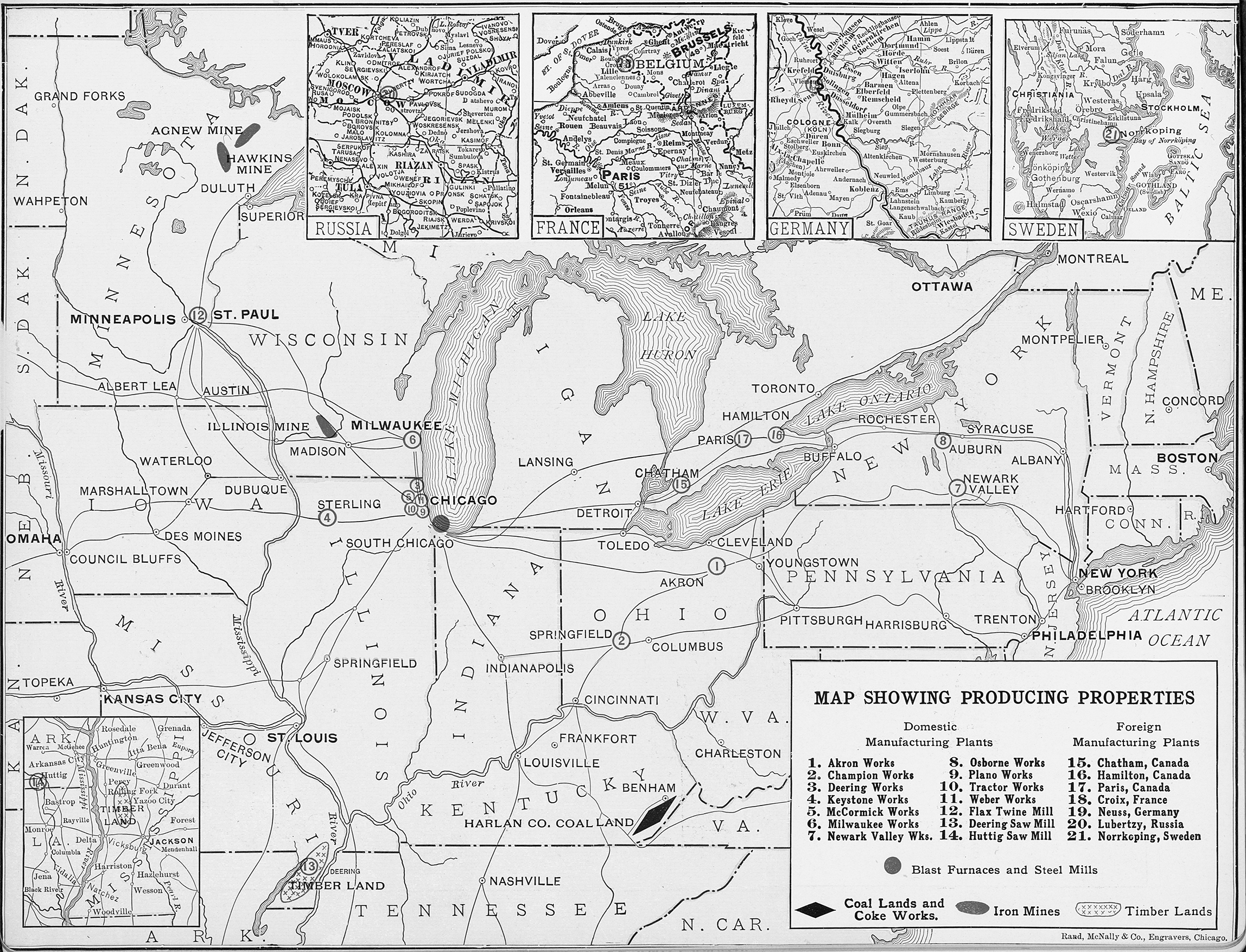
Consider first the former entrepreneurs’ seven brands and factories. The 1906 agreement’s eleventh provision read: “All names of companies shall be continued in the same order and in substantially the same form as at present.” The issue of brands thus was important enough to be part of this deal. Product lines had ties to localities in the Midwest and beyond. The Bureau made a point of identifying firms with their hometowns: Champion’s was Springfield, Ohio; Plano’s, West Pullman, Illinois; Minnie’s, St. Paul, Minnesota (Figure 2).Footnote 78 How did owners balance ties to localities with new demands of the merged firm?
International Harvester Company, 1911 Annual Report, p. 43. Wisconsin Historical Society, WHS-147185.
Cyrus McCormick offered insight in the 1907 Annual Report. Reflecting on “the first two or three years,” he pointed to “new lines of manufacture, such as wagons, manure spreaders, gasoline engines, cream separators, and similar products.” He reported “the expenditure of a large amount of capital,” stating, “Many transfers of equipment and men from one plant to another were made in order to concentrate the manufacturing energies engaged upon the old line of harvesting machinery and tillage implements, as well as to provide facilities for the production of the new lines.” There also were acquisitions. Four proved controversial, but some helped extend “new lines.”Footnote 79
Although not expeditious, progress was made. The Bureau of Corporations cited IH’s integration of steel and its volume for its competitive edge in 1910–1911. Although “selling expense to sales” exceeded independents’, the Bureau reasoned that the sales force blanketed or monopolized markets (a term it used) to realize cost savings “without reducing prices.” Consider, too, trends: From 1903 to 1911, sales-expense ratios fell.Footnote 80 True, no one plant showed “efficiency” gains, but agency data suggested that a shift in production improved overall levels. The 1907 Annual Report recalled: “The manufacture of harvesting machines at the Milwaukee (Wis.) Works and the Plano Works (West Pullman, Ill.) was transferred during the season 1905 to the McCormick and Deering Works respectively.”Footnote 81
Owners could have closed small factories; but having concentrated harvesters at the two most efficient plants, they directed small plants to build new items like “autowagons” and preharvest products on a large scale. For instance, the Bureau described Plano: “The manufacture of [manure] spreaders was begun at this plant in 1905, and of wagons in 1906.” From just 4 percent of all sales in 1903, new lines rose to 20 percent in 1912. Factories appear to have sent products overseas, but what fraction is unclear. “Foreign business” increased in these years from 23 to 41 percent of sales. In 1906 IH began adding plants overseas, as Carstensen explained. Combining nonharvesting lines and exports gave new purpose to small factories, like Plano’s, in their communities.Footnote 82
Antitrust also complicated the conventional account. Harvester’s size and market power contributed to state antitrust action.Footnote 83 Then there were prices. Prior to 1908, Harvester could have raised or lowered prices, but did neither. However, officials’ outlook shifted (for reasons not altogether clear). The Bureau found for 1909: “The extraordinary increase in this year is partly explained by a great increase in sales of new lines and an increase in the foreign trade, and also partly by an increase in prices.”Footnote 84
Pricing may have helped spark a 1912 antitrust case, which led to a 1918 consent decree. The McCormick grandson cited “the provision of the Court’s decree limiting the Company to a single dealer in each community.” It nudged IH to focus on “a composite” line. “Each International dealer … was able to stock, sell, and service all the tractors, motor trucks, grain binders, … and the many other items of the McCormick-Deering line.” IH had fought the suit, yet as the grandson wrote, the result corresponded with a simpler system. In addition, when “compelled by … the 1918 consent decree to sell the Champion, Osborne, and Milwaukee lines of harvesting machinery,” IH “renamed” sites after their hometowns.Footnote 85
Owner conflict hampered efficiency; the McCormicks improved prospects after 1906. This conventional view may be extended. A social dimension—owners’ ties to brands and factories in local communities—as well as a consent decree—complicated management’s central role. The point may be rephrased: Owners’ social ties may have constrained how management approached efficiency. This suggestion calls for new research. Put as questions: What role did owners’ ties to brands and factories play at Harvester and other mergers? How did prices—and antitrust—affect disquiet?Footnote 86
Conclusion
Chandler framed mergers’ evolution in terms of management and efficiency. The IH case study offers an additional conceptualization based on owner conflict. Consider the questions: Were a merger’s owners conflicted? Under what sort of governance structure were disputes, including control, confronted? How were solutions arrived at? What tools, whether voting trusts or other devices, did owners use to mitigate conflict? What impact did particular owner dynamics have for a firm’s efficiency? Rather than pass over owners, this case finds strife important to understanding a merger’s evolution.Footnote 87
The Harvester case study leads to another conclusion related to Berle and Means, who focused on “an ever wider dispersion of stock ownership” and “management control.” When the Deerings transferred part of their holdings, this did not yield “management control.” The pattern of ownership was varied, and the McCormicks either closed in on or obtained “majority control” (Table 1).Footnote 88 In contrast to “management control” presumably leading to better earnings, Harvester’s profits improved under the voting trust (Table 3). Put another way, the McCormicks handled many problems effectively, though certainly not all, most notably labor matters. The Harvester experience yields an insight about methodology—that is, a call to study the effect of corporate governance formats on efficiency in terms of case studies grounded in their specific contexts.Footnote 89
In the end, Perkins did not act alone. Gary, Cyrus McCormick, and others played roles. (The McCormicks would remain active at Harvester until it expired in the 1980s.) Yet Perkins likely had a firm hand in drafting the 1906 agreement. From his vantage point, he had fashioned an elegant answer to the question of how to mitigate owner conflict. This did not make him “friends” with the other two sets of owners. Still, Morgan’s partner illustrated one search for compromise.Footnote 90
I thank the journal’s anonymous referees, Angus Burgin, Christy Ford Chapin, Walter Friedman, Louis Galambos, Shane Hamilton, Peter Jelavich, Naomi R. Lamoreaux, Kenneth Lipartito, Andrew Popp, archivists and librarians at Columbia University, The Johns Hopkins University, The University of Texas at Austin, and the Wisconsin Historical Society, especially Sally Jacobs. I also thank The University of Texas at Austin for funding this project many years ago, and thank Louis Galambos for hosting an early version of this paper at his seminar, The Institute for Applied Economics, Global Health, and the Study of Business Enterprise at Johns Hopkins University.