Background
The current COVID-19 pandemic has resulted in increased unemployment and exit from the workforce, especially for women (Statistics New Zealand, 2020a). It is reasonable to expect that this changing economic climate and large-scale job loss will impact population-level mental health measures such as suicide rates. Unemployment is a well-established risk factor for suicide, a finding that is consistent across settings and study design (Milner, Page, & LaMontagne, Reference Milner, Page and LaMontagne2014b; Platt, Reference Platt1984).
The relationships between unemployment, suicide, and gender are complex. Gender differences in the epidemiology of suicide mean that many more men die by suicide than women. Hence, when considering the total burden of unemployed suicides, there is likely to be a greater overall number of suicides among men compared to women (e.g. Chan, Yip, Wong, & Chen, Reference Chan, Yip, Wong and Chen2007). There is less consensus on whether the relative increase in suicide risk attributed to unemployment differs for men and women. Unemployment is found to be an important risk factor for male suicide (Andrés, Collings, & Qin, Reference Andrés, Collings and Qin2010; Qin, Agerbo, & Mortensen, Reference Qin, Agerbo and Mortensen2003), which may reflect the primacy of employment to masculine identity (Scourfield, Fincham, Langer, & Shiner, Reference Scourfield, Fincham, Langer and Shiner2012; Shiner, Scourfield, Fincham, & Langer, Reference Shiner, Scourfield, Fincham and Langer2009). However, in cohort studies where gender has been considered, unemployment is also associated with an increased likelihood of female suicide, even more so than men, despite employment playing a less central role in feminine identity (Blakely, Collings, & Atkinson, Reference Blakely, Collings and Atkinson2003; Corcoran & Arensman, Reference Corcoran and Arensman2011; Milner, Morrell, & LaMontagne, Reference Milner, Morrell and LaMontagne2014a). For example, a study by Corcoran and Arensman (Reference Corcoran and Arensman2011) reported that the rate-ratio of suicide (plus undetermined deaths) for unemployed women aged 35–54 years was 5.91 [95% confidence interval (CI): 4.18–8.35] compared to employed women of the same age. For men in this same age group, the rate-ratio was 3.63 (95% CI: 3.12–4.22) comparing men who were unemployed to those who are employed.
There is a lack of cohort studies studying the relationship between employment status and presentations to health care facilities for self-harm, a behaviour more common among women (Carr et al., Reference Carr, Ashcroft, Kontopantelis, Awenat, Cooper, Chew-Graham and Webb2016; McManus et al., Reference McManus, Gunnell, Cooper, Bebbington, Howard, Brugha and Appleby2019). There has, however, been some exploration of the impact of the wider economic environment on self-harm presentations. One study set in Iceland assessed the effect of a recession on self-harm, finding the highest rates of self-harm and suicide attempts among men at the height of the economic boom and a decrease in new attendances among both men and women after the economic collapse (Ásgeirsdóttir et al., Reference Ásgeirsdóttir, Ásgeirsdóttir, Nyberg, Thorsteinsdottir, Mogensen, Matthíasson and Hauksdóttir2016). However, a study set in the UK found increased rates of self-harm in areas where there were greater rises in unemployment. Further, there was an increase in the proportion of unemployed men and women presenting to health care facilities for deliberate self-harm following an economic recession, compared to the proportion of unemployed persons who presented prior to recession (Hawton et al., Reference Hawton, Bergen, Geulayov, Waters, Ness, Cooper and Kapur2016). Only the second of these studies was able to assess employment status at the individual level (the study included both ecological and patient-level data), and neither were able to examine the wide range of potential confounding influences on the self-harm and employment relationship. It remains to be seen the extent to which employment impacts self-harm and suicide in the economic downturn in the current COVID-19 pandemic.
One continuing debate is the extent to which the greater risk of suicide observed among those who are unemployed is due to underlying mental health problems. This is because unemployment may lead to poorer mental health; at the same time, those persons with poorer mental health are more likely to become unemployed (Kaspersen et al., Reference Kaspersen, Pape, Vie, Ose, Krokstad, Gunnell and Bjørngaard2016; Milner et al., Reference Milner, Page and LaMontagne2014b). In fact, there is evidence for both of these directions (Lundin, Lundberg, Allebeck, & Hemmingsson, Reference Lundin, Lundberg, Allebeck and Hemmingsson2012; Milner et al., Reference Milner, Page and LaMontagne2014b). This emphasises the importance of careful consideration of the adjustment of analyses for mental health problems that occur prior to both unemployment/being not in the labour force (NILF) and later self-harm/suicide.
The aim of the current study is to conduct a country-level record linkage study of the role of employment status on both suicide (mortality) and presentations for self-harm among women and men. The study will answer the following questions: (1) what is the relationship between employment status and suicide/self-harm, after controlling for prior mental health conditions, health service and medication use? and (2) is this relationship between employment status and suicide/self-harm modified by gender?
This study was set in New Zealand and employment was measured at the time of the 2013 Census. In 2013 New Zealand was experiencing steady economic growth following a recession in 2008/2009 and the regional impact of a major natural disaster in 2011 (New Zealand Government, 2013). Unemployment was moderately high at around 6% and starting to decline again from the peak seen after the recession (Statistics New Zealand, 2020b).
Methods
Data
Data were sourced from New Zealand's Integrated Data Infrastructure (IDI). The IDI is a collection of government and non-government data sets that are probabilistically linked at the individual (person) level (Milne et al., Reference Milne, Atkinson, Blakely, Day, Douwes, Gibb and Teng2019; Statistics New Zealand, 2018). IDI research is subject to strict privacy and security guidelines including access to de-identified data for approved researchers only, secure virtual and physical environments for data access, and confidentialisation of all outputs prior to release from the secure environment. The specific IDI data sets used for this study are listed below in the ‘Measures' subsection.
Study population
All New Zealand residents aged 18–64 years, who completed the employment questions on their 2013 Census form, were included in this study. Individuals were removed from the population if they emigrated overseas during the study period (and thus their subsequent self-harm events or death would not be recorded) (Gibb, Bycroft, & Matheson-Dunning, Reference Gibb, Bycroft and Matheson-Dunning2016). Figure 1 shows the construction of the final population. The final population sizes were 2 276 421 (Model 1) and 2 193 432 (Models 2 and 3).
Participant selection diagram.

Measures
Outcome: suicide
Deaths by suicide were identified from the Ministry of Health mortality collection. Deaths from 5 March 2013 (Census day) onwards with the external cause of injury ICD-10 codes of X60 to X84 were included in this study. Death data were available until the end of 2016 allowing almost 4 years of follow-up.
Outcome: self-harm
The Ministry of Health publicly funded hospital admissions data set (referred to outside the IDI as the National Minimum Data set, NMDS) contains information on all publicly funded hospital stays longer than 3 h, including some emergency department stays if they are longer than 3 h. Any stay subsequent to 5 March 2013 (Census day) with the corresponding external cause of injury ICD-10 codes X60–X84 or ICD-9 codes E950–E959 was classified as a self-harm event. Any event for each individual from March 2013 to December 2018 was identified as the self-harm outcome.
Exposure: employment
Employment status as of 5 March 2013 was determined from 2013 Census data. Employment status was classified into the following three categories: employed, not employed, and NILF. Individuals who reported being in paid employment were categorised as ‘employed.’ Individuals who reported that they were not employed and had either looked for work in the last 4 weeks or were available for work were categorised as ‘unemployed.’ Individuals who reported that they were not employed and not looking or available for work were categorised as ‘not in the labour force.’
Confounders: demographics
Ethnicity
Ethnicity was sourced from the personal detail table in IDI, which uses ethnicity information from the 2013 Census (considered to be the highest quality ethnicity information) if available, otherwise from birth records, and then other administrative sources if Census and birth records are not available. Individuals were classified into one or more of the following major ethnic groups: (i) New Zealand European; (ii) Māori; (iii) Pacific; (iv) Asian; (v) Middle Eastern, Latin American, or African (MELAA), and (vi) Other. In compliance with the statistical standard for reporting ethnicity in New Zealand, ethnic groups were not mutually exclusive and individuals could belong to multiple groups.
Sex
Sex was classified as ‘male’ or ‘female’ and was sourced from the personal detail table which collates sex information from across a range of IDI tables. These tables vary in whether they record sex, gender, or a mix of the two concepts, thus the final variable is a mix of a range of different sex and gender definitions.
Highest qualification
The highest formal qualification at the time of the 2013 census was sourced from census data. It was classified into the following categories: no formal qualification, high school qualification, tertiary qualification below Bachelor's degree, Bachelor's degree, and postgraduate degree.
Deprivation
Area-level socioeconomic deprivation was based on the meshblock (small area of ~100 households) in which an individual lived at the time of the 2013 Census. This information was sourced from the address notification table, which collates address information from a range of IDI data sets. The most recently updated address prior to the 2013 Census was used to obtain meshblock information. Deprivation scores were assigned using the index of multiple deprivations (IMD) (Exeter, Zhao, Crengle, Lee, & Browne, Reference Exeter, Zhao, Crengle, Lee and Browne2017). To avoid problems with multicollinearity we used the variant of the IMD that did not include information about the highest educational qualification. Deprivation was classified into quintiles (1 = least deprived, 5 = most deprived).
Rurality
Rurality was assigned to the address at which an individual was living at the time of the 2013 census using the standard urban–rural classification (Statistics New Zealand, 2016). The standard classification of urban/rural areas in New Zealand is a five-point classification: (1) Main urban (centred on a city or major urban area, population of at least 30 000); (2) secondary urban (centred on larger regional centres, population: 10 000– 29 999); (3) minor urban (centred around smaller towns, population: 1 000–9 999); (4) rural centre (population 300–999) and (5) other rural. These were collapsed into two groups: urban (main urban, secondary urban and minor urban area) and rural (rural centre and other rural).
Mental health history
Prior mental health service use
Prior mental health service use was determined from the Programme for the Integration of Mental Health Data (PRIMHD) data set which contains records for all publicly funded specialist secondary mental health service use in New Zealand dating back to July 2008. Publicly funded specialist secondary mental health care is targeted at the 3% of the population with the highest mental health need; thus the majority of care for mild to moderate mental health problems happens in primary care settings and will not be recorded in this data set. Anyone with a record of a face-to-face consultation or treatment session in PRIMHD was classified as having prior mental health service use.
Prior antidepressant use
For antidepressant use prior to the 2013 Census was established using data from the pharmaceutical collection. This collection records all publicly funded medication dispensing from community pharmacies in New Zealand from 2006 onwards. Anyone with a record in this collection for a dispensing of medication in the ‘antidepressants’ therapeutic group from 2006 until February 2013 was considered to have had prior antidepressant use.
Prior self-harm
Prior-self harm was identified from the Ministry of Health publicly funded hospital admissions data set which contains information on all publicly funded hospital stays longer than 3 h since 1988, although coverage of emergency department visits longer than 3 h is incomplete before 2013. Any stay with admission from 1998 to 4 March 2013 (Census day) and the corresponding external cause of injury ICD-10 codes X60–X84 or ICD-9 codes E950–E959 was classified as prior self-harm.
Statistical methods
Data extraction and management were completed in SAS Enterprise Guide 7.1 and regression analyses were done in R version 3.4.1. Associations between employment status and suicide/self-harm were tested by fitting logistic regression models in which the dependent variable (either death by suicide or self-harm) was modelled as a function of employment status (three levels: employed, unemployed and NILF) and, for some models, covariates. Confounders were added to the model in two groups: demographic confounders (age, sex, ethnicity, socioeconomic deprivation and highest educational qualification) and mental health history (prior mental health service use, prior antidepressant use, prior self-harm). Separate models were fitted for males and females to allow the associations between employment status and suicide/self-harm to vary by sex. Following standard practice in New Zealand ethnicity was included in the models as a series of six binary variables representing membership in each of the six ethnic groups (NZ European, Māori, Pacific, Asian, Middle Eastern/Latin American/African (MELAA) and others) (Statistics New Zealand, 2005). Individuals could belong to more than one ethnic group.
Results
Table 1 shows the characteristics of the sample, for the total sample and also broken down by employment status. Overall 76.6% of the sample was employed, 10.4% unemployed, and 13.0% NILF. There were slightly more females than males in the sample. The majority of the sample identified with the European ethnicity group (73.5%), followed by Māori (13.1%), Asian (12.8%), Pacific (6.0%), Other (1.9%) and MELAA (1.3%). A total of 49.8% of the sample had some form of tertiary qualification, 35.1% had a high school qualification, and 15.1% of the population had no formal qualification. The sample was approximately evenly spread across the five deprivation quintiles although there were slightly lower numbers of people in the most deprived (5) quintile. In total, 13.5% of people were living in rural areas. A total of 18.5% of the sample had received antidepressants previously, 6.1% had been in contact with secondary specialist mental health services, and 1.5% had a prior hospital or emergency department visit for self-harm.
Demographics of the cohort, overall and by employment status

MELAA, Middle Eastern, Latin American, or African; N, no; Y, yes.
There were some differences in demographics between the employment status groups. The employed group contained slightly more males than females, while the unemployed and NILF groups contained more females than males. The employed group contained a greater proportion of people with European ethnicity and lower proportions of people with Māori, Pacific and Asian ethnicity than the other groups. Deprivation was highest in the unemployed group (32.5% in most deprived quintile 5) followed by NILF (22.4%) and employed (15.3%). The unemployed group was less often living in rural areas (9.1%) than the employed (14.4%) or NILF groups (12.0%). The unemployed and NILF groups were more likely than the employed group to have had prior mental health service contact. In the unemployed group 14.7% of people had prior contact with secondary specialist mental health services, and 11.9% in the NILF group, compared to 4.0% in the employed group. The unemployed and NILF groups also had higher rates of antidepressant dispensing (21.8 and 26.0% compared to 16.8%) and self-harm (both 3.0% compared to 1.1%) than the employed group.
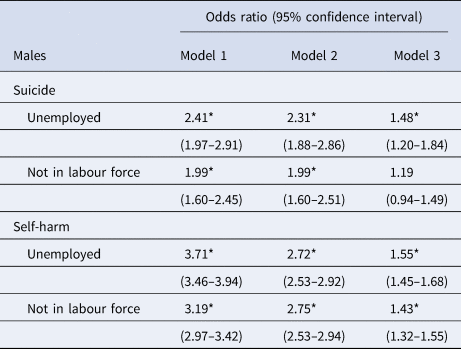
Results from the logistic regression models for males are in Table 2. The top panel shows the results for suicide. Model 1 contains the employment status predictor only and is not adjusted for confounding. Being unemployed [odds ratio (OR): 2.41, 95% CI: 1.97–2.91] or NILF (OR: 1.99, 95% CI: 1.60–2.45) was associated with a higher likelihood of suicide among men compared to being employed. Adjusting for demographics (model 2) did not substantively reduce the size of the effect, but additional adjustment for mental health history reduced it considerably. Full adjustment (model 3) resulted in adjusted ORs of 1.48 (95% CI: 1.20–1.84) for unemployment and 1.19 (95% CI: 0.94–1.49) for NILF.
Odds ratios from logistic regression models for males

* p < 0.05.
Model 1 is unadjusted.
Model 2 adjusts for age, ethnicity, highest qualification, area deprivation and rurality.
Model 3 adjusts for age, ethnicity, highest qualification, area deprivation and rurality as well as prior anti-depressant use, prior mental health service use and prior self-harm.
Similar results were seen for self-harm (bottom panel of Table 2). Prior to adjustment, being unemployed (OR: 3.71, 95% CI: 3.46–3.94) or NILF (OR: 3.19, 95% CI: 2.97–3.42) was associated with a higher likelihood of a hospital/emergency visit for self-harm compared to being employed. Adjusting for demographic factors reduced the ORs slightly. Additional adjustment for mental health history reduced the effect considerably, resulting in ORs of 1.55 (95% CI: 1.45–1.68) for unemployed and 1.43 (95% CI: 1.32–1.55) for NILF.
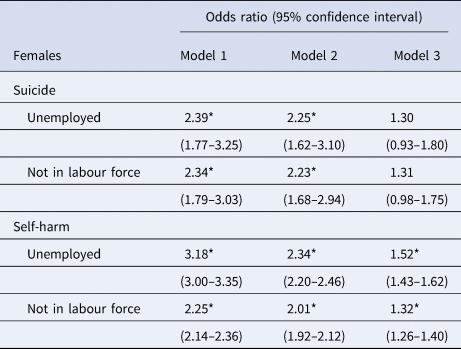
Results for females can be seen in Table 3. The top panel shows the results for suicide. Being unemployed (OR: 2.39, 95% CI: 1.77–3.25) or NILF (OR: 2.34, 95% CI: 1.79–3.03) was associated with a higher likelihood of suicide compared to being employed. Adjusting for demographics (model 2) reduced the size of the effect very slightly, and additional adjustment for mental health history reduced it substantially. After full adjustment (model 3) of the odds of suicide was 30% higher among both those who were unemployed (OR: 1.30, 95% CI: 0.93–1.80) and those NILF (OR: 1.31, 95% CI: 0.98–1.75) compared to those who were employed.
Odds ratios from logistic regression models for females

* p < 0.05.
Model 1 is unadjusted.
Model 2 adjusts for age, ethnicity, highest qualification, area deprivation and rurality.
Model 3 adjusts for age, ethnicity, highest qualification, area deprivation and rurality as well as prior anti-depressant use, prior mental health service use and prior self-harm.
Similar results were seen for self-harm (bottom panel of Table 2). Prior to adjustment being unemployed (OR: 3.18, 95% CI: 3.00–3.35) or NILF (OR: 2.25, 95% CI: 2.14–2.36) was associated with a higher likelihood of a hospital/emergency visit for self-harm compared to being employed. Adjusting for demographic confounders reduced the effect (Model 2) and additional adjustment for mental health history reduced the effect of employment on self-harm further, resulting in ORs of 1.52 (95% CI: 1.43–1.62) for unemployed and 1.32 (95% CI: 1.26–1.40) for NILF.
Discussion
This study highlights the adverse outcomes of being excluded from work on the risk of suicide and self-harm. Being unemployed and NILF was associated with elevated odds of suicidal behaviours among both women and men, compared to being employed.
Our results confirm previous research about unemployment and suicide (Milner, Page, & LaMontagne, Reference Milner, Page and LaMontagne2013; Platt, Reference Platt1984). We are among the first, however, to document the unfavourable effects of being unemployed or NILF on self-harm. As noted above, there has been relatively little research on this topic (Ásgeirsdóttir et al., Reference Ásgeirsdóttir, Ásgeirsdóttir, Nyberg, Thorsteinsdottir, Mogensen, Matthíasson and Hauksdóttir2016) (Hawton et al., Reference Hawton, Bergen, Geulayov, Waters, Ness, Cooper and Kapur2016). We were able to control for a number of potential confounders of employment status and suicide/self-harm including use of mental health services and medications, and prior history of self-harm. However, even after adjustment for these factors, employment status had an observable impact on suicide and self-harm. We believe this is suggestive of a causal relationship. Our study thus provides some clarity to the longstanding research debate about the extent to which unemployment and being excluded from the labour market leads to poorer mental health (and then, suicide), v. the extent to which poor mental health leads to both exclusion from employment and later suicidal behaviours (Butterworth, Leach, Pirkis, & Kelaher, Reference Butterworth, Leach, Pirkis and Kelaher2012; Lundin et al., Reference Lundin, Lundberg, Allebeck and Hemmingsson2012; Milner et al., Reference Milner, Page and LaMontagne2014b). Our results show that employment status is an important, possibly causal, contributor to suicide and self-harm among both women and men, after consideration of mental health-related risk factors.
Our findings also have implications for understanding the complex relationships between gender, employment and suicide. Previous studies have described the centrality of employment status as a risk factor for male suicide (Andrés et al., Reference Andrés, Collings and Qin2010; Qin et al., Reference Qin, Agerbo and Mortensen2003). However, our results emphasise the importance of having a job for women also. This finding is in contrast to previous theoretical work speculating that women have a lower risk of suicide following unemployment because their identities are less connected to the world of work, and more connected to family and community life (for a review, please see Kushner & Sterk, Reference Kushner and Sterk2005). The implication of this is that employment status is not as relevant to female suicidal behaviours as it may be to male suicide. However, in the current study, the OR for women who are unemployed or NILF (in comparison to employed women) appears to be substantial, particularly for self-harm, where we had the greatest power to observe effects. In comparison, there were fewer suicide deaths for women, which reduced statistical power. Our study findings have some concordance with research in mental health, which has documented the particularly detrimental effects of unemployment for women (Hollander, Bruce, Ekberg, Burström, & Ekblad, Reference Hollander, Bruce, Ekberg, Burström and Ekblad2013; Linander, Hammarström, & Johansson, Reference Linander, Hammarström and Johansson2015; Mandal & Roe, Reference Mandal and Roe2007) as well previous retrospective mortality studies on suicide (Milner et al., Reference Milner, Morrell and LaMontagne2014a). As an explanation for the impact of the loss of a job on women, it is important to note that women are generally financially worse-off than their male counterparts (Leopold, Reference Leopold2018; Ruel & Hauser, Reference Ruel and Hauser2013). When they are employed, they are often employed in lower-earning and more precarious work (Campos-Serna, Ronda-Pérez, Artazcoz, Moen, & Benavides, Reference Campos-Serna, Ronda-Pérez, Artazcoz, Moen and Benavides2013). Hence, the deprivation of work may be associated with particularly adverse economic outcomes for women, leading to an increased risk of self-harm.
On the flip side, our results clearly demonstrate that having a job is associated with better mental health, supporting previous mental health research which also documents these effects (Modini et al., Reference Modini, Joyce, Mykletun, Christensen, Bryant, Mitchell and Harvey2016). The mechanisms for the positive effects of having a job likely operate through both tangible and intangible pathways (Jahoda, Reference Jahoda1981, Reference Jahoda1982). Tangible impacts may include remuneration through pay and other entitlements such as paid leave. Intangible pathways likely operate through psychosocial pathways such as a sense of identity and membership in a social group, as well provision of a purpose and time structure to a person's day (Stiglbauer & Batinic, Reference Stiglbauer and Batinic2012). The denial of these experiences – through being either unemployed or being NILF – clearly imposes a risk in terms of suicide and self-harm. It is important to note, however, that unemployment and being NILF are different states. In the former, a person reports actively looking for work. In the latter, a person may not be looking for work. Instead, they may have left the labour force due to a diverse range of reasons including illness or disability, having to care for children or other reasons. Regardless of the reason, exclusion from the work has been associated with a greater likelihood of economic stress, family tension and marital disruption, and risk of involvement in crime (Brand, Reference Brand2015; Henderson, Hawke, Chaim, & Network, Reference Henderson, Hawke, Chaim and Network2017; Samoilenko & Carter, Reference Samoilenko and Carter2015). Hence, the lack of work brings with it a number of problematic individual and societal outcomes that may be risk factors for suicide and self-harm.
The results of this study are particularly salient in the context of the COVID-19 pandemic, which has been associated with mass increases in unemployment and exit from the labour force, and we may well see subsequent increases in self-harm and suicide. As temporary income support measures, which in NZ have included the COVID Wage Subsidy (to keep people in employment) and the COVID Income Support Payment (to provide temporarily higher benefits to those who have lost employment), are phased out we are likely to start to see the real impact of COVID-19 on income and employment. Previous economic recessions have been associated with increases in poor mental health outcomes and suicidal behaviour, particularly via unemployment (Frasquilho et al., Reference Frasquilho, Matos, Salonna, Guerriero, Storti, Gaspar and Caldas-de-Almeida2015; Haw et al., Reference Haw, Hawton, Gunnell and Platt2015), and a COVID-19-related recession also has the potential to lead to increased rates of suicide (McIntyre & Lee, Reference McIntyre and Lee2020).
The strengths of this study include its population-level data-linkage design which allowed the examination of exposure and outcomes in the complete national population. The longitudinal nature of the mental health treatment data meant that we were able to measure mental health history prior to measuring employment status, thus enabling us to take account of the potential influence of mental health status on employment. Moreover, we had the ability to control a substantial number of confounders. However, we were limited in our selection of confounders to those that were available in the data sets available in the NZ IDI. In particular, data from primary care services is not available, and so we were not able to control for mild to moderate mental distress that was not treated with antidepressants and was not severe enough to qualify for referral to secondary specialist services. Measures of prior antidepressant use were based on the chemical prescribed, as information about indication was not available. Therefore, some of these prescribing may have been for non-mental health reasons. In addition, there may also be some misclassification of self-harm both as an indicator of prior mental health problems and as an outcome, as self-harm that did not result in hospital presentation could not be measured.
Another factor to consider when assessing the results of this study is that we did not examine how proximate the occurrence of mental health history was to the exposure and outcomes. For example, we could speculate that prior self-harm occurring closer in time would have a greater effect than the experience of self-harm occurring further back in time. The sex measure in this study was binary and did not allow for examination of outcomes for the transgender or gender non-binary groups. While these groups are small, they are likely to have high rates of suicide and self-harm (Adams, Hitomi, & Moody, Reference Adams, Hitomi and Moody2017; McNeil, Ellis, & Eccles, Reference McNeil, Ellis and Eccles2017; Rimes, Goodship, Ussher, Baker, & West, Reference Rimes, Goodship, Ussher, Baker and West2019) and thus are an important focus for future work on gender and suicide.
In conclusion, the findings of this population-level study indicate that the experience of being either NILF or unemployed is associated with an elevated risk of both suicide and self-harm. This paper extends previous research through its population-level approach, and use of national linked health, mortality and census linked data. The results of this study suggest the importance of greater attention to the development and evaluation of programs that can facilitate the re-employment of men and women who have left work (Mawn et al., Reference Mawn, Oliver, Akhter, Bambra, Torgerson, Bridle and Stain2017; Moore et al., Reference Moore, Kapur, Hawton, Richards, Metcalfe and Gunnell2017). At the same time, we would suggest the importance of providing mental health and emotional support to those who have left a job or who are not in the labour market (Mawn et al., Reference Mawn, Oliver, Akhter, Bambra, Torgerson, Bridle and Stain2017; Moore et al., Reference Moore, Kapur, Hawton, Richards, Metcalfe and Gunnell2017). These dual approaches are particularly important as the full economic impacts of the COVID-19 become apparent in NZ and across the world.
Acknowledgements
The authors would like to pay tribute to our co-author Associate Professor Allison Milner who was killed in August 2019. Allison was an exceptional researcher and colleague who is sorely missed.
Ethical approval
This study was approved by the University of Otago Human Ethics Committee (ref HD17/067).
Financial support
This work was supported by a National Health and Medical Research Council of Australia funded by the Centre of Research Excellence in Disability and Health (APP1116385) (AK, GD). AM was funded by a Victorian Health and Medical Research Fellowship (Department of Health and Human Services, Victorian Government).
Conflicts of interest
None.