Bilingual children generally perform more poorly than monolingual children on tests of receptive vocabulary such as the Peabody Picture Vocabulary Test (PPVT; Dunn & Dunn, Reference Dunn and Dunn2007) (Bialystok et al., Reference Bialystok, Luk, Peets and Yang2010). A possible reason for the vocabulary size difference is that bilingual children spread their language learning and language use across two languages, thereby learning fewer vocabulary items in each language than monolingual speakers of that language. In addition, bilingual children produce fewer items than monolingual children during semantic fluency tasks (Kormi-Nouri et al., Reference Kormi-Nouri, Moradi, Moradi, Akbari-Zardkhaneh and Zahedian2012), providing further evidence of reduced vocabulary knowledge. In contrast to evidence from language processing, bilingual children often exhibit better performance than monolingual children on nonlinguistic tasks requiring executive function (EF; meta-analysis in Adesope et al., Reference Adesope, Lavin, Thompson and Ungerleider2010; review in Barac et al., Reference Barac, Bialystok, Castro and Sanchez2014), although these effects are not always found (Dunabeitia et al., Reference Dunabeitia, Hernandez, Anton, Macizo, Estevez, Fuentes and Carreiras2014; meta-analysis in Donnelly et al., Reference Donnelly, Brooks and Homer2019). This interaction between verbal and cognitive outcomes for bilinguals has also been demonstrated within the same groups of children. Calvo and Bialystok (Reference Calvo and Bialystok2014) tested 175 six-year-olds and reported that bilingual children performed better than monolinguals on cognitive tasks but more poorly than monolingual children on verbal tasks. Similarly, Blom et al. (Reference Blom, Küntay, Messer, Verhagen and Leseman2014) found better working memory in bilingual Turkish–Dutch children but poorer verbal performance than in their monolingual peers.
One explanation for better performance on cognitive tasks is that bilingual children use domain-general processes that are part of the EF system (Luk et al., Reference Luk, Green, Abutalebi and Grady2012) to manage the constant conflict between their two jointly activated languages (Kroll et al., Reference Kroll, Dussias, Bogulski, Valdes-Kroff and Ross2012; Timmer et al., Reference Timmer, Ganushchak, Ceusters and Schiller2014; Wu, & Thierry, Reference Wu and Thierry2012) to select the target language, thereby modifying those attention and selection systems. Although earlier accounts attributed this benefit to practice in inhibition of the nontarget language (e.g., Bialystok & Senman, Reference Bialystok and Senman2004; Martin-Rhee & Bialystok, Reference Martin-Rhee and Bialystok2008) as described in the Inhibitory Control Model by Green (Reference Green1998), the predictions from an inhibition account are not supported by evidence with cognitive tasks (discussion in Bialystok Reference Bialystok2015, Reference Bialystok2017). For example, in cases where bilinguals outperform monolinguals on such EF tasks as the flanker, the benefit is found equally for incongruent trials that clearly require inhibition and congruent trials for which no inhibition is needed, as first noted by Hilchey and Klein (Reference Hilchey and Klein2011).
The central feature of EF is that it refers to a set of processes that involve effortful attention and selection, and the current view is that continual experience in recruiting selection for language processing leads to an adaptation in those networks making them more effective for nonlinguistic tasks as well (Bialystok, Reference Bialystok2017). Our approach, therefore, is to consider selective attention as the relevant process that discriminates monolingual from bilingual cognitive performance. Selective attention is a persistent feature of the cognitive tasks that have shown better performance by bilingual children (review in Barac et al., Reference Barac, Bialystok, Castro and Sanchez2014). Unlike inhibition that formed the basis for earlier explanations of bilingual processing, selective attention is not restricted to a specific component of EF, such as inhibition in the model by Miyake and colleagues (Miyake et al., Reference Miyake, Friedman, Emerson, Witzki, Howerter and Wager2000), but rather indicates a limited resource that guides attention for a range of EF processing. Thus, selective attention may include inhibition but it is not explained by it. Selective attention is common to the EF tasks used in most of this research showing better performance by bilingual than monolingual children (Barac et al., Reference Barac, Bialystok, Castro and Sanchez2014) and may also be the basis for selecting the target language by focusing attention on relevant contextual and linguistic features. What is not known is how bilingual children will perform on linguistic tasks that also require effortful selective attention. The combination of the need for selective attention and verbal processing is pervasive in children’s language use as they acquire literacy and learn to process complex sentences as a necessary basis for learning and academic success.
Evidence for precocious performance by bilingual children on EF tasks comes from a variety of paradigms. For example, Martin-Rhee and Bialystok (Reference Martin-Rhee and Bialystok2008) administered a Simon task to monolingual and bilingual children who were 4–5 years old and reported faster performance by bilingual children for both congruent and incongruent trials. Similar results have been reported for children performing a flanker task (Bialystok et al., Reference Bialystok, Barac, Blaye and Poulin-Dubois2010; Carlson & Meltzoff, Reference Carlson and Meltzoff2008; Yang et al., Reference Yang, Yang and Lust2011; Yang & Yang, Reference Yang and Yang2016; Yoshida et al., Reference Yoshida, Tran, Benitez and Kuwabara2011), the Dimensional Change Card Sort Task developed by Zelazo et al. (Reference Zelazo, Frye and Rapus1996) (Bialystok, Reference Bialystok1999; Carlson & Meltzoff, Reference Carlson and Meltzoff2008; Okanda et al., Reference Okanda, Moriguchi and Itakura2010; Kalashnikova, & Mattock, Reference Kalashnikova and Mattock2014), and components of the Test of Everyday Attention for Children developed by Manly et al. (Reference Manly, Robertson, Anderson and Nimmo-Smith1999) (Blom et al., Reference Blom, Boerma, Bosma, Cornips and Everaert2017). All these paradigms require attention to target cues in the context of misleading distraction. Importantly, however, some studies find no difference in performance between monolingual and bilingual children on some of these same measures (Dunabeitia et al., Reference Dunabeitia, Hernandez, Anton, Macizo, Estevez, Fuentes and Carreiras2014; Gathercole et al., Reference Gathercole, Thomas, Kennedy, Prys, Young, Vinas Guasch and Jones2014; Morton & Harper, Reference Morton and Harper2007), so these effects are limited by a set of conditions likely reflecting differences in populations, tasks, and contexts (see discussions in Bak, Reference Bak2016; Bialystok, Reference Bialystok2016).
Successful language comprehension is influenced by the ability to manage linguistic and nonlinguistic environmental distractions (Foster & Lavie, Reference Forster and Lavie2008). Therefore, understanding a speaker’s referential intent requires coordinating attention to linguistic and nonlinguistic cues as the linguistic information included in an expression is not sufficient on its own (De Groot et al., Reference De Groot, Kaplan, Rosenblatt, Dews and Winner1995; Kreuz, Reference Kreuz2000). Tone of voice and facial expression are paralinguistic cues that are critical in adult communication, as these are some of the means by which thoughts, emotions, and attitudes are relayed (Fussell & Moss, Reference Fussell and Moss1998; Goldie, Reference Goldie2002; Ortony, Reference Ortony1975; Roberts & Kreuz, Reference Roberts and Kreuz1994). Thus, listeners are required to selectively focus their attention on the target communicative cues and ignore the interference from the nontarget cue, a task that goes beyond formal linguistic knowledge. Adults typically use numerous cues that vary with the context to correctly interpret the meaning of an utterance, particularly when it is ambiguous (Kreuz & Roberts, Reference Kreuz and Roberts1995; Rockwell, Reference Rockwell2000). Thus, facial expression and vocal affect are essential disambiguating cues for understanding referential intent in ambiguous situations (Kreuz & Roberts, Reference Kreuz and Roberts1995; Rockwell, Reference Rockwell2000).
Studies of children’s understanding of vocal affect have indicated that children’s communication strategies are different from those of adults and depend on the developmental level of the child and the situation (Morton et al., Reference Morton, Trehub and Zelazo2003; Waxer & Morton, Reference Waxer and Morton2011). Young children have difficulty when they must track several verbal and nonverbal cues that may conflict or when cues have different meanings depending on the situation or environment (Nurmsoo & Bloom, Reference Nurmsoo and Bloom2008; Yow & Markman, Reference Yow and Markman2011). For example, preschool children can successfully attend to simple communicative cues to interpret a speaker’s referential intent, but complications arise when multiple sources of information that conflict with each other are involved. In these cases, children need to integrate linguistic and paralinguistic information to arrive at the correct interpretation, a process they find difficult (Freire et al., Reference Freire, Eskritt and Lee2002; Nurmsoo & Bloom, Reference Nurmsoo and Bloom2008; Yow & Markman, Reference Yow and Markman2015).
Morton and Trehub (Reference Morton and Trehub2001) presented children (4–7 years) and adults with sentences in which the linguistic information and vocal affect did not always correspond (e.g., “I lost my cat” stated with positive vocal affect). Participants listened to 40 sentences describing happy and sad situations. All sentences were recorded twice, once with happy vocal affect and once with sad vocal affect. Participants were asked to listen carefully and say whether the speaker felt happy or sad, creating a kind of linguistic Stroop task. The results showed that children judged the speaker’s emotion by the semantic content of the sentence, but adults judged the emotion by the tone of voice. These findings suggest that there is a developmental progression in children’s capacity to infer the intended meaning of spoken sentences by integrating linguistic information with nonlinguistic cues.
Similarly, Berman et al. (Reference Berman, Chambers and Graham2010) developed a novel procedure to examine preschoolers’ ability to use vocal affect to understand a speaker’s referential intent. Children who were 3 and 4 years old were shown three images, two of which belonged to the same category but differed in their likelihood of being associated with negative or positive affect (broken doll vs. intact doll) and the third from a different category. Sentences were presented in which the speaker used positive, negative, or neutral emotional expression to ask the child to point to an object (e.g., “Point to the ball.”). Eye fixations were recorded when the ambiguous noun occurred to determine whether the child would look at the “broken” object (e.g., the deflated ball) or the intact object, so pointing responses and eye fixations could be compared. Eye fixation patterns showed that 4-year-olds were more likely to look to the object that matched the speaker’s vocal affect, but pointing responses indicated that children pointed to the intact object regardless of the emotional expression. In contrast, 3-year-old children showed no evidence of attending to vocal affect in either pointing or eye gaze responses. The pointing response is similar to the results reported by Morton and Trehub (Reference Morton and Trehub2001) in which children chose their response in terms of the semantic content rather than tone of voice, but in the study by Berman et al. (Reference Berman, Chambers and Graham2010), the 4-year-olds showed implicit sensitivity to the vocal affect to understand referential intent when ambiguity was involved, despite demonstrating no explicit sensitivity.
These tasks require coordination of linguistic and nonlinguistic information in contexts that create conflict making it difficult to attend to the relevant cues, in short, the typical situation for EF tasks. Given that bilingual children have poorer language processing but better executive functioning, what happens when these demands are combined? Filippi et al. (Reference Filippi, Morris, Richardson, Bright, Thomas, Karmiloff-Smith and Marian2015) showed that bilingual children were better able to comprehend sentences in the presence of linguistic interference than monolinguals. Eight-year-old children were shown images of two animals, one on each side of a computer screen, while they heard a male and a female speaking together. The target sentences were recorded in English and the nontarget sentences were recorded either in English or in an unknown language. The grammatical structure of the target English sentence was easy (subject–verb–object) or difficult (object–subject–verb or object–verb–subject). Children were asked to attend to the target sentence that was cued by the speaker’s gender and ignore the sentence that was presented with the opposite gender voice. The target and nontarget sentences were played concurrently, one in each ear. The target sentence described one animal doing a bad action to another one, and participants had to identify the “bad animal” by choosing the right or left an image on the screen. Bilingual children were more successful at this task than monolinguals, particularly for difficult sentences such as passive construction that were more cognitively demanding than active constructions.
These studies show that children can use verbal and nonverbal cues to comprehend a speaker’s referential intent (Diesendruck et al., Reference Diesendruck, Hall and Graham2006) but they have difficulty when they need to keep track of several cues or when the cues have conflicting meanings (Nurmsoo & Bloom, Reference Nurmsoo and Bloom2008). However, as shown in the study by Filippi and colleagues (Reference Filippi, Morris, Richardson, Bright, Thomas, Karmiloff-Smith and Marian2015), bilingual children were more able than monolinguals to use the paralinguistic information about the speaker to arrive at an interpretation of the sentence, especially when linguistic structures were complex.
Taken together, the research on language and cognitive development in bilingual children rests on two important findings. First, bilingual children perform more poorly than monolinguals on linguistic tasks in part because of their smaller vocabulary size. Second, bilingual children typically outperform monolinguals on some nonlinguistic EF tasks. However, it remains unknown what happens in linguistic tasks that require both language processing and the engagement of EF: Does the advanced EF ability found for bilingual children compensate for their language processing deficits and produce high levels of performance or does the poorer verbal knowledge prevent bilingual children from performing these tasks, especially as the language structures become more complex?
The present study addressed this question by comparing monolingual and bilingual children for their ability to attend to a speaker’s meaning in the presence of communicative cues that interfered with the correct interpretation. The hypothesis was that bilingual children will outperform monolingual children on tasks that require sentence comprehension in the presence of misleading information because of their greater ability with selective attention.
All the children lived in a linguistically diverse city and most children had some degree of exposure to multiple languages. Therefore, data were analyzed both in terms of (a) categorically assigning children to groups described as “monolingual” (little or no experience with non-English languages) or “bilingual” (including varying degrees of bilingual experience) and (b) continuous measures of bilingual experience across the entire sample. Variation in bilingual experience is increasingly recognized as central to investigations of the effects of bilingualism on cognitive outcomes (e.g., Ooi et al., Reference Ooi, Goh, Sorace and Bak2018; Thomas-Sunesson et al., Reference Thomas-Sunesson, Hakuta and Bialystok2018). Both approaches are used in the literature but no direct comparison between them has been made. Applying both methods to the same data can clarify the possible difference between them and contribute to methodological advances in this research.
Method
Participants
One hundred children between 4 and 5 years old were recruited from private daycare centers. All children were typically developing. Parents completed the Language and Social Background Questionnaire (LSBQ; Anderson et al., Reference Anderson, Mak, Keyvani Chahi and Bialystok2018), described below. The responses to this instrument were used both to categorize children as monolingual (n = 36) or bilingual (n = 64) and to obtain a continuous score indicating the degree of bilingual experience for each child. Because of the extensive linguistic diversity in this city, the majority of children have had some contact with and facility in a non-English language, so the terms “monolingual” and “bilingual” are more relative than absolute. The procedures for classifying children into two groups and to determine their degree of bilingualism are described below (see the section “Tasks and Instruments”). According to census data for this city, 47% of the population uses a home language that is not English (Statistics Canada, 2016), so exposure to multiple languages is common but the degree of exposure and degree of proficiency vary widely. The non-English languages included in the sample in order of frequency were Mandarin (9), Spanish (8), Farsi (8), French (7), Tagalog (4), Russian (4), Hebrew (3), Hindi (3), Cantonese (3), Chinese (unspecified dialect) (2), Amharic (2), Portuguese (2), Arabic (1), Bangla (1), Bosnian (1), Croatian (1), Greek (1), Italian (2), Japanese (1), Malayalam (1), Romanian (1), Serbian (1), and Tigrinya (1). The daycare centers were in a high-middle socioeconomic status (SES) area in which the majority of parents were university graduates; only 1 parent out of the 100 families had no high school diploma and 13 had high school diplomas but no postsecondary education. There were no other apparent demographic differences between children in the two language groups.
Tasks and instruments
Language and Social Background Questionnaire
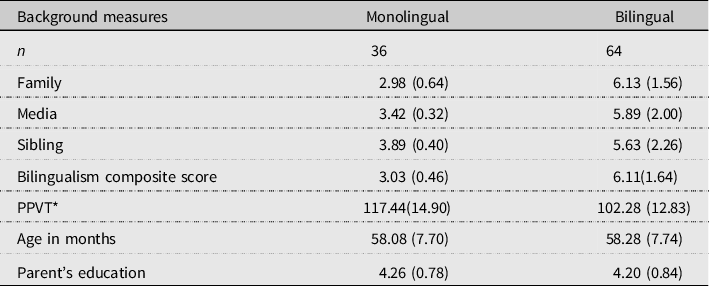
(LSBQ; Anderson et al., Reference Anderson, Mak, Keyvani Chahi and Bialystok2018a, Reference Anderson, Hawrylewicz and Bialystok2018b). Parents were asked to complete this questionnaire and return it to school. The instrument elicits demographic information (e.g., age, sex, handedness, parent’s education) and detailed information about the child’s language experience, including estimates of proficiency of each language that the child speaks or understands, the individuals with whom each language is likely to be used, and the language most often used in specific situations. Responses to the questionnaire were validated in a study of 605 adults (Anderson et al., Reference Anderson, Mak, Keyvani Chahi and Bialystok2018a) and another study of 675 children (Anderson et al., Reference Anderson, Hawrylewicz and Bialystok2018b) to create a calculator that produced three scores – family language use, language used for media, and language used with siblings. These scores were used to derive a weighted composite factor score. The factor scores were calculated using the R package with the Thurstone method of estimation and then applied to a correlation matrix. Thus, the factor score was based on a linear combination of the correlation matrix and the factor weights. Because of the way the questions were constructed, lower scores indicate a more monolingual (English) environment and higher scores indicate a more bilingual environment. These scores were then standardized to a scale ranging from 1 to 10. The mean scores for each language group are shown in Table 1. The range for the composite score was 2.74–4.72 for monolinguals and 3.24–9.80 for bilinguals, with a slight skew in the distribution (skewness = 0.57). The LSBQ also provides information about parent’s education with “1” indicating no high school diploma, “2” indicating high school graduate, “3” indicating some college or college diploma, “4” indicating bachelor’s degree, and “5” indicating graduate or professional degree.
Mean scores (and standard deviation) for background measures for monolingual and bilingual children

Note. Family, media, sibling, and language composite score were calculated from the Language and Social Background Questionnaire (LSBQ); Family: language use at home, media: language used for media, and sibling: language used with siblings. These scores are then used to derive a composite factor score that is the weighted mean of component scores. All these scores are on a scale from 1 to 10 with 1 being more monolingual and 10 being more bilingual. *p < .001.
For the categorical assignment to language group, responses to the LSBQ were evaluated holistically to approximate the way these classifications are typically carried out when factor scores are not calculated. These judgments were based heavily on parents’ evaluations of children’s fluency in the non-English language. Children who were described as having no exposure and essentially no proficiency in a second language were considered monolingual; all other children were placed in the bilingual group. All children also received a factor score on the bilingualism scale. This dual procedure based on qualitative (categorization) and quantitative (factor score) methods allowed us to compare the results from these two approaches, both of which are used in bilingualism research. Qualitative differences in bilingual status were evaluated by means of between-groups ANOVA, and quantitative differences between degrees of bilingual experience were evaluated by means of regression analyses.
Peabody Picture Vocabulary Test (PPVT-IV, Dunn & Dunn, Reference Dunn and Dunn2007)
This is a standardized task used to measure English receptive vocabulary. There are 4 practice items and 204 test items arranged in 17 sets of 12 trials each with a gradual increase in difficulty. For each trial, four images are shown to the child, accompanied by a spoken word, and the child chooses the image that best matches the word. Testing continues until eight or more errors are committed within a set. Raw scores were converted to standard scores by an age-based norming table.
Sentence-Picture Matching (SPM) task
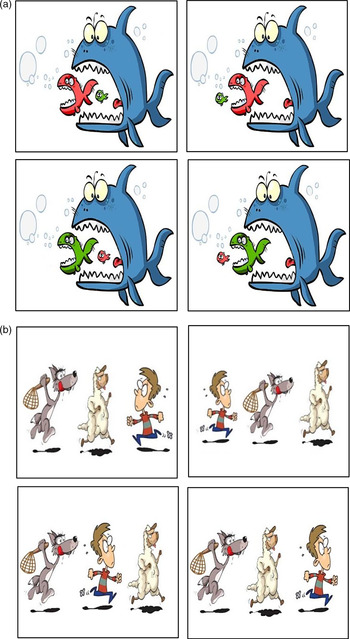
This task assessed children’s ability to keep track of information in a sentence to arrive at a correct interpretation in the context of distraction. An array of four images was presented on the screen accompanied by a recorded sentence. There were 40 sentences, consisting of 20 trials for each of 2 sentence types. Sentences were recorded by a female native English speaker and children heard each sentence twice. Children sat on a small chair facing the computer monitor and were asked to click on the picture that matched the sentence they heard. There was no time limit, so the images stayed on the screen until the child responded. The two sentence types differed in the relation between the grammatical structure and the images. The first type, called descriptive, encoded the sequence of perceptual features or actions found in the image. An example of a descriptive sentence is, “The blue fish is eating the green fish that is behind the red fish” (Figure 1a). The second type, called relational, embedded the central information in a relative clause or in the conjunction between two clauses, therefore requiring more linguistic interpretation. An example of a relational sentence is, “The wolf is chasing the sheep who is chasing the boy” (Figure 1b). Therefore, the difference between the two sentence types is in their linguistic complexity; descriptive sentences could be understood through sequential addition of the information but relational sentences required holding in mind a relative clause and then attaching it to the proper referent making order of mention an unreliable cue. For both types, the four images contained the same elements but differed in the relationship between them. The hypothesis was that bilingual children will perform more accurately than monolingual children because of their ability to selectively attend to the sentence elements in the context of distraction from the distracting images where the items were the same but the relations among them were different. Moreover, the language group difference was expected to increase in the more difficult relational condition. Although both conditions created conflict by presenting the same elements in each image, the solution for descriptive sentences could generally be based on a simple order of mention strategy whereas the solution for the relational sentences required more detailed linguistic processing.
Sample item for Sentence-Picture Matching task. Children are shown four images and listen to a sentence. The task is to choose the image that matches the sentence. (a) Descriptive sentence: “The blue fish is eating the green fish that is behind the red fish.” (b) Relational sentence: “The wolf is chasing the sheep who is chasing the boy”.

Referential Interpretation task
Berman et al. (Reference Berman, Chambers and Graham2010) developed this task to examine preschooler’s sensitivity to emotional cues in speech in order to understand the speaker’s referential intent. All the materials in the present study were the same as those used in the original study.Footnote 1 The child sat on a small chair facing the computer screen and saw three images accompanied by recorded directions relating to one of the images (e.g., “Point to the doll”). Two of the images belonged to the same category but differed in their likelihood of being associated with positive or negative vocal affect (broken doll vs. intact doll) and the third image was from a different category and served as the control (see Figure 2). Sentences were recorded by a female native English speaker. The speaker conveyed affect through emotional expressions, such as pitch levels, pitch contours, and speed of speech. Hence, the information provided relevant cues for the linguistic content in speakers’ utterances about objects.
Sample item for Referential Interpretation task. Children are shown three images and listen to the sentence, “Point to the doll.” The task is to choose the image that matches the sentence.

There were three conditions: positive vocal affect, negative vocal affect, and control. There were 6 sentences for each of the positive and negative affect conditions and 10 sentences with neutral affect for the control condition, producing 22 trials in total. Some control trials presented three distinct objects (e.g., shoe, boat, and turtle) while others presented two same-category objects that differed in one dimension (e.g., blue cup and red cup) and a third object from a different category. The pairing of vocal affect and object array was counterbalanced across participants. Each array appeared once in each affect condition. Images stayed on the screen until the child responded. The hypothesis was that bilingual children will outperform monolingual children on conditions that included conflicting affect. Moreover, this group difference was expected to interact with affect and reveal a larger effect for negative vocal affect. Negative and positive information are processed differently by children (Vaish et al., Reference Vaish, Grossmann and Woodward2008). Peeters and Czapinski (Reference Peeters, Czapinski, Stroebe and Hewstone1990) suggested that negative stimuli carry more information than positive stimuli and therefore require more processing resources, a situation that would favor bilingual children.
Procedure
Participating daycare centers were asked to send home packages that included the LSBQ and informed consent. All children who returned a signed informed consent and completed LSBQ were eligible to participate in the study. Participating children were greeted by the researcher and taken individually to a quiet space provided by the daycare. The researcher read the verbal assent to the child, and testing began following the child’s agreement.
Tasks were administered in the following order: SPM, Referential Interpretation task, and PPVT-IV. Each session took approximately 30 min to complete. Children were given stickers throughout the activity as well as at the end to increase their motivation and interest, but receiving stickers was noncontingent on their performance.
Results
The mean scores for the background variables are presented in Table 1. Bilingual children and monolingual children were similar in age and parent’s education, Fs < 1. English receptive vocabulary indicated by PPVT differed between language groups, with monolingual children obtaining higher scores than bilinguals, F (1, 98) = 28.62, p < .001, η2 = .23, consistent with previous research (Bialystok et al., Reference Bialystok, Barac, Blaye and Poulin-Dubois2010).
Mean accuracy for the SPM task is shown in Table 2. The overall score for the task was out of 40, with a range of 10–38; however, the distribution was somewhat negatively skewed (skewness = −1.20). To compare performance across groups, a 2 × 2 repeated measures ANOVA was conducted with language group as the between-subject variable and sentence type (descriptive, relational) as the within-subject variable. There was a significant main effect of language status, F (1, 98) = 9.19, p < .003, η2 = .09, with better performance by bilingual children than monolinguals. The main effect of sentence type, F (1, 98) = 23.84, p < .001, was also significant, with better performance on descriptive sentences than relational sentences. There was no interaction of language and type of sentences, Fs < 1. Although there was a significant group difference in receptive English vocabulary, there was no correlation between PPVT and SPM, r (100) = .02, p = .82.
Mean accuracy (out of 20) (and standard deviation) in Sentence-Picture Matching task

The effect of the continuous measure of bilingualism was evaluated in a regression analysis using the average accuracy across the two sentence types as the dependent variable. The bilingualism factor score showed a reasonably normal distribution (skew= 0.57) so this score was used as the independent variable. The regression model included age and PPVT vocabulary before entering degree of bilingualism. The model was not significant, F (3, 96) = 1.54, p = .21, and accounted for only 4.5% of the variance.
The mean proportion accuracy for the Referential Interpretation task by group is shown in Table 3. The scores are presented as proportion correct because the conditions were based on different totals. The range was from 0.50 to 1.00 and was reasonably well distributed (skewness = −0.22). To compare performance across groups, a 2 × 3 repeated measures ANOVA for language group and vocal affect (negative, positive, control) was conducted. There was a significant main effect of language status, F (1, 98) = 46.43, p < .001, η2 = .32, indicating better performance by bilingual children than monolinguals. The main effect of type of vocal affect, F (2, 196) = 99.97, p < .001, was also significant. Contrasts showed that all three types of vocal affect were significantly different from each other: control trials were performed better than positive affect, F (1, 98) = 23.42, p < .001, and positive affect was performed better than negative affect, F (1, 98) =70.11, p < .001. There was also an interaction of language group and type of vocal affect, F (2, 196) = 15.89, p < .001. Bilinguals outperformed monolinguals for positive, F (1, 98) = 4.74, p = .031, and negative trials F (1, 98) = 33.05, p < .001, but children in the two language groups performed similarly on the control trials, F < 1.
Mean proportion correct (and standard deviation) in Referential Interpretation task

Note. *p < .05, ***p < .001.
Unlike the SPM task, the correlation between overall task score and PPVT was significant, r (100) = −.33, p = .0008, so an ANCOVA with PPVT score as the covariate was conducted to rule out vocabulary differences as the responsible factor. The effect of language group remained significant, F (1, 97) = 31.38, p < .0001. Least squares (LS) mean scores collapsing across the three conditions were 0.71 for monolinguals and 0.84 for bilinguals.
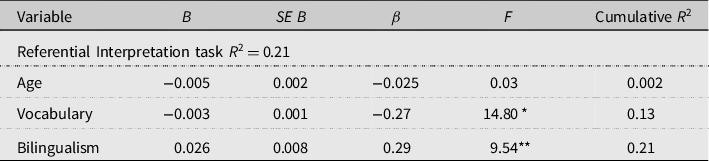
The results of a regression analysis evaluating the contribution of relevant factors to overall performance are shown in Table 4. Since all children performed similarly on the control conditions, the regression was conducted on the average of the two emotion conditions. The model was significant, F (3, 96) = 8.56, p < .001, and English vocabulary assessed by PPVT contributed significantly to the model, F (1, 96) = 14.80, p = .002, but surprisingly, higher vocabulary scores were associated with poorer performance. Degree of bilingualism was also significant, F (1, 96) = 9.54, p = .002, showing better performance with more bilingual experience. Because bilingualism and vocabulary influence performance in opposite directions, the model was rerun to include an interaction term for bilingualism × PPVT to determine if these effects are constrained by the level of the other factor. The interaction term added 0.02% to the accumulated R 2, an increase that was not significant, F (1, 95) = 2.51, p = .11.
Regression analysis for variables predicting Referential Interpretation task scores

Note. *p < .001, **p < .01. The regression was conducted on the average of the two emotion conditions
Finally, we examined correlations across the two tasks to determine the extent of commonality between them. Not surprisingly given their general similarity, the overall scores for the two tasks were positively correlated, r (100) = .42, p < .0001. Examining the correlation within task conditions, however, revealed a different pattern. Despite moderate to strong correlations among SPM relational, SPM descriptive, positive affect, and control, with r values ranging from .21 to .68, there was no correlation between negative affect and any other condition, with r values ranging from .06 to .13. Therefore, the processing required to correctly perform the negative affect items in the Referential Interpretation task was different from the processing involved in all other conditions for both tasks. Notably, it was on these negative affect items that the language group gap was the largest.
Discussion
The present study examined the performance of monolingual and bilingual children on two sentence comprehension tasks in which paralinguistic information interfered with a correct interpretation. In the SPM task, the four displays were confusing because they all contained the same elements but differed in the relationship among them; attention to the linguistic structure was necessary to resolve the confusion and select the correct picture. In the Referential Interpretation task, the correct image had to match the sentence for both meaning and emotion but the presence of a simple intact picture that represented the object in the negative affect condition was distracting. Thus, in both tasks, attentional control was required to focus on the relevant features and determine the correct response. Results were analyzed both in terms of group difference between children who were holistically assigned to the monolingual and bilingual groups and in terms of incremental differences in bilingual experience across the sample. Children in both language groups were similar in age and parent’s education but performed differently on these tasks.
For the SPM task, the hypothesis was that bilingual children will outperform monolinguals, with the possibility of a larger language group gap for the difficult relational condition. In fact, bilingual children obtained higher scores than monolinguals in both conditions with no interaction effect. For the descriptive sentences, the correct image could be chosen by directly matching the details of the sentence to the pictures using simple linguistic structure such as word order. However, because each image matched the sentence to some extent, attentional control was still required. For the relational sentences, the correct image was determined by the relation between the picture elements in a relative clause, so more complex linguistic processing was required before those relations could be matched to the images. In both cases, bilingual children demonstrated an advanced ability to keep track of relevant information while controlling the interference from the other three images to resolve the confusion and identify the target image despite performing more poorly than monolingual children on a simple vocabulary test.
The results from the Referential Interpretation task also revealed differences between monolingual and bilingual children in their ability to interpret intent when challenging communicative cues were involved. In this case, children were required to coordinate linguistic and emotional cues to infer a speaker’s intent. All children performed comparably on the control items, but both conditions that included information about emotion were performed better by bilinguals, particularly the negative affect trials. This finding is consistent with claims that negative sentences require greater attentional processing (Peeters & Czapinski, Reference Peeters, Czapinski, Stroebe and Hewstone1990). Speculatively, it may be that monolingual children have a bias to simply choose the object named in the sentence without considering the emotional dimension. This strategy works reasonably well for positive affect sentences, where monolingual children were correct on 81% of trials, but it fails for negative affect sentences, where their success dropped to 36%.
The scores obtained for 4-year-old monolinguals in the present study are comparable to those reported by Berman et al. (Reference Berman, Chambers and Graham2010) for the responses by the 4-year-olds in their study who were presumably monolingual (although no information about language background is provided). For negative affect, Berman et al. reported 42% correct compared to the current results of 36%, and for positive affect, Berman et al. reported 64% correct compared to the current results of 81%. However, the monolingual results from both studies were substantially lower than those for the bilinguals in the present study, namely 70% for negative affect and 90% for positive affect.
Because the children who participated in the present study represented a range of experience with other languages, regression analyses were conducted to determine whether the degree of bilingual exposure is calibrated to performance. In both cases, the composite factor score indicating degree of bilingualism was entered into the model after age and English receptive vocabulary. The model for the SPM task was not significant, but the model for the Referential Interpretation task was significant, and degree of bilingual experience added significantly to the explanation of variance, with more bilingual experience being associated with better performance. However, an unexpected result was that higher vocabulary scores were associated with lower performance. Although it may be possible that bilingual children outperformed monolinguals on this task because of their lower vocabulary, that interpretation is ruled out because bilingualism remained significant after vocabulary had been accounted for in both the regression and analysis of covariance. Moreover, adding an interaction term to the model that jointly evaluated vocabulary and bilingualism was not significant, leaving these as significant main effects. One possibility for the counterintuitive effect of vocabulary might be that highly verbal children at this age are more focused on meaning, a bias that in this case will lead to the wrong answer. This explanation is speculative and requires further study, but it is clear that with development, affective cues are increasingly incorporated into responses. It also appears that bilingual experience modulates the ability to integrate different cues, over and above age-related focus on content, and ignore conflicting cues.
Both tasks required attentional control and linguistic processing, and previous research has indicated that bilingual children generally outperform monolingual children on the former but underperform on the latter. These opposing tendencies were put in conflict in the present tasks. Yet in both tasks, the children classified as bilingual obtained higher mean scores than monolingual children, although the more nuanced relation between how much bilingual experience children had and how well they performed was only found for the Referential Interpretation task. The balance between the linguistic and attention demands was different for the two tasks: The SPM task was weighted more to linguistic processing than to attentional control because it required understanding complex syntax whereas the Referential Interpretation task was weighted more to attentional control than to linguistic processing because the linguistic demands were simple vocabulary items. Under this possibility, attentional control was more relevant for the latter, so bilingual children with greater bilingual experience and presumably better attentional control showed the incremental effects found in the regression model.
The present findings demonstrate that children who grow up in an environment with a complex communicative context are becoming adept at focusing attention where needed in response to a goal, a process that becomes more effortful in the context of different communicative cues. In this sense, bilingualism operates as a form of stimulation for the development of attentional control, leading to benefits in attentional control and conflict monitoring, skills that are required to control attention to unpredictable distractors and flexibly attend to relevant resources in the context. Methodologically, categorical and continuous analyses of degree of an experience provide somewhat different information and relate to performance in different ways. Bilingualism is complex (Surrain & Luk, Reference Surrain and Luk2019), and the details of this experience must be considered as a first step to resolving contradictory outcomes from research. Both categorical and continuous approaches are essential to move this research forward and more careful attention must be paid to how bilingualism is defined and operationalized in order to compare results across studies.
The research was conducted with children from a high-middle SES background, so extension of this research to other SES strata is necessary. However, previous research comparing high and lower SES children has found similar effects of bilingualism in both groups (Calvo & Bialystok, Reference Calvo and Bialystok2014; Hartanto et al., Reference Hartanto, Toh and Yang2019; Krizman et al., Reference Krizman, Skoe and Kraus2016), so there are grounds to expect that these results will generalize across levels of SES.
These results help to clarify language and cognitive processing in monolingual and bilingual children by showing the possible role of attentional control in complex linguistic comprehension and demonstrate that previous research demonstrating the differences between monolingual and bilingual in attentional control can be extended to explain the differences between these two groups in certain aspects of linguistic processing. The findings support the role of bilingualism in developing children’s progress in achieving attentional control skills which might lead bilingual children to be more effective in complex linguistic comprehension. Because attentional control is central to learning and cognition, this pattern might set the stage for long-term benefits for bilingual children.
Finally, although the results have been interpreted in terms of changes to attentional control that follow from bilingualism, we have not provided any detail about our definition for that concept. Our view is that attentional control is a processing resource that exists in a hierarchy of processes, much like the Inhibitory Control Model proposed by Green (Reference Green1998). Indeed, Green’s explanation of “inhibitory control” is not unlike our concept for “attentional control” despite the terminological disparity. In our view, the impact of bilingualism on cognition is seen in terms of an interaction between the attentional demands of a task and the attentional resources available to the individual. The impact of bilingual experience on attention networks is generally to enhance that resource through increased efficiency (Bialystok, Reference Bialystok2017), but the outcomes for performance also depend on task demands and the details of bilingual experience. The details of these proposals await further research.
Acknowledgments
This research was funded by Grant 435-2017-0778 from the Social Sciences and Humanities Research Council, Canada, and Grant A2559 from the Natural Sciences and Engineering Research Council, Canada, to EB. We are grateful to Sadek Shorbagi for his help in designing and programming the tasks.