Oral traditions necessarily have misty roots. This quality adds a sense of mystique to the art of storytelling, but it tends to hinder inquiry into the historical content of oral literatures. For a variety of reasons, the study of deep-time historicity in oral documents has an extremely diverse record of outcomes in scholarship. Despite the general absence of helpful indicators of the limits of verbal narrative durability, by the early twenty-first century archaeological chronologies were showing that oral tradition can shed light on ancient history extending back at least 1,000 years. Some researchers were pondering whether tradition keepers in communities worldwide had passed down verbal records over unknown millennia across an ever-deepening past. To assess how specific textual elements connect to antiquity, we need useful analytical processes. A key starting point would be to embrace a consensus that we do not know how far across time verbal narratives can travel. This article begins from that starting point, exploring slightly beyond the existing consensus. Then we travel into more distant dark settings, and we merge storytelling with archaeology and genomic analysis to study certain misty roots of deep-time human history.
I view “written” and “oral” materials as comparable carriers of evidence about the past, subject to analytical evaluation. Since transmission processes often encrust oral traditions with non-historical elements, we must take care to identify and extract the components that illuminate history. When I speak of “oral records” and “verbal literature” I intend to reconfigure the established usages of the component terms. I turn aside from a settled orthodoxy that has encouraged comparative hierarchies of veracity, defining “documents” as proper for historical research while treating “oral traditions” as inherently problematic. As a practical matter, a deliberate terminological merging is necessary. Verbally transmitted materials very often shape written texts, and oral traditions very often come to hand as reincarnated written materials. When we make the terms more interactive, we intentionally challenge entrenched assumptions in order to create a taxonomic permission structure for new integrative explorations of history.
I often suspect that the doctrines of professional archaeology include a default consensus assumption. An implacable transmission barrier must exist, a point in time when the chain of human sayings gets totally disrupted. And the drawing of impassable lines in the sands of time may be rooted in faith-based belief, but such beliefs are also logical. Transmission processes are often enmeshed in forms of cultural disintegration: the fading of memory, varieties of textual revision, evaporation of chronological guideposts, and social changes that suppress traditional knowledge. Many factors account for oral records, not all of which are conducive to the careful preservation of historical information, though some nonhistorical qualities do help to preserve historical textual elements (Echo-Hawk Reference Echo-Hawk2000:271–273). And since the eighteenth century, the invention of deepfake tradition has been recognized as a problem in European historical scholarship. For good reason, in the nineteenth century Edward Tylor put his finger on a major problem. He observed that for ethnologists studying traditions, the “great difficulty in dealing with them is to separate the fact and the fiction” (Tylor Reference Tylor1870:305). In short, acceptance of tradition at face value is often a major tenet of popular cultural identity, but it is not a tenet of evidence-based scholarship.
In the course of professionalization, archaeology long ago decided to dismantle the rambling edifice of thinking that made pre-World War I oral traditional studies a discipline without much discipline. Anthropologist Robert Lowie (Reference Lowie1917) led the demolition, rejecting oral tradition as a source of deep-time history. This sweeping rejection of oral historicity forced scholarship to move beyond salvage ethnography and toward critical study (Helm and Gillespie Reference Helm and Gillespie1981). But to create archaeological science, socially constructed epistemological boundaries that were unavoidably arbitrary came to seem rational, essential. This evolution of evidence-based archaeology also made possible the evaluation of historicity through critical analysis—a practical foundation for the inevitable rise of scholarship on deep-time oral tradition.
This outcome becomes apparent when we consider archaeological studies pertaining to the transmission of technology. What does the archaeological record say about time depth for technology? About continuity versus discontinuity? How does technology endure and dissipate in any given region among a given population? If technology transmission among ancestral-descendant groups spans millennia, does this also imply the concurrent transmission of related oral traditions? In recent decades it has become increasingly evident that when we study these issues, we are necessarily excavating ancient history from the fringes of prehistory.
The Archaeology of Archery
In early 2023 three scholars published research arguing for the existence of bow-and-arrow technology at a site in France dating back about 54,000 years. They concluded that 49 micropoints should be interpreted as “solid evidence of the use of the bow and arrow” in the Rhône Valley and that “bow use in Eurasia is highly suspected at least as early as 25 to 37 ka ago” (Metz et al. Reference Metz, Lewis and Slimak2023). Another study in 2024 mentioned that archaeological evidence points to the emergence of bow hunting “in southern Africa sometime during the Middle Stone Age between about 80 and 60 thousand years ago” (Lombard Reference Lombard2024). These various dates could serve as indicators of transmission durability. But the article by Metz and coauthors (Reference Metz, Lewis and Slimak2023) also noted research showing that groups could ignore, neglect, or give up the use of “bow-and-arrow technologies” over time—suggesting “that the success and spread of technological innovations are primarily constrained by social choices.”
In an article on South American archery history, Luis Flores-Blanco and colleagues (Reference Flores-Blanco, Cuellar, Aldenderfer, Stanish and Haas2023) argued that adoption of bow-and-arrow technology in the Lake Titicaca Basin region of the Andes “most likely occurred approximately 5000 years ago and coincided with increasing levels of socioeconomic complexity.” The study did not go into detail on transmission processes, but perhaps we can assume the existence of some forms of continuity over five millennia.
Kathryn Demps and colleagues (Reference Demps, Herzog and Clark2024) analyzed archery projectile point designs in the Late Archaic Great Basin to evaluate “the archaeological manifestations of learning processes” and “patterns of cultural variation.” This technology appeared in the region about AD 500. Studying regional variations in projectile point styles, this research hypothesized that smaller groups showed less variability than larger social groups, which featured more individualized knowledge transmission with more stylistic diversity. In essence, this article sought to assess the kinds of teaching associated with technology durability. We might wonder, in turn, whether this kind of analysis has implied relevance to the production and variability of oral tradition. Perhaps we can assume that verbal records associated with projectile points endured in the region for about 1,500 years.
In the North American Great Plains the introduction of bow-and-arrow and pottery technology marks the beginning of what archaeologists label the Plains Woodland tradition. It has long been argued that diffusion accounts for the spread of archery technology across North America, and by about AD 200 it was widely adopted across the Plains (Bamforth Reference Bamforth2021:9–11, 95, 171; Blitz Reference Blitz1988). Whatever population shifts and cultural innovations may have followed, we can probably assume continuity of archery technology over a period of 15 to 17 centuries among the residents of the Plains. To evaluate the potential depth of historicity in archery traditions, we can study verbal records that assert some kind of association with antiquity. And we can readily identify such storytelling in the oral traditions of Pawneeland.
Túhtiraakawikàtasa
In 1901 a Skidi Pawnee priest named Kirikiirisu Rakaawarii (Scout Roaming The World) sat down to tell stories to James R. Murie and anthropologist Alice Fletcher. Roaming Scout continued his work with Murie in projects arranged by George Dorsey at the Field Museum of Natural History, and Dorsey described him as “the most learned of the Skidi priests living” (Dorsey and Murie Reference Dorsey and Murie1906:102fn). In Roaming Scout’s authoritative version of the primary Skidi Pawnee creation story, Tirawa directed Bright Star and her lesser divinities to give seeds to the first girl (Dorsey and Murie Reference Dorsey and Murie1904:3–13). These celestial deities also bestowed upon the first man an assortment of items that included a bow and arrow: “Now we shall give him the bow, for there is on the arrow the flint-stone, tied on with sinew; the notch of the arrow for the bow-string to go in” (Dorsey and Murie Reference Dorsey and Murie1904:8). The first man later acquired these items at a location “where Lightning had struck upon the mountains.” There he “found flint-stones with bows and arrows, and even good-sized pieces of axes, so that he now made bow and arrows” (Dorsey and Murie Reference Dorsey and Murie1904:9). As the gods sang about their gifts, “the boy had seen the bow and arrows held up by his father, the Sun.” With his bow and arrows in hand, the boy began to hunt buffalo.
In another Skidi story told by Ckáwahaaru’ (Woman Good Fortune), a youth sought the hand of the daughter of Bright Star, aided by Sun, who gave him a bow and arrow (Dorsey and Murie Reference Dorsey and Murie1906:42, 476). This narrative was set in ancient times, and it explained the spread of earthlodge architecture. We can guess that Ckáwahaaru’ heard the story from her grandmother who had served as a keeper of one of the Big Star shrines.
A creation story told by Julia Troth (Woman Cleanse The People) touched on certain events set forth in the two Roaming Scout narratives (Dorsey and Murie Reference Dorsey and Murie1906:44–46). It began with the making of the first girl and boy—after their awakening, “the bow and arrows were given to the boy, so that they could live by killing animals for food” (Dorsey and Murie Reference Dorsey and Murie1906:44). Then the first two people received corn and seeds. Troth was also a member of a royal Skidi family, a keeper of a sacred shrine. This creation story could have passed down to her in the course of her education in traditional protocols.
A detailed South Band Pawnee creation story was told circa 1904 by Siriresaruku (They Are Making Him A Leader), listed as “Roaming-Chief” (Dorsey and Murie Reference Dorsey and Murie1906:13–19). This creation story, “Origin of the Chaui,” originated “from a bundle on one of the sacred altars, and is handed down from one generation to another” (Dorsey and Murie Reference Dorsey and Murie1906:13). In this narrative, Tirawa created the first woman and first man. Providing instructions and promising gifts, Tirawa mentioned bow-and-arrow technology: “I now give you, man, a bow and arrows, which are to be known as the ‘wonderful bow and arrows.’ You, too, woman, I give a bow and arrows” (Dorsey and Murie Reference Dorsey and Murie1906:15).
When we align the archaeology of archery with Pawnee tradition, we can shift otherwise timeless circumstances into history. The term tíraakis, for example, is the Pawnee term for bow—and Tíraakis is also the name of the Bow constellation. In 1906 astronomer Forest Moulton consulted with five Pawnees to identify this constellation: “the Bow is Delphinus”; and a Roaming Scout memoir at the American Museum of Natural History mentioned “the bow lying in the sky in relationship to the bow given to the first man by Morning Star; this made man ‘wonderful’ and gave him the ability and permission to kill buffalo and other game” (Chamberlain Reference Chamberlain1982:115, 226-227). Since the ancestors of the Pawnees were apparently unfamiliar with bows and arrows before about AD 200, we can say that the identification of this constellation in the night sky happened after that time. At an unknown date between AD 300 and 1800 the Pawnees began to say Túhtiraakawikàtasa, “There’s an image of a bow in the sky.”
These narratives by Roaming Scout, Woman Good Fortune, Julia Troth, and Siriresaruku reflect late nineteenth-century Pawnee perceptions of antiquity. The stories differ in many ways, and their formation and transmission cannot be traced in detail, but they cluster various elements that can be readily studied: the origins of bow-and arrow-technology, of earthlodges, of corn cultivation, and of buffalo hunting. We must speculate about the specific textual histories. But relevant archaeological evidence situates these elements within a broad circumstantial historical context extending back within the last 2,000 years. We can also suggest a likely impressionistic setting of circa AD 1300 for the formal institutionalization of the stories as mythological texts (Gover Reference Gover, Van Alst and Gover2024:163–164). And since these traditions can be aligned with the archaeology of Pawneeland, when we investigate such matters we can assume that we are studying ancient history.
With some oral traditions we can reasonably assume that we are peering into antiquity. But since we must typically infer significant aspects of textual formation, we should hesitate to treat the stories as literal history. Transmission processes involve retention of tradition and knowledge, but they can also introduce new components and modifications. Anthropological research has historically generated a significant literature of research on biological, linguistic, and cultural processes involving both continuity and change (Knight Reference Knight2013:130–157; Mesoudi Reference Mesoudi2015). This spectrum of processes can also be applied to explanations of oral tradition.
Assuming that typical knowledge-transmission processes apply to the four Pawnee oral traditions outlined above, including both the preservation and revision of information, we can readily observe one obvious modification. All four of these traditions mention a deity named “Tirawa.” This term represents a Pawnee linguistic innovation, adapted as an artificial truncation of Tirawaahat, This Celestial Expanse. This coined term entered Pawnee culture during the early nineteenth century as a response to generations of exposure to European/American religious concepts, and it transformed a nebulous divine life-force into a Christianized deity. We can surmise that by the early nineteenth century an exchange of ideas inspired new ways of thinking about cosmology in Pawneeland, and this term came to reflect a new synthetic religious ideology, a shorthand humanized divinity figure.
If we deleted “Tirawa” and substituted some other likely celestial intermediary between the heavenly Tirawaahat and the earthly realm, we could re-create reasonable facsimiles of the four stories as they might have existed during the late eighteenth century. In other words, we could move back toward older forms of the stories. And if we assume that the four narratives preserve historical components over centuries or millennia, we can imagine even more ancient iterations of those elements. Perhaps we can sense the misty conceptions of our far-off ancestors when we view Pawnee archery/flint imagery as rooted in a distant past, connected to global conceptions of flint.
The Lightning Arrows
The collections of the Denver Museum of Nature and Science (DMNS) include a Pawnee bow, quiver, and seventeen arrows (Echo-Hawk and Colwell Reference Echo-Hawk and Colwell2015). These items originated from an anonymous Pawnee in 1869, collected by an American named George Cuneo. He left a brief note that the arrows came “with a history.” But since no history has survived in the records, we can only guess that he heard something that intrigued him. It is possible that he was told about the significance of two arrows tipped with flint and obsidian points. The term for flint in the Skidi dialect is tahuuru’, which is applied to meteorites, flint projectile points, and flint fire-strikers (Parks and Pratt Reference Parks and Pratt2008:154, 244–245, 504). The use of this term for meteorites suggests that the word encompassed a variety of materials—perhaps with the shared linkage of the celestial realm and fire. This is certainly applicable to the association of flint with lightning.
An endnote to Roaming Scout’s Skidi creation story explained, “Formerly the belief was common in the great efficacy of flint, not only as points for arrows, but for the magic power which it was supposed to possess, owing to its intimate relation to the lightning” (Dorsey and Murie Reference Dorsey and Murie1904:339–340, n116). This note went on to clarify that flint had power because it was imbued with the essences of lightning: “Certain individuals had the right to attach a piece of flint to the upper end of the bow, in which case the bow itself became a weapon of last resort of considerable magic power.”
John Staller and Brian Stross (Reference Staller and Stross2013:175) found that in South America and Mesoamerica lightning bolts are reputed to “create stone tools and weapons of war.” Various Mayan communities associate stone axes and flint with “servants of the lightning deity” and identify them as “axes of our grandfathers.” They noted the “ubiquity of worked stone implements and celts being called ‘thunderstones’ and similar terms in Mesoamerica as well as in the Andes.” And they favored the view that these terms can be explained by “independent invention rather than diffusion by loan translation.” Viewed from a more global perspective, this question of diffusion in deep time versus independent unilateral invention deserves a more complex analysis.
Folklorists of the late nineteenth century and early twentieth century took note of worldwide ideas about flint that parallel the Pawnee concepts. In 1870 Edward Stevens reported that in Britain “flint arrow-heads were regarded as ‘elf-darts,’” and “stone hatchets” in Britain were “believed to be thunderbolts”; and in Greece “they are known as astropelekia, or axes that fall from the stars” (Stevens Reference Stevens1870:89). He noted that “in Java, China, Brazil, Germany, France, Italy, Spain, and elsewhere, stone hatchets are still believed to be thunderbolts; and have sometimes been preserved in families for centuries, on account of their valuable properties.” Stevens added that such ideas could also be found across northern Europe: “According to the popular belief in the north of Europe, the lightning is accompanied by a ‘thunderstone,’ which penetrates into the earth. . . . Every house in which such a stone is preserved is secure from the effect of thunderstorms” (Reference Stevens1870:89).
In nineteenth-century Celtic Britain celts were sometimes termed “thunderbolts” (Peacock Reference Peacock1883; Skeat Reference Skeat1912:65). A report on Borneo mentioned the “high regard” and “sacred character” of stone implements “believed to be teeth, or toe-nails, of Baling Go, the Thunder God” (Haddon Reference Haddon1900:902). Edward Tylor noted that Yoruba tradition in Africa assigned thunder and lightning “to a lower deity, Shango the Thunder-god, whom they call also Dzakuta the Stone-Caster, for it is he who (as among so many other peoples who have forgotten the Stone Age) flings down from heaven the stone hatchets which are found in the ground, and preserved as sacred objects” (Tylor Reference Tylor1903:263–264). And associations between flint and thunder and lightning have some time depth in Europe. C. W. King (Reference King1873:234–235) cited a text by the early seventeenth-century Flemish naturalist Anselmus Boetius de Boodt:
Under the popular names of “Strahlhammer,” “Donnerpfeil,” “Donnerkeil,” “Strahlpfeil,” “Strahlkeil” (lightning-hammer, thunder arrow or club, lightning-arrow, &c) . . . . he figures stone celts and hammers of five different, but all common types; remarking that so firm was the belief in these things being the “actual arrow of the lightning” (ipsa fulminis sagitta) that, should any one attempt to controvert it, he would be taken for a madman.
Reviewing a 1911 book, The Thunderweapon in Religion and Folklore, A. R. Wright drew an interesting conclusion on thunderstone beliefs: “The antiquity of the group of beliefs seems indicated by their uniformity over all the Old World, from Japan to Ireland, Siberia to India, and Norway to the Guinea Coast, although they are faint in districts such as Iceland, where thunderstorms are rare” (Reference Wright1912:122–123). As noted by archaeologist Olle Hemdorff, the archaeological identification of stone axes in Iron Age Scandinavian graves may well reflect the deeper antiquity of some form of connection between flint objects and thunder and lightning: “People believed that the lightning created thunderstones and that individuals who owned such stones would not be hit by the lightning” (University of Stavanger 2010).
What can we make of these scattered cultural similarities? Given the global use of flint for fire making, it is reasonable to suggest that certain elements of this parallel storytelling arose in different places via independent invention. We might also propose that some of this flint/lightning imagery could be due to globalization in recent history, with cultural interactions transporting flint and fire imagery around the world. Pondering flint cultural imagery in Pawneeland, I feel doubt, at least, that any hypothetical European thunderstone missionaries might somehow account for Pawnee ideas about flint. We can also wonder whether deep-time lightning symbolism in North America could have been associated with quartz Clovis and Folsom points, given their light emission qualities (Amick Reference Amick2017). It seems reasonable to consider whether these associations may have endured for many generations, echoes diffused from deep time into the recent traditions of Pawneeland and other communities worldwide.
Due to celestial associations, flint in various forms could be found in Pawnee holy bundles. In Roaming Scout’s Skidi creation story, the first man received instructions to place certain items in the first such holy bundle: “the flint-stone, the skins of owls, hawks, paints, pipe, tobacco, and sweet grass” (Dorsey and Murie Reference Dorsey and Murie1904:9). In 1918 James R. Murie (Reference Murie and Parks1981a:200) noted, “Every sacred bundle had to have four sacred arrows.” He also observed that a major ritual associated with the Skidi Bright Star bundle referred to arrows, “and at such times a part of the firedrills seems to be so regarded” (Murie Reference Murie and Parks1981b:53). George Bird Grinnell (Reference Grinnell1990 [1889]:252) heard that “their ancient arrows were usually headed with flint” and that “no one now alive can remember when these were in common use, but there are men who have heard their fathers and their grandfathers tell of them, and who say that these arrows were good for war and for the chase.” Passing out of “common use,” these flint arrows acquired a special significance:
Although these stone arrow heads must have passed out of general use toward the end of the last century, yet some of them were preserved much later, and it is possible that there may even now be some among the Pawnees, hidden away in the sacred bundles. After they ceased to be used for general purposes, they took on a sacred character and were employed to slay the sacrifices; among the Skidi to kill the captive, and in the Lower Village tribes the buffalo and deer, for sacrifice. There was a time when it was deemed essential that the animals to be sacrificed to Ti-ra’-wa, should be killed by one of these ancient—and so sacred—arrows [Grinnell Reference Grinnell1990 [1889]:253].
The special religious significance of flint-tipped arrows was echoed in the idea that flint could be considered a dangerous substance. Murie made note of the use of flint for its deadly properties:
The powers conferred by the supernatural beings were of three sorts, power to cure the sick, power to perform feats of magic, and power of a third sort, called pikawiu, for which there is no equivalent in English. Of these, the curative power was considered by far the most important. The ability to perform feats of magic was simply a tangible evidence that the medicine man possessed the knowledge which would enable him to cure the sick. The third sort of power resembled hypnotism in some of its manifestations. By it the medicine man was enabled to subjugate the will of another to his own and to render his patient passive during ceremonies so that his power could go to the soul of the patient and remove the evil influence which was at the root of the disease. The pikawiu power was also likened to an arrow or bullet in its ability to cut off life. Medicine men could throw this power into an enemy as one would shoot an arrow, and the individual attacked in this way was helpless until some other medicine man, who understood the power, exercised his magic to draw it out [Linton and Murie Reference Linton and Murie1923:5].
In Roaming Scout’s Skidi creation story, flint arrows originated as found objects, with the first man finding “upon the mountains . . . flint-stones with bows and arrows, and even good-sized pieces of axes” (Dorsey and Murie Reference Dorsey and Murie1904:9). A Chaui Pawnee priest known as Secret Pipe Chief also mentioned this history, telling George Bird Grinnell (Reference Grinnell1990 [1889]:224–225, 352) that divine revelation informed the Pawnees how to make lithic artifacts such as knives and arrow points. This happened in an ancient realm in the distant southwest in the vicinity of two mountain ranges. In that long ago place, the ancestors of the Pawnees knew nothing of iron tools. The Pawnees found flint projectile points and made use of them, as Grinnell (Reference Grinnell1990 [1889]:252) wrote: “They say that, so long as the Pawnees used flint for making arrow heads, they used to find plenty of these stones lying on the prairie, but that when the whites brought them iron, Ti-ra’-wa said to himself, ‘The Pawnees no longer need these flint stones; I will make no more of them.’”
These stories intend to describe historical events, afloat in an unknown age. If we look for history, it would seem appropriate to start with a survey of recent time—perhaps a few centuries before circa 1900. In Pawnee tradition, the southwest ancestral homeland lay beyond two mountain ranges, and in the Skidi creation story the first use of flint-tipped arrows is associated with mountains. I am unaware of any archaeology that identifies Pawnee ancestral sites in the vicinity of any mountain range within this time frame—no population living along the Rocky Mountains in the century or so around AD 1600 can be linked to the Pawnees. In 2018, pondering these stories, I coined a name for the realm, using the few descriptors mentioned in the accounts: Akaahkaritkihaaru (Stone House Land). I had long before settled on a likely match between the oral traditions and the archaeological record: a spectrum of neighboring complexes located southwest of the Pawnee homeland, known to archaeologists as the Sopris phase, the Apishapa phase, and the Antelope Creek phase. I eventually came to favor the Apishapa phase as the strongest candidate for Akaahkaritkihaaru; archaeologist Rand Greubel (personal communication 2024) has also suggested possible connections to “stone structure/enclosure sites on the western side of the San Luis Valley (SLV) and upper Rio Grande drainage”—sites dating back perhaps as far as the late sixth century AD. A collage of related groups stretching from present-day Wyoming to northern New Mexico no doubt gave rise to folk who eventually helped to shape the Pawnee people (Echo-Hawk Reference Echo-Hawk2018:81–135).
The flint and obsidian projectile points in the DMNS collection are interesting in this context. The DMNS sent the obsidian projectile point to a lab in Missouri and received an analysis that identified a source in northern New Mexico (Echo-Hawk and Colwell Reference Echo-Hawk and Colwell2015). We do not know the history of the arrows in the DMNS Pawnee quiver. A Pawnee likely found the points and picked them up—or perhaps trade or some other interaction could explain the arrows. But Pawnee tradition refers to the southwest as an origin point for an ancient population that helped give rise to the later Pawnees, and the obsidian point was crafted on the Plains more than 600 years ago from obsidian that originated in New Mexico. The flint point also dates to that time period, though it has not been sourced. By 1869 iron projectile points had become common in Pawneeland, and it is likely that the observations of later ethnographers about the significance of flint points applied to both the flint and obsidian points. Whether found or handed down, during the nineteenth century these arrows were likely kept for special symbolic uses.
Perhaps we must rely on impressionistic speculation to account for global patterns of parallel ideology about flint. But deep-time transmission clearly offers a plausible explanation. We must take seriously the likelihood that carriers of flint cultural imagery spread worldwide in distant antiquity, handing down various celestial ideas about stone implements, linking lightning and thunder to lithic tools and weapons. The ubiquity of the practical magic of flint as a source of fire would have surely helped to keep lightning in the long-term narrative picture. But when we argue for deep-time durability of such imagery, we are also proposing that verbal records are capable of preserving oral information over long periods.
This proposal holds long-standing interest among scholars of oral tradition. An example can be found in the study of “earth-diver” creation stories—short narratives that typically open on a world completely covered by the seas. Folklorist Earl Count concluded in a 1952 publication that this brief story should be seen as “easily among the most widespread single concepts held by man” (Dundes Reference Dundes1962:1037). Anna Birgitta Rooth (Reference Rooth1957:500) speculated that the theme of the primeval ocean “seems to have originated in the eastern Asiatic coastal area, from whence it spread westward across Siberia and eastward across the North American continent.” A few years later in 1963, G. M. Vasilevich also suggested that migrants from northeastern Asia carried earth-diver stories into North America at the end of the last glaciation (Schlesier Reference Schlesier1987:24–25). These observations underscore the assumed antiquity of the story, implying modes of oral transmission spanning millennia.
The opening decades of the twenty-first century continued this trickle of research arguing for the long-term transmission of oral tradition. Studies of fairy tales investigated textual relationships and transmission over about six millennia (Blakemore Reference Blakemore2016; Bohannon Reference Bohannon2013; Graça da Silva and Tehrani Reference Graça da Silva and Tehrani2016; Shultz Reference Shultz2016; Tehrani Reference Tehrani2013). Comparison of oral traditions and deep-time sea-level changes also pointed to long-term transmission of oral memoirs (Nunn Reference Nunn2018, Reference Nunn2021). An article published in 2023 aligned Haíɫzaqv oral tradition and archaeology and paleoenvironmental research to suggest that the transmission of oral information from the first human settlement of the Central Coast of British Columbia occurred during the late Pleistocene, more than 12,000 years ago (Gauvreau et al. Reference Gauvreau, Fedje, Dyck, Mackie, Hebda, Holmes, White, Housty, Housty and McLaren2023). A news report in 2024 noted the alignment of nineteenth-century GunaiKurnai sorcery practices with items excavated in a 12,000-year-old cave site in Australia (Pattison Reference Pattison2024). A volcanic eruption in Australia circa 37,000 years ago was argued to account for a Gunditjmara oral tradition (Barras Reference Barras2020). And research on night sky traditions suggested that oral stories endured across much deeper time (d’Huy and Berezkin Reference d’Huy and Berezkin2017; Norris Reference Norris2020).
Between 2012 and 2016 Julien d’Huy prepared phylogenetic studies showing how a spectrum of tale types “follow the movement of people around the globe” (d’Huy Reference d’Huy2016). He described his research on “the dissemination of Cosmic Hunt stories,” revealing how elements of the tale fit together into a phylogenetic tree that “connects Greek and Algonquin versions of the myth” and “indicates passage through the Bering Strait.” He then found similar results for “the family of Polyphemus myths” and for a “protomyth” involving “serpents and dragons.” He added an intriguing comment: “Similarities in certain rock art motifs and the reconstructed stories open a new window on the mental universe of the first humans who migrated across the Bering Strait to the New World between 30,000 and 15,000 years ago.”
When narrative themes in fictional storytelling suggest the existence of deep-time common roots, it would seem appropriate to seek ways to assess such information, and to ponder whether historical information can travel similar distances in time. Long ago, realizing that oral documents have traversed unknown ages, I found myself pondering the Bering Strait. I learned that origin stories utilizing the theme of darkness are common in North America and are extremely rare elsewhere in the world. Perhaps the Arctic Circle had shaped diverse origin stories of communities across North America. But there was an important problem. These stories reframed history into tales that did not sound historical, transforming the past into mythical dark realms.
In the Dark World
Denouncing oral tradition in a 1916 lecture, anthropologist Robert Lowie proclaimed, “Now, we know that very few of our Indians could have descended from the skies or climbed from an underground world” (Reference Lowie1917:166). He advised that such “manifestly absurd tales” would not survive “our canons of trustworthiness,” and he felt it reasonable for his colleagues to dismiss oral traditions that embrace “primitive theories of the universe” (Lowie Reference Lowie1917:165). He concluded, “The primitive tribes I know have no historical sense” (Lowie Reference Lowie1917:166–167). David Hurst Thomas noted that Lowie’s views attracted wide support, “and several prominent archaeologists—including Alfred Kroeber, Alfred Kidder, and Frederick Webb Hodge—chimed in to support Lowie’s views” (Thomas Reference Thomas and Killion2007:76). And Thomas quoted a 1917 publication by Kroeber: “the habitual attitude of the Zuni, then, is ahistorical. . . . That now and then he may preserve fragments of a knowledge of the past that approximates what we consider history, is not to be doubted. But it is equally certain that such recollection is casual and contrary to the usual temper of his mind.”
Many North American oral traditions speak of distant ancestors who dwelt in a realm of lingering darkness. If we connect underground origin stories to the narrative theme of emergence from darkness, we can link such storytelling to an ancient Arctic Circle population. Those folk of the far north made their way into the Americas, where generation after generation of descendants told of ancestors who emerged from a land of darkness. Evidence supporting this model has long been present in scholarship on American traditions. Edward Tylor outlined one such story found in the Popol Vuh, published by Charles Étienne Brasseur de Bourbourg: “The Quiché manuscript describes the ancestors of the race as travelling away from the rising of the sun. . . . Then the people collected on a mountain called Chi Pixab, and there they fasted in darkness and night. Afterwards it is related that they removed, and waited for the dawn which was approaching” (Tylor Reference Tylor1870:307–308). And Tylor came to an intriguing conclusion: “Obscure as much of this is, there are things in it which agree very curiously with the phenomena of the Arctic regions.” We can also choose from a diverse literature to illustrate the dark world origin theme in North American oral tradition (Echo-Hawk Reference Echo-Hawk2000:276–278, Reference Echo-Hawk2018:17–40). George Bird Grinnell (Reference Grinnell1907:170) published this Cheyenne story:
Once the Cheyenne were all under the ground, living in darkness. One day a man saw far off a little spot of white. He approached it, and as he advanced it grew larger, and presently he found himself surrounded by light which terrified and blinded him. After a while, however, he became accustomed to it, and going back below the ground described his discovery to his fellows and some of them came out and after that they lived above the ground.
The academic model for the origins of the first settlers of North America has long told us that those folk passed through the Arctic Circle in Beringia, a realm where nights and days differ from the nocturnal-diurnal cycle in lower latitudes. And in 2007 Erika Tamm and 20 colleagues published an article titled “Beringian Standstill and Spread of Native American Founders.” Studying genetic diversity associated with mtDNA, these scholars concluded “that ancestors of Native Americans paused when they reached Beringia, during which time New World founder lineages differentiated from their Asian sister-clades” (Tamm et al. Reference Tamm, Kivisild, Reidla, Metspalu, Smith, Mulligan and Bravi2007). They suggested that “the isolation in Beringia might have lasted up to 15,000 years.”
Studying these results, archaeologist David Meltzer (Reference Meltzer2009:170) agreed that this was an “intriguing” hypothesis that deserved further research. A team organized by Eske Willerslev and led by J. Víctor Moreno-Mayar subsequently published an article that added weight to this model. These researchers concluded, “Our findings support a long-term genetic structure in ancestral Native Americans, consistent with the Beringian ‘standstill model’” (Moreno-Mayar et al. Reference Moreno-Mayar, Potter, Vinner, Steinrücken, Rasmussen, Terhorst and Kamm2018:203). This means that a founding population dwelt for a lengthy period in Beringia, a realm of the Arctic Circle, a land of lingering darkness. Those folk then migrated into North America. There they gave rise to descendants who spread across the Americas thousands of years ago. An evolving literature soon appeared to study and refine the Beringian standstill model, including interesting research on genetic adaptations that support a long-term resident population in the Arctic (Grugni et al. Reference Grugni, Raveane, Ongaro, Battaglia, Trombetta, Colombo and Capodiferro2019; Hlusko et al. Reference Hlusko, Carlson, Chaplin, Elias, Hoffecker, Huffman and Jablonski2018; Raff Reference Raff2022a:239–240).
In 2021, summarizing the study of ancient genomes and the “journey into the Americas” of “the ancestors of present-day Indigenous peoples,” bioanthropologist Jennifer Raff set forth various models of population formation for the original settlers of the Americas. Her models all posited a long-term resident population in Beringia: “The genomes of Indigenous peoples indicate that their ancestors were isolated for several thousand years during the LGM” (Raff Reference Raff2021). And she speculated that this probably happened “on the southern coast of what would have been central Beringia.” Reviewing the sparse evidence pertaining to ancient genomics and archaeology, Eske Willerslev and David Meltzer (Reference Willerslev and Meltzer2021:358) suggested that “the Beringian standstill model” remained viable. They noted that “LGM isolation” could explain the dispersal of the various lineages that seem to account for the settlers who became ancestral to later populations in the Americas. The standstill model will inevitably undergo future refinement, but it seems certain that the ancestors of the first settlers of the Americas spent time above the Arctic Circle in Beringia.
When we compare American dark world origin stories and anthropological accounts of Beringia, we can see alignments. To evaluate these parallels, we must apply an analytical lens—in other words, oral traditions should be scrutinized to extract historical materials. Turning to the theme of dark world origins, we can sift out the history from the fantastical by discarding caves and lake bottoms and underworlds. Then we can offer some informed speculation to reconstruct the original story, unencrusted with fantasy elements. First, people ancestral to the settlers of the Americas dwelt in Beringia. Some of them journeyed into the Americas. For unknown generations their descendants said, “Our ancestors came from a land of lingering darkness.” This is a complete story. It is not dependent on technical details that must be carefully memorized. And we can suggest that this memorable short story also became convenient to deploy as a self-contained module, useful to set into many kinds of narratives. This exercise in informed speculation would explain the durability of the original story. Oral tradition and history: easy to remember; readily passed along. The complicated part is the production over time of the variant origin stories that arose from the original story—this is where we fill our footnotes with complexities.
We can assume that one or more of the ancestral lineages among the long-ago Beringian settlers of the Americas ultimately helped give rise to what eventually became the Pawnee people. And in one 1916 Pawnee oral tradition, a Kitkahahki named Kurauraresaru (Caregiver Leader) told of how the “first two people were placed on the earth” when “all was darkness” and one of the gods stood “upon the shore” and instructed the man to take his bow and arrow and shoot a speckled deer: “This deer was the sun and carried the night upon its back. Thus day and night originated” (Murie Reference Murie and Parks1981a:197). This story was handed down from the beginning of history in Pawneeland, handed down from a far-off realm—a timeless dark shore at the forgotten edge of the world.
Pro-race Ancient History
Arriving at the edge of the dark world, pausing among the twilight fringes of scholarship, we encounter an interesting problem. Speaking of the folk who migrated from northeast Asia and Beringia in deep time, Tamm and Meltzer and Raff made use of the terms “Native Americans” and “Indigenous.” Recognizing that this nomenclature is inherently dependent on the social meanings and definitions of racial ideology, they often deployed “ancestors of Native Americans.” It bears mentioning that archaeological literature has long treated the ancient residents of the Americas and their archaeological sites as “Native American.”
Modern racialism only became recognizable as a set of identity systems during the eighteenth century, evolving out of a chaotic stew of ideas and terms. When scholars intentionally apply the formulations of modern racial identity structures to pre-racial populations, they retroactively insert race into a non-racial past. We do not know what identity systems the long-ago residents of ancient America and Beringia embraced. But the non-racial folk who set forth into the future from Beringia were not racial Native Americans. Many thousands of years would pass before their descendants would become practicing adherents to racial Indigenism. Given the challenge of devising useful identity designations for populations in distant antiquity, it seems dubious to bestow deepfake racial identities on our non-racial ancestors, to inappropriately insert our pro-race world into the pre-racial past.
Willerslev and Meltzer (Reference Willerslev and Meltzer2021) made use of more neutral terms, adopting “Ancestral Native American” and “Ancient Beringian individuals.” The project of envisioning new terminological options deserves a continuing place in scholarship on ancient history; experiments with nuanced taxonomic innovations would benefit from recognition of the pre-racial character of the ancestors of modern practitioners of racial Indianhood (Echo-Hawk Reference Echo-Hawk2010). But this obvious point is readily deflected by the convenient empowerment of racial bonding narratives, by the vast social inertia of modern racial identity systems, and by the complexity of individual and communal modes of engagement with racialism.
The rise of Indigenous archaeology has reshaped the spectrum of twenty-first-century attitudes toward archaeology in Indian Country. And the incremental emergence of community archaeology infrastructure will no doubt promote the study of oral tradition and deep time. This expansion of cultural heritage options has necessarily been guided by various ideological protocols of racial Indianhood; to some degree, when we consider the extant unifying narratives of Indigenous archaeology, we can observe the influence of the intellectual legacy of Vine Deloria Jr.
Deloria (Reference Deloria1995) framed the study of the ancient past as a cultural battleground. Embracing fringe Velikovskian scenarios and other similar iterations of geomythology, he argued, “Most American Indians, I believe, were here ‘at the beginning’ and have preserved the memory of traumatic continental and planetary catastrophes” (Deloria Reference Deloria1995:251). Doubting that oral tradition could travel for “tens of thousands of years,” he concluded that these “eyewitness accounts” contain observations from “the beginning,” but “the events they describe are well within the past 3,000 years” (Deloria Reference Deloria1995:206). I suspect that this view of human history has little acceptance among practitioners of Indigenous archaeology, but Deloria’s more general purpose has energized a central tenet of the field. Confronting “the fallacies of Western science” he hoped to promote a pro-race “alternative view of North American history as seen through the eyes and memories of American Indians” (Deloria Reference Deloria1995:35).
Scholars who affiliate in some way with Indigenous archaeology will play a prominent role in shaping future research on oral traditions and ancient history, and Deloria’s influence will colorize this new literature with the ongoing consensus protocols of racial Indianhood. But this new literature will also draw intellectual momentum from the manifold cultural legacies of specific sovereign communities (Van Alst and Gover Reference Gover, Van Alst and Gover2024). For the foreseeable future, the ongoing legacies and aspirations of racializing ideology will frame the dynamic challenges of recalibrating past social landscapes. Pro-race intellectuals from diverse communities that self-identify as Indigenous will necessarily bring narrative protocols of various kinds into academic discourse on ancient history, scrutinizing and reshaping taxonomic labels and historical chronologies. Even so, the future of deep-time oral tradition studies is uncertain. In North America, at least, it may well become a segregated ideological project. American archaeology has long normalized an entrenched attitude, compartmentalizing origin stories and oral traditions as culturally important documents that do not pertain to history.
In the Twilight of Deep Time
In Pawneeland the unified study of archaeology and oral tradition began to take root as a communal project during the 1990s. Integrative collaboration proceeded sporadically for decades. More formalized partnerships arose after 2015, led by Carlton Shield Chief Gover, the first Pawnee to earn advanced degrees in archaeology (Gover Reference Gover, Van Alst and Gover2024). I feel less certainty that anthropology/archaeology will soon begin to routinely consider the interdisciplinary study of oral literature. The dismissal of oral tradition from the classroom of ancient history may well prove final. But we do have good reason to expect changes somewhere on the horizon. We see a slow accumulation of research showing that oral documents can indeed shed light on the distant past (Gover Reference Gover, Van Alst and Gover2024; Hall Reference Hall1997; Landol Reference Landol2022; Steeves Reference Steeves, McGrath and Russell2022; Van de Logt Reference Van de Logt2023:9–25; Zedeño et al. Reference Zedeño, Pickering and Lanoë2021).
The people who long ago settled in the Americas brought stories with them. And we can glimpse the silhouettes of those ancient stories in the traditions of Pawneeland and other neighboring communities. For scholars who suspect that oral records are woven from gossamer fragilities, not to be trusted with the responsibility of transporting the weighty artifacts of history, new studies continue to take notice of the luminous filaments that are also woven into the more durable fabrics of oral tradition. Historian Mark van de Logt (Reference Van de Logt2018:2) realized in the course of studying Caddoan monster stories that some oral traditions “are in fact histories” and “this finding seems obvious.” This insight deserves careful and continuing study.
In her book Origin, Jennifer Raff (Reference Raff2022a) synthesized archaeology and paleogenetics to look back into deep time to explain the worldbuilding that is unfolding today. It is a fascinating journey into both the present and the near future of this kind of scholarship. This book is technical where it matters, but it is not a technical exposition. Instead, Origin offers a panoramic survey of the beginnings of human history in ancient America, with special emphasis on genetics and archaeology. It also touches lightly on the study of oral tradition. My impression is that it reflects a long-established consensus in scholarship: the narratives of biological anthropology and archaeology together reveal real history; the narratives of oral tradition are also real enough—that is, as conveyances of cultural creeds rather than history. Perhaps we can conclude that this separate but equal doctrine is ultimately rooted in the early twentieth-century project to marginalize the study of oral documents away from deep-time human history. And perhaps we can agree that challenges to this doctrine must proceed through careful scholarship that justifies recalibrations.
In late November 2022 Daniel Sandweiss, then president of the Society for American Archaeology, wrote to Netflix to demand that Graham Hancock’s Ancient Apocalypse series be relabeled as “science fiction.” The letter noted that “archaeology does not willfully ignore credible evidence nor does it seek to suppress it in a conspiratorial fashion” (Sandweiss Reference Sandweiss2022). The term “credible” does intriguing work here. Since Sandweiss made no mention of oral tradition, we could read this omission as a hint that the study of oral records and deep antiquity is not deemed credible. Hancock’s Ancient Apocalypse generated much concern and useful criticism among archaeologists. In America Before, Hancock included an appendix titled “The Curious Case of the Skidi Pawnee” (Reference Grugni, Raveane, Ongaro, Battaglia, Trombetta, Colombo and Capodiferro2019:521–548). He consulted some authoritative publications on Pawnee tradition to draw various conclusions—comparing, for example, a circa 1870 photo of a Pawnee man wearing star imagery to Egyptian “tomb-paintings” showing star imagery.
With such thoughts in mind, I happened to notice another essay by Jennifer Raff (Reference Raff2022b), in which she went into detail on “how people first arrived in the Western Hemisphere.” Along the way she carefully wove together various complexities of archaeology, genetics, and 14C dating. But not oral tradition studies. To be sure, she did pause to mention “contemporary Native Americans, who have their own scientific and historical knowledge stretching back for countless generations” (Raff Reference Raff2022b). I also read with great interest her comment on scientific ideals: “Contrary to claims made about us, scientists emphatically don’t want dogma to stifle the consideration of new ideas.” How does this point fit with the treatment of oral tradition?
The intellectual trajectories associated with “archaeology” and with “Native Americans” coincide in meaningful ways. But in practice, when we review the archaeological literature, only one of these two culturally segregated paths is routinely woven into historical scholarship on distant antiquity. If some observers feel inclined to accuse academic archaeology of suppressing the study of oral tradition in an openly conspiratorial fashion, the truth is somewhat more nuanced. There is no area of academic specialization that systematically promotes the study of oral records and deep time. Even though little coherent momentum of scholarship exists in this area, I have the impression that many archaeologists wonder about oral traditions. In time, rational skepticism will provide a necessary tool to promote future professionalization. And I have elsewhere described formal analytical tests and principles that can be applied to the study of oral tradition (Echo-Hawk Reference Echo-Hawk2000:271–273).
Pondering the future, we can hope to someday see a community that would encourage analytical scholarship on the durability of verbal documents. An extensive literature already exists on oral history as a field of study. This realm of scholarship does not clarify long-term transmission processes spanning millennia, but it can provide useful insights into community dynamics and storytelling protocols that have potential relevance to deep-time studies (Anyon et al. Reference Anyon, Ferguson, Jackson, Lane, Vicenti, Swidler, Dongoske, Anyon and Downer1997; Bryant et al. Reference Bryant, Walsh, Abbott, Piccardi and Masse2007; Sugiyama Reference Sugiyama2017; Teague Reference Teague2009; Thompson Reference Thompson, Van Alst and Gover2024; Van de Logt Reference Van de Logt2018; Whiteley Reference Whiteley2002; Yellowhorn Reference Yellowhorn2002). Individual storytellers serve as caretakers of tradition, shaping community legacies. But traditions do not stand in monolithic isolation. Often enough, deep-time transmission processes necessarily transcend specific cultural lineages—for information to travel millennia we must share our stories, expecting unforeseeable journeying.
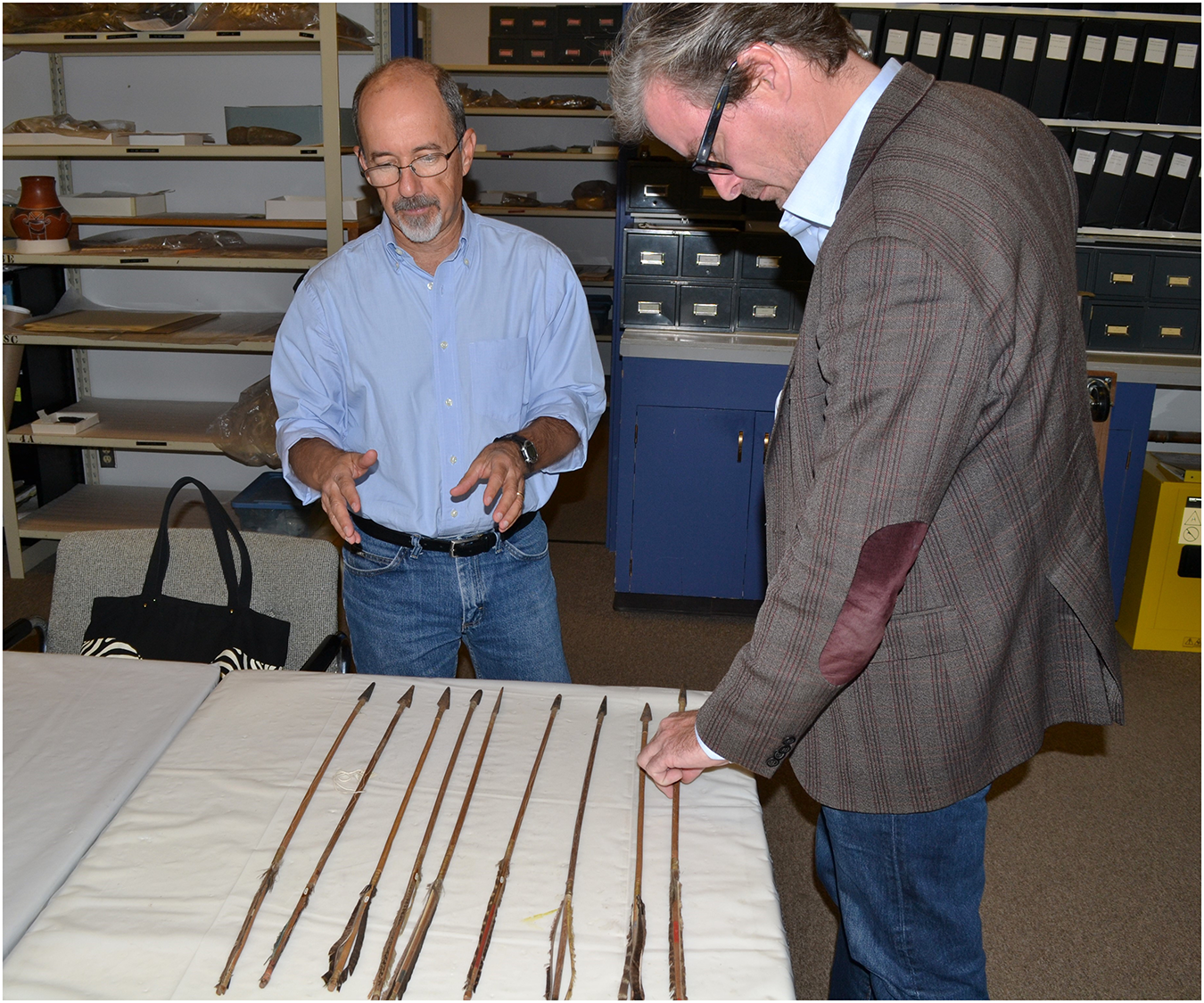
When we treat verbal literature as a source of history, we assume that discrete cultural traditions will fit together, creating a unified narrative panorama. This is why the study of interactive regional and global transmission patterns can yield important insights into deep history. We can presume that continuing research will occasionally bring together historians, community culture-keepers, folklorists, and anthropologists worldwide. By the early twenty-first century protocols designed to facilitate dialogue and consultation had become standard in archaeology—Figure 1 is a photo of Eske Willerslev and David Meltzer examining Pawnee arrows at the Denver Museum of Nature and Science while pondering long-term dialogue between anthropologists and deep-time descendant communities. Drawing on ethics of mutual respect, the integrative partnership of oral tradition and archaeology will together enrich our historical worldscapes, our communal worldbuilding.
Eske Willerslev and David Meltzer, September 2013 (photograph by Roger Echo-Hawk) (Color online).

When we ponder the future of oral tradition, it is reasonable to expect that formal professionalization will serve as a necessary foundation for credibility. Given that anthropological inquiry into the “first Americans” is a thriving field of study, a sprawling new world is surely emerging already. Even so, for now, an unsettling sense of confusion is warranted. When I consider the community of archaeologists and anthropologists who research the “first Americans,” I feel somewhat troubled. I favor an integrative model that unifies oral tradition and archaeology in evidence-based scholarship, and I suspect that most archaeologists are intrigued with what this model means for our understanding of antiquity. But I suspect that if we were to interrogate Graham Hancock and a room filled with random archaeologists who have researched the deep-time history of the peoples of the Americas, we would likely find that only Graham Hancock has actually read and pondered Pawnee oral tradition.
Acknowledgments
I started this research long ago as a consultant to the Pawnee Nation and the Native American Rights Fund, and I continued it in my graduate studies with Vine Deloria Jr., Philip Deloria, Patty Limerick, and Douglas Bamforth. My thanks for input on this article from Julia Hendon, David Meltzer, and Edward Jolie, and for encouragement along the way from Larry Zimmerman, Lynne Goldstein, Chip Colwell, Mark van de Logt, Carlton Shield Chief Gover, Rand Greubel, and Debra Martin. Peer reviews by Jack Ives, Mark van de Logt, and Erick Robinson considerably enriched this article.
Funding Statement
No funding support was provided to the author for this project.
Data Availability Statement
No original data appears in this essay.
Competing Interests
The author declares none.