





Introduction
Early pregnancy loss (EPL), failure of an intrauterine pregnancy prior to 13 weeks gestation, is one of the most common complications of pregnancy (ACOG, 2018). Treatment options for EPL, the medical term for miscarriage, include expectant management, medication, or procedural management (uterine evacuation). Mifepristone plus misoprostol is the most effective medication regimen for the treatment of EPL (Schreiber et al., Reference Schreiber, Creinin, Atrio, Sonalkar, Ratcliffe and Barnhart2018), with less need for unplanned uterine aspiration than with misoprostol alone. The American College of Obstetricians and Gynecologists’ (ACOG) 2018 guidelines state that adding mifepristone 24 hours before misoprostol may improve treatment efficacy and should be considered when available (ACOG, 2018; Schreiber et al., Reference Schreiber, Creinin, Atrio, Sonalkar, Ratcliffe and Barnhart2018). Despite extensive safety data, use of mifepristone is limited by the Food and Drug Administration’s Risk Evaluation and Mitigation Strategy (REMS) restriction (Raymond et al., Reference Raymond, Blanchard, Blumenthal, Cleland, Foster, Gold, Grossman, Pendergast, Westhoff and Winikoff2017). Consequently, mifepristone is primarily offered by providers that see a high volume of pregnant patients, traditionally staffed by obstetrician gynecologists (OBGYNs), despite data showing that it can be safely utilized by primary care providers (PCPs) and advanced practice clinicians (Prine et al., Reference Prine, Shannon, Gillespie, Crowden, Fortin, Howe and Dzuba2010; Porsch et al., Reference Porsch, Dragoman, Jones, Steinle and Dayananda2020). Despite proven benefit, only a small percentage of patients in a commercial insurance database containing de-identified patient-level healthcare claims received mifepristone plus misoprostol for EPL medication management (Boos et al., Reference Boos, Horta, Thompson, Dusetzina and Leech2023).
PCPs nationwide have reported that the lack of mifepristone in the primary care setting has adversely affected patient care including unnecessary appointments, less continuity of care, and more procedural management (Srinivasulu et al., Reference Srinivasulu, Riker, Maldonado and Breitbart2020). Prior research has demonstrated that, when provided with appropriate infrastructure, it is feasible for community-based primary care clinics to overcome the barriers to mifepristone provision (Wu et al., Reference Wu, Nutting, Harriett, McHugh, Janiak and Stulberg2023).
Prior studies have investigated patient satisfaction with EPL management in clinical settings including emergency departments (ED) and OBGYN ambulatory clinics (Dalton et al., Reference Dalton, Harris, Weisman, Guire, Castleman and Lebovic2006; Miller et al., Reference Miller, Roe, McAllister, Meisel, Koelper and Schreiber2019; Benson et al., Reference Benson, Holt, Gore, Callegari, Chipman, Kessler and Dalton2023). Though there is data demonstrating patient interest in and preference for induced abortion services with PCPs, there is limited research on patient experiences with EPL management in the primary care setting, specifically, community health centres serving uninsured and underinsured patients (Rubin et al., Reference Rubin, Godfrey and Gold2008; Godfrey et al., Reference Godfrey, Rubin, Smith, Khare and Gold2010; Wu et al., Reference Wu, Godfrey, Prine, Andersen, MacNaughton and Gold2015). Community health centres, also known as federally qualified health centres (FQHCs) deliver accessible comprehensive and continuous primary care to patients and families aligned with the medical home model (Rosenthal, Reference Rosenthal2008; Shi et al., Reference Shi, D-Chih, Chung, Liang, Lock and Sripipatana2017). A medical home is a patient-centred primary care model in which an ongoing –physician-patient relationship coordinates comprehensive, continuous, and accessible health care across referrals and services to improve overall health outcomes (Rosenthal, Reference Rosenthal2008). This study aims to understand patient experiences with their PCPs and their medical home for EPL management and how primary care clinics can better address their needs.
Methods
This qualitative study was approved by the University of Chicago Institutional Review Board (IRB21-1802). We used the Standards for Reporting Qualitative Research (SRQR) guidelines to structure the reported findings (O’Brien et al., Reference O’Brien, Harris, Beckman, Reed and Cook2014). This study was part of the Excellence in Providing Access to New Directions in Mifepristone Use (ExPAND) learning collaborative, which supports clinics in overcoming barriers to provision of mifepristone for EPL and/or induced abortion (Calloway et al., Reference Calloway, Stulberg and Janiak2021). ExPAND worked with this study’s Chicago-area, multisite FQHC. Before ExPAND, this FQHC used primarily expectant management (i.e., ‘watchful waiting’), misoprostol only medication management, or referred patients to OBGYN for misoprostol only medication and procedural management of EPL. After ExPAND, both mifepristone and misoprostol were available to PCPs for the most effective medication management of EPL.
The FQHC assisted in recruitment by displaying study flyers and sending portal messages to patients with reproductive capabilities, directing patients to complete a Research Electronic Data Capture (REDCap) secure web-based survey to screen for eligibility (Paul et al., Reference Paul, Taylor, Thielke, Payne, Gonzalez and Conde2009). Inclusion criteria included age ≥18 years, diagnosis or treatment of miscarriage on or after January 2020, and ability to consent in English or Spanish. Study personnel obtained participant verbal consent and then conducted semi-structured one-on-one interviews via phone; all participants chose to have their interview conducted in English. Demographics were collected after completion of the interview; demographics and reason for non-participants is not available. Verbal consent allows researchers to de-identify data since the only record linking the subject and the research would be the consent document. This qualitative research study presents minimal risk to study participants and verbal consent protects against potential harm from breach of confidentiality. The IRB approved the use of verbal/oral consent and waived the requirement for signed consent. Interview questions focused on participants’ experiences with miscarriage, abortion, and their perspectives on EPL management at their primary care clinic. Themes related to induced abortion were analysed and published separately (Hennessey et al., Reference Hennessey, Sanchez, Betancourt, Chor and Stulberg2026). Interviews lasted 14–31 minutes, followed by a brief survey assessing demographic background and obstetric history. Participants were compensated $50. Recognizing the risk of discomfort regarding personal experience with, and views on, EPL and abortion, the institutional ethics review board reviewed a plan for participants to discontinue the study at any time. Additionally, the standard protocol if a crisis arises during a study is to identify our institution’s crisis mental health team and provide immediate mental health resources and services.
Interviews were conducted by a medical student and a Complex Family Planning fellow, audio recorded and transcribed verbatim. All transcriptions were de-identified prior to analysis. Qualitative analysis software (ATLAS.ti), was used to code and organize data. Codes were analysed using principles of modified grounded theory (Corbin and Strauss, Reference Corbin and Strauss2014; Glaser and Strauss, Reference Glaser and Strauss2017), applying an initial codebook that was subsequently modified in the process of data review. Two study team members, a medical student and a Complex Family Planning fellow, individually read and coded interview transcripts using a pre-determined coding framework. New themes/sub-themes were identified through discussion and coding discrepancies were resolved using consensus coding. Before the collection of data, the research team had anticipated an a priori sample number of 20 patients, recognizing that the final sample size would be determined based on thematic saturation. Interviews were coded and analysed in batches through iterative group discussions, and thematic saturation was achieved when no new themes or codes were identified during data analysis.
Results
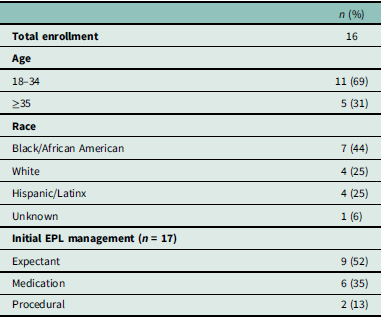
A total of 124 individuals were screened; 28 were eligible; 12 declined or were lost to follow-up; and 16 individuals completed interviews until thematic saturation was achieved. The remaining 96 patients were ineligible based on inclusion criteria, most commonly due to miscarriage outside of the study period. This group represented 17 episodes of EPL between 2021 and 2022: 52% of patients initially received expectant management, 35% medication management, and 13% procedural management (Table 1). Most participants, 81%, had received healthcare at the FQHC for at least three years, and four had been lifelong patients there. Over half of participants had family members who were also patients at the clinic, highlighting the patient-and family-centred medical home model that supports coordinated, relationship-based care for the whole family and community. Major themes and subthemes are described below, with illustrative quotes further expanded in Table 2. Four major themes from the interviews included: factors influencing participants’ decisions to seek care from their primary care clinic, appreciation for having the option of medication management, logistical barriers to accessing care, and recommendations for improving EPL management.
Patient characteristics

Table 1. Long description
A table summarizing patient characteristics and initial management of EPL. The table has 16 rows and 2 columns. The columns are labeled ‘n (%)’ and contain data on total enrollment, age distribution, race, and initial EPL management. Row 1: Total enrollment, 16. Row 2: Age 18-34, 11 (69 percent). Row 3: Age 35 or older, 5 (31 percent). Row 4: Black/African American, 7 (44 percent). Row 5: White, 4 (25 percent). Row 6: Hispanic/Latinx, 4 (25 percent). Row 7: Unknown, 1 (6 percent). Row 8: Initial EPL management (n = 17), empty. Row 9: Expectant, 9 (52 percent). Row 10: Medication, 6 (35 percent). Row 11: Procedural, 2 (13 percent).
Additional illustrative quotes highlighting major themes and subthemes

Table 2. Long description
The table has four columns: Subtheme, Quotes, and two empty columns. It contains 12 rows, each representing a different subtheme with corresponding quotes. The subthemes include Patients desire EPL management from PCP, Trusted relationships and continuity at medical home, Financial necessity, The option of medication management addresses the concerns, Medication management allows faster passage of the pregnancy, Recommendations for EPL management in the primary care setting, Increased education on expectations regarding pain, passage of POC, causes of EPL, Treat pain more effectively and sooner, Logistical and Structural Barriers to Ideal EPL management at community based primary care, Difficulty scheduling an initial or follow up visit, Lack of appropriate urgency when triaging patients requiring EPL Care. Each row provides illustrative quotes highlighting the respective subtheme.
Theme 1. Factors influencing seeking EPL care from medical home
Trusted relationships and continuity at medical home
Participants commented on trusted relationships and continuity of care at their clinic contributing to their satisfaction. Specifically, they valued providers and staff for their compassion, lack of personal or moral judgement, and bedside manner. Participants reported feeling more comfortable seeking future EPL care at their medical home instead of a new clinical setting.
‘I have always stuck with [FQHC], even if I moved… For the fact that no matter what provider I am seeing-the OBGYN, the behavioural health, or if I’m going to the regular doctor, or even the people in the front, like the nurses-everyone at the [FQHC] that I have interacted with have always been extremely caring and compassionate and nonjudgmental and have always done their best to be good providers. I have told them things that you might feel scared or embarrassed to tell a doctor. (P13)’
Financial necessity
Some participants stated they receive care at this FQHC due to financial necessity or limited insurance coverage or being uninsured.
‘…it’s close to home and, basically, they have an affordable payment plan or affordable fees for when I didn’t have insurance. And then, now, after my pregnancy, since I’m no longer pregnant, I will be losing my Medicaid insurance. So anywhere else I go it’s $200 just to be seen, and they only charged me $30. So that’s basically the only reason I stayed there. (P6)’
Theme 2. Option of medical management
Faster passage, clearer expectations for return to lives, families, duties
Compared to expectant management and the wait time of being referred to an OBGYN for procedural management, participants commented on the additional option of medication management for faster pregnancy resolution, clearer expectations of the process, and the ability to pass the pregnancy at home with less disruption to their lives. One patient who received expectant management reflected on the benefits if she had received medication:
‘I think that would have been really helpful if it had just been like, ‘okay. We can take care of this now.’ Because I’m waiting and wondering like, ‘when am I going to bleed again? When is this going to happen?’ So it would have been helpful to just get things moving. (P5)’
A patient who received mifepristone and misoprostol described some of her reasons for choosing medication management:
‘… I don’t want my kids to stay with my mom for two days, and then they will miss school or whatever. I was thinking of a lot of things other than myself, too, but it [medication management] was the best course. Drop them off at school, stay home for two days, and then I can still take care of them, because it wasn’t that crazy. And then I have my parents around just in case… But being in a hospital would make me not feel as good. (P7)’
Reduced time spent grieving & enduring trauma of pregnancy loss
Participants noted that faster passage of the pregnancy with medication compared to expectant management could help reduce the amount of time spent experiencing the trauma and grief of pregnancy loss. Responding to what she would advise a friend going through a similar situation, one patient explained:
‘If they were having a miscarriage? I would probably tell them to see if they can get a medical and induce the miscarriage because it is very painful and especially if you don’t have a support system then you can fall easily into possible depression or something like that. So I would probably see if they can try to get it out as fast as they can. (P14)’
Concern of complications
Multiple participants expressed concern of an increased risk of infection or incomplete passage of pregnancy with the option of a ‘watch and wait’ approach. Some feared procedural management as they perceived it as ‘really dangerous’, citing concerns about possible infertility, injury, or death. In some cases, this fear appeared related to misconceptions about procedural abortion management, particularly beliefs that abortion could cause infertility, bodily harm, or other long-term consequences. While abortion, like any medical procedure, carries potential risks, participants reported fear around these risks that were sometimes exaggerated or inaccurate, contributing to fear and uncertainty about abortion:
‘They were telling me how after you have an abortion, sometimes you can have fertility issues. So I was very scared about doing the procedure, thinking that maybe in the future I wouldn’t have kids again or um that it can affect my body or I could even die with the procedure so it was a pretty scary topic. (P14)’
Theme 3. Logistical barriers to EPL management in community-based primary care
Difficulty scheduling an initial visit or follow-up
Some participants were unsatisfied with their EPL care due to difficulty scheduling initial or follow-up visits. Scheduling barriers included: clinic closure on weekends, lack of available timely appointments, last-minute clinic cancellations, and lack of availability of specific providers such as midwives.
‘It’s like they’re always kind of backed up. Yeah. Even when I went to the emergency room and I had to make that follow-up appointment - I just thought about it - the emergency room, I think, made it for me. Had I tried to call and make that appointment, it probably wouldn’t work. (P11)’
Lack of urgency when triaging patients’ EPL care
A common theme related to scheduling was a perceived lack of urgency in the FQHC’s triage process. Some participants were frustrated that they were not able to be seen sooner despite the urgency of their symptoms and felt they were not followed up with them in an appropriate timeframe.
‘… I felt like every time I called them and told them, ‘I’m pregnant, I’m cramping, I’m bleeding,’ they were like, ‘Well, if you feel like it’s serious, go to the hospital,’ or, “we can’t give you an appointment. (P8)’
Theme 4. Recommendations for EPL management in primary care
Treat pain more effectively and sooner
Some participants described their experiences with expectant or medication management as very painful and desired more effective and timely analgesia. Specifically, one patient following up from the Emergency Room experienced passage of the pregnancy prior to her scheduled visit at the primary care clinic before analgesics were able to be prescribed.
‘So [the Emergency Room] kind of ran through what my options were and made an appointment for me to follow up at [FQHC], I think, the next day. So it was a Monday when I finally talked to them, and my appointment, I believe, was for Tuesday. And it was [Monday] night that I passed the majority of the products. …, but it was very painful that night. So I kind of, in retrospect—well, even at the time, I really wished that they had given me something for the pain right away so that I would have had it handy. Because I took like five Motrin just to try and take the edge off, and it didn’t even really. So anyway, that I felt like could have been improved. So then when I went in on Tuesday, they did give me something for nausea and for pain and then again talked about my options. (P5)’
Increased education
Participants cited a need for increased education about what to expect regarding pain levels, and passage of the pregnancy. Others expressed gaps in their knowledge such as being surprised by what products of conception looked like and causes of EPL.
‘… I think their patient education should have been a little bit better for people to know what to expect. I’m happy that it happened in the middle of the night where my husband was home. If he wasn’t home, I could have passed out. I could have possibly died there. And I think that it’s better for patient communication, that way we’re prepared for things like this. (P8)’
Address the grief and monitor for ongoing psychological morbidities and social needs
The physical and emotional toll of pregnancy loss contributed to periods of grief of varying severity. Some participants reported experiencing more severe depression requiring intervention from their PCP. They discussed how the pregnancy loss impacted their whole support system and exacerbated other traumatic experiences such as substance use disorder recovery or housing displacement.
‘… During that time, I just kind of wanted to be alone. But my support system really didn’t want me to go into a depression, which is kind of where I was heading because…we were displaced. And we’re still displaced. So having the miscarriage on top of being displaced, I had a lot of stress on me… (P11)’
Discussion
Participants expressed appreciation for having the option of medication management for EPL available in their primary care medical home. Some patients choosing medication management for EPL appeared partially influenced by misconceptions about procedural management and abortion stigma. Staff knowledge and training, clinic infrastructure and logistics related to scheduling remain barriers to receiving timely and optimized EPL care.
Our study expands upon work exploring patient experiences with EPL management in the primary care setting by adding the perspective of patients attending an FQHC. A 2019 study comparing patient experiences with EPL management in the ED versus an unspecified outpatient setting found that patients were dissatisfied with their care in the ED and had more streamlined experiences with diagnosis and treatment in the primary care setting (Miller et al., Reference Miller, Roe, McAllister, Meisel, Koelper and Schreiber2019). Our findings highlight the importance of long-standing relationships between PCPs, clinic staff, and patients that cultivate trust and compassion required for quality EPL care. More specifically, nurses who are trained in and knowledgeable about EPL protocols are integral to efficient clinic workflows including medication storage, tracking and logging, patient-centred triage of telephone calls and electronic medical record messages, and maintaining consistent, collaborative communication with their physician partners to ensure coordinated, high-quality care. At times, EPL care at the FQHC was influenced by financial need, demonstrating the importance of expanding and improving EPL management in under-resourced settings serving vulnerable patient populations who may lack access to specialized care.
Our results are concordant with prior research demonstrating wide-ranging considerations impacting patient preference for management of EPL including pain, duration, and time spent in the hospital (Petrou and McIntosh, Reference Petrou and McIntosh2009; Schreiber et al., Reference Schreiber, Chavez, Whittaker, Ratcliffe, Easley and Barg2016). Prior studies also found avoidance of procedural management due to an association with induced abortion (Wong et al., Reference Wong, Crawford, Gask and Grinyer2003). Our results indicate that patients may benefit from further non-biased counseling on all treatment options to address misconceptions about procedural treatment related to abortion stigma.
Primary care is well poised to do this given continuity of care, trusted relationships, number of clinics, and financial accessibility, but there remains room for improvement. Similarly, patients may benefit from further counseling for pain management and the EPL process Wong et al., Reference Wong, Crawford, Gask and Grinyer2003; Wallace et al., (Reference Wallace, Goodman, Freedman, Dalton and Harris2010). Dissatisfaction among some patients due to scheduling issues is consistent with prior research indicating interruptions to streamline care decrease patient satisfaction (Dalton et al., Reference Dalton, Harris, Weisman, Guire, Castleman and Lebovic2006).
Additionally, the study period (2021–2022) was during the COVID-19 pandemic, a time of extreme strain on FQHC infrastructures, so patients’ logistical barriers – such as scheduling difficulties and lack of triage urgency – may be symptoms of pandemic-era staffing shortages rather than specific failures in EPL clinical protocols. A prior study on staff perceptions of the ExPAND Learning Collaborative found that the pandemic’s staff shortage ‘led to a limited number of same-day appointments…which poses a problem for time-sensitive miscarriage and abortion care’ (Sakthivel et al., Reference Sakthivel, Wolff, Monast, McHugh, Stulberg and Janiak2024). Data were collected during the COVID-19 pandemic when healthcare delivery, community resources, and patient experiences differed substantially from usual practice. Although this may limit the generalizability of some findings, these participant perspectives remain relevant and highly the importance of patient access to a range of treatment options that align with their preferences and needs. During and after the pandemic, primary care clinics must continuously consider how to optimize their infrastructure for the timely nature of EPL management.
This study clinic’s ability to provide medication management of EPL was facilitated by its participation in the ExPAND learning collaborative. Patient satisfaction with EPL management at their FQHC and desire for medication management aligns with ExPAND’s goal of supportive holistic, patient-centred pregnancy care (Calloway et al., Reference Calloway, Stulberg and Janiak2021). ExPAND’s goal of breaking down abortion stigma may be further supported if clinics offer mifepristone for medication abortion, which would also be supported by many FQHC patients (Hennessey et al., Reference Hennessey, Sanchez, Betancourt, Chor and Stulberg2026).
Strengths of this study include the qualitative approach which allowed our team to explore participants’ experiences with EPL and receiving care at their medical home. Our team members are medical and public health professionals, with no patient representatives participating on the team. This could lead to bias in data analysis and interpretation; however, we used iterative methods for coding which incorporate input from multiple coders, allowing perspectives and experience of different team members to inform analysis. A limitation is that participant perspectives represent a single FQHC in a large urban area and patients attending FQHCs in different locations with distinct resources may have varied experiences. While we cannot infer generalizability, findings are likely applicable across varied primary care settings. Furthermore, the sample size of 16 was small and financial necessity of the participants may have influenced their reported satisfaction with the medical home, potentially masking dissatisfaction with clinical outcomes. Despite this small sample size, however, we did reach thematic saturation. While only 35% of participants received medication management for EPL, this may reflect patient preferences for treatment type, limited access to medication, or other unmeasured barriers to care which limits our ability to distinguish between patient choice and other access-related factors. Finally, self-selection bias is an important consideration, as EPL can be a challenging experience to process, so participating patients may have shared characteristics that make them more willing to discuss their experience.
Conclusion
This qualitative study asked participants about their experiences and perspectives on EPL management at their primary care clinic. While participants valued having medication management for EPL available within their primary care medical home, gaps in staff knowledge and training as well as clinic-level scheduling and infrastructure can limit timely and optimized access and quality of care. These findings demonstrate patients’ interest in having the option of EPL medication management from their PCPs at their medical home, call for future patient-centred studies about access and clinic workflow improvements, and highlights the patient-centred benefit of a learning collaborative model that helps clinics provide access to mifepristone into the primary care setting.
Data availability statement
The interview data gathered and analysed during this study are not publicly available due to the sensitive nature of the interview data and to protect participant confidentiality.
Acknowledgements
The authors would like to thank the clinical champions at the participating FQHC for their support in shaping and implementing ExPAND Mifepristone.
Author contributions
Lauren E. Harriett: Conceptualization, Formal Analysis, Investigation, Writing – Original Draft, Reviewing and Editing; Sumiko Maristany: Conceptualization, Data Curation, Methodology, Formal Analysis, Investigation, Writing – Original Draft; Lorna Sánchez: Formal Analysis, Investigation, Writing – Original Draft; Catherine Hennessey: Formal Analysis, Investigation, Writing – Reviewing and Editing; Julie Chor: Formal Analysis, Investigation, Writing – Reviewing and Editing; Debra B. Stulberg, MD: Formal Analysis, Writing – Reviewing and Editing, Funding Acquisition.
Funding statement
Funding for this study provided through a grant from an anonymous donor.
Competing interests
University of Chicago receives funds from Sanofi and Pfizer for Dr. Lauren E. Harriett to participate in clinical trials unrelated to this project and manuscript. The authors declare no conflicts of interest relevant to this work.
Ethical standards
University of Chicago Institutional Review Board (IRB21-1802).


 Open access

