




No CrossRef data available.
Article contents
Circulating blood volumes in pulmonary hypertension associated with erythrocytosis – the effects of therapeutic hemodilution
Published online by Cambridge University Press: 24 May 2005
Abstract
In the Eisenmenger syndrome, indirect estimation of blood volumes may provide quite inaccurate information when seeking to define therapeutic strategies. With this in mind, we analyzed directly the red cell mass, plasma volume, and total blood volume in patients with pulmonary hypertension associated with congenital cardiac defects and erythrocytosis, comparing the results with the respective estimated volumes, and examining the changes induced by therapeutic hemodilution.
Thus, we studied 17 patients with the Eisenmenger syndrome, aged from 15 to 53 years, in the basal condition, studying 12 of them both before and after hemodilution. We also investigated five individuals with minimal cardiac lesions, aged from 14 to 42 years, as controls. Red cell mass and plasma volumes were measured using [51 chromium]-sodium chromate and [131iodine]-albumin respectively. Hemodilution was planned so as to exchange 10% of the total blood volume, using 40,000 molecular weight dextran simultaneously to replace the removed volume. The mean values of the red cell mass, plasma volume and total blood volume as assessed by radionuclide techniques were 32%, 31% and 32% higher than the respective volumes as estimated using empirical mathematical formulas (p < 0.002). The measured total blood volume was also 19% higher in the patients compared with controls. Following a period of 5 days after hemodilution, we noted a 13% reduction in red cell mass (p = 0.046), and 10% reduction in total blood volume (p = 0.02), albeit with no changes in the plasma volume.
We conclude that direct measurement of blood volumes is useful for proper management of these patients, and provides results that are considerably different from those obtained by empirical estimations.
Information
- Type
- Original Article
- Information
- Copyright
- © 2003 Cambridge University Press
Pulmonary hypertension is a pathological condition associated with increased resistance in the pulmonary microvessels, mainly the small arteries.1–3 In pulmonary hypertension associated with chronic hypoxemia, significant erythrocytosis is frequently present.4–7 Increased blood viscosity as a result of the erythrocytosis then accounts for a further increase in the resistance through the damaged pulmonary microcirculation.8, 9 Furthermore, the hyperviscosity syndrome is frequently associated with systemic manifestations, such as headache, dizziness, arthralgia, paresthesia and progressive worsening in physical capacity.5, 10 In some patients with hypoxemic pulmonary hypertension, periodic hemodilution is sometimes used to relieve the symptoms related to the hyperviscosity, although the procedure is not indicated for correction of deviations in the hematocrit.5, 10–12
Although erythrocytosis is expected to result in an increased red cell mass,13–15 the extent to which this occurs, and the final results in terms of changes in plasma volume and total blood volume, may be difficult to predict in specific clinical conditions. This may present real problems in patients with pulmonary hypertension associated with congenital cardiac malformations, chronic hypoxemia and erythrocytosis.5, 12, 16 In such patients, an increase in total blood volume may result in an additional and detrimental overload on the right ventricle in the presence of preexisting abnormalities of afterload.17–20 On the other hand, since these patients are frequently subjected to therapeutic hemodilution, knowledge of baseline blood volumes, and how these volumes might be changed by treatment, may be important when planning hemodilution on an individual basis. An exaggerated reduction in the total blood volume would be deleterious, since poorly functioning right ventricles need to be adequately preloaded.
Our present study, therefore, was designed to evaluate circulating blood volumes in patients with pulmonary hypertension, chronic hypoxemia and erythrocytosis associated with congenital cardiac malformations – the so-called Eisenmenger syndrome,1, 5 and to examine the impact of routine therapeutic hemodilution on red cell mass, plasma volume and total blood volume. We hypothesized that estimation of blood volumes based on body weight and the peripheral venous hematocrit could lead to inaccurate results. We therefore compared data obtained by direct measurements performed with radioactive tracers with those estimated on basis of body weight and the hematocrit.
Patients and methods
Adolescents and adults with pulmonary hypertension associated with peripheral oxygen desaturation and erythrocytosis were entered into our study if they had a mean pulmonary arterial pressure above 35 mmHg at rest as measured at cardiac catheterization. All patients were under ambulatory care at the Heart Institute, São Paulo, Brazil, and were evaluated in steady conditions. We excluded all patients requiring emergency or hospital care, and those with clinical evidence of overt cardiac failure, venous congestion or oedema. Most patients were receiving aspirin and cardiac glycosides, and some were taking low-dose diuretics. We made no changes in medications during the study. Since radioactive material was an integral part of the study protocol, the possibilities of ongoing pregnancy and thyroid disease were carefully considered for all patients entering the study.
Preliminary observations had already indicated that the size of our cohort of patients should be sufficient to demonstrate differences of 0.8 standard deviation, with 80% power, at a one-sided significance level of 0.05. Accordingly, 12 patients were considered adequate for pairwise comparisons before and after treatment. Assuming that not all such patients would require therapeutic hemodilution for relief of symptoms, we estimated that we would need to enroll at least 15 subjects.
The patients, or their parents in case of adolescents, were fully informed about the research purpose of the laboratory determinations, and all consented to take part in the study. A small group of five subjects with minimal cardiac lesions, who also gave their consent for measurements of blood volumes, was included in the study as a control group. Based on clinical and echocardiographic evaluation, they were assumed to have normal hemodynamics. Their ages, from 14 to 42 years, and their body weight, were similar to those of the patients in our study group. The cardiac lesions were: corrected atrial and ventricular septal defects in 2 cases, small uncorrected ventricular septal defects in a further 2 cases, and pulmonary valvar stenosis with a systolic gradient of 20 mmHg in the final case. These subjects were enrolled as a control group, and their results presented as reference, although not used for purpose of comparisons with patients. The overall protocol of the study was analyzed and approved by the Scientific Committee of the Heart Institute.
Data recorded age, gender, body weight, resting peripheral oxygen saturation, and hematocrit as determined using an automatic hemocytometre. The increased pulmonary arterial pressure was confirmed in all cases during routine cardiac catheterization, which had been no longer than 6 months prior to the determination of blood volumes.
Blood volumes, specifically the total blood volume, the red cell mass and the plasma volume were initially estimated based on the body weight and hematocrit as follows:
- Total blood volume (l) = 0.08 × body weight (kg).
- Red cell mass (l) = total blood volume × hematocrit.
- Plasma volume (l) = total blood volume × (1 – hematocrit).
Direct measurements were performed in the baseline condition in all subjects, and repeated five days after hemodilution in those patients for whom this procedure was indicated. Total blood volume was calculated as the sum of red cell mass plus plasma volume. Measurement of red cell mass was performed using [51chromium]-sodium chromate-labeled autologous red cells, according to previously described techniques.21 Briefly, 10 ml of peripheral venous blood was incubated in the presence of 5.5 MBq [51chromium]-sodium chromate. Following re-infusion, blood aliquots were collected during the first 20 min for counting, and red cell mass was calculated as the distribution volume of [51chromium]. Plasma volume was determined as the distribution volume of [131iodine]-albumin.21 To achieve this, 0.37 MBq [131iodine]-albumin was infused slowly in the antecubital vein. After a 10 min period of equilibrium, blood aliquots were collected and a curve was constructed, with plasma volume being calculated as the [131iodine] distribution volume at time zero.
As a part of the routine management of patients with Eisenmenger syndrome in our institution, hemodilution is indicated and performed only in the presence of symptoms related to hyperviscosity. These are mostly worsening of physical capacity, headache, dizziness, arthralgia and paresthesia in the limbs. We routinely evaluate corpuscular hemoglobin and volume of red cells, as well as the levels of iron in the plasma, in the intervals between the hemodilution procedures. Patients are given iron orally whenever necessary to avoid microcytosis-related hyperviscosity. Hemodilution is performed with the plan to exchange 10% of the total blood volume with an equal volume of high molecular weight dextran of molecular weight 40,000. Drainage and infusion are performed simultaneously at equal velocities during an approximate period of one hour. Our policy of exchanging one-tenth of the total blood volume as a reference for fluid exchange is on our previous observations that such an exchange is appropriate for improvement of symptoms, without having any adverse effects on relevant laboratory parameters.22 Importantly, since drainage and infusion are performed simultaneously, the real amount of blood loss is less than one-tenth of the volume of the patient. Dextran was chosen instead of saline solution, taking into account its potential hemorheological benefits in terms of flow through the damaged pulmonary microcirculation. Furthermore, the colloidosmotic properties of 40,000 molecular weight dextran prevent a rapid decrease in circulating blood volumes. During hemodilution, the patients are maintained supine, with continuous monitoring of blood pressure, heart rate, and neurological state.
Results were expressed as mean plus or minus standard deviation. Variables were tested for closeness to the normal Gaussian distribution. All pairwise comparisons were performed using Student's t-test. A linear regression model was adjusted for prediction of total blood volume, calculating the coefficient of determination R2. In all tests, a p value of 0.05 was considered significant.
Results
We entered 17 patients, of whom 7 were female, who met our criterions, along with our controls, 3 of whom were female, consecutively into the study. This number proved sufficiently large to provide our 12 candidates for therapeutic hemodilution according to the established criterions. The results of baseline evaluation, including the estimated values for blood volumes, are shown in Table 1. In spite of the high levels of pulmonary arterial pressure, suggestive of advanced pulmonary vascular damage, all patients were in stable clinical conditions, and in functional class II to III of the stages of the New York Heart Association. None were under consideration for heart and lung transplantation at the time of the study. Based on the body weight, the estimated total blood volume was similar in patients and controls, with differences in red cell mass and plasma volume as a result of the respective hematocrits.
Table 1. Baseline data from patients and controls.

In the patients with pulmonary hypertension, measured red cell mass, plasma volume and total blood volume were significantly higher, at 32%, 31% and 32%, respectively, when compared to the estimated volumes (p < 0.002). Differences were less impressive, and not significant, in the control group of patients (Fig. 1). Individual values of total blood volume in patients and controls are shown in Table 2. Normalized values of measured volumes in the control patients, expressed in relation to body weight were

Figure 1. Comparisons of estimated (open bars) with measured (closed bars) blood volumes in patients with secondary pulmonary hypertension associated with erythrocytosis (n = 17) and controls (n = 5). All differences in the patients with pulmonary hypertension, but not in the controls, were significant (red cell mass, p = 0.0001; plasma volume, p < 0.0001; total blood volume, p < 0.0001).
Table 2. Individual values of total blood volume.

- Red cell mass, 45.2 ± 9.8 ml/kg.
- Plasma volume, 47.6 ± 11.2 ml/kg.
- Total blood volume, 92.8 ± 14.5 ml/kg.
Normalized measured volumes in the patients with pulmonary hypertension, in relation to the body weight were
- Red cell mass, 63.3 ± 12.6 ml/kg.
- Plasma volume, 43.0 ± 10.4 ml/kg.
- Total blood volume, 106.4 ± 15.2 ml/kg.
Regression models were constructed for prediction of the total blood volume based on the body weight. These showed that total blood volume was related to body weight in a different manner when the patients with pulmonary hypertension were compared with the control patients (Fig. 2). For measured values, a difference between the lines of regression for the patients and their controls was suggested (p = 0.0601). While the lines corresponding to measured and estimated total blood volume were overlapping in the control group, the lines were parallel in the group of patients with pulmonary hypertension, with all measured values being considerably higher than the respective estimated ones.

Figure 2. Total blood volume as a function of body weight in the five patients serving as controls (a) and in the 17 patients with Eisenmenger syndrome (b). In both groups, values obtained by direct measurement (○) were compared with those estimated by the formula {total blood volume (l) = 0.08 × body weight (kg)} ([bull ]). In the patients with pulmonary hypertension, the lines were distinct, with the difference corresponding exactly to the intercept.
Hemodilution was performed only in 12 patients who had symptoms related to their hyperviscosity, and with levels of the hematocrit above 55%. The procedure was uneventful for all subjects, and resulted in a significant reduction of the hematocrit from 62 ± 3% to 57 ± 3% (p < 0.0001). All patients stated that their physical capacity was improved by the procedure, and that their symptoms were ameliorated, albeit that the measured peripheral saturation of oxygen was unchanged from baseline value (83 ± 8% and 84 ± 4% respectively). In comparison with the baseline conditions, the evaluations of blood volume five days after hemodilution showed a significant decrease in red cell mass (13%, p = 0.0462) and total blood volume (10%, p = 0.0201), but in the absence of any significant change in plasma volume (Fig. 3). Individual values of total blood volume at baseline and five days after the procedure are shown in Table 2.

Figure 3. The effects of therapeutic hemodilution on blood volumes in the 12 patients with secondary pulmonary hypertension associated with erythrocytosis and symptoms related to hyperviscosity. The decreases in red cell mass and total blood volume were significant (p = 0.0462 and p = 0.0201 respectively). Open bars: baseline condition; closed bars: post-hemodilutional condition.
Discussion
We have studied a group of patients with secondary pulmonary hypertension associated with chronic hypoxemia and erythrocytosis who were potential candidates for therapeutic hemodilution. Our study was designed to establish their circulating blood volumes, and to examine how these volumes might be changed by the procedure of hemodilution. We have been able to show, first, that direct measurement of blood volumes using markers for red cell mass and plasma volume provide significantly higher values compared with those estimated using pre-established formulas based on the body weight and hematocrit. Second, in patients who were subjected to hemodilution for relief of symptoms related to hyperviscosity, the procedure was followed not only by a significant reduction in red cell mass, as expected, but also by a decrease of 10% mean value in the total blood volume. This last observation may have beneficial hemodynamic implications in terms of the chronic circulatory overload, and in particular right ventricular function, an important determinant of prognosis in these patients.20, 23 On the other hand, further reductions of preload could be dangerous in patients with marginal right ventricular function. Last, we attempted to establish a direct relationship between total blood volume and the body weight using regression models based on direct measurements.
It is difficult to determine the accuracy of the radioisotopic method for measurement of circulating volumes, since there are no simple gold standards for comparison. Rosove et al.16 showed that volumes remained constant when comparing subjects with compensated and decompensated erythrocytosis. The values reported in their study of patients with cyanotic congenital heart disease, and those observed in our patients with Eisenmenger syndrome, are almost identical.
A question could be raised of why the differences between estimated and measured volumes were significant in our patients with pulmonary hypertension, but not in their controls? One possible explanation is an underestimation of differences in the control group, due to the small number of subjects included. Alternatively, our patients, in contrast to normals, may have the percentage of body weight that corresponds to circulating volumes higher than 8% due to simultaneous increase in red cell mass and plasma volume. This would make the difference between expected and measured values more impressive. Our study has suggested differences between the patients with pulmonary hypetension and their controls regarding the relationship of total blood volume with body weight.
In some clinical conditions, as is the case in chronic obstructive pulmonary disease, hemodilution for improvement of erythrocytosis may be carried out using a fixed and arbitrary pre-established volume for withdrawal volume, such as 300 to 500 ml.5, 8, 12 The safety of the procedure in patients with cardiac dysfunction, however, may depend upon accurate information as to how much the exchange volume truly represents relative to the total blood volume of the patient. Such information could be helpful in avoiding undesirable acute changes in the hemodynamic status in these subjects with chronic circulatory overload.5, 10, 23
In the majority of clinical protocols for isovolumetric hemodilution, the calculation of the exchange volume is based on mathematical models in which an estimated value for total blood volume is included in the formula.24–26 The estimation of total blood volume based on anthropometric data may provide useful results,27–30 in subjects for whom significant changes in the ratio of red cell mass to plasma volume are not expected. As demonstrated in our patients, however, and in contrast to our controls, the values may differ importantly from those obtained by direct measurements in clinical conditions associated with erythrocytosis and congestion. This might argue in favor of direct measurement of red cell mass and plasma volume in subjects with secondary pulmonary hypertension associated with erythrocytosis if an adequate assessment of the overall circulatory overload is in order for proper planning of hemodilution.
Further discussion could be raised as to whether measurement of one component, red cell mass or plasma volume, with estimation of the other using the hematocrit, provides accurate information regarding total blood volume in these patients. The rationale for such estimation is based on the assumption of a close relationship between the venous hematocrit and the whole body hematocrit. Although preliminary observations have suggested a close relationship between these two variables,31 with a ratio of 0.91 between them, more recent reports have demonstrated that the ratio can vary between 0.85 and 0.95 in normals, and can exceed this range in pathological conditions.32 It seems inappropriate, therefore, to estimate plasma volume from red cell mass, with significant discrepancies being observed in one-third of patients.33 Thus, independent measurements of plasma volume and red cell mass are necessary for adequate assessment of total blood volume in pathological conditions.
A limitation of our study was that hemodynamic data were not available at the time of the determinations of blood volume, since most patients had been catheterized previously. Thus, we did not attempt to correlate hemodynamics with circulating blood volumes. It has been demonstrated, nonetheless, that an important component of pulmonary vascular resistance in erythrocytosis is the increased relative viscosity of blood at high hematocrits.9 In our patients, this could represent a third component of increased pulmonary vascular resistance besides arterial remodeling and vasoconstriction. In spite of not having the levels of pulmonary flow and resistance for correlation with circulating volumes, we speculate that a decrease in resistance might have occurred based on the significant reduction of red cell mass, and conceivably blood viscosity, following hemodilution.
The potential benefits of hemodilution in patients with cyanotic congenital heart disease, and particularly those with the Eisenmenger syndrome, have been extensively discussed.5, 10, 11, 14 An amelioration of the symptoms related to the hyperviscosity, coupled with correction of dysfunction of coagulation and platelets, and prevention of thrombotic episodes, have all been reported as the major benefits of hemodilution, these benefits therefore representing the rationale for therapeutic use of the procedure.34, 35 Isovolumetric reduction of the red cell mass increases cardiac output and improves the systemic transport of oxygen, decreases the systemic vascular resistance, and improves symptoms at rest and during exercise.11, 14 Nevertheless, since the circulatory effects are transient, and repeated sessions of withdrawal of blood may lead to hyperviscosity due to depletion of iron and microcytosis, hemodilution has been indicated only for symptomatic patients, not based upon the value of the hematocrit itself, nor the need to achieve a given hematocrit.12, 16 In our study, hemodilution was performed in symptomatic subjects, and was planned continuously to exchange only one-tenth of the total blood volume of the patient, using dextran of 40,000 molecular weight in the circuit. The average reduction of 10% in total blood volume measured 5 days after, with final values approaching those observed in controls, was associated with improvement of symptoms, mostly dyspnea, fatigue, headache, paresthesia and a sensation of fullness in the chest, in all cases, suggesting that judicious hemodilution in particular instances may be beneficial in these patients. Analysis of individual values of total blood volume after hemodilution in comparison with baseline (Table 2) showed that final volumes were different from prediction based on hemodilution per se. Since final volumes were measured 5 days after the procedure, they were obviously influenced by other factors, such as the state of hydration. On the other hand, the total blood volume at 5 days was at a lower level compared with baseline in 9 of 12 patients who were subjected to hemodilution, thus suggesting that the procedure was effective.
We have, therefore, demonstrated differences between the estimated and measured blood volumes in patients with secondary pulmonary hypertension associated with hypoxia and erythrocytosis. If the use of an anthropometric variable for estimation of total blood volume is the only available alternative, our results showed that estimation based on a specifically constructed regression model provides higher values compared with the general assumption of [total blood volume = 0.08 × body weight]. We also demonstrated that the magnitude of changes that follow a planned hemodilutional procedure in these patients is compatible with safety on the one hand, and improvement of symptoms on the other. Further studies are necessary to establish the correlations in these patients between blood volumes and hemodynamic variables and parameters of right ventricular function.
Acknowledgements
We thank Dr Marcelo Tatit Sapienza and Mrs Edslaine da Costa for their assistance in the radioisotopic determinations, and Mrs Roseli Polo for her technical assistance in preparing this manuscript.
References
Wood P. The Eisenmenger's syndrome or pulmonary hypertension with reversed central shunt. Br Med J 1958; 2: 701–709.Google Scholar
Heath D, Edwards JE. The pathology of hypertensive pulmonary vascular disease. A description of six grades of structural changes in the pulmonary arteries with special reference to congenital cardiac septal defects. Circulation 1958; 18: 533–547.Google Scholar
Moraes D, Lozcolzo J. Pulmonary hypertension: newer concepts in diagnosis and management. Clin Cardiol 1997; 20: 676–682.Google Scholar
Janssens SP, Thompson BT, Spence CR, Hales CA. Polycythemia and vascular remodeling in chronic hypoxic pulmonary hypertension in guinea pigs. J Appl Physiol 1991; 71: 2218–2223.Google Scholar
Vongpatanasin W, Brickner ME, Hillis LD, Lange LA. The Eisenmenger syndrome in adults. Ann Intern Med 1998; 128: 745–755.Google Scholar
Yu YA, Shimoda LA, Iyer NV, et al. Impaired physiological responses to chronic hypoxia in mice partially deficient for hypoxia-inducible factor 1α. J Clin Invest 1999; 103: 691–696.Google Scholar
Loer AS, Peters J. Effects of hemoconcentration and hemodilution on acute hypoxia-induced pulmonary hypertension and changes in vascular compliance of isolated rabbit lung. Intensive Care Med 2000; 26: 1124–1130.Google Scholar
Borst MB, Leschke M, König U, Worth H. Repetitive hemodilution in chronic obstructive pulmonary disease and pulmonary hypertension: effects on pulmonary hemodynamics, gas exchange, and exercise capacity. Respiration 1999; 66: 225–232.Google Scholar
Agarwal JB, Raymond P, Palmer WH. Relative viscosity of blood at varying hematocrits in pulmonary circulation. J Appl Physiol 1970; 29: 866–871.Google Scholar
Messmer K. Hemodilution (Symposium on a physiologic approach to critical care). Surg Clin of North Am 1975; 55: 659–677.Google Scholar
Oldershaw PJ, St John Sutton MG. Hemodynamic effects of hematocrit reduction in patients with polycythaemia secondary to cyanotic congenital heart disease. Br Heart J 1980; 44: 584–588.Google Scholar
Perloff JK. Systemic complications of cyanosis in adults with congenital heart disease: hematologic derangements, renal function and urate metabolism. Cardiol Clin 1993; 11: 689–699.Google Scholar
Vérel D. Blood volume changes in cyanotic heart disease and polycythemia rubra vera. Circulation 1961; 23: 749–753.Google Scholar
Rosenthal A, Nathan DG, Marty AT, Button LN, Miettinen OS, Nadas AS. Acute hemodynamic effects of red cell volume reduction in polycythemia of cyanotic heart disease. Circulation 1970; 42: 297–308.Google Scholar
Rosenthal A, Button LN, Nathan DG, Miettinen OS, Nadas AS. Blood volume changes in cyanotic congenital heart disease. Am J Cardiol 1971; 27: 162–167.Google Scholar
Rosove MH, Perloff JK, Hocking WG, Child JS, Canobbio MM, Skorton DJ. Chronic hypoxaemia and descompensated erythrocytosis in cyanotic congenital heart disease. Lancet 1986; 2: 313–315.Google Scholar
Brooks H, Kirk ES, Vokanas PS, Urschel CW, Sonnenblick EH. Performance of the right ventricle under stress: regulation to right coronary flow. J Clin Invest 1971; 50: 2176–2183.Google Scholar
Vlhakes GJ, Turley K, Hoffman JIE. The pathophysiology of failure in acute right ventricular hypertension: hemodynamic and biochemical correlations. Circulation 1981; 63: 87–95.Google Scholar
Forrester AL. Hemodynamics of the right ventricle in normal and disease states. Cardiol Clin 1992; 10: 59–67.Google Scholar
Schulman DS, Matthay RA. The right ventricle in pulmonary disease. Cardiol Clin 1992; 10: 111–135.Google Scholar
Adjunctive Medical Knowledge. Recommended methods for measurement of red cell and plasma volume. International Committee for Standardization in Haematology (ICSH). J Nucl Med 1980; 21: 793–800.
Caramuru LH, Soares RPS, Maeda NY, Lopes AA. Hypoxia and altered platelet behaviour influence von Willebrand factor multimeric composition in secondary pulmonary hypertension. Clin Appl Thromb Hemost 2003; 9: 251–258.Google Scholar
Saha A, Balakrishnan KG, Jaiswal PK, et al. Prognosis for patients with Eisenmenger syndrome of various aethiology. Int J Cardiol 1994; 45: 199–207.Google Scholar
Richard JP, Bairelle P, Conil JM, Antonini A. Hémodiluition normovolémique intentionnélle: calcul de la masse de sang a soustraire. Cah Anesth 1985; 33: 343–344.Google Scholar
Brecher ME, Rosenfeld M. Mathematical and computer modeling of acute normovolemic hemodilution. Transfusion 1994; 34: 176–179.Google Scholar
Weiskopf RB. Mathematical analysis of isovolemic hemodilution indicates that it can decrease the need for allogeneic blood transfusion. Transfusion 1995; 35: 37–41.Google Scholar
Baker RJ, Kozoll DP, Meyer K. The use of surface area as a basis for establishing normal blood volume. Surg Gynec Obst 1957; 104: 183–189.Google Scholar
Nadler SB, Hidalgo JU, Bloch T. Prediction of blood volume in normal human adults. Surgery 1962; 51: 224–232.Google Scholar
Price PC. The hematopoietic system. In: Harbert JC, Eckelmon WC, Newmann RD (eds). Nuclear Medicine: Diagnosis and Therapy. Thieme Med. Publ, New York, 1996, pp 759–798.
Pearson TC, Guthrie DL, Simpson J, et al. Interpretation of measured red cell mass and plasma volume in adults – expert panel on radionuclides of the International Council for Standardization in Haematology. Br J Haematol 1995; 89: 748–756.Google Scholar
Chaplin H, Mollison DL, Vetter H. The body/venous hematocrit ratios – its constancy over a wide hematocrit range. J Clin Invest 1953; 32: 1309–1316.Google Scholar
Dacie JV, Lewis SM. Practical haematology, 6th edn. Churchill Livingstone, London, 1984, pp 281–287.
Cosgriff PS, Blunkett M, Monish O. Estimating plasma volume from red cell volume. Nucl Med Comm 1999; 20: 1165–1167.Google Scholar
Wedemeyer AL, Lewis JH. Improvement in hemostasis following phlebotomy in cyanotic patients with heart disease. J Pediatr 1973; 83: 46–50.Google Scholar
Lopes AAB, Maeda NY, Ebaid M, Chamone DAF, Pileggi F. Effect of intentional hemodilution on platelet survival in secondary pulmonary hypertension. Chest 1989; 95: 1207–1210.Google Scholar
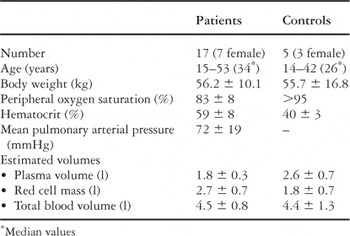
Table 1.

Comparisons of estimated (open bars) with measured (closed bars) blood volumes in patients with secondary pulmonary hypertension associated with erythrocytosis (n = 17) and controls (n = 5). All differences in the patients with pulmonary hypertension, but not in the controls, were significant (red cell mass, p = 0.0001; plasma volume, p < 0.0001; total blood volume, p < 0.0001).
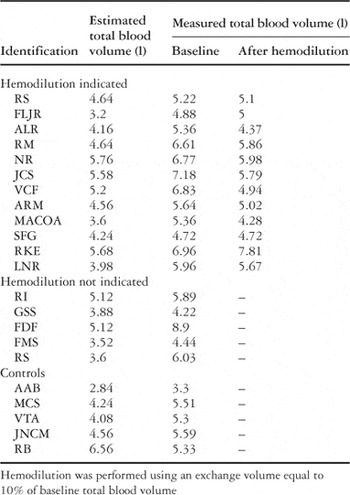
Table 2.

Total blood volume as a function of body weight in the five patients serving as controls (a) and in the 17 patients with Eisenmenger syndrome (b). In both groups, values obtained by direct measurement (○) were compared with those estimated by the formula {total blood volume (l) = 0.08 × body weight (kg)} ([bull ]). In the patients with pulmonary hypertension, the lines were distinct, with the difference corresponding exactly to the intercept.

The effects of therapeutic hemodilution on blood volumes in the 12 patients with secondary pulmonary hypertension associated with erythrocytosis and symptoms related to hyperviscosity. The decreases in red cell mass and total blood volume were significant (p = 0.0462 and p = 0.0201 respectively). Open bars: baseline condition; closed bars: post-hemodilutional condition.
 You have
Access
- 4
- Cited by