In this Q & A, Evaristo de Pinho Oliveira outlines what is necessary to bring about a change in course from conventional humanitarian and development approaches to be able to effectively maintain public services throughout protracted armed conflict in urban contexts.
The experience gained from addressing the challenge of maintaining public services (for example water, sanitation, electricity, and solid waste disposal) over time has taught us that the underlying causes of those challenges do not receive the attention they deserve. Even their symptoms are difficult to deal with through short-term emergency response. Addressing these challenges is all the more difficult when the complexity inherent in urban contexts is compounded by repeated cycles of armed conflict and international sanctions or other restrictions on importing goods. The ICRC's experience and research suggests that a new humanitarian era needs to be ushered in, where nothing less than a paradigm shift in our thinking is necessary, to design and implement interventions that are more effective for assisting affected people.
In 2015, the ICRC published a report entitled Urban services during protracted armed conflict: A call for a better approach to assisting affected people,Footnote 1 as part of an ongoing reflection on this topic. Evaristo de Pinho Oliveira discusses that reflection with the Review below.
ICRC Water and Habitat activities
The ICRC's Water and Habitat Unit provides assistance to millions of people whose lives have been disrupted in armed conflict zones or other situations of violence by restoring vital essential services.
Working within the Assistance Division, which addresses issues related to health, economic security, forensic services and weapons contamination, the Water and Habitat Unit tackles the direct, indirect and cumulative impact on essential infrastructure, preventing environmental health hazards. Sustainable strategies are built into emergency responses. Field delegates working for the Water and Habitat team assess the environmental health-related needs of the concerned population, including displaced persons, detainees and civilians, as well as design and plan need-responsive projects. Additionally, they supervise and manage all these activities, negotiating with the local authorities and civil society to ensure that essential services are restored and maintained.
Activities in urban and rural areas affected by armed conflict and over situations of violence as well as in places of detention range from ensuring the supply of safe drinking water, sanitation and environmental health, the building and rehabilitation of essential infrastructure, and energy saving solutions.
* * *
Can you describe the “urban challenge” in armed conflicts for humanitarian agencies? Why is it important to address this issue now?
Currently, some 50 million people worldwide are affected by armed conflict in urban areas, with knock-on effects that go far beyond the visible signs of destruction.Footnote 2 Most of these people are more dependent on essential services than their rural compatriots, making them more vulnerable to service disruptions. Considering that armed conflicts are increasingly played out in urban areas where millions of people are vulnerable to degraded basic services, or lack of access to them, this problem deserves much greater attention. Today there are multiple armed conflicts playing out in parallel, along with a general trend of rural to urban migration, which has created unprecedented humanitarian needs in urban areas. The evolution of armed conflict towards asymmetric warfare in urban areas coupled with urbanization – the rapid growth of cities – has increased the level of inherent risk to the onset of a destabilizing event, regardless of whether it is armed conflict or a natural disaster. Urban areas are clearly complex places for humanitarian agencies to work in, both logistically and politically, owing to the magnitude and duration of the challenges and the sensitive network of interpersonal relationships. This problem continues to challenge conventional humanitarian approaches.
Since urban areas host residents that typically have a higher dependence on basic services, they tend to be more vulnerable for a whole host of reasons, including the sophistication of large-scale infrastructure, potentially fragile governance structures and complex logistics, just to name a few. The complexity of engaging on essential services in urban environments is a function of the sheer scale of the challenge and the duration of the response required to restore or maintain service delivery. If left unattended, such impacts can accumulate to a point where traditional humanitarian programming becomes less effective than required to maintain or, at the very least, stabilize a given service.
However, much can be done regarding the modalities of how humanitarian assistance interventions are designed and implemented in order to bring about a better approach to assisting affected people in urban areas. In parallel with the changes required in our operational approach, we also need to address the fact that we have witnessed insufficient respect for international humanitarian law (IHL) in many of today`s conflicts where critical water, sanitation and electricity infrastructure (all of which are civilian objects) have not been immune from the extensive destruction in urban areas.Footnote 3 Still, even if IHL is perfectly respected, there may be harm to infrastructure during armed conflict, although it would likely be less extensive. As long as civilian objects risk being damaged by the conduct of hostilities, the consequences will be that large parts of the population remain vulnerable to a lack of access to essential services. This is first and foremost a public health concern, but also threatens livelihoods and can prompt displacement.
Recently, international attention has increasingly been given to the extensive harm caused to infrastructure, including essential services, by the conduct of hostilities in urban areas. What does international humanitarian law have to say about this? Footnote 4
Each of the three components of any essential service – people, hardware, and consumables – is covered by the general protection from direct attack afforded to civilians and civilian objects under IHL. Despite this legal protection, there are several key challenges that partly arise from a lack of respect for IHL in some contexts, as well as from certain types of weaponry used in urban areas. IHL includes object-specific protection for potential targets of attack and does not expressly acknowledge the interconnectivity or the increasing complexity, and thus vulnerability, of essential services in urban areas. This interconnectivity can and ought to be taken into account through the rules of proportionality and precautions in attack.
Running and maintaining urban services in protracted armed conflicts requires taking advantage of opportunities to mitigate the effects of explosive weapons. ICRC strives to engage with all of the parties to a conflict in a bilateral confidential dialogue to promote the need for greater compliance with IHL. The ICRC has continuously strived to mitigate the humanitarian consequences through other means, including by emphasizing that the use of explosive weapons with a wide impact area should be avoided in densely populated areas due to the significant likelihood of indiscriminate effects.
What is particular about essential services in urban areas? Where are they most vulnerable and what additional risks are posed by protracted violence?
Maintaining urban services during protracted armed conflicts is a complex endeavour. The complexity of the challenge is a result of both the uncertainty about the timing and nature of the violence, and the complicated social and infrastructure networks in urban areas. Very distant active combat can have a dramatic effect on urban dwellers if, for instance, an electrical power generator, supply road or water treatment plant is attacked or damaged by an attack on another target, cutting off that source of power, supplies or water from the city even if located far away. Such damage could possibly displace people into the urban areas, further increasing pressure on services.
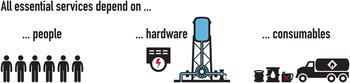
Services can come under a variety of strains as any of the three interdependent components of a service can be compromised: people (especially operations and maintenance staff), hardware (e.g. infrastructure, equipment), or consumables (such as fuel, chlorine, medicine) (see Figure 1). No one component is sufficient on its own; it is pointless having spare parts if the only staff able to install them have fled the fighting or do not have safe access to undertake repairs. As some components are located beyond the city limits, we propose a tailored working definition of “urban”: the area within which civilians vulnerable to disruptions in essential services reside and the network of components supporting those services. In the absence of a broadly recognized definition for an “urban context” the ICRC has opted to define it as “the area within which civilians vulnerable to disruptions in essential services reside and the network of components supporting those services.”Footnote 5
The three essential components of urban services are people, hardware and consumables.

Urban services are interdependent. For instance, damage to an electrical transformer can immediately shut down the water supply to an entire neighbourhood or hospital, which will in turn negatively impact public health. The set of skills and planning capabilities required to best address such interconnectivity is often beyond the scope of humanitarian operations. This needs to change if humanitarian actors are to be able to provide more effective assistance aimed at mitigating the consequences, be it on public health, livelihoods and/or displacement.
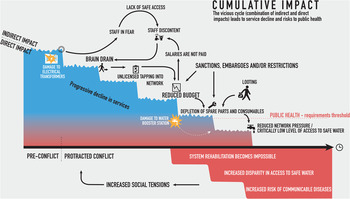
Armed conflict can impact any or all of the components of a service either directly, for instance a reservoir pierced by a tank shell or shortages caused by trade sanctions, or indirectly, for example insecurity can prevent staff from gaining safe access, curtailing the maintenance required to keep a power supply system operational in the long run (see Figure 2). The combination of direct and indirect impacts over time are cumulative, making them more difficult to address. As they become progressively worse, so does life for residents.
Showing cumulative impact on infrastructure of the conduct of hostilities, particularly over prolonged periods. This can create a vicious cycle of indirect and direct impacts leading to service decline.

In the worst cases, vicious cycles may arise, where the cumulative effect takes hold to the extent that it precludes a response. This is most likely to happen during protracted conflicts. By combining and accumulating, the impact may ultimately lead to increased disparity in quality of services, and an outbreak of communicable diseases. Such degradation can exacerbate existing social tensions, and may contribute to the very conflict which created it.
Given this combination of direct and indirect impacts, what needs to be considered if essential services are to be maintained or at least stabilized?
The humanitarian sector is clearly more focused on reacting to direct impacts (typically on infrastructure), while inadequately responding to challenges arising from indirect impacts on people and consumables that infrastructure depends upon. However, there are other critical assets that are also exposed to direct impacts during armed conflict that should be considered, for instance service provider offices and operation rooms, warehouses and stockyards, vehicles and heavy machinery. Even more importantly, formal service staff (and informal service providers) can suffer direct impacts as well. Expanding the response to effectively address direct impacts is not in itself sufficient. As humanitarian actors engaged in urban services interventions, our response needs to increasingly factor in indirect effects in protracted conflict settings. Indirect effects typically originate from socio-economic and security-related processes that reduce or even prevent proper operation and maintenance of critical infrastructure from routinely being carried out. In protracted crises this is often due to a multitude of factors. A number of these factors occurring at once can reduce the likelihood of stabilizing a service or services, not to mention preventative maintenance from being carried out and/or adequate emergency preparedness measures from being taken.
Over prolonged periods direct and indirect impacts take a cumulative toll on systems or infrastructure, which is not easily addressed through conventional humanitarian responses – and so requires a more proactive component, involving prior preparation and planning, in lock and step with the conventional rapid reactive interventions. Avoiding cycles where service decline becomes inevitable is often beyond the limits of humanitarian assistance, due to constraints in programming, funding and internal technical or logistical capacity. Yet humanitarian interventions are nonetheless already being adapted under current constraints to attempt to better meet needs in urban areas. For instance, support to service providers has moved beyond an emergency water supply response (water trucking, bladders, tap stands, and so on) to include rehabilitation of critical infrastructure as well as the provision of spare parts and consumables necessary to help maintain or stabilize a service or services. This type of support is logistically heavy, but absolutely essential for sustaining services. For example, in 2015 the ICRC continued to work closely with the water boards and the Syrian Arab Red Crescent (SARC) to not only repair damaged water supply infrastructure, but to also maintain the broader water supply system for the benefit of 16 million people in Syria. This effort requires a continuous logistics chain to ensure that spare parts and consumables are regularly provided to the water boards in order to help mitigate an interruption to the provision of water. To give an idea of the scale, over the course of 2015 this included 592 tons of disinfection materials, 5000 litres of hydrochloric acid and 12,600 tons of filtration sand for water treatment plants alone.Footnote 6
What are the main constraints in being able to shift from a conventional response to a more effective and proactive response?
If a service deteriorates beyond a certain point, conventional interventions will not prevent a slide into a condition that is too difficult or costly to reverse. The classic humanitarian response is often too focused on immediate needs to incorporate such medium- or long-term considerations. As previously mentioned, avoiding such cycles is often beyond the limits of humanitarian assistance under the current model, hence conventional response does not provide the means necessary to overcome the challenges in an already complex urban situation. The current operational modalities heavily favour:
-
1. Responses that are constrained to direct impacts, rather than being more inclusive to include indirect impacts and hence mitigating the likelihood of cumulative impacts; and
-
2. Emergency response as a reactive function rather than proactive preparedness measures being taken that would contribute to risk reduction and ultimately enhance resilience.
In addition, the lack of respect for the legal protection afforded to civilian objects under IHL continues to manifest itself and as a result assistance continues to focus on rehabilitating or even replacing critical infrastructure that has been damaged, sometimes time and time again.
In light of the constraints, how can the approach and hence the response best be improved?
If effective change is to come about, humanitarian operational approaches in urban areas caught up in protracted conflict must address a number of relevant issues, including the large spatial and time scale of the challenge; the multifaceted interdependencies of essential services; the cumulative effects of direct and indirect impacts; the challenges faced as a result of a lack of respect for the rules of IHL; the need to rethink the relief-rehabilitation-development spectrum; and funding that does not match the duration or scale of the needs. In specific regard to more flexible funding mechanisms, this requires a shift in our approach to multi-year programming, which from experience is not only based on adapting the length of current planning periods, but also the necessity to more robustly engage in relationships with local actors and the local population, as well as further developing our technical capacity and competences.
It is much easier to recommend these changes than to make them, as they imply a sector-wide shift in paradigm. The traditional paradigm that sees response efforts as separated into successive phases of relief, rehabilitation and development is particularly constraining when it comes to protracted armed conflicts that play out in urban areas. This paradigm constricts planning by limiting our thinking to stand-alone technical relief-type interventions, and precludes any integration of relief expertise and programming with improved emergency preparedness and response (for instance, disaster risk reduction measures) or activities previously perceived as “development”, such as the rehabilitation of infrastructure and the provision of spare parts and consumables to service providers. Many humanitarian organizations do not even have engineers on staff, and even if they do these engineers are typically working on more classical emergency response in informal settlements and camps for refugees and internally displaced persons. These humanitarian organizations do not feel as comfortable engaging in urban areas with services, regardless of whether it is in a context of conflict, for example in Syria, or in neighboring countries affected by an influx of refugees, for example Lebanon and Jordan. In many protracted urban conflicts, such technical interventions are seen by some as the first steps in bridging the artificial fissure between contexts of conflict and development, although they can still fall quite short of addressing the most pressing needs.
We thus encourage greater discussion around calls for change from many different perspectives, including other humanitarian organizations, donors, development agencies and academics, as well as civil society and other stakeholders. We also encourage efforts to clear the obstacles that have prevented more effective programming for too long. Inevitably, the path to a better approach requires further discussion both within and beyond the humanitarian sector. We may start along that path by making efforts to link relief, rehabilitation and transitional development assistance, but the ideas must be taken further, and converted into action.
The next steps for local and international implementing agencies are clear. Firstly, multi-year planning and programming is needed to address the severity and complexity of the challenge. Secondly, reporting structures should be modified to enable collection not only of evidence of direct impact but of indirect and cumulative impacts as well. Thirdly, agencies’ evaluations should include assessments of how well their programming supports local coping mechanisms, which, as the 2015 report on Urban Services During Protracted Armed Conflict explains in detail,Footnote 7 can be invaluable for some but dangerous to others. Finally, we as humanitarians must improve our logistical and technical capacity to be better able to adapt our response to more effectively meet the scale of the urban service needs. Concerning the development of the skills and competences necessary to tackle the urban infrastructural challenges both energy supply and wastewater treatment remain priorities for capacity development. This is context dependent. In Syria, for instance, the context demanded that the ICRC hire electric engineers; whereas in Gaza the ICRC has hired both wastewater and electric engineers (see Boxes 1 and 2).
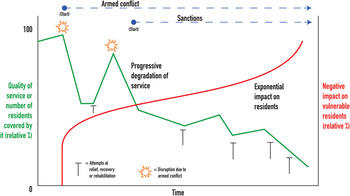
Donors should ensure that funding modalities match the scale and duration of the challenge. Although this may seem more costly on the surface, interventions will be much more expensive and take far longer if aid agencies and local service providers are unable to prevent or mitigate the consequences of cumulative impacts. This is particularly crucial because prolonged exposure to degraded urban services poses a serious risk to public health (see Figure 3).
Showing the deterioration in quality of essential services and consequent negative impact on residents of urban areas as a result of protracted armed conflict and/or sanctions.

The ICRC considers this approach to be central in securing “development holds” against the reversals in development caused by protracted conflict and hence providing financial savings as it avoids much greater costs that would otherwise be incurred after the conflict was ended. The ICRC also understands clearly the challenges posed by the shrinking humanitarian space as a result of the lack of respect for IHL that is seen in many of today's armed conflicts. Operationally speaking, this has meant that we have had to strengthen our remote management capabilities, without compromising humanitarian principles. A good example of where innovative approaches rather than simply technology has helped to provide broader humanitarian coverage is in Syria (see Box 1).
Box 1: Case study
Syria: Strengthening remote management
Since the outbreak of conflict in Syria, the infrastructure that provides access to clean water has been subject to damage from the fighting as well as the gradual deterioration of water delivery systems due to inadequate operation and maintenance. Service providers who aim to restore or simply stabilize water supply face huge challenges in being able to carry out repairs and rehabilitation, accessing spare parts and consumables, and in retaining skilled staff with the knowledge of these systems as well as ensuring safe access to sites. As a result, access to clean water in a country where some seven million people have been internally displaced in large part to urban areas has declined and in some areas is worryingly low. The ICRC began working early on to respond to this critical need.
As Syria is a country that has always had a strong skilled work force, notably of engineers, the ICRC sought to draw on local capacity to help meet needs in the most sustainable way. It has done this by providing training on water, sanitation and hygiene in emergencies to the volunteers of the Syrian Arab Red Crescent (SARC) as well as supporting them in hiring Syrian engineers, which work as front-line responders as well as with more structured assistance support across the country. As a result, the SARC has been able to develop its own response capacity for water and habitat assistance in emergencies, and the ICRC continues to provide resources to sustain and develop the new team and its programmes.
Through its work with the SARC, the ICRC now provides support to each major municipal water board in the country. Building the capacity of the SARC has helped the ICRC to overcome current challenges of remote management in some areas where its own access is restricted, as well as contributing to the SARC's capacity to better serve local communities in the future. Finally, the support to the water boards and to the SARC, is a long-term investment, since both the people and the structures will be critical during the post-conflict recovery process and beyond.
Since 2011, at which time the SARC had no water and sanitation department, the ICRC has supported the development of a team of approximately 270 SARC engineers and specialized volunteers. Specific trainings were initiated in 2013, and currently a program of twelve module-based trainings take place on an annual basis for the SARC water and sanitation (watsan) team. This covers basic response and principles, technical topics and managerial good practices. In addition to this training, an ICRC team of thirty-five engineers works in constant and close partnership with the SARC watsan volunteers. While the ICRC does not have safe access to all of the areas in Syria, the SARC watsan volunteers are now present in all fourteen governorates and in most SARC sub-branches. Similar training programmes are being prepared for the technical staff of service providers, to cope with loss of capacity.
Recognizing that this will take time, how can we as humanitarians be better prepared for long-term emergencies in urban areas?
Better responses are best served by better preparation, as well. In parallel to “quick-fixes” to repair damage once it has occurred, effective humanitarian programming must develop more enhanced and integrated emergency preparedness mechanisms for urban areas. Strengthening relationships with local actors such as municipal water utilities, for example, and supporting them in adapting their operational policies and procedures to an emergency context is vital. Such efforts open up opportunities for scenario planning and the identification of priorities that incorporate the people, hardware and consumables so critical to any service. Designing support programmes that factor all three of these elements of service provision is inclusive of both “hard” (ex post facto rehabilitation and repair) and “soft” (long-term planning) sides of emergency preparedness and ultimately reduces risk. In addition, such interventions aim to strengthen the resilience of urban service systems to help them better withstand emergency situations, which requires a shift from reactive to proactive programming and hence a longer term outlook. The benefits of such an approach in emergency contexts not only reduces the vulnerability of service provision and therefore of the population served, but also enhances emergency preparedness. Ultimately, this works to mitigate the cumulative impact of protracted conflict on urban service provision and it is beneficial prior to, during and long after a crisis.
Emergency preparedness in protracted conflicts is a continuous process, but the basis of any plan must be agreed upon with all stakeholders from the beginning. The necessary human and financial resources need to be allocated in due proportions to the response as well as to the preparedness plans. This stretches both the capacity and means of all aid organizations, who struggle to do either one or the other effectively. On the soft side, a common practice for organizations engaged in longer term planning is that emergency response plans require coordination and communication mechanisms and procedures to be put in place ahead of time, and also that they be inclusive of all of relevant stakeholders. These mechanisms could be technical, administrative, financial, logistical, and so on.
The hard side of contingency planning, the actual engagement with rehabilitation and repair of infrastructure and equipment or the provision of spare parts and consumables includes pre-positioning of equipment, spare parts and consumables as well as dispatch stations that reduce response time and help to ensure access to any given location from multiple entry points. Any emergency preparedness plan, for example, should seek to identify alternative water or electricity sources as well as transportation routes for the delivery of humanitarian assistance, including spare parts and consumables. Putting emergency preparedness measures in place is best done through training exercises and drills in partnership with local institutions, where they exist, and should serve to enhance response performance in the event of an emergency based on specific scenarios identified beforehand.
Box 2: Case Study
Gaza: Partnerships with service providers
The ICRC began supporting the water sector in Gaza in 2006 by providing technical, operational and financial support for the Coastal Municipalities Water Utility (CMWU). The Gaza Strip was plagued by regular power outages, partly due to damage to the only power plant in Gaza in June 2006. A sewage lagoon, or effluent pond, collapsed in Beit Lahia in March 2007, causing the death of four people in a vulnerable downstream community. The limited number of humanitarian actors made the ICRC's activities particularly important.
The ICRC prioritized its support for the rehabilitation and upgrading of essential infrastructure, as well as the urgent need to ensure wastewater treatment to secure the groundwater on which Gaza residents rely for domestic and agricultural supply. This involved the construction of interim wastewater treatment plants in Rafah, Khan Younis, and Wadi Gaza. Support to the CMWU was later expanded to strengthen municipal emergency preparedness, which proved essential in the response to the hostilities in 2008/2009 and 2012.
Since 2013, the main donors to the water sector in Gaza have resumed their investments in larger infrastructure. But the CMWU and municipal water departments still struggle to ensure adequate operation and maintenance (including the supply of spare parts and consumables), as well as the capital costs of smaller infrastructure works that need to be performed. The difficult operating environment due to the occupation, entry restrictions for materials, and internal political divisions has made service providers for water, wastewater and electricity financially unsustainable. Today, the ICRC supports the CMWU via the rehabilitation of infrastructure and provision of spare parts and consumables to enable more reliable operations and maintenance. The ICRC has also covered part of its operating costs.
During the 2014 conflict, the ICRC – in its role as neutral intermediary – was the sole actor coordinating water, wastewater and electricity provision between the parties to the conflict, who needed safe access to perform repairs and basic operation and maintenance on critical infrastructure. The ICRC also supported a short-term emergency response that included water-trucking and generators for a back-up power supply, while simultaneously rehabilitating damaged infrastructure.
This support helped stabilize essential service provision for the population of Gaza and specialist services like hospitals. After the 2014 conflict, the ICRC helped rehabilitate infrastructure. As a wider network of humanitarian actors has re-engaged, the ICRC has refocused its efforts on strengthening the emergency preparedness and response capability of service providers, thereby playing a complementary role to donor investment.
How is the ICRC in particular preparing to better respond to needs in urban armed conflict?
In light of the skills and planning capabilities required to stabilize and adequately maintain essential services, the ICRC must invest in developing the technical and planning competencies of its staff. As it stands in the humanitarian sector, capacity development is heavily weighted to municipal water supply, while skills in wastewater services (collection and treatment) and electricity supply have yet to be fully realized. The multidisciplinary skill sets needed on the ground (including water supply engineers, wastewater engineers, electrical engineers, mechanical engineers, environmental engineers, architects, hydrologists, hydrogeologists, and so on) also need to be reflected in the roster of humanitarian staff ready to be deployed.
The unprecedented humanitarian needs seen today have emerged from numerous armed conflicts spanning long periods of time, overstretching the ability of the humanitarian sector to respond. It is therefore the ICRC's duty to develop the skills necessary to effectively respond in urban areas, but it is also necessary to more effectively communicate and coordinate our response with other local and international actors in order to ensure a broader coverage of the needs, while mitigating the chance of duplication, and when relevant to engage in partnership with development actors. As part of these efforts the ICRC will be more assertive in mobilizing other relevant international and local organizations (when and where possible) to provide complementary assistance.
The course ahead must ultimately lead to programming that pre-empts the vicious cycle of cumulative impact of protracted armed conflict on essential urban services, enabling local and international humanitarian and development actors to maintain or at least stabilize urban services during protracted armed conflict. Dominant rural-urban or relief-development distinctions must be left behind. Instead, we must move towards multi-year integrated programming that is supported by funding models that are more fit-for-purpose, and improved protection of civilian objects as a function of greater respect for IHL. If we are to be of use to the millions affected by prolonged urban armed conflicts, let us embark on that course now. The ICRC is committed to developing further its own competencies to be able to respond to the urban challenge while adapting its approach to more effectively meet the needs in urban contexts, while making all efforts to promote greater respect for IHL.