Growing epidemic of paediatric heart failure
The epidemic of congestive heart failure is a growing worldwide concern and is expected to become even more prevalent. Among adults, there are ~15 million people worldwide and five million patients in the United States of America who have congestive heart failure, with 400,000 new cases per year in the United States of America alone. An equally alarming trend of this disease is being witnessed among children with an increase in prevalence observed over the last decade. There were almost 3000 more congestive heart failure-related hospitalisations among children in 2006 than in 2000, with over a billion dollars more in total charges to hospitals.Reference Rossano, Kim and Decker 1 This cost in simply managing children with congestive heart failure is not far from the amount spent for the management of all cancer-related diagnoses ($2.24 billion) and myocardial infarction ($3.18 billion) combined. These numbers in children will only increase during the next decade, as patients living with CHD now outnumber patients being born with CHD. Current therapies do not adequately address the spectrum of pathophysiology that encumbers patients with CHD and cardiomyopathy, which includes pressure and volume overload, ischaemia, and dysrhythmias.Reference Rossano and Shaddy 2
Considerable optimism has developed over the last decade for stem cell therapy as an option to recover dysfunctional myocardium due to encouraging pre-clinical studies and early clinical trials in human patients. In tandem with advancements in adult patients with ischaemic heart disease, there has been a steadily emerging effort to determine the potential of these stem cells for patients with CHD. In this review, we assess relevant pre-clinical studies and summarise the clinical experience to date with stem cell therapy for patients with CHD, including a discussion of the recently published first clinical trial to evaluate the safety and feasibility of stem cell therapy in patients with hypoplastic left heart syndrome. In addition, we discuss methodological considerations for the delivery of stem cells and the design of clinical trials as it pertains to patients with CHD. Finally, we provide an overview of important unanswered translational questions and upcoming clinical trials.
Building upon experience with ischaemic heart disease
Stem cell therapy has shifted to the forefront of translational and clinical research in cardiovascular medicine. A series of advances in the laboratory has driven the implementation of numerous early clinical trials, employing a wide range of types of stem cells, methods of delivery, and indications for therapy. Emerging from this assortment of preliminary clinical studies has been a handful of stem cell types that have produced reliable, safe, and favourable results in both the pre-clinical setting and the early clinical trials. These include, among others, bone marrow-derived mononuclear and mesenchymal stem cells, cardiosphere-derived cells, and c-kit+ cardiac stem cells.
Bone marrow-derived mononuclear cells represent a heterogeneous population of precursor cells that have the ability to differentiate into multiple cardiac lineages, secrete paracrine factors, and recover left ventricular function in animal models of myocardial infarction.Reference Karantalis, Balkan, Schulman, Hatzistergos and Hare 3 – Reference Telukuntla, Suncion, Schulman and Hare 5 Initially, two promising clinical trials – BOOST trial – bone marrow transfer to enhance ST elevation infarct regeneration – and REPAIR-AMI – the re-infusion of enriched progenitor cells and infarct re-modelling in acute myocardial infarction – gathered much enthusiasm after an increase of 6.7 and 5.5% in left ventricular function, respectively, was seen after myocardial infarction in adults.Reference Wollert, Meyer and Lotz 6 – Reference Schachinger, Erbs and Elsasser 8 Thereafter, many clinical trials attempted to refine the optimal timing of intra-coronary delivery and dosage of these cells after myocardial infarction; however, these multiple clinical trials failed to reproduce the previously reported improvements of left ventricular function seen in adult ischaemic patients as were initially reported in the BOOST and REPAIR-MI studies.Reference Traverse, Henry and Pepine 9 – Reference Perin, Willerson and Pepine 12 Even patients with chronic ischaemic cardiomyopathy failed to show improvements in left ventricular function after intra-coronary injection of these cells. Explanations for this discrepancy are still unclear, but the percentage of CD34+ and CD133+ cells within the bone marrow-derived preparation appear crucial for their regenerative abilities. Patient characteristics such as ageing can negatively impact the regenerative abilities of these autologous stem cells and need further clarification.
Regardless of left ventricular function improvement, the clinical trials using bone marrow-derived mononuclear cells have demonstrated an extremely safe profile in humans, an advantage to be considered when developing therapies for children with heart failure.Reference Wollert, Meyer and Lotz 6 – Reference Perin, Willerson and Pepine 12 Furthermore, the ease of harvest and delivery of these cells add to that advantage in the paediatric population. What is still unclear is the optimal timing of these cells in adults suffering from a myocardial infarction. This unknown may also directly impact children with heart failure due to possible implications that the regenerative efficacy of these cells may be influenced by the progression of myocardial disease. Finally, these bone marrow-derived cells have not been shown to routinely improve myocardial function and clinical symptoms in adults. A multi-centre, randomised controlled phase III trial is now in progress to more definitively answer this question, the BAMI trial – effect of intra-coronary re-infusion of bone marrow-derived mononuclear cells on all-cause mortality in acute myocardial infarction.Reference Telukuntla, Suncion, Schulman and Hare 5 This trial is powered to determine whether infusion of mononuclear cells can effectively reduce all-cause mortality in patients with an ejection fraction ⩽45% when compared with a control group receiving optimal medical therapy. Results from this clinical trial will directly impact research focussed on children with heart failure, as demonstrating efficacy in adults is the critical first step before the application of this cell preparation in the more vulnerable paediatric population.
Another source of bone marrow-derived progenitor cells are mesenchymal stem cells. These cells have shown safety, feasibility, and preliminary efficacy in improving regional contractility and quality of life, as well as decreasing scar formation in early phase clinical trials.Reference Karantalis, DiFede and Gerstenblith 13 – Reference Heldman, DiFede and Fishman 15 Distinct advantages of mesenchymal stem cells include the capacity to self-replicate and differentiate into various tissue lineages, as well as the potential for allogeneic use. Mesenchymal stem cells have the unique property of being immunologically more inert due to a reduced expression of major histocompatibility complex class-I molecule and lack of major histocompatibility complex class-II and co-stimulatory molecules CD80 (B7-1), CD86 (B7-2), and CD40.Reference Selem, Kaushal and Hare 16 , Reference Karantalis, Schulman, Balkan and Hare 17 This has been verified extensively in pre-clinical animal models and recently tested in phase I, double-blind randomised clinical trials. In the initial clinical trial, intravenous infusion of allogeneic mesenchymal stem cells were delivered to patients after an acute myocardial infarction and showed that the mesenchymal stem cells did not trigger an immune response. In addition, the mesenchymal stem cells promoted improvements in pulmonary function, left ventricular function, and symptomatic global assessment with a decrease of cardiac arrhythmias.Reference Hare, Traverse and Henry 18 Subsequently, a phase I/II randomised trial – the POSEIDON trial – the percutaneous stem cell injection delivery effects on neomyogenesis – was designed to compare the use of allogeneic and autologous mesenchymal stem cells in patients with chronic ischaemic cardiomyopathy. The investigators found that allogeneic mesenchymal stem cells caused no relative increase in serious adverse events and did not stimulate significant alloimmune reactions.Reference Hare, Fishman and Gerstenblith 14 In addition, both autologous and allogeneic stem cell injections in this study reduced the size of the infarct by ~33%, reduced the left-ventricular sphericity index, improved the physical functional capacity, and improved quality of life. The exact mechanism of action underlying the recovery of myocardial function is still unknown, but may include differentiation into mature cardiomyocytes, decreased inflammation and scar formation, decreased apoptosis of cardiomyocytes, secretion of paracrine factors, and stimulation of the resident c-kit+ cardiac stem cells.
Another area of intense focus has been the therapeutic potential of two types of resident cardiac stem cells: c-kit+ resident cardiac stem cells and cardiosphere-derived cells. The c-kit+ cardiac stem cells are defined by their multipotent, self-renewing, and clonogenic properties and have been clinically studied in the SCIPIO trial – administration of cardiac stem cells in patients with ischaemic cardiomyopathy – which was reported as a randomised, open-label phase I trial in patients with ischaemic heart disease having undergone coronary bypass re-vascularisation.Reference Bolli, Chugh and D’Amario 19 With the intra-coronary delivery of c-kit+ cardiac stem cells, there were no serious adverse events reported and, despite a small number of patients, the cell-treated patients showed a reduction in scar formation and an average improvement in the left ventricular ejection fraction by 12.3% during the 1st year of cellular transplantation compared with baseline. Another cell type extensively studied is the cardiosphere-derived cells, which are a heterogeneous population of CD105+/CD45− mononuclear cells. The CADUCEUS trial – cardiosphere-derived autologous stem cells to reverse ventricular dysfunction and autologous cardiosphere-derived cells – was a prospective, randomised, phase Ib safety trial in adult patients with post-infarction left ventricular dysfunction. The trial demonstrated that intra-coronary delivery of endocardial biopsy-derived cardiosphere-derived cells resulted in no arrhythmias, formation of tumours, myocardial infarction, or other serious adverse cardiac events. Although there were no significant improvements in cardiac function, there was significant reduction in scar mass, increased viable heart mass, regional contractility, and systolic wall thickening. With these encouraging results, a phase 1–2 trial using allogeneic cardiosphere-derived cells rather than the autologous cells are being studied in adult patients with ischaemic heart disease.Reference Makkar, Schatz and Traverse 20
Evaluation of stem cell therapy in animal models relevant to CHD
With the majority of stem cell research aimed at the regeneration or recovery of the ischaemic myocardium, less attention has been given to the evaluation of stem cell therapy under pathophysiological conditions relevant to patients with CHD. Although no animal model can truly replicate all the salient features of complex CHD, reproducible models of pressure or volume overload can mimic some of the cardinal features of these diseases; however, use of these models to determine the safety and efficacy of stem cell therapy has been scarce. In a notable exception, Davies et alReference Davies, Elwood and Li 21 used a model of right ventricular pressure overload in neonatal sheep to determine the effects of human cord blood stem cells on right ventricular function. In these experiments, immunosuppressed neonatal sheep underwent banding of the pulmonary artery followed by epicardial injection of human-derived cord blood stem cells into the right ventricle and were compared with post-banding parameters of right ventricular function as well as with animals receiving injection of a placebo solution. At 4 weeks post-injection, marked improvement was observed in load-independent indices of systolic and diastolic functions of the right ventricle in the cell-treated sheep compared with placebo-treated sheep.
To further evaluate the safety profile of the injection of cord blood stem cells to the right ventricle, a recent double-blinded randomised study injected cord blood stem cells or a placebo into the right ventricle of healthy juvenile swine.Reference Cantero Peral, Burkhart and Oommen 22 The animals were rigorously monitored for 3 months, including electrophysiological assessments using implanted event recorders. The investigators observed no major adverse events including systemic infection, tumour formation, myocardial necrosis, ventricular dysfunction, or dysrhythmias. Although the number of animals was relatively small at six per group, this study established the first evidence of a favourable safety profile for injecting cord blood stem cells to the right ventricle in a juvenile model.
In a rat model of chronic pressure overload of the right ventricle, Hoashi et alReference Hoashi, Matsumiya and Miyagawa 23 demonstrated that sheets of skeletal myoblasts transplanted 4 weeks after banding of the pulmonary artery improved diastolic function, reduced fibrosis of the right ventricle, and increased capillary density in the myocardium compared with controls. In addition, real-time polymerase chain reaction of explanted specimens from the right ventricle revealed increased expression of genes encoding the angiogenic cytokines, hepatocyte growth factor, and vascular endothelial growth factor in rats that received transplantation of skeletal myoblasts compared with controls, suggesting a possible mechanism for the improved angiogenesis observed in the treatment group.
Clinical experience with stem cell therapy in patients with CHD
Case reports and series
The majority of experience with stem cell therapy in children has been limited to isolated case reports and small case series. In total, over 20 reported children have received a stem cell therapy product for CHD or end-stage cardiomyopathy (reviewed in Tarui et alReference Tarui, Sano and Oh 24 ). Among these patients, dilated cardiomyopathy has been the most common aetiology of heart failure, with improvements in left ventricular ejection fraction of 20–23% from measured values at baseline in patients ranging from 4 months to 17 years of age. A similar increase in left ventricular ejection fraction was reported in a 9-year-old girl with congestive heart failure after an anterior myocardial infarction, which was presumed to be due to Takayasu arteritis.Reference Limsuwan, Pienvichit and Limpijankit 25 After initial treatment with medical therapy and placement of a left main stent, the patient was discharged from the hospital with an ejection fraction of 28.5% by cardiac MRI. She re-presented 1 year later with severe fatigue and dyspnoea and was found to have an ejection fraction of 19%. She underwent a bone marrow biopsy and was successfully treated with autologous bone marrow-derived progenitor cells via transcoronary injection to the left anterior descending artery. At 12 weeks of follow-up, a remarkable improvement in her symptoms and ejection fraction was observed, which had improved to 47.8%, as assessed by cardiac MRI.
Case reports that describe delivery of stem cells to patients with hypoplastic left heart syndrome have shown similar benefits to the performance of the single right ventricle; one patient developed failure of the single right ventricle following a hybrid stage I procedure that was complicated by obstruction of the arterial duct.Reference Rupp, Zeiher and Dimmeler 26 This patient was treated with intra-coronary delivery of bone marrow cells to the proximal and distal right coronary arteries; 12 months after administration of stem cells, the ejection fraction of the systemic right ventricle improved from 22 to 44%, and the serum level of brain natriuretic peptide was reduced from 2200 to 132 pg/ml.
More recently, Burkhardt et alReference Burkhart, Qureshi and Peral 27 published the first reported intra-myocardial delivery of autologous umbilical cord blood stem cells to patients with hypoplastic left heart syndrome during stage II surgical palliation. This patient suffered no sustained dysrhythmias, myocardial necrosis, or systemic infection related to cell injections, and the ejection fraction of the right ventricle improved from 30 to 35% before stage II to 50% at 3 months post-injection by transthoracic echocardiography. Despite the heterogeneity in age, indication, type of cell, and method of delivery, a commonality between all reported cases in children has been the robust response to cellular therapy. Until recently, however, no clinical trial had been completed to formally evaluate the safety, feasibility, and preliminary efficacy of stem cell therapy for children with complex forms of CHD.
A clinical trial for patients with hypoplastic left heart syndrome
Before the development of palliative strategies for hypoplastic left heart syndrome, this lesion was universally lethal in infancy. With development over the last few decades of staged surgical treatments, outcomes of surgical palliation for hypoplastic left heart syndrome have steadily improved. Typically, hypoplastic left heart syndrome patients undergo three-staged surgical procedures: stage I Norwood palliative operation in the neonatal period, stage II palliative bidirectional cavopulmonary connection operation at ~4 months of age, and the stage III palliative total cavopulmonary (Fontan) operation at ~3 years of age. Despite these advancements in surgical technique, the 5-year mortality rate still remains unacceptably high at 50–60%, with cardiac transplantation remaining as the only alternative for patients with failing circulatory systems.Reference Newburger, Sleeper and Frommelt 28 , Reference Feinstein, Benson and Dubin 29 Although the aetiology of this attrition is multifactorial, right ventricular dysfunction plays an important role.Reference Lee, Aiyagari, Hirsch, Ohye, Bove and Devaney 30 In a report by Altmann et al,Reference Altmann, Printz, Solowiejczyk, Gersony, Quaegebeur and Apfel 31 those patients who presented with depressed right ventricular function had an 18-month survival rate of 35% compared to 70% for those with normal function. Furthermore, as an increasing number of these patients survive the neonatal period, there is a growing population of patients who present with dysfunction of the single right ventricle, whose cellular and gross architecture is not structurally or genetically designed to chronically support the systemic circulation.Reference Kaneko, Khoo, Smallhorn and Tham 32 – Reference Voelkel, Quaife and Leinwand 35 Interventions aimed at improving the function of the systemic right ventricle that avoid or defer transplantation in patients with hypoplastic left heart syndrome are, therefore, urgently needed.
The TICAP trial – transcoronary infusion of cardiac progenitor cells in patients with single ventricle physiology – was the first completed clinical trial to address these needs in patients with hypoplastic left heart syndrome using a cell-based therapy.Reference Ishigami, Ohtsuki and Tarui 36 In this study, autologous cardiosphere-derived cells were isolated and expanded from biopsies of the right atrial appendage obtained from each patient, which were then administered via intra-coronary delivery 4–5 weeks after stage II or stage III surgical palliation. The primary objectives of the study were to evaluate the safety and feasibility of infusion of cardiosphere-derived cells, with a secondary aim to assess preliminary evidence of efficacy to enhance performance of the single ventricle. In total, seven patients were included in each arm of the study, which was not randomised. Function of the single ventricle was serially measured using cardiac MRI, transthoracic echocardiography, and single-photon emission CT.
No adverse events were reported in the form of peri-operative complications during delivery of the cells, formation of new tumours, or other major adverse cardiac events. Other favourable findings included a reduced incidence of re-admission to the hospital and end-organ dysfunction in the cell-treated group compared with controls. Interestingly, cell-treated patients demonstrated an improvement in right ventricular ejection fraction from 46.9±4.6 to 54.0±2.8% and a significant reduction in the diameter of the tricuspid valve annulus at 18 months of follow-up, whereas control patients showed little improvement in right ventricular ejection fraction, increasing from 46.7±4.4 to 48.7±6.7%, and no change in the diameter of the tricuspid valve annulus. At the 18-month follow-up, there were observed reductions in free wall mass and indexed end-systolic and end-diastolic volumes of the right ventricle in cell-treated patients. The authors also tracked somatic growth of enrolled patients and found that cell-treated patients had significantly improved z-scores for height and weight at 18 months compared with values at baseline, whereas there was no significant change in growth in the control group. In addition, a reduction in heart failure status, levels of brain natriuretic peptide, and the number of coil interventions was found in the cell-treated group compared with controls. Although the numbers in this initial study were small, and the study was not randomised, the authors effectively demonstrated safety of intra-coronary delivery of cardiosphere-derived cells to patients with hypoplastic left heart syndrome. Furthermore, this study showed the potential efficacy of a cell-based therapy to enhance the ventricular function of patients with complex CHD.
Methodological considerations
The potential of stem cell therapy for patients with CHD presents a different set of challenges not seen in adults with ischaemic heart disease. Given the diversity of the types of stem cells and approaches to delivery of stem cells that have been described, investigators are faced with designing clinical trials to the best of their ability using existing literature. The optimal type of stem cell for therapeutic use in patients with CHD is not known, and current choices for use in clinical trials may be based on the experience of the investigators, cost, regulatory issues, and feasibility. An additional consideration is the use of an allogeneic, rather than autologous, cell therapy product, which has emerged as a potential option for some types of stem cells. Clear advantages to this approach include “off-the-shelf” availability of a pre-screened and expanded stem cell product for clinical use, as well as the avoidance of an additional invasive procedure such as a bone marrow biopsy.Reference Karantalis, Schulman, Balkan and Hare 17 A recent phase I/II randomised trial comparing autologous to allogeneic mesenchymal stem cells demonstrated that allogeneic cells were safe and equally effective in the recovery of an ischaemic myocardium.Reference Hare, Fishman and Gerstenblith 14 In addition, an allogeneic preparation of cardiosphere-derived cells has been recently shown not to elicit an immune response and to have equal efficacy as allogeneic cells in the recovery of function of the left ventricle in rodent and swine models of myocardial infarction.Reference Ibrahim, Cheng and Marban 37 , Reference Suzuki, Weil and Leiker 38 These findings support the basis of the ALL-STAR trial – allogeneic heart stem cells to achieve myocardial regeneration – which is a phase I/II trial to determine the safety and efficacy of allogeneic cardiosphere-derived cells administered to patients with a history of an anterior myocardial infarction.Reference Makkar, Schatz and Traverse 20
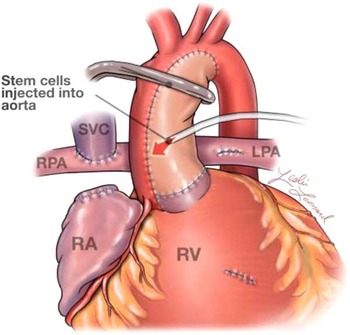
The optimal method for delivery of stem cells remains an active area of investigation. The ideal method would ultimately be tailored to the needs of the age of the patient, diagnosis, and whether or not a surgical procedure is planned at the time of administration of cells to provide direct exposure of cardiac structures. The existing delivery strategies include catheter-based intra-coronary delivery, intra-myocardial injection, or transendocardial injection. A novel method under investigation in our animal laboratory is the potential for cardiopulmonary bypass-assisted intra-coronary infusion of cardiac stem cells via the root of the aorta, which is anticipated to facilitate a global distribution of the cell product as an adjunct to a planned cardiac surgical procedure (Fig 1). In a population of neonatal and infant patients, especially those with complex cardiac malformations and a high association of coronary anomalies, a strategy of intra-myocardial injection or bypass-assisted coronary infusion at the time of surgical reconstruction may have reduced risk compared to a catheter-based coronary intervention.Reference Bergersen, Marshall and Gauvreau 39 , Reference Lin, Hegde and Marshall 40 Furthermore, the repeated interruption of coronary blood flow that occurs with the commonly used stop-re-flow technique during intra-coronary delivery may pose additional risks to patients with complex CHD or end-stage cardiomyopathy. Use of this technique has been safe thus far in clinical trials in adults where cells are delivered to a focal area of ischaemic or scarred myocardium, usually at the mid-to-distal left anterior descending artery.Reference Bolli, Chugh and D’Amario 19 , Reference Makkar, Smith and Cheng 41 There are key differences, however, in the approach to patients with CHD who have global, non-ischaemic ventricular dysfunction, and the clinical implication of intra-coronary delivery to these patients has yet to be fully determined. In the TICAP trial, for example, operators were required to engage and repeatedly occlude proximal coronary blood flow to each of the major coronary arteries supplying a univentricular heart, 1 month out from surgical palliation.Reference Ishigami, Ohtsuki and Tarui 36 The authors reported no complications experienced with the procedure and only transient ST-segment elevations using this technique, but concern for the possibility of future complications is warranted. In the design of future trials, intra-coronary infusion without balloon inflation may be a safer approach, and is the strategy employed in an upcoming trial designed for adult patients with non-ischaemic cardiomyopathy; however, whether cells are as effectively delivered to the myocardium as with the stop-reflow technique has yet to be verified.
Schematic of cardiopulmonary bypass-assisted intra-coronary infusion of a cell-based therapy via the aortic root during cardiac surgery. LPA=left pulmonary artery; PA=pulmonary artery; RA=right atrium; RPA=right pulmonary artery; RV=right ventricle; SVC=superior caval vein.

A key biological question is the mechanism of action of stem cells in patients with CHD. We have shown that the main action of recovery of the cardiosphere-derived cells obtained from patients with CHD is the more potent cytokine release by the younger-derived cardiosphere-derived cells when compared with older-derived cardiosphere-derived cells.Reference Simpson, Mishra and Sharma 42 We are now testing these younger-derived cardiosphere-derived cells in other non-ischaemic ventricular dysfunctional rodent models, which may have more relevance to patients with CHD. In addition to the impact of age of the donor on stem cell functionality, characterisation of the ideal cell product may also be determined using quantifiable growth properties such as telomere length, telomerase activity, and population-doubling time.Reference D’Amario, Leone and Iaconelli 43 As recent studies of ours and others continue to show the central importance of a high functioning secretome in the repair capabilities of stem cells,Reference Li, Cheng and Malliaras 44 it is likely that the stem cell type and donor with the most potent secretome will emerge as the most efficacious stem cell product for repair of the injured myocardium.Reference Mirotsou, Jayawardena, Schmeckpeper, Gnecchi and Dzau 45
Finally, the indication of stem cell therapy for patients with CHD remains to be defined – for instance, a subset of patients with hypoplastic left heart syndrome and right ventricular dysfunction may have the greatest clinical benefit from stem cell treatment. The answers to these translational questions will be paramount to achieve the greatest efficacy in the treatment of these challenging patients with CHD.
Future clinical trials
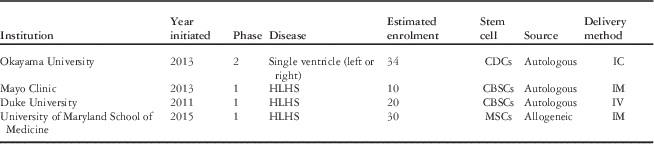
A number of planned or ongoing clinical trials have been designed to evaluate the safety, feasibility, and preliminary efficacy of stem cell therapy as a novel treatment for CHD (Table 1). Interestingly, patients with hypoplastic left heart syndrome are the population of interest for each of the planned or ongoing clinical trials, a testament to the severe unmet medical needs of this population.
Planned or ongoing clinical trials to evaluate safety, feasibility, and preliminary efficacy of stem cell therapy for patients with CHD.
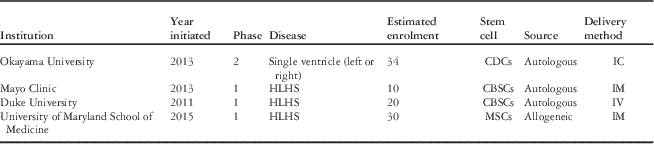
CBSCs=umbilical cord blood stem cells; CDCs=cardiosphere-derived cells; HLHS=hypoplastic left heart syndrome; IC=intra-coronary; IM=intra-myocardial; IV=intravenous; MSCs=mesenchymal stem cells
Randomised phase I clinical trials at Duke University and Mayo Clinic are both aimed at evaluating the safety and feasibility of administration of autologous cord blood stem cells to patients with hypoplastic left heart syndrome. At Mayo Clinic, cord blood stem cells are administered intra-operatively via intra-myocardial injection at the time of the stage II palliation, with a secondary objective to evaluate the preliminary efficacy to enhance performance of the right ventricle.Reference Burkhart, Qureshi and Peral 27 The trial at Duke University, by contrast, utilises intravenous delivery of cord blood stem cells with a focus on improvement of neurological outcomes.Reference Tarui, Sano and Oh 24 The investigators of the TICAP trial are also recruiting patients for its successor, a phase II trial known as the PERSEUS trial – cardiac progenitor cell infusion to treat univentricular heart disease.Reference Tarui, Sano and Oh 24 This is a randomised study aimed at assessing the efficacy of treatment with cardiosphere-derived cells for patients with single ventricle lesions of either the left or the right ventricle.
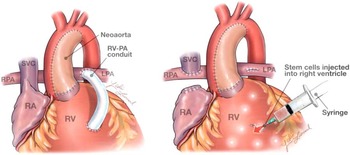
Our institution will soon begin enrolment to a phase I trial to intra-operatively administer allogeneic mesenchymal stem cells to patients with hypoplastic left heart syndrome undergoing stage II palliation (Fig 2).Reference Wehman and Kaushal 46 Mesenchymal stem cells have a long and proven safety record in adult clinical trials. In addition, the regenerative efficacy of mesenchymal stem cells is not affected when used as an allogeneic cell product. This is a unique feature of mesenchymal stem cells, and allows the potential to eliminate many of the variables present in an autologous cell product.Reference Hare, Fishman and Gerstenblith 14 Mesenchymal stem cells have also been shown in a large animal study to recruit and activate the endogenous pool of c-kit+ cardiac stem cells to areas of myocardial injury.Reference Hatzistergos, Quevedo and Oskouei 47 This has significant implications for the application of mesenchymal stem cell therapy in children with CHD, as our laboratory has demonstrated an age-dependent decline in the number and regenerative efficacy of resident c-kit+ cardiac stem cells present in paediatric versus adult myocardium.Reference Simpson, Mishra and Sharma 42 In our planned trial, we chose the stage II palliative operation as the time of stem cell injection for several reasons. First, there is a well-established risk for inter-stage mortality following the stage I operation, as high as 12% according to follow-up of 426 patients from the Single Ventricular Reconstruction trial.Reference Ghanayem, Allen and Tabbutt 48 Thus, the high early mortality rate after the stage I operation could potentially mask the safety end points of a phase I study. Second, an intervention at the stage II operation will allow for parallel study of the natural history of the systemic right ventricle following the bidirectional cavopulmonary connection operation. Specifically, we will have the opportunity to assess the effects of volume unloading on systolic and diastolic function over an extended period of follow-up using cardiac MRI, in addition to the evaluation of mesenchymal stem cell therapy on right ventricular function. Finally, restricting enrolment to patients undergoing the stage II operation will create a more homogeneous population of patients with hypoplastic left heart syndrome and eliminate patient selection variables in the final analysis of clinical results.
Schematic of planned phase I clinical trial at the University of Maryland School of Medicine for patients with hypoplastic left heart syndrome. Allogeneic mesenchymal stem cells will be delivered via intra-myocardial injections at the time of stage II surgical palliation, after take down of the previously placed RVPA (Sano) shunt. LPA=left pulmonary artery; PA=pulmonary artery; RA=right atrium; RPA=right pulmonary artery; RV=right ventricle; RVPA=right ventricle to pulmonary artery shunt; SVC=superior caval vein.

In summary, stem cell therapy has promise as a novel therapy for patients with CHD and could potentially offer a new paradigm for the management of these patients. Several pioneering trials are underway, with a resolute focus on the treatment of hypoplastic left heart syndrome, which will establish the foundation for stem cell therapy in patients with CHD. As pre-clinical and clinical research studies continue to advance, regular discourse between basic science and clinical investigators is essential for the effective translation of this therapy from bench to bedside in the safest and the most efficacious manner.
Acknowledgement
None.
Financial Support
Dr Kaushal is supported by the National Institutes of Health Grant R01HL118491 and the Children’s Heart Foundation.
Conflicts of Interest
None.
Ethical Standards
Not applicable.