Introduction
Research on health and aging is broad. In Canada, over the past decade much of the research in health and aging has been supported by the Institute of Aging (IA) within the Canadian Institutes for Health (CIHR). In its mandate, the IA takes an integrative, holistic approach “to support research to promote healthy aging and to address causes, prevention, screening, diagnosis, treatment, support systems, and palliation for a wide range of conditions associated with aging” (The Future is AGING, 2007). While other CIHR institutes are focused on specific diseases and conditions, IA’s mandate is focused dynamically on the older adult and the spectrum of possible effects of different health conditions on the aging process and quality of life. We argue that a team approach to research in accordance with the IA’s mandate can provide novel solutions to the complex health problems that affect older adults. We draw on a number of examples of broad research team experiences to provide some considerations for teams working in the field of health and aging research.
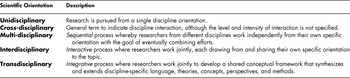
Teamwork in research often means collaboration across a range of disciplines. We use the term cross-disciplinary to speak broadly about all “levels” and “intensities” (see Table 1 for definitions) of discipline integration (Rosenfield, Reference Rosenfield1992; Stokols, Hall, Taylor, & Moser, Reference Stokols, Hall, Taylor and Moser2008). At their best, cross-disciplinary research teams provide valuable outcomes that cannot be achieved through single-discipline or single-investigator approaches. For example, an IA emerging team grant led by Stienstra and Chochinov focused on end-of-life care in vulnerable populations and drew together researchers from anthropology, education, disabilities studies, and palliative care, among other disciplines (2009). Although the lead investigators stated that there was a steep learning curve on how to work effectively as a team because of their differences in discipline approaches, they were able to achieve outcomes impossible for unidisciplinary teams. Not only did they achieve the goals of their research program – to identify challenges and barriers for care of vulnerable populations at the end of life – but the team also created new channels for dialogue between stakeholders and communities.
Discipline integration in research teams (Adapted from Rosenfield, Reference Rosenfield1992; Stokols et al., Reference Stokols, Hall, Taylor and Moser2008)

Teams collaborate for various reasons. A funding agency’s request for a proposal with a cross-disciplinary focus may spark collaboration among a number of loosely connected researchers from diverse fields. Alternatively, as a researcher’s program of study gains complexity and diversity, he or she might realize that the next logical step is a cross-disciplinary team approach. Regardless of why cross-disciplinary teams form, certain factors should be considered at the outset of their collaborative efforts (Hall, Stokols, Moser, Taylor, Thomquist, Nebeling et al., Reference Hall, Stokols, Moser, Taylor, Thornquist and Nebeling2008; Trochim, Marcus, Mâsse, Moser, & Weld, Reference Trochim, Marcus, Mâsse, Moser and Weld2008); accordingly, we discuss some evidence for their influence on team success. We also address the challenge of measuring team success in terms of how teams know if they have achieved it.
Collaboration Readiness – Considering Factors that can Facilitate Team Success
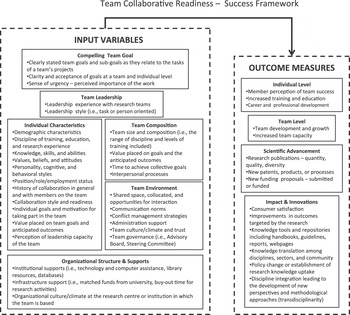
The team approach to research can be a science in itself, requiring the operation of general laws, such that certain inputs can predict the generation of certain outputs. As outlined in the Conceptual Framework for Facilitating Research Team Success (see Figure 1), certain input variables can influence team performance, and these can be defined in six broad categories: (a) compelling team goal, (b) leadership of the team, (c) team members’ individual characteristics, (d) team composition, (e) the environment created by the team, as well as the (f) organization and systems in which the team works. The framework outlines the factors that will lead a team to succeed and enables a researcher to “jump ship” early when a team project is doomed (i.e., because critical factors are missing, mismatched, or unbalanced). Additionally, considering the factors in the framework may help researchers recognize a fruitful opportunity they might otherwise have missed (Hays, Reference Hays2008). Because of space limitations we expand on only some of the elements listed in the framework.
Conceptual framework for facilitating research team success

Goals – Make them Clear and Compelling
Overt and undivided commitment to a compelling goal is essential for cross-disciplinary research team success (Hackman, Reference Hackman2002). For team initiatives that run over a number of years, there needs to be an overall compelling team goal, as well as project-specific individual and team sub-goals. An experienced, insightful team leader will focus the team on an appropriate compelling team goal and keep them on track through the accomplishment of individual and team sub-goals. For example, the task of a cross-disciplinary team may be to design effective, well-accepted hip protectors in residential care settings. However, without strong team leadership, team members might engage in behaviour that distracts from this goal. For instance, the engineers on the team might become fascinated with the biomechanical testing of the hip protectors, or the social scientists responsible for the compliance of the hip protector’s use could get sidetracked with questions about care practices in the facility. The team’s stated compelling goal – to prevent a catastrophic injury for an at-risk individual and preserve quality of life – will keep the team of diverse researchers focused and motivated on the team’s tasks.
Using team goals as criteria to evaluate a team may reduce the tendency to use only traditional performance indicators, such as publications and patents that do not always capture the breadth of the team’s achievements. Further, having explicitly stated team goals forces the team to be very clear when planning what they want their collaboration to accomplish in terms of the tangible outcomes, products, and accomplishments.
These broader, overarching team goals are one of three elements that are essential for a team experience to be considered effective (Hackman, Reference Hackman1983). Team goals must first serve the clients, which in the case of health-focused research teams can include the target population of the research as well as the funding agency. For instance, will the outcomes of the team’s research benefit the health of aging Canadians? How usable is this knowledge? Has the team considered the funding agency’s objectives? Sustainable funding requires that the team meet the agency’s objectives.
A second, equally important outcome of team efforts is that there is attention to team development. Teamwork needs to facilitate growth in the team. Do the collaborations enhance each team member’s capacity to carry out a portion of the work and to work interdependently with other members? Are there measureable advantages to mixing with other disciplines that would not have occurred otherwise? These unique advantages stemming from cross-disciplinary approaches to research can be many. For instance, adding a behavioural psychologist to a falls prevention team composed of geriatricians, physical therapists, and physiologists may greatly improve all investigators’ understanding of how to motivate study participants to adhere to an exercise program. There may be challenges with establishing a shared approach on the initial collaboration, but through the process of working together the team should develop a shared understanding, and subsequent collaborations should be enhanced as a result. So in this case, the growth in the team is in reducing the “transaction costs” for future collaboration. To promote future collaboration and to create an effective team research experience, members should strive for certain skills – active listening, being open minded, communicating clearly without jargon, knowing when to take the lead and when to take advice, to name a few. Thus, there should be secondary benefits accruing from one team experience to future health research collaborations.
Team development is often overlooked when team initiatives are being planned. Strong leadership will prioritize team development within the team tasks. Also, we are not convinced that the time it takes to develop research teams is appropriately valued in academic promotions and by tenure committees that often seem to focus on “individual” markers (e.g., sole authorship or first authorship) and “independence” as a higher value than “cohesion” and “collaboration.”
The final element for team effectiveness is that the team’s work must also cultivate individual learning. In other words, the group experience must contribute positively to the individual team members, perhaps expanding their respective research program, methodological expertise, or their understanding of the context in which they work. Within a team whose members represent a range of tenures, ranks, experiences, and disciplines, the exponential opportunities (compared to those available to single investigators) should be considered for (a) mentorship in grant writing, (b) access to expert collaborators outside the team, (c) access to internationally acclaimed mentors, and (d) convenient linkages to industry partners. The key point is that membership on teams has privileges – these benefits are available because the individual is a part of the team, and it is the expertise within the team, or the profile of the team, that effectively leverages the value for the individual.
In this way, teams focus on a goal that meets the funding agency’s needs while the team simultaneously gains efficiencies in team processes that will apply to other settings. Also, individual researchers feel fulfilled by growing in knowledge and skills.
Team Composition and Individual Characteristics – Sometimes More Is Better, Sometimes Less Is More
Ideally, the synergy of skills, expertise, and resources should increase group productivity and lead to greater outcomes than would be achieved by any single individual. However, despite good intentions for collaboration, situational and interpersonal factors can lead to process losses and can prevent the team from achieving its intended outcomes. Evidence from a variety of team scenarios shows that groups of about four to six members (Steiner, Reference Steiner1972) are less prone to the problems that arise with larger groups, and such groups tend to work more productively (Carayol & Matt, Reference Carayol and Matt2004; Peslak & Stanton, Reference Peslak and Stanton2007).
The individual characteristics of team members have been correlated with measures of team success. For example, in an evaluation of a laboratory-based team research organization, investigators found that the number of publications and patents correlated with teams that had a higher number of full-time research staff compared with teams composed primarily of doctoral students, post-doctoral fellows, or professors (who divided their time between teaching and research) Carayol & Matt, Reference Carayol and Matt2004). Other investigators have shown that productivity of research and development teams is related to having members with more years of work experience in the given field (Reagans & Zuckerman, Reference Reagans and Zuckerman2001). In the same study, cultural diversity also correlated with improved performance measured by new product development and product improvement. The authors suggested that cultural diversity might facilitate team learning and creativity.
Individual perceptions and past experiences may also influence team outcomes. Researchers with only a few years of cross-disciplinary research experience had more positive views about this type of work compared to those who had more years of actually doing cross-disciplinary research (Hall et al., Reference Hall, Stokols, Moser, Taylor, Thornquist and Nebeling2008). This could be interpreted to mean that those who had spent more time in collaborative research may have become disillusioned over the substantial time and effort it takes to develop the personal, organizational, and funding infrastructures for scientific collaboration. If a team is composed of members who have had a negative team experience and thus are disenchanted and unmotivated by the team approach to research, the likelihood of achieving team success is jeopardized.
Effective team leaders will strive to improve the team experience for all by taking proactive approaches (e.g., providing members with training in teamwork). Further, effective leadership will foster a team culture that strives to be inclusive concerning its members and their discipline perspectives, with the goal of diminishing the chances of team member disenchantment and improving interpersonal interactions for the betterment of team outcomes.
Team Environment and Organizational Structures – Establishing Norms and Supports
Success within cross-disciplinary teams may be improved by the early establishment of norms and systems in which to work – before problems arise. How conflict will be resolved and decisions will be made, for example, should be agreed upon by the team members at the outset of a team’s working together (Arrow, McGrath, & Berdahl, Reference Arrow, McGrath and Berdahl2000). Collectively establishing conflict management strategies and procedural mechanisms is crucial, especially for teams that are self-governing (i.e., most research teams). The establishment of these norms and strategies will lead to a positive team environment.
Communication norms are another important consideration for cross-disciplinary research teams, particularly as team members are often widely spread geographically. To overcome communication challenges, indirect methods of communication, such as e-mail, telephone, and Web-based conferencing systems provide a convenient and affordable solution (Furst, Blackburn, & Rosen, Reference Furst, Blackburn and Rosen1999). Strategies on how to communicate using these channels should be established early and should consider members’ preferences. This way, when team members circulate a draft of a research proposal by e-mail and solicit feedback, they can anticipate when and how they will receive responses from other team members.
Even when indirect communication methods work well, research teams should strive to have at least occasional face-to-face meetings. The personal interactions, camaraderie, and productivity of these types of meeting are well worth the investment of time and funds. Linking back to the importance of compelling goals, the face-to-face meeting should address the overarching team goal, promote cohesive group practices, and provide individual growth opportunities. Appropriate planning will often allow all of these goals to be met.
External to the team, certain support structures are important in fostering a team’s trajectory to success and its ability to achieve stated goals. Support systems include the organizational structure in which the team works, such as a university or a hospital with research facilities. One study showed that members of cross-disciplinary research teams were more positive about their collaborations and their perception of success when they also perceived that they received adequate institutional supports (Hall et al., Reference Hall, Stokols, Moser, Taylor, Thornquist and Nebeling2008). Whether greater institutional support provided a stable foundation for the collaborative work (e.g., staff salaries), or whether it led to less competition and greater trust among investigators was not addressed in the study and bears future research.
Impact and Innovation – The Real Measure of Research Success
Finally, we consider team success – how do team members know how well they have performed? The Conceptual Framework for Facilitating Research Team Success details successful outcome measures, including individual and team-level advancements, scientific advancements, and impact and innovations.
For those of us at the Centre for Hip Health and Mobility (CHHM), our mission is to prevent, detect, and treat bone and joint diseases across the lifespan through effective behavioural and clinical interventions that foster enhanced mobility. We strive to fulfill this mission by prioritizing attention on measurable health research impact for our target populations in the immediate term – within five years. Of note, at CHHM we recognize that to create positive health impacts for the target population requires an ecological approach to health research (Stokols, Reference Stokols1992). This approach recognizes the human behaviour influence on health impacts at multiple levels including interpersonal, organizational, environmental, community, and policy.
Because teams in aging health research come together with the compelling goal of improving the health and quality of life of older adults in some way, a measure of team success should then include an evaluation of the health benefits or the potential for benefits, as a result of the team’s research. These health benefits can be small in scale at first – perhaps only assisting the sample of participants involved in a particular study, for example. But researchers must think big – teams should and can think about how their work is meaningful on a larger scale. Greater impact of a team’s research can be achieved on a larger sample or at the population level by pursuing two routes: (a) engaging the community of other researchers in the field, consumer groups, and end users; and (b) seeking changes at the policy level to facilitate research implementation.
Conclusions
Consensus is lacking on the perfect formula for developing a successful cross-disciplinary research team. Team success will require trial and error and ongoing evaluation. We recognize that there are multiple challenges in cross-disciplinary teamwork – some of which can lead to the demise of the project and future collaborations. In these instances, members may leave with a negative view of the team experience and the value of teamwork overall. It is important to seek to understand why team initiatives fail – and how your team can avoid making the same mistakes. The elements we have discussed above have been shown to contribute to team success.
The work of cross-disciplinary teams extends beyond the pursuit of traditional measures of success. Because these types of teams often come together to create some kind of tangible and immediate impact in their work, teams strive to engage stakeholders and consumer groups, establish connections across disciplines, or create new approaches to research problems by merging discipline methods, among other pursuits. It must be recognized that these efforts take time. The academic community needs to place value on the process of developing teams and on the products that they generate. Once in place, teams can be a fertile medium for innovative, effective research that advances our scientific approaches in how we prevent disease, and consequently on how we deliver results in health care. These high-impact outcomes are often impossible to create in single investigators’ unidisciplinary work.
To keep funders apprised of the trends and advances in a given field, researchers should lobby funding agencies to support team approaches to complex research questions. It is the responsibility of researchers to participate in the direction setting of priority research areas, because the researchers are on the front lines of science exploration in their field. Further, adaptations to current funding opportunities should be solicited to create efficiencies in how teams function and how health research dollars are spent (further funding for team capacity building or staff who cross teams – which is unusual in a “project-by-project” funding system).
Also, given that the complexity of aging-health problems will not diminish, it is important that research trainees be exposed to cross-disciplinary research approaches and effective team work practices. This will generate a culture of teamwork in research and ensure that future researchers will be better prepared to answer the aging-health questions of tomorrow.