Implications
Quantitative information relating to the effect of space allowance, group size and floor characteristics on the lying behaviour of growing-finishing pigs may be an important contribution to the modelling of their welfare, providing an objective basis to support decision-making, concerning the development of current pig production systems.
Introduction
Most current livestock production systems have been developed on the basis of technical and economic efficiency, leading to intensive production models. More recently, attention has been paid to the animal welfare implications of these systems, mainly in response to the emergence of a social debate on this issue. Indeed, the welfare of growing-finishing pigs housed under intensive conditions may be affected by a number of environmental factors. Among these, the floor space provided to pigs has been extensively studied throughout the years, with a negative effect of high-stocking densities being found on different behavioural and physiological indicators associated to impaired welfare (Meunier-Salaün et al., Reference Meunier-Salaün, Vantrimponte, Raab and Dantzer1987 and Reference Meunier-Salaün, Bizeray, Colson, Courboulay, Lensink, Prunier, Remience and Vandenheede2007). Allometric space allowance, expressed as m2/BW0.667, which relates the space available per pig to its scaled body weight (BW; Petherick, Reference Petherick1983; Baxter, Reference Baxter1984), provides an adequate basis for the determination of the spatial needs. It allows a homogenisation of all the available information according to BW, and consequently a better interstudy comparison of results within the existing literature (Gonyou et al., Reference Gonyou, Brumm, Bush, Deen, Edwards, Fangman, McGlone, Meunier-Salaün, Morrison, Spoolder, Sundberg and Johnson2006).
Group size is another factor affecting the performance of pigs, although welfare in general is not compromised when increasing the number of individuals within a group for a given space allowance per pig (Turner et al., Reference Turner, Allcroft and Edwards2003; Turner and Edwards, Reference Turner and Edwards2004). However, the effects of group size and space allowance per pig are often confounded in many studies, making the interpretation and the extraction of conclusions with respect to these two factors difficult. The flooring characteristics, especially the presence of slats, are also important when determining the impact of housing conditions on welfare. Behavioural responses to environmental aspects, such as temperature, have been found to depend on whether pigs are housed on non-slatted or on slatted flooring (Aarnink et al., Reference Aarnink, Schrama, Heetkamp, Stefanowska and Huynh2006).
Time spent resting occupies the majority of the time budget in growing-finishing pigs (Ruckebusch, Reference Ruckebusch1972), and therefore, an adequate lying comfort seems important for their welfare (Tuyttens, Reference Tuyttens2005). The aforementioned housing factors can compromise the ability of pigs to perform this activity adequately. Data relative to the allometric space required to satisfy pigs’ different lying postures already exists (Petherick, Reference Petherick1983; Ekkel et al., Reference Ekkel, Spoolder, Hulsegge and Hopster2003), but the quantitative relationships between housing factors and the percentage of time spent lying remain largely unknown. The evaluation of these relationships could provide valuable information to determine the impact of alternative management of systems on the welfare of growing-finishing pigs, and how it might be improved. In this sense, the analysis of available scientific data appears to be a valuable tool to integrate the existing knowledge about those aspects of housing conditions potentially affecting pigs’ lying behaviour. Meta-analysis allows this information to be summarised, and the inference of the results obtained to be extended to a broader range of applicability (Sauvant et al., Reference Sauvant, Schmidely, Daudin and St-Pierre2008).
Therefore, the aim of this study was to quantify the effect of space allowance, group size and floor characteristics on the lying behaviour of pigs, by means of a meta-analysis of already existing scientific data. This approach aims to provide quantitative knowledge to help to improve the welfare of growing-finishing pigs with respect to the development of housing systems.
Material and methods
Data collection
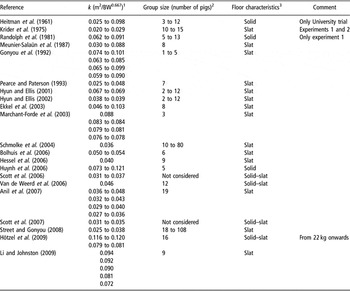
Data used in this study were extracted from other studies published in peer-reviewed journals between 1961 and 2009. References were obtained after an extensive search carried out using the Institute for Scientific Information (ISI) Web of Knowledge electronic database. Search criteria were based on information relative to growing-finishing pigs, in which a measure of the time spent lying had to be provided, and the first group of manuscripts was obtained. From this initial group, the selected manuscripts to be finally included in the database had to fulfil simultaneously the additional requirements: (i) they had to be carried out under conventional, intensive conditions, although studies in which a bedding substrate or some kind of environmental object was provided were also included; (ii) they had to provide sufficient information to determine the space allowance, the group size and floor characteristics, in addition to pig live weight; and (iii) behavioural observations had to be obtained by means of time budgets. Behaviour-recording periods of 24 h or longer were desired, although shorter periods were acceptable, with the shortest recording period being 40 min. Finally, 22 different experiments from 21 selected publications (shown in Table 1) were used in the meta-analysis. The initial BW of pigs from the selected manuscripts varied between 19 and 87 kg. An Excel datasheet was built to perform further statistical analyses, each line of the datasheet corresponding to an experimental treatment.
Descriptive aspects of the scientific database used in the meta-analysis of the percentage of total lying behaviour of growing-finishing pigs

1Range of values at the end of the experimental period. In case of experiments performing repeated measures, values provided for each time behaviour was recorded.
2Range of values at the end of the experimental period.
3Slat category includes both totally and partly slatted floor.
For each treatment within each experiment, information concerning the allometric space allowance, expressed by means of the k-value (m2/BW0.667) at the end of the experimental period was obtained. This information was either directly collected from the manuscript, or estimated using the average surface per pig, and their average BW at the end of the experimental period. The information was also collected on the group size (number of pigs) and the floor characteristics (solid floor v. totally and partly slatted floor). Although the initial idea was to collect information regarding the average temperature (°C) for each experimental treatment as well, this information was available from only 11 out of the 22 experiments, and its use was finally discarded.
Resting behaviour was expressed as the total lying behaviour that can be calculated either as the percentage of time devoted by pigs to this behaviour using time budgets of 24 h or shorter periods, or as the percentage of pigs performing this behaviour. For each treatment within each experiment, information on the average percentage of time spent lying, extracted from time budgets, was also collected. This information was either directly collected using the percentage of total lying behaviour, or indirectly estimated by adding up the percentages of time spent on sternal and lateral lying postures, if the information was provided in this manner. The analysis of the effect of the different factors on the ratio between sternal and lateral lying postures was also finally discarded due to the lack of sufficient information.
In the case in which repeated measures for the lying behaviour at different time intervals over the experimental period were provided, and therefore lying behaviour percentages could be obtained for different weights throughout the experiment, values for allometric space allowance, group size and floor characteristics were determined at the end of each time interval. When these data were not directly reported, they were estimated using the information provided in the study. In those studies in which the number of pigs within each pen was reduced, at any time during the experiment, in order not to exceed a minimum value of space allowance, data relative to group size were discarded and only space allowance at the end of the experimental treatment was considered in the analysis.
Statistical analysis
Mean time percentages of total lying behaviour, for each treatment within each time interval and within each experiment, were analysed by means of an ANOVA using a mixed model (MIXED Procedure; Statistical Analysis Systems Institute (SAS), 2000). The allometric space allowance, the quadratic value of allometric space allowance, the group size, the floor characteristics and their significant two-way interactions were introduced as fixed effects; the experiment and its interaction with the allometric space allowance were also introduced in the model as random factors to take into account the interexperiment effect (St-Pierre, Reference St-Pierre2001; Sauvant et al., Reference Sauvant, Schmidely, Daudin and St-Pierre2008). Although it is accepted that the period over which the behaviour was studied might affect time budgets, this information was not always clearly provided in all the studies, and therefore, it was not used. Nevertheless, the introduction of the experiment random factors in the statistical model should at least partially correct for potential differences due to this aspect.
Predicted values for all the observations were obtained using the described model. Additional linear, quadratic and broken-line (Robbins, Reference Robbins1986) regression analyses between total lying behaviour and k-value were performed on these values using the NLIN procedure of SAS (2000) to test whether the adjustment of data could be further improved. Parameter estimates and r 2 coefficients were obtained for each of the regression analyses performed.
Results
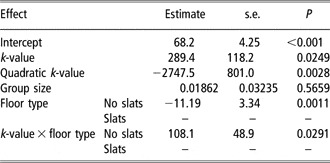
The parameter estimates of the studied fixed factors and significant two-way interactions included in the model are shown in Table 2. Both the k-value and the quadratic k-value were statistically significant (P < 0.05 and P < 0.01, respectively), indicating a nonlinear relationship between the allometric space allowance and the percentage of time spent lying by pigs. Floor type effect was statistically significant (P < 0.01), as well as its interaction with the allometric space allowance (P < 0.05). Therefore, the collected information was split into two different data sets, and further regression analyses between the allometric space allowance and the lying behaviour of pigs, using the predicted values of the observations provided by the model, were performed on solid floor and on slatted floor experiments separately. Results concerning the effect of group size were not significant.
Parameter estimates, standard error and significance level for the statistical model used in the quantification of total lying behaviour of growing-finishing pigs

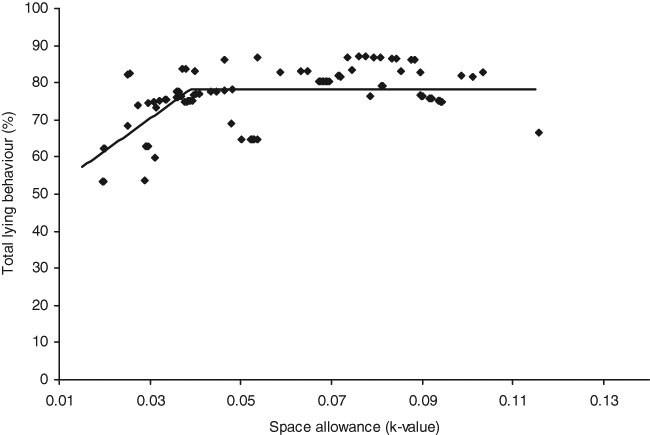
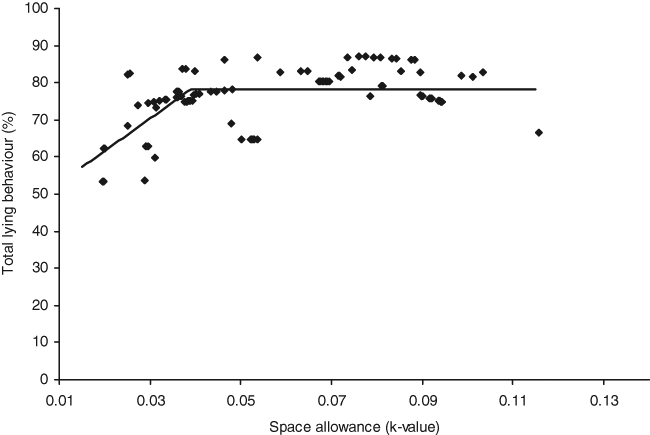
The parameter estimates obtained for the different regression analyses between the allometric space allowance and the predicted values of percentage of lying behaviour, for each of the floor types studied, are shown in Table 3. In the case of slatted flooring, all the regression adjustments tested (linear, quadratic and broken-line) were highly significant (P < 0.001), with the lowest r 2 coefficient obtained for the linear regression (0.19). The broken-line regression analysis did not improve the adjustment obtained by means of a quadratic regression, with both r 2 coefficients at the same level (0.32). Figure 1 shows a representation of the broken-line regression between the allometric space allowance and the corrected observations of the percentage of total lying behaviour in the case of slatted floors. Using this model, the estimate of k 0-value, from which a further increase in the percentage of time spent lying when space allowance increases is not expected, was 0.039 ± 0.002 m2/kg0.667.
Parameter estimates (s.e.) of the linear and nonlinear regression analyses of the effect of allometric space allowance on the percentage of lying behaviour of growing-finishing pigs

1Linear model, percentage of total lying behaviour = a + b × k.
2Quadratic model, percentage of total lying behaviour = a + b × k + c × k 2.
3Broken-line model, percentage of total lying behaviour = a + b × k, if k ⩽ k 0; a + b × k 0, if k > k 0.
4Value not corresponding to a parameter estimate, consequently, the standard error is not reported in brackets.
Broken-line regression analysis of the effect of allometric space allowance on the percentage of total lying behaviour of growing-finishing pigs housed on fully and partly slatted floor.
Owing to the insufficient degrees of freedom for non-slatted floors, it was not possible to simultaneously estimate the three parameters of the broken-line regression, and therefore the parameter estimates and statistics were obtained by testing different threshold k 0-values. In general, as k 0-value increased, the slope of the non-plateau part of broken-line regression decreased, whereas the predicted maximum percentage of total lying behaviour increased. Statistical significance of the regression increased, as the k 0-value also increased, but only up to a k 0-value of 0.072, for which the highest significance was obtained. Parameters of the regression for a k 0-value of 0.072 can be observed in Table 3, showing that although the most significant adjustment was obtained for the broken-line regression (P < 0.05), the r 2 obtained was low (0.14) and with parameter values similar to those obtained with a linear regression.
Discussion
The welfare of pigs is a matter of societal concern and debate. Therefore, the integration of the existing knowledge on each of the welfare indicators by means of a quantitative assessment would be useful when establishing new regulations and recommendations. For this reason, the determination of the effect of different housing factors on the behavioural responses of growing-finishing pigs may be a helpful contribution when making decisions. One important aspect affecting the welfare of pigs is the space they are given. Much information exists on the effect this aspect has on the productive performance of pigs, but additional information is still required to better determine how behaviour and overall welfare are affected by spatial restrictions (Petherick, Reference Petherick2007). Allometric principles, which establish a relationship between the floor area occupied by an animal (m2) and its BW (kg) by means of the expression, Area = k × BW0.667, and where the constant is commonly known as the k-value, are an adequate approach when calculating floor space needs (Petherick and Phillips, Reference Petherick and Phillips2009).
In this study, both the effects of the k-value and the squared k-value (Table 2) were statistically significant, indicating a nonlinear relationship between the space provided to pigs and the percentage of total lying behaviour, and suggesting a decreasing effect on the percentage of time that growing-finishing pigs spend resting as space allowance increases. Furthermore, the regressions suggest the existence of a threshold for space allowance value below which a further reduction in the space provided to pigs would affect the behavioural repertoire of pigs, reducing, in this case, the time devoted to the lying behaviour. In this sense, the use of broken-line regression analysis has proven to be a valuable tool in the determination of critical values when studying the effect of different characteristics of pig-housing environment on their physiology and behaviour (Huynh et al., Reference Huynh, Aarnink, Verstegen, Gerrits, Heetkamp, Kemp and Cahn2005a and Reference Huynh, Aarnink, Gerrits, Heetkamp, Cahn, Spoolder, Kemp and Verstegen2005b; Aarnink et al., Reference Aarnink, Schrama, Heetkamp, Stefanowska and Huynh2006). Broken-line analysis has been also successfully used in the determination of the critical floor space allowance for pigs’ performance (Gonyou et al., Reference Gonyou, Brumm, Bush, Deen, Edwards, Fangman, McGlone, Meunier-Salaün, Morrison, Spoolder, Sundberg and Johnson2006), suggesting that it might also be helpful in attempting to determine a critical space allowance value affecting the average time growing-finishing pigs spend lying. As the behaviour of pigs is directly related to the floor space provided, Gonyou et al. (Reference Gonyou, Brumm, Bush, Deen, Edwards, Fangman, McGlone, Meunier-Salaün, Morrison, Spoolder, Sundberg and Johnson2006) suggested that consistency of behaviour over the range of weights studied should be sought, if any attempt to quantify the relationship between behaviour and space allowance was to be carried out. Earlier studies have shown that piglets spend on average between 40% and 60% of their time resting (Blackshaw, Reference Blackshaw1981), whereas growing-finishing pigs spend, on average, 80% of their time doing so (Ruckebusch, Reference Ruckebusch1972). By including experiment as a random factor in the model, there should not have been any bias in estimates arising from differences in initial weights in the populations studied.
The significant interaction between the k-value and the floor type indicates that, for growing-finishing pigs, the relationship between space allowance and total lying behaviour depends on the presence or absence of slats. In the case of slatted floors, the proportion of variance explained by the quadratic and the broken-line regressions are the same (r 2 = 0.32); nevertheless, the threshold k 0-value (0.039 ± 0.002) obtained with the broken-line regression is relatively higher than the value of 0.032 to 0.035 found by Gonyou et al. (Reference Gonyou, Brumm, Bush, Deen, Edwards, Fangman, McGlone, Meunier-Salaün, Morrison, Spoolder, Sundberg and Johnson2006) for an optimal performance of growing-finishing pigs housed either on partially or totally slatted floors. This would indicate that the expression of lying behaviour as space availability decreases may be compromised before a reduced performance becomes apparent. This suggests that, in order to cope with a stressor, animals first make those adjustments that are least demanding to their biological functioning. If the stressor persists or intensifies, the coping strategy could ultimately lead to a redirection of biological resources and affect productivity (Moberg, Reference Moberg2000). Conversely, the use of a k-value equal to 0.047, derived from the area occupied by a pig lying in fully recumbent position (Petherick, Reference Petherick1983), would overestimate the spatial needs of pigs housed in a group, because it does not take into account the distribution of behaviour in time, the different lying postures and the dynamics within the group (Ekkel et al., Reference Ekkel, Spoolder, Hulsegge and Hopster2003). All these results suggest the existence of an intermediate critical value, which meets both space needs of pigs on slatted floors, without affecting their behavioural responses, and their productive performance. Our results would indicate that this k 0-value would be about 0.039 for growing-finishing pigs. Although we used most of the data available in literature, further information should be added into the model, when new scientific publications appear, in order to adjust this value for other important aspects such as environmental temperature.
The predicted maximum time spent lying by pigs found in this study was similar for non-slatted and for slatted floors (about 76% and 78% of the total time, respectively), similar to what was observed by Ruckebusch (Reference Ruckebusch1972). Nevertheless, the predicted k 0-value in the case of non-slatted floors almost doubled that found for slatted floors. This suggests that growing-finishing pigs, for a given BW, would need more space to lie down when they are housed on a solid floor. The slopes of broken-line regression would additionally indicate that, for pigs housed on solid floors, the effect of a reduction of space is less intense than in the case of pigs housed on slatted floors. It is known that under thermoneutral conditions pigs prefer to rest on solid floor, and that the percentage of individuals lying on a slatted area will increase with temperature when they are housed under partially slatted conditions (Aarnink et al., Reference Aarnink, Schrama, Heetkamp, Stefanowska and Huynh2006), or when they are offered the choice between different types of floors (Ducreux et al., Reference Ducreux, Aloui, Robin, Dourmad, Courboulay and Meunier-Salaün2002). Floor characteristics in this study were used as a binomial variable, with partly and totally slatted floor experiments undifferentiated, and therefore this hypothesis cannot be confirmed. It might be interesting, when new information is available to evaluate differences between the lying behaviour of pigs housed on totally and partially slatted floors. Additionally, in most of the studies in which non-slatted flooring was used, deformable substrates, such as straw bedding, were also provided to pigs, which might account for the differences found in the predicted lying behaviour. It is known that the use of deformable substrate on the floor is a source of environmental enrichment, having a recreational function and therefore promoting the physical activity of pigs (Van de Weerd and Day, Reference Van de Weerd and Day2009). Nevertheless, the same maximal value for lying behaviour in slatted and non-slatted floors was found in this study, which would suggest that the presence of substrate did not interfere with resting behaviour when sufficient floor space was provided.
Literature shows that pigs are able to adopt different behavioural strategies depending on group size (Estevez et al., Reference Estevez, Andersen and Nævdal2007). Our results would suggest that the adoption of a different strategy, when increasing the group size, does not imply a significant variation in the percentage of time spent lying by growing-finishing pigs. This would agree with the study of Turner et al. (Reference Turner, Allcroft and Edwards2003), relative to the performance of pigs and also carried out using pre-existing information, in which the growth rate was found to be compromised only during the growing stage (31 to 68 kg). The same authors, in light of different studies, concluded that different health and reproductive traits, morbidity and mortality rates and the occurrence of vices, such as tail biting, are unaffected by changes in the group size. More recent studies have also failed to find a clear effect of group size on different welfare indicators (Schmolke et al., Reference Schmolke, Li and Gonyou2004; Street and Gonyou, Reference Street and Gonyou2008).
Conclusions
On the basis of combined analysis of pre-existing literature, a quantitative relationship has been found between space allowance, expressed on an allometric basis, floor type and the percentage of total lying behaviour in growing-finishing pigs. A broken-line relationship between allometric space allowance and the percentage of time spent lying is proposed as suitable in growing-finishing pigs, with the critical k 0-value for pigs housed on non-slatted floors being higher than that of pigs housed on slatted floors. Results suggest that the ability to perform some behaviours might be affected before a reduction in pig productive performance becomes apparent. This is a promising approach to modelling behavioural activity in growing-finishing pigs, and more specifically their lying behaviour. Nevertheless, additional information should be added in future in the light of new studies on this subject to adjust the proposed parameters, as well as to try to include the effect of other important aspects such as that of ambient temperature. Moreover, additional behaviours should also be considered in the future.
Acknowledgements
The authors gratefully acknowledge the European Community financial participation under the Sixth Framework Programme for Research, Technological Development and Demonstration Activities for the Integrated Project Q-PORKCHAINS (FOOD-CT-2007-036245).
Disclaimer: The views expressed in this study are the sole responsibility of the authors and do not necessarily reflect the views of the European Commission. Neither the European Commission nor any person acting on behalf of the Commission is responsible for the use that might be made of the information. The information in this study is provided as it is, and no guarantee is given that the information is fit for any particular purpose. The user, therefore, uses the information at its sole risk and liability.