Parents who themselves experienced maltreatment as children are at increased risk for parenting in harsh, abusive, or neglectful ways (Egeland, Reference Egeland, Gelles and Loseke1993; Egeland, Jacobvitz, & Sroufe, Reference Egeland, Jacobvitz and Sroufe1988; Lyons-Ruth & Block, Reference Lyons-Ruth and Block1996; Pears & Capaldi, Reference Pears and Capaldi2001; Thornberry, Knight, & Lovegrove, Reference Thornberry, Knight and Lovegrove2012; Widom, Czaja, & DuMont, Reference Widom, Czaja and DuMont2015). Some parents with histories of childhood maltreatment, however, act in sensitive ways and avoid behaving in frightening or neglecting ways with their children (e.g., Berlin, Appleyard, & Dodge, Reference Berlin, Appleyard and Dodge2011; Egeland, Jacobvitz, & Paptola, Reference Egeland, Jacobvitz, Paptola, Lancaster and Gelles1989; Egeland et al., Reference Egeland, Jacobvitz and Sroufe1988; Huth-Bocks, Muzik, Beeghly, Earls, & Stacks, Reference Huth-Bocks, Muzik, Beeghly, Earls and Stacks2014; Schofield, Lee, & Merrick, Reference Schofield, Lee and Merrick2013). A central principle of developmental psychopathology concerns how normal and abnormal development are mutually informative (e.g., Sroufe, Reference Sroufe1990). Aligned with this perspective, maltreatment might be conceptualized as an extreme form of insensitive care. Thus, understanding the basic processes that confer risk and promote resilience for more typical variation in parenting behaviors, such as sensitivity, will also enhance our understanding of atypical outcomes, including maltreatment.
Differences in parenting may derive from differences in parents’ attachment state of mind, which refers to mental representations of attachment figures and associated ways of processing memories, thoughts, and feelings about attachment relationships. Although a relatively large body of research has demonstrated that parents’ attachment states of mind predict differences in sensitive parenting (van IJzendoorn, Reference van IJzendoorn1995), this research is largely limited to predictions of parenting during infancy and early childhood (e.g., Crowell & Feldman, Reference Crowell and Feldman1988; Pederson, Gleason, Moran, & Bento, Reference Pederson, Gleason, Moran and Bento1998; Shlafer, Raby, Lawler, Hesemeyer, & Roisman, Reference Shlafer, Raby, Lawler, Hesemeyer and Roisman2015; Verhage et al., Reference Verhage, Schuengel, Madigan, Fearon, Oosterman, Cassibba and van IJzendoorn2016; Ward & Carlson, Reference Ward and Carlson1995). Further, very few studies have examined the associations between parents’ attachment states of mind and parenting behavior among parents who themselves experienced childhood maltreatment or have a history of Child Protective Services involvement (Lindhiem, Bernard, & Dozier, Reference Lindhiem, Bernard and Dozier2011; Schoppe-Sullivan et al., Reference Schoppe-Sullivan, Mangelsdorf, Haight, Black, Sokolowski, Giorgio and Tata2007). Therefore, the goal of the current longitudinal study was to examine whether attachment states of mind and past experiences of maltreatment predict sensitive caregiving from infancy through middle childhood among a sample of parents involved with Child Protective Services.
Intergenerational Transmission of Parenting and Adult Attachment State of Mind
Intergenerational transmission of parenting refers to the idea that parents’ experiences within early attachment relationships may influence their childrearing attitudes and behaviors with their own children (Belsky & Jaffee, Reference Belsky, Jaffee, Cicchetti and Cohen2006; van IJzendoorn, Reference van IJzendoorn1992). Children who experience abuse and neglect are more likely to become harsh and abusive parents themselves (e.g., Egeland, Reference Egeland, Gelles and Loseke1993; Egeland et al., Reference Egeland, Jacobvitz and Sroufe1988; Hemenway, Solnick, & Carter, Reference Hemenway, Solnick and Carter1994; Lyons-Ruth & Block, Reference Lyons-Ruth and Block1996; Pears & Capaldi, Reference Pears and Capaldi2001; Simons, Whitbeck, Conger, & Wu, Reference Simons, Whitbeck, Conger and Wu1991). For example, a study drawing upon a national, random sample of parents (N = 801) indicated that parents’ retrospective reports of experiencing punitive child rearing (e.g., frequent yelling and spanking) as children were significantly and positively associated with their own parenting practices (Hemenway et al., Reference Hemenway, Solnick and Carter1994). In addition, parents who reported experiencing abuse during childhood were significantly more likely to become abusive parents, as indicated by child report of parenting practices, than parents who did not report experiencing abuse (Pears & Capaldi, Reference Pears and Capaldi2001). In a sample of 45 low-income mothers, maternal childhood experiences of physical or sexual abuse significantly predicted hostile–intrusive behaviors with their infants (Lyons-Ruth & Block, Reference Lyons-Ruth and Block1996).
This body of research generally indicates that parents with histories of abuse or neglect are at risk for providing inadequate care for their own children. However, estimated rates of transmission of abusive parenting vary widely and have ranged from 18% to 40% (Egelend et al., Reference Egeland, Jacobvitz, Paptola, Lancaster and Gelles1989; Hunter & Kilstrom, Reference Hunter and Kilstrom1979; Thornberry et al., Reference Thornberry, Knight and Lovegrove2012). Similarly, effect sizes for the intergenerational transmission of parenting are fairly modest, which also indicates that there is a fair amount of discontinuity. The modest effect sizes and varied range in estimates are likely due to various methodological considerations, including the use of retrospective versus prospective research designs, differing definitions of abuse or neglect, and the degree to which researchers controlled for potential confounding variables.
Attachment theory offers a rich framework for examining how parents’ mental representations of their childhood attachment experiences may contribute to the intergenerational transmission of parenting (e.g., van IJzendoorn & Bakermans-Kranenburg, Reference van IJzendoorn, Bakermans-Kranenburg, Atkinson and Zucker1997; Verhage et al., Reference Verhage, Schuengel, Madigan, Fearon, Oosterman, Cassibba and van IJzendoorn2016) and enhancing our understanding of why we might observe varying estimates of the rate of transmission of abusive parenting. According to attachment theory, parents’ early caregiving experiences are not directly linked with their later parenting behavior. Rather, early caregiving and attachment experiences are expected to shape the parents’ current mental representations of attachment, which, in turn, influence their behavior during interactions with their children.
The most well-validated method of assessing individuals’ mental representations is with the Adult Attachment Interview (AAI; George, Kaplan, & Main, Reference George, Kaplan and Main1985), an hour-long, semistructured interview. During the AAI, individuals are asked to describe their childhood attachment figures and instantiate their descriptions; to recall specific and salient events from childhood (e.g., when they were hurt, frightened, or upset), and to recall how their childhood attachment figures supported them at such times; to recall experiences of loss and/or abuse from childhood and adulthood; and to reflect upon how earlier attachment experiences may affect their current functioning. Coding of the AAI focuses on the coherence of discourse (Main & Goldwyn, Reference Main and Goldwyn1998), which is thought to reflect individuals’ states of mind regarding attachment. Individuals are first assigned to one of three mutually exclusive classifications. Adults who are classified as having an autonomous state of mind describe their experiences in a balanced and coherent way, engage in open discussion of their childhood caregiving experiences, and demonstrate a valuing of attachment relationships. Adults classified as having a dismissing state of mind do not provide convincing information (e.g., idealize their childhood experiences with attachment figures) and/or do not provide enough information (e.g., insist on a lack of memory for childhood experiences). Adults classified as having a preoccupied state of mind often become overwhelmed with anger when talking about their attachment figures and/or have rambling discourse. In addition to these three classifications, adults are classified as having an unresolved state of mind if they appear to become disoriented or psychologically confused when discussing experiences of loss or childhood abuse.
Among nonclinical samples of adults, approximately 58% are classified as autonomous, 23% are classified as dismissing, and 19% are classified as preoccupied. Approximately 18% of nonclinical adults are also classified as unresolved (Bakermans-Kranenburg & van IJzendoorn, Reference Bakermans-Kranenburg and van IJzendoorn2009). The prevalence of autonomous states of mind is lower and the prevalence of dismissing and unresolved states of mind is higher among parents from higher risk backgrounds than lower risk backgrounds (Bakermans-Kranenburg & van IJzendoorn, Reference Bakermans-Kranenburg and van IJzendoorn2009). In a previous publication using the sample featured in this paper (Raby, Yarger, et al., Reference Raby, Yarger, Lind, Fraley, Leerkes and Dozier2017), we reported that the distribution of adult attachment states of mind in our Child Protective Services-referred sample of parents living in poverty had lower rates of autonomous states of mind (30%), higher rates of dismissing states of mind (34%), and higher rates of unresolved states of mind (31%) than nonclinical samples. This distribution is highly consistent with the meta-analytic distribution for other high-risk samples (Bakermans-Kranenburg & van IJzendoorn, Reference Bakermans-Kranenburg and van IJzendoorn2009).
Childhood Maltreatment and Attachment State of Mind
A large body of work has examined childhood maltreatment as a predictor of nonautonomous attachment states of mind during adolescence and adulthood (e.g., Bailey, Moran, & Pederson, Reference Bailey, Moran and Pederson2007; Hughes, Turton, Hopper, McGauley, & Fonagy, Reference Hughes, Turton, Hopper, McGauley and Fonagy2004; Madigan, Vaillancourt, McKibbon, & Benoit, Reference Madigan, Vaillancourt, McKibbon and Benoit2012; Pierrehumbert et al., Reference Pierrehumbert, Torrisi, Glatz, Dimitrova, Heinrichs and Halfon2009; Raby, Labella, Martin, Carlson, & Roisman, Reference Raby, Labella, Martin, Carlson and Roisman2017; Riggs & Jacobvitz, Reference Riggs and Jacobvitz2002; Roisman et al., Reference Roisman, Rogosch, Cicchetti, Groh, Haltigan, Haydon and Steele2017). Taken together, these studies suggest that unresolved states of mind are more likely to be associated with separate reports of past childhood physical or sexual abuse and general child maltreatment (Bailey et al., Reference Bailey, Moran and Pederson2007; Hughes et al., Reference Hughes, Turton, Hopper, McGauley and Fonagy2004; Madigan et al., Reference Madigan, Vaillancourt, McKibbon and Benoit2012; Pierrehumbert et al., Reference Pierrehumbert, Torrisi, Glatz, Dimitrova, Heinrichs and Halfon2009; Riggs & Jacobvitz, Reference Riggs and Jacobvitz2002). In addition, Riggs and Jacobvitz (Reference Riggs and Jacobvitz2002) found links between preoccupied attachment state of mind and childhood experiences of abuse. However, most of these studies have relied on retrospective, self-report of childhood experiences of abuse and neglect (Bailey et al., Reference Bailey, Moran and Pederson2007; Hughes et al., Reference Hughes, Turton, Hopper, McGauley and Fonagy2004; Madigan et al., Reference Madigan, Vaillancourt, McKibbon and Benoit2012; Pierrehumbert et al., Reference Pierrehumbert, Torrisi, Glatz, Dimitrova, Heinrichs and Halfon2009; Riggs & Jacobvitz, Reference Riggs and Jacobvitz2002). In a large-scale study with prospective measures of maltreatment, childhood experiences of abuse and neglect were associated with elevated rates of both dismissing and preoccupied AAI states of mind during adolescence (Roisman et al., Reference Roisman, Rogosch, Cicchetti, Groh, Haltigan, Haydon and Steele2017). In another prospective study, childhood experiences of physical and sexual abuse were associated with an increased risk for AAI preoccupied states of mind in adulthood (Raby, Labella, et al., Reference Raby, Labella, Martin, Carlson and Roisman2017). However, because both of these prospective studies focused on dimensional indices of adults’ attachment states of mind, links between childhood maltreatment and the unresolved state of mind classification were not examined.
Attachment State of Mind and Parenting
Attachment state of mind predicts parental behavior as well as the quality of infant–parent attachment in the next generation (van IJzendoorn, Reference van IJzendoorn1995). In particular, an autonomous state of mind has been robustly linked with the provision of sensitive and supportive care in infancy and early childhood (Cohn, Cowan, Cowan, & Pearson, Reference Cohn, Cowan, Cowan and Pearson1992; Crowell & Feldman, Reference Crowell and Feldman1988; Pederson, Gleason, Moran, & Bento, Reference Pederson, Gleason, Moran and Bento1998; Shlafer et al., Reference Shlafer, Raby, Lawler, Hesemeyer and Roisman2015; Ward & Carlson, Reference Ward and Carlson1995). This is also the case in high-risks samples. For instance, in one study with high-risk adolescent mothers, those with an autonomous attachment state of mind interacted with their infants in a more sensitive manner than mothers classified as having a dismissing, preoccupied, or unresolved attachment state of mind (Ward & Carlson, Reference Ward and Carlson1995). In an initial meta-analysis of 389 mother–child pairs, parents classified as having an autonomous state of mind perceived their children's attachment signals more accurately, reacted more quickly, and responded in a more appropriate manner than nonautonomous parents (van IJzendoorn, Reference van IJzendoorn1995). Recently, Verhage et al. (Reference Verhage, Schuengel, Madigan, Fearon, Oosterman, Cassibba and van IJzendoorn2016) reexamined and replicated this association in a follow-up meta-analysis involving more than 1,200 parent–child dyads. In this meta-analysis, risk was found to attenuate the transmission of attachment status from parents’ attachment state of mind to children's Strange Situation attachment classification but not from parents’ attachment state of mind to their later sensitive caregiving. These meta-analytic findings highlight that attachment states of mind help shape sensitive caregiving even among high-risk parents.
Each of the nonautonomous classifications has been shown to be associated with lower caregiving quality. Specifically, parents with a dismissing state of mind tend to respond insensitively to their children's cues and signals during infancy (Pederson et al., Reference Pederson, Gleason, Moran and Bento1998), early childhood (Adam, Gunnar, & Tanaka, Reference Adam, Gunnar and Tanaka2004), and the preschool years (Crowell & Feldman, Reference Crowell and Feldman1988). Parents with preoccupied states of mind tend to respond in less supportive, angrier, and/or more intrusive ways during early childhood (Adam et al., Reference Adam, Gunnar and Tanaka2004) and during preschool than parents with autonomous states of mind (Crowell & Feldman, Reference Crowell and Feldman1998). For example, Bosquet and Egeland (Reference Bosquet and Egeland2001) found that low-income mothers classified as preoccupied were less supportive and more hostile and intrusive with their 19-month-old children than mothers classified as autonomous. In a similar sample, mothers with a preoccupied state of mind demonstrated lower levels of sensitivity with their toddlers than mothers with an autonomous state of mind (Oyen, Landy, & Hilburn-Cobb, Reference Oyen, Landy and Hilburn-Cobb2000). Finally, mothers classified as being unresolved due to past experiences of abuse or loss displayed more frightened and frightening (i.e., angry or threatening) behaviors when interacting with their infants or preschoolers than mothers who are not unresolved (Abrams, Rifkin, & Hesse, Reference Abrams, Rifkin and Hesse2006; Busch, Cowan, & Cowan, Reference Busch, Cowan and Cowan2008; Jacobvitz, Hazen, & Riggs, Reference Jacobvitz, Hazen and Riggs1997; Schuengel, Bakermans-Kranenburg, & van IJzendoorn, Reference Schuengel, Bakermans-Kranenburg and van IJzendoorn1999). In addition, unresolved state of mind has been associated with maternal disrupted communication, fearful and disoriented behavior, and withdrawal behaviors in a low-risk sample of mother–infant dyads (Goldberg, Benoit, Blokland, & Madigan, Reference Goldberg, Benoit, Blokland and Madigan2003).
To the best of our knowledge, only two studies have examined attachment states of mind (or maternal discourse related to attachment experiences) and parenting behaviors among parents with involvement with Child Protective Services. Using an interview similar to the AAI with a sample of 29 mothers whose children had entered the foster care system, Schoppe-Sullivan et al. (Reference Schoppe-Sullivan, Mangelsdorf, Haight, Black, Sokolowski, Giorgio and Tata2007) found that mothers’ coherence and flexibility when discussing their attachment experiences were positively related to their observed levels of structure and warmth and negatively related to hostility and intrusiveness with their young children during visits. In addition, among a relatively small sample of mothers referred to Child Protective Services (N = 25), parents with an autonomous state of mind have shown higher levels of sensitivity with infants than parents with a nonautonomous state of mind (Lindhiem et al., Reference Lindhiem, Bernard and Dozier2011). Of note, because of their small sample sizes, neither study examined whether specific subtypes of nonautonomous classifications confer differential risk for insensitive care among parents with involvement with Child Protective Services.
Parenting During Middle Childhood
The majority of work examining caregiving-related correlates of the AAI has focused on parental behavior when interacting with their children during infancy or early childhood (e.g., Adam et al., Reference Adam, Gunnar and Tanaka2004; Cohn et al., Reference Cohn, Cowan, Cowan and Pearson1992; Crowell & Feldman, Reference Crowell and Feldman1988; Haltigan et al., Reference Haltigan, Leerkes, Wong, Fortuna, Roisman, Supple and Plamondon2014; Pederson et al., Reference Pederson, Gleason, Moran and Bento1998; Ward & Carlson, Reference Ward and Carlson1995; Whipple, Bernier, & Mageau, Reference Whipple, Bernier and Mageau2011). As a result, relatively little is known about whether parents’ attachment state of mind is also associated with differential levels of sensitive care when children are older, such as during middle childhood. This is important because parents often encounter new parenting challenges when their children enter middle childhood. For most children, middle childhood is a developmental period characterized by transitions in physical maturity, cognitive abilities and learning, social relationships with peers, exposure to new settings, and self-regulation (Collins, Madsen, & Susman-Stillman, Reference Collins, Madsen, Susman-Stillman and Bornstein2002). Because of advances in children's reasoning and problem-solving skills at this age, parents have the opportunity to participate in increasingly elaborate and collaborative conversations with their children (Case, Reference Case, Kuhn, Siegler and Damon1998; DeLoache, Miller, & Pierroutsakos, Reference DeLoache, Miller, Pierroutsakos, Kuhn, Siegler and Damon1998). As children's peer relationships become more complex, parents can model basic skills that help their children interact with peers successfully (Collins, Reference Collins and Shulman1995). Parents also have the opportunity to provide social support, guidance, and nurturance when children of this age encounter stressors and risk outside of the home, such as neighborhood violence and drug use (e.g., Dishion, Capaldi, & Yoerger, Reference Dishion, Capaldi and Yoerger1999; Finkelhor & Dziuba-Leatherman, Reference Finkelhor and Dziuba-Leatherman1994). As self-regulation abilities increase during middle childhood (Maccoby, Reference Maccoby and Collins1984), children benefit from conversations with parents that emphasize emotions, help the child discern right from wrong, and instill increased autonomy (Chapman & McBride, Reference Chapman, McBride, Shantz and Hartup1992). Parenting that is sensitive to the child's signals is critical in middle childhood for facilitating children's further development of self-regulatory capabilities, maintaining a positive parent–child relationship while the child becomes more independent, and providing a model for effective relationships outside of the family. Such sensitive care might be particularly important for children who have experienced adversity, including maltreatment, and are at increased risk for cognitive impairment, internalizing and externalizing symptoms, and social withdrawal during middle childhood (for a review, see Hildyard & Wolfe, Reference Hildyard and Wolfe2002).
The Current Study
Although parents’ attachment state of mind is related to sensitive parenting when caring for infants and young children, it is less clear whether it is a strong predictor of parenting in middle childhood when children need sensitive interactions with their parents to help them further develop their self-regulatory capabilities, autonomy, and effective relationships outside of the family. In addition, few studies have examined associations between attachment states of mind and sensitive caregiving among parents involved with Child Protective Services, many of whom likely experienced maltreatment themselves as children. The goal of the current longitudinal study was to examine whether individual differences with regard to attachment state of mind and past experiences of maltreatment predict parental sensitivity in a sample of parents involved with Child Protective Services across three developmental periods: infancy, early childhood, and middle childhood.
Our central hypothesis was that parents with nonautonomous states of mind would be less sensitive in their interactions with their children than parents with autonomous states of mind at all three developmental periods. We expected these differences to persist in middle childhood even when children tend to become more independent, a developmental change that parents with a dismissing state of mind may be comfortable with, given that parental sensitivity at this age still involves interacting in a way that is collaborative and supports the child's interests and abilities. However, because a dismissing state of mind has been associated with rejecting children's bids (Crowell & Feldman, Reference Crowell and Feldman1988; Haltigan et al., Reference Haltigan, Leerkes, Wong, Fortuna, Roisman, Supple and Plamondon2014; Pederson et al., Reference Pederson, Gleason, Moran and Bento1998; Whipple et al., Reference Whipple, Bernier and Mageau2011), differences between dismissing and autonomous parents seemed most likely. In addition, we examined whether the extent of maltreatment experiences reported was associated with parents’ state of mind.
Method
Participants
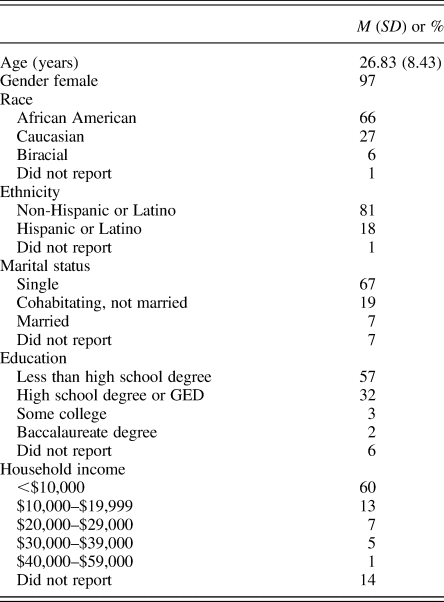
Data for this project were collected in the context of a longitudinal study assessing the efficacy of a parenting intervention for families involved with Child Protective Services. Participants were parents (N = 178) recruited from a randomized clinical trial designed to test the efficacy of an attachment-based parenting intervention for children. Child welfare agencies referred parents at high risk for maltreatment, most often due to child neglect, domestic violence, homelessness, and parental substance abuse. All parents were primary caregivers for at least one child enrolled in the study. Table 1 presents the demographic characteristics of parents at the time of enrollment when their children were infants.
Demographic characteristics of parents at time of enrollment

Procedures
At the time of enrollment, parents were randomized to receive the experimental intervention (Attachment and Biobehavioral Catch-Up; ABC; n = 89) or control intervention (Developmental Education for Families; DEF; n = 89). Both interventions were delivered in families’ homes by a trained interventionist (referred to as a parent coach). Intervention sessions lasting 1 hour were delivered weekly over the span of 10 weeks. ABC focused on helping the parent increase sensitivity to child signals, increase nurturance to child distress, and decrease frightening and harsh behaviors (Bernard, Meade, & Dozier, Reference Bernard, Meade and Dozier2013). During ABC sessions, parent coaches delivered “in-the-moment” feedback to promote target behaviors as parents interacted with their children. DEF focused on promoting children's cognitive and motor development. Parent coaches provided information about developmental milestones in several domains and helped parents engage in activities designed to enhance children's cognitive and motor development.
Prior to participating in any intervention sessions, parents’ attachment state of mind, childhood experiences of maltreatment, and sensitivity during parent–child interactions were assessed. At this preintervention visit, children were infants (M age = 10.92 months, SD = 8.66). Parents’ sensitivity was also assessed at up to three postintervention follow-up visits during early childhood. The first follow-up visit occurred approximately 1 month after the last intervention session. The second follow-up visit occurred around the child's first birthday (if the child was less than a year old when the 1 month postintervention was completed), and the third follow-up visit occurred around the child's second birthday. Ratings of each parents’ sensitivity at the time of these follow-up visits were averaged to provide a single assessment of sensitivity during early childhood (M age = 20.96 months, SD = 6.03). Another sensitivity assessment took place when children completed a follow-up visit during middle childhood (M age = 8.40 years, SD = 0.34).
Participants were included in the analyses if information about the parents’ attachment state of mind was available from the preintervention assessment and sensitivity data were available for at least one time point. Attrition analyses demonstrated that there were no significant differences between the original sample of 212 parents and the subsample of 178 parents that was included in the analyses with regard to demographic characteristics at the time of enrollment (including parent age, parent education level, family income, marital status, and employment status), parent gender, parent race/ethnicity, child gender, child race/ethnicity, AAI classification, or parent report of childhood maltreatment experiences. In addition, there were no significant differences between the subsample of 178 parents who completed the sensitivity assessment at age 8 and the subsample of parents who did not complete the sensitivity assessment at age 8.
Measures
AAI
The AAI is a 20-question, semistructured interview, which asks parents to describe their childhood relationships with attachment figures, recall memories of distress and attachment-related experiences (e.g., separations from parents), describe experiences of trauma and loss, and reflect on how childhood relationships and experiences might influence current relationships, caregiving, and personality. The interviews were audio-recorded and transcribed by professional transcriptionists. Interviews were then coded using the coding system developed by Main and Goldwyn (Reference Main and Goldwyn1998). Coders used several 9-point scales that considered participants’ childhood inferred caregiving relationships and participants’ states of mind regarding their caregiving experiences. Scores on these rating scales were used to first classify parents as autonomous, dismissing, or preoccupied. Next, parents were classified as resolved or unresolved regarding previous experiences of abuse or loss. All transcripts were coded by a single coder, who completed training and reliability certification administered by Mary Main. A second certified coder assigned codes for 15% of the sample, with the cases randomly selected. Agreement for the four-way classifications was 92% (κ = .88, p < .001). When the coders disagreed on classifications, the codes assigned by the primary coder were used so that the AAI classifications for all the participants were assigned by the same coder.
Childhood Trauma Questionnaire—Short Form
Prior to participating in any intervention sessions, parents completed the short form of the Childhood Trauma Questionnaire (CTQ-SF; Bernstein et al., Reference Bernstein, Stein, Newcomb, Walker, Pogge, Ahluvalia and Zule2003). The CTQ-SF is a 28-item self-report survey developed to assess experiences of abuse and neglect that occurred prior to age 18. There are five clinical subscales, including physical, sexual, and emotional abuse, and physical and emotional neglect. The abuse and neglect subscales were empirically derived based on the 70-item version of the CTQ (Bernstein et al., Reference Bernstein, Fink, Handelsman, Foote, Lovejoy, Wenzel and Ruggiero1994). There are five items for each subscale. Likert responses range from never true to very often true, and subscale scores range from 5 (no history of abuse or neglect) to 25 (history of extreme abuse or neglect). There is also a 3-item minimization/denial scale to detect the underreporting of maltreatment. For these items, respondents choose between five response options ranging from never true to very often true. Any item endorsed with very often true is scored as a 1 and is suggestive of potential reporting bias (Bernstein & Fink, Reference Bernstein and Fink1998). The minimization/denial scale can range from 0 to 3. The CTQ-SF has been validated in community samples and several high-risk samples, including adolescent psychiatric inpatients and adult substance abusers (Bernstein et al., Reference Bernstein, Stein, Newcomb, Walker, Pogge, Ahluvalia and Zule2003; Thombs, Lewis, Bernstein, Medrano, & Hatch, Reference Thombs, Lewis, Bernstein, Medrano and Hatch2007).
Parental sensitivity
For the sensitivity assessments during infancy and early childhood, parents were instructed to play with their children with a standardized set of toys for 7 min. Researchers did not provide any specific instructions to the parent regarding how to play with the toys or the parent's proximity to the child. These interactions were video-recorded and later coded by trained research assistants. Parental sensitivity was assessed using an adapted version of the Observational Record of the Caregiving Environment (NICHD Early Child Care Research Network, 1996). Coders were blind to intervention condition, date of collection, and study hypotheses. About 25% of the sensitivity assessments in infancy and early childhood were double-coded and used to calculate a one-way random effects intraclass correlation (ICC) . The interrater reliability for sensitivity during infancy and early childhood was moderate (ICCinfancy = .55; ICCearly childhood = .62).
Sensitivity captures the parent's ability to “follow the child's lead” during times of nondistress. A sensitive interaction is child centered, and the parent is observed to interpret and match the child's mood and level of development. The sensitivity scale was used to measure parents’ ability to “follow the child's lead” based on the child's interests, cues, and capabilities. Highly sensitive parents responded in a contingent fashion to the child's play behaviors. For example, if a child stacked cups, the parent stacked cups in a similar fashion. Highly insensitive parents demonstrated few contingent play behaviors and were more likely to lead the interaction. The rating scale ranged from 1 to 5, with higher numbers reflecting greater sensitivity.
For the sensitivity assessment during middle childhood, parents and children completed an interaction task during which parents and children were instructed to spend 5 min planning the perfect birthday party for the child. These interactions were also video-recorded and later coded by trained research assistants. This collaborative discussion task was based on similar tasks that have been used in other studies of parental sensitivity during middle childhood and early adolescence (e.g., NICHD Early Child Care Research Network, 2008; Sroufe, Reference Sroufe1991). Examples of sensitive behaviors during the middle childhood task include the parent asking open-ended questions, actively taking interest in the child's ideas, providing contingent vocalizations throughout the discussion, matching the child's affect and energy levels, encouraging the child's contributions to the conversation, and joining flexibly in the child's interpretation of the prompt without concern about the “right” way to have the discussion. Research assistants examined both quality and quantity of parents’ sensitive behaviors and assigned a single rating using a 5-point scale. A highly sensitive caregiver would receive a score of 5, whereas a highly insensitive caregiver would receive a score of 1. Half points (i.e., 1.5, 2.5, 3.5, and 4.5) were used in this coding system. All observations were double-coded. The interrater reliability for sensitivity was high (ICCchildhoodmiddle = .89), and sensitivity ratings between the two coders were averaged.
Missing data
Approximately 13% of parents were missing sensitivity data from the infancy assessment, 25% were missing sensitivity data from the early childhood assessment, and 52% were missing sensitivity data from the middle childhood assessment. To address missing data, regression analyses used full-information maximum likelihood with raw case-level analytic data as input. This produces less biased and more consistent parameter estimates than techniques that use pairwise or listwise deletion for missing data (Little & Rubin, Reference Little and Rubin1987), even when approximately half of the data are estimated (Graham, Reference Graham2009). All statistical analyses using full-information maximum likelihood were carried out using Mplus (Muthén & Muthén, Reference Muthén and Muthén1998–2011).
Results
Primary analyses addressed whether attachment state of mind significantly predicted sensitivity during infancy, early childhood, and middle childhood. In order to test whether parents’ attachment state of mind uniquely predicted sensitive caregiving during the later developmental periods, we controlled for prior assessments of sensitivity when predicting sensitivity during early childhood and middle childhood. Primary analyses also explored whether parents’ reports of childhood maltreatment were significantly related to AAI classifications or observed parental sensitivity. Preliminary analyses examined descriptive statistics and interscale correlations for the CTQ-SF subscale scores. Preliminary analyses also examined potential intervention differences with regard to CTQ-SF subscale scores, AAI classifications, and sensitivity ratings at all three time points.
Preliminary analyses for CTQ-SF
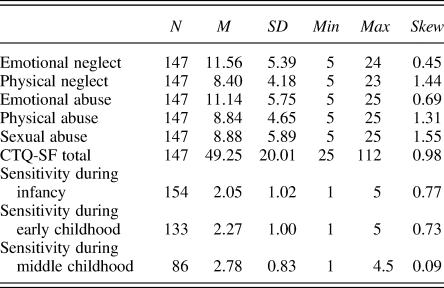
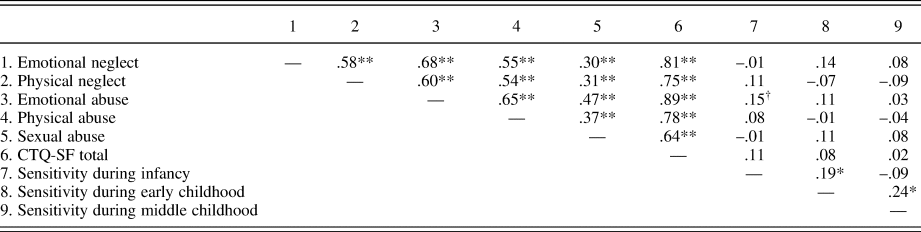
CTQ-SF data were available for 147 of the 178 parents. Table 2 presents descriptive statistics for the CTQ-SF clinical subscales. Approximately 93% of the parents (n = 136) reported experiencing at least one instance of abuse or neglect. All but one of the CTQ-SF clinical subscales were significantly skewed, and a logarithmic transformation was used to address the positive skew. Table 3 provides zero-order correlations among the CTQ-SF clinical subscale variables. The CTQ-SF clinical subscales and the minimization/denial subscale were not significantly associated with any parent demographic variables at the time of the preintervention assessment.
Means, standard deviations, minimums, maximums, and skew for CTQ-SF subscales and parental sensitivity measure

Note: CTQ-SF, Childhood Trauma Questionnaire—Short Form. For ease of interpretation, descriptive statistics that are provided for the CTQ-SF are not log-transformed.
Correlations among childhood maltreatment subscales and parental sensitivity

Note: CTQ-SF, Childhood Trauma Questionnaire—Short Form *p < .05. **p < .01. †p < .10.
Preliminary analyses for AAI
Using the four-way classification system, 59 parents were classified as autonomous, 57 as dismissing, 7 as preoccupied, and 55 as unresolved in their adult attachment representations. Of the 55 parents classified as unresolved, 20 received a secondary classification of dismissing, 14 as preoccupied, 11 as autonomous, and 10 as “cannot classify.” AAI classifications were not significantly associated with any parent demographic variables, but classifications were marginally related to child age, F (3, 150) = 2.23, p = .09. Post hoc analyses revealed that children of parents classified as dismissing were significantly younger than children of parents classified as autonomous, p = .04.
Preliminary analyses for sensitivity
Descriptive statistics for the parental sensitivity variables are presented in Table 2. Demographic information pertaining to parent education level and annual household income were collected at the preintervention assessment and during middle childhood. Parent education level at the time of enrollment was unrelated to sensitivity ratings during infancy (r = .02, p = .79, df = 152) or early childhood (r = .07, p = .42, df = 131), and parent education level in middle childhood was unrelated to sensitivity ratings at that time point (r = .04, p = .71, df = 83). Household income at the time of enrollment was unrelated to sensitivity ratings during infancy (r = .15, p = .09, df = 132) or early childhood (r = .13, p = .15, df = 114), and household income in middle childhood was unrelated to sensitivity ratings at that time point (r = .04, p = .76, df = 79). At each time point, sensitivity ratings were not significantly related to the age of the parent, the gender of the parent or child, or the race/ethnicity of the parent or child. Child age was unrelated to sensitivity ratings during infancy and middle childhood but was significantly associated with sensitivity ratings during early childhood (r = .23, p = .01, df = 125). The intervention groups did not differ in sensitivity ratings collected prior to the intervention when children were infants, t (152) = –0.30, p = .77, or after the intervention when children were in middle childhood, t (84) = –0.27, p = .79. However, parents who received the ABC intervention interacted with their children in a more sensitive manner during early childhood than parents who received the control intervention (M = 2.55, SD = 1.08 and M = 2.02, SD = 0.85, respectively; p < .01, d = 0.55). Intervention group status did not interact with the CTQ-SF scales or AAI classification to predict parental sensitivity at any time point.
Primary analyses
Childhood maltreatment and attachment state of mind in adulthood
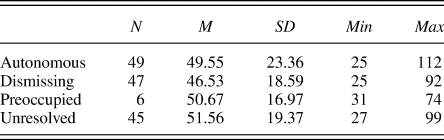
A multivariate analysis of variance was conducted to explore attachment state of mind differences in the CTQ-SF subscales and total score items. Parents’ state of mind was not associated with the extent of maltreatment reported on the CTQ-SF's emotional abuse subscale, F (3, 147) = 0.65, p = .58, emotional neglect subscale, F (3, 147) = 0.48, p = .70, physical abuse subscale, F (3, 147) = 1.76, p = .16, physical neglect subscale, F (3, 147) = 0.44, p = .73, sexual abuse subscale, F (3, 147) = 0.49, p = .69, minimization/denial subscale, F (3, 147) = 0.65, p = .58, and CTQ-SF total, F (3, 147) = 0.70, p = .56. Table 4 presents descriptive statistics for the CTQ-SF Total based on AAI classification.
Means, standard deviations, minimums, and maximums for CTQ-SF total based on AAI classification

Note: CTQ-SF, Childhood Trauma Questionnaire—Short Form. AAI, Adult Attachment Interview. For ease of interpretation, values that are provided are not log-transformed.
Attachment state of mind and sensitive caregiving during infancy
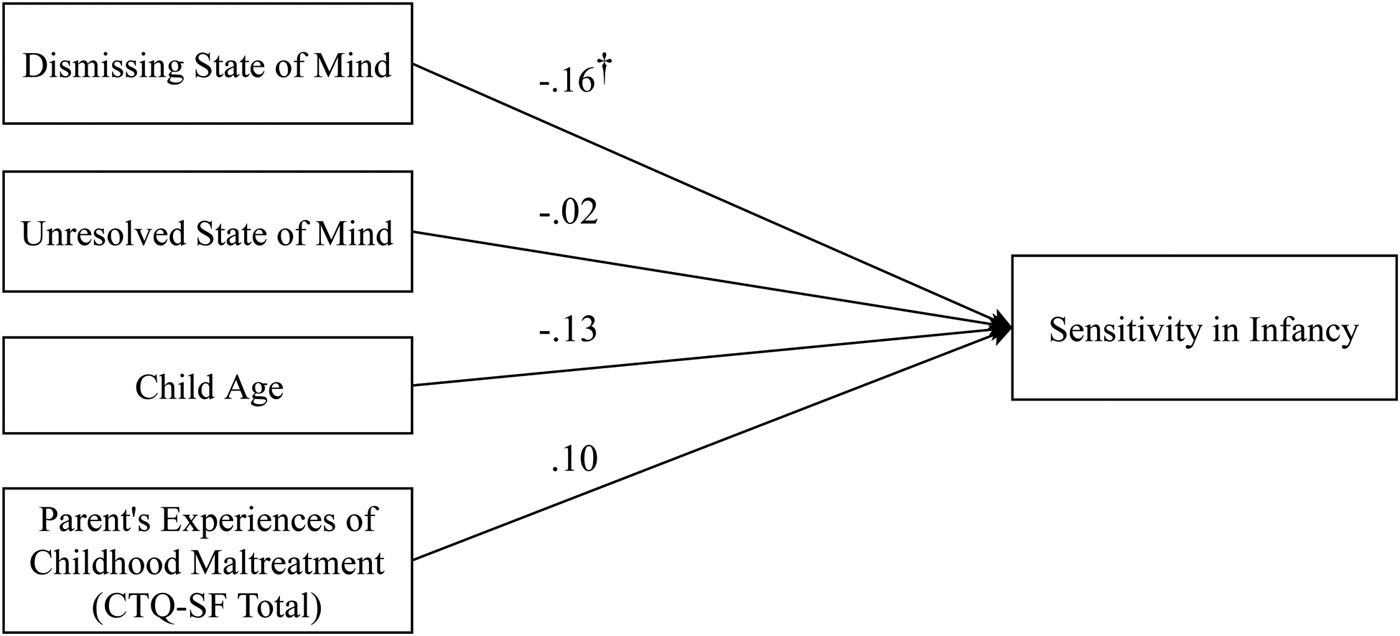
Initial regression analyses using full information maximum likelihood estimation examined whether parents’ history of childhood maltreatment and attachment state of mind predicted sensitive caregiving prior to participating in any intervention sessions when their children were infants. Given the low frequency, preoccupied attachment states of mind were not included in analyses. Attachment states of mind were represented by two binary, dummy-coded variables: one representing dismissing versus autonomous and unresolved classifications and a second variable representing unresolved versus dismissing and autonomous classifications. In this way, autonomous state of mind was the comparison group for the analyses involving dismissing and unresolved states of mind. In addition, child age at the time of the preintervention visit was controlled for in analyses because it was related to AAI classifications. Overall, the model did not predict a significant portion of variance in sensitivity scores, R 2 = .05, p = .22 (Figure 1). Dismissing states of mind marginally predicted lower scores of sensitivity, β = –.16, p = .08. Unresolved states of mind, child age, and parental history of childhood maltreatment were unrelated to sensitivity during infancy.
Predictors of parental sensitivity during infancy. Dummy variables were coded as follows: (a) dismissing state of mind: dismissing state of mind = 1 and autonomous or unresolved states of mind = 0; and (b) unresolved state of mind: unresolved state of mind = 1 and dismissing or autonomous states of mind = 0. Standardized estimates are presented for the continuous predictors, and the estimates for the dichotomous predictors were standardized only with respect to the outcome variable. †p < .10.

Attachment state of mind and sensitive caregiving during early childhood
Next, we tested whether parents’ history of childhood maltreatment and attachment state of mind predicted sensitive caregiving after parents completed the intervention when their children were in early childhood. Once again, attachment states of mind (i.e., dismissing vs. autonomous and unresolved; unresolved vs. dismissing and autonomous) and parental history of childhood maltreatment were included as predictors of sensitive caregiving during early childhood. Sensitivity during infancy was controlled for in analyses. In addition, given their associations with sensitivity during early childhood, intervention group (i.e., ABC vs. DEF) and child age were also controlled for in analyses.
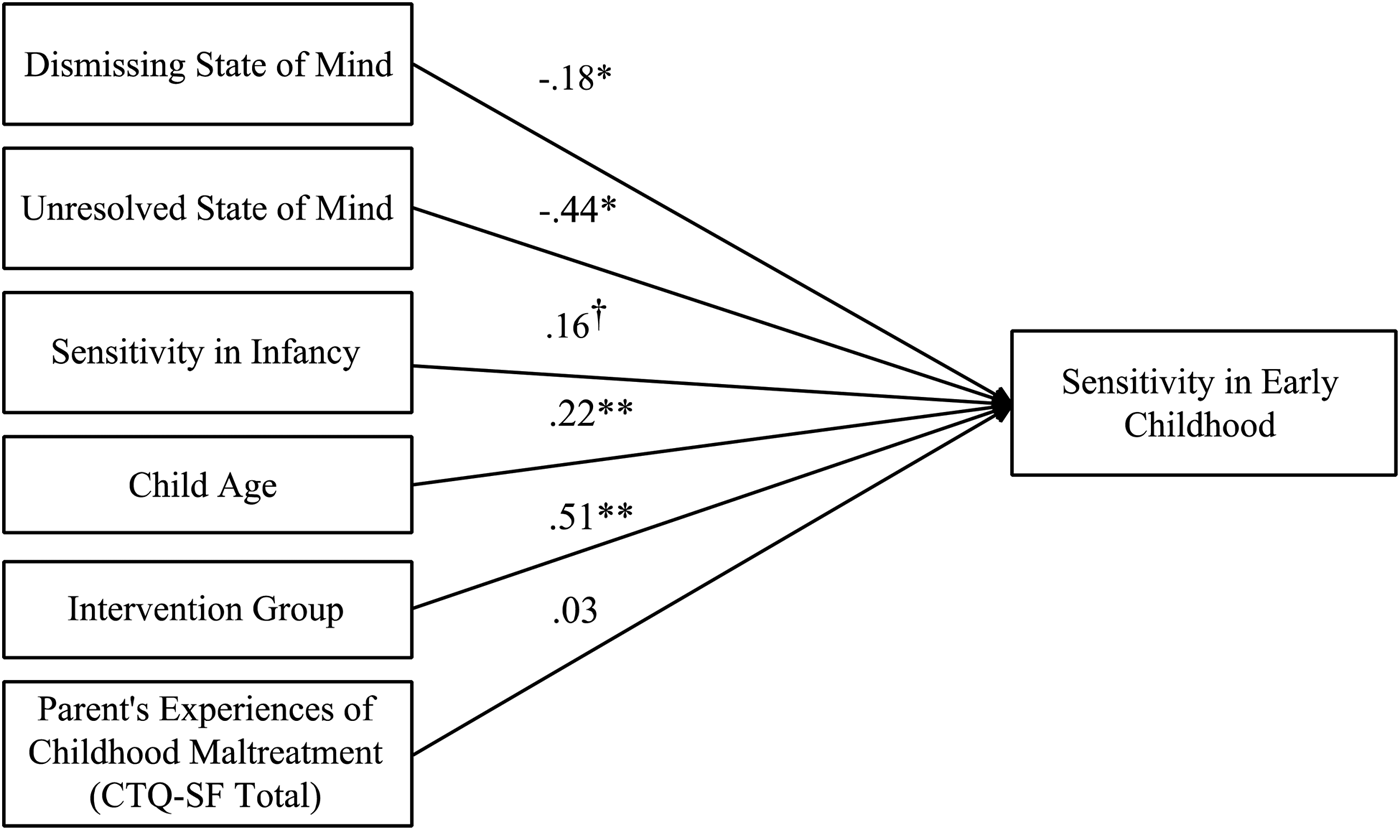
Overall, the model predicted a significant portion of variance in sensitivity scores during early childhood (R 2 = .22, p < .01; Figure 2). Both dismissing (β = –.18, p = .04) and unresolved states of mind (β = –.44, p = .02) significantly predicted lower scores of sensitivity at this age. Regarding the covariates, ABC significantly predicted higher scores of sensitivity (β = .51, p < .01), child age was positively associated with sensitivity ratings (β = .22, p < .01), and parental sensitivity during infancy marginally predicted sensitivity during early childhood (β = .16, p = .07). Parental history of childhood maltreatment was not significantly associated with sensitivity during early childhood.
Predictors of parental sensitivity during early childhood. Dummy variables were coded as follows: (a) intervention: Attachment and Biobehavioral Catch-Up intervention coded as 1 and the control intervention coded as 0; (b) dismissing state of mind: dismissing state of mind = 1 and autonomous or unresolved states of mind = 0; and (c) unresolved state of mind: unresolved state of mind = 1 and dismissing or autonomous states of mind = 0. Standardized estimates are presented for the continuous predictors, and the estimates for the dichotomous predictors were standardized only with respect to the outcome variable. *p < .05. **p < .01. †p < .10.

Attachment state of mind and sensitive caregiving during middle childhood
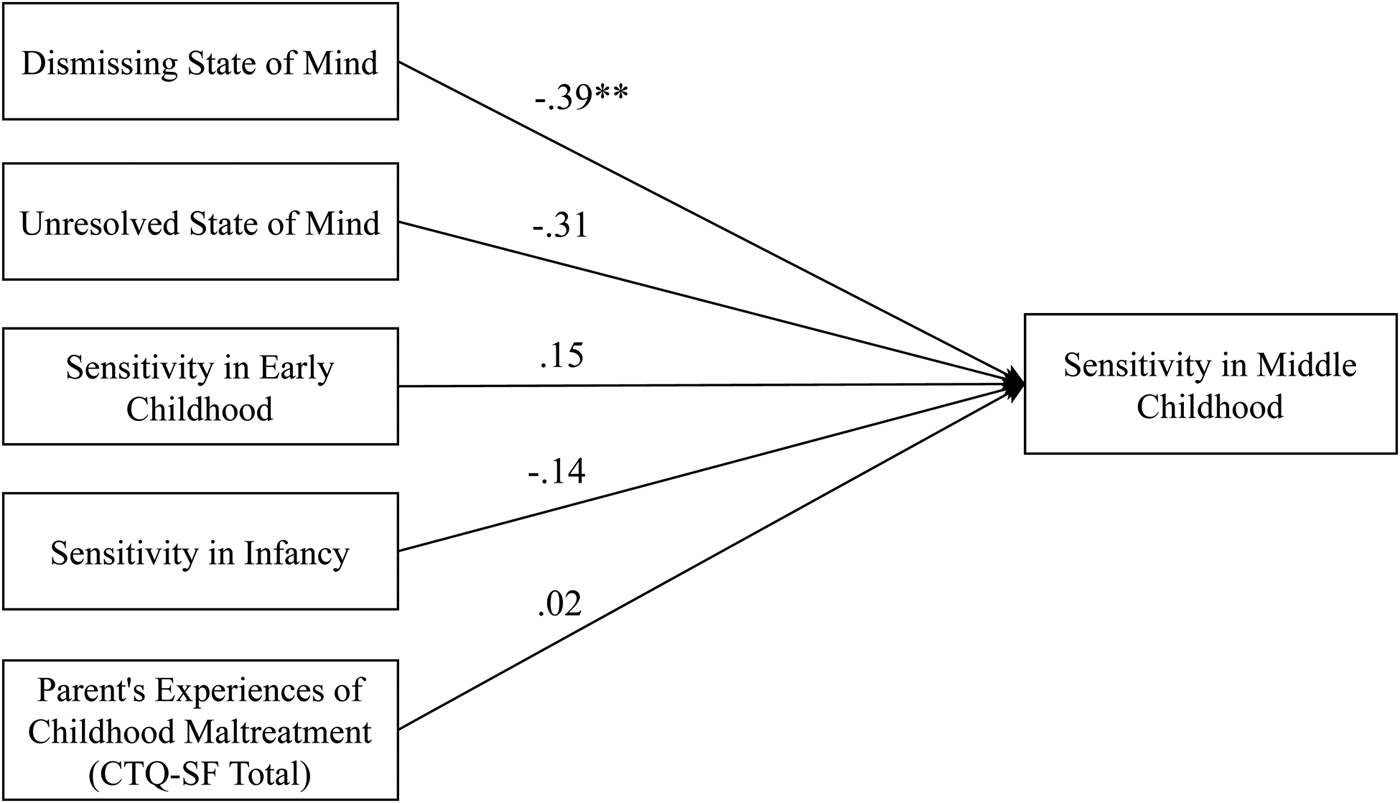
Finally, we tested whether parental history of childhood maltreatment and attachment state of mind predicted sensitive caregiving during middle childhood. Similar to the previous models, attachment states of mind (i.e., dismissing vs. autonomous and unresolved; unresolved vs. dismissing and autonomous) and parental history of childhood maltreatment were included as predictors of sensitive caregiving during middle childhood. In addition, sensitivity during infancy and early childhood were controlled for in analyses. Overall, the model predicted a significant portion of variance in sensitivity scores during middle childhood (R 2 = .21, p = .04; Figure 3). Dismissing states of mind significantly predicted lower sensitivity scores (β = –.39, p < .01). In contrast, unresolved states of mind, parental history of childhood maltreatment, sensitivity during infancy, and sensitivity during early childhood were unrelated to sensitivity during middle childhood.
Predictors of parental sensitivity during middle childhood. Variables were coded as follows: (a) intervention: Attachment and Biobehavioral Catch-Up intervention coded as 1 and the control intervention coded as 0; (b) dismissing state of mind: dismissing state of mind = 1 and autonomous or unresolved states of mind = 0; and (c) unresolved state of mind: unresolved state of mind = 1 and dismissing or autonomous states of mind = 0. Standardized estimates are presented for the continuous predictors, and the estimates for the dichotomous predictors were standardized only with respect to the outcome variable. **p < .01.

Discussion
The current study was designed to further our understanding of the significance of parents’ past experiences of maltreatment and attachment states of mind for their provision of sensitive parenting during infancy, early childhood, and middle childhood among a sample of parents who were involved with Child Protective Services. As expected, attachment state of mind was an important predictor of parental sensitivity. Specifically, parents who had a dismissing state of mind interacted in less sensitive ways with their children during both early and middle childhood than parents with an autonomous state of mind. Dismissing states of mind of parents also predicted marginally less sensitive interactions during infancy than autonomous states of mind. In addition, parents who had an unresolved state of mind interacted in less sensitive ways with their children during early childhood than parents with an autonomous state of mind.
Parents with a dismissing state of mind emotionally distance themselves from their own interpersonal experiences and therefore may be limited in their ability to respond effectively to their children's cues and emotional needs (e.g., Whipple et al., Reference Whipple, Bernier and Mageau2011). Several other studies have linked dismissing states of mind with less sensitive care than autonomous states of mind among parents of infants (Haltigan et al., Reference Haltigan, Leerkes, Wong, Fortuna, Roisman, Supple and Plamondon2014; Pederson et al., Reference Pederson, Gleason, Moran and Bento1998; Whipple et al., Reference Whipple, Bernier and Mageau2011) and preschoolers (Crowell & Feldman, Reference Crowell and Feldman1988). The present study's findings extend this literature in two important ways. First, the study demonstrates that parents with a dismissing state of mind are also less sensitive when interacting with their children during middle childhood than parents with an autonomous state of mind. Second, the study demonstrates that a dismissing state of mind is fairly robustly associated with less sensitive care at multiple ages in a sample of parents referred to Child Protective Services.
Parents with unresolved states of mind were found to interact with their children in less sensitive ways than parents with autonomous states of mind during early childhood but not during infancy or middle childhood. Unresolved states of mind have been consistently linked with more frightened and frightening behaviors when parents interact with infants (Abrams et al., Reference Abrams, Rifkin and Hesse2006; Jacobvitz et al., Reference Jacobvitz, Hazen and Riggs1997; Schuengel et al., Reference Schuengel, Bakermans-Kranenburg and van IJzendoorn1999). The lack of a significant association between an unresolved state of mind and sensitive caregiving during middle childhood might be a function of the interaction task. Relative to the interaction tasks that have been used in studies linking unresolved states of mind with frightened or frightening caregiving (e.g., Schuengel et al., Reference Schuengel, Bakermans-Kranenburg and van IJzendoorn1999), it seems likely that the middle childhood discussion task was less emotionally stressful for all caregivers regardless of their attachment state of mind. If the interaction task had been more stressful, perhaps caregivers with an unresolved attachment state of mind would have been more likely to demonstrate behavioral lapses and act in frightening or confusing ways with their children as proposed by Main and Hesse (Reference Main, Hesse, Greenberg, Cicchetti and Cummings1990).
Related to this, play interactions during early childhood may be more challenging for parents than play interactions with an infant or conversations with an 8-year-old planning a birthday party. During early childhood, children often have difficulty effectively managing their own emotions and behaviors and are prone to temper tantrums (e.g., Bronson, Reference Bronson2000). As a result, play interactions with preschool-aged children may more easily overwhelm a parent and elicit frightened or frightening behaviors from parents with unresolved states of mind. Similarly, the unique challenges faced by parents while interacting with their children during early childhood might explain why ABC intervention effects were observed during early but not middle childhood.
During infancy, unresolved states of mind were unrelated to sensitivity, and dismissing states of mind only marginally predicted less sensitive care than autonomous states of mind. These nonsignificant findings were unexpected given previous links found between dismissing and unresolved states of mind and less sensitive care during infancy (e.g., Haltigan et al., Reference Haltigan, Leerkes, Wong, Fortuna, Roisman, Supple and Plamondon2014; Jacobvitz et al., Reference Jacobvitz, Hazen and Riggs1997; Pederson et al., Reference Pederson, Gleason, Moran and Bento1998; Schuengel et al., Reference Schuengel, Bakermans-Kranenburg and van IJzendoorn1999). We suggest that the reader interpret our findings at infancy with caution, as it is possible that the nonsignificant association between attachment state of mind and sensitivity during infancy might be due to the lower intrarater reliability of the sensitivity ratings during infancy (ICC = .55) compared to early childhood (ICC = .62) and middle childhood (ICC = .89). The relatively lower intrarater reliability during infancy may reflect difficulties in coding parental sensitivity at that specific age due to infants’ more subtle and ambiguous cues.
To our surprise, parents’ own experiences of abuse and neglect were not related to their attachment states of mind or their sensitive parenting during infancy, early childhood, and middle childhood. These nonsignificant findings are not consistent with other research on the intergenerational transmission of maltreatment (e.g., Egeland et al., Reference Egeland, Jacobvitz and Sroufe1988; Hemenway et al., Reference Hemenway, Solnick and Carter1994; Hughes et al., Reference Hughes, Turton, Hopper, McGauley and Fonagy2004; Lyons-Ruth & Block, Reference Lyons-Ruth and Block1996; Pears & Capaldi, Reference Pears and Capaldi2001; Simons et al., Reference Simons, Whitbeck, Conger and Wu1991), as well as research on associations between childhood maltreatment and nonautonomous attachment states of mind, particularly unresolved attachment states of mind (Bailey et al., Reference Bailey, Moran and Pederson2007; Riggs & Jacobvitz, Reference Riggs and Jacobvitz2002; Raby, Labella, et al., Reference Raby, Labella, Martin, Carlson and Roisman2017; Roisman et al., Reference Roisman, Rogosch, Cicchetti, Groh, Haltigan, Haydon and Steele2017). The current study's assessment of childhood maltreatment was limited due to its use of a retrospective, self-report measure. Retrospective report is not ideal due to biases in memory and self-presentation (Greenhoot, Reference Greenhoot, Laursen, Little and Card2011). When assessing maltreatment in particular, the accuracy of retrospective reports may be impacted by social stigma and differing interpretations about what qualifies as abuse and neglect (Widom, Raphael, & DuMont, Reference Widom, Raphael and DuMont2004). For example, Shaffer, Huston, and Egeland (Reference Shaffer, Huston and Egeland2008) demonstrated that only half of the adults with prospectively documented experiences of child maltreatment retrospectively reported experiencing abuse or neglect during childhood.
Furthermore, the parents in this study were intentionally selected because of their involvement with Child Protective Services, and we expected that most would have experienced maltreatment. Over 90% reported some history of maltreatment. Given the truncated range, a greater number of maltreatment experiences may not be associated with greater likelihood of nonautonomous state of mind and insensitivity among a group of parents who all have a history of at least some maltreatment. Of note, severity of childhood maltreatment was unrelated to observed positive and negative parenting behaviors in a separate sample of mothers with a high rate of childhood maltreatment (i.e., 74% reported experiencing some form of physical, sexual, or emotional abuse and/or physical or emotional neglect; Huth-Bocks et al., Reference Huth-Bocks, Muzik, Beeghly, Earls and Stacks2014). It is also possible that there are factors not included in this study that promoted greater resilience but weakened the associations between childhood maltreatment experiences and parents’ nonautonomous states of mind or insensitivity. Ultimately, additional research is needed to further examine the relationship between experiences of childhood maltreatment and later parenting behaviors among high-risk parents with a high prevalence of childhood maltreatment histories.
The majority of work examining relations between attachment state of mind and sensitive care has involved concurrent or short-term longitudinal studies focused on caregiving behavior during infancy and early childhood (e.g., Crowell & Feldman, Reference Crowell and Feldman1988; Haltigan et al., Reference Haltigan, Leerkes, Wong, Fortuna, Roisman, Supple and Plamondon2014; Jacobvitz et al., Reference Jacobvitz, Hazen and Riggs1997; Pederson et al., Reference Pederson, Gleason, Moran and Bento1998; Schuengel et al., Reference Schuengel, Bakermans-Kranenburg and van IJzendoorn1999; Shlafer et al., Reference Shlafer, Raby, Lawler, Hesemeyer and Roisman2015; van IJzendoorn, Reference van IJzendoorn1995; Verhage et al., Reference Verhage, Schuengel, Madigan, Fearon, Oosterman, Cassibba and van IJzendoorn2016; Whipple et al., Reference Whipple, Bernier and Mageau2011). This study is unique in that it provides evidence of the predictive significance of attachment states of mind for sensitivity over the span of nearly eight years. Furthermore, the current study represents the largest sample investigation of the significance of parents’ attachment states of mind for their caregiving behavior among a sample of parents involved with Child Protective Services. Given that these high-risk parents are often the focus of prevention and intervention efforts, these findings have clinical and practical relevance. For example, these findings underscore the value and importance of assessing for attachment states of mind, rather than focusing on parents’ own experiences of maltreatment, as a potential way to identify parents who are at greatest risk for parenting in less sensitive ways in the context of Child Protective Services involvement. In addition, attachment states of mind have been differentially linked to therapeutic relationships and treatment utilization (Caspers, Yucuis, Troutman, & Spinks, Reference Caspers, Yucuis, Troutman and Spinks2006; Dozier, Lomax, Tyrell, & Lee, Reference Dozier, Lomax, Tyrrell and Lee2001; Tyrell, Dozier, Teague, & Fallot, Reference Tyrrell, Dozier, Teague and Fallot1999).
The methodology of this study represents a strength. First, the AAI is widely considered the “gold standard” for assessing adults’ attachment representations. Second, the current study used an observational coding method for assessing parental sensitivity at three developmental periods. The use of an observational measure permitted a more valid assessment of caregiving behavior rather than a self-report measure, which might be vulnerable to reporting biases. The coding system assessing parental sensitivity also was highly similar across the three developmental periods. The use of these measures in combination reduces the likelihood that results were attributable to shared method variance.
Future research should aim to replicate these findings in a larger sample of high-risk parents. Whereas a low frequency of preoccupied states of mind in a high-risk sample is consistent with previous studies (e.g., Weinfield, Sroufe, & Egeland, Reference Weinfield, Sroufe and Egeland2000), a limitation of the current study was its inability to examine the effects of a preoccupied state of mind on later sensitivity. The use of a larger sample size would increase power and possibly permit comparisons with parents classified as having a preoccupied state of mind. A prospective, longitudinal study would allow the examination of the effects of specific types of early adversity (e.g., physical abuse and emotional neglect) on adult attachment representations and later caregiving behaviors. It would also be advantageous to examine relations between parents’ experiences of maltreatment, attachment state of mind, and sensitivity during emotionally stressful interaction tasks. In addition, although the coding system used during middle childhood facilitated comparison to sensitivity during infancy and early childhood, it did not take into account the child's behavior during the interaction. This would be especially important to include in future studies, given the transactional nature of parent–child interactions during that developmental period. In addition to child behavior, our analyses were not able to include children's experience of maltreatment or history of separations from the parent. Future studies might also consider examining child outcomes to assess the impact of less sensitive parenting by dismissing parents during middle childhood. Finally, it would be beneficial to examine potential mediators or moderators of the association between attachment states of mind and less sensitive care across development; possibilities might include parents’ emotion regulation capabilities, stress reactivity, and psychopathology.
Conclusion
Attachment theory provides a rich framework for understanding the interpersonal consequences of adults’ mental representations of their attachment experiences, yet most work has focused on caregiving outcomes in infancy and early childhood (e.g., Crowell & Feldman, Reference Crowell and Feldman1988; Haltigan et al., Reference Haltigan, Leerkes, Wong, Fortuna, Roisman, Supple and Plamondon2014; Jacobvitz et al., Reference Jacobvitz, Hazen and Riggs1997; Pederson et al., Reference Pederson, Gleason, Moran and Bento1998; Schuengel et al., Reference Schuengel, Bakermans-Kranenburg and van IJzendoorn1999; Shlafer et al., Reference Shlafer, Raby, Lawler, Hesemeyer and Roisman2015; Whipple et al., Reference Whipple, Bernier and Mageau2011), and very few studies have examined attachment representations in Child Protective Services-referred parents (Lindhiem et al., Reference Lindhiem, Bernard and Dozier2011; Schoppe-Sullivan et al., Reference Schoppe-Sullivan, Mangelsdorf, Haight, Black, Sokolowski, Giorgio and Tata2007). The current study indicates that unresolved and dismissing states of mind are associated with less sensitive caregiving outcomes during these early developmental periods, whereas parents’ own childhood experiences of maltreatment are not, and extends this literature by providing evidence that dismissing states of mind may also undermine sensitive caregiving when children are in middle childhood. This longitudinal study further indicates that this association generalizes not only when predicting caregiving across multiple developmental periods but also among parents with Child Protective Services involvement, many of whom experienced childhood maltreatment themselves, and has clinical implications for the development of interventions for this specific population.
Acknowledgments
This research was supported by National Institute of Mental Health Grants R01MH052135, R01 MH074374, and R01MH084135 (to M.D.). The content is solely the responsibility of the authors and does not necessarily represent the official views of the National Institutes of Health. We thank the children and families who participated in the research as well as Deane Dozier for coding Adult Attachment Interviews. We also gratefully acknowledge the support of child protection agencies in Philadelphia.