Introduction
Hyoliths are a group of calcareous, operculate conical invertebrates, represented primarily by two orders: Hyolithida Sysoev, Reference Sysoev1957 and Orthothecida Marek, Reference Marek1966. The former is found most frequently in the Cambrian (e.g., Sysoev, Reference Sysoev1968; Missarzhevsky, Reference Missarzhevsky1969; Qian, Reference Qian1977, Reference Qian1978a, Reference Qianb; Qian et al., Reference Qian, Chen and Chen1979) with less common, generally sporadic occurrences consisting of smaller numbers of individuals at any one locality in younger Paleozoic strata. The latter order is not considered further in this report because it has not yet been reported from the Ordovician of Iberia. Hyolithids in the Ordovician are common in certain areas, including the Barrandian area of Bohemia (Barrande, Reference Barrande1867; Novák, Reference Novák1891; Marek, Reference Marek1966, Reference Marek1967, Reference Marek1974), Baltica (southwestern Sweden and Estonia: Eichwald, Reference Eichwald1840, Reference Eichwald1860; Holm, Reference Holm1893; Malinky, Reference Malinky2002, Reference Malinky2003a, Reference Malinky2006, Reference Malinky2007), in the Girvan district of Scotland (Reed, Reference Reed1909; Malinky, Reference Malinky2003b), and in Morocco (Marek, Reference Marek1983a; Valent and Corbacho, Reference Valent and Corbacho2015; Martí Mus, Reference Martí Mus2016). Other records of Ordovician hyolithids where species are represented by only several individuals include those of Malinky (Reference Malinky1990a and references therein) in North America, in France (Thoral, Reference Thoral1935; Marek, Reference Marek, Courtessole, Marek, Pillet, Ubaghs and Vizcaïno1983b; Pillet and Beaulieu, Reference Pillet and Beaulieu1995), and in Poland by Dzik (Reference Dzik1994). This study documents new occurrences of hyolithids on the Iberian Peninsula, and expands the taxonomic diversity and geographic range of this group in the Ordovician.
Hyolithid affinity
Hyoliths have been known since the mid-nineteenth century, but consensus regarding their phylogenetic affinity remains elusive. The nineteenth-century view that these organisms were “pteropods” (e.g., Barrande, Reference Barrande1867) had been largely supplanted in the mid-twentieth century by the notion that these organisms represented a group of extinct mollusks (e.g., Fisher, Reference Fisher and Moore1962; Sysoev, Reference Sysoev1968; Missarzhevsky, Reference Missarzhevsky1969; Malinky and Yochelson, Reference Malinky and Yochelson2007 for then-current summaries of differing points of view on affinity). However, Runnegar et al. (Reference Runnegar, Pojeta, Morris, Taylor, Taylor and McClung1975) and Runnegar (Reference Runnegar1980), placed them in the new phylum Hyolitha, despite similarity in shell microstructure of hyoliths to undoubted mollusks. The separation from phylum Mollusca seemingly rested upon differing interpretations of the soft parts between hyoliths and known mollusks. Those authors, apparently unknowingly, combined elements of both hyolithids and orthothecid hyoliths in their reconstruction of the hyolithid body (Marek and Yochelson, Reference Marek and Yochelson1976; Malinky and Yochelson, Reference Malinky and Yochelson2007). Sysoev (Reference Sysoev1976a) likewise proposed separate phylum status under the name Hyolithozoes, with further discussion regarding their systematic position by Sysoev (Reference Sysoev1976b, Reference Sysoev1981, Reference Sysoev1984a) and Sun et al. (Reference Sun, Babcock, Peng and Kastigar2017). However, Kouchinsky (Reference Kouchinsky2000), Feng et al. (Reference Feng, Mu and Kouchinsky2001), and Liu et al. (Reference Liu, Zhang, Skovsted, Yun, Pan and Li2018), following Runnegar et al. (Reference Runnegar, Pojeta, Morris, Taylor, Taylor and McClung1975), also noted similarity in the microstructure of hyolith shells to unequivocal mollusks, thereby adding further to the uncertainty regarding phylogenetic placement. Later finds of well-preserved hyolithids that retain traces of what appears to be tissue have sparked renewed interest in the issue of affinity. Structures interpreted as tentacles were taken to be evidence of lophophorate affinity (Moysiuk et al., Reference Moysiuk, Smith and Caron2017), although this view was challenged soon afterward (Liu et al., Reference Liu, Skovsted, Topper, Zhang and Shu2020b), based on a reinterpretation of the presumed tentacles. At present, the question of affinity remains unresolved. Despite the fine preservation of the Iberian hyoliths described herein, they contribute little to the resolution of the controversy surrounding their phylogenetic affinity, and we refrain from assigning them at phylum level at this time.
Iberian hyoliths then and now
The first hyolith species described from the Iberian Ordovician were “Theca beirensis Sharpe” (Sharpe, Reference Sharpe1853), which is now Gompholites beirensis, and “Theca triangularis (Portlock, Reference Portlock1843)” (=Orthoceras triangulare Portlock, Reference Portlock1843) (Verneuil and Barrande, Reference Verneuil and Barrande1855; Mallada, Reference Mallada1875), from Middle Ordovician strata of Portugal and Spain, respectively. The first Spanish occurrence of Hyolithes itself was reported by Barrois (Reference Barrois1882) in northwestern Spain. Since these early studies, the presence of hyoliths has been recorded by several authors from many localities in the Iberian Massif. However, few taxonomic identifications or figures were provided, with the exceptions of Born (Reference Born1918), Gil Cid (Reference Gil Cid1979), Gutiérrez-Marco et al. (Reference Gutiérrez-Marco, Rábano and Robardet1984), and Gutiérrez-Marco and Bernárdez (Reference Gutiérrez-Marco and Bernárdez2003). Born (Reference Born1918) described but did not illustrate “Hyolithus beirensis Sharpe” and “H. cf. striatulus Barrande, Reference Barrande1847” from Middle Ordovician (ca. upper Darriwilian–?lowermost Sandbian: Oretanian and Dobrotivian according to the regional Bohemo-Iberian scale, see below) localities in the Almadén region (central Spain, Central Iberian Zone: see Gutiérrez-Marco et al., Reference Gutiérrez-Marco, Robardet, Rábano, Sarmiento, San José Lancha, Herranz Araújo, Pieren Pidal, Gibbons and Moreno2002 for general maps and stratigraphic setting of the main Spanish Ordovician outcrops). Gil Cid (Reference Gil Cid1979) reported Hyolites sp. (sic) and Elegantillites (sic) cf. elegans (Barrande, Reference Barrande1847), illustrating seven specimens (mostly indeterminable conchs) from a lower Oretanian locality in the Toledo Mountains (also in the Central Iberian Zone). Gutiérrez-Marco et al. (Reference Gutiérrez-Marco, Rábano and Robardet1984) listed and figured single specimens of Hyolitha indet. and Cavernolites n. sp.? from the Oretanian nodules of northern Seville (southwest Spain, Ossa Morena Zone). Finally, Gutiérrez-Marco and Bernárdez (Reference Gutiérrez-Marco and Bernárdez2003, p. 298–300) illustrated several samples of Elegantilites and Gompholites from the Oretanian and Dobrotivian mudstones of the El Fabar Ordovician Tunnel, in the Cantabrian Zone of northwestern Spain.
In biostratigraphical notes on other Iberian assemblages, Delgado (Reference Delgado1908) recorded the presence of three named Bohemian or Iberian hyolith species, plus eight others left in open nomenclature, from different Middle and Upper Ordovician strata in northern and central Portugal. Later, Gutiérrez-Marco et al. (Reference Gutiérrez-Marco, Rábano and Robardet1984), Marek and Gutiérrez-Marco (Reference Marek, Gutiérrez-Marco, López, Obrador and Vicens1995), and Herranz Araújo et al. (Reference Herranz Araújo, Gutiérrez-Marco, Pieren Pidal, Robardet, San José Lancha, Rábano and Sarmiento2003) documented occurrences of Gompholites and Elegantilites from the “Llanvirn” (= Oretanian and Dobrotivian) mudstones of the Central Iberian Zone and the Iberian Ranges. This demonstrated that the great taxonomical diversity of hyoliths supposed by Delgado (Reference Delgado1908) was overestimated. However, more recently Sá and Gutiérrez Marco (Reference Sá and Gutiérrez-Marco2006, p. 156) illustrated several unidentified hyoliths plus a specimen of “Pauxillites” (= Recilites?, see below) from northern Portugal, thereby adding a third genus to the scarce record of the group in the Central Iberian Zone of the Iberian Massif.
With regard to previous occurrences of Ordovician hyoliths from other parts of southwestern Europe, a review of data from the Middle Ordovician of the Armorican Massif was recently published by Pillet and Beaulieu (Reference Pillet and Beaulieu1995), who also summarized earlier reports of hyoliths from this area between 1851 and 1952. Newly collected material allowed Pillet and Beaulieu (Reference Pillet and Beaulieu1995) to identify and describe seven different species, among them some new taxa such as Amphorotheca hermitei n. gen. n. sp. and Elegantilites clementi n. sp. The type material of “Amphorotheca hermitei” Pillet and Beaulieu, Reference Pillet and Beaulieu1995, combines a fragment of librigena of an illaenid trilobite, bearing the visual surface of the eye and the characteristic ornamentation of pits on its terrace lines, with the curved fragment of a distal pleura or spine from an asaphid trilobite (a genal spine with certainty in the case of the paratype specimen; see Pillet and Beaulieu, Reference Pillet and Beaulieu1995, pl. 3, figs. 1–3). The superposition of these trilobite remains in the holotype obviously generated a paleontological chimaera, erroneously interpreted by Pillet and Beaulieu (Reference Pillet and Beaulieu1995) as the “inflated conch” (= librigena) with “narrow aperture” (= visual surface of the eye) and “proximal curvature” (= ?pleural fragment) of a probable new group of hyoliths. However, because “Amphorotheca hermitei” was correctly described and figured according to ICZN rules in the original publication, we propose to retain the name as a nomen oblitum. Problems of recognition are also present in the species Elegantilites clementi Pillet and Beaulieu, Reference Pillet and Beaulieu1995, which provisionally we propose to restrict to its holotype conch; the remaining material could belong in part to a different species of Elegantilites, or to unrecognizable genera or even to non-hyolith fossils (e.g., Pillet and Beaulieu, Reference Pillet and Beaulieu1995, pl. 2, fig. 1= Lagynocystis pyramidalis (Barrande, Reference Barrande1887), a stylophoran echinoderm). Other controversial taxa figured and described in the same paper are two specimens identified as “Cavernolites klouceki (Zázvorka, Reference Zázvorka1928),” which correspond to conulariid fragments in terms of reticulate sculpture (see Pillet and Beaulieu, Reference Pillet and Beaulieu1995, p. 6–7, pl. 3, figs. 1–4). The single specimen described as “Nephrotheca sarkaensis? (Novák, Reference Novák1891)” clearly represents a fragment of a genal spine of trilobite, ornamented with the characteristic terrace ridges of some asaphids (see Pillet and Beaulieu, Reference Pillet and Beaulieu1995, p. 8, pl. 2, fig. 13). Among the remaining specimens described and illustrated in the same work, a majority of those identified as “Hyolithes benignensis Novák, Reference Novák1891” and “Gompholites cinctus? (Barrande, Reference Barrande1867)” by Pillet and Beaulieu (Reference Pillet and Beaulieu1995, pl. 2, figs. 14, 15, pl. 3, figs. 5–7; pl. 2, figs. 9–12, respectively), could be better considered as belonging to Gompholites beirensis (Sharpe, Reference Sharpe1853). Old Armorican records of this species, cited in part as “Hyolithes beiriensis” (sic) between 1876 and 1901, were considered by Pillet and Beaulieu (Reference Pillet and Beaulieu1995, p. 7) as a potential junior synonym of their “H. benignensis”, which however is a valid Bohemian species belonging to the genus Elegantilites (Marek, Reference Marek1966; Valent, Reference Valent2006).
Apart from the above mentioned data derived from the Iberian and Armorican Paleozoic massifs, the only other descriptions of Ordovician hyoliths from southwestern Europe come from the Lower Ordovician of the Montagne Noire, southwest France (Thoral, Reference Thoral1935; Marek, Reference Marek, Courtessole, Marek, Pillet, Ubaghs and Vizcaïno1983b) and from the Berounian (Upper Ordovician) of the Mediterranean island of Sardinia, Italy (Vinassa de Regny, Reference Vinassa de Regny1927). The last work includes the description of the species Hyolithes sardous Vinassa de Regny, Reference Vinassa de Regny1927, which is based on a single fragmentary specimen that, according to Serpagli and Gnoli (Reference Serpagli and Gnoli1984), may possibly be a conulariid fragment.
No former Ibero-Armorican data were considered by Marek (Reference Marek and Basset1976) and Malinky (in Malinky et al., Reference Malinky, Wilson, Holmer, Lardeux, Webby, Paris, Droser and Percival2004) in their respective analyses of the distribution of the Mediterranean Ordovician Hyolitha, which were later slightly enlarged by Valent (Reference Valent2010). Therefore, references to this group in the Iberian Peninsula require a thorough review. Despite the relative persistent of hyoliths in Middle Ordovician assemblages in Iberia, they remain very imperfectly known at present, having been mentioned only incidentally in studies devoted to other organisms or entire faunas. Recent field investigations by the senior author have demonstrated that hyoliths occur frequently in siliceous nodules and mudstones, and in brachiopod and trilobite coquinas recorded in sandstones. Until now, these fossils have been largely ignored. Our study of newly collected material from the Ossa Morena Zone (Gutiérrez-Marco et al., Reference Gutiérrez-Marco, Rábano and Robardet1984) reveals a surprisingly diversified assemblage of five different hyolith species from the same horizon. These newly discovered specimens fill a gap in the knowledge of Ordovician hyoliths in southwestern Europe where previous data were sparse. In addition, they expand the general knowledge of the group in the south polar area of peri-Gondwana, contribute to the paleobiogeographic record of hyoliths in the “Mediterranean province” of Marek (Reference Marek and Basset1976), and provide a firm basis for comparison with other coeval Ordovician hyolith assemblages in the Šárka Formation of Bohemia and various formations in Baltica.
Geological setting
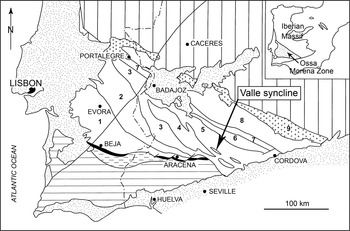
The examined material comes from a single locality in the Middle Ordovician (Oretanian regional Stage) of southwestern Spain in the Valle Syncline of the Ossa Morena Zone of the Iberian Massif (Fig. 1). The latter comprises large Precambrian and Paleozoic outcrops representing different zones of the European Variscan fold belt. The Valle syncline is situated in the north of the province of Seville, within the Sierra Norte de Sevilla UNESCO Global Geopark, and includes a very complete fossiliferous succession ranging from Cambrian to Middle Devonian (Robardet and Gutiérrez-Marco, Reference Robardet and Gutiérrez-Marco2004). The Middle Ordovician fossil locality studied here (abbreviation CS-IV) lies ~9.5 km west-northwest of the town of Cazalla de la Sierra, directly south of kilometer 8.5 of the local road SE-179 from Cazalla de la Sierra to El Real de la Jara, and very close to the main entrance to Cortijo Las Cañas/Las Cañas farm (Fig. 1). The geographical coordinates for the fossil locality are 37°57′40″N, 5°51′17″W (= locality 4 of Gutiérrez-Marco et al., Reference Gutiérrez-Marco, Rábano and Robardet1984, p. 18, fig. 1).
Sketch map of the southern part of the Iberian Peninsula showing the location of the Valle syncline within the Ossa-Morena Zone, with the Middle Ordovician fossiliferous locality here studied, as well as the southern Central Iberian Zone (vertical ruling), the South Portuguese Zone (horizontal ruling), the Beja-Acebuches ophiolites (in black), the Pulo-do-Lobo oceanic unit (dashes), and post-Paleozoic deposits (dotted). Abbreviations for the main units of the Ossa-Morena Zone (after Apalategui et al., Reference Apalategui, Eguíluz, Quesada, Dallmeyer and Martínez García1990): 1, Beja-Aracena Massif; 2, Montemor-Ficalho Unit; 3, Alter do Chão-Elvas Unit; 4, Olivenza-Monesterio Antiform; 5, Zafra-Córdoba-Alanís Unit; 6, Sierra Albarrana Unit; 7, Badajoz- Córdoba Shear Zone; 8, Obejo-Valsequillo-Puebla de la Reina Unit; 9, Los Pedroches batholith. Map modified from Robardet and Gutiérrez-Marco (Reference Robardet and Gutiérrez-Marco2004).

The hyoliths studied herein derive from siliceous nodules from 15–20 m thick, dark mudstones of an unnamed formation that lie above a thick succession (>200 m) of gray-green shales and siltstones that contain Floian graptolites and trilobites. The fossiliferous nodules are located in the upper 3–5 m of the dark mudstones and directly below a discontinuous oolitic ironstone bed that constitutes the base of the third Ordovician formation. That unit is composed of 60–80 m of sandstones containing brachiopods and trilobites of probable Dobrotivian age (Gutiérrez-Marco et al., Reference Gutiérrez-Marco, Robardet, Rábano, Sarmiento, San José Lancha, Herranz Araújo, Pieren Pidal, Gibbons and Moreno2002, fig. 4.8; Robardet and Gutiérrez-Marco, Reference Robardet and Gutiérrez-Marco2004, fig. 4).
The fossiliferous assemblage recorded from the nodules at locality CS-IV consists of diverse trilobites, brachiopods, echinoderms, and mollusks that closely compare with the Oretanian faunas from the Šárka Formation of Bohemia (Czech Republic) and the Ancenis Unit of the southern Armorican Massif of France (Robardet and Gutiérrez-Marco, Reference Robardet and Gutiérrez-Marco2004; for a provisional list of taxa, see below). Despite the absence of graptolites, the presence of some benthic forms characteristic of the lower Oretanian in other southwestern Iberian localities makes probable this precise age for the studied assemblage.
According to Gutiérrez-Marco et al. (Reference Gutiérrez-Marco, Sá, Rábano, Sarmiento, García-Bellido, Bernárdez, Lorenzo, Villas, Jiménez-Sánchez, Colmenar and Zamora2015, Reference Gutiérrez-Marco, Sá, García-Bellido and Rábano2017), the lower Oretanian stage of the Bohemo-Iberian regional chronostratigraphic scale can be correlated with the Darriwilian 2 (middle substage) of the global Ordovician standard scale (Bergström et al., Reference Bergström, Chen, Gutiérrez-Marco and Dronov2009).
Material and methods
The hyoliths studied herein are preserved as internal and external molds occurring in siliceous nodules that range from 2–6 cm in diameter. No original calcareous material is preserved. The hyolith fossils consist mainly of uncompressed conchs and isolated opercula, plus rare articulated specimens (conchs and opercula, but no helens) only known in the minute hyolithid genus Andalucilites n. gen. The latter form clusters of individuals preserved in situ, with opercula of some completely closed or slightly opened in others.
Studies of the surficial characters of hyolith specimens were made through latex casts taken from external molds. Illustrated specimens were whitened with magnesium oxide and photographed using a Canon EOS 7D digital camera with Canon Macro 60 and 100 mm lenses. Figures were assembled with Adobe Photoshop CS3 and CS6 Extended.
Repository and institutional abbreviation
Types, figured specimens, and other specimens examined in this study are deposited in the Museo Geominero of Madrid (MGM), which belongs to the Instituto Geológico y Minero de España/IGME-CSIC (Spanish Geological Survey).
Systematic paleontology
Terminology used below follows Marek (Reference Marek1963, Reference Marek1966, Reference Marek1967, Reference Marek1983a) and Sysoev (Reference Sysoev1984b), with the refinements and additions introduced by Berg-Madsen and Malinky (Reference Berg-Madsen and Malinky1999) and Martí Mus and Bergström (Reference Martí Mus and Bergström2005).
Class Hyolitha Marek, Reference Marek1963
Remarks
This class encompasses at least two orders—Hyolithida Sysoev, Reference Sysoev1957 and Orthothecida Marek, Reference Marek1966—and a possible third order, Toxeumorphorida Shimanskiy, Reference Shimanskiy1962. This study involves only members of the Hyolithida, but specimens of Orthothecida from localities in the Toledo Mountains (Central Iberian Zone) are currently under study. The third order consists of exceptionally large conchs compared to those of the two other orders and seems to be restricted exclusively to the upper Paleozoic of the Ural Mountains and Greenland (Peel and Yochelson, Reference Peel and Yochelson1984). Therefore it is not considered further here.
Order Hyolithida Sysoev, Reference Sysoev1957
Remarks
The hard- and soft-part of morphologies of hyolithids have been discussed in detail (Marek, Reference Marek1963, Reference Marek1967; Sysoev, Reference Sysoev1976a; Meshkova and Sysoev, Reference Meshkova and Sysoev1981; Martí Mus and Bergström, Reference Martí Mus and Bergström2005, Reference Martí Mus and Bergström2007; Martí Mus et al., Reference Martí Mus, Jeppsson and Malinky2014; Sun et al., Reference Sun, Babcock, Peng and Zhao2015, Reference Sun, Babcock, Peng and Zhao2016, Reference Sun, Zhao, Wen, Zeng and Peng2018; Liu et al., Reference Liu, Skovsted, Topper and Zhang2020a, Reference Liu, Skovsted, Topper, Zhang and Shub) and need not be presented in the same detail here. We mention only those features that directly relate to our specimens in order for their morphology to be better understood.
The hyolithid skeleton consists of a cone-shaped conch with a convex, inflated dorsum and flattened to lightly inflated venter (Marek, Reference Marek1963, p. 65, fig. 12); the resulting cross-section has a generally triangular shape. The ventral side possesses an apertural extension known as a ligula, which ordinarily terminates in a rounded margin. The dorsal apertural rim may be planar or level (orthogonal), or may extend slightly in an adapertural direction (Marek, Reference Marek1967, p. 60, fig. 4b), or possess a centrally located indentation (Marek, Reference Marek1967, p. 60, fig. 4c). Some hyolithid species are characterized by a shallow indentation, known as a lateral sinus, where the base of the ligula intersects the dorsal apertural rim (Marek, Reference Marek1967, p. 60, fig. 4b). The species that possess the lateral sinuses most probably had curvilinear spine-like structures known as helens that extended from the lateral sinuses (Marek, Reference Marek1963 p. 65, fig. 12), although recent evidence suggests that not all hyolithids possessed helens (Skovsted et al., Reference Skovsted, Martí Mus, Zhang, Pan, Li, Lui, Li and Zhang2020). There are several possible functions for these structures, which are discussed further below.
The aperture is closed by an operculum that is subdivided into a dorsal cardinal shield and a ventral conical shield. The operculum possesses a distinct bend that serves as the boundary between the two shields; the flattened surface between the shields is known as a tectula or rooflet. The subcentrally located highest point on the operculum is known as the apex. The interior of the operculum possesses elongated cardinal processes that extend into the conch when the operculum is closed. A diagnostic feature found on the interior surface are elongated structures known as clavicles, which are subparallel to the surface the conical shield. These extend at an oblique to a nearly right angle from beneath the apex toward the margin of the conical shield. The clavicles ordinarily become wider toward their distal termination (see Marek, Reference Marek1963, p. 55, figs. 1, 2, p. 56, fig. 3). Much variability exists in terms of size, shape, and number of clavicles between hyolithid species, but our concern here is primarily with the number of clavicles. A monoclaviculate operculum possess a single pair of clavicles, whereas a polyclaviculate operculum may have more than 12 pairs (Marek, Reference Marek1967, p. 60, fig. 6). The exterior of both conch and operculum may be covered with transverse or longitudinal ornament, or a combination of both.
We adopt the classical orientation for the conch with venter resting on the seafloor and aperture oriented toward on-coming currents, as suggested by flume studies (Marek et al., Reference Marek, Parsley and Galle1997), the anchoring of tergomyan epizoans (Horný, Reference Horný2006), and encrustation by a tabulate coral (Marek and Galle, Reference Marek and Galle1976; Galle and Parsley, Reference Galle and Parsley2005) and by bryozoans (Bassler, Reference Bassler1911; Galle et al., Reference Galle, Marek, Vannier, Racheboeuf and Regnault1994; Malinky, Reference Malinky2003b; Galle and Parsley, Reference Galle and Parsley2005), in addition to preservation of specimens retaining traces of soft tissues (Moysiuk et al., Reference Moysiuk, Smith and Caron2017).
Members of order Hyolithida encompass family Hyolithidae Sysoev, Reference Sysoev1958 and several other families (see summaries in Valkov, Reference Valkov1990; Qian and Xiao, Reference Qian and Xiao1995), although their exact number remains controversial.
Family Hyolithidae Sysoev, Reference Sysoev1958
Type genus
Hyolithes Eichwald, Reference Eichwald1840 from the Middle Ordovician, near Tallinn, Estonia.
Included genera
Type genus; Novakotheca Malinky, Reference Malinky1990b (middle Cambrian of China); Hallotheca Malinky, Linsley, and Yochelson, Reference Malinky, Linsley and Yochelson1987 (Lower Devonian of New York); Brittanella Malinky and Racheboeuf, Reference Malinky and Racheboeuf2010 (Middle Devonian of France); Robardetlites n. gen. (Middle Ordovician of southwestern Spain, herein).
Carinolithes Sysoev, Reference Sysoev1958, from the middle Cambrian of Sweden, was formerly included in the family, but has since been reassigned to family Carinolithidae Valent et al., Reference Valent, Fatka, Szabad and Vokáč2011. Marek (Reference Marek1974) placed Cavernolites Marek, Reference Marek1974, from the Lower Ordovician of Bohemia, under this family, but the absence of longitudinal furrows near the lateral margins of the dorsum (Novák, Reference Novák1891, pl. 4, figs. 40‒42) in combination with the distinctive features of the operculum (see Marek, Reference Marek1974, text-fig. 1, and below) support placement in a new, as yet unnamed family. Korilithes Missarzhevsky, Reference Missarzhevsky1969, from the lower Cambrian (Tommotian regional stage) of the Siberian Platform, was included in the family, but it is currently under study to determine whether that assignment is correct.
Diagnosis
See Malinky (Reference Malinky2006, p. 94).
Occurrence
Uncertain; lower Cambrian of Siberia?–minimally Middle Devonian of Europe (Czech Republic, Estonia, France, Spain), North America, and China. The uncertainty involves whether Korilithes Missarzhevsky, Reference Missarzhevsky1969, from the lower Cambrian of Siberia, belongs to this family. Hyoliths range at least into the middle Permian (Malinky, Reference Malinky2009), although the last currently known occurrences of the family are in the Middle Devonian of the Czech Republic (Barrande, Reference Barrande1867; Novák, Reference Novák1891).
Remarks
One distinguishing trait of this family is the presence of one longitudinal furrow along each edge of the dorsum that marks the boundary between dorsum and venter on the conch. This feature is present on Robardetlites n. gen. and therefore warrants placement of the genus within Hyolithidae. The genera in this family may be separated from each other by the depth of the dorsal furrows; they are deep and well developed on every genus except for Robardetlites n. gen. In addition, Brittanella Malinky and Racheboeuf, Reference Malinky and Racheboeuf2010, has a distinct longitudinal furrow in the center of the dorsum, which is not seen on Robardetlites n. gen. or any other genus in the family. In addition, the longitudinal ribs on the dorsum of Robardetlites n. gen. are finer than those of any other genus mentioned above.
The presence of Robardetlites n. gen., documented below, marks the first occurrence of the family Hyolithidae in the Iberian Peninsula.
Genus Robardetlites new genus
Type species
Robardetlites sevillanus n. sp., by monotypy, from lower Oretanian (ca. middle Darriwilian) strata of the Ossa Morena Zone, southwestern Spain.
Diagnosis
As for the type species by monotypy.
Etymology
After the French geologist Michel Robardet (1939–2017), author of reference papers on the geology of the Ossa Morena Zone, and discoverer of the locality bearing the studied fossils.
Remarks
Differences between Robardetlites n. gen. and other genera with family Hyolithidae were given above.
Robardetlites sevillanus new species
Figures 2.1, 2.2, 3.1
- v Reference Gutiérrez-Marco, Rábano and Robardet1984
Hyolitha indet.; Gutiérrez-Marco et al., pl. 2, figs. 1, 2.
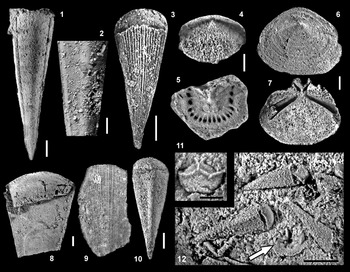
Middle Ordovician hyoliths from locality CS-IV in northern Seville, Andalusia, Spain. (1, 2) Robardetlites sevillanus n. gen. n. sp., (1) holotype, conch, latex cast of dorsum, MGM-8231O-1; (2) paratype, detail of the latex cast of conch MGM-8232O figured by Gutiérrez-Marco et al. (Reference Gutiérrez-Marco, Rábano and Robardet1984, pl. 2, figs. 1, 2) as Hyolitha indet. (3–5) Leolites malinkyi Marek and Gutiérrez-Marco, n. sp., (3) latex cast of holotype MGM-8235O-1; latex cast of exterior (4) and internal (5) mold of operculum, paratype MGM-8231O. (6, 7) Cavernolites sp., external surface (6) and internal mold (7) of operculum, MGM-8233O, figured by Gutiérrez-Marco et al. (Reference Gutiérrez-Marco, Rábano and Robardet1984, pl. 1, fig. 18). (8, 9) Pauxillites desolatus n. sp., steinkern of dorsal apertural part and external mold of venter (8), and latex cast of dorsal exterior of conch (9), holotype MGM-8234O. (10–12) Andalucilites parvulus n. gen. n. sp., (10) latex cast of conch with poorly preserved operculum in situ, paratype MGM-8237O; (11), holotype, latex cast of operculum showing conical shield and internal cardinal area with cardinal processes, MGM-8238O-1b; (12), latex cast of part of a nodule containing the counterpart of holotype (internal surface of operculum MGM-8238O-1a, arrowed) plus a number of paratypes, among them two conchs with articulated opercula (MGM-8238O-2, upper specimen; MGM-8238O-3, left specimen), a conch (MGM-8238O-4, right specimen) and another operculum to the left of holotype, MGM-8238O-5. Scale bars = 1 mm except for (11) (= 0.5 mm).

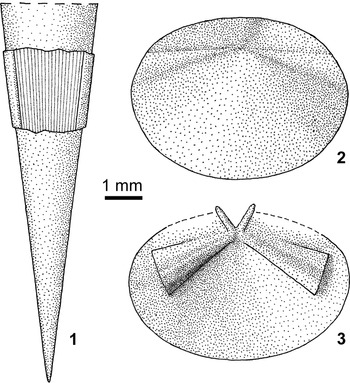
(1) Robardetlites sevillanus n. gen. n. sp., dorsal side of conch with detail of external ornamentation. After holotype MGM-8231O-1 (same as Fig. 2.1). (2, 3) Cavernolites sp., external (2) and internal (3) surfaces of operculum, after specimen MGM-8233O (see also Fig. 2.6, 2.7). Drawings by L. Marek.

Holotype
Dorsal side of a conch (MGM-8231O-1; Figs. 2.1, 3.1) from the lower Oretanian (ca. Darriwilian 2) locality CS-IV, of the Ossa Morena Zone, southwestern Spain.
Diagnosis
Hyolithid having elongated narrow, orthoconic conch with relatively small angle of divergence (14° on holotype). Cross section subtriangular, comparatively depressed. Median dorsal ridge depressed and slightly rounded, adjacent flanks only slightly inflated. One shallow longitudinal furrow along each margin of dorsum, with lateral margins of conch becoming inflated toward venter. Sculpture consisting of fine, longitudinal, closely spaced ribs on the dorsum, disappearing at longitudinal furrows.
Description
Elongated, straight narrow conch with relatively small angle of divergence. Length of the holotype is 10.9 mm, width at the aperture is 2.6 mm. Cross-section depressed subtriangular; median dorsal ridge relatively low and only slightly inflated; flanks adjacent to it slightly inflated; one longitudinal furrow marks the divide between dorsum and venter; lateral margins of conch slightly convex and inflated; in the middle 4 mm of the conch, dorsum bears fine closely spaced longitudinal ribs of ~16 per mm.
Etymology
After the demonym of the type locality in Seville province (Sevilla/sevillano in Spanish).
Materials
Two conchs: holotype, MGM-8231O-1 (Fig. 2.1), and paratype, MGM-8232O, that was figured by Gutiérrez-Marco et al. (Reference Gutiérrez-Marco, Rábano and Robardet1984, pl. 2, figs. 1, 2) and here (Fig. 2.2).
Remarks
This species is represented by two conchs; MGM-8231O-1 is selected as holotype. That specimen preserves only the dorsum; the venter has been broken away. Nonetheless, features of the dorsum are sufficiently distinctive as to distinguish it from other members of family Hyolithidae. Because the ventral side is unknown, the width/height index could not be measured. The other specimen (paratype, MGM-8232O) is similar to the holotype, but with better preservation of the fine longitudinal ribs on dorsum.
Family uncertain
Genus Cavernolites Marek, Reference Marek1974
Type species
Hyolithus giganteus Novák, Reference Novák1891 from the Middle Ordovician (Oretanian, ca. Darriwilian) Šárka Formation, Osek near Rokycany, Barrandian area, Czech Republic.
Other species
Cavernolites klouceki (Zázvorka, Reference Zázvorka1928) from the Middle Ordovician (Oretanian–Dobrotivian/Darriwilian 2–3) of Bohemia, Czech Republic; C. senex Marek, Reference Marek, Courtessole, Marek, Pillet, Ubaghs and Vizcaïno1983b from the Lower Ordovician (middle Arenigian/upper Floian) of Morocco; and Cavernolites sp. from the Middle Ordovician (lower Oretanian/middle Darriwilian) of Spain (herein). Marek (Reference Marek1974, p. 288) stated that Cavernolites “possibly” occurred in Sweden, but he mentioned no named species nor gave any other details. This occurrence remains unconfirmed.
Diagnosis
See Marek (Reference Marek1974, p. 287–288).
Occurrence
Ordovician (upper Floian–upper Darriwilian) of Europe (Czech Republic, Spain, ?Sweden) and North Africa (Morocco).
Remarks
The genus Cavernolites was originally included under Hyolithidae, but owing to a revision of that family (Malinky, Reference Malinky2006, Reference Malinky2007) it now encompasses only those genera that have a well-defined longitudinal furrow along each lateral margin of the dorsum and a broadly rounded median dorsal ridge. Marek's (Reference Marek1974) description of the conch of Cavernolites, based on the specimen illustrated by Novák (Reference Novák1891, pl. 4, figs. 40–42) and designated as lectotype by Marek (Reference Marek1974), lacks the furrows on the dorsum, and therefore does not belong under Hyolithidae. The interior morphology of the dorsum requires placement in a new family, but recognition of that family is beyond the scope of this report given that an incomplete operculum of Cavernolites is the only material available from Spain.
Cavernolites sp.
Figures 2.6, 2.7, 3.2, 3.3
- v Reference Gutiérrez-Marco, Rábano and Robardet1984
Cavernolites n. sp.?; Gutiérrez-Marco et al., pl. 1, fig. 18.
Occurrence
Middle Ordovician (lower Oretanian) at locality CS-IV of the Ossa Morena Zone (= locality 4 of Gutiérrez-Marco et al., Reference Gutiérrez-Marco, Rábano and Robardet1984) of southwestern Spain.
Description
Operculum of rounded oval outline with ratio of dorsal/ventral length to distance between lateral margins of 1.22. Interior with one pair of comparatively robust, hollow, and distally open clavicles, which are of an elongated triangular shape and trapeziform cross-section; clavicles narrow in proximal area becoming nearly 2.5 times as wide at distal termination; cardinal processes narrow and peg-like with rounded distal terminations; angle of divergence ~77°. External surface of operculum has very moderately convex conical shield and nearly indistinct tectula. Cardinal shield almost flat except for axial region, which is slightly elevated; apex consisting of prominent knob situated at boundary separating cardinal and conical shields at one-fourth the distance between margin and shields. External surface bears irregularly spaced, prominent to obscure, comarginal growth-lines and fine ribs. Surface between lines and ribs smooth.
Remarks
This species is characterized by one isolated operculum (MGM-8233O) at this locality. It measures 5 mm in length (dorsal to ventral margins) and 6.1 mm in width (distance between lateral margins). The cardinal processes apparently are broken, therefore the shape of the complete feature is unknown. In addition, the raised central axial region of the cardinal shield may be an artefact of preservation. The internal morphology of this operculum is typical of Cavernolites, although it possesses no additional detailed features for detailed comparison with the other species of the genus. It is possible that this operculum represents a juvenile individual because the other representatives of Cavernolites (C. giganteus [Novák, Reference Novák1891] and C. klouceki [Zázvorka, Reference Zázvorka1928] in Bohemia, C. senex Marek, Reference Marek, Courtessole, Marek, Pillet, Ubaghs and Vizcaïno1983b in Morocco) attained a fairly large size. The Spanish species is left in open nomenclature until more complete, better-preserved material is obtained.
Cavernolites was also reported from the Middle Ordovician of the Armorican Massif, western France, but the figured specimens (identified as C. klouceki by Pillet and Beaulieu, Reference Pillet and Beaulieu1995, pl. 3, figs. 1–4) clearly belong to fragments of conulariids with a reticulate external ornament.
Family ?Carinolithidae Valent et al., Reference Valent, Fatka, Szabad and Vokáč2011
Type genus
Carinolithes Sysoev, Reference Sysoev1958 from the late Drumian (Miaolingian, middle Cambrian) Andrarum Limestone of southwestern Sweden.
Included genera
Type genus, from the middle Cambrian of southwestern Sweden, England, Bohemia, and Australia, and Lower–Middle Ordovician of southwestern Sweden; Slehoferites Valent et al., Reference Valent, Fatka, Szabad and Vokáč2011, from the middle Cambrian (Drumian) of Bohemia; and possibly Andalucilites n. gen., from the Middle Ordovician of Spain and ?Late Ordovician of Bohemia.
Diagnosis
See Valent et al. (Reference Valent, Fatka, Szabad and Vokáč2011, p. 102).
Occurrence
Upper middle Cambrian of Europe (southwestern Sweden, England, Bohemia) and Australia, to Middle–Upper Ordovician of Spain and Bohemia.
Remarks
Andalucilites n. gen. is assigned tentatively to family Carinolithidae owing to similarities in dorsal morphology between that genus and Carinolithes. Andalucilites n. gen. shares a longitudinal lateral furrow along each margin of the dorsum with other members of the family. The referral is considered in question due to differences in opercular morphology, discussed below under genus.
Genus Andalucilites new genus
Type species
Andalucilites parvulus n. sp., Middle Ordovician (lower Oretanian, ca. middle Darriwilian), Ossa Morena Zone, southwestern Spain, by original designation.
Other species
Possibly Carinolithes? tantulus Marek, Reference Marek1967, from the Upper Ordovician Libeň Formation, lower Berounian (ca. lower Sandbian) of the Barrandian area of Bohemia, Czech Republic.
Diagnosis
As for the type species by monotypy.
Occurrence
Middle Ordovician (middle Darriwilian)–?Upper Ordovician (Sandbian 1) of Spain and Bohemia.
Etymology
After Andalusia (in Spanish, Andalucía), type region of the type species.
Remarks
The list of diagnostic traits of Carinolithes given by Valent et al. (Reference Valent, Fatka, Szabad and Vokáč2011) is lengthy, and only the traits relevant to the separation of that genus and Andalucilites n. gen. will be mentioned here. The prominent median dorsal ridge with flat to slightly concave adjacent flanks that grade into inflated lateral margins are distinctive traits of the family, and are seen in Andalucilites n. gen. The dorsal flanks of Carinolithes are more concave, and the lateral margins of the conch are more inflated than those of Andalucilites n. gen. Slehoferites may be distinguished by its less-pronounced and more poorly developed median dorsal ridge than on the other genera in this family. Other significant traits of Slehoferites are dorsal flanks that are much flatter (rather than concave) and lateral margins that are rounded (rather than inflated).
However, features of the operculum of Andalucilites n. gen. stand in stark contrast to those of Carinolithes and Slehoferites. According to Valent et al. (Reference Valent, Fatka, Szabad and Vokáč2011), members of the family possess a polyclaviculate operculum with distinct, broad, blade-like clavicles that diverge at an angle of ~40°, and thicken markedly toward their distal ends. The cardinal process is widely divergent and flat, with a rounded shape (see Valent et al., Reference Valent, Fatka, Szabad and Vokáč2011, p. 106, figs 2a, b, e–h). In contrast, the operculum of Andalucilites n. gen. is monoclaviculate, bearing only one pair of rod-like clavicles. They diverge beneath the apex of the operculum, and continue to curve toward the dorsal cardinal shield near their distal terminations (see Fig. 2.11). Owing to these differences, we refer Andalucilites n. gen. with question to Carinolithidae. Perhaps Andalucilites n. gen. is a homeomorph of a carinolithid and actually represents another family of hyolithids.
All specimens of Andalucilites n. gen. are smaller than the other two genera within the family. These probably are normal-sized adults, given that they are preserved with other fossils of various sizes, and therefore are not part of a size-sorted thanatocoenosis in which only specimens of a limited size range were included.
Andalucilites parvulus new species
Figures 2.10–2.12, 4.3–4.5
Holotype
Internal and external mold of an operculum, MGM-8238O-1a and MGM-8238O-1b (Figs. 2.11, 2.12, 4.3–4.5), in a nodule with a number of conchs, from the lower Oretanian (ca. Darriwilian 2) of the Valle syncline, Ossa Morena Zone, southwestern Spain.
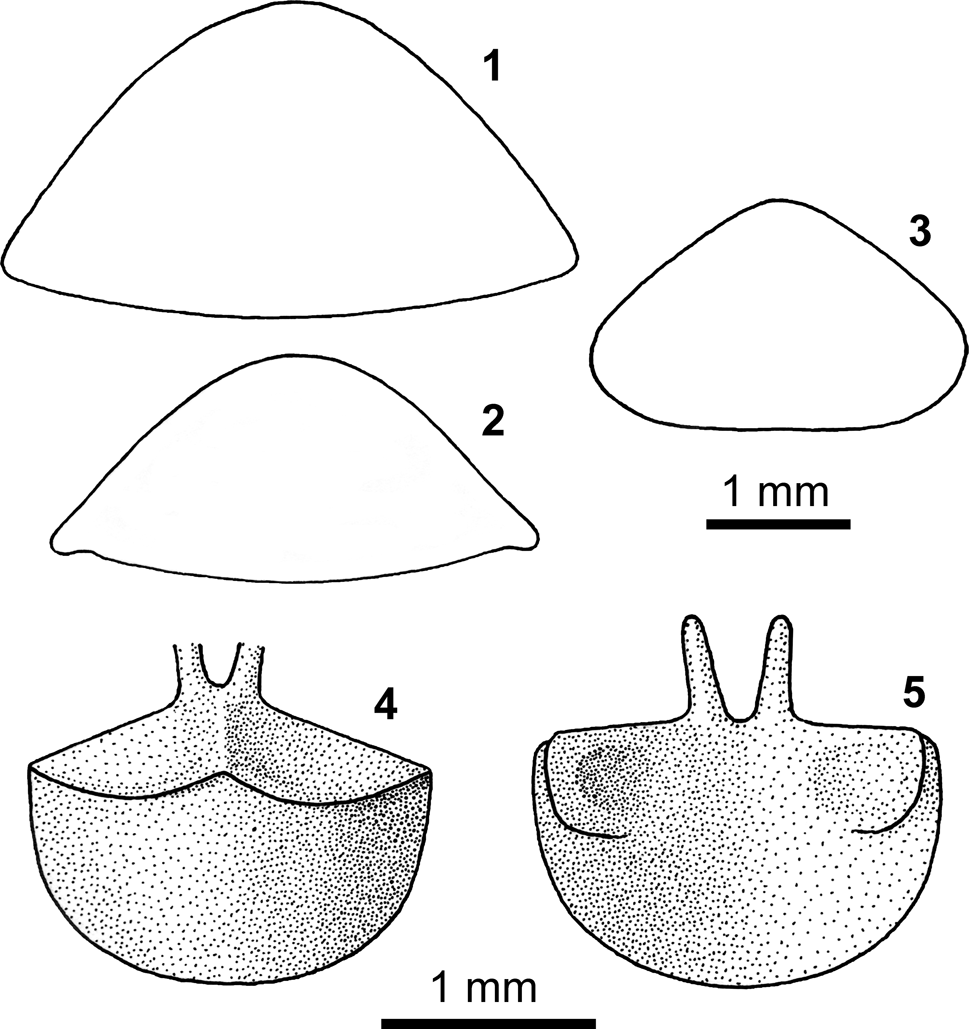
(1, 2) Pauxillites desolatus n. sp., cross-sections of conch, after external (1) and internal (2) molds of holotype MGM-8234O. (3–5) Andalucilites parvulus n. gen. n. sp., cross-section of conch (3) and external (4) and internal (5) surfaces of operculum; holotype MGM-8238O-1 (see also Fig. 2.11, 2.12). Drawings by L. Marek.

Diagnosis
Minute orthoconic conchs with relatively small apical angle; dorsum with prominent, well-developed central longitudinal ridge that terminates in an upper rounded surface; adjacent flanks sloping to become slightly concave; lateral margins of conch slightly inflated. Operculum monoclaviculate, with narrow rod-like clavicles that curve slightly when initially separating from each other where conjoined beneath the apex of operculum, and then curve dorsally near their distal terminations; cardinal processes seemingly flat and blade-like, and diverge widely from each other.
Occurrence
Middle Ordovician (lower Oretanian) at locality CS-IV of the Ossa Morena Zone (= locality 4 of Gutiérrez-Marco et al., Reference Gutiérrez-Marco, Rábano and Robardet1984) of southwestern Spain.
Description
Minute orthoconic conchs of ~5 mm in maximum length and 1.35 mm of largest width at the aperture; width of conch/height of conch (W/H index) varies between 1.6–1.7 and angle of apical divergence ~20°. The concave flanks of the dorsum meet in a prominent, rounded central dorsal ridge at an angle of ~100°. Strongly rounded lateral margins lie at about one-third height of the conch. Ventral side moderately convex with almost flat central region. Cross-section generally subtriangular. Ligula regularly arched and broadly rounded at anterior margin, with sides dipping gently to aperture, attaining the length of three-sevenths of the width of the aperture. Dorsal apertural margin seemingly orthogonal, although slight indentation in the axial part seen on some individuals. Lateral sinuses broad and shallow. No traces of any sculpture or growth-lines remaining on surface of conch.
Operculum monoclaviculate, having very narrow cardinal shield. Both sides of shield are arched anteriorly and meet at axial line in a wide groove. Conical shield moderately inflated, with broad rounded margin; cardinal shield with narrow, largely indistinguishable tectula separating the shields. Clavicles broad and flat, nearly square in outline, and diverge at angle of nearly 180°; margins nearly straight on ventral side, whereas margins are slightly rounded on dorsal side; clavicles curve slightly beneath apex of the operculum where initially diverging, then curve again such that distal terminations are oriented toward cardinal shield. Cardinal processes narrow, peg-shaped, and only slightly diverging. Central process between cardinal process developed as distinct narrow ridge reaching to dorsal margin of operculum. No traces of sculpture were observed.
Etymology
Parvulus (Latin) meaning very small.
Materials
Remains of ~20 conchs, mostly incomplete and preserved as external molds, and seven opercula, of which four are poorly preserved. Holotype is an operculum (MGM-8238O-1; Figs. 2.11, 4.4, 4.5) in a nodule with a number of conchs, MGM-8238O-2 to MGM-8238O-13. Other selected paratypes under MGM-8237O (conch with poorly preserved operculum in situ; Fig. 2.10), MGM-8239O to MGM-8240O (opercula), and MGM-8245O to 8250O (conchs).
Remarks
This species is known from a limited number of well-preserved conchs and opercula. Among the latter, two exposing the exterior and two the interior. The operculum is unique among hyolithids owing to the morphology of its clavicles. The clavicles curve toward their distal terminations rather than remaining straight throughout as is characteristic of other hyolithid species. The tectula separating the shields are small and indistinct, but this may be due to its very small size and imperfect preservation.
The Bohemian (lower Berounian) species described by Marek (Reference Marek1967) as Carinolithes? tantulus seems to be in some aspects related to Andalucilites n. gen. It is also a minute species, assuming that all known specimens are normal-sized adults. Berg-Madsen and Malinky (Reference Berg-Madsen and Malinky1999) and Valent et al. (Reference Valent, Fatka, Szabad and Vokáč2011) retained Carinolithes? tantulus in the essentially Cambrian genus Carinolithes. This genus has a distinctive keel-like, rather than rounded, central dorsal ridge and deeper lateral furrows along the margins of the dorsum. The dorsum of Andalucilites n. gen. is rounded rather than keel-like and its lateral furrows are shallower. The dorsal morphology of C.? tantulus suggests affinity to Andalucilites n. gen.; however, because the central process of the operculum is missing in C.? tantulus, we attributed it to Andalucilites n. gen. only tentatively.
The presence of lateral sinuses in Andalucities parvulus n. gen. n. sp. suggests the possession of helens—the lateral fin-like structures (see Martí Mus and Bergström, Reference Martí Mus and Bergström2007) that extended from the conch when the operculum is closed. Zhang et al. (Reference Zhang, Skovsted and Zhang2018) suggested that hyolithids that lack lateral sinuses also lacked helens. The presence or absence of these structures has important implications for the ecology and potentially the phylogeny of these animals. Thus far, no helens have been found at the same stratigraphic level as the conchs of Andalucilites parvulus n. gen. n. sp., although this may reflect the delicate nature of these structures, which did not permit their preservation. This issue is discussed further below under concluding remarks.
Family Pauxillitidae Marek, Reference Marek1967 (emended Malinky, Reference Malinky1989)
Type genus
Pauxillites Marek, Reference Marek1966 from the Middle Ordovician of the Barrandian area, Bohemia.
Included genera
Type genus, known from the Lower–Middle Ordovician of Bohemia (Tremadocian–Dobrotivian/Darriwilian 3), Morocco, and southwestern Spain; Recilites Marek, Reference Marek1967, from the Upper Ordovician (middle Berounian–Kralodvorian/Sandbian2–Katian4) of Bohemia, ?Belgium, and ?Scotland, and Silurian (Llandovery) of Scotland; Leolites Marek, Reference Marek1967, from the Middle Ordovician (Oretanian/Darriwilian 2) of southwestern Spain, Upper Ordovician (middle Berounian–Kralodvorian/Sandbian 2–Katian 4) of Bohemia and Morocco, ?Ashgill of Scotland, and doubtfully from the Ordovician of the Himalayas (Marek, Reference Marek and Basset1976, p. 497); Mediolites Marek, Reference Marek1967, from the Upper Ordovician (Kralodvorian/Katian 3–4) of Bohemia; Decipilites Marek, Reference Marek1975, from the Upper Ordovician (Kralodvorian/Katian 3–4) of Bohemia; Paolites Marek, Reference Marek1975, from the Silurian (Wenlock) of Bohemia; and Neopauxillites Malinky, Reference Malinky1989, from the lower Cambrian (Branchian Series) of southeastern Avalonian Newfoundland, Canada.
Diagnosis
See Malinky (Reference Malinky1989, p. 313).
Occurrence
Lower Cambrian–Silurian (Wenlock) of Europe (Bohemia, Spain, ?Scotland), North America (Canada), and ?Asia (Himalayas).
Remarks
The diagnosis of the family was emended by Malinky (Reference Malinky1989) to emphasize the longitudinal sculpture on the dorsum. In the original diagnosis, Marek (Reference Marek1967) stated that the dorsal apertural rim is oxygonal (having an anterior-facing projection from the middle of the dorsum; e.g., Leolites malinkyi Marek and Gutiérrez-Marco, n. sp., Fig. 2.4 herein), whereas Malinky (Reference Malinky1989) included apertures having an orthogonal (level dorsal apertural rim) or amblygonal (having a centrally located indentation on the dorsal rim) shape (see Marek, Reference Marek1967, for additional details and illustrations). Most pauxillitids ranging from the Lower Ordovician to the Silurian seem to have a distinctly oxygonal aperture (but see description of Leolites cognatus Marek, Reference Marek1967, p. 94), whereas Neopauxillites from the lower Cambrian of Newfoundland possesses an orthogonal aperture.
All members of family Pauxillitidae seem to be confined solely to the Ordovician, with the exception of Neopauxillites, from the lower Cambrian of Avalonian southeastern Newfoundland, and Paolites, from the Silurian of the Barrandian. The stratigraphic ranges of the previously known genera remain unchanged, except for Leolites whose range has been extended downward to the Middle Ordovician by its occurrence recorded herein.
Genus Pauxillites Marek, Reference Marek1966
Type species
Hyolithus pauxillus Novák, Reference Novák1891, from the Middle Ordovician (Oretanian/Darriwilian 2–3) Šarká and Dobrotivá formations of Bohemia, Czech Republic, by original designation.
Other species
Pauxillites pauxillus meridionalis Marek, Reference Marek1983a, from the Middle Ordovician (Oretanian/Darriwilian 2) of Morocco; Hyolithes latus Zázvorka, Reference Zázvorka1928, from the Middle Ordovician (Oretanian-Dobrotivian/Darriwilian 2–3) of Bohemia; Pauxillites desolatus n. sp., from the Middle Ordovician (Oretanian/Darriwilian 2) of southwestern Spain (herein); Pauxillites thaddei Valent and Corbacho, Reference Valent and Corbacho2015, from the Lower Ordovician (middle Arenigian/upper Floian) of Morocco.
Diagnosis
See Marek (Reference Marek1966, p. 91).
Occurrence
Lower Ordovician (?Tremadocian)–Middle Ordovician (Darriwilian 3) of Europe (Bohemia, Spain) and North Africa (Morocco).
Remarks
Pauxillites is distinguished from Leolites by the coarser, more widely spaced longitudinal ribs on the dorsum and distinctively polyclaviculate operculum of the latter genus. Recilites is separated from Leolites by the presence of longitudinal ribs on both its dorsum and venter and by its monoclaviculate operculum. Decipilites Marek, Reference Marek1975, can be recognized by a faint cancellate pattern composed of prominent narrow longitudinal ribs with faint transverse ribs superimposed on them on the dorsum. Mediolites Marek, Reference Marek1967, possesses an unusual polyclaviculate operculum with four pairs of long, thin radially arranged clavicles, but three of the four pairs are curved rather than linear. The conch of Paolites Marek, Reference Marek1975, is similar to that of Decipilites, although the latter genus possesses distinct longitudinal ribs on the interior of the conch, with a faint cancellate pattern on the exterior of the dorsum. Neopauxillites is the only member of the family to possess a low, depressed dorsum with widely spaced, sharp ribs.
Pauxillites desolatus new species
Figures 2.8, 2.9, 4.1, 4.2
Holotype
A nearly complete conch, MGM-8234O (Fig. 2.8, 2.9), from the lower Oretanian (ca. Darriwilian 2) of the Valle syncline, Ossa Morena Zone, southwestern Spain.
Diagnosis
Species of Pauxillites with fine, closely spaced longitudinal ribs on dorsum, numbering 9–10 per mm; apical angle of divergence ~23°.
Occurrence
Middle Ordovician (lower Oretanian) at locality CS-IV of the Ossa Morena Zone (= locality 4 of Gutiérrez-Marco et al., Reference Gutiérrez-Marco, Rábano and Robardet1984) of southwestern Spain.
Description
Small orthoconic conch of at least 20 mm in length and 7.2 mm wide at the aperture. Width/height index ~2.0, with height of the conch decreasing toward apex. Dorsum low and broadly rounded, with only weakly developed median ridge; flanks adjacent to ridge flat to only slightly convex, and dip gently toward lateral margins of conch. Sharply rounded lateral edges lie at ~15% of height of conch. Venter only slightly inflated. Cross-section rounded subtriangular. Aperture oxygonal. Ligula short, attaining almost one-fourth apertural width. Interior of ventral side with shallow longitudinal furrows near lateral edges (seen as grooves on internal mold).
Sculpture of dorsum consists of fine, distinct, closely spaced longitudinal ribs, 9–10 per mm, on a conch having a width of 7 mm. Venter practically smooth.
Etymology
From Latin word desolatus, past participle of desolo = desolate, abandoned. The name alludes to the rarity of Spanish specimens of this genus, whereas they are comparatively abundant in the Bohemian and Moroccan Oretanian.
Remarks
Pauxillites pauxillus pauxillus (Novák, Reference Novák1891), from the Bohemian Oretanian and Dobrotivian, differs from P. desolatus n. sp. in having a greater number of closely spaced and less-distinct longitudinal ribs, numbering 16–17 per mm on a conch 6 mm wide. In Pauxillites latus (Zázvorka, Reference Zázvorka1928), from the Dobrotivian, the dorsal sculpture is mostly developed only near the lateral edges, and the number of ribs is relatively high, at ~20 per mm. The surface of P. pauxillus meridionalis Marek, Reference Marek1983a, from the lower Oretanian of Morocco, bears ~16 ribs per mm, and its dorsum is more inflated than in the typical subspecies and in P. desolatus n. sp. Pauxillites thaddei Valent and Corbacho, Reference Valent and Corbacho2015, from the middle Arenigian (ca. upper Floian) of Morocco, has a more strongly rounded ligula and finer, less-pronounced ribs.
The specimen of “Pauxillites” from the Middle Ordovician of Portugal illustrated by Sá and Gutiérrez-Marco (Reference Sá and Gutiérrez-Marco2006, p. 156, lower right corner) is a compressed ventral side of a conch with densely spaced longitudinal ribs. By comparison with some unpublished Spanish material, this specimen can be better reassigned to Recilites? sp., because Pauxillites lacks the distinct longitudinal sculpture on the ventral side seen on Recilites Marek, Reference Marek1967.
Marek used the term “ventrolateral muscle track” (Marek, Reference Marek1967, p. 95, text-figure 31b, pl. 7, figs. 12, 14) for the shallow longitudinal grooves seen along the margins of the venter “regardless of the real function” of those structures. We refer to these features simply as “longitudinal furrows” because we are also uncertain of their function, and they may have had nothing directly to do with the muscles of the animal.
Genus Leolites Marek, Reference Marek1967
Type species
Leolites cognatus Marek, Reference Marek1967, from the Upper Ordovician (middle Berounian, ca. Katian 1) Zahořany Formation, Bohemia, Czech Republic, by original designation.
Other species
Leolites paucicostatus Marek, Reference Marek1989, from the Upper Ordovician (Kralodvorian/Katian 3–4) of Bohemia; Leolites sp. Marek (Reference Marek1983a), from the Upper Ordovician (upper Berounian/Katian 2–3) of Morocco; L. malinkyi Marek and Gutiérrez-Marco, n. sp. from the Middle Ordovician (Oretanian/Darriwilian 2) of Spain (herein). Hyolithes candidus Reed, Reference Reed1909, and H. ardmillanensis Reed, Reference Reed1909, from the Upper Ordovician (Caradoc and Ashgill, respectively) of the Girvan district, Scotland were first described in a monograph by Reed (Reference Reed1909) and revised by Malinky (Reference Malinky2003a) who questionably assigned the two species named above to Leolites. According to Marek (Reference Marek and Basset1976, p. 497), Leolites possibly is also represented in the Upper Ordovician of the Cohorti Pass, Himalayas, by “Hyolithes” lineolatus (Salter in Salter and Blandford, Reference Salter and Blandford1865).
Diagnosis
Emended after Marek, Reference Marek1967. Conchs small and straight, of low subtrigonal cross-section. Ventral side of internal mold with one pair of longitudinal furrows along its lateral margins. Ligula long, aperture may be oxygonal, orthogonal, or amblygonal. Ornamentation consists of longitudinal ribs on dorsal side; ventral side with inconspicuous growth lines.
Polyclaviculate operculum with variable number of radially arranged to horse-shoe shaped arrangement of clavicles and narrow cardinal shield and broad, gently sloping conical shield. Ornamentation of coarsely spaced radial ribs.
Occurrence
Middle Ordovician (Darriwilian 2)–Upper Ordovician (Katian 4) of Europe (Bohemia, Spain, ?Scotland) and possibly Asia (?Himalayas).
Remarks
The emended diagnosis of Leolites given above is nearly identical to that of Marek (Reference Marek1967, p. 91) in terms of the morphology of the conch, but alters the number of clavicles on the interior of the operculum. Leolites malinkyi Marek and Gutiérrez-Marco, n. sp. bears eighteen clavicles arranged in a horse-shoe shape near the margin of the operculum (Fig. 2.3). Because the operculum of L. malinkyi Marek and Gutiérrez-Marco, n. sp. is the only one known, it is not possible at this point to determine the range of variation in the number of clavicles in this species. In contrast, Leolites cognatus Marek, Reference Marek1967, has three pairs of large clavicles and 6–9 pairs of smaller radially arranged clavicles. Leolites paucicostatus Marek, Reference Marek1989, bears three pairs of what Marek (Reference Marek1989) termed “main” clavicles and 3–5 smaller ones; in addition, that species is distinctive due to the large apical angle of divergence of the conch (30–35°), making it exceptionally wide.
In addition, it is worth noting that Marek (Reference Marek1967, p. 90) emphasized that the dorsal apertural rim of all pauxillitid hyoliths has an oxygonal shape, and repeated it under the diagnosis of Leolites (Marek, Reference Marek1967, p. 94), yet under his description of the type species of that genus, he stated that the shape of the rim is orthogonal (see Marek, Reference Marek1967, p. 94). Perhaps Marek had in his possession specimens with orthogonal apertures that he did not illustrate, indicating that there is variability in terms of this feature within the species or the genus, or Marek may have made an error in preparing his manuscript. Malinky (Reference Malinky1989) revised the family Pauxillitidae such that the dorsal rim may have an amblygonal, oxygonal, or orthogonal aperture.
Leolites malinkyi Marek and Gutiérrez-Marco, new species
Figure 2.3–2.5
- v Reference Marek, Gutiérrez-Marco, López, Obrador and Vicens1995
Leolites n. sp.; Marek and Gutiérrez-Marco, p. 117 (name only).
Holotype
A conch with preserved ligula (MGM-8235O-1, Fig. 2.3), from the lower Oretanian (ca. Darriwilian 2) of the Valle syncline, Ossa Morena Zone, southwestern Spain.
Diagnosis
Species of Leolites with 11–12 thin, widely spaced longitudinal ribs with flat intervening spaces on dorsum. Operculum polyclaviculate, with eighteen clavicles on holotype.
Occurrence
Middle Ordovician (lower Oretanian) at locality CS-IV of the Ossa Morena Zone (= locality 4 of Gutiérrez-Marco et al., Reference Gutiérrez-Marco, Rábano and Robardet1984) of southwestern Spain.
Description
Small narrow orthoconic conchs with angle of divergence ~19°. Length of holotype, 5.6 mm (estimated maximum length 6.5 mm) and width of aperture 1.8 mm; width/height index ~2.1. Venter very slightly inflated, dorsum convex, but with low broadly rounded median ridge; adjacent slopes nearly flat. Lateral edges of conch tightly rounded. Resulting cross-section of low, rounded triangular shape. Ligula attains length slightly less than one-half apertural width, and aperture slightly oxygonal. Dorsum bears longitudinal sculpture of narrow, widely spaced ribs, 11–12 per mm at aperture, with flat, wide interspaces (Fig. 2.4). Venter smooth.
Operculum polyclaviculate, with 18 clavicles arranged in a horse-shoe shape near margin of operculum; cardinal processes small and short; shape of central process unknown. One pair of central muscle scars in central part of operculum. Internal surface otherwise without sculpture (Fig. 2.5). Cardinal shield very narrow and steeply inclined to the moderately convex conical shield. Boundary between shields delineated by deep, distinctive tectula at an unusual orientation in which the clavicles diverge at nearly 180° to each other, an arrangement unknown in any other hyolithid; apex of operculum rising to form a pointed, triangular shaped structure seen where the deep tectula converge (Fig. 2.4).
Etymology
Species named for our co-author, Dr. John M. Malinky (San Diego City College, CA), American paleontologist dealing with hyoliths, who aided in completion of this manuscript upon the death of the leading hyolith paleontologist of the time, mentor, and friend, Ladislav Marek.
Materials
Besides the holotype MGM-8235O-1, five paratypes MGM-8231O, MGM-8235O-2, and MGM-8236O-1 to MGM-8236O-3, consisting of external molds of conchs, three opercula, and one internal mold of venter.
Remarks
Leolites malinkyi Marek and Gutiérrez-Marco, n. sp. differs from the two other named species of the genus in the number of longitudinal ribs on the dorsum, clavicles on the interior of the operculum, and apical angle. It has 11–12 longitudinal ribs per mm on the dorsum, a platyclaviculate operculum with 18 clavicles arranged in a horse-shoe shaped formation, and an angle of apical expansion of 19°. Leolites cognatus Marek, Reference Marek1967 has narrower and more closely spaced longitudinal ribs, numbering 9–10 per mm, a smaller angle of divergence (6–8°), and 12–15 clavicles arranged in a manner similar to those in L. malinkyi Marek and Gutiérrez-Marco, n. sp. Leolites paucicostatus Marek, Reference Marek1989 is characterized by 11–13 longitudinal ribs per mm on the dorsum, a polyclaviculate operculum with three pairs of what Marek (Reference Marek1989) called “main” clavicles and 3–5 additional clavicles, and a large apical angle of 30–35°. Leolites sp., from the Berounian of Morocco (Marek, Reference Marek1983a), is too poorly preserved to be compared in detail to the other species of the genus. Malinky (Reference Malinky2003a) tentatively referred Hyolithes ardmillanensis Reed, Reference Reed1909, and H. candidus Reed, Reference Reed1909, both from the Upper Ordovician of Scotland, to Leolites, but incomplete preservation of those species limits comparison with the others in the genus.
Leolites malinkyi Marek and Gutiérrez-Marco, n. sp. is the oldest known representative of this genus, and possesses distinct lateral sinuses suggesting that this species possessed helens. Comments made concerning this issue under Andalucilites parvulus n. gen. n. sp. apply here, with additional discussion regarding lateral sinuses and helens below under Conclusions.
Conclusions
The Iberian Middle Ordovician hyolithid assemblage documented in this report expands the number of these fossils in Iberia and the overall record of hyolithids in general. This assemblage has a typical “Mediterranean province” character (see Marek, Reference Marek and Basset1976; Malinky et al., Reference Malinky, Eriksson and Ahlberg2009; Valent, Reference Valent2010), and includes genera widely distributed in Bohemia, Morocco, and France, and possibly Scotland. The peri-Gondwana Iberian Peninsula seems to have been a way-station for hyoliths on the autopista connecting it with the localities previously mentioned. Yet until now, Bohemian species have not been identified with certainty in the Middle Ordovician of Spain and Portugal. Taxonomic diversity of hyoliths in the Ossa Morena Zone seems to be higher than in the remaining zones of the Iberian Massif, where only Elegantilites, Gompholites, and Recilites? have been reported so far (Marek and Gutiérrez-Marco, Reference Marek, Gutiérrez-Marco, López, Obrador and Vicens1995). The Oretanian locality CS-IV in northern Seville yielded five different species occurring in the same bed, four of which are new and belong to genera recorded herein for the first time in the Iberian Peninsula.
The distinct difference in composition of coeval hyolith assemblages between the Central Iberian and Ossa Morena zones during the Oretanian (ca. middle Darriwilian) is related to the development of the second area as an outer and distal-shelf counterpart of the Iberian platform, which was tectonically (laterally) juxtaposed to its present position during the Variscan Orogeny (Quesada, Reference Quesada1991). This explains the absence of the inshore “Neseuretus fauna,” which is otherwise characteristic of the remaining zones of the Iberian Massif, at Locality CS-IV. The Ossa Morena Zone belongs to a deeper paleoenvironment in which Bohemian and Thuringian sedimentary facies and faunas predominated from the Early Ordovician to the Early Devonian. This is paleogeographically located within the so-called “South Iberian Domain” south of the Badajoz-Cordoba shear belt (Robardet and Gutiérrez-Marco, Reference Robardet, Gutiérrez-Marco, Dallmeyer and Martínez García1990, Reference Robardet and Gutiérrez-Marco2004; Robardet, Reference Robardet2002, Reference Robardet2003; Gutiérrez-Marco et al., Reference Gutiérrez-Marco, Piçarra, Meireles, Cózar, García-Bellido, Quesada and Oliveira2019).
The interpretation of these biogeographic differences is confirmed by the fact that the studied hyolith locality, CS-IV, also has yielded some trilobites and echinoderms characteristic of the cyclopygid biofacies. Most of them had been previously recorded in the Šárka Formation of Bohemia and in the Ancenis syncline of the south Armorican Massif, as well as in scattered localities in Morocco. The trilobites are provisionally identified as Kodymaspis puer (Barrande, Reference Barrande1872), Nerudaspis cf. N. aliena (Barrande, Reference Barrande1872), Ormathops sp., Salterocoryphe sp., Selenopeltis aff. S. buchi (Barrande, Reference Barrande1846), and a minute Ectillaenus sp. The echinoderms include Lagynocystis pyramidalis (Barrande, Reference Barrande1887) and Domfrontia? sp.; also present is the brachiopod Euorthisina minor Havlíček, Reference Havlíček1951 (Gutiérrez-Marco et al., Reference Gutiérrez-Marco, Rábano and Robardet1984, Reference Gutiérrez-Marco, Meléndez, Parsley, Prokop and Marek1992, Reference Gutiérrez-Marco, Rábano and Robardet2007; Robardet and Gutiérrez-Marco, Reference Robardet and Gutiérrez-Marco2004; Lefebvre and Gutiérrez-Marco, Reference Lefebvre, Gutiérrez-Marco, Álvaro and Villas2007). Further confirmation is provided by the hyoliths, but some taxa appear earlier in Spain than in Bohemia, for example Leolites malinkyi Marek and Gutiérrez-Marco, n. sp., which is the oldest known representative of the genus, and Andalucilites parvulus n. gen. n. sp., probably related to the younger Bohemian species A.? tantulus (Marek, Reference Marek1967). In addition to this late migration of some Spanish Oretanian faunas to Bohemia during the early Berounian, which has also been seen in other invertebrate groups (Gutiérrez-Marco et al., Reference Gutiérrez-Marco, Rábano, Sarmiento, Aceñolaza, San José, Pieren, Herranz, Couto and Piçarra1999), some other genera of presumed Moroccan origin, such as Cavernolites and Pauxillites, simultaneously migrated to Iberia and Bohemia during the Oretanian. It is interesting to note that both genera are abundant in the Bohemian Oretanian, but each is represented by only one specimen in southwestern Spain. Finally, Robardetlites sevillanus n. gen. n. sp. and Andalucilites parvulus n. gen. n. sp. currently are the only known endemic hyoliths from Spain.
The almost total absence of orthothecid hyoliths, such as Bactrotheca Novák, Reference Novák1891, in Iberia is also interesting, because they are well represented in the Mediterranean province and some of those genera are locally abundant in the Middle Ordovician of Bohemia. One possible explanation for the relative abundance of hyolithids is the presence of helens, at least in some species. The helens may have functioned as stabilizers to prevent the sinking of the animal in soft seafloor sediments (Yochelson, Reference Yochelson1974). The helens seem to have allowed limited locomotion and/or shallow burrowing in some species (Sun et al., Reference Sun, Zhao, Wen, Zeng and Peng2018), and possibly raised the shell slightly above the seafloor (Galle and Parsley, Reference Galle and Parsley2005). The apparent absence of lateral sinuses in some hyoliths suggests that they did not possess helens (Zhang et al., Reference Zhang, Skovsted and Zhang2018). These differences in function probably allowed these animals to exploit different nutrient sources when moving laterally on the seafloor, or burrowing in the seafloor, or elevating their conchs above the seafloor. This in turn may have allowed them to colonize slightly different environments on the seafloor, and thereby allowed them to become more geographically and environmentally widespread. Orthothecid hyoliths lacked helens, and, as with the hyolithid species that lacked helens, were therefore probably limited to only nutrient sources located nearby.
Both opercula and helens are less common than hyolithid conchs as fossils. This may be a function of preservation, or a compositional difference in which the conch, operculum, and helens were composed of different material, with opercula and helens possibly being non-mineralized, as is the case with the opercula of most gastropod species (Yochelson, Reference Yochelson, Gray and Boucot1979). We cite in support of this notion Holm's (Reference Holm1893, p. 20–21) seminal monograph on hyoliths and other fossils of uncertain taxonomic position, in which he reported a total of 1438 hyolith conchs in his collection, but only 66 opercula. The small number of opercula represents <5% of his specimens, with no records of any helens. He suggested that differences in mineral composition between conchs and opercula may have been responsible, with the opercula being the less stable skeletal piece. Examination of Holm's material by Malinky and Berg-Madsen (Reference Malinky and Berg-Madsen1999), Berg-Madsen and Malinky (Reference Berg-Madsen and Malinky1999), and Malinky (Reference Malinky2002) confirmed Holm's observations regarding opercula, and in this report we extend this notion to helens as well. The small number of opercula among our specimens, and within larger assemblages of hyoliths from elsewhere (e.g., Malinky, Reference Malinky1988, Reference Malinky1989; Malinky and Sixt, Reference Malinky and Sixt1990), provides at least tentative support for Holm's insightful observation.
Some hyoliths, such as Andalucilites parvulus n. gen. n. sp. occur in dense concentrations of specimens on the bedding surface. These may represent coprolites of some unknown predator. Hyoliths served as food for certain organisms in the middle Cambrian (Vannier and Chen, Reference Vannier and Chen2005; Vannier, Reference Vannier2012), such as the priapulid worm Ottoia from the Burgess Shale in which ingested specimens of Haplophrentis carinatus (Matthew, Reference Matthew1899) have been found lining its gut (Conway Morris, Reference Conway Morris1977; Bruton, Reference Bruton2001), and from the Ravens Throat River Lagerstätte in northwestern Canada (Kimmig and Pratt, Reference Kimmig and Pratt2018). In addition, ribbon-like aggregates of the hyolithid “Ambrolinevitus” from the early Cambrian Maotianshan Shale have been interpreted by Chen (Reference Chen2004) and Vannier and Chen (Reference Vannier and Chen2005) as coprolites or, more likely, as gut contents of priapulid worms.
Acknowledgments
This research was initiated under the auspices of the CSIC-AV CR cooperation program, project “Biostratigraphical correlation between the Iberian and Bohemian Ordovician,” co-led by the two first authors, but finally was carried out within the framework and with the financial support of the Spanish Ministry of Science and Innovation, project CGL2017-87631-P (to JCG-M). This is also a contribution to the IGCP 735 (IUGS-UNESCO) and to the scientific research program of the Sierra Norte de Sevilla UNESCO Global Geopark. We thank F. Shaw (New York) and the late E.L. Yochelson (Washington) for critically reading a very early version of the manuscript, as well as C.B. Skovsted (Stockholm) and J.S. Peel (Uppsala) for their careful and constructive reviews. C. Alonso (Universidad Complutense de Madrid) helped with the photography of specimens. Finally, we are grateful to the scientific editors B. Hunda (Cincinnati, OH), J. Botting (Llandrindod, UK), and J.M. Kastigar (Cincinnati, OH) for their valuable comments that improved the publication.