Introduction
The genus Rhinacanthus Nees belongs to subtribe Justiciinae of the Acanthaceae (Scotland & Vollesen, Reference Scotland and Vollesen2000). It comprises about 30 species, distributed mostly in the Old World tropics and subtropics (Clarke, Reference Clarke and Hooker1897, Reference Clarke and Thiselton-Dyer1900; Henry, Reference Henry1923; Backer & Bakhuizen, Reference Backer and Bakhuizen1965; Darbyshire & Harris, Reference Darbyshire and Harris2005). It is distinguished by small linear-lanceolate bracts and bracteoles, a slender cylindric corolla tube which is longer than the bilabiate limb, a two-locular ovary with two ovules in each locus, and a stipitiform capsule (Backer & Bakhuizen, Reference Backer and Bakhuizen1965; Cramer, Reference Cramer, Dassanayake and Clayton1998).
Only two species in the genus Rhinacanthus had previously been recorded in Sri Lanka, Rhinacanthus nasutus (L.) Kurz and R. polonnaruwensis Cramer (Cramer, Reference Cramer, Dassanayake and Clayton1998). Recent collections have revealed the existence of a new species, which is described below.
Species Description
Rhinacanthus flavovirens Amarasinghe & Wijesundara, sp. nov.Figs 1,2.
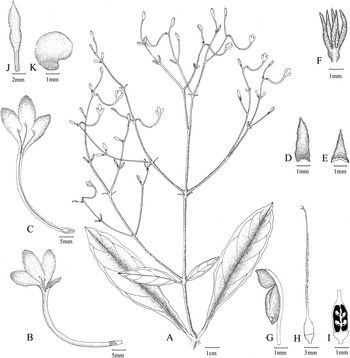
Fig. 1.Rhinacanthus flavovirens Amarasinghe & Wijesundara. A, flowering stem; B, flower; C, flower, longitudinal section, upper lip removed; D, bract; E, bracteole; F, calyx; G, anther; H, gynoecium, style length reduced; I, ovary, longitudinal section; J, capsule; K, seed (illustration: I. Peabotuwage).
 Fig. 2.
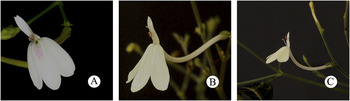
Floral morphology of A, Rhinacanthus nasutus; B, R. polonnaruwensis; C, R. flavovirens. (See online for a colour version of this figure.)
Species nova a ceteris speciebus Rhinacanthi zeylanicis foliis ovoideo-ellipticis ad oblongo-ellipticis, inflorescentia terminali, floribus flavovirentibus, tubo corollae cum curva unica valida instructo 34–37 mm longo, 0.6–1 mm diametro distincta. – Type: Sri Lanka, North Central Province, Anuradapura District, Ritigala, 22 viii 2008, Bandaranaike Memorial Ayurveda Research Institute RU106 (holo PDA).


Perennial herb, 20–80 cm tall. Stems erect, subangular, faintly striate, pubescent. Leaves oval-elliptic to oblong-elliptic, 4.5–11 × 1.5–2.9 cm, base and apex attenuate, leaf blade glabrous, marked with copious cystoliths, secondary veins 4–5 pairs, short hairs on veins, leaf margin broadly sinuate; petiole 3–10 mm long, pubescent. Inflorescence a laxly paniculate terminal thyrse, to 18 cm long; peduncle with gland-tipped hairs. Flowers subsessile, solitary at ends of secondary axes; bracts lanceolate, 2.5–3 mm long, with gland-tipped hairs; bracteoles bristly with pointed hairs. Calyx lobes 5, lanceolate, 3–4 mm long, with gland-tipped hairs. Corolla yellowish green, 44–48 mm long; tube yellowish green, 34–37 mm long, 0.6–1 mm in diameter, strongly curved from the middle upwards, pubescent with downward-pointing hairs with purple base; limb yellowish green; upper lip lanceolate, 6–7.5 mm long, apex acute; lower lip oblong-ovate, 13–15 mm long, lobes 3, apex obtuse, gland-tipped hairs scattered. Stamens 2, inserted near the corolla tube apex, with filaments 6–7 mm long; anther thecae oblique, 2-celled, upper cell 1–1.2 mm long, lower cell 1.7–2 mm long, basally acute. Ovary oblong, 2 mm long, glabrous; style filiform, 36–39 mm long; stigma bifid, 1 mm long. Capsule 11–13 mm long, with a long solid base, loculicidally dehiscent, pubescent with gland-tipped hairs. Seeds orbicular, 2.5–3 mm in diameter, held up on retinacula, black, papillose. Flowering July–December.
Distribution. North Central, Central and Southern provinces of Sri Lanka.
Ecology. Under shade of trees, close to watercourses in secondary forests of dry lowlands.
Etymology. The specific epithet flavovirens alludes to the yellowish-green flowers.
Additional specimens examined. Sri Lanka.North Central Province: Anuradapura district, Habarana, 15 v 2006, Bandaranaike Memorial Ayurveda Research Institute (BMARI) RU097 (PDA); Kekirawa, roadside, 26 vi 2006, BMARI RU112 (PDA); Polonnaruwa district, Polonnaruwa, shade of small trees not far from the statue of King Parakrama, 14 iii 1973, Townsend 73/224 (PDA); Polonnaruwa, archaeological ruins, 30 v 1971, Kostermanns 24319 (PDA). Central Province: Matale district, Kumarakanda, 30 ix 2007, BMARI RU118 (PDA); Haragama, Milapalya, Amaratunga 885 (PDA). Western Province: Gampaha district, Yakkala, Wichramaarachchi Ayurveda Institute, medicinal garden, 20 xii 2008, Amarasinghe RU098 (PDA). Southern Province: Hambantota district, Kataragama, mouth of Manik river, secondary forest, 8 i 2009, Manchanayake RU010 (PDA); Yala Road, Palatupana, Ruhuna National Park, 25 iii 1970, Cooray 70032515R (PDA); Matale district, Menikdena Arboretum and Archaeological Reserve, 4 i 1995, Jayasuriya 9006 (PDA).
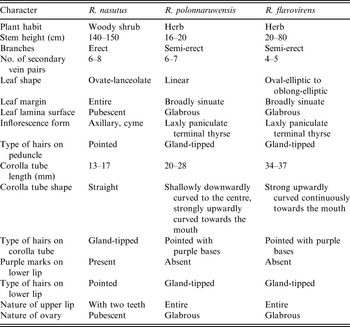
Diagnostic features and affinities. In the account of Rhinacanthus for Sri Lanka by Cramer (Reference Cramer, Dassanayake and Clayton1998) many of the specimens now included in this species were included in R. nasutus, without any note on the variation. However, morphometric analysis of the genus Rhinacanthus in Sri Lanka resulted in four distinct morphological variations, belonging to R. nasutus, R. flavovirens and two groups for R. polonnaruwensis, corresponding to material from the wet and dry zones. Rhinacanthus polonnaruwensis from the wet zone has a less hairy stem, shorter leaves, longer internodes, smaller panicles and larger capsules than the dry-zone specimens and they are perhaps ecological subspecies. These morphological differences, which may simply be ecological adaptations, are not significant enough to place them in separate taxa. The morphological characters of the three species of Rhinacanthus in Sri Lanka are shown in Fig. 2A–C and compared in Table 1.
The principal differences between the three Rhinacanthus species in Sri Lanka

Rhinacanthus flavovirens is morphologically most similar to Rhinacanthus dichotomus (Lindau) I.Darbysh. var. emaculatus I.Darbysh. from coastal Kenya and Tanzania (Darbyshire & Harris, Reference Darbyshire and Harris2005). However, Rhinacanthus flavovirens differs from that species in being more slender with a yellowish-green corolla (vs. pink to red) and a single upcurved corolla tube (vs. sinuous curvature). Further, Rhinacanthus flavovirens appears close to R. rottlerianus Nees (Justicia rottleriana Wallich Cat. no. 2477, K-W) which was placed in synonymy of R. nasutus by Clarke (Reference Clarke and Hooker1897). They differ, however, in that Rhinacanthus rottlerianus has smaller, subsessile leaves with obtuse or narrowly acute apices, three secondary vein pairs, subentire leaf margins, fewer-branched, dichotomous panicles, and shorter calyx lobes.
Key to the Sri Lankan species of Rhinacanthus
1a. Herb; leaves glabrous, margin broadly sinuate; inflorescence terminal; corolla tube curved, upper corolla lip entire, lower lip without purple marks 2
1b. Woody shrub; leaves pubescent, margin entire; inflorescence axillary; corolla tube straight, upper corolla lip of two teeth, lower lip with purple marks R. nasutus
2a. Leaves linear; corolla tube sinuous R. polonnaruwensis
2b. Leaves oval-elliptic to oblong-elliptic; corolla tube curved but not sinuous R. flavovirens
Acknowledgements
The authors thank the staff of the National Herbarium, Sri Lanka for facilities and co-operation; Bandaranaike Memorial Ayurveda Research Institute, Sri Lanka for supplying plants from several locations; Mr I. Peabotuwage, for producing the illustrations; Prof. Gunapala Amarasinghe, Institute of Indigenous Medicine, University of Colombo and Dr R. H. G. Ranil, Faculty of Agriculture, University of Peradeniya for advice and support; Dr I. Darbyshire, Royal Botanic Gardens, Kew for comments on the manuscript and providing a scanned image of Rhinacanthus rottlerianus; and an anonymous reviewer for the Latin diagnosis.