INTRODUCTION
The question of human-environmental interactions in island ecosystems is important for understanding both cultural and ecological history. By virtue of their geography and history, the Aleutian Islands serve as model for observing human maritime adaptation to and interactions with the environment.
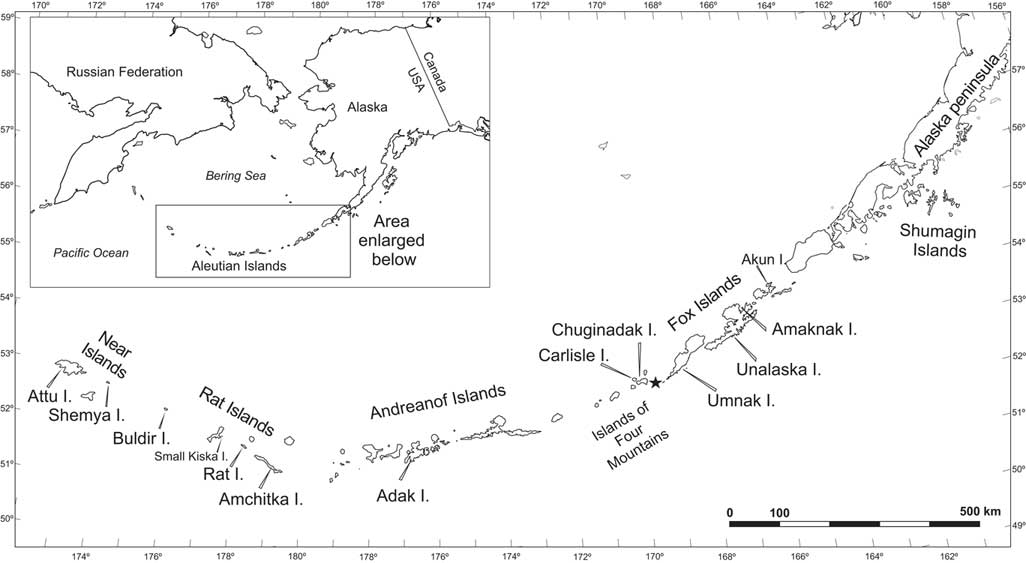
The Aleutian Islands are one of the most isolated geographic areas in the North Pacific, extending 1800 km between North America and Asia and separating the northern Pacific Ocean from the Bering Sea (Fig. 1). Volcanic in origin, the archipelago is comprised of more than 200 islands divided into six groups separated by ocean passages. The mixing Pacific and Bering Sea currents make highly productive ecosystems with decreasing productivity from east to west (Hunt and Stabeno, Reference Hunt and Stabeno2005; Mordy et al., Reference Mordy, Stabeno, Ladd, Zeeman, Wisegarver, Salo and Hunt2005). Each island differs in size, shape, and extent of coastal habitats, and thus differs as to resource abundance available to indigenous people. This unique maritime environment was pivotal to the adaptations and survival of the Aleuts, the prehistoric peoples who settled the archipelago. Due to the lack of terrestrial fauna on islands west of Samalga Pass, coastal resources were critically important to prehistoric Aleuts. Local inhabitants intensively exploited shellfish, fish, birds, and mammals, especially in nearshore environments during the last 9000 yr (e.g., Knecht and Davis, Reference Knecht and Davis2001). Herein, we use economic systems analysis, which is an important method for studying subsistence system in hunter-gatherer societies. Aleutian maritime hunter-gatherers lived in permanent or semi-permanent settlements for thousands of years. Discarded bones, shellfish remains, other domestic waste, and cultural artifacts formed “kitchen middens” near Aleuts dwellings. Analysis of materials within these middens can provide a detailed proxy of the resource utilization by ancient hunters as well as dynamics of the faunal community over thousands of years.
The Aleutian Islands map showing locations of major island groups and islands mentioned in the text. *, Samalga Pass.

For the Aleutians, McCartney (Reference McCartney1977) suggested that the suitability for human occupation was based on each island’s relative productivity, and thus small islands with regular coastlines were less preferable for settlement than islands with protective bays. In the Aleutians, the ocean-land interface is the most productive environment: the longer and more complex the coastline, the richer the resource base. Corbett (Reference Corbett1991) modeled Near Island Aleut catchments as half circles, oriented toward the sea, which we can apply to all Aleutian hunter-gatherer subsistence systems. The smallest catchment circle extended out in a 1-km radius, which incorporates reefs, beaches, streams, inshore waters, and a variety of terrestrial habitats that provide shellfish, fish, shore and land birds, and plants. Presumably, this was the most intensively exploited zone (Corbett, Reference Corbett1991). The second catchment circle extends out in a 3 to 4-km radius, which, for the sample sites, added waterfowl, cliff and colony nesting birds, marine fish, seals, pelagic birds, and sea mammals to the site’s resource inventory. Resources within this circle would have been accessible to people on foot traveling inland or along the beaches. The catchment also includes inshore kayaks or baidarkas (iqyax) fishing trips. Beyond these two catchments, resources were collected within 10 to 15 km of the sites. For these distances and resources, boats would have been necessary for efficient exploitation and transportation (Corbett, Reference Corbett1991). Resources in this circle included sea lions, pelagic fish, and birds such as albatrosses. The largest catchment circle encompasses long-range hunting expeditions using iqyax. Use of this zone might have been relatively rare.
Procurement system studies have a long history in Aleutian research, conducted on sites across the island chain (e.g., Yesner, Reference Yesner1977; Crockford et al., Reference Crockford, Frederick, Wigen and McKechnie2004; Corbett et al., Reference Corbett, West and Lefèvre2010). However, resource utilization in the Islands of Four Mountains (IFM) are unknown. The IFM is a group of comparatively small islands separated from the larger Umnak Island by Samalga Pass (Fig. 1). Collectively, their small size should limit ecosystem diversity, because shorter shorelines, fewer reefs, and smaller inland areas limit foraging possibilities.
Subsistence strategies are the methods through which social groups procure food resources and are shaped by diverse cultural and ecological factors (Binford, Reference Binford1980). Various models have been used to understand human subsistence strategies; these include niche breadth, optimal foraging theory, and prey choice (e.g., Jones, Reference Jones2004; Loponte and Acosta, Reference Loponte and Acosta2004). Changes in niche breadth might indicate either cultural or environmental change (e.g., Darwent, Reference Darwent2004) and, in different environments, the widening or narrowing of niche breadth can be interpreted in different ways (e.g., Jones, Reference Jones2004). Niche breadth facilitates discussing food habits in terms of the variety of animals used in the site (diversity) and the evenness (equitability) with which those species were used. Zooarchaeologists have long used measures of evenness, which quantify the degree to which classes within an assemblage are equally represented by the individuals within that assemblage (Wing, Reference Wing1963; Grayson, Reference Grayson1981). To measure niche breadth of IFM hunter-gatherers and to compare it with other Aleutian Islands, we use a measure of dominance to understand human subsistence in terms of generalist and specialist strategies. Decreasing dominance indicates either increasing niche/dietary breadth or decreasing availability of preferred prey types. On the other hand, increasing dominance indicates a narrowing of niche/dietary breadth due to resource constraints or an increase in the availability of preferred types of production. We suggest that, in the Aleutians, larger islands and islands with complex coastlines would have diverse environments providing more choices for foragers, allowing them to focus on the highly productive resources and ignoring less productive ones. In this case the width of the niche will be relatively narrow. In contrast, smaller islands offered low resource diversity and limited foraging options; as a result, the width of the niche would be wide.
We also want to understand the influence of human predation on local fauna in island contexts. The best-known example of the impact of human hunting on Aleutian fauna is the exploitation of sea otters in prehistoric and historic times (Konar, Reference Konar2000; Corbett et al., Reference Corbett, Causey, Clementz, Koch, Doroff, Lefèvre and West2008). Much less information exists regarding bird and fish populations. Some suggest that hunting practices of the early Aleuts had no demonstrable impact on the seabird community in the Aleutian Islands (Causey et al., Reference Causey, Corbett, Lefèvre, West, Savinetsky, Kiseleva and Khassanov2005). While some changes have taken place, they are not consistent with long-term effects associated with local extirpation by overhunting, selective harvesting, or habitat perturbation. On Shemya Island, however, Savinetsky et al. (Reference Savinetsky, Khassanov, West, Kiseleva and Krylovich2014) suggest there was a dramatic impact on bird colonies following human colonization.
One of the goals of the interdisciplinary project “Geological Hazards, Climate Change, and Human/Ecosystems Resilience in the Islands of the Four Mountains” was to study the history of environment and human interactions in the eastern Aleutians. In this paper, we describe the zooarchaeological record from two sites on neighboring islands, located within a 10-km stretch of each other and spanning approximately 3000 yr. Fauna collected during archaeological excavations provide valuable information about ancient Aleut lifeways and adaptations in the IFM environment and Aleut impact on the local biota.
MATERIAL AND METHODS
Site descriptions
To understand the natural world within a cultural context, we studied zooarchaeological materials from four cultural deposits on Chuginadak and Carlisle Islands in the IFM (Fig. 1).
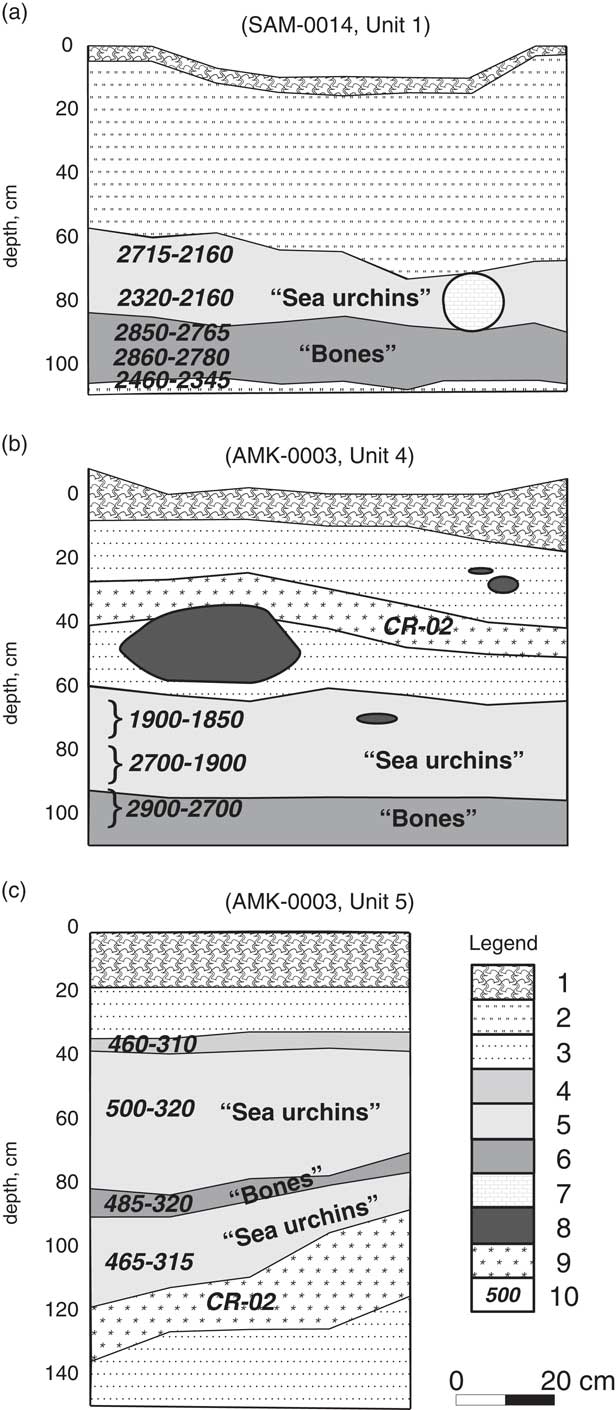
The first (SAM-0014, Unit 1) is located on the north coast of Chuginadak I and contained natural and cultural layers affiliated with the prehistoric Aleut village Tana Aguna. The Tana Aguna village site is situated on a high cliff above a small cove (Hatfield et al., Reference Hatfield, Bruner, West, Savinetsky, Krylovich, Khasanov and Vasyukov2016). Unit 1 was excavated in a partially eroded house pit located on the edge of a steep bluff. The excavated area measured 0.5×1.5 m. At approximately 60–70 cm below ground surface, shell midden layers appeared (Fig. 2a). Using stratigraphy, we divided the excavated deposit into two parts: (1) midden containing numerous sea urchin, fish, and bird remains; and (2) midden composed of fish bones, a small amount of sea urchin, and silt.
Schematic profiles of: (A) Tana Aguna (SAM-0014) Unit 1; (B) Ulyagan site (AMK-0003) Unit 4; (C) Ulyagan (AMK-0003) Unit 5. Common legend for all units: 1, sod; 2, sterile layers; 3, cultural layer without faunal remains; 4, cultural layer with poorly preserved bones; 5, cultural layer with high sea urchin shell content, “Sea urchins”; 6, cultural layer with low sea urchins shell content, “Bones”; 7, bone; 8, stone; 9, tephra CR-02; 10, dates (cal yr BP).

Three other investigated midden deposits (AMK-0003, Units 2, 4, and 5) are associated with the Ulyagan site (AMK-0003), an ancient village located on the steep southeast coast of Carlisle Island. Units 1 and 3 from the Ulyagan site did not contain faunal remains and are described elsewhere (Hatfield et al., Reference Hatfield, Bruner, West, Savinetsky, Krylovich, Khasanov and Vasyukov2016).
The Ulyagan Unit 4 excavation area measured 1.5×0.5 m and was located on the western side of a steep ravine dividing the Ulyagan site. Evidence of cultural activity lay just below the sod, but a deposit containing midden and well-preserved organic material (sea urchins, shells, and bones of vertebrates) was located 60–90 cm below ground surface (Fig. 2b). Between 90 cm and 105 cm, a dark cultural layer contained few bones and invertebrate remains. Still deeper, at a depth of around 105 cm, faunal remains gradually disappeared.
The Ulyagan Unit 5 excavation was located on the east side of a ravine that divides the Ulyagan settlement area. We discovered a midden on a small terrace situated on the edge of a coastal cliff. The excavated area measured 1×0.5 m and 115 cm in depth. A cultural lens, dense with bones and sea urchin shells, lay below a thick sod layer (Fig. 2c). We divided the deposit into three parts: the upper layer was a dense faunal component; the middle layer was dark brown with low concentrations of faunal remains; and the lower layer contained numerous faunal remains. The CR-02 tephra complex dated 1050 cal BP (Okuno et al., Reference Okuno, Izbekov, Nicolaysen, Nakamura, Savinetsky, Vasyukov and Krylovich2017) lay beneath this cultural deposit.
Ulyagan site Unit 2 represented a thick midden deposit associated with a longhouse designated House Pit 36 (Hatfield et al., Reference Hatfield, Bruner, West, Savinetsky, Krylovich, Khasanov and Vasyukov2016). The midden contained dense accumulations of faunal remains including discrete lenses of sea urchins along with other cultural artifacts. The Unit 2 excavation measured 1×1 m and 105 cm deep. The shell midden itself was 50 cm thick.
Materials collected during excavations of the Tana Aguna site (SAM-0014) Unit 1 and Ulyagan site (AMK-0003) Units 4 and 5 were water-screened through plastic 1.5-mm mesh. Matrix from the Ulyagan site Unit 2 was screened through 5-mm mesh in the field; for this unit, all vertebrate faunal remains retained in the screens or found directly in the pit were bagged for identification. One quarter of the Unit 2 matrix was water-screened through plastic mesh in order to recover smaller objects, including small fish bones. Then all Unit 2 material was combined.
Radiocarbon dating
In order to accurately radiocarbon date samples from these middens, special attention was paid to the material to be dated. The peculiar characteristic of the carbon cycle in ocean waters ultimately affects the radiocarbon ages of marine organisms (Stuiver and Braziunas, Reference Stuiver and Braziunas1993). Thus, the most trusted dates originate from terrestrial plants and animals. In the treeless Aleutians, firewood was scarce and local people used driftwood for fire, tools, and construction. Radiocarbon dates obtained on driftwood might be subject to “old wood” problems in which dates may originate from (1) heartwood, which can be older than the archaeological layer in which the wood was found, or (2) wood that had a possible time-lag between the tree’s death, use, reuse, and final deposition in an archaeological layer.
According to ethnographic accounts, eastern Aleutian Aleuts used locally growing crowberry (Empetrum nigrum) and other Ericaceous shrubs for fuel (Turner, Reference Turner2008). In the IFM archaeological screened matrix, we recovered charred twigs of local shrubs (Empetraceae/Ericaceae species) and used them for dating. A second source for “terrestrial” dates included remains of animals that lived on land and consumed an exclusively terrestrial diet, which, in the IFM included only two bird species: rock ptarmigan (Lagopus muta) and cackling goose (Branta hutchinsii). The bones of small passerines are not useful for radiocarbon dating because these birds sometimes feed in the littoral zone. A littoral diet leads to the deposition of marine or “old” carbon into their tissues. For radiocarbon dating, we used cackling goose bones from two middens.
The W.M. Keck Carbon Cycle Accelerator Mass Spectrometry Laboratory, University of California, Irvine radiocarbon dated all materials. Conventional 14C ages were calibrated to “calendar” years in OxCal 4.3 program (https://c14.arch.ox.ac.uk/oxcal.html) using calibration curves IntCal13 (Reimer et al., Reference Reimer, Bard, Bayliss, Beck, Blackwell, Ramsey and Buck2013). To construct an age-depth model of cultural deposits that have complex stratigraphy and varying growth, we chose the Bchron 4.2.6 package in R v.3.4.1 (Parnell, Reference Parnell2016; R Core team, 2017). The program output includes assessments of probabilities of true date for each layer.
Faunal identification and quantification
Identification of faunal material from Tana Aguna Unit 1 and from Ulyagan Units 4 and 5 were conducted using the osteological reference collection at the Laboratory of Historical Ecology, Institute of Ecology and Evolution, Russian Academy of Sciences. Crockford (Reference Crockford2016) identified the faunal remains from Ulyagan Unit 2 using the comparative faunal collection at the Zooarchaeology Laboratory, Department of Anthropology, University of Victoria, Canada.
Preservation of faunal remains was good in all units. The vertebrate faunal data was primarily quantified using number of identified specimens (NISP; Lyman, Reference Lyman2008). We did not count unidentifiable fish and bird remains or vertebrae and ribs. Bivalves were quantified using the total number of umbos and barnacles (Cirripedia) using the number of plates (Savinetsky et al., Reference Savinetsky, West, Antipushina, Khassanov, Kiseleva, Krylovich and Pereladov2012). Gastropods were quantified by counting shells when more than half was present (Bird et al., Reference Bird, Richardson, Veth and Barham2002); if fragments were small and broken, we only noted the presence. For sea urchin remains (Strongilocentrotus sp.), we calculated minimum number of individuals (MNI) by counting rotulas or hemipyramids, the most abundant elements of Aristotle’s lanterns. To identify the age of northern fur seal juveniles, we used measurements and equations suggested by Etnier (Reference Etnier2002) or reference collection (Crockford, Reference Crockford2016). We used the Pearson chi-square test (Lyman, Reference Lyman2008) with significance level 0.05 to compare the similarity of different taxa abundance in neighboring layers or periods.
Identifying bones of different species of geese recovered from an archaeological context can be very difficult. In the Aleutian Islands, cackling goose and emperor goose (Anser canagicus) are the most abundant goose species. However, these two species feed differently. Cackling goose exclusively feeds on terrestrial plants in tundra or grass communities (Mowbray et al., Reference Mowbray, Ely, Sedinger and Trost2002). Emperor goose feeds on littoral vegetation or invertebrates as well as on grass and sedges in grassy tundra (Schmutz et al., Reference Schmutz, Petersen and Rockwell2011). Consequently, these two species possess distinctive collagen carbon and nitrogen stable isotope values. In order to reliably identify goose remains, we used stable carbon and nitrogen isotopes analysis because these isotopes reflect animal diet (Gorlova et al., Reference Gorlova, Krylovich, Tiunov, Khasanov, Vasyukov and Savinetsky2015). Collagen extraction was conducted in the Laboratory of Historical Ecology, Institute of Ecology and Evolution, Russian Academy of Sciences, using a modified Longin (Reference Longin1971) method (Gorlova et al., Reference Gorlova, Krylovich, Tiunov, Khasanov, Vasyukov and Savinetsky2015). Stable isotope composition of the bone collagen was determined using a Thermo-Finnigan Delta V Plus continuous flow IRMS coupled with an elemental analyzer (Thermo Flash 1112) in the Joint Usage Center at the Institute of Ecology and Evolution, Russian Academy of Sciences. The isotopic composition of N and C is expressed in the δ-notation relative to the international standard (atmospheric nitrogen or Vienna Pee Dee Belemnite, respectively). Samples were analyzed with reference gas calibrated against International Atomic Energy Agency reference materials USGS 40 and USGS 41 (glutamic acid). The drift was corrected using an internal laboratory standard (acetanilide and casein). The standard deviation of δ13С and δ 15N values in reference materials (n=4–8) was <0.2‰. Nitrogen and carbon contents (as %) and C/N ratio were determined along with isotopic analyses.
Measure of dominance
To estimate the niche breadth of local hunter-gatherers, we used the dominance index which represents a D=1 – Simpson index, where
 $D{\equals} \mathop \sum\limits_i \left( {{{ni} \over n}} \right)^{2} $
, where n
i
is number of individuals of taxon i (Hammer et al., Reference Hammer, Harper and Ryan2001). The Simpson’s Dominance Index is a reciprocal of the evenness index in that a high dominance index reflects “an unevenness” in distribution of the number of individuals among taxa. Ranges are from 0 (all taxa are equally present) to 1 (one taxon dominates the sample completely).
Because of different level of zoological material identification for different purposes, it is difficult to compare assemblages using species level identification. We did not use invertebrates for comparison because quantitative information is available for only a few assemblages. We combined vertebrates into several groups. Fish were combined into sculpins (Cottidae), greenlings (Hexagrammos sp.), Atka mackerel (Pleurogrammos monopterygius), flatfishes (all Pleuronectidae representatives), salmon (Salmonidae family), and others (mainly small-sized fishes, not main fishing objects). Birds were combined into alcids (Alcidae), migrating Procellariiformes (albatrosses and shearwaters), nesting Procellariiformes (fulmars and storm petrels), geese, ducks, cormorants, gulls, and others (eagles, passerines, etc.). Mammals were grouped into true seals (Phocidae), eared seals (Otariidae, sea lion, and fur seal), sea otter, whales, and terrestrial mammals. Data from archaeological sites with identified vertebrates are presented in Supplementary Table 1. For comparisons, we did not use assemblages with less than 50 bones. We divided the islands by size: small, total area is less than 100 km2 (Shemya, Buldir, Rat, Little Kiska, Carlisle, and Chuginadak islands); medium, 100–1000 km2 (Attu, Amchitka, Adak, and Akun islands); and large, more than 1000 km2 (Umnak and Unalaska). For comparison of index values, we used nonparametric Kruskal-Wallis test following Dunn’s multiple comparison test.
RESULTS
Radiocarbon dates and chronology
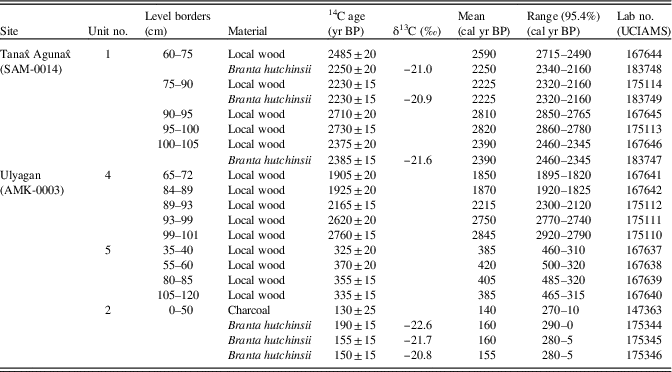
We calculated eight radiocarbon dates from terrestrial organic samples for Unit 1 of the Tana Aguna site (Table 1). Although strata were distinct, dates appear somewhat inverted and the large range of dates suggests human disturbance and the introduction of younger materials into the deposit. In this particular case, we estimate deposit formation between 2800 and 2000 cal yr BP.
Radiocarbon dates from the Islands of Four Mountains cultural layers with faunal material. Calibration curve – IntCal13.

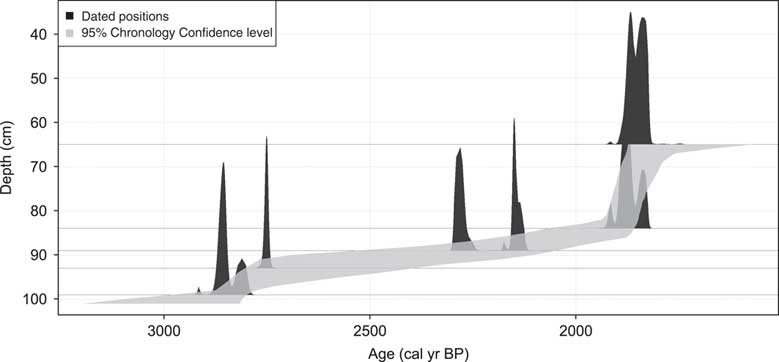
For the Ulyagan Unit 4, we calculated five radiocarbon dates for strata containing fauna (Table 1). We used terrestrial (local) wood for dating. For the most part, dates measure 2850 to 1850 cal yr BP. We divided the time of deposit formation into three periods by applying the age-depth model to date range probabilities (Fig. 3). These three periods are: 2900–2700 cal yr BP (low part of the midden); 2700–1900 cal yr BP (the lower part of the dense sea urchin layer); and 1900–1850 cal yr BP for the rapidly growing upper part of the dense sea urchin layer.
Age-depth model of Ulyagan (AMK-0003) Unit 4.

For Ulyagan Unit 5, we dated terrestrial sources to obtain four radiocarbon dates (Table 1). Radiocarbon dates indicated that this particular midden formed quickly at approximately 400 yr (Fig. 2c). Four radiocarbon dates of terrestrial material indicate that the Ulyagan Unit 2 midden formed approximately 150 cal yr BP (Table 1).
Relying on results of radiocarbon dating, we developed a chronological framework for the zoological material presented here: two middens, one on Chuginadak Island and one on Carlisle Island (Unit 4), accumulated almost simultaneously, although Unit 4 on Carlisle Island started slightly earlier (2900 cal yr BP) and stopped later (1850 cal yr BP); then there is a hiatus in the archaeozoological sequence until 400 cal yr BP, when Ulyagan Unit 5 was formed; finally, Ulyagan Unit 2 midden is deposited during the latest occupation, associated with the Russian era that potentially terminated during the historically documented Aleut Revolt in AD 1764 (Hatfield et al., Reference Hatfield, Bruner, West, Savinetsky, Krylovich, Khasanov and Vasyukov2016). Herein, we present our results by place and time of deposition from oldest to youngest, beginning with Chuginadak Island and then Carlisle Island.
Invertebrates
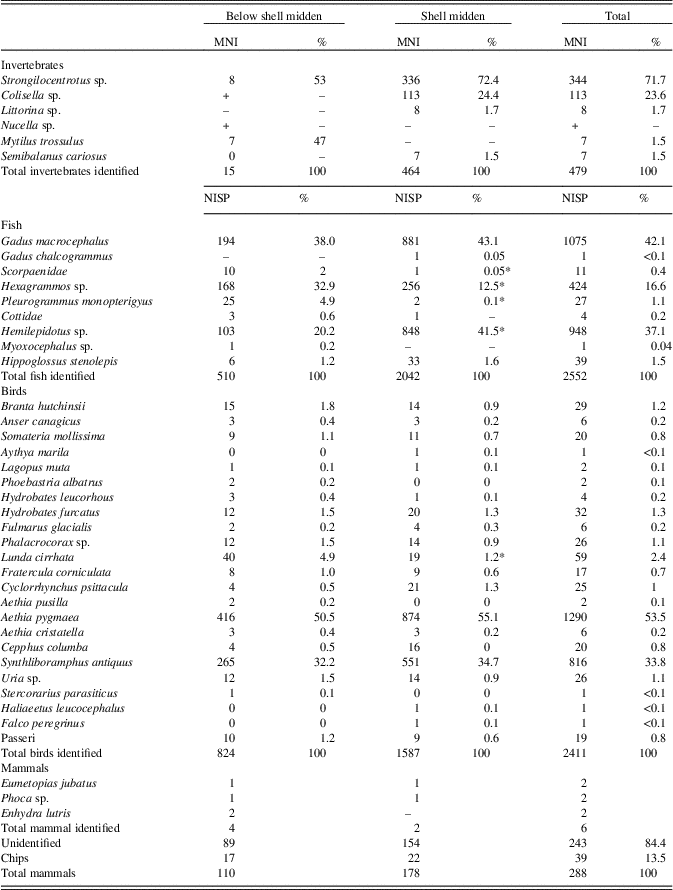
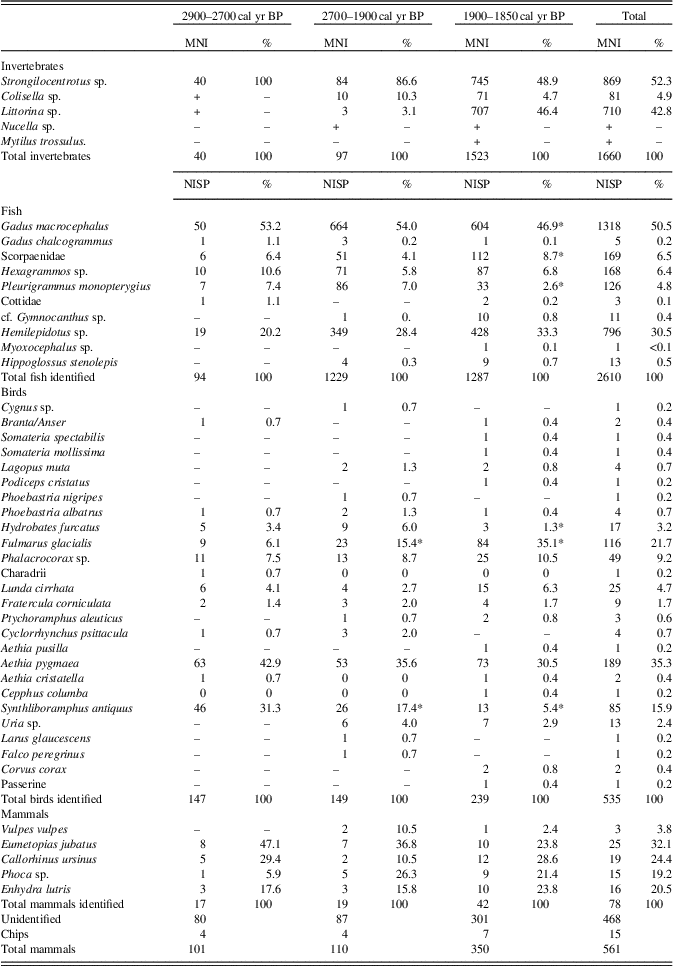
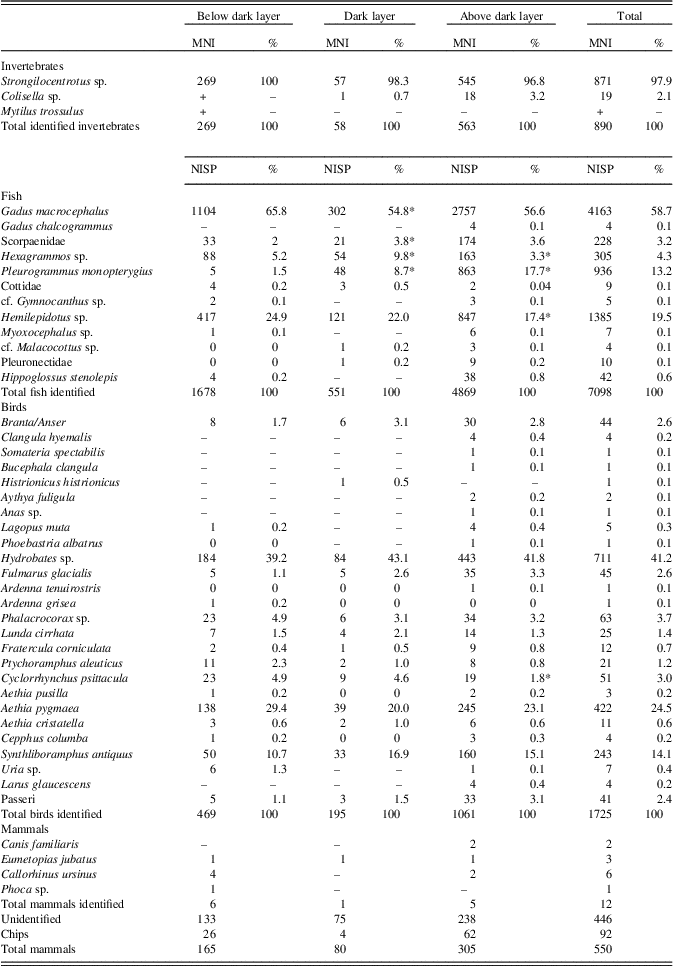
We identified six taxa of invertebrates in the Tana Aguna and Ulyagan deposits: sea urchins (Strongilocentrotus sp.), limpets (Colisella sp.), periwinkles (Littorina sp.), foolish mussels (Mytilus trossulus), and thatched barnacles (Semibalanus cariosus). The overwhelming majority of invertebrate remains in all deposits belong to sea urchins Strongilocentrotus sp. (52–98%; Tables 2–4). Identification of archaeological remains of Strongilocentrotus genus is difficult and requires use of a scanning electron microscope or tomography for accurate species identification. Sea urchin remains from archaeological sites on Adak, Buldir, and Shemya islands were identified as S. polyacanthus (Antipushina and Pakhnevich, Reference Antipushina and Pakhnevich2010). This species is common in the littoral zone of Amchitka Island (O’Clair, Reference O’Clair1977), but is difficult to distinguish from S. droebachiensis (Ebert et al., Reference Ebert, Barr, Bodkin, Burcham, Bureau, Carson and Caruso2018).
Faunal remains from Tana Aguna, (SAM-0014) Unit 1. *, difference with previous layer is significant (Pearson chi-square test, P < 0.05).

Faunal remains from Ulyagan (AMK-0003) Unit 4. *, difference with previous layer is significant (Pearson chi-square test, P < 0.05); +, fragments are present.

Faunal remains from Ulyagan (AMK-0003) Unit 5. *, difference with previous layer is significant (Pearson chi-square test, P <0.05); +, fragments are present.

In the Tana Aguna site deposit, limpet remains represented the second most abundant invertebrate (23.6%). In Ulyagan Unit 4, periwinkles represented up to 42.8% (MNI=710) of invertebrates. In the layers formed between 1900–1850 cal yr BP of Unit 4, lenses of Littorina sp. shells represent a majority of specimens identified.
The excavation methodology used for Ulyagan Unit 2 did not allow comparable collection of invertebrate remains, we only noted the presence of urchins and limpet fragments. The concentration of urchins was lower in this unit compared to other deposits.
We observe invertebrate remains in all deposits, but taxa diversity is very low. The most diverse composition occurred in the older deposits noted at both Tana Aguna and Ulyagan Unit 4.
Fish
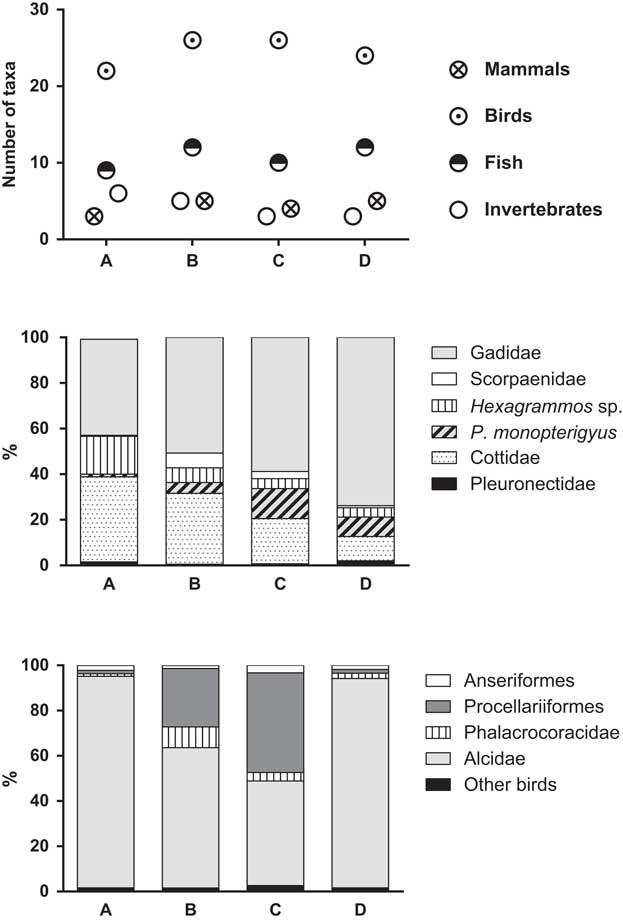
The IFM assemblages had comparable number of fish taxa: nine from Tana Aguna; 10 from Ulyagan Unit 4; and 12 each from Ulyagan Units 5 and 2 (Tables 2–5; Fig. 4). Pacific cod (Gadus macrocephalus) dominated all assemblages (ranging from 42.1 to 74% of total fish NISP; Fig. 4). Irish lord (Hemilepidotus sp.) represents the second most abundant taxon in all units. Greenlings (Hexagrammos sp.) and Atka mackerel (Pleurogrammus monopterigyus) are a common hexagrammid species in Aleutian assemblages including in the IFM. Unidentifiable representatives of the Cottidae and Scorpaenidae families comprised small portion in all units, as did halibut (Hippoglossus stenolepis) and unidentifiable flatfish bones. Only a few bones of Alaska pollock (Gadus chalcogrammus) were identified. In all assemblages, evidence of fish butchering activity (cut marks) was noted, predominantly on Pacific cod bones (Supplementary Table 2).
Number of identified taxa (top), composition of fish (middle), and birds (bottom) in studied units from Islands of Four Mountains region: (A) Tana Aguna (SAM-0014) Unit 1; (B) Ulyagan (AMK-0003) Unit 4; (C) Ulyagan (AMK-0003) Unit 5; and (D) Ulyagan (AMK-0003) Unit 2.

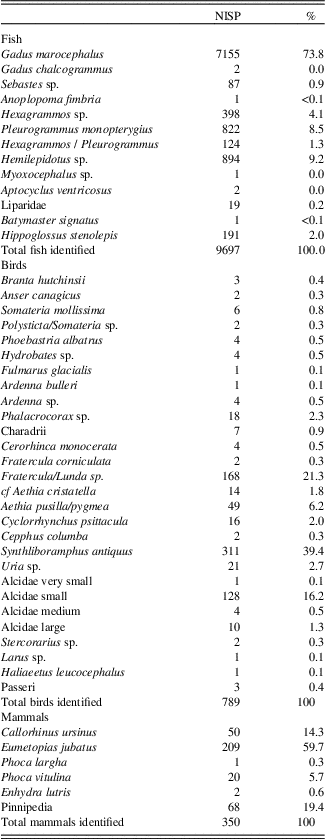
Faunal remains from Ulyagan (AMK-0003) Unit 2 (from Crockford, Reference Crockford2016).

Birds
In total, we found 39 bird taxa in all four units (Tables 2–5). Alcidae, in general, was the most commonly occurring family; whiskered auklet (Aethia pygmaea), ancient murrelet (Synthliboramphus antiquus), and puffins (Fratercula/Lunda sp.) were by far the most common species. At Tana Aguna and Ulyagan Unit 2, alcid remains comprise more than 90% of identified bird bones. But in Ulyagan Units 4 and 5, a significant number of fulmar and storm-petrel bones were identified. In Unit 4, northern fulmar (Fulmarus glacialis, 21.7%) followed alcids in abundance. In Unit 5, storm petrels (Hydrobates sp.) were most abundant (41.2%) among avian bones. Bones of juveniles were very abundant, comprising 67% of fulmar (Unit 4) and 31.5% of storm-petrel (Unit 5) remains (Supplementary Table 3). Other bird groups like ducks and geese, cormorants, gulls, and passerines comprise very small percentages (Tables 2–5).
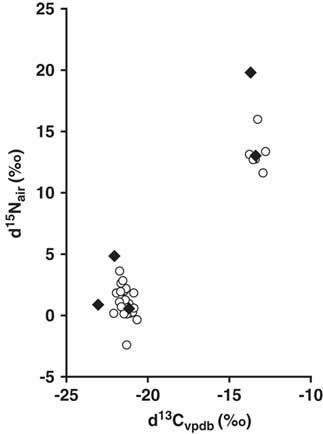
To differentiate bones of the two most common geese species, we conducted stable carbon and nitrogen isotope analyses of geese bones from Tana Aguna and Ulyagan Unit 2. In both units, we found two distinct groups of geese (Fig. 5). At Tana Aguna, we identified six bones of adult emperor goose (mean±SD, δ13C=−13.2±0.4‰, δ15N=+13.4±1.6‰) and 29 bones of cackling goose (δ13C=−21.4±0.3‰, δ15N=+1.1±1.2‰). From Ulyagan Unit 2, three bones of cackling goose (δ13C=−22.1±1‰, δ15N=+2.1±2.4‰) and two bones of emperor goose (δ13C=−13.5±0.2‰, δ15N=+16.4±4.8‰) were analyzed. C/N ratio for all analyzed bones was within the range of well-preserved collagen (DeNiro, Reference DeNiro1985)
Nitrogen stable isotope composition (δ15N) of geese remains from two Islands of Four Mountains excavated units. Open circles, Tana Aguna (SAM-0014) Unit 1; black diamonds, Ulyagan (AMK-0003) Unit 2.

In addition to juvenile fulmar and storm-petrel bones, juvenile bones of whiskered auklet, ancient murrelet, and other species were recovered (Supplementary Table 3). At Ulyagan Unit 5, we found medullary bones of whiskered auklet (N=2) and parakeet auklet (Cyclorrhynchus psittacula, N=1).
In all assemblages, we found bird-butchering and skinning activity. In the Tana Aguna site deposit, tibiotarsus bones of both whiskered auklets and ancient murrelet have cut marks (Supplementary Table 5). A total of 85.4% of the ancient murrelet tibiotarsi (41 of 48) and 14.8% of whiskered auklet tibiotarsi (13 of 88) exhibited cut marks near the distal ends. We also identified stages of tool manufacture on some bones from different units (Supplementary Table 6).
Mammals
Mammals comprise the smallest percentage of zooarchaeological material from all studied units (Tables 2–4), with only Ulyagan Unit 2 mammal bones representing a significant proportion (Table 5). We identified all major sea mammals typical of Aleutian archaeological sites except whales; one whale bone was found during excavation in Unit 1 of Tana Aguna (Fig. 2a).
Sea lion (Eumetopias jubatus) remains were most numerous in Units 4 and 2 of Ulyagan, especially in Unit 2 (52%). We found bones of all age classes, including juveniles less than one yr old (Supplementary Table 4). Northern fur seal (Callorhinus ursinus) was represented in all units of Ulyagan, where there are bones of adults, subadults, and juveniles, but not juveniles younger than four months (Supplementary Table 4). We found one very small and porous scapula fragment from Ulyagan Unit 4 that probably represented a fur seal fetus. True seal (Phoca sp.) are represented by adults and subadults remains, as well as sea otter (Enhydra lutris).
We found the bones of Canidae family in two units, which is unusual for the Aleutian zooarchaeological record. From Ulyagan Unit 4, we identified three bones of red fox (Vulpes vulpes) in the assemblage (Table 3) and, based on epiphyseal fusion (Harris, Reference Harris1978), a left distal tibia and a left astragalus represented a six-month-old individual and one unfused ulna fragment with cut marks on the distal end represented a four-month-old fox (Vasyukov et al., Reference Vasyukov, Krylovich, West, Hatfield and Savinetsky2018). From Ulyagan Unit 5, we identified two Canidae teeth, which compared favorably with domestic dog (Canis familiaris). We also collected the humerus of a subadult dog from midden layers exposed in the bluff near Unit 5 (for detailed description, see Vasyukov et al., Reference Vasyukov, Krylovich, West, Hatfield and Savinetsky2018).
Cut marks, indicating butchering and skin processing, occurred on bones of all sea mammal species in all IFM assemblages (Supplementary Table 5). We recovered a large quantity of large and small unidentifiable pieces of chopped and shaved sea mammal bone, representing manufacturing waste (Supplementary Table 6).
IFM intersite comparison
The number of identified faunal taxa from excavated units is almost equal in all units. The most diverse groups are birds and fish (Fig. 4). Mammals and invertebrates are represented by only a few species. In spite of comparable taxa numbers, the proportion of different groups in the studied units is different.
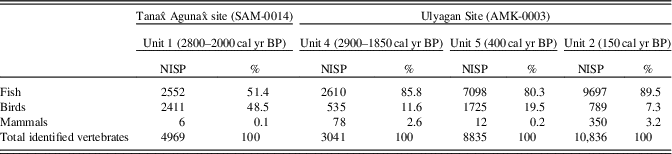
In the Tana Aguna midden, percentages of fish and bird bones are similar, 51.4 and 48.5%, respectively (Table 6). This situation is uncommon for the Aleutian Islands, where fish remains are frequently the most abundant in middens and comprise from 60 to 90% of vertebrates remains (Lefèvre et al., Reference Lefèvre, Corbett, Crockford, Czederpiltz, Partlow and West2010, Reference Lefèvre, West and Corbett2011; Crockford, Reference Crockford2012). In the Ulyagan middens, fish bones were always more abundant (from 80.3 to 89.5% of identified vertebrate bones) and bird bones are much less frequent (from 7.3 to 19.5%). Mammal bones are always rare, especially in the Tana Aguna midden; however, in the youngest deposit, Ulyagan Unit 2, mammal bone percentages are higher compared to the other IFM middens (Table 6).
Relative abundance of vertebrate groups from Islands of Four Mountains sites.

The proportion of fish and bird taxa also differs. Tana Aguna midden Pacific cod bones are nearly equal to numbers of medium- and small-sized fish like Irish lord and greenling (Fig. 4). At synchronous Ulyagan Unit 4, small-sized fish are abundant as well, with fewer greenling and the addition of rockfish and Atka mackerel. In the younger Ulyagan Unit 5, there is a high proportion of cod, as well as Atka mackerel and a higher percentage of butchered cod bones compared to other units. The proportion of cod bones is the highest in the youngest midden, Ulyagan Unit 2, whereas this unit contains the fewest small fish. We identified significant numbers of greenling bones from the Tana Aguna midden, but in the Ulyagan middens, greenling bones comprise only 10% of the assemblage. Most species of Hexagrammos are associated with kelp beds in nearshore sublittoral or littoral zones (Mecklenburg et al., Reference Mecklenburg, Mecklenburg and Thorsteinson2002). Shallow coves near Tana Aguna were probably better for greenling fishing than the sublittoral zone near Ulyagan. In our analyses, Irish lord remains were significantly more abundant in the oldest excavated layers on both islands and less abundant in the younger units at Ulyagan.
Interestingly, the bird composition (Fig. 4) in both the Tana Aguna and Ulyagan Unit 4 deposits, which formed almost at the same time, are different. Ulyagan settlers procured many northern fulmars, including juveniles, whereas at Tana Aguna, situated 10 km from Ulyagan, settlers procure ancient murrelets and whiskered auklets in mass, but not fulmars. The younger Ulyagan Unit 5 Aleuts obtained large quantities of storm petrels, both adults and juveniles, and the youngest Ulyagan Unit 2 midden is comprised predominantly of small alcids and puffins. The small colonial birds, such as whiskered auklet, ancient murrelet, and storm petrels, were the most abundant bird species in all IFM middens.
For mammals, we note that mammal bones are most frequent at Ulyagan Unit 2 and are comprised mostly of sea lion remains.
Dominance indexes
To estimate niche breadth of IFM hunter-gatherers and to compare it within Aleutian Islands, we use a measure of dominance indexes.
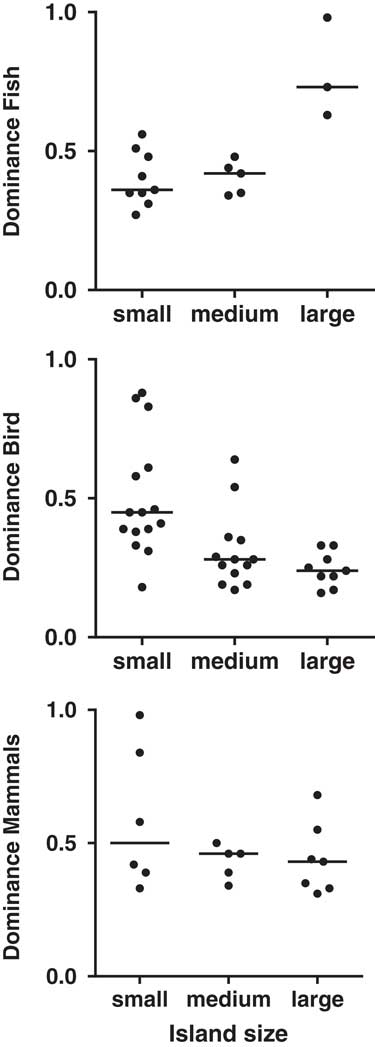
Indexes of fish are very similar among small and medium islands but differ for large islands (Fig. 6). For three sites located on large islands, all from the Fox Islands, dominance indexes are higher because Pacific cod remains dominate and differ significantly from small island indexes (Kruskal-Wallis test, P=0.0184). The index shows that the width of the niche on the large islands is narrower than that of small and medium islands. Inhabitants of large islands were focused on Pacific cod fishing; on medium and small islands, Aleuts obtained a variety of fish. Average dominance indexes for small island bird groups are significantly higher than for medium and large islands (Kruskal-Wallis test, P=0.0006). At the same time, indexes for five small island sites (Shemya, Buldir, Chuginadak, and Carlisle Island-Unit 2) are the most variable, with values more than 0.5. The most homogeneous values are within groups of medium and large islands. Within medium islands, two sites from Adak Island show high values. For the rest, medium and large islands are very similar. In all cases with high dominance index, alcids dominate the bird remains and we can interpret high indexes as narrow niche breadth and focused usage of specific bird resources. There are few sites with sufficient mammal bones for comparisons. Mammal indexes are the highest for two sites: Shemya Island, where eared seals dominate, and from Ulyagan Unit 2, where sea lions dominate. There is no clear association with island size (Kruskal-Wallis test, P=0.625).
Dominance indexes of fish (top), bird (middle), and mammal (bottom) groups from archaeological middens for small, medium, and large Aleutian Islands. Horizontal line, median.

DISCUSSION
Resource use
Combined, the four IFM faunal assemblages characterize the IFM Aleut interaction with local fauna during the last 3000 yr. The remains of resources from the two smaller catchment circles dominate these assemblages. Our data suggests that IFM sites were occupied year-round. In the spring and early summer, IFM occupants harvested nesting birds and their chicks, fished for Pacific cod, and hunted juvenile sea lions. During the late summer and fall, they harvested Atka mackerel and young fur seal. Winter occupation is more difficult to determine because resource availability was sparse. Famine was common at the end of the winter and beginning of the spring (Veniaminov, Reference Veniaminov1984; Unger, Reference Unger2014). In at least two middens, we recovered the remains of emperor goose, a species that only winters in the Aleutian Islands, appearing between October and April (Gibson and Byrd, Reference Gibson and Byrd2007). King eider, long-tailed duck, and common goldeneye also winter in the Aleutians from autumn to the end of spring (Gibson and Byrd, Reference Gibson and Byrd2007). According to Veltre and Veltre (Reference Veltre and Veltre1983), Atka Aleuts obtained ducks and geese from October to April. Finally, according to ethnographic data from Veniaminov (Reference Veniaminov1984), there were several permanent settlements on Chuganadak and Carlisle islands at the time of contact with Russian explorers and fur hunters although, subsequently, these people were exterminated by Glotov at the request of the Umnak Aleuts (Veniaminov, Reference Veniaminov1984).
We found few remains of animals, like sea lions or halibut, from the largest catchment circle, like sea lions or halibut. In the youngest IFM deposit (Ulyagan Unit 2), which formed during Russian contact, we found comparatively large quantities of sea lion bones. Overall, mammal samples were small, however, and it is interesting to note that all the major mammalian species (Steller sea lion, fur seal, harbor seal, and sea otter) were represented in the limited numbers at all sites. Only whales and dolphin remains, common in sites in the eastern and western Aleutians (Davis, Reference Davis2001; Knecht and Davis, Reference Knecht and Davis2003; Crockford et al., Reference Crockford, Frederick, Wigen and McKechnie2004; Lefèvre et al., Reference Lefèvre, Corbett, Crockford, Czederpiltz, Partlow and West2010), were not found. Only one unidentified whale bone was found in the pit wall of Tana Aguna. The remains of albatross are scarce, as well.
There are two possibilities for the scarcity (especially mammal scarcity) of resources from the largest catchment circle. This scarcity may be sampling error due to small excavation areas. In many cases, Aleutian sites with small excavation volumes reveal small amounts of mammal bones (for example, on Shemya, Rat, and Adak islands; Supplementary Table 1). In contrast, large excavation volumes, like on Unalaska Island, yield thousands of mammalian bones (Davis, Reference Davis2001; Knecht and Davis, Reference Knecht and Davis2003; Crockford et al., Reference Crockford, Frederick, Wigen and McKechnie2004). The second possible reason is that butchering patterns occur away from settlement sites, which is common for large animals, often butchered in special places with only select skeletal elements transported to the settlement (e.g., Grayson, Reference Grayson1984). This also would explain the scarcity of halibut in IFM deposits. The large quantity of mammal bone chunks and pieces, the byproduct of toolmaking, indicate mammal bones were actively used in tool manufacture.
The remains of prey harvested in the smallest catchment circle are much more abundant than resources from the largest catchment circle. In the IFM middens, these include the remains of invertebrates and some fish. In all IFM middens, invertebrate diversity is very low and dominated by sea urchins. We observed that the modern littoral zone around Chuginadak and Carlisle islands exhibits poor invertebrate diversity. During the 2014 and 2015 field seasons, we paid special attention to the current littoral zone invertebrates and found only sea urchins, several species of limpets, and periwinkles. We suggest that the current topography, narrow shelves possessing precipitous coastlines and high-energy habitats, must resemble the IFM topography of past littoral zones that supported these same invertebrate types. The absence of sandy bottoms near the studied sites today explains the total absence in the archaeological record of infaunal shellfish species like burrowing bivalves. Although the IFM littoral zone lacks species diversity, sea urchin and limpet are frequent. During low tide, we observed large numbers of sea urchins. A comparable invertebrate composition is represented on Buldir Island, where invertebrate remains were sparse and included sea urchins, foolish mussel, and periwinkle (West et al., Reference West, Antipushina, Savinetsky and Krylovich2012). Much of the Buldir Island coastline is precipitous and the littoral zone near the excavated Aleut settlement represents a high-energy environment lacking rocks that serve as holdfasts. The same observation was made for Kuril Island middens on more oceanic, small islands where poor littoral zones included large proportions of sea urchins and periwinkle (Fitzhugh et al., Reference Fitzhugh, Moore, Lockwood and Boone2004). In middens from islands with rich littoral zones (Amaknak, Adak, Amchitka, Shemya, and Agattu), invertebrate diversity was much higher (Spaulding, Reference Spaulding1962; Desautels et al., Reference Desautels, McCurdy, Flynn and Ellis1971; Knecht and Davis, Reference Knecht and Davis2003; Lefèvre et al., Reference Lefèvre, Corbett, Crockford, Czederpiltz, Partlow and West2010; Savinetsky et al., Reference Savinetsky, West, Antipushina, Khassanov, Kiseleva, Krylovich and Pereladov2012; West et al., Reference West, Antipushina, Savinetsky and Krylovich2012).
The archaeological and ethnographic records reveal that Aleuts used all available shellfish resources. In the past, Aleut women and children harvested sea urchins during low tide, but also used long shafts with prongs to harvest at high tide (Quimby, Reference Quimby1944; Laughlin, Reference Laughlin1980; Jochelson, Reference Jochelson2002). Aleuts consumed all sizes of shellfish, even small periwinkles (Littorina sp.). For example, twentieth-century Commander Islands Aleuts consumed periwinkles, “chimigix” in Unangum Tunuu (Bergsland, Reference Bergsland1994), which translates as “Aleut seeds.” These small gastropods can be found from mean low water up to the littoral fringe (Raid, Reference Raid1996). A lens of Littorina shells in the upper layer of the Ulyagan Unit 4 midden suggests that Aleuts collected these for food.
Greenling and Irish lords are also resources from the smallest catchment circle. Both kinds of fish are abundant in ancient Aleutian middens. Greenlings are especially abundant in middens in the central Aleutian Islands, including Adak and Rat islands (Funk, Reference Funk2011; Lefèvre et al., Reference Lefèvre, West and Corbett2011; Crockford, Reference Crockford2012; Savinetsky et al., Reference Savinetsky, West, Antipushina, Khassanov, Kiseleva, Krylovich and Pereladov2012).
In IFM middens, the resources from the second catchment circle dominate, including Pacific cod, Atka mackerel, and many birds. Aleuts of the IFM caught at least 40 different bird species, although only a few comprise the largest percentages of bird bones from the faunal assemblages. The main targeted bird groups were species occurring in high abundance and concentrated in colonies within the second catchment circle. In the IFM, these include storm petrels, fulmars, ancient murrelets, and whiskered auklets. Collecting these birds from nesting colonies was likely easier than catching spatially dispersed species.
Pacific cod represented the most numerous identifiable remains in IFM middens and comprised the largest percentage of fish bones from eastern and western Aleutian archaeological sites at different times (Denniston, Reference Denniston1972; Aigner, Reference Aigner1976; Knecht and Davis, Reference Knecht and Davis2003; Orchard, Reference Orchard2003; Crockford et al., Reference Crockford, Frederick, Wigen and McKechnie2004; Lefèvre et al., Reference Lefèvre, Corbett, Crockford, Czederpiltz, Partlow and West2010; Crockford, Reference Crockford2012). Exceptions are archaeological sites on Adak, Rat, and Buldir islands where greenlings or Atka mackerel were more abundant (Lefèvre et al., Reference Lefèvre, Corbett, West and Siegel-Causey1997, Reference Lefèvre, Corbett, Crockford, Czederpiltz, Partlow and West2010; Funk, Reference Funk2011; Crockford, Reference Crockford2012; Savinetsky et al., Reference Savinetsky, West, Antipushina, Khassanov, Kiseleva, Krylovich and Pereladov2012). The ethnographic record reveals the importance of cod fishing. In the Aleutian Islands, humans fished for cod during different seasons of the year, but mainly from early spring to midsummer (Veniaminov, Reference Veniaminov1984; Turner, Reference Turner2008). Prehistorically, Aleuts fished for cod using bone hooks tied to lines made of seaweed (Jochelson, Reference Jochelson2002; Veniaminov, Reference Veniaminov1984; Turner, Reference Turner2008).
Ancient murrelets are nocturnal, pigeon-sized birds that are widespread in the Aleutian Islands and the Gulf of Alaska (Gaston, Reference Gaston1992). In the Aleutians, ancient murrelets normally nest in burrows dug in soft soil rather than in rock crevices. In historic times, introduced Arctic foxes (Vulpes lagopus) probably destroyed many colonies in the Aleutian Islands. Following the removal of foxes, these birds have recolonized some islands and ancient murrelet numbers have generally increased in the Aleutians since the 1990s (Gaston and Shoji, Reference Gaston and Shoji2010). Ancient murrelet bones are commonly identified in Aleutian archaeological sites and they were the dominant avian type in sites on Adak and Buldir islands (Lefèvre et al., Reference Lefèvre, Corbett, West and Siegel-Causey1997; Crockford, Reference Crockford2012). Ethnographic records mention nothing about the pre-contact importance of murrelets. The lack of historic records complicates our understanding of how ancient Aleuts caught these birds. Today, there is no known nesting colony of ancient murrelets in the IFM region (Gibson and Byrd, Reference Gibson and Byrd2007; Rojek and Williams, Reference Rojek and Williams2018).
Whiskered auklets are small alcids that are common throughout the Aleutian Islands. Whiskered auklets generally breed in low densities over a wide range of habitat types (Williams et al., Reference Williams, Byrd and Konyukhov2003). In other Aleutian archaeological sites on Buldir and Adak islands, whiskered auklets were commonly identified, but they did not dominate avian assemblages (Lefèvre et al., Reference Lefèvre, Corbett, West and Siegel-Causey1997; Lefèvre et al., Reference Lefèvre, West and Corbett2011; Crockford, Reference Crockford2012).
Pacific, or northern, fulmars are familiar birds at sea in the Pacific areas of their range (Mallory et al., Reference Mallory, Hatch and Nettleship2012). Bones of juvenile fulmars in Ulyagan Unit 4 indicate that Aleuts captured these birds from nesting colonies. We found few fulmar bones at Tana Aguna Unit 1, however. The people who deposited this particular midden lived at approximately the same time as those who created the midden at the Ulyagan Unit 4 on Carlisle Island. It seems likely that fulmars did not nest near the Tana Aguna settlement on Chuginadak. Aleuts harvested fulmars on Carlisle for a millennium from 2850 to 1850 cal yr BP but fulmars were far less common on Carlisle by approximately 400 cal yr BP. Fulmars were found only in significant numbers in prehistoric sites on Shemya Island in the western Aleutians (Lefèvre et al., Reference Lefèvre, Corbett, Crockford, Czederpiltz, Partlow and West2010). Northern fulmars are known to nest only on eight islands in the Aleutians today (Gibson and Byrd, Reference Gibson and Byrd2007; Rojek and Williams, Reference Rojek and Williams2018). Large passes play an important role in the distribution of fulmars in the Aleutians today and the largest breeding colonies are situated near big passes (Byrd et al., Reference Byrd, Renner and Renner2005). The Carlisle colony probably arose due to the productivity of nearby Samalga Pass.
The large number of storm-petrel bones identified in Ulyagan Unit 5 indicates that these sea birds nested in a large colony on Carlisle during the formation of this deposit. Two species of storm petrels are common for the Aleutian Islands, fork-tailed storm petrel (Hydrobates furcata) and Leach’s storm petrel (Hydrobates leucorhoa). Various skeletal elements have different identification values, especially if the bones belong to juveniles. Because of this we, combined all bones of storm petrels in one group, Hydrobates sp.
Niche breadth
Along the Aleutian chain, we observe similar subsistence strategies and combinations of resources, albeit in different proportions on each island. We analyzed different groups of vertebrates separately because all of them had different importance and different catchment methods. Fish is one of the most important resources for ancient Aleuts. On small and medium islands, there is no dominant fish group and Pacific cod input in catches is moderate. Aleuts did not concentrate on one species; the use of different groups of fish was relatively even. On Umnak and Unalaska (big islands), Pacific cod dominates in assemblages: therefore, consumption of cod was much higher, probably due to the higher abundance of cod on the wide shelf of the Fox Islands (Logerwell et al., Reference Logerwell, Aydin, Barbeaux, Brown, Conners, Lowe, Orr, Ortis, Reuter and Spenser2005). In contrast, bird consumption along the chain appears restricted in diversity, especially on small islands, focusing on colonial nesting birds. On medium and large islands, bird hunting reflected more diversity with the presence of waterfowl and, in some places, albatrosses and shearwaters. On small islands, we observe both wide and narrow niche breadth. For example, on Carlisle Island, when additional resources such as colonies of nesting fulmars and storm petrels appeared, local inhabitants exploited these as well as other resources. At the same time on Chuginadak, humans concentrated on small alcids. On small Buldir Island, catchment was also concentrated on alcids. On small Shemya Island, which has a more complex coastline, birds were more diverse and included migrating albatross. On large islands, niche breadth is wider due to more diversity of waterfowl, albatross, and shearwaters. At the same time, concentrated breeding colonies of alcids are less likely to be found and exploited on large islands. In contrast to our expectations, we do not see intensive consumption of more profitable bird species (i.e., geese) on large islands. Perhaps in the case of large islands this is directly related to the dispersed location of colonies or aggregations of such profitable taxa.
Focused consumption of sea mammal rookeries on small islands is more prominent than on large islands where seal and sea otters are more common in catchment circles. Our analyses indicate that focused consumption on birds and mammals occurs mainly on small islands, probably forced by resource restriction. When resource availability increased, people widen their dietary niche; with fish, however, the opposite is true. Where Pacific cod is more available (around the Fox Islands), small and less-profitable fish decline in importance.
Human influence on island fauna
Human impact on animal populations arises from intensive exploitation of some resources on small islands. Because we recovered very few remains of sea mammals, especially sea otters, we can say nothing about hunting impact on their populations. In addition, we have a significant lack of information about the impact of Aleut harvesting of fish. Our zooarchaeological analysis, however, suggests the humans did sometimes impact bird populations in the IFM. The Aleutian Islands are often referred to as a bird paradise because of the abundance of nesting sea birds. Bird abundance in the Aleutians is associated with the absence of terrestrial carnivores on the islands west of the Umnak Island. The long history of human occupation in the Aleutians, however, is often not taken into account. Marine hunter-gatherers occupied the eastern Aleutians for 9000 yr and the western Aleutians for 3500 yr (Hatfield, Reference Hatfield2010). Throughout this time, Aleuts hunted a variety of sea birds. Contradictory information is reported in previous research. Causey et al. (Reference Causey, Corbett, Lefèvre, West, Savinetsky, Kiseleva and Khassanov2005) found no evidence of long-term effects associated with local extirpation by overhunting, selective harvesting, or habitat perturbation. In contrast, on Shemya Island, the composition of nitrogen stable isotopes in local peat deposit suggest human predation negatively impacted local nesting sea bird colonies soon after occupation (Savinetsky et al., Reference Savinetsky, Khassanov, West, Kiseleva and Krylovich2014), after which human occupants shifted toward hunting alcids to albatrosses (Lefèvre et al., Reference Lefèvre, Corbett, Crockford, Czederpiltz, Partlow and West2010).
Although Aleuts harvested a variety of sea birds nesting in different habitats for millennia, humans probably impacted some bird species much more dramatically than others. Storm-petrels, for instance, are burrow-nesting seabirds that breed on islands in colonies ranging from fewer than 100 to more than 1,000,000 birds (Boersma et al., Reference Boersma, Wheelwright, Nerini and Stevens Wheelwright1980; Boersma and Silva, Reference Boersma and Silva2001; Byrd et al., Reference Byrd, Renner and Renner2005). Two species of storm petrels today are the most abundant burrow-nesting planktivores in the Aleutians and occur on 51 islands (Byrd et al., Reference Byrd, Renner and Renner2005). During nesting, they typically dig earthen burrows in densely vegetated slopes and also nest in rock crevices or under debris. These habitats are very common and widespread in the Aleutians, including the IFM. The impact of environmental conditions (climate and food availability) on Aleutian Island storm-petrel populations is unclear but there is no evidence of substantial change in population size on Buldir Island since data collection began in the mid-1970s (Byrd et al., Reference Byrd, Renner and Renner2005). Predation on breeding colonies is probably the main cause of mortality. Historically, in the Aleutian Islands, introduced predators, including red fox, Arctic fox, and Norway rat (Rattus norvegicus), had devastating effects on storm-petrel populations (Denlinger, Reference Denlinger2006). But we cannot exclude the decrease of storm-petrel’s population only due to fox and rat predation. There are examples of colonies of fork-tailed storm petrels in the Commander Islands, where Arctic foxes lived long before the first people appeared there in AD 1741.
Based on archaeological data, Aleuts occupied the IFM by at least 4000 cal yr BP (Hatfield et al., Reference Hatfield, West, Bruner, Savinetsky, Krylovich, Vasyukov, Khasonov, Nicolaysen and Okuno2019). We identified few storm-petrel bones in IFM sites with the exception of Ulyagan Unit 5, where storm-petrel bones, including those of many juveniles, were abundant between ca. 500–300 cal yr BP. This suggests a large storm-petrel nesting colony existed somewhere on the island at that time. Storm-petrel bones are not numerous in other Aleutian sites, even in middens contemporary to Unit 5 (e.g., from Buldir and Adak islands), but they are regularly identified in small numbers (Lefèvre et al., Reference Lefèvre, Corbett, West and Siegel-Causey1997, Reference Lefèvre, Corbett, Crockford, Czederpiltz, Partlow and West2010, Reference Lefèvre, West and Corbett2011; Crockford, Reference Crockford2012). Currently, very large nesting colonies of both storm-petrel species exist on Buldir Island (Byrd and Day, Reference Byrd and Day1986), but their bones are rare in prehistoric Buldir middens (Lefèvre et al., Reference Lefèvre, Corbett, West and Siegel-Causey1997). This evidence suggests that, on Carlisle, a local event unconnected with environmental changes occurred throughout the Aleutian Islands. Changing nitrogen stable isotopes ratios of the 7000-yr-old peat deposit on Carlisle Island suggests that a large sea bird nesting colony arose on Carlisle Island after 2000 cal yr BP (Kuzmicheva et al., Reference Kuzmicheva, Smyshlyaeva, Khasanov, Krylovich, Vasyukov, Okuno, West, Hatfield and Savinetsky2019). According to δ15N dynamics, the bird colony reached its peak of development at 750–500 cal yr BP (Kuzmicheva et al., Reference Kuzmicheva, Smyshlyaeva, Khasanov, Krylovich, Vasyukov, Okuno, West, Hatfield and Savinetsky2019), following a large eruption of Cleveland volcano on neighboring Chuginadak Island (CR-02 tephra fall, 1050 cal BP; Okuno et al., Reference Okuno, Izbekov, Nicolaysen, Nakamura, Savinetsky, Vasyukov and Krylovich2017). The sea bird colony then decreased very rapidly after 500 cal yr BP. This period coincides with the Ulyagan Unit 5 midden formation (500–300 cal yr BP). In a later deposit (Ulyagan Unit 2), which formed circa 150 cal yr BP, only four storm-petrel bones were identified. We believe that the most likely explanation for such a drastic storm-petrel depopulation is human harvesting. For some reason, humans left Carlisle Island circa 1800 cal yr BP. Based on a hiatus in the archaeological sequence between 1700 to ca.1100 cal yr BP, indications are that the island was abandoned (Hatfield et al., Reference Hatfield, West, Bruner, Savinetsky, Krylovich, Vasyukov, Khasonov, Nicolaysen and Okuno2019). During this period, the storm-petrel breeding colony, as well as that of other sea birds, was established. When humans settled on the island again by 500 cal yr BP, they reduced the colony of storm petrels very rapidly. Thus, in the Aleutians, it appears humans had the ability to significantly impact some bird populations, especially those of storm petrels, immediately after colonization, as on Shemya Island (Savinetsky et al., Reference Savinetsky, Khassanov, West, Kiseleva and Krylovich2014). Following colonization, more sustainable bird-harvesting subsistence strategies could have been established and no one bird species was exterminated to the same extent like that experienced by storm petrels. Intensively harvested species like ancient murrelet or whiskered auklet did not undergo the devastation of the storm petrel.
The coexistence of humans and birds in the Aleutians for millennia is obviously not comparable with the introduction of Arctic foxes. The introduction of Arctic foxes on many Aleutian Islands, first by Russian traders in eighteenth to nineteenth centuries and then by American fox farmers, dramatically impacted local bird populations, especially burrow-nesting species (Bailey, Reference Bailey1993; Byrd et al., Reference Byrd, Renner and Renner2005). Following fox eradication on some islands, populations of most bird species immediately began to recover (Byrd et al., Reference Byrd, Renner and Renner2005; Mini et al., Reference Mini, Bachman, Cocke, Griggs, Spragens and Black2011). The effect of fox predation on seabirds almost certainly depended on how many foxes were present on each island. Hundreds of thousands of foxes were harvested during the Russian era (1750–1867) and later (Carnarhan, Reference Carnarhan1979). Approximately 27,000 foxes were harvested in the Aleutians from 1913 to 1936 (Jones and Byrd, Reference Jones and Byrd1979). We know little about human population size in Aleutians prior to Russian contact, with estimations ranging from 8000 to 20,000 (Zlojutro, Reference Zlojutro2008). Consequently, we cannot estimate the connection between bird and human population sizes.
Our discovery of red fox remains in layers dating to 1900–1850 cal yr BP and domestic dog remains in layers dating around 400 cal yr BP is curious, given that several predators coexisted on these small IFM islands. We cannot confirm that significant fox populations lived on Carlisle Island nor that domestic dogs were permanent parts of prehistoric Aleut villages, and this question needs more detailed analysis and discussion (Vasyukov et al., Reference Vasyukov, Krylovich, West, Hatfield and Savinetsky2018).
CONCLUSIONS
This first zooarchaeological analysis for the IFM provides data about resource exploitation by local inhabitants over 3000 yr. These small volcanic islands, geographically characterized by narrow shelves, precipitous coasts, narrow littoral zones, and small land areas, provided local hunter-gatherers with comparatively few resources. Prehistoric and post-contact human groups harvested IFM fauna for food, clothing, and tools. In faunal material from IFM excavations, we can observe the remains of resources that were harvested within several kilometers of villages.
Our analysis shows that subsistence system on IFM were shaped by the small size of these islands, which is true for most Aleutian Islands. Hunters on small (area <100 km2) and medium (100–1000 km2) Aleutian Islands used diverse fish species evenly; whereas, on large islands (>1000 km2), Aleuts mostly relied on Pacific cod. On the other hand, bird exploitation on small islands illustrates a focus on few, often small, colonial species. On medium and large islands, harvested birds reflect more diversity; this includes waterfowl from larger catchment circles. The changes in resource use reflected in the middens from the Ulyagan site on Carlisle Island indicate that if a new type of resource, such as a breeding bird colony, appeared, humans exploited it, readily widening their dietary niche. The utilization of mammal resources depended on the location of breeding rookeries rather than on island size. This is reflected in IFM middens by the presence of juvenile sea lion and the absence of newborn fur seal remains. Invertebrate resource diversity, as reflected in IFM middens, is dependent on island size as well as coastline and shelf characteristics.
The high frequency of storm-petrel remains in deposits formed circa 400 cal yr BP is a unique situation for the Aleutian Islands. Humans apparently abandoned Carlisle Island after one or more volcanic eruptions; the resultant absence of human predation allowed a storm-petrel colony to establish or, at least, recover after a very long absence. Because storm petrels are especially vulnerable to human predation because they nest in burrows and establish dense colonies, the human recolonization of Carlisle Island had a severe impact on the bird colony. Our assumption of island abandonment before 500 cal yr BP is supported by: (1) the lack of sites identified in the IFM archaeological sequence (Hatfield et al., Reference Hatfield, West, Bruner, Savinetsky, Krylovich, Vasyukov, Khasonov, Nicolaysen and Okuno2019) and (2) the evidence that both the birds’ colony development and the human occupation history are supported by isotopic data from Carlisle peat deposits (Kuzmicheva et al., Reference Kuzmicheva, Smyshlyaeva, Khasanov, Krylovich, Vasyukov, Okuno, West, Hatfield and Savinetsky2019).
ACKNOWLEDGMENTS
This research was funded by the National Science Foundation, Office of Polar Programs (OPP#1301927, OPP#1301925, and OPP#1301929), Grant RFBR No. 15-04-07969, 18-04-00782 and 15-04-09024, Keck Geology Consortium (REU#1358987), with additional funding and support from the Russian Programs “Living Nature,” “Bioresources,” and “Origin and Evolution of Biosphere.” Authors are very thankful to Alexei V. Tiunov for advice and for the opportunity to work in the Joint Usage Center of the Institute of Ecology and Evolution RAS. Work was conducted in collaboration with the Aleut Corporation, the Alaska Volcano Observatory, and the Alaska National Maritime Wildlife Refuge. Any opinions, findings, and conclusions or recommendations expressed in this material are those of the author(s) and do not necessarily reflect the views of the National Science Foundation. We express our special gratitude to Ben Fitzhugh (guest editor) and two anonymous reviewers that have greatly improved the manuscript.
SUPPLEMENTARY MATERIAL
To view supplementary material for this article, please visit https://doi.org/10.1017/qua.2018.127