INTRODUCTION
Dietary studies of African parrots in the wild indicate that all four continental genera (i.e. Poicephalus, Psittacus, Agapornis and Psittacula) track the availability of food resources as specialist or generalist feeders (Boyes & Perrin Reference BOYES and PERRIN2009a, Reference BOYES and PERRIN2009b; Chapman et al. Reference CHAPMAN, CHAPMAN and WRANGHAM1993, Koen Reference KOEN1992, Ndithia & Perrin Reference NDITHIA and PERRIN2006, Perrin et al. Reference PERRIN, MCGOWAN, DOWNS, SYMES, WARBURTON, Snyder, McGowan, Gilardi and Grajal2002, Selman et al. Reference SELMAN, HUNTER and PERRIN2002, Symes & Perrin Reference SYMES and PERRIN2003a, Taylor & Perrin Reference TAYLOR and PERRIN2006, Warburton & Perrin Reference WARBURTON and PERRIN2005, Wirminghaus et al. Reference WIRMINGHAUS, DOWNS, SYMES and PERRIN2002). Seed predators, such as parrots, are predicted to track food resource availability to exploit temporal and spatial fluctuations in fruit and flower production (Galetti Reference GALETTI1993, Gautier-Hion & Michaloud Reference GAUTIER-HION and MICHAULOUD1989, Renton Reference RENTON2001, Robinet et al. Reference ROBINET, BRETAGNOLLE and CLOUT2003). Most studies that corroborate food-resource tracking by avian seed predators and frugivores monitored bird diversity and abundance for comparison with fluctuations in food-resource availability in a specific area (Garcia & Ortiz-Pulido Reference GARCIA and ORTIZ-PULIDO2004, Lehouck et al. Reference LEHOUCK, SPANHOVE, VANGESTEL, CORDEIRO and LENS2009, Malizia Reference MALIZIA2001, Moegenburg & Levey Reference MOEGENBURG and LEVEY2003, Renton Reference RENTON2001, Telleria & Perez-Tris Reference TELLERIA and PEREZ-TRIS2007). Here we studied the feeding activity of Meyer's parrot (Poicephalus meyeri) over 18 mo relative to relative availability of food resources within a defined study area.
How does Meyer's parrot locate these food resources to track their relative probability of encounter or relative resource abundance? Most birds survey food resources from the air, and as a result have very high visual acuity and well-developed colour vision (Arruda et al. Reference ARRUDA, RODRIGUES and IZZO2008), probably using colour to locate fruit (Wheelwright & Janson Reference WHEELWRIGHT and JANSON1985) and measure fruit quality (Greg-Smith Reference GREG-SMITH1986, Wenny Reference WENNY2003). Fruits with bi-coloured displays (i.e. the fruit or part of the fruit is one colour (e.g. red or yellow) and the adjacent structure (e.g. leaf or peduncle) is a contrasting colour (e.g. green)) are thus typically eaten by birds (Wenny Reference WENNY2003, Wheelwright & Janson Reference WHEELWRIGHT and JANSON1985, Whitney Reference WHITNEY2005, Willson & Whelan Reference WILLSON and WHELAN1990). The contrast hypothesis predicts that frugivores select fruit colours according to the degree to which they contrast with their background (Arruda et al. Reference ARRUDA, RODRIGUES and IZZO2008). For example, red fruit has a higher removal rate when displayed against background foliage (Burns & Dalen Reference BURNS and DALEN2002, Schmidt et al. Reference SCHMIDT, SCHAEFER and WINKLER2004). Our study evaluated the importance of bi-coloured fruit displays and visibility from the air (i.e. position in forest structure) to the utilization of these food resources by Meyer's parrot.
Most studies of the food-item preferences of flying arboreal frugivores and seed predators focus on fruit characteristics (Wheelwright Reference WHEELWRIGHT1985), including taste (Sorensen Reference SORENSON1983), nutritional value (Johnson et al. Reference JOHNSON, WILLSON, THOMPSON and BERTIN1985), colour (Willson et al. Reference WILLSON, GRAFF and WHELAN1990), number of seeds per fruit (Hegde et al. Reference HEGDE, GANESHAIAH and SHAANKER1991), hardness (Dumont Reference DUMONT1999) and fruit size (Mello et al. Reference MELLO, LEINER, GUIMAIRAES and JORDANO2005). Optimal foraging theory, however, predicts that foragers should prefer prey that yields higher net energy gain per unit foraging time (Rakotomanana & Hino Reference RAKOTOMANANA and HINO1998, Sih & Christensen Reference SIH and CHRISTENSEN2001). Boyes & Perrin (in press) found that the ability of Meyer's parrot to procure protein and energy from any food resource in its diet was unlikely to restrict its daily activity pattern and daily nutritional requirements could easily be achieved. As arboreal seed predators with short wings and an over-sized head and beak (Juniper & Parr Reference JUNIPER and PARR1998, Rowan Reference ROWAN1983), Meyer's parrot has a high energetic cost for flight (Carlson & Moreno Reference CARLSON and MORENO1992). Due to unrestricted access to a wide variety of food resources (Boyes & Perrin Reference BOYES and PERRIN2009b), we propose that, when Meyer's parrot makes food-resource decisions, structural fruit characteristics (e.g. fruit size, nutritional value, hardness, seed load and taste) are insignificant in comparison to relative resource abundance of preferred food resources at landscape level and their resultant probability of encounter when dispersing from a central roost or activity centre (Boyes & Perrin Reference BOYES and PERRIN2009c). Our study investigated the degree to which Meyer's parrot tracks the relative abundance of significant food resources in its diet and the probable mechanisms that drive these resource relationships (e.g. dietary preferences, visibility from the air and high foraging costs).
STUDY SITE AND SPECIES
Study site
The Okavango Delta was chosen as the study site because of its significant Meyer's parrot population (Wirminghaus Reference WIRMINGHAUS, Harrison, Allan, Underhill, Herremans, Tree, Parker and Brown1997). The study was conducted at Vundumtiki Island located on the junction of the Maunachira and Kiankiandavu channels in the north-eastern part of the alluvial fan (19°00′S, 22°59′E; 995 m asl). The Okavango Delta is situated in the north-eastern corner of Botswana south of the Caprivi Strip, Namibia. It is the third largest inland delta in Africa and is made up of a patchwork mosaic of meandering primary channels, lagoons, islands, floodplains, seasonally flooded grasslands, riverine forest, Acacia bushland and dry mopane woodlands (Ellery et al. Reference ELLERY, MCCARTHY, DANGERFIELD, Gopal, Junk and Davis2000, Roodt Reference ROODT1998). Seven primary forest habitat types were identified for the Vundumtiki study area (Boyes Reference BOYES2009, Boyes & Perrin Reference BOYES and PERRIN2009b), including: riverine forest (dominated by Diospyros mespiliformis, Garcinia livingstonia, Berchemia discolor, Ficus sycamorus and Kigelia africana); Acacia nigrescens–Combretum marginal woodland (dominated by A. nigrescens, Combretum imberbe and C. hereroense); mopane woodland (dominated by Colophospermum mopane); Diospyros lycoides marginal woodland (almost homogeneous Diospyros lycoides); Lonchocarpus nelsii sandveld (almost homogeneous Lonchocarpus nelsii); Acacia erioloba sandveld (dominated by Acacia erioloba); and Terminalia sericea sandveld (dominated by T. sericea, T. prunoides and L. nelsii). Habitat descriptions followed Ellery & Ellery (Reference ELLERY and ELLERY1997), Ellery et al. (Reference ELLERY, MCCARTHY, DANGERFIELD, Gopal, Junk and Davis2000), Roodt (Reference ROODT1998). Tree nomenclature follows Van Wyk & Van Wyk (Reference VAN WYK and VAN WYK1997) and Palgrave (Reference PALGRAVE2002).
Climatic conditions in the Okavango Delta are distinctly seasonal, comprising a wet season (November–March) and dry season (April–October). Mean annual rainfall is 450–560 mm (Ellery et al. Reference ELLERY, MCCARTHY and SMITH2003, Wolski & Savenije Reference WOLSKI and SAVENIJE2006). During the annual flood the area covered by water expands from its annual low of 2500–4000 km2 in February–March to its annual high of 6000–12 000 km2 in August–September. Arrival of the annual flood lags the rainy season and follows 1 or 2 mo after the end of rainfall in the region (Ellery et al. Reference ELLERY, MCCARTHY and SMITH2003, Gumbricht et al. Reference GUMBRICHT, MCCARTHY and MERRY2001).
Study species
Meyer's parrot has the widest distributional range of any African parrot, exceeding that of the rose-ringed parakeet Psittacula krameri and red-faced lovebird Agapornis pullarius (Forshaw Reference FORSHAW1989, Juniper & Parr Reference JUNIPER and PARR1998, Snow Reference SNOW1978). Meyer's parrot also has the widest trophic niche of any Poicephalus parrot studied thus far (Boyes & Perrin Reference BOYES and PERRIN2009a). Unrestricted, often exclusive access to seeds from hard pods (e.g. Leguminosae and Combretaceae pods) and fleshy fruits with hard seed kernels (e.g. Sclerocarya birrea) facilitates this generalist feeding behaviour (Boyes & Perrin Reference BOYES and PERRIN2009b). As opportunistic generalists, there were no food resources considered keystone to the ecological success of Meyer's parrot, but the most important tree species in their diet include (in order of magnitude): Kigelia africana, Diospyros mespiliformis, Combretum imberbe, Ficus sycomorus, Diospyros lycoides, Combretum hereroense and Berchemia discolor (Boyes Reference BOYES2009, Boyes & Perrin Reference BOYES and PERRIN2009a, Reference BOYES and PERRIN2009b).
METHODS
Food item preferences
Feeding observations were conducted from August 2004 to July 2005 and February 2007 to August 2007. To standardize spatial distribution of feeding observations, the total sample area was defined as the area 100 m either side of the 26.2-km standardized road transect. The same observer and vehicle travelling at 15–20 km h−1 with an open top were used for all road transects. Road transects were conducted five times a week on different days from start to finish. A systematic sampling strategy was used for the temporal distribution of feeding observations, whereby six daytime periods were established (i.e. 06h00–08h30; 08h30–11h00; 11h00–13h30; 13h30–16h00; 16h00–18h30; and 18h30 to sunset) (Boyes & Perrin Reference BOYES and PERRIN2010). Road transects were conducted in all six time periods before a specific time period was sampled again.
Feeding activity was recorded using direct observations in the field. The following data were recorded when stopped to observe feeding activity: height above ground, tree species, food item type and number of feeding bouts. A feeding bout was defined as an individual within a flock, or solitary, feeding on a specific food item at a specific sighting. A food item was defined as any plant food eaten by Meyer's parrot described according to tree species and food item type. Food item types were classified according to the part consumed and fruiting stage (i.e. ripe, unripe, flowers, pseudocarp and seeds of figs, and fruit pulp from fleshy fruits). Arthropod food items were classified according to the host tree species and their family. Arthropod food items were identified by inspecting all potentially infested dietary (e.g. pods and fleshy fruits) and non-dietary (e.g. bark and leaves) food items consumed or inspected by Meyer's parrot over the study period.
Resource assessment
Total habitat area of each forest habitat type within the sample area was estimated by measuring the distance along the standardized road transect corresponding to the different forest habitat types up to 100 m either side of the road. Nineteen 300 × 20-m resource-abundance line transects were established within the sample area. We used a stratified sampling design within which three resource-abundance transects were dispersed in each forest habitat type to obtain a representative sample of resource availability (Chapman et al. Reference CHAPMAN, CHAPMAN, WRANGHAM, HUNT, GEBO and GARDNER1992, Renton Reference RENTON2001). Due to homogeneity and high stand density of Lonchocarpus nelsii sandveld only one transect was set up in this forest type. For the estimation of habitat-wide resource abundance, a habitat conversion factor (HCF) was calculated by dividing the total forest habitat area within the sample area by the total area of resource-abundance transects in each forest habitat type.
Each of the 19 resource-abundance transects were mapped and each transect line maintained using a Garmin Quest GPS (Garmin, Kansas, USA). Chapman et al. (Reference CHAPMAN, CHAPMAN, WRANGHAM, HUNT, GEBO and GARDNER1992) found that diameter at breast height (dbh) predicted fruit number and biomass the best for several methods evaluated. The dbh was measured for all trees over 100 mm in diameter using a large caliper and was used as a correlate of fruit crop abundance (Renton Reference RENTON2001). We marked with spray paint and hazard tape, numbered and recorded dbh and tree species once for all trees on the resource-abundance transects. To obtain a temporal scale of relative resource abundance, we visually assessed fruit production of each of these trees using a crown score (CSi) in the first 2 wk of each month between August 2004 and July 2005, and February 2007 and July 2007. CSi was scored in increments of 0.2 between 0 and 1, whereby 0 represented no fruit or flower production and 1 represented the full canopy producing fruit or flowers. Ripe and unripe fruits could be present on the same tree. The observer was standardized for all transects and once-off subjective measurements to maximize repeatability and precision (Casagrande & Beisssinger Reference CASAGRANDE and BEISSINGER1997, Chapman et al. Reference CHAPMAN, WRANGHAM and CHAPMAN1994).
We estimated the relative resource abundance of a specific tree (RRAi) in a specific month using the following equation: RRAi = dbhi × CSi. RRAi for all trees of the same species on all three resource abundance transects in each habitat type were then summed to obtain transect-wide relative resource abundance for each tree species within each forest habitat type (TW-RRAi). TW-RRAi was then multiplied by the HCF to obtain an index of habitat-wide relative resource abundance for each tree species (HW-RAi). Total relative resource abundance of a specific tree species (RRAi) in a specific month was estimated by summing all the HW-RAi values. Therefore, we estimated total relative resource abundance for each tree species using the following equation:

where i represents each food item; j represents each habitat type; and k represents each tree on the habitat transects.
We estimated standing relative abundance for a specific tree species (S-RRAi) in the same way, except that CSi was excluded from the equation used to estimate RRAi. S-RRAi was a corollary of the potential productivity of a specific tree species in the study area.
Infestation level of the different tree species were estimated weekly (n = 500) over the entire study period (Boyes Reference BOYES2009). These infestation levels were then multiplied by the RRAi for these tree species to obtain an estimate of relative resource abundance of each of the insect food items.
Food niche metrics
Niche breadth is the variance in resource use by a species, and can be estimated by measuring the uniformity of the distribution of conspecifics among resource states within the resource matrix (Colwell & Futuyma Reference COLWELL and FUTUYMA1971). Our study determined niche-breadth fluctuation month-to-month over the study period, and thus the resource matrix was modified to include different months as rows and different food items as resource states. Distribution within this ‘temporal habitat matrix’ was measured as the total number of feeding bouts in a habitat type in a specific month along the standardized census route. Total relative resource abundance (T-RRAi) should provide adequate information on the ecological distinctness of resource states (Colwell & Futuyma Reference COLWELL and FUTUYMA1971). T-RRAi was thus used in the weighted expansion of the resource matrix (k = 10 000), thus accounting for error caused by non-linearity and ecological inequality of spacing among resource states (Colwell & Futuyma Reference COLWELL and FUTUYMA1971), allowing for the expansion (k = 10 000) of the temporal resource matrix. For βi, a value close to 0 indicated food resource specialization, and a value tending to 1 indicated broader food resource preferences (Hurlbert Reference HURLBERT1978).
Degree of specialization in feeding activity on different food resources was evaluated by using Hurlbert's standardized and expanded niche breadth index (βi) (Hurlbert Reference HURLBERT1978, Renton Reference RENTON2001):
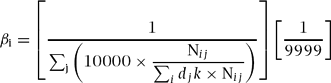
where Nij represents the number of feeding bouts associate with resource state j, and djk is the proportion of the total resource abundance represented by resource state j expanded to k = 10 000.
Fruit characteristics
Fruit size and colour were recorded for all food items in the diet of Meyer's parrot during feeding observations using a sample of 20 fruits or flower species. Fruit colour was classified according to a fruit colour wheel adapted from the Crystal Real Color Wheel developed by Jusko (http://www.realcolorwheel.com/aerialperspectivepalette.htm). The colour spectrum from green to magenta was included in the analysis, whereby green was given a fruit colour score (FCS) of 0, yellow a FCS of 90 and magenta a FCS of 180. All colours correspond with the number of degrees between pure green (0) and the position of the colour on the fruit colour wheel (0–180). White, blue, purple and magenta were given the FCS of 180 due to being the most contrasting to green. This system, therefore, measured the degree to which a fruit contrasts with green and the significance of the bi-colour display. Each of the food items were matched to its corresponding colour on the fruit colour wheel and scored accordingly. These colour scores were then multiplied by the total feeding bouts over 12 mo for each food item to determine the mean colour score from the relative frequency of colour preferences by Meyer's parrot at the population level.
The impact of fruit size and hardness on the ability of Meyer's parrot to procure protein and energy were inferred from mean protein and energy acquisition rates based on mean fruit consumption rate and nutritional value of as many food items as possible. Fruit consumption rates were estimated from direct observations in the field (Boyes & Perrin Reference BOYES and PERRIN2009d, Boyes & Perrin in press). Nutritional analyses of the different food items were done by Selman et al. (Reference SELMAN, HUNTER and PERRIN2002), Taylor (Reference TAYLOR2002), Symes & Perrin (Reference SYMES and PERRIN2003b) and Ndithia & Perrin (Reference NDITHIA and PERRIN2006) using standardized methods (Helrich Reference HELRICH1990). Dry weight was obtained from samples (n = 20) of seeds taken from the study site.
Data analyses
Spearman rank correlation (r s) was used to evaluate the relationship between temporal food resource abundance and observed feeding activity and monthly rainfall. Wilcoxon Matched Pair Test was used to look for significant difference in temporal resource abundance over the study period. Statistical analysis followed Quinn & Keough (Reference QUINN and KEOUGH2002) and STATISTICA 7.1 (Statsoft, Tulsa, Oklahoma, USA).
RESULTS
Food niche metrics
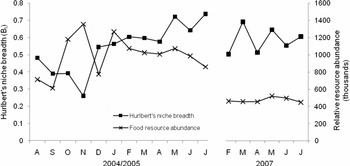
Hurlbert's expanded and standardized niche breadth index confirms a consistently generalist (i.e. βi > 0.5) food-item preference system of Meyer's parrot, which closely tracks overall food resource abundance (Figure 1).
Hurlbert's expanded and standardized niche breadth (βi) for Meyer's parrot and relative resource abundance of all food resources in sample area for the 2004/2005 field season and 2007 field season. For βi, 0 = specialist; 1 = generalist.

Food-item preferences and resource tracking
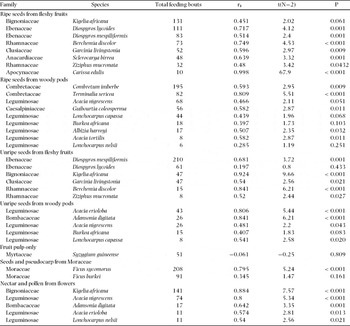
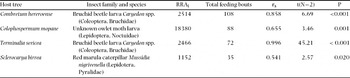
During 366 road transects over 18 mo, we recorded 3629 feeding bouts on 71 food items from 37 tree species within 16 families. Only food items that were recorded on the resource-abundance transects were included in this analysis (Table 1), accounting for all food resources representing more than 1% of the total feeding bouts (Boyes & Perrin Reference BOYES and PERRIN2009b).
Spearman's rank correlations for total monthly relative resource abundance (RRAi) and total feeding bouts for all vegetable food item over 18 mo (Significant at P < 0.05 or P < 0.0012 due to Bonferroni procedure for multiple testing).

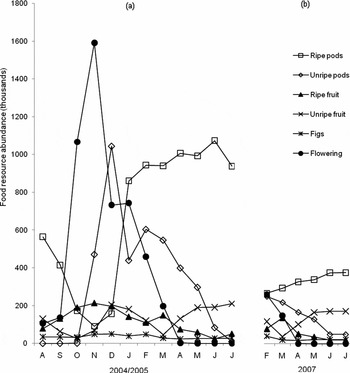
Temporal resource abundance of different food-item types was distinctly seasonal, whereby monthly resource abundance was significantly different for all food-item types (Kruskal–Wallis test: H = 38.9, df = 5, P < 0.001) (Figure 2). Resource abundance of different food-item types was significantly lower in 2007 compared with 2005 (Wilcoxon matched-pairs test: n = 36; T = 6.0; Z = 4.98; P < 0.001) (Figure 2).
Total monthly relative resource abundance (T-RRAi) of all plant food item types consumed by Meyer's parrot in Vundumtiki study area in the Okavango Delta, Botswana.

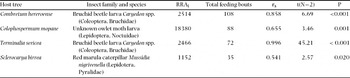
Without the Bonferroni procedure for multiple testing, there was a significant positive correlation between Meyer's parrot feeding activity and all food items in its diet, excluding seeds from ripe K. africana fruits, A. nigrescens pods, Burkea africana pods, L. nelsii pods, L. capassa pods, and Ficus burkei figs, and seeds from unripe D. lycoides and B. africana fruits (Table 1). Using Bonferroni, however, there continued to be significant positive correlations between monthly food resource abundance and total feeding bouts for ripe seeds from D. lycoides, B. discolor, Sclerocarya birrea and Terminalia sericea, unripe seeds from D. mespiliformis, K. africana, B. discolor, A. erioloba and Adansonia digitata, figs from Ficus sycomorus, and flowers from K. africana and A. nigrescens (Table 1). There was a significant positive correlation between monthly food-resource abundance and total feeding bouts for all arthropod food items in their diet (Table 2).
Spearman's rank correlations for total monthly relative resource abundance (RRAi) and total feeding bouts for all arthropod food items over 18 mo (Significant at P < 0.05 or P < 0.0012 due to Bonferroni procedure for multiple testing).
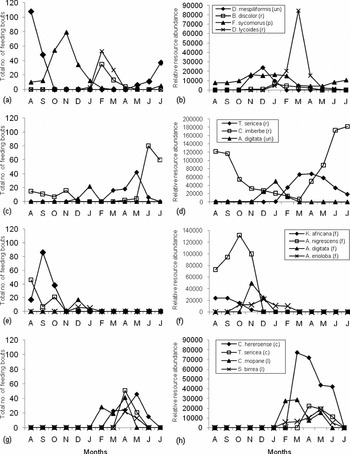
Meyer's parrot tracked the temporal resource abundance of flowers and arthropod larvae closer than any other food resource (Figure 3). The relative resource abundance of Leguminosae and Combretaceae pods within its diet (e.g. C. imberbe and A. nigrescens) was largely ignored even though these were important food resources in the diet (Figure 3).
Total number of feeding bouts by Meyer's parrot and relative abundance of different food resources: seeds from ripe and unripe fleshy fruit and figs (a & b), seeds from ripe and unripe hard pods (c & d), pollen and nectar of flowers (e & f), and insect larvae feeding on pods and fruits (g & h).

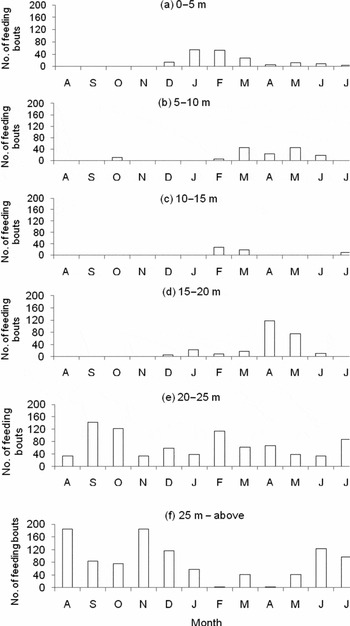
Over 70% of all feeding bouts were over 20 m above the ground in the high canopy. Only 8% of all feeding activity was between 10–20 m above the ground. Feeding activity below 10 m was only observed between December and July, accounting for 21% of total feeding bouts (Figure 4).
Total number of feeding bouts observed between 0–5 m (a), 5–10 m (b), 10–15 m (c), 15–20 m (d), 20–25 m (e), >25 m (f) between August 2004 and July 2005 in the Okavango Delta, Botswana.

Fruit characteristics
There was no correlation between mean protein consumption rate and feeding activity (n = 16; rs = −0.306, t(n−2) = −1.20, P = 0.249) or mean energy consumption rate and feeding activity on specific food items (n = 11; rs = −0.174, t(n-2) = −0.53, P = 0.610).
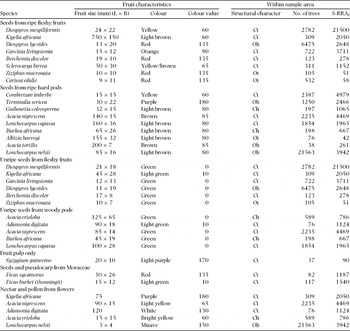
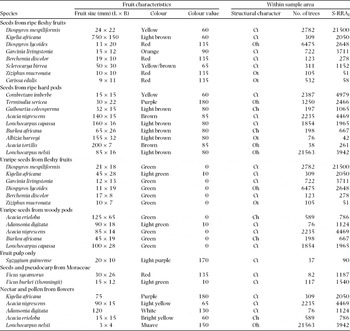
The mean fruit colour score (FCS) was 95.5 (i.e. yellow tending towards green). Green fruits accounted for 29% (n = 597) of the feeding bouts recorded between August 2004 and July 2005, followed by yellow (22%; n = 459), red (18%; n = 385), brown (15%; n = 320), purple (11%; n = 235), orange (3%; n = 73) and white (1%; n = 17). Fruit characteristics are listed in Table 3.
Fruit characteristics, number of trees, structural character and standing relative abundance for a specific tree species (S-RRAi) for all food items included in analysis. C = high canopy above 20 m, U = understorey below 20 m, O = open low canopy below 10 m, h = homogeneous plant community, t = heterogenous plant community.
DISCUSSION
According to a modified Hurlbert's expanded and standardized niche breadth index, Meyer's parrot is a food-resource generalist, indicating sensitivity to fluctuations in the relative abundance of food resource (e.g. fruits and flowers) and utilization of numerous food items in the landscape mosaic. At the population level, Meyer's parrot tracked the relative abundance of 31 food items represented along the resource abundance transects, 15 of which were from flowers or fruits presented in contrasting bi-coloured displays visible from the air. The remaining 16 food items were all visible from the air, with the exceptions of Ziziphus mucronata and Carissa edulis (Boyes & Perrin Reference BOYES and PERRIN2009b). Feeding activity on food resources available throughout the year (e.g. ripe Kigelia africana fruit and F. sycomorus figs) or not visible from the air (e.g. unripe Diospyros lycoides fruit), however, did not correlate significantly with fluctuations in food resource abundance over time, indicating a reliance on visibility from the air (Arruda et al. Reference ARRUDA, RODRIGUES and IZZO2008). Understorey tree species often not visible from the air such as Ziziphus mucronata, Carissa edulis and Grewia spp. only occurred in the diet of Meyer's parrot sporadically (Boyes & Perrin Reference BOYES and PERRIN2009b), supporting the hypothesis that Meyer's parrot tracks resource abundance through aerial assessment. Significantly, five out of the seven most frequently consumed food resources in the diet of Meyer's parrot in the Okavango Delta were presented in bi-colour displays in the high canopy. In addition, the mean fruit colour score was 95.5 indicating that Meyer's parrot prefer food items that contrast with green, noting that 81% of food items consumed were yellow, brown, red, purple, orange or white. Importantly, their food item choices were not significantly different between 2005 and 2007, closely tracking fruiting phenology recorded in the study area (Boyes Reference BOYES2009, Boyes & Perrin Reference BOYES and PERRIN2009b).
During feeding observations, we found that the majority of foraging activity was in the high canopy, indicating that Meyer's parrot likely makes feeding decisions from the air before descending to feed. The only significant feeding activity below 5 m was between December and March when Meyer's parrot was feeding on D. lycoides fruits. Diospyros lycoides marginal woodland comprises homogeneous stands of D. lycoides at very high stand density in forest gaps and on channel margins (Boyes & Perrin Reference BOYES and PERRIN2009b). Therefore, ripe D. lycoides fruits are easily visible from the air and resource abundance tracked effectively at landscape level. The same, however, is not true for unripe Diospyros lycoides fruits, which are a significant food resource, whereby feeding activity did not correlate with temporal food resource abundance. Unripe Diospyros lycoides fruits are green, and thus difficult to locate from the air unless informed by prior knowledge or information-sharing with conspecifics. Meyer's parrot is a vocal feeder that vocalizes constantly during feeding activity (Boyes & Perrin Reference BOYES and PERRIN2009b). Due to this behaviour Meyer's parrot aggregates at preferable feeding sites after dispersal from a central point. Four of the seven fruit pods tracked by Meyer's parrot contained arthropod larvae likely keystone to the breeding effort in the area (Boyes Reference BOYES2009, Boyes & Perrin Reference BOYES and PERRIN2009b). However, not all trees were infested with arthropod larvae and infestation levels were significantly different (Boyes Reference BOYES2009), thus indicating that inspection of pods at population level and prior knowledge of food items, in conjunction with vocal feeding, likely play a significant role in the location of cryptic food resources and in the facilitation of food resource tracking.
Differences in flight costs are associated with different foraging models (Carlson & Moreno Reference CARLSON and MORENO1992). Aerial feeders that habitually forage on the wing during large parts of the day employ low-cost flight at metabolic rates ranging from 2.9 to 5.7 the basal metabolic rate (BMR) (Flint & Nagy Reference FLINT and NAGY1984), whereas the short flights employed by some non-aerial foragers can cost as much as 23 BMR (Tatner & Bryant Reference TATNER and BRYANT1986). Meyer's parrot is a non-aerial forager and has very short wings that allow it to manoeuvre in dense tree canopies when foraging, and thus is expected to maintain a very high metabolic rate during flight. Minimization of foraging flight distance by feeding on locally common or abundant food resource at a specific point in time should, therefore, be an important consideration for Meyer's parrot. Boyes & Perrin (Reference BOYES and PERRIN2009c) demonstrated that Meyer's parrot is a central place forager departing from the communal roost according to the Foraging Dispersal (FD) hypothesis (Caccamise & Morrison Reference CACCAMISE and MORRISON1986, Symes & Perrin Reference SYMES and PERRIN2003b). The minimization of foraging flight distance by foraging for the most abundant food resource at landscape level fits into the FD model. Within the predictions of optimal foraging theory (Caccamise & Morrison Reference CACCAMISE and MORRISON1986) it appears that Meyer's parrot makes food resource decisions that maximize the probability of encountering the food resource, as opposed to nutritional value or potential protein or energy acquisition rates.
Boyes & Perrin (in press) showed that protein and energy acquisition rates were significantly different for different food resources, thus indicating that Meyer's parrot could derive significant benefit from feeding on specific food resources. Foraging time to achieve daily protein requirements, however, was conservatively estimated at 134–370 min for Combretaceae seeds, 40–105 min for Leguminosae seeds, 50–80 min for seeds from fleshy fruits and approximately 170 min for the pseudocarp and seeds from figs (Boyes Reference BOYES2009). Therefore, failure to correlate protein and energy acquisition rates with observed feeding activity was likely due to the energetic costs of flight, prospecting and interspecific competition outweighing the benefits from feeding on the most nutritious food resources, as the closest food resource available (except possibly Combretaceae seeds) could feasibly sustain Meyer's parrot in a short period of time. Significantly, this also shows that Meyer's parrot does not make food resource decisions according to their ability to open and process the seeds inside a fruit or pod. Making foraging decisions according to relative resource abundance at the landscape level benefits Meyer's parrot by minimizing energy expenditure by foraging for the food resource with the highest probability of being located from the air. Aerial surveillance and constant vocalizations during feeding activity likely interact to ensure that the majority of the population can locate preferential foraging sites at low energy expenditure. This likely enables Meyer's parrot to persist throughout the African subtropics where there are distinct wet and dry seasons, and therefore, periods when seed predators experience a food-resource bottleneck. This hypothesis is supported by the assumptions of optimal foraging theory (Rakotomanana & Hino Reference RAKOTOMANANA and HINO1998, Sih & Christensen Reference SIH and CHRISTENSEN2001).
Conclusions
Meyer's parrot tracks the temporal resource abundance of targeted food resources, but more work is required on specific stimuli functioning within their generalist food item preference system. Food resource tracking by Meyer's parrot is likely due to the inter-relationship of aerial surveillance for bi-coloured fruit displays, listening for contact calls of feeding parrots, and minimizing flight distances as central-place foragers. Significantly, Meyer's parrot likely uses fruit colour as an indicator to track, rather than select (Willson et al. Reference WILLSON, GRAFF and WHELAN1990), specific food items.
ACKNOWLEDGEMENTS
The project was predominantly sponsored by the Research Centre for African Parrot Conservation and British Ecological Society. Map Ives, Kai Collins and all the staff of Wilderness Safaris Botswana are thanked for their valuable support throughout the project. The support of Rutledge and Vikki Boyes was keystone to the completion of the Meyer's parrot Project.