Introduction
Increasing damages from hurricanes and coastal storms have helped focus scholarly and media attention on “policy failures” associated with the National Flood Insurance Program (NFIP) (Jarvis Reference Jarvis2017; Strother Reference Strother2018). Critics argue that, by providing subsidised insurance, the program hides the true cost of development in flood-prone areas, fails in its goal of fostering sustainable development and promotes moral hazard (Kunreuther and Michel-Kerjan Reference Kunreuther and Michel-Kerjan2009; Knowles Reference Knowles2014). These critiques have merit, but addressing them is complicated because, since its inception, the NFIP has embodied multiple, conflicting goals. It was established to provide affordable flood insurance where no market for it existed, identify and communicate flood risk and mitigate hazards by encouraging communities to adopt sound floodplain management practices (Pasterick Reference Pasterick1998). Ambiguity, which is endemic to politics (Zahariadis Reference Zahariadis2003; Mahoney and Thelen Reference Mahoney and Thelen2010; Stone Reference Stone2011), pervades the program, partly due to efforts to resolve these conflicting goals.
Ambiguity shapes policy debates, and it should be a central concept in studies of the policy-making process. First, ambiguity is a necessary condition for policy enactment, because it can subdue conflict and enable a diverse winning coalition to form. Competing groups can envision success through varied and often contradictory interpretations of a shared, ambiguously defined goal (Stone Reference Stone2011). Second, ambiguity provides a pathway for institutional change when advocates promote particular interpretations of institutional rules (Sheingate Reference Sheingate2007; Mahoney and Thelen Reference Mahoney and Thelen2010). During these moments of conflict, political advocates with clear interests represent and interpret ambiguous information strategically for decision-makers whose preferences are “problematic” (Cohen et al. Reference Cohen, March and Olsen1972; Kingdon Reference Kingdon2003; Zahariadis Reference Zahariadis2003, Reference Zahariadis2014). Advocates are not unrestricted in their creative use of ambiguity though. While they enjoy some discretion to interpret information and recombine problems and solutions (Jones and Baumgartner Reference Jones and Baumgartner2005), their strategies are constrained and shaped by elements of the political environment. In particular, with the exception of a few political officials who are poised to create openings for policy change, most advocates must fit their arguments into the “policy window” (Kingdon Reference Kingdon2003) that opens (Zahariadis Reference Zahariadis2003).
In this article, I draw on multiple streams analysis and historical institutionalism to show how ambiguity guides and constrains the policy-making process. The case – the 2012 passage and 2014 rollback of reforms to the NFIP – highlights the strategic manner in which advocates engage with ambiguity of information and of institutions. Drawing on interviews and congressional testimony, I show how advocates interpreted problems, program rules, and goals to shape legislators’ perceptions of the reforms’ political implications. I also show how advocates tailored their arguments to a particular policy window. The study is a deep exploration of the concept of ambiguity, which is typically conceptualised as a background variable or an assumption about political context rather than a primary object of study. Foregrounding ambiguity can, however, help explain puzzling instances of policy-making. The case shows how advocates interpret ambiguous institutional rules to create meaning for legislators, how they strategically use ambiguous information to present favourable policy images, and how the particularities of a policy window shape advocates’ engagement with ambiguity.
The article proceeds in five sections. First I introduce the case, which presents a puzzling instance of policy reform and reversal. I provide a brief overview of the NFIP and the reform effort that culminated in the 2012 passage of the Biggert-Waters Flood Insurance Reform Act (Biggert-Waters). Next, I introduce theoretical perspectives concerning the role of ambiguity in politics and operationalise concepts around which the empirical case is built. I then describe my data collection and analytical methods. I rely on congressional testimony and interviews with journalists, scholars, congressional staffers and advocates engaged in designing and passing Biggert-Waters. Next, I present my analysis, in which I use process tracing (Bennett and Checkel Reference Bennett and Checkel2014) to show how advocates engaged strategically with ambiguity to shape legislators’ perceptions of the problems and policy solutions associated with the NFIP. I conclude with a discussion of the study’s implications for the analysis of institutional change and public policy.
Reforming the National Flood Insurance Program
The NFIP was established in 1968 to provide flood insurance to Americans, identify and communicate flood risk and mitigate hazards by encouraging communities to manage their floodplains (Pasterick Reference Pasterick1998). At the time, a private market for flood insurance did not exist. Insurance companies believed the oncentrated nature of flood risk would lead to adverse selection, that the catastrophic character of flood damages would require them to charge insurance premiums that few would be willing or able to pay, and therefore premiums would not cover catastrophic damages (Michel-Kerjan and Kousky Reference Michel-Kerjan and Kousky2010). Hurricane Betsy provided the catalysing event for the program’s establishment. Congress – responding to the huge outlays in disaster aid following the 1965 storm – created the NFIP to offset direct spending on disaster aid and to provide relief to flood victims (King Reference King2013).
According to congressional staffers involved in the reform process, the 2005 hurricane season put restructuring the NFIP on the congressional agenda. Hurricanes Katrina, Rita, and Wilma left the program roughly 18 billion dollars in debt to the U.S. Treasury, due to claims obligations that the NFIP could not meet. Senate Banking Committee Chairman Richard Shelby (R-AL) began a process to restructure the NFIP, and by spring 2008 both the House and Senate had passed bills to restructure the program. Before the two chambers could reconcile their versions of NFIP reform, the 2008 financial meltdown drew the relevant committees’ attention away from flood insurance reform.
But the NFIP’s operating authority also expired in 2008. Between 2008 and May 2012, Congress passed 17 short-term extensions and allowed the program to lapse four times. Finally, in July 2011, the House passed the reauthorisation and reform bill known as the Biggert-Waters Flood Insurance Reform Act by a huge majority. Biggert-Waters reauthorised the NFIP for five years and made several changes intended to make the program actuarially sound. The Senate Banking Committee approved a similar bill in December 2011, and a reconciled package passed both chambers and was signed by the President in July 2012 (Biggert-Waters Flood Insurance Reform Act 2012). In early 2014, – facing constituent backlash over rising premiums – Congress passed and the President signed the Homeowner Flood Insurance Affordability Act, which reversed or delayed many of Biggert-Waters’ structural changes (Homeowner Flood Insurance Affordability Act 2014).
The rapid rollback of Biggert-Waters around household-level affordability concerns raises the puzzling question of whether legislators considered these concerns in the lead-up to Biggert-Waters’ passage. Political careers depend on legislators’ ability to anticipate their constituents’ “potential preferences:” how a bill could affect constituents, and whether they will link harms or benefits to a legislator’s actions or vote based on this knowledge (Arnold Reference Arnold1992, p.11). The structural changes contained in Biggert-Waters threatened concentrated losses, in the form of rising insurance premiums, to homeowners living in flood-prone areas. The reforms promised diffuse benefits – debt reduction and reduced government spending – to American taxpayers. Theoretically, a policy with this incidence of costs and benefits is unlikely to pass (Wilson Reference Wilson1982; Arnold Reference Arnold1992), and it helps explain the backlash to Biggert-Waters (Strother Reference Strother2018). The puzzle, though, is whether and why legislators did or did not anticipate this backlash in debates leading up to the law’s passage.
The distribution of costs and benefits is not straightforward but instead can be a matter for interpretation. Thus, in this analysis, I explore how advocates interpreted problems, program rules, and goals to shape legislators’ perceptions of the reforms’ political implications and thereby advance their interests. As is typical during policy-making processes, advocates became “meaning suppliers” for legislators (Zahariadis Reference Zahariadis2003; Reference Zahariadis2014). They strategically represented and interpreted information to show how policymakers’ interests aligned with their own goals. The bounds of the debate were contained within the program’s rules and history (Sheingate Reference Sheingate2007; Mahoney and Thelen Reference Mahoney and Thelen2010), and the particularities of the political context (i.e. the policy window) (Kingdon Reference Kingdon2003) shaped advocates’ strategies. Ambiguity, as I operationalise it in the “Ambiguity in politics” Section, was central to advocates’ interpretative task.
Ambiguity in politics
I apply a conceptual framework that draws from historical institutionalism and multiple streams analysis, both of which include ambiguity as a characterising feature of politics. Both these literatures also feature a class of actors called “political entrepreneurs,” who play the starring role in this analysis. Scholars use this term to refer to individuals who “change the direction and flow of politics” (Schneider and Teske Reference Schneider and Teske1992, p.737). Institutional theorists focus on entrepreneurs’ “creative recombination” of rules and other institutional features (Sheingate Reference Sheingate2007, p.15) to better advance their interests. Policy scholars highlight entrepreneurs’ role in shaping the political agenda. Entrepreneurs define problems and policy alternatives (Kingdon Reference Kingdon2003; Zahariadis Reference Zahariadis2003), select venues and windows of opportunity through which to advance proposals (Baumgartner and Jones Reference Baumgartner and Jones1991; Kingdon Reference Kingdon2003) and build coalitions to enact them (Arnold Reference Arnold1992). Political entrepreneurs can operate from within or outside of government. Examples include interest group lobbyists, elected officials who take a particular interest in an issue because of constituency concerns or institutional position, or civil servants who engage in policy-making processes. They shape political institutions and public policies by seizing or (sometimes) creating opportunities to advance their desired ends through political venues.
Ambiguity is a defining feature of the political contexts within which political entrepreneurs operate, and assessing ambiguity can help to illuminate befuddling policy outcomes. Broadly, ambiguity means that there are “many ways of thinking about the same circumstances or phenomena” (Feldman Reference Feldman1989, p.5). Drawing from historical institutionalism and multiple streams analysis, I conceptualise ambiguity as interpretability of rules, circumstances, events, and problems. Ambiguity differs from uncertainty, defined as “an inability to accurately predict an event” (Zahariadis Reference Zahariadis2003, p.3). A key differentiating feature between ambiguity and uncertainty is that obtaining more information may reduce uncertainty, but it does not reduce ambiguity. For example, even with full information about the causes of a particular problem, the problem remains ambiguous if there are alternative ways of interpreting its impacts.
Historical institutionalists have argued that ambiguity – defined as “openness in the interpretation and implementation” of rules – is a “permanent feature” of institutions (Mahoney and Thelen Reference Mahoney and Thelen2010, p.11). From the moment of enactment, formal political institutions often have ambiguous mandates that reflect compromises required to win the support of a coalition of diverse actors (Moe Reference Moe1989). Each member of a passing coalition expects to gain something from the institution, but these expectations are often rooted in divergent interpretations of rules or expectations for outcomes (Stone Reference Stone2011; Stokes Reference Stokes2015). Later, institutions develop and change through the accumulation of innovations inspired by competing motives (Schickler Reference Schickler2001; Mahoney and Thelen Reference Mahoney and Thelen2010). The resulting structure provides the source for institutional change, because political entrepreneurs seize opportunities to advance their preferred interpretations of institutional rules (Mahoney and Thelen Reference Mahoney and Thelen2010; Sheingate Reference Sheingate2007, Reference Sheingate2010).
The historical institutionalists’ definition of ambiguity leads to two expectations about ambiguity in policy debates. First, some degree of “‘play’ in the interpreted meaning of particular rules or in the way rules are instantiated in practice” indicates the presence of ambiguity (Mahoney and Thelen Reference Mahoney and Thelen2010, p.11). Second, political entrepreneurs will capitalise on this openness to “generate their own opportunities by promoting alternative interpretations of the rules and then securing official recognition for their innovations” (Sheingate Reference Sheingate2007, p.18). In an important sense, the ambiguity embedded within institutions sets the boundaries of policy debates, during which political entrepreneurs vie to advance their own (likely divergent) interpretations of institutional rules and mandates.
In addition to its presence as a feature of institutions, ambiguity provides leeway for advocates to interpret problems and solutions for policy makers. Scholars of public policy focus on how political advocates operate under conditions of ambiguity, which are defined by “fluid participation,” “problematic preferences” and “unclear technology” (Cohen et al. Reference Cohen, March and Olsen1972; Zahariadis Reference Zahariadis2003; Zahariadis Reference Zahariadis2014). I focus on the opportunities for entrepreneurship that arise in response to “problematic preferences.” This quality signifies that decision-makers such as legislators do not have clear preferences about every issue, because their attention is limited (Cohen et al. Reference Cohen, March and Olsen1972; Kingdon Reference Kingdon2003; Zahariadis Reference Zahariadis2003). Political entrepreneurs are assumed to have clear and precise preferences about their specialty issue and often have an information advantage. They become “meaning suppliers and identity providers” for policy makers (Zahariadis Reference Zahariadis2014, p.30). In this role they strategically seek to activate certain concerns, emotions, and identities and, in the process, build support for their preferred interpretations of problems, policy solutions or (usually) both (Kingdon Reference Kingdon2003, Zahariadis Reference Zahariadis2014).
Information – which is itself ambiguous in that it is “subject to differing interpretations or perspectives” (Jones and Baumgartner Reference Jones and Baumgartner2005, p.13) – is an essential tool that entrepreneurs use to control ambiguity and provide meaning. Ambiguity implies that there are multiple dimensions of any circumstance, event, or outcome that entrepreneurs could use to focus attention, define problems and specify solutions. Advocates use information selectively to highlight some dimensions of a problem or proposed solution while masking other aspects (Entman Reference Entman1993). They seek to convey “policy images” (Baumgartner and Jones Reference Baumgartner and Jones1993) that will lead policy makers to adopt the advocates’ preferred problem definition and policy solution (Zahariadis Reference Zahariadis2003).
The distribution of costs and benefits is usually a key feature of these policy images. People are more averse to losses than they are enthusiastic about gains (Tversky and Kahneman Reference Tversky and Kahneman1981), and concentrated losses are more powerful as mobilising forces than are diffuse losses (or gains) (Wilson Reference Wilson1982). Entrepreneurs thus seek to portray problems and solutions strategically such that the perceived incidence of costs and benefits will tilt the political scale in their favour. Moreover, particularly in cases when policy makers lack clear preferences, advocates have leeway to define the point of reference from which losses and gains are perceived to depart (Zahariadis Reference Zahariadis2003).
The particularities of a “policy window” (Kingdon Reference Kingdon2003) shape entrepreneurs’ rhetorical strategies.Footnote 1 Public policy scholars use the concept of policy windows to describe time-bound opportunities for entrepreneurs to define problems, attach them to preferred solutions, and shuttle them through a political decision-making venue (Kingdon Reference Kingdon2003). They open due to changes in the “politics stream,” such as an election, or focusing events in the “problem stream,” such as a natural disaster. The various dimensions of problems, solutions or circumstances are differentially resonant depending on the particularities of a policy window.
The view of ambiguity as interpretability of problems and alternatives leads to a third and fourth expectation about the use of ambiguity in policy debates. Political entrepreneurs use information strategically to frame problems and proposed solutions. The analytical task is to assess how their choices may create meaning for legislators, often through portrayals of losses and gains associated with a problem or policy. Moreover, the characteristics of a policy window shape the choice and tractability of dimensions on which entrepreneurs focus attention.
In my analysis, I use the concepts and expectations developed here to show how the ambiguity embedded in the NFIP provided openings for entrepreneurs to advance their interests by (re)interpreting program rules and mandates. I then show how entrepreneurs engaged with ambiguity to supply meaning to legislators. They used information strategically to advance their interpretations of problems, policy solutions and goals and related these interpretations to legislators’ concerns about the incidence of costs and benefits. Throughout the discussion, I address how the particularities of the policy window shaped entrepreneurs’ strategies.
Case selection and data
The passage and rollback of the 2012 reforms to the NFIP provide a compelling case through which to study advocates’ strategic engagement with ambiguity. First, the case presents a compelling puzzle in its own right. In a Congress known more for stalemates and shutdowns than for getting things done, the reform passed with broad support. But sharp backlash based on the threat of concentrated, direct costs raises the question of how the law passed so resoundingly. Second, the program provides a “typical” case through which to explore the role of ambiguity in politics (Seawright and Gerring Reference Seawright and Gerring2008). While it is easy to critique the NFIP as a “policy failure” (Jarvis Reference Jarvis2017; Strother Reference Strother2018), the program may more accurately be characterised as replete with ambiguity. Likewise, the case meets the criterion of “organised anarchy” (Cohen et al. Reference Cohen, March and Olsen1972), the decision-making setting within which ambiguity is present. In particular, especially at the time the reform was passed, the low profile of the NFIP suggests that the modal member of Congress had “problematic preferences” about the program. This left entrepreneurs with a great deal of leeway for framing arguments and supplying meaning to legislators. The typical-case design helps to illustrate the role of ambiguity in politics, even as ambiguity helps to explain this puzzling instance of congressional backpedaling. Third, the close succession of reform and repeal means that little had changed in the institutional or political setting within which advocates were operating, many of the same actors were involved in both processes, and some of these actors’ arguments changed over time. This helps to isolate the role of ambiguity, and assessing over-time variation provides analytical leverage to explore strategic engagement with ambiguity.
Two main questions guided data collection. First, I identify the main elements – including ideas and actors – in the debate leading to Biggert-Waters’ passage. Second, I ask how actors used information strategically to shape perceptions of problems with the NFIP and expectations about outcomes associated with Biggert-Waters. I focus particular attention on how costs and benefits were understood and portrayed. I draw on news accounts, interviews, academic and agency reports on the NFIP, and congressional testimony to address these questions.
Through my interviews I sought to understand the role of each organisation in the policy-making process that led to Biggert-Waters, each respondent’s perceptions of the program’s goals and problems, and their priorities for the legislation. To this end, I asked about respondents’ participation in policy design, lobbying, and coalition building; their role in bringing reform and reauthorisation to the congressional agenda; the key issues and arguments in the debate; their own priorities; the other actors involved; and differences and similarities between the House and Senate during debate, markup, and passage. I used a semi-structured interview approach (Weiss Reference Weiss1994). This means I used a guide to ensure that I covered a core set of topics with each respondent, but I allowed flexibility in the conversation so that respondents could raise concerns and perspectives I may not have asked about. I adapted a template interview guide for each respondent, and this template is included in the Appendix.
I used a snowball-sampling approach to gather perspectives from the full slate of political entrepreneurs engaged in the policy debate leading to Biggert-Waters. For my initial interviews, I targeted staff from House and Senate committees and government agencies involved in the reform process; authors of published reports on Biggert-Waters; and leaders from interest groups who published statements, testified to Congress, were mentioned in media reports, or otherwise took public positions on Biggert-Waters. I then contacted additional groups and individuals that my early interview respondents identified as actively engaged in the policy-making process. I validated information relayed to me as fact, either by asking other respondents about the topic of concern or by referring to published documents (including congressional testimony). Still, my interviews serve primarily as a source of perspective rather than fact.
The analytical focus on ambiguity emerged through the process of collecting and iteratively coding the interview data. I first transcribed the interviews. Next, the first round of coding reflected the core questions contained in my interview guide. This initial coding helped me to identify themes, commonalities, and differences between respondents’ portrayals of the debate. One of the major themes to emerge was that the debate shifted over time and that perceptions, portrayals and priorities changed between policy windows. Thus, the second round of coding focused more explicitly on ambiguity. I categorised respondents’ definitions of problems, expectations associated with proposed solutions, prioritisation of problem dimensions, interpretations of program rules and goals, information used to support interpretations, and descriptions of policy windows.
Table 1 shows the organisational affiliations of my 21 interview respondents, at the time of their involvement in the policymaking process this article addresses. My panel included six representatives from government agencies involved with the legislative process or the administration of the NFIP; four congressional staffers who actively participated in the process; seven leaders from interest groups that testified to or lobbied Congress; and four scholars and journalists with expertise in the NFIP.
Organisational affiliations of interview respondents

This table categorises the organisational affiliations of my 21 interview respondents. I identified these respondents using a snowball-sampling technique in order to incorporate the perspectives of all participants in the debate over Biggert-Waters.
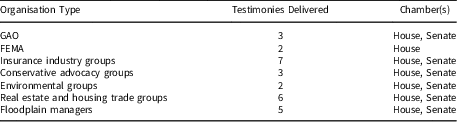
I incorporate congressional testimony for two purposes: to scrutinise the claims made during interviews and to show how entrepreneurs framed the debate for legislators, in venues accessible to the public. I draw from testimony delivered to the House Committee on Financial Services Subcommittee on Housing and Community Opportunity in April 2010 and March 2011, and to the Senate Committee on Banking, Housing, and Urban Affairs Subcommittee on Economic Policy in September 2010 and May 2012. Table 2 shows the outside groups that testified in writing or in person during these hearings.Footnote 2 Combined, congressional testimony and interview data show how political entrepreneurs understood the debate, focused legislators’ attention, interpreted program rules and goals, and adapted their arguments over time.
Witnesses providing testimony in congressional hearings
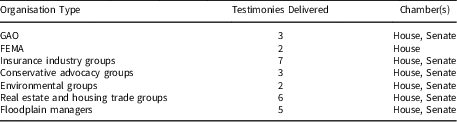
This table categorises the organisational affiliations of the individuals providing testimony during two rounds of congressional hearings addressing the bill that passed as Biggert-Waters. Hearings were held in 2009 and 2011 in the House, and 2010 and 2012 in the Senate. FEMA = Federal Emergency Management Agency. GAO = Government Accountabilty Office.
Using ambiguity for political advantage
Institutional ambiguity provided openings for entrepreneurial interpretation
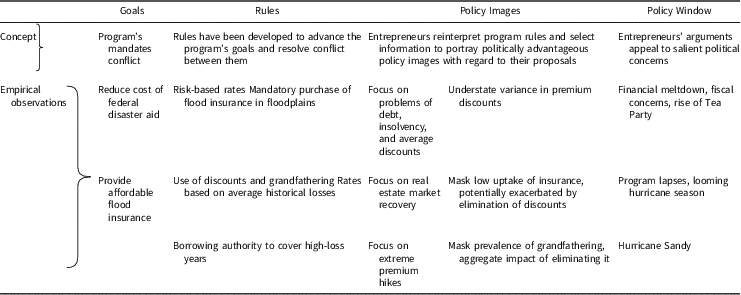
Table 3 summarises the main elements of the analysis, in which I show how advocates used information to advance their interpretations of rules, problems, policy solutions and goals. At the most fundamental level, the NFIP embodies two goals, which conflict. The program was “intended to reduce the federal government’s costs for repairing flood damage after disasters” (Government Accountability Office 2010, p.4). It achieves this by providing flood insurance to property owners who otherwise would not be able to obtain it, while covering claims and expenses through premiums like a private insurance company. The Government Accountability Office (GAO) notes that it is impossible to meet these competing goals – providing affordable flood insurance and maintaining fiscal solvency – in high-loss years. This duality of goals at the heart of the program provides an opportunity for political entrepreneurs. Depending on a group’s preferences or the policy window that opens, entrepreneurs may invoke either of these goals in interpreting a problem or proposal for legislators.
Program goals, ambiguous rules, policy images and policy windows
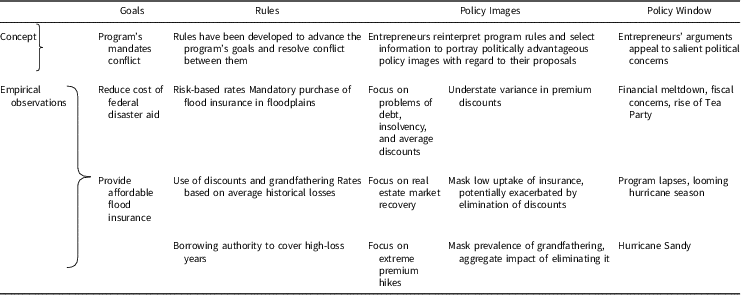
This table outlines the relationships between conflicting institutional mandates, program rules that provide opportunities for entrepreneurial innovations, strategic manipulation of ambiguity in the portrayal of policy images and the policy windows within which the debate occurred.
Over time, efforts to achieve and resolve these goals have led to the development of rules which, in turn, provide openings for interpretation. These include procedures for defining risk and setting insurance rates, premium discounts, a purchase requirement for properties in flood zones, and ways to account for flood-control systems in the rate structure. Some of these rules are intended to keep insurance rates affordable and/or encourage participation in the program.Footnote 3 Others are intended to improve the program’s solvency.Footnote 4 These rules exemplify how institutions develop in ways that reflect competing mandates that were present from the moment of enactment.
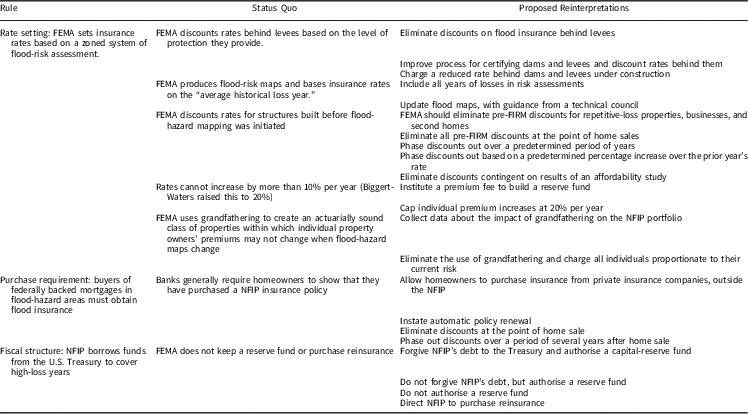
The rules are open for interpretation though, and this ambiguity provides opportunities for entrepreneurial innovation. Table 4 shows the program rules that interview respondents mentioned most often in their recollections of designing, debating and building a coalition for Biggert-Waters. The table also shows the various ways in which respondents reinterpreted the rules. My analysis focuses on how advocates built favourable policy images around the rules that changed the premium structure, since these were the ones that eventually faced opposition and were rolled back based on threats of direct, concentrated costs.
Ambiguity embedded within the NFIP
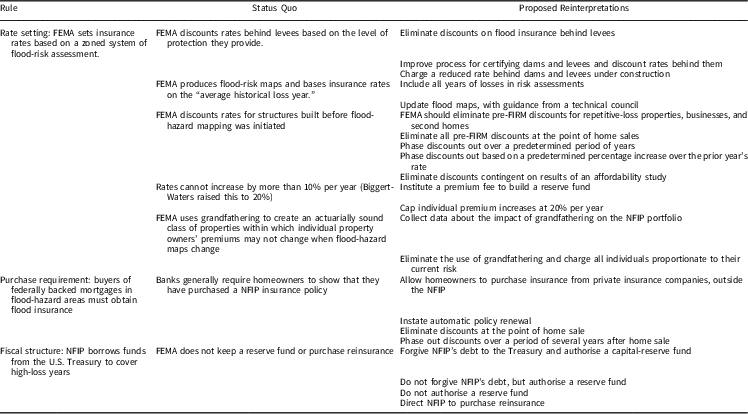
This table shows the program rules that interview respondents mentioned most often in their recollections of designing, debating, and building a coalition for Biggert-Waters; the status-quo interpretations of the rules; and the various reinterpretations that were discussed in the buildup to Biggert-Waters.
NFIP = National Flood Insurance Program; FEMA = Federal Emergency Management Agency.
Entrepreneurs engaged with ambiguity to advance their interests
The coalition that supported Biggert-Waters’ passage included diverse groups with a multiplicity of interests. Environmental groups, housing trade groups, the insurance industry and think tanks promoting fiscal responsibility and market-based solutions all supported Biggert-Waters’ passage, albeit for different reasons that they emphasised to varying degrees over time. While these groups all supported the bill in its final form, interviews and congressional testimony reveal differences in their preferred policy solutions, problem definitions and priorities. Broadly, the groups fall into two camps: those who prioritised structural reforms to the program and those who accepted reform as a necessary condition for ensuring the program’s reauthorisation. These two camps advanced different interpretations of the NFIP’s goal: reform advocates focused on the program’s mandate to reduce disaster-aid costs, while reauthorisation proponents focused on the availability of affordable flood insurance.
The Smarter Safer Coalition (SSC) — which includes environmental advocates, some insurance and reinsurance trade associations, consumer and taxpayer advocates and conservative think tanks — advocated for the structural reforms at the heart of Biggert-Waters. Even here groups differed in the specific reforms they cared most about. The Reinsurance Association of America, for example, pushed for a provision explicitly directing the Federal Emergency Management Agency (FEMA) to purchase reinsurance to transfer risk. Reinsurance was framed as a way to ensure the program’s solvency and served as a nod to “privatisation,” which appealed in particular to Tea Party conservatives who formed an important caucus within the House Republican majority. For the reinsurance industry, the measure presented an important market opportunity. Some of the other groups went along because it held political appeal without provoking opposition from insurance groups, who did not want to see the program fully privatised. This example demonstrates members of a supporting coalition envisioning success through different expectations for a multidimensional and ambiguous policy proposal (Stone Reference Stone2011, Stokes Reference Stokes2015). The example also illustrates entrepreneurs advancing particular interpretations of institutional rules: advocates for reinsurance argued that the NFIP’s enabling statute already allowed FEMA to use reinsurance (Nutter Reference Nutter2011).
The second group prioritised long-term reauthorisation of the program and went along with structural reforms somewhat reluctantly. This group included trade groups representing the housing, insurance, construction, mortgage and financial services industries. Notably, interview respondents differed in whether they identified these groups as distinct from the SSC, which strongly advocated for structural reforms to the program. This indicates that, at the moment when Biggert-Waters passed, conflict was subdued within the supporting coalition. The hushing of conflict also illustrates the reauthorisation advocates’ strategic engagement with ambiguity in policy making.
How did these groups engage with ambiguity to portray politically advantageous policy images and how did the particularities of policy windows shape their strategies and influence their success? More specifically, how did entrepreneurs promote policy images that portrayed their proposals as providing concentrated benefits and/or avoiding concentrated losses? And how did ambiguity allow for the portrayal of policy images that did not include premium hikes as an identifiable feature?
Advocates of structural reforms focused attention on the problems of the program’s debt and fiscal insolvency and the impact that restructuring would have on these aggregate-level concerns. In interviews and testimony, entrepreneurs cited the $18 billion debt accrued from the 2005 hurricane season as the primary catalyst for beginning the policy reform process. They promoted the elimination of pre-FIRM discounts and a requirement that FEMA include high-loss years in flood-risk assessments as ways to improve the program’s fiscal solvency and chip away at the debt. An emphasis on fiscal solvency and these and other nods towards privatisation suited the political moment. The financial collapse had heightened awareness of fiscal vulnerability and led to a strong push to reduce the deficit and cut government spending. Arguments for improving the program’s fiscal structure resonated in particular with the ascendant Tea Party in 2010–2012, who may not have voted to reauthorise the program without major reforms.
Even in this political context though, a focus on the collective benefit of debt reduction might have met political opposition since diffuse benefits often come with the consequence of concentrated losses. Indeed, NFIP rates were never intended to capture catastrophic risk since this would raise rates (impose concentrated costs) severely (King Reference King2013). The Department of Housing and Urban Development determined that pre-FIRM discounts were necessary to encourage communities to participate in the program (The National Flood Insurance Act of 1968, as amended, and The Flood Disaster Protection Act of 1973, as amended 1968; Pasterick Reference Pasterick1998). But entrepreneurs manipulated ambiguity by downplaying the concentrated, individual-level costs that the proposed changes might impose. Specifically, a focus on average discounts softened the perceived impact of eliminating them. Interview respondents recalled that legislators and advocates understood the impacts of eliminating discounts in aggregate terms, based on information from FEMA, GAO and the Congressional Budget Office. Congressional testimony supports respondents’ claims. The GAO cited FEMA’s estimate that the average discounted premium rate was 40–45% of the full-risk rate (Brown Reference Brown2011). National Association of Realtors (NAR) representatives referred to FEMA’s estimates that, if homeowners paying the average discounted policy were moved to full-risk premiums, they would pay an average of 2.5 times the current rates (Veissi Reference Veissi2010; Sullivan Reference Sullivan2011). Insurance industry representative David Sampson cited premium discounts of 20–50% on average, and 40–45% for repetitive-loss and high flood-risk properties (Sampson Reference Sampson2012, p.2). Most interview respondents claimed that legislators considered the impact of eliminating this average discount to be acceptable.
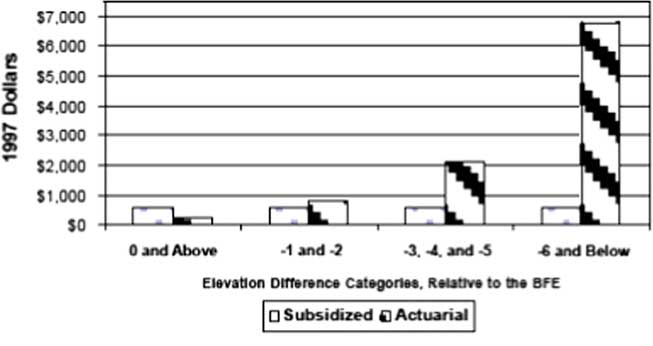
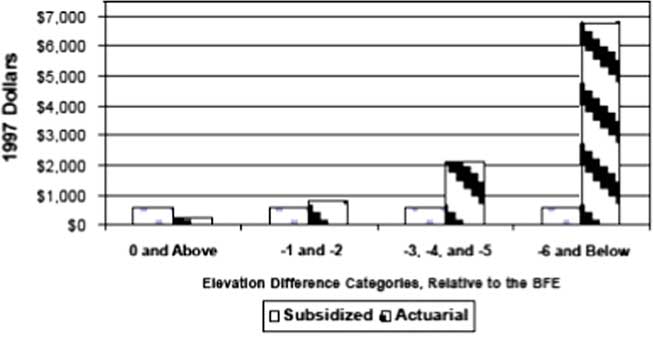
The problem is that aggregates and averages conceal a great deal of variance within the pool of premium discounts. A subsidised premium’s discount differs based on a structure’s elevation in comparison with the expected flood depth at its location (Pricewaterhouse Coopers LLC 1999). Figure 1, excerpted from a 1999 study, illustrates the variation in magnitude of premium discounts. The figure shows that insurance discounts increase exponentially the lower a structure sits below the FEMA-designated base flood elevation. Focusing on averages masks this variance, and by extension the large, direct, and proximate costs that removing discounts would impose on some constituents. The realtors did represent this variance in their discussion, noting that some premiums would increase by “four-fold or more” (Veissi Reference Veissi2010; Sullivan Reference Sullivan2011), but even this figure understates the variance depicted in Figure 1. This is a poignant example of how ambiguity provides opportunities. There are many ways of interpreting the impact of eliminating the discounts contained within the NFIP, and the interpretation that dominated in debate focused on averages and masked the extreme premium increases that Biggert-Waters could cause.
1998 Average Premiums for Pre-FIRM Residential Properties in all NFIP Communities (Pricewaterhouse Coopers LLC 1999, p.5–5). This figure shows the difference between subsidised and actuarial premiums for properties at varying levels of elevation above base flood elevation. The figure shows that premium discounts increase exponentially as a property’s elevation decreases, relative to the base flood elevation.
FEMA, which sets flood insurance rates and premium discounts, commissioned the study from which Figure 1 is drawn. In addition, the President’s official position from the Biggert-Waters debate states, “The Administration looks forward to working with the Congress on additional reforms to strengthen the NFIP and help economically distressed homeowners” (Executive Office of the President Office of Management and Budget 2012, emphasis mine). This statement, along with the evidence from FEMA’s study conducted a decade prior, suggests that the executive branch did have concerns about affordability associated with Biggert-Waters. In his testimony, FEMA Administrator Craig Fugate mentioned FEMA’s efforts to address affordability in a study of reform options. But he did not emphasise affordability concerns (Fugate Reference Fugate2010; Fugate Reference Fugate2011), nor were the premium increases contingent on the outcome of the affordability study. In sum, individual-level affordability concerns were not absent from the debate, but they did not receive the same strategic focus as the aggregate-level problem of the program’s debt or the relatively mild magnitude of costs portrayed by averages.
Perhaps most importantly, the entrepreneurs most likely to have highlighted affordability concerns engaged strategically with ambiguity and shaped their arguments to the policy window that opened. Both interview data and congressional testimony indicate that as the debate progressed, the housing trade groups quelled their opposition to the reforms. In his 2010 testimony, NAR President Maurice Veissi expressed opposition to phasing in “‘full-risk’ premiums for nonresidential and nonprimary residential properties” as well as phasing in full-risk premiums for primary residences at the point of sale (Veissi Reference Veissi2010, p.4). Even in her 2011 testimony to the House, NAR’s representative raised concerns about moving pre-FIRM properties other than repetitive-loss properties to full-risk premiums (Sullivan Reference Sullivan2011). Instead of strongly opposing the measure outright though, she urged Congress to phase in premium increases by a set percentage each year rather than all at once. By 2012, Veissi did not raise concerns about the costs that would be imposed by premium-structure changes. Instead, he focused on costs associated with the program’s lapses and the need for affordable flood insurance. He emphasised that the nation’s housing markets were feebly recovering from the recession and highlighted the hindrance to the recovery that short-term extensions and operating lapses had caused. He argued that facilitating real-estate market recovery would boost local economies: “Each sale provides jobs and income to real estate agents, construction workers, mortgage service providers, home inspectors, home appraisers, and many others” (Veissi Reference Veissi2012, p.5). In choosing to focus on this dimension of the problem, he connected the threat of program lapses to the particularistic concerns of all legislators, since housing is an important economic driver in virtually every legislative district. He became a meaning-maker by effectively linking his preferred interpretation of the problem to legislators’ concerns about economic growth at home. NAR highlighted the costs imposed by the program’s lapses and went along with premium-structure changes as a necessary condition for getting reauthorisation approved by conservatives in the House and Senate.
This rhetoric epitomises strategic engagement with ambiguity in a second way. The argument overlooks one highly relevant dimension: low participation in the program. In portraying the market impact of NFIP lapses, Veissi assumed that a program lapse affects all home sales in a Special Flood Hazard Area (SFHA) (Veissi Reference Veissi2012, p.4). His interpretation assumes perfect compliance with the rule requiring the purchase of flood insurance to obtain federally backed mortgages in flood zones. But studies have found that insurance purchasing rates are low, even among residents of SFHAs to whom the flood insurance requirement applies (Dixon et al. Reference Dixon, Clancy, Seabury and Overton2006; Government Accountability Office 2006; Kousky Reference Kousky2010; Michel-Kerjan and Kousky Reference Michel-Kerjan and Kousky2010; Landry and Jahan-Parvar Reference Landry and Jahan-Parvar2011; King Reference King2013). Would imperfect purchasing rates temper the magnitude of the NFIP’s impact on real-estate markets? Biggert-Waters’ drafters evidently believed so, since the law raised the penalty from $350 to $2,000 if lenders fail to require insurance (Biggert-Waters Flood Insurance Reform Act 2012, Sec. 100208(1)). If this incentive worked, it would bring many more borrowers into the program, and all of them would pay full-risk premiums. By glossing over this, Veissi understated the reforms’ concentrated impact on households, while overstating the threat posed by program lapses. If Biggert-Waters’ stricter penalty for noncompliance worked as intended, it would amplify the poorly understood household-level impacts by applying them to more people.
Two other groups of witnesses might have raised affordability concerns: representatives of local jurisdictions, who might be sensitive to the costs associated with eliminating discounts, or insurance industry representatives with deep expertise in the nature of flood risk and costs of insuring against it. At the final Senate hearing before Biggert-Waters passed, neither of these groups expressed concern about the concentrated costs of eliminating discounts. Instead, a representative from a southeast-Louisiana levee district focused on FEMA’s consideration of levees in risk assessment. A floodplain manager from Montana focused on the need for reauthorisation and urged Congress to eliminate subsidies. Two insurance industry witnesses focused on the need for the NFIP’s reauthorisation and, again, tailored their arguments to the policy window (Jensen Reference Jensen2012; Sampson Reference Sampson2012). One insurance group representative, David Sampson, reminded senators: “The NFIP is set to expire on May 31 – the day before the official start to the Atlantic hurricane season – if Congress does not act. More than 5.6 million American homeowners, renters, and businesses are NFIP policyholders and rely on this program to protect their homes and their financial security” (Sampson Reference Sampson2012, p.1). Sampson could have highlighted the likelihood that hurricane-related losses would make flood insurance prohibitively expensive due to Biggert-Waters’ provision that FEMA incorporate all years of losses in its rate calculations. This argument would have been consistent with the insurance industry’s opposition to NFIP privatisation because of the catastrophic nature of flood losses. Instead, he made the strategic choice to focus on the coincident timing between the NFIP’s pending expiration and the opening of hurricane season. Overall, the debate focused on the aggregate benefits of eliminating discounts and the need to reauthorise the program. The entrepreneurs who had initially expressed concerns about concentrated costs eventually subdued their opposition in order to ensure the program’s continuation.
One alternative explanation merits mention: that Biggert-Waters’ proponents used a procedural strategy to shuttle the law through in spite of knowledge that it would impose politically unpalatable costs. Interview respondents addressed this possibility when they explained how and why the Senate bill was rolled into MAP-21, a major transportation-funding bill (Moving Ahead for Progress in the 21st Century Act 2012). Embedding the reforms in the transportation bill could weaken the link between legislators’ choices and policy outcomes, and thereby make it easier for some to vote for a policy that may displease constituents (Arnold Reference Arnold1992). Some respondents did suggest that bundling may have provided cover for leaders such as Mary Landrieu (D-LA), whose constituents would face major costs as a result of the law. These respondents pointed out that MAP-21 also secured and allocated payouts from the Deepwater Horizon oil spill for the state of Louisiana. This made it virtually impossible for Landrieu to oppose the package. Bundling may have helped ensure Landrieu’s support but cannot fully explain the outcome. As evidence for this, respondents pointed to the fact that bills containing Biggert-Waters’ premium-structure changes had passed both chambers with large majorities in 2007 and 2008. Leaders rolled Biggert-Waters into MAP-21 because it needed to move and it had garnered broad support. Procedural strategies played a role but cannot fully explain Biggert-Waters’ passage.
Early in the implementation of Biggert-Waters, ambiguity again provided leeway in defining problems. Instead of focusing on averages and aggregates, the advocates of rolling back Biggert-Waters focused on extreme anecdotes. Interview respondents noted this rhetorical shift and highlighted its power in light of the ambiguity of the moment. Respondents noted that nobody – including FEMA – knew exactly how many properties were paying grandfathered rates, or how much grandfathered rates differed from full-risk rates. After Biggert-Waters’ passage, a National Academy of Sciences panel began designing a framework for assessing the NFIP’s affordability challenges (National Academy of Sciences 2015). Meanwhile, the agency had begun a remapping process simultaneous to Biggert-Waters’ passage. Since the law eliminated grandfathering, properties mapped into different flood-hazard areas must pay the rate for their new flood zone. While the remapping and affordability study were underway, policy makers and advocates remained uncertain about the extent and magnitude of the premium changes Biggert-Waters would have imposed, only part of the law had actually gone into effect, and FEMA had not yet released new rate tables. Then Hurricane Sandy struck the mid-Atlantic in October 2012. Sandy served as a focusing event to highlight the individual-level impacts of rate changes, since Biggert-Waters also required FEMA to include high-loss years in its rate calculations.
The only premium increases that went into effect immediately were those triggered by home sales. Thus, the only individuals who directly and immediately experienced the impact were those who wanted to sell their homes and – notably as a mobilising influence – the housing trade groups. The NAR served as a powerful instigator, highlighting extreme changes. In his 2013 testimony to the House, Veissi described the experience of two families who purchased homes in floodplains and saw their insurance rates shoot up by over 1,000% because of the “home-sale trigger” (Viessi Reference Viessi2013). This increase far exceeds the 2.5-fold increase projected in the debate preceding Biggert-Waters.
Veissi’s choice to focus on the way in which Biggert-Waters affected families departs substantially from his earlier focus on the collective economic benefits that reauthorisation would achieve. These arguments were difficult to rebut without more information about the prevalence of grandfathering and the results of the affordability study that was written into Biggert-Waters. More information would have reduced uncertainty by improving policymakers’ ability to predict the impacts of eliminating grandfathering. Even after reducing the uncertainty though, the problem would have remained ambiguous. Policymakers still faced a choice about whether to focus on the program’s aggregate impacts or extreme individual-level effects. As one respondent noted, discounted properties make up a “small segment of a small segment of a small program. Do I have to set national policy based on what this small group cares about? Would that do the greatest good for people?” This is fundamentally a question of how to interpret the problems associated with the NFIP. Uncertainty provided opponents of the reform a leg up in the debate, but focusing on extreme, individual-level impacts was fundamentally an interpretive choice.
Little had changed in the “political stream”: the same Congress that passed Biggert-Waters also enacted its rollback in early 2014. Instead, Hurricane Sandy provided a focusing event that underscored the emphasis on individual-level affordability concerns that had been understated in the buildup to Biggert-Waters. Entrepreneurs responded by highlighting the extreme premium increases that could ensue, even before the provisions phasing out pre-FIRM discounts had been implemented. The synecdoche used to emphasise dramatic rate hikes is neither more nor less accurate than the averages emphasised to push Biggert-Waters through. Instead, these rhetorical choices advanced particular interpretations of problems and outcomes that resonated in the particular political moment.
Conclusion
This case demonstrates the importance of ambiguity – the capacity to have multiple meanings – in public policy and institutional change processes. I draw from multiple streams analysis and historical institutionalism to operationalise ambiguity as interpretability of goals, rules, circumstances, problems and solutions. In some ways, rules are sources of rigidity and structure, but, as historical institutionalists have argued, rules also provide openings for change (Sheingate Reference Sheingate2007; Mahoney and Thelen Reference Mahoney and Thelen2010; Sheingate Reference Sheingate2010). Several program rules became primary objects of concern during the design, debate and passage of Biggert-Waters. Entrepreneurs promoted their interpretations of these rules, showed how their interpretations corresponded to legislators’ priorities and adapted their arguments to the policy window that opened. Ambiguity facilitated their rhetorical strategies by providing entrepreneurs leeway in choosing dimensions to highlight (Entman Reference Entman1993; Zahariadis Reference Zahariadis2003; Zahariadis Reference Zahariadis2014). Capitalising on this leeway, they selected information strategically to build politically advantageous policy images (Baumgartner and Jones Reference Baumgartner and Jones1993; Jones and Baumgartner Reference Jones and Baumgartner2005). Entrepreneurs understated the direct, concentrated costs that the changes they advocated might impose and highlighted the reforms’ link to the politically salient concerns of market security and deficit reduction. Ambiguity again provided leeway for interpreting Biggert-Waters’ effects after its passage, when some groups advocated for the delay of the reforms they had originally opposed but reluctantly accepted.
Maxine Waters – one of the bill’s original sponsors – claimed after the law’s passage that the dramatic rate hikes that were highlighted during implementation were unintended (Knowles Reference Knowles2014). This might be true: during the “fog of enactment” (Stokes Reference Stokes2015, p.26), decision-makers may not have anticipated the consequences of the reforms. We cannot ascertain legislators’ true beliefs about Biggert-Waters’ consequences, but the veracity of the claim is less relevant than its plausibility. If a legislator makes a choice that imposes direct, concentrated costs on constituents, the ability to claim unintentionality is useful (Stone Reference Stone2011, p.220). Entrepreneurs’ public interpretations – lobbying as theatre – were crucial to the plausibility of claims that consequences were unintentional. Ambiguity provided the necessary leeway for entrepreneurs to publicly interpret problems and solutions for legislators.
Foregrounding ambiguity as a variable advances public policy scholarship in three important ways. First, historical institutionalists have suggested that the ambiguity embedded in institutions provides the source for institutional change (Mahoney and Thelen Reference Mahoney and Thelen2010; Sheingate Reference Sheingate2010). I use the empirical example of the NFIP to show how ambiguous institutional rules open opportunities for political entrepreneurship in the policy-making process. Second, and relatedly, the case suggests that instances like the rollback of Biggert-Waters should not be considered wholesale “failures.” Instead, they are episodes in a trajectory of efforts to resolve the conflicting mandates that are embedded in the institution. Historical efforts to resolve these conflicts produce ambiguous rules that provide openings for change. But the direction of change depends crucially on the interests of political entrepreneurs and the priorities that are salient when a policy window opens. Third, the case highlights the power of political entrepreneurs and the importance of ambiguity to their political strategies. Lobbyists serve the valuable function of providing expertise to legislators and otherwise supplementing staff activity on issues of interest (Hall and Deardorff Reference Hall and Deardorff2006). Particularly when decision-makers have “problematic preferences” though, this role for lobbyists is also problematic. Entrepreneurs have tremendous leeway to advance their self-interested interpretations of institutional rules by using information strategically to define problems and outcomes in politically advantageous ways.
Supplementary material
To view supplementary material for this article, please visit https://doi.org/10.1017/S0143814X18000284
Acknowledgements
I am grateful to Leah Stokes, Amy Glasmeier, Judy Layzer, Deborah Stone, Zack Lamb and anonymous reviewers for their helpful feedback on earlier versions of this article.