Stable iodine administration is an important means of radiation protection in the event of a nuclear disaster. Radioactive iodine released into the environment by a nuclear plant accident accumulates locally in the thyroid and can cause thyroid cancer and other diseases.Reference Yoshida, Ojino and Ozaki 1 A stable iodine tablet is effective in reducing the internal exposure of the thyroids to inhaled and ingested radioactive iodine.Reference Yoshida, Ojino and Ozaki 1
Some countries have adopted a “pre-distribution system” of stable iodine tablets to their inhabitants. Japan had adopted an “after-distribution system” of stable iodine tablets in nuclear disasters. The area within a radius of 10 km from each nuclear facility was defined as an emergency planning zone (EPZ), and a stockpile of stable iodine tablets was maintained for the inhabitants in the EPZ.
However, damage from the accident at the Fukushima Daiichi nuclear power plant extended to a radius of 30 km, greatly exceeding the EPZ. Inhabitants within a radius of 20 km were evacuated, and those in the 20–30-km zone were instructed to stay indoors. The Nuclear Safety Commission advised administration of stable iodine tablets for inhabitants who experienced exposure in excess of 10,000 cpm as the result of screening. 2 However, this advice, which recommended the intake of stable iodine tablets under certain conditions, was not communicated to the medical team of the Emergency Response Center, which inevitably did not consider them and therefore did not convey them to the Nuclear Emergency Response Local Headquarters. 2 The order for administration of stable iodine tablets was not properly communicated to evacuees as a result of confusion under the complex disaster circumstances, and potassium iodine (KI) was not administrated to the general population except in a few local areas.Reference Shimura, Yamaguchi and Terada 3 The physicians providing medical support to disaster victims could not obtain information such as radiation doses, expert assessments, and knowledge about the health effects of radiation exposure and the administration of stable iodine tablets.Reference Ojino 4
Learning lessons from this nuclear plant accident, the Japanese government expanded the areas covered by intensive nuclear disaster measures. As a general rule, a precautionary action zone (PAZ) with a radius of 5 km was set up around a nuclear facility and an urgent protective action planning zone (UPZ) was defined by a radius of 30 km. A PAZ is an area in which prophylactic prevention measures, such as immediate evacuation, are taken before the release of radioactive substances into environment. A UPZ is an area where emergency protection measures are made available to minimize the risk of deterministic effects.
In response, a revision was made to the policy of distribution of stable iodine tablets. The effectiveness of stable iodine in radiation protection depends on the timing of administration.Reference Yoshida, Ojino and Ozaki 1 Because the inhabitants in the PAZ would not have time for protective measures when they are instructed to evacuate immediately, the government decided to distribute stable iodine tablets in advance so that the inhabitants could take the tablets at the time of evacuation. 5 Following this revision, the first case of pre-distribution in Japan was conducted in Kagoshima Prefecture. This report presents the results of the pre-distribution conducted by the Kagoshima Prefecture from June to July of 2014.
METHODS
Kagoshima Prefecture is located in the southwestern part of Japan, which is also the location of the Sendai Nuclear Power Plant of the Kyushu Electric Power Company, Inc. The target population of the pre-distribution was 4715 persons aged 3 years or older of the 4772 persons living within a 5-km radius of the Sendai Nuclear Power Plant. Pre-distribution to children under 3 years of age is impossible because they cannot take tablets. They are treated with syrups prepared from a powder in the event of a nuclear disaster. Because stable iodine tablets can cause adverse effects in individuals who are hypersensitive to an ingredient used for tablet preparation or to iodine,Reference Yoshida, Ojino and Ozaki 1 such persons received stable iodine tablets only with the approval of a physician.
Kagoshima Prefecture held 9 information meetings in June and July 2014. First, all attending inhabitants were given explanations concerning the purpose of the pre-distribution of the stable iodine tablets, the method of storage after distribution, the prophylactic effect and side effects of a stable iodine tablet, the health impacts that may occur in persons with contraindication or allergy, the timing of administration, the consequences of overdosing, and other matters.
Next, a health survey was conducted to identify persons at potential risk for side effects. The health conditions of individual inhabitants were checked by using an interview sheet. An interview sheet was created by the local government on the basis of national guidelines. The 8 side effects and medicationsReference Yoshida, Ojino and Ozaki 1 with which the iodine could interact were written on a sheet. Inhabitants checked whether any items applied to them. Questions concerning side effects were related to hypersensitivity to the ingredients used to prepare the stable iodine tablets or to iodine, hypersensitivity to iodine-based contrasting media, thyroid diseases, kidney diseases or renal dysfunction, congenital myotonia, hyperkalemia, hypocomplementemic urticarial vasculitis, pulmonary tuberculosis (including caries, pleurisy, etc), and Duhring dermatitis herpetiformis. Public health nurses, nurses, and pharmacists screened the interview sheets and identified persons who were positive for these items. Physicians judged whether a stable iodine tablet should be handed out to each of those who screened positive for side effects. Others who screened negative were also able to consult with physicians if they wanted a physician’s judgment. When consultation with the attending physician was considered necessary, such cases were recorded as “consultation recommended.”
Finally, Kagoshima Prefecture held the distribution meeting for stable iodine tablets in July 2014 for persons who did not meet any of the side effect criteria and those approved by physicians. The tablets were distributed in quantities of one tablet per person for ages from 3 to less than 13 years and 2 tablets per person for ages of 13 years or more.
RESULTS
Health Survey
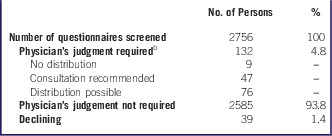
Of the 4715 persons in the area, 2756 persons answered the interview sheets and were screened (Table 1). Of these 2756 persons, 132 (4.8%) were recorded as “physician’s judgment required,” 2585 (93.8%) as “not required,” and 39 (1.4%) as “declining.” Of the 132 persons who required a physician’s judgment, 9 were judged as “no distribution,” 47 as “consultation recommended,” and 76 as “distribution possible.”
Result of Health Survey of Stable Iodine Tablets in Kagoshima PrefectureFootnote a

a Data from Miki et al, 2014.Reference Miki, Ebata and Hisadome 6
b Including those who screened positive for side effects and others who wanted a physician’s judgment.
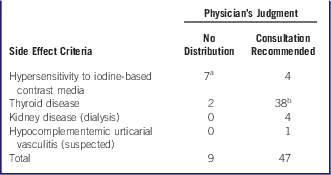
Table 2 shows the reasons physicians gave the determination of “no distribution” and “consultation recommended.” These were hypersensitivity to iodine-based contrast media in 11 cases (including 1 case of total thyroidectomy), thyroid disease in 40 cases, kidney disease in 4 cases, and hypocomplementemic urticarial vasculitis suspected in 1 case.
Physician’s Judgment on the Health Survey

a One of the 7 cases was a total thyroidectomy.
b Of the 38 cases, 1 was a case of pulmonary tuberculosis and 1 was under dialysis.
Distribution of Stable Iodine Tablets
A total of 2420 persons who completed the health survey received either one or more stable iodine tablets in the distribution meeting. Of these 2420 persons, 147 were aged from 3 to less than 13 years, and 2273 persons were aged 13 years or more.
Physicians Who Cooperated in the Pre-Distribution
The Sendai City Medical Association dispatched 2 or 3 regional physicians to an explanatory meeting. The dispatched regional physicians studied the Guidebook on Distributing and Administering Stable Iodine Tablets 7 and attended lectures given by specialists from the National Institute of Radiological Sciences (NIRS) to obtain the knowledge needed for judgment on the distribution of stable iodine tablets. The guidebook was prepared by the Japan Medical Association (JMA) and the Japan Medical Association Research Institute (JMARI), with the collaboration of the NIRS and the Japanese government.
DISCUSSION
Health Survey: Identification of Persons at Potential Risk for Side Effects
The conduct of a health survey in the process of pre-distribution is a characteristic feature of such practices in Japan. For example, a system in which vouchers for tablets are mailed to households is utilized in France, and inhabitants bring the vouchers to nearby pharmacies to receive stable iodine tablets. 8 In the United States, states conducting pre-distribution use mail delivery, with distribution at pharmacies or local government offices, but the system differs in each state depending on whether the medication is distributed in advance or after the fact. 9 Regional physicians are not involved in the process as in Japan, and health surveys are rarely conducted.
Stable iodine carries a risk of side effects, and there are certain numbers of people who will screen positive for risk criteria as shown above. In the current case of Kagoshima Prefecture, 56 persons were judged as “no distribution” and “consultation recommended.” The health survey proved meaningful to prevent misuse by people at potential risk for side effects.
Kagoshima Prefecture is proceeding with distribution to the 1354 persons who have not been screened and the inhabitants who will come under the coverage of distribution, such as children aged less than 3 years and those who will be born in the future. Recovery and re-distribution necessitated by the expiration period of 3 years for stable iodine tablets are also planned. Because a nuclear disaster is a very rare situation, people’s awareness may decline, the distribution rate may decrease, and the management system may become neglectful with the passage of time. In the case of Tennessee, which has conducted pre-distribution since 1981, the percentage of people receiving the medication decreased year by year from about 32% in 1983 to 20% in the 1980s, and almost nobody turned up to receive it in the 2000s.Reference Fowinkle, Sell and Wolle 10 These problems will be addressed in Japan, where the pre-distribution of stable iodine tablets is a new practice. To ensure quality in pre-distribution, it is necessary to develop a distribution system that can maintain inhabitants’ interests in radiation protection.
Involvement of Regional Physicians: Improvement of the Quality of Risk Communication
The involvement of physicians in pre-distribution is also a unique feature in the practice of Japan. Only brochures concerning the administration of stable iodines and nuclear safety and disaster management are sent by mail in the case of France. 11 Physicians are not involved in the process, and there are no opportunities for direct risk communication with inhabitants in the processes of pre-distribution.
The present case of pre-distribution in Kagoshima Prefecture was accompanied by the opportunities for “collective” and “individualized” risk communication between physicians and inhabitants. Collectively, all inhabitants who attended the meetings were given explanations concerning behavior in the event of a nuclear disaster, the scientific bases for radiation risk management, and the beneficial and adverse effects of stable iodine tablets. In addition, opportunities for individual consultation with physicians were given not only to the persons at potential risk for side effects but also to anyone who wanted such consultation. Through these forms of risk communication, inhabitants developed their interest in how they should act in the event of a disaster.Reference Ojino and Yoshida 12
Prior to the Fukushima Daiichi nuclear power plant accident, the explanation of stable iodide was given to inhabitants only at the time of yearly disaster drills.Reference Ojino 4 These drills were attended by only 10% to 15% of inhabitants, 13 and dissemination of knowledge about stable iodide was insufficient. At the time of the Fukushima Daiichi nuclear power plant accident, the government could not provide any sufficient information and explanation concerning the accident, radiation doses, and the health impacts of radiation exposure.Reference Ojino 4 Furthermore, the provided opinions of specialists seemed to be inconsistent.Reference Ojino 4 There was an urgent sense of tension among inhabitants, and anxiety about radiation exposure grew.Reference Ojino 4 It was difficult to accomplish effective risk communication in a situation lacking scientific bases for radiation risk management and pre-existing plans.Reference Shimura, Yamaguchi and Terada 3
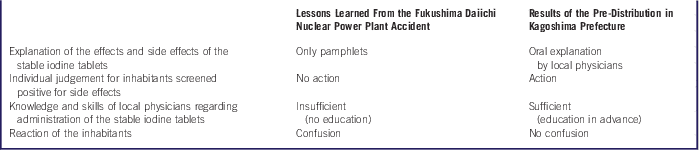
Risk communication with inhabitants has improved greatly as a result of the lessons learned from the Fukushima Daiichi nuclear power plant accident (Table 3).
Distribution of Stable Iodine Tablets: Comparison of the Pre-Distribution in Kagoshima Prefecture With the Lessons Learned From the Fukushima Accident

Physician Training
The involvement of physicians in the community in the process of pre-distribution was quite meaningful. This makes it necessary to offer continuous medical education programs to physicians so that they can make judgments on the distribution of stable iodine tablets according to the health conditions of the inhabitants.
The accident at the Fukushima Daiichi nuclear power plant revealed the inadequacy of the participation of regional physicians, whereas evacuees were anxious about the health impacts of radiation exposure.Reference Ojino 4 The regional physicians who were providing medical support to the evacuees were not able to give sufficient explanation of the health impacts of radiation exposure or protection methods.Reference Ojino 4 This was partly because the public health approach to radiation emergency medicine and training in the use of stable iodine tablets was taught in continuing education in a limited manner. Such trainings and a sufficient level of disaster information was only given in the areas near nuclear facilities, limitedly targeting the physicians at medical institutions specializing in radiation emergency medicine accepting emergency patients affected by contamination and exposure to radioactive substances.
The importance of widening the targeted group concerning radiation protection of the inhabitants was confirmed anew through the experiences of the pre-distribution program in Kagoshima Prefecture. Physicians sent from the Sendai City Medical Association worked in the process of pre-distribution. They studied the Guidebook on Distributing and Administering Stable Iodine Tablets 7 developed by JMA and JMARI and attended lectures given by a specialist from the NIRS to obtain the knowledge needed to make judgments on the distribution of stable iodine tablets. The interview survey conducted by the author with the physicians involved in pre-distributionReference Ojino and Yoshida 12 confirmed that the physician training was indispensable and the materials used in the training were effective in providing necessary knowledge.
In the event of a large-scale composite disaster, medical support must come from not only regional physicians but also the providers outside the affected area. In fact, many physicians gathered from all over the country to the areas affected by the accident at the Fukushima Daiichi nuclear power station and provided medical support to evacuees. JMA produced radiation mapsReference Nagata, Kimura and Ishii 14 and dispatched the Japan Medical Association Teams nationwide.Reference Ishii and Nagata 15 In view of these facts, it is necessary to disseminate nationwide the knowledge of radiation protection for inhabitants, including the use of stable iodine tablets, to physicians providing medical support to disaster victims, as well as those in the vicinities of nuclear power plants.
CONCLUSION
The first pre-distribution of stable iodine tablets took place in Kagoshima Prefecture to inhabitants within a radius of 5 km of nuclear facilities under the new policy of the Japanese government. The major features of the practice of pre-distribution in Japan are the conduct of a health survey and the involvement of physicians. These were found to be effective in identifying persons at potential risk for side effects, of whom a certain percentage are known to exist, and in preventing misuse of stable iodine tablets at the time of a disaster. The opportunities for collective and individualized risk communication between physicians and inhabitants of the region encouraged the inhabitants to think about their responses during a nuclear disaster based on an understanding of their health conditions. The involvement of regional physicians is an indispensable element in the pre-distribution of stable iodine tablets. Continuing medical education for these physicians enabling them to make judgments about distribution according to the health conditions of inhabitant is essential nationwide.