The miracle on the Han River.Footnote 1 From aid recipient to aid donor.Footnote 2 The story of South Korea’s rapid industrialization since the 1960s has become a textbook case of economic transformation and growth. A popular version goes like this: In 1957, South Korea had essentially the same gross domestic product (GDP) per capita as Ghana, then the richest country in sub-Saharan Africa. But then Ghana grew sluggishly for several decades, while South Korea became the thirteenth-largest economy in the world, all without the blessings of Ghana’s natural resources.Footnote 3 Though the comparison between the Republic of Korea (ROK) and Ghana was first popularized in the 1980s, it persists today: In a 2018 edition of their best-selling economics textbook, Paul Krugman and Robin Wells include an exercise that asks students to compare “growth in living standards” in Ghana and South Korea and explain “What might account for these differences?”Footnote 4 Likewise, U.S. president Barack Obama invoked South Korea as a model for Africa across his two terms, their contrast summarized in what he called a “fairly telling point”:
[W]hen my father traveled to the United States from Kenya to study [in 1959], at that time the per capita income and Gross Domestic Product of Kenya was higher than South Korea’s. Today obviously South Korea is a highly developed and relatively wealthy country, and Kenya is still struggling with deep poverty in much of the country.… Why is that?Footnote 5
At one time, historian Michael Robinson suggested, the idea of a “miracle” carried a “condescending implication that for Koreans to build an industrialized economy was a miraculous event.”Footnote 6 Today it is more likely a compliment: “What looked like a miracle was … a product of bold risk-taking, hard work, and great sacrifice over four decades,” political scientist Nae-Young Lee has written.Footnote 7
In telling this story of South Korea’s miracle, economists and policy makers have reified universalist claims of development economics. They promote South Korea as a model, suggesting that the miracle can be used as a template for industrialization in other nations, while also implying that nations that have not industrialized as successfully have somehow failed to show the grit and perseverance that South Korea did.Footnote 8 The story told about South Korea’s miracle contrasts with the more complicated narrative around Japan. Rather than holding Japan up as a model, scholars have deconstructed Japan’s Cold War economic history, suggesting that Japan’s industrial success resulted not only from hard work, risk-taking, and sacrifice, but from such factors as U.S. intervention in Japan’s political economy. Historian John Dower, for example, describes the mix of culture, politics, economics, and empire that shaped Japanese economic resurgence in Embracing Defeat. Footnote 9 Yet historians are still working to attach similarly complex narratives to the next tranche of Asian industrialization, centered on the “Four Tigers” of Hong Kong, Singapore, South Korea, and Taiwan.
Social, cultural, gender, and labor historians of South Korea, as well as many ordinary South Koreans, are laying the foundation for this necessary revision by telling the story of the miracle differently—from the bottom up. Writing from a perspective that is local and human scale, they emphasize the costs of industrialization. Families torn apart when young daughters and sons left the countryside for work in urban factories. Workers broken by grueling jobs making T-shirts or shoes or toys for export to wealthier countries. Activists crushed by an authoritarian government—until finally their resistance forced the South Korean government to change. This bottom-up narrative is also the story of South Korea’s miracle, but it is a devastating story, for this miracle demanded scars and sacrifice in return for prosperity and democracy.Footnote 10
These two narratives—the global story and the human story, the triumphant miracle and the terrible miracle—are often told separately, making it difficult to see the entire picture. On one hand, the miracle narrative flattens South Korea’s story by emphasizing the benefits of industrialization and de-emphasizing the costs. The miracle even suggests that South Korea’s example offers a recipe for economic growth, a model that is predictable and replicable. On the other hand, human stories of individual pain and collective labor organizing do not always embed South Korea in its regional and global contexts, making it difficult to put South Korea’s history into conversation with its Asian neighbors or to see how the empires that surrounded South Korea shaped its industrialization at the local level. But the two narratives are deeply connected. The struggles of women labor activists in South Korean factories shaped politico-economic stories of industrialization, while industrialization in South Korea rippled out to influence relationships between Korean Americans and African Americans in the United States.
To connect these two narratives, and to capture the complex, contingent story of the miracle, this article uses a commodity history. A commodity history builds on the interdisciplinary methods of commodity chain analysis, which aims to articulate global networks of production–distribution–consumption, and the “cultural biography of a thing,” which aims at a rich and nuanced but partial genealogy. But a commodity history goes beyond both approaches in asking that we constantly shift registers and methodologies to connect the commodity’s multiple narratives and in asking that we move boldly across time and space to connect one local context to another. A commodity history demands that we treat the commodity as an actor, like any other historical actor, because the commodity influences the lives around it and can be influenced by them, too.Footnote 11 A commodity history is well suited to telling the story of the miracle, because commodities were at the center of South Korean industrialization. When the commodity is at the center, it becomes a nexus for the many historical approaches we use to capture the complexity of industrialization, from cultural and labor history to political and economic history. Indeed, the history of capitalism demands a methodology that is just as multimodal and complex as its subject. For if what we learn from a commodity history seems complicated or tangled, that is because capitalism is itself complicated and tangled.
This article describes the history of a peculiar commodity: the South Korean wig.Footnote 12 The wig is a lens on South Korean industrialization because wigs were surprisingly important to Asian industrialization in the 1960s and 1970s, and for South Korea in particular. The wig industry began its rise when wigs appeared on Paris runway models in 1958. Soon, fashionable women in the United States were wearing wigs and hairpieces, often made in Europe from European hair. (Even Jackie Kennedy!) But as this high-fashion trend moved midmarket in the mid-1960s, both hair supplies and wig production shifted from Europe to Asia, with the wig industry powering economic growth in Hong Kong, India, Indonesia, Singapore, South Korea, and Taiwan. In these countries, the wig played a starring role in export-oriented industrialization: As a “light industry” product that was made by low-wage workers in factories with low capital investment, and sold to wealthy consumers in industrialized countries, the wig brought foreign currency into Asia’s industrializing economies and thus helped bridge the transition to more capital-intensive industries.
The wig wave crested in 1970, as wigs became a global business approaching US$1 billion in revenue, and one especially important to South Korea: as South Korea’s number two export, wigs employed tens of thousands of workers, and wig shipments fueled the takeoff of the country’s air cargo industry. Success also flowed across the Pacific: When Koreans migrated to the United States after 1965, as many as one in ten of the businesses they started was a wig business. But once wigs became cheap and ubiquitous, their accessibility made them less fashionable, and the wig wave crashed in the early 1970s, shrinking from a mass market of nearly 40 percent of U.S. women to a core market of African American women. By sticking with this African American market, Korean Americans came to dominate the U.S. wig and beauty supply industry in the 1970s and still own much of the industry today.Footnote 13
The wig’s history is a “thick” commodity history: Its story reshapes our understanding of labor and gender history, foreign policy and Cold War history, and histories of ethnicity and race just as much as it reshapes the history of capitalism. Economic history meets gender and labor history in a factory in Seoul; business history meets migration and race history in a Korean American storefront in Los Angeles. The wig offers a productive site for this “thick” narrative because the wig connected to so many lives. The wig started as hair on the head of a Korean villager, but transformed into raw material in the hands of a Seoul factory worker, then became a product on the shelves of a Korean American store owner, and finally was a wig on the head of an African American woman. It was an object that circulated globally, moving along transnational, neo-imperial, transoceanic networks, but it also revealed how people, capital, and ideas circulated alongside the commodity, with all of their “lives” intertwined. The day-to-day experience of South Korea’s wig factory workers revealed the boundaries of the U.S. Cold War empire in Asia, just as South Korea’s export-oriented economy framed the relationship between Korean American wig entrepreneurs and African American wig customers. In other words, this almost-forgotten commodity was actually at the center of a complex set of networks. And when we follow its story from village to factory to shelf, we can see how these networks connect through the wig, and connect in ways we would not expect.
Through the commodity history of the wig, we can see the commodity itself differently: not as a thing that moved inexorably forward, stripped clean of its past identities whenever it transformed, but instead as a node where people connected across time and space. And through the commodity history of the wig, we can see Asian industrialization differently: not as a model or recipe but as a kaleidoscopic story of gendered work, class solidarity, racialized hair, and trans-Pacific connections, all conducted under the sheltering umbrella of U.S. Cold War empire. And now, to demystify the miracle, we will follow the story of the South Korean wig.
Transforming Bodies into Hair
Before it was a wig it was hair, growing from the heads of women and girls across South Korea. Above all, hair is messy—it can be a body part, a thing, and a commodity all at once. Hair contradicts itself like a cowlick: It sprouts as a sign of vitality but is also a collection of dead cells that can be chopped, torched, or bleached. Hair is so sacred it is liminal, marking our personal transformations: It can be cut to begin a new life or a new year, shaved off to mourn a death in the family, or covered to honor a marriage. Hair is all the messy things we are.Footnote 14
In the context of wigs, hair is part of the South Korean developmental mythology, entwined with the story of South Korea’s progress from preindustrial to industrialized to postindustrial. For hair, the trajectory runs like this: In the early 1960s, Korean hair was merely a raw material, exported to other (industrialized) countries because it could not be used at home. But by the mid-1960s, as a Korean wig industry developed, Korean hair became an input for homegrown factories. And by the late 1960s, South Korean wig factories used mostly foreign hair, as the country had become wealthy enough and the wig industry large enough that Korean hair was no longer a viable raw material. As journalist Sangju Bak put it, “You can say that the myth of South Korean exports grew out of wigs made from the hair of our grandmothers, mothers, and sisters.”Footnote 15 Under the mythology of modernization, a country that collected hair for industry was a country that lagged behind, so backward it devoured its national body not by working its people to the bone in factories, as an industrialized country would, but instead by cannibalizing their hair. “A country of hair,” as newspaper Chosun Ilbo called South Korea in December 1966, was a country so poor that nothing could be wasted.Footnote 16 Subok Kim remembers: Kim was young in the 1960s, and he recalls how difficult it was to get through early spring in South Korea—when families had worked through their winter food supplies and anxiously awaited the first harvest. During these lean times, Kim’s family and friends eagerly welcomed the hair collector to town, hoping the hair on their heads could transform into sustenance. Back then, “Hair was almost like cash,” Kim recalled, as a body part was converted into an industrial input, and at the same time, the women who sold their hair became entangled in the cash economy.Footnote 17
In the countryside, hair collectors were often traveling peddlers (bangmul jangsu) who moved from town to town trading cheap goods. Some peddlers offered cash but others bartered: If you heard scissors clanking, you would know a yeot peddler was coming, ready to trade a hand-snipped piece of Korean taffy for your hair. As grandmothers, aunts, and sisters went out to get their hair cut, friends gathered to kibitz, advising how to style the cut to conceal the hair that was removed. After a year of growth, a woman’s bun would be about the size of a big apple, Kim recalls; as a child, he was “perplexed to see how small the hair had become” after the spring hair harvest.Footnote 18
The height of the Korean hair business was the 1960s. During that decade, hair grew from a tease—in 1962, only 11 metric tons of human hair were exported, worth US$92,000—to a pompadour—in 1964, 474 metric tons were exported, worth US$3.4 million. As prices approached US$30 per kilogram for top-quality Korean hair in 1966, one newspaper article suggested that a long-haired girl—able to offer 5 inches of hair at least— might get as much as ₩500, or almost US$2, for her locks. With so much cash in every coif, amazing stories circulated about hair windfalls. A woman paid for her mother’s medical bills with a haircut. A son enjoyed the luxury of eating white rice thanks to his mother’s tonsorial sacrifice.Footnote 19 One journalist warned that the transformation of hair into cash could work both ways, however, with Koreans commoditizing women’s bodies. The journalist mentioned one horrifying example: in 1966, a thirteen-year-old girl murdered her six-year-old friend as she stole her friend’s hair to sell it. After the teen’s arrest, her photo appeared in the newspaper, her long hair draped in front of her face, shielding her identity.Footnote 20
By listening to the people who sold their hair, however, we can complicate this interpretation. When things become commodities, they are never transformed fully from one thing into another. Nor do commodities toggle between A and B, existing as body part or raw material. Instead they are both things at once: When hair is exposed to a market for industrial inputs, it is both raw material and body part. (And then three things, and four, and on through the multiplicity of commodity transformations.) Hair vendors might try to strip identities away from the hair they collected, transforming part of a person into an impersonal input. But hair was still a body part, connected to a South Korean woman or girl. Hair did not have a single life but rather many accumulating lives: The women and girls who sold their hair continued to live alongside industrialized hair, haunting it even as it was stitched into wigs.
Moreover, those women and girls resisted their own backward commoditization, the process in which their personhood was threatened by their hair’s denomination in Korean won, as well as their hair’s alienation from their bodies. Subok Kim remembers: When the women in his family had their hair cut, they often recruited other villagers to do the cutting rather than the traveling barber because only a friend or relative could be trusted to shrink a bun into a bump. Women did not cut their hair because they valued money more than beauty or identity; they cut it knowing they could conceal what they had lost. A woman who sacrificed her hair made an offering that helped her family regenerate during the foodless days of early spring.
Transforming Raw Material into Industrial Export
Once hair was collected in villages and barber shops, it was sold first to hair wholesalers then to wig factories, as hair transformed into raw industrial input and again into a finished export product and thus fuel for South Korean industrialization. In contemporaneous 1960s interviews and more recent oral histories, ROK government officials and Korean factory owners often took credit for these transformations and the value they created. Sometimes, however, they hinted at a more complex story in which their individual entrepreneurial efforts succeeded because they aligned with broader Cold War politics. This section will interrogate these narratives of industrialization, arguing that the South Korean wig industry rose to prominence thanks to Cold War interventions in the wig market. Because the Cold War structured many of South Korea’s other light industries in the 1960s, the case of the wig industry suggests that the ROK may be a flawed template for industrialization in today’s post–Cold War world.
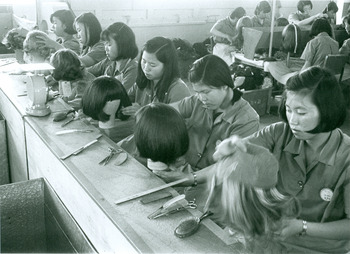
In 1967, wig entrepreneur Joon-Gyu Choi told his story. In February 1963, Choi was working for Daehan Trading Company, a business that exported Korean pork and marine products. Traveling in Japan and Hong Kong on a trip to drum up trade with overseas customers, he came across the burgeoning Hong Kong wig industry. Choi saw potential in the wig business—and he was right to see it, for within two years Hong Kong’s industry had become the global leader in wig production.Footnote 21 Choi returned to South Korea and plotted his entry into the wig market. In January 1964, he sent four apprentices to Japan to learn the wig trade; and by the end of 1964, Choi’s Seoul Trading Company became the first Korean wig business to produce for export, tallying US$137,000 in revenues for the year.Footnote 22 Business grew quickly: By 1967, Seoul Trading had a US$6 million target—making it the largest wig exporter in South Korea,Footnote 23 a title it claimed into the 1970s (see Figure 1).Footnote 24
Putting the finishing touches on wigs at the Seoul Trading Company factory in Seoul, South Korea, in May 1970.
Source: Courtesy of World Bank Group Archives, file unit 1894103.

In that 1967 interview, Choi said, “People might say I’m lying if I told them I had earned US$10 million from collecting hair that has no use.” Here, Choi obscured the old, embodied life of hair by describing it as “hair that has no use,” disembodied and stripped of gender. Before Choi launched South Korea’s wig industry, he suggested, most hair cuttings or combings had been burned or thrown in the trash. Hair was worth only pocket change to the women who sold it and the yeot peddlers who collected it, while hair wholesalers and wig manufacturers made the real money. In this telling, Choi seemed actually to create the value of discarded hair.Footnote 25
We can also read Choi’s story as a more complicated parable of modernity, in which the wig industry is a synecdoche for the broader transformation of the South Korean economy: A poor country that exported “primary commodities” such as sugar or tungsten or hair became a country on the rise, exporting low-capital, high-labor “light industry” products, such as clothing or wigs; then a “heavy industry” power, exporting complicated, capital-intensive products such as chemicals and cars; and finally a postindustrial power that profited from intellectual capital (K-pop) and strategic control of globally dispersed supply chains (Samsung).
This narrative of progress aligns with more schematic versions of developmentalist economic thought from the 1960s, especially the model pushed by U.S. economic advisors in Asia in the 1960s. This model was often rooted in the thinking of Kennedy administration economist Walt W. Rostow’s model of “stages of economic growth.” Rostow’s model (and other similar developmental modelsFootnote 26) held sway among U.S. and Asian economists and bureaucrats working to produce economic growth in Tokyo, Seoul, and Taipei. Rostow argued that national economies moved through “stages” of industrialization—starting with a “traditional society” in which production was labor-intensive; moving to a society with “preconditions” for growth, meaning receptiveness to the political, cultural, and economic upheaval that accompanied industrialization; into a stage of “takeoff,” wherein growth is quick and sustained in a few focused industrial sectors that grow using “modern industrial techniques”; then on to “maturity,” with all key industries using modern technology; and finally transitioning into an economy in which technology extension was no longer the nation’s chief goal. Footnote 27 Choi’s personal story seemed a Rostovian model in miniature. To start his wig business, Choi moved from a trading company that exported unprocessed commodities to a classic takeoff industry that required some technological know-how but was also seen as a stepping-stone to higher-skill industries. In Choi’s story, Japanese wig firms provided the expertise to build Seoul Trading’s capabilities, as Choi’s apprentices began the process of transferring the wig industry from Japan to South Korea. (We can also wonder: Were these postcolonial Japan–ROK transits eased by connections forged during the period of Japanese colonialism in Korea?)
As economists have revised these models, describing Asian industrialization as far more complex than a takeoff or miracle led by a national government, ordinary South Koreans have made the same point. Because they are not working to define a singular Rostovian model of success, they tell stories in which everyone from entry-level factory workers to top government officials helped to shape industrialization. Because many dealt with trading partners from around the world, their stories embed South Korea’s growth in a global, Cold War context. And because they witnessed the everyday challenges of industrialization, whether from a corner office or a factory floor, they observed how South Korea’s transformation was shaped not simply by skill and hard work but also by luck, accident, and failure.
ROK economic official Wonchul Oh also remembered the early days of Choi’s Seoul Trading Company. In early summer of 1965, Oh recalled, he witnessed a meeting between Choi and South Korea’s Commerce and Industry Minister Chung Hoon Park. It had been only a few months since Seoul Trading had started to produce wigs for export, and the wig business was still unfamiliar to the Commerce and Industry Ministry. In the meeting, Choi presented several wads of strangely colored material for inspection, explaining to incredulous officials that they held Korean hair in their hands—hair that started out black but was bleached and dyed into a variety of fashionable colors.Footnote 28 South Korea had been exporting raw hair as a commodity, Choi continued, but if South Koreans exported finished wigs rather than raw hair, export revenues could double or triple. “Wig-making is completely manual work,” Choi said, arguing that South Korea could compete against more established Hong Kong and Japan, because “we have abundant labor power.” Choi noted that in the United States, wigs were becoming “daily necessities” and were especially popular among African American women. Finally, the minister asked how the South Korean government could help, and Choi replied: “By prohibiting the export of hair.”Footnote 29
Oh’s story suggests how the wig industry, like many South Korean industries, grew through aggressive ROK government intervention, in line with the politico-economic theory of the “developmental state.”Footnote 30 When South Korea’s wig industry was starting out in the mid-1960s, the government granted exclusive export rights to Seoul Trading to maintain high levels of quality, protecting the future reputation of the wig industry. As the industry began takeoff in 1967, the government stepped in again to shut down nineteen out of sixty-nine exporters, stabilizing the industry, and also established a “check price” system to prevent destructive competition. The government designated wigs as an export-specializing industry, which qualified wig manufacturers for tax credits; supported research, development, and training programs; and instituted an official inspection regime to ensure high quality. When the wig market was glutted by cheap wigs from Hong Kong in 1969 and again in 1970, South Korea’s government-imposed limits prevented the implosion of the industry.Footnote 31
Yet stories told by ordinary South Koreans also push beyond Rostow. They suggest that South Korea’s success in the wig industry resulted not only from national economic policy but from South Korea’s position as a client state within the U.S. Cold War empire—a key player within a network anchored by Japan but reinforced by U.S. allies such as Taiwan. Scholars have made this same point, arguing that planned U.S. economic and military interventions were key to Asian industrialization and that nascent Asian industries were sheltered by the U.S. Cold War umbrella.Footnote 32 The wig’s case supports their conclusions, but it also suggests a slightly different point: that unplanned Cold War interventions could sometimes be more influential than planned interventions. Thus, in November 1965, the global wig industry was suddenly restructured by the U.S. Treasury Department’s Office of Foreign Assets Control when Treasury placed a surprise embargo on “Asiatic hair.”Footnote 33 It was a Cold War intervention that had unintentional effects: Though Treasury bureaucrats targeted Communist China’s hair industry, their embargo also decimated Hong Kong’s wig industry and jumpstarted the South Korean wig industry.
When the wig market first exploded during the early 1960s, European sources ran low on hair, and wigmakers began to source hair from China instead. For 1965, Treasury officials estimated that Chinese communists would earn US$6 million or more in U.S. currency from sales of hair for wigs; and in a year when Chinese troops had been dispatched to Vietnam, they believed that this currency flow needed to stop. In the minds of these Treasury bureaucrats, the embargo seemed an obvious solution: it was an expansion of an existing U.S. embargo against Chinese goods, imposed in 1950 as a response to China’s full participation in the Korean War. (The Korean War embargo, in turn, had been authorized under World War I’s Trading with the Enemy Act in 1917, revealing how the near-constant U.S. state of emergency enabled economic and political control of the U.S. empire.Footnote 34) While top U.S. officials from the White House on down had long believed that the embargo against China was ineffective or even counterproductive, Treasury Department bureaucrats instead pursued their narrow goal of cutting off foreign currency to China. As the United States fought its long Cold War across Asia, it left the field littered with economic weapons like the embargo; occasionally, someone would pick up those weapons and fire a shot.Footnote 35
If the hair embargo was a Cold War intervention, it was also a racialized intervention. When U.S. Treasury officials wrote the embargo to target “Asiatic” hair, they revived a racial categorization first institutionalized in 1913. It distinguished between “hair,” understood as European hair meant for high-fashion wigs, and “Asiatic hair,” understood as Chinese hair meant for cheap wigs and hairnets.Footnote 36 When U.S. officials attempted to implement these racial distinctions in 1965, however, they ran into several problems, rooted in the idea that customs inspectors were supposed to distinguish Asiatic from non-Asiatic hair simply by look and touch. First was deciding which countries were Asiatic—was the Philippines Asiatic? Was Indonesia? India? Lebanon? (Yes, yes, no, no, Treasury said.) Over the next two years, Treasury rulings remapped Asia through its hair, revealing how geopolitics conflicted with race as the United States stitched together its Cold War trading network. A more fundamental problem cropped up when Treasury ruled that hair from U.S.-allied countries could be used in wigs regardless of whether it was “Asiatic,” so long as it was guaranteed to be from a non-communist source. The ruling asked customs inspectors to do the impossible, distinguishing between hair from Communist China and hair from Hong Kong or Taiwan. Treasury’s solution was to require wigmakers to track hair from head to factory to U.S. shores—and thus build an intrusive system to surveil the global commodity chain. Here, the wig’s past lives haunted its present: Though wigmakers tried to conceal the Asian origins of the hair they used, the embargo meant that they had to trace that hair back to the Korean women it came from.Footnote 37
As economic official Oh described it, the U.S. embargo was “manna from heaven” for South Korea, helping ROK wigmakers to leapfrog past industry leader Hong Kong for a critical half-year period in 1966.Footnote 38 It was South Korea’s homegrown hair industry that enabled it to take advantage of the embargo. In 1965, most wig producers sourced hair from China; so before they could export wigs again, they needed to establish a supply of hair that was acceptable under the U.S. inspection process. Over the next few years, India and Indonesia became the leading hair sources for these producers, but only after they painstakingly reconstructed their global hair supply chains. South Korea, by contrast, had ample supplies at home—a supply that was further guaranteed in July 1966 when the South Korean government banned domestic hair exports to other countries, just as wigmaker Choi had recommended. The result: South Korean hair accounted for 100 percent of the hair used in South Korean wigs in 1966, and more than 90 percent in 1967.Footnote 39
While in 1965 the ROK’s US$1.85 million in wig exports had accounted for 5 percent of the global market, compared with Hong Kong’s 45 percent plurality share, in 1966 South Korea shipped almost US$11 million in wigs to the United States, with exports increasing almost 700 percent in a year.Footnote 40 Though the Hong Kong wig industry recovered by the end of 1966 and led global wig exports again in 1967, the door had opened to South Korean wigs. By 1971, South Korea overtook Hong Kong to become the global wig export leader, with Hong Kong never to regain the number one spot.Footnote 41
South Korea thus was the beneficiary and Hong Kong the victim of Cold War power politics played between the United States and China. Moreover, Cold War success stories repeated across a series of South Korean industries: The Vietnam War helped the South Korean economy achieve takeoff not only for wigs but also for shoes, textiles, cement, plywood, and automobiles, when contracts to supply goods to the United States in Vietnam jumpstarted South Korean industries just as Korean War contracts with the United States had jumpstarted Japanese industries. Certainly, wigs were a peculiar version of a Cold War commodity—but in being peculiar, they reveal how the Cold War reached even the most obscure corners of the economy. Under this totalizing logic, in which every last penny was critical to Cold War accounting, minor U.S. Treasury bureaucrats could restructure global markets on a whim.Footnote 42
The wig embargo also aligned with more direct U.S. attempts to spur economic development in the region, attempts that aimed to transform South Korea into a Cold War “model” for the U.S. politico-economic system, as historian Gregg Andrew Brazinsky has suggested. Indeed, in the 1960s, U.S.–ROK cooperation was so tight as to seem unprecedented to experienced observers. When the Park administration’s export promotion subcommittee selected wigs as one of several priority industries, Park’s Light Industry Working Task Force began to work with representatives from the USAID Mission in Seoul and the U.S. commercial attaché to link U.S. wig buyers with Korean entrepreneurs. USAID also invited U.S. department store buyers to visit South Korea and sent Korean executives to the United States; facilitated U.S. investment in Korean wig firms; encouraged members of the U.S. wig industry to offer technical guidance; and in the late 1960s, when the Korean wig industry’s needs finally outstripped its domestic supplies of raw hair, the United States advised India in developing its hair export industry, which became South Korea’s biggest source of hair. The embargo supercharged these piecemeal interventions by creating and guaranteeing a place within the U.S. economic network for the ROK wig industry. The embargo offered preferential access to the U.S. market: Between 1966 and 1969, the United States received more than 95 percent of South Korea’s wig exports. (For comparison, in 1965, before the embargo, the United States purchased 97 percent of Hong Kong wig exports; in 1966, that number fell to 73 percent and declined steadily afterward.)Footnote 43
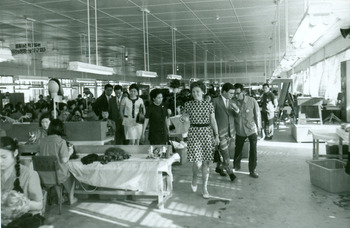
By 1970, the wig industry had become a model of South Korean industrialization, as ROK officials took VIPs and foreign visitors on tours of the massive Seoul Trading wig factory. In that year, Wonchul Oh escorted Margaret McNamara, wife of then-World Bank president Robert McNamara, around the factory floor (see Figure 2). Oh recalled:
As soon as she stepped into the factory, she stopped walking, looking shocked. She seemed to be wondering, “How is this possible?” When she heard that she was visiting a wig factory, she expected to see 10 or so middle-aged handicraft workers…. So she could not help but be astonished to see almost 1,000 young women at work.
Oh marveled too: “How dexterous Korean women are, how nimble their fingers,” he wrote, for “their skill at sewing each strand of hair onto the fabric was like magic.”Footnote 44
Margaret McNamara tours the massive Seoul Trading Company factory in Seoul, South Korea, in May 1970.
Source: Courtesy of World Bank Group Archives, file unit 1894103.

Transforming Donors into Workers and People into Hands
For all of the big picture transformations it embodied, the almost magical shift from hair to wigs also effected a deeper societal transformation, weaving hair-growing women into the fabric of industrial South Korea: First by converting their lives, paced by the seemingly premodern timelines that permitted them to grow long, luxurious tresses, into modern foreign currency; and second by attracting many of those same women to Seoul and other big cities for stints as wig factory workers.Footnote 45 Soon Young Choi remembers. In 1970, Choi moved to Seoul from Gangwon Province in order to make money for her family. She first found work in a sock-dyeing factory, but soon switched to one of South Korea’s most successful companies, YH Trading.Footnote 46
In 1970, YH Trading was at its height, boasting four thousand workers and a massive 70,000-square-foot factory. Founder Yong Ho Jang was even awarded a medal by the Park administration in recognition of YH Trading’s US$10 million in total exports.Footnote 47 By then, Choi was nineteen years old but an experienced worker; as an apprentice at the wig factory, she made about ₩2,500 per week, the equivalent of around US$50 in 2018 dollars—a good wage for a female worker in Seoul.Footnote 48 In a recent oral history interview, Choi said that working in a wig factory felt like being in the military—it was regimented and grueling. Though work officially began at 8 a.m., workers started on the assembly line a half hour before that, settling in for what could be fifteen-hour days, broken up by a lunchtime sprint home for a bowl of rice.Footnote 49
Though the YH factory had an unusually large number of workers, its grim working conditions were typical for South Korean light industry in 1970. And outside the factory, life was not much easier for the workers. Choi lived in a local rooming house crammed with women. It was so crowded that she and her coworkers had to “knife sleep” (kaljam), packed in side by side like sardines. Even in winter she could see the stars through holes in her door; outside, a smelly stream ran by. Eventually, YH built some shabby dormitories, but they felt even shabbier next to the clean, modern factory.Footnote 50
In interviews and oral histories, South Korean factory workers tell a story that differs from the developmental narrative. Popular narratives of worker sacrifice for economic growth, such as South Korea’s recent blockbuster film Ode to My Father (Gukjesijang), can sometimes frame the worker’s sacrifice as transactional, with an individual’s body offered on behalf of the nation’s.Footnote 51 But Korean workers, whether in wigs or in other light industries, have developed an alternative set of touchstones that supplement and often contrast with whiggish, transactive stories. When workers stayed late into the night, for example, they sometimes received a bonus from the factory: Full Moon bread (boleumdal ppang), a cheap, packaged sponge cake meant to sustain workers during their overtime. Choi recalled that one of her coworkers tried to gather packages of the bread so workers could send them home to family. In a way, Choi noted, it was a kind of gye, a rotating savings and credit pool. But instead of pooling cash as in the usual gye, women pooled the food they needed to sustain them past 10 p.m.—a gye of aching muscles and growling stomachs.Footnote 52
Another common experience for 1960s workers was being recruited from a village for work in the big city. And during the height of the wig boom, a disproportionate number of migrants were young women and girls like those who worked in wig factories: As Mikyoung Kim has noted, about 40 percent of the people who migrated from the countryside to Korean cities between 1966 and 1970 were women and girls aged fifteen to twenty-four; while from 1971 to 1975, they comprised almost 50 percent of the total.Footnote 53 (Similarly, it was mostly girls and young women who worked in wig factories: for example, in 1968 Bando Trading Company’s wig factory in Pusan tallied 550 workers, of whom 400 were women.) Jobs were specialized not only because some required more skill and others less but also so it would be difficult for workers to take their knowledge to a competitor. Different sets of workers would wash hair; then dry it; comb or “hackle” it to remove the knots; bleach it; dye it; dry it; stitch it into fabric caps, either by hand or by machine; style it into a wig; inspect it; and package it for shipment. Factory work thus put another spin on the commodity fetish: a disassembly of the woman’s body in service of commodity production. As women were cut off from their families, their hometowns, and even the full understanding of their work, they transformed from working women into nimble hands stationed along an assembly line.Footnote 54 This process of disassembly was spelled out for workers in black and white: Factory owners placed didactic signs around the work space to encourage productivity, with slogans that made workers and machines seem interchangeable. In one wig factory, a sign read: “The sewing machine is your second life—so polish and oil it as if it were your own life”—a message transforming the individual worker’s sweat into the collective lifeblood of the factory.Footnote 55
The tension between developmental narrative and worker’s story can be seen in U.S. journalist Howard Sochurek’s 1969 article in National Geographic. To document South Korea’s transformation from a “shattered shell” after the Korean War to a “new and modern” country thanks to “native energy and foreign aid,” Sochurek sought the opinion of Lee Byung-chul, chair of Samsung. A cigar-puffing Lee credited President Park for the country’s miraculous industrialization: “He has built up the people’s confidence in themselves,” Lee said. But, Sochurek wrote, “It was, in fact, a child who completed my economics lesson.” In a Seoul wig factory, he interviewed “a thin girl from a country village” who had “been sent to town from her village only a short time before.” When the journalist asked if she enjoyed her “new life,” making ₩9,000 (US$33) per month, “A small, sad tear trickled down her cheek.” As the journalist considered the girl’s life in the factory—crafting wigs that South Korea sold for US$9 wholesale but retailers in the United States sold for US$50 or more—“The thought crossed my mind that she might have made one of the wigs I had seen on fashionable women at New York social affairs,” he wrote. But having broken through the commodity fetish to see the worker behind the wig, he then fell back on a developmentalist logic: “In time, I knew she would grow out of her homesickness,” he wrote, explaining the girl’s tears. If she returned to her village, he suggested, she would be stuck in an arranged marriage; in the city, “she might have the opportunity to find her own mate.” Here, Sochurek told a myth of multiple transformations: village to city, worker to wife, and most of all backward to modern. Sochurek’s story created what we might call an imperial commodity fetish—a myth that used forgetting to reinforce both authoritarian control of South Korea and the U.S. legitimacy there.Footnote 56
In industrializing Korea, a wig worker’s tears might seem only temporary, caused by the growing pains of modernization. But instead it was the wig boom that was temporary and the pain of dislocation that lasted. In 1970, the global wig industry had a banner year, posting its highest-ever revenues—good enough to employ almost 31,000 workers in Hong Kong and almost 33,000 in South Korea. By December 1970, however, the wig industry had collapsed. The Hong Kong industry was in ruins, with wigmakers abandoning wigs for textiles or electronics; but though the collapse was almost as dramatic in South Korea, many Koreans stuck with the wig industry for the next decade, even as their investors and workers bore steep losses. YH Trading was one company that stuck it out through much of the 1970s—with disastrous results.Footnote 57
As the wig industry consolidated during the early 1970s, wages fell from some of the highest in South Korean light industry to some of the lowest.Footnote 58 It was no coincidence that as the rising South Korean labor movement became increasingly active in the mid-1970s, it targeted the wig industry. In 1975, YH wig workers went on strike, forming a union to protest changes in managerial and working conditions. One wig worker who joined the strike remembered her work this way:
We in the drying department were in charge of rolling hair on iron bars [to dry it]. After working a full day, our shoulders hurt as if they were about to collapse. We used to say that when we died, our shoulders would rot before any other part. At an age when we would have been studying and dreaming about the future if we had been born into a rich family, we worked so hard to earn money, but our wages were so meager. Even after working our asses off for a month, we sighed at our monthly pay and were afraid of payday.Footnote 59
Thanks to the continuing decline of the wig industry and the flight of the company’s leadership and capital to the United States, YH Trading went bankrupt in 1979. In August, management shuttered the factory and fired its workers. “The unilateral shut down was the same as telling me to give up on life,” one female worker recalled.Footnote 60 About two hundred workers launched a protest against the company to recover back wages, supported by Kim Young Sam, leader of the opposition New Democratic Party. A police crackdown against the protest turned violent, resulting in the death of one worker and a surge in support for the broader protest movement against President Park Chung Hee. Within weeks, the Park administration was destabilized; and in October 1979, Park was assassinated over dinner by the director of the Korean CIA, an action that may have been prompted partly by disagreements over how to handle the protests.Footnote 61
When South Korean readers encounter Soon Young Choi’s oral history, it may conjure images of striking YH workers. For these readers, the pain of rotting shoulders and the shock of dying bodies help to crack the myths of industrialization and expose the secrets of empire they conceal. Yet such myths fractured only as the global wig market collapsed and worker action in South Korea became more common. Work at a wig factory produced not only wigs but also awareness and activism. Knife sleeping, crammed into a bed; pooling bread into a gye; laboring long hours to help your family and friends—work in a wig factory produced a politics of solidarity.
In Soon Young Choi’s case, literally so: Having headed the union for YH workers in the 1970s, Choi was well positioned to become a deputy of the Democratic Labor Party and was elected to South Korea’s National Assembly in 2004. That year, Choi wrote a scathing letter addressed to Park Geun-hye. Park, who served as president of South Korea from 2013 to 2017, was then a member of the National Assembly and the head of the Grand National Party. In the letter, Choi remembered her youth as a wig worker at YH, when she happened to see Park Geun-hye on TV. (As the daughter of President Park Chung Hee and de facto First Lady of South Korea, Park was a public face of the Park administration in the 1970s.) Choi wrote to daughter Park:
That was the first time I saw your face, full of composure and intelligence on television. I thought your name was “Yeongae” and your brother’s name was “Yeongsik.” After contemplating the difference between “yeongae” Park Geun-hye and “gongsuni” Soon-young, I came to realize that my belief that anyone with ability could live comfortably and be treated equally was wrong.
Choi considered how she and Park, young women only one year apart in age, could carry such different nicknames: while yeongae was an honorific for daughter, gongsuni was a disparaging term for a “factory girl.”Footnote 62 In her letter, Choi argued that gongsuni like herself, along with other ordinary farmers and workers like Choi’s father, had sacrificed themselves to transform the country but had received little credit or respect. Thanks to her transformation through union activism and her rising power through political activism, however, that had changed. Choi concluded her letter: “As I witness the arrival of the era of ‘gongsuni’ and ‘gongdoli’ [factory boy] in politics, I feel that the sweat and tears of my youth three decades ago were worthwhile.”Footnote 63
Transforming Immigrants into Entrepreneurs
Once the wig moved through workers’ hands, it was packed and flown to the United States for sale. As it transformed from export product to retail fashion item and flew from South Korea to the United States, the wig again seemed to take on a life of its own, this time as a symbol of the successful immigrant entrepreneur. But again the wig’s past lives intruded on this whiggish narrative, revealing how Korean American lives were shaped from the top down by Cold War politics and from the bottom up by the challenges of entrepreneurialism in African American neighborhoods.
Korean Americans have a reputation as entrepreneurs: In the 1980s, about one out of every three Korean immigrant families worked in a small business, and Korean Americans still have one of the highest rates of entrepreneurship of any immigrant group in the United States.Footnote 64 When Korean immigrants arrived in the United States during the late 1960s and throughout the 1970s, many came as white-collar professionals or students. But as economic and social pressures transformed many of them into blue-collar entrepreneurs, “wig retailing became the most prevalent business,” sociologists Ku-Sup Chin, In-Jin Yoon, and David Smith have written. They report that as of 1975, more than one of every ten Korean American businesses in Los Angeles was a wig shop. At the same time, 90 percent of wig shops in LA were owned by Koreans/Korean Americans.Footnote 65 The connection between Korean Americans and hair persists: In 2014, there were an estimated 8,500 Korean American beauty supply stores in the United States.Footnote 66
When Korean Americans explain how wig stores became stepping-stones to success, they tell stories of backbreaking, endless hard work. But like the factory owners and assembly line workers before them, their success was also structured by the Cold War relationship between the United States and South Korea. In an interview with writer/activist Al Santoli, wig entrepreneur Cha Ok Kim told his story. Kim was born in 1935 but was orphaned by the time of the Korean War, and to survive, he and his older brother became peddlers in their hometown, selling cigarettes and scarves on the street. After moving to Gwangju, Kim continued to scramble for work. While Kim was working at a bakery, fortune struck. Some students visiting the bakery took a shine to him and tutored him until he passed the high school entrance exam. From there he made it to Chung-Ang University in Seoul, graduating in 1961 with an international relations degree. After graduation, Kim joined the ROK Army and was assigned to the Korean Augmentation to the United States Army (KATUSA), a program in which South Korean soldiers served alongside U.S. soldiers. When Kim left KATUSA, he continued to work with people from the United States as an employee of the Korean Defense Ministry while studying for a master’s degree in international relations, which he completed in 1967. “Some of my American friends and people in the Korean government suggested that I go to the United States to continue my studies,” he recalled. “My dream was to become a university professor.”Footnote 67
In 1971, Kim and his wife, Min Cha, migrated to the United States. Their move was possible thanks to an overhaul of U.S. immigration law in 1965. For much of the twentieth century, U.S. law had favored immigration from northwestern Europe while heavily restricting or barring immigration from other regions, including Asia. The 1965 revisions reopened U.S. borders to large numbers of Asian immigrants, albeit with a preference for skilled immigrants and the families of immigrants.Footnote 68 Min Cha, a pharmacist, received a visa as a skilled and desirable employee; Cha Ok was admitted as her spouse. Cha Ok’s goal was to study international relations in New York, but financial problems and Min Cha’s unexpected pregnancy led them to revise their plans. When Min Cha’s pregnancy prevented her from working, Cha Ok took a job at a textile factory. But as the family struggled on his US$2 per hour job, he began to sell wigs on weekends, setting off each morning for Harlem or Brooklyn shouldering a cloth bag filled with dozens of wigs. His weekend work quickly became his only job: “In one day of selling wigs I could make as much money as one week in the factory,” he remembered. “So I left the textile job.”
Building on his success in New York City, Cha Ok began to sell across the country, from Philadelphia to Detroit—in “the black neighborhoods, where people appreciated our low-cost merchandise.” He peddled wigs everywhere: in parking lots outside factories, as people left work; in hospital lobbies, diverting nurses from their patients; even to members of a funeral procession. Min Cha, meanwhile, worked from home, managing inventory and mailing wigs ahead to new cities for her itinerant husband. After Cha Ok had peddled successfully for a few months, he and Min Cha set up a permanent wholesale business. Though their dreams were diverted—Min Cha never resumed her career as a pharmacist, while Cha Ok’s New York University master’s degree drained the family’s savings—they built beyond wigs into a thriving, diverse wholesale business with more than US$4 million in annual revenues, selling belts, toys, and gloves imported from across Asia—immigrants transformed into entrepreneurs.Footnote 69
Korean American dominance of the U.S. wig market was built on sweat: seven-day work weeks plus a few hours of sleep stolen on backroom floors or at highway rest stops. But Korean American success also was intimately entangled with empire, as Korean and Korean American customer relationships, trading routes, and access to capital were structured by racialized, imperial connections. Consider how the Kims came to the United States. We can start with immigration laws: The 1965 Immigration and Nationality Act was Cold War legislation, aimed in part at countering Soviet critiques of U.S. hypocrisy by bringing U.S. immigration policy into line with its rhetoric of freedom and equality. But even before the 1965 immigration revisions, Cold War military ties between the United States and South Korea helped to channel Cha Ok’s migration. Since the end of World War II, the U.S. military has been deeply entrenched in South Korea, and since the Korean War, South Korean and U.S. troops have served side by side, as the United States embedded South Korean nationals with U.S. Army divisions in the KATUSA program. The program continues today, with ROK soldiers such as Cha Ok wearing U.S. uniforms, honing their English, and making U.S. contacts. The KATUSA experience helped Cha Ok to envision a move to the United States; for other Koreans, such visions also emerged from their interactions at and around the dozens of U.S. military bases that studded South Korea. (And remain today: In 2019, tens of thousands of U.S. troops were stationed across more than twenty bases in South Korea.Footnote 70) Connections between the United States and South Korea also grew stronger during the Vietnam War, as South Korea became the most ardent U.S. ally—indeed, the only U.S. ally to send substantial military assistance, offering two infantry divisions plus some support troops in return for fulfillment of an ROK wish list of security guarantees, payments, and concessions for supply contracts in Vietnam.Footnote 71 These were the contracts that created Cold War commodities, as South Korean shoe manufacturers sold combat boots, concrete and plywood manufacturers built wartime infrastructure, and automakers sold military jeeps. Large, guaranteed contracts such as these were critical to jumpstarting Korean industry—making Vietnam into South Korea’s “El Dorado,” as one U.S. official put it.Footnote 72
Finally, the U.S.–South Korean military partnership brought South Koreans and African Americans into close contact, helping to seed the long and complicated relationship between Korean Americans and African Americans in the United States. To understand why, we can return to 1970, the year when the wig market first peaked and then cratered. By the end of 1970, Hong Kong entrepreneurs had largely abandoned the industry, but South Koreans held on, in part because they successfully navigated the shift from a mass market of all U.S. women to a market focused on African American women. One 1975 article reported that “black enthusiasm has been sparking the wig industry,” estimating that while African Americans constituted 11 percent of the female U.S. population, they comprised 25 percent of wig buyers.Footnote 73 While White women saw the wig as a fashion fad, “for the Negro woman, whose hair has always been one of her biggest problems, the return of the wig as a fashion staple is a God-send,” the African American magazine Jet proclaimed in a 1962 cover article on wigs.Footnote 74 Language of “problems” aside, wigs had long been popular with African American women, who bought wigs to make it easier to wear a variety of hairstyles without using chemical or heat straighteners. In the 1960s, as wigs became a popular part of women’s fashion, they intersected with an ongoing conversation about Black hair, in which hair and wigs were a central site of Black culture, identity, and debate.Footnote 75 Wigs had something for everyone. They were a site of Black nationalist protest, as when a prominent Harlem wig store was picketed in 1963. They were also a site of Black pride: Especially by the end of the 1960s, when many African American women wanted to wear Afro styles, the wig allowed a woman to present several faces to the world, going “straight” at the workplace under a wig and going “natural” at home.Footnote 76 Indeed, when Korean Americans entered the wig business, they also entered the relationship between African Americans and their hair.
From the start of the wig export business in South Korea in the early 1960s, Korean and Korean American wig sellers understood that African Americans were the core of the wig market. When economic official Younghoon Baek went to New York to identify opportunities for South Korean industry, he saw the potential for wigs when he spotted African American shoppers queuing to buy them in a department store. When investigating whether the ROK government should support the wig industry, Commerce and Industry Minister Chung Hoon Park asked about African American customers. And when entrepreneurs such as Cha Ok and Min Cha Kim set up in the United States in the 1970s, they targeted African Americans.Footnote 77 The ability of Korean Americans to see African Americans as potentially lucrative customers derived, in part, from Korean acquaintance with African American soldiers in occupied South Korea. A few years ago, I spoke with the head of a Korean wig company who had been in the business since the late 1960s. He recalled the 1970s shift away from a mass market that targeted White customers and toward a market focused on African American customers and remembered how he navigated this shift by reading magazines aimed at African Americans, such as Ebony and Jet, and by talking to African Americans in Itaewon, the U.S. military district in Seoul.Footnote 78
In the United States, Korean American wig sellers also gravitated to African American consumers. In 1975 Los Angeles, for instance, 70 percent of Korean American wig stores were in African American neighborhoods.Footnote 79 There were many reasons for the relationship. On landing in the United States, many Korean immigrants moved into storefronts in African American neighborhoods because rents were affordable, due partly to the departure of Jewish American storekeepers at the end of the 1960s. (Cha Ok and Min Cha took over their warehouse from a Jewish American family; while Korean Americans as a whole took over the wig business from Jewish American owners, a trend presaged in Yong Ho Jang’s case.) And Korean American wig sellers who could not afford to rent were ready to peddle in African American neighborhoods like Cha Ok Kim did, seeking out the heaviest concentration of 1970s wig customers.Footnote 80 Some Korean Americans also believed that African American customers were more sympathetic to immigrants like them. “Kim,” a Korean woman who helped to run a family wig business in the 1970s, recalled that the family’s most lucrative stores were in African American neighborhoods. “The African Americans didn’t look down on us because of our accents and imperfect English,” she remembered, “and they were the best customers; they were not as choosy, they were more generous in their spending, and they tended to buy more because of the nature of their hair.”Footnote 81
One more ethno-racial lens helps to explain Korean American success: the strong intra-ethnic, trans-Pacific Korean system of credit. Wig selling was a low-capital business to begin with—especially for the low-priced wigs many Korean Americans sold. But any capital that was needed could be provided by Korean wig producers, who extended credit to U.S.-based sellers; by wholesalers such as the Kim family; by Korean banks in the United States, which offered low-interest loans backed by the Korean government; or by gyes among Korean American entrepreneurs. It was difficult for established wig businesses to compete with these Korean American shoestring entrepreneurs.Footnote 82
But if Korean American competitive advantages were strong, the 1970s wig market was not, so most Korean American wig retailers left the business by the end of the 1970s, harvesting profits before moving on to a new business.Footnote 83 Thus, once Cha Ok Kim accumulated some capital as a wig peddler, he first transitioned into supplying wigs for other peddlers and then moved out of wigs into a business importing inexpensive wholesale goods from Asia, such as gloves and sunglasses, which he shipped to retailers around the country.Footnote 84 The Koreans and Korean Americans who remained in the wig business came to dominate what remained of the U.S. market, as Korean wigs accounted for 89 percent of America’s US$45 million import market, while Korean American retailers all but monopolized wig retail in the United States.Footnote 85
Conclusion: Beyond the Miracle
The wig business has changed since the 1970s, but it still shows its Korean roots today. While South Korean wigmakers have moved their wig factories to China and Southeast Asia to capitalize on lower labor costs, the factories they run still produce many if not most of the world’s wigs.Footnote 86 And while some Korean American wig businesses in African American neighborhoods have become groceries or variety stores today, many are still wig and hair supply stores, a situation that has caused friction between African American consumers and Korean American owners. Some African American consumers wonder about their responsibility to “buy Black”—that is, to spend their money to support African American–owned businesses rather than Asian American– or Euro American–owned businesses. And indeed, “buying Black” has special resonance when it comes to wigs and hair products, commodities that are personal extensions of Black identity.Footnote 87
During times of protest in African American communities, some Korean American wig stores have been attacked. In Los Angeles in 1992, after the acquittal of four police officers who beat Rodney King, Jung Sum Back and his wife lost their wig store in the violence that flared. “Just three walls are left,” Back said. “Nothing else. No ceiling.”Footnote 88 In Ferguson, Missouri, in 2014, two Korean American beauty and hair supply stores, Prime Beauty Supply and Beauty Town, were burned to the ground in the turmoil after the decision not to indict Darren Wilson, the police officer who killed Michael Brown. At Prime Beauty Supply, owned by Korean American Nancy Kim and her family, African American employee Jessica Dunkins cried when she found her workplace in ashes. “Who all’s going to help with some money so I can pay my rent?” she asked a journalist.Footnote 89 And in Baltimore in 2015, Beauty Fair and J-mart Wigs were both ransacked after the funeral of Freddie Gray, who was mortally injured while in Baltimore police custody. J-mart was owned by Jung and Sung Chung, who migrated from South Korea to the United States in 1982 and started their business in 1986; the Chois, owners of Beauty Fair, migrated and started their wig business in the 1990s. Kevin Kim, a Korean manager at Beauty Fair, translated the thoughts of owner Hyo Yol Choi for a reporter: “He’s so upset, you know, because he’s working many years, from the bottom. Kind of a little step, step, step—work, work, work. And then, open the business like this. And then, one night, all gone.”Footnote 90
Kim also offered his own opinion, connecting the disorder to the political movements of his birthplace: “Korea, you know, we got a lot of democratic demonstrations.… Things like fire bottles, throwing it at the police officers right there. Throwing rocks. Throwing sticks. But they don’t loot any store. They’re not bothering any other people. They’re just against the police.” He continued: “I don’t understand what they’re doing. I mean, I’m not born here, whatever. But why do they break into the commercial place? We are a different race also. We’re not related to whatever happened.”Footnote 91 Kim was not alone in his confusion. In a May 2015 article on the Baltimore violence, one historian tried to understand why some stores were looted while others were not. He attributed the looting of a drugstore and a payday lender to “the constraints of the ghetto economy,” arguing that a long history of “economic repression and humiliation” in African American neighborhoods worked hand in hand to make such businesses targets. But he could not explain why Choi’s wig store had been looted, especially as the Chois seemed not to “have engaged in predatory financial practices” like the other stores.Footnote 92
When commodities transform, these transformations can conceal the past, making it seem that the wig began its life on a store shelf in Baltimore or Los Angeles. But when Korean Americans opened wig stores in African American neighborhoods, they did not start fresh. Instead, they plunged into ongoing conversations about African American life in the United States: about the long-running denial of capital to African American businesses and real estate to African American residents; about the ability of African Americans to exercise the rights of U.S. citizenship in full; and, of course, about the cultural tangles of “straight” and “natural” hair and African American heads. Often, Korean Americans joined these conversations without language that was up to the task—possessing neither easy English nor the cultural vocabulary needed to bridge a gap between new immigrant and longtime American. And when Korean Americans and African Americans did talk, their conversation could be complicated and conflicted, with words and feelings attaching to things as well as people: the wigs that burned on Sa-I-Gu, the Korean American name for the date the violence in Los Angeles began, April 29, 1992; or a US$1.79 bottle of orange juice, which African American teenager Latasha Harlins was wrongly accused of stealing before she was shot to death by Korean American shopkeeper Soon Ja Du in March 1991. Like all commodities, the wig contained a welter of lives, which haunt us whether we acknowledge them or not.Footnote 93
As wig worker Bae Ok-byoung knows well, we must force ourselves to see the lives that attach to the commodity; she tells our final story. In the mid-1970s, eighteen-year-old Bae began work at Seoul Trading Company’s wig factory in Guro. (The same business that was built by entrepreneur Joon-Gyu Choi and visited by Margaret McNamara.) Bae often started her fourteen-hour days at 3 a.m., but because she was paid by the piece, at best she made US$36 a month. To improve her situation, she began to attend night school, where she met activists who helped her “develop a labor consciousness,” she told journalist Elizabeth Shim in 2015. As a result, Bae joined her coworkers to organize a labor union, and in early 1980, they staged a three-day strike for higher wages. But Bae was arrested for her activism and jailed for eighteen months, a period that included a month of torture. “The skin on my chest peeled away from being forced to crawl naked on the jail floor,” she recalled. When Bae was released, she found that no one would hire her.Footnote 94
It took decades for her to receive a measure of redemption: Labor activists petitioned the courts to reexamine 1980s anti-labor charges such as those against Bae, and in July 2015, after a new trial, Bae’s charges were finally dismissed—an acquittal that undid the legal but not the psychological or material damage. Bae told her story in the newspaper and at the Seoul Museum of History, where she shared items from her life as a worker for a special exhibition on “Guro Industrial Complex, the Growth Engine for Korea.”Footnote 95 But if workers are now written into public histories of industrialization—a 2016 exhibit at the National Museum of Korean Contemporary History likewise juxtaposed wig factory artifacts and a New Democratic Party pamphlet on the YH Trading protests—their stories are still often told as a parable of transaction, in which a past generation’s sacrifice was traded for the present generation’s success. The newspaper story on Bae thus contrasts “a country with a GDP per capita in the 1960s comparable to the poorer countries of Africa and Asia” with today’s “clean and efficient subways, [where] young South Koreans in skinny jeans tap away on their glassy Samsung smartphones … and no one lives in fear of government reprisals.”Footnote 96
The myth of the miracle obscures the complexity of industrialization, offering a predictable path to modernity if only we pay the toll. It is a convenient myth for South Korea and for the United States because it helps to conceal the importance of empire for industrialization. But what empire conceals, the commodity can reveal—if we only take time to trace the many lives it contains. Like shoes and concrete and jeeps and many other products of South Korean industrialization in the 1960s, wigs were Cold War commodities: products of efforts to forge a “free world” economic network that linked democracies and dictatorships across the United States and Asia; of the near-permanent state of emergency in the United States, which laid the legal foundation for an embargo against “Asiatic” hair; of the immigration reforms and KATUSA jobs that enabled Korean migration into African American neighborhoods; of South Korea’s “developmental state,” which aimed its economy at maximizing trade with neocolonial partners Japan and the United States and aimed its politics at suppressing dissent; and of the totalizing philosophy of an obscure office in the U.S. Treasury Department, which argued that every wig is a weapon in some war, somewhere.
But if the Cold War is contained in every wig, in every wig lived a South Korean woman from 1965, who sold her long hair, offering the raw material that South Korea used to bypass the U.S. embargo and become a power in the wig industry; along with a 1970 Korean factory owner, who learned about African American customers thanks to U.S. empire in South Korea; and a 1975 Korean factory worker, who sacrificed her shoulders and her dinner to make cheap wigs for U.S. consumers; and a 1993 Korean American immigrant, who set up a wig and beauty shop in an African American neighborhood, because other Koreans had done the same thing for decades; and an African American woman today, who buys wigs from a Korean American wig store, while wondering how her purchase affects African American businesses.Footnote 97
Between these ordinary lives and Cold War forces, the world came together in the wig.