Introduction
‘One man, one vote.’
—Popular slogan‘A pongyi [Buddhist monk] is not like a man.’
—U NuFootnote 1In the course of the twentieth century, the political systems on mainland Southeast Asia increasingly revolved around principles and practices associated with mass electoralism. Since the early 1950s, regimes of all stripes have recognized that the holding of regular elections on the basis of equal and universal suffrage is indispensable for any claim to political legitimacy to be recognized as valid, both domestically and internationally.Footnote 2 As is the case elsewhere in the world, the general rule is that adult men and women who are citizens have the right to vote, unless they are mentally disabled. But in mainland Southeast Asia we also find an important exception to this rule, in the form of disenfranchisement based on religious status. As mass electoralism was introduced into the Southeast Asian societies with Theravāda Buddhist majority populations, Buddhist clergy were sooner or later explicitly prohibited from voting in elections for representative institutions. This was pioneered by Siam in 1914, with Burma, Cambodia, and Laos eventually following suit.Footnote 3 In some instances, the ban on voting was extended also to Buddhist ‘nuns’ as well as to non-Buddhist clergy.
The practice of religious disenfranchisement in Southeast Asia has important normative implications. It constitutes a qualification of the fundamental democratic principle that the right to vote should be equal and universal, and, furthermore, is a violation of the human-rights norm against political discrimination based on religious identity and status.Footnote 4 While it thus raises interesting ethical questions, this article is primarily concerned with religious disenfranchisement as an empirical phenomenon, and its theoretical implications.Footnote 5
From the perspective of mainstream social science, religious disenfranchisement in Southeast Asia may possibly appear an exotic curiosity. A recent survey of how modern democracies define the right to vote does not even discuss religious disenfranchisement.Footnote 6 Likewise, perusal of large-scale datasets on political institutions worldwide may lead one to conclude, erroneously, that religious disenfranchisement is an archaic practice that had recently become extinct.Footnote 7 It is still alive, however, and not so long ago was the norm in Theravāda Southeast Asia. It thereby provides an, until now, unexploited opportunity to engage with broader debates concerning the relationship between religion and politics. Two influential theoretical perspectives are particularly relevant in this regard: secularization theory and religious economy. How far can the practice of religious disenfranchisement be explained by these rival theoretical approaches?
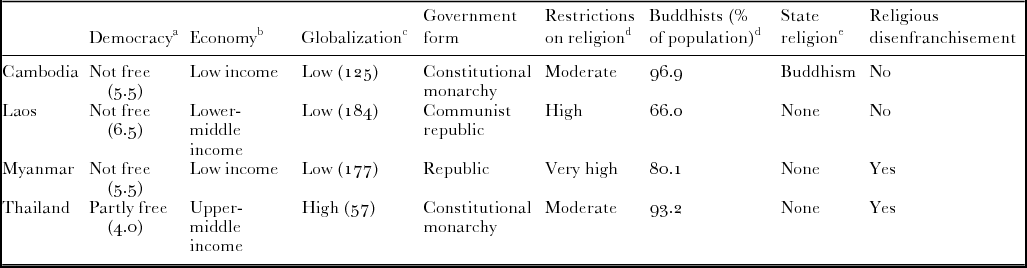
With regard to the secularization paradigm, the answer is: not far at all. Based on secularization theory, one would expect countries that are more ‘modern’ to have states that are more secular and, as such, are less inclined to regulate religious belief and behaviour.Footnote 8 If so, religious enfranchisement—as a contemporary phenomenon—should correlate positively with indicators of political and economic modernity such as democratization, economic development, and globalization. In fact, however, religious enfranchisement in contemporary Southeast Asia does not co-vary with the extent of political freedom, levels of economic development, nor the degree of integration into global economic and social flows and international political institutions (see Table 1). The country that secularization theory would construe as the most likely to have adopted a non-discriminatory electoral system is Thailand, because it is the wealthiest, most democratic, and most ‘globalized’ of the four societies. But contrary to expectations, Thailand disenfranchises Buddhist monks. The two countries that actually have enfranchised them—Cambodia and Laos—are, in comparison with Thailand (if not with Myanmar, the other country with religious disenfranchisement), impoverished, undemocratic, and poorly integrated into global flows and institutions (see Table 1). The forces of modernity therefore fail to explain the degree to which constitutions and electoral laws in the region have been ‘secularized’ and religious discrimination abolished.Footnote 9 Neither, it might be noted here, does religious disenfranchisement correlate with several other possibly relevant variables, such as form of government, overall government restrictions on religious freedoms, religious demography, or official state religion (see Table 1).
Religious disenfranchisement in Buddhist Southeast Asia in comparative perspective.

Source: a <http://www.freedomhouse.org/regions/asia-pacific>. Actual 2013 score (out of 7) in parenthesis.
c <http://globalization.kof.ethz.ch/media/filer_public/2013/03/25/rankings_2013.pdf>. Countries ranked among the top 50 per cent (out of a total of 207 countries) are rated as ‘high’ and those in the bottom 50 per cent as ‘low’. Country rank in parenthesis.
d Pew Forum on Religion and Public Life, The Global Religious Landscape (Washington DC: Pew Research Center, 2012).
e <http://www.thearda.com/ras/>, [all accessed 18 May 2014].
The religious economy (or economy of religion) approach, which is grounded in rational-choice theory, offers an alternative theoretical perspective that potentially could help us explain the phenomenon of religious disenfranchisement in Southeast Asia.Footnote 10 In The Wealth of Nations, Adam Smith famously asserted that government regulation of corn and religion is driven by strikingly similar political dynamics. Following his lead, the assumptions and analytical tools of economics have been used to explain the behaviour of churches and states with regard to regulation of the religious ‘marketplace’. One source of weakness of this ‘religious economy’ approach is that it has hitherto been applied primarily to the Christian world, and in particular to the Catholic Church. It thus largely remains to be seen how well it performs when extended to non-Christian contexts, such as those found in mainland Southeast Asia.Footnote 11
As I hope to demonstrate, the religious-economy approach runs into serious difficulties in Theravāda territory. It does so because it conceives of the disenfranchisement of the clergy as inherently anti-clerical and anti-religious. But it need not be. Religious disenfranchisement in Southeast Asia is grounded in a religious worldview, according to which a separation between the morally ‘pure’ realm of the sangha and the ‘dirty’ realm of partisan politics ought to be maintained.Footnote 12 The initial move to disenfranchise monks was, accordingly, made by state actors who sought to co-opt Buddhist ideology in general and ecclesiastical Buddhism in particular for the purposes of state-building, nation-building, and regime legitimation. The first to do so successfully were the Siamese monarchs who ruled from 1851 to 1925. As pithily observed by Tamara Loos, ‘King Mongkut created the Thammayut Buddhist sect of Theravada Buddhism [in 1833, before he ascended to the throne]; King Chulalongkorn rationalized and conflated it with the modernizing state; and King Vajiravudh fused it with nationalism.’Footnote 13 Rulers in neighbouring countries would later follow suit by similarly seeking to bring organized Buddhism under state control and to fuse it with Burmese, Cambodian, and Laotian varieties of ‘official’ nationalism.Footnote 14 While framing their actions within a Buddhist political cosmology that has pre-colonial origins, and presenting themselves as righteous protector-kings in their own right, or as their republican reincarnations (as in Burma), the heads of nascent nation-states put forward policies vis-à-vis the sangha that in many instances did not have any direct historical precedent or any clear doctrinal basis. Religious disenfranchisement is a prominent example of such an institutional innovation, prompted by the introduction of another novelty: broad-based elections to public offices.
The simultaneous adoption of two different frameworks of political legitimation—mass electoralism (if not quite democracy) and Buddhist virtue—gave rise to a dilemma that had to be worked out through ‘monkish politics’, by which I mean contestation over the political status of members of the Buddhist monastic order.Footnote 15 The question that twentieth and twenty-first century constitution drafters and law makers in Theravāda Southeast Asia have had to decide is whether the Buddhist monk should be considered a member of the species homo politicus. They have frequently—but not always—concluded that he should not, and, furthermore, that the state had a duty to prevent his trespassing into the electoral and legislative arena.Footnote 16 In most instances, the monks themselves—or at least the senior echelons of the ecclesiastical hierarchy—have agreed.Footnote 17
My argument is not only that ideas matter, but also that history does, as monkish politics is characterized by a significant degree of path dependence. This is because it is difficult for groups who have been defined as inherently non-political to effectively make political claims, and because it is easier to extend rights to new groups than to revoke them. This means that the settlements arrived at during ‘critical junctures’ in the process of state-formation will be difficult to reverse, and that the temporal context—timing and sequencing—will shape outcomes.Footnote 18 In Southeast Asia, religious disenfranchisement was adopted when universal suffrage was introduced in contexts where the state's overarching moral purpose had been defined in terms of nationalist ideologies inspired by notions of Buddhist kingship: the protection of the Buddha, the dhamma, and the sangha. It was not adopted when the state had no such moral purpose, nor when that moral purpose was embraced long after universal suffrage had been introduced and segments of the monkhood had already become extensively involved in partisan politics at the national level.
The remainder of the article is structured as follows. In the next section, I will elaborate on the religious economy approach, discuss how it has been used to explain the political logic of phenomena such as the disenfranchisement of the clergy, and draw out theoretical expectations for our Southeast Asian cases. In the following section I will then provide an outline history of religious disenfranchisement in Thailand, Myanmar, Cambodia, and Laos. In the next section I will compare and contrast the experiences of these countries, discuss the theoretical implications of the findings, and make a brief comparative excursion to Ceylon/Sri Lanka and Bhutan.Footnote 19 I conclude with some further theoretical, comparative, and methodological observations.
Religious economy and religious disenfranchisement
One of the main contentions of the religious-economy approach is that the behaviour of religious actors is driven less by religious ideology and doctrine than by the baser interests and motivations of homo economicus. In order to model the behaviour of religious actors in economic terms, it is necessary to translate central aspects of religious life into terms more familiar to the economist. The first such concept is that of a religious good, which is defined as ‘fundamental answers to the deep philosophical questions surrounding life that have as [their] basis some appeal to supernatural force’.Footnote 20 In the Buddhist tradition, karma, merit, reincarnation, nirvana, and spirits provide such a basis.Footnote 21 Second, religious ‘firms’ (such as churches and religious orders) produce such goods and compete with one another over members and resources. Third, political actors have an ambiguous attitude towards the activities of religious firms. On the one hand, religious firms can help legitimate the political order, which reduces the need for political actors to use more costly means of retaining power, such as the distribution of patronage or the application of coercion. However, religious actors can also undermine the authority of secular rulers, by highlighting unrighteous rule and by serving as focal points and mobilizing vehicles for political opposition movements. Thus, argues Anthony Gill, ‘For rulers who are concerned with their political survival, maintaining a tight regulatory control over this potential rival source of authority provides a strong incentive to tamper with laws regulating religion in order to enhance their own political position.’Footnote 22 The regulation of the religious marketplace is thus the outcome of strategic interaction between religious firms seeking to maximize their share of the religious market, on the one hand, and secular political rivals seeking to gain or hold on to power as cheaply as possible, on the other.
Can such a political-economy approach explain religious disenfranchisement? Fortunately, Gill has already demonstrated its utility in an ‘analytical narrative’ that seeks to explain, among many other things, the imposition (and eventual lifting) of religious restrictions on the right to vote in twentieth-century Mexico. There, the revolutionary constitution of 1917 ‘denied basic civil liberties to the clergy, specifically the freedom to vote and criticize the government’.Footnote 23 This served the interests of the revolutionaries who regarded ‘church hierarchs’ as ‘unremitting enemies of the Revolution’. The disenfranchisement of the clergy was part of a revolutionary ‘punishment’ of the church, which also entailed prohibitions on ‘foreign clergy, outdoor religious celebrations, property ownership by religious organizations (including schools), and recognition of degrees earned in seminaries. The capstone was the refusal to recognize the legality of any religious organization, effectively denying the church and its personnel due process before the law.’Footnote 24 Restricting the political liberties of the clergy thus served to reduce the threat they posed to the ruling party, Partido Revolucionario Institucional. However, the outbreak of the counterrevolutionary war (La Cristiada) in 1926 made clear to the new regime that significant political costs were associated with its efforts to strictly enforce its anti-clerical policies. To end the war, the regime agreed to apply the anti-clerical regulations ‘with benevolence’.Footnote 25 Over the following decades a temporary truce between church and state developed, but the clergy remained disenfranchised. Eventually, however, the anti-clerical policies were reversed by the Partido Revolucionario Institucional. Gill explains this development as the result of a shift in the relative bargaining power between a revitalized episcopacy, with a slowly expanding social reach, and a ruling party suffering a gradual loss of political legitimacy. The shift in relative power had become pronounced by 1992, when the Mexican bishops, ‘with help from the Vatican, compelled the government to rescind the most restrictive anti-clerical provisions in the constitution’.Footnote 26 The clergy could now vote again.
While the Mexican church hierarchy in this instance was opposed to the imposition of religious restrictions, in numerous instances church authorities have championed political constraints on religion—provided that these are directed at rival denominations and faiths. For instance, in colonial British America, Puritans frequently made sure that the right to vote and hold public office was limited to co-congregationalists.Footnote 27
What are the implications of this analysis for the Southeast Asian experience? Can we make any substantive inferences beyond the truism that religious disenfranchisement probably serves someone's political or religious interest? Applying Gill's analytical framework to Southeast Asia generates at least three more specific predictions. First, we would expect religious disenfranchisement to be supported by political and religious actors who view organized Buddhism as a source of political opposition or religious competition. Second, we would expect the sangha to oppose government restrictions on the political freedoms of their own members and followers. Third, the liberalization of religious regulations—such as the re-enfranchisement of the clergy—will reflect an increase in the political bargaining power of the monastic order in relation to its political rivals.
Assessing the explanatory power of secularization theory was relatively straightforward, as it rests on a simple co-variational logic. The religious-economy approach requires a more complex exercise, as it is necessary to trace the historical and political processes leading to religious disenfranchisement (and re-enfranchisement), with an account of the preferences and positions taken by relevant political and religious leaders. While the available evidence on the perceived costs and benefits of religious disenfranchisement in Southeast Asia is patchy, the historical record provides a sufficiently rich evidentiary base for a probe of the plausibility of a religious-economy-based explanation for religious disenfranchisement.
Religious disenfranchisement in Southeast Asia
In this section I will first discuss the two countries that still disenfranchise monks—Thailand and Myanmar—before moving on to the two countries that no longer do so—Cambodia and Laos. Particular attention will be paid to the dynamics of monkish politics during episodes of ‘extraordinary’ politics, such as the introduction of universal franchise, the coming of independence, and the wake of revolutions.
Siam/Thailand
It is in Siam that we find the first instance of explicit clerical disenfranchisement, as a consequence of the reform of local government administration. In 1897, King Chulalongkorn enacted a Local Administration Act (Phraratchabanyat laksana pokkhrong thongthi) that decreed that village headmen henceforth would be popularly elected. The law extended the franchise in village elections to both men and women, and thereby made Siam something of a world pioneer in terms of female enfranchisement.Footnote 28 For our purposes here, the 1897 law is of interest mainly because it appears to have enfranchised not only women but also monks. At least, there was no explicit limitation on the franchise that would have excluded monks. The right to vote in village elections was extended to ‘male and female citizens [ratsadon chai ying] who have houses or permanently anchored house rafts in the village’.Footnote 29 These criteria begged as many questions as they answered. The law did not include any minimum age, so did that mean that children could vote? Did the mention of houses and house rafts make voting rights conditional on property ownership? Would monks resident in a village temple be considered eligible voters? These and other questions were answered through King Vajiravudh's 1914 amendment to the law, which restricted the right to vote to men and women who were ‘Siamese subjects’Footnote 30 and ‘laypersons [kharawat] aged 21 or older’.Footnote 31 If the 1897 law had enfranchised monks by mistake, this had now been corrected.Footnote 32
In Mexico, as mentioned earlier, the disenfranchisement of the clergy—only a few years after the disenfranchisement of the clergy in Siam—constituted a politically motivated attack on the Catholic Church. Was Vajiravudh being similarly anti-clerical? Hardly. The king was, as Buddhist political tradition dictated, an enthusiastic and generous patron and protector of the sangha. He had ordained as a monk for a period, and one of the first things he did after ascending to the throne was to fill the vacant position of supreme patriarch by appointing his uncle, thereby ensuring a close working relationship with the ecclesiastical hierarchy. Styling himself as ‘Defender of the Faith’, Vajiravudh put forth the ‘protection of Buddhism’ as a central moral purpose of the Thai state and nation.Footnote 33 Such safeguarding entailed, in part, ensuring that the monastic order focused on transcendental matters and abstained, as far as possible, from involvement in worldly (and ‘supernatural’) affairs.Footnote 34 The disenfranchisement of the clergy can therefore hardly, in the Thai context, be viewed as an inherently anti-clerical move, but should rather be regarded as part of a state effort to ensure that the sangha remained ‘pure’. Given that the elections concerned were for the lowest rung of government administration—the office of village headman—it is difficult to see how voting rights for the clergy could have threatened royal power in any way except perhaps by undermining it symbolically.
The fall of the absolute monarchy in 1932 at the hands of a group of civilian and military officials known as the People's Party paved the way for further expansion of the role of electoral procedures in Siamese government. The country's first-ever national elections were held in 1933 under an electoral law which, as far as religious disenfranchisement was concerned, followed the precedent set by the 1914 Local Administration Act, but made the language even more explicit by stating that persons with the social status of ‘monk, novice, ascetic, or clergyperson’ were ineligible to vote.Footnote 35 While the 1932 revolution was an important milestone in Thai political history, very little has been written about it from the perspective of suffrage. This is in part a consequence of a conspicuous absence of political controversy over the extension of the franchise. ‘Significantly,’ Loos has observed, ‘there are no documented debates among members of the People's Party or in the print media about suffrage, whether it should be universal, all male, or class-based.’Footnote 36 In the absence of any such broad debates relating to the scope of the franchise, we may perhaps be justified in assuming that religious disenfranchisement would have been similarly uncontroversial. The continuity of pre-revolutionary arrangements into the new and ostensibly egalitarian and democratic era was not limited to the Buddhist exception to universal franchise. Like its absolutist predecessor, the revolutionary regime conceived of itself as a protector of Buddhism, and it ‘relied on the royalist Thammayut sect to enforce religious orthodoxy’.Footnote 37
In 1949 the definition of the franchise, with disenfranchisement based on religious status, was elevated from a separate electoral law and brought into the constitution itself.Footnote 38 Although this move is more symbolic than substantive, its timing is revealing. The 1949 constitution marked a significant restoration of royal (and royalist) power within the Thai political system, and a concomitant dilution of its more democratic features, thus reversing much of the progress that had been made since 1932.Footnote 39 By incorporating a provision for ensuring monastic discipline in its basic law, the Thai state trumpeted its moral and religious purpose more loudly than ever.
Although Thai constitutions have proved to be rather ephemeral since 1949, the religious ban on voting has proved a durable feature of the constitutional landscape in Thailand. It was included in the otherwise unprecedentedly liberal ‘people's constitution’ of 1997 and also in the rather reactionary constitution that was enacted in the aftermath of the 2006 military coup against Prime Minister Thaksin Shinawatra and the Thai Rak Thai Party.Footnote 40
It is interesting to note that the many Thai laws that have defined religious limitations to voting rights have never mentioned any particular religion, only the social identity and status of the individuals concerned: monk, novice, ascetic, or clergyperson. While the Thai words used for monk and novice refer specifically to Buddhist monks (phiksu) and novices (samanen), ascetic (nak phrot) and clergyperson (nak buat) could refer to followers of other religions as well. However, it appears that the denial of voting rights has only ever been applied to Buddhist monks and ‘nuns’ (mae chi),Footnote 41 and not to the clergy of other religions, such as Christian priests or Muslim imams.Footnote 42 As a consequence, the Thai state disenfranchises the clergy of what is de facto the state religion, but not those of its competitors in the religious marketplace.
The ban on voting by monks has largely gone unchallenged in Thailand, but it has recently become the subject of limited debate. In 2012, a proposal from a member of parliament that the Ministry of Culture should conduct a study on the possibility of enfranchising monks was shot down by the Ministry, with the argument that it was self-evident that religion would degenerate if monks were allowed to ‘meddle’ in politics, leading to a loss of popular reverence for the sangha.Footnote 43 Although not stated in these precise terms, the implicit message was that enfranchising monks (and, presumably, mae chi) would be incompatible with one of the religious provisions of the 2007 constitution, namely that the state ‘shall patronise and protect Buddhism’.Footnote 44
Throughout the history of religious disenfranchisement in Thailand, the lack of opposition from within the Thai sangha hierarchy is conspicuous. This is perhaps not entirely surprising given that in the course of the twentieth century it was turned into a pillar of a conservative Buddhist-monarchical political order in a centralized nation-state form.Footnote 45
Burma/Myanmar
In Burma, the first mass elections were held under colonial tutelage in the 1920s. Elections were introduced for local administrative organs as well as for the legislative assembly, with the franchise restricted to persons assessed for capitation, income, and other taxes. Assessment rather than payment of such taxes was made the basis of the franchise, because a number of socially significant groups of people in Burmese society were exempted from actual payment of their taxes. These included government servants, magistrates, village headmen, schoolmasters, ministers, and, notably, priests and teachers of religion. As monks were assessed for taxation, they also had the right to vote. In practice, it seems likely that few monks actually exercised their rights at the ballot box, not least because the most politically active monks, as leaders of the nationalist movement, advocated boycotting the colonial-era elections.Footnote 46 In the 1930s, as wider constitutional reforms were discussed, the issue of clerical enfranchisement became a topic for some debate. In the 1931–32 Burma Round Table Conference on constitutional reform, Burmese representatives argued that the franchise in British Burma ought to be genuinely universal, and that monks, in light of this principle, should have the right to vote, even though they might not, for religious reasons, care to exercise it. That did not, however, settle the matter. In the period leading up to separation from India in 1936, important segments of public opinion in Burma turned against the idea of clerical enfranchisement. It was not so much the prospect of monks going to the ballot boxes that provoked resistance, as the idea of monks being on the ballot, as candidates for legislative office. In newspaper articles and petitions, conservative opinion makers sought to ensure that monks would be kept out of the legislative chambers. A 1935 petition from the ‘leading sayadaws [abbots]’ in the former royal capital Mandalay argued that monks in the legislature would be like ‘vultures among sparrows’: ‘They will move about clumsily in their yellow robes and will ask questions and move resolutions. These affairs concern laypeople only, and participation of Pongyis in such affairs is sinful.’Footnote 47 The petition mentioned that a monk, U Pandita, had been elected to the Tharrawaddy District Council, and that this (possibly apocryphal) piece of news had caused ‘far-sighted Pongyis’ to fear for the future of Buddhism, filling them ‘with anxiety and regret, so much so that they feel as if their own heads are on fire’.Footnote 48
The main concern expressed by opponents of clerical enfranchisement is clearly to do with the impact of democratic electoral practices on the Buddhist religion, rather that with any potentially negative effects on the workings of representative government. However, there is some concern with the latter as well. Haughty monastics might ‘not readily submit themselves to the authority of the President or Speaker’, and they might ‘demand a respect and a submission from other members [of the legislature] which would be quite incompatible with free discussion’.Footnote 49 Even if the pongyis were not to demand such deference from fellow lawmakers, the elevated social and moral status of Buddhist clergy might, it was thought, make them an awkward presence within any political institution designed to embody the principles of egalitarianism.
The colonial authorities came to share this sceptical view. This was reflected in the 1936 orders in council governing elections in British Burma which directed that members ‘of the Buddhist Monastic Order shall be disqualified for being chosen as, and for being’ members of the House of Representatives and the Senate.Footnote 50 However, Burmese monks did not lose the right to vote, even though the colonial authorities had come to view this as ‘desirable in itself’.Footnote 51 That is to say, unlike the perceived problems associated with monks becoming parliamentarians, there were no serious political concerns associated with allowing monks to vote. Although various options were explored to disenfranchise Burmese monks, the colonial government was ultimately unable to find a politically workable means of doing so—not least because it was constrained by the Government of India Act (1935), which, in defining the franchise, had made no special provisions for Burmese monks (or any other religious community).
After the end of the Second World War, with Burmese independence looming, the status of monks in regard to electoral practices became a topic of renewed debate. In Rangoon, the governor set up a Franchise Committee, which arrived at a rather ambiguous conclusion. It simply recommended that monks should not vote, but failed to clearly state whether or not they should be debarred from doing so by law enacted and enforced by the state. On the related question concerning the position of nuns, the Committee felt that they should retain the right to vote. As the issue progressed through the political system, such ambiguities were cleared away. Following the debate of the Franchise Committee's report in March 1946, in which there had been spirited defence of the principle of a truly universal franchise, the Burma Legislative Council recommended that, ‘excepting Buddhist Pongyis and Nuns, franchise be granted to all males and females of 21 years of age’.Footnote 52 What decided the matter was that the country's senior monks in the Sangha Council, who had been invited to submit an opinion to the legislature, took a strong position against voting rights for Buddhist monks and nuns. They asserted that voting would constitute an infraction of the Buddhist monastic code, the vinaya. Even though the Sangha Council failed to make clear what monastic rule would be breached through the act of voting (or, indeed, why ‘nuns’ should be considered subject to its strictures), this authoritative religious opinion settled the question at the Burmese end of the legislative process, and the vote to disenfranchise monks and nuns was passed by 24 votes for and 6 against.Footnote 53
From the early 1930s to the late 1940s, the idea of religious disenfranchisement thus went from virtually unthinkable to a widely accepted norm in Burmese political society. While the reasons for this are likely to be complex, one important factor was the increasing concern with indiscipline in the sangha ranks in this period, a concern that was fuelled, in part, by the participation of Buddhist monks in serious anti-Muslim violence in 1938, and by their political activities during the Japanese occupation.Footnote 54
In London, the British government made the Legislative Council's position its own as it brought the Burma Legislature Bill (1946) to parliament. As had been the case in Rangoon, the government hoped that appealing to religious authority would resolve the matter. The Earl of Listowel (who went on to become the last secretary of state for India and Burma) explained the government's position in the following terms:
There is one important class of persons deliberately excluded from the new franchise, namely Buddhist monks and nuns. I think a word of explanation is due about this, if only to prevent anyone from supposing that we are discriminating against the national religion of Burma. As your Lordships are aware, Buddhism is a religion of renunciation and abnegation of self, which teaches men to change the objects of their desire rather than the political institutions or social conditions under which they live. Buddhist monks are therefore expressly prohibited by the rules of their Order from taking any part in secular disputes. The Sangha Council, which directs the affairs of the Order, has itself declared against the inclusion of monks and nuns in the new suffrage.Footnote 55
While the law was passed by the House of Lords without any hitch, these religious motivations for restricting political rights were met with consternation and opposition in the House of Commons, especially from Labour members of parliament. The critics of the provision were not convinced that the fact that a religious order had made rules concerning the behaviour of its members obliged the legislature to turn such tenets into law. They frequently made their argument against religious disenfranchisement by hypothetically transplanting provisions for religious disenfranchisement to a European context. One member of parliament noted that parliament would not be likely to agree to disenfranchise Methodist ministers, if the Methodist Union had said that they ought to be.Footnote 56 Another argued that ‘nobody would suggest’ that ‘enclosed contemplative Benedictine nuns’ should be disenfranchised because their religious vows preclude their ‘taking part in an election and going to a polling station and voting’.Footnote 57 Experiences in other parts of the British colonial empire were also used to challenge the government's position. In Ceylon, it was noted, Buddhist monks and nuns had been enfranchised but ‘no Buddhists in Ceylon took offence because they were not deprived of the franchise’.Footnote 58 It was also observed that Jains, Hindus, and Buddhists in India had not been disenfranchised, and that this constituted a precedent that ought to be respected when making law for Burma.Footnote 59 A Conservative member of parliament weighed in on the side of the critics of the bill:
It seems to me most extraordinary that we should be imposing here upon a religion, the inner meaning and spirit of which very few of us really comprehend, a prohibition which we would never dream of imposing on any other faith in the world and which, indeed, we have not imposed on this particular religion in other quarters of the world.Footnote 60
Some members of parliament gave explicit recognition to the fact that at least some Buddhist monks in Burma were obviously quite keen to participate in political affairs—not least in the nationalist movement—and that they likely would continue to do so, irrespective of whether or not they enjoyed voting rights. An unspoken, non-religious motive for religious disenfranchisement was suspected by one member of parliament, who wondered if the real reason for disenfranchising monks was that it was ‘feared that they might vote the wrong way’.Footnote 61
One perceptive member of parliament highlighted what the proposed disenfranchisement actually constituted, namely state support for the ‘internal discipline of a religious Order’.Footnote 62 But he refused to recognize that as a legitimate political purpose: ‘The real logical reason for putting this Clause into the Bill would be from the point of view that it was harmful for Burma for monks to vote, not that it was harmful for monks to vote.’Footnote 63 Such an argument could, of course, be made. But it would require the colonial government to claim that a particular, ostensibly apolitical, conception of monastic discipline was a fundamental state interest. But the British government did not, in the end, seek to persuade its opponents that Burma's wellbeing ought to be defined in terms of a well-disciplined (non-voting) sangha. That would have required the British sovereign to adopt a religious moral purpose, defined in Buddhist terms, with London taking upon itself the traditional monarchical role of ‘protector’ of Buddhism. Rather than making the case for religious disenfranchisement in such terms, the Earl of Listowel tabled an amendment, which was explained to the House of Lords as follows:
My Lords, this Amendment will remove the disqualification on Buddhist monks and nuns from voting in the general constituencies in Burma. I should like to give your Lordships a brief account of the history of this proposed change. In another place [the House of Commons] strong disapproval was expressed of the proposal in the Bill, as it now stands, to deprive a religious body of the franchise, and, in deference to this widespread disapproval, the Government have agreed to accept the Amendment. Even if this Amendment is included in the Bill and becomes a part of the law, it is, of course, still open to the Buddhist Order to exclude its members, if it so desires, from participation in secular affairs, and, of course, in the exercise of the franchise.Footnote 64
Both houses then passed the law, with the clause discriminating against monks and nuns removed. The appeal to ecclesiastical authority that had worked so well in Burma was less successful in London, thus thwarting the colonial government's plans to disenfranchise Buddhist monks as the colonial era drew towards a close.
The parliamentary debate in London, and the result it ultimately produced, provoked considerable debate in Burma, and clerical enfranchisement, as pushed through by the House of Commons, would not last for very long. The 1947 constitution of the Union of Burma asserted that, ‘members of any religious order may by law be debarred from voting at any such [parliamentary] elections or from being a member of either Chamber of Parliament’.Footnote 65 Accordingly, the Parliamentary Elections Act (1948) disenfranchised Buddhist clergy and members of every religious order, who were neither allowed to stand for nor vote in elections (section 27).Footnote 66 The law did not provide any more extensive definition of who was to be counted as a member of a religious order.
Subsequent Burmese constitutions, enacted in 1974 and 2008, have incorporated the voting ban on ‘members of religious orders’ directly into the basic law itself,Footnote 67 and the associated electoral laws have provided for more elaborate answers to the question of whom, exactly, should be considered ‘members of religious orders’. The category includes, first, Buddhist monks, novices, lay brothers and nuns (plus, in the State Law and Order Restoration Council version from 1989, ‘hermits and hermitesses’); secondly, Christians ‘who have dedicated themselves to the service of their religion and recognized and initiated as such by Churches concerned’; and thirdly, and finally, ‘sanyasis [ascetics], mahants [abbots] or Hindu monks’.Footnote 68
The voting ban on the clergy, grounded in Buddhist beliefs, has thus been extended to incorporate a wider range of persons considered to have a primarily ‘religious’ identity in Burma. I have not been able to find any explanation for this development. However, we may speculate that it is a reflection of the influence of some members of the country's political elite, such as Aung San and Ne Win, who regarded the ‘secular’ state as a bulwark of national unity. It is, however, difficult to imagine that the ‘Marxist-minded, secularly oriented’ members of the Left would have been able to disenfranchise the clergy on their own.Footnote 69 This was a policy primarily driven by their religiously more conservative colleagues and rivals—most notably U Nu—who desired to see Buddhism made the state religion of Burma, and, in accordance with the wishes of the senior members of the sangha, also yearned for the country's clergy to be exiled from the electoral arena. Thus, as was the case in Thailand, the disenfranchisement of the clergy in Burma cannot be said to reflect predominantly anti-religious or anti-clerical sentiments. With the assassination of Aung San on the eve of independence, it was, furthermore, the more devout Buddhist politicians who came to dominate policy making in newly independent Burma. They were thus in a position to massively expand state support for institutional Buddhism—until Ne Win staged a military coup in 1962 in response, in part, to renewed efforts to elevate Buddhism to state religion.Footnote 70
The multifaceted pro-democracy movement that emerged in the wake of the bloody military crackdown on demonstrators in 1988 has had to engage with the question of whether or not Buddhist monks and nuns (and other clergy) should continue to be disenfranchised in a future ‘Free Burma’. In this respect it is interesting to note that the National League for Democracy's Interim Constitution from 1990 accepted and confirmed the relevant section in the original 1947 constitution (i.e. section 76, which had decreed that ‘members of any religious order may by law be debarred from voting’).Footnote 71 Over the past few years, however, Burmese opposition groups in exile—dominated by non-Buddhist ethnic minorities—have developed a number of constitutional drafts that have rejected the notion that religious status would constitute a legitimate basis for political disenfranchisement. The draft constitution proposed by the National Council of the Union of Burma did not provide for any special treatment on religious grounds; it extended to ‘every citizen of full age’ the right ‘to vote and be elected in periodic elections which shall be general, free, equal, direct and secret’.Footnote 72 The draft further specified that, as a matter of their inalienable rights, every person should ‘be equal before the law, irrespective of national or social origin, religion, social status, political opinion, language, sex, age, colour or race’.Footnote 73 Similarly, a draft constitution developed by the Ethnic Nationalities Council, with financial support from the Danish government, included almost identical language to that proposed by the National Council of the Union of Burma. It went one step further by affirming that ‘The Federal Union [of Burma] shall not mix religion and politics, and shall be a secular State.’Footnote 74 Thus, unlike any actual constitution of independent Burma/Myanmar, these more recent ‘alternative’ democratic constitutions do not leave room for disenfranchisement on religious grounds.Footnote 75
Such radically secularist sentiments have not (yet) been translated into public policy in Myanmar and, as a consequence, ‘members of religious orders’ remain disenfranchised. Thus, when elections were held in 2010, after a hiatus of 20 years, the ‘men in saffron robes’—and the women in pink—were once again barred from participation.Footnote 76
Cambodia
Village (commune) elections were introduced in the French protectorate of Cambodia at some point in the early twentieth century. Although this reform may have had a somewhat earlier origin, a law from 1908 that reorganized local administration specified that commune leaders (mekhum) were to be popularly elected and that suffrage was extended to persons of any nationality who were registered on the personal tax roll. In 1919, the right to vote was specified further: eligibility was granted to those aged 21 years or older, of any nationality, and registered on the personal and capitation tax rolls.Footnote 77 Although monks were not expected to pay taxes,Footnote 78 they would have been included on the tax rolls and in that capacity would have enjoyed the right to vote (as had been the case in Burma).Footnote 79 In this respect their position was similar to that of members of the royal family, soldiers, and certain indigenous government officials. Whether monks actually exercised their right is not clear.
In 1946, the French granted Cambodia internal autonomy and, as a consequence, arranged a national election which political parties were, for the first time, allowed to contest. The question of monastic voting was immediately politicized. The leftist Democratic Party accused its rivals of ‘agitating for the right of monks to vote’ and put forth a vision of a political order in which monks could ‘live an uncontaminated existence remote from the games played by politicians’.Footnote 80 With the backing of members of the monkhood, civil servants, teachers, and students, the Democratic Party was able to win a substantial majority of the seats in the Constituent Assembly, and it was, as a consequence, able to translate this desire into law. Article 48 of the 1947 Constitution of the Kingdom of Cambodia thus stated that monks could neither stand for public office nor vote, ‘on account of the Buddhistic dogmas’. As in our previous cases, this cannot be construed as an anti-religious or anti-clerical move. Indeed, the constitution also decreed that, ‘Buddhism shall be the State religion.’
Interestingly, I have found evidence that one exception was subsequently made from the general rule of clerical disenfranchisement. In 1955, Sihanouk called a referendum at which the franchise was extended beyond its constitutional bounds, and the right to vote was given to ‘[a]ll male citizens, aged 20 years and above, including bonzes and military personnel’. To facilitate voting by these normally disenfranchised groups, ‘[p]olling booths were established in pagodas for the bonzes and at local headquarters for military personnel’.Footnote 81 The question that the referendum had to decide was the following: ‘Has the Royal Mission been accomplished to the satisfaction of our people?’ Balloting, in this instance, was not secret, and when all the ballots had been counted, it was found that 99.8 per cent of voters had expressed their approval of Sihanouk's Royal Mission. Such clerical enfranchisement was, however, the exception and not the rule in Sihanouk's Cambodia.
Sihanouk and the Cambodian monarchy were toppled in 1970 and replaced by an anti-communist republican regime led by General Lon Nol. The arrival of republicanism did not, however, bring with it any changes to the disenfranchisement of Buddhist clergy. While the 1972 constitution of the Khmer Republic removed the ban on voting for monks (as well as that for members of the armed forces), the government decree that defined the rules for the election of the first national assembly of the Khmer Republic insisted that, ‘Les moines ne peuvent pas être électeurs en raison des dogmes bouddhiques.’Footnote 82 The decree did not constitute a general electoral law, but rather only specified the rules for the republic's first general election. This suggests that the Lon Nol regime, although staunchly pro-Buddhist (and anti-communist), and while retaining Buddhism as the state religion, nevertheless regarded non-voting by Buddhist clergy as symbolically of somewhat less central importance than previous regimes had done. Alternatively, the Lon Nol government may have recognized that discrimination against monks had become a somewhat more controversial issue than it had been in the past.Footnote 83
The toppling of the Lon Nol regime by the Khmer Rouge in 1975 brought with it a seriously adverse change in the status and respect accorded by the state to religion in general and the monkhood in particular. Paradoxically, however, the electoral status of monks improved. The 1976 constitution does not say anything at all concerning Buddhism, elections, or individual freedoms.Footnote 84 And, indeed, the elections held on 20 March 1976 appear to have been conducted on the basis of a universal franchise, with no distinction made between the clergy and the laity.Footnote 85 Of course, the point is somewhat moot, as the Khmer Rouge simultaneously had attacked traditional religious symbols and institutions, which included killing and defrocking a large number of monks, who had no legitimate role to play in the utopian society envisioned by Pol Pot.Footnote 86
A more meaningful shift in the suffrage status of monks followed in the wake of the fall of the Khmer Rouge regime in 1979. The Vietnam-installed government drafted a new constitution, enacted in 1981, in which religion and individual rights reappeared, signalling greater tolerance for the monkhood, which was politically rehabilitated and gradually reconstituted.Footnote 87 But things did not return to the status quo ante with regard to voting rights for monks. On the contrary, the constitution decreed that ‘religious clergy have the right to vote and run for elections’.Footnote 88 This is the first (and only) time in the history of Theravāda Buddhist polities on the Southeast Asian mainland that a constitution has given explicit recognition of the right of the clergy to participate in politics. Although this endorsement was removed from subsequent constitutions (1989, 1993), the continued embrace of the fundamental principle of universal and equal suffrage meant that monks retained the right to vote. It is particularly noteworthy that this remained the case even after 1993, when the monarchy was restored and Buddhism returned to the position of state religion. Monks were thus allowed to vote in the UN-organized elections in May 1993, despite the fact that senior monks from the country's two main Buddhists sects made ‘representations to Yasushi Akashi, special representative of the UN secretary-general, to try to prevent monastic voting’.Footnote 89
While the UN administration ignored such religious sensitivities, the enfranchisement of monks has at times seemed quite precarious after the coming of the Second Kingdom, especially once the Cambodian People's Party consolidated its dominance over the state in the late 1990s.Footnote 90 The supreme patriarch of the main monastic order in Cambodia, Tep Vong, imposed a voting ban on Mohanikay clerics in 2003, arguing that voting went against Theravāda Buddhist doctrine.Footnote 91 Although the ban pertained to the internal discipline of the sect, state officials at least in part helped to enforce it at the polling stations, by refusing to recognize monks as eligible voters.Footnote 92 However, the ban proved deeply unpopular among some members of the monastic order and many opposition politicians, who, perhaps rightly, viewed the religious ban on voting as an attack on an important segment of their political base.Footnote 93 As was noted at the time by the International Republican Institute, ‘Monks are disproportionately young, educated, and respected in society, and are considered to be a strong constituency for Cambodia's opposition.’Footnote 94 In the midst of this controversy, one of Phnom Penh's leading monks, Sam Bunthoeun, who had challenged Tep Vong's voting ban, was assassinated, and it was widely speculated, although not proven, that his advocacy of voting rights for monks had sealed his fate.Footnote 95 Whatever the real reason for the assassination, one can assume that the rumours would have had a chilling effect on monks who failed to toe the party line on this matter. Soon thereafter, King Sihanouk apparently came out as an advocate of voting rights for monks.Footnote 96 Even so, a large number of monks associated with the political opposition and opposed to the voting ban were expelled from or pressured to leave the monkhood. The supreme patriarch eventually reversed his position, thus paving the way for the monks’ return to the ballot boxes as voters in subsequent elections.Footnote 97 While monks could not sustainably be banned from voting, the ruling party has nevertheless severely restricted the scope for political opposition and anti-regime discourse emanating from within the monkhood. Through a combination of patronage and repression, the government has ensured that the sangha is supportive of the ruling party.Footnote 98 Shortly after Tep Vong reversed his ban on voting, the government set up a new institution, known as the Monks Assembly, to monitor behaviour and discourse within the Mohanikay sect, and appointed the commander of Prime Minister Hun Sen's personal bodyguard, General Hing Bun Heang, to serve as its ‘Supreme Consultant’. The appointment signalled that the country's ruling elite perceived the internal discipline of the monkhood to be an important foundation for the security of the regime. But at present the scope of the internal discipline of the monkhood has been transformed with regard to elections: while pre-communist monastic discipline required monks to abstain from voting, communist and post-communist monastic discipline requires monks to vote for the right party—or not at all.Footnote 99
Laos
The principle of mass electoralism arrived later in Laos than in Siam, Burma, or Cambodia. Prior to the Second World War, not even local elections appear to have been institutionalized by the colonial state.Footnote 100 In the second half of the 1940s, however, the electoral principle was introduced, and with it, the practice of religious disenfranchisement. The religious restriction on the franchise was not, however, to be found in the country's constitution. The 1947 constitution of the Kingdom of Laos proclaimed that deputies to the national assembly were to be elected by ‘universal [male] suffrage, under conditions fixed by the electoral law’. While I have been unable to locate a copy of the subsequently enacted electoral law (1951), various reports from elections in the 1950s make it clear that Buddhist monks were in fact unable to participate as voters.Footnote 101 As in the previous cases, religious disenfranchisement in Laos should be understood as an expression of the state's fundamentally benevolent intentions towards institutional Buddhism. According to the 1947 constitution, ‘Buddhism is the religion of the state’, and the king—who ‘must be a fervent Buddhist’—‘is its high defender’.Footnote 102
In the mid-1950s, the extent of the franchise became a topic for negotiation between the two rival sides in the Laotian civil war—the Royal Lao government and the communist Pathet Lao. The Pathet Lao sought to broaden the franchise, mainly by including women and students. According to Deuve, they sought to expand the suffrage to include Buddhist monks as well.Footnote 103 However, an American intelligence report, which provides details concerning a critical episode in these negotiations, lists Pathet Lao demands on 11 different issues related to the conduct of elections, and clerical enfranchisement is not one of them.Footnote 104 If indeed Pathet Lao had also pushed for clerical enfranchisement, they were in any case unsuccessful in this respect. Although the 1957 electoral law expanded the franchise (most notably to include women), it decreed that no ‘religious persons’ should be included on the electoral roll.Footnote 105 This seems like an unreasonably broad disqualification, and I assume that it applied only to persons whose primary social status was ‘religious’ (i.e. Buddhist monks—and possibly the clergy of other religions as well).
The victory of the communists in 1975 led, as one would expect, to fundamental reforms of state-sangha relations; the triumphant Marxist-Leninists dethroned the two symbolic pillars of l’ancien régime—the monarchy and the sangha. The new Laos was to have neither king nor supreme patriarch. While the country's new rulers viewed the traditional sangha with considerable suspicion and animosity, the egalitarian instincts of the Pathet Lao, which perhaps had been hinted at already in the 1950s, could now be fully realized by removing any religious limitations on voting rights. The precise timing of this is, however, difficult to pin down. Local elections were held in 1975, with voting ‘made compulsory for all persons 18 years and above’.Footnote 106 In 1976, an election was held for a constituent assembly; what the electoral rules looked like is not exactly clear, but I have not been able to find any evidence to suggest that monks were disenfranchised. These early communist-era elections were conducted in the absence of an electoral law and a constitution. In fact, there was a remarkably long hiatus before the communist regime found it convenient to draft such basic laws. When finally enacted in 1991, the constitution and electoral law provided for equal and universal franchise, with no religious restrictions.
As was the case in Cambodia, the expansion of electoral rights was, to a large extent, moot. The shift to a one-party communist state was accompanied by the dismantling of the traditional sangha hierarchy, including the abolition of the office of the supreme patriarch (albeit using somewhat less violent means than its neighbour to the south). ‘The deposition of the supreme patriarch had a significance similar to the deposition of the king,’ according to Brown and Zasloff. ‘No longer does a single religious leader, endowed with the charisma that flows from an esteemed office, rule over a religious institution that has links in every Lao village.’Footnote 107 The newly established regime's efforts to subordinate the sangha to the Communist Party triggered a flow of yellow-robed refugees across the Mekong River.Footnote 108 In place of the old sangha organization, the new regime created a politically reliable and ideologically pliable Buddhist monastic order known as the Lao United Buddhists Association. In 1979 it became a founding member of the Communist Party's popular-front organization, the Lao Front for National Construction. Through these and other reforms the Communist Party sought to ‘minimize Theravada Buddhism as a social and cultural presence’ in Laos and to ensure that what little remained of the monkhood would be supportive of the new regime in all areas of national life.Footnote 109
Although official attitudes towards Theravāda Buddhism have since shifted dramatically—due not least to socialism's limited efficacy as a legitimating ideology—the communist regime's articulation of a nationalist ideology in which Buddhism is central to Lao identity has not (yet) gone so far as to lead to the reintroduction of religious disenfranchisement.Footnote 110 And with voting compulsory—turnout at Laotian elections in recent years is reported at an average of 99.78 per cent of eligible voters—the members of the Lao sangha are clearly fulfilling their patriotic duty at the ballot box.
Comparative insights, theoretical implications
In the course of this survey of the historical evolution of constitutions and electoral laws with regard to religious disenfranchisement and re-enfranchisement in Southeast Asia, a number of theoretically relevant patterns have emerged. First, the regimes that initially disenfranchised the clergy all had profoundly pro-religious and pro-clerical inclinations. The nationalist elites who rose to power as colonialism waned across Theravāda Buddhist Southeast Asia—whether in Siam's absolute monarchy, the Cambodian and Laotian constitutional monarchies, or the Burmese republic—all embraced a traditional or, better yet, traditionalist strategy for state and regime legitimation which put rhetorical and symbolic emphasis on state patronage and protection of Buddhism. Even ‘revolutionary’ successors to the regimes that first established religious disenfranchisement generally adhered to the inherited practice. This is true of Siam's Pridi Phanomyong and Phibun Songkhram, Burma's Ne Win, and Cambodia's Lon Nol. Second, a policy of religious re-enfranchisement was only ever adopted by the region's most virulently anti-religious and anti-clerical regimes. It is communist regimes, exclusively, that have reversed the policy of religious disenfranchisement, and they have done so as part of a more general rejection (at least temporarily) of political legitimation through appeals to core religious values and symbols. Monks were thus re-enfranchised only as a consequence of an aggressively secularist attack on Buddhist political cosmology and its institutional manifestations within the Lao and Khmer anciens régimes. Third, and finally, Buddhist ecclesiastical authorities have not been opposed to the disenfranchisement of their clergy. On the contrary, they have welcomed and even championed such restrictions of their political liberties, even when this has proven somewhat controversial within some sections of sangha, as has been the case in Cambodia recently.
From the perspective of religious economy, as formulated by Gill, Southeast Asian political and religious actors thus displayed seemingly ‘irrational’ preferences and behaviour—acting against their (presumed) interests. Why doesn't the politics of disenfranchisement in these Theravāda countries conform to theoretical expectations? A fundamental premise of the religious-economy approach is that ideology and theology have little—if any—explanatory value. Outcomes result from the rational pursuit of interest, not from differences in faith. As a consequence, scholars writing in the religious-economy tradition treat religious belief as ‘an incidental factor, largely overruled by rational calculations of an institution's needs’.Footnote 111 It is thus assumed that the behaviours of religious and political actors in, for instance, Venustiano Carranza's Mexico and Vajiravudh's Siam can all be understood and explained without paying closer attention to the different moral orders within which they operated.
However, the religious tradition of Southeast Asian Theravāda Buddhism constitutes a moral universe in which it makes perfect sense that it is the governments who seek to base their political legitimacy, at least in part, on religious virtue and the backing of ecclesiastical authorities that have enacted constitutions and electoral laws that deny Buddhist monks basic political rights.Footnote 112 It also makes considerable sense that these ecclesiastical authorities have frequently welcomed the disenfranchisement of their own clergy. For Southeast Asian political elites concerned with their political survival, disenfranchising the clergy has offered an almost costless means by which to signal their commitment to maintaining a ‘proper’ relationship between the two wheels of dhamma. In the absence of any more significant public opinion—domestically or internationally—against the propriety of the practice, the only political cost would be the votes lost from potential ecclesiastical supporters. That cost would be marginal indeed, given that most clergy could be expected to adhere to more orthodox notions of the monastic vocation. As a consequence, religious disenfranchisement can be viewed as a mutually beneficial institutional arrangement, which allows both sangha and state to protect and enhance their religious reputations. This makes for a remarkably stable equilibrium, which it has taken communist revolutions to break.
While these political dynamics are clearly at odds with those described by Gill in Mexico, the literature on religious economy nevertheless provides us with a concept that may be helpful in understanding them. Religious goods are ‘credence goods’. This is because the person who ‘consumes’ religious goods by, for instance, donating food to monks on their morning alms round in order to gain religious merit is not in a position to ascertain if any merit is, indeed, attained. The efficacy of such acts—indeed the karmic balance of all acts—will only be revealed after rebirth, in the next life. Our willingness to spend money, time, and resources on credence goods thus rests on the ability of their purveyors to make credible claims as to their efficacy. In the final analysis, our readiness to consume religious goods rests on our faith in—or trust of—religious authorities. To gain and maintain the trust of religious consumers, religious firms often engage in extravagant forms of signalling their trustworthiness. In the religious marketplace, as Gill notes, ‘Clergy frequently live austere lives, make other sacrifices (e.g. celibacy), and engage in rather costly rituals to cultivate an aura of trust among parishioners.’Footnote 113 Denying themselves the political rights normally accorded to citizens—including the right to vote—may be understood simply as the latest in a series of abnegations of self by which religious virtuosi in Southeast Asia have sought to signal their trustworthiness to patrons.
There is a second way in which, from a rational-choice perspective, one might possibly conceive of the imposition of political constraints on the clergy as a benefit rather than a cost, and thus as ‘rational’. In some situations, less really is more, in the sense that having fewer options is better than having many. This is what Ulysses realized as he approached the Sirens and tied himself to the mast. In an analogous fashion, we may think of religious disenfranchisement as a means by which the sangha can protect itself and its members from the temptation to engage in political activities which, in the long run, it fears might lead to an erosion of the religion's core values. If it is the sangha authorities that impose on its own members a ban on voting, we might speak of it in terms of self-paternalism; if the state steps in and officially disenfranchises them, it might be thought of in terms of paternalism. In the majority of instances we have encountered above, religious disenfranchisement can then be considered a state-supported self-binding and pre-commitment device that is intended to protect the sangha from future changes in preferences (i.e. seduction by the Siren's song of political participation and partisanship).Footnote 114 In a few instances we see that the implied prophecy of changing preferences has been realized, and in such situations a voting ban or disenfranchisement may primarily be intended to stop monks from acting on their newly discovered desires. In both instances, the intention is to protect the core values of the monastic order. The Southeast Asian experience provides some evidence for the efficacy of disenfranchisement as a means by which to prevent preference change among the clergy. This would explain why the initial disenfranchisement of monks was generally so uncontroversial (less so in Burma than elsewhere in the region), why sustaining the ban has also proved generally uncontroversial (within the sangha), and why, in contrast, the Cambodian sangha's efforts to reintroduce a voting ban after monks had already been enfranchised—and politicized—was met with resistance from some monks, making the policy unsustainable.
While it may therefore be possible to make the phenomenon of religious disenfranchisement in Southeast Asia ‘fit’ within a religious-economy framework by invoking the special nature of religious goods, or the notion that less occasionally may be more, doing so would render it theoretically incoherent. Economic models of behaviour rest on the assumption that costs and benefits can be assessed ‘from some neutral or consensually agreed standpoint’, and that premise does not hold if religious disenfranchisement is viewed as both a tax on religion (in Mexico, for example) and a subsidy (in much of Buddhist Southeast Asia).Footnote 115 Any assessment of costs and benefits presumes certain conceptions of politics, religion, and their relation. As long as such conceptions are contested and conflicted, there will be no basis on which universally applicable assessments of costs and benefits can be made. This is true not only across religious traditions, but also within them.
Monkish politics in South Asia
While all the Theravāda Buddhist societies in Southeast Asia initially embraced religious disenfranchisement, not all Theravāda Buddhist societies did so. Neither is the practice limited to the Theravāda branch of the Buddhist tradition. A brief digression to Ceylon/Sri Lanka and Bhutan will underline these points, and put clerical disenfranchisement in Southeast Asian in wider comparative perspective. This will also provide further illustrations for the argument that the historical context plays an important role in determining the outcomes of monkish politics.
Although Ceylon/Sri Lanka has a majority Buddhist population (68 per cent), monks and other religious clergy gained the right to vote with the introduction of universal suffrage, under British colonial tutelage, in 1931, and they have retained that right since independence in 1948. Monastic involvement in electoral politics—with Buddhist monks as voters, vote canvassers, and candidates—has over time become increasingly common. The success, in the parliamentary elections of 2004, of a newly formed political party whose candidates were all Buddhist monks can be considered something of a ‘watershed’ event in the political history of the Theravāda Buddhist polities in South and Southeast Asia.Footnote 116
In light of the Southeast Asian experience, this begs the question: why has there been no religious disenfranchisement in Ceylon/Sri Lanka? It is not because of any communist revolution, as in Cambodia and Laos, nor because there was never any demand for it. In 1946, some conservative members of the country's political and religious elite made a brief attempt to disenfranchise Buddhist monks. Fearing that politically active monks were communist sympathizers, they sought to empower orthodox elements at the top of the sangha hierarchy in the former royal capital Kandy to disrobe and even imprison ‘political monks’.Footnote 117 The guidelines developed for the purpose of such ‘sangha purification’ decreed that it was ‘improper’ for a monk to ‘register as a voter or to vote’, and that a monk who did so ‘should be expelled from his monastic fraternity, and lay people should not pay any obeisance to such a monk’.Footnote 118 In contrast with developments on the Southeast Asian mainland, however, this effort to disenfranchise Buddhist monks failed. While the reasons for this are complex, two factors appear to be especially salient from a comparative perspective.
The first concerns the timing in relation to Ceylon's constitutional development. Questions about the franchise had been settled through the work of the Donoughmore Commission (1927) and the Soulbury Commissions (1944), leading to the promulgation of the Ceylon constitutions of 1931 and 1946, respectively. It was through these constitution-drafting processes that efforts could have been made to prevent Buddhist monks from future political participation, whether as voters or as candidates.Footnote 119 But it appears that no such efforts were made. If they had been, they would have been incompatible with the secularist vision of Ceylon that informed the proceedings, as manifested in article 29(2) of the 1946 constitution. This limited the Ceylon legislature's sovereignty by barring it from enacting laws that discriminated, positively or negatively, against persons of any particular community or religion.Footnote 120 In comparison with Southeast Asia, where clerical disenfranchisement was either taken for granted or was the subject of serious deliberation by constitution drafters, the attempt to disenfranchise monks on Ceylon looks at best like a panicked afterthought and at worst like a nakedly instrumental invocation of Buddhist principles for partisan purposes. This is symptomatic, I believe, of the great extent to which Ceylon's political elites under colonialism—heavily Anglicized and Christianized as they were—had become disconnected from the sangha and traditionalist concerns associated with ideologies of Buddhist kingship. Unlike their Southeast Asian counterparts, the political elites who managed Ceylon's transition to independent statehood did not view themselves—or their future nation-state—as operating within a Theravāda Buddhist moral order.
A second and, in all likelihood, closely related factor was that, at the time of independence, the apolitical conception of the Buddhist monk did not enjoy nearly the same kind of hegemonic position on Ceylon as it did on the Southeast Asian mainland. As a consequence, the conservative effort to restrict the political activities of members of the sangha was immediately challenged by a group of monks associated with one of the country's two leading Buddhist seats of learning, Vidyalankara Pirivena. They did so most notably through the publication of a series of powerful polemics, including Bhikkhus and Politics: Declaration of the Vidyalankara Pirivena (1946) and Walpola Rahula's The Heritage of the Bhikkhu (1946). In publications and public debates, the Vidyalankara monks asserted that Buddhist monks had not only the right, but also a patriotic responsibility, to participate fully in the nation's political life, in order to promote public welfare and protect Buddhism.Footnote 121 In spite of their rather fanciful interpretation of Buddhist doctrine and the pre-colonial history of Buddhism, the political monks’ advocacy of this-worldly engagement won the official imprimatur of one of the island's leading centres of Buddhist learning. In line with this ‘alternative’ conception of the role of the monk as social and political activist, ‘electoral politics would become the new medium through which monkish engagement with the laity would be conducted’.Footnote 122 True to their vision, the Vidyalankara monks also put forward a number of concrete political proposals that appealed to broad segments of the Sinhalese population. As a consequence, they managed to mobilize sufficient political support to defeat the conservative elite's attempt to define the ‘political monk’ as beyond the pale.
When compared with the Southeast Asian experience, the influence of ‘traditionalist’ Buddhist political-cosmological conceptions on law-making was therefore negligible in the years leading up to independence in Ceylon. To continue the comparative-historical analysis just one step further, we may ask why this was so.
My tentative answer would be that differences in the timing of the advent of colonization and in subsequent colonial policy choices provide important pieces of the puzzle. Whereas British imperialism had already put an end to Buddhist kingship in Ceylon by 1815, the gradual conquest of Burma allowed Buddhist kingship to survive there until 1885.Footnote 123 The French adopted rather more tolerant attitudes towards the Buddhist monarchies in Indochina, whose services were retained within a colonial administrative framework, and in Siam, which remained independent, the political position of the monarchy was in many ways strengthened by the encounter with European imperialism.Footnote 124 It is thus not entirely surprising that the relationship between Buddhism and the state followed different trajectories on Ceylon and in Southeast Asia. In the absence of an indigenous Buddhist king, some influential Ceylonese monks in the late nineteenth century had turned to the remaining Buddhist monarchs in Burma, Siam, and Cambodia in their quest for protection and patronage—albeit largely in vain.Footnote 125 It is easy to imagine how the absence of a secular patron and protector, and fading prospects of one ever emerging, may have stimulated the Vidyalankara monks’ innovative reconceptualization of the monk's vocation and its relation to ‘politics’—with the consequence that they came to view clerical disenfranchisement as a bane rather than a boon for Buddhism.
In Ceylon, the colonial and early post-colonial governments thus adopted a secularist hands-off approach with regard to the sangha. However, an opportunity to revisit the nature of state-sangha relations, and the suffrage of monks, arose in the early 1970s, when a new constitution was enacted. While the 1972 republican constitution elevated Buddhism to a special position and paid rhetorical homage to Buddhist kingship ideals, the monkhood retained its voting rights, as ‘political monks’ had by now become an extremely influential political force in their own right.
Unlike Sri Lanka (but as in Siam and the other Southeast Asian cases), Bhutan adopted universal suffrage in conjunction with a moral purpose of the state, defined in terms of Buddhism-protection, with the expected consequence that monkish politics was settled in favour of exclusion from partisan politics. In 2008, a royal initiative transformed the Bhutanese form of government from a quasi-absolute monarchy to an electoral democracy. As part of this process, Buddhist monks were banned from taking part in elections to the two chambers of parliament.Footnote 126 In fact, the scope of religious disenfranchisement was broader than that, with the voting ban applicable to ‘any influential religious personality or ordained members of any religion’.Footnote 127 As in Southeast Asia, this attempt to bar the clergy from trespassing into ‘politics’ is a reflection of avowed pro-religious sentiments. The new constitution did not establish Buddhism as a state religion, but it recognized Buddhism as ‘the spiritual heritage of Bhutan’ and assigned to the king the role of ‘protector of all religions in Bhutan’.Footnote 128 The constitution further regulates appointment to high clerical offices, with the king appointing the chief monk (Je Khenpo), on recommendation from the country's senior abbots. As in Southeast Asia, the disenfranchisement of the clergy in Bhutan has little to do with anti-clericalism, and more to do with paternalistic concern for the monkhood and upholding a boundary between the religious and worldly realms. As in Southeast Asia, it is also a reflection of an ideology of Buddhist kingship, for which a flourishing, well-disciplined sangha is key to political legitimacy. But unlike Southeast Asia, the ideology has shallow historical roots, having been constructed ‘rather haphazardly’ only in the aftermath of the founding—with British support—of the monarchy in 1907 as a rival to the country's ‘Mahayana Buddhist theocratic tradition’.Footnote 129 Although Bhutan was never fully colonized, it was, like Siam, a ‘buffer state’ in which the British empire played a key role in encouraging the expansion of absolutist royal power.
As a final observation on these South Asian cases, I would like to draw attention to a factor that fell into the analytical shadows in the discussion of Southeast Asia, namely colonialism. Southeast Asia underwent a variety of colonial experiences—with Burma colonized by Britain, Cambodia and Laos by France, and Siam retaining is independence—but by the early 1950s the four countries had all arrived at the same outcome—the disenfranchisement of the clergy. One would thus be tempted to conclude that colonial experiences in some sense didn't matter—which suggests that the outcome might have been driven by antecedent conditions, such as the shared pre-colonial legacies of Buddhist kingship. While traditional ideas of virtuous kingship are clearly important, the South and Southeast Asian cases illustrate how different encounters with—and indigenous reactions to—European imperialism preserved (Siam, Burma, Cambodia, Laos), marginalized (Ceylon), or created (Bhutan) political institutions and actors who have an elective affinity with that particular tradition of statecraft.
Conclusion
In this article I hope to have demonstrated four things.
First, that neither secularization theory nor the religious-economy approach provide much leverage for explaining Southeast Asia's monkish politics. The patterns of religious disenfranchisement and re-enfranchisement do not align with patterns of socio-economic and political modernization. And the political dynamics driving disenfranchisement and re-enfranchisement essentially turn religious economy on its head. Political actors have not disenfranchised religious leaders because they are regarded as political threats. On the contrary, they have been disenfranchised by governments that view ecclesiastical Buddhism as an important source of political legitimacy, and who are ideologically committed to furnishing the sangha with state patronage and protection. Furthermore, monastic authorities in Southeast Asia have frequently welcomed the disenfranchisement of their own members. Finally, it was severely anti-religious and anti-clerical regimes that enfranchised clerics in post-independence Southeast Asia.
Second, that disenfranchisement of the clergy in Southeast Asia provides a striking illustration of ‘religion's power as an independent variable to shape events, interests, and identities’—and, ultimately, political institutions.Footnote 130 Central here is the (contested) belief that the religious and worldly spheres ought to be separated, and that Buddhist monks belong to the former but not the latter. Modern lawmakers have been able to give that desideratum concrete institutional expression by disenfranchising religious persons. This is not to deny some of the basic intuitions associated with the religious-economy perspective. Regulation of the religious marketplace probably does reflect the strategic interaction of religious and political actors pursuing their respective interests, as they understand them. The argument is simply that those understandings are shaped, in part, by religious worldviews in ways that are consequential.
This becomes even more evident if we consider the global distribution of religious disenfranchisement as a political practice. With Bhutan joining the club, the number of countries worldwide that currently ban the clergy from voting rose from two to three. As it happens, Bhutan, Myanmar, and Thailand are all countries with Buddhist state traditions. Religiously motivated restrictions of the right to vote is, therefore, an institutional practice that, today, is uniquely (as far as I can tell) associated with Buddhist civilization. This is unlikely to be mere coincidence. It suggests that Buddhism provides ideological raw materials that enable states to sustain an infringement of political liberties that have proven either unthinkable or politically unsustainable in other religious traditions. In addition, the fact that disenfranchisement generally has flown under the radar of the otherwise so-alert global human-rights regime suggests that ‘Buddhist’ justifications for denying religious people the right to vote are also somehow viewed as reasonable from non-Buddhist perspectives. It is not just religious ideas that are consequential; ideas about religion—echoing Lord Listowel's words about ‘a religion of renunciation and abnegation of self’—are probably just as important in making this institutional practice viable in the twenty-first century.
Third, that the politics of religious disenfranchisement is characterized by powerful path dependencies. That is to say, once monks have been either disenfranchised or enfranchised in national elections, it has proven extremely difficult to reverse the decision. The only successful examples of such reversals, to date, followed in the wake of the communist revolutions in Cambodia and Laos, which overthrew the existing social order. Attempt to reverse course have otherwise failed, as in Ceylon in 1946, and Cambodia after 2003 where already enfranchised and politicized monks mounted vocal and successful opposition to attempts to disenfranchise them. These path-dependent characteristics also help explain the apparent anomaly that monks are enfranchised in the countries that have adopted Buddhism as the official religion of the state, namely Cambodia and Sri Lanka. In both cases, Buddhism was elevated to that position well after monks had been enfranchised by secularist regimes.
Fourth, and finally, that a theoretically informed comparative-historical approach to the politics of Theravāda Buddhism in Southeast Asia represents a viable and promising research strategy. The existing literature on religion and politics in Southeast Asia has been, as Hamayotsu argues, seriously weakened by a dearth of ‘comparative analysis—not only across various religious traditions and across regions, but also within the same religious system’.Footnote 131 This article has responded to that call by comparing and contrasting the historical and political dynamics of religious disenfranchisement in five countries belonging to the same religious system (Theravāda Buddhism) and one belonging to a closely related one (Mahayana Buddhism), in light of a paradigmatic case study from a third (Christianity). Rich case studies of single countries are obviously extremely worthwhile—this article could not have been possible without them—but I believe new insights might be generated if scholars more often engaged in explicitly comparative analysis of the intersection of the religious and the political in Southeast Asia. My impression is that scholars of Islam in maritime Southeast Asia have been more eager to embrace this kind of comparative cross-national analysis, and prominently so with regard to the politics of religion and law, than have scholars of the mainland.Footnote 132
Further research along these comparative lines should therefore be encouraged. And so should work that explores international connections and flows. In this article, I have approached the different countries as if they were isolated from one another. But it seems unlikely that rulers in Siam, Burma, Laos, Cambodia, and Bhutan should all have arrived at the same institutional solution—banning monks from voting—independently of one another. Ideas can travel, and one wonders to what extent political and religious elites in these countries were aware of practices elsewhere and learned from them. The vectors of diffusion of ideas and legal models remain to be identified, and the process of learning unpacked. This research therefore highlights the need for further research on the circulation of politically significant ideas within the Buddhist civilizational sphere.