How do bilinguals represent lexical–syntactic information in their mental lexicon, that is, syntactic information associated with words such as grammatical class, number, gender, or argument structure? Although there is a substantial body of research regarding the question of shared or independent representations in the semantic/conceptual and phonological system of bilinguals (for recent reviews, see Francis, 2005; Sebastián-Gallés & Bosch, 2005), the nature of lexical–syntactic representations has received relatively little attention in the bilingual psycholinguistic literature despite the importance of lexical–syntactic information for the construction of well-formed speech beyond the single word level. The present paper explores this question by focusing on the nature of the representation of verb argument structure in the bilingual lexicon. Following Tanenhaus and Carlson (1989, p. 529), argument structure is defined as “any information concerning the types of immediate complements a word [here a verb] may take,” including syntactic subcategorization and thematic role information. In particular, the following types of information associated with argument structure will be explored: syntactic structure, constituent order, and thematic roles. The aim is to address two interrelated questions that are relevant to issues of modeling bilingual representation and production of lexical–syntactic information: (a) Are representations of equivalent first langugage (L1) and second language (L2) verb argument structure shared or independent in the bilingual lexicon (Experiment 1)? (b) Are these representations susceptible to cross-linguistic variation of constituent order and order of thematic roles (Experiments 2 and 3)? These questions will be tackled by employing syntactic or structural priming1
Both terms will be used interchangeably, although the more commonly mentioned term, “syntactic priming,” is preferred.
Evidence indicating that syntactic information associated with L1 and L2 verbs interact in spontaneous speech derives from code switching and L2 speech errors. For example, it has been argued that the majority of (intrasentential) code switches are structurally constrained in that they occur at points where they do not violate the surface syntactic requirements of either language (Pfaff, 1979; Poplack, 1980) or at least of the language that sets the grammatical frame of the utterance (Myers-Scotton & Jake, 1995). In L2 production structural constraints associated with verbs from one language are also manifest while communicating in the other language. An example is the following excerpt from the speech of a Dutch learner of English where L1 (Dutch) syntax intervenes with L2 (English): I can explain it you… (Correct Dutch [L1] version: ik kan het je uitleggen [= I can explain it you], quoted in Poulisse, 1999, p. 219).
In this paper we outline two theoretical alternatives regarding the representation of syntactic information in the bilingual lexicon based on L1 findings and models. We also present the scant empirical evidence on cross-linguistic syntactic priming and underline the need for further research. We then report three experiments that test the questions posed above. Finally, we discuss the findings and outline a representational model of syntactic information of verbs in the bilingual lexicon.
SYNTACTIC PRIMING AND REPRESENTATION OF SYNTACTIC INFORMATION
Syntactic priming is the tendency to reproduce the same syntactic structure2
Syntactic structure is used here to denote the types of phrases included in a construction (e.g., Helen gave a present to her friend: NP V NP PP) and is not specified for constituent order, thematic roles, or animacy.
A model of the representation of the syntactic information of verbs in the monolingual lexicon has been proposed by Pickering and Branigan (1998) based on findings of syntactic priming with PO and DO structures independently of repetition of verb form, tense, aspect, and mood. Their account relies on Levelt's (1989) and Roelofs' (1992, 1993) models of lexical access and production and their more detailed version as explicated in Levelt, Roelofs, and Meyer (1999). In these models syntactic information associated with words is represented at the lemma level. More specifically, Roelofs' model for verbs (1993) incorporates information about syntactic category, tense, person, number, and mood. Each particular piece of syntactic information (e.g., verb for syntactic category, present for tense) is represented by a single, separate node. These syntactic nodes are shared among different lemmas that belong to the same category or exhibit the same syntactic feature in a particular context, thus avoiding representational redundancy. Whenever a verb is used in context, in addition to the corresponding (verb) lemma node, the appropriate syntactic nodes are also activated.
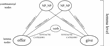
Pickering and Branigan (1998) extended this verb model by adding nodes that represent “combinatorial” information of verbs (Figure 1). Combinatorial information “specifies the way in which a word can combine with other linguistic units to form possible expressions of the language. A verb (e.g., eat) can combine with arguments (e.g., the men, the food) that correspond to the participants in the action denoted by the verb” (Pickering & Branigan, 1998, p. 634), that is, its subcategorization frame or argument structure. In Pickering and Branigan's model, the combinatorial nodes are linked to verb lemmas and are active when a verb is used with a particular complement. For example, the lemma of a ditransitive verb that dativises is connected to two combinatorial nodes: one for the PO construction (noun phrase, prepositional phrase [NP], [PP]) and another for the DO construction (NP, NP). According to this account, syntactic priming is affected because combinatorial nodes are shared among verb lemmas that opt for the same postverbal syntactic patterns. The activation of a combinatorial node does not dissipate immediately and can therefore facilitate processing of the same structure in subsequent discourse. Finally, Pickering and Branigan do not exclude the possibility that the combinatorial nodes of verbs include not only their subcategorization information (e.g., NP, PP, and NP, NP for ditransitive verbs) but also their overall combinatorial potential, that is, both their argument and nonargument phrases.

Pickering and Branigan's (1998) partial model of shared representations of the syntactic information associated with verbs at the lemma level in the monolingual production lexicon. From “The representation of verbs: Evidence from syntactic priming in language production,” by M. J. Pickering and H. P. Branigan, 1998, Journal of Memory and Language, 39. Copyright 1998 by Elsevier. Reprinted with permission.
Pickering and Branigan's (1998) model can also be used to frame questions about the relationship between the representations of L1 and L2 syntactic information related to verbs in the bilingual lexicon. On the one hand, the combinatorial nodes of one language (L2) may map onto those of the other (L1), resulting in shared representations, at least for languages that offer the same or equivalent combinatorial possibilities for a particular category of verbs. In such a model, the L1–L2 shared syntactic (combinatorial) information is linked to and can be activated by both L1 and L2 verbs. On the other hand, there may be separate representations of the combinatorial possibilities in each language, resulting in duplicate representations. These language-specific representations are linked to and activated by verbs of a single language only. The former model has the advantage of an economic representational architecture where resources and information from either language can be drawn upon to the maximum, whereas the latter offers processing autonomy and minimizes interlanguage interference (cf. also Hartsuiker, Pickering, & Veltkamp, 2004).
SYNTACTIC PRIMING ACROSS LANGUAGES
In contrast to the monolingual literature, syntactic priming has been less researched in the bilingual literature. Although most of the studies that have employed cross-language syntactic priming thus far employed overlapping type of structures, tasks, and languages, their results are contradictory. Heydel and Murray (1997, described in Heydel & Murray, 2000) presented German–English bilinguals with a German sentence and two pictures per trial. Participants had to decide whether the German sentence was related to the events depicted in the pictures—this was never the case for the critical items, that is, prime sentences and target pictures—and then describe each picture in writing using one English sentence. There were three types of prime sentences: (a) actives (Ein PR-MannNOMberät den ManagerACC, TheNOM PR-manNOM advises the managerACC), (b) passives (Der ManagerNOMwird von einem PR-MannDATberaten, The managerNOM is advised by the PR-manDAT), and (c) topicalizations (Den ManagerACCberät ein PR-MannNOM, The PR-man advises the manager).
The target pictures could be described in English using only an active or passive construction. The results showed priming of the production of active target constructions following an active prime sentence (an increase of 7%) and priming of the production of passive target constructions after a passive prime sentence (an increase of 8%). Along with passive primes, however, topicalizations also primed the production of passive target responses (an increase of 11%), rather than the production of actives. The effect was, thus, interpreted as arising from the conceptual similarities (in this case the order of thematic roles) between primes (German topicalizations) and targets (English passives).
Two methodological issues should be noted here though. First, in the majority of previous studies, the picture description task was disguised as a memory task. In Heydel and Murray's (2000) tasks, participants were presented with prime sentences and target pictures and had to decide whether the prime sentence was related to the event depicted in the target pictures prior to target picture description. That is, they were invited to consciously elaborate on the semantics of primes and targets looking for similarities or associations. Critical primes and targets were always semantically unrelated (e.g., a prime sentence like Ein PR-Mann berät den Manager (A PR-man advises the manager) paired with two target pictures showing a pelican swallowing a fish); nonetheless, they both entailed an event and two participants. Thus, the conceptual organization of the prime (i.e., the arrangement of thematic roles) might have become unusually potent by virtue of the requirements of the task.
Second, Heydel and Murray (2000) elicited written target responses in their tasks. Although structure priming has been obtained in written production as well, Branigan, Pickering, and Cleland (1999) found that the effect decays rapidly in written production when other structures intervene between prime and target. However, this rapid decay does not apply to oral production (Branigan, Pickering, Stewart, & McLean, 2000). They attributed this difference to the specific nature of written production in that it may induce more conceptual processing than oral production. Writing is a slower and more effortful procedure. More importantly, a written production task allows more time to think and plan the resulting outcome. Consequently, different factors than the ones involved in oral production might come into play. Therefore, it is not unlikely that some processing details are different between written and oral sentence production and differentially affect syntactic priming.
Loebell and Bock (2003) used a picture description task that differed methodologically from Heydel and Murray's (2000). In this task, participants had to repeat the auditory prime sentence, describe the target picture, and then decide whether they had heard the sentence or seen the picture before. They tested four types of primes (actives, passives, POs, and DOs) both L1-to-L2 and L2-to-L1 with German–English bilinguals. They obtained a priming effect for DOs only. No difference between L1-to-L2 and L2-to-L1 priming was obtained.
In a sentence recall task, Meijer and Fox-Tree (2003) primed English target sentences with Spanish PO sentences. Unlike Loebell and Bock (2003), they obtained cross-language syntactic priming of PO structures from Spanish to English. They also showed that Spanish PO sentences are primed by English sentences with locative or instrumental PPs that shared syntactic structure but not thematic roles with the targets. However, in neither experiment were the items rotated across conditions, leaving open the possibility that these effects may be due to specific items.
Hartsuiker et al. (2004) employed a dialogue task (Branigan, Pickering, & Cleland, 2000) with Spanish primes and English targets but the same prime structures as Heydel and Murray (1997, quoted in Heydel & Murray, 2000): actives, passives and “dislocated” actives (corresponding to Heydel and Murray's German topicalizations). Unlike Heydel and Murray, they found that only passive primes produced priming relative to a baseline. The fact that dislocated actives did not produce priming supports the view that the effect resulting from the “topicalizations” in Heydel and Murray might be because of the procedure used, although such an explanation cannot account for the absence of priming from actives in the Hartsuiker et al. study.
A possible explanation for the contradictory results among the previous four studies regarding priming of actives versus passives and POs versus DOs might be the different tasks and methodologies employed. Note, however, that the picture description task and the dialogue task, used by Loebell and Bock (2003) and Hartsuiker et al. (2004), respectively, have also been employed in L1 studies (e.g., Bock & Loebell, 1990; Branigan, Pickering, & Cleland, 2000) where robust syntactic priming effects have been reported with all these structures. The lack of priming with PO structures in the Loebell and Bock study specifically might be because of the particular status of this construction in German. The PO structure is grammatically correct and semantically acceptable only with a small number of German ditransitive verbs; for example, it is ungrammatical with such main ditransitive verbs as geben (give), zeigen (show), anbieten (offer), and leihen (lend). This suggests that the DO, which is perfectly grammatical with all German ditransitive verbs, is the main structure used to express the dative meaning in German, whereas the use of the PO is quite restricted and might thus be underspecified in the mental lexicon of German speakers. Even more revealingly, the within-language effects in a follow-up experiment using only the German material did not reach significance.
More robust cross-language results come from two more recent studies. Desmet and Declercq (2006) demonstrated L1-to-L2 priming of preferences for (high or low) relative clause attachment. Dutch–English bilinguals tended to attach a relative clause to the first postverbal NP of an ambiguous English target sentence (e.g., John met the boss of the employees that…) after completing an equivalent Dutch prime sentence with a relative clause unambiguously attached to the first postverbal NP than after completing a Dutch prime sentence with a relative clause unambiguously attached to the second postverbal NP. However, note that this type of syntactic information is not directly related to specific lexical (here verb) entries, unlike, for example, the PO and DO structures examined in the previous studies. Using a dialogue task, Schoonbaert, Hartsuiker, and Pickering (in press) obtained both L1-to-L2 and L2-to-L1 priming with PO and DO structures. Moreover, L1-to-L2, but not L2-to-L1, priming was significantly boosted when using translation-equivalent prime and target verbs.
In summary, despite some contradictory findings and methodological limitations, previous cross-language studies of syntactic priming support the assumption that at least some structural/syntactic information is shared between languages. In particular, Loebell and Bock (2003), Meijer and Fox-Tree (2003), and Hartsuiker et al. (2004) argued in favor of the existence of shared information at a purely syntactic level of representation. Contrary to Heydell and Murray (2000), they do not postulate any contribution to cross-language syntactic priming from conceptual (thematic role) similarities. However, the bilingual data thus far cannot be conclusive about the nature of cross-language syntactic priming or the conditions under which it takes place. For example, apart from syntactic structure, the prime sentences that induced priming in Loebell and Bock (DO; 2003), Meijer and Fox-Tree (PO; 2003), Hartsuiker et al. (passive; 2004), and Schoonbaert et al. (PO and DO; in press) also fully or partially shared number, type, and order of thematic roles with the target sentences. The cross-linguistic experiments in this study thus tested for syntactic priming with PO and DO structures but using a different language combination from the ones employed thus far (i.e., Greek–English in which POs and DOs are acceptable) and additional priming conditions to determine the source of the effect and the nature of the representation of syntactic information in the bilingual lexicon.
THE PRESENT STUDY
This paper examined two theoretical issues. The first issue, explored in Experiment 1, investigates the shared or independent nature of L1 and L2 syntactic representations in the bilingual lexicon by testing two alternative hypotheses. The first one, which will be termed the language-shared hypothesis, claims that equivalent L1 and L2 syntactic structures share representations in the bilingual mental lexicon. The second hypothesis, which will be called the language-specific hypothesis, states that even equivalent L1 and L2 syntactic structures do not have shared representations. The language-shared hypothesis predicts cross-language syntactic priming with these structures. If participants produce an L1 utterance with a PO structure, they will be more likely to produce a subsequent L2 utterance with a PO rather than a DO structure and vice versa. The language-specific hypothesis predicts no such priming. This prediction is also based on the assumption that activation of syntactic representations perseveres after their use.
The language-shared hypothesis also makes an additional prediction. If cross-language syntactic priming exploits translational (lexical) links and/or shared concept nodes between L1 and L2 lemmas (in addition to syntactic information), priming will be significantly stronger when the L1 prime and L2 target verbs are translation equivalents (e.g., δ

νω/'ðin

/[give]) than when they are unrelated (e.g., πρ oσφ

ρω/pr
'sfεr
/[offer, give]). In contrast, if priming is because of the shared L1–L2 subcategorization information only, then its magnitude will not be affected by whether the primes and targets are translation equivalents. The recent Schoonbaert et al. (in press) data support the former possibility because they found a “lexical boost” with translation-equivalent prime and target verbs and adjacent prime and target trials. To test for purely structural priming, independent of discourse, conceptual, and lexical influences from prime to target structures, we introduced in our task a filler trial between primes and targets containing an intransitive structure.
The second issue that the paper investigates concerns the exact nature of syntactic representations in the bilingual lexicon. Do these representations encode information about syntactic structure in general, about constituent order, order of thematic roles, or a combination of these? Note that the cross-linguistic priming between PO or DO structures obtained in previous studies (e.g., Loebell & Bock, 2003; Schoonbaert et al., in press) cannot distinguish between these three possibilities because PO and DO structures differ across syntactic structure, constituent order, and order of thematic roles (PO: NP V NP PP, agent–theme–goal; DO: NP V NP NP, agent–goal–theme). Evidence that the order of thematic roles and constituent order may drive the priming of PO and DO structures derives from monolingual studies. Hare and Goldberg (1999), for instance, showed that utterances such as The editor credited Bob with the hot story primed DO utterances with which they share order of thematic roles rather than PO utterances with which they share syntactic structure and constituent order. In contrast, Pickering, Branigan, and McLean (2002) found that shifted-PO primes (NP V PP NP, The racing driver showed to the helpful mechanic the torn overall) primed neither PO constructions, with which they share syntactic structure, but not constituent order, nor DO constructions, with which they share order of thematic roles. Instead, they behaved like baseline intransitive primes. On this basis they concluded that the representation of postverbal syntactic structure is fully specified for constituent order. However, it might be argued that the lack of priming from a shifted-PO to a PO structure is because the shifted-PO construction is rarely used in English (e.g., when the DO is particularly long) and might not be fully represented or productive in native English speakers' mental lexicon. A relatively free word order language like Greek where the shifted-PO construction is more commonly used relative to the PO (33.9% shifted-PO vs. 66.1% PO; Lascaratou, 1994) provides a better test case for investigating priming from a shifted-PO prime structure and evaluating the role of constituent order and thematic information during syntactic priming.
Thus, Experiment 2 examined the role of syntactic structure, constituent order, and order of thematic roles in cross-language syntactic priming by testing three alternative hypotheses. The first, which will be termed the syntactic structure hypothesis, claims that syntactic structure alone, irrespective of constituent order variations, is the cause of cross-linguistic syntactic priming. The second, the constituent order hypothesis, states that structural repetition during sentence production across languages is because of the surface constituent alignment of sentences. Finally, the third is the order of thematic roles hypothesis, and states that the array of thematic roles in sentences drives cross-language syntactic priming.
Finally, a further possibility about the nature of syntactic representations that will be tested in Experiment 3 is what we will term the pairing of thematic roles and syntactic structure hypothesis. This hypothesis postulates that the crucial factor in cross-language syntactic priming is the identity of the pairing of thematic roles and syntactic structure in the prime and target sentences. It has two versions. The two-argument pairing of thematic roles and syntactic structure hypothesis requires a complete matching of thematic roles and syntactic structure for both postverbal arguments of the prime and target sentence. The first-argument pairing of thematic roles and syntactic structure hypothesis requires identity of thematic roles and syntactic structure between the first postverbal argument of prime and target sentences only, complying with incremental processes of speech production. Speakers embark on articulating their thoughts as soon as some aspects of the utterance's frame become available rather than wait until all the necessary input for the utterance construction has been retrieved and processed (e.g., Kempen & Hoenkamp, 1987). Accordingly, accessing the first postverbal argument of prime ditransitive constructions, rather than processing the entire (prime) structure, might be sufficient to bias speakers' response towards one of alternative target structures in a syntactic priming task.
All three experiments employed a bilingual version of Branigan, Pickering, Stewart, and McLean's (2000) oral sentence completion task with L1 prime and L2 target items to elicit cross-language syntactic priming. The syntactic structure used was the dative alternation and the L1–L2 pair was Greek–English.
EXPERIMENT 1
Experiment 1 contrasted the language-shared and language-specific hypotheses; that is, it investigated whether representations of L1 and L2 syntactic structures are shared between pairs of languages in which these structures serve the same discourse function and have an equivalent surface syntax. Examples of such equivalent structures are the PO and DO constructions in English and Greek. Sentence 2 corresponds to 3 and sentence 4 to 5.3
Greek, having a relatively flexible constituent order and morphological case marking, offers two constituent order variants for each structure: PO: NP V NPacc PP(P NPacc) or NP V PP(P NPacc) and DO: NP V NPgen NPacc or NP V NPacc NPgen. The latter order, however, is seldom (if ever) used because the clause-final NPgen can be ambiguous between an indirect object and a possessive reading. Because investigating the role of constituent order is beyond the scope of Experiment 1, only those Greek structures that are equivalent to the English PO and DO in terms of constituent order will be used.
- 2. The president gave/offered the gold medal to the winner.
- 3. Ο πρόεδρος δωσε/πρόσφερε το χρυσό μετ
 λλιο στο νικητ.
- 4. The president gave/offered the winner the gold medal.
- 5. Ο πρόεδρος δωσε/πρόσφερε του νικηττο χρυσό μετλλιο.
The language-shared hypothesis predicts priming from L1 structures to L2, whereas the language-specific hypothesis does not.
Method
Participants
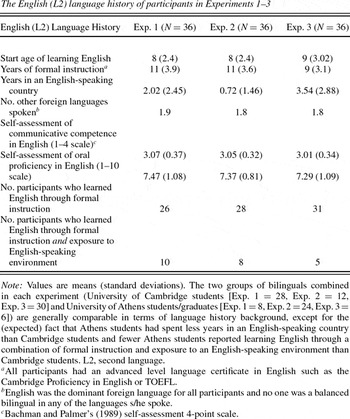
Thirty-six native Greek-speaking advanced learners of English participated in the experiment. Twenty-six were students at the University of Cambridge, studying a variety of subjects, and 8 were students at or graduates (working as English language teachers) of the department of English Studies of the University of Athens. A more detailed profile of the participants is provided in Appendix A.
Materials
The critical experimental material consisted of English and Greek sentence fragments whose main verb was a ditransitive (e.g., give, στ
λνω/'stεln
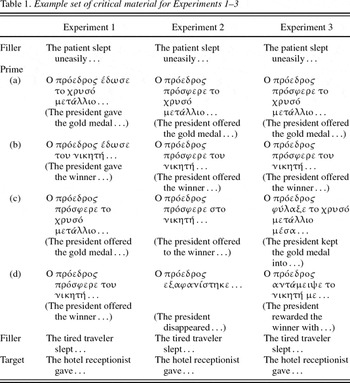
/[send]). These fragments were incorporated into 32 sets of items. Each set included two intransitive filler fragments, a prime fragment, and a target fragment. An example set of material can be viewed in Table 1. (See Appendix B for more example items.)

The prime fragment was always in Greek (L1) and the target fragment always in English (L2). The intransitive filler fragment intervening between prime and target was always in English so as to avoid having a language switch just before the target fragment completion. The other intransitive filler fragment was in English in half of the sets and in Greek in the other half.
Every target fragment contained a subject NP followed by a ditransitive verb and could be completed either with a DO construction (i.e., NP NP) or a PO construction (i.e., NP PP). The prime fragments included an additional postverbal NP and varied in two dimensions. First, by introducing this additional NP it was possible to manipulate the prime fragment completion so as to induce either a DO or PO construction. For instance, in (a) the postverbal NP is a plausible theme but an implausible recipient/goal for the action denoted by the ditransitive verb. Thus, participants were more likely to complete this fragment with a PO construction. In contrast, in (b) the postverbal NP is a plausible recipient/goal but an implausible theme. Hence, participants were more likely to complete (b) with a DO construction. Second, half of the prime fragments included an L1 translation of the target L2 verb (e.g., a and b) and the other half a different L1 verb (e.g., c and d). Thus, each of the 32 target fragments occurred with four different prime types: (a) translated-verb–PO-eliciting prime, (b) translated-verb–DO-eliciting prime, (c) different-verb–PO-eliciting prime, and (d) different-verb–DO-eliciting prime. All prime verbs had the same tense, aspect, and number as target verbs.
Nine different Greek verbs were included in the prime fragments and seven different English verbs in the target fragments. Most of the English verbs had been used in previous sentence completion tasks and were reported to produce relatively low proportions of other (i.e., non-PO or non-DO) completions (Branigan et al., 1999; Branigan, Pickering, Stewart, et al., 2000; Pickering & Branigan, 1998). In half of the sets the order of the items was intransitive, prime, intransitive, and target fragment; in the other half the order was prime, intransitive, target, and intransitive fragment. Half of the pairs of intransitive fragments employed the same verb and half a different verb. In each pair of intransitive fragments, one fragment was followed by an adverb; in half of the sets this fragment occurred between prime and target and in the other half of the sets either preceded the prime or followed the target. These manipulations had two purposes. First, they were intended to make the pairs of intransitive fragments as similar as possible to, and to an extent indistinguishable from, the pairs of primes and targets. Second, they were designed so that there was always an intransitive fragment between critical items that would preclude any discourse effects from primes to targets.
In addition, 62 filler fragments of various syntactic form were constructed, for example, noun phrase, noun phrase + verb, noun phrase + verb + noun phrase. None of the filler fragments included a ditransitive verb that could be completed with a DO or PO construction. Some of the fillers shared verbs. Finally, 10 practice fragments were constructed. Two of these fragments were used as buffer trials at the beginning of the main experiment. None of the practice items was repeated in the main experiment.
The experimental items were allocated into four presentation lsts. Each lst contained the 32 sets of items (=32 primes, 32 targets, 64 fillers), 62 filler fragments, and 10 practice fragments, for a total of 200 sentence fragments. Each lst contained eight sets of items from each condition so that each set appeared in only one of its four versions in every lst. The order of items was individually randomized for each participant under the constraints that no more than three sets of items from the same experimental condition occurred in succession and that at least three filler fragments intervened between targets and the following primes.
Procedure
Participants were individually tested using a PC screen. Each was randomly allocated to one of the four lsts. Following Branigan, Pickering, Stewart, et al. (2000), the instructions stated that the purpose of the experiment was to study the types of sentences English learners produce and that participants must repeat aloud and complete sentence fragments in English and Greek in any way they like provided that the resulting sentence is grammatically correct and semantically plausible. It was also stressed that they should start repeating the fragment as soon as it appears on screen and subsequently completing it as quickly as possible with the first completion that comes to their mind, as there was a limited time in which they had to respond. A beep sound warned them that the next fragment was to appear soon. The instructions were presented on the PC screen.
The presentation of the experimental material was controlled by SuperLab software. Each experimental trial consisted of the following stimuli: a fixation point (*) for 1000 ms, the target fragment for 5000 ms, a blank screen for 1000 ms, the beep sound that lasted approximately 118 ms, and finally another blank screen for 1000 ms. The location of the fixation point on the screen marked the beginning of each sentence fragment. Each trial lasted about 8000 ms.
Before the experiment proper, participants were given a brief questionnaire to fill in regarding their language history. A short practice section consisting of 10 sentence fragments preceded the experimental task. Each experimental session lasted approximately 45 min including four breaks, the duration of which was individually determined by each participant.
Scoring
Each experimental session was recorded, transcribed and scored. Branigan, Pickering, Stewart, and McLean's (2000) scoring method was followed. Prime and target completions were scored as PO, DO, or other. A completion was scored as PO if it met the following criteria: (a) if the ditransitive verb was followed by a NP with the thematic role of theme or patient and then a PP with the preposition to in English or σε (to) in Greek and the thematic role of recipient/goal (V NP PP(P NP); in Greek, both postverbal NPs also had to be marked as follows: NPacc PP(P NPacc); (b) if the ditransitive verb was not part of a phrasal verb construction (e.g., show off); (c) if it did not occur in a DO-eliciting prime fragment; and (d) in the case of target fragments if its DO alternative was grammatical. Similarly, a completion was scored as DO under the following conditions: (a) if the ditransitive verb was followed by a NP with the thematic role of recipient/goal and then by a second NP with the thematic role of theme or patient (V NP NP; in Greek, both postverbal NPs also had to be marked as follows: NPgen NPacc); (b) if the ditransitive verb was not part of a phrasal verb construction; (c) if it did not occur in a PO-eliciting prime fragment; and (d) in the case of target fragments, if its PO alternative was grammatical. All other completions were scored as other.
Data analysis
The data analysis was based on the method outlined by Pickering et al. (2002). That is, the dependent variable was the “PO target ratio,” a measure designed to calculate the proportion of PO versus DO target completions excluding other target completions. Target fragments following prime completions that were scored as other were also discarded from the analysis. The analysis was carried out on proportions rather than absolute numbers, because, as participants were free to complete the fragments in any way they liked, the total number of primes completed in the intended way, and hence the number of valid target completions might have varied in each condition (Pickering & Branigan, 1998). Proportions provide a better basis for comparison between and across conditions.
The PO target ratio was calculated as the number of PO target completions divided by the sum of the number of PO and DO target completions in each condition. The use of the PO rather than the DO proportions in the analyses is arbitrary, as the proportions of PO and DO target ratio are complementary. We also calculated an “overall PO target ratio,” which was the number of PO target completions divided by the sum of the number of PO and DO target completions across all four conditions, excluding again other target completions.
In addition to the analysis of the PO target ratio, an analysis of the proportion of other target completions in each of the four conditions was performed. The relevant proportions were derived by dividing the number of other target completions in each condition by the total number of prime completions in the same condition that were completed with the structure by which that condition was meant to elicit. For example, in the same-verb PO condition, the number of other target completions was divided by the total number of PO prime completions in that condition. In all sets of analyses, the proportions were calculated per participant and per item and all experimental factors were within participants and within items.
Results
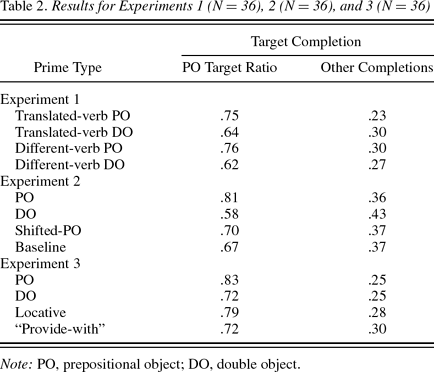
Of all prime fragments (1,015), 88% (1,152) were completed with a PO or DO; of these, 24% were translated-verb PO completions, 26% translated-verb DO, 23% different-verb PO, and 27% different-verb DO. The percentage of the target fragment completions on these trials was 48% PO (492), 24% DO (242), and 28% other (281). One cell in the translated-verb DO condition and three cells in the different-verb PO condition in the participants analysis had missing values and were replaced by the overall mean. Table 2 displays the PO target ratio and the proportion of other target completions in the four prime conditions.

An analysis of variance (ANOVA) on the other target completions showed no significant difference among prime conditions (all Fs < 2.63, all ps > .1). In the PO target ratio analyses, a two-way ANOVA revealed a significant main effect of prime type, F1 (1, 35) = 36.29, mean square error (MSE) = .015, p < .01; F2 (1, 31) = 15.11, MSE = .025, p < .01. The mean PO target ratios in Table 2 show that participants produced more PO target completions following a PO prime completion than following a DO prime (and vice versa for the DO target completions). Neither the main effect of verb type nor their interaction approached significance (all Fs < .79) meaning that the syntactic priming effect was unaffected by the type of verb (translated vs. different) used in the prime fragments.
Finally, we tested for any significant difference in the overall number of PO and DO target completions across all conditions. Because the PO and DO target ratios are complementary (PO + DO = 1), a one-sample t test was employed on the overall PO target ratio across all conditions per participant and per item with a test value of .50. The assumption is that if there is no difference between the PO and DO target ratio, both of them will equal .50. If, therefore, the PO target ratio is significantly different from .50, then it will also be significantly different from the DO target ratio. The test revealed a significant difference in participants' overall production of PO target completions (.69) versus DO target completions (.31), t1 (35) = 4.21, p < .01; t2 (31) = 6.58, p < .01.
Discussion
Experiment 1 demonstrates that syntactic priming can occur cross-linguistically from L1 to L2 in oral production between L1 and L2 structures that are equivalent in terms of surface syntax and discourse function. The production of PO target completions (as expressed by the PO target ratio) was 12.5% higher after PO than after DO prime completions, and vice versa. These results are in line with the language-shared hypothesis that postulates a shared representation of equivalent L1 and L2 syntactic structures.
In addition, priming was unaffected by whether the L2 target verb was a translation of the L1 prime verb or a completely different verb. In prime-target trials with translation equivalent verbs, there were 11% more target completions of the same type as the prime completions than of the alternative type. In prime-target trials with different verbs, the difference was 14%. This difference between translated and different-verb conditions did not reach significance. This finding suggests that translation links between L1 and L2 verb lemmas did not contribute to priming. If this had been the case, there would have been greater priming in the translated versus different-verb condition. This result contrasts with monolingual studies in which, although the overall level of priming was similar to that obtained here, greater priming was obtained when the primes and targets repeated the same verbs (e.g., Pickering & Branigan, 1998). It also contrasts with a recent cross-language study, which shows greater priming with ditransitive structures for translation equivalent than different verbs from Dutch (L1) to English (L2; Schoonbaert et al., in press). This difference can be attributed to a number of factors. First, recall that an intransitive filler fragment always intervened between primes and targets in the present study, whereas targets immediately followed primes in Pickering and Branigan (1998) as well as in Schoonbaert et al. (in press). Any translation priming effects may well be short lived (like associative priming effects) and thus may not persist over the prime-target delay in the present paradigm. Second, lexical effects that are assumed to be long lasting such as repetition priming effects resulting from the strengthening of the connection between lemma and form, have been reported within language (Wheeldon & Monsell, 1992) but not across languages (Monsell, Matthews, & Miller, 1992, who employed repetition priming from the dominant to the weaker language). The fact that the translation verb condition in Schoonbaert et al. (in press) results in more priming than the different verb condition indicates that in the former condition some sort of translation priming takes place in addition to the structural priming. This translation priming could be realized either via the translation links between the translation equivalent verb lemmas or via their shared conceptual representations (the latter possibility being more in line with the revised hierachical model of Kroll & Stewart, 1994, which assumes that word-to-concept connections are stronger for L1 than for L2 and, as a result, L1-to-L2 priming is conceptually mediated). The L1-to-L2 priming obtained with translation equivalent verbs in Schoonbaert et al. may thus reflect a combination of lexical/conceptual and structural priming. By contrast, Experiment 1 demonstrates purely structural priming across languages independently of translation effects or strategies with translation equivalent (and different) verbs.4
We acknowledge that the pair of languages used in Experiment 1 (Greek–English) employ different alphabets, as opposed to previous studies that used either one language only (e.g., English; Pickering, & Branigan, 1998) or pairs of orthographically related languages (e.g., Dutch–English; Schoonbaert et al., in press). However, we do not think that orthographic differences between Greek and English could explain the absence of lexical/translational effects in Experiment 1 as such effects have been repeatedly reported between languages with different scripts (e.g., Chen & Ng, 1989; Gollan, Forster, & Frost, 1997; Jiang, 1999).
The present experiment yielded a significantly higher proportion of PO than DO target completions across all conditions. This PO effect that also occurred in Experiments 2 and 3 (on average 71% PO–29% DO),5
The average for English L1 speakers in equivalent monolingual experiments is 56% PO–44% DO (Salamoura, 2004).
There is evidence that L2 learners might overuse or underuse a particular L2 structure because of L1 influence or transfer (MacWhinney, 1997). Trévise (1986) argues that the overuse of topicalization structures in English by French learners compared to natives is because of their more widespread usage in French than in English. Likewise, Selinger (1989) attributes the restricted usage of the English passive by Hebrew learners to the fewer contexts that allow a passive construction in Hebrew relative to English.
EXPERIMENT 2
Having established the existence of a syntactic priming effect across languages with PO and DO structures, the goal of Experiment 2 was to evaluate the role of constituent order and thematic roles in cross-language syntactic priming, and hence, in syntactic processing and representation in the bilingual lexicon. This is necessary, as in Experiment 1 the pairs of prime and target constructions that induced priming shared not only syntactic structure but also the order of thematic roles and constituent order.
Using the same bilingual sentence completion paradigm as in Experiment 1, we also introduced, after Pickering et al. (2002), a shifted-PO structure (Ο πρόεδρος
δωσε στο νικητ

…το βραβε
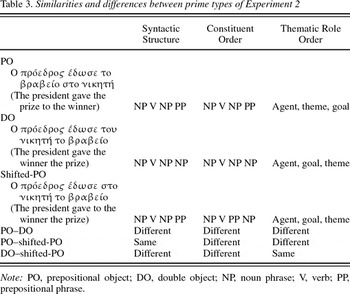
ο = The president gave to the winner… the prize) and an intransitive baseline (Ο πρόεδρος χρεωκόπησε… = The president went bankrupt…) in the set of L1 primes. As in Experiment 1, an L2 intransitive filler fragment always intervened between L1 primes and L2 targets. The three hypotheses tested in this experiment (syntactic structure, constituent order, order of thematic roles) predict the main syntactic priming effect, that is, PO prime completions will prime PO rather than DO target completions and vice versa. This priming is predicted because PO and DO structures differ along their syntactic structure, constituent order, and order of thematic roles. Table 3 provides a summary of the similarities and differences of the prime types with respect to these three variables. All three hypotheses, however, make different predictions concerning the priming that will result from the shifted-PO structure. The syntactic structure hypothesis predicts no difference in priming between PO and shifted-PO primes, that is, both PO and shifted-PO structures will prime PO target completions to the same extent in comparison to the baseline. The constituent order hypothesis predicts no priming of either PO or DO target completions following shifted-PO primes, that is, the proportion of PO target completions after shifted-PO primes will be similar to the proportion of POs after baseline (intransitive) primes. Last, the order of thematic roles hypothesis predicts no difference in priming between DO and shifted-PO primes, that is, both DO and shifted-PO structures will negatively prime PO target completions to the same degree relative to the baseline.

These predictions are valid under the assumption that (a) cross-language syntactic priming, like within-languages priming, is balanced, that is, priming of PO target completions is higher after PO primes and lower after DO primes relative to baseline primes, and (b) the production of shifted-PO target completions is negligible. If priming is not balanced and, for example, PO primes behave like baseline primes, although it is only DO primes that influence target production, then one cannot distinguish between the syntactic structure and the constituent order hypotheses as both make the same prediction: no difference in priming among the PO, shifted-PO, and baseline conditions. Moreover, both in natural speech (Wasow, 1997) and in experimental conditions (e.g., Pickering et al., 2002), native English speakers rarely produce shifted-POs in free production, unless the DO NP is particularly long.7
Previous studies, however, employing sentence completion tasks (e.g., Branigan, Pickering, Stewart, et al., 2000; Pickering & Branigan, 1998) reported that target completions were usually short.
Method
Participants
The participants were 36 native Greek-speaking advanced learners of English. Twelve were students at the University of Cambridge and 24 were students at or graduates of the department of English Studies of the University of Athens. None of them had taken part in Experiment 1. (See Appendix A for a more detailed profile.)
Materials
The design of the experimental material was identical to that in Experiment 1 except for the design of the prime items. There were four different types of prime fragments. An example of these prime fragments and a target fragment is given in Table 1. (See Appendix B for more example items.)
The prime fragments of Types (a) and (b) included a postverbal NP manipulated in such a way so as to elicit a PO or DO completion, respectively, as described in Experiment 1. The prime fragments of Type (c) contained a postverbal PP using the preposition στ o(ν)/στη(ν)/στ o (to). This PP was always a plausible recipient/goal and an implausible theme for the action denoted by the ditransitive verb, so a shifted-PO completion was very likely in this case. Finally, the prime fragments of Type (d) consisted only of a subject NP and an intransitive verb so as to elicit an intransitive structure. Thus, each of the 32 target fragments occurred with four different prime types: (a) PO-eliciting prime, (b) DO-eliciting prime, (c) shifted-PO eliciting prime, and (d) baseline prime. L1 prime and L2 target fragments always contained different, never translated, verbs in this task.
Nine Greek ditransitive and eight intransitive verbs were included in the prime fragments and six English ditransitive verbs in the target fragments. The Greek verbs used in the shifted-PO primes were drawn from the pool of the ditransitive verbs used in the PO- and DO-eliciting prime fragments. None of the Greek verbs used in the baseline primes appeared in any of the Greek intransitive fillers or in the English ones as a translation.
Procedure and data analysis
The procedure and data analysis were identical to those of Experiment 1.
Scoring
It was the same with that of Experiment 1 apart from the following points. Prime completions were scored as PO, DO, shifted-PO, or baseline. Target completions were scored as PO, DO, or other. A few shifted-PO completions that were produced in target fragments were classified as other target completions because their small number (36/1,081 or 3.3%) did not allow us to run any reliable statistics on them. A completion was scored as shifted-PO if it met the following criteria: (a) if the ditransitive verb was followed by a prepositional phrase with the preposition σε (L1) or to (L2) and the thematic role of recipient/goal and then by a NP with the thematic role of theme or patient (V PP[P NP] NP), in Greek both NPs also had to be marked for accusative case, and (b) if the ditransitive verb was not part of a phrasal verb construction (e.g., show off). Every grammatically correct and semantically plausible completion in the baseline prime fragments was scored as baseline.
Results
Of all prime fragments (1,152), 94% (1,081) were completed with an expected structure; of these, 22% were PO, 26% DO, 26% shifted-PO, and 26% baseline. The percentage of the target fragment completions on these trials was 42% PO (451), 20% DO (215), and 38% other (415). Table 2 shows the PO target ratio and the proportion of other target completions in the four prime conditions.
The proportions of other target completions did not differ across prime conditions (both Fs < 2.24, both ps > .1). In the PO target ratio analyses, a one-way ANOVA revealed a significant effect of prime type, F1 (3,105) = 8.05, MSE = .038, p < .01; F2 (3, 93) = 5.12, MSE = .055, p < .01. Hence, the expected syntactic priming effect with PO and DO was obtained in this experiment. Planned comparisons showed that the PO target ratio differed significantly between the shifted-PO and PO prime conditions in the participant analysis and approached significance in the item analysis, F1 (1, 35) = 5.64, MSE = .038, p < .05; F2 (1, 31) = 3.56, MSE = .055, p < .075. It also differed significantly between the shifted-PO and DO conditions, F1 (1, 35) = 6.14, MSE = .038, p < .05; F2 (1, 31) = 5.06, MSE = .055, p < .05. However, it did not differ significantly between the shifted-PO and baseline prime conditions (both Fs < .41). Finally, participants demonstrated again a bias for producing overall more PO target completions (.69) than DO target completions (.31), t1 (35) = 3.87, p < .01; t2 (31) = 10.29, p < .01.
Discussion
The results replicate the main cross-linguistic syntactic priming effect between PO and DO (23% priming), also present in Experiment 1. In addition, only the L1 PO (but not the L1 shifted-PO) variant of the PO structure primed the L2 PO structure relative to the baseline. L1 shifted-PO primed neither L2 PO nor L2 DO to the same degree that L1 PO and L1 DO did, respectively. In fact, L1 shifted-PO behaved similarly to the L1 baseline with respect to the production of PO and DO target completions. It is of interest that the PO target ratio in the shifted-PO condition (70%), and in the baseline condition (67%), was near the mean of the PO ratios in the PO and DO conditions (58 and 81%, respectively). This shows a balanced priming effect similar to the one obtained in L1 by Pickering et al. (2002). L1 shifted-PO and baseline primes produced a lower number of L2 PO target completions relative to L1 PO primes and a higher number of L2 PO target completions relative to L1 DO primes. Overall, the findings were consistent with Pickering et al.'s (2002) L1 data and indicate that the lack of priming from shifted-POs cannot be attributed to the frequency of use of that structure in English. These results lend support to the constituent order hypothesis that claims that constituent order is primed across languages during oral sentence production and appears to be a source of cross-linguistic syntactic priming.
EXPERIMENT 3
Apart from the constituent order hypothesis though, the cross-language data of Experiment 2 can also be explained by an alternative account that we have termed the pairing of thematic roles and syntactic structure hypothesis, and claims that cross-language syntactic priming is driven by the combination of thematic roles and syntactic structure in the prime and target sentences. This pairing could extend to the whole structure (i.e., to both postverbal arguments; the two-argument pairing hypothesis) or may be restricted only to the first postverbal argument (the first-argument pairing hypothesis). Accordingly, accessing the first postverbal argument of prime ditransitive constructions, rather than processing the entire (prime) structure, might be sufficient to bias speakers' response toward one of alternative target structures in a syntactic priming task. Experiment 3 aimed at disentangling these hypotheses (two-argument and first-argument pairing) from the constituent order hypothesis in the context of cross-language syntactic priming.
To do so, it was necessary to employ, in the same task, constructions whose constituent order/syntactic structure and order of thematic roles coincides or contrasts with those of POs and DOs. Thus, Experiment 3 used four types of L1 prime structures: PO, DO, locative (Ο πρóεδρ oς φ

λαξε τ o χρυσó μετ

λλι o μ
σα στ o συρτ
ρι = The president kept the gold medal in the drawer) and provide-with (Ο κ oσμηματ oπ

λησ πρ oμ

θενsigmaε την πελ
τισσ
τ oυ με τ o ακριβó δαχτυλ
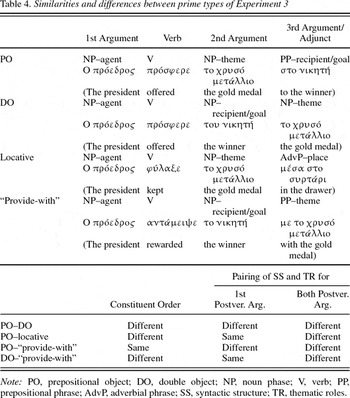
δι = The jeweller provided his customer with the expensive ring). Table 4 provides a summary of the similarities and differences of the prime types with respect to syntactic structure, constituent order, order of thematic roles, and pairing of syntactic structure and thematic roles. Locative constructions such as The wealthy widow drove an old Mercedes to the church have been used in the past by Bock and Loebell (1990), who showed that they primed POs such as The girl is handing a paint brush to the boy, despite the difference in thematic roles between the two utterances (locative: agent, theme, location; PO: agent, theme, recipient/goal). However, Hare and Goldberg (1999) argued that the priming demonstrated in Bock and Loebell (1990) between PO and locative structures could also be accounted for by thematic role similarities. Under some linguistic accounts (e.g., Jackendoff, 1983, 1987) the thematic role of recipient/beneficiary in The wealthy widow gave an old Mercedes

and the thematic role of locative in The wealthy widow drove an old Mercedes
can both be subsumed under a broader thematic role, that of goal. To circumvent such a possibility, we used locatives whose second postverbal argument can only assume the thematic role of location (for a detailed description see the Materials section).

Again, all hypotheses predict a main syntactic priming effect for the PO and DO structures. However, they make different predictions about priming from the locative and provide-with primes. The constituent order hypothesis predicts that provide-with structures will prime PO but not DO target completions. In other words, the proportion of PO target completions after provide-with primes will be similar to the proportion of POs after PO primes rather than DO primes. Locative primes will behave differently from PO primes. The two-argument pairing hypothesis predicts that neither the locative will prime POs nor the provide-with will prime DOs. Finally, the first-argument pairing hypothesis predicts that the locative will prime POs although the provide-with will prime DOs, and in addition, provide-with and locative should differ from each other.
Method
Participants
Thirty-six native Greek-speaking advanced learners of English took part. Thirty were graduate students at the University of Cambridge and 6 were students at or graduates of the department of English Studies of the University of Athens. None of them had taken part in Experiments 1 or 2. (See Appendix A for a more detailed profile.)
Materials
The design of the experimental material was again identical to that in Experiment 1 except for the design of the prime items. There were four different types of prime fragments. An example of these prime fragments and a target fragment is given in Table 1. (See Appendix B for more example items.)
All prime fragments consisted of three arguments: a subject NP, a verb, and a postverbal NP. Prime fragments of Type (c) included a locative verb that can take a direct object NP and a locative adverb phrase (AdvP), that is, an AdvP that expresses the thematic role of location. These verbs were the Greek equivalents of Levin's (1993) “keep verbs” (φυλ
ω/fl'la
/[keep], αφ
νω/a'fin
/[leave], απ oθηκε
ω/ap
θi'ķεv
/[store], στ oιβ
ζω/sti'vaz
/[stack]) and “verbs of concealment” (κρ
βω/'kriv
/[hide]). The verb ξεχνacuteαω/ksε'xna
/(forget) was also added, used in the sense of “leave something behind,” “forget to take something.” Unlike the motion verbs (e.g., drive, return, move) used in the prepositional locatives by Bock and Loebell (1990), none of the locative verbs in this task express motion of any sort, and thus the locative PP can be interpreted as pure locative rather than the goal of the verb's action. Keep verbs “relate to maintaining something at some location. They do not describe the actual putting of any entity at this location” (Levin, 1993, p. 146, my emphasis). Similarly, verbs of concealment relate “to keeping something out of view” (Levin, 1993, p. 143, my emphasis). In these primes the postverbal NP was always a plausible theme for the action denoted by the verb and was followed by a locative adverb (μ
σα/'mεsa/[in]/[inside], π
νω/'pan
/[on], κ
τω/'kat
/[under], π
σω/'pis
/[behind]). This locative adverb required a locative preposition; in this case, either σε/sε/(in, at, on, to) or από/a'p
/[from], followed by an NP as a complement V NP AdvP(Adv PP[P NP]). The locative adverb and the locative preposition form a periphrastic or complex preposition. Finally, prime fragments of Type (d), which we term provide-with primes, employed Greek verbs equivalent to Levin's (1993) “verbs of fulfilling” (πρ oμηθε
ω/pr
mi'θεv
/[provide], εφ oδι
ζω/εf
'ðjaz
/[supply]), “equip verbs” (εξoπλ
ζω/εks
'pliz
/[equip], απ oζημι
νω/ap
zi'mj
n
/[compensate], ανtauαμε
βω/a

da'miv
/[reward], φ oρτ
νω/f
'rt
n
/[burden], επιβαρ
νω/εpiva'rin
/[charge sb [with money/a chore]], επιφ oρτ
ζω/εpif
'rtiz
/[entrust sb [with a task]]), and “pelt verbs” (β oμβαρδ
ζω/v
mva'rðiz
/[bombard]).
8All verbs in the provide-with category express their arguments in the NP V NP PP(with NP) pattern, where the postverbal NP expresses the recipient/goal argument and the PP expresses the theme argument. Only πρ oμηθε

ω/par
mi'θεv
/(provide) and φ oρτωνω/f
'rt
nc/(burden) can also occur in the NP V NP PP(to NP) pattern, where the postverbal NP expresses the theme argument and the PP expresses the recipient/goal argument.
Procedure and data analysis
The procedure and data analysis were the same as in Experiment 1.
Scoring
It was identical to that of Experiment 1 apart from the following modifications. Prime completions were scored as PO, DO, locative, or provide-with. A prime completion was scored as locative if the locative adverb at the end of the sentence fragment was followed by a preposition and an accusative noun phrase that had the thematic role of location V NPacc AdvP(Adv PP[P NPacc]). It was scored as provide-with if the preposition με/mε/(with) at the end of the sentence fragment was followed by an accusative noun phrase that had the thematic role of recipient/goal (V NPacc PP[P NPacc]).
Results
Of all prime fragments (1,152), 95% (1,094) were completed with an expected structure; of these, 22% were PO, 26% DO, 26% locative, and 26% provide-with. The percentage of the target fragment completions on these trials was 55% PO (605 trials), 18% DO (194), and 27% other (295). Table 2 shows the PO target ratio and the proportion of other target completions.
The proportions of other target completions did not differ across prime conditions (both Fs < 1.13, both ps > .3). In the PO target ratio analyses, a one-way ANOVA revealed a significant effect of prime type, F1 (3, 105) = 5.37, MSE = .020, p < .01; F2 (3, 93) = 2.77, MSE = .042, p < .05. Thus, the usual syntactic priming with PO and DO occurred. Planned comparisons showed that the PO target ratio did not differ significantly between the PO and locative prime conditions (both Fs < 2.33, both ps > .13) as well as between the DO and provide-with conditions (both Fs < .03, both ps > .8). The difference between the locative and provide-with prime conditions was significant in the participant analysis, F1 (1, 35) = 5.13, MSE = .020, p < .02, but nonsignificant in the item analysis, F2 < 1.2, MSE = .042, p > .2. Furthermore, the difference between POs and provide-with structures was also significant, F1 (1, 35) = 11.59, MSE = .020, p < .01; F2 (1, 31) = 5.59, MSE = .042, p < .05. Finally, participants demonstrated again a bias for producing overall more PO target completions (.76) than DO target completions (.24), t1 (35) = 6.1, p < .01; t2 (31) = 12.33, p < .01.
Discussion
As in Experiments 1 and 2, there was cross-linguistic syntactic priming (10%) between PO and DO. Moreover, L1 provide-with structures primed L2 DOs rather than L2 POs. L1 locatives behaved similarly to L1 PO primes in both participant and item analysis and differed significantly from L1 provide-with primes concerning priming of L2 POs in the participant analysis. The difference in priming between POs and provide-with structures indicates that the overall surface structure is not the source of priming.9
Even if it is assumed that the AdvPs of locative structures in fact act as PPs, the overall priming observed in Experiment 3 cannot be explained by a purely syntactic structure and constituent order account, as such an account could not accommodate the fact that the provide-with structures prime DO targets, although their syntactic structures do not fully match.
The argument holding for Bock and Loebell's (1990) material that to-PPs express the same thematic role (Goal) in both locative structures with motion verbs and POs (e.g., Jackendoff, 1987), cannot apply to the present data. The locative AdvPs in combination with the specific verbs used in this task (e.g., φυλ
ω… μ
σα σε [keep…in]) denote location rather than goal. Moreover, despite the priming between L1 provide-with and L2 DO structures and the tendency of L1 locatives to prime L2 POs, the order of thematic roles up to the first postverbal argument (DO-provide-with: agent, recipient/goal; PO-locative: agent, theme) is not a plausible explanation of cross-language syntactic priming because it cannot accommodate the data of Experiment 2. In that task, an L1 shifted-PO did not prime L2 DO responses, although both structures share the same order of thematic roles (agent, recipient/goal, theme).
GENERAL DISCUSSION
All three experiments exhibited cross-language (L1-to-L2) syntactic priming using an oral sentence completion task. They also investigated the conditions under which this effect takes place. Experiment 1 obtained cross-language syntactic priming when there was an overlap of syntactic structure and order of thematic roles between prime and target. It also showed that the magnitude of priming did not differ when the L1 prime and L2 target verbs were translation equivalents or when they differed, suggesting that priming did not exploit the translational links between L1 and L2 verb lemmas when there is a prime-target delay. Experiment 2 showed that cross-language syntactic priming, like within-language priming, is balanced in that both PO and DO structures can be primed across languages compared to a baseline (intransitive) structure. It also demonstrated that constituent order variants of the same structure did not prime each other. Only the L1 PO structure primed the L2 PO relative to a baseline. The L1 shifted-PO structure behaved similarly to the baseline (intransitive) structure, indicating that constituent order is a factor influencing structural repetition across languages and consequently L2 sentence production. Finally, the results of Experiment 3 in conjunction with those of Experiment 2 showed that cross-language syntactic priming is contingent upon the overlap of syntactic structure and thematic roles between the first postverbal arguments of prime and target items independently of the overall syntactic structure and thematic roles of the entire sentence. More importantly, in all these experiments one intervening filler item was introduced between primes and targets to preclude lexical and discourse influences between them.
It could be argued that the animacy of the event participants can account for the cross-language syntactic priming obtained in Experiments 1–3 because in both English and Greek ditransitive constructions themes are typically inanimate entities while recipients/goals are usually animate. The results of Experiment 2 exclude such a possibility though. In that task, shifted-POs did not prime L2 DOs compared to the baseline, although both shifted-POs and DOs present the same animacy order (agent animate, recipient/goal animate, theme inanimate).
A further issue that needs to be addressed is whether the cross-language effect was actually a within-language effect in disguise because of the use of a translation strategy on the part of the participants. Participants might have covertly translated experimental items from one language to the other, particularly from L2 to L1, because they were unbalanced bilinguals with L1 as the dominant language. A number of arguments counteract such a possibility. First, participants' average L2 proficiency level and their fluency in L2 during the task make it highly unlikely that they relied on translation at the sentence level to express their thoughts in L2. Second, there was always an intervening L2 sentence fragment between L1 prime and L2 target; hence, no language switch took place at the target trials, which might have encouraged the use of a translation strategy. Third, no significant difference was obtained in the magnitude of the priming effect between the translated- and different-verb conditions in Experiment 1. If a translation process were in operation, then the translated-verb conditions would have equalled the same-verb conditions of a monolingual task. In such a task the same-verb conditions typically result in a higher degree of priming in relation to the different-verb conditions because of lexical overlap (Pickering & Branigan, 1998). Fourth, evidence from the examination of syntactic priming under conditions that required the overt use of a translation strategy is relevant here. The syntactic priming effect from a cross-language picture naming task that involved explicit translation of the prime sentences was seven times greater than priming from exactly the same cross-language task that did not entail overt translation of primes (Heydel & Murray, 1997, 2000). It was also seven times greater than priming obtained in monolingual syntactic priming studies that used the same task and structures and where clearly no translation process could have occurred (e.g., Bock, 1986; Bock & Loebell, 1990). Likewise, the results of Experiments 1 and 2 are very similar in magnitude to the results of equivalent monolingual studies (Pickering & Branigan, 1998; Pickering et al., 2002). Had an explicit translation process been implicated in the present studies, it would have significantly increased the magnitude of priming in comparison to equivalent monolingual studies, as it did in Heydel and Murray's (2000) explicit-translation task. These facts jointly corroborate the argument that the cross-language priming effects obtained in the present experiments were genuine cross-language effects and not simply covert within-language effects.10
This is not to deny the possibility that some cross-linguistic interactive activation might have taken place at the lexical level (cf. Dijkstra & van Heuven, 2002; La Heij, 2005), which does not undermine the effects obtained at the syntactic combinatorial level.
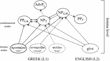
Figure 2 presents a model of the representation of syntactic information in the bilingual lexicon that takes into account the present findings. This model is an extension of Pickering and Branigan's (1998) monolingual model and assumes shared representations of syntactic and thematic information associated with verbs at the lemma level. This model is not, strictly speaking, a spreading activation model but a model of the potential representational status of the lexicon at the lemma level. In this bilingual model, L1 and L2 verb lemmas with the same combinatorial potential are linked to combinatorial nodes shared between the L1 and L2 lexicon whenever possible. The shared information in the combinatorial nodes entails syntactic structure information (e.g., NP, PP) that is also tagged for thematic roles (e.g., T indicates theme, G/R indicates goal/recipient) for each constituent. The existence of thematic role “tags” on the structural information facilitates the mapping between semantics and syntax.
11This proposal does not imply that thematic role information is not also represented independently at the semantic/conceptual level.
ρω (offer), or they may not, for example, the ditransitive give and the locative φυλ
ω (keep). The combinatorial nodes encode both argument and nonargument structure (obligatory complements and adjuncts) of verbs (e.g., both the theme NP and the locative AdvP in the case of the locative verb φυλ
ω [keep]). In addition, each postverbal argument or adjunct phrase is represented by a separate combinatorial node. This ensures maximum possibility for node sharing among verb lemmas and maximum potential for incremental processing during L1 and L2 production.

The model of language-shared representations of some of the syntactic and thematic information associated with verbs at the lemma level in the bilingual lexicon (based on Pickering & Branigan, 1998). The subscript letters in the combinatorial nodes represent thematic role information; G/R, goal/recipient; T, theme; L, location. Lines distinguish routes of activation (e.g., having activated [NPG/R], ανtauαμ oβω (reward) will activate [PPT] rather than [NPT]), not levels or degree of activation. The arrows indicate the direction of activation spreading from the verb lemma to the first postverbal argument and subsequently to the second argument. (The arrows between some arguments can be bidirectional, e.g., [PPG/R] and [NPT], indicating that these arguments can function both as first and second postverbal arguments in a structure, e.g., give [NPT] [PPG/R] or give [PPG/R] [NPT].)
Each verb lemma is linked to a first postverbal combinatorial node and this node, in turn, is linked to a second postverbal combinatorial node; that is, each verb is linked to its second and subsequent combinatorial nodes via its first combinatorial node. Thus, the first postverbal argument plays a pivotal role in activating a particular structure; this is especially true for constructions that are differentiated from each other postverbally, such as the alternative ditransitive constructions (e.g., PO, DO, shifted-PO). To illustrate this point let us take an example of node activation in Figure 2. In this model, the postverbal node (NPG/R) can be activated by three different verb lemmas: πρ oσφ
ρω (offer), ανtauαμ o
βω (reward) and give, and it is further linked to two second postverbal nodes: (NPT] and (PPT). Once (NPG/R) has been accessed via give (e.g., upon constructing the utterance The president gave the winner the prize), it will, in turn, obligatorily opt for the [NPT] rather than the [PPT] node as the utterance's second postverbal complement by virtue of the syntactic and semantic properties of the lemma give. Selection of [PPT] would result in an ungrammatical construction. Once [NPG/R] has been accessed via ανtauαμ o
βω (reward) though, it will next obligatorily opt for the [PPT] node. Although for some verb lemmas there is a choice between two or more first postverbal nodes (e.g., between [NPG/R], [NPT], and [PPG/R] for give), once the first node is accessed, there is no actual choice between the second nodes as the structure of the lexicon itself determines selection of the second postverbal complement. This is illustrated in Figure 2 by the different type of lines between the nodes that denote different routes of activation.
This transition from the first postverbal node to the second depending on which verb is active could, for example, be modeled within a connectionist simple recurrent network (SRN). In an SRN the transition from one state to another is not only dependent upon the immediately preceding state but also potentially the states before that (i.e., it takes the total context into account). However, the discussion of such a development is beyond the scope of this paper and remains an issue for future research. What the present findings suggest is that any working model of the representation of syntactic information of verbs in the bilingual lexicon should be able to explain cross-language priming of both syntactic and thematic information and the particular role of the first postverbal argument in this priming.
In summary, the present study demonstrated the existence of a robust L1-to-L2 syntactic priming effect during production. Participants tended to reuse L1 structure when generating L2 sentences. This tendency was subsequently found to be dependent on the overlap of both syntactic structure and thematic roles up to the first postverbal argument rather than the entire utterance structure. These findings provide evidence for a representational model of the bilingual mental lexicon in which verb lemmas are linked to combinatorial nodes. These combinatorial nodes encode the syntactic as well as thematic properties of postverbal argument or adjunct phrases and are shared among verb lemmas within and across languages whenever possible.
APPENDIX A

APPENDIX B
Sample critical items for Experiment 1
In each set, the first fragment was the prime and the second the target. In the prime fragment the first verb was used in the translated-verb conditions, the second verb in the different-verb conditions, the first postverbal NP in the DO-eliciting conditions, and the second NP in the PO-eliciting conditions. A word-for-word translation of the prime fragments is provided in parentheses. The full lst of critical items for all three experiments is available by request from the corresponding author.
- Ο δσκαλοςδωσε/δειξε του μαθητ/τη βαθμολογα του τριμνου… (The teacher gave/showed the student/the school term report…) The secretary gave…
- Ο χειροργος δνεισε/δωσε του συναδλφου του/το νυστρι… (The surgeon lent/gave his colleague/the scalpel…)
- The professor lent… Ο κοσμηματοπλης πρόσφερε/χρισε της πελτισσς του/το ακριβό δαχτυλδι… (The jeweler offered/gave (as a gift) his customer/the expensive ring…) The generous old lady offered…
- Ο επιβτηςδειξε/δωσε του ελεγκτ/το εισιτριό του… (The passenger showed/gave the conductor/his ticket…) The proud parents showed…

Sample critical items for Experiment 2
In each fragment the first postverbal NP was used in the DO-eliciting condition, the second NP in the shifted-PO-eliciting condition, and the third NP in the PO-eliciting condition. The second prime fragment was used in the baseline condition.
- Ο κατασκευαστςστειλε του δυσαρεστημνου πελτη/στο δυσαρεστημνο πελτη/αποζημωση… (The manufacturer sent the unhappy customer/to the unhappy customer/a refund…) Ο κατασκευαστς χρεωκόπησε… (The manufacturer went bankrupt…) The bus driver gave…
- Η συμβολαιογρφος ταχυδρόμησε του πελτη της/στον πελτη της/το συμβόλαιο… (The notary posted her client/to her client/the contract…) Η συμβολαιογρφος ξεκουρστηκε… (The notary rested…) The father handed…
- Η βιβλιοθηκριος δνεισε του φοιτητ/στο φοιτητ/το σπνιο χειρόγραφο… (The librarian lent the student/to the student/the rare manuscript…) Η βιβλιοθηκριος δψασε… (The librarian got thirsty…) The injured athlete showed…
- Ο μηχανικός αυτοκιντων δνεισε του βοηθοτου/στον βοηθό του/τα εργαλεα του… (The car mechanic lent his assistant/to his assistant/his tools…) Ο μηχανικός αυτοκιντων τεμπλιασε… (The car mechanic idled…) The young journalst sent…
Sample critical items for Experiment 3
In each set, the first three fragments were the primes and the fourth the target. In the first fragment the first postverbal NP was used in the DO-eliciting prime condition and the second NP in the PO-eliciting prime condition. The second fragment was used in the locative prime condition whereas the third in the provide-with prime condition.
- Ο ικανοποιημνος διευθυντς πρόσφερε του υπαλλλου του/να δρο… (The happy director offered his employee/a present…) Ο ικανοποιημνος διευθυντςφησενα δρο πνω… (The happy director left a present on…) Ο ικανοποιημνος διευθυντς αντμειψε τον υπλληλό του με… (The happy director rewarded his employee with…) The clown gave…
- Η ηθοποιός δωσε του θαυμασττης/να αυτόγραφο… (The actress gave her fan/an autograph…) Η ηθοποιόςφησενα αυτόγραφο πσω… (The actress left an autograph behind…) Η ηθοποιός αντμειψε τον θαυμασττης με… (The actress rewarded her fan with…) The airhostess offered…
- Ο επιχειρηματαςστειλε του συνεταρου του/χρματα… (The businessman sent his partner/money…) Ο επιχειρηματαςκρυψε χρματα κτω… (The businessman hid money under…) Ο επιχειρηματας επιβρυνε τον συνεταρο του με… (The businessman charged his partner with…) The guide lent…
- Η αρχιτκτοναςδειξε του δημρχου/τα σχδια για το νο δημαρχεο… (The architect showed the mayor/the new town hall plans…) Η αρχιτκτονας αποθκευσε τα σχδια για το νο δημαρχεο κτω… (The architect stored the new town hall plans under…) Η αρχιτκτονας εφοδασε τον δμαρχο με… (The architect supplied the mayor with…) The clerk handed…
This research was supported by a Greek State Doctoral Scholarship (I.K.Y.) to A. Salamoura. We thank Holly Branigan and Ernest Lee for their useful suggestions on an earlier version of this paper.