Introduction
An ancient pan-Mesoamerican deity, characterized by its one-legged form (Fitzer Reference Fitzer1981; Schele Reference Schele and Miller1983; Stuart Reference Stuart1987), is consistently portrayed with a mirror and a smoking cigar, axe, or torch from the Classic to Postclassic periods. This figure appears in creation myths from the Mexica Postclassic—where it was known as Tezcatlipoca— back through the Maya Classic and Postclassic periods, where most authors agree in identifying it with the deity called K’awiil (among a few other names) (Olivier Reference Olivierr2015; Valencia Rivera Reference Valencia Rivera2006, Reference Valencia Rivera2016). Iconographic analysis suggests its precursors may extend to the Formative-period Izapa culture (Carlson Reference Carlson and Benson1981; Rice Reference Rice2012; Stuart Reference Stuart1987; Valencia Rivera Reference Valencia Rivera2016).
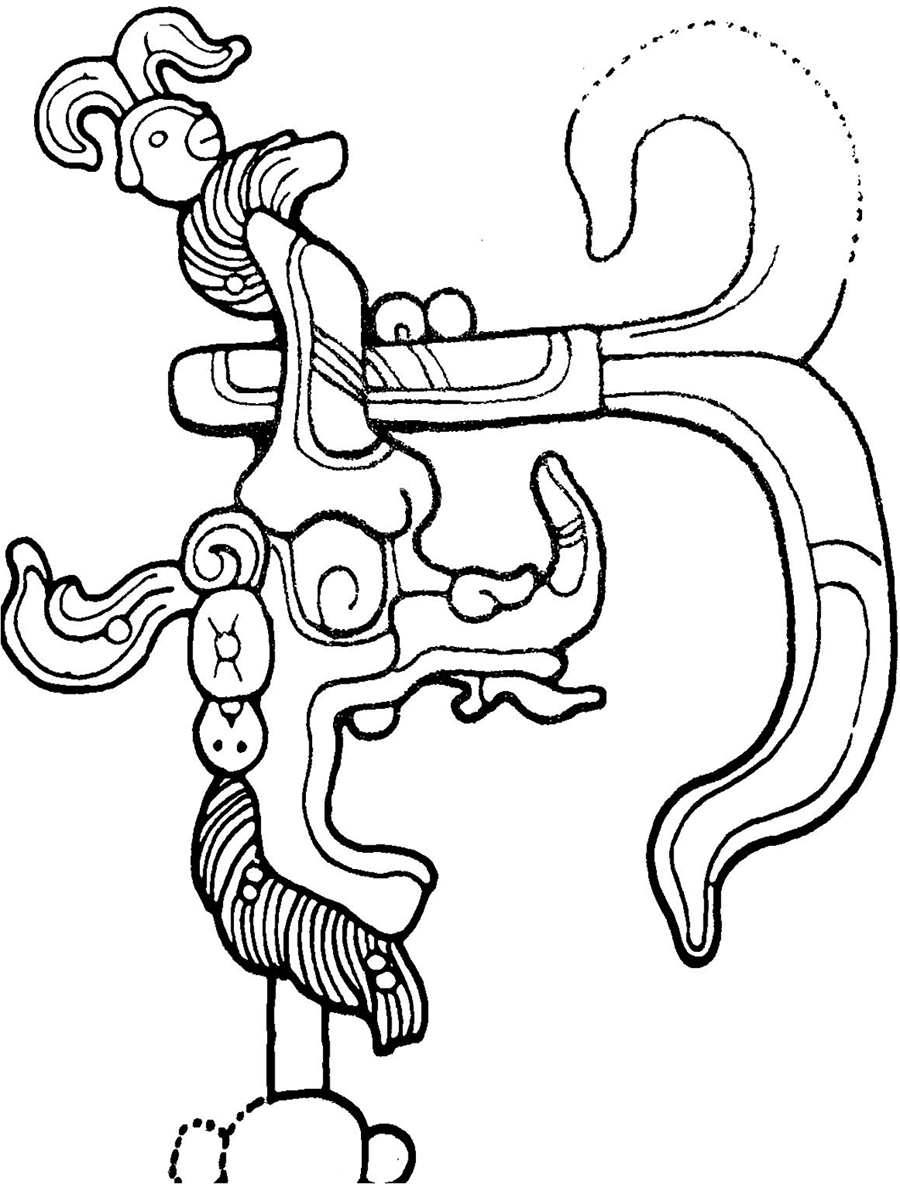
From the Classic to the Contact period, the mirror and the smoking cigar, which pierces it (Figure 1), are defining or diagnostic attributes of the deity, found in effigies, headdresses, paintings, and logograms. This Classic iconography evokes the use of a concave mirror to ignite fire (Carlson Reference Carlson and Benson1981; Ekholm Reference Ekholm1973; Robicsek Reference Robicsek1978:104), symbolizing the deity’s dominion over this element and contributing to the title “Lord of the Smoking Mirror” in Maya and Mexica cultures. However, the interpretation that concave mirrors were actually used as incendiary devices in that period has remained speculative, lacking archaeological evidence.
K’awiil at Palace North Structure from Palenque with a smoking cigar piercing the mirror at his headdress.

Conversely, concave mirrors have indeed been excavated from Olmec sites dating to the Preclassic or Formative period. Yet, the scarcity of written records or relevant artistic depictions in the archaeological record has been insufficient to correlate these artifacts with incendiary use, or to link them definitively to the worship of the Smoking Mirror deity.
Carlson proposed that
The technology of concave-mirror grinding itself apparently yielded the Olmec concave iron ore mirror aesthetic and perhaps gave birth to Sun-God-Mirror, Smoking-Mirror, and shamanistic divinatory-mirror traditions of Mesoamerican culture (Carlson Reference Carlson and Benson1981:130).
For Carlson, mirrors were central in the cult of the god K’awiil among the Maya. Thus, the study of this technology could unveil some relationships among the elements that appear within the worship of this god. Notably Tezcatlipoca, being one of the central Mexica deities, means “Smoking Mirror” (from the nahuatl Tezcatl: mirror, and poctli: smoke or popoca: meaning to smoke) (Gran Diccionario Nahuatl Reference en Línea2012), an association that evokes an incendiary concave mirror.
This article aims to show some evidence grounded in archaeological and ethnohistoric registers, to establish a correlation among burning concave mirrors, cigars, and the worship of Mesoamerican Lord of the Smoking Mirror. This evidence that functionally connects mirrors and fire making within the context of this worship is essential to determine whether these supernatural attributes of the deity were based in a specific known technology, thus shedding light on the historical development of both Mesoamerican material and technologic culture, and the myth itself.
Mesoamerican mirrors
Mirrors in ancient Mesoamerica were objects of admiration, prestige, and social status, symbols of power and veneration, and masterful achievements in lapidary craftsmanship. Today, they are the focus of renewed academic interest and fascination. In this brief space, we can only offer a glimpse into more than two thousand years of tradition behind these optical devices. Much has been written about their cultural and religious significance, as well as the complex commercial and technical challenges their manufacture entailed. Given the impossibility of doing justice to this rich topic in a short summary, we refer the reader to Gallaga’s Manufactured Light (Gallaga Reference Gallaga and Blainey2016), Marc Blainey’s Surfaces and Beyond (Reference Blainey2007), and Ménager’s edited Special Section in Ancient Mesoamerica (Ménager Reference Ménager, Salgado and Freidel2024) as excellent starting points for further exploration.
As early noted by Kirchhoff (1960), pyrite (iron ore) mirrors are one of the defining traits of Mesoamerican cultures. They are ubiquitously present in iconography (Taube 1992), and their archaeological remains have been found by the hundreds. These masterpieces of lapidary art were made from non-translucent (opaque), minerals that present a metallic luster when polished—the so-called iron ores (crystals of iron oxides or sulfides).
Olmec mirrors from the Formative period were concave and circular or oval in shape. They were carved from a single nodule of a dark mineral with metallic luster, such as magnetite, ilmenite, or hematite. These mirrors made of a single piece, later transitioned into mosaic-like mirrors made of a much more reflective mineral: pyrite (Gallaga Reference Gallaga, Melgar and Lowe2024). However, care must be taken not to confuse different raw materials by the eye and to use analytic techniques to determine chemical composition (Barrientos Reference Barrientos, Sandoval, Iizuka and Tanya Carías2024). From pyrite, a multitude of individual tesserae (rectangular or Voronoi-like polygons) were finely cut, polished, and adhered to a slate, ceramic, or wooden base, resulting in a more complex and sophisticated object that denoted prestige and were likely used as adornments or insignia (Arroyo Reference Arroyo2024), for self-contemplation and for scrying, conjuring, and divination (Freidel Reference Freidel, Navarro-Far, Rich and Meléndez2024; Healy 2012). These characteristics persisted into the Classic period, with the conspicuous absence of concave mirrors in the Classic archaeological record—marking an apparent discontinuity in the concave mirrors manufacturing from the Preclassic to the Postclassic periods (Blainey Reference Blainey2007). The complexity of the trading network needed to get the precious raw materials and the time consumed by the most skilled craftsman (Andrieu Reference Andrieu and Cadalen2024; Gallaga Reference Gallaga and Blainey2016), gives testimony of the importance given by the Mayas to these objects in foreign relations as well as internal political matters (Freidel 2024b).
During the Classic period, the Teotihuacanos showed great appreciation for glitter and mirrors, incorporating them into sculptures, architecture, rituals, and attire (Barnes Reference Barnes2024; López Juárez Reference Juárez, Julieta, Luis Ruvalcaba Sil, Vega González and Aguilar Franco2024). The majority of feathered medallions found in Teotihuacan iconography are representations of mirrors (Taube 1992). At Teotihuacan, pyrite mirrors were an important component of both ritual and dress that can serve almost as a hallmark of Teotihuacan costume and influence. They used both dark and light minerals to manufacture mirrors of pyrite, obsidian (the dark volcanic glass which has lower reflectivity), and transparent mica for decorating censers with model mirrors simulating real ones. Furthermore, they built models of their surrounding topographic landscape using liquid mercury to mimic shining water lakes (Gazzola Reference Gazzola, Gómez Chávez, Thomas, Gallaga and Blainey2016; Gómez Chávez Reference Gómez Chávez, Gazzola and Chávez2025). No less was the taste for mirrors among the Maya people, who also viewed them as symbols of the highest status and divine power (Freidel Reference Freidel, Navarro-Far, Rich and Meléndez2024). Notably, Taube points out that by iconographic analysis, “the wearing of circular mirrors on the chest and brow can be easily traced to the Early and Middle Formative Olmec period” (Taube 1992).
Mirrors from the Postclassic period include, in addition to those made of tessellated pyrite, examples crafted from obsidian sometimes of very large dimensions, such as the famous John Dee’s mirror (Campbell Reference Campbell, Healey, Kuzmin and Glascock2021). Furthermore, the so-called Toltec-style mirrors were produced from the Late Classic to Postclassic periods. These are large disc-shaped frames beautifully decorated with turquoise mosaics, featuring a central mirror made of pyrite or other shiny materials. Such mirrors have been found in Hidalgo (Tula), Tlaxcala, Oaxaca, Yucatán, Querétaro, Durango, Zacatecas, and Chihuahua Mexican States (Taube Reference Taube, King, Carocci, Cartwright, McEwan and Stacey2012). Mirrors, not only by their beauty, but as a symbol of the complex trading networks and tradition directed skills needed to manufacture them, actually deserve the recognition of being one of the finest achievements of Mesoamerican peoples of antiquity.
Tobacco cigars
As stated, Kirchhoff enlisted pyrite mirrors as a shared defining trait of Mesoamerican cultures, however tobacco cigars were omitted from the list in his seminal paper. Nevertheless, we should consider that, as remarked by Gallaga (Reference Gallaga and Blainey2016), Kirchhoff’s original list was intended only as a guiding proposal to be supplemented. We believe that tobacco cigars, alongside mirrors, indeed merits to be added to Kirchhoff’s list as well, for reasons that will become apparent.
When the first European colonizers arrived in America, tobacco was widely distributed throughout the continent. Scholars believe that the domestication of the Nicotiana rustica species began around six thousand to eight thousand years ago and originated in South America, while the Nicotiana tabacum species spread from the Caribbean, Mexico, and the southwestern United States sometime later, about 2500–3500 cal b.p. (Tushingham and Eerkens Reference Tushingham, Eerkens, Bollwer and Tushingham2016; Tushingham et al. Reference Tushingham, Snyder, Brownstein, Damitio and Gang2018). Remarkably, Duke and coworkers recently have uncovered evidence for human tobacco use approximately 12,300 years ago (Duke Reference Duke, Wohlgemuth, Adams, Armstrong-Ingram, Rice and Young2022). Tobacco is one of the earliest domesticated plants in America, among many others (Chiou Reference Chiou, Lira-Noriega, Gallaga, Hastorf and Aguilar-Meléndez2024). As its name indicates, domestication of plants always takes place in domestic contexts and perhaps every family grew one or two tobacco plants at home during millennia, but it is difficult to know with certainty. We speculate that tobacco was popular (Kerr Reference Kerr and Kerr2005) and many smoked at Classic times (Loughmiller-Cardinal Reference Loughmiller-Cardinal and Zagorevski2016), however very little is known about it, but solely in elite burials (Freidel Reference Freidel, Navarro-Far, Rich and Meléndez2024; Loughmiller-Cardinal Reference Loughmiller-Cardinal and Eppich2019). Perhaps, modern metabolomic (Zimmermann Reference Zimmermann, Brownstein, Díaz, Aragón, Hutson, Kidder, Tushingham and Gang2021), paleo-metagenomic, or other micropaleontologic techniques will be applied to domestic contexts in the future to shed light on this issue. Certainly, the tobacco cigar is an important element of Mesoamerican cultures, and was used in a variety of forms ranging from recreational, ritual, medicinal, psychoactive, among others (Loughmiller-Cardinal Reference Loughmiller-Cardinal and Eppich2019). Scholars have proposed various hypotheses to explain why the ancient Maya smoked cigars. Tushingham and Eerkens (Reference Tushingham, Eerkens, Bollwer and Tushingham2016:212), for example, assert that tobacco smoking emerged from the quest for psychoactive substances to be used in ritual practices. However, this explanation is insufficient because, while tobacco does have psychoactive effects, it can be administered in various forms—ranging from the simplest, such as chewing or drinking it as an infusion, to more complex methods like inhaling it as a powder, inserting it as a liquid via enema, or consuming it as a gelatin (Gilman and Zhou Reference Gilman and Xun2004:12; Staller in Loughmiller-Cardinal Reference Loughmiller-Cardinal and Eppich2019:10–11). On the other hand, Robicsek suggests that the ancient Maya’s smoking habit may have stemmed from some “incense ceremonies of medicine men and priests” (Robicsek Reference Robicsek2004:30). While it is true that smoke generation might be expected in a ceremony dedicated to a smoking God–v.g. K’awiil or God L (related to fire, torches, and smoke), there are various ways to achieve this without resorting to the use of cigars.
From our perspective, this peculiar method of administering psychoactive substances is best explained through the relationship between cigars and fire, as cigars are excellent devices for starting and manipulating embers and keeping them alight. We will attempt to show that the tobacco cigar is also an important Mesoamerican cultural development intended not only for recreational or medicinal purposes, or as a means of communicating with gods, but also as a complex and well-developed pyrotechnological device for starting fire. Two cases will be presented: the first, takes into account the iconographic correlation of cigars and mirrors jointly depicted in vases and ceramic pieces from the Classic Maya period; the second explores the presence of those same items in the case of the Lord of the Smoking Mirror and its devotion. Then, the complementarity of physical data and ethnohistoric registers will be analyzed to support this hypothesis
Mirrors, cigars, and feathers: A pictorial correlation
Despite not being noticed, in Maya pictorial tradition in particular, smoking figures appear often alongside mirrors, showing significant correlation. We will discuss this iconography as support for the hypothesis that concave mirrors served as solar concentrators for igniting ritual fires, specifically using tobacco cigars.
Interpreting iconographic content is a risky endeavor. In this regard, following Valencia (Reference Valencia Rivera2016) and Barnes (Reference Barnes2024) in their methodological approach, we acknowledge the polysemic nature of symbols and seek to identify the principal value of each symbol’s meaning within the broadest possible context. This includes not only the depicted scene but also the cultural relevance of the symbol at the time and its archaeological context, whenever such records exist. The attitude, posture, and dress of different characters, as well as decoration, pictorial style, colors, and various associated objects, all contribute to a narrative that can be then compared to surviving oral or written accounts from the closest living culture—the Maya—through ethnographic studies or written texts such as the Popol Vuh and chronicles from the contact period. Much has already been reconstructed about the social and economic organization of the Classic-period Maya, which also constitutes a valuable corpus of information that should be considered when interpreting iconographic elements and performing an iconological analysis.
Mirrors and cigars
Following Blainey (Reference Blainey2007), who identified approximately 50 vases in the Kerr collection featuring mirrors, and searching for mirrors and cigars in the archaeological iconographic register, we examine the Kerr Maya Vase Database (Kerr 2025)—which contains more than a thousand images—for mirrors depicted in conjunction with fire or cigars. A notable 18 percent of a universe of 50 vessels featuring mirrors documented by Kerr incorporated cigars across different pictorial styles. We regard the mutual appearance of mirrors and cigars as significant since the conditional probability of finding a cigar given the fact that a mirror appears in the scene fairly exceeds the probability of cigars appearing whether mirrors appear or not, showing a significant correlation among these elements (see supplementary material), being most of the vases lacking information on provenance, dating, or context. We added two important ceramic pieces not in the Kerr Maya Vase Database to our analysis: the Reynolds Vase (Figure 3), and a plate from a Sotheby’s auction.
Cigars and feather bouquets
In Maya iconography, feathers and fire share a profound symbolic connection (Figure 3), as they do in ritual contexts. Feathers are a ubiquitous element in depictions of Maya and Mexica rulers and gods, adorning headdresses, mirrors, fans, and shields, and as key ceremonial offerings. They frequently appeared crowning carefully folded and tied bundles of fabrics or clothes—as on Vase K5453—offered to powerful rulers or otherworldly entities. The feathers are tightly bound at their calamus, forming the handle of a bouquet—being this handle’s form iconographically almost indistinguishable to that of torches or cigars (elements also depicted emerging from K’awiil’s mirror). James Langley (Reference Langley and Berlo1992:272) states that feathers can be used to designate flames in Teotihuacan art, a convention also known for later Aztec iconography. Further, these feather bouquets recall what Taube has described as the “feathered maize fetish” or “torch motif” among the earlier Olmecs (Taube Reference Taube, Clark and Pye2000).
While this bouquet has been ambiguously identified as a “perforator dagger?” (Robicsek and Hales Reference Robicsek and Hales1982:80), its resemblance to smoking objects is striking. The symbolic metaphorical substitution becomes evident when viewed through the lens of a key passage in the Popol Vuh. In the story, that takes place in the “House of Darkness,” the Hero Twins are given a lit torch and a lit cigar by the Lords of Xibalba and commanded to keep them alight all night yet return them intact—an impossible task given fire’s ephemeral nature, not unlike life itself. The Twins subvert this unfeasible demand through trickery:
the messenger of One Death gave to them a torch, already burning, and a cigar for each of them…But they didn’t light the torch. They just placed the red tail feather of a macaw on it as a substitute for flame…As for the cigars, they just put fireflies on their tips. All night they would glow brilliantly because of them…Thus they returned them whole to the lords (Christenson Reference Christenson2007).
Macaw feathers simulate a torch’s flame, and fireflies simulate a cigar’s ember. This myth provides an insight for interpreting the iconography: the feathers bouquet is not merely an offering but a symbolic representation of a smoking or burning object, a torch or cigar, metaphor explicitly stated in the text (Figure 2). On Vase K5453 these three elements appear jointly: the cigar, the torch, and the feathers bouquet on top of a bundle.
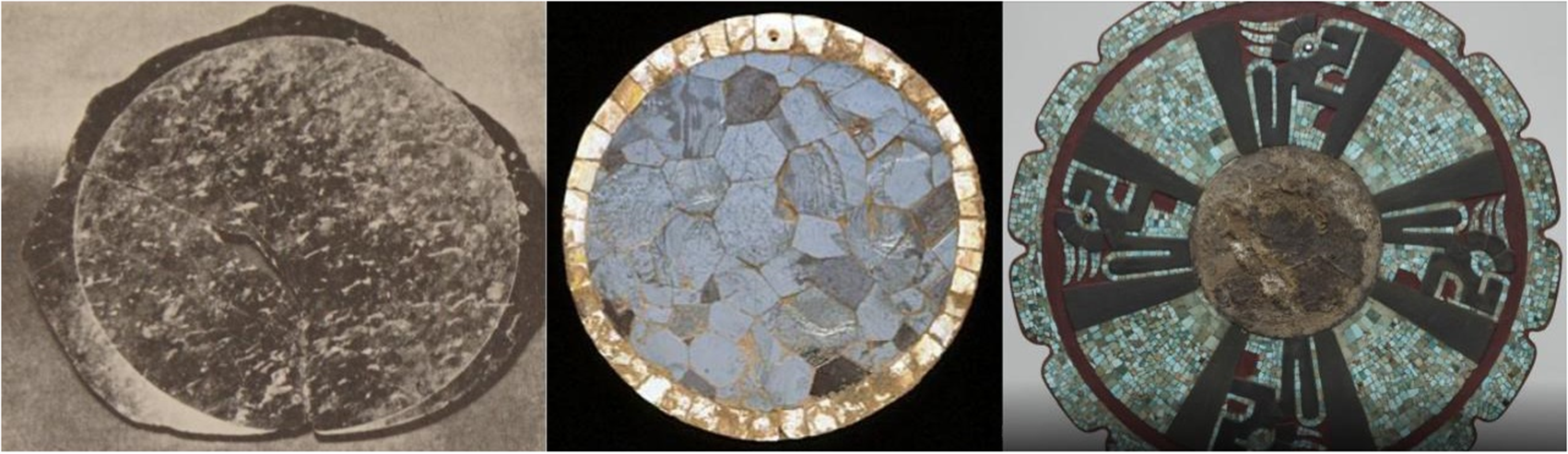
Olmec Mirror No. 13 from Carlson’s catalog found in Arroyo Pesquero, Veracrúz (left), carved Mirror Ornament from Southern Veracruz, Mexico, at Los Angeles County Museum of Art (center), and Turquoise Plaque from Chichen Itza, Yucatan (right).

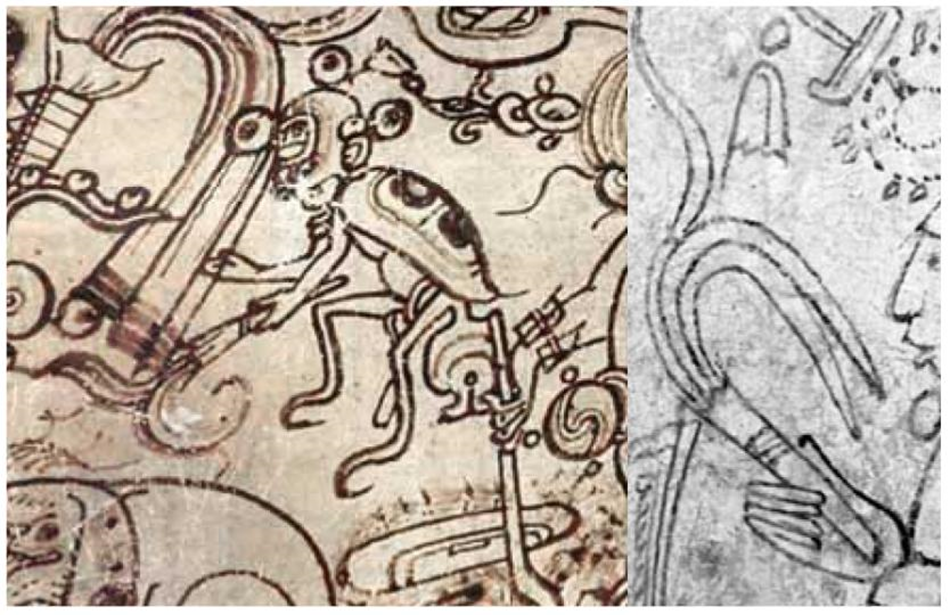
Fireflies are often depicted holding torches or smoking cigars (Coe Reference Coe1973:160; Lopes Reference Lopes2025), their forms closely mirroring the feathers bouquet described earlier, as can be seen in Figure 4 in which we compare the torch held by a firefly on Vase K521 and the feathers bouquet held by one young lord in the Vase K1561 rollout. This beam of feathers has been originally called a “feathers bouquet” by Robicsek and Hales and we decided to keep this name here for clarity (Robicsek and Hales Reference Robicsek and Hales1982:80).
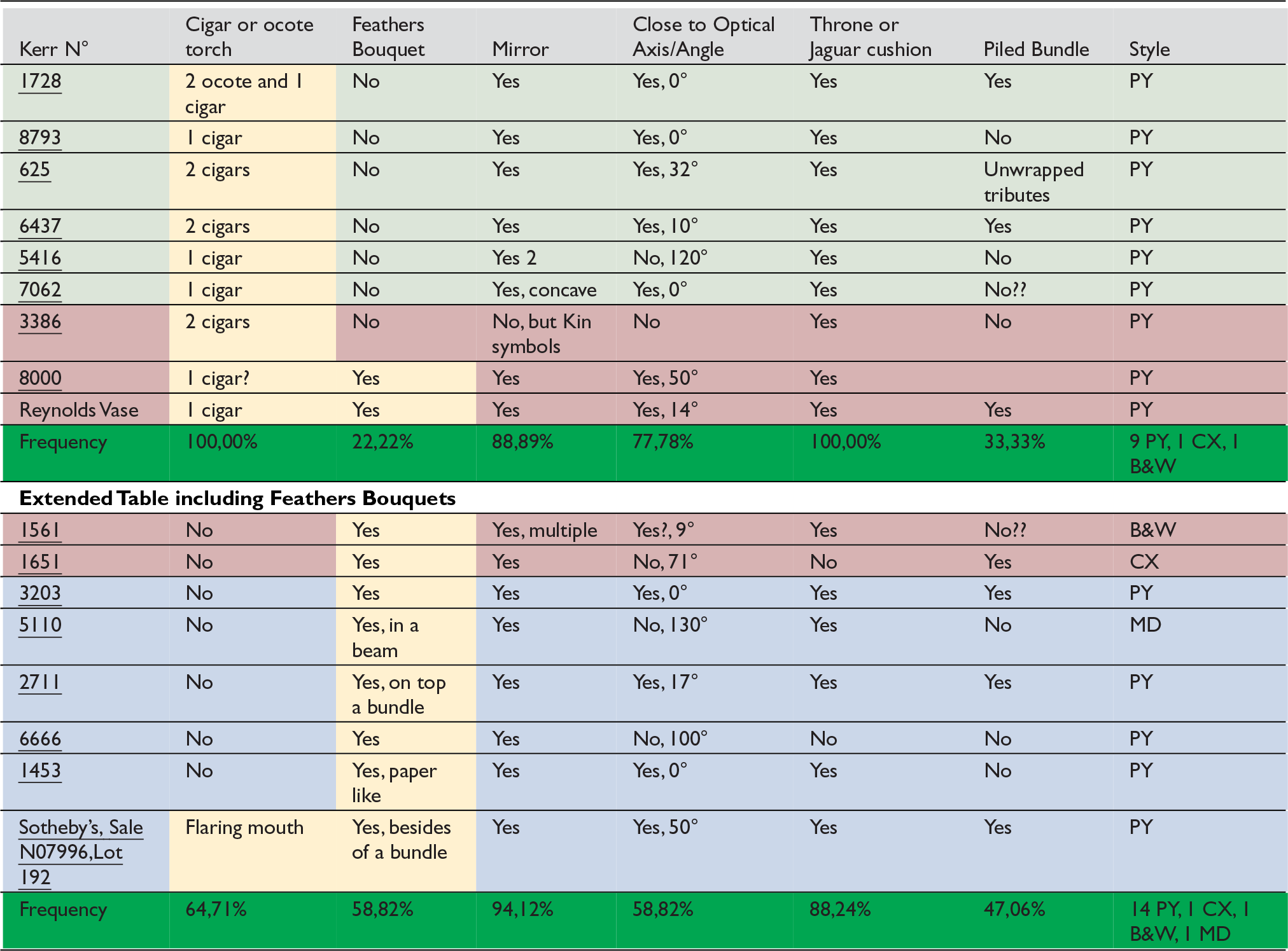
If we extend the iconographic analysis to include vases in which feather bouquets—interpreted as symbolic torches or cigars—appear in conjunction with mirrors, the number grows to 17. This represents 34 percent of the universe of the total mirrors identified by Blainey, suggesting a significant iconographic link. However, we should keep in mind that this analysis is highly interpretive in its application of the proposed metaphor. The revision of the roll-out pictures from the Kerr Maya Vase Database is summarized in Table 1.
Comparison of different iconographic elements appearing in vases with mirrors and cigars (feather bouquets)

Table 1 Long description
Rows list individual Kerr numbers and named vases, with columns for cigar or ocote torch, feathers bouquet, mirror, close to optical axis angle, throne or jaguar cushion, piled bundle, and style. In the first set, all nine Kerr entries plus the Reynolds Vase show a cigar or ocote torch, and all show a throne or jaguar cushion. Mirrors are marked yes for eight of nine Kerr entries, including one noted as concave and one noted as yes 2, while Kerr 3386 is marked no but Kin symbols. Close to optical axis angle is marked yes for seven of nine Kerr entries, with angles of 0 degrees for Kerr 1728, 8793, and 7062, and no for Kerr 5416 at 120 degrees; Kerr 3386 is marked no with no angle. Feathers bouquet is marked yes only for Kerr 8000 and the Reynolds Vase, and piled bundle is marked yes for Kerr 1728, 6437, and the Reynolds Vase, with Kerr 625 noted as unwrapped tributes. The first frequency row reports 100.00 percent for cigar or ocote torch and for throne or jaguar cushion, 22.22 percent for feathers bouquet, 88.89 percent for mirror, 77.78 percent for close to optical axis angle, 33.33 percent for piled bundle, and styles listed as 9 py, 1 cx, 1 b and w. In the extended section, additional rows include 1561, 1651, 3203, 5110, 2711, 6666, 1453, and Sothebys, Sale N07996,Lot 192, with cigar or ocote torch often marked no and one entry marked flaring mouth. Mirrors are marked yes for all extended entries, including 1561 noted as yes, multiple, and close to optical axis angle includes yes at 0 degrees for 3203 and 1453, and no at 71 degrees for 1651, 130 degrees for 5110, and 100 degrees for 6666. The extended frequency row reports 64.71 percent for cigar or ocote torch, 58.82 percent for feathers bouquet, 94.12 percent for mirror, 58.82 percent for close to optical axis angle, 88.24 percent for throne or jaguar cushion, 47.06 percent for piled bundle, and styles listed as 14 py, 1 cx, 1 b and w, 1 md.
Notes: The appearance of cigars or bouquets is highlighted in yellow; palace scenes with actual cigars are highlighted in light green; and feather bouquets are highlighted in light blue. The scenes of Twin Lords are highlighted in purple. See supplementary material for analysis of the whole set of ceramic pieces, or click on the Kerr Maya Vase Database catalog No. in the table linking to each picture.
We have not attempted a comprehensive pictographic or epigraphic analysis, a task beyond our expertise and the scope of this work. Rather, we aim to demonstrate the presence of mirrors, cigars, and other elements of K’awiil worship that may suggest the use of cigars to ignite fire with concentrated sunlight.
We have grouped the representative scenes into two main narrative types:
• Scenes with Twin Lords, identified as the Hero Twins in the Reynolds Vase (Robicsek Reference Robicsek1978), seated on thrones with cigars or feather bouquets and mirrors. Reynolds Vase, Vases K1561, K3386, K8000, and K1651 (purple in Table 1).
• Palace scenes likely representing an enthronement ceremony or a tribute payment event. Vases K1728, K8793, K625, K6437, K5416, and K7062 having cigars (light green in Table 1), and K3203, K5110, K2711, K6666, and K1453 with feather bouquets (light blue in Table 1).
As can be seen, a large proportion of these vases feature a concurrence of elements: the mirror, the smoking or flaring torch or cigar/bouquet, elite contexts, sacred bundles, etc., associated with the worship of K’awiil (see the section devoted to him). These 17 scenes are related by their common elements, though not all are present in every scene: a throne, known as a “teem” or a jaguar cushion (15/17), a principal figure seated on the throne in a lotus position (17/17), a mirror standing on the throne, on the floor, or atop a bundle (16/17), a sacred bundle, recognized in the paraphernalia of both Tezcatlipoca and K’awiil worships (8/17) (Valencia-Rivera Reference Valencia Rivera2006), a servant or two standing beside or behind the dignitary, where the dignitary or a servant is smoking a cigar (8/17), and a bouquet of feathers symbolizing a smoking cigar or torch (10/17). In 10/17 cases, the cigar or the feathers bouquet is in close proximity to the mirror’s optical axis (OA) (proximity meaning that the angle between the OA and the direction pointing toward the cigar/bouquet is less than 45°), showing not only a strong correlation between mirrors and these objects but, likely, the act of, factually or symbolically, igniting them.
In those vases not included in this analysis, and not representing the god K’awiil with his mirror/cigar pair, the mirror is used for self-contemplation, scrying, as a portal to the otherworld, or as an adornment denoting prestige—but always in an elite context, in accordance with royal lineage and Kovasevich’s findings (Kovasevich Reference Brigitte2016).
Olivier remarked:
Undoubtedly, we are dealing with a system for representing the structure of Mesoamerican myths in which—to borrow Claude Lévi-Strauss’s expression—”the mythical motifs” may vary or differentiate without altering the meaning within the framework of stable structures. Rather, these play of variations enrich the symbolism and meaning of each mythical scene or narrative (Olivier Reference Olivierr, Carrasco and Sessions2010: 287).
Thus, let the vases speak for themselves.
Scenes of Twin Lords
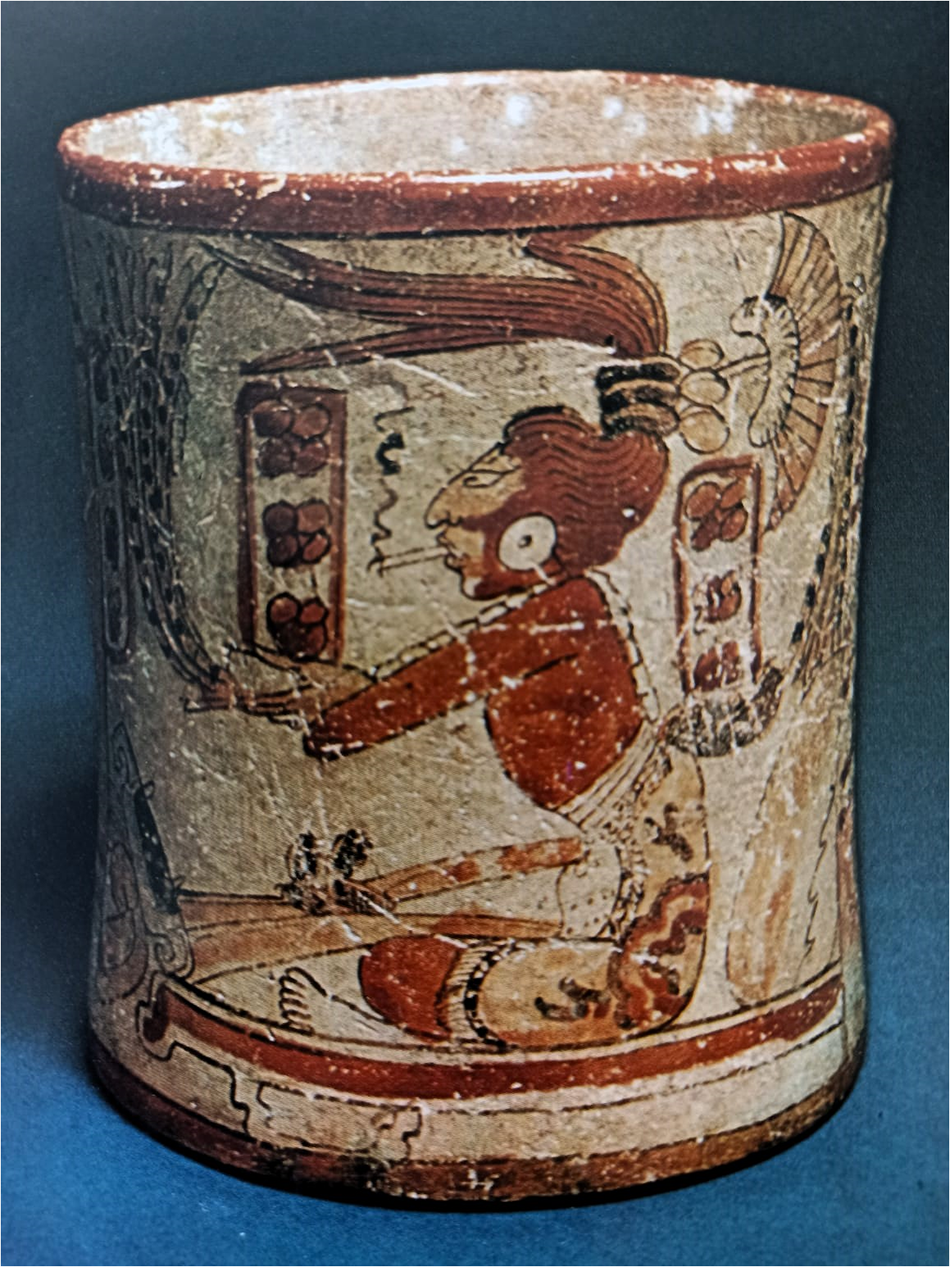
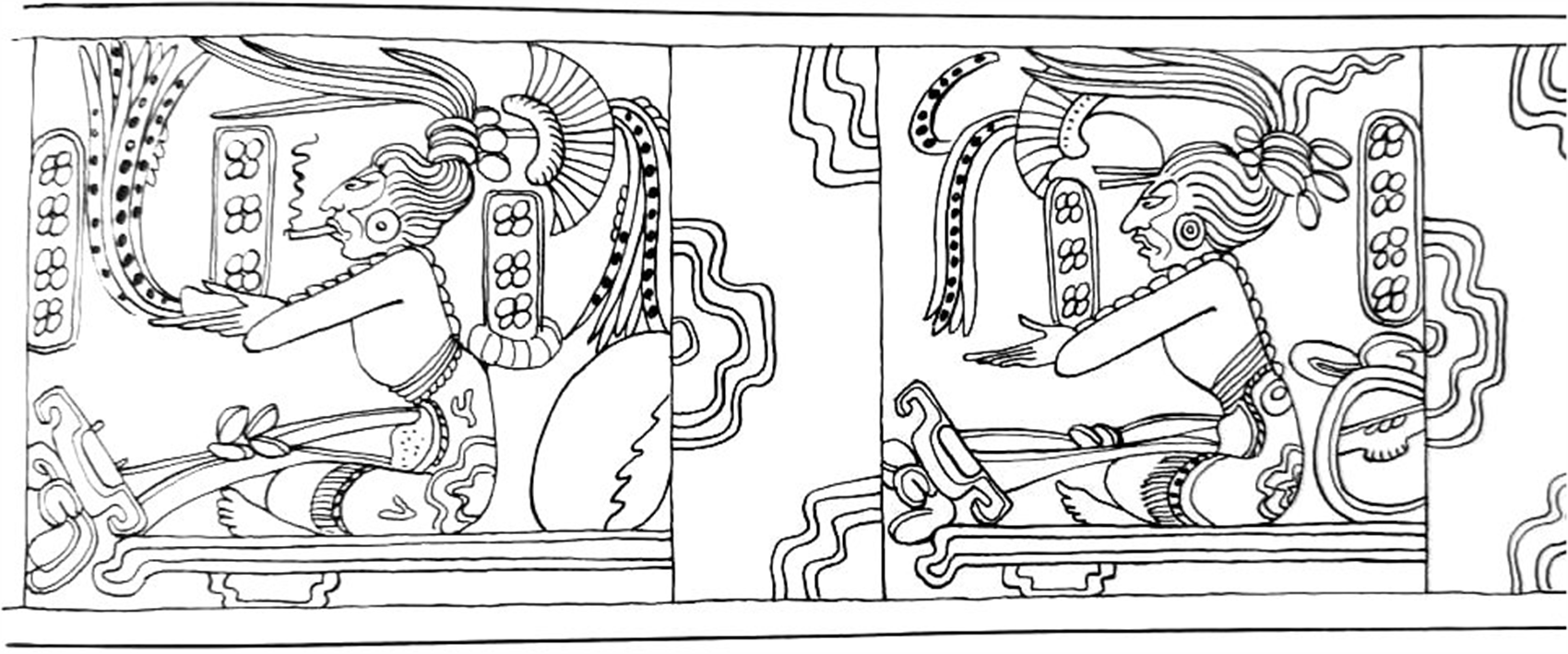
The Reynolds Vase (Figures 3 and 5) has been correctly identified by both Robicsek and Coe as depicting the Hero Twins of the Popol Vuh, who are known in that epic as Hunahpu and Xbalanque (Robicsek Reference Robicsek1978:120). We build upon their contributions by identifying the mirror present in each tableau. Our own analysis benefits from a now more developed understanding of how such optical instruments were represented pictorially from a side view. This scene is part of a coherent iconographic group—including K3386, K1561, K8000, K1651 (purple in Table 1), and possibly K624—that evokes the Popol Vuh narrative of the Twins’ journey in Xibalba (Coe Reference Coe1973:13–14; Robicsek Reference Robicsek1978:121).
The Reynolds Vase showing a young lord, seated and smoking a cigarette in his throne in front of a mirror while holding a feathers bouquet (metaphor of a lit torch).

Comparison between the torch held by a firefly (Vase K521, left) and the feathers bouquet held by one young lord (Vase K1561, right).

Line drawing of the Reynolds Vase in which Maya Hero Twins sit on a pair of thrones and their mirrors stand in front of them and on top of their thrones. Probably from the Usumacinta region, vase at the Smithsonian Museum of the American Indian.

Being aware of what Robicsek called the “Popol Vuh syndrome”—the tendency to interpret all iconography in light of this text—we did not resist the temptation, but proceeded carefully. An important sign in this Twin Lords group of vases is the attitude and posture of the figures: these young lords are peacefully seated cross-legged, and the only action they perform is holding the feathers bouquet, just as the Hero Twins did when commanded to wait for dawn with their torches and cigars alight and keep them intact. We suggest that these figures are in the House of Darkness, given this narrative concordance with the text.
One Hunahpu and Seven Hunahpu (progenitor and uncle of the Hero Twins who faced the same challenge but failed)…They were seated cross-legged there in the darkness when the courier arrived to give to them their torch and their cigars. The torch was brightly burning when it arrived, and with it were lit each one of the cigars:
“These are to be returned at dawn. They are not to be used up. Instead, they are to be collected again intact. Thus say the lords to you,” they were told (Christenson Reference Christenson2007:110).
In addition, the Twin Lords have their headdresses facing forward and with pompom ornaments, matching those of the Hero Twins (Coe Reference Coe1973). The vertical bands separating both panels are related to the Sun or the sun god Cauac monster associated with the entrance to the Underworld, and they feature jaguar-spotted loincloths or beaded collar-like beads or marks on the back or arms. Table 2 summarizes some of the shared iconographic elements in this group. Thus, these signs allow us to extend the identification of these young Twin Lords with the Hero Twins of the Reynolds Vase to the whole group as a working hypothesis.
Twin Lords group, in which some shared elements among different vases are shown

Table 2 Long description
Rows list five vases and columns mark whether specific elements are present: Forward headdress, Pompon, Jaguar loincloths, Feathers bouquet, Cigar, Bundle, and Other. Forward headdress, Pompon, and Feathers bouquet are Yes for Reynolds Vase, K1651, K3386, K8000, and K1561. Jaguar loincloths are Yes for K1651 and K8000, and No for Reynolds Vase, K3386, and K1561. Cigar is Yes for Reynolds Vase and K3386, Yes? for K8000, No for K1561, and No? for K1651. Bundle is Yes, sky for Reynolds Vase; Yes for K1651; No? for K3386; Yes? for K8000; and No for K1561. Other is No for Reynolds Vase; Pipes? for K1651; Sun vertical bands (VB) for K3386; blank for K8000; and sun god VB, Macaw for K1561.
In Figure 5, the left character—while seated cross-legged—smokes a cigarette and holds a bouquet of feathers, possible metaphors for a smoking torch or cigar, much alike in the Popol Vuh’s House of Darkness passage. There is a mirror in front of each character. Two different bundles appear in both images on the thrones behind the characters (Robicsek Reference Robicsek1978:120). The bundle behind the right figure has the sky glyph showing perhaps its divine character. Here both elements appear: the cigar and the feathered torch—just as in the House of Darkness passage—alongside the conundrum that mirrors represent.
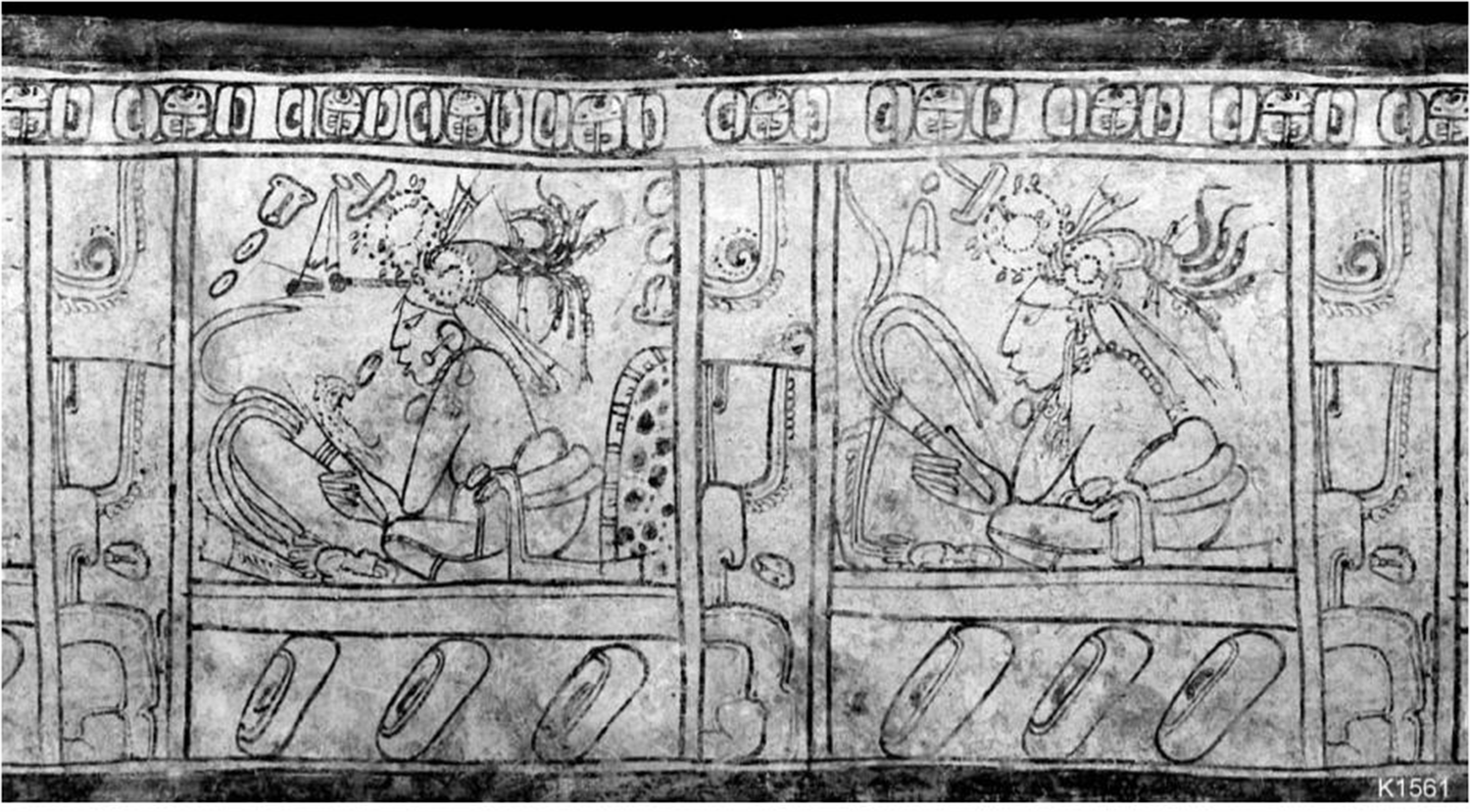
The scene on the Reynolds Vase finds its mirror in the scene of Vase K1561 (Figure 6), where the young Twin Lords each hold a bouquet of feathers and below each throne are three logographic representations of mirrors. Notably, the bouquet held by the figure on the left has on top the faint outline of what appears to be a dead macaw—an echo of the Popol Vuh episode in which Vucub Caquix (Seven Macaw) is defeated. We must recall that before traveling to Xibalba, the Hero Twins defeated the false Sun and arrogant tyrant Vucub Caquix. Through deception, they stole all the precious metal from his once-shining eyes—where resided his solar-like power—tricking him into believing they would heal a wound they had inflicted. Christenson (p. 140, n. 189) notes that the macaw has a circular white ring around its eyes, where feathers appear to have been removed since this event.
Vase K1561 featuring the Twin Lords seated on a pair of thrones, holding bouquets of feathers that resemble cigars or torches, where the feathers could symbolize flames. Below each throne are three logographic representations of mirrors.

The conjunction of the mirror with the cigar held by one of the twins in Figure 5 is not merely decorative; it decisively links these iconic figures to the core paraphernalia of the Lord of the Smoking Mirror, a connection previously overlooked. Due to the co-occurrence of the Twin Lords characters and the feather bouquets similar to torches, these vases likely illustrate the myth of substitution, where fireflies mimic cigar embers and macaw feathers (perhaps from the defeated Vucub Caquix?) simulate torch flames, but they add a crucial element absent from the Chichicastenango text—the Popol Vuh—the ritual mirror. Did they use a mirror, maybe the stolen eyes of Vucub Caquix, to light up their cigars and torches at dawn again?
We therefore suggest throughout these rhetorical questions a logical and materially grounded explanation—namely, that the mirrors were used to ignite cigars with sunlight at dawn—which closes the narrative gap in a way that is consistent with both passages of the Popol Vuh, the visual evidence, and the known technological capabilities of the period.
As Shele and Miller state about the relationship among Mayan art and myths:
The Popol Vuh stories are not illustrated word for word in the art of the Classic period, but many elements of the storyline have compelling parallels in Classic imagery created seven hundred years before the text was written, and some appear to be directly illustrated, suggesting that these stories are fragments, surviving to the time of the Conquest, of very ancient myth cycles describing the universe and the origins of gods and man (Schele and Miller Reference Schele and Miller1986:33).
Myths and tales can embody not only ethical or historical knowledge but technical knowledge and concepts as well. Throughout sophisticated languages—pictorial, epigraphic, oral, theatrical, and others—this knowledge is codified without diminishing their poetic content, thus speaking to the subtlety of both the concepts and the human experiences intended to be preserved within them. Indeed, part of the refined optical knowledge developed by the Maya—knowledge that manifests itself in their perfect lapidary art—would therefore be encoded in the very vases that artistically depict these rituals and myths.
Palace scenes
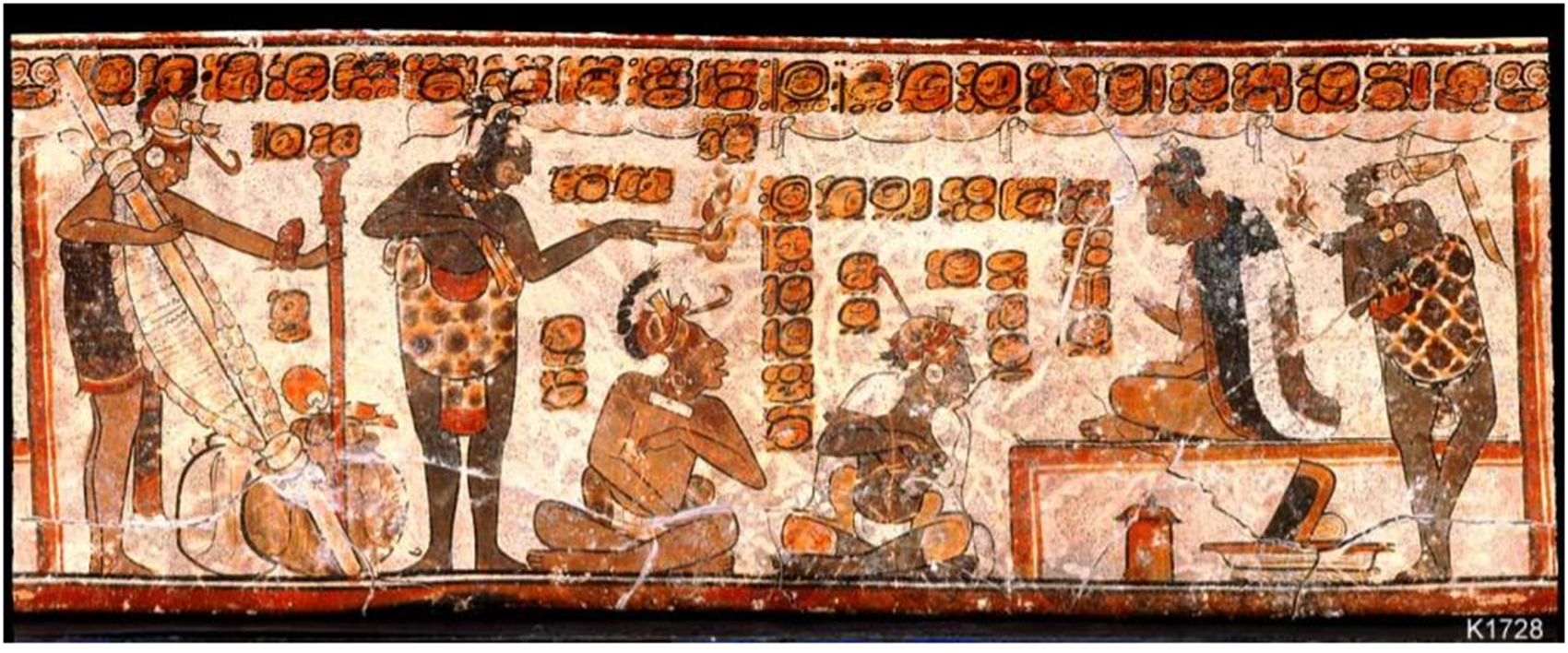
A compelling example that synthesizes these elements is found on Vase K1728 (Figure 7). The scene depicts a palace ritual, likely an enthronement or tribute ceremony. Here, a black and likely concave mirror is placed at the feet of the rightmost character, below the throne. Crucially, the ritual action directly involves fire: two figures hold burning objects. The rightmost character appears to be using a cigar as a tool to generate fire on an ocote torch, while the other character’s torch burns in the vicinity of the mirror’s optical axis. This vivid depiction provides a strong iconographic link between the mirror, the act of ignition using a torch or a cigar within an elite ceremonial context. Oftentimes mirrors point in the direction of lords themselves, likely serving as a kenning for the lord becoming the Sun itself—that is, the very act of contemplating one’s own image.
Kerr Maya Vase Database, Vase K1728. A lord sits on a throne beneath which a concave black mirror is displayed. The character on the far right stands, smoking a cigar at his lips and holding an object engulfed in flames. The second character from left to right holds an ocote beam burning in flames aligned to the mirror’s optical axis.

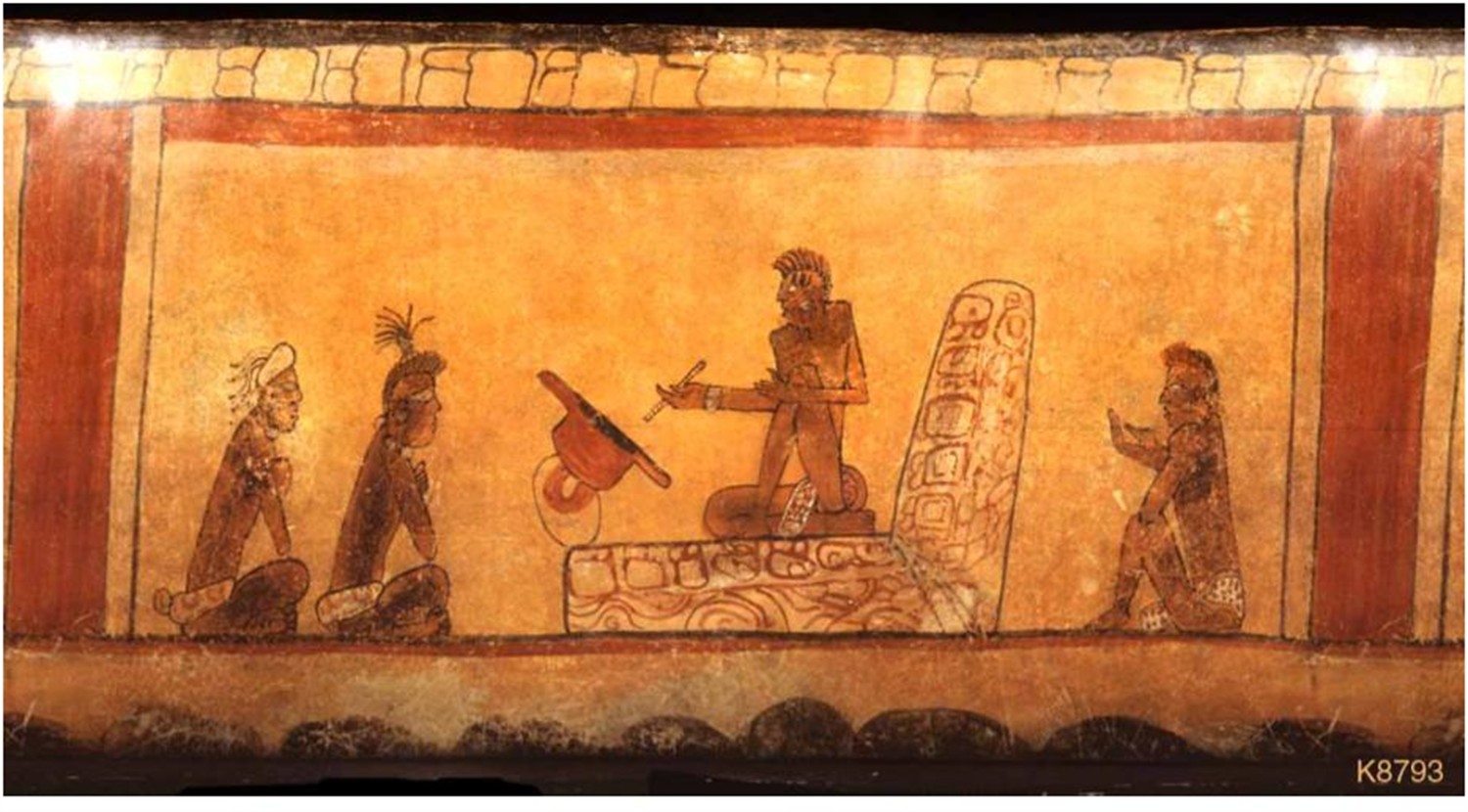
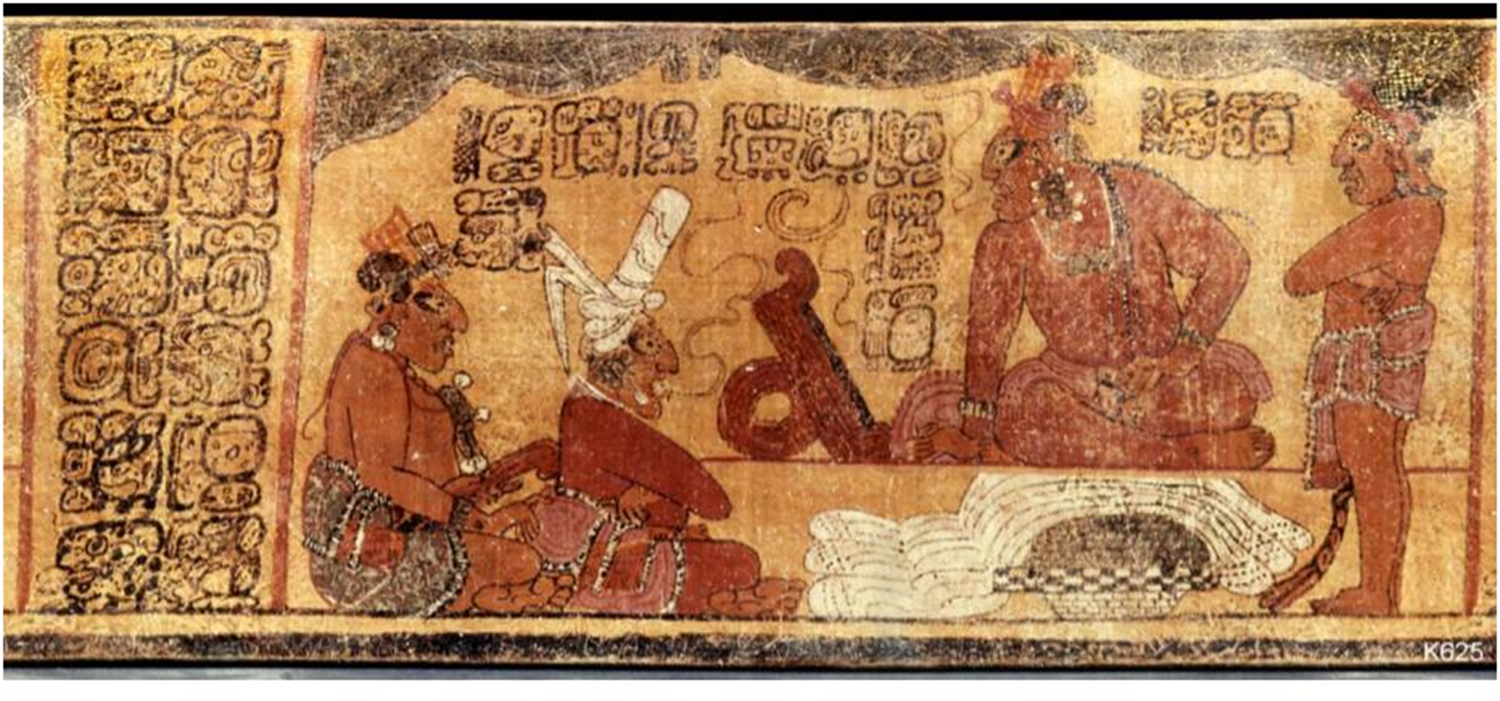
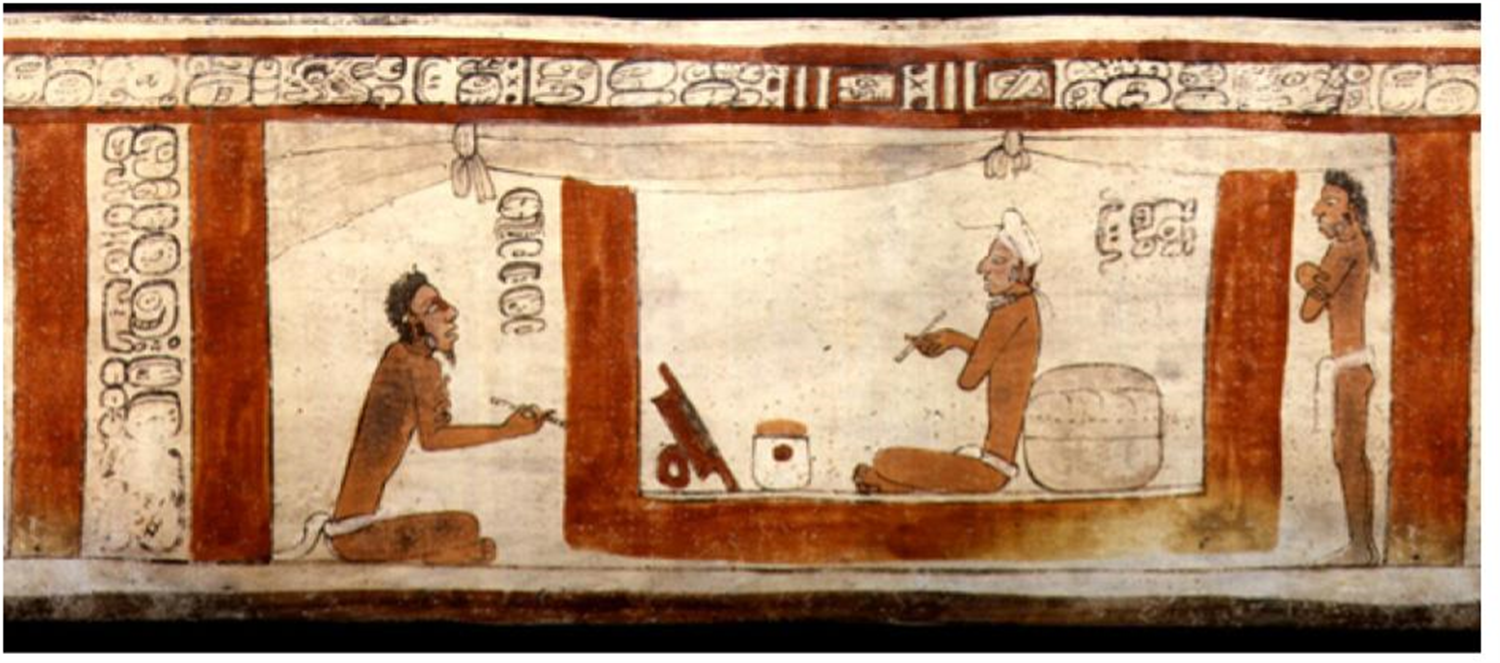
In several other paintings (Vases K8793, K625, K6437, K5416, and K7062), Figures 8-10, characters appear smoking cigars or using smoking tubes alongside mirrors, as well within palace contexts, in which elements that are commonly suited for being offered to the gods or tributed to the highest lords or rulers (feathers, textile bunds, etc.) are present. The dignitary or another accompanying individual is often shown smoking, sometimes directly in front of the mirror. The recurrence of this scene across different sites, time periods, and artistic styles, and its composing elements, suggests that it represents a significant ceremony, most likely a ruler who is being paid or honored with tribute by elites of a social hierarchy atop which he sits. But the cigars appearing together with mirrors and close to their optical axis are instances that point out toward a functional relationship among those instruments: their incendiary ability of the mirrors if they were concave.
A painted depiction of a dignitary seated on his throne, holding a cigar or smoking tube in front of a mirror. The cigar is in a close vicinity of the mirror’s optical axis. Kerr Maya Vase Database, Vase K8793.

A dignitary is smoking, seated on his throne on which a mirror stands in front of him and on top of the throne. Again, the cigar is located close to the optical axis of the mirror. Probably from northern Peten in the Late Classic period. Kerr Maya Vase Database, Vase K625.

A palace scene in which a dignitary is sitting on his throne in front of a mirror, holding a cigar close to the mirror’s optical axis. The text suggests the bearded individual is a visitor from the west. An attendant standing in wings is behind the throne. Kerr Maya Vase Database, Vase K6437.

In the preceding scenes, the mirror could be interpreted in two, not mutually exclusive ways: as a vain and prestigious luxury object for self-contemplation, or as a symbolic element of power, given the magical attributes for scrying and divination that these objects possessed. Our interpretation is that cigars could have been lightened by mirrors, based on the symbolic protagonic role of both elements, the frequent apparition of similar scenes, and the importance of both elements in the veneration of K’awiil—a deity, who for centuries was a symbol of the divine legitimacy of dynastic lineages, being this interpretation is consistent with the elite ceremonial context represented. Both the cigar and the mirror received the same scribal attention, repeatedly and across different epochs and places. We cannot disregard the cigar as a futile iconographic element based on our own present-day perspective; rather, we must interpret the signs and symbols and their roles within the scene accounting their symbolic value in their own historical context, considering the Popol Vuh as a key reference.
For the vases depicting a similar palace scene to those previously analyzed, but in which feather bouquets symbolically substitute torches or cigars (light blue in Table 1) (which includes Vases K3203, K5110, K2711, K6666, and K1453), the analysis should be carried out in the same way, noting the significant and frequent apparition of the pair mirror/feathers bouquet (35 percent) and the proximity of these last objects to the mirror’s optical axis (50 percent).
In the supernatural realm, the mirror and the cigar are closely related in the very effigy of K’awiil. However, when used in conjunction in this world, they possess the capacity to ignite fire. We believe this constitutes a power worthy of the veneration that Mayan people have dedicated to this pair.
In summary, our analysis shows that cigars and mirrors were consistently depicted together in palace-related ceremonial contexts. This association may reflect multiple, overlapping meanings: cigars could have functioned as intoxicating agents to facilitate communication with entities perceived beyond the mirror during scrying; both objects may have served as symbols of prestige, self-contemplative vanity, and sensory pleasure, as they serve today; they might also have referenced the transformative power of fire and light as symbols of K’awiil attributes; or, alternatively, formed part of a pyrotechnological assemblage used to generate fire. These interpretations are not mutually exclusive and may have coexisted within the same cultural framework.
Whereas iconography concerns itself with the identification of motifs and their corresponding narrative contents, iconology aims to identify the prevailing cultural forces that caused, necessitated, or enabled historical changes in the form assumed by and prominence afforded to signs and symbolic objects within a given culture (Barnes Reference Barnes2024).
In this sense, our analysis shows the symbolic prominence of the cigar/mirror pair that does not only reflect supernatural attributes of deities, but emphasises the dignity, knowledge, and dominion over the natural and supernatural forces of the community’s rulers or elites, providing them with divine legitimacy throughout K’awiil’s symbolism.
We acknowledge that the vast majority of mirrors from the Classic period are flat, however we propose that some mirrors—specifically those depicted in ritual contexts involving cigars—may have been concave and functionally incendiary, and that this specialized knowledge was sly restricted to elite practitioners associated with K’awiil symbolism. Furthermore, since a concave mirror must possess a precise combination of specular reflectivity, focal distance, aperture, and minimal aberrations to achieve the concentration factor necessary to ignite cellulose, such mirrors would have been rare technologically sophisticated objects, and their manufacture and use would have been restricted to high-status individuals. The very difficulty of producing an effective incendiary mirror would have enhanced its ritual and political value, as it could serve as a tangible demonstration of divine power, strict control on trade networks, and technological mastery.
Mirrors and cigars in the supernatural realm
K’awill and Tezcaltlipoca
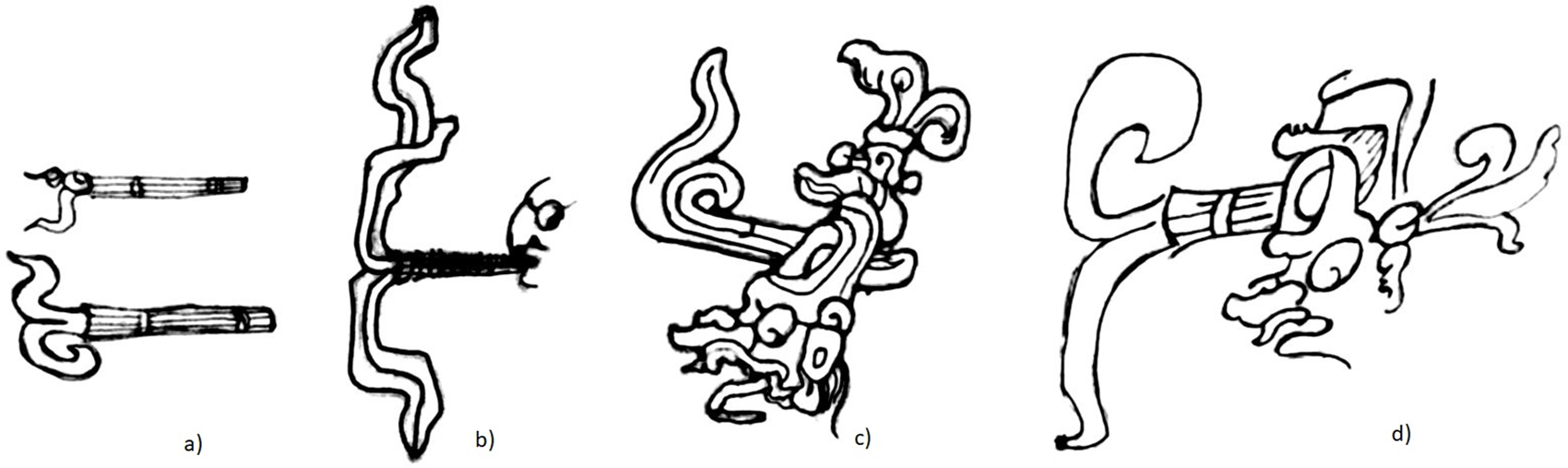
The most striking and well-known relationship between mirrors and cigars emerges from the Classic iconography of the god K’awiil. As Taube (1992:69) points out based on the classic works of Schele and Miller (Reference Schele and Miller1983) and Stuart (Reference Stuart1987), in classic Maya iconography and epigraphy, K’awiil (Figure 1) is depicted as a reptilian being with a long, upturned snout, and adorned with a fire element on its forehead. This fire element has been interpreted as a mirror pierced by what seems to resemble a lit torch, or alternatively a cigar with smoke or flames, or a smoking blade or axe. However, Coe, in personal communication with Schele and Miller, argues that the smoking element piercing the mirror is a cigar, akin to the one portrayed in the mouth of God L at the Temple of the Cross Complex in Palenque as shown in Figure 11b (Schele and Miller Reference Schele and Miller1983:9).
From left to right, ocote torches, God L smoking a cigar, and two representations of K’awiil with the characteristic mirror and a torch or cigar burning and smoking on its forehead, after (Shele, 1988).

Furthermore, Robicsek reports that Coe “identified the forehead tube at different periods as a bone tube, a pipe, and finally a cigar, and the flame-like appendage rising from the tube as a smoke, an iconographic complex indicating power and divinity,” and that Schelle agreed that the object probably represents a smoking tobacco cigar, theory reinforced by Kelley on glyphic bases suggesting about the pipe infixed onto the head of K’awiil that “the infix has been so conventionalized in the codices that is no longer recognizable as a separate element” (Robicsek, Reference Robicsek1978: 60). Nowadays, it is well established that the smoking element emerging from the mirror on the forehead of K’awiil’s effigy can represent an axe as in the case of the wooden effigies of K’awiil from Tikal; a torch such as the manikin scepter at Princeton University Museum (Rice Reference Rice2012:Figure 1a), or a cigar as in the Vase K5164, depending on the divine attributes to be represented (García Barrios 2008; Houston Reference Houston and Dine2024; Rice Reference Rice2012; Valencia Rivera Reference Valencia Rivera2016, 2014).
Maya God K/K’awiil is a multivalent and pluripotent entity with shifting identities and attributes that can be tracked from the Preclassic or Formative period at least into the sixteenth century…Iconographically, God K is primarily recognized by his large, decorated, up-turned nose or snout, and a smoking ax, celt, cigar, mirror, or torch on the forehead or temple (Rice Reference Rice2012).
Veneration practices of the Lord of the Smoking Mirror
In order to determine the role played by the cigar and the mirror in K’awiil’s effigy, as well as the cultural relevance of both, it is important to analyze the appearance of such elements in the worship practices of K’awiil and his myths. Olivier (Reference Olivierr2015) describes the common practice, among different Mesoamerican cultures, of adopting foreign deities from their respective pantheons, or “translating” them in function of their divine attributes, by calling “divine homologues” at those equivalent deities, explaining their multivalent or polymorphic nature across time and regions. Thus, due to the fact that the god’s name mutates across different regions and historical periods, the ritual practices and myths of those equivalent deities should be analyzed as well. In this sense, the Postclassic K’iche’ creational deity Huracan—from jun raqan, meaning “one leg”—is one manifestation of this pan-Mesoamerican deity, identified at present as the K’iche’s tutelary deity Tohil (Rice Reference Rice2012). This figure corresponds to the Classic Maya K’awiil (God K, GII, B’olon Tzakab, or the manikin scepter) and in central Mexico, the Mexica worshipped this same fundamental deity as Tezcatlipoca (Rice Reference Rice2012; Olivier Reference Olivierr2003:2; Valencia Rivera Reference Valencia Rivera2006). One of the God K names in the Postclassic period was Ah Bolon Tzacab (Schele Reference Schele and Miller1983). According to Rice (Reference Rice2012), all these distinct deities represent the same and one single creational deity whose origins can be traced back to the Preclassic period. Forerunner depictions can be identified in characteristic features of this deity like in the “flame eyebrow” of the Olmec were-jaguar, the “Young Lord” serpentine figurine, and Izapa Stela 3 deity (Rice Reference Rice2012). One peculiar representation of K’awiil as a baby, the God GII in Palenque’s triad, has the name Unen K’awiil, being Unen the Mixe-Zoquean word for baby, pointing toward an Olmec or Mixe-Zoquean origin of this deity (Martin 2002:63, cited by Valencia Rivera Reference Valencia Rivera2016:59).
According to the Mexica creation myth, the primordial world was a chaotic ocean inhabited by the monstrous beast Tlalteuctl or Cipactli. The couple of gods formed by Tezcatlipoca (one-legged Lord of Smoking Mirror) and the feathered serpent Quetzalcoatl sought to create order by luring Cipactli. Using his own leg as bait, Tezcatlipoca attracted the creature, allowing the two gods to capture it despite losing his leg. They then tore Cipactli in half, lifting the upper part to form the sky and leaving the lower part as the earth (Aguilera Reference Aguilera and Ponciano2008; Cartwright Reference Cartwright2017; Noguez Reference Noguez2024). A parallel exists in the K’iche’ Maya Popol Vuh, where the gods Huracan (one-legged, and identified with the Lord of Smoking Mirror K’awiil) and Qʼuqʼumatz, the feathered serpent known as Kukulkan by the Yucatec Mayans, similarly raise the sky to separate it from the primordial sea, though the specific motif of the dismembered beast is absent (Christenson Reference Christenson2007).
Based on an iconographic analysis, Philip reproduces the Olmec myth of the creation of the world (Philp 2005). According to this myth, a mythical hero faces an aquatic monster, and in this battle, the hero loses a limb but manages to create the Earth’s surface from the body of the defeated monster. Izapa Stela 3, from the Preclassic period, most likely depicts this mythical scene.
Whether a precursor character of this myth existed among the Olmec or Izapa cultures remains a matter of debate, however, the identification of the aforementioned deities—K’awiil, Tohil, Tezcatlipoca, etc.—as different manifesting forms of the same entity, with different names, and their corresponding temporal or regional changes in iconography or divine attributes, is currently a more settled issue.
More relevant to the analysis of the relationship of these gods with tobacco, some researchers link K’awiil to Tohil, the present K’iche’ deity of lightning and storms (Christenson Reference Christenson2007:77; Schele and Miller Reference Schele and Miller1983; Taube Reference Taube1992b). Schele, for instance, suggests the connection between the two gods based on a phonetic similarity between the words “toh” or “tah” (meaning torch and obsidian in nearly all Mayan languages) and the name of the god. Additionally, Tedlock (cited by Taube) notes that, like Tohil, K’awiil is depicted with only one human leg (Taube Reference Taube1992b:76), being this a continuous persistent trait of the deity throughout Mesoamerican history. According to Francisco Jimenez’s re-edition of the Popol Vuh (Jimenez Reference Jimenez1857:90), Tohil is the deity who provides humans with the first fire, keeping the secret of its creation to himself. When the fire extinguishes and people begin to suffer from cold again, Tohil demands that people offer him human blood and tobacco. In other words, Tohil, in addition to being associated with lightning, is a fire deity fed by tobacco. Similarly, Tozzer reported that in the early twentieth century, among the Lacandon people, the first tobacco harvest was offered to the fire god (known as Qaq or KaK to the Lacandon people) in the form of cigars (Tozzer Reference Tozzer1907:142), and that during this ceremony for igniting the new fire, self-bloodletting sacrifices were conducted (Tozzer Reference Tozzer1907:136).
A beautiful archaeological relationship between the actual tobacco plant, and K’awiil can be found in miniature tobacco flasks with K’awiil and God L—both tobacco-related deities—depictions on their surface, in elite burial contexts (Eppich and Navarro-Farr 2016:216, Figure 9.3; Kerr Reference Kerr and Kerr2005).
On the other hand, Taube associates K’awiil with Chaac, as it is common in Maya iconography to encounter a composite deity, Chaac/K’awiil, displaying attributes of the lightning god. Several researchers linked the axe form of K’awiil with lightning, as an instrument of Chaac (Bassie-Sweet 2021; García Barrios 2008:384). “K’awiil is lightning and is the emblem of power used by rulers during the Late Classic period” (García Barrios 2008:384–390). Importantly, Taube also mentions that in Yucatec Maya tradition, Chaac is recognized as a heavy smoker (Taube Reference Taube1992b:76).
Thus, a proposed relationship between these deities could be that K’awiil—the lightning god—serves as the axe of Chaac—the rain god—the instrument that opens the earth to allow Maize to emerge each year, producing fire amid these resplendent and fulgurant events (Chinchilla Reference Chinchilla2021).
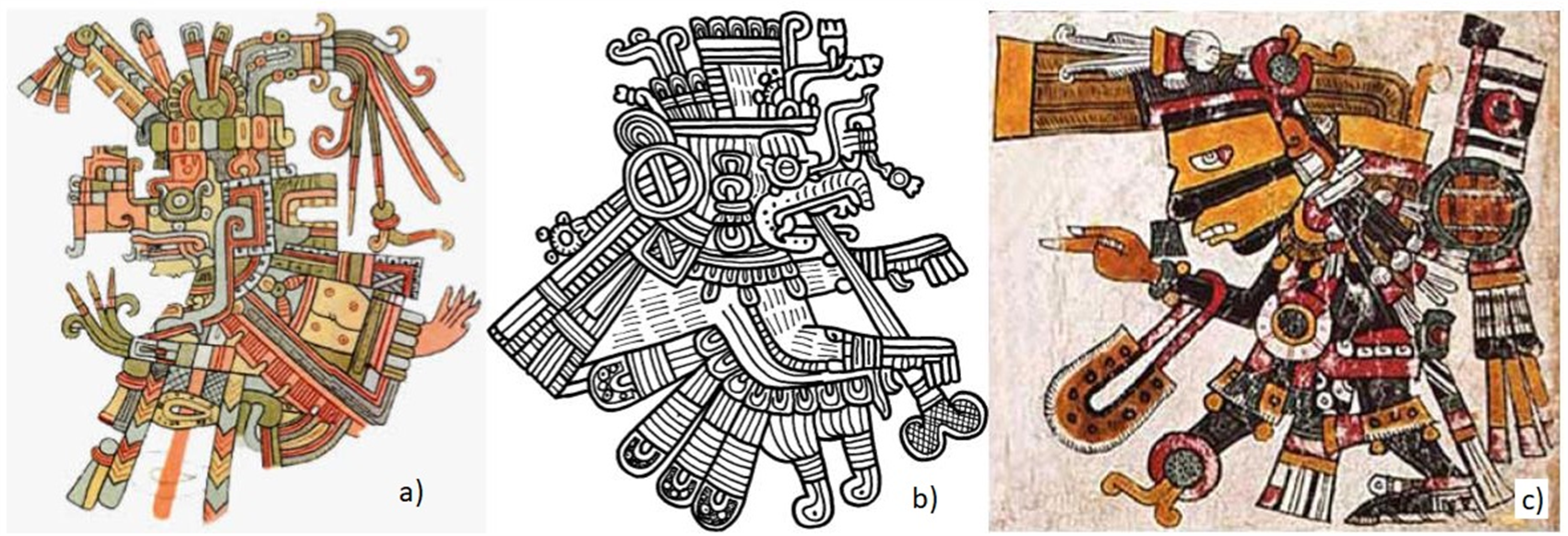
Certainly, not only the name but the iconography and pictorial style of this complex deity also varies with region and time, influenced by the aesthetics of the dominant group at that era. Figures 1, 11c, 11d, 12a, and 12b show different representations of K’awiil from different periods, each with slightly different divine attributes. The Postclassic effigies of K’awiil in Figures 12a and 12b (Taube Reference Taube1992b:70–72) exhibit an “international” pictorial style (Valencia Rivera Reference Valencia Rivera2016), with iconographic elements much closer to those of central Mexico. For example, the smoking mirror of the Maya god from El Corozal has acquired a form very similar to that of the Mexica deity Tezcatlipoca (Figure 12c). In contrast, during the Classic Maya period, the mirror was represented from a transverse sectional view or in a manner resembling the nen glyph (T617).
Image of a Late Postclassic K’awiil from El Corozal, Belize (left), representation of a winged K’awiil with a smoking tube at his mouth, from Tulum (center), and an image of his Mexica divine homolog Tezcatlipoca, from the Borgia Codex (right).

In fact, this creational deity and its myth appear to have been a persistent feature throughout Mesoamerican cultural development, even though the deity does not seem to be represented with the smoking mirror attribute until the Classic Maya period.
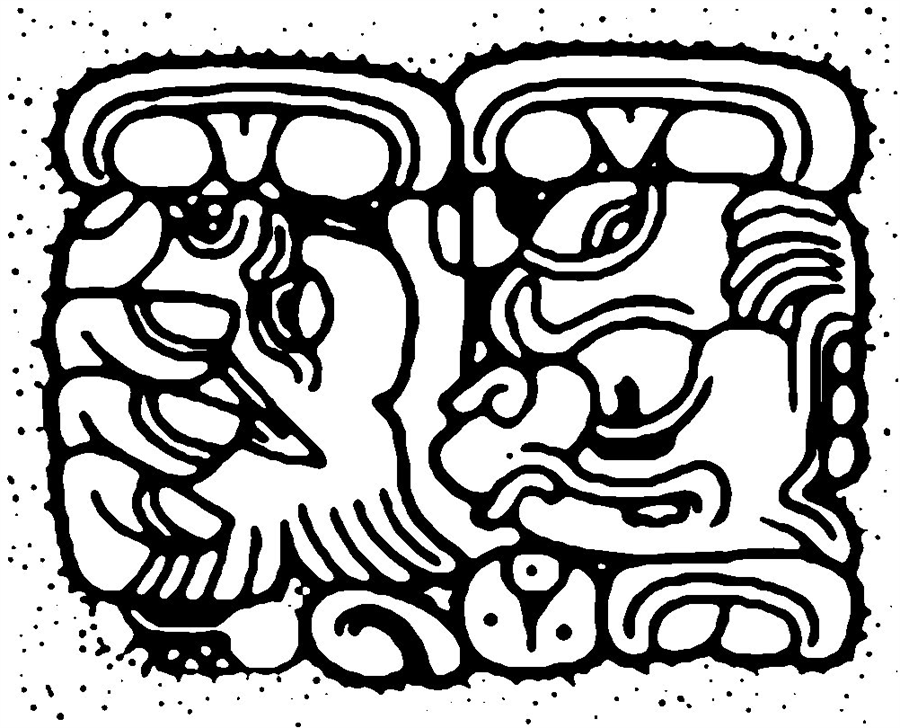
K’awiil was a key deity in the political life of Mayan cities since he was a symbol of divine royal lineage. His name was shared by many kings (Copan, Calakmul, Chichen Itza, Tikal, Palenque, etc.) and his effigy as a scepter was used as a symbol of enthronement. Classic-period Maya rulers are frequently depicted in art (stelae, panels) during their enthronement ceremonies holding in their right hand K’awiil’s scepter, with the accompanying inscription uch’ amaw K’awiil (transliterated as u-ch’am-ma-wa K’AWIIL), translated as “To take/grasp/conjure K’awiil” (see Figure 13). This is a nominal formula used to mark the precise moment of enthronement, when a ruler becomes the legitimate possessor of the deity. Therefore, it has been recognized that the scepter of the K’awiil’s effigy was an emblem of royal power (Valencia 2010).
Glyphic inscription read as uch’ amaw K’awiil or “to take K’awiil,” a nominal formula for ascension.

In this royal context, it is worth noting that Queen Lady K’abel (Burial 61 from El Perú-Waka’ site) was buried laying to rest with her tobacco flask alongside her mirror, among other precious belongings: thus providing us with one important archaeological association between actual tobacco and mirrors, symbols of K’awill’s divine attributes and not merely their artistic representations (Freidel Reference Freidel, Navarro-Far, Rich and Meléndez2024; Eppich, in Loughmiller-Cardinal Reference Loughmiller-Cardinal and Eppich2019; Loughmiller-Cardinal Reference Loughmiller-Cardinal and Zagorevski2016).
Last, it is important to mention Milbrath’s association of K’awiil with Tezcatlipoca (Milbrath Reference Milbrath and Elizabeth2014). This association becomes apparent when considering that both one-legged gods are depicted with a smoking mirror (Figure 12). Once again, as seen in the worship of the gods Chaac and Tohil, cigars and tobacco play a significant role. Similar to Tohil, who requires human blood and tobacco as offerings, Sahagún recounts in the Florentine Codex that the same elements were offered to Tezcatlipoca.
The young man who was being nurtured by them to be killed during this festival was trained very diligently to learn how to play the flute well and how to handle and carry the smoking tubes and the flowers, just as is the custom among the lords and the people in the palace. And they would teach him how to saunter and walk around while sucking in the smoke and smelling the flowers, as is the custom among the lords and in the palace. (Sahagún Reference Sahagún, Richter and Houtrouw2023:bk. 2, f. 31r and 31v)
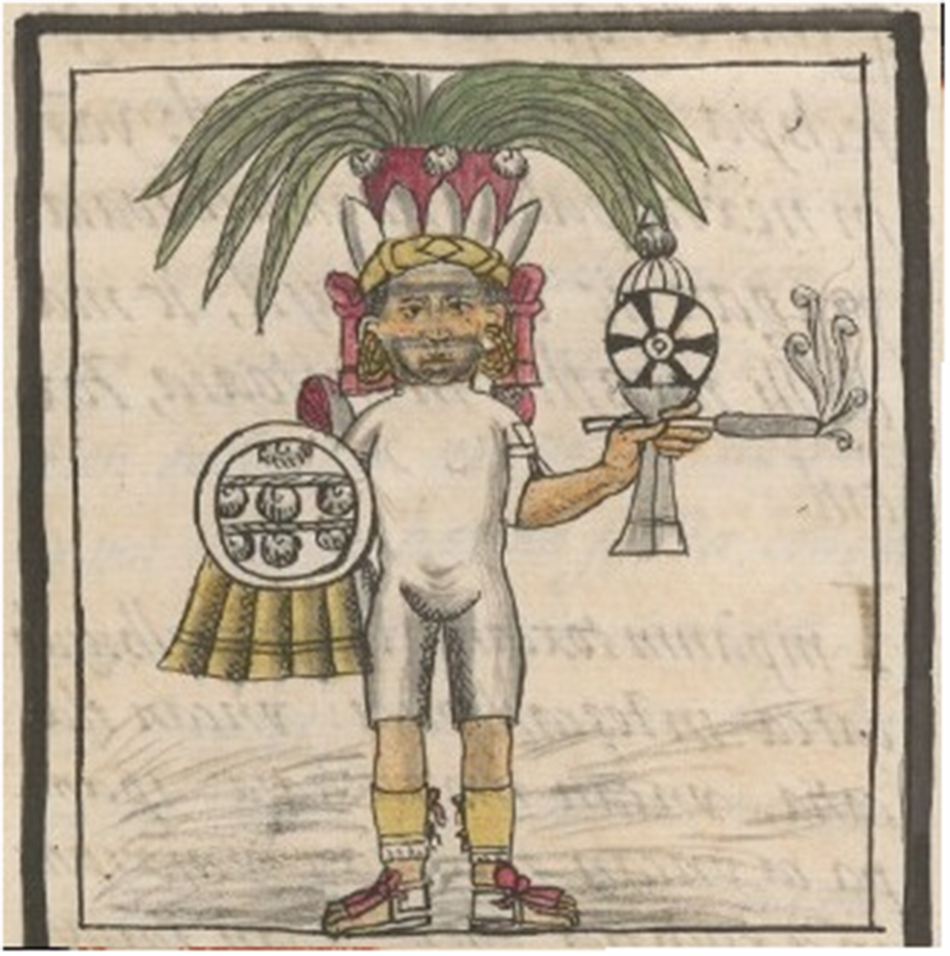
In the corresponding image from the Florentine Codex for this section, shown in Figure 14, appears as a god impersonated in the young to be sacrificed holding a shield in his right hand. A mirror and cigar are held in the god’s left hand, showing again the association of mirrors and smoking cigars.
Mexica young man character to be sacrificed, holding a mirror and a smoking device, from the Florentine Codex.

Sahagun also recounts about the mirror craftsman: “He sells two-faced mirrors, polished on both sides, mirrors with only one face, and concave mirrors, all of which are very good” (Sahagún Reference Sahagún, Richter and Houtrouw2023:bk. 10, f. 63r), witnessing the manufacture of concave mirrors at the Contact period.
Therefore, cigars and mirrors seem to be intrinsically intertwined within the worship of the Lord of the Smoking Mirror (whether one of its divine homologs; K’awiil, Tohil, or Tezcatlipoca, always sharing divine attributes), both from the iconographic and ritualistic paraphernalia points of view.
Physical complementarity between cigars and mirrors
Beyond the complementarity of cigars and mirrors in iconographical and ethnohistorical registers it remains necessary to analyze their possibilities as a pyrotechnologic instrument. Excavations at La Venta in 1949 uncovered several Olmec concave mirrors crafted from magnetite, hematite, and ilmenite, dating to the Preclassic period (Gullberg Reference Gullberg, Drucker, Heizer and Squier1959). This discovery gave rise to the hypothesis that these artifacts were used to ignite fire by concentrating sunlight (Ekholm Reference Ekholm1973; Gullberg Reference Gullberg, Drucker, Heizer and Squier1959; Robicksek Reference Robicsek1978), and that this practice could be linked to the later worship of the “Lord of the Smoking Mirror” during the Maya Classic and Mexica Postclassic periods (Milbrath Reference Milbrath and Elizabeth2014). However, this hypothesis remained speculative for two primary reasons. First, no concave mirror had been identified in the Classic Maya archaeological record, the period to which the beginning of this deity’s worship can be traced with reasonable consensus. Second, the burning capability of the discovered Olmec mirrors had not been systematically demonstrated but just for one specimen by Ekholm in 1972 (Heizer and Gullberg 1981:115). Further, scholars lack evidence that these mirrors were used for ignition.
Mirrors revisited: pyrite Mayan concave mirrors
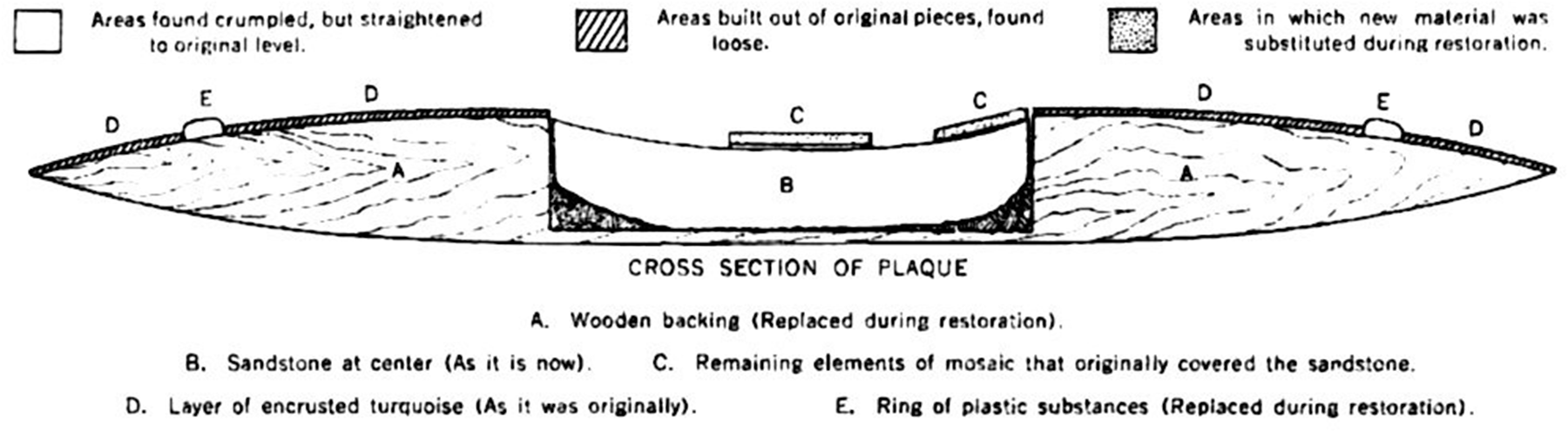
Regarding the first impediment —the absence of Classic or Postclassic-period mirrors—our group identified a prominent example: the Turquoise Plaque of Chichen Itza. A review of the archaeological reports by Morris (Reference Morris, Charlot and Morris1931) revealed that the diagram of the transverse section of its central pyrite mirror clearly indicates its concavity (see Figure 15).
Diagram of the restoration of the turquoise mosaic plaque from the Temple of the Warriors, Chichen Itza in a transverse section view, showing the concavity (at B) of the pyrite mirror at his center. Drawing taken from Morris (Reference Morris, Charlot and Morris1931).

The concavity is paramount since only if it has the right geometry, it would allow the mirror to concentrate solar radiation to a point at which it can start a fire on an appropriate target. Not in art nor in religion, but in anatomy, physiology or engineering, the principle of “form determines function” states that the physical structure, shape, or composition of an object dictates what it can or cannot do. From this perspective, the question if the Preclassic Olmec concave mirrors were used to ignite fire can be extended to the Postclassic Maya due to the presence of this Chichen Itza mirror.
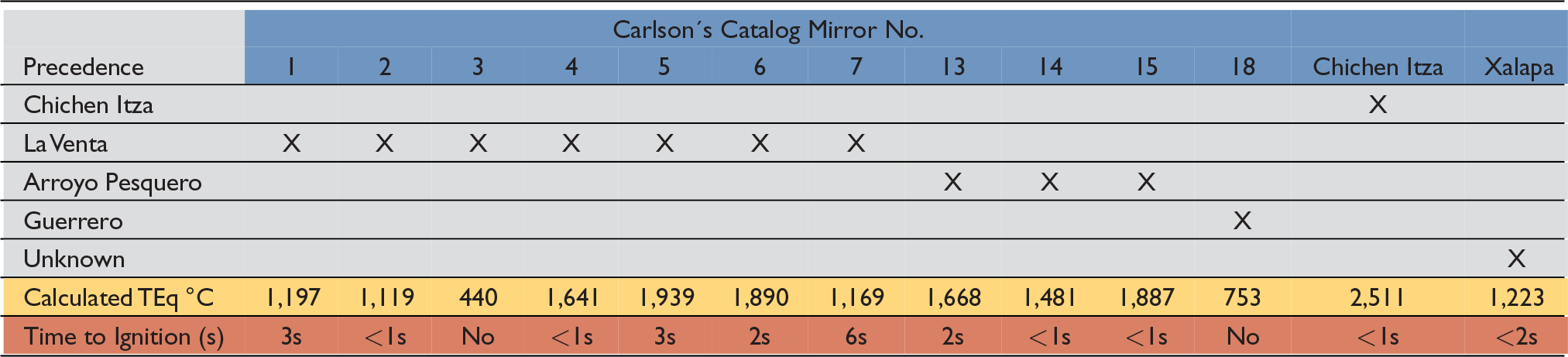
Concerning the second barrier, our research (all details appear in Salazar-Neumann et al. [Reference Salazar-Neumann, Delgado-Calderon and Yuri2026]) in this same volume) demonstrates that most of the known archaeological concave specimens were indeed capable of igniting fire. The cross-section diagram of the superb Chichen Itza mirror allowed us to calculate its radius of curvature and thus evaluate its burning ability, both theoretically and experimentally using a radiative equilibrium approach and analog modern mirrors. Results show that extraordinary temperatures could be reached at their focal point on to a blackened object, much higher than the ignition point of cellulose lignine mixtures (see the penultimate yellow row of Table 3).
Calculated equilibrium temperatures TEq of a black object at the focal point of Olmec and Mayan concave mirrors, and the time it takes a blackened target to ignite, if located at the focal point of an analogous model mirror exposed to the sunlight

Table 3 Long description
Columns list Carlsons Catalog Mirror No. values 1, 2, 3, 4, 5, 6, 7, 13, 14, 15, and 18, plus two additional columns labeled Chichen Itza and Xalapa. Rows mark mirror provenance with X for Chichen Itza, La Venta, Arroyo Pesquero, Guerrero, and Unknown. X marks appear for Chichen Itza under mirror 14; for La Venta under mirrors 1, 2, 3, 4, 5, 6, 7, and 13; for Arroyo Pesquero under mirrors 14, 15, and 18; for Guerrero under mirror 18; and for Unknown under Xalapa. Calculated TEq in degrees C by mirror number is 1,197 for 1; 1,119 for 2; 440 for 3; 1,641 for 4; 1,939 for 5; 1,890 for 6; 1,169 for 7; 1,668 for 13; 2,511 for 14; 1,223 for 15; and 753 for 18. Time to Ignition in seconds is 3 seconds for 1; under 1 second for 2; No for 3; under 1 second for 4; 3 seconds for 5; 2 seconds for 6; 6 seconds for 7; 2 seconds for 13; under 1 second for 14; under 2 seconds for 15; and No for 18.
The theoretical predictions for the equilibrium temperature (TEq) of a blackened target at the focal point of the mirrors are based on the principle that the target’s temperature increases until the incoming solar energy flow equals the energy radiated back into the surrounding environment, as described by the Stefan-Boltzmann law for a black body (Duffie Reference Duffie and Beckman2013). In this context, the color of the target is critical, as it determines the capacity to absorb and emit electromagnetic radiation, and thus the burning power of the mirror/target pair or its equilibrium temperature TEq.
Even though our results show the continuity of the lapidary tradition of crafting concave mirrors from the Preclassic to the Postclassic periods, as well as the good incendiary power of these artifacts, a subsequent question arises concerning the specific materials used as tinder.
One can naively think that any flammable material such as dry leaves or dry wood would suffice and often appears trivial to answer this question. However, the tobacco cigar itself ignited in front of the mirror (Figure 1) provides a coherent answer that aligns both the physical principles governing the mirror and the cigar, and the symbolic world of K’awiil worship, as it will be shown.
The tobacco cigar revisited
From a physical point of view, the ignition of a fire using a concave mirror to concentrate the Sun’s radiation requires a small, easily combustible, blackened object to be suspended at the mirror’s focal point.
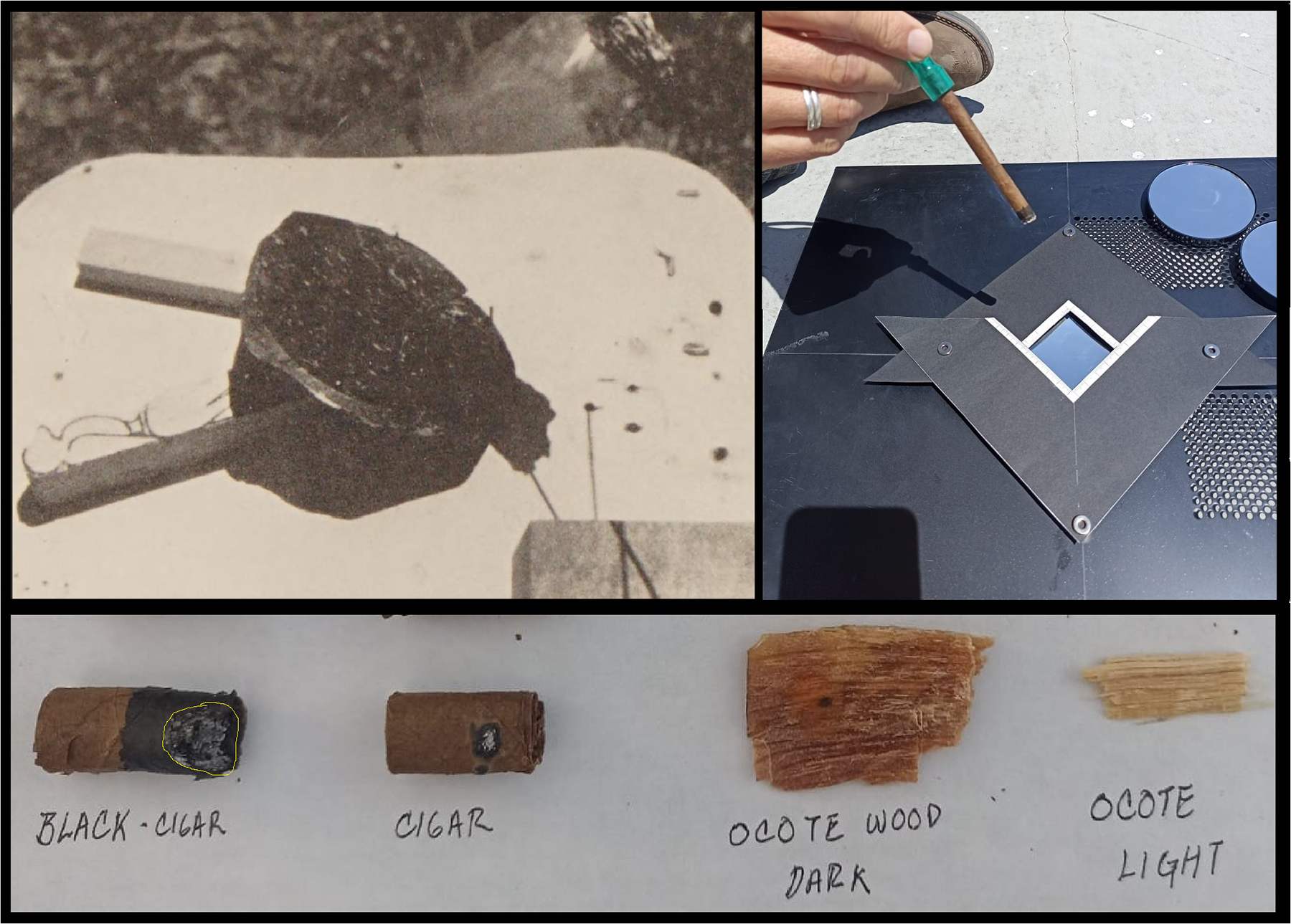
To demonstrate how strongly the burning power of the mirror/target pair depends on the target’s absorptance (i.e., its darkness), we performed experiments using modern glass silvered concave mirrors—analogous mirrors—with similar focal distance than their archaeological specimens, but adjusting the aperture area to match the reflected energy flow of their original counterparts (the time required to ignition is shown in the last row of Table 3, when a blackened cigar is used as target). Then, we exposed various materials to solar radiation concentrated by the Chichen Itza analog mirror for three seconds each. The experimental setup of Ekholm who succeeded to light fire with the Arroyo Pesquero Olmec mirror is shown in Figure 16 (upper left), and our own experiment using modern analogous mirrors (upper right). The clear contrast between light-colored and dark-colored materials is shown in the same Figure 16, where the extent of burning caused by the concentrated solar beam is evident. Although the choice of objects made from cellulose seems obvious, since this material is a good fuel and is almost universally available, our results show that Olmec and Mayan mirrors fail to ignite fire on cellulose if it is in the form of compact material like wood or branches, or if its color is light like that of paper or ocote wood.
Experimental setup of Ekholm, who succeeded to light fire with the Arroyo Pesquero Olmec mirror (upper left), and our own experiment using modern analogous mirrors—with equivalent apertures and focal distances—lighting a tip blackened cigar (upper right). Below, different materials and the extent of burning caused by the concentrated solar radiation. The burnt zone on the blackened cigar on the left has been circled in yellow for clarity.

Placing the blackened target at the focal point without casting a significant shadow over the mirror necessitates a thin, elongated support that simultaneously allows oxygenation during combustion. These criteria are met by tobacco cigars, enabling the lighting of an ember at the tip of the cigar while allowing to enlarge the ember seed by inhalation. Transport and transfer of the ember are made more convenient using such devices (smoking tubes or cigars) through puffing. The smoldering cigar could then be placed into a bundle of kindling (small twigs) to ignite a full flame.
The aforementioned reasons would explain the use of cigars as starting fire devices and their association with mirrors that frequently appears in both Mayan paintings and in Mesoamerican ceremonies. Even more, the enormous amount of effort required to make cigars through drying, curing, fermenting, and rolling tobacco leaves—while still flexible—can be explained by the paramount significance of the ceremonial act of igniting fire on a sacred plant with the Sun’s light.
Cigars are devices that promote very efficient combustion, reaching more than 800ºC temperatures (Touey and Mumpower Reference Touey and Mumpower1957), since oxygen flowing through the cigar increases the kinetics of the combustion reaction proportionally to this air flow (more than tenfold increase in flow rate, from tens of ml/s to 0.5 l/s). They act as a chimney in which the influx of fresh air, without carrying humidity from the lungs, optimally oxygenates the combustion reaction taking place at the burning tip. Furthermore, in a cigar, the smoldering front advances in the same direction as the airflow. If the air were blown in the opposite direction, the ember does not find fuel to sustain itself, making the burning process much less efficient
Nonetheless the ignition temperature of mixtures of cellulose, hemicellulose, and lignin affect the ignition point of different biomass fuels, as shown by Cao and colleagues (Reference Cao, Jun, Teresa and Zhang2019) ranging from 370°C to 410°C, the calculated burning ability through their equilibrium temperature (TEq) of these ancient Mesoamerican concave mirrors consistently remains over the ignition point of these mixtures (see Table 3).
It is worth noting that, according to the experiments we have conducted lighting cigars using analogous models, the blackening process is critical; only in the case when the blackened cigar is exposed to the concentrated radiation does it light up almost instantly. However, if the cigar is extinguished and its gray ash-colored tip is exposed to the mirror’s concentrated radiation, it fails to light.
This critical requirement of blackening the target coincides with an important ethnographic observation reported by Thompson, who describes a surficial treatment using carbonized and pulverized tubers of an unidentified plant mixed with a sweet potato and corn gruel for manufacturing cigars among Mayan people (Thompson Reference Thompson1970:109). This treatment, which essentially constitutes a black paint known as cocom paste, is applied to the exterior wrapping leaves of the cigar. Analogously, Sahagun refers:
The smoking tube seller, the tobacco (tube) seller, is one who provides a covering (for the tobacco tube) a maker of reed smoking tubes, a cutter of reeds. He strips them, he removes the outer surface; he prepares charcoal, he grinds charcoal. He covers (the reed with moist charcoal dust); he paints them, he colors them, he gilds them (Sahagún Reference Sahagún, Richter and Houtrouw2023:bk. 10, f. 64r).
Although the specific purpose of this treatment is not documented, we propose that this tradition likely comes from the search to increase the optical absorptance of the cigar, making it a more efficient receiver of concentrated radiation (larger value of the absorptance α in Eq. 4. in [Salazar-Neumann Reference Salazar-Neumann, Delgado-Calderon and Yuri2026]). As has been shown experimentally, this absorptance value is critical to achieve the ignition of the receiver.
In addition, Tozzer gives us a conspicuous ethnographic testimony about the knowledge once Lacandons had on how to ignite fire using tobacco and optical devices: “The first tobacco is made into a form of a cigar, lighted symbolically by a crystal, and offered to the gods” (Tozzer Reference Tozzer1984:16). It must be stressed that aside from one of the mirrors of Chichen Itza, a couple of clear quartz crystals were found by Morris in 1931 (Morris Reference Morris, Charlot and Morris1931:182).
The physical and ethnohistoric evidence therefore supports the plausibility of cigars serving as rolls of combustible tinder. Their function would have been to catch the concentrated radiation from a concave mirror, initiating an ember for fire making. Indeed, our experimental results with analogous models of the ancient concave mirrors, including similar focal distances to those of their original archaeological counterparts, have notoriously demonstrated their burning power, as well as the cigar’s excellent capacity as a tool for igniting an ember using solar concentrated radiation.
Discussion
The long-standing hypothesis, first elaborated by Carlson, Ekholm, and Robicsek, positing a relationship between the cult of the Lord of the Smoking Mirror and the use of concave mirrors to ignite fire, long remained dormant. This was due to the absence of any such mirrors in the Classic archaeological record, since a discontinuity in the manufacture of these artifacts existed from the Preclassic (when no concluding evidence of the worship is known) to the Classic periods. However, a thorough revision of archaeological reports revealed that the Turquoise Plaque of Chichen Itza was in fact a missing piece—a sophisticated concave mirror (Schieber Reference Schieber, Christa, Beatriz Solís Ciriaco, Corzo and Claudio2024) that could finally link the deity’s worship to a tangible technological artifact.
Our experience using analogous mirrors to light fires, and judging by our modern failed experiments with these analogous models (Salazar-Neumann Reference Salazar-Neumann, Delgado-Calderon and Yuri2026) and original Olmec mirrors (Olsen 2011), suggests that even with suitable mirrors the difficulty of lighting fires with them remains; concave mirrors require a suitable target, whose thermodynamic design is finely tuned with the mirror’s optical characteristics. Cigars and smoking tubes are long, thin chimneys that make it possible to locate the fuel at the small focal region of the concave mirror without casting a significant shadow on the mirror and simultaneously allowing for oxygenation of the ember at the tip by means of inhalation at the distal extreme, therefore being idoneous receivers for the concentrated radiation of concave mirrors. For this reason, we believe that to support Carlson’s hypothesis relating concave mirrors with the ritual of the Lord of the Smoking Mirror, the presence of cigars is essential.
However, to substantiate the hypothesis that such mirrors could actually have been used to ignite fire, an iconographic analysis and a review of the ethnohistoric record were undertaken. Our findings reveal that the mirror/cigar pair can be found not only in the pictorial depictions of the myth of K’awiil but also in the ones depicting palace ceremonies (likely of paying tribute or enthronement), as well as in mythical scenes of the Hero Twins.
The identification of bouquets of feathers as torches intended to simulate being alight, together with other iconographic elements within the scene—namely cigars, the presence of the Twin Lords, and their postures—corresponds closely to descriptions found in the Popol Vuh. This correspondence has enabled the interpretation of a group of vases depicting the Twin Lords as visual representations of the mythical passage through the House of Darkness as narrated in the Popol Vuh. Notably, the mirror emerges as a significant element: a fragment of the episode lost from the Popol Vuh, yet preserved exclusively in pictorial registers. This interpretation may prove valuable both for the epigraphic analysis of the inscriptions on the vases and for the recognition of analogous elements in similar scenes across other contexts.
Additionally, the iconographic analysis shows that in a significant number of cases, cigars, or feather bouquets are depicted directly along the mirror’s optical axis or in its close vicinity. This precise alignment strongly supports the hypothesis that concave mirrors were used to ignite these objects—either literally or symbolically—from the Classic Maya period onward.
Within the K’awiil worship context, the smoking tobacco cigar and the mirror could be viewed as a supernatural power to ignite fire, mirrored in this world by a compound optical and thermodynamic apparatus mastered and manipulated by the ruler king who displays control over these elements. Who else if not K’awiil himself would give a man such a remarkable power? As stated by Schelle and Miller (Reference Schele and Miller1986:301), “supernatural power was focused on the objects manipulated by the king, which seemed to accrue sacred energy through their use in ritual.”
We believe that the current interpretation of concave mirrors requires a critical reassessment in order to recognize their technological significance. This might require challenging existing perceptions, revisiting old data with new tools, and advocating for interdisciplinary research in order to deepen our understanding of ancient technologies and shed light on the inventiveness of past civilizations. It also emphasises the necessity for further studies oriented to the search of nicotine traces in teeth or dental pieces in burials where concave mirrors were found, for example, Burial 40 at Chalcatzingo, Morelos (Merry de Morales Reference Merry de Morales and Grove1987), or Chiapa de Corzo burials (Gallaga and Lowe Reference Gallaga and Lowe2018) in order to trace the use of tobacco among the Olmecs and Preclassic-related cultures that used concave mirrors.
Even though our hypothesis is built on a convergent body of archaeological, iconographic, epigraphic, ethnohistoric, and theoretical and experimental data, further research is needed to prove the usage of concave mirrors and tobacco cigars as incendiary instruments in ancient Mesoamerica.
Conclusions
The continuity of the Lord of the Smoking Mirror worship and the lapidary tradition of making concave mirrors have been scrutinized throughout iconography, ethnohistoric, and archaeological registers. In this respect, the tobacco cigar emerges as an important element accompanying concave mirrors, as it enables to initiate, grow, preserve, and manipulate an ember showing itself as an idoneous receiver for concentrated solar radiation.
Based on this iconographic, ethnohistorical, and physical evidence, we propose that cigars and Maya concave mirrors functioned as an integrated photothermal system designed to harness incoming solar radiation for fire lighting. The concentrated radiant energy was focused onto the blackened cigar—a well-conceived furnace-chimney device—which then ignited the dry fuel, nurtured the ember, and facilitated its transfer to a kindling pile. Thus, this combination of mirror and cigar served as a complete optical and thermodynamic apparatus.
From our point of view, within the haven of the deity K’awiil, the possible use in rituals of concave mirrors together with cigars to ignite fire would have represented a display of the profound knowledge of natural forces, such as the sunlight power and the psychoactive activity of substances like tobacco. This knowledge could have strongly underscored the high hierarchical status held by dignitaries who possessed such understanding and claimed dominion over these forces, providing legitimation through symbolism.
This ritualistic practice in the Tezcatlipoca and K’awiil cult traditions, associated with mirrors, tobacco and fire, highlights the multifaceted role of concave mirrors in indigenous cultures, illuminating the intertwined relationship between technology, spirituality, and symbolism (the Reflective Surface Complex inscribed within the wider Lord of the Smoking Mirror Complex, a worship and myth extended throughout Mesoamerica likely from the Formative up to the Postclassic periods) thus contributing to a better appreciation of the technological prowess of ancient Mesoamerican cultures.
Supplementary material
The supplementary material for this article can be found at https://doi.org/10.1017/S0956536126101096
Competing interests
The authors declare none.
Data availability statement
Data available on request to the corresponding author at yuri@ifisica.uaslp.mx.
Funding statement
Any funds were received for the realization of this article.