Dytiscidae is the largest family among the aquatic families of Coleoptera and has 4589 species worldwide (Jäch and Balke Reference Jäch and Balke2008; Nilsson and Hájek Reference Nilsson and Hájek2021). Dytiscidae species occupy a niche as top predators in freshwater where fish are absent, and it is an important taxon in food webs in many habitats (Foster and Bilton Reference Foster and Bilton2014).
Hydaticus pacificus conspersus Régimbart, 1899 (Coleoptera: Dytiscidae) has been recorded in Japan, China, Taiwan, and South Korea (Wewalka Reference Wewalka2016; Nakajima et al. Reference Nakajima, Hayashi, Ishida, Kitano and Yoshitomi2020), and it is currently considered “endangered,” according to the Red List of Japan (Ministry of the Environment of Japan 2015, 2020). This species occurs in roadside drainages with sandy ground that contain clean water and leaf litter (Wewalka Reference Wewalka2016) and in wetlands covered by trees and/or Phragmites australis (Cavanilles) Trinius ex Steudel (Poaceae) (Mori and Kitayama Reference Mori and Kitayama2002; Ministry of the Environment of Japan 2015). Moreover, this species is attracted by light traps (Mori and Kitayama Reference Mori and Kitayama2002). Individuals of this species lay eggs on the surface of aquatic plants and have a larval period of approximately 2 weeks (Ministry of the Environment of Japan 2015). New adults emerge in August (Ministry of the Environment of Japan 2015) and overwinter in water (Matsumoto and Isozaki Reference Matsumoto and Isozaki1988). However, the report of the Ministry of the Environment of Japan (2015) does not provide detailed data on the larval period, and the accuracy of currently available information is hard to judge. To assess the larval period in detail, quantitative and temporal data produced from experimental rearing are required. Insights into life histories and development of immature stages will contribute to ex situ and in situ conservation approaches to preserve biodiversity in aquatic ecosystems, such as those inhabited by this species (e.g., Vahrushev Reference Vahrushev2011; Watanabe et al. Reference Watanabe, Hayashi and Kato2017; Ohba et al. Reference Ohba, Fukui, Terazono and Takada2020). Therefore, we aimed to describe the developmental period of laboratory-reared immature stages of H. pacificus conspersus.
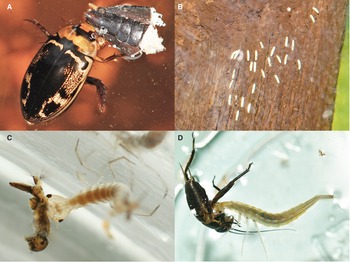
The Ishikawa Insect Museum (Ishikawa, Japan) reared H. pacificus conspersus collected from the Kyoto Prefecture, Japan, and F1-generation adults were used for this study. Thirty adults were kept in a glass tank (30 × 30 × 50-cm height, approximately 40-cm water depth), and live Ceratophyllum demersum Linnaeus (Ceratophyllaceae) and driftwood were placed in the tank. Live prey (Gryllus bimaculatus De Geer (Orthoptera: Gryllidae)) was provided every 2–3 days (Fig. 1A), and the tank was examined daily. The dates of the first egg laying and larval hatching were recorded, and the duration from laying to hatching was calculated. Larvae were removed on the hatching day and were transferred to plastic cups (8 cm diameter, 4 cm height) filled with water to a height of approximately 2 cm. First-instar larvae were fed with live mosquito (Diptera: Culicidae Culicini) larvae, and second- and third-instar larvae were fed with live G. bimaculatus nymphs daily. We carefully placed individual third instars in pupation cups (same size as the larval cups) containing crushed and moistened peat moss (2 cm depth) when they stopped consuming prey and moved continuously and the content of the midgut was not visible from the outside. Hatching, moulting, transition to pupation cups, and dates when adults emerged from the pupal chambers to the soil surface were recorded every 24 hours. The rearing room conditions were maintained at 26 °C with a 9:15-hour light–dark cycle (light from 08:15 to 17:15 Japan Standard Time).
Hydaticus pacificus conspersus. A, Adult preying on Gryllus bimaculatus; B, eggs laid on driftwood surface; C, first-instar larva preying on mosquito larva; and D, third-instar larva preying on G. bimaculatus nymph.

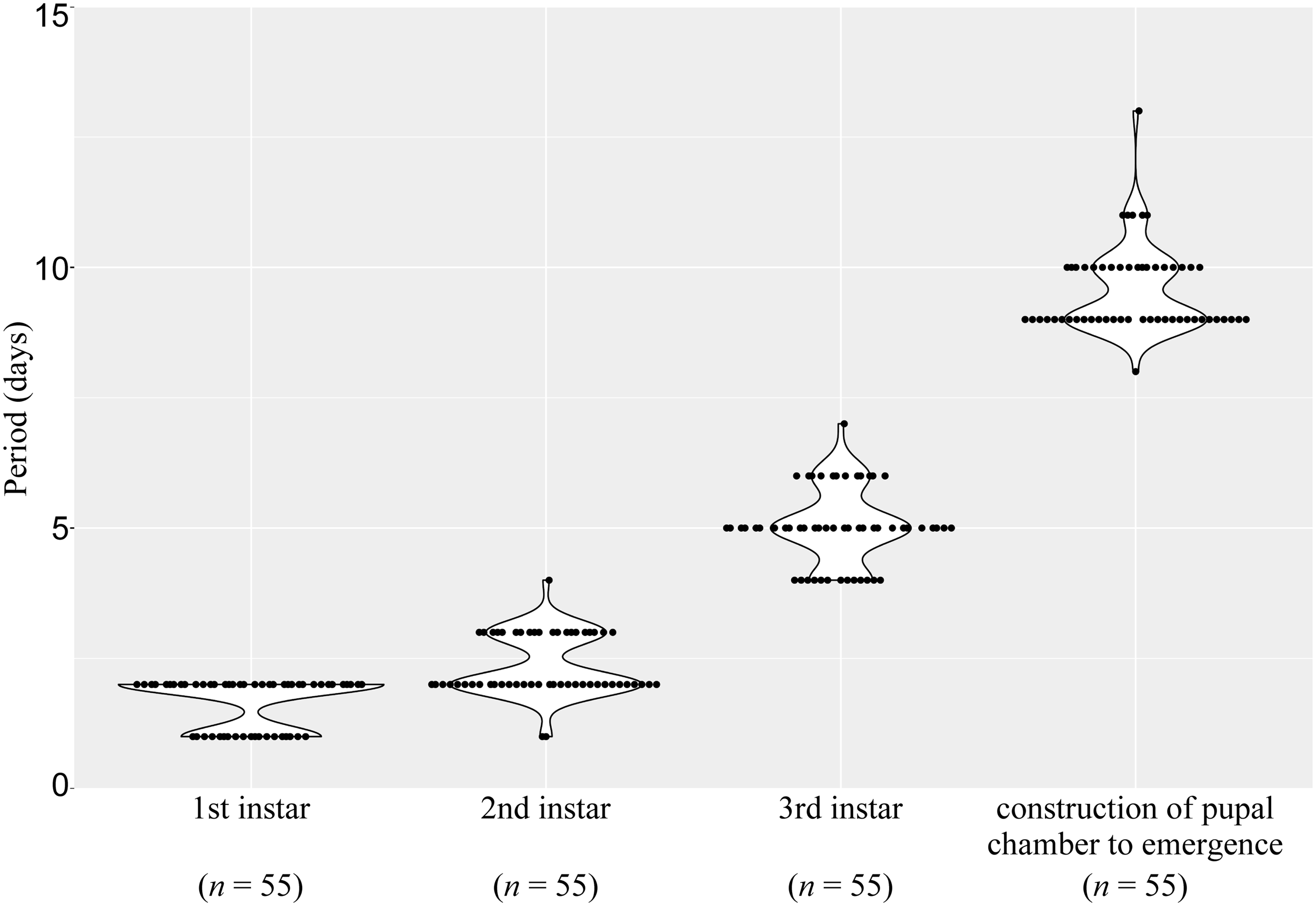
Eggs were laid on the surface of the driftwood (Fig. 1B) and on the surface of the tank-corner sealing on the day adult rearing began. Eight larvae hatched after an incubation time of 3 days. The observed duration and individual numbers per developmental stage were as follows (Fig. 2): total larval period – 7–11 days (9.0 ± 0.8 days; n = 55); first-instar period (Fig. 1C) – 1–2 days (1.7 ± 0.5 days; n = 55); second-instar period – 1–4 days (2.4 ± 0.6 days; n = 55); and third-instar period (Fig. 1D) – 4–7 days (5.0 ± 0.7 days; n = 55).
The durations of each developmental stage and from construction of pupal chamber to emergence in Hydaticus pacificus conspersus.

After transitioning to land within the pupal cups, the larvae constructed a pupal chamber using peat moss on the soil surface. The duration of the pupal stage could not be determined in all individuals because the inside of the pupal chamber could not be observed. The duration from pupal chamber construction to emergence was 8–13 days (9.6 ± 0.8 days; n = 55).
We observed that H. pacificus conspersus eggs were deposited individually on the surface of driftwood and on the water tank–corner seal. This species lays eggs on the surfaces of plants such as Salvinia molesta Mitchell (Salviniaceae) under rearing conditions (Niikura et al. Reference Niikura, Hirasawa, Inoda and Kobayashi2017); however, egg deposition substrates are not restricted to live plants. Three congeneric species, Hydaticus bowringii Clark, 1864, H. bipunctatus Wehncke, 1876, and H. grammicus (Germar, 1827), inhabit sunny wetlands and ponds that are rich in aquatic plants (Nakajima et al. Reference Nakajima, Hayashi, Ishida, Kitano and Yoshitomi2020). These three species deposit their eggs on the surfaces of aquatic plants under natural or rearing conditions (Sakamizu Reference Sakamizu1983; Watanabe and Kato Reference Watanabe and Kato2017; Watanabe Reference Watanabe2019), and larvae grow in paddy fields (Saijo Reference Saijo2001; Watanabe Reference Watanabe2016; Watanabe et al. Reference Watanabe, Ohba and Yokoi2020). In contrast, H. pacificus conspersus larvae occur in small pools without aquatic plants, located in or near forests, and adults and mating behaviour were observed at such sites (Nishida Reference Nishida1999, Reference Nishida2000). These results suggest that, unlike H. bowringii, H. bipunctatus, and H. grammicus, H. pacificus conspersus reproduce in small, poorly lit water bodies where few aquatic plants occur and they use submerged substrate of various types, including trees and leaf litter as egg oviposition substrates. The egg period has been reported to be approximately 50 hours at 28 °C (Niikura et al. Reference Niikura, Hirasawa, Inoda and Kobayashi2017), whereas the current study showed an egg period of 3 days at 26 °C.
The total larval period was 9.0 ± 0.8 days at 26 °C, and the present results showed a shorter developmental period than the previously described duration of approximately 14 days (Ministry of the Environment of Japan 2015). As the egg period at 28 °C was shorter than that at 26 °C, the larval period may also be even shorter, depending on water temperature. Kingsley (Reference Kingsley1985) described the developmental period of the immature stage of 19 Dytiscidae species and proposed that the most rapid development occurred in Eretes sticticus (Linnaeus, 1767) (Coleoptera: Dytiscidae) (total larval period: 9 days). It should be noted that the developmental periods of the 19 Dytiscidae species presented by Kingsley (Reference Kingsley1985) are based on literature and not on uniform conditions. The larval periods of several Dytiscidae species have been examined under the same temperature conditions as the present study thereafter (e.g., Watanabe et al. Reference Watanabe, Hayashi and Kato2017; Watanabe Reference Watanabe2020a, Reference Watanabe2020b, Reference Watanabe2021). No Dytiscidae species previously documented has a shorter developmental period than E. sticticus. The shortest larval period for H. pacificus conspersus was 7 days, and the respective average was the same as that of E. sticticus, i.e., 9 days. We therefore propose that H. pacificus conspersus is among the Dytiscidae with the shortest larval periods. The reproductive habitats of this species are small pools, and pool duration is strongly dependent on rainfall. Thus, the short larval period may be an adaption to increase reproductive success in unstable environments. The use of small pools as reproductive habitats by H. pacificus conspersus, as well as the life history of its immature stages, suggest that the adult habitat may differ from the reproductive environment. Consequently, both water bodies need to be conserved for the conservation of this species.
Acknowledgements
The authors express their sincere gratitude to Masaya Kato (Okinawa Environment and Regional Consultant) for his kind offer of samples. They also thank Editage (www.editage.jp) for English language editing.