Introduction
Among major factors that hinder the development of commercial poultry production are short supplies and high prices of available commercial type poultry diets. Recent studies observed that feed cost accounts for between 60% of total cost of broiler production in NigeriaReference Iyayi and Fayoyin1 and 70% in CameroonReference Teguia and Beynen2. Thus, a combination of high ingredient costs and limited availability of conventional feed ingredients have resulted in the production of poultry feeds that are mostly of questionable quality. As a result, most feeds often failed to satisfy the needs of poultry farmers in terms of nutrients supplied compared to the nutritional requirements of the birds. Intensive broiler management systems tend to deprive birds of free access to fresh pastures and succulent leguminous plants that are readily available to scavenging chicken around homesteads and villages. These resources appear not to have been amply investigated as local feed resources for poultry production even though they are believed to contain reasonable levels of certain valuable nutrients.
Williamson and PayneReference Williamson and Payne3 observed that supplementing maize-based diets with fresh green feeds containing high crude protein (CP) (173–220 g kg−1 DM) could contribute significantly to meeting the protein requirements of broilers for growth. Thus, a good knowledge of the nutritional value of such plants in poultry nutrition would be valuable, especially for the ones that grow easily with simple agronomic practices. Full use of these green feeds could improve quality as well as reduce total feed cost under intensive poultry production. Therefore, the purpose of this study was to evaluate the effects of supplementing commercial type broiler diets with selected fresh green feeds on the performance of broilers. Specifically, the study aimed at: (1) evaluating the value of centrosema, pueraria, and waterleaf as supplemental feed resources to broiler diets, and (2) determining their possible effects on some carcass characteristics of broilers.
Materials and Methods
Site of experiment and treatments
The experiment was conducted at the Rivers State University of Science and Technology Teaching and Research Farm in Port Harcourt, Nigeria (a humid forest zone) with the birds housed in a half-walled deep-litter poultry house. Each pen measured about 1×3 m with diurnal temperature ranging between 28 and 32°C. The commercial type broiler diets were purchased from a local dealer while the fresh green feeds (centrosema, pueraria and waterleaf) introduced as supplements were harvested from already growing crops within the University Teaching and Research Farm premises. There were four dietary treatments, namely: Treatment I (commercial type broiler diet only; as control), Treatment II (commercial type broiler diet+fresh centrosema leaves), Treatment III (commercial type broiler diet+fresh pueraria leaves) and Treatment IV (commercial type broiler diet+fresh waterleaf leaves).
Birds and experimental design
One hundred and twenty day-old broilers (Lohmann Brown), procured from local dealers, were randomly allocated into 12 groups, each comprising ten birds. Treatments were arranged in a completely randomized design (CRD) with three replicates per group. Each replicate of ten birds was housed in a 1×3 m half-walled pen. The commercial type broiler diets and fresh green feeds were introduced to the pens simultaneously on a daily basis. Commercial type broiler starter diet was fed from day-old to 5 weeks and followed by broiler finisher diet from 6 to 10 weeks of age. Bundles of fresh green feed supplemental treatments, weighing about 50–300 g per replicate of ten birds, were hung daily in each pen at about 10–45 cm above the floor of the pen, which was adjusted as the birds grew older to ensure about 10% daily leftovers. Birds were monitored for feed intake and weighed, individually, at the start of the experiment and at weekly intervals. Feed conversion ratios (FCRs) and protein efficiency ratios (PERs) (ratio of weight gain to protein intake) were then computed. Two birds per replicate were, randomly, selected at the end of the 62-day experimental period, weighed and sacrificed by cervical dislocation to determine relative intestinal length, gizzard, liver, spleen, kidney and carcass weights.
Chemical and statistical analyses
Proximate composition of both the commercial type broiler diets and green feeds was carried out according to the prescribed methods4. Results were subjected to analysis of variance (ANOVA) to determine differences among treatment means according to the procedures describedReference Wahua5. Where differences were significant, mean separation was done using the least significant differences (LSD) option at the 5% level of probability.
Results
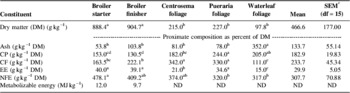
Table 1 showed higher dry matter (DM) and crude fiber (CF) contents in centrosema (215.0 and 342.0 g kg−1 DM) and pueraria (227.0 and 330.0 g kg−1 DM) than in waterleaf (97.8 and 111.0 g kg−1 DM), respectively. The ash content of waterleaf (352.0 g kg−1 DM) was significantly (P<0.05) higher than those of centrosema (81.0 g kg−1 DM), pueraria (78.0 g kg−1 DM) and the commercial type broiler diets (53.8 g kg−1 DM for starter and 103.8 g kg−1 DM for finisher). Similarly, ether extract (EE) and nitrogen-free extract (NFE) ranged from the lowest (15.0 and 317.0 g kg−1 DM) for waterleaf to the highest (40.0 and 478.1 g kg−1 DM) for the starter diet, respectively. The CP content of pueraria (244.0 g kg−1 DM) was significantly (P<0.05) higher than those of both centrosema (182.0 g kg−1 DM) and waterleaf (205.0 g kg−1 DM).
Proximate analysis and metabolizable energy contents of proprietary diet, and centrosema, pueraria and waterleaf foliage.

1 SEM, standard error of mean.
ND, not determined.
a–d Means with the same superscripts in the same row are not significantly different (P>0.05).
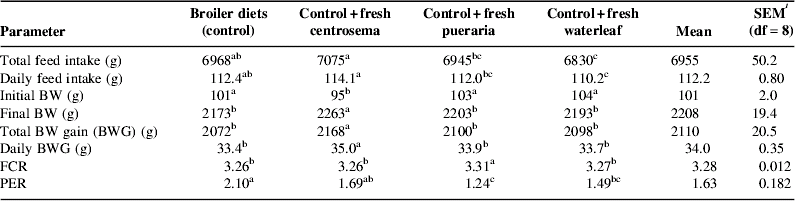
Feed intake ranged (P<0.05) from lowest (110.2 g d−1) for waterleaf group to highest (114.1 g d−1) for centrosema group (Table 2). Similarly, final bodyweight (BW) and BW gain (BWG) were significantly different (P<0.05), with the control group recording the lowest values (2173 g and 33.4 g d−1) and the centrosema group recording the highest values (2263 g and 35.0 g d−1), respectively. The FCR and PER both gave significant differences (P<0.05) among treatments, ranging from 3.26 to 3.31 and from 1.24 to 2.10, respectively.
Effects of foliage from centrosema, pueraria and waterleaf on feed intake, bodyweight (BW) changes, FCR and PER of broilers after 62 days.
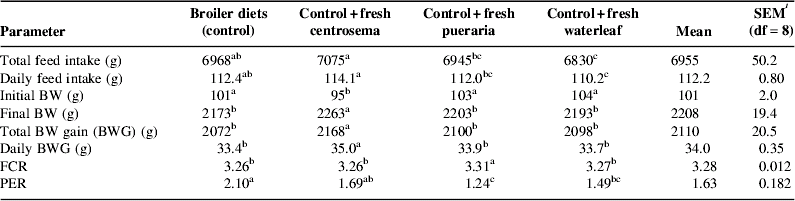
1 SEM, standard error of mean.
a–c Means with the same superscripts in the same row are not significantly different (P>0.05).
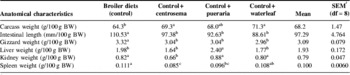
The effects of centrosema, pueraria, and waterleaf on some carcass characteristics of broiler chickens (all adjusted to percent of BW) are shown in Table 3. Carcass weight ranged (P<0.05) from 64.3 g/100 g BW for control to 71.3 g/100 g BW for waterleaf group. Significant differences (P<0.05) were recorded for intestinal length (88.61–110.53 mm/100 g BW) and gizzard weight (2.96–3.32 g/100 g BW). Similarly, liver and kidney weights differed (P<0.05), with the centrosema group recording the least (1.64 and 0.66 g/100 g BW) and the pueraria group recording the highest (2.40 and 0.88 g/100 g BW) values, respectively. Spleen weight varied (P<0.05) between 0.085 g/100 g BW for the centrosema group and 0.111 g/100 g BW for the control group.
Effects of foliage from centrosema, pueraria and waterleaf on some carcass characteristics of broilers after 62 days expressed per 100 g bodyweight (BW).

1 SEM, standard error of mean.
a–c Means with the same superscripts in the same row are not significantly different (P>0.05).
Discussion
The ash and EE contents recorded for centrosema (Table 1) were lower while those for pueraria were within the ranges reported earlier (Lawal and SodeindeReference Lawal, Sodeinde, Joseph, Awosanya, Apata, Belewu, Atteh and Ayorinde6). The same authors also reported lower CP, but similar NFE, contents in both centrosema and pueraria. Also, the recorded CF contents were within the range reported for centrosema but lower than the reported values for puerariaReference Lawal, Sodeinde, Joseph, Awosanya, Apata, Belewu, Atteh and Ayorinde6. The mean recorded CP contents for the commercial type starter and finisher broiler diets used for the study were grossly below the recommended CP levels of 21.0–23.0% and 19.0–19.5%, respectively, for broilers in the tropicsReference Hamre7–Reference Kekeocha9.
Fresh green feeds have been reported to add succulence to feed, stimulate appetite, supply protein, minerals and vitaminsReference Oluyemi and Roberts10, and could contribute significantly to improved performance of birds. The recorded daily feed intakes were higher than some published valuesReference Awosanya, Abikoye, Oduguwa, Fanimo and Osinowo11–Reference Udedibie, Esonu and Okah13 but relatively lower than those reported by othersReference Iyayi and Fayoyin1, Reference Card and Nesheim14. Similarly, the mean daily BWG was higher than reported by someReference Eruvbetine, Aiyedun, Kusimo, Joseph, Awosanya, Apata, Belewu, Atteh and Ayorinde12, Reference Oyawoye, Ogunkunle, Oduguwa, Fanimo and Osinowo15–Reference Uchegbu, Okoli, Anyanwu, Etuk, Esonu and Udedibie17, similar to the value by Awosanya and AbikoyeReference Awosanya, Abikoye, Oduguwa, Fanimo and Osinowo11, but lower than othersReference Iyayi and Fayoyin1. The recorded FCRs were higher than observed ranges by othersReference Iyayi and Fayoyin1, Reference Ojewola and Longe16, Reference Onibi, Owoyemi and Akinyemi18 but much lower than reported by Uchegbu et al.Reference Uchegbu, Okoli, Anyanwu, Etuk, Esonu and Udedibie17 Higher FCR reflects lower feed efficiency since more feed is required per unit BWG. The variations in PER indicated that protein in the control diet was superior to that in the green feeds. Among the green feeds, the protein in centrosema and waterleaf gave similar and better BWG than that in pueraria, which was the least effective at being converted to meat.
The organ weights were adjusted for BW (as percent) as suggested by Daghir and PelletReference Daghir and Pellet19 for a more objective comparison. The slight differences in carcass weight among treatments renders the use of the green feeds not very valuable for practical intensive broiler production purposes. Another disadvantage is that the proposition may not be economical in the circumstances, considering the labor intensive nature of green feeds collection. The recorded carcass weights were similar to those reported by Awosanya and AbikoyeReference Awosanya, Abikoye, Oduguwa, Fanimo and Osinowo11, who evaluated the effects of feeding raw, toasted or cooked pueraria seed in a broiler finisher ration at 20% inclusion level. However, the values were relatively higher than those recorded by some workers (Udedibie et al.Reference Udedibie, Esonu and Okah13) but lower than those by others (Eruvbetine et al.Reference Eruvbetine, Aiyedun, Kusimo, Joseph, Awosanya, Apata, Belewu, Atteh and Ayorinde12; Udedibie et al.Reference Udedibie, Esonu and Okah13; Uchegbu et al.Reference Uchegbu, Okoli, Anyanwu, Etuk, Esonu and Udedibie17; Onibi et al.Reference Onibi, Owoyemi and Akinyemi18). There was no observable effect of CF (from the green feeds) on both intestinal length and gizzard weight as was earlier reported (Deaton et al.Reference Deaton, McNaughton and Burdick20).
Mean gizzard weight was lower than values published by Udedibie et al.Reference Udedibie, Esonu and Okah13, similar to those reported by Eruvbetine et al.Reference Eruvbetine, Aiyedun, Kusimo, Joseph, Awosanya, Apata, Belewu, Atteh and Ayorinde12 and Onibi et al.Reference Onibi, Owoyemi and Akinyemi18 but higher than values published by othersReference Uchegbu, Okoli, Anyanwu, Etuk, Esonu and Udedibie17. Also, the recorded mean liver weight was lower than the values reported by previous workersReference Awosanya, Abikoye, Oduguwa, Fanimo and Osinowo11, Reference Oyawoye, Ogunkunle, Oduguwa, Fanimo and Osinowo15, Reference Uchegbu, Okoli, Anyanwu, Etuk, Esonu and Udedibie17, similar to that recorded by Udedibie et al.Reference Udedibie, Esonu and Okah13, but higher than that published by Onibi et al.Reference Onibi, Owoyemi and Akinyemi18 The recorded mean kidney values were relatively higher than mean values reported earlier by other workers except for the centrosema group where it was lowerReference Eruvbetine, Aiyedun, Kusimo, Joseph, Awosanya, Apata, Belewu, Atteh and Ayorinde12, Reference Uchegbu, Okoli, Anyanwu, Etuk, Esonu and Udedibie17, Reference Onibi, Owoyemi and Akinyemi18.
The trial did not find much addition to economic benefit resulting from the use of the green feeds as fresh supplemental resources. Furthermore, synthetic vitamins and minerals are also available in their pure forms that could be used more economically and efficiently than fresh green feeds. There may be better effects if the forage from centrosema, pueraria and waterleaf were evaluated for scavenging backyard rearing systems or as a major proportion of the ration under restricted commercial type diet intake. Other conditions under which the benefits might easily be observed would be when planted on pasturelands for scavenging broilers, as is attainable under an extensive or semi-intensive production system as is peculiar with village chicken production system.
This could be achieved, possibly, by managing the broilers on fenced rangelands planted with pure stands of the selected green feeds. Furthermore, such a system would support diversification of production where other domestic livestock (such as rabbits, sheep and goats) could be reared jointly in an integrated production system thus guaranteeing agricultural sustainability. However, from an economic point of view this may also not be profitable; moreover, the birds can scarcely consume such a quantity of the green feeds that will sustain them except when the dried leaf meals are incorporated into their diets.