Introduction
Gastro-intestinal nematodes (GINs) are a major cause of reduced productivity in domestic animals, characterized by devastating effects on animal health in terms of mortality and morbidity, particularly in developing countries. In the Kashmir valley, the intensity (worm burden and faecal egg counts) of GIN infection is moderate in sheep (Tariq et al., Reference Tariq, Chishti, Ahmad and Shawl2008) and goats. Various risk factors, including those of the host and the environment, play an important role in the onset of GIN infection in animals. The effects of nematode infections on production of particular livestock species depend mostly upon the age of the animal, genotype, parasite species involved and intensity of the worm population (Al-Shaibani et al., Reference Al-Shaibani, Phulan, Arijo and Qureshi2008). The climate in a particular locality is also one of the important factors that determines the type and severity of parasitic infections in grazing animals.
Goat rearing is an economically important aspect of the agriculture sector in the Kashmir valley, as most of the people live in rural areas. No epidemiological information was available on GINs of goats in this region. The control and treatment of nematodoses of goats is based on the epidemiological reports available from other regions of the world. However, the control strategies designed for one geo-climatic region and farming system may not necessarily be appropriate for all agro-ecological zones and farming systems, due to differences in local ecological factors and management practices (Nginyi et al., Reference Nginyi, Duncan, Mellor and Stear2001). Therefore, it is of prime importance to identify the local GIN fauna and to demonstrate the associated factors that influence the epidemiology of GIN infection of goats in this climatically different and unique zone of the world.
The present study was designed to investigate the seasonal epidemiological aspects of prevalence of infection by GINs in randomly selected goat populations, relative to season, host sex and age, originating from different farms and abattoirs of the Kashmir valley. The hypothesis of this study is that Kashmir valley is a temperate agro-climatic region, the transmission of GINs is highly seasonal and that the epidemiology of goat GINs is substantially different from that described for tropical, subtropical and warmer regions of the world.
Materials and methods
Study design and description of goats
The present study was divided into two separate years, year 1 (February 2005 to January 2006) and year 2 (February 2006 to January 2007) with an aim to include more flocks in the study and to demonstrate the seasonal dynamics of GIN infection. It was a cross-sectional study in which subjects were randomly selected from the population without knowledge of the disease status. In order to prevent any bias in sampling, randomization was done to prevent the differential selection of goats, so that variation in data is evenly distributed among the subjects and the distribution of variables such as sex and age is balanced among the subjects.
A total of 1267 goats were randomly selected from farms, pastures and abattoirs and examined for GIN infection [faecal examination: 938 (year 1: 470; year 2: 468); gastro-intestinal (GIT) examination: 329 (year 1: 175; year 2: 154)]. The animals belonged to all the three well-defined systems of traditional livestock rearing in Kashmir valley, including migratory, semi-migratory and sedentary. Both the sexes and five different age groups (years: < 1, 1–2, 2–3, 3–4, >4) were included in this study to demonstrate the role of host factors in the prevalence of GIN infection. Collection of data was repeated monthly, with the aim to include more and more flocks in the study and to demonstrate the seasonal differences in the prevalence and level of infection.
The monthly collections of faecal and GIT samples of randomly selected goat population in farms and abattoirs were carried out from various regions of the Kashmir valley and, in order to ensure homogeneous sampling, attempts were made to collect faecal samples from those areas where GIT collection was inaccessible.
Faecal analysis and egg counts
Rectal faecal samples were collected randomly from goat flocks at monthly intervals. Samples were collected in 4% formalin in suitable airtight containers, such as screw-cap bottles and plastic bags, and labelled carefully with the host's sex, age and month of collection. Will's technique (Soulsby, Reference Soulsby1982) was used for the analysis of faecal samples for the presence of worm eggs (qualitative analysis) and Stoll's dilution method was employed for the estimation of number of eggs/gram of faeces (Stoll, Reference Stoll1930).
Gastro-intestinal tract examination
The GITs of goats slaughtered in various abattoirs of the Kashmir valley were collected at monthly intervals to determine the parasite species present and to assess the mean seasonal worm burden. Whole GITs, tied at appropriate junctions (to prevent worm migration between different divisions) and ends, were brought fresh to the laboratory and analysed by standard procedures. At necropsy, the abomasum, small and large intestines were separated and processed separately. Each abomasum was opened along the greater curvature and the contents put in a 10-litre plastic bucket. The mucosa were cleaned under running tap water and the washings drained into the bucket, and clean water was added to it to make the desired volume. The small and large intestines were processed separately in other buckets. After thorough stirring, an aliquot of 1:20 was removed from the washings of each of the abomasum, small and large intestine into a separate container containing 10% formalin. The contents and washings of each of the abomasa, small and large intestines were inspected separately for nematodes. Members of different species of nematode parasites were collected, mounted in a clearing agent (lactophenol), identified, counted and estimated as mean seasonal worm burden.
Data analysis
The prevalence of parasite species was calculated by dividing the number of individuals of a host species infected with a particular parasite species by the total number of hosts examined. Percentages to measure prevalence and the chi-square test to measure the association between prevalence of infection and season (among the seasons separately), sex and age (among the different age groups separately) of the host were the statistical tools applied, utilizing MINITAB–13 for Windows (Minitab Inc., State College, Pennsylvania, USA). Egg counts and worm burdens were expressed as eggs/gram of faeces and mean worm burden seasonally. In all the analyses, P ≤ 0.05 was regarded as significant.
Results and discussion
During the course of this study, a total of 1267 goats were examined [faecal examination: 938 (year 1: 470; year 2: 468); GIT examination: 329 (year 1: 175; year 2: 154)]. Out of these, 689 were found positive for GIN infection [faecal examination: 518 (year 1: 266; year 2: 252); GIT examination: 171 (year 1: 88; year 2: 83)]. Thus the overall prevalence of GIN infection in these animals was 54.3% (year 1: 54.8%; year 2: 53.8%, P = 0.842). A total of nine species of GINs infecting goats were, in decreasing order of prevalence (%): Haemonchus contortus (48.3), Bunostomum trigonocephalum (30.1), Chabertia ovina (29.8), Ostertagia circumcincta (29.8), Nematodirus spathiger (25.2), Trichostrongylus spp. (25.1), Oesophagostomum columbianum (23.5), Trichuris ovis (19.0), and Marshallagia marshalli (16.6). Although the nematode parasites usually tend to be host specific, we have recovered the same type of GIN fauna in sheep, but with different prevalences and intensity of infection (Tariq et al., Reference Tariq, Chishti, Ahmad and Shawl2008). The reason why the same type of GIN fauna is shared between sheep and goats could be that these two animal species are reared together by shepherds and farmers, so that they feed on the same grazing lands and share residential pens. This co-rearing creates an ideal situation for the crossing of the GIN fauna between sheep and goats.
In both the animal species, a quite high prevalence of GINs was observed; however, the overall intensity of GIN infection was low, as could be seen from low and/or moderate faecal egg counts and mean worm burdens, in this study and in the earlier study of sheep (Tariq et al., Reference Tariq, Chishti, Ahmad and Shawl2008).
Influence of seasons on the prevalence of infection
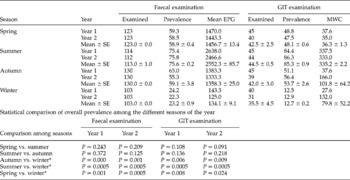
This study revealed definite seasonality of infection (P < 0.05) in goats over the period of 2 years, with greater infection in summer and lesser in winter (table 1). The mean maximum prevalence of GIN infection (faecal examination: 75.6 ± 0.2; GIT examination: 85.3 ± 0.9), faecal egg counts (2552.3 ± 85.7) and average worm burden (333.2 ± 2.2) occurred in the summer season, and they were lowest in winter (prevalence: faecal examination, 23.2 ± 0.9; GIT examination, 12.7 ± 0.20; faecal egg counts: 134.1 ± 9.1; and average worm burden: 79.8 ± 52.2) with significant differences between the seasons (P < 0.05). The prevalence among different seasons when compared statistically revealed significant differences: summer vs. winter (P = 0.0005), spring vs. winter (P < 0.05), autumn vs. winter (P < 0.05).
Seasonal dynamics of nematode infections in goats in the Kashmir valley from February 2005 to January 2007.

Year 1: February 2005 to January 2006; Year 2: February 2006 to January 2007.
MWC, mean worm count; EPG, eggs/gram of faeces; SE, standard error of the mean.
* These seasonal comparisons are statistically significant at P ≤ 0.05.
Following the winter period, a spring rise in prevalence and faecal egg counts and worm burdens occurred and the highest mean faecal egg counts and worm burdens were recorded in the summer seasons of both the years and dropped again to low levels in the autumn season. The rainy season, which started in spring and continued into early summer, made the environmental conditions more favourable for the development and survival of the pre-parasitic stages of nematodes and led to an increased availability of infective larvae in the rainy and post-rainy season. This resulted in higher prevalence and level of parasitism in summer and post-summer months; therefore, egg counts and parasite burdens also reached maximum levels in summer and autumn. In line with this seasonal trend of the GINs are the observations of various authors (Vlasoff et al., 2001; Khajuria & Kapoor, Reference Khajuria and Kapoor2003).
These findings of high prevalence (during spring and summer months) and low intensity of nematode infections (low worm burden and faecal egg counts) seem to agree closely with the agro-climatic conditions of the Kashmir valley and the animal-rearing practices. The valley has a temperate climate marked by well-defined seasonality, consisting of four different seasons with wide variation in temperature and other weather conditions that influence the occurrence of parasitic infections in domestic animals. During spring (March–May) and summer (June–August), maximum rainfall occurs – the ideal conditions for hatching and dissemination of L3 of GINs. During autumn (September–November), it is comparatively dry, and in winter (December–February) there is maximum precipitation in the form of snow – probable inhibitory conditions for the survival of intermediate stages of GINs on the grasslands and pastures. The great variation in temperature between the different seasons and a grazing break during winter disrupt the continuous cycle of nematode infection between host and pasture, as a result of which transmission of parasites does not occur throughout the year. The pastures are, therefore, contaminated during the grazing seasons only and this leads to a higher prevalence of infection during these months.
Magona & Musisi (Reference Magona and Musisi2002) also showed that epidemiological factors (grazing system, season and agro-climatic zone) have a significant influence on the risk of GIN infections in Ugandan goats and on the worm egg output under field conditions. Therefore, grazing management should be a primary tool to control internal nematode parasitism in goats, because they remain continuously susceptible to infective larvae of the nematodes from grasslands and other grazing lands.
The agro-ecological conditions that favour the development and transmission of free-living infective stages of GINs are inadequately studied in our valley. The ability of eggs and larvae to survive the environmental conditions depends on species of the parasite and on development stage of the parasite when adverse conditions occur. Furthermore, the animal husbandry practices are still primitive in Kashmir valley as compared to the developed nations of the world; farms are not modernized and periodic deworming is not performed because farmers are not provided with anthelmintics. Based on the findings in this study, three check points to control nematodoses in small ruminants in Kashmir valley should be: (1) deworming before the onset of winter; (2) deworming during the middle of the grazing months (July–August); and (3) deworming in early spring before the animals are sent to pastures for grazing.
To obtain a better understanding of the key environmental factors in the epidemiology of GIN infections of ruminants in Kashmir valley, detailed ecological investigations are recommended.
Influence of sex and age on the prevalence of infection
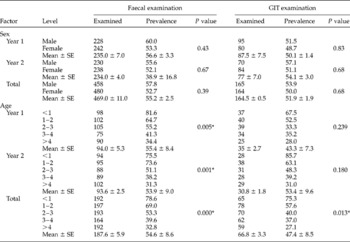
After arranging all the data, the sexwise observations did not reveal any significant difference in the GIN infection in goats (table 2). Differences in susceptibility to nematode infection between the sexes have been observed previously in ruminants by various workers. For example, Gorski et al. (Reference Gorski, Niznikowski, Strzelec, Popielarczyk, Gajewska and Wedrychowicz2004) reported that males were more infected with nematode species than females. However, Patel et al. (Reference Patel, Nauriyal, Hasnani and Gupta2001) and Shahiduzzaman et al. (Reference Shahiduzzaman, Alim, Rahman and Mondal2003) observed more infection in female goats than in males. Therefore, it seems that both sexes are equally susceptible to nematode infection and the differences reported could be the effect of management conditions of the host animals.
Nematode infections in goats relative to host sex and age in the Kashmir valley from February 2005 to January 2007.

SE, standard error of the mean; P values have been shown for each factor between different levels for 2 years and the values were considered significant * at P ≤ 0.05 level.
Observations revealed the highest prevalence in lower age groups (P ≥ 0.05) and it decreased with an increase in age (table 2). The more infection in lower age groups of animals is because of their low resistance or greater susceptibility. This low resistance was due to the fact that these animals had not been exposed earlier to the infection. For some months of the first year of their life they fed, grazed and browsed on grasslands – this was the first stage of their exposure to horizontal infection with the infective stages of nematodes. Gradually, as the exposure to nematode infection increases, the immune system of host animals builds up specifically against these nematode parasites and age resistance develops. Therefore, the low level of parasitism reported in the adult animals is due to the development of significant immunity with the course of time. These findings of the effect of host age on the prevalence of nematode infection also confirmed our earlier observations in sheep (Tariq et al., Reference Tariq, Chishti, Ahmad and Shawl2008) and the findings in goats reported by various other authors. For example, Magona & Musisi (Reference Magona and Musisi2002) reported young goats more infected with GINs than adult goats. Rizvi et al. (Reference Rizvi, Magrey and Zia1999) also reported highest nematode infection in young goats than in adults.
In conclusion, the present study reveals that there is a significant influence of season and host age on the prevalence of GIN infection in goats. These findings need to be taken into consideration while designing control strategies for the gastro-intestinal nematode infections of ruminants reared under the traditional husbandry system in temperate agro-climatic conditions in the Kashmir valley, as well as in similar climatic zones of other parts of the world.
Acknowledgements
It is a privilege to sincerely thank the owners of the herds and abattoirs for their help in sample collection. K.A.T. wishes to thank Mr Rafiq Ahmad of the Department of Sheep Husbandry, Kashmir, for his fruitful contributions.