


Introduction
Overestimation of threat (OET), in concert with other cognitive biases (such as inflated responsibility, heightened desire of control, intolerance of uncertainty, perfectionism), has been ascribed an important pathogenic role for the establishment of obsessive-compulsive disorder (OCD; Obsessive Compulsive Cognitions Working Group, 1997, 2001, 2003). As OET is a multi-faceted cognitive bias (e.g. overestimation for personal vs. general risk; different classes of threat), greater knowledge of its specific underpinnings may both improve our understanding of the construct and foster refined cognitive-behavioral treatment approaches. For example, it is not yet resolved whether OET in OCD arises from a tendency to overestimate the objective incidence probability of negative events, and if so, whether such a bias is especially pronounced for OCD-related concerns (Obsessive Compulsive Cognitions Working Group, 1997). To illustrate, excessive hand washing after touching handles in public transport could reflect an overestimation of the probability of contamination with a chronic disease or be rooted in general fearfulness. If overestimation of base rates was, in fact, the core problem, provision of corrective information may appease such concerns (Jones and Menzies, Reference Jones and Menzies1997, Reference Jones and Menzies2002).
Alternatively, patients may overestimate the personal vulnerability to experience a negative event. A plethora of studies has affirmed that healthy people, and even people from high-risk groups for certain diseases (e.g. a smoker and lung cancer), show a so-called “unrealistic optimism (UO) bias” (Fischhoff, Reference Fischhoff1975; Gold and Aucote, Reference Gold and Aucote2003; Weinstein, Reference Weinstein1982; Weinstein, Marcus and Moser, Reference Weinstein, Marcus and Moser2005), which denotes the illusion that positive (or negative) events are more (or less) likely to happen to oneself versus others. It might be that patients with OCD show an attenuation of this bias or may even display an inversion of UO and deem themselves as more vulnerable than others to experience or cause certain events (e.g. fear of infectious diseases because one lives near a hospital). Moreover, patients with OCD may have previously encountered certain negative incidents and for this reason overestimate the reoccurrence of such events (e.g. “a burnt child dreads the fire”). Finally, patients may appraise the consequences of negative events worse rather than overestimating the probability of such incidents.
Prior research on OET has mainly been conducted through questionnaires covering some of the aforementioned aspects of OET. For example, the “overestimation of threat” subscale of the Obsessive Beliefs Questionnaire (OBQ, Obsessive Compulsive Cognitions Working Group, 2001) encompasses items covering general overestimation of threat (e.g. “I believe that the world is a dangerous place”), overestimation of threat due to prior experiences (e.g. “Small things always seem to turn into big ones in my life”) as well as the overestimation of personal vulnerability (e.g. “Bad things are more likely to happen to me than to other people”). The UO paradigm is especially useful in shedding light on the latter aspect. It is thus not yet clear which particular components of OET are deviant in OCD. To shed light on this issue might explain why some studies found marked differences on OET scales relative to psychiatric controls (Steketee, Frost and Cohen, Reference Steketee, Frost and Cohen1998) while others did not (Obsessive Compulsive Cognitions Working Group, 2003; Tolin, Worhunsky and Maltby, Reference Tolin, Worhunsky and Maltby2006).
Although overestimation of the frequency or incidence probability of obsession-related concerns (e.g. likelihood one gets cancer, or causes a fire when leaving the oven unattended) is implied in some OCD models (Carr, Reference Carr1974; Jones and Menzies, Reference Jones and Menzies1997), evidence for this claim is at best equivocal. In a study by Riskind, Abreu, Strauss and Holt (Reference Riskind, Abreu, Strauss and Holt1997), healthy participants scoring high on a measure of contamination fears were found to display a significantly enhanced sense of vulnerability and probability of harm for different contamination scenarios (e.g. going into a dirty gas station bathroom). It is unclear from this study, however, if participants overestimate the general incidence probability of negative events or just their personal incidence probability. In two separate investigations (Woods, Frost and Steketee, Reference Woods, Frost and Steketee2002), OCD patients and students were asked to rate the probability and severity of future negative events and their anticipated coping ability. Interestingly, while both severity of negative consequences and decreased coping ability were correlated with OCD symptomatology in the OCD group, the probability rating was not. In contrast, OCD symptoms in the student sample were modestly correlated with all three parameters.
Evidence for unaffected base rates estimation of both OCD-related and OCD-unrelated events in OCD derives from another recent German study (Moritz and Pohl, Reference Moritz and Pohl2006). Thirty OCD patients and 39 healthy controls were asked to estimate the incidence frequency of several events that were washing-related (e.g. estimated number of rats per German inhabitant), checking-related (e.g. percentage of unsolved robberies in Germany), negative (e.g. number of bankruptcies in Germany in the year 2003), or neutral (number of universities in Germany). Participants were then asked to affectively appraise the correct statistics and to reproduce their initial estimates after a 2-hour delay. Groups did not differ regarding initial estimates and both samples displayed an equal bias towards underestimating the base rates for washing-related events. Importantly, in the case of large initial overestimations, healthy controls but not OCD patients expressed relief when confronted with the correct statistics. Finally, there was no evidence for a heightened maintenance of false beliefs in either group.
In view of the complexity of the OET construct, the present study aimed to clarify the specificity of different aspects of OET for OCD. While we hypothesized that OCD participants would not show deviant performance regarding objective risk assessment (see Moritz and Pohl, Reference Moritz and Pohl2006), it was assumed that OCD patients display a specific overestimation bias for their personal vulnerability to experience OCD-related events in a variant of the “unrealistic optimism” paradigm (e.g. Weinstein, Reference Weinstein1982; Weinstein et al., Reference Weinstein, Marcus and Moser2005).
The study was implemented via the internet. Although web-based research is still rare in psychopathological research, self-report responses obtained from internet studies are generally comparable in reliability and validity to paper-and-pencil administration when certain precautions are taken (Chinman, Young, Schell, Hassell and Mintz, Reference Chinman, Young, Schell, Hassell and Mintz2004; Coles, Cook and Blake, Reference Coles, Cook and Blake2007; Meyerson and Tryon, Reference Meyerson and Tryon2003; Ritter, Lorig, Laurent and Matthews, Reference Ritter, Lorig, Laurent and Matthews2004; Jones, Fernyhough, de-Wit and Meins, Reference Jones, Fernyhough, de-Wit and Meins2008; Riva, Teruzzi and Anolli, Reference Riva, Teruzzi and Anolli2003). Finally, the present study used multiple criteria to assure the reliability of the data and to safeguard against double entries (the utilized software did not allow more than one entry from the same computer).
Methods
Recruiting strategy
An invitation to participate in a scientific study was posted on several moderated German discussion forums on OCD and affective illnesses. Only those discussion forums for which membership was required and which were devoted to a particular disorder were selected. Forums with a broader scope regarding illness type (e.g. mental illness per se) were not included. Potential participants were informed in the advertisement that they had to estimate the probability of certain events, that it would take approximately 20–30 minutes to complete, and that the data would be handled confidentially and anonymously. A link directly connected the forum site to the internet questionnaire.
Questionnaire
The electronic questionnaire was implemented in German via the software package OPST®. This software did not allow more than one entry from the same computer. The web-pages had to be moved with forward buttons, whereby the survey only proceeded if all mandatory items were completed. On the first page, participants were welcomed and assured that the study would be anonymous. If questions arose, the participant could contact one of the authors (postal and e-mail addresses for the first author were displayed). On the following page, the participant was asked his or her age and gender.
General set-up of experimental blocks
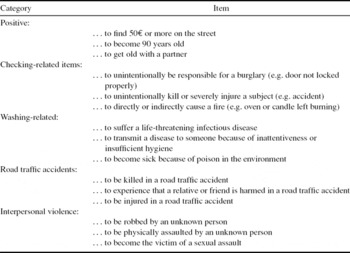
Following prior research on unrealistic optimism (e.g. Weinstein et al., Reference Weinstein, Marcus and Moser2005), five blocks (see next section) were then presented, all dealing with the same 15 events (presented in random order within each block). The order of the blocks followed recommendations in the literature (e.g. Weinstein et al., Reference Weinstein, Marcus and Moser2005). Items of each block represented five categories of events: positive, checking-related (OCD), washing-related (OCD), road traffic accident, and interpersonal violence. Classifications of items were not made explicit to participants. Items are displayed in Table 1 and were selected according to consensus decisions, which involved four clinical experts on OCD and anxiety disorders, respectively. To confirm the validity of item allocation, the responses for the 15 items of the first block were submitted to a factor analysis with varimax rotation (OCD patients only) confirming the a priori groupings. All items from the pre-specified category loaded strongest on the designated factor. A total of 72% of the variance was explained; the Kaiser-Maier-Olkin measure and Bartlett's test of sphericity yielded a satisfactory solution.
Description of items

Specific instructions for blocks 1–5
In block 1, participants were asked to estimate how likely it was that the depicted event would happen to themselves in the future (personal vulnerability). The aforementioned 15 events were presented to participants with the instruction to rate each item on a 7-point scale with “very unlikely” (=1) and “highly probable” (=7) as endpoints and “medium” (=4) as midpoint.
On block 2 (objective probability), the same events and response options were re-presented. This time the participant had to estimate the likelihood that an average person of the same sex and age would experience these events in the future.
On block 3 (comparative vulnerability), participants were asked to compare the relative probability that the event would occur in the future to oneself or an average person of the same age and sex. Responses had to be made on a 7-point Likert scale with “much less compared to others” (=1) and “much higher compared to others” (=7) as endpoints and “equally high” (=4) as midpoint.
On block 4 (appraisal), participants were requested to appraise the consequences that each event would cause. Responses had to be given on a 7-point Likert scale with “extremely negative” (=1) and “extremely positive” (=7) as endpoints and “neutral” (=4) as midpoint. It was emphasized that for methodological reasons negative and positive rating options were also available for events that would be clearly negative or positive for most people.
Finally, in block 5 (prior experience) participants had to indicate how often events had ever occurred to (a) themselves or (b) friends/relatives/acquaintances; rating options: never (=1), once (=2), several times (=3).
Psychopathology and treatment history
Subsequent questions related to mental health. Participants were asked if they had ever sought psychological help and, if so, to provide details: date of first contact; setting (counselling, outpatient treatment, inpatient treatment, other); frequency of in- or outpatient treatment. Details of further diagnoses (as determined by a clinician) were sought, whereby more than one diagnosis could be endorsed: depression, bipolar disorder, anxiety disorder, obsessive-compulsive disorder, posttraumatic stress disorder, schizophrenia, other, or no psychiatric diagnosis at all. Participants were then asked whether they took medication and, if so, to specify. Participants were also requested to indicate whether they had ever suffered from checking or washing compulsions. For each participant, the Maudsley Obsessive Compulsive Inventory (MOCI; Hodgson and Rachman, Reference Hodgson and Rachman1977) was administered. Participants were then asked if they had ever been victim or witness of an assault (e.g. sexual or physical attack) or a road traffic accident and if this event was accompanied by intensive fear, hopelessness, or horror. If both questions received a positive response, the Posttraumatic Diagnostic Scale (PDS; Foa, Cashman, Jaycox and Perry, Reference Foa, Cashman, Jaycox and Perry1997) was administered. If, however, one or two of the questions were answered negatively, the questionnaire automatically proceeded to the Beck Depression Inventory (BDI; Beck, Ward, Mendelson, Mock and Erbaugh, Reference Beck, Ward, Mendelson, Mock and Erbaugh1961), which was mandatory for all participants. On the page following the BDI, participants were asked if they had honestly answered all questions. Next, the participant had the opportunity of writing comments or leaving their e-mail address if they were interested in participating in future studies. On the final page, gratitude was expressed for participation and the postal and e-mail address of one of the authors (SM) was again given for questions.
Sample
In total, 151 participants completed the survey. Blind to results in blocks 1–5, participants were allocated to three groups following strict criteria as prevention of false-positive assignments was given priority over false-negative assignments. General exclusion criteria were premature termination of the survey and admittance of low honesty (last question). Participants were allocated to the OCD group (n = 53) if they (1) connected from OCD websites (these websites are solely devoted to OCD-related concerns and are therefore likely to be accessed by persons with OCD), (2) affirmed the presence of checking or washing compulsions (i.e. participants with other compulsions were thus excluded), (3) had a MOCI total score of at least 10 points, (4) reported a prior diagnosis of obsessive-compulsive disorder, and (5) denied presence of schizophrenia or bipolar disorder. Participants were allocated to the anxiety/affective control group (n = 23) if they (1) affirmed the presence of depression or an anxiety disorder, (2) denied presence of checking or washing compulsions, (3) denied presence of OCD, schizophrenia or bipolar disorder and (4) displayed a MOCI total score ≤15.
Participants were allocated to the healthy control group (n = 40) if they (1) denied the presence of any psychiatric illness, (2) denied the presence of checking or washing compulsions, (3) denied any contact with psychological or psychiatric institutions because of psychological problems, and (4) had a BDI score <6, and (5) displayed a MOCI total score ≤10.
Thirty-five participants were excluded blind to results for the following reasons: presence of schizophrenia and/or bipolar disorder according to self-report (n = 4), MOCI sores above 10 in the healthy control group (n = 3), MOCI scores above 15 in the psychiatric control group (n = 3), contact with psychological/psychiatric institutions but reported absence of psychiatric diagnoses (n = 15), no prior psychiatric diagnosis according to self-report but had BDI scores above 6 (n = 10).
Results
Background characteristics
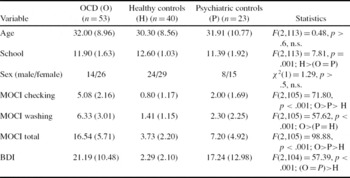
Samples did not differ regarding age and gender distribution as can be seen in Table 2. The psychiatric samples were indistinguishable on self-reported depression but displayed higher scores than healthy controls. School education was higher in controls relative to patients. Confirming the validity of group assignments, OCD participants obtained higher MOCI subscale scores than both comparison groups.
Sociodemographic background variables

Notes: BDI = Beck Depression Inventory; MOCI = Maudsley Obsessive Compulsive Inventory Post-hoc comparison: Fisher's LSD tests, p < .05.
Event probability for oneself versus other (indirect comparison; block 1 vs. 2)
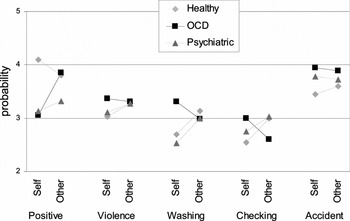
A three-way ANOVA with Event Type (positive, checking, washing, road traffic accident, interpersonal violence) and Locus (self vs. comparable other) as within-subject factor, Group as between-subject factor and Event Probability (1–7) as the dependent variable revealed significant main effects of Event Type, F(4,452) = 26.10, p < .001, and Locus, F(1,113) = 4.48, p = .05. Moreover, the interaction between Group and Event Type, F(8,452) = 3.28, p = .001, and the three-way interaction, F(8,452) = 7.65, p < .001, were significant. As can be seen in Figure 1, the effect of Event Type is explained by higher overall probabilities relating to positive events and road traffic accidents than other event types as indicated by a highly significant cubic contrast (event types were entered as steps in the order shown in Figure 1, p < .001). The effect of Locus can be attributed to an overall higher estimated event probability for others than oneself, which was qualified by the two-way and three-way interactions. Whereas healthy participants showed the expected unrealistic optimism bias (probability positive events: self > others; probability all negative events: others > self), OCD participants showed the reverse pattern (unrealistic pessimism), particularly for washing and checking related items. Except for road traffic accident events, psychiatric control participants estimated the probability of all events to be higher for others than for themselves (including positive events). Post-hoc one-way analyses with the difference score between Self or Others as dependent variable and Group as a between-subject factor showed that participants with OCD significantly differed from both control groups regarding checking and washing related events (post-hoc comparison, at least p < .03), while no group differences occurred for difference scores relating to interpersonal violence (p > .4) and road traffic accidents (p > .6). For positive items, the difference between healthy participants and OCD participants achieved significance (p = .02) and approached trend level relative to psychiatric control participants (p = .07).
Probability that an event will happen to oneself (block 1) or to a person with the same age and sex (block 2) from “very unlikely” (=1) to “highly probable” (=7) with “medium” (=4) as midpoint. Whereas healthy participants displayed an unrealistic optimism bias for negative events, OCD participants showed the opposite pattern. Regarding washing and checking-relevant events, differences to healthy and psychiatric controls achieved significance.

Direct comparison of relative risk (block 3)
A two-way ANOVA with Event Type as the within-subject factor, Group as the between-subject factor and Event Probability as the dependent variable revealed a significant main effect for Event Type, F(4,452) = 4.94, p = .001, but not for Group, F(2,113) = 0.79, p > .4. The effect of Event Type was further qualified by an interaction of Group X Event Type, F(4,452) = 5.15, p < .001. Post-hoc one-way ANOVAs revealed that the significant interaction was due to positive events, F(2,115) = 14.91, p < .001: healthy participants significantly more often judged that positive events would happen to themselves than both psychiatric groups (p < .001). For all other conditions, no significant effect emerged. Overall, healthy subjects displayed an unrealistic optimism bias: whereas they deemed all four negative event types to happen more frequently to others than to themselves (one-sample t-test against neutral score (=4); at least p < .005), they judged positive events to happen more frequently to themselves (p = .005). Except for checking-related items and road traffic accidents, OCD participants judged events as more likely to happen to others than themselves (at least p < .02). For psychiatric control participants all event types, except road traffic accidents, were judged as more likely to happen to others than themselves (at least p < .03).
Appraisal (block 4)
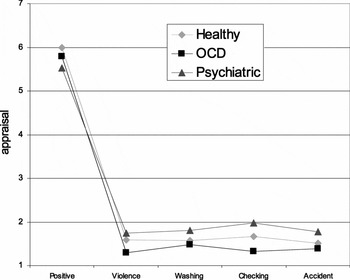
A two-way ANOVA with Event Type as within-subject factor, Group as between-subject factor and Appraisal (1 = highly negative – 7 = highly positive) as the dependent variable showed the expected effect of Event Type, F(4,452) = 841.26, p < .001 (see Figure 2). Positive events received higher appraisal scores than negative events (all comparisons p < .001), which in turn did not differ from each other as revealed by pairwise t-tests (p > .1). The significant effect of Group, F(2,113) = 3.25, p = .04, was further qualified by a significant interaction, F(8,452) = 2.25, p = .009. While healthy participants regarded the positive events as significantly more positive than the psychiatric control group (p = .03), OCD participants regarded the checking-related and interpersonal violence events as more negative than both control samples (checking: healthy: p = .02, anxiety: p < .001; interpersonal violence: healthy: p = .06, anxiety: p = .02). Road traffic accidents were rated as significantly more negative by OCD participants than psychiatric controls (p = .05).
Appraisal ratings ranged from “extremely negative” (=1) to “extremely positive” (=7). OCD participants regarded negative events as more negative than both control groups, especially for events relating to checking, interpersonal violence, and road traffic accidents. Healthy participants appraised positive events as more positive than psychiatric controls.

Experiences (block 5)
A three-way ANOVA with Event Type and Locus (oneself vs. friend/relative/acquaintance) as within-subject factor, Group as between-subject factor and Frequency of Event as dependent variable (1 = never, 2 = once, 3 = several times) revealed no effect involving Group. A significant effect of Event Type, F(4,452) = 60.23, p< .001, was noted. Road traffic accidents (M = 1.65), interpersonal violence (M = 1.56) and positive events (M = 1.53) had happened more often than checking (M = 1.19) and washing-related events (M = 1.18). This effect and the result that events had happened more often to others than oneself, F(1,113) = 265.22, p <.001, was further qualified by a significant interaction of Locus x Event Type, F(4,452) = 56.58, p <. 001: Although all event types had happened more frequently to others than oneself, the difference between self versus significant others for the OCD-related events was significantly smaller overall compared to the positive event and the road traffic accident event (p < .001).
Correlations
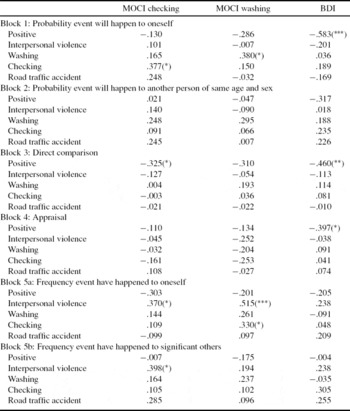
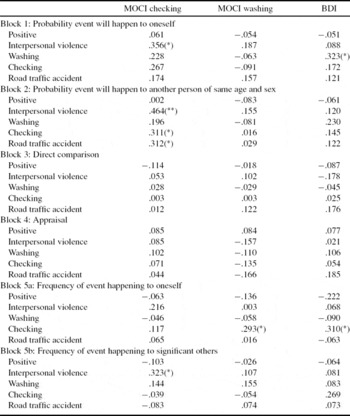
Tables 3 and 4 summarize the correlations between the BDI and the MOCI subscales “washing” and “checking” with the experimental variables separately for the OCD and healthy group. For exploratory purposes, we present uncorrected correlations, which will be interpreted with caution. In OCD patients, MOCI washing scores but not those for MOCI checking or the BDI were related to the perceived personal vulnerability to experience washing-related negative events in the future, while a corresponding pattern emerged for checking-related events. The BDI was associated with lower probability that positive events would happen to oneself and decreased appraisal for such events. All three psychometric scales (in the case of the MOCI washing subscale a trend was achieved) correlated with the direct comparison rating for positive events in block 1. No correlation emerged with overall probability estimates (block 2). OCD symptoms were highly correlated with prior experience of interpersonal violence for oneself and, in the case of the MOCI checking subscale, also with respect to friends/relatives and acquaintances.
Correlations between experimental variables and MOCI subscores washing, checking and BDI (OCD sample)

Notes: *p < .05, ** p < .01, *** p < .001.
Correlations between experimental variables and MOCI subscores washing, checking and BDI (healthy sample)

Notes: *p < .05, **p < .01.
In the healthy participants, MOCI checking scores were particularly related to overall probabilities and frequency for interpersonal violence (block 1, 2 and 5) but also to overall probabilities for checking-related events (block 2).
Discussion
In line with our prior investigation (Moritz and Pohl, Reference Moritz and Pohl2006), participants with obsessive-compulsive disorder (OCD) did not differ from healthy controls in their estimates of the objective likelihood of negative and OCD-related events. As hypothesized, OCD participants showed an inversion of the common unrealistic optimism bias (UO), particularly for OCD-related events. While healthy subjects and, to a lesser degree, psychiatric controls deemed their risk of experiencing negative and OCD-related events as less probable than another person of the same age and sex, OCD participants showed the opposite pattern. The difference for OCD-related items turned out to be significant relative to both control groups (block 1 vs. 2). This bias could also be labelled “unrealistic pessimism”. Interestingly, this bias may not be fully conscious to OCD participants: When asked to directly compare their individual risk relative to a comparable person (block 3), group differences were less clear. This is consistent with prior findings that the indirect comparison of self versus others may be a more sensitive indicator for unrealistic attitudes (Weinstein, Reference Weinstein1982; Weinstein et al., Reference Weinstein, Marcus and Moser2005). Weinstein et al. (Reference Weinstein, Marcus and Moser2005) write “indirect approaches for eliciting risk comparisons may reveal unrealistic optimism when questions that ask for direct self/other comparisons do not” (p. 56). Thus, questionnaire items measuring OET such as “Bad things are more likely to happen to me than to other people” may not be ideal to discriminate groups. To summarize, patients with OCD overestimate their personal rather than the objective threat (unrealistic pessimism) relative to other samples. This bias is not ubiquitous but pronounced for disorder-related items.
Furthermore, OCD participants appraised the consequences of negative and OCD-unrelated events as more grave than controls. Put differently, overestimation of the harm potential and consequences of certain events may be an additional source for concern in OCD participants (block 4). The results further support the claim that an overestimation of subjective threat is not rooted in prior encounters with fear-related events (i.e. “Misfortunes never come singly”), which could promote fear of encountering such events again (block 5). Participants with OCD symptoms did not report more prior encounters than controls on any of the five classes of events (including estimates for significant others).
Correlational analyses for OCD participants emphasized the hypothesis of an inflated sense of personal vulnerability as a core aspect of OET. A specific relationship emerged between the MOCI subscales for checking and washing and the personal probability to experience corresponding events in the future (block 1) but not with overall probability (block 2). This suggests that compulsions might serve a precautionary or compensatory purpose. BDI scores were primarily related to an under-appreciation of positive events and an underestimation for one's own likelihood of having such experiences. In the OCD sample, BDI scores did not correlate with any score relating to OCD behaviour. In accordance with prior results (Woods et al., Reference Woods, Frost and Steketee2002), MOCI checking subscores obtained in healthy participants were correlated with enhanced probability ratings for checking-related events in block 2. Interestingly, experiences of interpersonal violence were correlated with obsessive-compulsive behaviour in OCD participants, mirroring results from other clinical populations (Gamble et al., Reference Gamble, Talbot, Duberstein, Conner, Franus, Beckman and Conwell2006). Although we did not find between-group differences on the prevalence of interpersonal violence, a recent study pointed to a relationship between childhood trauma and OCD (Lochner et al., Reference Lochner, du Toit, Zungu-Dirwayi, Marais, van Kradenburg, Seedat, Niehaus and Stein2002).
Before turning to possible practical implications of our findings, limitations have to be noted. Although there is ample evidence that self-report responses in internet studies are comparable in reliability to paper-and-pencil administered studies (Chinman et al., Reference Chinman, Young, Schell, Hassell and Mintz2004; Coles et al., Reference Coles, Cook and Blake2007; Meyerson and Tryon, Reference Meyerson and Tryon2003; Ritter et al., Reference Ritter, Lorig, Laurent and Matthews2004), a major limitation of the study is the allocation of participants to diagnostic groups without external validation. However, as no personal benefit (such as a monetary incentive) was offered, deliberate false answers are unlikely. In addition, special effort was made to constitute the groups through applying multiple criteria. Moreover, internet-based studies have the advantage of including a more representative sample of patients, for example, people living in remote areas. In general, internet-based approaches have special potential for basic and psychotherapy research (see Lange, van de Ven and Schrieken, Reference Lange, van de Ven and Schrieken2003). However, the present findings await replication in a sample firmly characterized by expert-rating scales such as the SCID, the MINI, or the Y-BOCS. Further, the correlational analyses did not control for multiple comparisons and should therefore be regarded as preliminary. Although rated by experts as OCD-irrelevant, at least one item of the accident category may raise worry in a subgroup of OCD patients (“to experience that a relative or friend is harmed in a road traffic accident”).
We would like to suggest some possible therapeutic implications from these results. As stated above, overestimation of subjective threat in OCD may reflect different causes. From the present data, overestimation of individual versus objective risk and utter dramatization of negative consequences may be the most relevant ones. The unrealistic optimism paradigm in our view represents a useful tool in the treatment of OCD to uncover the specific underpinnings of a patient's worries. For example, revealing a patient's indirect (block 1 vs. 2) but not direct unrealistic pessimism may lead to a discussion of why the patient implicitly thinks he or she is at heightened risk, thus uncovering irrational (superstition) or pseudo-rational beliefs (e.g. on the commute to work the patient passes a hospital, which in his view makes him or her more prone to get infected). By studying the appraisal of consequences, patients may be encouraged to consider if they tend to “meet trouble half way”. For example, if a burglary takes place, the thief will probably not steal personal belonging such as photo albums, the insurance may cover most of the damage, and there is a chance that the police will catch the burglar and the goods.
While the present study was solely concerned with unrealistic optimism, future research should start to clarify possible interrelationships to other well-documented cognitive biases in OCD such as inflated responsibility, intolerance of uncertainty, and importance of thoughts (Obsessive Compulsive Cognitions Working Group, 2001, 2003, 2005). In our view, the relationship to responsibility (Salkovskis and Forrester, Reference Salkovskis, Forrester, Frost and Steketee2002) deserves particular attention, as typical responsibility-related concerns such as “I often believe I am responsible for things that other people don't think are my fault” may be directly linked to an enhanced subjective vulnerability (block 1 vs. 2) and dramatization of consequences (block 4): An imagined enhanced disposition to cause/experience negative events and the exaggeration of one's harm potential may easily induce an increased sense of responsibility for the well-being of others. There is already evidence that responsibility and over-estimation of threat, the latter construct being the starting point for our investigation into unrealistic optimism, are closely linked. Both constructs loaded on the same factor (labeled Responsibility/Threat Estimation) in a recent factor analytic study (Obsessive Compulsive Cognitions Working Group, 2005).
Although this and a prior study found no evidence for a general bias to overestimate the base rates of certain events, one should not dismiss this possibility for a minority of patients. For example, in a recent study (Moritz and Pohl, in preparation) healthy participants and OCD participants both tended to largely overestimate the likelihood of transmitting HIV. While unrealistic optimism may guard a healthy participant against exaggerated concerns even in light of an overestimation of threat, the lack thereof may trigger false beliefs. Provision of corrective information may prove beneficial in some cases, although we have reported earlier that corrective information appeases controls more than OCD patients (Moritz and Pohl, Reference Moritz and Pohl2006).
To conclude, patients with OCD seem to be especially prone to implicitly overestimate their personal risk and dramatize negative consequences while other possible contributors to OET are largely unaffected.



Comments
No Comments have been published for this article.