WRITING IN PRECOLUMBIAN AMERICA
Much has been written on the nature of writing, how it can be defined, where it can be found, and which societies possessed it, with much dissent among scholars as to how to define writing itself. From their knowledge of Old World writing, most scholars have seen writing as representing language alone; scholars from other parts of the world have stressed that writing could entail more information than simply language. The notion of writing as purely recording language has actually obstructed subtle differences in how New World writing might encode information. The present paper addresses such subtle differences in writing, with special emphasis on writing at the central Mexican metropolis of Teotihuacan. Here, scribes used speech scrolls to distinguish spatially between different kinds of information that were recorded in their writing system.
Teotihuacan flourished between a.d. 100 and 600. In its time it was the largest settlement in the New World, and one of the largest in the entire world (Evans and Berlo Reference Evans, Berlo and Berlo1992). In this, and in its art and architecture, Teotihuacan stands out among the many thriving civilizations of Mesoamerica. Much research on Teotihuacan has focused on the ideological significance of the pyramids or the Ciudadela complex (Heyden Reference Heyden1975; López Austin et al. Reference López Austin, Luján and Sugiyama1991; Sugiyama Reference Sugiyama and Berlo1992; Sugiyama and Cabrera Castro Reference Sugiyama and Castro2003). Equally important in ideological terms, however, are Teotihuacan's mural paintings, which, taken together, form the largest assemblage of such paintings in ancient Mesoamerica (Miller Reference Miller1973). They provide insights into religious and political ideologies among the ruling elite (Headrick Reference Headrick2007; Pasztory Reference Pasztory and Berlo1992, Reference Pasztory1997) and fill an important gap in understanding Teotihuacan ideology. Teotihuacan is especially known for the strong evidence for contact and cultural interchange with other Mesoamerican cultures, including possible “barrios” or other settlements within the city, related to the Zapotec (Spence Reference Spence and Berlo1992; Urcid Reference Urcid2003) and Maya (Millon Reference Millon1973; Taube Reference Taube and Braswell2003). Teotihuacan's influence outside of its core zone has also been much discussed in the Maya literature, most notably at Kaminaljuyu in the Guatemalan highlands (Braswell Reference Braswell and Braswell2003b; Kidder et al. Reference Kidder, Jennings and Shook1946:229–240), Monte Alban in Oaxaca (Flannery and Marcus Reference Flannery and Marcus2003:161–181), and in such Maya centers as Tikal and Copan (Martin and Grube Reference Martin and Grube2000; Stuart Reference Stuart, Carrasco, Jones and Sessions2000). While the nature and direction of these influences have been hotly debated (Braswell Reference Braswell and Braswell2003a; Marcus Reference Marcus and Braswell2003; Martin and Grube Reference Martin and Grube2000; Sharer Reference Sharer, Bell, Canuto and Sharer2004; Stuart Reference Stuart, Carrasco, Jones and Sessions2000), it is clear that Teotihuacan was able to integrate and influence people of many different cultures. The question arises: Why did such an important and influential civilization, in contact with the Classic Maya who possessed a highly sophisticated logosyllabic writing system, never develop a writing system of their own? Much, of course, hinges on our definition of “writing.” But even if scholars agree on what writing is, they differ as to whether Teotihuacan possessed a writing system. In numerous publications, scholars have tried to show that Teotihuacan possessed a writing system (Cabrera Castro Reference Cabrera Castro and de la Fuente1996d; Millon Reference Millon1973; Taube Reference Taube2000), while other scholars see “less evidence for true writing in Teotihuacan art” (Marcus Reference Marcus1992:17). Both of these groups of scholars define writing as a representation of spoken language (e.g., Marcus Reference Marcus1992:17; Taube Reference Taube2000:3), but I favor a different path: that writing should not be rigidly defined outside of any given cultural context, but instead should be understood as a special, culturally specific device for communication.
THEORETICAL APPROACHES TO WRITING
Most theoretical discussions view writing as the graphical representation of language. One of the earliest twentieth century approaches to writing is that of Ferdinand de Saussure (1955[1920]). Saussure proposed that there generally are only two types of writing system. An ideographic writing system inscribes ideas with signs, without reference to the underlying sound; by contrast, a phonetic system represents directly the sounds of language (Saussure Reference de Saussure1955 [1920]:47). For Saussure (Reference de Saussure1955 [1920]:47), the only purpose of (real) writing is to represent speech. Most later scholars are also of the opinion that ‘real’ writing directly represents language (Coulmas Reference Coulmas1996:555; DeFrancis Reference DeFrancis1989:5; Diringer Reference Diringer1962:13; Sampson Reference Sampson1985:12). Even though most of these scholars work in Old World cultures and cannot be held accountable if their theory fails to explain New World systems, most New World specialists tend also to explain writing as the representation of speech (Coe Reference Coe1992:13; Marcus Reference Marcus1992:17; Taube Reference Taube2000:3). Implicit in most such definitions is a scheme that evolved in the evolutionary sciences of the nineteenth century (Boone Reference Boone, Boone and Mignolo1994:6). In this scheme, the less advanced writing systems consist of pictures that express ideas; such simple systems slowly develop into the more advanced writing systems, which record speech through abstract geometric symbols. In his chart of the evolution of writing systems, DeFrancis (Reference DeFrancis1989:58), for example, makes it clear that pictures and writing are distinct modes of communication, with picture-based systems evolving into true writing systems. This theory has been called into serious question by Denise Schmandt-Besserat (Reference Schmandt-Besserat1996:15–25), who showed that Mesopotamian writing may have developed out of geometrical signs impressed with tokens into clay vessels, indicating ownership of objects associated with these tokens. As Diringer (Reference Diringer1962:29) states, “it is probably fruitless to pursue at any length the question as to whether or not geometrical embryo writing developed out of representational drawing. […] The element of geometricism is present from the very beginning.” We can thus dismiss the simplistic evolutionary scheme that sees pictures evolving into geometric forms, in a process by which the representation of ideas was replaced by the representation of spoken language. With it we can also discard the Western presumption of what “pictures” look like as opposed to “letters”, and how much a sign has to be stripped of pictorial content so as to count as true writing.
In his extensive treatment of writing, Ignace Gelb (Reference Gelb1963:12) begins with a more open definition, stating that writing is “a system of human intercommunication by means of conventional visible marks” [emphasis in original]. Although this initial definition seems to be very inclusive, Gelb too had a restricted view of writing. Following Gelb, Geoffrey Sampson (Reference Sampson1985:26) defines writing as a means of “communicat[ing] relatively specific ideas by means of permanent, visible marks.” He considers conventionality to be a defining aspect of writing. Sampson, like Gelb (Reference Gelb1963:11) before him, further distinguishes between semasiographic writing (representing ideas) and glottographic writing (representing language). Following Sampson, specialists in American writing systems have developed more inclusive definitions of writing, notably including so-called pictures in the concept of writing. Elizabeth Hill Boone (Reference Boone, Boone and Mignolo1994:15) thus adopts Sampson's definition of writing as the “communication of relatively specific ideas in a conventional manner by means of permanent, visible marks” [emphasis in original]. She goes on to argue that semasiographic writing is independent from, but on the same logical level as, glottographic writing; indeed, she says, semasiographic writing is today on the rise, far from being a “dead end” as DeFrancis supposed.
In the present paper a different approach to writing systems is used that departs from all earlier approaches that distinguish between pictures and writing. Roy Harris's (1995) “integrational theory of writing” explicitly tries to move away from the Saussurean speech circle, in which written communication consists of graphic interchanges between speaker A and speaker B. Harris (Reference Harris1995:4) argues instead for “the contextualized integration of human activities by means of signs.” These activities are constrained and contextualized by biomechanical, macrosocial, and circumstantial factors, which can include a variety of contexts, such as the surface on which writing is produced, the instruments of production, the social background of the human being producing written signs, the general and specific context of communication settings, and so on. Harris explains writing as a versatile human capacity of sign-making. His general theory allows all relevant forms of writing to be systematically analyzed, including glottographic, mathematical, and musical writing. Harris's theory avoids the a priori classification of notational systems as non-writing, which is especially important in the case of ancient sign systems. Little is known about their creation and too much of the interpreter's ethnocentric cognitive schemas can color interpretation (Harris Reference Harris1995:58). The early twentieth-century misinterpretation of Classic Maya hieroglyphs as simple pictures is a case in point.
In his treatment of writing, Harris (Reference Harris1995:7) elaborates on several aspects of writing “simply as illustrations of how some major features of writing can be dealt with on an integrational basis.” One of these is the focus of this article. Harris (Reference Harris1995:121) emphasizes that all written texts need “a graphic space in which to be situated for purposes of reading.” This is self explanatory, but he goes on to underscore that “the underlying formal substratum of writing is not visual but spatial” (Harris Reference Harris1995:45), leading him to draw a distinction between pictures and writing “not at the level of the individual graphic units, but in terms of the way the units are deployed in graphic space” (1995:48). Writing and non-writing can occur within the same graphic space (Harris Reference Harris1995:121), such as figures and associated captions often attached underneath or above the respective figure. A writer can thus use space to distinguish between, for example, different forms of writing, or between writing and painting.
In this article the “spatial approach” to a theory of writing is tested against a writing system that still eludes decipherment or even the most basic understanding. I contend that the Teotihuacan writing system provides an instructive exponent of the use of graphic space to distinguish between different forms of writing that do not exist in western conceptions and are thus often not labeled as “writing.” To explore this, I use the distinction between semasiographic and glottographic writing as developed by Sampson (Reference Sampson1985:26; see above). I attempt to show that ancient Teotihuacanos consciously distinguished between semasiographic and glottographic writing. Scribes at Teotihuacan, I argue, used speech scrolls as a graphic space in which to distinguish between semasiographic and glottographic writing. While speech scrolls could be filled or infixed only with signs representing semasiographic writing, the outside of scrolls could be “decorated” or affixed with both glottographic and semasiographic writing, depending upon the context of each scroll. It is hoped that the method employed here will contribute to a more refined understanding of the yet poorly understood writing system of Teotihuacan, which has only recently become the object of more intensive study (Langley Reference Langley1986, Reference Langley1991, Reference Langley and Berlo1992, Reference Langley, Berrin and Pasztory1994; Taube Reference Taube2000).
SPEECH SCROLLS IN MESOAMERICA
In all Mesoamerican cultures speech is of utmost importance since it is the “oratorical privilege of the lord” (Houston and Taube Reference Houston and Taube2000:273), as reflected in most titles of Mesoamerican kings. Classic Maya rulers are ajaw “lords,” a word that has been theorized to derive from *aj-aw “the shouter” (Houston and Stuart Reference Houston and Stuart1996:295). The Aztec ruler is called tlatoani, which translates from Classical Nahuatl, “to speak, to issue proclamations and commands” (Karttunen Reference Karttunen1983:266). Most Mesoamerican peoples used speech scrolls to depict spoken messages (Houston and Taube Reference Houston and Taube2000:Figure 9). This is most clearly indicated by hieroglyphic texts appended to scrolls representing the spoken word, as among the Classic period Zapotec (Figure 1a) and Maya (Figure 1b) (Grube Reference Grube, Sáenz, Hoffmann, König and Prümers1998:545; Urcid Reference Urcid1992:253; Whittaker Reference Whittaker, Bricker and Bricker1992:12). In the Late Postclassic Bodley manuscript (Figure 1c) and among the Aztec (Figure 1d) scrolls before the mouth may represent speech. Speech scrolls can thus be used to represent glottographic writing.
Speech scrolls throughout Mesoamerica: (a) Lápida de Santiago Atitlan (Taube Reference Taube2000:Figure 25b); (b) Ceramic Vessel, K2914 (Taube Reference Taube2000:Figure 25a); (c) Codex Bodley, Page 29 (drawing by the author); (d) Codex Mendoza, Folio 5v (Prem Reference Prem, Bricker and Bricker1992:Figure 5–1).

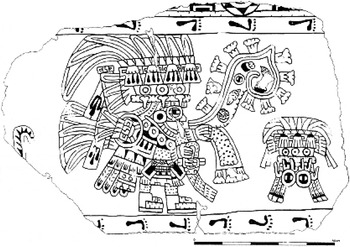
Speech scrolls have, however, long been interpreted not only as representations of speech, but as instances of a more widespread Mesoamerican concept of breath. Breath was encoded iconographically in many Mesoamerican cultures either by beads or flowerlike signs which emerge from the nose (Houston and Taube Reference Houston and Taube2000:265), or by scrolls emanating from the mouth (Houston and Taube Reference Houston and Taube2000:273–281). Furthermore, many scrolls at Teotihuacan are thought to have “an obvious and general reference to water and fertility” (Pasztory Reference Pasztory1988:192–193). The notion of fertility is of importance for this article and shall be explained. As normally understood, fertility is a measure of reproduction, mostly of human beings (Haenn and Wilk Reference Haenn and Wilk2006), but can also be used to describe reproduction of animals and conditions of agriculture, where it implies a capacity to yield a large number of crops. At ancient Teotihuacan, as among most Mesoamerican peoples, fertility is more a concept of vital forces that energize humans, animals, and objects, similar to the ch'ulel notion among the Tzotzil Maya. The concept of ch'ulel is described in ethnography by Evon Vogt (Reference Vogt1969:369) as the “inner, personal soul, located in the heart of each person; it is also found in the blood.” Ch'ulel is the Tzotzil variant of the Classic Maya term k'uhul “holy” (see Houston and Stuart Reference Houston and Stuart1996:292; see also Freidel et al. Reference Freidel, Schele and Parker1993:177, who record it as k'ul), referring to a power that inhabits the blood and activates people and a variety of objects. Of course, the significance of hearts and blood in Mesoamerican cultures is widely known. Among the Classic Maya hearts were, for example, the “most exquisite food for deities” (Houston et al. Reference Houston, Stuart and Taube2006:23). Among the Aztec a vital force, the “teyolia contained in the human heart” (Carrasco Reference Carrasco1990:65) could become deified. The notion of ch'ulel is part of the concept of fertility in Mesoamerica, a force that energizes living beings and objects alike. This aspect of fertility can be seen on a ceramic vessel from Teotihuacan's Tlamimilolpa phase (Figure 2), where a striding figure is depicted holding a sacrificial knife in his right hand. On the knife is a pierced, possibly sacrificed, heart from which three streams of blood flow. A scroll emerges from the leftmost stream. Berrin and Pasztory (Reference Berrin and Pasztory1994:252) interpret this scroll as denoting “a prayer,” yet, perhaps, considering its issuance from a heart and the widespread Mesoamerican connection of hearts to vital forces, the scroll may express something like ch'ulel.Footnote 1
Tlamimilolpa phase ceramic vessel from Teotihuacan with striding figure (after Séjourné 1966:Figure 75). Drawing by the author.

As Evon Vogt (Reference Vogt1969:371) observes, the ch'ulel essence is able to interact with other people and with material objects. The ability of this essence to interact and communicate might be depicted by the speech scroll shown in Figure 2 and other speech scrolls at Teotihuacan. This is not to say that a literal message is transmitted in these drawings, but rather that certain ideas may be communicated, perhaps only the essence that lies within the blood and heart. Accordingly, speech scrolls were able to transmit not only linguistic messages, but ideas and concepts. The transmission of ideas like that of ch'ulel is evidence of semasiographic writing in the context of speech scrolls.
In addition, speech scrolls are often used to organize graphic space and to distinguish between forms of non-writing and writing. The Classic Maya provide excellent test-cases for the organization of space through speech scrolls. Many speech scrolls lead directly from the mouth of iconographic figures to written texts (see Figure 1b) (Grube Reference Grube, Sáenz, Hoffmann, König and Prümers1998:Figure 2). Here, a distinction between the picture of a person and the written message is made available through the speech scroll that organizes a graphic space according to a precise linguistic and iconographic message. Speech scrolls are therefore multi-functional. They carry linguistic and semantic information and, at the same time, are used to organize forms of glottographic and semasiographic writing in space. The thesis here is that speech scrolls at ancient Teotihuacan fulfilled all these roles. They were a major organizer of space and spatially separated glottographic and semasiographic forms of writing.
TYPES OF SPEECH SCROLLS AT TEOTIHUACAN
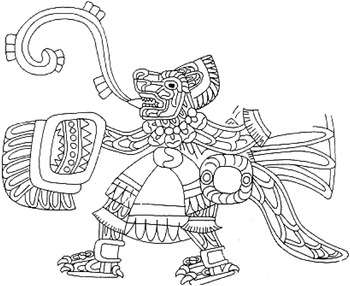
Most common at Teotihuacan are the simple types of scrolls that are composed of left- or right-curved scrolls. These consist of two or three painted lines, often with pairs or triplets of “bumps” outside the scroll (see Figure 3). These scrolls appear with many kinds of figures, including figures that may be anthropomorphic (often called “priests”) (e.g., Atetelco [Lombardo de Ruiz Reference Lombardo de Ruiz and de la Fuente1996:36]) or zoomorphic (e.g., Zacuala, Portico 1 [Lombardo de Ruiz Reference Lombardo de Ruiz and de la Fuente1996:18]).
Simple scroll (Zacuala, Portico 1; Lombardo de Ruiz Reference Lombardo de Ruiz and de la Fuente1996:Figure 29).

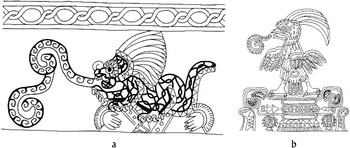
There are two variations of scrolls associated with the symbol for “water.” The first of these comprises many small water scrolls inside a speech scroll (Figure 4a). This scroll appears only in conjunction with so-called priests (see Techinantitla North Mural, Person 2 [Cabrera Castro Reference Cabrera Castro and de la Fuente1996a:132]) and “net-jaguars” (see Compound of the Jaguars, Room 10, Mural 2 [Fuente Reference Fuente and de la Fuente1996a:121]). A rare variation of the water scroll (Figure 4b) exhibits water scrolls at the sides, as can be seen in Atetelco in the North Palace (Cabrera Castro Reference Cabrera Castro and de la Fuente1996b:240). This type of scroll is associated with birds only. Neither of these variations is associated with bumps or any other, outside elements.
(a) Speech scroll with water signs (Compound of the Jaguars, Room 10, Mural 2 [Fuente Reference Fuente and de la Fuente1996a:121]); (b) speech scroll with water signs outside (Atetelco in the North Palace [Cabrera Castro Reference Cabrera Castro and de la Fuente1996b:240]).

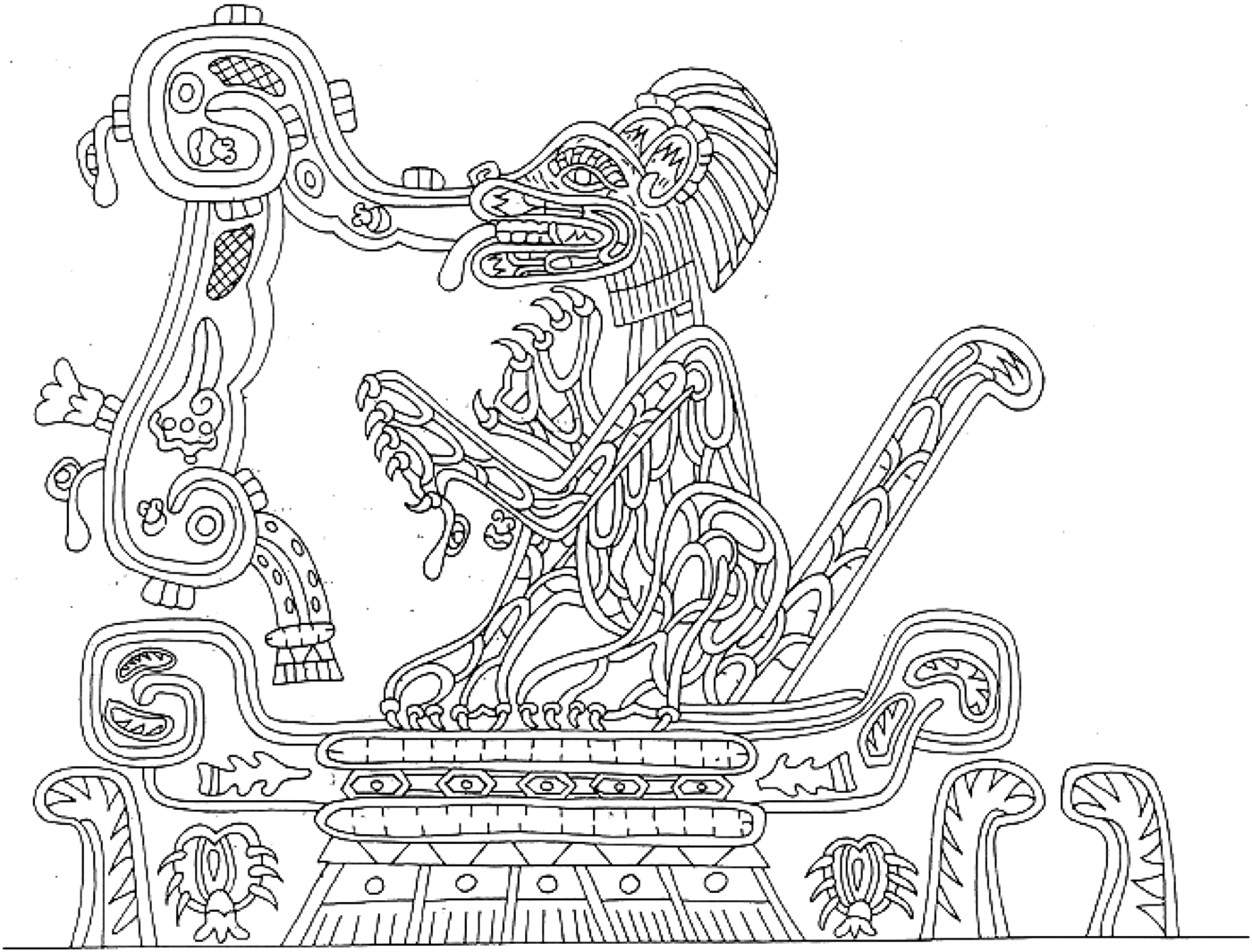
The most complex type of speech scroll are double scrolls that are filled either with dots or with elements; these also exhibit bumps, flowery elements, and other signs attached to the outside. These complex scrolls appear most often with so-called priests, identified as such by their bags (see, for example, Teopancaxco, Room 1, Mural 1 [Cabrera Castro Reference Cabrera Castro and de la Fuente1996a:136]), and in only a single instance they do occur with a coyote- or wolf-like figure (Figure 5) (Atetelco, North Plaza, Portal 1, Mural 1 & 4 [Cabrera Castro Reference Cabrera Castro and de la Fuente1996b:248]).
Complex speech scroll (Atetelco, North Plaza, Portal 1, Mural 1 & 4 [Cabrera Castro Reference Cabrera Castro and de la Fuente1996b:248]).

THE SIGNS
The signs associated with speech scrolls are the focus of this article. Signs at Teotihuacan are generally defined as “small conventional depictions of natural objects” (Langley Reference Langley, Berrin and Pasztory1994:132) and they must—following Langley (Reference Langley1986:12, Reference Langley1991:286)—fulfill three criteria: they must be compact and self-contained, divorced from the natural context, and form part of a visual pattern compatible with the transmission of verbal messages. George Kubler (Reference Kubler1967:6f) pioneered the study of Teotihuacan signs by identifying sign clusters for actions, nouns, adjectives, and other meanings. A few years later Clara Millon, in a seminal 1973 article, was able to identify certain signs that specify either individuals or social ranks within Teotihuacan society. The donation of the Wagner murals to the San Francisco Fine Arts Museum [now the de Young]) enabled scholars to identify a large number of signs associated with flowering trees, probably representing plant or place names (Berrin Reference Berrin1988:137–161). George Cowgill (Reference Cowgill and Berlo1992:236–240) compared the signs of the flowering trees of Techinantitla to liturgical Aztec texts of the sixteenth century, finding that descriptions from these texts exactly matched the iconographic composition of the glyphs at Techinantitla. Some years later, Rubén Cabrera Castro (Reference Cabrera Castro and de la Fuente1996d) published his work on the signs at the La Ventilla complex; he found that the 42 signs on the floor of the compound likely constituted place or lineage names. Langley (Reference Langley1986, Reference Langley1991, Reference Langley and Berlo1992, Reference Langley, Berrin and Pasztory1994) investigated the signs and sign clusters at Teotihuacan in all the relevant contexts, establishing the distinction of “‘glyphic signs’ and other motifs used symbolically” (Langley Reference Langley1986:5) and thereby investigating the function of the signs as parts of symbolic communication. Drawing on these studies, Taube (Reference Taube2000) published an extensive study of writing at Teotihuacan, with the conclusion that the city had a complex writing system which was the precursor to the later Aztec writing system (Taube Reference Taube2000:2).
Here, I adopt a narrower focus on the signs associated with speech scrolls, a procedure that facilitates the definition of a sign. I follow Langley's definition of signs as “pictorially…out of place, having no obvious naturalistic or decorative functions, but serving rather as symbolic supplements to the imagery” (1994:132). More specifically, signs associated with speech scrolls can be viewed as supplemental when they are either directly attached to or placed inside of speech scrolls, or in closer proximity to scrolls than to any other major iconographic features. This definition fulfills all of Langley's criteria (1986:12, 1991:286), except that the status of speech scroll signs as visual patterns compatible with language is left unresolved. This, however, is not a problem to be addressed by pure iconographic analysis but rather by comparison with other textual references.
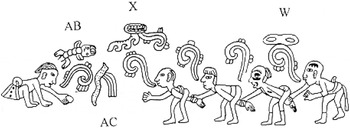
A number of scholars have drawn a distinction between affixes and infixes of speech scrolls by investigating the signs associated with such scrolls. The first to do so was Thomas Barthel (Reference Barthel1982:4, Reference Barthel1987:11), who proposed that affixes refer to the recipients of chants and offerings, while infixes refer to precious gifts and the offerings themselves. Later scholars (Langley Reference Langley1986:125; Pasztory Reference Pasztory1988:189) have continued to distinguish between signs inside and outside of scrolls, but generally avoid attaching any meaning to that distinction. Two of the aforementioned types of speech scrolls, the simple scroll and the complex double scrolls, are associated with a variety of these infixes and affixes. The signs affixed to simple scrolls include stylized headdresses, eyes, flints, flowers, and bivalve shells (Techinantitla, East Room, Mural 4 [Cabrera Castro Reference Cabrera Castro and de la Fuente1996a:136]), possibly cacao beans (Techinantitla, East Mural, Person 1 [Cabrera Castro Reference Cabrera Castro and de la Fuente1996a:131]), as well as bones, legs, circles, and teeth (Tepantitla, Mural of Tlalocan Paradise [Angulo Reference Angulo and de la Fuente1996:153]), and birds and faces (Tepantitla, Northeast Mural [Uriarte Reference Uriarte and de la Fuente1996:228]) (see Figure 6).
Simple scrolls with affixes (Tepantitla, Mural of Tlalocan Paradise [Taube Reference Taube2000:Figure 24a]). Sign captions by the author.

A commonly recurring affix is the flower (Figure 7). Flowers on volutes can be associated with both anthropomorphic figures (Angulo Reference Angulo and de la Fuente1996:136) and, at Techinantitla, zoomorphic figures (Lombardo de Ruiz Reference Lombardo de Ruiz and de la Fuente1996:Figure 115). Flowers themselves can emerge from the mouths of birds, as seen in a mural from Techinantitla, today on display at the Museo Amparo in Puebla (García Moll Reference García Moll and de la Fuente1996:438). It is thus generally concluded that flowers represent beautiful songs, such as those of birds (Houston and Taube Reference Houston and Taube2000:270), and that they also have that meaning when affixed to scrolls. A major distinction between the simple and complex scrolls is that the latter can have infixes as well as affixes. These can either be simple dots (Teopancaxco, Room 1, Mural 1 [Cabrera Castro Reference Cabrera Castro and de la Fuente1996a:137]), or more complex signs such as hands, animal heads, plants (Tepantitla, Room 2, Mural 3 [Fuente Reference Fuente and de la Fuente1996c:152]), shells, stones, bivalve shells (Atetelco, North Plaza, Portico1, Murals 1 and 4 [Cabrera Castro Reference Cabrera Castro and de la Fuente1996b:248]), flints, eyes, unidentifiable circles (Techinantitla [Lombardo Ruiz 1996:43]), and flowers and faces (Lombardo Ruiz 1996:44).
Anthropomorphic figure with flower signs affixed to complex speech scroll. Wagner Mural, Techinantitla (C. Millon Reference Millon and Berrin1988:Figure V.3).

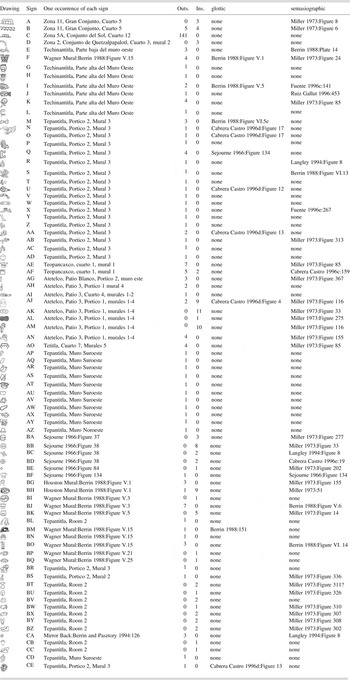
In the remainder of this paper, I analyze all of the signs associated with speech scrolls, as well as compare them to other contexts in Teotihuacan iconography where they appear. Table 1 lists the 84 signs associated with 214 speech scrolls in Teotihuacan, analyzed in this study. The leftmost column contains drawings of the signs that are labeled in the next column. Column 3 refers to the occurrence of one example of the signs. Columns 4 and 5 indicate how many times the respective signs occur as infixes or affixes of speech scrolls. The last two columns list occurrences of the respective signs not associated with speech scrolls and distinguish whether these occurrences are of a glottographic or semasiographic nature.
Infixes and affixes of speech scrolls and their occurrence in other glottographic and semasiographic contexts (all drawings by the author)

Several points of caution should be mentioned in connection with Table 1. The most important is the preliminary and fragmentary nature of the sample. Although all available examples of speech scrolls and signs have been included in the present analysis, it is unknown at what percentage this sample of signs reflects the overall population. For this reason, any statistical analysis of signs must be conducted with care (Langley Reference Langley, Berrin and Pasztory1994:133). A second concern pertains to the identification of single signs. It is uncertain whether each sign entity, as listed in Table 1, constitutes the smallest signifying element, or whether the elements in the table are themselves composed of other signifying elements. While certain elements, like the hand sign (CA), the faces (AA, BR, BU, BX), some plant elements (K, E), and a zoomorphic figure (AB), clearly cannot be subdivided, the case is less secure with other elements, such as some flower elements (AE, AH, AO), and especially the signs G and H, which seem to be a conflation of parts of the headdress sign F with the shell sign AJ. Methodologically, it is very difficult to determine which signs are to be interpreted as complete, and which signs should be subdivided into smaller signifying units. An interpretative difficulty arises, for example, in the case of sign G, which occurs only as a speech scroll affix, while one of its obvious constitutive elements (AJ) occurs as an infix. This is in fact true of all potentially divisible signs; they occur as affixes, but are composed of elements that themselves occur at least one time as affixes, and never exclusively as infixes (signs F, G, J, X). Langley (Reference Langley1986) goes a long way toward identifying these signs, and his work should be consulted for further study of the smallest meaningful signs in Teotihuacan notation.
Despite interpretive difficulties, the database of signs associated with speech scrolls is as complete as it can be at this time. The systematic comparison of these signs with signs in other contexts yields important and interesting hints to the significance of the signs associated with scrolls. One of the most productive results is that the sets of speech scroll affixes and infixes are almost mutually exclusive, suggesting different functions for those signs. There are only a few exceptions to this rule: signs B, AF, AJ, and BH. As mentioned above, sign B is a general sign for water and scrolls associated with sign B form a special type, never being modified by any other sign. More difficult to explain are signs AF and AJ, which are analyzed below. In the following section, speech scroll affixes and infixes are systematically compared with the occurrence of these signs in other contexts, also tabulated in Table 1.
COMPARISON OF SPEECH SCROLL MODIFIERS WITH SIGNS IN GLOTTOGRAPHIC AND SEMASIOGRAPHIC CONTEXTS
At this point it is appropriate to compare the signs identified as affixes and infixes of speech scrolls with signs that occur in other contexts, where they do indeed appear to represent glottographic or semasiographic writing. Before this can be accomplished, however, we must define what is meant by glottographic and semasiographic writing at Teotihuacan.
The presence of glottographic writing at Teotihuacan may be a matter of dispute, but in this article, personal names and place names are accepted as secure examples of glottographic writing. It is generally agreed that personal and place names express words in a spoken language and are not merely semasiographic signs (Bauer Reference Bauer, Eichler, Gerold, Loffer, Steger and Zgusta1995:15; Harris Reference Harris1995:80–83). Mixtec personal names in the Codex Muro (Smith Reference Smith and Benson1973b) provide a good example. The personal names in Mixtec pictorial signs might be superficially interpreted as simple pictures. The Colonial transcriptions in the Latin script, however, indicate unambiguously that the pictorial signs function as names, having clear and systematic correlates in spoken language (Smith Reference Smith and Benson1973b:47–48). It is also well known that Aztec place signs were composed of highly phonetic elements (Nicholson Reference Nicholson and Benson1973:8–36; Prem Reference Prem, Bricker and Bricker1992:60), having clear cognates in Classical Nahuatl. It can therefore be stated that, in most Mesoamerican cultures, personal and place names represent glottographic writing, and it does not seem an interpretative stretch to assume such a function at Teotihuacan as well. The existence of personal and place names at Teotihuacan is established rather securely. Clara Millon (Reference Millon1973) first identified personal names in Teotihuacan iconography. Another example of glottographic writing at Teotihuacan has been mentioned by Pasztory (Reference Pasztory1976:186–187), since she refers to signs at Tepantitla as “toponymics,” place names. These glyphic signs occur on the base of the trunks of plants and trees (see also Berrin Reference Berrin1988:148–151). A further example is the 42 glyphic signs of the Plaza de los Glifos at La Ventilla (Cabrera Castro Reference Cabrera Castro and de la Fuente1996d). The linear, perhaps codical (Cabrera Castro Reference Cabrera Castro and de la Fuente1996d:427), arrangement of these signs is highly suggestive of glottographic writing, probably representing the names of either places or lineages (Cabrera Castro Reference Cabrera Castro and de la Fuente1996d:426–427; Taube Reference Taube2000:34–36).
Signs that cannot be associated with these glottographic contexts are here relegated to semasiographic writing. While not specifically linguistically coded, these semasiographic signs nevertheless transmit messages and ideas, much like the ch'ulel concept explained above. Because they refer to ideas, semasiographic signs can be repeated infinitively because they always make reference to the same idea. This, however, is not true for glottographic signs, where an infinite repetition of signs is senseless.
SPEECH SCROLL AFFIXES
The first scholar to compare signs associated with speech scrolls with signs in other contexts was Taube (Reference Taube2000). In his chapter “Texts in Speech Scrolls,” he imprecisely refers to the elements inside the scrolls, while the elements he discusses all appear on the outside of the scrolls, as affixes (Taube Reference Taube2000:30–33). The comparative analysis of the affixes of speech scrolls with signs in other contexts leads to the conclusion that most affixes seem to represent glottographic writing.
As Taube (Reference Taube2000:30) mentions, some of the speech scroll affixes from the murals of Tepantitla are identical to signs found in the Plaza de los Glifos in La Ventilla (Cabrera Castro Reference Cabrera Castro and de la Fuente1996d). Among these are signs N and O (a jaguar face devouring a heart), sign AA (head of an old man), sign U (bird beak), and sign M (a bone), which also occurs at Techinantitla as a possible toponym (Berrin Reference Berrin1988:151). Since the signs at La Ventilla are thought largely to represent either family names or place names (Cabrera Castro Reference Cabrera Castro and de la Fuente1996d:427), they provide an important link between speech scroll affixes and glottographic writing. Sign I (feathered serpent eye) occurs in a clear glottographic writing context as a personal name (Berrin Reference Berrin1988:Figure V.5). However, this iconic rendition of the eye of the feathered serpent might also be used both semasiographically as a reference to the feathered serpent (Fuente Reference Fuente and de la Fuente1996c:141), and linguistically as referring pars pro toto to the spoken referent of the feathered serpent. Another link to glottographic writing is provided by calendrical and numerical signs. Sign Q includes all forms of dots and bars which in all Mesoamerican cultures had linguistic cognates.Footnote 2 Furthermore sign F (the year-and-trapeze sign) is also used as a calendrical sign on conch shells (see Pasztory Reference Pasztory1997:Figure 11.6). Calendrical dates were used among a variety of Mesoamerican cultures as names referring to historical persons, widely among the Mixtec, rarely among the Classic Maya (Colas Reference Colas2004; Smith Reference Smith1973a), suggesting some connection with glottographic writing.
A number of signs occur rarely or not at all outside of scroll contexts such as signs BM (an eye with dark markings and stripes surrounding it), V (feathers?), W (double 8), Y (leg), Z (simple scroll with a single bump), and AB (centipede?). Sign BM might be represented as a sign on the base of the trees in the Tepantitla murals (Berrin Reference Berrin1988:151), suggesting a glottographic function as a place or lineage name. Taube (Reference Taube2000:31) and Houston and Taube (Reference Houston and Taube2000:278) think that the centipede sign (AB) may refer to the chain of four figures on the Tepantitla murals denoting the game played, and further suggest that sign Y (a leg) may refer to the action of kicking a person, as shown elsewhere on the mural (Taube Reference Taube2000:31), probably spelling out the actions depicted. Signs AA, BR, and CE are similarly rare, but represent human faces that are reminiscent of logographs in other Mesoamerican cultures. At least one of these signs (AA) occurs also at La Ventilla (Taube Reference Taube2000:Figure 23), suggesting a logographic and thus glottographic value for the different head signs.
Several signs seem to be conflations of other signs that appear in clear glottographic contexts. Signs G and H thus seem to synthesize signs AJ (shell) and F (upper part of headdress); these constituent elements occur in both glottographic and semasiographic contexts. As combinations, however, signs G and H are unique in the corpus of Teotihuacan notation, and it cannot be determined whether they should be analyzed as parts or as whole signs. Similarly, sign J seems to conflate sign BH with an upper rim. In the J form, this sign occurs only once as a speech scroll affix; in the BH form (i.e., without the rim), it is always found as an infix. Sign J in its other contexts is semasiographic rather than glottographic, and the sign thus seems to be semasiographic. Sign X seems to be another synthetic sign, composed of a four-lobed object, a small scroll, and a mouth with teeth. While the mouth is found in semasiographic context associated with several types of deities (Fuente Reference Fuente and de la Fuente1996b:267; cf. Paulinyi Reference Paulinyi2006:Figures 10a, 12), as a combination, sign X is unique. In the same manner, signs AX and AY, here analyzed apart, might in fact represent a compound unique at Teotihuacan.
Several signs are difficult to explain iconographically, and since they occur only once in the corpus of Teotihuacan signs little can be said about their significance. Such are signs P, T, AC, AD, AI, AP, AQ, AR, AS, AT, AU, AV, AW, AZ, BN, BS, CD. Also problematic is sign S, a butterfly, which occurs once, possibly associated with a speech scroll (Uriarte Reference Uriarte and de la Fuente1996:233), but it is doubtful whether sign S is really associated with the scroll (see Langley Reference Langley1986:240). Sign R also appears only once as a speech scroll affix. Its only other contexts seem to be semasiographic, within the floating signs of the Los Glifos mural (Langley Reference Langley, Berrin and Pasztory1994:Figure 8), where its significance is difficult to ascertain.
A number of signs that always appear as scroll affixes seem strongly associated with semasiographic writing in other contexts. Among these are signs BO (two tassels) and sign AH (one tassel), for which a semasiographic function associated with the spearthrower owl can be suggested (see Berrin Reference Berrin1988:Figure VI.14). Another such sign is CA (trefoil E), which occurs prominently in the Los Glifos mural (Langley Reference Langley, Berrin and Pasztory1994:Figure 8). Sign AN, a type of eye, also occurs only as affix and never occurs in contexts of clear glottographic writing elsewhere (see Miller Reference Miller1973:155). Probably also serving a semasiographic function are the many different flower signs, including K, L, AE, AO, BF, BG, BJ, AF (also an infix), and signs for certain types of plants (signs BL and E), or seeds (sign AG). Flowers and precious jewels often function as representations of breath in ancient Mesoamerica, and flowers on the outside of scrolls seem to denote breath or beautiful songs (Houston and Taube Reference Houston and Taube2000:275–276). Another semasiographic sign with uncertain meaning is sign C, a “bump” indicated by two or three small squares directly attached to the outside of the scroll. This sign is so ubiquitous that no particular meaning can be associated with it.
Although the picture emerging is fuzzy at best, a comparison of the affixes of speech scrolls has shown a predominant correspondence of these with glottographic contexts. Even though this does not seem to be an exclusive pattern, affixes of speech scrolls in large numbers appear to be glottographic and not semasiographic writing, although there are notable exceptions, as mentioned above. Most important, the signs that occur in other glottographic contexts never occur repetitively in the context of one scroll, while those affixes occurring in semasiographic contexts do, as could be seen with the flower signs referred to above. The repetition of signs may be a feature unique to semasiographic writing, while glottographic signs occur singly in the context of one speech scroll.
SPEECH SCROLL INFIXES
A large number of the scroll infixes are very likely forces that energize people, animals and objects alike, as pointed out by Pasztory (Reference Pasztory1988:192–193), and in reference to fertility in the sense explained above. Most of the simple signs used as scroll infixes are associated with water, and appear elsewhere in the corpus of Teotihuacan art in contexts that suggest semasiographic writing, given that none of them appear in clear glottographic contexts. Signs AK (a double circle), AM (a conch shell), BH (a shell with x-markings), and BK (shell with vertical stripes) all appear in the streams of water accompanying an emblem featuring disembodied hands (Figure 8). Other signs include BU (a face), BW (a hand), BX (deer head), BY (frontal coyote or wolf head), and BZ (profile coyote or wolf head). Sign AM can also appear in the bands surrounding a scene (see Miller Reference Miller1973:Figure 116). In the Tetitla murals, another set of signs is linked to the streams of water in which a swimmer moves (Miller Reference Miller1973:Figure 277): these are signs BA (circle with one line), BB (circle with two lines), and BC (a type of knot). Sign AL seems to be the depiction of a net, similar to the one used by the figure fishing for shells in Mural 3 at Tetitla (Miller Reference Miller1973:Figures 275 and 277), also suggesting a connection to water. Signs BD (circle with lines and inner circle) and BE (small circle) occur less frequently as infixes, but are again associated with streaming water, in the case of BE, the water streaming from the hands of the storm god (Miller Reference Miller1973:202). Sign BQ is unique in the Teotihuacan corpus. It appears to be a shell, occurs only as a scroll infix, and seems to have a function similar to the other shell signs. More complicated is the most common sign, AJ (a shell) which occurs as part of sign compounds in the place names at Techinantitla (Berrin Reference Berrin1988:151) and at the La Ventilla complex (Cabrera Castro Reference Cabrera Castro and de la Fuente1996d:Figures 5 and 6), all suggesting a glottographic use. As a single sign AJ occurs in many other contexts, where it is used repetitively with circles and other shells (e.g., Figure 8), which points to a semasiographic function. The significance of sign AJ seems to be wider than for most other signs. Sign BP seems to depict some type of plant, also suggesting a semasiographic function, perhaps also referring to fertility. Little can be said about signs BI, BT, and BV which occur only as scroll infixes.
Dismembered hands wearing bracelets probably of the Great Goddess (see Paulinyi Reference Paulinyi2006:2), surrounded by symbols of fertility such as shells (signs AJ, AM, and BH), stones (sign AK) (Conjunto del Sol, Room 18, Murals 1–4 [Miller Reference Miller1973:Figure 128]).

Against this analysis, it may be objected that many of the signs listed here actually refer to linguistic units and do not describe concepts of fertility. While this critique is hard to disprove, it is the repetitive nature of the scroll infixes that is especially revealing. As can be seen in Figure 8, the shells and circles occur in repetitive order (AK and AM) and seem to form a coherent semasiographic message rather than single linguistic units. Further, as mentioned above, many of the flower signs (K, L, AE, AO, BF, BG, BJ, AF) that function as affixes are also of repetitive nature in the context of speech scrolls, while other affixes that occur in glottographic contexts are not repeated in speech scrolls. It thus seems that the criterion of repetition only applies to those signs that otherwise occur in semasiographic contexts. Therefore the criterion of repetition itself seems to be an indicator for semasiographic writing. If the above assertions hold true, it seems that infixes of speech scrolls mostly occur in other contexts as semasiographic signs, suggesting the same function in the context of speech scrolls.
DISCUSSION
The patterns described above are by no means irrefutable. However, a clear tendency can be detected for signs used as speech scroll infixes to occur mainly in semasiographic contexts. The pattern for speech scroll affixes is less clear. However, a majority of the affixed signs appear elsewhere in clearly glottographic settings. Other signs, such as flowers, suggest a more generalized semasiographic function, perhaps denoting the associated speech as a beautiful song. Still other affixes are synthetic combinations whose constituent signs appear in glottographic contexts. Some affixed signs occur in both glottographic and semasiographic writing contexts. In these cases an argument might be made that certain signs could have both a semasiographic and glottographic function.
The full meaning of these signs will probably never be known without some correlation to the as-yet-unknown language spoken at Teotihuacan. What can be said, however, is that a remarkable relationship can be established between the context in which a sign is used in the general notational system, and its employment as either an affix or an infix to speech scrolls. Signs infixed in speech scrolls never represent glottographic writing, but rather function as symbols of fertility, while signs affixed to speech scrolls can have a variety of functions, an important one being glottographic writing.
CONCLUSION
Students of writing systems often invoke an evolutionary scheme that views the alphabet as the apex of all writing systems, to which all other systems either evolve or fail to evolve. Many scholars (Gelb, Diringer, DeFrancis, Sampson) have created charts that illustrate the development of writing systems and classify certain writing systems as “limited systems” (Gelb Reference Gelb1963:51). This is due to the use of the word writing itself, since Western presumptions about the meaning of the word naturally accompany its use. Such an ethnocentric approach is a serious mistake when brought to bear on a relatively unknown system, such as that at Teotihuacan. I advocate a different semiotic approach to writing systems, closer to Roy Harris's (1995) “integrational theory of writing.” All relevant contexts, such as persons, circumstances, culture, writing surface, and writing instruments, have to be taken into consideration when evaluating a script. Not all of these contexts are available to the student of Teotihuacan, yet a specific aspect of the integrational theory of writing, the analysis of graphic space, may well be productive in interpreting its writing system. The emphasis on the arrangement of signs in relation to each other in graphic space mediates against cultural bias in the interpretation of writing systems. More complicated is a comparison of contexts of use, as, for example, the identification of glottographic contexts by the appearance of personal and place names: there is hardly any disagreement among scholars about the glottographic nature of personal and place names.
The analysis of the infixes and affixes of speech scrolls revealed that the scribes of Teotihuacan possibly differentiated between glottographic and semasiographic writing by using the graphic space of speech scrolls. These scribes used only semasiographic writing, perhaps in reference to fertility, as infixes of speech scrolls. The affixes of speech scrolls, on the other hand, could be used, according to context, either for glottographic or semasiographic writing, the latter often characterized by repetition of signs. The integrational theory of Roy Harris, with its emphasis on context and graphic space, can thus possibly account for the subtleties in Teotihuacan writing.
Studies of individual signs at Teotihuacan that fail to consider their relational arrangement in graphic space will yield few results. Harris's concept of the use of graphic space, however, provides a possible avenue for more trenchant understanding of the Teotihuacan script. My analysis shows that the scribes of Teotihuacan made ample use of graphic space to distinguish between glottographic and semasiographic writing, and suggests that were probably conscious of this distinction. Their handling of the two graphic systems suggests that Teotihuacan had an even more complex writing system than previously thought. Both forms of writing carried important, but different, information and cultural values. While glottographic writing directly transmitted the (as-yet-unknown) language of Teotihuacan, semasiographic writing revealed general ideas and values within Teotihuacan society.
RESUMEN
El estudio de escritura ha tratado de detectar diferentes formas de escritura y distinguirlos de formas que no son escritura usando concepciones del Occidente que la escritura debe representar el lenguaje. Este estudio aplica una teoría diferente, la teoría integracionál, al sistema de escritura de Teotihuacan en el México central usando una distinción entre la escritura glotográfica (basando en la lenguaje) y la semasiográfica (basando en ideas). Se demuestra que los escritores de Teotihuacan usaban el espacio gráfico de volutas para distinguir entre escritura glotográfica e semasiográfica. El análisis muestra que hay una diferencia importante entre infijos y afijos de volutas. Infijos siempre representan escritura semasiográfica, afijos pueden representar ambos, escritura semasiográfica y glotográfica. Una teoría integracional usando el espacio gráfico como elemento distinto para sistemas de escritura puede mostrar como los escritores de Teotihuacan hicieron distinciones en su sistema de escritura que no se conoce en la escritura del Occidente.
ACKNOWLEDGMENTS
This article is based on ideas I developed during preparation for the seminar on Teotihuacan iconography that I held at the University of Hamburg in 2003 and 2004. I want to thank all students in that seminar. I am equally grateful to participants for lively debate about Teotihuacan writing in the seminar on Mesoamerican Writing Systems at the University of Bonn 2004. Thanks must also go to Annabeth Headrick for discussions of Teotihuacan iconography and writing, and to Berthold Riese for supplying nearly untraceable literature. Arik Ohnstad deserves a special abrazo for his skillful reading of the manuscript.
[Stephen Houston: At the request of William Fowler, I undertook a light edit of this paper by a brilliant and much-missed colleague, taken too soon from his family and friends. Most changes addressed details of prose, as the author was fluent and expressive in English but not a native speaker or writer. Comments from two anonymous reviewers were taken into account, with the proviso that I felt it inappropriate to make any major changes. One reviewer had strongly suggested reference to a doctoral thesis by Jennifer Browder (Reference Browder2005); again, such discussion would have been developed, to be sure, by the author, had he lived. The second reviewer urged fuller presentation of the database behind the study—clearly, too, a task beyond my brief. The reviewer also questioned the absence of glottography in certain “sound scrolls.”].